Ethical and Legal Issues in Selling


            Chapter 3
Important Questions Answered
   Why do salespeople need to develop their own codes of
    ethics?
   Which ethical responsibilities do salespeople have
    toward themselves, their firms, and their customers?
   Do ethics get in the way of being a successful
    salesperson?
   Which guidelines should salespeople consider when
    confronting situations involving an ethical issue?
   Which laws apply to personal selling?


                              2
“Without my clients having the confidence and
  knowledge of my moral and ethical
  standards, I doubt that I would have been
  able to create a solid client base.”
                                      ~Eric Pollack
Ethics and Personal Selling
   Ethics are the principles governing the behaviour of an
    individual or a group.
   These principles establish appropriate behaviour
    indicating what is right and wrong.
   Difficult to determine what the principles are?
   Ethics/Ethical values vary from person to person, culture
    to culture, country to country and from industry to
    industry.


                               4
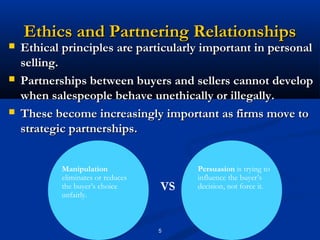
Ethics and Partnering Relationships
   Ethical principles are particularly important in personal
    selling.
   Partnerships between buyers and sellers cannot develop
    when salespeople behave unethically or illegally.
   These become increasingly important as firms move to
    strategic partnerships.


            Manipulation                 Persuasion is trying to
            eliminates or reduces        influence the buyer’s
            the buyer’s choice      VS   decision, not force it.
            unfairly.


                                    5
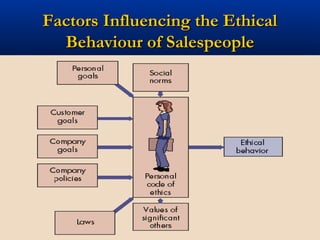
Factors Influencing the Ethical
  Behaviour of Salespeople


               6
Factors Affecting Ethical Behavior of
             Salespeople
   Factors influencing the ethical behavior of
    salespeople
       Personal, company, and customer needs
       Company policies
       Values of significant others
       Laws
       A personal code of ethics


                                                  7.7
Personal, Company, and Customer
                 Needs
   Often salespeople get into situations where there is
    a conflict between their and the customers’
    interest. The best way out is to rely on their ethical
    standards and understanding of the laws governing
    these situations


                             8
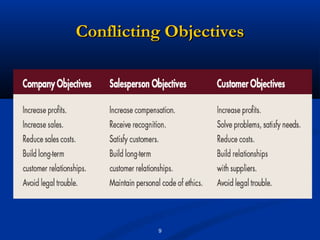
Conflicting Objectives


          9
Company Policies

   Company policies help salespeople and customer
    understand the does and don'ts and avoid
    difficult/indecisive situations.


                             10
Values of Significant Others
   People acquire their values and attitudes about what is
    right and wrong from the people they interact with and
    observe. e.g. relatives and friends, other salespeople, and
    their sales managers.
   Sales managers establish the ethical climate in their
    organization through the salespeople they hire, the
    ethical training they provide for their salespeople, and
    the degree to which they enforce ethical standards
                               11
Laws

   Laws dictate which activities society has deemed
    to be clearly wrong, the activities for which
    salespeople and their companies will be punished


                             12
A Personal Code of Ethics

   Each salesperson has a sense of right and wrong -
    a standard of conduct - from family and friends.
    Although salespeople should abide by their own
    codes of ethics, they may be tempted to avoid
    difficult ethical choices by developing “logical’’
    reasons for unethical conduct.


                             13
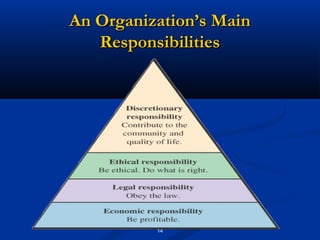
An Organization’s Main
   Responsibilities


          14
Guidelines for Ethical Behavior
   Universal Nature                Truth Telling
                                    Trust facilitates
                                    cooperation

   The golden rule                 Responsibility for One's
                                     Actions


   Everyone plays by the
                                    Don't blame others for
                                     your problems
    same rules
                                    The "victim" mentality


                            15
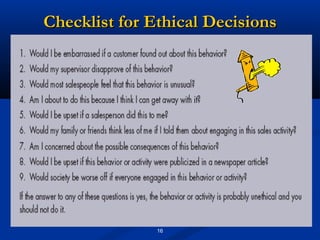
Checklist for Ethical Decisions


               16
Choices You Can Make if Your
    Manager Asks You to Act Unethically
   When a salesperson views polices or requests of the firm
    as improper, he/she has three choices:
       Ignore personal values and do what company asks to do. Self-
        respect suffers when one has to compromise principles to
        please an employer. This will probably make the salesperson
        feel guilty and dissatisfied with the job in the long run.
       Take a stand and tell the employer what he/she thinks. Try to
        influence the decisions and policies of the company and
        supervisors.
       Refuse to compromise his/her principles. Taking this path may
        mean that the salesperson will get fired or be forced to quit.
   One should not take a job with a company whose
    products, policies, and conduct conflict with your
    standards.                 17
Selling Ethics and Relationships

   The salespeople may confront some ethical
    situations in their relationships with
       Customers
       Competitors
       Other colleagues (other salespeople)


                                18
Relationships with Customers

   Deception
   Bribes, Gifts and Entertainment
   Special Treatment
   Confidential Information
   Backdoor Selling


                           19
Deception

    Deliberately presenting inaccurate information,
    or lying, to a customer is illegal.
    However, misleading customers by telling half-
    truths or withholding important information is a
    matter of ethics.


                              20
Bribes, Gifts and Entertainment
     Bribes : payments to buyers to influence decisions
     kickbacks : payments made to buyers based on the
    amount of orders. Both of these have negative
    consequences for the purchasing agent’s firm.
   On the other hand determining which gifts and
    entertainment activities are acceptable and which are
    not brings up ethical issues.


                              21
Special Treatment

    Some customers take advantage of their status to
    get special treatment from salespeople, which may
    upset other customers who do not get the special
    attention. This special service can reduce the
    salesperson’s productivity. Therefore, salespeople
    should be diplomatic but careful about
    undertaking requests to provide unusual services


                           22
Confidential Information
    Offering information about a customer’s
    competitor in exchange for an order is unethical.
    Long-term relationships can develop only when
    customers trust salespeople to maintain
    confidentiality. Disclosing confidential information
    gives a bad reputation (untrustworthy) to the
    salesperson.

                             23
Backdoor Selling

    Sales to ultimate consumers bypassing the
    middlepersons or A salesperson's practice of
    avoiding a purchasing agent. Some companies do
    not allow, therefore, Backdoor selling can be very
    risky and unethical.


                            24
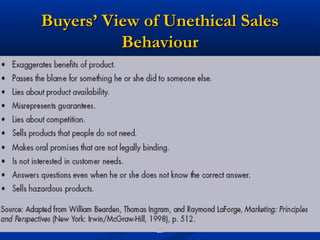
Buyers’ View of Unethical Sales
          Behaviour


               25
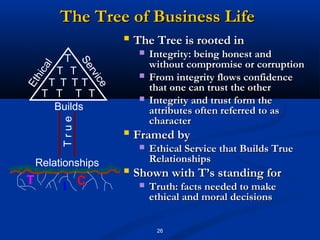
The Tree of Business Life
                             The Tree is rooted in
         T
                                  Integrity: being honest and
                                   without compromise or corruption
                   Se
       al

       T T
   hic


                      r
                                   From integrity flows confidence
                     vic
                               
      T T TT
Et


                                   that one can trust the other
     T T T T            e         Integrity and trust form the
       Builds                      attributes often referred to as
                                   character
            True


                             Framed by
                                  Ethical Service that Builds True
    Relationships                  Relationships
                             Shown with T’s standing for
T           I C                   Truth: facts needed to make
                                   ethical and moral decisions


                                    26
Relationships with the Salesperson's
                Company
Sales people in the field cannot be monitored. Companies

trust the salespersons and the professional salespersons do
not abuse this trust. Still there could be problems between
the salesperson and the company:
      Expense Accounts
      Reporting Work-time Information & Activities
      Switching Jobs


                                 27
Expense Accounts
  Many companies provide their salespeople with
cars and reimburse them for travel and entertainment
expenses. It is good to have policies to be able to
treat all the salespersons equally.
To do their jobs well, salespeople need to incur
expenses. However, using their expense accounts to
offset what they consider to be inadequate
compensation is unethical.


                         28
Reporting Work-time
     Information & Activities
     Salespersons are expected to work full time.
    Some salaried salespersons steal time and waste
    time on coffee breaks, long lunches, or
    unauthorized days off. While some salespeople
    paid by commission cheat by not working full
    time. This result in decrease of their income and
    profit of the company.
   To monitor work activities, many companies ask
    their salespeople to provide daily call reports.
                            29
Switching Jobs

    As for every professional, when a salesperson
    decides to change the job, has some ethical
    responsibilities like:
       Give ample notice.
       Offer assistance during the transition phase.
       Don’t burn the bridges.


                                 30
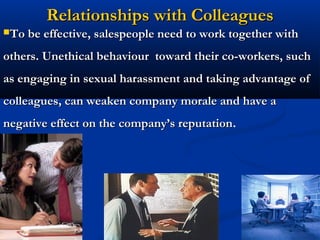
Relationships with Colleagues
To be effective, salespeople need to work together with

others. Unethical behaviour toward their co-workers, such
as engaging in sexual harassment and taking advantage of
colleagues, can weaken company morale and have a
negative effect on the company’s reputation.
                                 reputation


                             31
Relationships with Competitors
Making false claims about competitors’ products or

sabotaging their efforts is unethical and often illegal. This
can even backfire can harm reputation of the salespeople
and their companies both. Another questionable tactic is
criticizing a competitor’s products or policies.


                              32
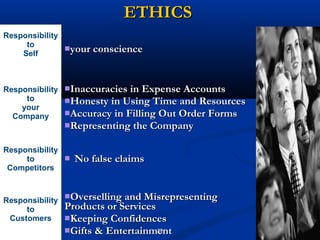
ETHICS
Responsibility
     to
               your conscience
    Self


Responsibility Inaccuracies in Expense Accounts
     to        Honesty in Using Time and Resources
    your
  Company      Accuracy in Filling Out Order Forms
              Representing the Company


Responsibility
     to           No false claims
 Competitors


Responsibility
               Overselling and Misrepresenting
     to        Products or Services
 Customers     Keeping Confidences
              Gifts & Entertainment
                                 33
Legal Issues
Salespeople violating the activities determined by the

society as unethical and are often countered by a legal
system. This does not only causes problems to themselves
but to their companies as well.


                             34
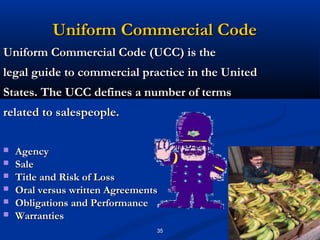
Uniform Commercial Code
Uniform Commercial Code (UCC) is the
legal guide to commercial practice in the United
States. The UCC defines a number of terms
related to salespeople.

   Agency
   Sale
   Title and Risk of Loss
   Oral versus written Agreements
   Obligations and Performance
   Warranties
                                 35
Agency
   Salesperson who is a representative of the
    company, therefore, his/her statements and
    actions represent the company. These legally bind
    the company and have significant financial impact.


                                                    7.36
Sale
   The transfer of title to goods by the seller to the
    buyer for a consideration known as price.


                                                          7.37
Title and Risk of Loss
   Understanding the terms of the sale and who has
    title can be useful in resolving complaints about
    damaged merchandise.


                                                        7.38
Oral Versus Written Agreement
   In most cases oral and written agreements between
    a salesperson & a customer are equally binding.
    Normally, written agreements are required for big
    transactions. One must be careful when signing
    written agreements.


                                                   7.39
Obligations and Performance
   Once the agreement is concluded, both firms must
    perform according to those terms in “good faith.’’
    Even if salespeople overstate the performance of
    their products, their firms have to provide the
    stated performance and meet the terms of the
    contract.


                                                    7.40
Warranties

   Is an assurance by the seller that the products will
    perform as represented. Sometimes a warranty is called a
    guarantee.


                              41
Misrepresentation or Sales Puffery
   Misrepresentation
       “Mechanically, this oil rig is a 9 on a scale of 10.”
       “Feel free to prescribe this drug to your patients, doctor. It’s
        nonaddicting.”
   At times salespersons exaggerate performance of
    products. Glowing descriptions are considered as
    Opinions or Sales Puffery.
     “This is a top-notch product.”
       “This product will last a lifetime.”
   Factual statements become particularly strong indicators
    of an expressed warranty when complex products are
    sold to unsophisticated buyers
                                      42
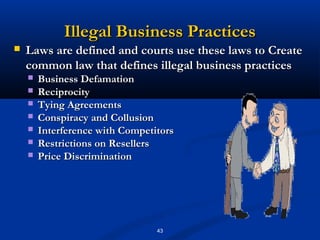
Illegal Business Practices
   Laws are defined and courts use these laws to Create
    common law that defines illegal business practices
       Business Defamation
       Reciprocity
       Tying Agreements
       Conspiracy and Collusion
       Interference with Competitors
       Restrictions on Resellers
       Price Discrimination


                                 43
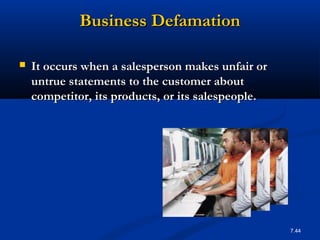
Business Defamation

   It occurs when a salesperson makes unfair or
    untrue statements to the customer about
    competitor, its products, or its salespeople.


                                                    7.44
Reciprocity

   It is a special relationship in which two companies
    agree to buy products from each other. These
    agreements are illegal if one company forces the
    other one to join the agreement.


                                                     7.45
Tying Agreements

   If a buyer is required to purchase a product in
    order to get another one. Such agreements are legal
    only if it could be proved that both the items
    should be used together


                                                    7.46
Conspiracy and Collusion

   An agreement between competitors before
    customers are contacted is a conspiracy; while
    collusion refers to competitors working together
    while the customer is making a purchase decision


                                                   7.47
Interference with Competitors

   Salespeople may illegally interfere with
    competitors by
       Trying to get a customer to break a contract with a
        competitor.
       Tampering with a competitor’s product.
       Confusing a competitor’s market research by buying
        merchandise from stores.


                                                              7.48
Restrictions on Resellers

   Numerous laws govern the relationship between
    manufacturers & resellers/wholesalers and
    retailers. These laws change with time.


                                                    7.49
Price Discrimination

   A seller price discriminates when it charges
    different prices to different buyers.


                                                   7.50
Legal Guidelines
   To reduce the chances of violating laws governing sales
    practices, you should adopt the following guidelines
       Be sure that all specific statements about your product’s
        performance, such as technical characteristics and useful life,
        are accurate.
       Be sure that all specific positive statements about performance
        can be supported by evidence. If you make strong positive
        statements that cannot be supported, use very general wording,
        such as high quality and great value.
        If your customers do not pay attention to warnings and
        operating instructions, remind them to read this information.
        Never suggest that this information can be ignored.
       If customers contemplate using your product incorrectly or in
        an inappropriate application, caution them specifically about
        how the product should be used.51
Legal Guidelines (Contd.)
   Assess your customer’s experience and knowledge. Your legal
    obligations are greatest with unsophisticated customers.
   Don’t make negative statements about a competitor’s
    product, financial condition, or business practices. Never
    pass along rumours about competitors.


                               52
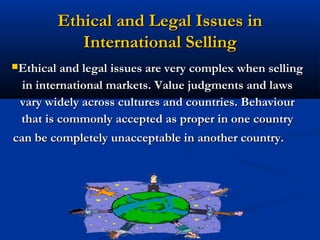
Ethical and Legal Issues in
           International Selling
Ethical and legal issues are very complex when selling

  in international markets. Value judgments and laws
 vary widely across cultures and countries. Behaviour
 that is commonly accepted as proper in one country
can be completely unacceptable in another country.


                           53
International Ethical and Legal Issues
Lubrication…small sums of money or gifts, typically made

to low-ranking managers or government officials in order to
get things to happen more quickly.
Subordination…large payments to higher-ranking officials

to get them to do something illegal or ignore an legal act.
Resolving cultural differences

      Cultural relativism…no culture’s ethics are superior
      Ethical imperialism…home country’s ethics should be applied
       to one’s behavior across the world.
It is important that the salespersons are aware of the host

as well as their own country when working internationally.
                                                              7.54
LEGAL ISSUES FACING THE
            SALESPERSON
                Quality below standard specified
                Violation of delivery date
                Pricing concessions
                Incomplete or incorrect instructions
  Some          Price fixing
  Legal
  Traps         Delivering a different brand than that sold
                Misrepresentation of product usage
                Kickbacks to buyer
                Charges after the sale
                Misuse of proprietary data
                Signing agreements without the proper authorization


Categories      Antimonopoly
    of
  Laws          Deceptive actions
                                                                       55
                Preserve competition
How to keep out of Legal Trouble
"Puffery" vs. statements of fact.

Educate the customer thoroughly before making the sale

Know technical specs, etc. for the product you sell.

Know your company's literature. Challenge it if is false

Know the terms of sale policies. You can bind the

company
Know federal and state laws regarding your product and

its warranties
Don't guess at your product's capabilities


                              56
Summary
Legal and ethical responsibilities of salespeople are

important because salespeople may face conflicts between
their personal standards and the standards of their firms
and customers.
Salespeople’s ethical standards determine how they will

conduct relationships with their customers, employers, and
competitors.
Many companies have ethical standards that describe the

behavior expected of their salespeople.
Good ethics are good business.
End of Chapter 3
Thank you

Personal Selling: Chapter 3

  • 1.
    Ethical and LegalIssues in Selling Chapter 3
  • 2.
    Important Questions Answered  Why do salespeople need to develop their own codes of ethics?  Which ethical responsibilities do salespeople have toward themselves, their firms, and their customers?  Do ethics get in the way of being a successful salesperson?  Which guidelines should salespeople consider when confronting situations involving an ethical issue?  Which laws apply to personal selling? 2
  • 3.
    “Without my clientshaving the confidence and knowledge of my moral and ethical standards, I doubt that I would have been able to create a solid client base.” ~Eric Pollack
  • 4.
    Ethics and PersonalSelling  Ethics are the principles governing the behaviour of an individual or a group.  These principles establish appropriate behaviour indicating what is right and wrong.  Difficult to determine what the principles are?  Ethics/Ethical values vary from person to person, culture to culture, country to country and from industry to industry. 4
  • 5.
    Ethics and PartneringRelationships  Ethical principles are particularly important in personal selling.  Partnerships between buyers and sellers cannot develop when salespeople behave unethically or illegally.  These become increasingly important as firms move to strategic partnerships. Manipulation Persuasion is trying to eliminates or reduces influence the buyer’s the buyer’s choice VS decision, not force it. unfairly. 5
  • 6.
    Factors Influencing theEthical Behaviour of Salespeople 6
  • 7.
    Factors Affecting EthicalBehavior of Salespeople  Factors influencing the ethical behavior of salespeople  Personal, company, and customer needs  Company policies  Values of significant others  Laws  A personal code of ethics 7.7
  • 8.
    Personal, Company, andCustomer Needs  Often salespeople get into situations where there is a conflict between their and the customers’ interest. The best way out is to rely on their ethical standards and understanding of the laws governing these situations 8
  • 9.
  • 10.
    Company Policies  Company policies help salespeople and customer understand the does and don'ts and avoid difficult/indecisive situations. 10
  • 11.
    Values of SignificantOthers  People acquire their values and attitudes about what is right and wrong from the people they interact with and observe. e.g. relatives and friends, other salespeople, and their sales managers.  Sales managers establish the ethical climate in their organization through the salespeople they hire, the ethical training they provide for their salespeople, and the degree to which they enforce ethical standards 11
  • 12.
    Laws  Laws dictate which activities society has deemed to be clearly wrong, the activities for which salespeople and their companies will be punished 12
  • 13.
    A Personal Codeof Ethics  Each salesperson has a sense of right and wrong - a standard of conduct - from family and friends. Although salespeople should abide by their own codes of ethics, they may be tempted to avoid difficult ethical choices by developing “logical’’ reasons for unethical conduct. 13
  • 14.
    An Organization’s Main Responsibilities 14
  • 15.
    Guidelines for EthicalBehavior  Universal Nature  Truth Telling  Trust facilitates  cooperation  The golden rule  Responsibility for One's Actions  Everyone plays by the  Don't blame others for your problems same rules  The "victim" mentality 15
  • 16.
  • 17.
    Choices You CanMake if Your Manager Asks You to Act Unethically  When a salesperson views polices or requests of the firm as improper, he/she has three choices:  Ignore personal values and do what company asks to do. Self- respect suffers when one has to compromise principles to please an employer. This will probably make the salesperson feel guilty and dissatisfied with the job in the long run.  Take a stand and tell the employer what he/she thinks. Try to influence the decisions and policies of the company and supervisors.  Refuse to compromise his/her principles. Taking this path may mean that the salesperson will get fired or be forced to quit.  One should not take a job with a company whose products, policies, and conduct conflict with your standards. 17
  • 18.
    Selling Ethics andRelationships  The salespeople may confront some ethical situations in their relationships with  Customers  Competitors  Other colleagues (other salespeople) 18
  • 19.
    Relationships with Customers  Deception  Bribes, Gifts and Entertainment  Special Treatment  Confidential Information  Backdoor Selling 19
  • 20.
    Deception  Deliberately presenting inaccurate information, or lying, to a customer is illegal. However, misleading customers by telling half- truths or withholding important information is a matter of ethics. 20
  • 21.
    Bribes, Gifts andEntertainment  Bribes : payments to buyers to influence decisions  kickbacks : payments made to buyers based on the amount of orders. Both of these have negative consequences for the purchasing agent’s firm.  On the other hand determining which gifts and entertainment activities are acceptable and which are not brings up ethical issues. 21
  • 22.
    Special Treatment  Some customers take advantage of their status to get special treatment from salespeople, which may upset other customers who do not get the special attention. This special service can reduce the salesperson’s productivity. Therefore, salespeople should be diplomatic but careful about undertaking requests to provide unusual services 22
  • 23.
    Confidential Information  Offering information about a customer’s competitor in exchange for an order is unethical. Long-term relationships can develop only when customers trust salespeople to maintain confidentiality. Disclosing confidential information gives a bad reputation (untrustworthy) to the salesperson. 23
  • 24.
    Backdoor Selling  Sales to ultimate consumers bypassing the middlepersons or A salesperson's practice of avoiding a purchasing agent. Some companies do not allow, therefore, Backdoor selling can be very risky and unethical. 24
  • 25.
    Buyers’ View ofUnethical Sales Behaviour 25
  • 26.
    The Tree ofBusiness Life  The Tree is rooted in T  Integrity: being honest and without compromise or corruption Se al T T hic r From integrity flows confidence vic  T T TT Et that one can trust the other T T T T e  Integrity and trust form the Builds attributes often referred to as character True  Framed by  Ethical Service that Builds True Relationships Relationships  Shown with T’s standing for T I C  Truth: facts needed to make ethical and moral decisions 26
  • 27.
    Relationships with theSalesperson's Company Sales people in the field cannot be monitored. Companies trust the salespersons and the professional salespersons do not abuse this trust. Still there could be problems between the salesperson and the company:  Expense Accounts  Reporting Work-time Information & Activities  Switching Jobs 27
  • 28.
    Expense Accounts  Many companies provide their salespeople with cars and reimburse them for travel and entertainment expenses. It is good to have policies to be able to treat all the salespersons equally. To do their jobs well, salespeople need to incur expenses. However, using their expense accounts to offset what they consider to be inadequate compensation is unethical. 28
  • 29.
    Reporting Work-time Information & Activities  Salespersons are expected to work full time. Some salaried salespersons steal time and waste time on coffee breaks, long lunches, or unauthorized days off. While some salespeople paid by commission cheat by not working full time. This result in decrease of their income and profit of the company.  To monitor work activities, many companies ask their salespeople to provide daily call reports. 29
  • 30.
    Switching Jobs  As for every professional, when a salesperson decides to change the job, has some ethical responsibilities like:  Give ample notice.  Offer assistance during the transition phase.  Don’t burn the bridges. 30
  • 31.
    Relationships with Colleagues Tobe effective, salespeople need to work together with others. Unethical behaviour toward their co-workers, such as engaging in sexual harassment and taking advantage of colleagues, can weaken company morale and have a negative effect on the company’s reputation. reputation 31
  • 32.
    Relationships with Competitors Makingfalse claims about competitors’ products or sabotaging their efforts is unethical and often illegal. This can even backfire can harm reputation of the salespeople and their companies both. Another questionable tactic is criticizing a competitor’s products or policies. 32
  • 33.
    ETHICS Responsibility to your conscience Self Responsibility Inaccuracies in Expense Accounts to Honesty in Using Time and Resources your Company Accuracy in Filling Out Order Forms Representing the Company Responsibility to  No false claims Competitors Responsibility  Overselling and Misrepresenting to Products or Services Customers Keeping Confidences Gifts & Entertainment 33
  • 34.
    Legal Issues Salespeople violatingthe activities determined by the society as unethical and are often countered by a legal system. This does not only causes problems to themselves but to their companies as well. 34
  • 35.
    Uniform Commercial Code UniformCommercial Code (UCC) is the legal guide to commercial practice in the United States. The UCC defines a number of terms related to salespeople.  Agency  Sale  Title and Risk of Loss  Oral versus written Agreements  Obligations and Performance  Warranties 35
  • 36.
    Agency  Salesperson who is a representative of the company, therefore, his/her statements and actions represent the company. These legally bind the company and have significant financial impact. 7.36
  • 37.
    Sale  The transfer of title to goods by the seller to the buyer for a consideration known as price. 7.37
  • 38.
    Title and Riskof Loss  Understanding the terms of the sale and who has title can be useful in resolving complaints about damaged merchandise. 7.38
  • 39.
    Oral Versus WrittenAgreement  In most cases oral and written agreements between a salesperson & a customer are equally binding. Normally, written agreements are required for big transactions. One must be careful when signing written agreements. 7.39
  • 40.
    Obligations and Performance  Once the agreement is concluded, both firms must perform according to those terms in “good faith.’’ Even if salespeople overstate the performance of their products, their firms have to provide the stated performance and meet the terms of the contract. 7.40
  • 41.
    Warranties  Is an assurance by the seller that the products will perform as represented. Sometimes a warranty is called a guarantee. 41
  • 42.
    Misrepresentation or SalesPuffery  Misrepresentation  “Mechanically, this oil rig is a 9 on a scale of 10.”  “Feel free to prescribe this drug to your patients, doctor. It’s nonaddicting.”  At times salespersons exaggerate performance of products. Glowing descriptions are considered as Opinions or Sales Puffery.  “This is a top-notch product.”  “This product will last a lifetime.”  Factual statements become particularly strong indicators of an expressed warranty when complex products are sold to unsophisticated buyers 42
  • 43.
    Illegal Business Practices  Laws are defined and courts use these laws to Create common law that defines illegal business practices  Business Defamation  Reciprocity  Tying Agreements  Conspiracy and Collusion  Interference with Competitors  Restrictions on Resellers  Price Discrimination 43
  • 44.
    Business Defamation  It occurs when a salesperson makes unfair or untrue statements to the customer about competitor, its products, or its salespeople. 7.44
  • 45.
    Reciprocity  It is a special relationship in which two companies agree to buy products from each other. These agreements are illegal if one company forces the other one to join the agreement. 7.45
  • 46.
    Tying Agreements  If a buyer is required to purchase a product in order to get another one. Such agreements are legal only if it could be proved that both the items should be used together 7.46
  • 47.
    Conspiracy and Collusion  An agreement between competitors before customers are contacted is a conspiracy; while collusion refers to competitors working together while the customer is making a purchase decision 7.47
  • 48.
    Interference with Competitors  Salespeople may illegally interfere with competitors by  Trying to get a customer to break a contract with a competitor.  Tampering with a competitor’s product.  Confusing a competitor’s market research by buying merchandise from stores. 7.48
  • 49.
    Restrictions on Resellers  Numerous laws govern the relationship between manufacturers & resellers/wholesalers and retailers. These laws change with time. 7.49
  • 50.
    Price Discrimination  A seller price discriminates when it charges different prices to different buyers. 7.50
  • 51.
    Legal Guidelines  To reduce the chances of violating laws governing sales practices, you should adopt the following guidelines  Be sure that all specific statements about your product’s performance, such as technical characteristics and useful life, are accurate.  Be sure that all specific positive statements about performance can be supported by evidence. If you make strong positive statements that cannot be supported, use very general wording, such as high quality and great value.  If your customers do not pay attention to warnings and operating instructions, remind them to read this information. Never suggest that this information can be ignored.  If customers contemplate using your product incorrectly or in an inappropriate application, caution them specifically about how the product should be used.51
  • 52.
    Legal Guidelines (Contd.)  Assess your customer’s experience and knowledge. Your legal obligations are greatest with unsophisticated customers.  Don’t make negative statements about a competitor’s product, financial condition, or business practices. Never pass along rumours about competitors. 52
  • 53.
    Ethical and LegalIssues in International Selling Ethical and legal issues are very complex when selling in international markets. Value judgments and laws vary widely across cultures and countries. Behaviour that is commonly accepted as proper in one country can be completely unacceptable in another country. 53
  • 54.
    International Ethical andLegal Issues Lubrication…small sums of money or gifts, typically made to low-ranking managers or government officials in order to get things to happen more quickly. Subordination…large payments to higher-ranking officials to get them to do something illegal or ignore an legal act. Resolving cultural differences  Cultural relativism…no culture’s ethics are superior  Ethical imperialism…home country’s ethics should be applied to one’s behavior across the world. It is important that the salespersons are aware of the host as well as their own country when working internationally. 7.54
  • 55.
    LEGAL ISSUES FACINGTHE SALESPERSON  Quality below standard specified  Violation of delivery date  Pricing concessions  Incomplete or incorrect instructions Some  Price fixing Legal Traps  Delivering a different brand than that sold  Misrepresentation of product usage  Kickbacks to buyer  Charges after the sale  Misuse of proprietary data  Signing agreements without the proper authorization Categories  Antimonopoly of Laws  Deceptive actions 55  Preserve competition
  • 56.
    How to keepout of Legal Trouble "Puffery" vs. statements of fact. Educate the customer thoroughly before making the sale Know technical specs, etc. for the product you sell. Know your company's literature. Challenge it if is false Know the terms of sale policies. You can bind the company Know federal and state laws regarding your product and its warranties Don't guess at your product's capabilities 56
  • 57.
    Summary Legal and ethicalresponsibilities of salespeople are important because salespeople may face conflicts between their personal standards and the standards of their firms and customers. Salespeople’s ethical standards determine how they will conduct relationships with their customers, employers, and competitors. Many companies have ethical standards that describe the behavior expected of their salespeople. Good ethics are good business.
  • 58.
  • 59.

Editor's Notes