Overview of ADO.NET
Architecture of ADO.NET
.NET Data Providers
Data Providers Components
 ADO.NET is a large set of .NET classes that
enable us to retrieve and manipulate data, and
update data.
 As an integral part of the .NET framework, it
shares many of its features:
 sources, in very many different ways.
 features such as multi-language support,
garbage collection, just-in-time compilation,
object-oriented design,
 and dynamic caching, and is far more than an
upgrade of previous versions of ADO.
 The ADO.NET object model consists of two
fundamental components: the Dataset, which
is disconnected from the data source and
doesn't need to know where the data it holds
came from; and the .NET
 data provider. The .NET data providers allow
us to connect to the data source, and to
execute SQL.
 At the time of writing, there are three .NET
data providers available: for SQL Server, for
OLE DB data sources.
 for ODBC-compliant data sources. Each
provider exists in a namespace within the
System. Data namespace, and
 consists of a number of classes.
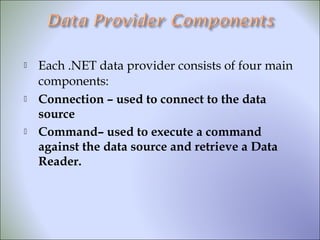
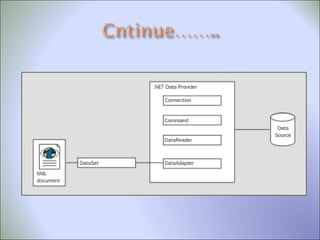
 Each .NET data provider consists of four main
components:
 Connection – used to connect to the data
source
 Command– used to execute a command
against the data source and retrieve a Data
Reader.
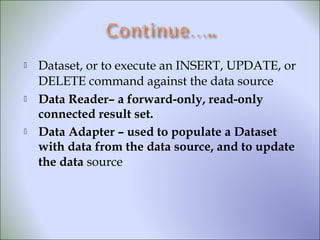
 Dataset, or to execute an INSERT, UPDATE, or
DELETE command against the data source
 Data Reader– a forward-only, read-only
connected result set.
 Data Adapter – used to populate a Dataset
with data from the data source, and to update
the data source
 The connection classes are very similar to the
ADO Connection object, and like that, they are
used to
 represent a connection to a specific data source.
The connection classes store the information
that ADO.NET
 needs to connect to a data source in the form of
a familiar connection string (just as in ADO).
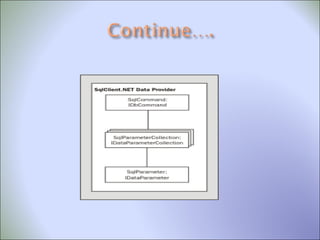
 The command classes expose the
IDbCommand interface and are similar to the
ADO Command object – they
 are used to execute SQL statements or stored
procedures in the data source. Also, like the
ADO Command
 object, the command classes have a Command
Text property, which contains the text of the
command to be
 executed against the data source, and a
Command Type property, which indicates
whether the command is a
 SQL statement, the name of a stored procedure,
or the name of a table.
 The DataReader is ADO.NET's answer to the
connected recordset in ADO. However, the
DataReader is
 forward-only and read-only – we can't navigate
through it at random, and we can't use it to
update the data source. It
 therefore allows extremely fast access to data
that we just want to iterate through once, and it
is recommended to use
 the Data Reader (rather than the DataSet)
wherever possible.
 The other major component of ADO.NET
is the DataSet; this corresponds very
roughly to the ADO
 recordset. It differs, however, in two
important respects. The first of these is
that the DataSet is always
 exactly the same way to manipulate data from
a traditional data source or from an XML
document. In order to
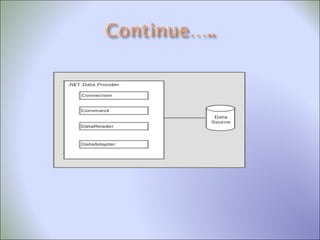
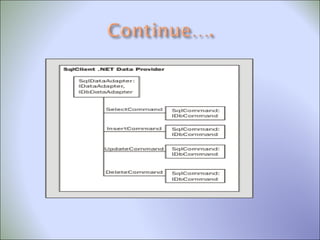
 connect a DataSet to a data source, we need to
use the DataAdapter as an intermediary
between the
 DataSet and the .NET data provider:
Session x(ado.net)
Session x(ado.net)

Session x(ado.net)

  • 1.
    Overview of ADO.NET Architectureof ADO.NET .NET Data Providers Data Providers Components
  • 2.
     ADO.NET isa large set of .NET classes that enable us to retrieve and manipulate data, and update data.  As an integral part of the .NET framework, it shares many of its features:  sources, in very many different ways.
  • 3.
     features suchas multi-language support, garbage collection, just-in-time compilation, object-oriented design,  and dynamic caching, and is far more than an upgrade of previous versions of ADO.
  • 4.
     The ADO.NETobject model consists of two fundamental components: the Dataset, which is disconnected from the data source and doesn't need to know where the data it holds came from; and the .NET  data provider. The .NET data providers allow us to connect to the data source, and to execute SQL.
  • 5.
     At thetime of writing, there are three .NET data providers available: for SQL Server, for OLE DB data sources.  for ODBC-compliant data sources. Each provider exists in a namespace within the System. Data namespace, and  consists of a number of classes.
  • 6.
     Each .NETdata provider consists of four main components:  Connection – used to connect to the data source  Command– used to execute a command against the data source and retrieve a Data Reader.
  • 7.
     Dataset, orto execute an INSERT, UPDATE, or DELETE command against the data source  Data Reader– a forward-only, read-only connected result set.  Data Adapter – used to populate a Dataset with data from the data source, and to update the data source
  • 9.
     The connectionclasses are very similar to the ADO Connection object, and like that, they are used to  represent a connection to a specific data source. The connection classes store the information that ADO.NET  needs to connect to a data source in the form of a familiar connection string (just as in ADO).
  • 10.
     The commandclasses expose the IDbCommand interface and are similar to the ADO Command object – they  are used to execute SQL statements or stored procedures in the data source. Also, like the ADO Command  object, the command classes have a Command Text property, which contains the text of the command to be
  • 11.
     executed againstthe data source, and a Command Type property, which indicates whether the command is a  SQL statement, the name of a stored procedure, or the name of a table.
  • 13.
     The DataReaderis ADO.NET's answer to the connected recordset in ADO. However, the DataReader is  forward-only and read-only – we can't navigate through it at random, and we can't use it to update the data source. It
  • 14.
     therefore allowsextremely fast access to data that we just want to iterate through once, and it is recommended to use  the Data Reader (rather than the DataSet) wherever possible.
  • 16.
     The othermajor component of ADO.NET is the DataSet; this corresponds very roughly to the ADO  recordset. It differs, however, in two important respects. The first of these is that the DataSet is always
  • 17.
     exactly thesame way to manipulate data from a traditional data source or from an XML document. In order to  connect a DataSet to a data source, we need to use the DataAdapter as an intermediary between the  DataSet and the .NET data provider: