Data Driven Decision Making
3DM
Russell Berkeley
DARBUS Ltd
Deltek Strategic Partner
Agenda
• Introduction
• Data Creation
• Data Collation
• Information Creation
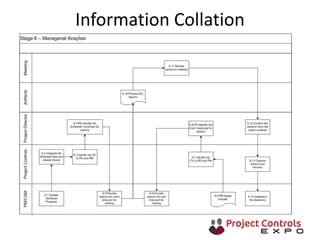
• Information Collation
• Do I need emotions to make decisions?
• Decision Making
• Effect emotions have on decisions
• Understanding board emotions
INTRODUCTION
Data – Information - Decisions
• I have read many articles about Data Driven
Decision making, and the collective opinion is
that you create data, analyse and then make
decisions based on the dataset.
• In most of these articles they concentrate on the
data into information, and very little is written
about the actual decision making process
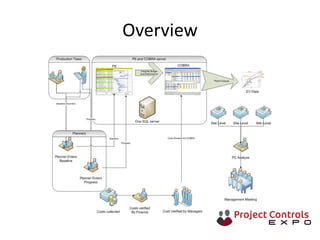
• This presentation will demonstrate the data into
information, but most importantly the decision
making
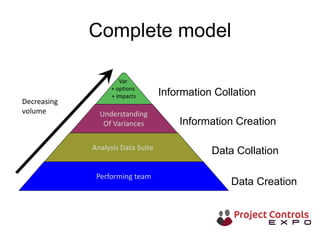
Complete model
Performing team
Analysis Data Suite
Understanding
Of Variances
Var
+ options
+ impacts
Data Creation
Data Collation
Information Creation
Information Collation
Decreasing
volume
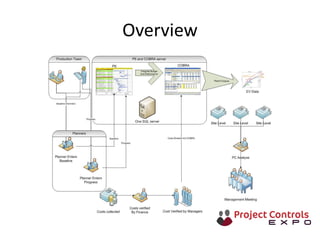
Overview
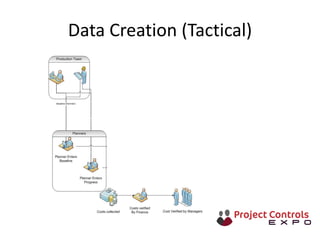
Data Creation (Tactical)
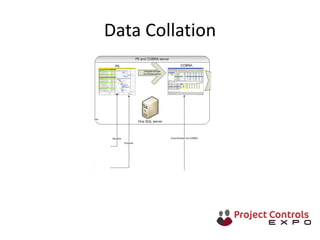
Data Collation
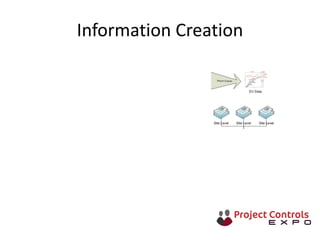
Information Creation
Information Collation
Decision Making
Overview
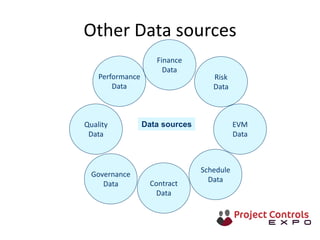
Finance
Data
EVM
Data
Quality
Data
Risk
Data
Governance
Data Contract
Data
Schedule
Data
Performance
Data
Data sources
Other Data sources
DATA CREATION
The only purpose of Data
• The only purpose of the data generation is to
aid in the decision making process and to
speed up how long it takes for a decision to
get made.
• How can we define and support this to
happen
• However the word ‘data’ has different
meaning to tactical and strategic teams
15
Data Creation(Tactical)
• Typically an engineer will create tactical data
to support his preferred decision.
• He will then present this data to justify his
option. In most cases this will be a complex
and detailed collection of engineering
information.
Management response (Strategic)
• In many cases the management will respond
by saying.
• “I need more ‘data’ to make a decision”
• What the Engineer will
provide
• The engineer will further develop
any data into lower fidelity as to
the engineer this is the ‘data’
needed to justify his option
• What the decision
maker wants
• The decision maker is actually
after strategic ‘data’. This is all
the options and impact analysis
for each option.
DATA COLLATION
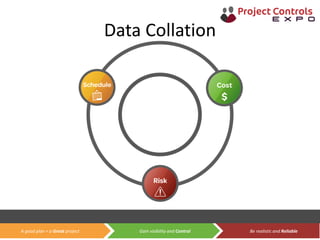
Gain visibility and Control Be realistic and ReliableA good plan = a Great project
Data Collation
INFORMATION CREATION
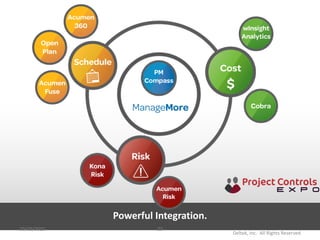
Information Creation
• Technology has evolved rapidly, and
companies like Deltek have recognised the
need for these to be integrated and have the
ability to filter to the issues that need
resolution.
--
Powerful Integration.
10/20/2015
Deltek, Inc. All Rights Reserved
23
INFORMATION COLLATION
Information Collation
Summary so far
• Data Driven Decision Making
• We have the data being collated quickly,
accurately and automatically.
• The data is integrated and filtered through the
use of effective toolset
DO I NEED EMOTIONS TO MAKE
DECISIONS
The role of emotions
• A few years ago, neuroscientist Antonio Damasio made a
groundbreaking discovery.
• He studied people with damage in the part of the brain
where emotions are generated.
• He found that they seemed normal, except that they were
not able to feel emotions. But they all had something
peculiar in common: they couldn’t make decisions.
• They could describe what they should be doing in logical
terms, yet they found it very difficult to make even simple
decisions, such as what to eat.
• With no rational way to decide, these test subjects were
unable to arrive at a decision.
Source: http://bigthink.com/experts-corner/decisions-are-emotional-not-logical-the-neuroscience-behind-
decision-making
DECISION MAKING
Why do women buy handbags?
Why do men buy cars?
Is business decision making the same
• YES!
• Although we might try and fool ourselves into
thinking that we can make decisions without
emotions, in reality we always take emotions
into consideration.
EFFECT EMOTIONS HAVE ON
DECISIONS
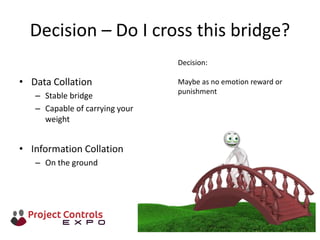
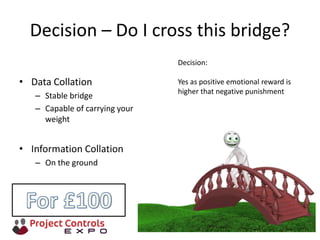
Decision – Do I cross this bridge?
• Data Collation
– Stable bridge
– Capable of carrying your
weight
• Information Collation
– On the ground
Decision:
Maybe as no emotion reward or
punishment
Decision – Do I cross this bridge?
• Data Collation
– Stable bridge
– Capable of carrying your
weight
• Information Collation
– On the ground
Decision:
Yes as positive emotional reward is
higher that negative punishment
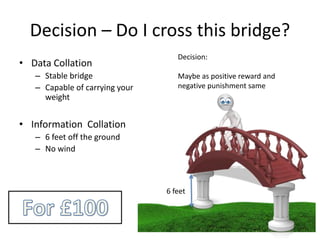
Decision – Do I cross this bridge?
6 feet
• Data Collation
– Stable bridge
– Capable of carrying your
weight
• Information Collation
– 6 feet off the ground
– No wind
Decision:
Maybe as positive reward and
negative punishment same
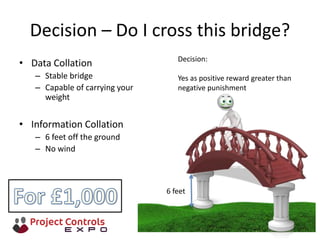
Decision – Do I cross this bridge?
6 feet
• Data Collation
– Stable bridge
– Capable of carrying your
weight
• Information Collation
– 6 feet off the ground
– No wind
Decision:
Yes as positive reward greater than
negative punishment
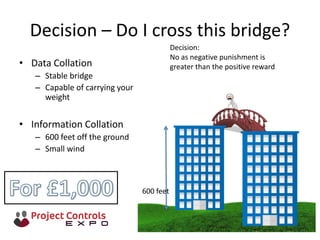
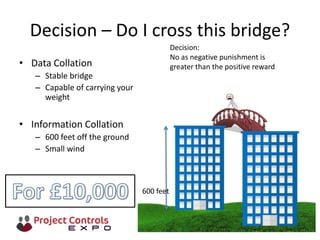
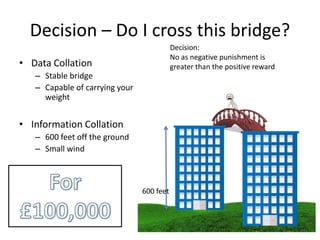
Decision – Do I cross this bridge?
600 feet
• Data Collation
– Stable bridge
– Capable of carrying your
weight
• Information Collation
– 600 feet off the ground
– Small wind
Decision:
No as negative punishment is
greater than the positive reward
Decision – Do I cross this bridge?
600 feet
• Data Collation
– Stable bridge
– Capable of carrying your
weight
• Information Collation
– 600 feet off the ground
– Small wind
Decision:
No as negative punishment is
greater than the positive reward
Decision – Do I cross this bridge?
600 feet
• Data Collation
– Stable bridge
– Capable of carrying your
weight
• Information Collation
– 600 feet off the ground
– Small wind
Decision:
No as negative punishment is
greater than the positive reward
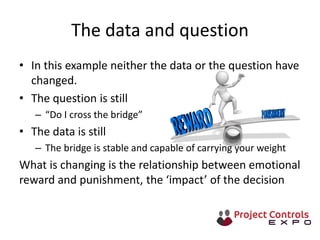
The data and question
• In this example neither the data or the question have
changed.
• The question is still
– “Do I cross the bridge”
• The data is still
– The bridge is stable and capable of carrying your weight
What is changing is the relationship between emotional
reward and punishment, the ‘impact’ of the decision
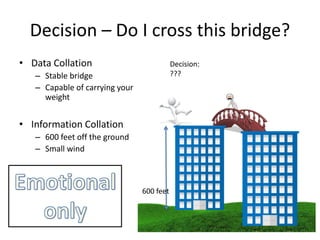
Decision – Do I cross this bridge?
600 feet
• Data Collation
– Stable bridge
– Capable of carrying your
weight
• Information Collation
– 600 feet off the ground
– Small wind
Decision:
???
SO WHAT!!!
Options (Data) and Impact (Emotions)
• In order for the management team to make
decisions, we need to ensure that they are
given information relating to the impact of
that decision.
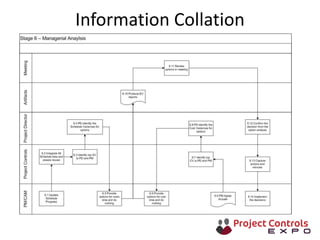
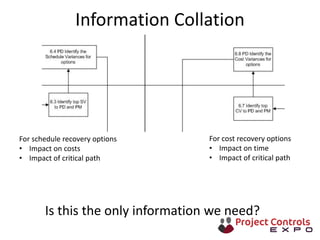
Information Collation
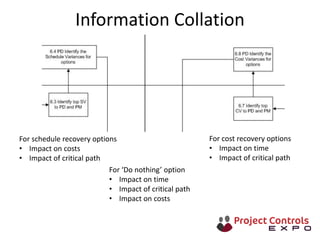
For schedule recovery options
• Impact on costs
• Impact of critical path
For cost recovery options
• Impact on time
• Impact of critical path
Is this the only information we need?
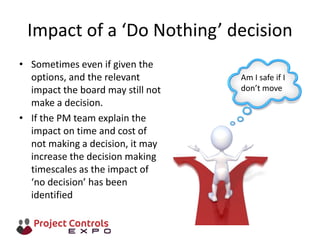
Impact of a ‘Do Nothing’ decision
• Sometimes even if given the
options, and the relevant
impact the board may still not
make a decision.
• If the PM team explain the
impact on time and cost of
not making a decision, it may
increase the decision making
timescales as the impact of
‘no decision’ has been
identified
Am I safe if I
don’t move
Information Collation
For schedule recovery options
• Impact on costs
• Impact of critical path
For cost recovery options
• Impact on time
• Impact of critical path
For ‘Do nothing’ option
• Impact on time
• Impact of critical path
• Impact on costs
UNDERSTANDING BOARD
EMOTIONS
The PMO’s understanding of the board
• If data is expected to enable the decision
making process, then it must be presented in
the form of information that addresses the
emotional influences to which the decision
makers are being subjected.
• Otherwise the result may be in-decision, or
decisions which are difficult to rationalise
later.
Board Emotions
Conclusion
• We need to acknowledge that the board have
emotions, and these will effect the decision
making process.
• We need to acknowledge that once provided with
the impact of not making a decision ‘Do nothing’
is actually a decision and should be documented
as such
• That the Data into Information identifies the
elements where decision may need to be made,
and the options and impacts provide what
decisions could be made.
ANY QUESTIONS
Russell Berkeley
Darbus Ltd

Session T5 - Data Driven Decision Making - 3DM

  • 1.
    Data Driven DecisionMaking 3DM Russell Berkeley DARBUS Ltd Deltek Strategic Partner
  • 2.
    Agenda • Introduction • DataCreation • Data Collation • Information Creation • Information Collation • Do I need emotions to make decisions? • Decision Making • Effect emotions have on decisions • Understanding board emotions
  • 3.
  • 4.
    Data – Information- Decisions • I have read many articles about Data Driven Decision making, and the collective opinion is that you create data, analyse and then make decisions based on the dataset. • In most of these articles they concentrate on the data into information, and very little is written about the actual decision making process • This presentation will demonstrate the data into information, but most importantly the decision making
  • 5.
    Complete model Performing team AnalysisData Suite Understanding Of Variances Var + options + impacts Data Creation Data Collation Information Creation Information Collation Decreasing volume
  • 6.
  • 7.
  • 8.
  • 9.
  • 10.
  • 11.
  • 12.
  • 13.
  • 14.
  • 15.
    The only purposeof Data • The only purpose of the data generation is to aid in the decision making process and to speed up how long it takes for a decision to get made. • How can we define and support this to happen • However the word ‘data’ has different meaning to tactical and strategic teams 15
  • 16.
    Data Creation(Tactical) • Typicallyan engineer will create tactical data to support his preferred decision. • He will then present this data to justify his option. In most cases this will be a complex and detailed collection of engineering information.
  • 17.
    Management response (Strategic) •In many cases the management will respond by saying. • “I need more ‘data’ to make a decision”
  • 18.
    • What theEngineer will provide • The engineer will further develop any data into lower fidelity as to the engineer this is the ‘data’ needed to justify his option • What the decision maker wants • The decision maker is actually after strategic ‘data’. This is all the options and impact analysis for each option.
  • 19.
  • 20.
    Gain visibility andControl Be realistic and ReliableA good plan = a Great project Data Collation
  • 21.
  • 22.
    Information Creation • Technologyhas evolved rapidly, and companies like Deltek have recognised the need for these to be integrated and have the ability to filter to the issues that need resolution.
  • 23.
  • 24.
  • 25.
  • 26.
    Summary so far •Data Driven Decision Making • We have the data being collated quickly, accurately and automatically. • The data is integrated and filtered through the use of effective toolset
  • 27.
    DO I NEEDEMOTIONS TO MAKE DECISIONS
  • 28.
    The role ofemotions • A few years ago, neuroscientist Antonio Damasio made a groundbreaking discovery. • He studied people with damage in the part of the brain where emotions are generated. • He found that they seemed normal, except that they were not able to feel emotions. But they all had something peculiar in common: they couldn’t make decisions. • They could describe what they should be doing in logical terms, yet they found it very difficult to make even simple decisions, such as what to eat. • With no rational way to decide, these test subjects were unable to arrive at a decision. Source: http://bigthink.com/experts-corner/decisions-are-emotional-not-logical-the-neuroscience-behind- decision-making
  • 29.
  • 30.
    Why do womenbuy handbags?
  • 31.
    Why do menbuy cars?
  • 32.
    Is business decisionmaking the same • YES! • Although we might try and fool ourselves into thinking that we can make decisions without emotions, in reality we always take emotions into consideration.
  • 33.
  • 34.
    Decision – DoI cross this bridge? • Data Collation – Stable bridge – Capable of carrying your weight • Information Collation – On the ground Decision: Maybe as no emotion reward or punishment
  • 35.
    Decision – DoI cross this bridge? • Data Collation – Stable bridge – Capable of carrying your weight • Information Collation – On the ground Decision: Yes as positive emotional reward is higher that negative punishment
  • 36.
    Decision – DoI cross this bridge? 6 feet • Data Collation – Stable bridge – Capable of carrying your weight • Information Collation – 6 feet off the ground – No wind Decision: Maybe as positive reward and negative punishment same
  • 37.
    Decision – DoI cross this bridge? 6 feet • Data Collation – Stable bridge – Capable of carrying your weight • Information Collation – 6 feet off the ground – No wind Decision: Yes as positive reward greater than negative punishment
  • 38.
    Decision – DoI cross this bridge? 600 feet • Data Collation – Stable bridge – Capable of carrying your weight • Information Collation – 600 feet off the ground – Small wind Decision: No as negative punishment is greater than the positive reward
  • 39.
    Decision – DoI cross this bridge? 600 feet • Data Collation – Stable bridge – Capable of carrying your weight • Information Collation – 600 feet off the ground – Small wind Decision: No as negative punishment is greater than the positive reward
  • 40.
    Decision – DoI cross this bridge? 600 feet • Data Collation – Stable bridge – Capable of carrying your weight • Information Collation – 600 feet off the ground – Small wind Decision: No as negative punishment is greater than the positive reward
  • 41.
    The data andquestion • In this example neither the data or the question have changed. • The question is still – “Do I cross the bridge” • The data is still – The bridge is stable and capable of carrying your weight What is changing is the relationship between emotional reward and punishment, the ‘impact’ of the decision
  • 42.
    Decision – DoI cross this bridge? 600 feet • Data Collation – Stable bridge – Capable of carrying your weight • Information Collation – 600 feet off the ground – Small wind Decision: ???
  • 43.
  • 44.
    Options (Data) andImpact (Emotions) • In order for the management team to make decisions, we need to ensure that they are given information relating to the impact of that decision.
  • 45.
  • 46.
    Information Collation For schedulerecovery options • Impact on costs • Impact of critical path For cost recovery options • Impact on time • Impact of critical path Is this the only information we need?
  • 47.
    Impact of a‘Do Nothing’ decision • Sometimes even if given the options, and the relevant impact the board may still not make a decision. • If the PM team explain the impact on time and cost of not making a decision, it may increase the decision making timescales as the impact of ‘no decision’ has been identified Am I safe if I don’t move
  • 48.
    Information Collation For schedulerecovery options • Impact on costs • Impact of critical path For cost recovery options • Impact on time • Impact of critical path For ‘Do nothing’ option • Impact on time • Impact of critical path • Impact on costs
  • 49.
  • 50.
    The PMO’s understandingof the board • If data is expected to enable the decision making process, then it must be presented in the form of information that addresses the emotional influences to which the decision makers are being subjected. • Otherwise the result may be in-decision, or decisions which are difficult to rationalise later.
  • 51.
  • 52.
    Conclusion • We needto acknowledge that the board have emotions, and these will effect the decision making process. • We need to acknowledge that once provided with the impact of not making a decision ‘Do nothing’ is actually a decision and should be documented as such • That the Data into Information identifies the elements where decision may need to be made, and the options and impacts provide what decisions could be made.
  • 53.