Creating a Data-Driven
Organization
Carl Anderson
9:15am, Grand 2
@leapingllamas | www.p-value.info
Why data-driven?
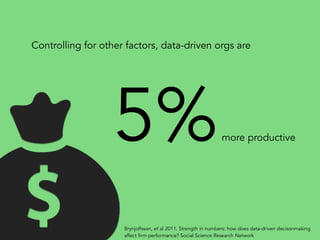
5%more productive
Controlling for other factors, data-driven orgs are
Brynjolfsson, et al 2011. Strength in numbers: how does data-driven decisonmaking
affect firm performance? Social Science Research Network
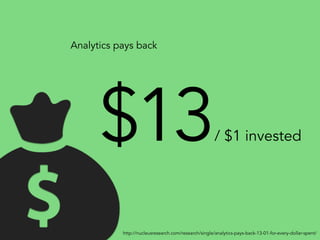
$13/ $1 invested
Analytics pays back
http://nucleusresearch.com/research/single/analytics-pays-back-13-01-for-every-dollar-spent/
What is data-driven?
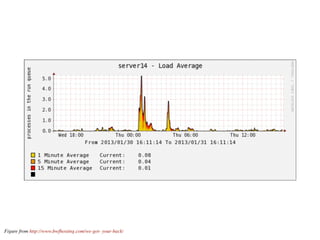
Having lots of reports does not make you data-driven.
Having lots of dashboards does not make you data-driven.
Having lots of alerts does not make you data-driven.
Figure from http://www.bwfhosting.com/we-got- your-back/
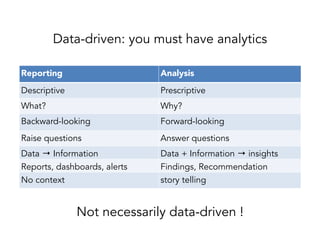
Data-driven: you must have analytics
Not necessarily data-driven !
Reporting Analysis
Descriptive Prescriptive
What? Why?
Backward-looking Forward-looking
Raise questions Answer questions
Data → Information Data + Information → insights
Reports, dashboards, alerts Findings, Recommendation
No context story telling
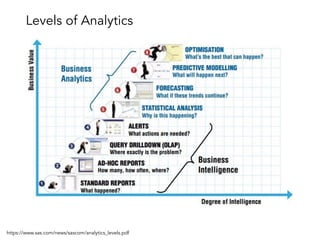
https://www.sas.com/news/sascom/analytics_levels.pdf
Levels of Analytics
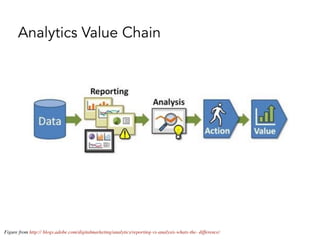
Analytics Value Chain
Figure from http:// blogs.adobe.com/digitalmarketing/analytics/reporting-vs-analysis-whats-the- difference/
“Analytics is about impact…In our company [Zynga],
if you have brilliant insight and you did great research
and no one changes, you get zero credit.”
Ken Rudin
Facebook
Train analysts to be business savvy
2013 Strata+Hadoop talk: https://www.youtube.com/watch?v=RJFwsZwTBgg
Having a hadoop cluster does not make you data-driven.
Leverage data as a strategic asset.
Data-driven requires a data culture
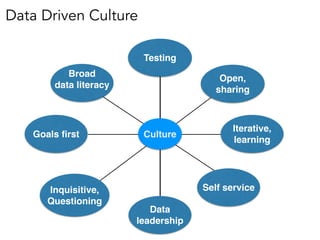
Culture
Testing
Iterative,
learning
Open,
sharing
Self service
Data
leadership
Broad
data literacy
Inquisitive,
Questioning
Goals first
Data Driven Culture
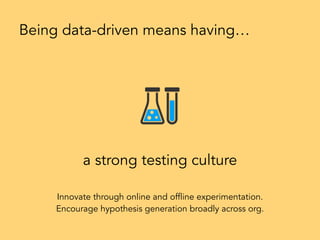
a strong testing culture
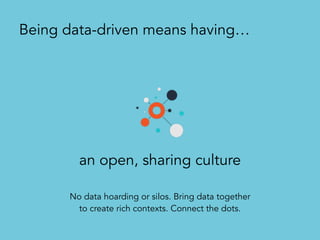
Being data-driven means having…
Innovate through online and offline experimentation.
Encourage hypothesis generation broadly across org.
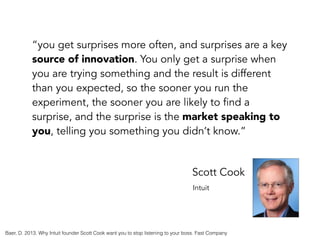
“you get surprises more often, and surprises are a key
source of innovation. You only get a surprise when
you are trying something and the result is different
than you expected, so the sooner you run the
experiment, the sooner you are likely to find a
surprise, and the surprise is the market speaking to
you, telling you something you didn’t know.”
Scott Cook
Intuit
Baer, D. 2013. Why Intuit founder Scott Cook want you to stop listening to your boss. Fast Company
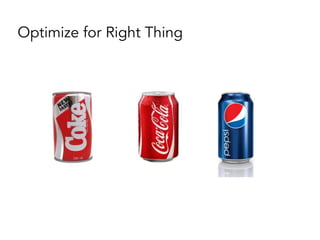
Optimize for Right Thing
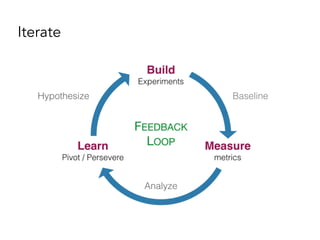
Iterate
an open, sharing culture
Being data-driven means having…
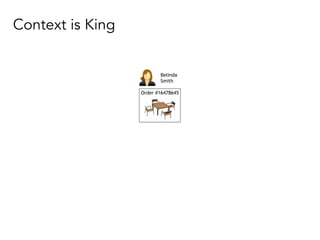
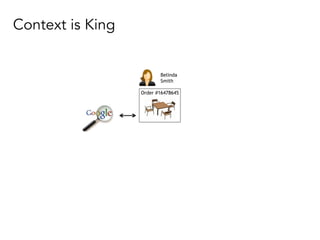
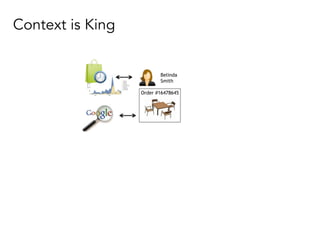
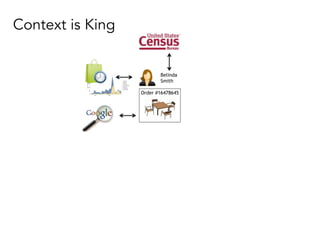
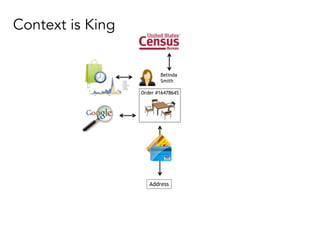
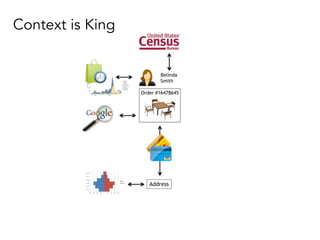
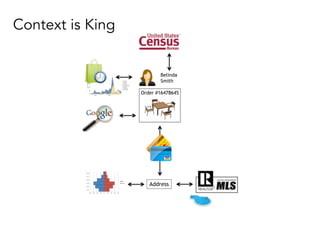
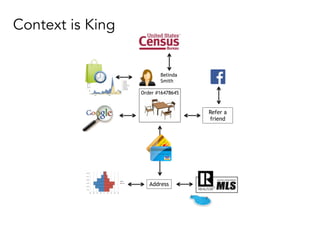
No data hoarding or silos. Bring data together
to create rich contexts. Connect the dots.
Order #16478645
Belinda
Smith
Context is King
Order #16478645
Belinda
Smith
Context is King
Order #16478645
Belinda
Smith
Context is King
Order #16478645
Belinda
Smith
Context is King
Order #16478645
Address
Belinda
Smith
Context is King
Order #16478645
Address
Belinda
Smith
Context is King
Order #16478645
Address
Belinda
Smith
Context is King
Order #16478645
Address
Refer a
friend
Belinda
Smith
Context is King
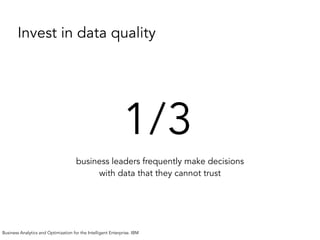
1/3
business leaders frequently make decisions
with data that they cannot trust
Business Analytics and Optimization for the Intelligent Enterprise. IBM
Invest in data quality
a self service culture
Being data-driven means having…
Business units have necessary data access as well as within-
team analytical skills to drive insights, actions, and impact.
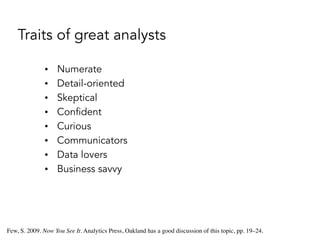
Traits of great analysts
• Numerate
• Detail-oriented
• Skeptical
• Confident
• Curious
• Communicators
• Data lovers
• Business savvy
Few, S. 2009. Now You See It. Analytics Press, Oakland has a good discussion of this topic, pp. 19–24.
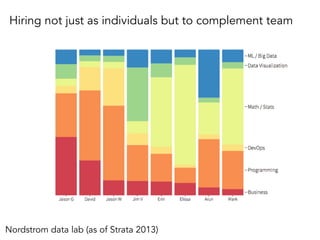
Hiring not just as individuals but to complement team
Nordstrom data lab (as of Strata 2013)
a broad data literacy
Being data-driven means having…
All decision-makers have appropriate skills to use and interpret data.
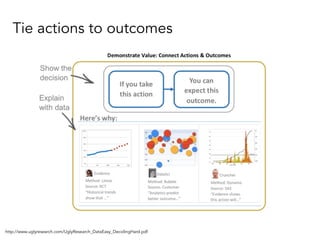
Analysts must sell, sell, sell their product
http://www.uglyresearch.com/UglyResearch_DataEasy_DecidingHard.pdf
Tie actions to outcomes
a goals first approach.
Being data-driven means having…
Set out metrics before experiment. What does success mean?
Have an analysis plan. Prevent gaming the system.
an objective, inquisitive culture
Being data-driven means having…
‘“Do you have data to back that up?” should be a question that no one is
afraid to ask and everyone is prepared to answer’—Julie Arsenault.
a visible, clearly-articulated strategy
Being data-driven means having…
Commonly understood vision. Suite of well-designed, accessible
KPIs. All staff understand how their work ties back to these metrics.
strong data leadership
Being data-driven means having…
A head of data to evangelize data as strategic asset with
budget, team, and influence to drive cultural change.
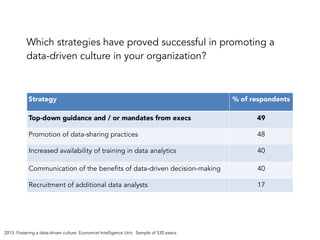
Which strategies have proved successful in promoting a
data-driven culture in your organization?
Strategy % of respondents
Top-down guidance and / or mandates from execs 49
Promotion of data-sharing practices 48
Increased availability of training in data analytics 40
Communication of the benefits of data-driven decision-making 40
Recruitment of additional data analysts 17
2013. Fostering a data-driven culture. Economist Intelligence Unit. Sample of 530 execs.
but bottom up too
Change should not just be top-down
Everyone in org has role and responsibility through “leveling up” their
data skills, mutual mentoring, and embedding data into their processes.
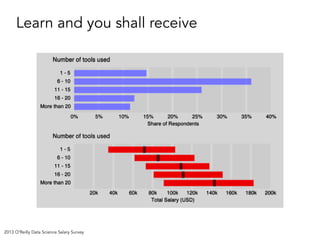
2013 O’Reilly Data Science Salary Survey
Learn and you shall receive
blindly following data.
Being data-driven doesn’t mean
Augment decision makers with objective, trustworthy, and relevant data.
using data to effect impact and results
Ultimately, data-driven means
Push data through “analytics value chain” from collection, analysis,
decisions, action, and finally to impact. Partway along chain doesn’t count.
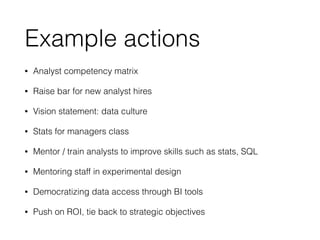
Example actions
• Analyst competency matrix
• Raise bar for new analyst hires
• Vision statement: data culture
• Stats for managers class
• Mentor / train analysts to improve skills such as stats, SQL
• Mentoring staff in experimental design
• Democratizing data access through BI tools
• Push on ROI, tie back to strategic objectives
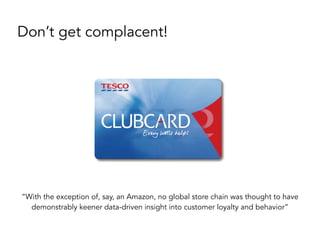
Don’t get complacent!
“With the exception of, say, an Amazon, no global store chain was thought to have
demonstrably keener data-driven insight into customer loyalty and behavior”
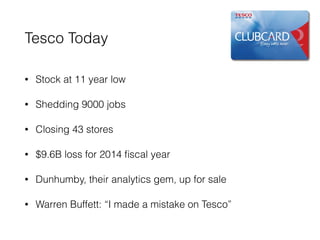
Tesco Today
• Stock at 11 year low
• Shedding 9000 jobs
• Closing 43 stores
• $9.6B loss for 2014 fiscal year
• Dunhumby, their analytics gem, up for sale
• Warren Buffett: “I made a mistake on Tesco”
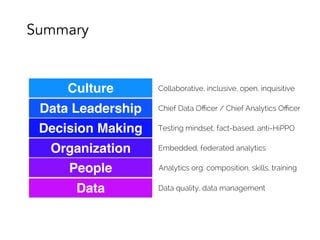
Data
Organization
Decision Making
People
Data Leadership
Culture
Analytics org: composition, skills, training
Data quality, data management
Embedded, federated analytics
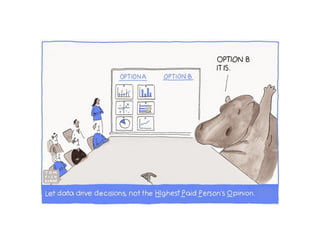
Testing mindset, fact-based, anti-HiPPO
Chief Data Officer / Chief Analytics Officer
Collaborative, inclusive, open, inquisitive
Summary
Bake in data-driven culture early!
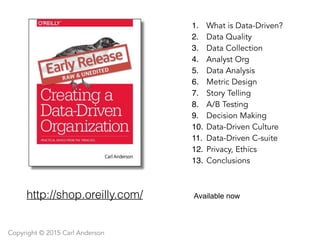
Available now
1. What is Data-Driven?
2. Data Quality
3. Data Collection
4. Analyst Org
5. Data Analysis
6. Metric Design
7. Story Telling
8. A/B Testing
9. Decision Making
10. Data-Driven Culture
11. Data-Driven C-suite
12. Privacy, Ethics
13. Conclusions
http://shop.oreilly.com/
Copyright © 2015 Carl Anderson
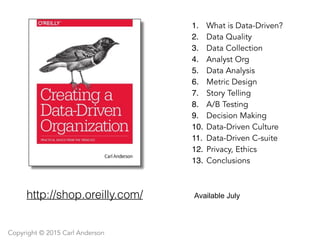
Available July
1. What is Data-Driven?
2. Data Quality
3. Data Collection
4. Analyst Org
5. Data Analysis
6. Metric Design
7. Story Telling
8. A/B Testing
9. Decision Making
10. Data-Driven Culture
11. Data-Driven C-suite
12. Privacy, Ethics
13. Conclusions
http://shop.oreilly.com/
Copyright © 2015 Carl Anderson
Questions?
@leapingllamas
http://p-value.info
carl.anderson@warbyparker.com
spares
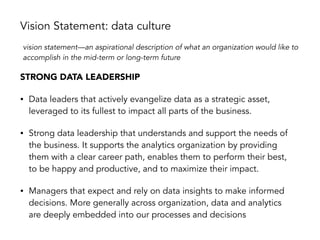
Vision Statement: data culture
STRONG DATA LEADERSHIP
• Data leaders that actively evangelize data as a strategic asset,
leveraged to its fullest to impact all parts of the business.
• Strong data leadership that understands and support the needs of
the business. It supports the analytics organization by providing
them with a clear career path, enables them to perform their best,
to be happy and productive, and to maximize their impact.
• Managers that expect and rely on data insights to make informed
decisions. More generally across organization, data and analytics
are deeply embedded into our processes and decisions
vision statement—an aspirational description of what an organization would like to
accomplish in the mid-term or long-term future
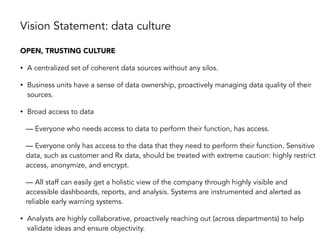
Vision Statement: data culture
OPEN, TRUSTING CULTURE
• A centralized set of coherent data sources without any silos.
• Business units have a sense of data ownership, proactively managing data quality of their
sources.
• Broad access to data
— Everyone who needs access to data to perform their function, has access.
— Everyone only has access to the data that they need to perform their function. Sensitive
data, such as customer and Rx data, should be treated with extreme caution: highly restrict
access, anonymize, and encrypt.
— All staff can easily get a holistic view of the company through highly visible and
accessible dashboards, reports, and analysis. Systems are instrumented and alerted as
reliable early warning systems.
• Analysts are highly collaborative, proactively reaching out (across departments) to help
validate ideas and ensure objectivity.

Creating a Data-Driven Organization (Data Day Seattle 2015)

  • 1.
    Creating a Data-Driven Organization CarlAnderson 9:15am, Grand 2 @leapingllamas | www.p-value.info
  • 2.
  • 4.
    5%more productive Controlling forother factors, data-driven orgs are Brynjolfsson, et al 2011. Strength in numbers: how does data-driven decisonmaking affect firm performance? Social Science Research Network
  • 5.
    $13/ $1 invested Analyticspays back http://nucleusresearch.com/research/single/analytics-pays-back-13-01-for-every-dollar-spent/
  • 6.
  • 7.
    Having lots ofreports does not make you data-driven.
  • 8.
    Having lots ofdashboards does not make you data-driven.
  • 9.
    Having lots ofalerts does not make you data-driven.
  • 10.
  • 11.
    Data-driven: you musthave analytics Not necessarily data-driven ! Reporting Analysis Descriptive Prescriptive What? Why? Backward-looking Forward-looking Raise questions Answer questions Data → Information Data + Information → insights Reports, dashboards, alerts Findings, Recommendation No context story telling
  • 12.
  • 13.
    Analytics Value Chain Figurefrom http:// blogs.adobe.com/digitalmarketing/analytics/reporting-vs-analysis-whats-the- difference/
  • 14.
    “Analytics is aboutimpact…In our company [Zynga], if you have brilliant insight and you did great research and no one changes, you get zero credit.” Ken Rudin Facebook
  • 15.
    Train analysts tobe business savvy 2013 Strata+Hadoop talk: https://www.youtube.com/watch?v=RJFwsZwTBgg
  • 16.
    Having a hadoopcluster does not make you data-driven.
  • 18.
    Leverage data asa strategic asset.
  • 19.
  • 20.
  • 21.
    a strong testingculture Being data-driven means having… Innovate through online and offline experimentation. Encourage hypothesis generation broadly across org.
  • 22.
    “you get surprisesmore often, and surprises are a key source of innovation. You only get a surprise when you are trying something and the result is different than you expected, so the sooner you run the experiment, the sooner you are likely to find a surprise, and the surprise is the market speaking to you, telling you something you didn’t know.” Scott Cook Intuit Baer, D. 2013. Why Intuit founder Scott Cook want you to stop listening to your boss. Fast Company
  • 23.
  • 24.
  • 26.
    an open, sharingculture Being data-driven means having… No data hoarding or silos. Bring data together to create rich contexts. Connect the dots.
  • 27.
  • 28.
  • 29.
  • 30.
  • 31.
  • 32.
  • 33.
  • 34.
  • 35.
    1/3 business leaders frequentlymake decisions with data that they cannot trust Business Analytics and Optimization for the Intelligent Enterprise. IBM Invest in data quality
  • 36.
    a self serviceculture Being data-driven means having… Business units have necessary data access as well as within- team analytical skills to drive insights, actions, and impact.
  • 37.
    Traits of greatanalysts • Numerate • Detail-oriented • Skeptical • Confident • Curious • Communicators • Data lovers • Business savvy Few, S. 2009. Now You See It. Analytics Press, Oakland has a good discussion of this topic, pp. 19–24.
  • 38.
    Hiring not justas individuals but to complement team Nordstrom data lab (as of Strata 2013)
  • 39.
    a broad dataliteracy Being data-driven means having… All decision-makers have appropriate skills to use and interpret data.
  • 40.
    Analysts must sell,sell, sell their product
  • 41.
  • 42.
    a goals firstapproach. Being data-driven means having… Set out metrics before experiment. What does success mean? Have an analysis plan. Prevent gaming the system.
  • 43.
    an objective, inquisitiveculture Being data-driven means having… ‘“Do you have data to back that up?” should be a question that no one is afraid to ask and everyone is prepared to answer’—Julie Arsenault.
  • 44.
    a visible, clearly-articulatedstrategy Being data-driven means having… Commonly understood vision. Suite of well-designed, accessible KPIs. All staff understand how their work ties back to these metrics.
  • 45.
    strong data leadership Beingdata-driven means having… A head of data to evangelize data as strategic asset with budget, team, and influence to drive cultural change.
  • 46.
    Which strategies haveproved successful in promoting a data-driven culture in your organization? Strategy % of respondents Top-down guidance and / or mandates from execs 49 Promotion of data-sharing practices 48 Increased availability of training in data analytics 40 Communication of the benefits of data-driven decision-making 40 Recruitment of additional data analysts 17 2013. Fostering a data-driven culture. Economist Intelligence Unit. Sample of 530 execs.
  • 47.
    but bottom uptoo Change should not just be top-down Everyone in org has role and responsibility through “leveling up” their data skills, mutual mentoring, and embedding data into their processes.
  • 48.
    2013 O’Reilly DataScience Salary Survey Learn and you shall receive
  • 49.
    blindly following data. Beingdata-driven doesn’t mean Augment decision makers with objective, trustworthy, and relevant data.
  • 52.
    using data toeffect impact and results Ultimately, data-driven means Push data through “analytics value chain” from collection, analysis, decisions, action, and finally to impact. Partway along chain doesn’t count.
  • 53.
    Example actions • Analystcompetency matrix • Raise bar for new analyst hires • Vision statement: data culture • Stats for managers class • Mentor / train analysts to improve skills such as stats, SQL • Mentoring staff in experimental design • Democratizing data access through BI tools • Push on ROI, tie back to strategic objectives
  • 54.
    Don’t get complacent! “Withthe exception of, say, an Amazon, no global store chain was thought to have demonstrably keener data-driven insight into customer loyalty and behavior”
  • 55.
    Tesco Today • Stockat 11 year low • Shedding 9000 jobs • Closing 43 stores • $9.6B loss for 2014 fiscal year • Dunhumby, their analytics gem, up for sale • Warren Buffett: “I made a mistake on Tesco”
  • 56.
    Data Organization Decision Making People Data Leadership Culture Analyticsorg: composition, skills, training Data quality, data management Embedded, federated analytics Testing mindset, fact-based, anti-HiPPO Chief Data Officer / Chief Analytics Officer Collaborative, inclusive, open, inquisitive Summary
  • 57.
    Bake in data-drivenculture early!
  • 58.
    Available now 1. Whatis Data-Driven? 2. Data Quality 3. Data Collection 4. Analyst Org 5. Data Analysis 6. Metric Design 7. Story Telling 8. A/B Testing 9. Decision Making 10. Data-Driven Culture 11. Data-Driven C-suite 12. Privacy, Ethics 13. Conclusions http://shop.oreilly.com/ Copyright © 2015 Carl Anderson
  • 59.
    Available July 1. Whatis Data-Driven? 2. Data Quality 3. Data Collection 4. Analyst Org 5. Data Analysis 6. Metric Design 7. Story Telling 8. A/B Testing 9. Decision Making 10. Data-Driven Culture 11. Data-Driven C-suite 12. Privacy, Ethics 13. Conclusions http://shop.oreilly.com/ Copyright © 2015 Carl Anderson
  • 60.
  • 61.
  • 62.
    Vision Statement: dataculture STRONG DATA LEADERSHIP • Data leaders that actively evangelize data as a strategic asset, leveraged to its fullest to impact all parts of the business. • Strong data leadership that understands and support the needs of the business. It supports the analytics organization by providing them with a clear career path, enables them to perform their best, to be happy and productive, and to maximize their impact. • Managers that expect and rely on data insights to make informed decisions. More generally across organization, data and analytics are deeply embedded into our processes and decisions vision statement—an aspirational description of what an organization would like to accomplish in the mid-term or long-term future
  • 63.
    Vision Statement: dataculture OPEN, TRUSTING CULTURE • A centralized set of coherent data sources without any silos. • Business units have a sense of data ownership, proactively managing data quality of their sources. • Broad access to data — Everyone who needs access to data to perform their function, has access. — Everyone only has access to the data that they need to perform their function. Sensitive data, such as customer and Rx data, should be treated with extreme caution: highly restrict access, anonymize, and encrypt. — All staff can easily get a holistic view of the company through highly visible and accessible dashboards, reports, and analysis. Systems are instrumented and alerted as reliable early warning systems. • Analysts are highly collaborative, proactively reaching out (across departments) to help validate ideas and ensure objectivity.