DECISION MAKING
Damasio(2005) summarized the prevalent model as ‘ the supposedly
clear process of deriving logical consequences from assumed premises,
the business of making reliable inferences, which, unencumbered by
passion, allow us to choose the best possible option, leading to the best
possible outcome, given the worst possible problem
Decision - making is thus characterized as essentially problem - solving
and so is seen as an exercise in logic
BUT … Emotion plays a huge part in decision - making and consequently
in performance
3.
EFFECTS OF DECISIONS
the effects of all decisions on all key players and connected players; and
the many possible criteria against which decisions can be evaluated– is
limitless
4.
PENELITIAN: MORAL EMOTION& DECISION MAKING
Damasio’s research: when there is no inner feeling, individual will reason
numerous possible alternatives before making decision somatic
marker (no external directed emotion) short cuts
https://youtu.be/AIXuN9MYeVI
Emosi pada saat pengambilan keputusan etis memengaruhi
5.
EMOTIONS IN DECISION-MAKING
feelings are an important source of information in effective decision -
making.
Emotions from the past affect the degree of aversion and attraction of
different possible options now.
Indeed, they affect whether or not various options even surface into
consciousness.
Emotions and feelings affect our decision - making in other ways too
6.
BENEFITS OF POSITIVEEMOTIONS ON DECISION MAKING
Appreciative Inquiry is also concerned with the creation of positive
emotion, recognizing positive emotion as a source of energy for change.
Isen’s (2005) and Fredrickson ’ s (2005) work on positive emotions and
positivity have illuminated the many beneficial effects of ‘ feeling good ’ .
7.
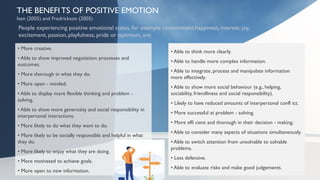
THE BENEFI TSOF POSITIVE EMOTION
Isen (2005) and Fredrickson (2005)
• More creative.
• Able to show improved negotiation processes and
outcomes.
• More thorough in what they do.
• More open - minded.
• Able to display more flexible thinking and problem -
solving.
• Able to show more generosity and social responsibility in
interpersonal interactions.
• More likely to do what they want to do.
• More likely to be socially responsible and helpful in what
they do.
• More likely to enjoy what they are doing.
• More motivated to achieve goals.
• More open to new information.
• Able to think more clearly.
• Able to handle more complex information.
• Able to integrate, process and manipulate information
more effectively.
• Able to show more social behaviour (e.g., helping,
sociability, friendliness and social responsibility).
• Likely to have reduced amounts of interpersonal confl ict.
• More successful at problem - solving.
• More effi cient and thorough in their decision - making.
• Able to consider many aspects of situations simultaneously.
• Able to switch attention from unsolvable to solvable
problems.
• Less defensive.
• Able to evaluate risks and make good judgements.
People experiencing positive emotional states, for example contentment,happiness, interest, joy,
excitement, passion, playfulness, pride or optimism, are:
• Able to think more clearly.
• Able to handle more complex information.
• Able to integrate, process and manipulate information
more effectively.
• Able to show more social behaviour (e.g., helping,
sociability, friendliness and social responsibility).
• Likely to have reduced amounts of interpersonal confl ict.
• More successful at problem - solving.
• More effi cient and thorough in their decision - making.
• Able to consider many aspects of situations simultaneously.
• Able to switch attention from unsolvable to solvable
problems.
• Less defensive.
• Able to evaluate risks and make good judgements.
8.
MICRO - DECISION- MAKING
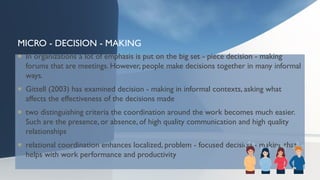
In organizations a lot of emphasis is put on the big set - piece decision - making
forums that are meetings. However, people make decisions together in many informal
ways.
Gittell (2003) has examined decision - making in informal contexts, asking what
affects the effectiveness of the decisions made
two distinguishing criteria the coordination around the work becomes much easier.
Such are the presence, or absence, of high quality communication and high quality
relationships
relational coordination enhances localized, problem - focused decision - making that
helps with work performance and productivity
9.
OTHER FACTORS THATENHANCE DECISION - MAKING
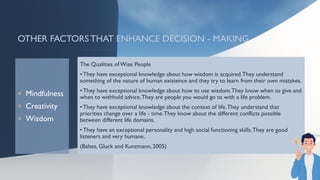
Mindfulness
Creativity
Wisdom
The Qualities of Wise People
• They have exceptional knowledge about how wisdom is acquired.They understand
something of the nature of human existence and they try to learn from their own mistakes.
• They have exceptional knowledge about how to use wisdom.They know when to give and
when to withhold advice.They are people you would go to with a life problem.
• They have exceptional knowledge about the context of life.They understand that
priorities change over a life - time.They know about the different conflicts possible
between different life domains.
• They have an exceptional personality and high social functioning skills.They are good
listeners and very humane.
(Baltes, Gluck and Kunzmann, 2005)
10.
MOVING FROM
DECISION- MAKINGTO
SENSE- MAKING
The process of mistake avoidance and correction in inherently risk - heavy
organizations (Weick and Sutcliffe, 2007)
Research into teams of people who successful negotiate such fragile situations
reveals a complexity of thought
They manage to take risks and be cautious, to demonstrate intimacy and detachment,
aggressiveness and surrender, repetition and improvization, intuition and deliberation,
curiosity and timidity.
at different times each of these values may be the most valuable
STICC: Situation,Task, Intent, Concerns and Calibration
LCES: Lookouts, Communication links, Escape routes and Safety zones