1
Does Happiness adapt to Poverty? And
Poverty to Happiness
Sara Ayllon
Presented by: Stephan Klasen
University of Göttingen
August 25, 2014
IARIW General Conference 2014
2
What the paper is about
• Motivation:
– Feed-back loop poverty-unhappiness; poverty makes
you unhappy, unhappiness promotes poverty;
– Do people adapt to poverty (stop being unhappy),
does the penalty of unhappiness fade over time?
– Uses long-term panel data and several past spells of
poverty and unhappiness;
• Key Findings:
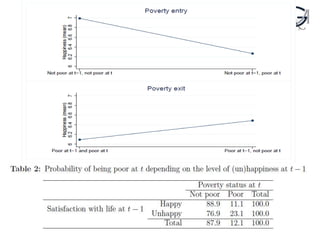
– Finds individuals adapt to poverty over time;
– Fluctuations in poverty no worse than being poor all
the time;
– Past (short-lived) unhappiness promotes poverty;
3
Methods and Data
• Data: German Socio-Economic Panel 1992-2010
– Individual-level data of all adults;
– Usual relative poverty measure (new OECD scales, cash
income including imputed rent),
– Dichotomizes happiness (unhappy<5), 9% unhappy;
• Method:
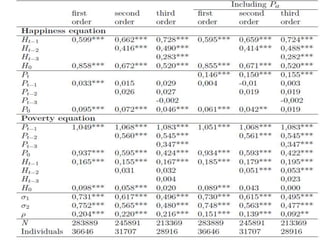
– Bivariate Probit with increasing lags;
– Control for initial conditions problem (Wooldridge, 2005);
5
6
Comments
• Nice paper on an important subject;
• Innovative and real contrbution to the literature;
• Methods:
– ‚Magic‘ of identification of bivariate probit (by functional form);
– Throw away information through dichtotomization of happiness:
• plus arbitrary cut-off at 5 seems problematic, robustness check
needed;
• also dichotomization of poverty?);
• Alternative:
– Simultaneous equation system (with income and happiness
scale);
– IV approach;
– Identify via shocks to happiness (e.g. death, health shock?);
• Report other covariates, and possible interactions, and
transmission channels (esp. labor market)? 7

Session 4 b ayllon

  • 1.
    1 Does Happiness adaptto Poverty? And Poverty to Happiness Sara Ayllon Presented by: Stephan Klasen University of Göttingen August 25, 2014 IARIW General Conference 2014
  • 2.
    2 What the paperis about • Motivation: – Feed-back loop poverty-unhappiness; poverty makes you unhappy, unhappiness promotes poverty; – Do people adapt to poverty (stop being unhappy), does the penalty of unhappiness fade over time? – Uses long-term panel data and several past spells of poverty and unhappiness; • Key Findings: – Finds individuals adapt to poverty over time; – Fluctuations in poverty no worse than being poor all the time; – Past (short-lived) unhappiness promotes poverty;
  • 3.
    3 Methods and Data •Data: German Socio-Economic Panel 1992-2010 – Individual-level data of all adults; – Usual relative poverty measure (new OECD scales, cash income including imputed rent), – Dichotomizes happiness (unhappy<5), 9% unhappy; • Method: – Bivariate Probit with increasing lags; – Control for initial conditions problem (Wooldridge, 2005);
  • 5.
  • 6.
  • 7.
    Comments • Nice paperon an important subject; • Innovative and real contrbution to the literature; • Methods: – ‚Magic‘ of identification of bivariate probit (by functional form); – Throw away information through dichtotomization of happiness: • plus arbitrary cut-off at 5 seems problematic, robustness check needed; • also dichotomization of poverty?); • Alternative: – Simultaneous equation system (with income and happiness scale); – IV approach; – Identify via shocks to happiness (e.g. death, health shock?); • Report other covariates, and possible interactions, and transmission channels (esp. labor market)? 7