Instructor: Dr. Dawn-Elise Snipes PhD, LPC-MHSP, NCC
Executive Director, AllCEUs.com
 Define Readiness
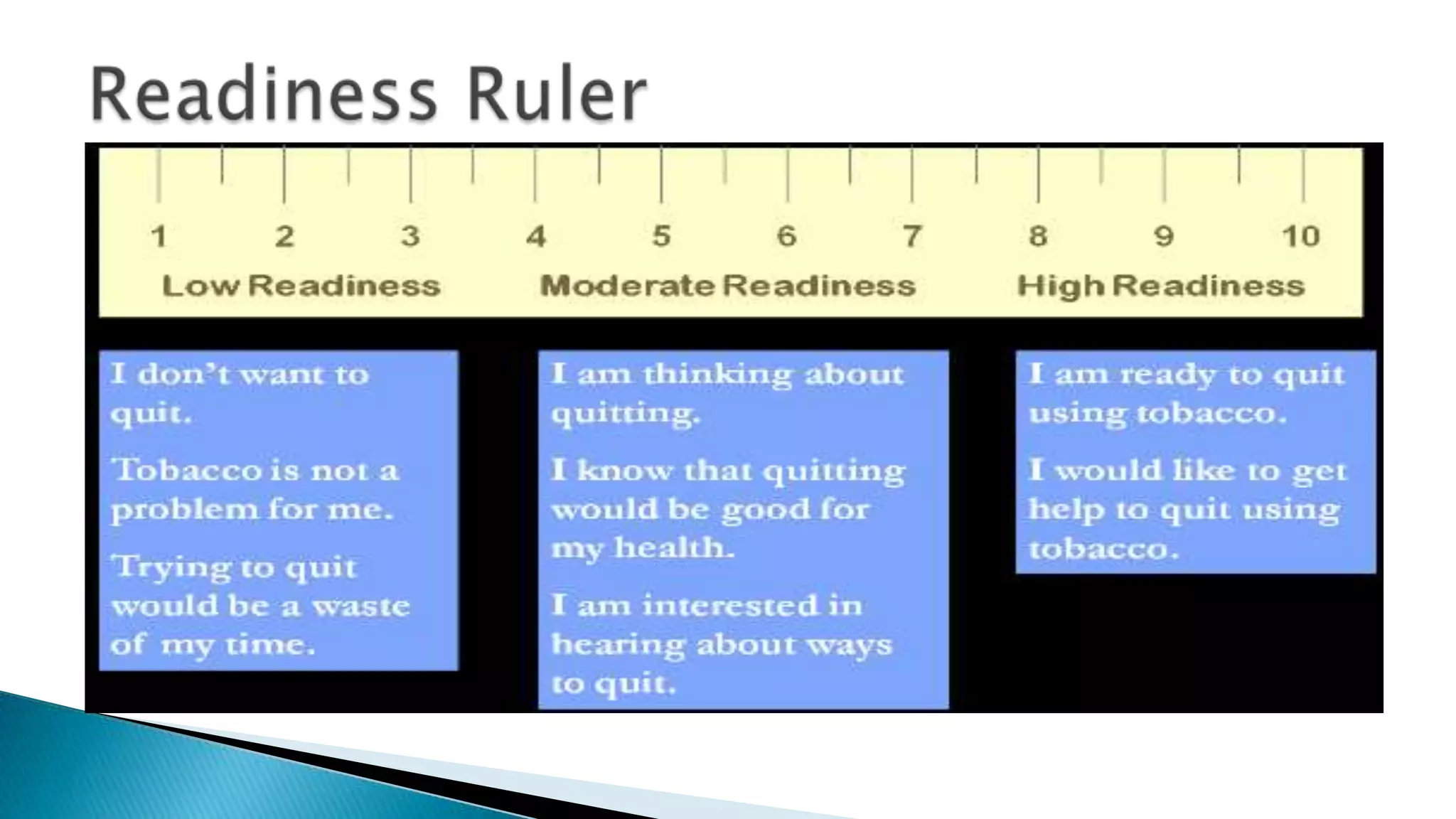
 Learn how to use the readiness ruler
 Identify the 4 types of precontemplators
 Identify processes people use to move through the
stages of change
 Explore the TransTheoretical Model of Change
 Discuss the 7 steps in the change process
 "Readiness" refers to the combination of factors
evident in participants: their previous experience
with such endeavors, the degree to which they have
the necessary skills and knowledge for the tasks
ahead and their attitude toward undertaking this
change
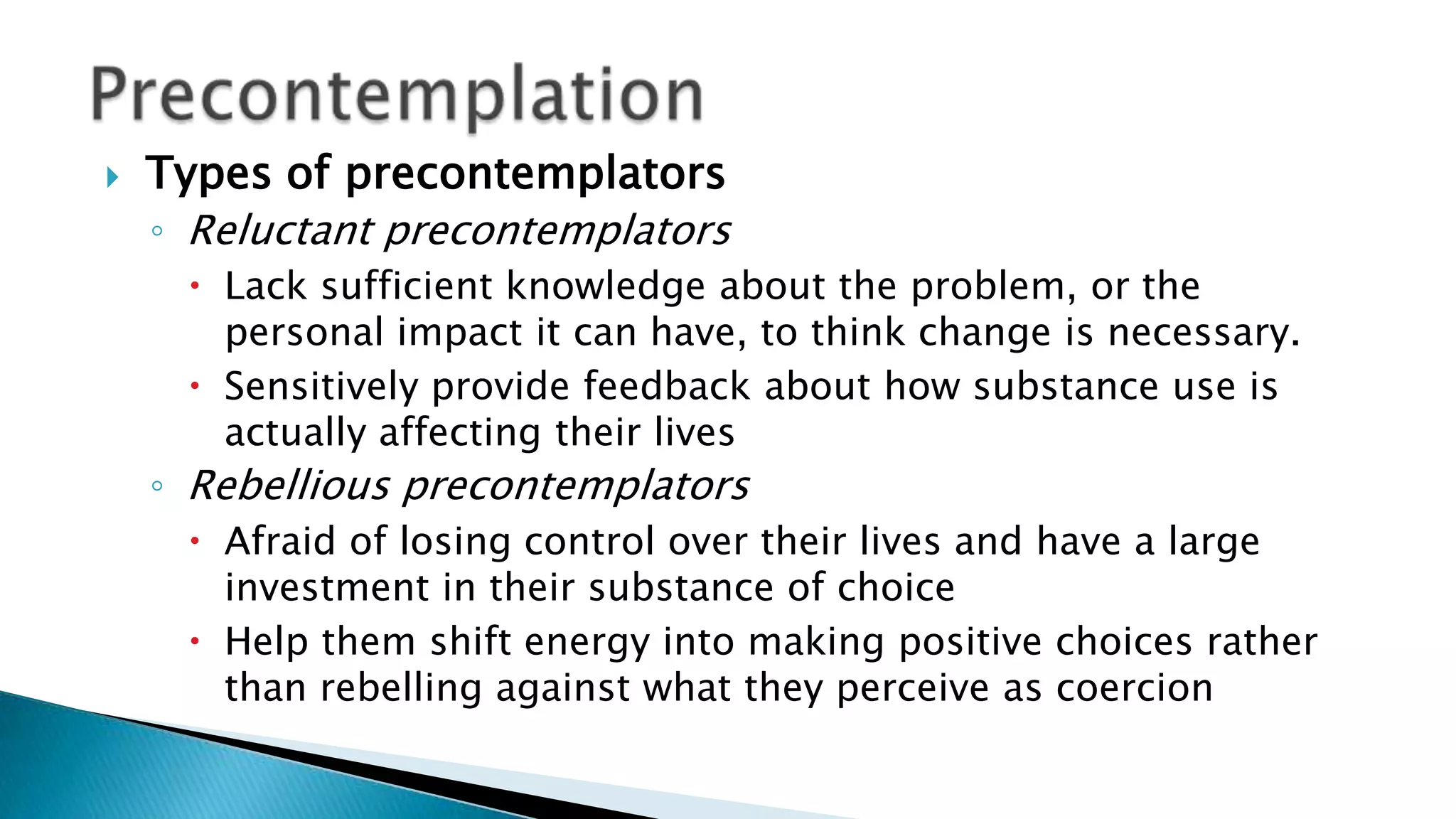
 Types of precontemplators
◦ Reluctant precontemplators
 Lack sufficient knowledge about the problem, or the
personal impact it can have, to think change is necessary.
 Sensitively provide feedback about how substance use is
actually affecting their lives
◦ Rebellious precontemplators
 Afraid of losing control over their lives and have a large
investment in their substance of choice
 Help them shift energy into making positive choices rather
than rebelling against what they perceive as coercion
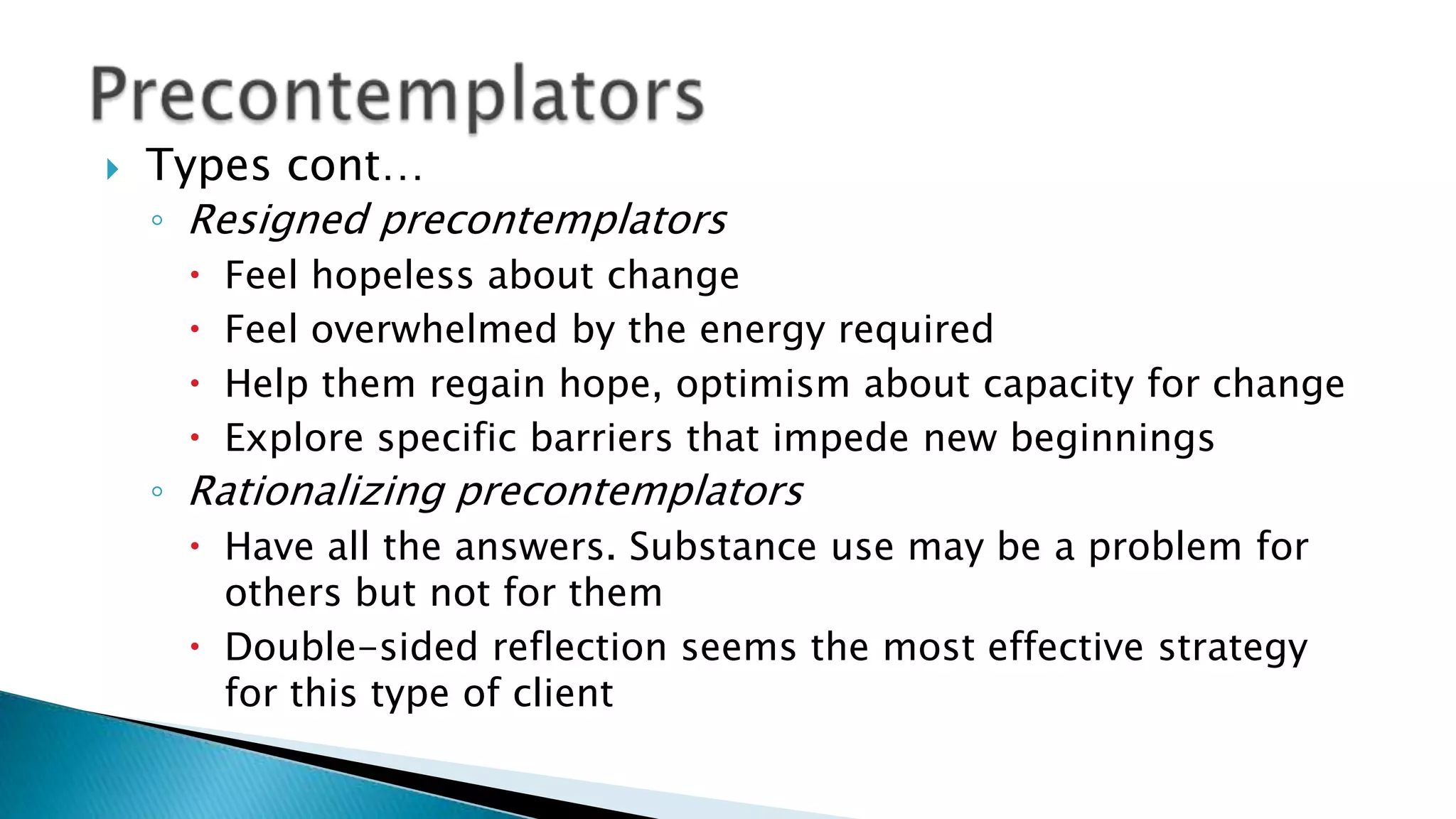
 Types cont…
◦ Resigned precontemplators
 Feel hopeless about change
 Feel overwhelmed by the energy required
 Help them regain hope, optimism about capacity for change
 Explore specific barriers that impede new beginnings
◦ Rationalizing precontemplators
 Have all the answers. Substance use may be a problem for
others but not for them
 Double-sided reflection seems the most effective strategy
for this type of client
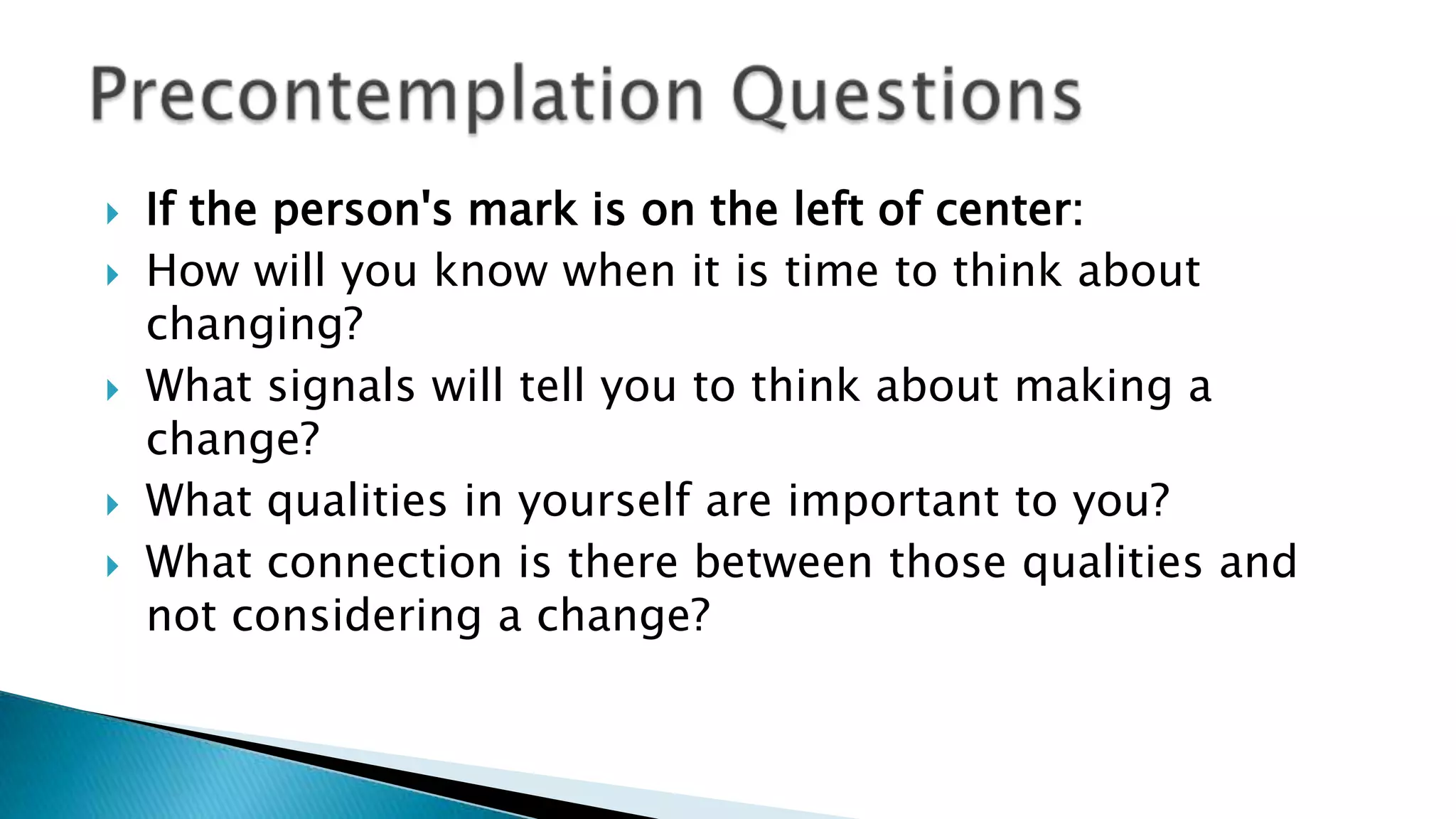
 If the person's mark is on the left of center:
 How will you know when it is time to think about
changing?
 What signals will tell you to think about making a
change?
 What qualities in yourself are important to you?
 What connection is there between those qualities and
not considering a change?
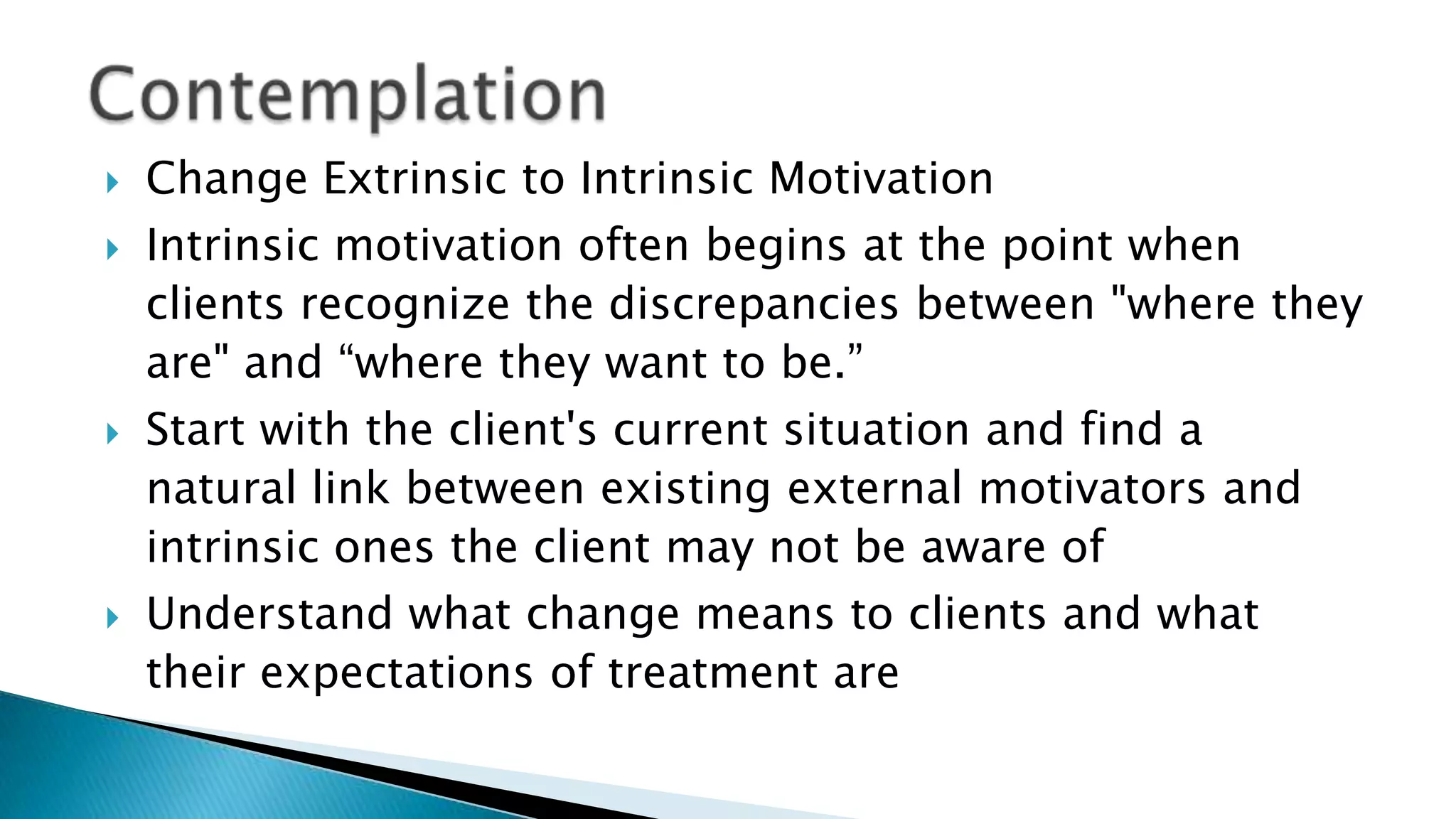
 Change Extrinsic to Intrinsic Motivation
 Intrinsic motivation often begins at the point when
clients recognize the discrepancies between "where they
are" and “where they want to be.”
 Start with the client's current situation and find a
natural link between existing external motivators and
intrinsic ones the client may not be aware of
 Understand what change means to clients and what
their expectations of treatment are
 If the person's mark is near the center:
 Why did you put your mark there and not closer to the left?
 What might make you put your mark further to the right?
 What are the good things about the way you are currently
trying to change?
 What are the things that are not so good?
 What would be a good result of changing?
 What are the barriers to changing?
 Signs of readiness
◦ Decreased resistance.
◦ Fewer questions about the problem.
◦ Resolve.
◦ Self-motivational statements reflecting willingness ("I
have to do something") and optimism ("I can beat it").
◦ More questions about change.
◦ Envisioning.
◦ Experimenting.
 If the person's mark is on the right of center:
◦ What is one barrier to change?
◦ What are some things that could help you overcome
this barrier?
◦ Pick one of those things that could help and decide to
do it by____________________(specific date).
 If the person has taken a serious step toward
change:
◦ What made you decide on that particular step?
◦ What has worked in taking this step?
◦ What helped it work?
◦ What could help it work even better?
◦ What else would help?
◦ Can you break that step down into smaller parts?
 Pick one of those parts and decide to do it by______(specific
date).
 If the person is changing and trying to maintain
that change:
◦ Congratulations! What's helping you?
◦ What else would help?
◦ What makes it hard to maintain the change?
 To progress through the early stages, people use
◦ Cognitive
◦ Affective
◦ Evaluative processes
 In action and maintenance, they rely on
◦ Commitments
◦ Conditioning
◦ Contingencies
◦ Controls (environmental)
◦ Support
 10 covert and overt activities used to progress
through the stages of readiness for change
◦ Consciousness-Raising—increasing awareness via
information, education, and personal feedback
◦ Dramatic Relief—Feeling inspiration and hope when they
hear about how people are able to change
◦ Environmental Reevaluation—realizing how their unhealthy
behavior affects others and how they could have more
positive effects by changing
 The 10 processes
◦ Social Liberation—realizing that society is more supportive
of the healthy behavior
◦ Self-Reevaluation—realizing that the healthy behavior is an
important part of who they are and want to be
◦ Stimulus Control—using reminders and cues that
encourage healthy behavior as substitutes for those that
encourage the unhealthy behavior.
◦ Helping Relationships—finding people who are supportive
of their change
 The 10 processes
◦ Counter-Conditioning—substituting healthy ways of acting
and thinking for unhealthy ways
◦ Reinforcement Management—increasing the rewards that
come from positive behavior and reducing those that come
from negative behavior
◦ Self-Liberation—believing in one’s ability to change and
making commitments to act on that belief
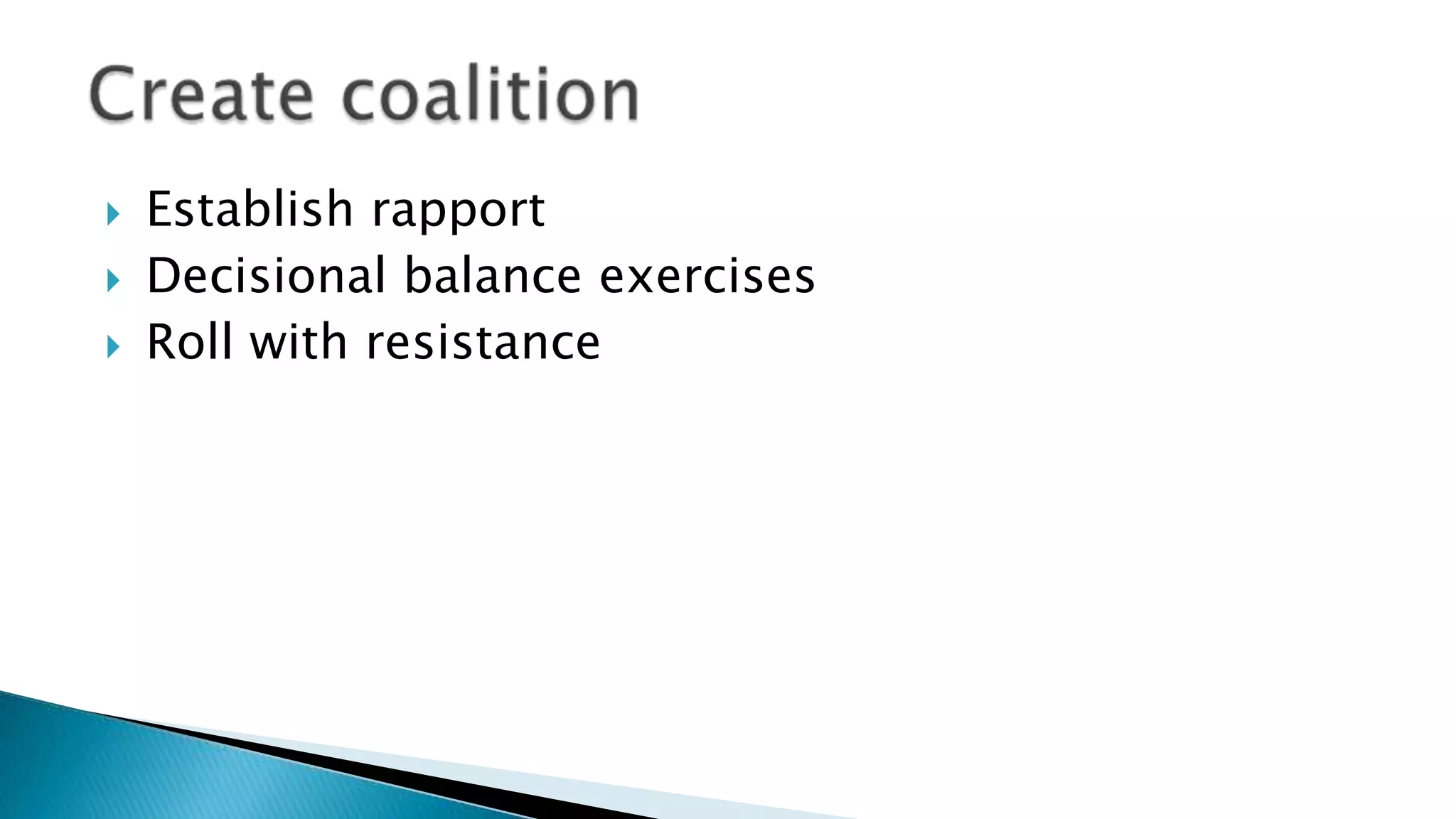
 Create coalition
 Develop vision
 Share vision
 Empower
 Short term wins
 Consolidate gains
 Anchor change
 Establish rapport
 Decisional balance exercises
 Roll with resistance
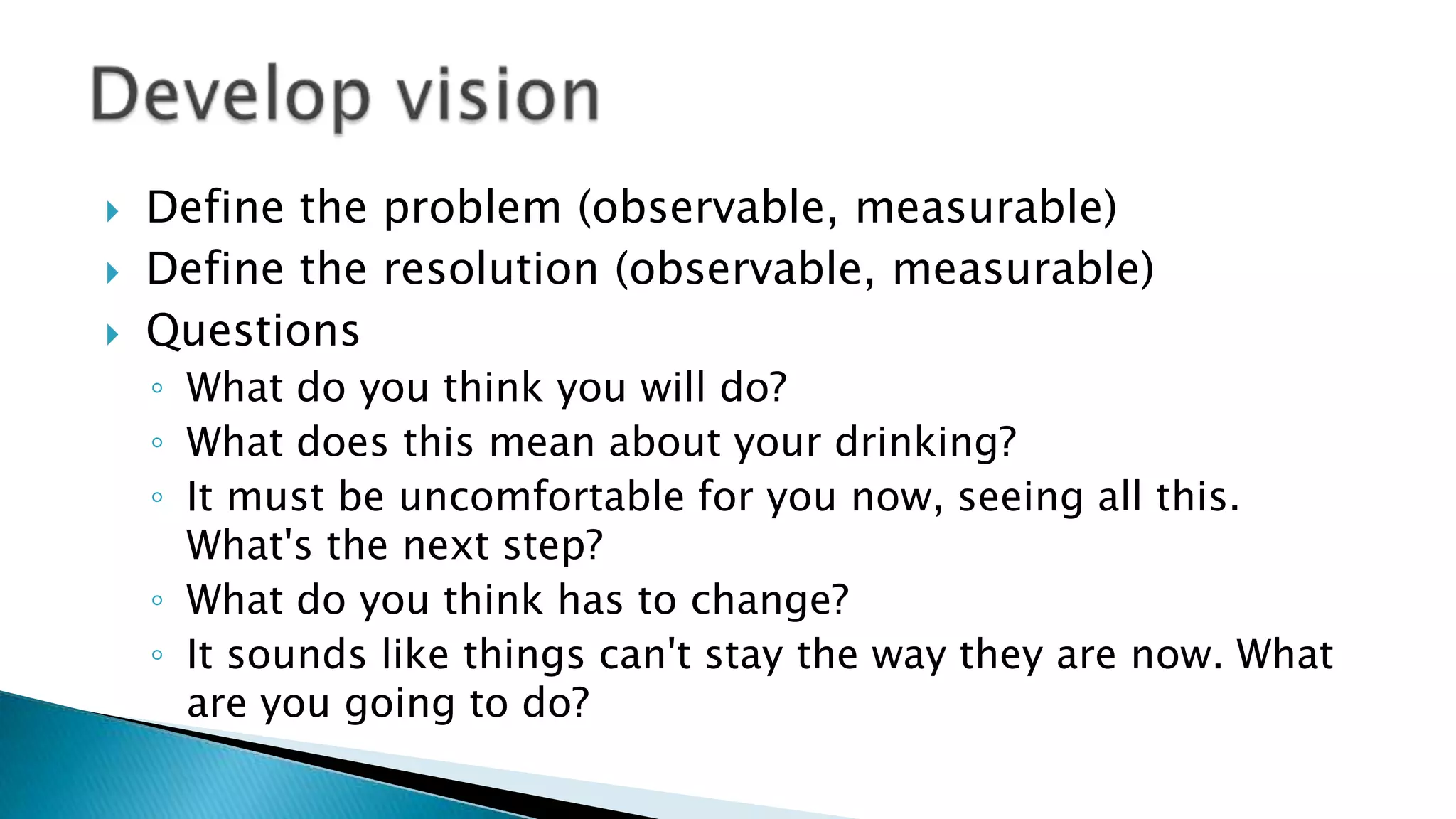
 Define the problem (observable, measurable)
 Define the resolution (observable, measurable)
 Questions
◦ What do you think you will do?
◦ What does this mean about your drinking?
◦ It must be uncomfortable for you now, seeing all this.
What's the next step?
◦ What do you think has to change?
◦ It sounds like things can't stay the way they are now. What
are you going to do?
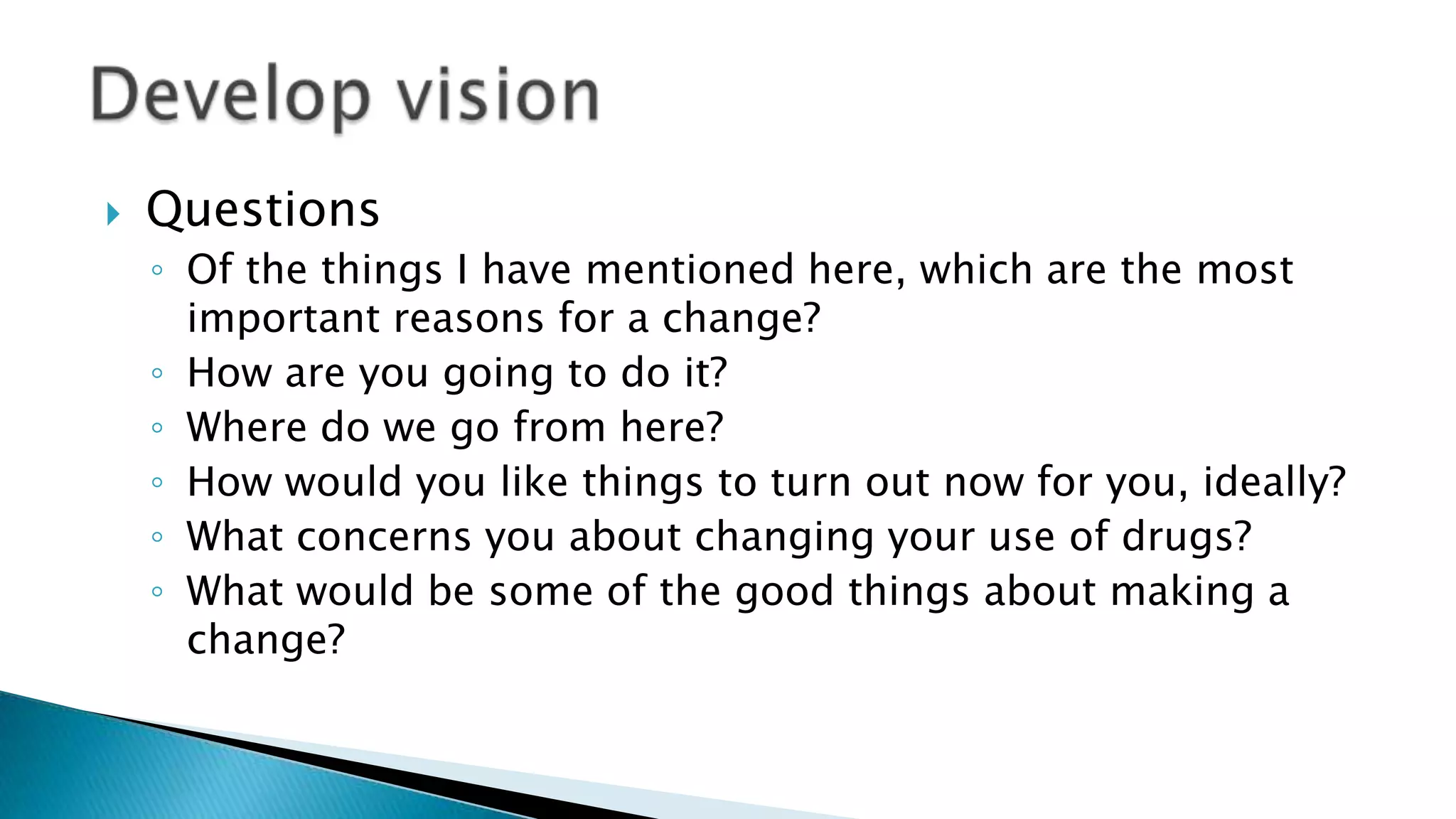
 Questions
◦ Of the things I have mentioned here, which are the most
important reasons for a change?
◦ How are you going to do it?
◦ Where do we go from here?
◦ How would you like things to turn out now for you, ideally?
◦ What concerns you about changing your use of drugs?
◦ What would be some of the good things about making a
change?
 Develop a plan
◦ Offering a menu of change options
◦ Developing a behavior contract
◦ Lowering barriers to action
◦ Enlisting social support
◦ Educating your client about treatment
 Identify intensity and amount of help needed
 Identify available social support—
Who, Where, When
 Develop a sequence of subgoals or steps in the
plan
 Discuss how to address multiple concurrent
problems--for example, how to deal with
legal, financial, and health problems
 Assist patients in implementing plan
 Provide encouragement and support
 Reward small steps
 Troubleshoot
◦ Decreasing motivation
◦ Relapse warning signs
 Identify patient’s goals and rewards
◦ Daily
◦ Weekly
◦ Monthly
 Rewards that are sufficiently strong and frequent
◦ Prevent behavior strain
◦ Maintain forward progress
 Monthly treatment plan reviews
◦ Highlight successes
◦ Empower patient to troubleshoot unmet goals
◦ Normalize imperfection
 Relapse prevention planning
 Daily grounding/mindfulness activities
 Support group meetings
 Defining "Readiness“ as the combination of factors
◦ Their previous experience with such endeavors
◦ The degree to which they have the necessary skills and
knowledge for the tasks ahead
◦ Their attitude toward undertaking this change
 Explored the use of the Readiness Ruler and questions
to ask to propel people toward change.
 To progress through the early stages, people use
cognitive, affective, evaluative processes
 In action and maintenance, they rely on Commitments,
Conditioning, Contingencies, Controls, Support
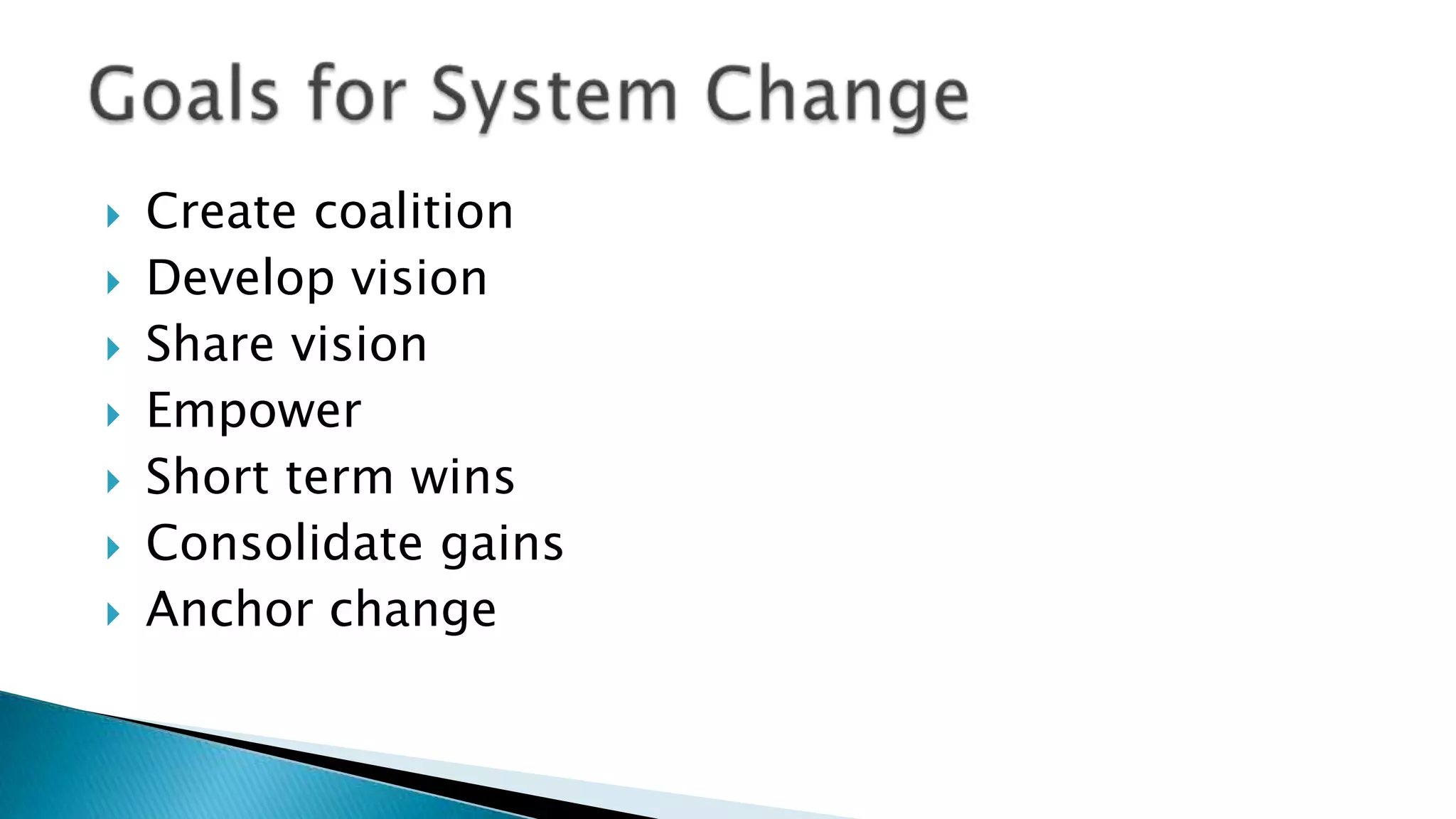
 Goals for System Change
◦ Create coalition
◦ Develop vision
◦ Share vision
◦ Empower
◦ Short term wins
◦ Consolidate gains
◦ Anchor change
 10 activities used to progress through change
◦ Consciousness-Raising
◦ Dramatic Relief
◦ Environmental Reevaluation
◦ Social Liberation
◦ Self-Liberation
◦ Helping Relationships
◦ Stimulus Control
◦ Helping Relationship
◦ Counter-Conditioning
◦ Reinforcement Management

Session 15--Assessing Readiness for Change

  • 1.
    Instructor: Dr. Dawn-EliseSnipes PhD, LPC-MHSP, NCC Executive Director, AllCEUs.com
  • 2.
     Define Readiness Learn how to use the readiness ruler  Identify the 4 types of precontemplators  Identify processes people use to move through the stages of change  Explore the TransTheoretical Model of Change  Discuss the 7 steps in the change process
  • 3.
     "Readiness" refersto the combination of factors evident in participants: their previous experience with such endeavors, the degree to which they have the necessary skills and knowledge for the tasks ahead and their attitude toward undertaking this change
  • 5.
     Types ofprecontemplators ◦ Reluctant precontemplators  Lack sufficient knowledge about the problem, or the personal impact it can have, to think change is necessary.  Sensitively provide feedback about how substance use is actually affecting their lives ◦ Rebellious precontemplators  Afraid of losing control over their lives and have a large investment in their substance of choice  Help them shift energy into making positive choices rather than rebelling against what they perceive as coercion
  • 6.
     Types cont… ◦Resigned precontemplators  Feel hopeless about change  Feel overwhelmed by the energy required  Help them regain hope, optimism about capacity for change  Explore specific barriers that impede new beginnings ◦ Rationalizing precontemplators  Have all the answers. Substance use may be a problem for others but not for them  Double-sided reflection seems the most effective strategy for this type of client
  • 7.
     If theperson's mark is on the left of center:  How will you know when it is time to think about changing?  What signals will tell you to think about making a change?  What qualities in yourself are important to you?  What connection is there between those qualities and not considering a change?
  • 8.
     Change Extrinsicto Intrinsic Motivation  Intrinsic motivation often begins at the point when clients recognize the discrepancies between "where they are" and “where they want to be.”  Start with the client's current situation and find a natural link between existing external motivators and intrinsic ones the client may not be aware of  Understand what change means to clients and what their expectations of treatment are
  • 9.
     If theperson's mark is near the center:  Why did you put your mark there and not closer to the left?  What might make you put your mark further to the right?  What are the good things about the way you are currently trying to change?  What are the things that are not so good?  What would be a good result of changing?  What are the barriers to changing?
  • 10.
     Signs ofreadiness ◦ Decreased resistance. ◦ Fewer questions about the problem. ◦ Resolve. ◦ Self-motivational statements reflecting willingness ("I have to do something") and optimism ("I can beat it"). ◦ More questions about change. ◦ Envisioning. ◦ Experimenting.
  • 11.
     If theperson's mark is on the right of center: ◦ What is one barrier to change? ◦ What are some things that could help you overcome this barrier? ◦ Pick one of those things that could help and decide to do it by____________________(specific date).
  • 12.
     If theperson has taken a serious step toward change: ◦ What made you decide on that particular step? ◦ What has worked in taking this step? ◦ What helped it work? ◦ What could help it work even better? ◦ What else would help? ◦ Can you break that step down into smaller parts?  Pick one of those parts and decide to do it by______(specific date).
  • 13.
     If theperson is changing and trying to maintain that change: ◦ Congratulations! What's helping you? ◦ What else would help? ◦ What makes it hard to maintain the change?
  • 14.
     To progressthrough the early stages, people use ◦ Cognitive ◦ Affective ◦ Evaluative processes  In action and maintenance, they rely on ◦ Commitments ◦ Conditioning ◦ Contingencies ◦ Controls (environmental) ◦ Support
  • 15.
     10 covertand overt activities used to progress through the stages of readiness for change ◦ Consciousness-Raising—increasing awareness via information, education, and personal feedback ◦ Dramatic Relief—Feeling inspiration and hope when they hear about how people are able to change ◦ Environmental Reevaluation—realizing how their unhealthy behavior affects others and how they could have more positive effects by changing
  • 16.
     The 10processes ◦ Social Liberation—realizing that society is more supportive of the healthy behavior ◦ Self-Reevaluation—realizing that the healthy behavior is an important part of who they are and want to be ◦ Stimulus Control—using reminders and cues that encourage healthy behavior as substitutes for those that encourage the unhealthy behavior. ◦ Helping Relationships—finding people who are supportive of their change
  • 17.
     The 10processes ◦ Counter-Conditioning—substituting healthy ways of acting and thinking for unhealthy ways ◦ Reinforcement Management—increasing the rewards that come from positive behavior and reducing those that come from negative behavior ◦ Self-Liberation—believing in one’s ability to change and making commitments to act on that belief
  • 18.
     Create coalition Develop vision  Share vision  Empower  Short term wins  Consolidate gains  Anchor change
  • 19.
     Establish rapport Decisional balance exercises  Roll with resistance
  • 20.
     Define theproblem (observable, measurable)  Define the resolution (observable, measurable)  Questions ◦ What do you think you will do? ◦ What does this mean about your drinking? ◦ It must be uncomfortable for you now, seeing all this. What's the next step? ◦ What do you think has to change? ◦ It sounds like things can't stay the way they are now. What are you going to do?
  • 21.
     Questions ◦ Ofthe things I have mentioned here, which are the most important reasons for a change? ◦ How are you going to do it? ◦ Where do we go from here? ◦ How would you like things to turn out now for you, ideally? ◦ What concerns you about changing your use of drugs? ◦ What would be some of the good things about making a change?
  • 22.
     Develop aplan ◦ Offering a menu of change options ◦ Developing a behavior contract ◦ Lowering barriers to action ◦ Enlisting social support ◦ Educating your client about treatment  Identify intensity and amount of help needed
  • 23.
     Identify availablesocial support— Who, Where, When  Develop a sequence of subgoals or steps in the plan  Discuss how to address multiple concurrent problems--for example, how to deal with legal, financial, and health problems
  • 24.
     Assist patientsin implementing plan  Provide encouragement and support  Reward small steps  Troubleshoot ◦ Decreasing motivation ◦ Relapse warning signs
  • 25.
     Identify patient’sgoals and rewards ◦ Daily ◦ Weekly ◦ Monthly  Rewards that are sufficiently strong and frequent ◦ Prevent behavior strain ◦ Maintain forward progress
  • 26.
     Monthly treatmentplan reviews ◦ Highlight successes ◦ Empower patient to troubleshoot unmet goals ◦ Normalize imperfection
  • 27.
     Relapse preventionplanning  Daily grounding/mindfulness activities  Support group meetings
  • 28.
     Defining "Readiness“as the combination of factors ◦ Their previous experience with such endeavors ◦ The degree to which they have the necessary skills and knowledge for the tasks ahead ◦ Their attitude toward undertaking this change  Explored the use of the Readiness Ruler and questions to ask to propel people toward change.  To progress through the early stages, people use cognitive, affective, evaluative processes
  • 29.
     In actionand maintenance, they rely on Commitments, Conditioning, Contingencies, Controls, Support  Goals for System Change ◦ Create coalition ◦ Develop vision ◦ Share vision ◦ Empower ◦ Short term wins ◦ Consolidate gains ◦ Anchor change
  • 30.
     10 activitiesused to progress through change ◦ Consciousness-Raising ◦ Dramatic Relief ◦ Environmental Reevaluation ◦ Social Liberation ◦ Self-Liberation ◦ Helping Relationships ◦ Stimulus Control ◦ Helping Relationship ◦ Counter-Conditioning ◦ Reinforcement Management