Maya Dynamics Basics
Lab 6: Particle Materials
Author: Khieu Van Bang
Email: tribang.nd@gmail.com
CONTENTS
 Basics:
 Shaders/Materials.
 Working with color particle : color, expression, expression shader, ...
 Texture :
 Which type Particle, we can use texture ?
 Create textures on Adobe Photoshop.
 Apply textures to particles.
 Examples:
 Create a spacecraft flying in the sky stars.
Particle Materials
1) COLOR
Particle Materials
1) COLOR
1.1) Shaders/Materials.
1.2) Working with color Particle.
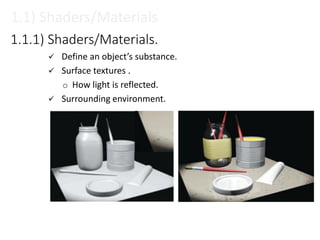
1.1.1) Shaders/Materials.
1.1) Shaders/Materials
 Define an object’s substance.
 Surface textures .
o How light is reflected.
 Surrounding environment.
1.1.2) Basic attributes of materials.
1.1) Shaders/Materials
 Color
o Change basic color.
o Apply a texture as a color map.
 Transparency
o Change basic transparency.
o Apply a texture as a transparency map.
 Shine
o Change the intensity and size of the specular highlights of an
object.
o Apply a texture as a specularity map.
1.1.2) Materials Types
Anisotropic: This material has elliptical specula highlights.
Blinn: Provides soft circular highlights and is good for metallic surfaces.
Lambert: This material has no highlights and is useful for cloth and non-reflective
surfaces.
Layered Shader: Combines several shaders into one single shading object.
Phong: Provides hard circular highlight and is good for glass surfaces.
Phong E: Similar to Phong, but optimised to render faster.
Shading Map: This material allows for colour changes to the rendering which
provides cartoon shading.
Surface Shader: Provides a connection to a surface material attributes.
Used Background: Allows for adjustment and control of an objects shadows and
reflections.
1.1) Menterial particle templates
Particle Materials
1) COLOR
1.1) Shaders/Materials.
1.2) Working with color Particle.
1.1) How to add color to Particle ?
1.2) Working with color Particle
1
2
3
4
1.2) Add Attributes
1.2) Working with color Particle
Step 1: Select component “ Add Dynamic Atributes”.
Step 2: Add attributes.
Step 3: Change attributes.
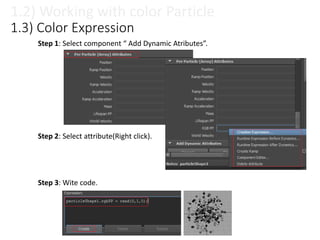
1.3) Color Expression
1.2) Working with color Particle
Step 1: Select component “ Add Dynamic Atributes”.
Step 2: Select attribute(Right click).
Step 3: Wite code.
RampMap
1.2) Working with color Particle
1.3) Color Expression
Step 1: Create Ramp.
Step 2: Edit Ramp.
Particle Materials
2) TEXTURE
2.1) Which type particle, we can use texture ?
2) TEXTURE
 Type of Particle: Sprites
2.1) Create texture in Photoshop
2) TEXTURE
 Step 1: Create text.  Step 2: Slect text content.
 Step 3: Create Alpha Channels.
 Step 4: Save as “.TIF” file.
2.2) Apply textures to particles.
2) TEXTURE
1
2
3
2.2) Control textures with expression.
2) TEXTURE
1
2
3
4
2.2) Control textures with expression.
2) TEXTURE
2) TEXTURE
How to create it ?
Particle Materials
3) EXAMPLES
3) EXAMPLES
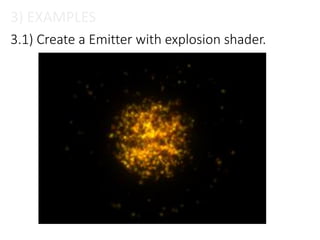
3.1) Create a Emitter with explosion shader.
3) EXAMPLES
3.2) Slow motion rain drops.
Thanks!

Session 06 – particle materials

  • 1.
    Maya Dynamics Basics Lab6: Particle Materials Author: Khieu Van Bang Email: tribang.nd@gmail.com
  • 2.
    CONTENTS  Basics:  Shaders/Materials. Working with color particle : color, expression, expression shader, ...  Texture :  Which type Particle, we can use texture ?  Create textures on Adobe Photoshop.  Apply textures to particles.  Examples:  Create a spacecraft flying in the sky stars.
  • 3.
  • 4.
    Particle Materials 1) COLOR 1.1)Shaders/Materials. 1.2) Working with color Particle.
  • 5.
    1.1.1) Shaders/Materials. 1.1) Shaders/Materials Define an object’s substance.  Surface textures . o How light is reflected.  Surrounding environment.
  • 6.
    1.1.2) Basic attributesof materials. 1.1) Shaders/Materials  Color o Change basic color. o Apply a texture as a color map.  Transparency o Change basic transparency. o Apply a texture as a transparency map.  Shine o Change the intensity and size of the specular highlights of an object. o Apply a texture as a specularity map.
  • 7.
    1.1.2) Materials Types Anisotropic:This material has elliptical specula highlights. Blinn: Provides soft circular highlights and is good for metallic surfaces. Lambert: This material has no highlights and is useful for cloth and non-reflective surfaces. Layered Shader: Combines several shaders into one single shading object. Phong: Provides hard circular highlight and is good for glass surfaces. Phong E: Similar to Phong, but optimised to render faster. Shading Map: This material allows for colour changes to the rendering which provides cartoon shading. Surface Shader: Provides a connection to a surface material attributes. Used Background: Allows for adjustment and control of an objects shadows and reflections. 1.1) Menterial particle templates
  • 8.
    Particle Materials 1) COLOR 1.1)Shaders/Materials. 1.2) Working with color Particle.
  • 9.
    1.1) How toadd color to Particle ? 1.2) Working with color Particle 1 2 3 4
  • 10.
    1.2) Add Attributes 1.2)Working with color Particle Step 1: Select component “ Add Dynamic Atributes”. Step 2: Add attributes. Step 3: Change attributes.
  • 11.
    1.3) Color Expression 1.2)Working with color Particle Step 1: Select component “ Add Dynamic Atributes”. Step 2: Select attribute(Right click). Step 3: Wite code.
  • 12.
    RampMap 1.2) Working withcolor Particle 1.3) Color Expression Step 1: Create Ramp. Step 2: Edit Ramp.
  • 13.
  • 14.
    2.1) Which typeparticle, we can use texture ? 2) TEXTURE  Type of Particle: Sprites
  • 15.
    2.1) Create texturein Photoshop 2) TEXTURE  Step 1: Create text.  Step 2: Slect text content.  Step 3: Create Alpha Channels.  Step 4: Save as “.TIF” file.
  • 16.
    2.2) Apply texturesto particles. 2) TEXTURE 1 2 3
  • 17.
    2.2) Control textureswith expression. 2) TEXTURE 1 2 3 4
  • 18.
    2.2) Control textureswith expression. 2) TEXTURE
  • 19.
    2) TEXTURE How tocreate it ?
  • 20.
  • 21.
    3) EXAMPLES 3.1) Createa Emitter with explosion shader.
  • 22.
    3) EXAMPLES 3.2) Slowmotion rain drops.
  • 23.