TOEFL
PREPARATION 2
TOEFL = Test of English as a Foreign
Language
1. TOEFL International (CBT)
2. TOEFL ITP (Institutional Testing
Program) = PBT
3. TOEFL Prediction
TOEFL SCORE
380 - < 450: Elementary proficiency
Able to satisfy basic survival requirements,
maintain very simple face to face
conversations on familiar topics; thinks in
native language and translates into
English.
TOEFL SCORE
450 – < 550: Intermediate Proficiency
Can initiate and maintain predictable
face-to-face conversations; range and
control of language limited; demonstrates
emerging, but not consistent, basic
grammar, can read very simple English
texts.
TOEFL SCORE
550 – < 630: Working Proficiency
Able to satisfy routine social demands;
facility with concrete subject matter
and language; however, needs more
practice in academic-level reading.
TOEFL SCORE
630 – 677: Advanced Working
Proficiency
Approaching native proficiency in
English; able to satisfy most university-
level academic requirements with
language usage that is often, but not
always, acceptable and effective;
however, effective use of language may
deteriorate under tension or pressure.
Plan for Preparation
• First, concentrate on Listening,
Structure, and Reading, instead of on
vocabulary.
• Second, spend time preparing
everyday for at least an hour.
• Finally, do not try to memorize
questions from this or any other
book.
TOEFL PREPARATION 2
LISTENING COMPREHENSION
GENERAL STRATEGIES
 Be familiar with the directions.
 Listen carefully to the conversations and
talks.
 Know where the easier and more difficult
questions are generally found.
 Never leave any questions blank on your
answer sheet.
 Use any remaining time to look ahead at
the answers to the questions that follow.
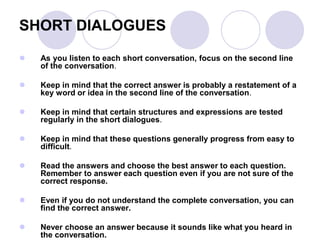
SHORT DIALOGUES
 As you listen to each short conversation, focus on the second line
of the conversation.
 Keep in mind that the correct answer is probably a restatement of a
key word or idea in the second line of the conversation.
 Keep in mind that certain structures and expressions are tested
regularly in the short dialogues.
 Keep in mind that these questions generally progress from easy to
difficult.
 Read the answers and choose the best answer to each question.
Remember to answer each question even if you are not sure of the
correct response.
 Even if you do not understand the complete conversation, you can
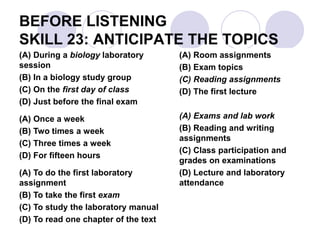
find the correct answer.
 Never choose an answer because it sounds like what you heard in
the conversation.
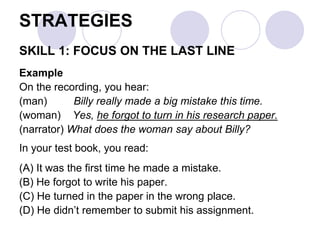
STRATEGIES
SKILL 1: FOCUS ON THE LAST LINE
Example
On the recording, you hear:
(man) Billy really made a big mistake this time.
(woman) Yes, he forgot to turn in his research paper.
(narrator) What does the woman say about Billy?
In your test book, you read:
(A) It was the first time he made a mistake.
(B) He forgot to write his paper.
(C) He turned in the paper in the wrong place.
(D) He didn’t remember to submit his assignment.
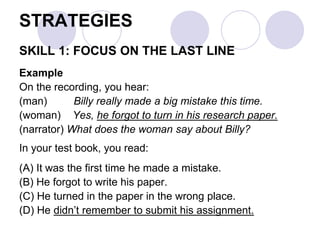
STRATEGIES
SKILL 1: FOCUS ON THE LAST LINE
Example
On the recording, you hear:
(man) Billy really made a big mistake this time.
(woman) Yes, he forgot to turn in his research paper.
(narrator) What does the woman say about Billy?
In your test book, you read:
(A) It was the first time he made a mistake.
(B) He forgot to write his paper.
(C) He turned in the paper in the wrong place.
(D) He didn’t remember to submit his assignment.
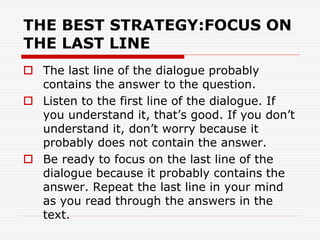
THE BEST STRATEGY:FOCUS ON
THE LAST LINE
 The last line of the dialogue probably
contains the answer to the question.
 Listen to the first line of the dialogue. If
you understand it, that’s good. If you don’t
understand it, don’t worry because it
probably does not contain the answer.
 Be ready to focus on the last line of the
dialogue because it probably contains the
answer. Repeat the last line in your mind
as you read through the answers in the
text.
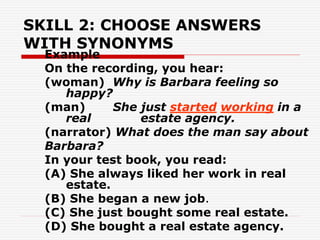
SKILL 2: CHOOSE ANSWERS
WITH SYNONYMS
Example
On the recording, you hear:
(woman) Why is Barbara feeling so
happy?
(man) She just started working in a
real estate agency.
(narrator) What does the man say about
Barbara?
In your test book, you read:
(A) She always liked her work in real
estate.
(B) She began a new job.
(C) She just bought some real estate.
(D) She bought a real estate agency.
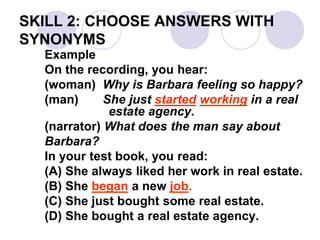
SKILL 2: CHOOSE ANSWERS WITH
SYNONYMS
Example
On the recording, you hear:
(woman) Why is Barbara feeling so happy?
(man) She just started working in a real
estate agency.
(narrator) What does the man say about
Barbara?
In your test book, you read:
(A) She always liked her work in real estate.
(B) She began a new job.
(C) She just bought some real estate.
(D) She bought a real estate agency.
CHOOSE ANSWERS WITH
SYNONYMS
 As you listen to the last line of
the dialogue, focus on key
words in that line.
 If you see any synonyms for key
words in a particular answer,
then you have probably found
the correct answer.
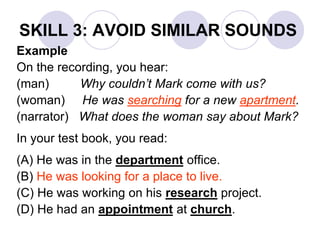
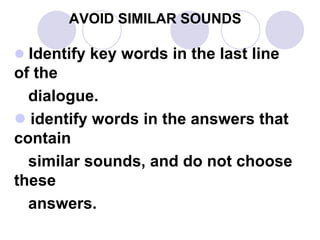
SKILL 3: AVOID SIMILAR SOUNDS
Example
On the recording, you hear:
(man) Why couldn’t Mark come with us?
(woman) He was searching for a new apartment.
(narrator) What does the woman say about Mark?
In your test book, you read:
(A) He was in the department office.
(B) He was looking for a place to live.
(C) He was working on his research project.
(D) He had an appointment at church.
AVOID SIMILAR SOUNDS
 Identify key words in the last line
of the
dialogue.
 identify words in the answers that
contain
similar sounds, and do not choose
these
answers.
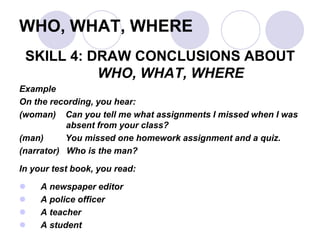
WHO, WHAT, WHERE
SKILL 4: DRAW CONCLUSIONS ABOUT
WHO, WHAT, WHERE
Example
On the recording, you hear:
(woman) Can you tell me what assignments I missed when I was
absent from your class?
(man) You missed one homework assignment and a quiz.
(narrator) Who is the man?
In your test book, you read:
 A newspaper editor
 A police officer
 A teacher
 A student
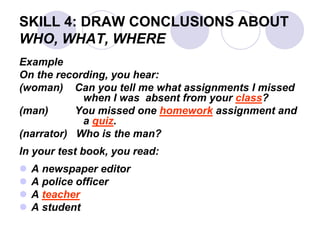
SKILL 4: DRAW CONCLUSIONS ABOUT
WHO, WHAT, WHERE
Example
On the recording, you hear:
(woman) Can you tell me what assignments I missed
when I was absent from your class?
(man) You missed one homework assignment and
a quiz.
(narrator) Who is the man?
In your test book, you read:
 A newspaper editor
 A police officer
 A teacher
 A student
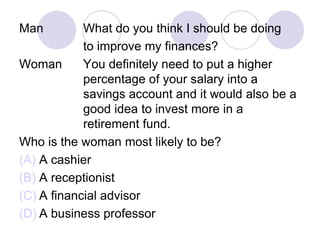
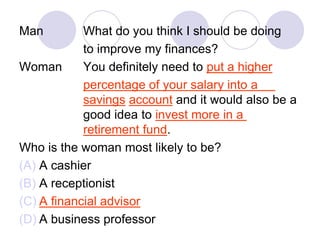
Man What do you think I should be doing
to improve my finances?
Woman You definitely need to put a higher
percentage of your salary into a
savings account and it would also be a
good idea to invest more in a
retirement fund.
Who is the woman most likely to be?
(A) A cashier
(B) A receptionist
(C) A financial advisor
(D) A business professor
Man What do you think I should be doing
to improve my finances?
Woman You definitely need to put a higher
percentage of your salary into a
savings account and it would also be a
good idea to invest more in a
retirement fund.
Who is the woman most likely to be?
(A) A cashier
(B) A receptionist
(C) A financial advisor
(D) A business professor
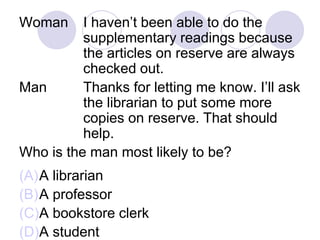
Woman I haven’t been able to do the
supplementary readings because
the articles on reserve are always
checked out.
Man Thanks for letting me know. I’ll ask
the librarian to put some more
copies on reserve. That should
help.
Who is the man most likely to be?
(A)A librarian
(B)A professor
(C)A bookstore clerk
(D)A student
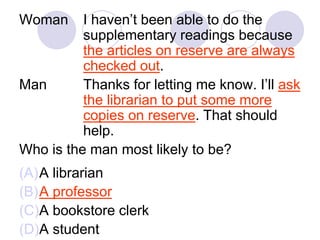
Woman I haven’t been able to do the
supplementary readings because
the articles on reserve are always
checked out.
Man Thanks for letting me know. I’ll ask
the librarian to put some more
copies on reserve. That should
help.
Who is the man most likely to be?
(A)A librarian
(B)A professor
(C)A bookstore clerk
(D)A student
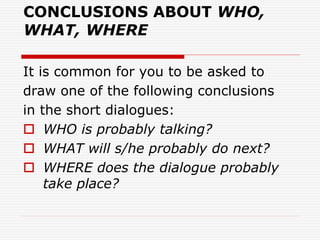
CONCLUSIONS ABOUT WHO,
WHAT, WHERE
It is common for you to be asked to
draw one of the following conclusions
in the short dialogues:
 WHO is probably talking?
 WHAT will s/he probably do next?
 WHERE does the dialogue probably
take place?
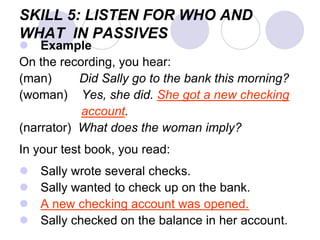
SKILL 5: LISTEN FOR WHO AND
WHAT IN PASSIVES
 Example
On the recording, you hear:
(man) Did Sally go to the bank this morning?
(woman) Yes, she did. She got a new checking
account.
(narrator) What does the woman imply?
In your test book, you read:
 Sally wrote several checks.
 Sally wanted to check up on the bank.
 A new checking account was opened.
 Sally checked on the balance in her account.
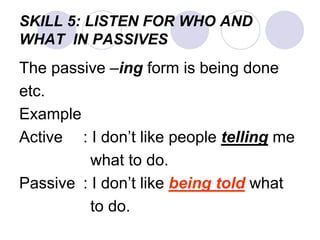
SKILL 5: LISTEN FOR WHO AND
WHAT IN PASSIVES
The passive –ing form is being done
etc.
Example
Active : I don’t like people telling me
what to do.
Passive : I don’t like being told what
to do.
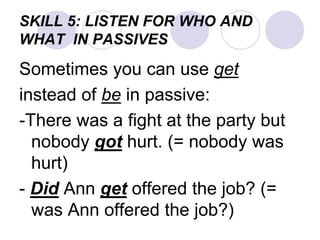
SKILL 5: LISTEN FOR WHO AND
WHAT IN PASSIVES
Sometimes you can use get
instead of be in passive:
-There was a fight at the party but
nobody got hurt. (= nobody was
hurt)
- Did Ann get offered the job? (=
was Ann offered the job?)
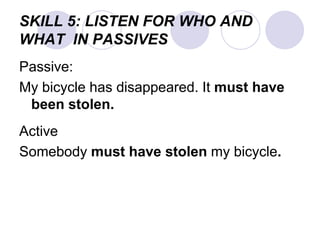
SKILL 5: LISTEN FOR WHO AND
WHAT IN PASSIVES
Passive:
My bicycle has disappeared. It must have
been stolen.
Active
Somebody must have stolen my bicycle.
SKILL 5: LISTEN FOR WHO AND
WHAT IN PASSIVES
Present Continuous
Active: Somebody is cleaning the room at
the moment.
Passive: This room is being cleaned at the
moment.
Look at those houses! They are being
knocked down.
SKILL 5: LISTEN FOR WHO AND
WHAT IN PASSIVES
Present Perfect: have/has been + done
Active: The room look nice. Somebody has
cleaned it.
Passive: The room look nice. It has been
cleaned.
PASSIVE STATEMENTS
 If the dialogue contains a passive
statement, the answer to the
question is often an active
statement.
 If the dialogue contains an active
statement, the answer to the
question is often a passive
statement.
SKILL 6: LISTEN FOR WHO AND
WHAT WITH MULTIPLE NOUNS
 Example
 On the recording, you hear:
 (man) Do you know who is in the band now?
 (woman) I heard that Mara replaced Robert in the
band.
 (narrator) What does the woman say about the band?
 In your test book, you read:
 Robert became a new member of the band.
 Robert took Mara’s place in the band.
 Mara didn’t have a place in the band.
 Mara took Robert’s place in the band.
SKILL 6: LISTEN FOR WHO AND
WHAT WITH MULTIPLE NOUNS
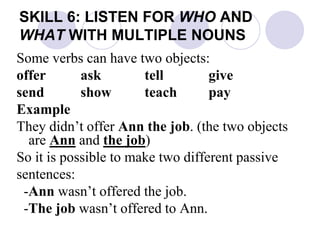
Some verbs can have two objects:
offer ask tell give
send show teach pay
Example
They didn’t offer Ann the job. (the two objects
are Ann and the job)
So it is possible to make two different passive
sentences:
-Ann wasn’t offered the job.
-The job wasn’t offered to Ann.
SKILL 6: LISTEN FOR WHO AND
WHAT WITH MULTIPLE NOUNS
His colleagues gave him a
present when he retired.
SKILL 6: LISTEN FOR WHO AND
WHAT WITH MULTIPLE NOUNS
He was given a present by
his colleagues when he
retired
FUNCTION
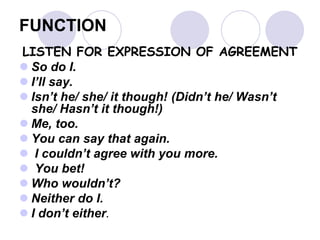
LISTEN FOR EXPRESSION OF AGREEMENT
 So do I.
 I’ll say.
 Isn’t he/ she/ it though! (Didn’t he/ Wasn’t
she/ Hasn’t it though!)
 Me, too.
 You can say that again.
 I couldn’t agree with you more.
 You bet!
 Who wouldn’t?
 Neither do I.
 I don’t either.
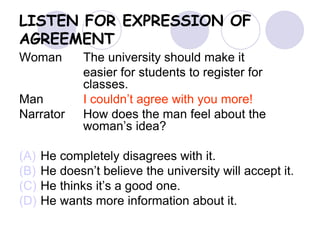
DISAGREEMENT
I don’t think so
That’s not what I think
I can’t say I agree
I couldn’t agree with you less
I’m afraid I don’t agree
Probably not
Not necessarily
Not really
I’m not so sure
LISTEN FOR EXPRESSION OF
AGREEMENT
Woman The university should make it
easier for students to register for
classes.
Man I couldn’t agree with you more!
Narrator How does the man feel about the
woman’s idea?
(A) He completely disagrees with it.
(B) He doesn’t believe the university will accept it.
(C) He thinks it’s a good one.
(D) He wants more information about it.
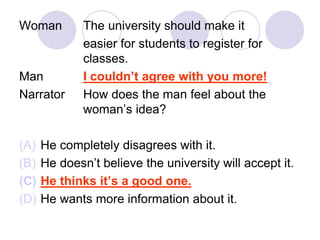
Woman The university should make it
easier for students to register for
classes.
Man I couldn’t agree with you more!
Narrator How does the man feel about the
woman’s idea?
(A) He completely disagrees with it.
(B) He doesn’t believe the university will accept it.
(C) He thinks it’s a good one.
(D) He wants more information about it.
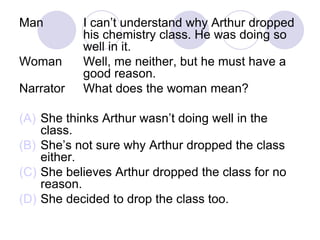
Man I can’t understand why Arthur dropped
his chemistry class. He was doing so
well in it.
Woman Well, me neither, but he must have a
good reason.
Narrator What does the woman mean?
(A) She thinks Arthur wasn’t doing well in the
class.
(B) She’s not sure why Arthur dropped the class
either.
(C) She believes Arthur dropped the class for no
reason.
(D) She decided to drop the class too.
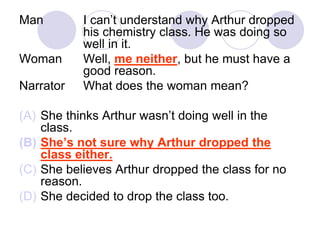
Man I can’t understand why Arthur dropped
his chemistry class. He was doing so
well in it.
Woman Well, me neither, but he must have a
good reason.
Narrator What does the woman mean?
(A) She thinks Arthur wasn’t doing well in the
class.
(B) She’s not sure why Arthur dropped the
class either.
(C) She believes Arthur dropped the class for no
reason.
(D) She decided to drop the class too.
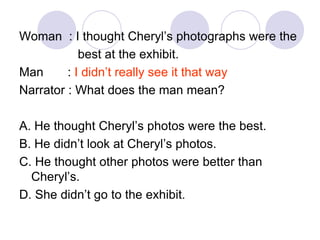
Woman : I thought Cheryl’s photographs were the
best at the exhibit.
Man : I didn’t really see it that way
Narrator : What does the man mean?
A. He thought Cheryl’s photos were the best.
B. He didn’t look at Cheryl’s photos.
C. He thought other photos were better than
Cheryl’s.
D. She didn’t go to the exhibit.
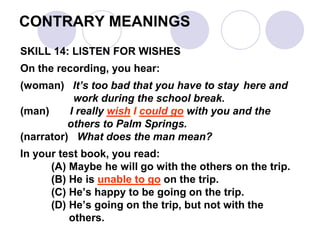
CONTRARY MEANINGS
SKILL 14: LISTEN FOR WISHES
On the recording, you hear:
(woman) It’s too bad that you have to stay here and
work during the school break.
(man) I really wish I could go with you and the
others to Palm Springs.
(narrator) What does the man mean?
In your test book, you read:
(A) Maybe he will go with the others on the trip.
(B) He is unable to go on the trip.
(C) He’s happy to be going on the trip.
(D) He’s going on the trip, but not with the
others.
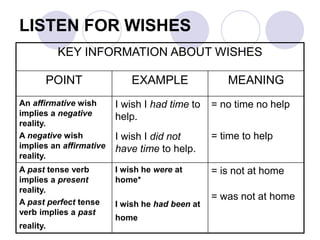
LISTEN FOR WISHES
KEY INFORMATION ABOUT WISHES
POINT EXAMPLE MEANING
An affirmative wish
implies a negative
reality.
A negative wish
implies an affirmative
reality.
I wish I had time to
help.
I wish I did not
have time to help.
= no time no help
= time to help
A past tense verb
implies a present
reality.
A past perfect tense
verb implies a past
reality.
I wish he were at
home*
I wish he had been at
home
= is not at home
= was not at home
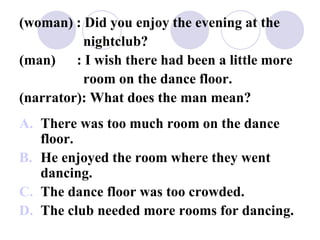
(woman) : Did you enjoy the evening at the
nightclub?
(man) : I wish there had been a little more
room on the dance floor.
(narrator): What does the man mean?
A. There was too much room on the dance
floor.
B. He enjoyed the room where they went
dancing.
C. The dance floor was too crowded.
D. The club needed more rooms for dancing.
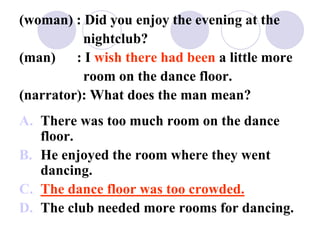
(woman) : Did you enjoy the evening at the
nightclub?
(man) : I wish there had been a little more
room on the dance floor.
(narrator): What does the man mean?
A. There was too much room on the dance
floor.
B. He enjoyed the room where they went
dancing.
C. The dance floor was too crowded.
D. The club needed more rooms for dancing.
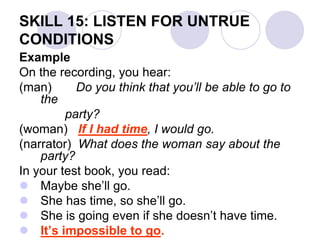
SKILL 15: LISTEN FOR UNTRUE
CONDITIONS
Example
On the recording, you hear:
(man) Do you think that you’ll be able to go to
the
party?
(woman) If I had time, I would go.
(narrator) What does the woman say about the
party?
In your test book, you read:
 Maybe she’ll go.
 She has time, so she’ll go.
 She is going even if she doesn’t have time.
 It’s impossible to go.
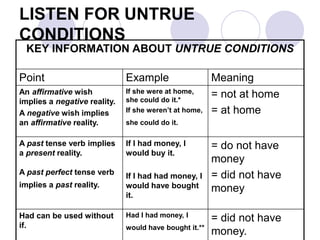
LISTEN FOR UNTRUE
CONDITIONS
KEY INFORMATION ABOUT UNTRUE CONDITIONS
Point Example Meaning
An affirmative wish
implies a negative reality.
A negative wish implies
an affirmative reality.
If she were at home,
she could do it.*
If she weren’t at home,
she could do it.
= not at home
= at home
A past tense verb implies
a present reality.
A past perfect tense verb
implies a past reality.
If I had money, I
would buy it.
If I had had money, I
would have bought
it.
= do not have
money
= did not have
money
Had can be used without
if.
Had I had money, I
would have bought it.**
= did not have
money.
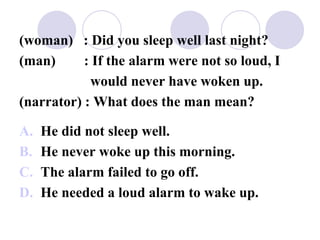
(woman) : Did you sleep well last night?
(man) : If the alarm were not so loud, I
would never have woken up.
(narrator) : What does the man mean?
A. He did not sleep well.
B. He never woke up this morning.
C. The alarm failed to go off.
D. He needed a loud alarm to wake up.
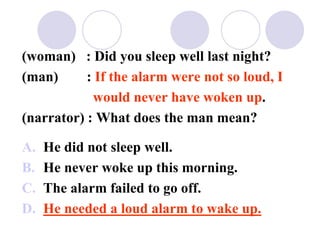
(woman) : Did you sleep well last night?
(man) : If the alarm were not so loud, I
would never have woken up.
(narrator) : What does the man mean?
A. He did not sleep well.
B. He never woke up this morning.
C. The alarm failed to go off.
D. He needed a loud alarm to wake up.
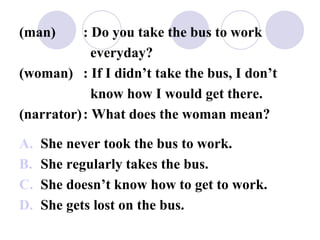
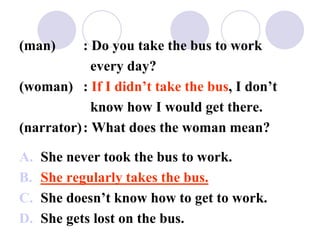
(man) : Do you take the bus to work
everyday?
(woman) : If I didn’t take the bus, I don’t
know how I would get there.
(narrator): What does the woman mean?
A. She never took the bus to work.
B. She regularly takes the bus.
C. She doesn’t know how to get to work.
D. She gets lost on the bus.
(man) : Do you take the bus to work
every day?
(woman) : If I didn’t take the bus, I don’t
know how I would get there.
(narrator): What does the woman mean?
A. She never took the bus to work.
B. She regularly takes the bus.
C. She doesn’t know how to get to work.
D. She gets lost on the bus.
IDIOMATIC LANGUAGE
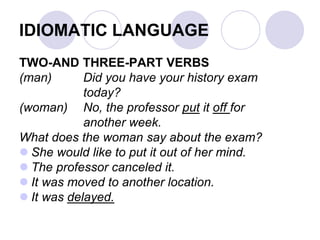
TWO-AND THREE-PART VERBS
(man) Did you have your history exam
today?
(woman) No, the professor put it off for
another week.
What does the woman say about the exam?
 She would like to put it out of her mind.
 The professor canceled it.
 It was moved to another location.
 It was delayed.
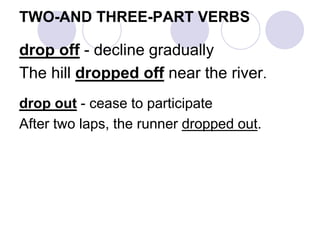
TWO-AND THREE-PART VERBS
drop off - decline gradually
The hill dropped off near the river.
drop out - cease to participate
After two laps, the runner dropped out.
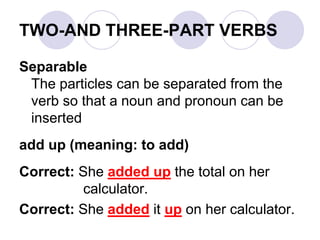
TWO-AND THREE-PART VERBS
Separable
The particles can be separated from the
verb so that a noun and pronoun can be
inserted
add up (meaning: to add)
Correct: She added up the total on her
calculator.
Correct: She added it up on her calculator.
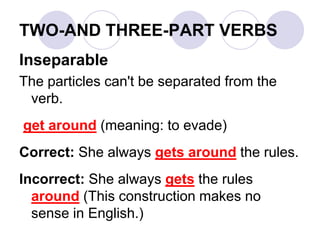
TWO-AND THREE-PART VERBS
Inseparable
The particles can't be separated from the
verb.
get around (meaning: to evade)
Correct: She always gets around the rules.
Incorrect: She always gets the rules
around (This construction makes no
sense in English.)
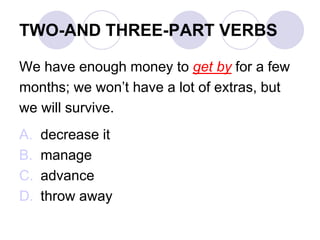
TWO-AND THREE-PART VERBS
We have enough money to get by for a few
months; we won’t have a lot of extras, but
we will survive.
A. decrease it
B. manage
C. advance
D. throw away
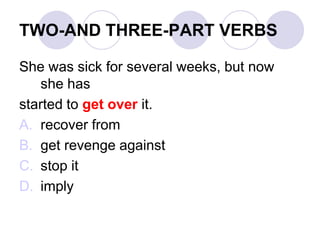
TWO-AND THREE-PART VERBS
She was sick for several weeks, but now
she has
started to get over it.
A. recover from
B. get revenge against
C. stop it
D. imply
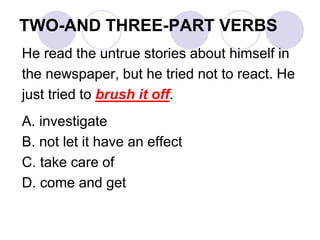
TWO-AND THREE-PART VERBS
He read the untrue stories about himself in
the newspaper, but he tried not to react. He
just tried to brush it off.
A. investigate
B. not let it have an effect
C. take care of
D. come and get
TWO-AND THREE-PART VERBS
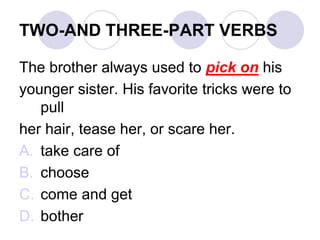
The brother always used to pick on his
younger sister. His favorite tricks were to
pull
her hair, tease her, or scare her.
A. take care of
B. choose
C. come and get
D. bother
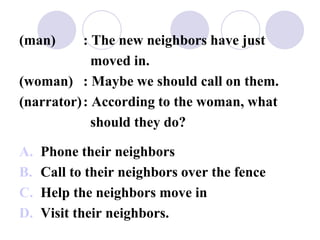
(man) : The new neighbors have just
moved in.
(woman) : Maybe we should call on them.
(narrator): According to the woman, what
should they do?
A. Phone their neighbors
B. Call to their neighbors over the fence
C. Help the neighbors move in
D. Visit their neighbors.
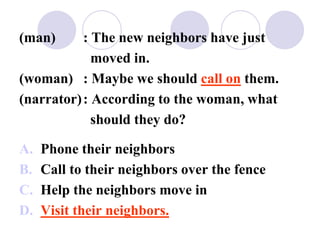
(man) : The new neighbors have just
moved in.
(woman) : Maybe we should call on them.
(narrator): According to the woman, what
should they do?
A. Phone their neighbors
B. Call to their neighbors over the fence
C. Help the neighbors move in
D. Visit their neighbors.
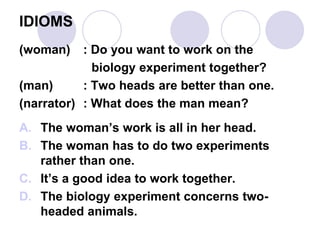
IDIOMS
(woman) : Do you want to work on the
biology experiment together?
(man) : Two heads are better than one.
(narrator) : What does the man mean?
A. The woman’s work is all in her head.
B. The woman has to do two experiments
rather than one.
C. It’s a good idea to work together.
D. The biology experiment concerns two-
headed animals.
IDIOMS
(woman) : Do you want to work on the
biology experiment together?
(man) : Two heads are better than one.
(narrator) : What does the man mean?
A. The woman’s work is all in her head.
B. The woman has to do two experiments
rather than one.
C. It’s a good idea to work together.
D. The biology experiment concerns two-
headed animals.
LONG CONVERSATIONS
STRATEGIES FOR THE LONG CONVERSATIONS
 If you have time, preview the answers to the
questions.
 Listen carefully to the first line of the
conversation.
 As you listen to the conversation, draw
conclusions about the situation of the
conversation: who is talking, where the
conversation takes place, or when it takes
place.
 As you listen to the conversation, follow along
with the answers in your test book and try to
determine the correct answers.
 You should guess even if you are not sure.
 Use any remaining time to look ahead at the
answers to the questions that follow.
BEFORE LISTENING
SKILL 18: ANTICIPATE THE TOPICS
- Look briefly at the answers in the
test book, before you actually hear
the conversations on the
recording.
- Try to determine the topics of the
conversations that you will hear.
BEFORE LISTENING
SKILL 19: ANTICIPATE THE QUESTIONS
Example
In your test book, you read:
(A) In the airport
(B) In the library
(C) In the dormitory
(D) In the travel agent’s office
You try to anticipate the question:
Where does the conversation probably take place?
WHILE LISTENING
SKILL 20: DETERMINE THE TOPIC
Example:
On the recording, you hear:
(narrator) Listen to the conversation between two
students.
(man) You can’t believe what I just got!
(woman) I bet you got that new car you’ve always
wanted.
(man) Now, how in the world did you
figure that out?
You think:
The topic of conversation is the new car that the
man just got.
WHILE LISTENING
SKILL 21: DRAW CONCLUSIONS ABOUT
WHO,
WHAT, WHEN, WHERE
Who is talking?
When does the conversation probably
take place?
Where does the conversation probably
take place?
What is the source of information for
the conversation?
SKILL 21: DRAW CONCLUSIONS ABOUT WHO,
WHAT, WHEN, WHERE
Example
On the recording, you hear:
(man) Why do you have so many books?
(woman) I need them for my paper on George
Washington. Do you know how I can check
them out?
(man) Yes, you should go downstairs to the
circulation desk and fill out a card for each
book.
You think:
 Who is probably talking? (two students)
 Where are they? (in the library)
 What course are they discussing? (American History)
WHILE LISTENING
SKILL 22: LISTEN FOR ANSWERS IN
ORDER
You can just listen to the
conversation (and ignore the
answers)
You can follow along with the
answers while you listen.
LONG TALKS
STRATEGIES FOR THE LONG TALKS
 If you have time, preview the answers to
the questions.
 Listen carefully to the first line of the
talk.
 As you listen to the talk, draw
conclusions about the situation of the
talk: who is talking, where or when the
talk takes place, which course this
lecture might be given in.
 You should guess even if you are not
sure.
 Use any remaining time to look ahead at
the answers to the questions that follow.
BEFORE LISTENING
SKILL 23: ANTICIPATE THE TOPICS
(A) During a biology laboratory
session
(B) In a biology study group
(C) On the first day of class
(D) Just before the final exam
(A) Once a week
(B) Two times a week
(C) Three times a week
(D) For fifteen hours
(A) To do the first laboratory
assignment
(B) To take the first exam
(C) To study the laboratory manual
(D) To read one chapter of the text
(A) Room assignments
(B) Exam topics
(C) Reading assignments
(D) The first lecture
(A) Exams and lab work
(B) Reading and writing
assignments
(C) Class participation and
grades on examinations
(D) Lecture and laboratory
attendance
BEFORE LISTENING
SKILL 24: ANTICIPATE THE
QUESTIONS
Example
In your test book, you read:
 For three weeks
 For three days
 For three months
 For three hours
You try to anticipate the question:
How long does (something) last?
BEFORE LISTENING
SKILL 24: ANTICIPATE THE
QUESTIONS
Question: ___________
(A)What caused the Ring of Fire
(B)The volcanoes of the Ring of Fire
(C)Hawaiian volcanoes
(D)Different types of volcanoes
WHILE LISTENING
SKILL 25: DETERMINE THE TOPIC
Example:
On the recording, you hear:
(man) The major earthquake that
occurred east of Los Angeles in
1971 is still affecting the economy
of the area today.
You think:
The topic of the talk is the effect of the
1971
earthquake on Los Angeles today.
WHILE LISTENING
SKILL 26: DRAW CONCLUSIONS ABOUT
WHO, WHAT, WHEN, WHERE
Who is talking?
When does the talk probably take place?
Where does the talk probably take place?
What course is the talk concerned with?
What is the source of information for the
talk?
(narrator) Listen to the beginning of Talk 1, and
try to imagine the situation.
(woman) Welcome to Biology 101. I’m
Professor Martin, and this is your
laboratory assistant, Peter Smith. This
course meets twice a week for lecture and
once a week for laboratory assignment.
1. WHO IS PROBABLY TALKING?
2. WHERE DOES THE TALK PROBABLY TAKE PLACE?
3. WHEN DOES THE TALK PROBABLY TAKE PLACE?
4. WHAT COURSE IS BEING DISCUSSED?
WHILE LISTENING
SKILL 27: LISTEN FOR ANSWERS IN
ORDER
There are two possible methods to use while
you listen to the talks.
You can just listen to the talk (and ignore
the answers).
You can follow along with the answers
while you listen.
References
Phillips, Deborah. 2001. Longman Complete
Course for the TOEFL Test. New York:
Addison-Wesley Longman, Inc.
and
Any sources from the internet and books
.

LISTENING.ppt

  • 1.
    TOEFL PREPARATION 2 TOEFL =Test of English as a Foreign Language 1. TOEFL International (CBT) 2. TOEFL ITP (Institutional Testing Program) = PBT 3. TOEFL Prediction
  • 2.
    TOEFL SCORE 380 -< 450: Elementary proficiency Able to satisfy basic survival requirements, maintain very simple face to face conversations on familiar topics; thinks in native language and translates into English.
  • 3.
    TOEFL SCORE 450 –< 550: Intermediate Proficiency Can initiate and maintain predictable face-to-face conversations; range and control of language limited; demonstrates emerging, but not consistent, basic grammar, can read very simple English texts.
  • 4.
    TOEFL SCORE 550 –< 630: Working Proficiency Able to satisfy routine social demands; facility with concrete subject matter and language; however, needs more practice in academic-level reading.
  • 5.
    TOEFL SCORE 630 –677: Advanced Working Proficiency Approaching native proficiency in English; able to satisfy most university- level academic requirements with language usage that is often, but not always, acceptable and effective; however, effective use of language may deteriorate under tension or pressure.
  • 6.
    Plan for Preparation •First, concentrate on Listening, Structure, and Reading, instead of on vocabulary. • Second, spend time preparing everyday for at least an hour. • Finally, do not try to memorize questions from this or any other book.
  • 7.
  • 8.
    GENERAL STRATEGIES  Befamiliar with the directions.  Listen carefully to the conversations and talks.  Know where the easier and more difficult questions are generally found.  Never leave any questions blank on your answer sheet.  Use any remaining time to look ahead at the answers to the questions that follow.
  • 9.
    SHORT DIALOGUES  Asyou listen to each short conversation, focus on the second line of the conversation.  Keep in mind that the correct answer is probably a restatement of a key word or idea in the second line of the conversation.  Keep in mind that certain structures and expressions are tested regularly in the short dialogues.  Keep in mind that these questions generally progress from easy to difficult.  Read the answers and choose the best answer to each question. Remember to answer each question even if you are not sure of the correct response.  Even if you do not understand the complete conversation, you can find the correct answer.  Never choose an answer because it sounds like what you heard in the conversation.
  • 10.
    STRATEGIES SKILL 1: FOCUSON THE LAST LINE Example On the recording, you hear: (man) Billy really made a big mistake this time. (woman) Yes, he forgot to turn in his research paper. (narrator) What does the woman say about Billy? In your test book, you read: (A) It was the first time he made a mistake. (B) He forgot to write his paper. (C) He turned in the paper in the wrong place. (D) He didn’t remember to submit his assignment.
  • 11.
    STRATEGIES SKILL 1: FOCUSON THE LAST LINE Example On the recording, you hear: (man) Billy really made a big mistake this time. (woman) Yes, he forgot to turn in his research paper. (narrator) What does the woman say about Billy? In your test book, you read: (A) It was the first time he made a mistake. (B) He forgot to write his paper. (C) He turned in the paper in the wrong place. (D) He didn’t remember to submit his assignment.
  • 12.
    THE BEST STRATEGY:FOCUSON THE LAST LINE  The last line of the dialogue probably contains the answer to the question.  Listen to the first line of the dialogue. If you understand it, that’s good. If you don’t understand it, don’t worry because it probably does not contain the answer.  Be ready to focus on the last line of the dialogue because it probably contains the answer. Repeat the last line in your mind as you read through the answers in the text.
  • 13.
    SKILL 2: CHOOSEANSWERS WITH SYNONYMS Example On the recording, you hear: (woman) Why is Barbara feeling so happy? (man) She just started working in a real estate agency. (narrator) What does the man say about Barbara? In your test book, you read: (A) She always liked her work in real estate. (B) She began a new job. (C) She just bought some real estate. (D) She bought a real estate agency.
  • 14.
    SKILL 2: CHOOSEANSWERS WITH SYNONYMS Example On the recording, you hear: (woman) Why is Barbara feeling so happy? (man) She just started working in a real estate agency. (narrator) What does the man say about Barbara? In your test book, you read: (A) She always liked her work in real estate. (B) She began a new job. (C) She just bought some real estate. (D) She bought a real estate agency.
  • 15.
    CHOOSE ANSWERS WITH SYNONYMS As you listen to the last line of the dialogue, focus on key words in that line.  If you see any synonyms for key words in a particular answer, then you have probably found the correct answer.
  • 16.
    SKILL 3: AVOIDSIMILAR SOUNDS Example On the recording, you hear: (man) Why couldn’t Mark come with us? (woman) He was searching for a new apartment. (narrator) What does the woman say about Mark? In your test book, you read: (A) He was in the department office. (B) He was looking for a place to live. (C) He was working on his research project. (D) He had an appointment at church.
  • 17.
    AVOID SIMILAR SOUNDS Identify key words in the last line of the dialogue.  identify words in the answers that contain similar sounds, and do not choose these answers.
  • 18.
    WHO, WHAT, WHERE SKILL4: DRAW CONCLUSIONS ABOUT WHO, WHAT, WHERE Example On the recording, you hear: (woman) Can you tell me what assignments I missed when I was absent from your class? (man) You missed one homework assignment and a quiz. (narrator) Who is the man? In your test book, you read:  A newspaper editor  A police officer  A teacher  A student
  • 19.
    SKILL 4: DRAWCONCLUSIONS ABOUT WHO, WHAT, WHERE Example On the recording, you hear: (woman) Can you tell me what assignments I missed when I was absent from your class? (man) You missed one homework assignment and a quiz. (narrator) Who is the man? In your test book, you read:  A newspaper editor  A police officer  A teacher  A student
  • 20.
    Man What doyou think I should be doing to improve my finances? Woman You definitely need to put a higher percentage of your salary into a savings account and it would also be a good idea to invest more in a retirement fund. Who is the woman most likely to be? (A) A cashier (B) A receptionist (C) A financial advisor (D) A business professor
  • 21.
    Man What doyou think I should be doing to improve my finances? Woman You definitely need to put a higher percentage of your salary into a savings account and it would also be a good idea to invest more in a retirement fund. Who is the woman most likely to be? (A) A cashier (B) A receptionist (C) A financial advisor (D) A business professor
  • 22.
    Woman I haven’tbeen able to do the supplementary readings because the articles on reserve are always checked out. Man Thanks for letting me know. I’ll ask the librarian to put some more copies on reserve. That should help. Who is the man most likely to be? (A)A librarian (B)A professor (C)A bookstore clerk (D)A student
  • 23.
    Woman I haven’tbeen able to do the supplementary readings because the articles on reserve are always checked out. Man Thanks for letting me know. I’ll ask the librarian to put some more copies on reserve. That should help. Who is the man most likely to be? (A)A librarian (B)A professor (C)A bookstore clerk (D)A student
  • 24.
    CONCLUSIONS ABOUT WHO, WHAT,WHERE It is common for you to be asked to draw one of the following conclusions in the short dialogues:  WHO is probably talking?  WHAT will s/he probably do next?  WHERE does the dialogue probably take place?
  • 25.
    SKILL 5: LISTENFOR WHO AND WHAT IN PASSIVES  Example On the recording, you hear: (man) Did Sally go to the bank this morning? (woman) Yes, she did. She got a new checking account. (narrator) What does the woman imply? In your test book, you read:  Sally wrote several checks.  Sally wanted to check up on the bank.  A new checking account was opened.  Sally checked on the balance in her account.
  • 26.
    SKILL 5: LISTENFOR WHO AND WHAT IN PASSIVES The passive –ing form is being done etc. Example Active : I don’t like people telling me what to do. Passive : I don’t like being told what to do.
  • 27.
    SKILL 5: LISTENFOR WHO AND WHAT IN PASSIVES Sometimes you can use get instead of be in passive: -There was a fight at the party but nobody got hurt. (= nobody was hurt) - Did Ann get offered the job? (= was Ann offered the job?)
  • 28.
    SKILL 5: LISTENFOR WHO AND WHAT IN PASSIVES Passive: My bicycle has disappeared. It must have been stolen. Active Somebody must have stolen my bicycle.
  • 29.
    SKILL 5: LISTENFOR WHO AND WHAT IN PASSIVES Present Continuous Active: Somebody is cleaning the room at the moment. Passive: This room is being cleaned at the moment. Look at those houses! They are being knocked down.
  • 30.
    SKILL 5: LISTENFOR WHO AND WHAT IN PASSIVES Present Perfect: have/has been + done Active: The room look nice. Somebody has cleaned it. Passive: The room look nice. It has been cleaned.
  • 31.
    PASSIVE STATEMENTS  Ifthe dialogue contains a passive statement, the answer to the question is often an active statement.  If the dialogue contains an active statement, the answer to the question is often a passive statement.
  • 32.
    SKILL 6: LISTENFOR WHO AND WHAT WITH MULTIPLE NOUNS  Example  On the recording, you hear:  (man) Do you know who is in the band now?  (woman) I heard that Mara replaced Robert in the band.  (narrator) What does the woman say about the band?  In your test book, you read:  Robert became a new member of the band.  Robert took Mara’s place in the band.  Mara didn’t have a place in the band.  Mara took Robert’s place in the band.
  • 33.
    SKILL 6: LISTENFOR WHO AND WHAT WITH MULTIPLE NOUNS Some verbs can have two objects: offer ask tell give send show teach pay Example They didn’t offer Ann the job. (the two objects are Ann and the job) So it is possible to make two different passive sentences: -Ann wasn’t offered the job. -The job wasn’t offered to Ann.
  • 34.
    SKILL 6: LISTENFOR WHO AND WHAT WITH MULTIPLE NOUNS His colleagues gave him a present when he retired.
  • 35.
    SKILL 6: LISTENFOR WHO AND WHAT WITH MULTIPLE NOUNS He was given a present by his colleagues when he retired
  • 36.
    FUNCTION LISTEN FOR EXPRESSIONOF AGREEMENT  So do I.  I’ll say.  Isn’t he/ she/ it though! (Didn’t he/ Wasn’t she/ Hasn’t it though!)  Me, too.  You can say that again.  I couldn’t agree with you more.  You bet!  Who wouldn’t?  Neither do I.  I don’t either.
  • 37.
    DISAGREEMENT I don’t thinkso That’s not what I think I can’t say I agree I couldn’t agree with you less I’m afraid I don’t agree Probably not Not necessarily Not really I’m not so sure
  • 38.
    LISTEN FOR EXPRESSIONOF AGREEMENT Woman The university should make it easier for students to register for classes. Man I couldn’t agree with you more! Narrator How does the man feel about the woman’s idea? (A) He completely disagrees with it. (B) He doesn’t believe the university will accept it. (C) He thinks it’s a good one. (D) He wants more information about it.
  • 39.
    Woman The universityshould make it easier for students to register for classes. Man I couldn’t agree with you more! Narrator How does the man feel about the woman’s idea? (A) He completely disagrees with it. (B) He doesn’t believe the university will accept it. (C) He thinks it’s a good one. (D) He wants more information about it.
  • 40.
    Man I can’tunderstand why Arthur dropped his chemistry class. He was doing so well in it. Woman Well, me neither, but he must have a good reason. Narrator What does the woman mean? (A) She thinks Arthur wasn’t doing well in the class. (B) She’s not sure why Arthur dropped the class either. (C) She believes Arthur dropped the class for no reason. (D) She decided to drop the class too.
  • 41.
    Man I can’tunderstand why Arthur dropped his chemistry class. He was doing so well in it. Woman Well, me neither, but he must have a good reason. Narrator What does the woman mean? (A) She thinks Arthur wasn’t doing well in the class. (B) She’s not sure why Arthur dropped the class either. (C) She believes Arthur dropped the class for no reason. (D) She decided to drop the class too.
  • 42.
    Woman : Ithought Cheryl’s photographs were the best at the exhibit. Man : I didn’t really see it that way Narrator : What does the man mean? A. He thought Cheryl’s photos were the best. B. He didn’t look at Cheryl’s photos. C. He thought other photos were better than Cheryl’s. D. She didn’t go to the exhibit.
  • 43.
    CONTRARY MEANINGS SKILL 14:LISTEN FOR WISHES On the recording, you hear: (woman) It’s too bad that you have to stay here and work during the school break. (man) I really wish I could go with you and the others to Palm Springs. (narrator) What does the man mean? In your test book, you read: (A) Maybe he will go with the others on the trip. (B) He is unable to go on the trip. (C) He’s happy to be going on the trip. (D) He’s going on the trip, but not with the others.
  • 44.
    LISTEN FOR WISHES KEYINFORMATION ABOUT WISHES POINT EXAMPLE MEANING An affirmative wish implies a negative reality. A negative wish implies an affirmative reality. I wish I had time to help. I wish I did not have time to help. = no time no help = time to help A past tense verb implies a present reality. A past perfect tense verb implies a past reality. I wish he were at home* I wish he had been at home = is not at home = was not at home
  • 45.
    (woman) : Didyou enjoy the evening at the nightclub? (man) : I wish there had been a little more room on the dance floor. (narrator): What does the man mean? A. There was too much room on the dance floor. B. He enjoyed the room where they went dancing. C. The dance floor was too crowded. D. The club needed more rooms for dancing.
  • 46.
    (woman) : Didyou enjoy the evening at the nightclub? (man) : I wish there had been a little more room on the dance floor. (narrator): What does the man mean? A. There was too much room on the dance floor. B. He enjoyed the room where they went dancing. C. The dance floor was too crowded. D. The club needed more rooms for dancing.
  • 47.
    SKILL 15: LISTENFOR UNTRUE CONDITIONS Example On the recording, you hear: (man) Do you think that you’ll be able to go to the party? (woman) If I had time, I would go. (narrator) What does the woman say about the party? In your test book, you read:  Maybe she’ll go.  She has time, so she’ll go.  She is going even if she doesn’t have time.  It’s impossible to go.
  • 48.
    LISTEN FOR UNTRUE CONDITIONS KEYINFORMATION ABOUT UNTRUE CONDITIONS Point Example Meaning An affirmative wish implies a negative reality. A negative wish implies an affirmative reality. If she were at home, she could do it.* If she weren’t at home, she could do it. = not at home = at home A past tense verb implies a present reality. A past perfect tense verb implies a past reality. If I had money, I would buy it. If I had had money, I would have bought it. = do not have money = did not have money Had can be used without if. Had I had money, I would have bought it.** = did not have money.
  • 49.
    (woman) : Didyou sleep well last night? (man) : If the alarm were not so loud, I would never have woken up. (narrator) : What does the man mean? A. He did not sleep well. B. He never woke up this morning. C. The alarm failed to go off. D. He needed a loud alarm to wake up.
  • 50.
    (woman) : Didyou sleep well last night? (man) : If the alarm were not so loud, I would never have woken up. (narrator) : What does the man mean? A. He did not sleep well. B. He never woke up this morning. C. The alarm failed to go off. D. He needed a loud alarm to wake up.
  • 51.
    (man) : Doyou take the bus to work everyday? (woman) : If I didn’t take the bus, I don’t know how I would get there. (narrator): What does the woman mean? A. She never took the bus to work. B. She regularly takes the bus. C. She doesn’t know how to get to work. D. She gets lost on the bus.
  • 52.
    (man) : Doyou take the bus to work every day? (woman) : If I didn’t take the bus, I don’t know how I would get there. (narrator): What does the woman mean? A. She never took the bus to work. B. She regularly takes the bus. C. She doesn’t know how to get to work. D. She gets lost on the bus.
  • 53.
    IDIOMATIC LANGUAGE TWO-AND THREE-PARTVERBS (man) Did you have your history exam today? (woman) No, the professor put it off for another week. What does the woman say about the exam?  She would like to put it out of her mind.  The professor canceled it.  It was moved to another location.  It was delayed.
  • 54.
    TWO-AND THREE-PART VERBS dropoff - decline gradually The hill dropped off near the river. drop out - cease to participate After two laps, the runner dropped out.
  • 55.
    TWO-AND THREE-PART VERBS Separable Theparticles can be separated from the verb so that a noun and pronoun can be inserted add up (meaning: to add) Correct: She added up the total on her calculator. Correct: She added it up on her calculator.
  • 56.
    TWO-AND THREE-PART VERBS Inseparable Theparticles can't be separated from the verb. get around (meaning: to evade) Correct: She always gets around the rules. Incorrect: She always gets the rules around (This construction makes no sense in English.)
  • 57.
    TWO-AND THREE-PART VERBS Wehave enough money to get by for a few months; we won’t have a lot of extras, but we will survive. A. decrease it B. manage C. advance D. throw away
  • 58.
    TWO-AND THREE-PART VERBS Shewas sick for several weeks, but now she has started to get over it. A. recover from B. get revenge against C. stop it D. imply
  • 59.
    TWO-AND THREE-PART VERBS Heread the untrue stories about himself in the newspaper, but he tried not to react. He just tried to brush it off. A. investigate B. not let it have an effect C. take care of D. come and get
  • 60.
    TWO-AND THREE-PART VERBS Thebrother always used to pick on his younger sister. His favorite tricks were to pull her hair, tease her, or scare her. A. take care of B. choose C. come and get D. bother
  • 61.
    (man) : Thenew neighbors have just moved in. (woman) : Maybe we should call on them. (narrator): According to the woman, what should they do? A. Phone their neighbors B. Call to their neighbors over the fence C. Help the neighbors move in D. Visit their neighbors.
  • 62.
    (man) : Thenew neighbors have just moved in. (woman) : Maybe we should call on them. (narrator): According to the woman, what should they do? A. Phone their neighbors B. Call to their neighbors over the fence C. Help the neighbors move in D. Visit their neighbors.
  • 63.
    IDIOMS (woman) : Doyou want to work on the biology experiment together? (man) : Two heads are better than one. (narrator) : What does the man mean? A. The woman’s work is all in her head. B. The woman has to do two experiments rather than one. C. It’s a good idea to work together. D. The biology experiment concerns two- headed animals.
  • 64.
    IDIOMS (woman) : Doyou want to work on the biology experiment together? (man) : Two heads are better than one. (narrator) : What does the man mean? A. The woman’s work is all in her head. B. The woman has to do two experiments rather than one. C. It’s a good idea to work together. D. The biology experiment concerns two- headed animals.
  • 65.
    LONG CONVERSATIONS STRATEGIES FORTHE LONG CONVERSATIONS  If you have time, preview the answers to the questions.  Listen carefully to the first line of the conversation.  As you listen to the conversation, draw conclusions about the situation of the conversation: who is talking, where the conversation takes place, or when it takes place.  As you listen to the conversation, follow along with the answers in your test book and try to determine the correct answers.  You should guess even if you are not sure.  Use any remaining time to look ahead at the answers to the questions that follow.
  • 66.
    BEFORE LISTENING SKILL 18:ANTICIPATE THE TOPICS - Look briefly at the answers in the test book, before you actually hear the conversations on the recording. - Try to determine the topics of the conversations that you will hear.
  • 67.
    BEFORE LISTENING SKILL 19:ANTICIPATE THE QUESTIONS Example In your test book, you read: (A) In the airport (B) In the library (C) In the dormitory (D) In the travel agent’s office You try to anticipate the question: Where does the conversation probably take place?
  • 68.
    WHILE LISTENING SKILL 20:DETERMINE THE TOPIC Example: On the recording, you hear: (narrator) Listen to the conversation between two students. (man) You can’t believe what I just got! (woman) I bet you got that new car you’ve always wanted. (man) Now, how in the world did you figure that out? You think: The topic of conversation is the new car that the man just got.
  • 69.
    WHILE LISTENING SKILL 21:DRAW CONCLUSIONS ABOUT WHO, WHAT, WHEN, WHERE Who is talking? When does the conversation probably take place? Where does the conversation probably take place? What is the source of information for the conversation?
  • 70.
    SKILL 21: DRAWCONCLUSIONS ABOUT WHO, WHAT, WHEN, WHERE Example On the recording, you hear: (man) Why do you have so many books? (woman) I need them for my paper on George Washington. Do you know how I can check them out? (man) Yes, you should go downstairs to the circulation desk and fill out a card for each book. You think:  Who is probably talking? (two students)  Where are they? (in the library)  What course are they discussing? (American History)
  • 71.
    WHILE LISTENING SKILL 22:LISTEN FOR ANSWERS IN ORDER You can just listen to the conversation (and ignore the answers) You can follow along with the answers while you listen.
  • 72.
    LONG TALKS STRATEGIES FORTHE LONG TALKS  If you have time, preview the answers to the questions.  Listen carefully to the first line of the talk.  As you listen to the talk, draw conclusions about the situation of the talk: who is talking, where or when the talk takes place, which course this lecture might be given in.  You should guess even if you are not sure.  Use any remaining time to look ahead at the answers to the questions that follow.
  • 73.
    BEFORE LISTENING SKILL 23:ANTICIPATE THE TOPICS (A) During a biology laboratory session (B) In a biology study group (C) On the first day of class (D) Just before the final exam (A) Once a week (B) Two times a week (C) Three times a week (D) For fifteen hours (A) To do the first laboratory assignment (B) To take the first exam (C) To study the laboratory manual (D) To read one chapter of the text (A) Room assignments (B) Exam topics (C) Reading assignments (D) The first lecture (A) Exams and lab work (B) Reading and writing assignments (C) Class participation and grades on examinations (D) Lecture and laboratory attendance
  • 74.
    BEFORE LISTENING SKILL 24:ANTICIPATE THE QUESTIONS Example In your test book, you read:  For three weeks  For three days  For three months  For three hours You try to anticipate the question: How long does (something) last?
  • 75.
    BEFORE LISTENING SKILL 24:ANTICIPATE THE QUESTIONS Question: ___________ (A)What caused the Ring of Fire (B)The volcanoes of the Ring of Fire (C)Hawaiian volcanoes (D)Different types of volcanoes
  • 76.
    WHILE LISTENING SKILL 25:DETERMINE THE TOPIC Example: On the recording, you hear: (man) The major earthquake that occurred east of Los Angeles in 1971 is still affecting the economy of the area today. You think: The topic of the talk is the effect of the 1971 earthquake on Los Angeles today.
  • 77.
    WHILE LISTENING SKILL 26:DRAW CONCLUSIONS ABOUT WHO, WHAT, WHEN, WHERE Who is talking? When does the talk probably take place? Where does the talk probably take place? What course is the talk concerned with? What is the source of information for the talk?
  • 78.
    (narrator) Listen tothe beginning of Talk 1, and try to imagine the situation. (woman) Welcome to Biology 101. I’m Professor Martin, and this is your laboratory assistant, Peter Smith. This course meets twice a week for lecture and once a week for laboratory assignment. 1. WHO IS PROBABLY TALKING? 2. WHERE DOES THE TALK PROBABLY TAKE PLACE? 3. WHEN DOES THE TALK PROBABLY TAKE PLACE? 4. WHAT COURSE IS BEING DISCUSSED?
  • 79.
    WHILE LISTENING SKILL 27:LISTEN FOR ANSWERS IN ORDER There are two possible methods to use while you listen to the talks. You can just listen to the talk (and ignore the answers). You can follow along with the answers while you listen.
  • 80.
    References Phillips, Deborah. 2001.Longman Complete Course for the TOEFL Test. New York: Addison-Wesley Longman, Inc. and Any sources from the internet and books .