SERVICE MARKETING
Deep J. Gurung
Assistant Professor
Department of Commerce
CHRIST (Deemed to be University)
Main Campus, Bengaluru
Any act or performance one party offers
to another which is intangible and does
not result in ownership of anything.
WHAT IS SERVICE?
Economists have divided all industrial and
economic activities into three main groups:
primary, secondary, and tertiary.
Primary activities include agriculture, fishing
and forestry.
Secondary activities cover manufacturing and
construction
Tertiary activities refer to the services and
distribution.
HERE IS THE STORY
USA
African and many Asian
countries
India
IS THE STORY SAME?
SERVICE MIX
 HYBRID
MAJOR SERVICE WITH minor
goods
 Intangibility
 Implications:
 Difficulty in sampling, judge quality and value in advance.
 Solutions: Physical evidence
 Inseparability (or simultaneous production and
consumption)
 Implications:
 Requires presence of producer/performer. Limited scale of
operations
 Solutions: Increase number of trained service provider
CHARACTERISTICS OF SERVICES
Variability (or heterogeneity)
Implications: Difficulty to standardize quality
Solution: Careful selection & training of personnel,
standardize procedure, automation of operations
Perishability
Implications: Cannot be stored
Solutions: Match supply & demand
**Source: Cowell, Donald, ‘The Marketing of Services’.
Heinemann, London.
Increasing affluence:
Greater demand for services (activities which
consumers used to perform themselves) such as
interior decoration, laundry, care of household
products such as carpets, care of garden etc.
More leisure time:
Greater demand for recreation and entertainment
facilities, travel resorts, and self-improvement
courses.
REASONS OF GROWTH IN SERVICE
INDUSTRY
Higher percentage of women in labour
force:
Greater demand for crèches, baby sitting,
household domestic help
Greater life expectancy:
Greater demand for nursing homes and health
care services
Greater Complexity of products:
Increased demand for skilled specialists to
provide maintenance for complex products
such as air conditioners, cars, home
computers.
Increasing complexity of life:
Increased demand for specialists in income-
tax, labor laws, legal affairs, marriage
counselling, employment services.
Increasing number of new products:
The computer-sparked development of such service
industries as programming, repair and time sharing.
Greater concern about ecology and resource
scarcity:
Greater demand for purchased or leased services, car
rental, travel, resort to time sharing rather than
ownership basis.
evidence
MARKETING MIX OF SERVICE
A service is a bundle of features and
benefits that can have relevance for a
specific target market
CORE: What customers are really buying?
PRODUCT
Auxiliary/ Periphery/ Facilitating Service:
The services required to provide the core service
meaningfully
Bed with bed sheet, Lighting, Bathroom etc.
Supporting Services:
Does not facilitate the consumption of core service
but increase the value of core services.
Cleanliness, Ambience, Help desk etc.
Augmented Services:
Services to exceed the customer’s
expectation and have leverage in
competition
Courteous staff, complementary services
etc.
PERISHABILITY of the product
Differential Pricing
PRICING
INSEPERABILITY
Direct sales
Limited intermediaries
PLACE/ PHYSICAL DISTRIBUTION
Encourage the consumption:
Package, discounts etc.
Encourage the employees: Enhance
feedback etc.
PROMOTION
 All human actors who play a part in service delivery
and thus influence the buyer’s perceptions; namely,
the firm’s personnel, the customer, and other
customers in the service environment
 Training
 Commitment
 Incentives
 Appearance
 Inter-personal behaviour
 Attitudes
 Degree of involvement
PEOPLE
The environment in which the service is
delivered and where the firm and customer
interact, and any tangible components that
facilitate performance or communication of
the service.
Environment
Furnishings
Colour
Layout
Facilitating goods
Tangible clues
PHYSICAL EVIDENCE
PROCESS
The actual procedures, mechanisms and flow
of activities by which the service is delivered –
the service delivery and operating system
Polices
Procedures
Mechanisation
Employee
Customer involvement
Flow of activities
**Source: Booms, B.H. and Bitner, M.J, Marketing Strategies and
Organisation Structure for Services Firms, in Donnelly J and George W.R.
(eds), Marketing of Services, AMA, 1981
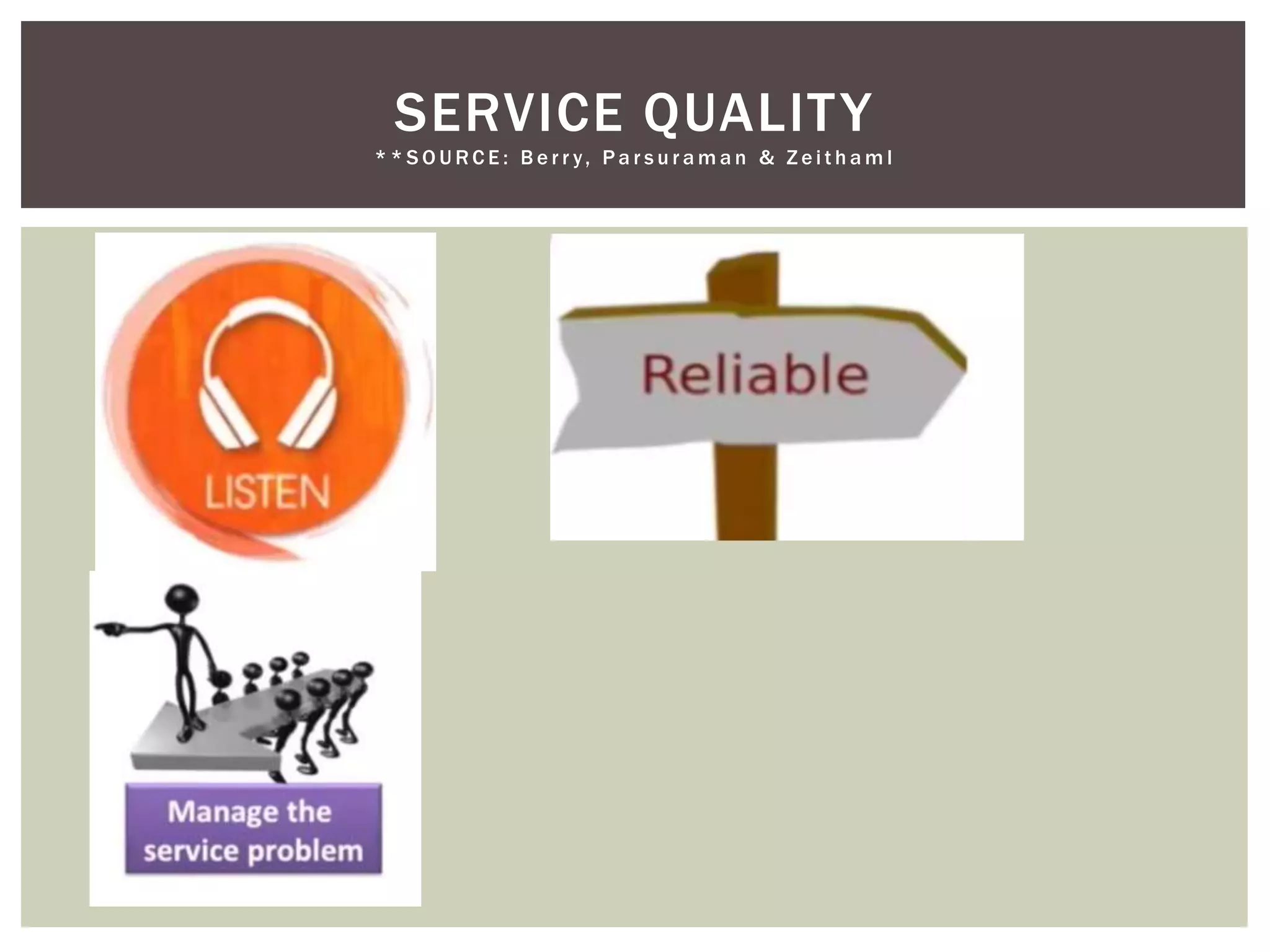
SERVICE QUALITY
* * S O U R C E : B e r r y, P a r s u r a m a n & Z e i t h a m l
Services marketing

Services marketing

  • 1.
    SERVICE MARKETING Deep J.Gurung Assistant Professor Department of Commerce CHRIST (Deemed to be University) Main Campus, Bengaluru
  • 2.
    Any act orperformance one party offers to another which is intangible and does not result in ownership of anything. WHAT IS SERVICE?
  • 3.
    Economists have dividedall industrial and economic activities into three main groups: primary, secondary, and tertiary. Primary activities include agriculture, fishing and forestry. Secondary activities cover manufacturing and construction Tertiary activities refer to the services and distribution. HERE IS THE STORY
  • 4.
    USA African and manyAsian countries India IS THE STORY SAME?
  • 5.
  • 7.
  • 8.
    MAJOR SERVICE WITHminor goods
  • 10.
     Intangibility  Implications: Difficulty in sampling, judge quality and value in advance.  Solutions: Physical evidence  Inseparability (or simultaneous production and consumption)  Implications:  Requires presence of producer/performer. Limited scale of operations  Solutions: Increase number of trained service provider CHARACTERISTICS OF SERVICES
  • 11.
    Variability (or heterogeneity) Implications:Difficulty to standardize quality Solution: Careful selection & training of personnel, standardize procedure, automation of operations Perishability Implications: Cannot be stored Solutions: Match supply & demand **Source: Cowell, Donald, ‘The Marketing of Services’. Heinemann, London.
  • 12.
    Increasing affluence: Greater demandfor services (activities which consumers used to perform themselves) such as interior decoration, laundry, care of household products such as carpets, care of garden etc. More leisure time: Greater demand for recreation and entertainment facilities, travel resorts, and self-improvement courses. REASONS OF GROWTH IN SERVICE INDUSTRY
  • 13.
    Higher percentage ofwomen in labour force: Greater demand for crèches, baby sitting, household domestic help Greater life expectancy: Greater demand for nursing homes and health care services
  • 14.
    Greater Complexity ofproducts: Increased demand for skilled specialists to provide maintenance for complex products such as air conditioners, cars, home computers. Increasing complexity of life: Increased demand for specialists in income- tax, labor laws, legal affairs, marriage counselling, employment services.
  • 15.
    Increasing number ofnew products: The computer-sparked development of such service industries as programming, repair and time sharing. Greater concern about ecology and resource scarcity: Greater demand for purchased or leased services, car rental, travel, resort to time sharing rather than ownership basis.
  • 16.
  • 17.
  • 18.
    A service isa bundle of features and benefits that can have relevance for a specific target market CORE: What customers are really buying? PRODUCT
  • 19.
    Auxiliary/ Periphery/ FacilitatingService: The services required to provide the core service meaningfully Bed with bed sheet, Lighting, Bathroom etc. Supporting Services: Does not facilitate the consumption of core service but increase the value of core services. Cleanliness, Ambience, Help desk etc.
  • 20.
    Augmented Services: Services toexceed the customer’s expectation and have leverage in competition Courteous staff, complementary services etc.
  • 21.
    PERISHABILITY of theproduct Differential Pricing PRICING
  • 22.
  • 23.
    Encourage the consumption: Package,discounts etc. Encourage the employees: Enhance feedback etc. PROMOTION
  • 24.
     All humanactors who play a part in service delivery and thus influence the buyer’s perceptions; namely, the firm’s personnel, the customer, and other customers in the service environment  Training  Commitment  Incentives  Appearance  Inter-personal behaviour  Attitudes  Degree of involvement PEOPLE
  • 25.
    The environment inwhich the service is delivered and where the firm and customer interact, and any tangible components that facilitate performance or communication of the service. Environment Furnishings Colour Layout Facilitating goods Tangible clues PHYSICAL EVIDENCE
  • 26.
  • 28.
    The actual procedures,mechanisms and flow of activities by which the service is delivered – the service delivery and operating system Polices Procedures Mechanisation Employee Customer involvement Flow of activities **Source: Booms, B.H. and Bitner, M.J, Marketing Strategies and Organisation Structure for Services Firms, in Donnelly J and George W.R. (eds), Marketing of Services, AMA, 1981
  • 29.
    SERVICE QUALITY * *S O U R C E : B e r r y, P a r s u r a m a n & Z e i t h a m l