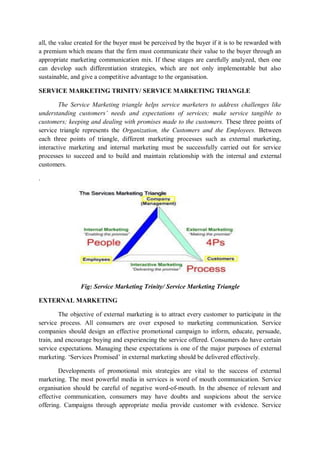
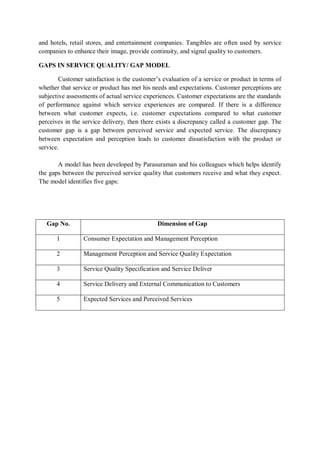
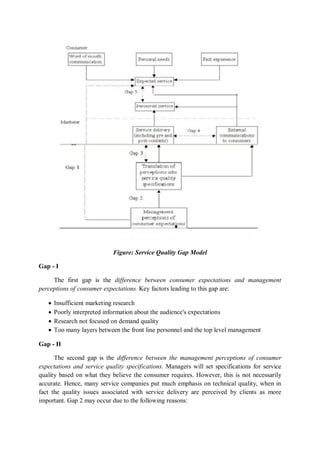
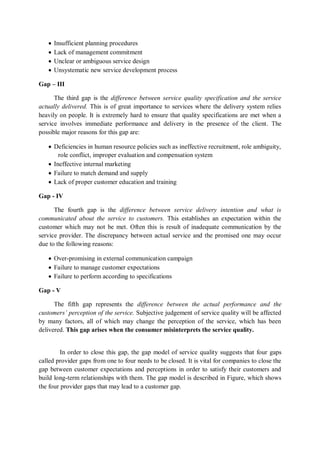
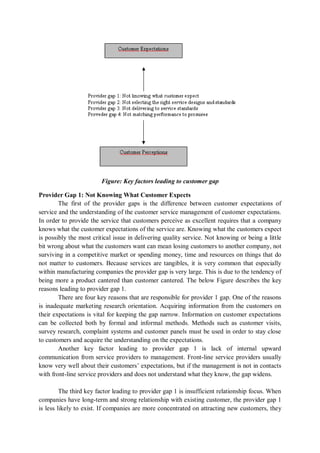
SERVICES MARKETING
Dr. DIVYA VIJAY
UNIT – I
MARKETING SERVICES
INTRODUCTION
The turn of the century has seen profound changes in the global economy. Services
have played a crucial part in these changes, because services are becoming the way
organizations meet with their markets. Already organizations have discovered that their
survival no longer exclusively depends on the products they offer, but also on the additional
offerings they make to their customer that differentiate them from their competitors.
Innovative organizations, offering new services as well as unique customer services, are now
succeeding in market where established organizations have failed.
Services marketing are not a self – enclosed task but is integral organizations as a
whole and the object of the activity is people, who are reactive, not passive as compared with
a product. Services marketing concepts, frameworks and strategies were developed as the
result of interlinked the forces of many industries, organizations, and individuals who have
realized the increasingly important role services are playing in the current world economy.
Initially the development of services marketing focused on service industries. However,
manufacturing and technology industries recognized services as a prerequisite to compliment
their product, in order to compete successfully in the market place.
Providing a service is a people business. Their interaction between customer and
service employees is vital for the actual success of service delivery. Rendering excellent
quality service depends very much on the way service employees behave. In this regard,
service competencies and service inclination contribute towards the success of service.
Customers are becoming more educated and demand not only quality product but also high
levels of services to accompany them. Service organizations therefore need to adapt to
customers’ views on customers as better than those providing by other service providers.
SERVICES: THE CONCEPT
All industrial and economic activities are divided into three, namely, primary,
secondary and tertiary. Primary activities include agriculture, fishing, forestry, mining etc.
Secondary activities consist of manufacturing, processing, construction etc. Tertiary activities
comprise of services, distribution etc.
Services form a major part of economic activities and the world today is dominated by
the service sector. The service sector is enormously large and varied. It includes banking,
transportation, insurance, communication, education, employment, healthcare, Legal service,
accounting, tourism, hospitality and information services. Some of the services are provided
on a non- profit basis, for example, education and healthcare, while others are provided on a
commercial basis such as hotels, professional consultants, solicitors etc.
Defining a service is not an easy task and there is no single universally accepted
definition of the term. An earlier view of the concept of service was that it was a mere benefit
attached to a physical product. Now a major shift has taken place in the concept of service
and the service industry at present has achieved its independence and growth quite apart from
physical goods.
Hence service industries are fundamentally different from manufacturing industries.
In common parlance the term services means personal services like repairing, health service,
legal services, counselling etc. Marketing experts view the problem in a different way. They
feel that the contents of services are much wider. Services are deeds, acts or performances.
The complexity of definition of services increases when one realises that there are no pure
services or pure tangible products.
DEFINITIONS
The American Marketing Association defined services as “activities, benefits, or
satisfactions which are offered for sale, or provided in connection with the sale of goods”.
Regan suggested that “services represent either intangible yielding satisfactions
directly (transportation, housing etc.), or intangibles yielding satisfactions jointly when
purchased either with commodities or other services (credit, delivery, etc.)”.
Robert Judd defined service as “a market transaction by an enterprise or
entrepreneur where the object of the market transaction is other than the transfer of
ownership of a tangible commodity”.
Blois says that, “a service is an activity offered for sale which yields benefits and
satisfactions without leading to a physical change in the form of a good”.
Stanton defined service as “Separately identifiable, intangible activities which
provide want satisfaction when marketed to consumers and/or industrial users and which are
not necessarily tied to the sale of a product or another service”.
Kotler and Bloom defined service as, “any activity or benefit that one party can offer
to another that is essentially intangible and does not result in the ownership of anything. Its
production may or may not be tied to a physical product”.
Gronroos defined a service as “an activity or series of activities of more or less
intangible nature that normally, not necessarily, take place in interactions between the
customer and service employees and/or physical resources or goods and/or systems of the
service provider, which are provided as solution to customer problems”.
SERVICES: FEATURES
Services have some salient features, which necessitate a new vision, a distinct
approach and a world class professional excellence to deal with the various aspects of the
services effectively and profitably. The service professionals who are not well aware of these
features find it difficult to make creative decisions. It is against this background that the
important features of services are analysed as follows for making appropriate managerial
decisions.
1. Intangibility
Services are intangible in that they do not have a physical shape. So a consumer cannot
touch or see it but can derive the benefits after buying it. This intangibility makes the task of
decision makers more complex. While motivating the prospects they cannot display the
positive or negative aspects of services. The consumer also finds it difficult to measure
service value and quality. To overcome this, consumers tend to look for evidence of quality
and other attributes. They also consider physical evidence and qualifications or professional
standing of the consultant. Services by nature are abstract. Therefore, services carry with
them a combination of intangible perceptions and benefits. Thus it is right to mention that due
to intangibility, the managing of services become much more complicated.
2. Inseparability
Services often cannot be separated from the person of the service provider. Moreover,
some services must be created and dispensed simultaneously. For example, dentists create
and dispense almost all their services at the same time. From the marketing point of view,
inseparability implies that direct sale is the only channel of distribution of services. This
feature of services also limits the scale of operation of a service firm. The goods are produced
at one point and then distributed by others at other points. In services, we find the selling
processes contributing to its creation. Thus in the words of Donald Cowell, goods are
produced, sold and then consumed, whereas services are sold and then produced and
consumed.
3. Heterogeneity
It is not possible for a service firm to standardise its service. Each unit of the service is
somewhat different from the other units of the same service. For example, an airline does not
provide the same quality of service on each journey. The primary reason for such
inconsistency is the effort to satisfy the customer's need to the fullest. This requires the
interaction of customers and service providers. They should do everything to ensure the
consistent quality of the service.
4. Perishability
Services are highly perishable and they cannot be stored. In the context of services, if we
fail to sell the services, it is lost forever. For example, a vacant seat in an aircraft or an un-
booked room in a hotel etc. are opportunities lost forever. This makes it essential those
decision-makers should minimise the risk by utilising their professionalism. The strategies
include peak load pricing, motivating non- peak period consumption etc.
5. Ownership
Lack of ownership is a basic feature of the service industry. A customer may only have
access to or use of a facility. Payment is for the use, access or hire of the service. Thus the
ownership is not affected in the process of selling the services.
6. Fluctuating Demand:
Generally the demand for services is fluctuating in nature. Demand for certain services
that may be high during peak seasons may be low during off-seasons. Most service
organisations have capacity constraints. So simultaneous attempt to achieve closer match
between demand and supply is sought. The combination of perishability and fluctuating
demand offers challenges to service company executives in planning, pricing and promotion
of services.
Management experts would like to add some more features to services while
distinguishing them from products. These are:
1. Lack of entry barriers:
Introduction of new changes in various services is not patentable i.e. the innovativeness
of one firm can easily be adopted by another. Also, services are not generally capital
intensive, and thus entering a service sector is not at all difficult.
2. Minimum opportunities to achieve economies of scale:
Most services operate from multiple locations so that they can cater to the surrounding
geographical area. This prevents the service provider from producing a service at one place as
is done in the case of producing tangible goods. Thus opportunities of achieving economies
of scale are difficult.
3. Customer Contact
`The customer is very much a part of the service process. A service can be classified as high
or low contact depending on the percentage of time the customer spends in the delivery
system relative to the total service time. In high contact services the customer influences the
timing of demand and the nature of service by direct participation in the process.
CLASSIFICATION OF SERVICES
There have been a number of approaches towards classification of services. The intention
behind this classification is to provide service managers with a means of identifying other
companies who, though operating in different types of services, share certain common
characteristics. Lovelock classifies services based on five crucial factors. They are:
 Nature of the service act.
 The relationship of service organisation to customers.
 The extent of customization and judgement.
 The nature of supply and demand for the service
 The process of service delivery
A simple form of classification of services is into:
a) Business and professional services.
b) Non-business services
Business and Professional Services include Banking, Insurance, Advertising,
Consulting, Market Information, Budgeting, Legal, Medical, Accounting etc.
Non-business Services include Leisure, Entertainment, Recreation, Education,
Counselling etc.
Helen Woodruffe classifies services into the following five categories:
1. End User
According to the end-user of services, it may be classified into:
 Consumer Services - such as Leisure, Hairdressing, Personal Service
 Business Services- Advertising Agencies, Printing, Accounting, Consultancy
 Industrial Services- Plant Maintenance, Repair Service, Project Management
2. Service Tangibility
The degree of tangibility of a service can be used to classify services:
 Highly Tangible Services - Car Rentals, Vending Machines, Telecommunications.
 Services Linked to Tangible Goods - Car Service, Repair of Domestic Appliances.
 Highly Intangible Services - Consultancy, Legal Service.
3. People based services:
Services can be classified based on the extent of the consumer contact:
 People-Based Services -Education, Healthcare etc. where high contact is necessary
 Equipment Based Services - only low customer contact is required for such services:
Car Wash, Cinema, and Vending Machines.
4. Expertise / Professionalism
On the basis of expertise and skills required, services may be classified into:
 Professional Services - Legal, Medical, Accounting, and Consultancy.
 Non-Professional Services - Day Care, Baby Sitting.
5. Profit Orientation
The overall business orientation is a recognised means of classification:
 Commercial Services - Banks, Insurance, Hotel and Catering Services.
 Non-Commercial Services - Charities, Public Sector Leisure Facilities.
PROBLEMS IN MARKETING SERVICES
The major problems faced by marketing a service are:
1. A service cannot be demonstrated.
2. Sale, production and consumption of services takes place simultaneously.
3. A service cannot be stored. It cannot be produced in anticipation of demand.
4. Services cannot be protected through patents.
5. Services cannot be separated from the service provider.
6. Services are not standardized and are inconsistent.
7. Service providers appointing franchisees may face problems of quality of services.
8. The customer perception of service quality is more directly linked to the morale,
motivation and skill of the frontline staff of any service organization.
FORMS OF MEASURING SERVICE MARKETING CAPACITY
Five potential forms for measuring and managing capacity of service marketing are as
follows: 1. Physical facilities designed to contain customers 2. Physical facilities designed for
storing or processing goods 3. Physical equipment used to process people, possessions or
information 4. Labour 5. Infrastructure.
1. Physical facilities designed to contain customers: Physical facilities designed to
contain customers and used for delivering people-processing services or mental
stimulus processing services. Examples include hospital clinics, hotels, passenger
aircraft, buses, restaurants, swimming pools, cinemas, concert halls and college
classrooms. In these situations, the primary capacity constraint is likely to be defined
in terms of such furnishings as beds, rooms, seats, tables or desks. In some cases,
local regulations may set an upper limit to the number of people allowed in the
interest of health or fire safety.
2. Physical facilities designed for storing or processing goods: Physical facilities
designed for storing or processing goods that either belong to customers or are being
offered to them for sale. Examples include supermarket shelves, pipelines,
warehouses, car parks, freight containers or railway freight cars.
3. Physical equipment used to process people, possessions or information: Physical
equipment used to process people, possessions or information may embrace a huge
range of items and be very situation-specific – machinery, telephones, hair dryers,
computers, diagnostic equipment, airport security detectors, toll gates on roads and
bridges, cooking ovens, bank ATMs, repair tools and cash registers are among the
many items whose absence in sufficient numbers for a given level of demand can
bring service to a crawl (or a complete stop).
4. Labour: Labour, a key element of productive capacity in all high-contact services
and many low- contact ones, may be used for both physical and mental work. Staffing
levels for personnel, from restaurant waiters and waitresses to nurses to telephone
operators, must be sufficient to meet anticipated demand – otherwise customers will
be kept waiting or service rushed. Professional services are especially dependent on
highly skilled staff to create high value-added, information-based output.
5. Infrastructure: Many organizations are dependent on access to sufficient capacity on
the public or private infrastructure to be able to deliver quality service to their own
customers. Capacity problems of this nature may include busy telephone circuits,
electrical power failures (or black outs caused by reduced voltage) congested air ways
that lead to air traffic restrictions, and traffic jams on major roads.
SERVICE DESIGN
Marketing is the performance of those business activities that direct the flow of goods
or services from producer to ultimate consumer. The customers may have different likes and
dislikes, preferences and attitudes. These things play a crucial role to develop a product or
service, which is appropriate according to the aspiration of the customers. Further the
relevance of product or service to the aspiration of the customers decides the final success or
failure of the product or service. Thus customer’s requirements and the performance
standards that the service needs to satisfy form the specifications for design. The design
consists of four related components:
i. Product design
ii. Facilities design
iii. Service operations process design.
iv. Customers service process design.
Service product design refers to the design of the physical attributes of the service. The
subscription options for home cable television service or the banking transactions that are
available through an automatic teller machine are examples of such attributes. These
attributes may involve the assembly of raw materials or developing software.
Further the service facility design refers to the design of the physical layout of the
facilities. Customers’ perceptions of the quality of the service are influenced by attributes
such as the cleanliness, spaciousness, lighting and layout of the environment, where the
service takes place. In addition to these facilities, other additional facilities such also need to
be designed. The efficiency of service operations depends on the configuration of these
facilities.
Service operations process design refers to the activities that are needed to deliver or
maintain a service. The activities that make up the operations processes are those required for
the service to deliver its output. By contrast, the activities comprising the customer service
process design pertain to the interactions between the customer and the service provider. The
customer service and service operations activities together make up the operations process.
The quality of the service experience depends on the performance of both types of activities.
These activities therefore need to be designed together.
STEPS IN SEVICE DESIGN
A real design exercise involves the complex interactions of a variety of technical and
non-technical factors that affect the quality of the design. In order to design a product, it is
important to employ a methodology that integrates the technical aspects of the design with
the marketing and management principles that are required to ensure the commercialization
of the product. Such a methodology is referred to as total design.
Step 1: To involve the customer in designing process.
Step 2: To determine the specifications of the design from these customers.
Step 3: To determine the technical aspects of the design from these customers as per
the specifications. The technology should be a derivative of the customers need and
not the other way around.
Step 4: To design the service using a multi-function team with.
Step 5: To test the design in the marketplace, and not in the laboratory. A successful
design should not only be one that creatively applies the latest technology, but should
also be one that customers like, purchase, and use.
BLUEPRINTING AND SERVICE MAPPING
Blueprinting is a technique that helps to understand the totality of a service as a
process, so that “fail points,” those stages of the service that have a high statistical probability
of generating problems, can be identified and properly understood. The blueprint is an
objective, graphical depiction of the service.
Blueprinting is a process that highlights by way of a process flow diagram the service
system so that the people who are to execute the service can understand their roles. The
systematic process is portrayed in a way that the roles of customers, employees, and the
processes that support those roles are spelled out to explicitly define each and every step of
the service delivery.
The key steps in preparing the service blueprint as follows:
1. To identify the activities involved in delivering the service and present these in a
diagrammatic form. The level of detail will depend on the complexity and nature of the
service.
2. To identify the critical points. These are stages where things may go wrong. The corrective
measures at this stage must be determined, and systems and procedures should be developed
to reduce the occurring in the first instance.
3. To set standards against which the performance should be measured.
4. To analyze the profitability of the service delivered, in terms of the number of customers
served during a period of time.
On the other hand service maps are to be built up on blueprints and two additional
features are to be provided to add to management information.
 To pay greater attention to customer interaction with the service organization. Further
the clear diagrammatic distinctions should be made between actions of customers and of
service contact personnel. In effect, more should be provided on the front stage activities in
blueprints.
 Additional vertical layers to the diagram are to be drawn in service maps to provide a
visual representation of the structure of the service.
 In particular, the backstage activities are to be divided into those provided by frontline
employees, support staff and management services.
Service-Blueprinting is a service planning help tool. It can be used for developing
new innovative services as well as for improving existing services. The method is also
appropriate for ensuring the quality of service processes. The Service-Blueprinting output
consists of a graphically-presented overview of the service process and its activities. Service-
Blueprinting allows for visualization of the service development process in its early stages. In
each process step, contact points between client and firm (and physical element, if a tangible
service) become visible. It is possible to identify failure points and discover areas for
innovation as well. This technique eases the identification of cost saving potentials and offers
an excellent base for further Service-process management.
EVOLUTION OF SERVICE BLUEPRINTING
Service blueprinting was initially introduced as a process control technique for services
that offered several advantages: it was more precise than verbal definitions; it could help
solve problems pre-emptively; and it was able to identify failure points in a service operation.
Just as firms have evolved to become more customer-focused, so has service blueprinting.
One early adaptation was the clarification of service blueprinting as a process for plotting the
customer process against organizational structure.
Service blueprinting was further developed to distinguish between onstage and
backstage activities. These key components still form the basis of the technique and its most
important feature, that of illuminating the customer’s role in the service process. In addition,
it provides an overview so that employees and internal units can relate what they do to the
entire, integrated service system. Blueprints also help to reinforce a customer-orientation
among employees as well as clarify interfaces across departmental lines.
COMPONENTS OF SERVICE BLUEPRINTS
There are five components of a typical service blueprint.
• Customer Actions,
• Onstage/Visible Contact Employee Actions,
• Backstage/Invisible Contact Employee Actions,
• Support Processes, and
• Physical Evidence.
“Customer actions” include all of the steps that customers take as part of the service
delivery process. Customer actions are depicted chronologically across the top of the
blueprint. What makes blueprinting different from other flowcharting approaches is that the
actions of the customer are central to the creation of the blueprint, and as such they are
typically laid out first so that all other activities can be seen as supporting the value
proposition offered to or co-created with the customer.
The next critical component is the “onstage/visible contact employee actions,”
separated from the customer by the line of interaction. Those actions of frontline contact
employees that occur as part of a face-to-face encounter are depicted as onstage contact
employee actions. Every time the line of interaction is crossed via a link from the customer to
a contact employee (or company self-service technology, etc.), a moment of truth has
occurred.
` The next significant component of the blueprint is the “backstage/invisible contact
employee actions,” separated from the onstage actions by the very important line of
visibility. Everything that appears above the line of visibility is seen by the customer, while
everything below it is invisible. Below the line of visibility, all of the other contact employee
actions are described, both those that involve non-visible interaction with customers (e.g.,
telephone calls) as well as any other activities that contact employees do in order to prepare
to serve customers or that are part of their role responsibilities.
The fourth critical component of the blueprint is “support processes” separated from
contact employees by the internal line of interaction. These are all of the activities carried out
by individuals and units within the company who are not contact employees but that need to
happen in order for the service to be delivered. Vertical lines from the support area
connecting with other areas of the blueprint show the inter-functional connections and
support that are essential to delivering the service to the final customer.
Finally, for each customer action, and every moment of truth, the “physical evidence”
that customers come in contact with is described at the very top of the blueprint. These are all
the tangibles that customers are exposed to that can influence their quality perceptions.
The Service Blueprinting is based on the separation of the service into individual
processes that can be assumed separately. The process progress chart is depicted horizontally.
Each single component is on a different plane, ordered vertically. Each plane represents a
level of closeness to the client, the higher the level the closer the interaction level is to the
client Planes Service Blueprinting differentiates between five degrees of client interaction
and integration (See Figure):
 The client interaction line separates the process steps of the service activities that the
client carries out independently.
 The visibility line separates the service activities that the client can see from the
service activities which are hidden from view. Above the line, the process
components that can be seen, heard, smelt or perceived are ordered.
 The internal interaction line separates activities that imply immediate relation to the
client’s order from support activities. Support activities serve as the preparation for
the primary activities but do not belong to the client’s order. Examples are the
maintenance of a ski lift or the cleaning of an office.
 The control line separates the preparation activities from the general management
activities.
BLUE PRINT OF A COURIER SERVICE
Fig: Blueprinting of a Courier Service
The components discussed above are depicted in figure as a blueprint of a courier
service. Each component is a different level. The top level is portrayed by the line of
interaction, signifying that all customer actions take place above this line owing to the
interaction with the employees. Another feature of this print is that we can see an interaction
take place the moment a vertical line crosses the horizontal line.
The next horizontal line is the line of visibility that separates visible (onstage) activities
from those of backstage. This is the evidence of service to customer and is created in light of
the nature of the service and the appeal it may have for the customer. This is exemplified by
some of the fast food restaurants and coffee shops. Such setups have their show kitchens
operating very much in visibility of the customer.
The area below the line of visibility is that of processes, which support the service
delivery and are performed by the support staff that may or may not be visible to customers.
This area is represented by interactions between employees of the company. Vertical lines
here as well represent internal encounters.
The above explains the basic flow that may characterize a blueprint. With complete
explosion of all activities, we can see in even more detail the interactions and the tasks
involved therein. It will show us where and how much customers are involved; who helps the
customer; how many people we need to help him; what kind of relationships are defined
among the staff that support each other to deliver the service; and, how many staff members
we need to do different tasks etc.
REASONS FOR GROWTH OF SERVICES
Manufacturing industries grew because they produced tangible goods which satisfied
man’s physiological needs of food, shelter and clothing. As the basic need was fulfilled there
was demand for improved satisfaction, and this led to a proliferation of variations of the same
product and a number of companies involved in its manufacture. The growth of service
industries can be traced to the economic development of society and the socio-cultural
changes that have accompanied it. Changing environmental forces brought out the various
types of services in forefront of the economy. These environmental forces separately or in
combination create new type of service. The following environmental factors are responsible
to make a new service.
 Consumer Affluence: Due to the fast rise in the income of consumers, they are
attracted towards the new areas like clubs, health clubs, domestic services, travel and
tourism, entertainment, banking, investment, retailing, insurance, repairs, etc. and
these are growing much faster than ever before. There is a significant change in the
pattern of family expenditure.
 Working Women: During the recent times a large number of women have come up
in a variety of professions. The work performance of women in most of services
sector like bank, insurance, airlines, etc. is highly appreciable. In short, women are
getting involved in almost all male dominated activities. Due to increasing
involvement of women in commercial activities, the services like domestic activities,
fast food restaurants, marriage counselling, personal care, financial services, retailing,
etc. have emerged in the recent times.
 Double Income No Kids (DINK): Dinks are the working couples who have
consciously postponed parenthood plans indefinitely or in an increasing number of
cases, have decided not to have any children ever. The dink culture is getting stronger
and spreading wider day by day. The realisation that parenthood is likely to result in
more commitments at home and demands on their time, thereby slowing down their
career plans and ambitions, make them postpone their parenthood plans. Whatsoever
be their life style, they have double income and no kids, resulting in the emerging and
enhancing of services like, entertainment, hotels and restaurants, career institutes,
domestic services, travel resorts, personal care, etc.
 Leisure Time: People do get some time to travel and holiday, and therefore, there is a
need for travel agencies, resorts, hotels and entertainment. There are others who
would like to utilise this time to improve their career prospects, and therefore, there is
a need for adult education, distance learning, part time courses, etc.
 Greater Life Expectancy: According to the World Development Report and World
Human Resource Index, the life expectancy of people has increased significantly all
over the world barring few developing countries. It may be due to the advancement in
the medical technology, and greater awareness about health and education. Greater
life expectancy invites opportunities in services like hospitals, Nursing Homes,
entertainment, leisure services, investment banking and so on.
 Product Innovations: In the changing time the consumers have become more
conscious of quality than cost. They need high quality goods at par with international
standards. Having this in mind the manufacturers have focused their attention on
quality improvement, innovations, etc. In this process many more services have
emerged on account of product innovation. Some of them are servicing services,
repairs, computer, training and development, education, etc.
 Product Complexity: A large number of products are now being purchased in
households which can be serviced only by specialised persons e.g. water purifiers,
microwave oven, computers, etc., giving rise to the need for services. The growing
product complexities create greater demand for skilled specialists to provide
maintenance for these complex products and bring out other services like expert
advice, consultancy services, etc.
 Complexity of Life: Certain product and services have made human life more
comfortable and complex as well. Also, life itself has become more complex due to
the socio-economic, psycho-political, technological and legal change. This has
brought about the emergence of services like legal aid, tax consulting, professional
services, airlines, courier services, insurance, banking, etc.
 New Young Youth: Every new generation has its own characteristics and enjoys a
different life style. There is a lot of difference between the generations in respect to
their living conditions/ styles, maturity, thinking, attitudes, behaviour, beliefs,
satisfactions, performance values and so on. Today’s generation with all these
changes provide more opportunities to services like entertainment, fast food,
computers, travel, picnic resorts, educational institution, counselling, retailing, etc.
 Resource Scarcity and Ecology: As the natural resources are depleting and need for
conservation is increasing, we have seen the coming up of service providers like
pollution control agencies, car pools, water management, etc.
 Corporate Crowd: The phenomena of globalisation, privatisation and liberalisation
coupled with faster urbanization have created the corporate world crowd and its
support services. This crowd is responsible in bringing the new services, and
redefining the old ones. The services like hotels and restaurants, banking, insurance,
travel and tourism, advertising, airlines, courier services, marketing research, health
care, legal services, etc. will emerge and flourish more and more.
ROLE OF SERVICES IN ECONOMY
There is a growing market for services and increasing dominance of services in
economies worldwide. Services are a dominant force in countries around the world as can be
seen in the global feature. The tremendous growth and economic contributions of the service
sector have drawn increasing attention to the issues and problems of service sector industries.
There was a time when it was believed that the industrial revolution was the only solution to
the problems of poverty, unemployment and other ills of society.
Now, however, the service sector promises to fulfil the task. Services touch the lives
of every person every day whether it is in the field of food services, communication, leisure
services, maintenance services, travel, amusement parks etc. Services are increasingly being
used by the corporate as well as the household sector. This emphasis on services and its
increasing use has not happened overnight, started in the twentieth century especially after
the end of World War II. Due to large scale destruction during the war, a lot of economic
activities had to be carried out to bring the war torn economies back on road. World War II
marked as milestone in the explosive rise of service industries. Throughout the second half of
the twentieth century services industries have attained considerable growth in most western
nations. After Green Revolution and Industrial revolution, the next possible popular
revolution will be in the field of service sector. In Green revolution the man learnt to use,
exploit and interact with nature (i.e., land and natural resources). In Industrial revolution man
learnt to use, exploit and interact with equipments and machines for development. In case of
services, man is learning to use, exploit and interact with other man-made resources for
development. In the present day world the service sector is growing at a phenomenal rate and
termed as ‘sunrise sector of the economy’.
Today service industries are the source of economic leadership. Many developed
countries are now termed as service economy. Raising the standard of living of people
through services; service sector may well symbolise the third and possibly the most important
revolution of recent times. The standard of living of people will not increase only through
capital formation, economic transformation and national income; indeed it is also important
that masses are aware of the living style and behaviour. Service sector creates and expands
job opportunities. The new and indeed, the biggest employment opportunities are offered by
service industries.
SERVICES IN INDIA
Services lie at the very hub of economic activity in any society. Our welfare and the
welfare of our economy are now based on services. Almost all countries of globe look
interested in utilising this sector of the economy. For a developing country like India, the
need of the hour is to assign due weightage to the development of service sector. The service
sector is assuming increasing importance in the Indian economy.
In the recent past, we have seen the transition from agrarian nature of economy to
agro-based industry to industrial growth, now we tend to think in terms of developing the
service sector. Probably it is because this sector can create more jobs at a low cost. Service
sector has significant contribution for income generation and employment creations. In India,
service sector is one of the fastest growing sectors today. It provides more than 55 per cent of
the jobs and about 40 per cent export is from service sector. The service sector dominates the
Indian economy today, contributing more than half of our national income. No wonder the
service sector will be the biggest driver of new economic growth and profit earning in the
new millennium for the world in general as well as for India in particular. As a result, the
service organisations, if they have to be successful, have to have a more professional
approach to manage their business. Perhaps, it is in this context the role of marketing is
gaining importance in the service organisations.
QUESTIONS
1. Define Services.
2. What is Product Design?
3. What is Facility Design?
4. What is Blue Printing?
5. What is Service Mapping?
6. What do you mean by customer action?
7. What is client interaction line?
8. What is visible line?
9. What is internal interaction line?
10. What is control line?
11. Briefly explain the concept of services.
12. Explain the different features of services.
13. What are the classifications of services? Explain.
14. Explain the factors affecting the growth of service sector.
15. What are the components of service design?
16. What are the steps in service design?
17. Explain the key steps in preparing Service Blue Printing.
18. What are the components of service blue printing? Explain.
UNIT - II
MARKETING MIX IN SERVICES
Marketing mix is the set of important internal elements that make up an organisation’s
marketing programme. The marketing mix concept is a well established tool used as a
structure by marketers. It can be defined as the elements an organisation controls that can be
used to satisfy or communicate with customers. The phrase ‘marketing mix’ was first used by
Neil H. Borden. The concept had its genesis in the classic work of James Culliton on the
management of marketing costs. Borden suggested twelve marketing mix variables in the
context of manufacturers. Borden’s concept of marketing mix was given due recognition in
marketing theory and the concept of marketing mix was accepted as the set of marketing
tools that a firm uses to pursue its marketing objectives in the target market, influenced by
specific environmental variables.
It was McCarthy who summed up the twelve elements of Borden’s marketing mix
into 4Ps - product, price, place (i.e. distribution), and promotion. He even clarified that the
customer is not a part of the marketing mix; rather, he should be the target of all marketing
efforts. The activities in service marketing are different , and often do not fall in the
conventional marketing mix (4Ps) classification, though many marketing concepts and tools
used by goods marketers hold good in services with some change in focus and importance.
The traditional marketing mix became inadequate for service industries because of the
following reasons:
 The concept of marketing mix as such was developed for manufacturing industries
and was more oriented to deal with goods marketing situations.
 Marketing practitioners in service sector found that it did not address their needs.
 Due to differences in characteristics of physical products and services, marketing
models and concepts had to be developed in direction of the service sector.
Keeping in view the inadequacy of conventional marketing mix to address the service
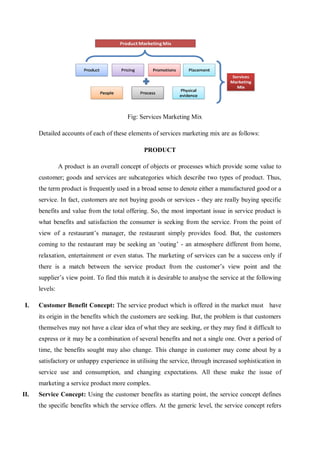
situations, it needs to be modified and broadened. A seven Ps framework for services has
been proposed. These elements of marketing mix for services are product, price, place,
promotion, people, physical evidence and process. It is important to elaborate these Ps in
order to have an understanding of a specific combination of these elements to arrive at the
marketing strategy for service firms.
Fig: Services Marketing Mix
Detailed accounts of each of these elements of services marketing mix are as follows:
PRODUCT
A product is an overall concept of objects or processes which provide some value to
customer; goods and services are subcategories which describe two types of product. Thus,
the term product is frequently used in a broad sense to denote either a manufactured good or a
service. In fact, customers are not buying goods or services - they are really buying specific
benefits and value from the total offering. So, the most important issue in service product is
what benefits and satisfaction the consumer is seeking from the service. From the point of
view of a restaurant’s manager, the restaurant simply provides food. But, the customers
coming to the restaurant may be seeking an ‘outing’ - an atmosphere different from home,
relaxation, entertainment or even status. The marketing of services can be a success only if
there is a match between the service product from the customer’s view point and the
supplier’s view point. To find this match it is desirable to analyse the service at the following
levels:
I. Customer Benefit Concept: The service product which is offered in the market must have
its origin in the benefits which the customers are seeking. But, the problem is that customers
themselves may not have a clear idea of what they are seeking, or they may find it difficult to
express or it may be a combination of several benefits and not a single one. Over a period of
time, the benefits sought may also change. This change in customer may come about by a
satisfactory or unhappy experience in utilising the service, through increased sophistication in
service use and consumption, and changing expectations. All these make the issue of
marketing a service product more complex.
II. Service Concept: Using the customer benefits as starting point, the service concept defines
the specific benefits which the service offers. At the generic level, the service concept refers
to the basic service which is being offered. A centre for performing arts may offer
entertainment and recreation. But, within this broad framework, there can be specific choice
paths for satisfying the entertainment objectives, such as, drama, musical concerts, mime,
poetry recitation, dance, etc.
III. Service Offer: After defining the operation of businesss, the next step is to give a specific
shape and form to the basic service concept. In the case of centre for the performing arts, the
service concept is to provide entertainment. The service offer is concerned with the specific
elements that will be used to provide entertainment; drama, music, dances. In the category of
musical concerts the choice may be vocal or instrumental, with vocal whether light or
classical, Hindustani, Carnatic or Western. While these represent the intangible items of the
service offer, the physical infrastructure of the centre, in terms of its seating capacity, seating
comfort, quality and acoustics, provision for air-conditioning, snack bar and toilets are the
tangible items. The tangible aspects can be controlled by offering the best possible benefit,
but the quality and performance of the actors, singers, musicians cannot be controlled.
IV. Service Forms: In what form should the services be made available to the customers is
another area of decision making. Should all the shows of the centre be available in a package
deal against an annual membership fee or seasonal ticket? Should there be daily tickets with
the consumer having the freedom to watch any one or more performances being staged on
that particular day? Should each performance have a separate entrance ticket, with a higher
priced ticket for a well-known performer? Service form refers to the various options relating
to each service element. The manner in which they are combined gives shape to the service
form.
V. Service Delivery System: When we go to bank to withdraw money, we either use a cheque
or a withdrawal slip in which we fill all the particulars and hand it over to the dealing
assistant, who after verifying the details, gives us money. The cheque or withdrawal slip and
the dealing assistant constitute the delivery system. In case of airlines, the aeroplane, pilot,
crew members, airport, etc. are the elements of delivery system. The two main elements in a
delivery system are the people and the physical evidence. The competence and public
relations ability of a lawyer represents the ‘people’ component, while his office building,
office door, letter head, etc., are all elements of the ‘physical evidence component. The
physical evidence components have also been called facilitating goods or support goods.
These are the tangible elements of the service and they exert an important influence on the
quality of the service as perceived by the consumers. Delivering an intangible at a level
consistently is a complex issue. The experience in two flights of the same airline is not the
same. The visit to a bank on two occasions brings different experiences. The consumer’s
service experience is, as such, a result of provider-customer interaction, atmosphere,
emotional stress, anxieties, surprises, etc. It is because of these delivery factors (varying at
different points of time) that no two customer experiences are identical. This variability of
experience is attributable to the inability of the service firms to deliver the intangible
uniformly.
Service firms must learn to manage intangibles. They need to go beyond the technical
skills of employees or the tangible output. Service levels should be set in accordance with the
desired customer satisfaction. The answer to ‘what customer expects’ should be sought. And
it is not an easy answer because the subjective nature of the customer expectations often
vitiates the whole exercise.
PRICE
Pricing is one factor that has received much less attention in service firms. Pricing
decisions in services are approached in a not-very-sophisticated manner. The role price plays
in the marketing strategy is lesser known in service firms than in manufacturing firms. Even
in Britain, the United States and some other developed economies where more people are
employed in the provision of services than in the direct production of material goods, the
marketing of services in general, and their pricing in particular, are relatively neglected
aspects of management studies.
Though price is one of the Ps in the marketing mix of firms, its use as a purposive
marketing tool has been limited to a few marketers. Most marketers tend to adopt a passive
approach and commit many mistakes in pricing their goods and services. “The most common
mistakes are: pricing is too cost-oriented; price is not revised often enough to capitalize on
market changes; price is set independent of the rest of marketing mix rather than as an
intrinsic element of market positioning strategy and price is not varied enough for different
product items and market segments”.
Unlike in manufactured goods, where price has one common name across a wide
range of goods, such as, fruits, clothes, computers, cars, etc.; price in services goes by
different names. The services are diverse. The extent of their diversity can be gauged by the
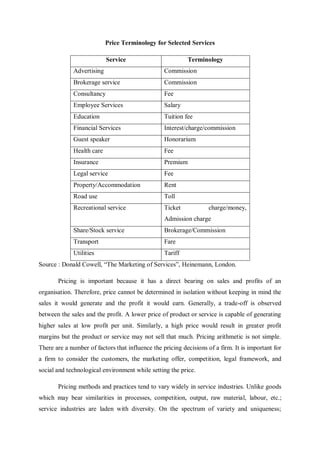
names by which the price is called in services. The below table shows some terms referring to
price in different services are listed. Almost every service has its own price terminology.
Price Terminology for Selected Services
Service Terminology
Advertising Commission
Brokerage service Commission
Consultancy Fee
Employee Services Salary
Education Tuition fee
Financial Services Interest/charge/commission
Guest speaker Honorarium
Health care Fee
Insurance Premium
Legal service Fee
Property/Accommodation Rent
Road use Toll
Recreational service Ticket charge/money,
Admission charge
Share/Stock service Brokerage/Commission
Transport Fare
Utilities Tariff
Source : Donald Cowell, “The Marketing of Services”, Heinemann, London.
Pricing is important because it has a direct bearing on sales and profits of an
organisation. Therefore, price cannot be determined in isolation without keeping in mind the
sales it would generate and the profit it would earn. Generally, a trade-off is observed
between the sales and the profit. A lower price of product or service is capable of generating
higher sales at low profit per unit. Similarly, a high price would result in greater profit
margins but the product or service may not sell that much. Pricing arithmetic is not simple.
There are a number of factors that influence the pricing decisions of a firm. It is important for
a firm to consider the customers, the marketing offer, competition, legal framework, and
social and technological environment while setting the price.
Pricing methods and practices tend to vary widely in service industries. Unlike goods
which may bear similarities in processes, competition, output, raw material, labour, etc.;
service industries are laden with diversity. On the spectrum of variety and uniqueness;
services are unique, both in their own character and in their difference from one another. This
service character does not allow standardisation of pricing across various service categories.
A household service supplier, banking company, hairdresser, transporter, etc.; because of
their unique character, tend to consider their pricing in a variety of ways.
In determining the prices of services, the one characteristic which has great impact is
their perishability and the fact that fluctuations in demand cannot be met through inventory.
Hotels and airlines offering lower rates in off-season and lower telephone charges for
outstation calls after peak hours are examples of how pricing strategy can be used to offset
the perishable characteristics of services.
Another characteristic of services that creates a problem in price determination is the
high content of the intangible component. The higher the intangibility, the more difficult it is
to calculate cost and greater the tendency towards non-uniform services, such as fees of
doctors, management consultants, lawyers, etc. In such cases, the price may sometimes be
settled through negotiation between the buyer and seller.
On the other hand, in services such as dry cleaning, the tangible component is higher,
and the service provided is homogeneous. It is easier to calculate the cost on a unit basis and
have a uniform pricing policy. In general, the more unique a service is, the greater the
freedom to fix the price at any level. Often the price may be fixed according to the customer’s
ability to pay. In such cases price may be used as an indicator of quality.
The third characteristic to be kept in mind while determining prices is that in many
services, the prices are subject to regulations, either by the government or by trade
associations. Bank charges, electricity and water rates, fare for rail and air transport in India
are controlled by the government. In many other cases, the trade or industry association may
regulate prices in order to avoid undercutting and maintain quality standards. International air
fares are regulated by international agreement of airlines, sea freight fares are regulated by
shipping conferences. In all such cases, the producer has no freedom to determine his own
price.
The two methods which a service organisation may use to determine prices are cost-
based pricing and market-oriented pricing. In the former, the price may be regulated by the
government or industry association on the basis of the cost incurred by the most efficient unit.
Such a pricing strategy is effective in restricting entry and aiming at minimum profit targets.
The market-oriented pricing may either be a result of the competition or customer-oriented.
In case of competition-oriented pricing, the price may be fixed at the level which the
competitor is charging, or fixed lower to increase market share. Customer-oriented pricing
varies according to the customer’s ability to pay.
The pricing tactics that may be used to sell services are:
I. Differential or Flexible Pricing: It is used to reduce the ‘perishability’ characteristic
of services and iron out the fluctuations in demand. Differential price implies
changing different prices according to:
 Customer’s ability to pay differentials (as in professional services of management
consultants, lawyers);
 Price time differentials (used in hotels, airlines, telephones where there is the concept
of season and off-season and peak hours); and
 Place differential used in rent of property-theatre seat pricing (balcony tickets are
more expensive than front row seats) and houses in better located colonies command
higher rent.
II. Discount Pricing: It refers to the practice of offering a commission or discount to
intermediates such as advertising agencies, stock brokers, property dealers for
rendering a service. It may also be used as a promotional device to encourage use
during low-demand time slots or to encourage customers to try a new service (such as
an introductory discount).
III. Diversionary Pricing: It refers to a low price which is quoted for a basic service to
attract customers. A restaurant may offer a basic meal at a low price but one which
includes no soft drink or sweet dish. Once the customer is attracted because of the
initial low price he may be tempted to buy a drink or an ice-cream or an additional
dish. Thus, he may end up buying more than just the basic meal.
IV. Guaranteed Pricing: It refers to pricing strategy in which payment is to be made
only after the results are achieved. Employment agencies charge their fee only when a
person actually gets a job, a property dealer charges his commission only after the
deal is actually transacted.
V. High Price Maintenance Pricing: This strategy is used when the high price is
associated with the quality of the service. Many doctors, lawyers and other
professionals follow this pricing strategy.
VI. Introductory Pricing: It is one in which an initial low price is charged in the hope of
getting more business at subsequently better prices. The danger is that the initial low
price may become the price for all times to come.
VII. Offset Pricing: It is quite similar to diversionary pricing in which a basic low price is
quoted but the extra services are rather highly priced. A gynaecologist may charge a
low fee for the nine months of pregnancy through which she regularly checks her
patient, but may charge extra for performing the actual delivery and post-delivery
visits.
VIII. Competitive Parity Pricing: Prices are set on the basis of following those set by the
market leader.
IX. Value Based pricing: Prices are based on the service’s perceived value to a given
customer segment. This is a market driven approach which reinforces the positioning
of the service and the benefits the customer receives from the service.
X. Relationship Pricing: Prices are based on considerations of future potential profit
streams over the lifetime of customers. Relationship pricing follows closely the
market oriented approach of value-based pricing but takes the lifetime value of the
customer into account.
PLACE
In order to bring the products to the customer, the marketer has to work with
distribution channels that are the interdependent set of organisations involved in the process
of making the goods or services available. Service marketers, like goods marketers, also have
to handle distribution channel problems. They too, have to make their services available to
target customers without which marketing cannot take place. Because of intangibility of
services, they cannot be stored, transported and inventoried. Similarly, because of
inseparability, that is, in case of services production cannot be separated from selling,
services must be created and sold at the same time. These characteristics of services make
distribution strategy more complex and difficult.
There are three critical issues that must be sorted out while evolving the distribution
channels for a service:
I. Location of the service: Location is concerned with the decisions a firm makes about
where its operations and staff are situated. The importance of location for a service
depends upon the type and degree of interaction involved. When the customer has to
go to the service provider, location becomes very important. For a service business
such as a restaurant, location may be one of the main reasons for patronage. In this
type of interaction, service providers seeking growth can consider offering their
services at more than one location. Where the service provider can go to the customer,
site location becomes much less important provided it is sufficiently close to the
customers for good quality service to be received. In some circumstances, the service
provider has no discretion in going to customer as certain services must be provided at
the customer’s premises. This is the case with a wide range of maintenance services
such as, lift repair, cleaning services etc. However, when the customer and service
organisation transact at arm’s length location may be largely irrelevant. Customers are
not concerned with where the physical locations are of suppliers of services such as
electricity, telephone or insurance. There are three important questions that would
help service provider in deciding where to locate service:
 How important is the location of the service to the customers?
 Is the service, technology - based or people-based?
 How important are complementary services to the location decision?
The selection of location and site for a service depends on a number of factors and trade -
offs among benefits and costs. The below table depicts the critical factors affecting the
location decisions, vary from one service to another.
Critical factors affecting choice of location
Critical Factors Services
Convenience Retail Stores, Health Centres, Bank, Repair
Services, Theatre, Personal Care
Cost Operating Speciality Shops, Wholesalers, Clerical Services
Proximity with composition to share
Support system availability
Furniture, Fast Food, Antique Shop, Tailors,
designers, Hotels, Jewellers, Tourism
Geographic of Environmental Factors Beach Resorts, Ski Resorts
Business Climate Insurance Companies, Private Educational
Institutions
Communication Networks Banks, Financial Services
Transport Facilities Mail Order Houses, Couriers, Warehouses
II. Channels through which services are provided: The second decision variable in the
distribution strategy is whether to sell directly to the customers or through
intermediaries. Traditionally it has been argued that direct sales are the most
appropriate form of distribution for services. Whilst this form of distribution is
common in some service sectors, e.g., professional services, companies in other areas
of the service sector are increasingly seeking other channels to achieve improved
growth and to fill unused capacity.
Many services are now being delivered by intermediaries and these can take a variety of
forms. The broad channel options for services are direct sales, agent or broker, sellers’ and
buyers’ agents, franchises or contracted service deliverers, etc.
III. How to provide service to maximum number of customers: The third decision
variable in the distribution strategy is how to provide the service to a maximum
number of customers in the most cost-effective manner. Some of the innovations in
the area are:
 Rental or Leasing-Leasing or Rental offers an easy solution for companies which
want to expand and diversify but do not have the necessary resources to buy the
required plant and machinery. This trend is now also becoming popular in services.
 Franchising-Franchising is the granting of rights to another person or institution to
exploit a trade name, trade mark or product in return for a lump-sum payment or a
royalty. In service industries franchises operate in the area of hotels, restaurants, car
rentals, fast food outlets, beauty parlours, travel agencies, couriers, computer
education etc.
 Service Integration - Recent times have also witnessed the growth of an integrated
service system. Hotels offer local tours and airlines offer holiday resort services.
Travel agencies offer ‘package tours’ in which they take care of all formalities such as
visa, foreign exchange, reservations, local travel, etc.
All these trends highlight the importance of using innovative methods to overcome the
inherent characteristics of service products which make their distribution a complex affair.
PROMOTION
The promotion element of the services marketing mix forms a vital role in
communicating the positioning of the service to customers. Promotion adds significance to
services; it can also add tangibility and help the customer make a better evaluation of the
service offer. The fundamental difference which must be kept in mind while designing the
promotion strategy is that the customer relies more on subjective impressions rather than
concrete evidence. This is because of the inherent nature of services. Secondly, the customer
is likely to judge the quality of service on the basis of the performer rather than the actual
service. Thirdly, since it is difficult to sample the service before paying for it, the customers
find it difficult to evaluate its quality and value. Thus, buying a service is a riskier proposition
than buying a product. So, the service marketers must design a promotion strategy which
helps the customers overcome these constraints.
George and Berry have identified six guidelines for services advertising which really
are applicable to most elements of the communication mix. These apply to a wide range of
service industries, but not to all of them, because of the heterogeneous nature of services.
 Provide Tangible Clues- A service is intangible in the sense that a performance
rather than an object is purchased. Tangible elements within the product surround can
be used to provide tangible clues, e.g. seating comfort in Aircraft.
 Make the Service Understood- Services may be difficult to grasp mentally because
of their intangibility. Tangible attributes of the service can be used to help better
understand the service offered, e.g. Credit Cards.
 Communication Continuity- This is important to help achieve differentiation and
present a unifying and consistent theme over time. McDonalds and Disney logo
provide good examples of such continuity.
 Promising what is Possible- Service firms need to deliver on their promises. If a
promise such as fast delivery cannot be consistently met, it should not be made at all,
e.g. Domino’s Pizza.
 Capitalising on Word of Mouth- The variability inherent in services contributes to
the importance of word of mouth. Word of mouth is a vitally important
communication’s vehicle in services, as evidenced by the way we seek personal
recommendations for Lawyers, Accountants, Doctors, Bankers, etc.
 Direct Communications to Employees- In high contact services communication
should be directed at employees to build their motivation, e.g. Cabin Crew of
Airlines.
The promotion mix of services includes the following elements:
I. Advertising: It is any kind of paid, non-personal method of promotion by an
identified organisation or individual. The role of advertising in services marketing is
to build awareness of the service, to add to customer’s knowledge of the service, to
help persuade the customer to buy, and to differentiate the service from the other
service offerings. Relevant and consistent advertising is therefore, of great importance
to the success of the marketing of the service. Advertising has a major role in helping
deliver the desired positioning for the service. Since the core product is intangible it is
difficult to promote, and therefore, service marketers frequently choose tangible
elements within the product for promotion. Thus, airlines promote the quality of their
cuisine, seat width, and the quality of their in-flight service. Certain services such as
entertainment, transportation, hotel, tourism and travel, insurance, etc. have been
advertising heavily in newspapers, magazines, radio, TV to promote greater usage and
attract more customers. However, certain service professionals such as doctors and
lawyers had rarely used advertising as a means of increasing their clientele. But, this
situation is changing and one can occasionally see an advertisement in the daily
newspaper giving information about the location and timings that a particular doctor
is available for consultation.
II. Personal Selling: Personal selling has a vital role in services, because of the large
number of service businesses which involve personal interaction between the service
provider and the customer, and service being provided by a person, not a machine.
The problem with using personal selling to promote services is that in certain types of
services, the service cannot be separated from the performer. Moreover, it is not a
homogeneous service in which exact standards of performance can be specified. In
such situations, personal selling implies using an actual professional rather than a
salesman to sell the service. A firm of management consultants may send one of its
consultants for soliciting new business. This kind of personal selling is certainly
effective but also very expensive. One way of making personal selling more cost
effective is to create a derived demand by tying up with associated products and
services. A management consultant may associate with a bank, so that the bank
recommends his name as a consultant to any new entrepreneur coming for a loan. A
chain of hotels may team up with an airline to offer a concessional package tour. The
other way is to maintain a high visibility in professional and social organisations,
getting involved in community affairs and cultivating other professionals so as to
maximize personal exposure and the opportunities for getting work from new sources.
Personal selling has a number of advantages over other promotion mix elements, such
as:
 Personal Contact- Three customer contact functions have been identified; selling,
servicing and monitoring. These personal contacts should be managed to ensure that
the customer’s satisfaction is increased or maintained at a high level.
 Relationship Enhancement- The frequent and sometimes intimate contact in many
service businesses provides a great opportunity to enhance the relationship between
the seller/service provider and the customer.
 Cross Selling- The close contact frequently provides the opportunity for cross-selling
other services. The sales persons are also in a good position to communicate details of
other services which they may offer to customers.
III. Sales Promotion: In the case of services, the sales promotion techniques which are
used are varied and various in number. Traditionally, sales promotion has been used
mainly in the fast moving consumer goods market. However, in the recent past we
have seen a trend for many service firms to use sales promotion. Sales promotion
tools are aimed at these audiences:
 Customers - Free Offers, Samples, Demonstrations, Coupons, Cash Refunds, Prizes,
Contests and Warrantees.
 Intermediaries- Discounts, Advertising Allowances, Cooperative Advertising,
Distribution Contests and Awards.
 Sales Force- Bonuses, Awards, Contests and Prizes for Best Performer.
A number of activities can be undertaken which aim at providing incentive to encourage
sales. A doctor may charge lesser amount as fee on subsequent visits to encourage patient’s
loyalty, a car mechanic may offer a guarantee for repairs undertaken up to three months, a
chartered accountant may offer his services free for the first two visits to allow the customer
to evaluate his work.
In services, sales promotion techniques are also used to offset their perishability
characteristic, e.g., family discounts offered by hotels in off-season in which two children
under twelve are allowed free of charge. Sales promotion helps to overcome the problem
faced by customers in evaluating and judging the quality before making the purchase, thus, it
reduces the risk associated with the purchase.
IV. Publicity: It is unpaid for exposure which is derived by getting coverage as a news or
editorial item. It is possible to get publicity when the service which one is offering is
unique and, therefore, newsworthy, by holding a press conference in which offered
services can be associated with some issues of greater social relevance or by
involving the interest of the newspaper or its staff in covering the service. The
important point about publicity is that the choice of newspaper, magazine and journal
should be correct. The vehicle which is chosen must be credible and enjoy a
reputation of being trustworthy. A wrong choice of media vehicle will result in
adverse publicity.
V. Word of Mouth: One of the most distinctive features of promotion in service
businesses is the word of mouth communications. This highlights the importance of
the people factor in services promotion. Customers are often closely involved in the
delivery of a service and then talk to other potential customers about their
experiences. Research points to personal recommendations through word of mouth
being one of the most important information sources. Where people are the service
deliverers personal recommendation is often the preferred source of information.
Thus, word of mouth can have a more important impact than other promotion mix
elements in a number of services, including professional and health care services.
Positive or negative word of mouth communication will then influence the extent to
which others use the service. However, negative experiences tend to have a greater
impact than positive experiences. Customers who are dissatisfied tend to tell more
than twice as many people of their poor experiences as those who are satisfied relate
good experiences.
DISTRIBUTION METHODS
After the product, price, and promotion has been decided, the service has to be available
to the consumer where and when they want to buy. Consumers should be able to get to the
service easily, and has to be in the right place to sell well.
Service Provider Consumer
Service Provider Agent Consumer
Service Provider Franchisor Franchisee Consumer
COMMON CHANNELS OF DISTRIBUTION
1. Direct Channel: In this channel, producers sell their goods and services directly to
the consumers. There is no middleman to come between the producers and
consumers.
2. Indirect Channel: If the producer is producing goods on a large scale, it may not be
possible for him to sell goods directly to consumers. As such, he sells goods through
middlemen.
PEOPLE
In services, ‘People’ refers to all human actors who play a part in service delivery and
thus influence the buyer’s perceptions; namely, the firm’s personnel, the customer, and other
customers in the service environment. All of human actors participating in the delivery of a
service provide clues to the customer regarding the nature of the service itself. How these
people are dressed, their personal appearance, and their attitudes and behaviours all influence
the customer’s perception of the service. If the service personnel are cold and rude, they can
undermine all the marketing work done to attract the customers. If they are friendly and
warm, they increase customer satisfaction and loyalty. Employee behaviour is often an
integral part of the service product. This is not true in a manufacturing operation, where
employee behaviour may affect product quality, but is not a part of the product.
People constitute an important dimension in the management of services in their role
both as performers of services and as customers. People as performers of service are
important because, a customer sees a company through its employees. The employees
represent the first line of contact with the customer. They must, therefore, be well informed
and provide the kind of service that wins customer approval. The firm must recognise that
each employee is a salesman for the company’s service. If these employees are not given
training in how to go about face-to-face customer contact, the entire marketing effort may not
prove to be effective. The importance of customers in services stems from the fact that most
services imply active and involved customer-organisation interface. In many service
situations, customers themselves can also influence service delivery, thus affecting service
quality and their own satisfaction. Customers not only influence their own service outcomes,
but they can influence other customers as well. People can be subdivided into:
I. Service Personnel: Service personnel are important in all organisations but more so
in an organisation involved in providing services. The behaviour and attitude of the
personnel providing the service is an important influence on the customer’s overall
perception of the service and he can rarely distinguish between the actual service
rendered and the human element involved in it. Customer contact is very important
concept in services, which refers to the physical presence of the customer in the
system. The extent of contact refers to the percentage of time a customer ought to be
in the system out of the total time it takes to serve him. The low contact services
include bank, post offices or retailing and the high contact services include hotels,
educational institutions, restaurants and hospitals. Services with high contact are
more difficult to control and manage because a longer customer contact is more
likely to affect the time of demand, and nature of service and its quality; whereas, in
low contact services such contact has much less impact on the service. Therefore,
the high contact personnel must be dexterous in public relations and inter-personal
skills, and the low contact personnel must have high technical and analytical
attributes. The quality and performance of service personnel can be improved
through:
 Careful selection and training of personnel;
 Laying down norms, rules and procedures to ensure consistent behaviour;
 Ensuring consistent appearance; and
 Reducing the importance of personal contact by introducing automation and
computerization wherever possible.
II. Customers: Customers are important because they are a source of influencing
themselves, being actively involved in service delivery, and other customers as well.
In case of Doctors, Lawyers, Consultant’s one satisfied customer will lead to a chain
reaction, bringing in his wake a number of other customers. So, it’s an important
task of service marketers to ensure complete satisfaction of the existing customers.
The kind of customers that a firm attracts exerts an important influence on
prospective customers. The prospective customer may feel attracted towards the
organisation e.g., Club, Restaurant, School, because it has his type of customers or
the customer may turn away if he perceives the existing customers to be a kind with
whom he would not like to associate.
PHYSICAL EVIDENCE
It refers to the environment in which service is delivered and where the firm and
customer interact, and any tangible components that facilitate performance or communication
of the service. The physical evidence of service includes all of the tangible representations of
the service such as, Brochures, Letterhead, Business Cards, Report Format, Signage,
Equipment, etc.
Packaging importance stems from the fact that it is what comes in between the
product and the customer’s eye. The product package is a visual representation of the whole
marketing effort. The customer judgement and evaluation are often based on the product
packaging. Physical evidence is to a service, what the packaging is to a product. In services,
the product itself being intangible, the need is to tangibles it as far as possible. Thus, physical
entities can be successfully employed to describe the service product and its distinguishing
qualities. Since the potential customers form impressions about the service organisations on
the basis of physical evidence, like building, furniture, equipments, stationery and brochures,
it becomes imperative that the marketers manage the physical evidence in a manner that
reinforces the proposed position and image of the organisation.
Cleanliness in a doctor’s clinic, the exterior appearance and interior decor of a
restaurant, the comfort of the seating arrangement in a cinema hall, adequate facility for
personal needs at the airport, all contribute towards the image of the service as perceived by
the customer. The common element in these is that they are all physical, tangible and
controllable aspects of a service organisation. There may be two kinds of physical evidence:
I. Peripheral Evidence: It is actually possessed as a part of the purchase of service but
by itself is of no value. An airline ticket, cheque book, or receipt for a confirmed
reservation in a hotel is examples of peripheral evidence. A cheque book is of value
only if customer has money in the bank, without that it is of no significance.
Peripheral evidence adds on to the value of essential evidence, such as writing pad,
pen, match box, complimentary flowers and drinks, etc. in a hotel, which customer
may take away. Such evidence must be designed keeping in mind the overall image
which the organisation wishes to project and the reminder value of the evidence in its
ability to remind the customer about the organisation.
II. Essential Evidence: Whereas the peripheral evidence is possessed and taken away by
the customer, the essential evidence cannot be possessed by the customer; the
building, its size and design, interior layout and decor, logo, etc. of the organisations
are constituents of essential evidence. The essential evidence is a very critical input in
determining the atmosphere and environment of the service organisation. Physical
evidence can be used to build strong association in the customers’ minds and service
can be differentiated from the competitor’s similar offering. By making the service
more tangible and making it easier for the customer to grasp the concept of the
service, marketers can create the ideal environment for the service offering.
PROCESS
Process in services refers to the actual procedures, mechanisms, and flow of activities
by which the service is delivered- the service delivery and operating systems. In a service
organisation, the system by which customer receives delivery of the service constitutes the
process. In fast food outlets the process comprises buying the coupons at one counter and
picking up the food against that at another counter. The process of a delivery function which
can be compared with that of operations management implies the conversion of input into the
finished product. But, in a service organisation, there is no clear cut input or output. Rather, it
is the process of adding value or utility to system inputs to create outputs which are useful for
the customers.
The process by which services are created and delivered to the customer is a major
factor within the services marketing mix, as services customers will often perceive the service
delivery system as part of the service itself. Thus, decisions on operations management are of
great importance to the success of the marketing of the service. In fact, continuous
coordination between marketing and operations is essential to success in most services
businesses. Identification of process management as a separate activity is a prerequisite of
service quality improvement. The importance of this element is especially highlighted in
service businesses where inventories cannot be stored. Through the introduction of Automatic
Teller Machines (ATMs) banks have been able to free staff to handle more complex customer
needs by diverting cash only customers to the ATMs. If the processes supporting service
delivery cannot, for example, quickly repair equipment following a breakdown or provide a
meal within a defined period, an unhappy customer will be the result. This suggests that close
cooperation is needed between the marketing and operations staffs who are involved in
process management. By identifying processes as a separate marketing mix element, its
importance to service quality is duly recognized.
QUESTIONS
1. What is Service Marketing Mix?
2. What is Service Concept?
3. What is Customer Benefit Concept?
4. What is Service Delivery System?
5. What is Flexible Pricing?
6. What is Guaranteed Pricing?
7. What is High Price Maintenance Pricing?
8. What is Offset Pricing?
9. What is Direct Channel?
10. What is Peripheral Evidence?
11. Discuss Service Marketing Mix.
12. Explain the product in service mix.
13. Explain the people element in service mix.
14. Briefly explain the promotion mix in service marketing.
UNIT III
EFFECTIVE MANAGEMENT OF SERVICE MARKETING
The growing importance of service industry in today’s context has forced the
academic interest towards the service sector. Basically industrial and economic activities
have been classified into three categories viz. primary, secondary and tertiary. Primary
activities are concerned with agriculture, fishing, mining and forestry. Secondary activities
include manufacturing and construction, whereas a tertiary activity comprises services and
distribution. Before the industrial development, the primary and secondary activities were the
mainstay of the economy. But the process of commercialization has emphasized the priority
of service sector. In present era, it has become major industry and has apex importance in the
economy. However the term service is very simple to say but it is very difficult to explain in
precise words because it is general in concept. Services are economic activities that create
value and provide benefits for customers. It is an act or performance offered by one person
another and which is especially separately identifiable, intangible, non transfer of ownership
and perishable in character. Services includes a wide variety of activities i.e. utilities, law
enforcing, civil, administrative and defence, transport and communication, distribution
traders, business profession, leisure and recreation. The growth of service industry is the
result of economic development of the society and socio-cultural change among the people.
Sometimes, it may be possible that the specific service industry is the result of a combination
of several reasons.
Services are economic activities that create value and provide benefits to customers at
specific times and places as specified by the recipient of the service. Services are those
separately identifiable, essentially intangible activities which provide want, satisfaction, and
that are not necessarily tied to the sale of a product or another service. To produce a service
may or may not require the use of tangible goods. However when such use is required, there
is no transfer of title (permanent ownership) to these tangible goods.
The Service Concept
The service concept is the core of the service offering. Two Levels of Service
Concept are possible. The ‘general’ service concept refers to the essential product being
offered (e.g. a car hire company offers solutions to temporary transportation problems). In
addition, there will be ‘specific’ service concepts at the core of specific service (e.g. candle-
lit dinners or oriental foods for restaurants).
The service concept has to be translated into the ‘service formula’. This translation
process, implies not only a clear definition of the service concept (i.e. what consumer benefits
is the service firm aiming to serve; which service attributes best express the consumer
benefit). It also demands attention to the service process; that is the ways and means the
service is produced distributed and consumed the market segment has to be identified the
organization-client interface has to be organized in a network the service image has to
facilitate clear communication between the service organization and its potential clients.
The service concept is the definition of the offer in terms of the bundle of goods and
services sold to the consumer plus the relative importance of this bundle to the consumer. It
enables the manager to understand some of the intangibles, elusive and implicit that affect the
consumer decision and to design and operate his organization to deliver a total service
package that emphasizes the important element of that package.
The marketing concept dictates that marketing decisions should be based upon
customer needs and wants. Buyers purchase goods and services to satisfy their needs and
wants. Thus when a buyer engages in a market transaction he perceives a bundle of benefits
and satisfaction to be derived from that transaction. However he does not usually divide the
market offering into its component parts. From the sellers’ view point however the market
offering can be divided into its component parts. The marketing mix is the convenient means
of organizing all the variables controlled by the marketer that influence transactions in the
marketplace. It is a ‘checklist approach’ where marketer’s attempt to list and organize the
variables under their control which may be important in influencing transactions in the
market place.
THE COMPONENTS OF A SERVICE
The products that firms market do differ in extent to which they involve the transfer
of ownership of physical goods. However, intangible components inevitably play a pivotal
role in winning and maintaining a satisfied customer. The Physical product is whatever the
organization transfers to the customer that can be touched. It is tangible and physically real.
Examples include houses, automobiles, computers, books, hotel soap and shampoo, and food.
The Service product is the core performance purchased by the customer, the flow of
events designed to provide a desired outcome. It refers to that part of the experience apart
from the transfer of physical goods and typically includes interactions with the trim’s
personnel’.
The service environment can also signal the intended market segment and position the
organizations. For example, a restaurant near a university campus might signal that it is
catering to college students by putting college memorabilia and pictures of students on the
walls. The service product is the result of “planning your work, “and the service delivery is
the result of working your plan.
MANAGEMENT OF SERVICE OFFER
The service offer is concerned with giving more specific and detailed shape to the
basic service concept notion. Management of services offer is concerned with making
decisions viz. what service will be provided, when they will be provided, how they will be
provided and so on. These decisions and thinking through the implication of actions affecting
these components:
1. Elements of Service
The service elements are the ingredients of a total service offer; they are the particular
bundle of tangibles and intangibles which compose the service product. Service managers
face two particular problems in defining the composition of a service offer. First there is the
difficulty of articulating all of the elements that could make up a service offer. It is usually
easier to articulate the tangible elements than the intangible. Secondly there is the difficulty
of deciding upon the particular set of elements the service organization will actually use in its
service offer.
But some elements of a service offer are less controllable. Management can ensure
that all guests singing in at a hotel reception desk are formally greeted by the receptionist.
There is less control over the warmth of the greeting. Nevertheless management must try to
anticipate some of these controllable elements and ensure that the climate of the organization
contributes to rather than detracts from the service offer.
2. Forms of Service
Service elements are offered to the marketplace in different forms. Service form is
concerned with examining in details the various options relating to each service elements.
The particular decision taken on the precise form of each service elements will depend upon a
number of factors including market requirements, competitors’ policies and the need to
obtain balance within, and between, the various elements that make up the service product
offer-what is called ‘cohesiveness and coherence of the set of services offered’.
3. Levels of Service
An offer can be viewed at several levels as follows:
a) Core or generic: For consumer or industrial products this consists of the basic
physical product, e.g. a camera. The core elements for a camera, consists of the
camera body, the viewer, the winding mechanism, the lens and the other core basic
physical components which make up the transactional utility in the form of deposits
and withdrawals.
b) Expected: This consists of the generic product together with the minimal purchase
conditions which need to be met. When a customer buys a video cassette recorder
they expect an instruction book which explains how to programme it, a warranty for a
reasonable period should it break down, and a service network so that it can be
repaired.
c) Augmented: This is the area which enables one offer to be differentiated forms
another. For example, IBM has a reputation for excellent customer service although
they may not have the most technologically advanced core product. They differentiate
by ‘adding value’ to the core, in terms of service reliability and responsiveness.
d) Potential: This consists of all potential added features and benefits that are or may be
of utility to some buyers. The potential for redefinition of the product gives
advantages in attracting new users or ‘looking’ in ‘existing customers. This could
make it difficult or expensive for customers to switch to another supplier.
PRODUCT LIFE-CYCLE
All Product and services have certain life cycles. The life cycle refers to the period
from the product’s first launch into the market until its final withdrawal and it is split up in
phases. During this period significant changes are made in the way that the product is
behaving into the market i.e. its reflection in respect of sales to the company that introduced it
into the market. Since an increase in profits is the major goal of a company that introduces a
product into a market, the product’s life cycle management is very important. Some
companies use strategic planning and others follow the basic rules of the different life cycle
phase that are analyzed later.
The understanding of a product’s life cycle, can help a company to understand and
realize when it is time to introduce and withdraw a product from a market, its position in the
market compared to competitors, and the product’s success or failure.
Introduction
In the beginning, sale of new products increase slowly. Factors influencing the growth
of sales at this stage include the relatively small number of innovative customers, problems of
building effective distribution, technical problems of assuring quality and reliability and
limited production capacity. Profits too may be low or non-existent at this stage because of
factors like the promotional costs involved in promoting sales.
Growth
In this stage sales grow. More consumers follow the lead of innovators, the market
broadens through policies of product differentiation and market segmentation, competitors
enter the market, and distribution broadens. Profit margins peak as experience effects serve to
reduce unit costs and promotional expenditures are spread over larger sales volumes.
Maturity
In this stage, sales are at peak. The growth rate in sales goes considerably down as
most of the consumers are already having the product where as new ones are difficult to add.
Profit margins are at peak and reduced unit costs and promotional expenditures are spread
over larger sales volumes.
Saturation
In this stage, sales level is almost stagnant. Growth is increasingly governed by
factors like population growth or attempts to stretch the cycle through market segmentation
strategies. Profits too decline because of the number of competitive offerings, cost reductions
become more difficult and smaller specialist competitors eat into the market.
Decline
In this stage sales decline because of changing tastes, fashions and technical advances
causing product substitution. Declining sales are accompanied by reducing profit margins as
too many competitors fight for the remaining market. Price cutting may be active and
marginal competitors fall out of the industry.
PROBLEM WITH THE PRODUCT LIFECYCLE
In reality, lifecycle patterns are far too variable in both shape and duration for any
realistic predictions to be made. A second difficulty in applying the lifecycle concept lies in
the inability of marketers to ascertain accurately where in the lifecycle a product actually is at
any time. For example, a stabilization of sales may be a movement into maturity or simply a
temporary plateau due to external causes. In fact, it is possible that the shape of the lifecycle
is a result of an organization’s marketing activity rather than an indication of environmental
factor to which the organization should respond-in other words; it could lead to a self-
fulfilling prophecy.
Another criticism of the concept is that the duration of the stages will depend upon
whether it is a product calls, form or brand which is being considered. For example, the
lifecycle for holidays is probably quite flat, whereas those for particular formulations of
holidays and for specific holiday operators’ brand become progressively more cyclical.
STRATEGIES OF SERVICE PRODUCTS
1. Market Penetration: An organization continues to supply its existing services to its
existing customer segments, but seeks to increase sales from them. This may be
achieved by increasing their total consumption of that type of service, or by taking
consumers from competitors.
2. Market Extension: New types of consumer are found for existing services. For
example, a restaurant chain may extend its operations to a new overseas market, or
higher education institutions may promote their courses to new groups of students.
3. Service Development: New or modified services are developed to sell to the current
market. For example, a bank may offer a new type of charge card aimed at its current
customer base.
4. Diversification: New services are offered to new markets. For example, a traditional
package holiday operator offering a conference organizing service.
NEW SERVICE DEVELOPMENT
The new service development process can be described as consisting of three macro
stages: the front end, the back end and product introduction. The front end essentially
chooses what service concept should be developed, the back end implements the chosen
service concept, and the product introduction opens the implemented service for use by actual
customers. The three macro-stages and their elements are detailed in Front end steps are
traditionally conducted by marketing, back end steps by operations and product introduction
step by both marketing and operations. The different stages in new service development
process are:
1. Idea Generation
Ideas may be generated in many ways. They can arise inside the organization and outside
it, they can result from search procedures (e.g. marketing research) as well as informally;
they may involve the organization in creating the means of delivering the new service product
or they may involve the organization in obtaining rights to services product, like franchise.
2. Idea Screening
This stage is concerned with checking out which ideas will justify the time, expense and
managerial commitment of further research and study. Two features usually associated with
the screening phase are:
i. The establishment or use of previously agreed evaluative criteria to enable the
comparison of ideas generated (e.g. ideas compatible with the organization’s
objectives and resources);
ii. The weighting, ranking and rating of the ideas against the criteria used.
3. Concept Development and Testing
Ideas serving the screening process then have to be translated into product concepts. In
the service product context this means concept development and concept testing.
(a) Concept Development
This phase is concerned with translating the service product idea, where the possible
service product is defined in functional and objective terms, into a service product concept,
the specific subjective consumer meaning the organization tries to build into the product idea.
(b) Concept Testing
Concept testing is applicable in services contexts as well as in products’ contexts.
Concept testing consists of taking the concepts developed after the stages of idea generation
and idea screening and getting reactions to them from groups of target customers.
4. Business Analysis
This stage is concerned with translating the proposed idea into a firm business proposal. It
involves undertaking a detailed analysis of the attractiveness of the idea in business terms and
its likely chances of success or failure. A substantial analysis will consider in detail aspects
like the manpower required to implement the new service product idea, the additional
physical resources required, the likely estimates of sales, costs and profits over time, the
contribution of the new service to the range on offer, likely customers reaction to the
innovation and the likely response of competitors.
5. Development
This stage requires the translation of the idea into an actual service product for the
market. Typically this means that there will be an increase in investment in the project. Staff
may have to be recruited or trained, facilities may have to be constructed, and
communications systems may need to be established. The tangible elements of the service
product will be designed and tested. Unlike goods the development stage of new service
product development involves attention to both the tangible elements of the service product
delivery system.
6. Testing
Testing of new service products may not always be possible. Airlines may introduce a
new class of service on a selected number of routes or a bank may make a new service
available initially on a regional basis like automated cash dispensers. But some new service
products do not have such an opportunity. They must be available and operate to designed
levels of quality and performance from their introduction.
7. Commercialization
This stage represents or organization’s commitment to a full-scale launch of the new
service product. The scale of operation may be relatively modest like adding an additional
service to an airline’s routes or large scale involving the national launch of fast service
footwear repair outlets operating on a concession basis. In undertaking the launch, the four
points may apply:
(a) When to introduce the new service product;
(b) Where to launch the new service product, whether locally, regionally nationally or
internationally;
(c) To whom to launch the new service product;
(d) How to launch the new service product.
MANAGING THE PRODUCTIVITY AND DIFFERENTIATION IN SERVICES
PRODUCTIVITY
Generally, it is submitted that productivity enhancing is the way to increase the profits
of firms. And, the productivity is usually described as the ratio of output of a production
process to an aggregate value of inputs. Such a concept of productivity revolves around two
basic assumptions. First, the factors of output are perfectly defined so that they can be
measured and second, the utility of output is not questioned. This concept of productivity has
been developed on the basis of experiences in the manufacturing sector. However, services
are basically different from goods in the following ways:
1. Services are performed and not produced,
2. Service facilities must exist before they are used,
3. Services can’t be stored,
4. Quality varies in services sector, and consumers are an integral element in service
productivity.
All such factors complicate the issue of productivity measurement in services sector.
Nonetheless the relevance of productivity management can’t be overlooked. The other
problem in services sector is that lower productivity is influenced by a number of factors,
which are unique to services industry. For example, service in industry is more labour
intensive as against the manufacturing sector, which is capital intensive. The second problem
is that of fewer opportunities because of economies of scale, lack of specialization and
independence on the human element. The third problem is the size of service operations. A
number of service organisations are run by a handful of people. Here neither is division of
labour possible nor specialization. All these problems make the task of managing
productivity much more challenging in service organisations, and therefore it is considered to
be a major strategic issue.
STRATEGIES FOR PRODUCTIVITY
Strategies for improving productivity are:
 Improving Staff Performance through Training: The staffs in contact with the
customers provide a visible element of the service. They should be trained to provide better
service not only through hard work but also with skills. This would result in better
productivity and also higher customer satisfaction.
 Introducing Systems and Technology: Production line approach to services
recommends that service companies should industrialize their services and adopt a
manufacturing attitude towards producing services. It is observed that service industry
executives should begin to think seriously that they are actually manufacturing products.
They would then ask what technologies and systems are required, what machines can replace
people, what systems are needed in place of serendipity. For industrialization of services,
technology can be applied in three ways. First is the hard technology, which implies
substituting machinery for people’ (e.g., airport surveillance of baggage with x-ray
equipment). The second, the soft technology that implies substituting pre-programmed
systems for individual service operations (e.g., fast food operation). The third, hybrid
technology, which implies combining the above two, i.e., equipment with planned systems to
gain greater order, speed and efficiency.
 Reducing Service Levels: Productivity can be improved by reducing quality of
service (e.g., a doctor can give less time to a patient and the preliminary investigation or
patient’s history can be documented by a junior doctor). But here one has to strike a balance
between quantity and quality of service delivered. Alternatively, as a strategic tool, one can
differentiate their services by broadening the quantity and thereby quality.
 Substituting Products for Services or Adding New Services: One can increase
productivity by increasing number of services. For example, Department of Post introduced
courier service and followed it by introducing the non-document courier service thus adding
to their services. A hotel can add parties and marriages to their banquet services to introduce
productivity.
 Customer Interaction: Involving the customer in the service delivery process in
place of your own employees can enhance the productivity, e.g., a self service restaurant.
However, there could be situations where the customer is willing to pay more rather than
‘waiting’. Hospitals are such examples where customers don’t want to participate in the
production of services but want to leave everything on the hospital staff. Therefore, one has
to understand consumer behaviour and the causes of such behaviour before educating and
expecting the customer to participate in the production process.
 Reduce Mismatch Between Supply and Demand: The concept of de-marketing
suggests a strategy to discourage the customers on a temporary or permanent basis to achieve
synchronization between the demand and supply. The strategy should be either to manage
demand or supply or both. There are some basic strategies to alter demand so as to fit it
within the available capacity. In such situations where capacity is restricted, the four strategic
options are: developing off-peak pricing schemes, non-peak promotion and demand creation,
developing complementary services, and creation of reservation system.
Developing off-peak pricing schemes will help in shifting the demand from peak periods
to non-peak periods. Resorts and hotels do offer off-season packages to shift the demand and
even the telephone corporations have differential pricing to shift demand to non-peak hours.
Non peak promotion and demand creation, such a strategy may not always work. It has
also been observed that organisations, during the slack season, impart training their staff, do
maintenance of equipment, clean premises to prepare for next season. During this period if
demand builds up, there are chances of customers walking out dissatisfied. It might even
affect the business in the peak season because of negative word of mouth.
Another method, which can help in shifting demand from peak period, is developing
complementary or facilitating services. Such services would not only attract consumers away
from bottleneck operations at peak times but might also provide an alternative service while
they are in queue for the capacity restricted operations.
Lastly, the reservations strategy can also help in managing demand and, thus, customer
satisfaction. Table reservations in a restaurant, reservation of cinema tickets in advance are
some examples of such a strategy.
MANAGING CAPACITY
The other set of strategic options are related to managing capacity and controlling the
supply side by selecting out of the following strategic options: using part-time employees,
increasing efficiency of existing personnel involving customers, sharing capacity with others,
and investing in expansion options.
Employing part-time employees (moonlighters) is one of the solutions to increase
capacity. At a resort hotel, local students can be engaged during peak seasons to cater to the
customers.
The other option is to maximize the efficiency of existing employees by imparting
training. By training the staff in multiple functions, most employees can be engaged in
essential tasks of delivering the service during peak hours and the support tasks are deferred
to slack periods. A smaller hotel can successfully use this method where a handful of people
can provide room service, housekeeping and restaurant service.
The third method is that the consumers participate in delivery of service and, thereby,
lower the labour requirements of the producer. Self service groceries floor or restaurants are
examples of such a strategy.
The fourth method is that of sharing capacity with others rather than creating capacity
in-house. Hospitals, for example, participate with pathological labs, X-ray clinics, rather than
investing in expensive equipment themselves.
Even restaurants are selling branded ice creams rather than investing in ice cream
making facilities in-house. Lastly, of course, is the option of increasing capacity by investing
in expansions so as to cater to the increase in demand. This strategy is best suited if the
increase in demand is of a permanent nature. Although, productivity would result in better
profitability, service managers should not push it so hard that quality is affected in some or
the other way. It might be that the quality delivered is the same but the customer has
perceived a reduction in quality. Therefore, one has to balance out between productivity,
standardized quality and. customers.
DIFFERENTIATION
The important thing, which needs to be understood, is the level of service package.
One has to understand the primary service package and the secondary package in relation to a
specific service and then create differentiation. Take the example of recent changes, which
have come about in the Indian aviation industry, the strategies package for civil aviation
industry includes punctuality. If these Airlines have achieved 97 percent on time departures,
they are able to differentiate themselves from the public sector airlines. The other strategies
towards differentiation include free on board liquor, non-Indian cabin crew, quality of food,
etc. From this example it is observed that most innovations in service industries are capable
of being copied. Although this is a reality in service industries, a marketer still keeps
introducing newer innovations to sustain the competitive edge
It is difficult to understand competitive advantage by looking at a firm as a whole.
Instead, each of the activity, which a firm performs to design, produce, market, deliver and
support its product, should be examined and the interaction of each with the rest should be
analyzed to identify the sources of competitive advantage. The competitive forces had a
direct impact on a firm’s profitability and, therefore, marketing or business strategy should
take competition into cognizance.
The differentiation is a major issue in service industries as most service innovations
can be easily copied. Service companies, therefore, face the challenge of continuously
developing new innovations to gain a succession of temporary advantages over their
competitors. The firms invariably view the potential sources of differentiation too narrowly.
A firm needs to differentiate its offer from that of competitors by providing something unique
that is valuable to the buyer. If this is successfully achieved the firm can command a
premium price, sell more of its product in the long run and win greater loyalty.
Further, the products are differentiated by the company’s image and reputation, the
salespersons with whom the customer interacts and a bundle of other intangible attributes.
Differentiation stems from each of the specific activities a firm per-forms and how they affect
the buyer. Therefore differentiation, in fact, grows out of the firm’s value chain. Though the
concept of value chain was devised keeping the manufacturing companies in focus, however,
this concept applies equally well to the service industry. The value chain desegregates a firm
into strategically relevant activities with corresponding cost implications. A firm can gain
competitive advantage by performing these strategically important activities mare
economically or better than its competitors to gain an advantage over them.
Value chain activities are broadly categorized under two heads.
 First are the primary activities like inbound logistics, operations, outbound logistics,
marketing, sales arid servicing.
 The second are the support activities, which include infrastructure, human resource
management, technology development and procurement.
In fact, the support activities are integrating functions that cut across the various
primary activities, which can be further subdivided into specific and discrete primary
activities, which contribute to the value chain.
Generally, it can be observed that value activities are discrete building blocks of
competitive advantage. How each value activity is performed with its economics of cost in
relation to the competitors would determine its contribution to the buyers needs and, thereby,
create a differentiation and a discrete competitive advantage. Similar to the firm, buyers also
have value chains. It is difficult to construct a value chain that covers everything an
individual buyer or a household and its occupants do. But it is possible to construct a chain
for activities that are relevant to how a particular product is used. A chain need not be
constructed for every household but chains for representative households or individuals can
provide an important.
STEPS IN DIFFERENTIATION
Porter recommended an eight-step approach to determine the bases of differentiation
and selecting a differentiation strategy. More specifically, the differentiation exercise would
follow the following steps:
The first step is to determine who the real buyer is. In other words, within the overall
buying cycle who would interpret your offer and decide. It is possible that apart from the end
user, channel members may also be the buyers.
The second step in this process is that the firm must identify the direct and indirect
impact on its buyer’s value chain to determine the value the firm should create for its
buyers. A firm must explore all possible options to influence the buyer’s value chain in its
direction. Such an analysis of buyer’s value chain would provide a foundation for
determining the buyer purchase criteria (BPC). Therefore, logically, the third step is to rank
the buyer purchasing criteria. At times, such an analysis might suggest purchase criteria that
the buyer does not currently perceive. However, the same must be identified in a manner that
it can be operationalised, and their list of buyer purchase criteria on a continuous basis to
sustain competitive advantage. Such an inventory of BPC is then divided into two categories;
use criteria and signalling criteria.
The fourth step is that the firm must identify its existing sources of uniqueness in
relation to its competitors and also the potential new sources of uniqueness, because
differentiation stems from the uniqueness of firm’s value chain. Since differentiation is
always relative, a firm’s value chain must also be compared with the value chain of
competitors. Such an exercise should result in the identification of specific factors of
uniqueness, termed as ‘drivers’.
The fifth step then is to study the cost implications of all the indemnified factors,
both use criteria and signalling criteria, which can lead to differentiation.
The sixth step is to choose the configurations of value activities that create the most
valuable differentiation for the buyer.
The seventh step is to check the sustainability factor of your chosen differentiation
strategy. Sustainability has to be checked against erosion or imitation. Kotler has observed
that in services industry imitation is easy to copy, but some companies have been able to
cross this stage successfully.
The last stage is that of cost reduction in activities that do not affect the chosen
forms of differentiation. Such a strategy would not only improve profitability but also reduce
vulnerability to competitors because of price premium. In fact, successful differentiation
strategies communicate multiple forms of differentiation throughout the value chain. After
all, the value created for the buyer must be perceived by the buyer if it is to be rewarded with
a premium which means that the firm must communicate their value to the buyer through an
appropriate marketing communication mix. If these stages are carefully analyzed, then one
can develop such differentiation strategies, which are not only implementable but also
sustainable, and give a competitive advantage to the organisation.
SERVICE MARKETING TRINITY/ SERVICE MARKETING TRIANGLE
The Service Marketing triangle helps service marketers to address challenges like
understanding customers’ needs and expectations of services; make service tangible to
customers; keeping and dealing with promises made to the customers. These three points of
service triangle represents the Organization, the Customers and the Employees. Between
each three points of triangle, different marketing processes such as external marketing,
interactive marketing and internal marketing must be successfully carried out for service
processes to succeed and to build and maintain relationship with the internal and external
customers.
.
Fig: Service Marketing Trinity/ Service Marketing Triangle
EXTERNAL MARKETING
The objective of external marketing is to attract every customer to participate in the
service process. All consumers are over exposed to marketing communication. Service
companies should design an effective promotional campaign to inform, educate, persuade,
train, and encourage buying and experiencing the service offered. Consumers do have certain
service expectations. Managing these expectations is one of the major purposes of external
marketing. ‘Services Promised’ in external marketing should be delivered effectively.
Developments of promotional mix strategies are vital to the success of external
marketing. The most powerful media in services is word of mouth communication. Service
organisation should be careful of negative word-of-mouth. In the absence of relevant and
effective communication, consumers may have doubts and suspicions about the service
offering. Campaigns through appropriate media provide customer with evidence. Service
quality depends, to a large extent, on the ability and effective participation of customers.
Participation ability, skill, involvement, etc. of consumers depend upon the way they are
informed, educated, and trained through external marketing.
COMPONENTS OF EXTERNAL MARKETING
External marketing in services is popularly known as promotion in traditional
marketing. There are five major components of external marketing:
i. Advertising: It is any kind of paid, non-personal method of promotion by an
identified organisation or individual. The role of advertising in service marketing is to build
awareness of the service, to add to customer’s knowledge of the service, to help persuade the
customer to buy, and to differentiate the service from the other service offerings. Relevant
and consistent advertising is therefore, of great importance to the success of the marketing of
the service. Advertising has a major role in helping deliver the desired positioning for the
service. Since the core product is intangible, it is difficult to promote and service marketers
therefore, frequently choose tangible elements within the product for promotion. Thus,
airlines promote the quality of their cuisine, seat width, and the quality of their in-flight
services. Certain services such as entertainment, transportation, hotel, tourism and travel,
insurance, etc. have been advertising heavily in newspapers, magazines, radio, TV to promote
greater usage and attract more customers. However, certain service professionals such as
doctors and lawyers rarely use advertising as a means of increasing their clientele.
ii. Personal Selling: Personal selling has a vital role in service making as a large number
of service businesses involve personal interaction between the service provider and the
customer, and service is provided by a person, not a machine. The problem with using
personal selling to promote services is that the service cannot be separated from the
performer. Moreover, it is not a homogeneous service in which exact standards of
performance can be specified. In such situations, personal selling implies using an actual
professional rather than a salesman to sell the service. A firm of management consultants
may send one of its consultants for soliciting new business. This kind of personal selling is
certainly effective but also very expensive. One way of making personal selling more cost
effective is to create a derived demand by tying up with associated products and services. A
management consultant may associate with a bank, so that the bank recommends his name as
a consultant to any new entrepreneur coming for a loan. A chain of hotels may team up with
an airline to offer a concessional package tour. The other way is to maintain a high visibility
in professional and social organisations, getting involved in community affairs and
cultivating other professionals so as to maximize personal exposure and the opportunities for
getting work from new sources. Personal selling has a number of advantages over other
promotion mix elements, such as, Personal contact- Three customer contact functions have
been identified; selling, servicing and monitoring. These personal contacts should be
managed to ensure that the customer’s satisfaction is increased or maintained at a high level.
 Relationship Enhancement: The frequent and sometimes intimate contact in many
Service businesses provides a great opportunity to enhance the relationship between the
seller/ service provider and the customer.
 Cross Selling: The close contact frequently provides the opportunity for cross-selling
other services. The sales persons are also in a good position to communicate details of other
services which they may offer to customers.
iii. Sales Promotion: In the case of services, the sales promotion techniques which are
used are varied and various in number. Traditionally, sales promotion has been used mainly
in the fast moving consumer goods market. However, in the recent past we have seen a trend
for many service firms to use sales promotion. Sales promotion tools are aimed at these
audiences:
 Customers: Free offers, samples, demonstrations, coupons, cash refunds, prizes,
contests and warrantees, early bird incentive etc.
 Intermediaries: Discounts, advertising allowances, cooperative advertising,
distribution contests and awards.
 Sales force: Bonuses, awards, contests and prizes for best performer.
A number of activities can be undertaken which aim at providing incentive to
encourage sales. A doctor may charge lesser amount as fee on subsequent visits to encourage
patient’s loyalty, a car mechanic may offer a guarantee for repairs undertaken up to three
months, a chartered accountant may offer his services free for the first two visits to allow the
customer to evaluate his work.
In services, sales promotion techniques are also used to offset their perishability
characteristic, e.g., family discounts offered by hotels in off-season in which two children
under twelve are allowed free of charge. Sales promotion helps to overcome the problem
faced by customers in evaluating and judging the quality before making the purchase, thus, it
reduces the risk associated with the purchase.
iv. Publicity: It is unpaid for exposure which is derived by getting coverage as a news or
editorial item. It is possible to get publicity when the service offering is unique and, therefore,
newsworthy, by holding a press conference in which offered services can be associated with
some issues of greater social relevance or by involving the interest of the newspaper or its
staff in covering the service. The important point about publicity is that the choice of medium
should be correct. The vehicle which is chosen must be credible and enjoy a reputation of
being trustworthy. A wrong choice of media vehicle will result in adverse publicity.
v. Word of Mouth: One of the most distinctive features of promotion in service
businesses is the ‘word of mouth’. This highlights the importance of the people factor in
services promotion. Customers are often closely involved in the delivery of a service and then
talk to other potential customers about their experiences. Research points to personal
recommendations through word of mouth being one of the most important information
sources. Where people are the service deliverers personal recommendation is often the
preferred source of information. Thus, word of mouth can have a more important impact than
other promotion mix elements in a number of services, including professional and health care
services. Positive or negative word of mouth communication will then influence the extent to
which others use the service. However, negative experiences tend to have a greater impact
than positive experiences. Customers who are dissatisfied tend to tell more than twice as
many people of their poor experiences as those who are satisfied relate good experiences.
Each of these components of external marketing has distinctive capabilities and also
limitations of suitability. The major task for service marketers is to design a proper mix of it.
The effectiveness of external marketing depends upon how effectively the mix of components
is designed.
THEMES OF EXTERNAL MARKETING CAMPAIGNS
Service organisations need to focus on the different themes of external marketing in
order to achieve organisational objectives. The important themes are given below:
(a) Information: Information relating to the service offering package will be the focal theme
in different situations. When a service company introduces a new or modified service; or
introducers the service in a new market through a new channel; or introduces change in
marketing mix, information becomes the central theme of the communication programme.
(b) Education: Customers need to be educated properly before they participate in service
production and consumption. In service organisations production and consumption are
simultaneous, so educated customers may help in improving service quality. The educational
theme aims at managing service promises and influencing consumer expectations of the
service. The management of service promises involves coordinating all promises made by the
company and the employees in order to ensure that execution is consistent and feasible.
Service organisation should make only realistic promises. It is necessary to offer service
guarantees in order to strengthen the organisation’s stand on the service promise. In case of
any deficiency or failure in service, the company should assure compensation on the loss
suffered by the customer. Innovation is a continuous process in services. The changes
brought in the service package and process need to be communicated to consumers, otherwise
there may be a danger of misunderstanding between the company and customers.
‘Customer Expectation Management’ is another important responsibility of the
service organisation that can be achieved through customer education. It is necessary to study
the level of service expectations by the customers and design a communication programme to
influence the customers to have proper and correct expectations. Some customers develop
unrealistic expectations. The organisation should negotiate these unrealistic expectations and
bring them down to realistic propositions without hurting customer’s feelings. Service
employees should have transactional skills to effectively negotiate customer expectations.
When a company wants to down size its activities or shift focus to such services which yield
more revenue, it is necessary to reset consumer expectations gracefully without affecting
sales potential.
(c) Persuasion: Persuasive communication aims at influencing the decision making process
of consumers. By showing the reasons for preferring a service and particular service provider,
as well as the special benefits and values to consumers, service organisations persuade the
target market to become the customers of the organisation. Persuasive communication is used
against the defensive or offensive approaches of competition.
(d) Reinforcement: This aims at developing loyalty among the customers. It focuses on the
credibility, reliability, and continuity of all the quality factors and gives an assurance to the
target market that they can have similar or better experiences by using the service.
Reinforcement reduces cognitive dissonance among consumers. It supports and strengthens
the earlier decision of using a service and encourages consumers to continue with the same
service.
(e) Training: In services, production and consumption are simultaneous and consumers are
co-producers. The expertise and involvement of the service provider coupled with the
expertise and involvement of the consumer in service production process results in better
service quality. Service organisations cannot expect all consumers to have the ability and
expertise to participate in service production process. Service organisations are responsible
for training the customers. They are the joining phase, production process phase, and
detachment phase. The series of activities the consumer has to pass through and the activities
he has to perform need to be communicated and proper assistance provided to ensure that
consumers are performing their tasks affectively. Designing consumer support systems and
training customers to access such systems is an important dimension of service
communication programme.
(f) Efficiency: Service organisations may choose several parameters to communicate their
efficiency. The growth achieved over a period in market expansion and networking, the loyal
consumer network, the success percentage in service, the relationship networking with other
services, and the size and strength of the corporate group in the economy are some of the
themes used to communicate efficiency.
(g) Leadership: A leader can attract better prospects. Leadership positioning, either in terms
of market share or innovations, creates a solid position for the organisation in the market.
Thus theme can be undertaken only by leaders either at the corporate level or at the local
level.
(h) Relationship: Service organisations are taking up special programmes for building,
maintaining, and enhancing relationships. The theme focuses not only on customer retention
but also on turning each customer into a brand ambassador and indirect sales personnel of the
organisation.
(i)Image building: A company cannot buy its image overnight. It has to build it over a
period of time through service excellence. Image building programmes are essential for
service organisations because the image influences customer’s perceived quality.
(j) Price v/s Quality: The price v/s quality communication programme focuses on attracting
different market segments. It also motivates consumers to compare the price-quality offerings
of the company with the competitive offerings. The campaign helps customers to choose a
service that suits their economic conditions and develop expectations accordingly.
INTERNAL MARKETING
Internal marketing is a term commonly used to describe the programmes necessary to
install and maintain a strong service mentality throughout the organisation. For every service,
employees remain the primary ingredient of success. A survey of consumers found that the
most common definition of quality for service was employee contact skills such as, courtesy,
attitude, or helpfulness. The importance of employees in marketing of services is well
recognized and captured in the ‘people’ element of the marketing mix. It is a well proven fact
that only satisfied employees can deliver quality services to customers. Employees should be
fast and efficient at executing operational tasks, as well as courteous, and helpful in dealing
with customers.
Internal marketing is a management strategy that focuses on how to develop customer
conscious employees. Employees must be skilled, have customer orientation and be service
minded so that they can influence customer perceptions positively in interactions during
production, delivery, client handling, technical service, and other related activities.
According to Christian Gronroos, the concept of internal marketing states that the
internal market of employees is best motivated by an active, marketing- like approach, where
a variety of activities are used internally in an active and coordinated manner. The purpose
of internal marketing is to integrate multiple functions of the firm and operate the service
firm as holistic management process. It ensures that all employees understand and experience
various business activities and campaigns and are also prepared and motivated to act in a
service-oriented manner. The necessary condition is that the internal exchange between the
organisation and its employees should operate effectively before facing external markets.
The marketing goal of every service organisation is to achieve customer satisfaction
and customer retention. It is proved that the marketing goal can be achieved only when
employees are satisfied. Hence, service organisations should study employee expectations,
and gear up the policy framework to satisfy them. Employee satisfaction will not only
increase employee productivity but also result in employee retention. The performance of a
satisfied employee results in customer satisfaction and the satisfied customer becomes loyal
to the service organisation. A loyal customer base increases revenue as well as profitability of
the organisation. Therefore, employee satisfaction has a chain of positive effects to the
service organisations.
Employees of service organisations are also known as ‘boundary spanners’ because
they operate at the boundary of the organisation. They have to interact with external
environment as well as internal environment. Frontline employees require extraordinary
ability to handle interpersonal and inter organisational conflicts. While participating in
service encounters, they need to be cheerful, make eye contact, show interest, and engage in
friendly conversation with customers. The performance of this service function requires the
emotional involvement of the employees.
Internal marketing programmes have three important purposes.
o First, they guarantee that all employees have a firm understanding of the structure of
the business, its mission, and its customer-orientation.
o Secondly, these programmes should be designed to keep employees motivated and
suitably trained to act in service-oriented ways.
o Finally, they can be very helpful in attracting and keeping good employees.
ROLES OF A SERVICE EMPLOYEE
Service employees are required to perform varied roles in a service organisation.
Employees who are involved in the service production process are required to perform the
following roles effectively.
Product Designer: The Basic Service Package (BSP) formulated by the service organisation
serves as a basic input for the contact employee. Each customer may require a different
service for solving his specific problems. Service employees should ascertain each
customer’s specific service requirements and design a distinctive service product by taking
into consideration the resources and competencies of the service organisation.
Performer: A service employee is the performer in the service production process. He has to
interact with uncontrollable elements (consumers) and extract quality performance, by
influencing the customers to get involved in the process.
Technician: Some services require the use of equipment and the service employee who
possesses the skills to operate such equipment. Associate: Service employees and service
consumers together produce service. The expected role of an employee is to associate with
the consumer and produce quality service.
Friend: A service employee has to play the role of a friend with consumers as well as co-
employees in a team. Co-employees and customers look for help, cooperation, guidance and
support from others on various issues. Every employee of the service organisation should
respond to such needs positively.
Empathiser: Empathy is the key quality parameter in service. Consumers feel comfortable
and perceive better quality when contact employees are empathetic. Service employees
should have the patience and inclination to be empathetic towards customers.
Assurer: Service employees’ words and actions should reflect assurance to customers. As
services are intangible, variable and perishable, customers seek assurance in every production
process. The consumer contact employees are the representatives of the service company; this
is why a contact employee needs to perform the role of an assurer.
Salesman: The performance of a service employee builds a positive image for the service
company. The customers of a service are likely to become consumers of other services
offered by the company. Contact employees will have an opportunity to interact closely and
intimately with customers. Therefore, their role in influencing and persuading the customers
is vital. Service companies can use their contact employees as sales personnel.
Marketing Intelligence: One of the most prominent sources of marketing intelligence is
contact employees. They are the right personnel to gather data relating to day-to-day
happenings.
COMPONENTS OF INTERNAL MARKETING
Internal marketing is a philosophy of managing personnel and developing and
enhancing a service culture systematically. The activities of internal marketing should
promote service-mindedness and customer orientation. Most of the internal marketing
activities are part of human resource management and development. A combination of
management and development strategies are needed to ensure that right kind of people are
entrusted with the right kind of jobs. They must have customer orientation, service
mindedness and the capacity to stay motivated to perform services. There are eight major
components of internal marketing:
(a) Staffing- A proper assessment of what kind of people are required and how many is the
starting point in human resource policy of any service organisation. The three important
issues in staffing are manpower planning, recruitment and selection.
Manpower Planning: In service business, manpower often becomes the core competence for
companies. To build the organisation with competent personnel, it is necessary to have proper
manpower planning. Besides planning the right size of employment at various service points,
manpower planning ensures that the right people occupy right positions. It also develops
supplementary plans for manpower expansion and contraction, according to demand
fluctuations.
Recruitment: In order to get the right people, organisations should know who the best people
are, where they are available and then compete with other organisations to hire them. It
suggests that the traditional approach of recruitment such as advertising for posts and calling
applications may not be suitable or sufficient. Other recruitment ideas, such as campus
interviews at reputed universities and institutions, career fairs and encouraging current
employees to identify potential employees can be used. Service firms should be prepared to
spend time, energy and money to get the best people. It can be said that spending money and
time is worth it when finding a right person, rather than losing large amount of money
because of the entry of a wrong person in the organisation.
Selection: Service competencies include skill and knowledge of the employees. Some
services do not require knowledge and skill in a specific discipline, or trained people may not
be available. In such cases, the companies have to prescribe minimum qualifications and
identify those who have the best credentials. A proper selection process needs to be designed.
The selection process may vary according to the needs of the service organisation.
Besides finding qualified people, it is necessary to examine whether they have an
inclination to the service or not. People in service firms should possess an aptitude and
willingness to serve. The attitude towards the service job and orientation to serve people are
important criteria to test. Although all the applicants for service jobs may have some level of
service inclination some will be more service driven. Such people must be spotted and
selected for the service. The employer should look for people who have both the
qualifications and the inclination. A variety of tests and interviews may be designed to
identify the right candidate for the job.
The ability to attract the right people depends upon, among other things, the image of
the organisation as an employer. The internal marketing efforts, the satisfaction of the
existing employees, the employee turnover, the growth prospects of the firm and career
prospects of employees are some of the measurement points used by the people to join an
organisation. Therefore that ensures employee prosperity.
(b) Training- Service firms may have a training system and infrastructure or may hire a
specialist organisation for its training needs. Training employees on relevant aspects is an
absolute necessity for service firms. Gronroos has identified the following three kinds of
training tasks:
 Developing a holistic view of how a service strategy works and what is the role of
each individual in relation to other individuals, functions within the firm and relations
with customers.
 Developing and enhancing a favourable attitude towards a service strategy and part-
time marketing performance.
 Developing and enhancing communication skills and service skills among employees.
The training programme should aim at basically three important skills for employees.
They are:
 Technical skills relating to job specification and expected role performances.
 Interactive skills relating to providing courteous, caring, responsive and empathetic
service. It includes communication, listening, problem-solving and interpersonal
skills.
 Social skills relating to building personal relationships and recognising and treating
regular customers differently.
Training in service organisations should not be limited only to new employees. It should
be an ongoing process. The ever changing market environment necessitates change in service
organisations and the need for improved service skills. Continuous training is important for
firms to offer better quality service.
(c) Organising: Employees of service organisations need to be organised properly to achieve
better results. The following are the four important dimensions of organising employees:
Work Assignment- Classification of service jobs and assigning them to such personnel who
have the capability as well as willingness to serve is a critical task. The qualities,
qualifications and interests of the employee have to be thoroughly assessed before assigning a
service job. A wrong assignment not only makes the service a failure, but also causes loss of
customers. There is a lot of difference between handling a job and handling a job efficiently.
Consumers normally possess the ability to perceive the difference in handling.
Empowerment: In service production and delivery process, frontline employees have to
assess the exact needs of the customer and develop a customized service product. To perform
these activities on the spot effectively, frontline employees need to be empowered.
According to Zeithaml and Bitner, “Empowerment means giving employees the
desired skills, tools and authority to serve the customer”. The key factor in empowerment is
delegation of authority to allow employees to take decisions relating to interactive marketing.
Empowerment makes the employee feel free in attending to unpredictable activities with
customers, motivates him to modify the process and also makes him an innovator. Minor
improvements are capable of attracting major responses from customers. Frontline employees
can be the major source for developing minor improvements in service processes.
Service Culture: Culture is a broad term that reflects the norms and values of a society.
Culture explains why people do certain things, think in common ways, and appreciate similar
goals, routines, even jokes, just because they are members of the same organisation.
Corporate culture is the pattern of shared values and beliefs that give the members of
the organisation meaning, and provide them with the rules for behaviour in the organisation.
A strong corporate culture empowers the people to act in a specific manner and to respond to
various stimulations in a uniform way. A strong service-oriented culture in an organisation
gets easily picked up by new employees. The existing employees help by sharing the norms
and values. On the other hand, a weak corporate culture creates an insecure feeling for the
new incumbent of the organisation. He or she may be under confusion as to how to respond
to various dues and how to react in different situations.
A service culture cannot be developed immediately. Continuous and sustained efforts
of the management over a period of time in designing work environment, human resource
policies and efficiency of execution will naturally result in the development of a service
culture. Good culture once developed becomes the core competency of the organisation.
Team Work: Customers often perceive better experiences when employees work together as
teams. Due to the nature of service jobs, which is sometimes frustrating, demanding or
challenging, team work reduces the stress and strain of individual employees and helps them
to maintain enthusiasm in work. Team work should be developed and promoted. It may
require restructuring the organisation to develop market-based grouping. Creating teams and
supporting effective team work, especially across functions, is important. There are many
barriers and obstacles to overcome while implementing such strategies in most traditional
organisations. However, if this exercise is done well, the benefits to both employees and
customers will be tremendous.
(d) Supporting- Service employees need support systems to be efficient and effective in their
jobs. The quality of service provided will be greatly dependent on the adequacy of support
systems. A medical practitioner requires a system that provides information relating to the
patient, testing facilities, equipment to handle and support services, to perform effectively.
Similarly, a professor requires a good library, teaching aids, supply of student information
and feedback, secretarial assistance to develop notes and reading material and facilities to
counsel students, in order to perform well. Therefore, service firms should design effective
support systems for their employees.
Basically, service employees require two types of support-technical support and
process support.
Technical Support: The quality of the work by the employees gets enhanced with the support
of technology and equipment. Tools, machines, other tangibles and systems provided to the
employees not only increase speed and accuracy but also provide comfort and convenience in
service performance.
Process Support: Support services are necessary to service employees and customers for their
efficient functioning in service production as well as consumption. Secretarial assistance,
documents, information networking, communication system, mobility, scheduling and
routing, will influence the performance of employees and customers in the service process.
(e) Motivating- Employee motivation is the key element for internal marketing. Employee
motivation is particularly significant in services because of the human impact on buyer-seller
interactions. Employees are often required to respond to new situations, unforeseen or even
awkward to them. A motivated person alone can handle such situations properly and, thus,
build the reputation of the organisation. What motivates an employee to perform quality
service and to continue with the service organisation is the question for which the
management has to search an appropriate answer. There are two important issues the
management has to take care of particularly in motivating employees. They are promotions
and treating employees as customers.
Promotions: Every employee looks for improvement in rank within an appropriate time span
of his career. If an organisation does not provide opportunities to move forward in their
careers, employees get frustrated and de-motivated. If they find opportunity get frustrated and
de-motivated. If they find opportunity elsewhere, they will quit the organisation. Service
companies should realise the need for creating promotional opportunities for employees. If
promotion is purely given by merit, the management can create a healthy competitive
environment among the employees and motivate them to perform better.
Treating employees as customers: The basic concept of internal marketing propagates the
theme of treating employees as customers. Employee-employer relations play a vital role in
service performance. The management need to understand the needs and want of the
employees and offer value satisfaction to them, only then the employees may be expected to
give their best to the organization and are likely to stay with the organisation. An organisation
can become the best place to work if four important principles are followed.
(1) Treating employees as customers
(2) Involving employees in decision making
(3) Ensuring employee satisfaction and
(4) Benchmarking and incorporating the best practices of human resource management.
In order to design programmes to satisfy the needs of employees, internal research
and employee segmentation are useful approaches. Advertising and other forms of
communication directed at employees can also increase their sense of value and enhance
commitment to the organisation.
(f) Evaluating- Evaluation of performance of the employees is vital in internal marketing. It
is necessary to develop systems that measure the performance of the employees.
Feedback to Management: Management of service firms should collect feedback on
employee performance regularly for several purposes. The feedback helps the management to
identify areas for improvement, defects, and deviations from the quality specifications and
initiate appropriate corrective action.
Feedback to Employees: In the service industry, direct supervision may not be effective in
assessing the performance and such measures, sometimes, become counterproductive.
Employees of service firms need to be provided support systems that can help evaluate
performance by themselves and also report such performance to the top management.
Therefore, the evaluation system not only has the capability of measuring performance but
also has the capability of providing timely feedback to employees as well as to management.
Corrective action can then be initiated when something is not in the order. A survey by
internal employees, customer feedback surveys and so on are useful in designing and
evaluating the system.
Measuring Performance: Service firms need to develop an acceptable methodology for
measuring the performance of employees. The measures should help employees to know their
level of performance so that they can plan for further improvement. The performance
measures help the management to recognize the merit, to identify training needs and to
develop plans for motivating employees, if necessary.
(g) Rewarding: One of the prime concerns of any employee is the reward that he or she gets
for the service rendered to the organisation. The rewarding system primarily should contain
the following three dimensions to be effective in service business:
Competitive Compensation: The compensation offered to service personnel it should be
competitive (wage, salary commission or brokerage). Since employees get distinctive
identities in service performance and such identities are linked to a company’s capability,
credibility, reliability and responsiveness, competitors always try to attract the employees of
other organisations.
During the software boom of the 1990s, software companies faced a severe threat of
employee turnover. The only approach that helped organisations retain software exports was
a competitive compensation policy. Service firms need to review their compensation package
periodically to motivate the employees and promote morale in them.
Extended Benefits: Besides direct compensation, service firms provide extended benefits to
the employees. The extended benefits include employee welfare measures within the
organisation, employees’ family welfare measures, employee children education, functions
and social interaction. Managements can be innovative in providing extended benefits. They
can touch upon the sensitivities of employees and can create a positive inner feeling among
employees for the service organisation. Such benefits promote the sense of belongingness
among employees and help build a strong morale.
Reward for excellence: A rewarding system, to be effective, should be capable of identifying
the best performers and rewarding them to the level of their excellence. The measures
adopted to identify the performers are often subjected to severe criticism by employees. If the
system is not properly received by employees, it may prove harmful to the organisation. It is
necessary, therefore, to involve the employees in developing the measurement system and the
related reward policy.
(h) Retaining: Hiring the right people is the beginning of a human resource policy. Retaining
them is the real essence of the policy. When experienced and efficient personnel move out of
the service organisation, the reputation, image and performance of the company will suffer.
Service companies have to develop strategies to retain employees.
Inclusion in the company vision: One of the key elements of the retention strategy would be
inclusion of employees in the ‘company’s vision’. When the employees are made part of the
company’s vision, they share not only the present benefits but also the benefits to be
generated in future. This step helps employees to relate their personal goals with
organisational goals. They try to share an understanding of the organization’s vision. They
feel motivated and committed to the organisation, when they understand how their work fits
into the big picture of the organisation and its goals. Service companies should prepare a
vision document and communicate it to all employees frequently to reorient them to achieve
their organisational goals.
Retaining the best employees: In spite of an efficient process of recruitment, selection and
training, it is impossible for an organisation to ensure that the people hired are good and
efficient. However, service firms cannot afford to retain inefficient and incompetent people in
the organisation. It is important to retain the best employees and keep away unwanted
employees. Employee retention strategy is not applicable to all the employees but only to the
best performers.
INTERACTIVE MARKETING
If internal marketing is all about creating and preparing an organization to effectively
delivering a service, interactive marketing is about making sure that it does happen.
Everything happens during interaction and, therefore, interactive marketing is fundamentally
real-time marketing. It is the promises made by sellers are either kept or broken during
interactions. Internal marketing is the cause whereas interactive marketing is the effect of
that.
Internal relationships are put to work in a way that all departments interact with the
objective of achieving the goals of differentiation, operational excellence, and service quality.
The goal of the company is to deliver a service of quality as expected by the customer, at a
price that is competitive, and in a manner that the delivery is more efficient and productive
than its competitive offerings.
QUESTIONS
1. What are core services?
2. What are expected services?
3. What is Market Penetration?
4. What is Service Development?
5. What is Market Extension?
6. What is Productivity?
7. Define Service Triangle.
8. What is External Marketing?
9. What is Internal Marketing?
10. What is Interactive Marketing?
11. List out the components of External Marketing?
12. List out the components of Internal Marketing?
13. Explain the concept of Services.
14. Briefly explain the components of Service Offer.
15. Explain Product Life Cycle of services and what are its different stages?
16. Explain the different strategies of Service Products.
17. Explain the stages of New Service Development Process.
18. Explain the different strategies to improve productivity?
19. Describe Service Marketing Triangle/ Trinity.
20. What is External Marketing and its components? Explain.
21. What is internal Marketing and its components? Explain.
22. Briefly describe the role of Service Employees.
UNIT IV
DELIVERING QUALITY SERVICES
INTRODUCTION
In the present times, no marketer can ignore the importance of services. However,
merely providing the service is not source of competitive advantage because every marketer
is providing the same. In order to outsmart the competitors, it is important that ‘better’
service is provided to the customers. The issue of improving customer focus concerns the
relationship between the ser-vice organization and its customers. This involves consideration
of the relationship marketing approach. The relationship marketing concept brings quality,
customer service and marketing together. The specific linkage between these elements is
shown in Figure.
Figure: Linkages between quality, customer service and marketing
Just as many service companies have not been as successful as they would have liked
in achieving a customer focus through their marketing activities, so success has evaded many
organizations in their quality and customer service initiatives. Despite the advent of the
concepts like TQM (Total Quality Management) and ISO etc., many service organizations
continue to address quality primarily on the basis of an operations perspective concerned with
conformance to specifications, rather than customer-perceived quality. However, any
viewpoint of services, if imposed by the marketers, without considering the customers’
perspective, is bound to fail the marketplace. Right approach to marketing starts from the
customer and remains with the customer.
DEFINING SERVICE QUALITY
Being an intangible concept, defining service quality poses a lot of problems. It is
very difficult to quantify the abstract elements of service quality, which are highly
idiosyncratic and customer-specific. However, the most commonly accepted definition of
service quality is:
Service quality is the delivery of excellent or superior service relative to customer
expectations.
PROCESS VS TECHNICAL OUTCOME QUALITY
Ultimately, consumers judge the quality of services on their perceptions of the
technical outcome provided and on how that outcome was delivered. For example, a patient
will judge the quality of services of a doctor by how well his sickness was cured, and also the
quality of the process. The doctor’s diagnosis and treatment would constitute the technical
dimension of quality. Process quality would include such things as the doctor’s timeliness,
his responsiveness in attending to the patient, empathy for the patient, courtesy and listening
skills. Similarly, a restaurant customer will judge the service on his perceptions of the food
and on how the meal was served and how the employees interacted with him. In this example,
the food would constitute the technical dimension of the quality while employees’ behaviour
would be the process dimension of the quality.
If the service has a specific outcome, for example, getting fully cured by the doctor,
the customer can judge the effectiveness of the service on the basis of that out-come.
However, many services offered by lawyers, doctors, engineers, teachers, accountants are
highly complex and a clear outcome is not always evident. In these situations, the technical
quality of the service - the actual competence of the provider or effectiveness of the outcome
is not easy for the customer to judge. The customer may never know for sure whether the
service was performed correctly or even if it was needed in the first place. For example, a car
mechanic may charge any amount for repairing even for a small defect because of the
ignorance of the customer. A doctor can extract any amount out of a patient’s pocket for his
advice. A customer’s satisfaction or dissatisfaction would be known only after he has
consumed the service.
DIMENSIONS OF SERVICE QUALITY
It has been found that customers do not perceive quality as a one-dimensional
concept. The customers’ assessments of quality include perceptions of multiple factors. For
example, it has been suggested that the following eight dimensions of quality are applied to
all goods and services:
1. Performance: It involves the various primary operating characteristics of the product.
This dimension of quality involves measurable attributes. For example, a television
set, these characteristics will be the quality of the picture, sound and longevity of the
picture tube.
2. Features: These are characteristics that are additional or supplemental to the basic
operating characteristics that enhance the appeal of the product or service to the user.
For example, in an automobile, a stereo CD player would be an additional feature.
3. Reliability: Reliability of a product is the degree of dependability and trustworthiness
of the benefit of the product for a long period of time. It addresses the probability that
the product will work without interruption or breaking down.
4. Conformance: It is the degree to which the product conforms to pre- established
specifications. All quality products are expected to precisely meet the set standards.
5. Durability: It measures the length of time that a product performs (Product’s Life)
before a replacement becomes necessary. The durability of home appliances such as a
washing machine can range from 10 to 15 years.
6. Serviceability: Serviceability refers to the promptness, courtesy, proficiency and ease
in repair when the product breaks down and is sent for repairs, as well as the
competence and behaviour of the service person.
7. Aesthetics : Aesthetic aspect of a product is comparatively subjective in nature and
refers to its impact on the human senses such as how it looks, feels, sounds, tastes and
so on, depending upon the type of product. Automobile companies make sure that in
addition to functional quality, the automobiles are also artistically attractive.
8. Perceived quality: An equally important dimension of quality is the perception of the
quality of the product in the mind of the consumer. Honda cars, Sony Walkman and
Rolex watches are perceived to be high quality items by the consumers.
The dimensions of quality are meaningful when applied to categories of products (for
example durable goods, packaged good services. There is a lot of diversity in these
dimensions of service quality, when applied to different products.
SERVQUAL
SERVQUAL, later called RATER, is a quality management framework. SERVQUAL
was developed in the mid-1980s by Zeithaml, Parasuraman & Berry to measure quality in the
service sector.
The SERVQUAL service quality model was developed by a group of American
authors, 'Parsu' Parasuraman, Valarie Zeithaml and Len Berry, in 1988. It highlights the main
components of high quality service. The SERVQUAL authors originally identified ten
elements of service quality, but in later work, these were collapsed into five factors -
Reliability, Assurance, Tangibles, Empathy and Responsiveness - that create the acronym
RATER.
The original SERVQUAL instrument consisted of 22 statements covering the five
service quality dimensions (4 questions on tangibles, 5 on reliability, 4 on responsiveness, 4
on assurance and 5 on empathy) - i.e. a set of 22 statements covering expectations and a set of
22 corresponding statements covering perceptions. Expectations and perceptions statements
includes aspects like (i) equipments, physical facilities, appearance of employees, materials
associated with in the service like pamphlets or statements (Tangibles) ii) timely provision of
service, performing the service right the first time, meeting the promises, sincere interest in
solving the problems (Reliability), (iii) prompt service, willingness to help, employees never
too busy to respond to customer requests (Responsiveness), (iv) behaviour of employees
instilling confidence, feeling of safety in transactions, employees having knowledge to
answer the questions (Assurance) and (v) individual attention to customers, employees
understanding specific needs of customers (Empathy).
The SERVQUAL scale can be used
 To determine a company's service quality along each of the five service quality
dimensions.
 To find out relative importance of service quality dimensions as considered by the
customer,
 To compute overall weighted SERVQUAL score, which takes into account the
relative importance of each dimension.
 To track customers' expectations and perceptions over time
 To compare a company's SERVQUAL score against those of competitors.
Businesses using SERVQUAL to measure and manage service quality deploy a
questionnaire that measures both the customer expectations of service quality in terms of
these five dimensions, and their perceptions of the service they receive. When customer
expectations are greater than their perceptions of received delivery, service quality is deemed
low.
Key areas of service quality and their respective components are:
Key Area of Service Quality Components of key Areas
Reliability Ability to perform the service dependably and accurately
Responsiveness Willingness to help customer and provide prompt service
Assurance Employees’ knowledge and courtesy and their ability to
inspire trust and confidence
Empathy Caring, individualized attention given to customers
Tangibles Appearance of physical facilities, equipment, personal and
written materials
Key areas of Service Quality
Dimensions of Service Quality
These dimensions represent how consumers organize information about service
quality in their minds. These five dimensions relevant for many services, including banking,
insurance, appliance repair and maintenance, securities brokerage, long-distance telephone
service, automobile repair service. The dimensions are also applicable to retail and business
services.
Reliability
Out of the five dimensions of service quality, reliability has been consistently found to
be the most important determinant of perceptions of service quality. It is defined as the ability
to perform the promised service dependably and accurately. It is an indicator of how a
company delivers its promises about delivery, service provision, problem resolution, and
pricing. Customers want to do business with companies that keep their promises, particularly
their promises about the core service attributes.
All firms need to be aware of customer expectations of reliability. Firms that do not
provide the core service, that customers think they are buying, fail in the eyes of their
customers in the most direct way. The importance of reliability is further dramatized by the
finding that customers’ expectations for service are likely to go up when the service is not
performed as promised. When service failures occur, customers’ tolerance zones are likely to
shrink and their adequate and desired service levels are likely to rise.
Responsiveness
Responsiveness is the willingness of the service providers to help customers and to
provide prompt service. This dimension emphasizes attentiveness and promptness in dealing
with customer requests, questions, complaints, and problems. There are strong similarities
between the employee behaviours noted in those critical service encounters and the
responsiveness dimension of service quality. Responsiveness is communicated to customers
by the length of time they have to wait for assistance, answers to questions, or attention to
problems. Responsiveness also captures the notion of flexibility and ability to customize the
service to customer needs.
To excel on the dimension of responsiveness, a company must be able to view the
process of service delivery and the handle the requests queries or complaints of from the
customers. It must be able to understand customers’ point of view rather than impose its own
point of view. Standards for speed and promptness that reflect the company’s view of internal
process requirements may be very different from the customer’s requirements for speed and
promptness.
Assurance
Assurance is defined as employees’ knowledge and courtesy and the ability of the firm
and its employees to inspire trust and confidence. This dimension is likely to be particularly
important for services that the customer perceives as involving high risk and/or about which
they feel uncertain about their ability to evaluate outcomes. For example: banking, insurance,
brokerage, medical, and legal service.
Trust and confidence may be embodied in the person who links the customer to the
company. For example: securities brokers, insurance agents, lawyers, counsellors. In such
service contexts the company seeks to build trust and loyalty between key contact people and
individual customers. The “personal banker” concept captures this idea-customers are
assigned to a banker who will get to know them individually and who will coordinate all of
their banking services.
Empathy
Empathy is defined as the caring, individualized attention the firm provides to its
customers. The essence of empathy is conveying, through personalized or customized
service, that customers are unique and special. Customers want to feel understood by and
important to firms that provide service to them. Personnel at small service outlets often know
customers by name and build relationships that reflect their personal knowledge of customer
requirements and preferences. When such a small firm competes with larger firms, the ability
to be empathetic may give the small firm a clear advantage.
In business-to-business services, customers want supplier firms to understand their
industries and issues. Many small computer consulting firms successfully compete with large
vendors by positioning themselves as specialists in particular industries. Even though larger
firms have superior resources, the small firms are perceived as more knowledgeable about
customer’s issues and needs and able to offer more customized services.
Tangibles
Tangibles are defined as the appearance of physical facilities, equipment, personnel,
and communication materials. All of these provide physical representations or images of the
service that customers, particularly new customers, will use to evaluate quality. Every service
has an element of tangibility, although its significance may vary.
Service industries that emphasize tangibles in their strategies include hospitality
services where the customer visits the establishment to receive the service, such as restaurants
and hotels, retail stores, and entertainment companies. Tangibles are often used by service
companies to enhance their image, provide continuity, and signal quality to customers.
GAPS IN SERVICE QUALITY/ GAP MODEL
Customer satisfaction is the customer’s evaluation of a service or product in terms of
whether that service or product has met his needs and expectations. Customer perceptions are
subjective assessments of actual service experiences. Customer expectations are the standards
of performance against which service experiences are compared. If there is a difference
between what customer expects, i.e. customer expectations compared to what customer
perceives in the service delivery, then there exists a discrepancy called a customer gap. The
customer gap is a gap between perceived service and expected service. The discrepancy
between expectation and perception leads to customer dissatisfaction with the product or
service.
A model has been developed by Parasuraman and his colleagues which helps identify
the gaps between the perceived service quality that customers receive and what they expect.
The model identifies five gaps:
Gap No. Dimension of Gap
1 Consumer Expectation and Management Perception
2 Management Perception and Service Quality Expectation
3 Service Quality Specification and Service Deliver
4 Service Delivery and External Communication to Customers
5 Expected Services and Perceived Services
Figure: Service Quality Gap Model
Gap - I
The first gap is the difference between consumer expectations and management
perceptions of consumer expectations. Key factors leading to this gap are:
 Insufficient marketing research
 Poorly interpreted information about the audience's expectations
 Research not focused on demand quality
 Too many layers between the front line personnel and the top level management
Gap - II
The second gap is the difference between the management perceptions of consumer
expectations and service quality specifications. Managers will set specifications for service
quality based on what they believe the consumer requires. However, this is not necessarily
accurate. Hence, many service companies put much emphasis on technical quality, when in
fact the quality issues associated with service delivery are perceived by clients as more
important. Gap 2 may occur due to the following reasons:
 Insufficient planning procedures
 Lack of management commitment
 Unclear or ambiguous service design
 Unsystematic new service development process
Gap – III
The third gap is the difference between service quality specification and the service
actually delivered. This is of great importance to services where the delivery system relies
heavily on people. It is extremely hard to ensure that quality specifications are met when a
service involves immediate performance and delivery in the presence of the client. The
possible major reasons for this gap are:
 Deficiencies in human resource policies such as ineffective recruitment, role ambiguity,
role conflict, improper evaluation and compensation system
 Ineffective internal marketing
 Failure to match demand and supply
 Lack of proper customer education and training
Gap - IV
The fourth gap is the difference between service delivery intention and what is
communicated about the service to customers. This establishes an expectation within the
customer which may not be met. Often this is result of inadequate communication by the
service provider. The discrepancy between actual service and the promised one may occur
due to the following reasons:
 Over-promising in external communication campaign
 Failure to manage customer expectations
 Failure to perform according to specifications
Gap - V
The fifth gap represents the difference between the actual performance and the
customers’ perception of the service. Subjective judgement of service quality will be affected
by many factors, all of which may change the perception of the service, which has been
delivered. This gap arises when the consumer misinterprets the service quality.
In order to close this gap, the gap model of service quality suggests that four gaps
called provider gaps from one to four needs to be closed. It is vital for companies to close the
gap between customer expectations and perceptions in order to satisfy their customers and
build long-term relationships with them. The gap model is described in Figure, which shows
the four provider gaps that may lead to a customer gap.
Figure: Key factors leading to customer gap
Provider Gap 1: Not Knowing What Customer Expects
The first of the provider gaps is the difference between customer expectations of
service and the understanding of the customer service management of customer expectations.
In order to provide the service that customers perceive as excellent requires that a company
knows what the customer expectations of the service are. Knowing what the customers expect
is possibly the most critical issue in delivering quality service. Not knowing or being a little
bit wrong about what the customers want can mean losing customers to another company, not
surviving in a competitive market or spending money, time and resources on things that do
not matter to customers. Because services are tangibles, it is very common that especially
within manufacturing companies the provider gap is very large. This is due to the tendency of
being more a product cantered than customer cantered. The below Figure describes the key
reasons leading to provider gap 1.
There are four key reasons that are responsible for provider 1 gap. One of the reasons
is inadequate marketing research orientation. Acquiring information from the customers on
their expectations is vital for keeping the gap narrow. Information on customer expectations
can be collected both by formal and informal methods. Methods such as customer visits,
survey research, complaint systems and customer panels must be used in order to stay close
to customers and acquire the understanding on the expectations.
Another key factor leading to provider gap 1 is lack of internal upward
communication from service providers to management. Front-line service providers usually
know very well about their customers’ expectations, but if the management is not in contacts
with front-line service providers and does not understand what they know, the gap widens.
The third key factor leading to provider gap 1 is insufficient relationship focus. When
companies have long-term and strong relationship with existing customer, the provider gap 1
is less likely to exist. If companies are more concentrated on attracting new customers, they
may fail to recognize the changing needs and expectations for their existing customers.
Companies need to have clear strategies to retain customers and strengthen relationships with
them.
The fourth and final key factor leading to provider is a lack of service recovery.
Companies must understand why customers complain, what they expect when they complain.
Companies need to have a clear strategy for service recovery. This may mean a well-defined
complaint handling procedure, training employees to react in real time to fix the failure, a
service guarantee and ways to compensate the customer for not meeting the expectations.
Figure: Key factors leading to provider gap 1
Provider Gap 2: Not Selecting the Right Service Designs and Standards
The provider gap 2 is about the difficulty of turning customer expectations into
service quality specifications. The below Figure list the key factors leading to provider gap 2.
The provider gap 2 exists when there is a difference between company understanding of
customer expectations and developed customer-driven service designs and standards.
The customer-driven standards are different from the conventional key performance
indicators which companies establish. The customer-driven standards should correspond to
the customer expectations and priorities rather than to productivity or efficiency.
Figure: The key factors leading to Provider Gap 2
The provider gap 2 may exist for several reasons:
Sometimes the management or others responsible for setting the service standards in a
company believe that customer expectations and requirements are unrealistic or
unreasonable. If there are no standards against which customer service personnel is evaluated
and compensated or if the standards do not reflect customer expectations the quality of
service will suffer and customer expectations cannot be steadily met. Preset standards for
customer service would signal to the front-line personnel what the management priorities are
and which type of performance in customer service is desirable and really count.
Provider Gap 3: Not Delivering to Service Standards
The provider gap 3 is a discrepancy between development of customer-driven service
standards and actual service performance by company employees. High-quality service is not
a certainty, not even when the guidelines and quality standards exist within the company.
Standards and guidelines need still appropriate recourses, i.e. people, system and technology.
The employees must be measured and compensated based on the performance against the set
standards. Even the most accurate standards on customer reflections are useless, if the
company do not encourage and require their personnel to follow the standards. The provider
gap 3 can be narrowed only by ensuring that all the resources in the company can achieve the
standards.
The employees might not be aware of the role and responsibilities they are to have
and perform in the company. Employees might also experience a conflict between customer
and company management. Also having the wrong employees hired to customer service,
inadequate technology in use, inappropriate compensation and recognition, and lack of
empowerment and teamwork are some of the reasons leading to provider gap 3. Avoiding the
provider gap 3 requires expertise from the company’s human resource practices. Correct
people must be hired to the customer service and employees must get enough and correct
training in order to be able to serve customers professionally. Employees should get
constructive feedback on their work performance and their working motivation must be
looked after by the company.
Figure: The key factors leading to Provider Gap 3
In addition to company’s service personnel it can be intermediaries and customers
who may cause a company to have a provider gap 3. When companies are providing services
through intermediaries such as retailers, franchisees, agents or brokers, the control over the
service delivery and its quality is not directly in the hands of the company. Someone other
than the producer is critically important in the delivery of quality service. In these cases a
company must effectively communicate the service standards to the intermediaries and
develop ways to control or motivate them to meet the company goals on service quality. In
addition, customers can cause the provider gap 3 by not managing to perform as they are
expected in the service situation. If customers do not provide all the necessary information
for the service provider or fail to follow instructions given, service quality is jeopardized.
In order to avoid provider gap 3, companies must also be able to synchronize the
demand and capacity. Services cannot be inventoried or stocked and therefore it is difficult
for service companies to be prepared for the fluctuation of the demand. In slow periods the
capacities, i.e. employees are underutilized whereas on over demand company’s loose
customers as there are not enough employees to handle the customer needs.
Provider Gap 4: Not Matching Performance to Promises
Provider gap 4 is about the difference between service delivery and the service
provider’s external communication. Promises that a service company communicates to the
customer’s via media advertising, sales force or other communication means must equal with
the actual service. If there is a discrepancy between actual and promised service, the provider
gap 4 widens. Overpromising in advertising or personal selling, inadequate coordination
between operations and marketing and differences in policies and procedures across service
outlets may all cause the discrepancy that widens the gap.
In addition to external communication, it is possible to affect customers’ exaggerated
claims and service quality assessments. For a service company it is important to educate the
customers to use services correctly and manage customers’ expectations of what they will
receive in the service transactions and relationship.
Another very important aspect for the companies is to make sure that the front-line
employees in customer service understand the reality of service delivery and are aware of
company`s marketing strategy and service standards. The interactive marketing between the
customer and service personnel must equal to the company´s external marketing. If the
employees make exaggerated promises or fail to service customers according to promoted
standards, the service delivery leads to poor service quality perceptions. Effectively
coordinated service delivery with good external communication helps to avoid the
discrepancy and narrows the provider gap 4.
Figure: The key factors leading to Provider Gap 4
IMPROVING SERVICE QUALITY
Improving service quality is an important activity, which needs to be followed. Some of the
commonly used techniques for improving service quality are:
 Benchmarking
 Service Blueprinting
Benchmarking
In order to evaluate service quality it is important to establish a firm’s
performance relative to its competitors. Benchmarking involves looking for the best ways to
achieve competitive advantage. It stems from the Japanese practice of ‘dantotsu’ which
means striving to be ‘best of the best’. The company’s products, service and practices are
continually compared with the standards of the best competitors and identified industry
leaders in other sectors. By observing and measuring the best within and outside the industry
it is possible to improve the performance of the company.
An early firm to adopt benchmarking was Xerox Corporation who uses it as a
major tool in gaining competitive advantage. Xerox first started benchmarking in their
manufacturing activities and focused on product quality and feature improvements. Xerox is
now seen as a world role model for quality improvement with some 240 different functional
areas of the company routinely involved in benchmarking against comparable areas. Service
companies can identify improvement opportunities from a wide range of different industries,
not just services.
The value chain concept developed by Micheal Porter can be especially useful in
benchmarking competitors. By systematically comparing processes within each element of
the firm’s value chain with those of competitors, areas for improvement can be identified.
Such systematic comparisons can make transparent areas where competitive advantage can
be secured. Benchmarking can be used to improve service quality or reduce cost. For
example, it may show where competitors are subcontracting activities out to third parties at
prices lower than it would cost them to perform the activities themselves.
Service Blueprinting/Process Analysis
Service companies who wish to achieve high levels of service quality and
customer satisfaction need to understand all the factors which may influence customer
perception. ‘Blueprinting’ or service process analysis is a concept which breaks down the
basic systems and structures of an organization in order to develop a greater understanding of
the service process. The approach requires the identification of all of the points of contact
between the customer and the service provider. Possible breakdowns in the service encounter
can then be identified. These can then be acted upon and improved, thereby improving
service quality. Several approaches to carrying out a blueprinting exercise have been
suggested:
a) Blueprinting/cycle of service analysis:
The concept suggests that each contact with the customer is a ‘moment of truth’,
each being an opportunity to either increase or decrease customer satisfaction. The
customer’s perception is a continuous stream of experiences which together determine the
service quality. The company will very often not perceive the service in this way as their
employees are constrained in their view by the particular part of the overall service with
which they are involved. The blueprinting/cycle of service approach enables a service
company to shift its employees’ perception so that they have a better understanding of the
customer’s experience.
b) Value chain analysis:
This important analytical tool involves breaking down each of the activities of a
firm into its various activities, and showing where value is added for its customers. Each
activity can be analyzed to determine its contribution to customer satisfaction and service
quality.
c) Storyboarding:
This concept was developed by the Walt Disney organization in designing its
theme parks in order to engineer the customer experience and ensure the greatest customer
satisfaction. When a film is made, each scene is outlined in advance, using a series of
sketches arranged in a sequence known as a storyboard. Similarly, sketches of each contact a
customer has with the service provider can be used to identify points for improvement in
customer service. Scenes can be rearranged to improve the quality of the customer
experience.
CUSTOMER RELATIONSHIP MANAGEMENT (CRM)
A restricted view of Customer Relationship Management would be database
marketing focusing on how promotional marketing is linked to database management tools. A
more widely accepted idea states that it is the application of technology that emphasizes on
individual or one to one relationships with customers by integrating database knowledge with
the long term prospects of growth and customer loyalty. Managing a successful CRM
implementation requires an integrated and balanced approach to technology, process, and
people.
CRM or Customer Relationship Management is an enterprise wide initiative that
belongs to all areas of an organisation. It reflects the comprehensive strategy and process of
acquiring, retaining, and partnering with selective customers to create superior value for the
company and the customer. Customer Relationship Management is a term for the
methodologies, technologies and e-commerce capabilities used by the firms to manage
customer relationships.
In particular CRM software packages aid the interaction between the customer and
the company, enabling the company to co-ordinate all of the communication efforts so that
the customer is presented with a unified message and image.
CRM coordinates touch points around a common view of the customer. As the
business gets larger and number of customer relationships to be managed increase
exponentially, it calls for integration of different business departments to collaborate the
customer information to provide a unified view of customer interaction to serve the
customers better. Customer Relationship Management is the strategic process of shaping the
interactions between a company and its customers with the goal of maximizing current and
lifetime value of customers for the company as well as maximizing satisfaction for
customers.
CRM can be viewed as an application of one-to-one marketing and relationship
marketing, responding to an individual customer on the basis of what the customer says and
what else is known about that customer. It is a management approach that enables
organisations to identify, attract, and increase retention of profitable customers by managing
relationships with them and further identifying strategically significant customers.
CRM is a business strategy that goes beyond increasing transaction volume. Its
objectives are to increase profitability, revenue, and customer satisfaction. To achieve CRM,
a company’s wide set of tools, technologies, and procedures promote the relationship with the
customer to increase sales. Thus, CRM is primarily a strategic business and process issue
rather than a technical issue.
DEFINITIONS
CRM can be defined as “a cross-functional, customer-driven and technology-
integrated business process management strategy that maximizes relationships’.
A “combination of strategy and information systems, it aims at focusing attention on
customers in order to serve them better”.
CRM “allows companies to gather customer data swiftly, identify the most valuable
customers over time, and increase customer loyalty by providing customized products and
services”.
CRM refers as “the strategic process of selecting the customers a firm can most
profitably serve and shaping the interactions between that company and these customers with
the goal of optimizing the current and future value of the customers for the company”.
COMPONENTS OF CRM
CRM consists of three components:
 Customer,
 Relationship, and
 Management
CRM tries to achieve a ‘single integrated view of customers’ and a ‘customer centric
approach’
Customer
Relationship Management
Fig: Components of CRM
Customer: The customer is the only source of the company’s present profit and future
growth. However, a good customer, who provides more profit with less resource, is always
scarce because customers are knowledgeable and the competition is fierce. Sometimes it is
difficult to distinguish who is the real customer because the buying decision is frequently a
collaborative activity among participants of the decision-making process. Information
technologies can provide the abilities to distinguish and manage customers. CRM can be
thought of as a marketing approach that is based on customer information.
Relationship: The relationship between a company and its customers involves continuous bi-
directional communication and interaction. The relationship can be short-term or long-term,
continuous or discrete, and repeating or one-time. Relationship can be attitudinal or
behavioural. Even though customers have a positive attitude towards the company and its
products, their buying behaviour is highly situational.
Management: CRM is not an activity only within a marketing department. Rather it involves
continuous corporate change in culture and processes. The customer information collected is
transformed into corporate knowledge that leads to activities that take advantage of the
information and of market opportunities. CRM required a comprehensive change in the
organization and its people.
DEVELOPMENT OF CRM
The Computer Telephony Integration (CTI) system started in 1996, when telephone
number display service was introduced in Japan. CTI is called the predecessor of CRM.
Computers were connected with telephone and customer information was displayed on a
database when call from customer was received. Before the word CRM came into existence,
CTI was synonymous with customer care.
CRM’s First Generation was developed during 1998-2000. Email and web are new
channels which were used to connect customers with companies. The goal of the first
generation was to strengthen customer – Company relations for each channel.
CRM’s Second Generation came into existence during 2000-2002. The companies realized
that they should manage their customer information independently for each channel. The
companies came into the point that they should build synthetic relations with customers that
further lead to present a clear image to their customers. By unifying the customer information
gathered by various channels, knowledge about customer vastness and deepens. Now we are
passing through 21st century that is a time of innovative hi-tech world. Various internet
channels have been established and spread through the world. Now this is electronic era in
which e-CRM has its own place. In the first half of 1990, many dot com companies in US
began selling its products online.
CRM’s Third Generation came into existence when flow of CRM joined with supply chain
management (SCM), in which customer area and back office became united. The third
generation of CRM makes it possible to synthetically use various customer information
collected in a company in order to do effective marketing, effective production and customer
service activities.
BENEFITS OF CRM
The following are the benefits of CRM
1. Improved ability to target profitable customers
2. Integrated offerings across channels
3. Improved sales force efficiency and effectiveness
4. Individualized marketing messages
5. Customized products and services
6. Improved customer service efficiency and effectiveness
7. Improved pricing
THE GOALS OF CRM
The goals of CRM are:
1. Build long term and profitable relationships with chosen customers.
2. Getting closer to those customers with every point of contact with them.
CRM is an enterprise wide approach to understanding and influencing customer
behaviour through meaningful communication to improve customer acquisition, customer
retention, customer loyalty, and customer profitability. CRM can be viewed as an application
of one-to-one marketing and relationship marketing, responding to an individual customer on
the basis of what the customer says and what else is known about that customer.
It is a management approach that enables organisations to identify, attract, and
increase retention of profitable customers by managing relationships with them and further
identifying strategically significant customers. Five macro environmental factors responsible
for the growth of relationship orientation in marketing included-
 Rapid technological advancements, especially in the field of information technology.
 The adoption of total quality programs by companies.
 The growth of the service economy.
 Organisational development processes leading to the empowerment of individuals and
teams.
 An increase in competitive intensity leading to concern for customer retention.
Customers are now more than ever demanding a different relationship with their
suppliers, managing a close relationship has become a central aspect in delivering the
business goals. A company’s product can quickly be compared to another, and many
companies are offering very similar products or services to each other. With this in mind, the
relationship experience becomes one of the greatest competitive aspects for a business’s
survival.
CRM, which has also been described as ‘information-enabled relationship marketing’
comprises processes used by organisations to manage consumer relationships which also
include collecting, storing and analyzing data, and is often termed as data-driven marketing.
CRM attempts to provide a strategic bridge between information technology and marketing
strategies aimed at building long-term relationships and profitability. This requires
‘information-intensive strategies’. It is vital to maintain appropriate Customer Information
Management systems by acquiring customer databases and consolidating customer feedback.
Four main CRM strategic capabilities include:
 Technology: This will enable the desired functionality for the CRM practice.
 People: Skills, abilities and attitudes of the people responsible for the CRM initiative.
Process: The processes that the company has identified to enable or to ensure that the
 CRM objectives are fulfilled-these include the transactional interactions with the
customers.
 Knowledge and insight: To ensure stronger and deeper relationships with the right set
of customers, companies need to identify the right approaches that will enable them to
gain knowledge to gain insight for enhancing the customer value significantly.
CRM PROCESSES
CRM processes can be broadly divided into five categories:
 The strategy development process: This process requires a dual focus on the
organisation’s business strategy and its customer strategy.
 The value creation process: The value creation process transforms the outputs of the
strategy development process into programs that both extract and deliver value. The
three key elements of the value creation process are (i) determining what value the
company can provide to its customer; (ii) determining what value the company can
receive from its customers and (iii) by successfully managing this value exchange,
which involves a process of co-creation or co-production, maximizing the lifetime
value of desirable customer segments.
 The multi channel integration process: The multichannel integration process is
arguably one of the most important processes in CRM because it takes the outputs of
the business strategy and value creation processes and translates them into value-
adding activities with customers.
 The Information Management process: The information management process is
concerned with the collection, collation, and use of customer data and information
from all customer contact points to generate customer insight and appropriate
marketing responses. The key material elements of the information management
process are the data repository, which provides a corporate memory of customers; IT
systems, which include the organisation’s computer hardware, software, and
middleware; analysis tools; and front office and back office applications, which
support the many activities involved in interfacing directly with customers and
managing internal operations, administration, and supplier relationships.
 The Performance assessment process: The performance assessment process covers
the essential task of ensuring that the organisation’s strategic aims in terms of CRM
are being delivered to an appropriate and acceptable standard and that a basis for
future improvement is established. This process can be viewed as having two main
components: shareholder results, which provide a macro view of the overall
relationships that drive performance, and performance monitoring, which provides a
more detailed, micro view of metrics and key performance indicators.
Role of CRM Technology
CRM Technology aims at analysis of customer revenue and cost data to identify
current and future high value customers, to enable organisations to target their direct
marketing efforts better. In this context, CRM Tools help companies capture relevant product
and service behaviour data, create new distribution channels, develop new pricing models,
build communities, process transactions faster and provide better information to the front
line. Also included are functions for managing logistics and the supply chain more
efficiently, as also catalysing collaborative E-Commerce. Alignment of incentives and
metrics, deployment of knowledge management systems, tracking customer defection and
retention levels and customer service satisfaction levels are other contributions of CRM
Technology
Bonding for Customer Relationship Management
Financial Bonds
Financial Bonds tie in the customer primarily through financial incentives-lower
prices for volumes or for customers who have been patronising the firm over a period of time.
Loyalty programmes such as frequent flyer programs, rewards programs of hotels, and credit
cards are examples of financial bonding through volume and frequency rewards. Bundle and
cross selling is seen in the case of magazine subscriptions, Credit Cards, Telecom and
Internet services in which customers can buy other services provided by the same provider or
someone else at a lower cost.
Social Bonds
Marketers build social bonds with customers by viewing them as clients who are not
merely nameless faces. They find ways to keep in touch with them and interact with them to
find their changing needs and offer solutions. It is easy to visualise social bonds of the
personal kind in the context of professional service providers and personals service providers.
During interactions, information sharing and rapport are necessary for providing the service
as they also cement a social, interpersonal bond. Opportunities for social bonding also exist in
business markets where the account/relationship managers work very closely with the client’s
team. This helps them build social bonds which transcend the commercial transactions.
Customisation Bonds
Intimate knowledge of customers and their needs developed through a learning
relationship is very useful in retaining valuable customers. Customer intimacy can notes that
the customer is actively sharing information during interactions and contributing in the
marketer’s endeavour to customise the products, services or any aspect of the marketing mix.
Every member of the organisation uses every opportunity of interaction to learn new things
about the customer and add to the organisational knowledge of the customer.
Structural Bonds
Structural bonds are created through integrated information systems, joint investments
and shared processes. Structural bonds are the strongest bonds and subsequently the most
difficult to break. Structural bonds are stronger than customisation bonds; customisation
bonds are stronger than social and financial bonds. As the bonds become stronger, customer
loyalty increases, and the opportunities and scope for reaping the benefits of relationship
marketing increases.
E-CRM
With the increasing interaction of business applications to the Internet, CRM has
enhanced an organisation’s capabilities by providing access to its customers and suppliers via
the web. This web experience and communication through the wireless web is called E-CRM.
E-CRM comprises activities to manage customer relationships by using the Internet, web
browsers or other electronic touch points. A higher degree of interactivity possessed by these
channels further allows companies to engage in dialogue, organize consumer redressal, solicit
feedback, respond to controversies and establish and sustain long-term customer
relationships. Existing companies are being challenged to rethink the most basic business
relationship-the one between the organisation and its customers.
Customer Relationship Management is a comprehensive business and marketing
strategy that integrates technology, process and all business activities around the customer.
Despite media hype about the internet changing the rules of engagement with customers, it
hasn’t changed the underlying fact that addressing customers’ needs leads to sustainable
profit, and that E-CRM is related to customer satisfaction. In this scenario, where information
overload in the internet age can force people to become passive receptors of information, it is
important for an organisation to make sure that the right information reaches the right people
at the right time. A higher perceived value by the consumer in the organisational information
will stimulate consumer interest leading to a desire to interact, achieving ‘engagement’ from
the organisational perspective.
While CRM can be considered as an approach or business strategy providing seamless
integration of every area of business that touches the customer, namely sales, marketing,
customer service and field support, through integration of people, process and technology,
ECRM on the other hand, takes advantage of revolutionary internet technology to expand the
traditional CRM techniques by integrating technologies of new electronic channels and
combines them with e-business applications into the overall enterprise CRM strategy.
The practice of CRM involves tracking customer transactions and interactions across
all contact points and analyzing the transactions or interactions to make sense of the
customer’s behaviour. The terminologies associated with these issues comprise operational
and analytical CRM.
The three components of the E-CRM framework are Operational CRM, Analytical CRM
and Collaborative CRM.
1. Operational CRM
Operational CRM aims at combining sales, support and marketing databases into a
single repository that tracks and manages interactions with customers, thereby focusing on
improving the efficiency of customer interactions. It is concerned with the customer facing
functions and the capturing of data generated as a result of interactions with the consumer,
across all contact points.
Operational CRM focuses on actual customer interfaces. In course of its day to day
transactions, a company collects large amounts of data about its customers, competitors and
details about its processes and the environment in general. Such data contains hidden implicit
knowledge which could be profitably used by the company. Extraction of this data requires
data analysis using statistical and other such techniques. It involves process management
technologies across diverse functions of an organisation and involves the automation of
horizontally integrated business processes. Thus channel integration is important for an
operational CRM system. Online communities can aid this channel integration by hosting
consumer enquiries, order placements, organisation-consumer interaction during order
fulfilment, and providing a medium for conversion of consumer related tacit knowledge to
explicit knowledge. Integration of the same through data extraction and dissemination of
actionable information across different organisational departments, will successfully serve the
CRM function.
2. Analytical CRM
Analytical CRM comprises the analysis of customer data for strategic or tactical
purposes to enhance both customer and firm value. Analytical CRM aids decision making
using various tools ranging from simple spreadsheet analysis to sophisticated data mining.
The analysis should enable insight into consumer behaviour, and meet the objectives of the
CRM initiatives, for the purpose of business performance management and improvement.
The aspects that could be covered include prediction of consumer behaviour, creating
segments of consumers based on their purchase behaviour, understanding consumer purchase
preferences, understanding changing trends, identifying consumers at the risk of churn,
analyzing responses to campaigns and retention strategies.
Customer analysis applications predict and interpret consumer behaviour and the
integrated customer information is used to build a business campaign strategy and assess
results. Also built are predictive models to identify the customers most likely to perform a
particular activity. Segment selection processes improve response rates and campaign
effectiveness and lower campaign costs by reducing the size of the original target segment.
Usually there are three major types of customer analysis applications-online analytical
processing, data mining and statistics. Data mining applications perform the analysis and
extract relevant consumer information. Analytical CRM depends on Operational CRM for
getting the input data on which analysis is to be done.
3. Collaborative CRM
Collaborative CRM is primarily geared towards increasing the interactions between
the customers and the companies. Collaborative CRM facilitates interactions between
customers and companies and between members of the company around customer
information to improve communication and coordination, to raise customer switching costs
and to increase customer intimacy and retention. It involves business collaboration
management technologies.
Collaborative CRM is an integrated organisation wide system which allows for
greater customer responsiveness throughout the supply chain. Organisational collaboration
results in productivity enhancement resulting in greater profitability by enhancing cross
functional effectiveness. Some collaborative CRM technologies are voice, conferencing,
email, web based and other interactive technologies.
Questions
1. Define Service Quality.
2. What is SERVQUAL?
3. What is Reliability?
4. What is Assurance?
5. What is called empathy?
6. What is Benchmarking?
7. What is Value Chain Analysis?
8. What is storyboarding?
9. Define CRM.
10. What is Customer Relationship Management?
11. What are the Benefits of CRM?
12. What is E- CRM?
13. What are the dimensions of Gap?
14. Explain the dimensions of Service Quality.
15. Explain the key areas of Service Quality.
16. Discuss the Gap Model in Service Quality?
17. What are the strategies used to close the Gaps in Service Quality?
18. Explain the techniques used to improve service quality.
19. Explain the Components of CRM.
20. Discuss the different development stages of CRM.
21. Explain the CRM Process in detail.
22. Explain the components of E-CRM.
UNIT V
MARKETING OF SERVICE
FINANCIAL SERVICES
INTRODUCTION
Financial services markets play a prominent role in the mobilization of savings from
all quarters of economy for useful inputs and for necessary formulation and implementation
of various policies. This facilitates liquidity management in consonance with the macro-
economic environment. Regulators like SEBI, RBI and the Government of India monitor for
the suitable sustained economic growth in the economy. In the Indian financial system funds
flow into the main economy for growth, from financial institutions, commercial banks,
insurance companies, mutual funds, provident funds, and from non banking finance
companies. Of course the deposits and shares are mobilized from supplier of funds like
individuals, businesses and governments.
Till early eighties, no one in the highly regulated banking/finance industry showed
any inclination to innovate or market new financial products, given their respective roles as
bankers or finance companies all offered absolutely the same products. Product development
or innovation of financial products interestingly requires very little or no additional
investment. But the downside is that no brand can boast of a Unique Selling Proposition
(USP) for long, as it can be copied immediately. Of course, the safeguard to some extent here
is the very branding of the product.
Following is the list of some typical financial products available in the market:
 Savings and Recurring Account
 Current Account
 Fixed Deposits
 Retail Loan Products
 Commercial Loans
 Leasing and Hire Purchase
 Credit Cards
 Insurance
 Mutual Funds
Beside these, banks and finance companies provide a number of fee-based services such as
merchant banking, issue management for raising equity from the market, foreign exchange
advisory services etc.
BUYER BEHAVIOUR FOR FINANCIAL SERVICES
While making even the simplest purchase, consumers go through a complicated
mental process. For us to appreciate the complexity of the consumer's buying decision, we
need to understand the variety of individual influences on consumer behaviour; the impact of
environmental factors such as family, social, and cultural influences on the consumer; and
how these components are integrated in the consumer's mind.
A firm's marketing efforts interacts with non-commercial sources of information to
stimulate the purchase decision process. This process is tempered by the individual influences
on consumer behaviour, including motivation, personality, learning and perception. The
process stops when the consumers lose interest or evaluates the product and decides not to
make a purchase. If the purchase is made, the consumer has an opportunity to see whether the
product satisfies his or her needs. If not, the consumer will discontinue the use of the product.
1. Individual Influences on Consumer Behaviour
The effort of the all marketing is to influences people's buying behaviour, but it is
difficult to foresee the success of planned marketing programs because human beings are all
individuals. Each behaves differently, thereby making mass consumer behaviour patterns we
see every day:
 People vary in their persuability. Some are easily persuaded to do something; others
are sceptical and difficult to convince.
 Some people have very 'cool heads' and control their emotions. Others are 'hot heads'
and get angry easily.
 Some people are loner, whereas others need the security of a crowd.
 Many people are oriented towards the acquisition of material things while some
people are motivated mainly by spiritual matters.
 Some people spend their money cautiously while others spend their money
extravagantly.
Many other contrasts in the behaviour of people could be noted such as interests in
sports and hobbies, goal orientation, colour preference. All these affect consumers’ buying
decisions.
To further complicate the marketer's goal of influencing consumer behaviour,
consider these observations. First, people's attitudes, beliefs and preferences change. What we
have liked as children we may not like as adult. That includes products, activities and living
conditions.
Second, individual behaviour is inconsistent and difficult to predict from one day to
the next. An individual may like to go out and have diner today, but he may prefer to stay
home tomorrow.
Third, people are often unable to explain their own behaviour. A man may say he
brought a shirt because he needed it and it was at a discount of 30%. The real reason may be
different.
People often do not understand why they behave as they do. And if they do
understand their true motivations, they may fear expressing them. For example, a
businessman who purchases a new Mercedes probably would be reluctant to admit it if the
reasons for the purchase was his insecurity amongst his peer group.
2. Family Influences on Buying Behaviour
We are aware as to how our needs and expectations change over different stages of our
lifecycle. Your priorities as a teenager or a young adult or a family man are very different.
These differences are important as they enable the marketer to fine tune his marketing effort
by using family life cycle as a segmentation variable.
The family life cycle was developed in 1960 and was based on variables like marital
status, number and ages of children, work status and age. It has since then, been widely used
as a segmentation tool.
Because our age, income and family requirements, except for the basic necessities
change over time, the family life cycle and identification of family needs over various stages
of the FLC are useful inputs to the marketer. The family life cycle consists of 5 stages, the
young bachelor stage, the full nest I, the full nest II, the empty nest and the solitary survivor
stage. Expenditure priorities and need for money at different stages have interesting
implication for the demand for various financial services. The below table gives an idea of
varying requirements of consumers for banking services.
Table : Family Life Cycle and Banking Needs
Stage Financial Situation Banking Needs
Young Bachelor Stage Few financial burdens, per
capita income high, income
low as compared to future
prospects.
Credit Cards, auto loans, low
cost banking services.
Full Nest I Married with
young children
Home buying a priority,
liquidity low, may have
working couples situation.
Mortgage, Credit cards,
Overdraft saving accounts
Housing and durables loans.
Full Nest II Older married
with older dependents
children
Income stabilized. Good
financial position. Mid
career, comfortable position,
money involving matters.
Home improvements loans
Equity investment, certificate
of deposits, money market
deposit accounts, fixed or
flexi-deposits, other
investments services.
Empty Nest - Older couple,
with children now not living
at home, may be retired.
Significantly reduced income Social security services, few
loan services, health
insurance services.
BRANDING OF FINANCIAL PRODUCTS
Branding, which is a major input in the marketing strategy of commercial products,
can be successfully used in the marketing of financial services too.
Brand is a broad term that includes practically all means of identifying a product,
e.g., the LIC logo, Citibank’s “City” – schemes, Canara Bank’s “Can”- schemes.
Brand name is that part of the brand which can be verbalized e.g., Citihome, Canstar
etc.
Brand mark is that part of the brand which can be recognised but is not utterable. e.g.
the LIC folded hands symbol, Citibank’s distinctive lettering etc. These constitute the logo of
the company.
Branding is of two types – individual branding which is one-time affair like the
Reliance public issue “Khazana” or umbrella branding, the practice of labeling more than
one product with a single brand name e.g., Citibank’s “Citihome, “Citimoble”, and LIC’s
“Jeevan Dhara”, “Jeevan Akshay”etc.
The concept of branding of financial products offers several advantages. Brands
command customer loyalty for the product. Each brand has a consumer franchise which can
be used to its advantage. Financial products aim to attract the investors to bring his savings
into the market. This is quite a delicate task because the investor’s money is involved. Most
of the financial instruments are very similar. This is where the advantages of branding can be
exploited. Branding can help in creating differentiation between the various financial
products or public issues. Branding can also help to create some insulation from the
competitor’s promotional strategy.
A successful brand will be demanded by a consumer even if the price is slightly
higher. Trust is the key element if people are expected to part with their money. A good name
evokes that trust and gives the investor’s confidence that their money will be safe. Branding,
especially umbrella branding, helps the consumers to decide whether to buy a product when
the new product quality cannot be determined prior to purchase. Another strong advantage of
branding is that good brands help to build the company’s corporate image. In umbrella
branding, the advertising and promotion costs of subsequent products can be reduced
considerably. This is because the brand-name recognition and preference is already there.
Branding of financial products has arrived in India in a big way. The first example of
the handling of a public issue was when NTPC came out with its “Power Bonds” in 1986.
Since then, the investors have seen Reliance Petro- Chemical’s “Khazana”, Deepak
Fertilizer’s “Mahadhan” and others. Most of the major issues of 1989 were branded - Bindal
Agro’s “Goldmine”, Usha Rectifier’s “Usha Lakshmi”, Essar’s “Steel Bonds” and Larsen and
Turbo’s “L&T Vision”. Banks too have gone in for umbrella branding in big way. For
instance, a series of Canara Bank’s schemes like, “Canpep”, Canstar” and “Canstock”, or, the
series of Citibank’s schemes – “Citione”, “Citihome”, “Citimobile”. Even institutions like
LIC have jumped on to the branding bandwagon with their schemes like “Jeevan Dhara” and
“Jeevan Akshay”.
The importance of brand name is crucial in the branding exercise. The brand name
should not be a casual after thought but an initial reinforce of the product concept. First, it
should suggest something about the product’s benefits and qualities. Secondly, it should be
easy to pronounce, recognise and remember. Third, it should be distinctive.
There are a couple of things to be careful about while using umbrella branding. Spill
over occurs when information about one product affects the demand for other products with
the same brand name. Spillovers can be positive or negative. All products under the umbrella
contribute to the brand’s reputation. This joint estimate of quality is used to evaluate product.
The company cannot control all the information revealed about its product, nor can it
precisely determine how information will be shared by its umbrella-branded products. For
instance, if customers are dissatisfied by “Citi mobile” – this dissatisfaction can spill over to
“Citi home” and other Citi schemes. Thus, it is imperative to maintain the quality of all the
products under the umbrella brand, all the times.
A brand line should not be extended indiscriminately. Ries and Trout have called it
the line extension trap when the new products added to the brand does more damage to the
previous products than good. Any new product should be consistent with the established line.
A “fit” is said to occur, when a consumer accepts the new product as logical and would
expect it from the brand. The company should know when to draw the line about introducing
new products with the same brand name. In other words, brand name should not be overused.
For instance, if Canara Bank introduces fifteen more “Can” – schemes, the investors will not
only get confused but also begin to doubt the quality of the previous schemes.
Developing a brand requires a great deal of long term investment especially
advertising, promotion etc. It is quite an expensive proposition and hence is worthwhile
mostly for large public issues or long term plans like a bank’s schemes. Nonetheless, the
advantage of branding can easily be exploited by the marketers of financial products. With a
little bit of caution and planning, branding can be as successful for public issues as it is for
toothpastes or cigarettes.
CHANNELS OF DISTRIBUTION FOR BANKS
The channels of distribution in financial services perform a number of key functions,
as follows:
 Sales and offer of services and products, as well as advising customers.
 Contact and liaison with advertising and public relations agencies to assist in
designing more effective advertising/promotional campaigns.
 Gathering of information necessary for planning marketing activities, strategy
decision and product development.
In distributing financial services, firms employ a number of channels. The advantages
of direct distribution channels – for example branches, used to be lower operational costs and
more efficiency. In comparison, the selling through indirect channels offers convenience to
the customers and more “impartial” advice, as in the case of agencies.
The Branch Network
Bank’s major distribution outlets are their branches. The design and development of the
branch network will be affected by:
 Characteristics of the products – importance of service quality, inseparability of the
product, intangibility of the product.
 Customer needs – convenience, operating hours, availability of ATM, telephone
banking, home banking and so on.
 Environment factors – legislation, development of information technology.
 Competitors – if a branch network is efficient, it will be a competitive advantage
keeping up to date with changes made by competitors.
Advantages of the branch network include:
 Its accessibility for customers.
 It keeps a bank’s name in the public eye.
 The prime sites.
 Banks become accepted as an important member of the community.
Disadvantages of the branch network include:
 It is costly to maintain premises.
 The staff costs.
 The major investment involved – the amount of capital tied up in it.
 It is old fashioned, difficult to modernize.
 Small branches can be difficult to enlarge when expansion is necessary.
Branch location and distribution
As the roles and functions of financial services continue to grow in most countries,
pressures are building up for more efficient distribution systems. Historically, for financial
services, branches have essentially been retail outlets. Although in the last few decades or so
the roles of the branches have changed, financial services customers still regard convenience
of delivery as being decisive when choosing a financial organisation. Moreover, location
decisions involve long-term commitment of resources and as such have implications on the
long term profitability of the bank. In distribution of banking services the marketer is faced
with a huge market that should be duly served. This market falls into two broad categories:
 The mass (retail) market: Standard products, relatively inflexible in performance
and cost, can be offered to this market. It spells out the requirements of geographical
decentralization, standardized services, heavy advertising and promotion, attractive
services and above all cost effective processes.
 The individual (corporate) market: This market constitutes single orders of
sufficient size of importance to be profitable singled out for individual treatment. It
requires individualized services and counselling, such as comprehensive financial
advice, the availability of research services and negotiated terms and so on.
Banks are now changing the image of their branches. Bank branches used to be
serious, dull places that often intimidated customers. All the staff used to work behind
security screens and this created an unfriendly atmosphere. Now, some security screens have
gone, banking halls are brighter and a friendly atmosphere has been created that is less
daunting for customers. Branches are more like a financial services shop. Newly designed
branches are open, planned and many staff has moved into the banking hall to tables, to
advise customers in a friendly way about financial matters, opening of accounts, solve
problems or answering queries. Though the importance of ATM’s, tele banking and internet
banking is increasing, branches still continue to be the most important channel of distribution
for banks.
Internet Banking
Security First Network Bank, an Atlanta (US) based saving bank, is one of the first
international banks to go operational on the internet. Within 10 months of its launch in
October, 1995 it garnered 5550 accounts and US$ 15 million deposits across the world. The
services being envisaged by Indian Banks include:
 View transactions in their accounts, exchange messages with the officers concerned in
the bank through a mailbox, request cheque book and get printed account statements,
structure loans by asking a series of ‘what if’ questions and getting answers.
 Request for funds transfer between accounts, issue stop payment requests and
standing instructions and do deposit modelling
 Have on-line connectivity providing the customer with the ability to directly debit and
credit the account without the bank’s intervention etc.
PRICING OF BANKING PRODUCTS/SERVICES
No discussion on marketing mix for banking services can be complete without
understanding the concept of pricing and its importance, in detail. Pricing can be strategically
used as a tool to meet/reduce the competition.
Pricing affects the product cost and also plays a key role in decision making of the
buyers (customers). Pricing is affected by competition, seasonality and general trend of
demand and supply. In short it can be said that the price is determined by cost, demand and
competition in the market.
Price in the eyes of the consumer is the evaluation of the total product offering which
includes the brand name, package, product benefits, service, delivery, credit extended etc.
Price can be defined as the money value of a product or service agreed upon in a market
transaction and can be shown as – PRICE = sum of expectations + satisfactions.
In a competitive market, price is determined by free play of demand and supply. Price
will increase or decrease depending on increase or decrease in demand for product. Pricing
decisions link the marketing actions with financial objectives of organisations.
Pricing affects:
1. Sales volume
2. Profit margin
3. Rate of return on investment
4. Product position
5. Image of the organisation
Price simply read can be described as “cost plus profit”. Therefore, proper analysis of
cost and proper decisions regarding profit level has direct impact on pricing
decisions/strategy.
a. Pricing Objectives
The pricing strategy to be adopted depends on the objective to be achieved.
These objectives can be:
1. Growth in Sales – A low price can achieve higher growth in sales volume but may
affect the profit level adversely.
2. Market Share- The customer acceptance is reflected by market share of a product
and is an indicator of acceptability of price.
3. Competition- To face the competition, prices can be lowered to maintain sales or in
the absence of it, prices can be revised but stable prices help in maintaining image or
brand name and quality.
4. Pre-determined Profit – If a profit level is pre-decided as a policy, the price has to
be maintained at a particular level despite other factors as to ensure attaining that
objective.
5. Corporate objectives to have pay-back in a specific period also can affect the pricing
and price level.
b. Pricing Methods
(I) Market based pricing system
In order to understand consumers based inputs on pricing system, we should also take
into account the market related pricing systems which adopt one or more of the following
approaches:
i. Perceived value pricing
ii. Psychological pricing
iii. Promotional pricing
iv. Skimming
i. Perceived value pricing: This is based on the belief the consumers have about the
value of products and pricing is based on these assumptions. This is supplemented by market
research and if price is more than buyer – recognised value, it may affect sales whereas if
price is less than buyer – recognised value, the revenue will suffer.
ii. Psychological Pricing: In many pricing systems, pricing is based on prestige – and
can be kept higher to promote the idea of status and quality. Many other times the price will
be just below a round figure say Rs. 99.90 (to show it is less than Rs. 100) or Rs. 499.00 (i.e.
not Rs. 500/- or above). Sometimes instead of giving a 20% discount, the price per unit per-se
will be constant (uncharged) but it is advertised that on purchase of 4 units one unit will be
free.
iii. Promotional Pricing: This is used for promoting high level of sales or to clear excess
stock which although is with a reduced profit margin.
iv. Skimming: This strategy is to ‘skim and cream’ i.e. adopting a high price approach.
When the product is new and innovative and in a monopolistic or less competitive market, the
price will be higher (like in mobile phones) which can be progressively reduced with entry of
more producers.
(II) Cost Based Pricing
There are four main cost based pricing methods which are :
1. Standard cost pricing
2. Cost-plus pricing
3. Break-even analysis
4. Managerial pricing
(III) Competition Related Pricing Strategies
The competitive pricing means pricing to compete with the leader in the market with
respect to the price. It can be either to set higher price initially and then to offer discounts
known as ‘discount pricing’ or to significantly increase sales volume by competing with
others already leading in the market by undercutting the prices significantly with the sole idea
of penetrating the market.
PROMOTION OF BANKING PRODUCTS / SERVICES
Promotion is a generic term used for the communication efforts of the firm that are
directed towards achieving the objectives of a marketing strategy.
The promotion efforts include the marketing communication through
 Advertising
 Sales Promotion
 Personal Selling
 Publicity
 Bank’s internal communication process, etc.
These elements of promotion serve as the link between the Bank and the target segment
of its market (customers). You may note that promotion does not mean only advertisements
but a Bank’s conscious communication efforts towards integrating its marketing strategies
with business plans. Promotion thus means the Bank’s well organized, planned and goal
oriented communication efforts which must be in congruence with its overall business goals
and objectives in the desired market area keeping specific needs of customer in mind.
In the service industry like Banking, promotion assumes all the more important
position as what we really sell is ‘abstract’ thing i.e. service with the interest rates, range of
product etc. being more or less same, the service given through proper promotional channel
makes all the difference between two Banks in marketing context.
Promotion can thus mean ‘communicating with the buyers (customer), in order to
strengthen his attitudes that are favourable to the (Bank’s) sellers’ offering and to change his
attitudes which are unfavourable to the sellers. This presupposes ensuring that such buyers
become satisfied customers of the Bank, now or later.
a) Advertising
Although advertising is a very effective and most frequently used promotional tool in
marketing of banking services, it is desirable to measure the effectiveness (impact) of an
advertisement campaign. For this there cannot be any one criterion to assess the
effectiveness. Normally below mentioned methods are used to measure effectiveness of
advertising:
1. Usage Measurement: This is done through measuring business growth, interviewing
consumers.
2. Measuring Recalls: This can be either unaided recall or aided recall – which assesses
the extent to which advertisements are retained in customers’ mind.
3. Psychological Measurement: This can be measured through interviews.
4. Attitude Measurement: This is done through structured interviews or attitude scales.
5. Measuring Awareness: This is done through YES/NO type questionnaires.
The success of advertising affects successful launching of product/schemes, customer’s
positive response of increase in business share. This can reflect in the business figures like
Deposits, Advances, Profitability, etc. and the comparison of pre and post advertisement
figures can reveal the visible effect of advertising campaigns.
It can thus be summed up that effective advertising is the technique of creative
communication. It ensures co-ordination and application of various batches of the art and
profession to achieve a pre-determined end i.e. to communicate a message to the public in
general or to the desired segment of public/market in particular. Advertising is significant
both as a social and economic force.
Advertising serves as ‘mouthpiece’ for the organisation’s objectives to be made public.
In simpler words, advertisement makes use of communication process with inbuilt
psychological and sociological contents which influence the buyer’s behaviour in advertiser’s
favour through a process cycle of – stimuli, response, motivation and reward.
b. Sales Promotion
Advertising and Sales Promotion as parts of the marketing mix are integrated with the
marketing objectives and they are often co-ordinated with other selling efforts.
As the name suggests, sales promotion is a collective name given to all measures used to
promote the sales. Any sales by an intending seller of a product presupposes a corresponding
buyer and, therefore, to sell anything the buyer has to be made aware about the product and
its advantages to the buyer. The visible benefits of the product have to be demonstrated to
facilitate buyer’s decision to buy that product.
In a controlled economy and market if the competition is low or less, sales promotion
may not be necessary if there is only one seller and many buyers but in a competitive market
place, the importance of sales promotion cannot be undermined.
In Indian context in general and in marketing of banking services in particular during the
launching of product, sales promotion is an important task. Before deciding the sales
promotion strategy it is important to keep in mind following three essentials:
1. Product Knowledge: This is first essential. The employees and specialized staff
promoting a scheme/product must have the thorough knowledge of both the
advantages and disadvantages of the product. Only after ensuring the market demand
and specific needs of customers, the product/scheme has to be launched with full
details made available to staff before hand to promote this product in a better way.
2. Market information: This means knowing who will buy the product, when he will
buy and why he will buy? This gives an idea about the probable market share and
enables to decide promotion (selling) strategy to specific segment of the market. This
also enables the seller to decide on the advertising through proper media keeping in
view the specific needs of the potential buyers.
3. Reaching the customer: After ascertaining the market and ensuring proper product
knowledge to all concerned; when it’s time to reach the customer, the campaign has to
take into account :
a. TIMING – to launch the product;
b. APPEAL – to target audience; and
c. GEOGRAPHICAL TIMING: to ensure that when the customers respond, in
adequate quantity, product will be available at all probable locations of demand.
c. Personal Selling:
Sales promotion also can be done through personal selling. In banking context, it is
the person at the counter who is the primary contact point with both existing and potential
buyers (customers). Well informed and well-trained staff at the counter, eager to explain the
schemes to the customer using smile, courtesy and proper communication process can ensure
successful sales promotion through personal selling, within the branch, across the counter.
The pro-active approach of the staff and projecting a harmonious image of the bank
taking keen interest in customers’ interest can do wonders to boost the image and increase
business of the bank. Seminar, exhibitions, deposit mobilization-month/fortnight, branch
anniversary etc. are some of the other special sales promotion measures taken by banks.
The sales promotion is very important instrument which smoothens the process of
selling a product to the customer successfully. A well thought strategy of sales promotion,
like planned advertising, should be looked at as an investment and not just expenditure. Sales
promotion is a bridge between advertising and actual selling in the field. Like the sum 2 + 5 =
5, when proper advertising is added with sales promotion, publicity and personalized services
it can bring rich dividends in promotional efforts.
d) Publicity
The Oxford English Dictionary gives definition of word “Publicity” as: “The quality
of being public, the condition or fact being open to public observation or knowledge- the
business of making goods or persons publicly known”.
The publicity differs from advertising not in its aim but in its technique/s. While the
latter has a more specific job to do i.e. inform and motivate, publicity seeks to interest and
draw attention, without essentially motivating or informing the public
Publicity can be good or bad. With high customer expectations and presence of
various consumer councils these days it is just possible that a branch of a bank can get wide
bad publicity for some mistakes/flaws or inadequacies in giving service.
The publicity handouts or press releases are the commonest form of publicity.
Such a press release must
i. give specific facts
ii. not give any sales promotion suggestion
iii.be accompanied by photograph
iv. be prepared/sent well in advance of the function/event. Publicity normally is not paid
for by the organisations. It comes through good liaison with press reporters,
journalists and column writers. Good public relation strategy usually compliments
publicity to boost the bank’s image.
Publicity does the job of reducing ill effects of bad news and also increases positive
effect of goods news if properly backed by proper public relations.
e) Internal Communication
The various promotional measures that are required in the communication process to
achieve the corporate goals and objectives of the banks.
In order to supplement such external communication measures, most of the banks also
have internal communication strategies in the form of an annual budget or business and
corporate plan which spell out its goals, objectives and targets during the financial year.
The expectations of the CMD are conveyed with respect to corporate goals using past
data and changes in economy and business environment appealing to the managers/staff to
realistically assess the business potential in the common area of their branches and to arrive
at revised business targets as expected by corporate goals based on analysis of market and
potential of branches. Motivational techniques and recognition measures are used in such an
exercise of budget or business plan.
The success of such an exercise largely depends on the realistic assessment of past
data and realistic targets set. The utilization of the top-bottom communication ensures
positive feedback/response from bottom to top.
Besides business plan exercise, internal communication also involves:
1. House Journals
2. Circulars
3. Corporate objective/Business plan booklets
4. D.O. letter for encouragement/appreciation
5. Posters etc.
HEALTH SERVICES
INTRODUCTION
The Indian Health Care Market is more of seller’s market. The demand far outstrips
the supply. As in case with any other product or industry in a seller’s market, the ‘marketing’
aspect in Indian Healthcare market is given a low level of importance. Some of the
organisations which have started giving a thought to marketing are also more limited to
‘sales’ aspect or ‘image building’ exercise and not to total marketing approach.
However, there will be changes in the near future towards acceptance of marketing
activities as an essential part of health care organisations, though not as much as in developed
countries (where demand/supply conditions and purchasing powers are totally different from
ours). The major reasons necessitating a shift towards marketing approach in India are:
o In certain market segments, competition is becoming more intense.
o More consumer awareness.
o Setting up of Corporate Hospitals.
o Increasing purchasing power.
o Need to attract limited available specialists.
In India, where medical care infrastructure is inadequate compared to the requirements,
proper attention has be to given to educate people about the nature of illnesses, the facilities
available, importance of healthcare and hazards of ignoring these aspects. An educated
citizen would mean better utilization of available facilities as well as prevention of many
diseases, thereby easing pressure on the scarce resources.
TYPES OF HEALTH SERVICES
The type of health services available in India can be broadly categorised into two :
a) Government owned
b) Privately owned / commercial
The Government (both Central and State) has a network of institutions at primary,
secondary, and tertiary levels. These include sub-centres, primary health centres, community
health centres, rural hospitals and dispensaries in rural areas, sub-divisional and divisional
hospitals, medical college hospitals and specialised hospitals. One important government
health care scheme is the Employee State Insurance scheme designed for industrial workers.
The scheme is mainly financed by contributions from employers and employees in the
implemented areas. The scheme provides both medical benefits as well as cash benefit like
sickness benefits, disablement benefit, maternity benefits etc.
During the last couple of decades a lot of private nursing homes, diagnostic centres and
specialty hospitals have come up in urban areas, with their major market being middle and
high income group people. The healthcare market has also witnessed the emergence of
‘Corporate Hospitals’ in India. Apollo Hospitals, a Rs. 10.24 crore public limited venture
opened at Chennai on 18th
September 1983 has the distinction of being the first corporate
hospital in the country. Medical care is now emerging as a big industry in the private sector.
This has resulted in some competition and better availability of advanced technologies/super
specialties, which were so far available in western countries only. Since large investments are
required for setting up of such hospitals, it was beyond the scope of an individual and the
most viable alternatives were to have corporate hospitals. However, most these recent
developments are again mainly targeted at middle and high income groups. Health care needs
in India are classified into three main categories:
1. Emergency Care: As the name suggests, this is required in situations of dire
necessity like accidents, fire, stroke etc. These are the situations when the survival of
the patient is in question.
2. Routine Care: This refers to periodic patient visits to the medial professional
involving checkups and for ailments where meeting a doctor is essential but an
immediate meeting is not critical.
3. Elective Treatment: This is a medical procedure that a patient chooses to undertake
on his or her own initiative. These include ‘Life Stage Treatments’ (associated with
events which people typically plan for at some stage in their life like permanent birth
control procedures, teeth removal in old age etc) and ‘Life Style Treatments’
(associated with activities that people undertake to improve their ‘Self’, boost their
image e.g. cosmetic surgeries, weight reducing treatments, hair implantation etc.).
Life Style Treatment segment is likely to grow in India at a fast rate.
PRICING OF HEALTH SERVICES
Pricing is one of the most important decisions that you as a provider of health services
will have to take. The sheer variety of available price levels for similar services among
different providers of medical and health services is indicative of the differential practices
that are being used to arrive at the ultimate price for various services.
The pricing strategy for any given service, medical services included, depends on
three basic fundamentals. These are costs, value and competition. The costs represent the
monetary value of everything that the organisation has to utilize in order to create and offer
the service for the patients. In the short run or the long run, all costs must be recovered if the
organisation is to earn profits. Costs thus represent the lowest limit below which in the long
run, prices cannot be set. On the other hand, you cannot set the price, beyond the value that
your customers assign to the service, simply because at that price level, exchanges (or
purchase of service) will not take place.
Consumer’s perception of value of a given service would thus set the upper limit
beyond which prices cannot be set. Between these two limits service organisations may have
the freedom to charge whatever prices they determine, but for the presence of a third variable,
the competition. You are not the only provider of health services in the market. There may be
several other providers with similar or better services. The prices that your competitors
charge for a similar service will limit your freedom of setting prices between the two limits
provided by the costs and the consumer’s concepts of value. The prices being charged by the
competition would thus determine the actual level at which prices for a given treatment or
service may finally be set in between these two limits. To recapitulate the three basic
variables that are fundamental to any pricing decision are:
 How does my consumer define value for a given service?
 What are my costs in providing that service?
 How does my competitor price the same service?
Pricing for Medical/Hospital Services Different from Pricing for Goods
In order to realistically set your prices, you should be able to have an appreciation of
what role does price play in the customers’ decisions to avail a given medical service or
health plan. Health providers must, therefore, have a clear idea about how their prospective
client population perceive prices and price changes of various medical services offered by
them. The three basic ways, in which pricing for hospital/clinical/medical services differ from
pricing for goods are the issue of customer’s knowledge of prices, the role of prices in
indicating quality of services and the issue of non-monetary costs.
a. Prices of Hospital Services and Customer Knowledge:
How important is price to the customer when he/she tries to select a particular
hospital/ practitioner for a particular treatment? Do customers have any idea at all about the
costs associated with such services? Do customers really have clear awareness about the
exact prices they would be required to pay for a given treatment before they decide to avail of
a given treatment? Let us briefly look at these issues and their implication for pricing of
health services. To take a simple exercise, ask adult people around you a few questions about
health services and their prices. For example, what is the price for a medical check- up in
your city? What is the price for a service like a root canal operation, or a simple tooth
extraction? What is the price one is likely to pay for a bone setting process after a fracture
and so on. You will find that few people will be able to answer accurately on the basis of
their memory alone, because clear ideas about such prices are not available. The price point
in our memory for a product or service is called the ‘reference price’ for that product or
service. Very few prospective patients have a clear reference price for the range of health
services provided by hospitals and clinics. Let us examine some of the reasons for this
phenomenon.
Health services are intangible, and can be offered in a variety of configurations with
variation in accompanying services. Hospitals, therefore, are able to create a number of
permutations and combinations of a given treatment package, resulting in complex pricing
structures. If a prospective customer wanted to have comparative assessments of prices for a
Cesarean section, she/he would find that the type of package varies (length of stay, associated
services provided), patient particulars may vary and necessitate price variation (complexities,
age, medical condition), the level of services may vary (single vs. double room, patient to
nurse ratio etc.) Few hospitals would offer exactly the same features or package of services.
Prices are, therefore, not strictly comparable.
The problem becomes compounded on account of the fact that in quite a few cases
medical providers may be unable to give an accurate price figure in advance as they may not,
at the very outset know what a given treatment would ultimately involve. In case of health
services, customer’s individuals needs also result in different prices being charged. Previous
history, general medical condition, age related health complications etc. may often determine
the course of action that would need to be taken for a given patient, final prices, therefore,
may also be a function of individual needs of different patients.
It is also comparatively difficult to gather accurate pricing information of all
comparable hospitals, because unlike retail outlets displaying prices on their merchandise,
prices of health services are not really displayed except for routine services and consultation
charges. It must now be clear to you that prospective customers often possess inaccurate
information about prices of health services. The implications of the fact for your pricing
strategy are important. The first implication is that consumer uncertainty can be reduced by
finding some ways of communicating prices at least for all routine services; creating of price
visibility is an issue that many hospitals consider seriously.
The second implication is that while the customer may not ‘know’ the final price until
after he has been in the service transaction for some time for his initial treatment, prices
become an important criterion for repurchase of the service as the customers’ knowledge of
the service costs has now become more accurate.
b. Prices and Quality of Health Services: One of the interesting things about service
prices is that because other cues to quality of service are seldom available, customers tend to
use prices as indicators of service quality. In case of goods, the tangible nature of the product
and the possibility of physical examination by touching, smelling, feeling enables a customer
to have an assessment of the quality of the product before he buys it. In case of services
which are intangible, such pre-purchase assessment is difficult. Research shows that in case
of most services, because other tangible indications to assess quality are not available,
consumers use physical evidence and price as surrogate indicators of service quality.
Wherever pre-purchase assessment of quality is not easily assessable high prices in the
consumer mind get associated with high perceived quality. Medical services are among the
services which are high on credence qualities, where evaluation of service quality even after
experiencing a given service (for example a bypass surgery) is difficult to make. In such
situation consumers depend on prices as a cue to quality. Prices for medical services,
therefore, must be determined keeping in mind the fact that price and quality for such
services are positively associated. In addition to cost coverage and/or meeting the
competition, prices must be set to convey an appropriate and desired quality image.
c. Costs other than the Monetary Cost: There is an increasing realisation on part of
service providers that apart from the monetary cost, customers have to bear several non
monetary costs also while availing a given service. Sometimes these costs affect consumer
valuation and affect his choice of alternative service offers. These costs include time costs,
search costs and psychic costs.
Health services require direct participation of the patient and thus require him to spend
both waiting time and interaction time with the hospital subsystems – registration, specific
tests and of course the doctors. For any given appointment his time spent may comprise both
waiting time and time with the doctor. Time spent in availing a given service represents a
specific cost to the customer.
Some health services, specially the costlier ones like a bypass surgery require the
customers to go through a lot of information search to identify the best possible alternative
offers are comparable, one variable may include apart from the prices, the expertise of the
doctors, facilities offered, location etc., such costs are sometimes considerable and also have
to be borne by the customer.
Sensory costs are the other class of costs that may make a difference. Unpleasant sounds,
noise, crowds are some of the sensations that most people are uncomfortable with. In
hospitals that are located in crowded or squalid neighbourhoods, or are overcrowded
customers may have to bear these costs. If there are alternatives which are comparable on
other variables mentioned earlier, customer may like to avoid the sensory costs, even if they
have to pay a little higher.
For health services, one of the most potent costs are the psychic costs – not understanding
the service, fear of uncertainty, fear of undesirable consequences like pain, disability or loss
of control are very important in the customer’s decision to avail or postpone a given medical
transaction. Providers of health services, therefore, must be aware of not only the monetary
costs like cost of time, cost of search, sensory and psyche costs because there costs offset
consumer valuation significantly and should this be an input in pricing consideration.
IMPLEMENTING THE PRICING POLICY: STRATEGIC CONSIDERATIONS
In addition to variables like costs, demand and competition and the considerations of
the objectives in arriving at a pricing figure, there are certain issues which demand decision
before you can implement and administer a pricing strategy. The following discussion
highlights these issues and the underlying decision that must be made in order to be able to
define and implement the pricing strategy.
How Much to Charge: The issue of costs is important for the pricing decision. The health
service provider, however, would need to decide upon the relevant costs that must be
considered while arriving at the pricing decision. Is the hospital trying to cover only the
variable costs or all the costs, whether it has decided to allocate a share of the fixed costs
across all priced services and is seeking to get them also covered? Is there a way in which
costs of fixed goods such as land and building can be spread over all services or over a period
of few years? Should the hospital have a basic package of core services priced at a certain
level and then keep on adding to the price depending upon the combination of value added
services availed along with the core service?
Answers to these questions would depend upon the choices you make and will thus
determine the actual figure you want to finalise as the price for a given service.
For the market/markets that you cater to, you would also need to assess the
prospective customers’ sensitivity to prices. While for a lot of health services, because of
their necessity and expediency nature, customer do not display high levels of price
sensitivity, yet for frequently availed routine services like medical checkups, ultrasounds,
dental fillings etc. wide price differential may make customers go to alternative providers
unless they are supported by superior value through accompanying services.
Price discounts should be carefully used. All discounts affect the overall total revenue
to the organisations and reduce the contribution margin from each transaction. While offering
specific price discounts to attract a given segment may create marketing opportunities in new
segments, heavy discounting may actually interfere with the valuation of the service in the
eyes of the high paying customers. Discounting over time, however is prevalent in the health
sector, where understanding the customer reluctances to stay in a hospital over weekends
some hospitals offset the dip in weekend utilisation of operating and post-operating services
by offering substantial discount on operations during the weekend.
Advocates of psychological pricing suggest that when prices of services are in term of
an odd figure e.g. a sonography costing Rs. 490.95 as opposed to Rs. 500, it gives the
consumer the feeling of paying “somewhere around 400” rather than almost 500. Since
people rarely carry an absolute figure in their mind as the price for a given service this
perception of the price as “somewhere around 400” is likely to give a substantial competitive
pricing edge to your prices if odd pricing or psychological pricing is used. Hospital
administrators on the other hand and sometimes customer as well may actually welcome the
convenience of round price figures.
On What Basis should Prices be Charged: A complete service provider will need to
identify the basis on which prices would be charged in the hospitals. There could be actually
more than one basis on which price could be charged. For example, fee could be charged for
admission (or registration) and then on a time basis (duration of stay on a per day basis in the
hospital) or on the basis of resources consumed (additional nurses hired for round the clock
care). Different establishments also vary in their practices as to whether they should bill each
element of the treatment separately or charge a single ‘package price’ for the whole
transaction. It is however a good practice to have a price figure for each service element, even
though the policy is to quote a package price to the customer.
Where Payment should be made: You must clearly indicate the payment procedures in
terms of whether the payments should be made and receipts collected at the reception counter
or at the Accounts and Billing department if you have a separate section like that.
Increasingly consumers today are using their credit cards to make payments, where customers
simply give their card number and ask for their account be billed directly. Policies allowing
cheque payments for government employees may allow greater willingness for patients to
choose one particular hospital over another. All these are example of facilitation provided
especially if the payments are large.
Where and How the Payment should be made: The two alternative options that service
organisations use are asking the customers to pay in advance or to ask for payment once the
treatment is completed. Most prevalent in case of medical care is the practice of asking the
customer for an initial advance deposit, with the balance being billed later as the treatment
progresses or is completed. This practice makes sense because specialist services or time of
specialists may need to be allocated or services brought in, expensive resources may need to
be appointed and scheduled in advance of the actual treatment. In addition, very often in the
beginning of the treatment, the service provider is rarely ever completely sure as to what
costs the treatment will actually entail, the complication that may arise, and the additional
services that may need to be provided. It is, therefore, prudent to ask for an initial deposit and
then identify the billing inputs as they accrue.
How Prices should be communicated: Once the decision on how much a charge and how
the payments are taken, the hospital must at a policy level decides how the prices are to be
communicated to the customers. Since prices constitute an important input in the purchase of
at least some of the medical services, creating information access to prices can enable
customer to minimise some of the uncertainty in decision making. Not only do customers
need to have some information on prices in advance, they also need to have information on
how and when would they be required to pay. It is, therefore, advisable to institutionally
decide, how much information on prices is to be communicated and how? Should rate lists
for various services be on display or the rate cards be given to customers once they seek that
information. Decision on how public should know pricing information needs to be
institutionally taken and then clear unambiguous communication of prices needs to be
managed.
To define the term in the most comprehensive way, value to the customer is the sum
total of all perceived benefits minus the sum of all the perceived costs. Looking at this
concept of value, it must be clear that the larger the gap between perceived total benefits and
perceived total costs, the greater is the value that the customer would perceive in a given
service.
To enhance this perception of value in a given price category, therefore, a provider of
health services may follow two alternative strategies or follow a combination of both. Value
can be enhanced by increasing the benefits that gives to the customers or by rendering costs.
On the side of costs, apart from the monetary costs, in services like health, other costs like
cost of time (waiting in the reception, waiting for an appointment), cost of effort (in terms of
access to location), cost on account of stress and sensory costs like fear are very relevant. If
the provider can manage to reduce some of these costs, he can alter the customer’s perception
of value of his own service. What you must appreciate is that while comparing alternative
providers of health services, customers use this perception of ‘net’ value i.e. the difference
between perceived benefits and perceived costs, rather than just the figure of monetary prices.
Therefore, consider carefully the perceived benefits that are associated with the hospital
services and the perceived costs that the customer has to bear, before arriving at a monetary
price figure for the services.
SERVICE QUALITY IN HEALTH CARE
The quality of service as it is perceived by consumer has two dimensions – a technical
or outcome dimension and a functional or process related dimension. That means, the
consumer judges the quality not only on the basis of what is being delivered but also how that
outcome is delivered. For example for consumer of health care services the primary
expectation is related to the response to the illness–‘cure’. The process of achieving this end
is characterized by the delivery of service experience – ‘care’. As health care services are rich
in credence qualities and, therefore, the technical outcome is difficult to evaluate, consumer
would tend to make the assessment of the technically complex cure dimensions on the basis
of the more familiar ‘care’ experience.
The evaluation of the clinical aspect of the service is particularly complex for
individual patients but the impact of it upon overall satisfaction is unquestionable i.e. if the
patient considers the medical response to have been inadequate, aspects of care can’t
compensate sufficiently to result in overall satisfaction. However, given the difficulties in
adequately evaluating “cure” and the investment that a patient has in believing in the doctor’s
ability to treat illness, it is suggested that patients take this aspect of the service for granted
and evaluate their service provision on the other aspects of service delivery. The five
dimensions of service quality are:
Reliability: Ability to perform the promised service dependably and accurately (example –
doctor keeps the appointment on schedule, diagnosis prove to be accurate).
Responsiveness: Willingness to help customers and provide prompt service (example – no
waiting, doctor’s willingness to listen).
Assurance: Employees’ knowledge and courtesy and their ability to inspire trust and
confidence (Example – reputation, credentials and skills
Empathy: Caring individualized attention given to customers (Example – acknowledging
patient as a person, remembers previous problems, patience).
Tangibles: Appearance of physical facilities, equipment, personnel and written materials
(Example – waiting room, examination room, equipment, report cards).
Since health care services involve some amount of uncertainty/high risk, assurance
dimension would be of great importance to the consumers. In the early stages of relationship,
the consumer may use tangible evidence to assess the assurance dimensions. Visible evidence
of degree, honours and awards and special certifications may give new customer confidence
in a professional service provider.
The hospitality level offered by the healthcare provider is more important for life
stage and life style treatments and goes a long way in making the patient feel safe and secure
about undergoing a procedure, as well as assuring that the hospital would provide all the
requisite services prior to and after the treatment. Also patients from different strata of
society are starting to have differing expectations from hospitals about the level of service
they should be provided while being treated. Some providers have, therefore, developed
capabilities for providing differential levels of service at regular, premium and luxury levels.
For this health care providers should use research techniques to map out the consumer
decision making process and the relative importance consumers assign to expertise and
hospitality. The next logical step would be to understand service features that relate to
consumer perceptions of expertise and hospitality. Finally, the provider should understand the
cost implications of making changes in these features and their relative impact on consumer
choice and revenues.
Poor service quality can be caused by a number of factors. These include
organisation’s lack of understanding of customers expectations; not selecting the right service
design and standards; inability or unwillingness to meet the standards i.e. not delivering as
per the service standards; not matching performance to premises. To provide quality services,
an organisation should first learn about consumer expectations through market research. Even
in the developed countries, in the not-too distant past, health care organisations had little
firsthand familiarity with marketing research.
However, as hospitals increasingly have adopted a marketing orientation, they are
choosing to use marketing research to help them understand marketing problems and
opportunities.
MARKETING COMMUNICATION FOR HEALTH CARE SERVICES
Communication is an essential part of marketing. In fact it is one of the elements of
marketing mix i.e., promotion. Few goods or services, despite being well developed, priced
and distributed can sustain the market place without effective promotion. Promotion can
broadly be understood as “communication by a marketer that inform, persuades and reminds
potential buyers of a product to influence an opinion or elicit a response.” The various
elements of promotional mix are advertising, sales promotion, public relations and personal
selling.
However, in this section we are going to focus on word of mouth communication,
since in case of services, especially services which involve some amount of uncertainty or
risk (like health services), consumers tend to rely more on information from personal sources
(e.g. friends) than from non- personal sources (e.g. mass media). Therefore, word of mouth
communication becomes a critical part of health care marketing.
Word of mouth communication can be defined as “Oral, person-to-person
communication between a receiver and communicator whom the receiver perceives as non
commercial regarding a brand, a product or a service.”
A health care marketer might ask how favourable word of mouth can be prompted,
unfavourable word of mouth reduced – and since either effort will likely require marketing
expenditures, what results can be expected.
Issues regarding word of mouth communication in health care marketing:
1. Word of mouth is more effective than advertising. And in the health care field, the
difference is even more striking than in other purchase categories.
2. The effectiveness of word of mouth applies across the board in terms of the kinds of
responses marketers traditionally seek. Word of mouth communication not only
increases awareness and knowledge, but is also persuades and lead to action, such as
actually choosing the provider one has heard about.
3. Favourable word of mouth communication can’t overcome personal negative
experience.
4. Health care organisations should encourage its employees, their spouses to become
involved in community and neighbourhood groups and to educate them on what to
say when they get there, in the hope that a source of word of mouth communication is
listening.
5. Word of mouth increases as the level of satisfaction increases. An emotionally
positive experience with a health care provider increases word of mouth
communication and satisfaction which in turn, raises the odds that word of mouth
communication will be positive. A marketer, therefore, has an opportunity to enhance
experience that leads to positive word of mouth communication. So, health care
marketers should seek a mandate to provide emotional highs to the patients and
prevent strong emotional negatives, even if these goals involve serious trade-off.
6. Consumers of medical care are more likely to engage in negative word of mouth
communication than they are to complain to their health care provider. Health care
providers, therefore, must make a greater effort than marketers in other industries to
make complaining easy and acceptable.
Advertising
Though advertising is not being used substantially by hospitals in India, it can be a
significant means of communication to the customer. The incorporating the five dimensions
of service quality: assurance, reliability, empathy, responsiveness and tangibles into their
advertising, health care providers can increase the level of perceived quality and thereby
reducing the perceived risk. To be effective, health care advertisements must contain one or
more of these dimensions in the form of headlines, copy or captions. Pictures and drawings
can also be used. To prevent clutter and confusion, an advertisement should focus on only
one or two clues; more can be used by cycling several advertisements.
TOURISM AND HOSPITALITY SERVICES
INTRODUCTION
The tourism and hospitality industry is identified by the products which are needed to
satisfy the demand for travel, accommodation, food and beverage away from home. Demand
for accommodation is a function of travel and tourism. A tourist is often defined as an
individual spending at least 24 hours away from home for the purposes of pleasure, holiday,
sports, business or family reasons. Tourism is one the major industries today, with over 720
million tourist travelling annually. The annual average growth rate for the industry is
estimated to be between 9% to 12% globally. Tourism as a service industry comprises of
several allied activities which together produce the tourism product. We find involved in the
tourism product development, three major sub-industries. They are: (a) tour operators and
travel agents; (b) accommodation sector; and (c) passenger transportation.
According to international estimates, a tourist spends 35% of his total expenditure on
transportation, about 40% on lodging and food and the balance 25% on entertainment,
shopping and incidentals. The product in this case in not confined to travel and
accommodation but includes a large array of auxiliary services ranging from insurance,
entertainment and shopping. Demand generation, in addition to the consumer motivation, is
also heavily dependent upon powerful persuasive communication both at the macro (country)
level and the micro (enterprise) level. The participants in the process of this service business
can be illustrated by the Figure below.
Figure: Element of International Tourism Industry
Some of the pointers to nature of tourism as a service industry are:
1. Tourism accounts for nearly 6% of world trade.
2. Bulk of the tourism business is located in Europe and North America, with 1/8 of the
market share being shared between the other world regions.
3. The highest growth rate in tourism in recent years has been in the third world
4. Tourism, like most pure services, because of the characteristic of inseparability,
exemplifies a product which cannot be sampled before purchase; the prospective
consumers have to travel to a foreign destination in order to consume the product.
Technology today provides the opportunity of some assessment of sorts, through net
generated images and rich information. While these do provide some basis for
evaluation, only the actual transaction of the service act would lead to realistic
assessment of the product.
5. The major players in the tourism market include a number of intermediary companies.
Some of them transnational in character, some of them exhibit vertical integration,
both backward and forward, acquiring interests in all major sectors in this service
industry. Quite common is the existence of loose coalitions between intermediaries so
that a more complete range of services can be offered to the consumer.
Travel demand
influenced by:
- Rising incomes
- Increased
mobility
- Improved
transport
- Education
- Marketing
Tourist Industry
Intermediaries
- Travel Agents
- Tour Companies
- Hotel
Companies
- Transport
Companies
Travel destination
influenced by:
- Historical
connections
- Accessibility
- Nature of tourist
product
- Search for foreign
exchange
FACTORS GOVERNING TOURISM DEMAND AND SUPPLY
Because of the unique nature of the tourism product-it being an amalgam of the
physical characteristics of a destination and the infrastructural as well as managerial efforts of
the promoter; the determinants of tourism demand emanate from both individual; tourist
motivations and the economic, social and technological factors. Not quite so apparent is the
creation of tourism demand as result of sophisticated tourism promotion.
The economic, social, and technological determinants of tourism demand include high
and rising incomes, increased leisure time, good-education, new, cheaper and faster modes of
transport. Some of the important factors are:
a. Income Levels
In the last 30 years, disposable incomes around the world have shown upward trends, thus
allowing more money for activities like leisure travel. Smaller families have meant higher
allocations per person in family. More and more women are entering the work force and in
real terms the cost of the travel has fallen. The dramatic rise of tourism in the last 50 years
can be attributed in a large measure to the combined effect of more leisure time and rise in
both real and disposable incomes.
b. More Leisure time
Increasing unionization of labour right from 1930 onwards has reduced the number of
working hours per week. Changing managerial orientations towards human resources have
increased the level of pay and paid vacation time in most developed countries. Added to that
is the component of social tourism, in eastern European countries where the state often pays
for the cost of holiday for certain classes of employees. All this has resulted in a larger
number of people having longer periods of leisure which could be allocated to travel.
c. Mobility
Better transportation and communication services have made the world a smaller place,
and have brought both exposure and awareness of distant lands to large sections of potential
tourists across the world. Faster modes of travel have cut down on travel time, making it
easier for people to economically plan and execute trips aboard.
d. Growth in Government Security Programmes and Employment Benefits
The growth in government security programmes and well entrenched policies of
employee benefits mean that quite a large number of families may have long term financial
security and may be more willing to spend money for vacations.
e. Growth of Business
Business travelers have always contributed to a large extent to the tourism traffic. The
increasing volume of transnational business and the attendant international travel has meant a
spurt in the tourism business. Business travel is in fact such an important segment of the
tourism market that many international airlines and hotel chains have targeted it as their key
area of operation, developing a whole range of services to cater to the needs of the business
travelers.
f. Tourism Motivation
Even if the people have the time, the money and the mobility to travel, tourism will not
occur unless people have the motivation to take a trip. Motivation to travel may spring from a
variety of needs. A variety of typologies developed for the tourists have classified tourists as
those wanting to satisfy need for status and self–esteem, need for recognition as well as the
need to know and understand, and the need for aesthetics.
Consumer may know what they want but are frequently unaware of the need that
underlines that want. A couple may want a winter cruise but may not be able to decipher
why. All too often tourism marketing is focused on advertising to the want and not addressing
the underlying need. If such needs can be established and promoted, the result would be a
more effective marketing effort. For example the couple who want the winter cruise may feel
that they, on their return will be the envy of the entire neighbourhood (need for status) or a
person may feel that he would like to see a monument and its surroundings for himself in
order to truly appreciate its beauty (need for aesthetics). If such underlying motivation can be
unearthed, and the extent measured, it would be possible to design tourism effort more
effectively.
A clue to the motivations regarding travel, apart for travelling for business is provided by the
tourist typologies, which classify tourists on the basis of reasons for travel. Valerie Smith
gave an interactive typology of tourists stressing the large variety of tourists and their
behaviour at a destination. Tourists can be classified into the following seven demand
categories:
i. Explorer: Very limited in number, these tourists are looking for discovery and
involvement with local people.
ii. Elite: People, who favour special, individually tailored trips to exotic places.
iii. Offbeat: These are filled with a desire to get away from the usual humdrum life
iv. Unusual: Visitors who are looking forward to trips with peculiar objectives such
as physical danger or isolation.
v. Incipient Mass: A steady flow, travelling alone or in small organized groups
using some shared services.
vi. Mass: The general packaged tour market, leading to tourist enclaves abroad.
vii. Charter: Mass travel to relaxation destinations which incorporate as many
standardized, developed world class facilities as possible.
Tourism Products and the Supply Factors
The supply factors, as the mix of destination, facilities and services is usually called,
can be broadly classified into five broad types.
a. Attractions: These may be natural (land forms, flora, fauna) or man- made (historic
or modern) or by reason of cultural or sociological destinations (music, art, folk lore).
b. Transport: Tourism growth is closely related to the supply and extent of
development in transport systems. Certain third world destinations and certain
locations within these countries are rendered in an advantageous position, by easy
access to the world air routes.
c. Accommodation: A critical component of the supply factor, accommodation can be
further divided into commercial sectors (hotels, guest houses, holiday camps) and
private residences or even camping/canvassing sites.
d. Support and auxiliary services: Cover a large array of supporting services such as
shops, restaurants, banks and medical centres.
e. Physical and communication infrastructure: To make available the facilities noted
above, the infrastructural requirements needed are covered under this head. Examples
are roads, airports, electricity, and sewage disposal and so on. These are generally
provided by government because of high capital costs.
SEGMENTATION IN THE TOURISM MARKET
The tourism market can be segmented by using variables like: (a) age groups; (b)
number of trips taken per annum/season; (c) income and education; (d) purpose of the trip. In
contrast to the first three the last variable i.e. purpose of the trip has been fairly extensively
used by the major players in the tourism industry – hotels, tour operators and travel agents,
and airlines.
Using this criterion segments have been identified as travel for business, vacation,
convention, personal emergencies, visits to relatives and other types. The different elements
in tourism marketing mix are then tailored to suit the different demand elasticity of these
segments. Tourism market is segmented by purpose of travel, along with their major market
characteristics. Other bases sometimes used to segment Tourism Market are:
a. Benefit Segmentation: Based on the realization that different tourists seek different
benefits from the tourism experience, benefit segmentation consists of identifying the benefits
that the tourist might be looking for in a given product class, identifying the kind of tourist
who might be looking for each benefit and defining the tourist destination which come closest
to delivering each benefit.
The objective here is to find sizable groups of people all seeking same benefits from a
tourism product. Once different benefit segments have been identified and grouped, each
segment can then be measured in terms of volume of consumption, frequency of consumption
and possible growth prospects.
b. Psychographic Segmentation: Using lifestyle and personality variations among
consumers, psychographic segmentation seeks to determine variance in consumer demand for
tourism and then tailor or package the product to these demands. For example, travel agencies
and tour operators market differently to ordinary families seeking a relatively cheap summer
holiday than to swingers (young unmarried, fun-loving people seeking ‘up-to-date’
destinations and hedonistic living)
c. Distance travelled: As a generalization, long distance travelers comprise the larger
and more profitable segment in the tourism market while nearer travelers may be seen as
representing the low margin high traffic consumer groups. Marketers depending upon their
marketing objectives and the need to balance margins and volumes, use differential
marketing mix to attract both segments.
THE HOTEL MARKET
The total hotel market, which consists of the total demand for hotel facilities, may be
divided into various segments. These segments are determined as per the needs of the people
and the means they possess to pay for their satisfaction. The market for the hotel will be
served according to what is provided, how it is provided, and for how much. At a managerial
level, it is relevant to conceptualise the demand for the hotel sector at both the primary and
secondary levels, to be able to assess the requirements on the supply side.
Primary level
1. Basic demand which exists for hotel facilities but not being served at present.
2. Displacement demand arising from the clientele for other hotels where the customers’
needs are not fully met by the market package offered.
Secondary level
1. Created demand which does not exist so far, and arising from people who do not
normally use hotel facilities, or from people who do not use the hotel facilities in
particular area.
2. Futuristic demand which may occur at sometime in the future, due to certain socio-
economic or socio-psychological factors or both, e.g., rise in the standard of living
and per capita income (‘green revolution’ areas, new industrial complexes), increase
in population, changing social systems and habits, etc.
A new hotel introduced in a particular segment of the hotel market may eventually be
able to exploit all these levels of demand. It is essential that there should be substantial basic
demand which can be tapped by a new hotel.
Displacement and created levels of demand require a period of time and sustained sales
effort to realise their potential, whereas, the assessment of future demand relates to the
continuing long-term prosperity of the hotel. If the basic demand is absent but if the
displacement, created and future levels of demand promise well for an investment appraised
on ’10 to 15 year basis’, the decision to start a new hotel under such circumstances has
perforce to be a long-gestation decision.
For accommodation, each segment of the market, together with its primary and secondary
divisions, contains some or all of the potential buyers of hotel accommodation, which may
sometimes overlap. There may well be more types according to the geographical, economic,
industrial, and social characteristics of the location of each hotel. Similarly, for food and
beverages, each segment of the hotel market contains varied categories of potential buyers of
catering services which may also sometimes overlap.
THE HOTEL PRODUCT
The hotel product has a number of components like accommodation, food and
beverage, recreation and health, shops, car rental service, apart from others. But of all these,
the accommodation and food and beverage components are the primary ones.
Philip Kolter has identified 5 levels of a hotel product. These levels are:
1. Core Benefit: the fundamental benefit the customer is buying (hotel: rest/ sleep)
2. Basic Product: basic, functional attributes (room; bed, bath etc)
3. Expected Product: set of attributes/conditions the buyer normally expects (clean
room, large towel, quieter location)
4. Augmented Product: that meets the customers’ desires beyond expectations (prompt
room service, music, check in/ out, aroma)
5. Potential Product: the possible evolution to distinguish the offer (all-suite hotel)
From the above, it is quite clear that at the “Core” level all hotels are alike and the
differentiation starts as you start moving up. The accommodation component of the hotel
product requires a clear identification of the type of clientele the hotel wishes to attract and
serve. Regardless of ‘star’ categorisation, as customers tend to graduate from one ‘star’
category to another, accommodation can be either of the luxury type almost regardless of the
price, or the economy type providing the essentials of shelter frugally. Between these two
there are a variety of accommodation facilities-catering to customer whose accommodation is
paid for; leisure customers who pay for their accommodation; customers who are part of
groups either on business or on pleasure. However, once the hotel property has been
constructed to serve identified and specific customer segments, the possibility of variation is
severely restricted. Admittedly, the economy type property cannot be moved up into a luxury
one without considerable expense and time although a reversal from the luxury to the
economy class is more feasible and less problematic.
To tide over the above difficulties, hotel architects, the world over, are now designing
properties with as much flexibility as possible to make multipurpose adjustable public rooms
feasible. In the case of a hotel where such flexibility does not exist, the hotel product decision
for accommodation will depend entirely on the accuracy of selling rooms to the right type of
customer.
On the other hand, the food and beverage component of the basic hotel product offers
greater scope for flexibility. Qualitative differentials can be very wide and would range from
high class, high-price menu restaurants with complete table service to the medium or low-
priced menu dining rooms. Capital expenditure is relatively lower- decor, furnishings and
fittings can be changed more easily to transform the image of a restaurant or dining room in
either way. Availability of room service from either the hotel’s own kitchens or from outside
is another area of flexibility. It is obvious, however, that resident guests in a hotel know what
exactly they are buying in room occupancy and in food and beverage sales. Hence their
experience of the hotel product will condition their future relationship with the hotel and the
patronage afforded.
HOTEL PRICING AND DISTRIBUTION
Pricing
It is difficult for a hotel to exercise differential pricing except for certain specific
purpose. These may typically be differentials in tariffs and prices during the peak and lean
seasons; group rates; contract rates for airline crew; special conference rates or special
concessions to attract customers etc. However, by and large, hotel pricing tends to follow or
conform to pricing standards applicable to the particular city area or resort, to competitive
hotels, to the amount of traffic being generated in the hotel location, tourist location,
international or national conference venue, and so on. Nevertheless, hotel pricing also suffers
from a degree of lack of flexibility, although to a lesser extent than that of the hotel product.
The depreciated valuation of the hotel property, its financial management efficiencies, credit
policies and other factors, specially cost of empty room-nights, fixed overheads, also have a
bearing on tariffs and menu prices.
Distribution
Hotel distribution relies on interdependence with other industries serving travellers
and tourists such as the transportation industry (airlines, railways, roadways, shipping lines),
travel agents and tour operators, national and state tourism organisations, shopping and
entertainment providers. In sum, those services which provide certain other facilities to the
traveller or the tourist which are bought when accommodation and food are assured.
Some interesting features of hotel distribution need critical examination. The first is
cooperative distribution which operates in passing on traffic overflow from one hotel to its
neighbour, on a reciprocal basis, without affecting regular business with the main
intermediaries in the distribution system such as travel agents; tour operators; airlines and
special business clientele. The second is the increasing development of franchising.
Franchising may take various forms but it basically involves making available to the
franchisee (the beneficiary) of a service, system that is designed and controlled for quality
standards by the franchiser. The franchisee gets the advantage of being part of a reservation
and sales system which ensures a certain level of business which may not be available
otherwise. The franchisee also benefits from the image of the franchiser, professional advice
and training provided by the franchiser. In the process, he improves his own operational
image and efficiency. The franchiser also benefits as his investment is not required in the
franchisee’s properties. At the same time, the franchiser’s distribution system is expanded
and the franchisee is well motivated to succeed in his own business. Hotel distribution is,
thus, an important element of the marketing mix.
COMMUNICATIONS
Perhaps this element of the hotel marketing mix is the most important one as it is
directly responsible for bringing customers to the hotel. Hotel marketing communications are
either direct or indirect. The direct communications are through personal selling, advertising,
sales promotion and direct mail. Appropriate messages are conveyed to those who are
potential buyers of the hotel product and those who directly influence decisions to buy the
hotel product. Personal selling of the hotel product is effective when long-term relationship
between the hotel and the customer is sought. It is also required where the level of business
per customer is likely to be significant. Indirect marketing communications for hotels include
public relations and publicity, both of which may and may not form a part of the hotel’s
marketing communication programme but may function independently. The major elements
of the hotel communication mix thus are – mass media advertising, direct mail, sales
promotion, public relations, and publicity.
1. Advertising
Hotel advertising is an effective and, generally, a long-term effort to inform the customer
about the existence of the property, giving details about the location and types of facilities
offered. Advertising is also aimed at influencing the attitude of the customer to bring about
his acceptance of the particular service offered. Informative advertising is necessary for a
new hotel or a hotel offering new facilities or services which are different from the past.
Persuasive advertising is aimed at a more competitive situation.
In advertising, a hotelier is dealing with a non-personal contact with the target audience,
unlike sales promotion where the hotelier is aware of the identity of the target. The purpose
of advertising is indeed the same as the purpose of communication – it aims to inform and
persuade the consumer or the travel trade to change, to influence their attitude towards the
advertiser’s product or organisation.
Effective advertising not only gains the attention of the prospective guest, advertising will
be the first introduction of the area, location and the hotel itself. The success of this
introduction will invariably depend upon the impressions made. To ensure that this
impression is favourable, all advertising should have the touch of quality or class. A flavour
of showmanship and originality in concepts are required to make advertising efforts effective,
distinctive, interesting and compelling. Further, to meet the competition, effective advertising
must stand out as superior to competing advertisements, which, in turn, need an effective
advertising campaign.
In the hotel industry, planning the advertising campaign is very important as the hotel
product has certain unique characteristics: it being highly intangible cannot be exhibited; it is
normally purchased in advance and from a distance; since it cannot be transported, it cannot
be taken to the market-place. Hence one has to depend on the descriptions and the
representations of the hotel product rather than the actual product in the market-place.
Additionally, if the hotel product in the market-place can only be promoted on the strength of
these descriptions and representations, then its competitive position is a direct result of the
quality of those descriptions and representations. Therefore, the advertising campaign should
be planned carefully and well in advance. The rationale behind identifying the target
audiences and creating proper message is that there is a need to differentiate marketing
communication or advertising approach to different target audiences. Market segments are
different because they have different needs, they have different requirements; they want to
buy different products or they want to buy the same product, but for different reasons. Hence,
while making an attempt to communicate with different target segments, there should be a
differentiated communication approach. In communicating with the travel trade a hotel must
provide the facts and figures in simple language whereas a consumer may like to listen to
evocative language. While communicating with the prospective hotel guest, it is essential to
identify psychological motivation and try to motivate the prospective hotel guest through a
message which promises a benefit – a benefit that will satisfy the guest’s psychological or
other needs. The hotel product facilities and services can be advertised against a number of
areas, as there are different market segments, as mentioned below:
 Conventions, conferences and meetings
 Room occupancies
 Reservations for various hotel facilities
 Good eating and top class food
 Family dinner
 Dining, dancing, and discotheques
 Bar and permit rooms
 Buffets, special dinners, and lunches
 Sophisticated entertainment
 Popular entertainment
 Weddings and special accommodations
 Festival and parties
The objectives of advertising in hotel industry vary from image building to immediate
sale. One may advertise keeping more than one objective or a mix of objectives in view.
2. Sales Promotion
Sales promotion is aimed at generating immediate response in terms of a buying decision.
For a hotel which wishes to cash in on sales promotion, the specific part of the business
which stands to benefit, i.e., room sales or food and beverage sales, has to be clearly
identified and a promotion drive which will bring about the desired increase of sales must be
launched. For instance, a hill station hotel which normally has almost empty rooms during
winter or offseason may promote its accommodation and other facilities when a famous
winter sports festival is to be held in that area or a national or international conference is to
take place or any other special convention or workshop where participating delegates also
need relaxation. People who would normally not visit the hill station in winter will do so
when presented with such an opportunity.
There are two ways in which one can examine sales promotion. First as the schemes
which can be defined in terms of time and second, an ongoing permanent activity/function.
Irrespective of these distinctions one can clearly identify three groups of activities under sales
promotion: trade promotions; consumer promotions; and displays.
Trade promotions are schemes which are generally intended to induce or persuade the
travel trade or the distribution channel to generate more demand. The term “travel trade” has
been used in its generic form-to refer to all the available distribution channels or outlets to the
hotel industry. Trade promotions are, therefore, schemes which are intended to induce or
persuade the travel trade to sell more of the hotel product or hotel service and for this purpose
a variety of incentives are given.
Consumer promotions are schemes to persuade the consumer, i.e., the potential hotel
guest or the user of hotel services, to buy a particular hotel product or service, at a particular
point of time. Consumer promotions should be understood as the first definition of sales
promotion schemes which are defined in terms of time and are finite.
The third group of activities which include product display and related point-of sale
material, i.e., posters, show cards, display units, etc., help keep in perspective the view that
one can’t obviously display the actual hotel product or service at the point of sale and so one
has to depend on the descriptions and representations of the actual product.
3. Public Relations
Public relations can never be some kind of special sugar that can be sprinkled or coated
on a sour or difficult situation to make it taste sweet or comparatively functionally easy.
Public relations, as a marketing communication function, aims to supplement the total
communications/promotional effort by helping to create and enhance a favourable image of
the hotel or the hotel organisation; and by counteracting any adverse influence that may exist
from time to time, as also by creating a proper goodwill for the hotel or hotel organisation. It
is needless to say that a well researched and effective public relations mechanism will pay
handsome dividends in the long run. At all times, remain genuine and don’t attempt to
oversell. Public relations ought to be a sustained ongoing affair and it should be
harmoniously integrated into the total promotional effort.
When it comes to operational levels, public relations must be distinguished in terms of a
‘variety of public’ – guests, media professionals, government agencies, community, and
employees – which are of interest to the hotel as a unit or the organisation and therefore
strategies should be evolved to exercise healthy relations with all such publics.
Guest Relations: There is an obvious public or group which is the customer and this form of
public relations is termed guest relations.
Media Relations: Hotels also deal with the media, with the press and with electronic media,
in other words, with the mass media. Hotels need mass media either for their own sake
because they are opinion leader, also because they influence public opinion, or they want to
reach some other group through the media. This aspect of public relations is described as
media relations or press relations. This is probably the most important area of the total public
relations of a hotel organisation and indeed any organisation in the tourism industry.
Relations with Government Agencies: These are the authorities with whom the best of
relations, at various levels, have to be maintained whether they are city authorities, local,
state government or central government. They all have a bearing on the operation of the hotel
or hotel organisation.
Community Relations: There is also the community within which the hotel operates. This is
important from the point of view of a hotel and therefore, there is a need for community
relations. The question of community relations is very important for certain hotels that are
located in fairly remote areas of the country. Also to those which cater to foreign tourists
where there is a very sharp distinction in lifestyles and in the spending pattern of the
community within which the hotel operates. In an underdeveloped area of the country, if a
luxury resort is created (it may not be luxury from an industrial and technical point of view,
but for the people who live in and around that area where the hotel is being built, it is luxury)
it is possible that the community may resent it. This factor dictates a need for good
community relations.
Employee Relations/Labour Relations: And finally, an important aspect to which a great
deal of public relations activity, on the part of a hotel, must be directed is the group of
employees of a hotel. Employee’s relations or labour relations is very important because the
hotel industry is a service industry, an industry in which a large proportion of the labour force
comes into direct contact with the customers; an industry which depends on the personalised
and qualitative aspects of the product. Hence, unless one can generate the fullest enthusiasm,
highest loyalty, high sense of motivation, and pride in the organisation, one’s effort to create
consumer satisfaction may very well be frustrated. So another area to exercise good public
relations is employee relations.
There can be a wide variation in the objectives of PR from one organisation to
another. The nature of the relationship between an organisation and public varies, depending
on factors such as the size of the organisation and community within which it operates; the
product; types of services or faculties offered; the type of target market segment, etc. Some of
the public relations activities all of which may not be applicable in case of a hotel are as
follows:
Listening to the public to determine their attitude about the organisation and its policies,
programmes, products, personnel and practices.
Satisfying hotel customers or removing guest dissatisfaction through prompt handling of
complaints, correcting the causes of the complaint or any irritants and making need based
adjustments in the policies, practices or products (as a package of services) of the hotel
organisation.
 Establishing a customer or travel trade correspondence function to answer enquiries
about any matters regarding the hotel or hotel organisation.
 Getting feedback and creating/developing promotional material, advertising appeal, or
total advertising campaigns, sales letters, direct mail material, etc.
 Training of employees to provide prompt, pleasant, courteous, accurate and friendly
service to anyone who contacts the hotel organisation personally, on phone or through
correspondence.
 Assisting the managers and employees of the various departments of the hotel in
improving their own communication and public relations efforts so that there is an air
of efficiency.
 Working with the personnel in advertising (can be the advertising agency), sales
promotion and personal sales to create consistent, effective, honest and persuasive
messages for all of the hotel or hotel organisation’s publics.
 Establishing open communications with other organisations, government agencies,
travel agents, tour operators and community leaders on matters relating to the
organisation and its economic, environmental and social impact on the country, local
community, and individual consumers.
 Conveying to society that the organisation is listening, reacting, adjusting, and
progressing in its attempts to promote optimum satisfaction to its diverse publics.
These are only few samples of the kind of objectives public relations personnel have
established in a hotel or a hotel organisation. Some of these objectives may appear to be quite
broad in their content and scope for operational purposes. If, however, a constant and in-
depth attempt is made, these can help to a great extent in promoting the hotel package of
product and service.
4. Publicity
Another aspect of marketing communication is publicity which is the promotion not
necessarily created by the organisation and usually generated by the media. Thus, publicity is
not a marketing function like marketing research, product planning, distribution system,
advertising, sales promotion, public relations, etc., which are the marketing
activities/techniques. Publicity is rather an objective of public relations as through good
public relations one tries to get publicity and generate publicity.
News media in every community do look upon industries, hotels and other business for
news. This occurs because every enterprise has an important and even direct bearing on the
social, economic and sometimes political life of the community. Newspapers present news of
public interest to the readers. Bad publicity is mostly the result of lack of information and
often an indifferent attitude towards the press. Hence newsworthy information should be
made available to the press. It is in the interest of the organisation to supply this information
because it shows a willingness to cooperate. An indifferent attitude may unfortunately result
in damaging coverage through an article, review or appraisal of a situation or condition; or
even an unfavourable report that will adversely affect the image and the business of the hotel.
A willingness to share the news with the media will help a great deal in handling those
situations where wrong published new would affect the hotel or hotel organisation.
EXTENDED MARKETING MIX FOR HOTELS
The first element of the extended marketing mix for services is physical evidence
which includes service scape as well as other tangibles. Tangibles are those objects and
physical clues which might represent the service. For example dress code of staff, etc. The
service scape relates to the setting in which the service is delivered. Service scape issues are
particularly significant in all services where “customer goes”.
The second element of the extended marketing mix is people. In the service
organisations both internal marketing and selection of the right target customers are
important. Internal marketing and management of employees are also important in hospitality
sector. It is being said that in hotel organisations the room to employee ratio is 1:2. This
means, a 100 room hotel may have about 200 employees. It is likely that the service may
suffer if this ratio is not maintained. Some hotels have identified alternate options to reduce
the labour cost. For example, most hotel guests expect bed-tea and, therefore, room service
staff requirements are very high. Some hotels provide electric cattle, tea bags, sugar and milk
powder in the room itself, and they find that their costs are much less than hiring people to
deliver bed-tea. Similarly other areas are being identified for reducing the man-power costs
while maintaining the quality of services. Integration of information technology is one such
method.
The third element of extended marketing mix is the service delivery process. There
can’t be any compromise on such issues and we have seen that in some of the excellent
properties (hotels), they do not attract many customers because of poor service delivery. On
the other hand, small and ordinary properties which are able to compete very well in the
market place only on the efficiency in service delivery and high quality.
PROFESSIONAL SERVICES
INTRODUCTION
The professional services industry is one of the largest and most diverse sectors of
modern economies. The common attribute that all firms within it share, whether they are
business-to-business or consumer-oriented businesses, is that professional skills form the
basis of what they offer to clients and the qualifications needed are generally a barrier to
entry for aspiring new comers. How each firm approaches its market and the processes it
develops, however, differ according to its skill set, its size, the ownership structure and the
type of projects it takes on. This introduction to the industry details each of these and their
relevance to the firm. It also examines the role that professional services marketing should
increasingly play in what is, in many instances, a maturing market. This is a challenge for
firms where the concept of marketing is still underdeveloped, and for marketers who have
been trained in more traditional product marketing.
Profile of the Professional Services Industry
The industry encompasses a wide range of businesses, from accountancy partnerships,
executive search firms, education, training and coaching providers, legal and architectural
specialists, through to consultancies in various specialisms, marketing agencies and the
growing services arms of publicly listed companies. It includes an array of medical
practitioners such as doctors, dentists, optometrists/opticians, pharmacists, psychotherapists,
osteopaths and physiotherapists. There are also a variety of retail professionals such as
hairdressers, veterinarians and realtors/estate agents, which range from single shops to large
chains.
The industry comprises any business for which professional skill is the basis of their
offer to clients and qualifications provide a barrier to entry against new suppliers. It can be
categorised by skill set, size, ownership and type of project. Each affects the approach that
leaders of the business take to their market and the processes they adopt to grow their
revenues.
A professional can engage in the following tasks. He can:
 Operate assignments for clients and invoice clients for this,
 Market the services of the professional firm,
 Develop or improve services,
 Take part in education and training,
 Administer a professional firm or some part of it.
It is common for a professional mainly to spend his time in operating assignments but
it is less common for him only to market, develop or administer the services. A professional
who does not take part in the carrying out of assignments suffers after some time a reduction
in his professional effectiveness. He may, however, have an inclination and gift for
combining the activities set out above in varying proportions. There are two points
concerning this. Firstly, the client is buying a professional: "A professional service can only
be purchased meaningfully from someone who is capable of rendering the service. Selling
ability and personality by themselves are meaningless". Secondly, what is needed is the
professional who sells, not the professional salesman.
APPLICATION OF THE GENERAL CONCEPTS OF MARKETING
1. Service: A Non-standardised Product: Factories have set formulas for ingredients
so that the consumer knows exactly the type of product he is going to consume. For a
professional agency, there is usually no standardised product. When an agency is
called by client for consultation on a problem, the solution to the client’s problem
may well lie with the three other Ps (Product, Price, Place), than with promotion.
2. Service: Where Product Quality needs Renewal on Every Purchase: While all
products produced by a factory may meet predetermined quality norms, in the service
industry giving the consumer consistent quality may not be as easy. This is because
the service has to be renewed with every purchase. Because a service has to be created
every time the customer demands it, there is a production consumption interaction
while the demand is being fulfilled. As service is usually given personally, the inter-
personnel dynamics between the people offering the service and the consumer has to
be nurtured so that the renewal of the service meets certain norms of both service
quality and consumer satisfaction. In professional agencies giving good creative
inputs may also be changed by clients because servicing may not be able to create a
positive experience in the client’s mind. The production consumption interaction in
such a case does not meet client’s demand of service quality, hence consumer
dissatisfaction is expressed. An appreciation of the renewal aspect of service brings
out the importance of people and process (Two of the three new Ps.)
3. Service: An Intangible: With no physical ownership rights existing on the offering to
the customer, no transfer of ownership can take place as in a tangible product. Also,
unlike a physical product, they can’t be evaluated easily by taste, smell, feel etc.
While the agency’s output may help to sell physical products (sometimes services too)
of the client, the agency has no physical product itself to sell. Its physical products at
best may be the consultancy works, which by themselves have no value. Evaluation
of its service, however, can only be done overtime by the response it generates. There
are no tangible ways of measuring it today.
AGENCY GROWTH: ITS STYLE AND CONTENT
A) Content/philosophy of Growth
The business philosophy of a good professional agency defines its growth, as a dependent
variable of the client’s growth. Thus the primary task of an agency is to make its client’s
products grow. In the long run when planning for growth of the agency, it becomes very
important to develop skills that nurture and foster the growth of the client organisation.
 Though physically agencies may execute routine servicing to clients, this is only the
outer manifestation of its real business.
 The real job of the agency is to build brands, increase market shares, penetrate new
markets, influence product development and planning, understand, participate in and
may be, even influence marketing strategies.
 A client organisation is different from a brand. It may have needs of corporate
communication which may have to be identified and then fulfilled.
 The client as a corporate identity may be evolving. The agency could participate in its
process of identifying new markets, new products and new business. Thus an agency
should grow not only with the brands that it helps to build but also evolve and grow
with its client organisations.
B) Style of growth
As with marketing of any business firm, there are three objectives that professional
firms also seek: sufficient demand, sustained growth and profitable volume. To achieve these
objectives professional firms need to market themselves. The three styles of marketing for an
agency (as for any professional firm) can be: minimal, hard-sell and professional marketing.
 Minimal Marketing: Minimal marketing is practiced by many firms offering
professional services. These firms dislike thinking of themselves as businessmen, instead
state that they are motivated by service. They think of marketing as a salesman’s job and look
down on business solicitation. They believe that their good work will get more clients.
 Hard Sell Marketing: Hard sell marketing is at the opposite end of the spectrum to
minimal marketing. It reflects a total sales orientation, offering price discounts, bad mouthing
competition, offering referral commissions and indulging in practices bordering on violating
professional codes of ethics. This approach forgets like any sales oriented approach, that
there is more to business than attracting clients. Marketing involves a discipline of identifying
and cultivating a market, choosing targets, developing services, formulating plans etc.
 Professional Marketing: This approach to marketing of professional services is in
consonance with the professional code of ethics. Such an approach involves:
 Planning for long-range marketing objectives and works out strategies to match;
 Training staff to improve the efficiency and effectiveness of marketing and personal
selling;
 Allocating time and budget to support marketing activity; and
 Ensuring that quality of professional services offered currently does not suffer as
marketing activity is increased.
Such effort is usually preceded by gathering data about the market. Strategies are evolved
thereafter. These strategies may include “service” or “market” specialisation. Specialisation
in any particular service/range of services may give and agency a cutting edge with clients
who are looking for those services. Similarly specialising in certain type of markets (say
“public issues” market) may pre-empt segments of the market to the agency. Another strategy
may be of expanding services to current clients.
AGENCY POSITIONING
One way of defining Positioning of an professional agency could be: “Bringing the
right people together and making them work effectively”. This is an incomplete definition for
it ignores the ‘consumer benefit’ approach or the client’s point of view. Clients have specific
needs when searching for agencies. Agencies have more strength in certain areas.
Symbolisation (or positioning) is the ‘value added’ dimension agencies give to these
strengths so that the client perceives them as fulfilling his specific needs.
Positioning by Size
A client may be looking at a “big” or a “small” agency. The positioning statement for
a “big” agency includes “full infrastructural back up, many branches, the ability to think and
act big, benefit of experience of handling many product categories etc.” Positioning statement
for a “small” agency includes “flexibility, personalised service and attention, innovation,
quick turnaround time and ability to go that extra mile for a client and his product etc.”
Positioning by Talent
It must be remembered that an agency has to offer full fledged services. However its
positioning may be decided by the strength it creates in one particular area mainly Creativity
oriented and marketing input oriented services.
Positioning by Auxiliary Services
Agencies can position themselves by offering additional services like in-house “market
research” services. Further alternatives are “Direct Marketing”, “Public Relations” etc. These
packages of services can help give and agency the extra edge with clients whose usage level
of such services is high.
Positioning by Markets
It is possible for an agency to position itself by markets, too. Some agencies in India
specialise in “public issue”. Their positioning in this segment is so strong that few consumer
product launches are done by these agencies while the bulk of the public issues business in
the country is diverted to them. There are also some agencies whose bulk business comes
through publishing “Tender Notices” of public sector undertakings. This is another example
of specialisation by markets.
Positioning by Price
Though professional code of ethics does not allow any discounting practices on
commission earnings, some agencies position themselves by offering discounts to clients.
Skill Set
The most obvious defining characteristic of a professional services firm is the skill set
it offers to its clients. The training and experience involved in becoming a professional, in
any of the wide range of services, is the basis of the offer to clients. The expertise is what
clients seek and pay for. However, there are different returns within each area of expertise
and different market forces. For example, professionals can charge and earn more if they
acquire deeper knowledge or join leading firms in their own sector. An accountant will earn
different returns as an individual practitioner than as a partner in a major firm. They would
also earn differently as a generalist or a forensic expert or as a due diligence specialist in a
merger and acquisitions deal. A strategy consultant will earn differently as a single
practitioner, as part of a merchant bank or as a consultant in a niche firm. The way they
market themselves during their career also affects their route and their earnings, while the
marketing of the businesses they are part of, which can be different in different corners of
their markets, affects their returns as well. In one they might benefit from the brand, in
another they might focus on personal reputation, and in yet another they might offer
packaged services.
Exploiting the principles of marketing in the development of a professional’s career
and the marketing of the firms they are part of, whether intuitive or formal, therefore affects
their success. There are also differential earnings between the sectors of the industry. The
returns of a merchant banker or corporate lawyer are radically different from those of a
human resources (HR) consultant or hairdresser. In addition, each sector of the industry has
characteristics, networks and approaches which are established within it, so that marketing
approach, strategy and technique have to vary according to the skills offered by the firm.
A change of skill must, therefore, change the way the firm acts in its market. For
instance, when different professionals merge their skills to form a multidisciplinary practice,
the new entity can falter while it finds a new market momentum across the different sectors it
now serves. Similarly, when firms build their skills into packaged services or software, their
market approach must change radically.
Size
The size of a professional services firm gives it characteristics which affect its
business growth. There are several major inflection points in this growth which should be
taken into account in marketing strategy and programmes.
They are:
 Single Practitioners: smaller firms based around a single fee earner.
 Boutiques: based around two or more fee earners, which often become rooted in a
particular geographic location or a certain set of skills. Properly focused, these firms
can often return good earnings to their owners by becoming niche suppliers.
 International Networks: these are professional services firms which operate
internationally with local offices in many countries. They can be a unitary firm with
one profit pool, an association of either smaller firms or independent partners, or an
integrated federation of locally formed firms.
 Publicly Listed Firms or professional services businesses within such firms.
The sole practitioner
The first inflection point is when a sole practitioner sets up a business based around a
particular skill. This might be an accountant setting up their own practice, a hairdresser or
pharmacist establishing a shop or a redundant middle manager becoming a consultant in a
particular speciality. Many internationally famous firms started this way.
For the business-to-business practitioner, such as an accountant, the limit to growth at
this point is the number of days or hours that can be sold. For a retail service aimed at
consumers, like an optometrist/optician, the growth limit will be based upon the number of
appointments that can be handled in a day, plus the extra margin from the sale of physical
products like glasses and contact lenses. The common concerns of these fledgling businesses
are: gaining clients, building a pipeline of business and cash flow. These must be managed
while maintaining the quality of work that motivated the fee earner to get into the field of
practice in the first place.
Marketing and business development is therefore as important to these small firms as
it is to any larger business containing a sophisticated marketing department. The fee earner,
although alone and cash constrained, needs to have a marketing strategy. They need to
enhance reputation, gain recognition and manage client service. Those who have thrived have
found ways to handle this demanding mix of needs.
As revenues grow, the proprietor begins to consider one of the major issues of all
professional services businesses: the nature and amount of ‘support’. Support is an ill-defined
term for functions of the business which are non-fee earning. Larger firms may have a
director or partner responsible for ‘support’ or ‘operations’. However, they share with these
fledgling businesses the prime consideration of engaging support: whether the cost enables
the fee earner to earn more for the firm, increasing both revenue and margin. Poorly done, the
firm ends up increasing the former but not the latter. Support can be varied. It can be directly
employed or subcontracted. For instance, sole practitioners might employ a secretary as
demand increases. This frees them from basic administrative tasks in order to carry out more
client work.
Similarly, a consumer-based retail professional might employ a receptionist. In the
early days of growth, mimicking the desire of larger firms to keep down non-fee earning
overheads, this task is often done by friends, part-timers or family members. Many of these
sole practitioners will stay at this level of fees quite happily, with the cap on the amount that
can be earned compensated by relatively good margins. If they want to grow, however, the
next inflection point comes when the sole practitioner begins to hire junior professionals to
execute work. Business-to-business practitioners might hire recently qualified professionals
to work on projects, while retail professionals, on the other hand, will usually look for growth
by extending the brand franchise.
A hairdresser or pharmacist, for instance, might acquire or join forces with a
counterpart in a different location to broaden the reach of the business or they may try to
create a unique franchise by mentoring junior professionals to do work ‘their way’. Again,
the success of these growth strategies depends on the ability of these newly hired people to
‘leverage’ the fee earner by releasing their time to bring in more work. However, without the
right marketing and business growth strategy, sole practitioners can become trapped by their
own success.
Growth in demand can cause them to take on more support to administer the business
and more professional staff to execute it. Yet, if they do not have some form of competitive
differentiation that allows higher fees or the generation of a healthy pipeline, margins will not
increase and may, particularly in times of recession, decrease. They then become trapped by a
need to generate income to feed the machine they have created. As years go by, the stress
caused by generating work that increases revenue but not margin causes some to get out of
the business altogether. Others will try to recruit employees who will also bring in revenues.
Yet others will move on to the next inflection point: partnership with other fee earners.
Partnership with other fee earners
When the business grows, to the point where the single practitioner will no longer be
able to cope with being the only fee earner. Colleagues who can actively generate new
business are needed. By finding others who can generate revenue, the firm can earn greater
returns and margin. Options include: joining forces with other practitioners to form a
partnership; merging with, or selling out to, another firm; or recruiting potential fee earners.
It is notoriously difficult to negotiate this inflection point successfully and it is the graveyard
of many ambitious and talented professional services firms, for several reasons.
First, recruitment of fee earners is not as straightforward a route as it sounds. Finding
the right people can be very difficult, because people capable of generating large fees tend to
be very driven individuals, with large social networks. They are unlikely to be found at
affordable rates in existing firms. They are also not likely to be attracted by a reward package
which consists of a simple salary plus bonus. If professionals are talented enough to be both
technically excellent and able to build a pipeline of business, they will be ambitious for more
than a salaried role in a small firm.
The other route to growth, forming a partnership, also has its drawbacks. Partnerships
can be quite risky because the fee earners need to work very closely together and are
interdependent. However, the working relationship can deteriorate due, for example, to
different approaches to work or different fee earning capabilities. In addition, the partners’
assets are vulnerable in adverse circumstances, adding strains to the professional relationship
because partnerships can be so hard to dissolve. Nevertheless, banding together with other fee
earners, by whatever route is chosen, is the way sole practitioners can break through this
inflection point in business growth. Potential partners may operate in a similar field and help
maintain the focus of the growing firm. Alternatively, they might be sought because they
have supplementary business skills (for example, a surveyor and an architect might work
together) creating a multidisciplinary practice to reduce risks by supplementing revenue
streams. Once there are four to five rainmakers, these small boutiques can grow their fees
substantially.
International networks
When the boutique becomes part of a bigger network, Some firms achieve this by
selling out to one of the large global networks. This might be one of the big marketing
services group, a publicly quoted firm, one of the large accounting practices or a consulting
firm. The smaller firm might be integrated into the parent firm, or it may be kept intact
because it is perceived to have a certain value either through brand reputation, client access or
specialist skill. The acquiring firm may have sought the boutique because of any of these
attributes.
The acquiring firm will normally be able to increase both revenue and margin through
the acquisition. Revenue might be enhanced by giving the boutique access to its major clients
and marketing programmes, while margins might be improved because the newly acquired
firm will benefit from the stripping out of administration and support costs through gaining
access to firm-wide central services. For the partners of the boutique, there is normally a
capital sum available over a three- to five-year earn-out period and the staff gain enhanced
career opportunities in a wider group.
Growth strategies for the larger firms themselves vary according to their size and
structure. An integrated international firm that has one profit pool is likely to emphasise
natural growth through development of fee earners or sector penetration. A decentralised
network, or federation of practices, on the other hand, is more likely to grow by acquisition,
gaining access into new geographic territories, skill areas or industrial sectors.
Growing retail professional services
Retail professional services have a unique dynamic to their business which means
they need to be grown in a particular way. They tend to provide low margin, high volume
services which are supplemented by relevant product sales. They are characterised by the
‘footfall per square metre’ of the retail industry, i.e. the number of clients coming through the
store. Growth considerations must therefore take into account consumer needs and choice,
store location and design, increase in footfall, sales promotion and product merchandising.
Owners can take a ‘premium’ approach, earning high margins or a least-cost
approach, creating a chain of stores which employs young professionals while their earnings
are low to keep costs down. There have been a number of notable successes in this field,
where integrated chains have been created to take advantage of the inefficiencies of a market
dominated by single practitioners.
Marketing for these firms is about the site of shops and effective merchandising as
much as the client service and reputation management typical of the rest of the professional
services industry.
Ownership
The ownership structure is also a defining characteristic of professional services firms
because it affects the firm’s culture and decision-making process. Sole partnerships are, by
their very nature, dominated by a single owner, usually the principal who started it. That
person will probably have built up a personal reputation and be strongly motivated by the
business concept. So the culture of the firm will revolve around the character, moods and the
style of that individual.
As the number of partner’s increases, a management structure will evolve. For
instance, one partner may be elected as ‘managing partner’ and, if growth continues, may
have to give up client work in order to dedicate their time to management issues. Partners
generally do not like being managed and, as the partners being managed are also the owners
of the firm who vote the managing partner into position; the leadership must work by
consensus.
Decisions and initiatives which are not supported by a majority will eventually lead to
management change. From time to time, leaders do need to take a clear and urgent decision
which partners will live with. If, however, a sequence of dictatorial decisions appears to be
leading the firm in a direction which threatens partner take, leadership will be changed by the
partnership.
Type of project
Professional services firms can also be categorised according to the type of project
work they engage in.
‘Brains’ This is where the firm sells its services on the basis of the highly
professional and technical skills of its staff, dealing with unique and particularly complex
situations. The key elements involved are creativity, innovation, and the development of new
approaches, concepts and techniques. These types of firms will be top-heavy with highly
skilled and highly paid professionals.
Grey hair’ projects, on the other hand, while needing a certain amount of
customisation and intellectual flair, are addressing areas in which the firm has already had
experience and can sell its knowledge, experience and judgement. More junior staff can be
employed to do some of the tasks.
‘Procedure’ projects involve well-recognised and familiar types of problems.
However, because the client believes an outside firm will be more efficient, or lacks the staff
capabilities to do the work itself, it will bring in a professional firm with demonstrable
experience. There will be a far higher proportion of junior staff for this type of project than
for the previous two.
Promotional Activities used by Professional Service Firms
a. Personal selling including market research
 Sales calls on own initiative
 Sales calls on inquiry
 Proposals
 Current contacts with certain important customers and prospects
 Controlling time-consuming negotiations
 Controlling suppliers or others who may influence sales
 Surveying activities and events in the market
 Developing know-how on individual prospects
b. Advertising
 Advertisements in daily newspapers
 Advertisements in trade journals
 Other types of advertisements: telephone directories, year books, etc.
 Direct mail
 Participation in advertising arranged by trade associations
c. Public relations and other promotional activities
 Conferences, symposiums, seminars, courses, etc. arranged by the professional firm
 Participation in conferences, etc. arranged by a trade association or someone outside
the professional firm
 Participation as lecturer, seminar leader, etc.
 Membership of associations
 Dinners, lunches and other forms of entertainment
 Invitations, e.g., to the professional firm's office
 Exhibitions
 Reference assignments
 References to persons
 Participation in professional contests
 Arranging contests
 Awarding fellowships
 Publication of articles
 Reprints of articles
 Publication of books
 Product sheets
 Annual reports
 Publishing a magazine for clients
 Slides, films, etc.
 Billboards and name-plates
 Press releases
 Press conferences, interviews
 Gifts
 Christmas greeting, anniversary greetings, etc.
PUBLIC UTILITY SERVICES
INTRODUCTION
The term ‘public utility’ encompasses a wide variety of industries including, among
others, airlines, telecommunications, oil, natural gas, electricity, trucking, cable television
and railroads. These industries share a common ‘network’ structure, in that they have an
extensive distribution system of lines, pipes, or routes requiring the use of public rights of
way, often with strong physical linkages between component parts. In some cases, such as
airlines, government owns a part of the infrastructure. Public utilities typically have
substantial sunk costs because of the need for extensive infrastructure.
Historically, utilities, where privately owned, have been rate-of-return regulated.
Utilities are government-owned in some jurisdictions. In almost all cases, utilities have been
granted legally enforced monopolies over their service territories. In the public sector much
of the marketing related activity is concerned with the satisfaction of customers despite the
fact that frequently there is no direct or even indirect form of competition. Having a
monopoly in terms of supply does not in itself kill off the need for marketing. In the case of
the public sector a poor customer image does not enhance the organisation’s image in the
eyes of its other stakeholders.
A public service is a service which is provided by government to people living within
its jurisdiction, either directly (through the public sector) or by financing provision of
services. The term is associated with a social consensus (usually expressed
through democratic elections) that certain services should be available to all, regardless
of income. Even where public services are neither publicly provided nor publicly financed,
for social and political reasons they are usually subject to regulation going beyond that
applying to most economic sectors. Public service is also a course that can be studied at a
college and/or university.
TYPES OF PUBLIC SERVICES
Public services are seen as so important that for moral reasons their universal
provision should be guaranteed. They may be associated with fundamental human
rights (such as the right to water). The Volunteer Fire Department and Ambulance
Corporations are institutions with the mission of servicing the community. A service is
helping others with a specific need or want. Here, service ranges from a doctor curing an
illness, to a repair person, to a food pantry.
In modern developed countries, the term "public services" (or "services of general
interest") often includes:
 Electricity
 Education
 Emergency services
 Environmental protection
 Fire service
 Gas
 Health care
 Law enforcement
 Military
 Postal service
 Public broadcasting
 Public library
 Public security
 Public transportation
 Public housing
 Social services
 Telecommunications
 Town planning
 Waste management
 Water supply network
CHARACTERISTICS
A public service may sometimes have the characteristics of a public good (being non
rivalries and non-excludable), but most are services which may (according to prevailing
social norms) be under-provided by the market. In most cases public services are services, i.e.
they do not involve manufacturing of goods. They may be provided by local or national
monopolies, especially in sectors which are natural monopolies.
They may involve outputs that are hard to attribute to specific individual effort and/or
hard to measure in terms of key characteristics such as quality. They often require high levels
of training and education. They may attract people with a public service ethos who wish to
give something to the wider public or community through their work.
The various means that a public sector organisation employs to bring about
satisfaction are used to communicate ideas, benefits and values about products and services
that it has to offer the stakeholder. Communication then is central to the effective conduct of
marketing operations. Three primary types of corporate communication exist within an
organisation – management, marketing and organisational. In addition it has been suggested
that management communication refers to messages conveyed by management to both
internal and external stakeholders.
Marketing communications are those directly aimed at the consumer (e.g. advertising,
direct mail, personal selling and sponsorship). Organisational communication covers all other
communications based within an organisation, such as public relations (PR), public affairs,
environmental communications, investor relations and internal communication.
MARKETING CHALLENGES FACED BY PUBLIC SECTOR MANAGERS
In the 1990s, the public sector in various European countries started to see its clientele
as customers and perceived the benefits of applying marketing tools and strategic marketing
planning in order to ‘sell’ policies to citizens. Public organisations employ four types of
marketing, which differ from each other in the objectives underlying them.
 First, ‘marketisation’ means that certain aspects of public sector activities become
akin to commercial marketing in the private sector by subjecting products and services to the
competitive forces of the commercial marketplace. The aim is to bring down the price level
and to bring the standard of quality more into line with customer demand.
 Second, all organisations use marketing for promoting their self-interest. For instance,
the public organisations use stakeholder marketing to secure their continued existence by
support from the market and society.
 Third, in the case of local authorities, marketing is used to promote the area under the
responsibility of the public organisation, such as city marketing.
 Finally, marketing may be instrumental in promoting key political objectives, i.e. the
realisation of social effects.
CONSTRAINTS FACED BY PUBLIC SECTOR ORGANISATIONS
The public sector is constrained in terms of the services it is obliged to provide and
hence may be unable to implement a customer-led approach even if this is desired.
Constraints may include:
o Legislative Restrictions
o Political Philosophies
o Lack of Physical Resources
o Lack of Financial Resources
Another problem has been to do with something which is fundamental to the marketing
concept – respecting the customer’s wishes at all times. Marketers maintain ‘the customer is
always right’, but in the public sector this principle is sometimes compromised. The customer
can sometimes be wrong and the public sector organisation always has to adopt the best
professional practice whether the customer agrees or not. Many public sector organisations
provide services for the public good which are often restrictive and controlling in nature. In
such cases the user is far from happy with the service. Unlike the private sector, the public
sector does not depend on individual users for its survival: many organisations are in place
due to legislation, government policies, and so on. This does not mean that the public sector
organisation loses customers, because it may be
 A monopoly provider so the customer has no choice but to accept the service on offer
even if it does not fully meet its requirements (e.g. social services);
 Offering a free service so the customer has to accept that something is better than
nothing – this is especially so if the customer cannot afford to pay for an equivalent
service (e.g. basic education services);
 Providing a service to customers which they must have even if they do not want it
(e.g. Revenue & Customs services).
SEVEN PS AND FOUR CS OF THE MARKETING MIX
The 4Cs reflect a more client-oriented marketing philosophy, which meets with the
principle of a customer-centred approach to marketing.
Four Ps Four Cs
Product Customer needs and wants
Price Cost to the customer
Place Convenience
Promotion Communication
The 4 Cs
The below table shows the 7Ps of the marketing mix
People
Those
involved
in service
delivery,
their
behaviour,
attitudes and
interactions
Stakeholders
Product
Quality,
features,
options,
style,
brand
name,
packaging,
services
The
service
Features,
location,
design,
branding
Price
Listed
price,
discounts,
allowances,
payment
period,
credit
Financial
manageme
nt,
Tendering
contracts
Promotion
Advertising
,
selling,
sales
promotion,
publicity,
public
relations
Vision,
values,
culture
Branding,
design of
literature,
letterheads,
leaflets
Physical
evidence
Information in
leaflets,
components
facilitating the
performance
and
communicatio
n
of the service
Prospectus
Website,
newsletters,
organisation’s
facilities
and buildings
Processes
Viewed as a
system of
inputs and
outputs (e.g.
information,
people);
mechanisms
involved in
the
delivery of a
product or
service;
policies and
procedures
Surveys
Evaluation
of
surveys,
complaints
procedure,
quality
management
,
consultation,
Charter
Mark,
Investors in
People,
Open Door
Policy
Place
Distribution
channels,
coverage,
location,
convenience,
availability
The
organisation
Where situated,
opening times
The 7Ps of the marketing mix
The services marketing mix as ‘the set of tools and activities available to an
organisation to shape the nature of its offer to customers’. It is having distinguishing
characteristics and is important in the design of an appropriate marketing mix. When
referring to the marketing mix while bearing in mind that it can be thought of from the more
client-oriented approach.
In order to create stakeholder value the elements of the marketing mix have to be
managed effectively. This is achieved by recognising that stakeholders make up different
segments of a market and that they will need to be addressed in different ways with different
marketing strategies. Individual strategies will require different marketing mixes. Each group
of stakeholders will have to be targeted in turn and the service positioned in stakeholders’
minds in such a way that it will be perceived to create value for stakeholders.
EDUCATION SERVICES
INTRODUCTION
Marketing of education is a subject with very wide coverage if one considers that
formal education begins at the school age and depending upon the choice, vocation and
circumstance of the pursuant, matures into intermediate and higher levels of learning
including professional and specialised fields. Apparently, benefits sought from higher and
professional or vocational courses are more tangible or measurable in terms of entry
qualifications to a chosen profession, certification to enable practicing a profession or relative
ease of access to a suitable form of livelihood. Not attempting to cover the marketing of
education per se, the scope of this unit is limited to the post school or higher education.
Interestingly, the need to ‘market’ their services has not really been felt by the
education sector, as educational institutions, be they colleges or Universities or institutions
catering to specific fields like ours, have faced more demand than they could cope with. For
specialised fields like management and computer education, where attractive market potential
has increasingly caused more and more institutions to be set up, competitive situation is
changing. Even the institutions facing heavy demand have been confronted with the question
of being able to choose the desired target customers, and therefore face issues like product
differentiation, product extension, diversification and service integration. There is a basic
concern with building and retaining organisational reputation for creating a ‘pull’ in the
market. All this has activated some interest in the hitherto neglected area of marketing of
education services. Let us try to understand some of the basic services marketing concepts,
relevant to marketing of education.
Education service can be said to be fulfilling the need for learning, acquiring
knowledge-providing an intangible benefit (increment in knowledge, professional expertise,
skills) produced with the help of a set of tangible (infrastructure) and intangible components
(faculty expertise and learning), where the buyer of the service does not get any ownership.
The tangible physical evidence to show for the service exchange transaction but the actual
benefit accrued is purely intangible in nature.
SERVICE CLASSIFICATION AND EDUCATION
A number of classification schemes have been developed to classify the whole array
of services according to some chosen variables. One of the simplest schemes classifies
services as consumer, intermediate and industrial service. Education is a service that is geared
primarily to the consumer market, therefore it can be classified as a consumer service rather
than an intermediate or industrial service, though packages of industrial training are also
designed for the organisational customers.
On the basis of the way in which services have been bought, education, depending
upon the type and level can be classified both as a shopping service and as a speciality
service. Establishing the education service is bought for instrumental motives (i.e. as a means
to an end) or an expressive motive (as an end in itself) provides a useful framework for
service designers. For majority of customers education may fulfill the instrumental function,
but there is always a category of customer from whom education and the pursuit of
knowledge are expressive motives.
Another classification scheme categorises services as equipment based and people
based services, depending upon which resource is primarily used in the production of the
service. By its very nature, education is essentially a people based service though some
service delivery systems may make heavy use of technology and equipment. Services have
also been classified on the level of personal contact as low contact or high contact services.
Recent developments in open and distance learning systems have successfully countered the
challenge of constantly maintaining high levels of contact, by creating specialised kinds of
user friendly course material and using multi-media technology to gain access to students.
The intangibility characteristic of services has classified services on the bases of dominance
of tangibility/intangibility, along a continuum of a pure tangible product with high tangibility
dominance to a pure service with intangibility dominance. Accordingly education can be
classified as a pure service with dominant intangibility content.
SERVICE CHARACTERISTICS AND IMPLICATIONS FOR MARKETING OF
EDUCATION
1. Intangibility
Education like most ‘pure’ services is an intangible dominant service, impossible to
touch, see or feel. Evaluation of this service however can be obtained by judging service
content (curricula, course material, student workload, constituent faculty) and the service
delivery system. The consumer, based on these evaluations, has a number of alternative
choices before him and may make selection on the basis of his own evaluation referrals,
opinions sought from others and of course a brand or corporate image of the organisation
providing education. At the end of the service experience, the consumer gets something
tangible to show for his efforts i.e. a certificate or a grade card denoting his level of
proficiency at the given course/programme. The distinction of intangibility into palpable and
mental intangibility has implications for the marketing of the educational services. For
reasons of both mental and palpable intangibility:
Education cannot be seen or touched and is often difficult to evaluate: It is therefore,
imperative to build in “service differentiation” in the basic product to enable competitive
positioning.
Precise standardisation is difficult: For educational packages of same levels and bearing
similar certification (e.g. B.A., B.Sc., and B.Com. degree programmes, postgraduate
commerce and science programmes, management diploma and degree programmes) across
universities and colleges, it is often difficult to bring about standardisation of course design
as resources/needs/objectives of different institutions may differ. Institutions like
Universities, though, try to manage equivalence in standards through Boards of Studies which
are generally inter-university bodies. Technical education is sought to be standardised
through bodies like the All India Council for Technical Education. Interestingly, the lack of
standardisation also opens up the marketing opportunity of creating highly differentiated,
need based course packages, suited to chosen target groups of customers or serving
specialised/localised needs.
Education as a service cannot be patented: This feature implies that courses designed or
developed at one institution can be replicated and offered at other institutions. It also implies
that as far as the service product features are concerned, all advantages of a given competitor
have an essentially perishable character. Only those discernible strengths which have their
basis in the people resource, cannot be easily replicated. Hence, the added importance of
faculty selection and motivation for educational institutions. As these implications of
intangibility become apparent to the service product designers and providers in the field of
education, the following pointers to marketing planning emerge:
i. Focus on account of intangibility should increasingly be on benefits delivered by the
service system and the uniqueness of the package that is being offered. The benefit
accruing to the student may emanate from the service product-its depth, width, level
or variety or from the uniqueness of the delivery system, the evaluation system or the
extremely high goodwill enjoyed by the institution.
ii. Education, like most other pure services, should be tangibalised so that the beneficiary
has some physical evidence to show for his achievements. Certifications for various
levels of attainment, citations and separate certificates for any special achievements or
activities should be duly prepared and delivered in time to be meaningful.
iii. Branding through effective use of Institute/University acronym, to aid instant
identification and recognition should be practiced. Concerted efforts at building up
organisation’s reputation through performance as well as through skillful use of
communication tools would need to be carried out to associate this ‘brand name’ with
a desired ‘brand image’.
2. Perishability
Services are perishable and cannot be stored. To an extent, education displays this
characteristic which results in certain features.
Production and consumption are simultaneous activities: This is true of most
conventional teaching institutions where face to face teaching necessitates simultaneous
production and consumption. Open and distance learning systems which make substantial use
of technology, however, have made it possible for production and consumption of the service
to be carried out at different times-the use of audio-video units and preparation of course
materials sent to the students across the consumer population, are designed to meet the
challenge posed by the perishability character of services.
No inventories can be build up: This is true of most services, as well as education, as an
unutilised service like a course on offer, or a lecture scheduled to be delivered, cannot be
stored, if there are no students enrolling for the course or to attend the lecture. This factor
opens up the challenge of managing the service in the face of fluctuating demand.
Nearly all universities at one time or the other have faced the problem of overstaffing,
when certain disciplines went out of vogue, like pure sciences and post graduate courses in
languages. The marketing implications of perishability necessitate that a better match
between supply and demand for educational packages would need to be made. Course design
and course offers need to be preceded by a need analysis of the target population before the
decision to launch them is made. This points towards the use of marketing research
techniques for service development (designing the course concept) and planning, but more
than that it necessitates a shift from ‘institution orientation’ to a student or ‘customer
orientation’. Courses need not be offered because the institutions have available expertise in
an area or it is something that the institution has been traditionally doing. In consonance with
the marketing concept, the capability of finding a better fit between the needs of the society
and the design of the offering, would define the difference between an effective and a non
effective institution.
3. Inseparability
Services are also characterised by the factor of inseparability in the sense that it is usually
impossible to separate a service from the person of the provider. In the context of education,
this translates into the need for the presence of the performer (the instructor) when the service
is to be performed and consumed. This necessarily limits the scale of operations to the
number of instructors available, it also means that the distribution mode is more often than
not direct in the sense that no intermediaries are involved; the transfer of knowledge is
directly from the provider to the learner. As noted before, open learning systems have
overcome the characteristic of inseparability by incorporating the teacher into the material
and bringing about a separation between the producer and the service. A direct marketing
implication of this inseparability is the need for obtaining/training more service providers as
well as the need for more effective scheduling of operations.
4. Heterogenity
Heterogenity in the context of services means that unlike product manufacturing
situations where design specifications can be minutely standardised and followed, the
standards of services, educational services included, would depend upon who provides the
service and how. This heterogenity of performance renders service offers for the same basic
“service product” from different institutes vastly different from each other. Even though
standardisation of courses according to some prescribed norms may be attained, it is difficult
to ‘standardise’ individual performance i.e. that of the faculty resource person. That, perhaps,
is not even a desirable goal in education, but maintenance of a certain quality standard across
‘performers’ certainly is. In the absence of accepted quality standardisation mechanisms in
this context, it is the market forces alone, which would force quality standards on education.
Dwindling registrations in institutions, snatching away of “market shares” by more effective
competitors is what is making institutions take a renewed look at quality of service delivery
and mechanisms for maintenance of standards.
In terms of marketing implications, the hetrogenity characteristic of educational services
necessitates careful personnel selection and planning, constant and careful monitoring of
standards which can provide clues to the prospective customers to aid choice of institutions.
Examples of these cues could be success rates of the placement programme, the absorption of
the institutions product in the job market, or the performance of the pass-outs at other
competitive examinations.
5. Ownership
Ownership or the lack of it also characterises service. In the context of education, the
customer only buys access to education, or derives the learning benefit from the services
provided. There is no transfer of the ownership of tangibles and intangibles which have gone
into creation of the service product. Payment of fees (price for the service) is just the
consideration for access to knowledge and for the use of facilities for a given tenure.
MARKETING STRATEGY AND EDUCATION
It has been pointed out in almost all studies on the subject of services marketing that
strategic management and marketing strategy for each organisation needs to be unique in
itself as it is organisation and situation specific. Some directions for marketing strategy for
education may, however, be drawn keeping in mind the special characteristics of education as
an intangible dominant, people based, high contact consumer service. These are outlined
below.
1. The dominantly intangible nature of education service may make the consumer’s
choice of competitive offers more difficult.
2. In case of delivery systems where the performance of the service demands the
presence of the instructor, marketing of education would need to be localised and
offer the consumer a more restricted choice. Of course, as institutions build up their
“pull” in the market, consumers are willing to relocate themselves to avail of the
service.
3. Perishability may prevent storage of the service product and may add risk and
uncertainty to the marketing of education, especially in the event of fluctuating
demand for courses/instructors/disciplines.
THE MARKETING MIX
In the traditional 4 P concept for marketing of products has been conceptually
extended to include 3 more Ps i.e. People, Physical evidence and Process. Developing the
right marketing mix for marketing of education would mean constantly fashioning and
reshaping the components of the mix into the most effective combination of the components
at any point of time. By considering these components, try to considerations of education
planners and dispensers need to keep in mind, with respect to these elements of services
marketing. It is mainly concentrate on the aspects of the service product and promotion, as
concepts of process and people have been integrated in the concept of the augmented service
product.
1. The Service Product-The Education Package
While deciding on the education packages to be offered to a consumer population, the
starting point obviously has to be the consumer. It is imperative at the very outset of deciding
the service product; to outline the distinction between what an educational institution offers
in terms of its service and what benefit does its larger population derive from it. Central to the
idea of a service product, are the consumer benefit concept, the service concept, the service
offer and the service delivery system. While the consumer benefit concept defines what
benefits do consumer derive from a particular educational package offered, the service
concept is concerned with the definition of the general benefit the service organisation offers
on the basis of the consumer benefits sought. Thus at the very basic stage of the design of the
education offer, marketing orientation suggests that the offer should be fashioned as a
response to the identification of the consumer benefits sought.
The service concept has to be defined at two levels. The general service concept refers to
the essential utility being offered (a computer training organisation offers solution to the
problem of keeping up to date information flows within the organisation) while at the core of
the service offer are specific offers (software training packages for bank employees). The
concept of service offer a little more as it has specific implications for marketing of
education. Developing the education product can be:
 developing the service concept,
 developing a basic service package,
 developing an augmented service offering and finally, and
 managing image and communication.
The service concept defines the intentions of the organisation in respect of offering a
certain benefit to the consumers. The ‘basic service package’ described the bundle of services
that are needed to fulfill the needs of the target market. Extending this to the education sector,
the basic service package determines the entire package offer which is a designed to fulfill
the learning needs of a target population. For decision making purposes it is essential to
recognise this basic package as consisting of three elements. These are:
 the core service,
 the facilitating service (and goods), and
 the supporting service
The core service is the reason for being in the market. A management institute exists
because it equips people with skills and abilities to manage organisations. Faculty expertise
and the accumulated experience at the institute represent the core resource for supplying this
benefit. However, in order to make it possible for students to avail these services, additional
services are required. A registration and admission service, class schedules, counselling
service, enabling students to make relevant specialisation choices, and library facilities are
required so that the students are facilitated in deriving the benefits of the core service i.e. the
learning. These services are called the facilitating services. It is important for the planners to
realise that if the facilitating services are not adequately provided, the core benefit cannot be
consumed. Sometimes tangible goods are also required to avail the benefit of the core service.
Course material, in the form of books and prepared course notes, instruction manuals,
computers, classrooms and class equipments are examples of facilitating goods that help
access the core benefit.
The third element of service that goes to make the basic service package is the supporting
services. Like facilitating services, they are also auxiliary to the core benefit but their
objective does not lie in facilitating the use of core service, rather they are used to enhance
the value of the core product and to differentiate the service offer from other comparable
offers. An efficient placement cell in the above mentioned example, high quality residential
facilities, good network of exchange relationships with business organisations, do not
facilitate the learning process but add value to the service offer by adding to the utility
derived from the total offer.
From a managerial viewpoint, it is important to make a distinction between facilitating
and supporting services. In order to effectively access the core package, the facilitating
services are necessary and the service package would collapse, if the facilitating services are
not provided. The marketing strategy directive that can be developed here is that for highly
intangible core service products like education, facilitating services should aspire to attain a
quality level which enables them to become a competitive strength. Supporting services
which are essentially designed as a means of competition diminish the value of the package if
they are lacking. The core benefit, learning however, can still be derived if the supporting
services are deficient or absent.
The basic service package, however, is not equal to the service perceived by the
consumer. An excellent basic education package, along with its facilitating and support
service elements may be made ineffective by the way students are handled or student
interactions are managed. How the whole service offer is perceived forms an integral part of
the total product. The basic service package and the elements that go into the service
perception form what has been termed as the augmented service product. The Augmented
Service Product integrates the concept of service process with the services offer. Three
distinct elements which along with the basic offer go into the creation of the augmented
service product as components of the perceived service process are:
1. Accessibility of the service,
2. Interactions with the service organisation, and
3. Consumer participation.
Taking the example of a university, accessibility of the service would depend upon:
o The number and skills of the persons associated with providing the core, facilitating,
and supporting service.
o Office hours, class and seminar schedules, time used for other services
o Exterior and interior of offices, classrooms, facilities.
o Tools, equipments, study materials etc.
o The number, quantity and aptitude levels of students involved in the learning process.
The interaction between the service provider (the University) and its customer can be in
terms of:
o Interaction with resource faculty (their expertise, skill, attention, attitudes)
o Interaction with other service interfaces (admission, evaluation, student’s inquiries,
student’s welfare office, office staff, hostel wardens and proctors. Reception-attitudes
and willingness of response, accurate answers.)
o Interaction with the physical environment (space, cleanliness, maintenance, noise
levels)
o Interaction with accessory service system (waiting line for admission, results,
enquiries, payment receipts etc.)
o Interaction between students and,
o Interaction of the various subsystems with each other (faculty, facilities, office
personnel, other service departments).
Customer participation is a concept which identifies the impact the receiver of the benefit
has on the service he perceives. In the above example the student is expected to fill in various
forms, exercise choices of disciplines and subject combinations and participate in the learning
process through interaction and attention. The service rendered by the University would be
dependent upon the quality of student participation in the above and allied activities.
Specifically the aspects of student participation that are relevant are:
 Are students knowledgeable enough to identify their need or problem and to exercise
choice options offered by the University?
 Are they reasonably aware of the time and flexibility dimensions offered to them?
 Are they prepared and willing to share information and feed back?
 Are there any quicker and more efficient ways of motivating participation?
In planning the total educational package offer, therefore the focus of the concern is not
the course alone; the package has to be seen as a total offer along with its facilitating and
supporting services. As planners identify that consumer perceptions are also affected by
inputs other than the core service, attention needs to be focused on the accessibility,
interaction and consumer participation aspects as well as the basic service offer, so that the
augmented education service offering can be effectively created and positioned.
2. Pricing of the Education Service
Pricing decisions for the service offer are of a major importance and should ideally be
related to achievement of marketing and organizational goals. Pricing of the educational offer
however, typically represented as ‘tuition fees’, is subject to certain constraints and
characteristics. Most educational institutions, in fact all public institutions like the
Universities, institutes of technology, medical and engineering colleges, come under the
category of services where price are subject to public regulation. In all such cases the price
element is not controllable by the marketer, instead it becomes a subject matter of public
policy, where political, environmental and social considerations take priority over purely
economic considerations. Prices may be based on the ability to pay (fee structure relating to
parents’ income in case of Universities) or some socially desirable goals (total fee exemption
for women candidates in states like Rajasthan and Gujarat). Autonomous institutions also
subject themselves to formal self regulation of price for example, the institutions like
AICWA, and AICA are subject to institutional regulations relating to fee structures which
they decide for themselves. On the other hand private institutions, typically in specialised
fields like medicine, engineering, computers and management tend to price their services on
what the market would bear. As most of these institutions operate in subject fields where
demand far exceeds supply, prices charged depend upon economic condition, consumer
feelings about prices, buyer need urgency, competition in the market place, level of demand
etc.
Heterogenity of services and different pricing considerations used by different types of
institutions make price a less important determinant of consumer choice in educational
services.
The more the services are homogenous (undergraduate, graduate courses in the basic
disciplines) the more competitive would tend to be the pricing. Another generalisation that
can be drawn from product marketing is that the more unique the education service offer, the
greater would be the ability of the providers to vary prices according to the buying capacity
of the consumer population.
Differential pricing, based on the consumer’s willingness to pay may also be utilized for
the education service. The practice of charging different fees for the sponsored candidates
and the non sponsored ones is common in professional courses, so is the practice of charging
differential fees from full time and part time evening participants of the study programme.
3. Promotion and the Education Services Offer
The objective of promotion in education services is akin to its role in other marketing
endeavours. Accordingly, the basic objective that promotion as a marketing tools is expected
to play for marketing of education would include:
o Building awareness of the education offer package and organisation providing it.
o Creating and sustaining differentiation of the organisation and its offer from its
competitors.
o Communicating and portraying the benefits to be provided.
o Building and maintaining overall image and reputation of the service organisation.
o Persuading customers to use or buy the service.
o Generating detailed information about core, facilitating, supporting and augmented
service offer.
o Advising existing and potential customers of any special offers or modifications or
new service offer packages.
o Eliminating perceived misconception.
Educational institutions however, have not been able to use promotional tools effectively
because of certain perceived notional barriers. Some of these barriers are:
1. Most educational institutions are product oriented rather than market or student
oriented. They perceive themselves as producers of certain educational programmes,
rather than as satisfiers of certain learning needs. This lack of marketing orientation,
keeps those managing educational institutions from realising and exploiting the role
that promotion could play in attaining their organisational objectives.
2. Professional and ethical considerations may prevent the use of certain forms of
promotion. Established educational institutions may regard the use of mass media
advertising and sales promotion as being in bad taste.
3. The nature of competition in case of educational institutions like Universities,
technology and management institutes is such that they are unable to cope with their
present demands and work loads. They therefore may not feel the need to promote for
demand generation purposes. What has to be realised however, is that even such
institutions need to use promotion for image creation and to sustain as well to
maintain a secure market position, and to improve the quality of customers (students)
seeking their services.
4. The nature of consumer attitudes regarding education and their perception of mass
media information sources may sometimes preclude the use of intensive promotion.
For making their choices regarding a particular institution or a course package,
prospective students rely mostly on subjective impressions of the institution, or use
surrogate indicators of quality like the provider’s reputation or image. They also tend
to rely heavily on word of mouth referrals rather than published literature or material
supplied by the institution.
Due to some of the above considerations, as also because of prevailing ‘industry
tradition,’ promotion of educational service has tended to rely more heavily on the
component of publicity rather than any other element.
Growing competition and the threat of losing market shares has awakened many a
institution to realise the importance of mass media tools like advertising for organizational as
well as service offer promotion. Some guidelines that can be used while applying this
powerful tool for generating awareness, interest and enrolment are summarised below:
Create Clear, Simple Messages
The real challenge in advertising educational services lies in communicating the range,
depth, quality and level of service offers by a given institution, in simple, unambiguous form.
The need of giving pertinent information has to be balanced against the need to avoid wordy
copy.
Emphasise Service Benefits
Based on an identification of benefits sought, advertising for the educational product
should emphasise the benefits to be provided rather than the technical details of the offer.
Make Realistic, Attainable Promises
Education by its very nature is a high reliability service, where expectations are high.
Unfulfilled promises create dissonance. Promises in terms of performance of services
therefore should be realistic.
Build on Word of Mouth Communication and Referrals
As noted earlier, non marketer dominated sources in case of education marketing may be
more important to the consumer. Educational organisational should therefore build upon the
importance of word of mouth communication by
 persuading satisfied consumers to share their sense of satisfaction with others;
 directing ad campaigns at opinion leaders; and
 encouraging potential consumers to talk to existing consumers.
Provide Tangible Clues
In terms of certification, records of attainments and past success figures, provide the
prospective target population with tangible clues to enable them to make choices.
Develop Continuity in Advertising
Most successful institutions position themselves in different ways, so that their images are
discernibly different in the eyes of the consumer population. Positions could be built around
innovative teaching methods, faculty expertise, research and development possibilities,
international orientation, tradition of quality, range and depth of specialisations offered,
progressiveness, delivery system, flexibility, supporting services or a combination of any of
the above. Once a theme has been identified, consistent use of themes, formats, symbols and
images enables recognition of the organisation and its association with the desired values.
4. Place Decision and the Education Service
In most cases the educational services represent the single location and direct distribution
processes with no intermediary between the producer and the consumers of the service. The
learning process is usually accomplished by the user of the service going to the service
provider. However, because of buyer need urgency and the nature of the utility derived,
accessibility and convenience for educational service location are not as critical a factor as in
case of, say, a banking service. Depending upon the competitive situation, the factors that
have marketing implications in terms of location are:
a) What is the market demand? Will the purchase of service be postponed or negated if
the institution is not conveniently located? How critical are accessibility and
convenience in service choice decision?
b) Are competitors finding alternative ways to reach to the markets? (for e.g. distance
learning in education) Can some competitive advantage be gained by developing
alternate/different norms of service location and delivery?
c) How do flexibility, being technology or people based, affect the educational service
offer in terms of flexibility in location and relocation?
d) Is there an obligation on part of the institution to be located in a convenient site? (e.g.
public health education centres, family planning training centres, vocational training
centres etc.)
e) How critical are complementary services to the location decision? (Transport to and
fro, residential and canteen facilities and so on)
The key to better delivery of the education service is not that it is performed by people
but that it is performed for people. People therefore represent the starting point for analysis to
precede conceptualising the service offer and developing it into a marketable service
package. The education service offered by the institution must reflect the organisational
response to the identified needs and wants of the target segment, in a given socio-economic
context.
QUESTIONS
1. Discuss the individual and family influences on buyer behaviour for financial
services.
2. Explain the importance of branding in marketing of financial services with the help of
suitable examples.
3. Explain the development of different types of bank branches and other models of
delivery of banking service.
4. Explain briefly various methods of pricing financial products.
5. Describe the main participants in the international tourism process and discuss the
factors responsible for growth of tourism industry.
6. What is a hotel product? Identify the support and facilitating services for a business
hotel in a metropolitan city.
7. Explain the distribution strategy you would follow for a budget hotel located at a
popular hill resort.
8. Why is pricing for health services unlike the pricing of a product? What difficulties
can be envisaged while pricing health services? Discuss with the help of examples.
9. ‘Pricing strategy includes much more than determining what to charge’. Examine the
statement with regards to pricing of health services.
10. What are the components of service quality? How would you apply these to health
care services?
11. Discuss the importance of word of mouth communication for health care services.
12. What changes do you envisage in the Indian health care market with the emergence of
corporate hospitals?
13. How do the marketing mix elements relate to professional agencies? Explain
14. What do you understand by ‘marketing mix’ for public utility services
15. What are the marketing implications of intangibility, inseparability, perishability and
heterogenity for education services? Discuss with the help of suitable examples.
16. What are the implications of core, facilitating and supporting services for marketers of
education? Discuss the concept of augmented service products with the help of
examples from the educational services.
17. The interaction between the provider of an educational service and its customers can
be at various levels and in different forms. Describe the components of this
‘interaction’ for any educational institution of your choice.
18. What are the major promotion objectives that an education service provider may
seek? Are these objectives in any way different from those sought by product
marketers? Comment.

Services Marketing

  • 1.
  • 2.
    UNIT – I MARKETINGSERVICES INTRODUCTION The turn of the century has seen profound changes in the global economy. Services have played a crucial part in these changes, because services are becoming the way organizations meet with their markets. Already organizations have discovered that their survival no longer exclusively depends on the products they offer, but also on the additional offerings they make to their customer that differentiate them from their competitors. Innovative organizations, offering new services as well as unique customer services, are now succeeding in market where established organizations have failed. Services marketing are not a self – enclosed task but is integral organizations as a whole and the object of the activity is people, who are reactive, not passive as compared with a product. Services marketing concepts, frameworks and strategies were developed as the result of interlinked the forces of many industries, organizations, and individuals who have realized the increasingly important role services are playing in the current world economy. Initially the development of services marketing focused on service industries. However, manufacturing and technology industries recognized services as a prerequisite to compliment their product, in order to compete successfully in the market place. Providing a service is a people business. Their interaction between customer and service employees is vital for the actual success of service delivery. Rendering excellent quality service depends very much on the way service employees behave. In this regard, service competencies and service inclination contribute towards the success of service. Customers are becoming more educated and demand not only quality product but also high levels of services to accompany them. Service organizations therefore need to adapt to customers’ views on customers as better than those providing by other service providers. SERVICES: THE CONCEPT All industrial and economic activities are divided into three, namely, primary, secondary and tertiary. Primary activities include agriculture, fishing, forestry, mining etc. Secondary activities consist of manufacturing, processing, construction etc. Tertiary activities comprise of services, distribution etc. Services form a major part of economic activities and the world today is dominated by the service sector. The service sector is enormously large and varied. It includes banking, transportation, insurance, communication, education, employment, healthcare, Legal service, accounting, tourism, hospitality and information services. Some of the services are provided
  • 3.
    on a non-profit basis, for example, education and healthcare, while others are provided on a commercial basis such as hotels, professional consultants, solicitors etc. Defining a service is not an easy task and there is no single universally accepted definition of the term. An earlier view of the concept of service was that it was a mere benefit attached to a physical product. Now a major shift has taken place in the concept of service and the service industry at present has achieved its independence and growth quite apart from physical goods. Hence service industries are fundamentally different from manufacturing industries. In common parlance the term services means personal services like repairing, health service, legal services, counselling etc. Marketing experts view the problem in a different way. They feel that the contents of services are much wider. Services are deeds, acts or performances. The complexity of definition of services increases when one realises that there are no pure services or pure tangible products. DEFINITIONS The American Marketing Association defined services as “activities, benefits, or satisfactions which are offered for sale, or provided in connection with the sale of goods”. Regan suggested that “services represent either intangible yielding satisfactions directly (transportation, housing etc.), or intangibles yielding satisfactions jointly when purchased either with commodities or other services (credit, delivery, etc.)”. Robert Judd defined service as “a market transaction by an enterprise or entrepreneur where the object of the market transaction is other than the transfer of ownership of a tangible commodity”. Blois says that, “a service is an activity offered for sale which yields benefits and satisfactions without leading to a physical change in the form of a good”. Stanton defined service as “Separately identifiable, intangible activities which provide want satisfaction when marketed to consumers and/or industrial users and which are not necessarily tied to the sale of a product or another service”. Kotler and Bloom defined service as, “any activity or benefit that one party can offer to another that is essentially intangible and does not result in the ownership of anything. Its production may or may not be tied to a physical product”.
  • 4.
    Gronroos defined aservice as “an activity or series of activities of more or less intangible nature that normally, not necessarily, take place in interactions between the customer and service employees and/or physical resources or goods and/or systems of the service provider, which are provided as solution to customer problems”. SERVICES: FEATURES Services have some salient features, which necessitate a new vision, a distinct approach and a world class professional excellence to deal with the various aspects of the services effectively and profitably. The service professionals who are not well aware of these features find it difficult to make creative decisions. It is against this background that the important features of services are analysed as follows for making appropriate managerial decisions. 1. Intangibility Services are intangible in that they do not have a physical shape. So a consumer cannot touch or see it but can derive the benefits after buying it. This intangibility makes the task of decision makers more complex. While motivating the prospects they cannot display the positive or negative aspects of services. The consumer also finds it difficult to measure service value and quality. To overcome this, consumers tend to look for evidence of quality and other attributes. They also consider physical evidence and qualifications or professional standing of the consultant. Services by nature are abstract. Therefore, services carry with them a combination of intangible perceptions and benefits. Thus it is right to mention that due to intangibility, the managing of services become much more complicated. 2. Inseparability Services often cannot be separated from the person of the service provider. Moreover, some services must be created and dispensed simultaneously. For example, dentists create and dispense almost all their services at the same time. From the marketing point of view, inseparability implies that direct sale is the only channel of distribution of services. This feature of services also limits the scale of operation of a service firm. The goods are produced at one point and then distributed by others at other points. In services, we find the selling processes contributing to its creation. Thus in the words of Donald Cowell, goods are produced, sold and then consumed, whereas services are sold and then produced and consumed.
  • 5.
    3. Heterogeneity It isnot possible for a service firm to standardise its service. Each unit of the service is somewhat different from the other units of the same service. For example, an airline does not provide the same quality of service on each journey. The primary reason for such inconsistency is the effort to satisfy the customer's need to the fullest. This requires the interaction of customers and service providers. They should do everything to ensure the consistent quality of the service. 4. Perishability Services are highly perishable and they cannot be stored. In the context of services, if we fail to sell the services, it is lost forever. For example, a vacant seat in an aircraft or an un- booked room in a hotel etc. are opportunities lost forever. This makes it essential those decision-makers should minimise the risk by utilising their professionalism. The strategies include peak load pricing, motivating non- peak period consumption etc. 5. Ownership Lack of ownership is a basic feature of the service industry. A customer may only have access to or use of a facility. Payment is for the use, access or hire of the service. Thus the ownership is not affected in the process of selling the services. 6. Fluctuating Demand: Generally the demand for services is fluctuating in nature. Demand for certain services that may be high during peak seasons may be low during off-seasons. Most service organisations have capacity constraints. So simultaneous attempt to achieve closer match between demand and supply is sought. The combination of perishability and fluctuating demand offers challenges to service company executives in planning, pricing and promotion of services. Management experts would like to add some more features to services while distinguishing them from products. These are: 1. Lack of entry barriers: Introduction of new changes in various services is not patentable i.e. the innovativeness of one firm can easily be adopted by another. Also, services are not generally capital intensive, and thus entering a service sector is not at all difficult. 2. Minimum opportunities to achieve economies of scale: Most services operate from multiple locations so that they can cater to the surrounding geographical area. This prevents the service provider from producing a service at one place as
  • 6.
    is done inthe case of producing tangible goods. Thus opportunities of achieving economies of scale are difficult. 3. Customer Contact `The customer is very much a part of the service process. A service can be classified as high or low contact depending on the percentage of time the customer spends in the delivery system relative to the total service time. In high contact services the customer influences the timing of demand and the nature of service by direct participation in the process. CLASSIFICATION OF SERVICES There have been a number of approaches towards classification of services. The intention behind this classification is to provide service managers with a means of identifying other companies who, though operating in different types of services, share certain common characteristics. Lovelock classifies services based on five crucial factors. They are:  Nature of the service act.  The relationship of service organisation to customers.  The extent of customization and judgement.  The nature of supply and demand for the service  The process of service delivery A simple form of classification of services is into: a) Business and professional services. b) Non-business services Business and Professional Services include Banking, Insurance, Advertising, Consulting, Market Information, Budgeting, Legal, Medical, Accounting etc. Non-business Services include Leisure, Entertainment, Recreation, Education, Counselling etc. Helen Woodruffe classifies services into the following five categories: 1. End User According to the end-user of services, it may be classified into:  Consumer Services - such as Leisure, Hairdressing, Personal Service  Business Services- Advertising Agencies, Printing, Accounting, Consultancy  Industrial Services- Plant Maintenance, Repair Service, Project Management 2. Service Tangibility The degree of tangibility of a service can be used to classify services:  Highly Tangible Services - Car Rentals, Vending Machines, Telecommunications.
  • 7.
     Services Linkedto Tangible Goods - Car Service, Repair of Domestic Appliances.  Highly Intangible Services - Consultancy, Legal Service. 3. People based services: Services can be classified based on the extent of the consumer contact:  People-Based Services -Education, Healthcare etc. where high contact is necessary  Equipment Based Services - only low customer contact is required for such services: Car Wash, Cinema, and Vending Machines. 4. Expertise / Professionalism On the basis of expertise and skills required, services may be classified into:  Professional Services - Legal, Medical, Accounting, and Consultancy.  Non-Professional Services - Day Care, Baby Sitting. 5. Profit Orientation The overall business orientation is a recognised means of classification:  Commercial Services - Banks, Insurance, Hotel and Catering Services.  Non-Commercial Services - Charities, Public Sector Leisure Facilities. PROBLEMS IN MARKETING SERVICES The major problems faced by marketing a service are: 1. A service cannot be demonstrated. 2. Sale, production and consumption of services takes place simultaneously. 3. A service cannot be stored. It cannot be produced in anticipation of demand. 4. Services cannot be protected through patents. 5. Services cannot be separated from the service provider. 6. Services are not standardized and are inconsistent. 7. Service providers appointing franchisees may face problems of quality of services. 8. The customer perception of service quality is more directly linked to the morale, motivation and skill of the frontline staff of any service organization. FORMS OF MEASURING SERVICE MARKETING CAPACITY Five potential forms for measuring and managing capacity of service marketing are as follows: 1. Physical facilities designed to contain customers 2. Physical facilities designed for storing or processing goods 3. Physical equipment used to process people, possessions or information 4. Labour 5. Infrastructure.
  • 8.
    1. Physical facilitiesdesigned to contain customers: Physical facilities designed to contain customers and used for delivering people-processing services or mental stimulus processing services. Examples include hospital clinics, hotels, passenger aircraft, buses, restaurants, swimming pools, cinemas, concert halls and college classrooms. In these situations, the primary capacity constraint is likely to be defined in terms of such furnishings as beds, rooms, seats, tables or desks. In some cases, local regulations may set an upper limit to the number of people allowed in the interest of health or fire safety. 2. Physical facilities designed for storing or processing goods: Physical facilities designed for storing or processing goods that either belong to customers or are being offered to them for sale. Examples include supermarket shelves, pipelines, warehouses, car parks, freight containers or railway freight cars. 3. Physical equipment used to process people, possessions or information: Physical equipment used to process people, possessions or information may embrace a huge range of items and be very situation-specific – machinery, telephones, hair dryers, computers, diagnostic equipment, airport security detectors, toll gates on roads and bridges, cooking ovens, bank ATMs, repair tools and cash registers are among the many items whose absence in sufficient numbers for a given level of demand can bring service to a crawl (or a complete stop). 4. Labour: Labour, a key element of productive capacity in all high-contact services and many low- contact ones, may be used for both physical and mental work. Staffing levels for personnel, from restaurant waiters and waitresses to nurses to telephone operators, must be sufficient to meet anticipated demand – otherwise customers will be kept waiting or service rushed. Professional services are especially dependent on highly skilled staff to create high value-added, information-based output. 5. Infrastructure: Many organizations are dependent on access to sufficient capacity on the public or private infrastructure to be able to deliver quality service to their own customers. Capacity problems of this nature may include busy telephone circuits, electrical power failures (or black outs caused by reduced voltage) congested air ways that lead to air traffic restrictions, and traffic jams on major roads.
  • 9.
    SERVICE DESIGN Marketing isthe performance of those business activities that direct the flow of goods or services from producer to ultimate consumer. The customers may have different likes and dislikes, preferences and attitudes. These things play a crucial role to develop a product or service, which is appropriate according to the aspiration of the customers. Further the relevance of product or service to the aspiration of the customers decides the final success or failure of the product or service. Thus customer’s requirements and the performance standards that the service needs to satisfy form the specifications for design. The design consists of four related components: i. Product design ii. Facilities design iii. Service operations process design. iv. Customers service process design. Service product design refers to the design of the physical attributes of the service. The subscription options for home cable television service or the banking transactions that are available through an automatic teller machine are examples of such attributes. These attributes may involve the assembly of raw materials or developing software. Further the service facility design refers to the design of the physical layout of the facilities. Customers’ perceptions of the quality of the service are influenced by attributes such as the cleanliness, spaciousness, lighting and layout of the environment, where the service takes place. In addition to these facilities, other additional facilities such also need to be designed. The efficiency of service operations depends on the configuration of these facilities. Service operations process design refers to the activities that are needed to deliver or maintain a service. The activities that make up the operations processes are those required for the service to deliver its output. By contrast, the activities comprising the customer service process design pertain to the interactions between the customer and the service provider. The customer service and service operations activities together make up the operations process. The quality of the service experience depends on the performance of both types of activities. These activities therefore need to be designed together. STEPS IN SEVICE DESIGN A real design exercise involves the complex interactions of a variety of technical and non-technical factors that affect the quality of the design. In order to design a product, it is
  • 10.
    important to employa methodology that integrates the technical aspects of the design with the marketing and management principles that are required to ensure the commercialization of the product. Such a methodology is referred to as total design. Step 1: To involve the customer in designing process. Step 2: To determine the specifications of the design from these customers. Step 3: To determine the technical aspects of the design from these customers as per the specifications. The technology should be a derivative of the customers need and not the other way around. Step 4: To design the service using a multi-function team with. Step 5: To test the design in the marketplace, and not in the laboratory. A successful design should not only be one that creatively applies the latest technology, but should also be one that customers like, purchase, and use. BLUEPRINTING AND SERVICE MAPPING Blueprinting is a technique that helps to understand the totality of a service as a process, so that “fail points,” those stages of the service that have a high statistical probability of generating problems, can be identified and properly understood. The blueprint is an objective, graphical depiction of the service. Blueprinting is a process that highlights by way of a process flow diagram the service system so that the people who are to execute the service can understand their roles. The systematic process is portrayed in a way that the roles of customers, employees, and the processes that support those roles are spelled out to explicitly define each and every step of the service delivery. The key steps in preparing the service blueprint as follows: 1. To identify the activities involved in delivering the service and present these in a diagrammatic form. The level of detail will depend on the complexity and nature of the service. 2. To identify the critical points. These are stages where things may go wrong. The corrective measures at this stage must be determined, and systems and procedures should be developed to reduce the occurring in the first instance. 3. To set standards against which the performance should be measured.
  • 11.
    4. To analyzethe profitability of the service delivered, in terms of the number of customers served during a period of time. On the other hand service maps are to be built up on blueprints and two additional features are to be provided to add to management information.  To pay greater attention to customer interaction with the service organization. Further the clear diagrammatic distinctions should be made between actions of customers and of service contact personnel. In effect, more should be provided on the front stage activities in blueprints.  Additional vertical layers to the diagram are to be drawn in service maps to provide a visual representation of the structure of the service.  In particular, the backstage activities are to be divided into those provided by frontline employees, support staff and management services. Service-Blueprinting is a service planning help tool. It can be used for developing new innovative services as well as for improving existing services. The method is also appropriate for ensuring the quality of service processes. The Service-Blueprinting output consists of a graphically-presented overview of the service process and its activities. Service- Blueprinting allows for visualization of the service development process in its early stages. In each process step, contact points between client and firm (and physical element, if a tangible service) become visible. It is possible to identify failure points and discover areas for innovation as well. This technique eases the identification of cost saving potentials and offers an excellent base for further Service-process management. EVOLUTION OF SERVICE BLUEPRINTING Service blueprinting was initially introduced as a process control technique for services that offered several advantages: it was more precise than verbal definitions; it could help solve problems pre-emptively; and it was able to identify failure points in a service operation. Just as firms have evolved to become more customer-focused, so has service blueprinting. One early adaptation was the clarification of service blueprinting as a process for plotting the customer process against organizational structure. Service blueprinting was further developed to distinguish between onstage and backstage activities. These key components still form the basis of the technique and its most important feature, that of illuminating the customer’s role in the service process. In addition,
  • 12.
    it provides anoverview so that employees and internal units can relate what they do to the entire, integrated service system. Blueprints also help to reinforce a customer-orientation among employees as well as clarify interfaces across departmental lines. COMPONENTS OF SERVICE BLUEPRINTS There are five components of a typical service blueprint. • Customer Actions, • Onstage/Visible Contact Employee Actions, • Backstage/Invisible Contact Employee Actions, • Support Processes, and • Physical Evidence. “Customer actions” include all of the steps that customers take as part of the service delivery process. Customer actions are depicted chronologically across the top of the blueprint. What makes blueprinting different from other flowcharting approaches is that the actions of the customer are central to the creation of the blueprint, and as such they are typically laid out first so that all other activities can be seen as supporting the value proposition offered to or co-created with the customer. The next critical component is the “onstage/visible contact employee actions,” separated from the customer by the line of interaction. Those actions of frontline contact employees that occur as part of a face-to-face encounter are depicted as onstage contact employee actions. Every time the line of interaction is crossed via a link from the customer to a contact employee (or company self-service technology, etc.), a moment of truth has occurred. ` The next significant component of the blueprint is the “backstage/invisible contact employee actions,” separated from the onstage actions by the very important line of visibility. Everything that appears above the line of visibility is seen by the customer, while everything below it is invisible. Below the line of visibility, all of the other contact employee actions are described, both those that involve non-visible interaction with customers (e.g., telephone calls) as well as any other activities that contact employees do in order to prepare to serve customers or that are part of their role responsibilities.
  • 13.
    The fourth criticalcomponent of the blueprint is “support processes” separated from contact employees by the internal line of interaction. These are all of the activities carried out by individuals and units within the company who are not contact employees but that need to happen in order for the service to be delivered. Vertical lines from the support area connecting with other areas of the blueprint show the inter-functional connections and support that are essential to delivering the service to the final customer. Finally, for each customer action, and every moment of truth, the “physical evidence” that customers come in contact with is described at the very top of the blueprint. These are all the tangibles that customers are exposed to that can influence their quality perceptions. The Service Blueprinting is based on the separation of the service into individual processes that can be assumed separately. The process progress chart is depicted horizontally. Each single component is on a different plane, ordered vertically. Each plane represents a level of closeness to the client, the higher the level the closer the interaction level is to the client Planes Service Blueprinting differentiates between five degrees of client interaction and integration (See Figure):  The client interaction line separates the process steps of the service activities that the client carries out independently.  The visibility line separates the service activities that the client can see from the service activities which are hidden from view. Above the line, the process components that can be seen, heard, smelt or perceived are ordered.  The internal interaction line separates activities that imply immediate relation to the client’s order from support activities. Support activities serve as the preparation for the primary activities but do not belong to the client’s order. Examples are the maintenance of a ski lift or the cleaning of an office.  The control line separates the preparation activities from the general management activities.
  • 14.
    BLUE PRINT OFA COURIER SERVICE Fig: Blueprinting of a Courier Service The components discussed above are depicted in figure as a blueprint of a courier service. Each component is a different level. The top level is portrayed by the line of interaction, signifying that all customer actions take place above this line owing to the interaction with the employees. Another feature of this print is that we can see an interaction take place the moment a vertical line crosses the horizontal line. The next horizontal line is the line of visibility that separates visible (onstage) activities from those of backstage. This is the evidence of service to customer and is created in light of the nature of the service and the appeal it may have for the customer. This is exemplified by some of the fast food restaurants and coffee shops. Such setups have their show kitchens operating very much in visibility of the customer. The area below the line of visibility is that of processes, which support the service delivery and are performed by the support staff that may or may not be visible to customers. This area is represented by interactions between employees of the company. Vertical lines here as well represent internal encounters.
  • 15.
    The above explainsthe basic flow that may characterize a blueprint. With complete explosion of all activities, we can see in even more detail the interactions and the tasks involved therein. It will show us where and how much customers are involved; who helps the customer; how many people we need to help him; what kind of relationships are defined among the staff that support each other to deliver the service; and, how many staff members we need to do different tasks etc.
  • 16.
    REASONS FOR GROWTHOF SERVICES Manufacturing industries grew because they produced tangible goods which satisfied man’s physiological needs of food, shelter and clothing. As the basic need was fulfilled there was demand for improved satisfaction, and this led to a proliferation of variations of the same product and a number of companies involved in its manufacture. The growth of service industries can be traced to the economic development of society and the socio-cultural changes that have accompanied it. Changing environmental forces brought out the various types of services in forefront of the economy. These environmental forces separately or in combination create new type of service. The following environmental factors are responsible to make a new service.  Consumer Affluence: Due to the fast rise in the income of consumers, they are attracted towards the new areas like clubs, health clubs, domestic services, travel and tourism, entertainment, banking, investment, retailing, insurance, repairs, etc. and these are growing much faster than ever before. There is a significant change in the pattern of family expenditure.  Working Women: During the recent times a large number of women have come up in a variety of professions. The work performance of women in most of services sector like bank, insurance, airlines, etc. is highly appreciable. In short, women are getting involved in almost all male dominated activities. Due to increasing involvement of women in commercial activities, the services like domestic activities, fast food restaurants, marriage counselling, personal care, financial services, retailing, etc. have emerged in the recent times.  Double Income No Kids (DINK): Dinks are the working couples who have consciously postponed parenthood plans indefinitely or in an increasing number of cases, have decided not to have any children ever. The dink culture is getting stronger and spreading wider day by day. The realisation that parenthood is likely to result in more commitments at home and demands on their time, thereby slowing down their career plans and ambitions, make them postpone their parenthood plans. Whatsoever be their life style, they have double income and no kids, resulting in the emerging and enhancing of services like, entertainment, hotels and restaurants, career institutes, domestic services, travel resorts, personal care, etc.  Leisure Time: People do get some time to travel and holiday, and therefore, there is a need for travel agencies, resorts, hotels and entertainment. There are others who
  • 17.
    would like toutilise this time to improve their career prospects, and therefore, there is a need for adult education, distance learning, part time courses, etc.  Greater Life Expectancy: According to the World Development Report and World Human Resource Index, the life expectancy of people has increased significantly all over the world barring few developing countries. It may be due to the advancement in the medical technology, and greater awareness about health and education. Greater life expectancy invites opportunities in services like hospitals, Nursing Homes, entertainment, leisure services, investment banking and so on.  Product Innovations: In the changing time the consumers have become more conscious of quality than cost. They need high quality goods at par with international standards. Having this in mind the manufacturers have focused their attention on quality improvement, innovations, etc. In this process many more services have emerged on account of product innovation. Some of them are servicing services, repairs, computer, training and development, education, etc.  Product Complexity: A large number of products are now being purchased in households which can be serviced only by specialised persons e.g. water purifiers, microwave oven, computers, etc., giving rise to the need for services. The growing product complexities create greater demand for skilled specialists to provide maintenance for these complex products and bring out other services like expert advice, consultancy services, etc.  Complexity of Life: Certain product and services have made human life more comfortable and complex as well. Also, life itself has become more complex due to the socio-economic, psycho-political, technological and legal change. This has brought about the emergence of services like legal aid, tax consulting, professional services, airlines, courier services, insurance, banking, etc.  New Young Youth: Every new generation has its own characteristics and enjoys a different life style. There is a lot of difference between the generations in respect to their living conditions/ styles, maturity, thinking, attitudes, behaviour, beliefs, satisfactions, performance values and so on. Today’s generation with all these changes provide more opportunities to services like entertainment, fast food, computers, travel, picnic resorts, educational institution, counselling, retailing, etc.  Resource Scarcity and Ecology: As the natural resources are depleting and need for conservation is increasing, we have seen the coming up of service providers like pollution control agencies, car pools, water management, etc.
  • 18.
     Corporate Crowd:The phenomena of globalisation, privatisation and liberalisation coupled with faster urbanization have created the corporate world crowd and its support services. This crowd is responsible in bringing the new services, and redefining the old ones. The services like hotels and restaurants, banking, insurance, travel and tourism, advertising, airlines, courier services, marketing research, health care, legal services, etc. will emerge and flourish more and more. ROLE OF SERVICES IN ECONOMY There is a growing market for services and increasing dominance of services in economies worldwide. Services are a dominant force in countries around the world as can be seen in the global feature. The tremendous growth and economic contributions of the service sector have drawn increasing attention to the issues and problems of service sector industries. There was a time when it was believed that the industrial revolution was the only solution to the problems of poverty, unemployment and other ills of society. Now, however, the service sector promises to fulfil the task. Services touch the lives of every person every day whether it is in the field of food services, communication, leisure services, maintenance services, travel, amusement parks etc. Services are increasingly being used by the corporate as well as the household sector. This emphasis on services and its increasing use has not happened overnight, started in the twentieth century especially after the end of World War II. Due to large scale destruction during the war, a lot of economic activities had to be carried out to bring the war torn economies back on road. World War II marked as milestone in the explosive rise of service industries. Throughout the second half of the twentieth century services industries have attained considerable growth in most western nations. After Green Revolution and Industrial revolution, the next possible popular revolution will be in the field of service sector. In Green revolution the man learnt to use, exploit and interact with nature (i.e., land and natural resources). In Industrial revolution man learnt to use, exploit and interact with equipments and machines for development. In case of services, man is learning to use, exploit and interact with other man-made resources for development. In the present day world the service sector is growing at a phenomenal rate and termed as ‘sunrise sector of the economy’. Today service industries are the source of economic leadership. Many developed countries are now termed as service economy. Raising the standard of living of people through services; service sector may well symbolise the third and possibly the most important revolution of recent times. The standard of living of people will not increase only through
  • 19.
    capital formation, economictransformation and national income; indeed it is also important that masses are aware of the living style and behaviour. Service sector creates and expands job opportunities. The new and indeed, the biggest employment opportunities are offered by service industries. SERVICES IN INDIA Services lie at the very hub of economic activity in any society. Our welfare and the welfare of our economy are now based on services. Almost all countries of globe look interested in utilising this sector of the economy. For a developing country like India, the need of the hour is to assign due weightage to the development of service sector. The service sector is assuming increasing importance in the Indian economy. In the recent past, we have seen the transition from agrarian nature of economy to agro-based industry to industrial growth, now we tend to think in terms of developing the service sector. Probably it is because this sector can create more jobs at a low cost. Service sector has significant contribution for income generation and employment creations. In India, service sector is one of the fastest growing sectors today. It provides more than 55 per cent of the jobs and about 40 per cent export is from service sector. The service sector dominates the Indian economy today, contributing more than half of our national income. No wonder the service sector will be the biggest driver of new economic growth and profit earning in the new millennium for the world in general as well as for India in particular. As a result, the service organisations, if they have to be successful, have to have a more professional approach to manage their business. Perhaps, it is in this context the role of marketing is gaining importance in the service organisations.
  • 20.
    QUESTIONS 1. Define Services. 2.What is Product Design? 3. What is Facility Design? 4. What is Blue Printing? 5. What is Service Mapping? 6. What do you mean by customer action? 7. What is client interaction line? 8. What is visible line? 9. What is internal interaction line? 10. What is control line? 11. Briefly explain the concept of services. 12. Explain the different features of services. 13. What are the classifications of services? Explain. 14. Explain the factors affecting the growth of service sector. 15. What are the components of service design? 16. What are the steps in service design? 17. Explain the key steps in preparing Service Blue Printing. 18. What are the components of service blue printing? Explain.
  • 21.
    UNIT - II MARKETINGMIX IN SERVICES Marketing mix is the set of important internal elements that make up an organisation’s marketing programme. The marketing mix concept is a well established tool used as a structure by marketers. It can be defined as the elements an organisation controls that can be used to satisfy or communicate with customers. The phrase ‘marketing mix’ was first used by Neil H. Borden. The concept had its genesis in the classic work of James Culliton on the management of marketing costs. Borden suggested twelve marketing mix variables in the context of manufacturers. Borden’s concept of marketing mix was given due recognition in marketing theory and the concept of marketing mix was accepted as the set of marketing tools that a firm uses to pursue its marketing objectives in the target market, influenced by specific environmental variables. It was McCarthy who summed up the twelve elements of Borden’s marketing mix into 4Ps - product, price, place (i.e. distribution), and promotion. He even clarified that the customer is not a part of the marketing mix; rather, he should be the target of all marketing efforts. The activities in service marketing are different , and often do not fall in the conventional marketing mix (4Ps) classification, though many marketing concepts and tools used by goods marketers hold good in services with some change in focus and importance. The traditional marketing mix became inadequate for service industries because of the following reasons:  The concept of marketing mix as such was developed for manufacturing industries and was more oriented to deal with goods marketing situations.  Marketing practitioners in service sector found that it did not address their needs.  Due to differences in characteristics of physical products and services, marketing models and concepts had to be developed in direction of the service sector. Keeping in view the inadequacy of conventional marketing mix to address the service situations, it needs to be modified and broadened. A seven Ps framework for services has been proposed. These elements of marketing mix for services are product, price, place, promotion, people, physical evidence and process. It is important to elaborate these Ps in order to have an understanding of a specific combination of these elements to arrive at the marketing strategy for service firms.
  • 22.
    Fig: Services MarketingMix Detailed accounts of each of these elements of services marketing mix are as follows: PRODUCT A product is an overall concept of objects or processes which provide some value to customer; goods and services are subcategories which describe two types of product. Thus, the term product is frequently used in a broad sense to denote either a manufactured good or a service. In fact, customers are not buying goods or services - they are really buying specific benefits and value from the total offering. So, the most important issue in service product is what benefits and satisfaction the consumer is seeking from the service. From the point of view of a restaurant’s manager, the restaurant simply provides food. But, the customers coming to the restaurant may be seeking an ‘outing’ - an atmosphere different from home, relaxation, entertainment or even status. The marketing of services can be a success only if there is a match between the service product from the customer’s view point and the supplier’s view point. To find this match it is desirable to analyse the service at the following levels: I. Customer Benefit Concept: The service product which is offered in the market must have its origin in the benefits which the customers are seeking. But, the problem is that customers themselves may not have a clear idea of what they are seeking, or they may find it difficult to express or it may be a combination of several benefits and not a single one. Over a period of time, the benefits sought may also change. This change in customer may come about by a satisfactory or unhappy experience in utilising the service, through increased sophistication in service use and consumption, and changing expectations. All these make the issue of marketing a service product more complex. II. Service Concept: Using the customer benefits as starting point, the service concept defines the specific benefits which the service offers. At the generic level, the service concept refers
  • 23.
    to the basicservice which is being offered. A centre for performing arts may offer entertainment and recreation. But, within this broad framework, there can be specific choice paths for satisfying the entertainment objectives, such as, drama, musical concerts, mime, poetry recitation, dance, etc. III. Service Offer: After defining the operation of businesss, the next step is to give a specific shape and form to the basic service concept. In the case of centre for the performing arts, the service concept is to provide entertainment. The service offer is concerned with the specific elements that will be used to provide entertainment; drama, music, dances. In the category of musical concerts the choice may be vocal or instrumental, with vocal whether light or classical, Hindustani, Carnatic or Western. While these represent the intangible items of the service offer, the physical infrastructure of the centre, in terms of its seating capacity, seating comfort, quality and acoustics, provision for air-conditioning, snack bar and toilets are the tangible items. The tangible aspects can be controlled by offering the best possible benefit, but the quality and performance of the actors, singers, musicians cannot be controlled. IV. Service Forms: In what form should the services be made available to the customers is another area of decision making. Should all the shows of the centre be available in a package deal against an annual membership fee or seasonal ticket? Should there be daily tickets with the consumer having the freedom to watch any one or more performances being staged on that particular day? Should each performance have a separate entrance ticket, with a higher priced ticket for a well-known performer? Service form refers to the various options relating to each service element. The manner in which they are combined gives shape to the service form. V. Service Delivery System: When we go to bank to withdraw money, we either use a cheque or a withdrawal slip in which we fill all the particulars and hand it over to the dealing assistant, who after verifying the details, gives us money. The cheque or withdrawal slip and the dealing assistant constitute the delivery system. In case of airlines, the aeroplane, pilot, crew members, airport, etc. are the elements of delivery system. The two main elements in a delivery system are the people and the physical evidence. The competence and public relations ability of a lawyer represents the ‘people’ component, while his office building, office door, letter head, etc., are all elements of the ‘physical evidence component. The physical evidence components have also been called facilitating goods or support goods. These are the tangible elements of the service and they exert an important influence on the quality of the service as perceived by the consumers. Delivering an intangible at a level consistently is a complex issue. The experience in two flights of the same airline is not the
  • 24.
    same. The visitto a bank on two occasions brings different experiences. The consumer’s service experience is, as such, a result of provider-customer interaction, atmosphere, emotional stress, anxieties, surprises, etc. It is because of these delivery factors (varying at different points of time) that no two customer experiences are identical. This variability of experience is attributable to the inability of the service firms to deliver the intangible uniformly. Service firms must learn to manage intangibles. They need to go beyond the technical skills of employees or the tangible output. Service levels should be set in accordance with the desired customer satisfaction. The answer to ‘what customer expects’ should be sought. And it is not an easy answer because the subjective nature of the customer expectations often vitiates the whole exercise. PRICE Pricing is one factor that has received much less attention in service firms. Pricing decisions in services are approached in a not-very-sophisticated manner. The role price plays in the marketing strategy is lesser known in service firms than in manufacturing firms. Even in Britain, the United States and some other developed economies where more people are employed in the provision of services than in the direct production of material goods, the marketing of services in general, and their pricing in particular, are relatively neglected aspects of management studies. Though price is one of the Ps in the marketing mix of firms, its use as a purposive marketing tool has been limited to a few marketers. Most marketers tend to adopt a passive approach and commit many mistakes in pricing their goods and services. “The most common mistakes are: pricing is too cost-oriented; price is not revised often enough to capitalize on market changes; price is set independent of the rest of marketing mix rather than as an intrinsic element of market positioning strategy and price is not varied enough for different product items and market segments”. Unlike in manufactured goods, where price has one common name across a wide range of goods, such as, fruits, clothes, computers, cars, etc.; price in services goes by different names. The services are diverse. The extent of their diversity can be gauged by the names by which the price is called in services. The below table shows some terms referring to price in different services are listed. Almost every service has its own price terminology.
  • 25.
    Price Terminology forSelected Services Service Terminology Advertising Commission Brokerage service Commission Consultancy Fee Employee Services Salary Education Tuition fee Financial Services Interest/charge/commission Guest speaker Honorarium Health care Fee Insurance Premium Legal service Fee Property/Accommodation Rent Road use Toll Recreational service Ticket charge/money, Admission charge Share/Stock service Brokerage/Commission Transport Fare Utilities Tariff Source : Donald Cowell, “The Marketing of Services”, Heinemann, London. Pricing is important because it has a direct bearing on sales and profits of an organisation. Therefore, price cannot be determined in isolation without keeping in mind the sales it would generate and the profit it would earn. Generally, a trade-off is observed between the sales and the profit. A lower price of product or service is capable of generating higher sales at low profit per unit. Similarly, a high price would result in greater profit margins but the product or service may not sell that much. Pricing arithmetic is not simple. There are a number of factors that influence the pricing decisions of a firm. It is important for a firm to consider the customers, the marketing offer, competition, legal framework, and social and technological environment while setting the price. Pricing methods and practices tend to vary widely in service industries. Unlike goods which may bear similarities in processes, competition, output, raw material, labour, etc.; service industries are laden with diversity. On the spectrum of variety and uniqueness;
  • 26.
    services are unique,both in their own character and in their difference from one another. This service character does not allow standardisation of pricing across various service categories. A household service supplier, banking company, hairdresser, transporter, etc.; because of their unique character, tend to consider their pricing in a variety of ways. In determining the prices of services, the one characteristic which has great impact is their perishability and the fact that fluctuations in demand cannot be met through inventory. Hotels and airlines offering lower rates in off-season and lower telephone charges for outstation calls after peak hours are examples of how pricing strategy can be used to offset the perishable characteristics of services. Another characteristic of services that creates a problem in price determination is the high content of the intangible component. The higher the intangibility, the more difficult it is to calculate cost and greater the tendency towards non-uniform services, such as fees of doctors, management consultants, lawyers, etc. In such cases, the price may sometimes be settled through negotiation between the buyer and seller. On the other hand, in services such as dry cleaning, the tangible component is higher, and the service provided is homogeneous. It is easier to calculate the cost on a unit basis and have a uniform pricing policy. In general, the more unique a service is, the greater the freedom to fix the price at any level. Often the price may be fixed according to the customer’s ability to pay. In such cases price may be used as an indicator of quality. The third characteristic to be kept in mind while determining prices is that in many services, the prices are subject to regulations, either by the government or by trade associations. Bank charges, electricity and water rates, fare for rail and air transport in India are controlled by the government. In many other cases, the trade or industry association may regulate prices in order to avoid undercutting and maintain quality standards. International air fares are regulated by international agreement of airlines, sea freight fares are regulated by shipping conferences. In all such cases, the producer has no freedom to determine his own price. The two methods which a service organisation may use to determine prices are cost- based pricing and market-oriented pricing. In the former, the price may be regulated by the government or industry association on the basis of the cost incurred by the most efficient unit. Such a pricing strategy is effective in restricting entry and aiming at minimum profit targets.
  • 27.
    The market-oriented pricingmay either be a result of the competition or customer-oriented. In case of competition-oriented pricing, the price may be fixed at the level which the competitor is charging, or fixed lower to increase market share. Customer-oriented pricing varies according to the customer’s ability to pay. The pricing tactics that may be used to sell services are: I. Differential or Flexible Pricing: It is used to reduce the ‘perishability’ characteristic of services and iron out the fluctuations in demand. Differential price implies changing different prices according to:  Customer’s ability to pay differentials (as in professional services of management consultants, lawyers);  Price time differentials (used in hotels, airlines, telephones where there is the concept of season and off-season and peak hours); and  Place differential used in rent of property-theatre seat pricing (balcony tickets are more expensive than front row seats) and houses in better located colonies command higher rent. II. Discount Pricing: It refers to the practice of offering a commission or discount to intermediates such as advertising agencies, stock brokers, property dealers for rendering a service. It may also be used as a promotional device to encourage use during low-demand time slots or to encourage customers to try a new service (such as an introductory discount). III. Diversionary Pricing: It refers to a low price which is quoted for a basic service to attract customers. A restaurant may offer a basic meal at a low price but one which includes no soft drink or sweet dish. Once the customer is attracted because of the initial low price he may be tempted to buy a drink or an ice-cream or an additional dish. Thus, he may end up buying more than just the basic meal. IV. Guaranteed Pricing: It refers to pricing strategy in which payment is to be made only after the results are achieved. Employment agencies charge their fee only when a person actually gets a job, a property dealer charges his commission only after the deal is actually transacted. V. High Price Maintenance Pricing: This strategy is used when the high price is associated with the quality of the service. Many doctors, lawyers and other professionals follow this pricing strategy.
  • 28.
    VI. Introductory Pricing:It is one in which an initial low price is charged in the hope of getting more business at subsequently better prices. The danger is that the initial low price may become the price for all times to come. VII. Offset Pricing: It is quite similar to diversionary pricing in which a basic low price is quoted but the extra services are rather highly priced. A gynaecologist may charge a low fee for the nine months of pregnancy through which she regularly checks her patient, but may charge extra for performing the actual delivery and post-delivery visits. VIII. Competitive Parity Pricing: Prices are set on the basis of following those set by the market leader. IX. Value Based pricing: Prices are based on the service’s perceived value to a given customer segment. This is a market driven approach which reinforces the positioning of the service and the benefits the customer receives from the service. X. Relationship Pricing: Prices are based on considerations of future potential profit streams over the lifetime of customers. Relationship pricing follows closely the market oriented approach of value-based pricing but takes the lifetime value of the customer into account. PLACE In order to bring the products to the customer, the marketer has to work with distribution channels that are the interdependent set of organisations involved in the process of making the goods or services available. Service marketers, like goods marketers, also have to handle distribution channel problems. They too, have to make their services available to target customers without which marketing cannot take place. Because of intangibility of services, they cannot be stored, transported and inventoried. Similarly, because of inseparability, that is, in case of services production cannot be separated from selling, services must be created and sold at the same time. These characteristics of services make distribution strategy more complex and difficult. There are three critical issues that must be sorted out while evolving the distribution channels for a service: I. Location of the service: Location is concerned with the decisions a firm makes about where its operations and staff are situated. The importance of location for a service depends upon the type and degree of interaction involved. When the customer has to
  • 29.
    go to theservice provider, location becomes very important. For a service business such as a restaurant, location may be one of the main reasons for patronage. In this type of interaction, service providers seeking growth can consider offering their services at more than one location. Where the service provider can go to the customer, site location becomes much less important provided it is sufficiently close to the customers for good quality service to be received. In some circumstances, the service provider has no discretion in going to customer as certain services must be provided at the customer’s premises. This is the case with a wide range of maintenance services such as, lift repair, cleaning services etc. However, when the customer and service organisation transact at arm’s length location may be largely irrelevant. Customers are not concerned with where the physical locations are of suppliers of services such as electricity, telephone or insurance. There are three important questions that would help service provider in deciding where to locate service:  How important is the location of the service to the customers?  Is the service, technology - based or people-based?  How important are complementary services to the location decision? The selection of location and site for a service depends on a number of factors and trade - offs among benefits and costs. The below table depicts the critical factors affecting the location decisions, vary from one service to another. Critical factors affecting choice of location Critical Factors Services Convenience Retail Stores, Health Centres, Bank, Repair Services, Theatre, Personal Care Cost Operating Speciality Shops, Wholesalers, Clerical Services Proximity with composition to share Support system availability Furniture, Fast Food, Antique Shop, Tailors, designers, Hotels, Jewellers, Tourism Geographic of Environmental Factors Beach Resorts, Ski Resorts Business Climate Insurance Companies, Private Educational Institutions Communication Networks Banks, Financial Services Transport Facilities Mail Order Houses, Couriers, Warehouses
  • 30.
    II. Channels throughwhich services are provided: The second decision variable in the distribution strategy is whether to sell directly to the customers or through intermediaries. Traditionally it has been argued that direct sales are the most appropriate form of distribution for services. Whilst this form of distribution is common in some service sectors, e.g., professional services, companies in other areas of the service sector are increasingly seeking other channels to achieve improved growth and to fill unused capacity. Many services are now being delivered by intermediaries and these can take a variety of forms. The broad channel options for services are direct sales, agent or broker, sellers’ and buyers’ agents, franchises or contracted service deliverers, etc. III. How to provide service to maximum number of customers: The third decision variable in the distribution strategy is how to provide the service to a maximum number of customers in the most cost-effective manner. Some of the innovations in the area are:  Rental or Leasing-Leasing or Rental offers an easy solution for companies which want to expand and diversify but do not have the necessary resources to buy the required plant and machinery. This trend is now also becoming popular in services.  Franchising-Franchising is the granting of rights to another person or institution to exploit a trade name, trade mark or product in return for a lump-sum payment or a royalty. In service industries franchises operate in the area of hotels, restaurants, car rentals, fast food outlets, beauty parlours, travel agencies, couriers, computer education etc.  Service Integration - Recent times have also witnessed the growth of an integrated service system. Hotels offer local tours and airlines offer holiday resort services. Travel agencies offer ‘package tours’ in which they take care of all formalities such as visa, foreign exchange, reservations, local travel, etc. All these trends highlight the importance of using innovative methods to overcome the inherent characteristics of service products which make their distribution a complex affair. PROMOTION The promotion element of the services marketing mix forms a vital role in communicating the positioning of the service to customers. Promotion adds significance to
  • 31.
    services; it canalso add tangibility and help the customer make a better evaluation of the service offer. The fundamental difference which must be kept in mind while designing the promotion strategy is that the customer relies more on subjective impressions rather than concrete evidence. This is because of the inherent nature of services. Secondly, the customer is likely to judge the quality of service on the basis of the performer rather than the actual service. Thirdly, since it is difficult to sample the service before paying for it, the customers find it difficult to evaluate its quality and value. Thus, buying a service is a riskier proposition than buying a product. So, the service marketers must design a promotion strategy which helps the customers overcome these constraints. George and Berry have identified six guidelines for services advertising which really are applicable to most elements of the communication mix. These apply to a wide range of service industries, but not to all of them, because of the heterogeneous nature of services.  Provide Tangible Clues- A service is intangible in the sense that a performance rather than an object is purchased. Tangible elements within the product surround can be used to provide tangible clues, e.g. seating comfort in Aircraft.  Make the Service Understood- Services may be difficult to grasp mentally because of their intangibility. Tangible attributes of the service can be used to help better understand the service offered, e.g. Credit Cards.  Communication Continuity- This is important to help achieve differentiation and present a unifying and consistent theme over time. McDonalds and Disney logo provide good examples of such continuity.  Promising what is Possible- Service firms need to deliver on their promises. If a promise such as fast delivery cannot be consistently met, it should not be made at all, e.g. Domino’s Pizza.  Capitalising on Word of Mouth- The variability inherent in services contributes to the importance of word of mouth. Word of mouth is a vitally important communication’s vehicle in services, as evidenced by the way we seek personal recommendations for Lawyers, Accountants, Doctors, Bankers, etc.  Direct Communications to Employees- In high contact services communication should be directed at employees to build their motivation, e.g. Cabin Crew of Airlines. The promotion mix of services includes the following elements:
  • 32.
    I. Advertising: Itis any kind of paid, non-personal method of promotion by an identified organisation or individual. The role of advertising in services marketing is to build awareness of the service, to add to customer’s knowledge of the service, to help persuade the customer to buy, and to differentiate the service from the other service offerings. Relevant and consistent advertising is therefore, of great importance to the success of the marketing of the service. Advertising has a major role in helping deliver the desired positioning for the service. Since the core product is intangible it is difficult to promote, and therefore, service marketers frequently choose tangible elements within the product for promotion. Thus, airlines promote the quality of their cuisine, seat width, and the quality of their in-flight service. Certain services such as entertainment, transportation, hotel, tourism and travel, insurance, etc. have been advertising heavily in newspapers, magazines, radio, TV to promote greater usage and attract more customers. However, certain service professionals such as doctors and lawyers had rarely used advertising as a means of increasing their clientele. But, this situation is changing and one can occasionally see an advertisement in the daily newspaper giving information about the location and timings that a particular doctor is available for consultation. II. Personal Selling: Personal selling has a vital role in services, because of the large number of service businesses which involve personal interaction between the service provider and the customer, and service being provided by a person, not a machine. The problem with using personal selling to promote services is that in certain types of services, the service cannot be separated from the performer. Moreover, it is not a homogeneous service in which exact standards of performance can be specified. In such situations, personal selling implies using an actual professional rather than a salesman to sell the service. A firm of management consultants may send one of its consultants for soliciting new business. This kind of personal selling is certainly effective but also very expensive. One way of making personal selling more cost effective is to create a derived demand by tying up with associated products and services. A management consultant may associate with a bank, so that the bank recommends his name as a consultant to any new entrepreneur coming for a loan. A chain of hotels may team up with an airline to offer a concessional package tour. The other way is to maintain a high visibility in professional and social organisations, getting involved in community affairs and cultivating other professionals so as to maximize personal exposure and the opportunities for getting work from new sources.
  • 33.
    Personal selling hasa number of advantages over other promotion mix elements, such as:  Personal Contact- Three customer contact functions have been identified; selling, servicing and monitoring. These personal contacts should be managed to ensure that the customer’s satisfaction is increased or maintained at a high level.  Relationship Enhancement- The frequent and sometimes intimate contact in many service businesses provides a great opportunity to enhance the relationship between the seller/service provider and the customer.  Cross Selling- The close contact frequently provides the opportunity for cross-selling other services. The sales persons are also in a good position to communicate details of other services which they may offer to customers. III. Sales Promotion: In the case of services, the sales promotion techniques which are used are varied and various in number. Traditionally, sales promotion has been used mainly in the fast moving consumer goods market. However, in the recent past we have seen a trend for many service firms to use sales promotion. Sales promotion tools are aimed at these audiences:  Customers - Free Offers, Samples, Demonstrations, Coupons, Cash Refunds, Prizes, Contests and Warrantees.  Intermediaries- Discounts, Advertising Allowances, Cooperative Advertising, Distribution Contests and Awards.  Sales Force- Bonuses, Awards, Contests and Prizes for Best Performer. A number of activities can be undertaken which aim at providing incentive to encourage sales. A doctor may charge lesser amount as fee on subsequent visits to encourage patient’s loyalty, a car mechanic may offer a guarantee for repairs undertaken up to three months, a chartered accountant may offer his services free for the first two visits to allow the customer to evaluate his work. In services, sales promotion techniques are also used to offset their perishability characteristic, e.g., family discounts offered by hotels in off-season in which two children under twelve are allowed free of charge. Sales promotion helps to overcome the problem faced by customers in evaluating and judging the quality before making the purchase, thus, it reduces the risk associated with the purchase.
  • 34.
    IV. Publicity: Itis unpaid for exposure which is derived by getting coverage as a news or editorial item. It is possible to get publicity when the service which one is offering is unique and, therefore, newsworthy, by holding a press conference in which offered services can be associated with some issues of greater social relevance or by involving the interest of the newspaper or its staff in covering the service. The important point about publicity is that the choice of newspaper, magazine and journal should be correct. The vehicle which is chosen must be credible and enjoy a reputation of being trustworthy. A wrong choice of media vehicle will result in adverse publicity. V. Word of Mouth: One of the most distinctive features of promotion in service businesses is the word of mouth communications. This highlights the importance of the people factor in services promotion. Customers are often closely involved in the delivery of a service and then talk to other potential customers about their experiences. Research points to personal recommendations through word of mouth being one of the most important information sources. Where people are the service deliverers personal recommendation is often the preferred source of information. Thus, word of mouth can have a more important impact than other promotion mix elements in a number of services, including professional and health care services. Positive or negative word of mouth communication will then influence the extent to which others use the service. However, negative experiences tend to have a greater impact than positive experiences. Customers who are dissatisfied tend to tell more than twice as many people of their poor experiences as those who are satisfied relate good experiences. DISTRIBUTION METHODS After the product, price, and promotion has been decided, the service has to be available to the consumer where and when they want to buy. Consumers should be able to get to the service easily, and has to be in the right place to sell well. Service Provider Consumer Service Provider Agent Consumer Service Provider Franchisor Franchisee Consumer
  • 35.
    COMMON CHANNELS OFDISTRIBUTION 1. Direct Channel: In this channel, producers sell their goods and services directly to the consumers. There is no middleman to come between the producers and consumers. 2. Indirect Channel: If the producer is producing goods on a large scale, it may not be possible for him to sell goods directly to consumers. As such, he sells goods through middlemen. PEOPLE In services, ‘People’ refers to all human actors who play a part in service delivery and thus influence the buyer’s perceptions; namely, the firm’s personnel, the customer, and other customers in the service environment. All of human actors participating in the delivery of a service provide clues to the customer regarding the nature of the service itself. How these people are dressed, their personal appearance, and their attitudes and behaviours all influence the customer’s perception of the service. If the service personnel are cold and rude, they can undermine all the marketing work done to attract the customers. If they are friendly and warm, they increase customer satisfaction and loyalty. Employee behaviour is often an integral part of the service product. This is not true in a manufacturing operation, where employee behaviour may affect product quality, but is not a part of the product. People constitute an important dimension in the management of services in their role both as performers of services and as customers. People as performers of service are important because, a customer sees a company through its employees. The employees represent the first line of contact with the customer. They must, therefore, be well informed and provide the kind of service that wins customer approval. The firm must recognise that each employee is a salesman for the company’s service. If these employees are not given training in how to go about face-to-face customer contact, the entire marketing effort may not prove to be effective. The importance of customers in services stems from the fact that most services imply active and involved customer-organisation interface. In many service situations, customers themselves can also influence service delivery, thus affecting service quality and their own satisfaction. Customers not only influence their own service outcomes, but they can influence other customers as well. People can be subdivided into:
  • 36.
    I. Service Personnel:Service personnel are important in all organisations but more so in an organisation involved in providing services. The behaviour and attitude of the personnel providing the service is an important influence on the customer’s overall perception of the service and he can rarely distinguish between the actual service rendered and the human element involved in it. Customer contact is very important concept in services, which refers to the physical presence of the customer in the system. The extent of contact refers to the percentage of time a customer ought to be in the system out of the total time it takes to serve him. The low contact services include bank, post offices or retailing and the high contact services include hotels, educational institutions, restaurants and hospitals. Services with high contact are more difficult to control and manage because a longer customer contact is more likely to affect the time of demand, and nature of service and its quality; whereas, in low contact services such contact has much less impact on the service. Therefore, the high contact personnel must be dexterous in public relations and inter-personal skills, and the low contact personnel must have high technical and analytical attributes. The quality and performance of service personnel can be improved through:  Careful selection and training of personnel;  Laying down norms, rules and procedures to ensure consistent behaviour;  Ensuring consistent appearance; and  Reducing the importance of personal contact by introducing automation and computerization wherever possible. II. Customers: Customers are important because they are a source of influencing themselves, being actively involved in service delivery, and other customers as well. In case of Doctors, Lawyers, Consultant’s one satisfied customer will lead to a chain reaction, bringing in his wake a number of other customers. So, it’s an important task of service marketers to ensure complete satisfaction of the existing customers. The kind of customers that a firm attracts exerts an important influence on prospective customers. The prospective customer may feel attracted towards the organisation e.g., Club, Restaurant, School, because it has his type of customers or the customer may turn away if he perceives the existing customers to be a kind with whom he would not like to associate.
  • 37.
    PHYSICAL EVIDENCE It refersto the environment in which service is delivered and where the firm and customer interact, and any tangible components that facilitate performance or communication of the service. The physical evidence of service includes all of the tangible representations of the service such as, Brochures, Letterhead, Business Cards, Report Format, Signage, Equipment, etc. Packaging importance stems from the fact that it is what comes in between the product and the customer’s eye. The product package is a visual representation of the whole marketing effort. The customer judgement and evaluation are often based on the product packaging. Physical evidence is to a service, what the packaging is to a product. In services, the product itself being intangible, the need is to tangibles it as far as possible. Thus, physical entities can be successfully employed to describe the service product and its distinguishing qualities. Since the potential customers form impressions about the service organisations on the basis of physical evidence, like building, furniture, equipments, stationery and brochures, it becomes imperative that the marketers manage the physical evidence in a manner that reinforces the proposed position and image of the organisation. Cleanliness in a doctor’s clinic, the exterior appearance and interior decor of a restaurant, the comfort of the seating arrangement in a cinema hall, adequate facility for personal needs at the airport, all contribute towards the image of the service as perceived by the customer. The common element in these is that they are all physical, tangible and controllable aspects of a service organisation. There may be two kinds of physical evidence: I. Peripheral Evidence: It is actually possessed as a part of the purchase of service but by itself is of no value. An airline ticket, cheque book, or receipt for a confirmed reservation in a hotel is examples of peripheral evidence. A cheque book is of value only if customer has money in the bank, without that it is of no significance. Peripheral evidence adds on to the value of essential evidence, such as writing pad, pen, match box, complimentary flowers and drinks, etc. in a hotel, which customer may take away. Such evidence must be designed keeping in mind the overall image which the organisation wishes to project and the reminder value of the evidence in its ability to remind the customer about the organisation. II. Essential Evidence: Whereas the peripheral evidence is possessed and taken away by the customer, the essential evidence cannot be possessed by the customer; the
  • 38.
    building, its sizeand design, interior layout and decor, logo, etc. of the organisations are constituents of essential evidence. The essential evidence is a very critical input in determining the atmosphere and environment of the service organisation. Physical evidence can be used to build strong association in the customers’ minds and service can be differentiated from the competitor’s similar offering. By making the service more tangible and making it easier for the customer to grasp the concept of the service, marketers can create the ideal environment for the service offering. PROCESS Process in services refers to the actual procedures, mechanisms, and flow of activities by which the service is delivered- the service delivery and operating systems. In a service organisation, the system by which customer receives delivery of the service constitutes the process. In fast food outlets the process comprises buying the coupons at one counter and picking up the food against that at another counter. The process of a delivery function which can be compared with that of operations management implies the conversion of input into the finished product. But, in a service organisation, there is no clear cut input or output. Rather, it is the process of adding value or utility to system inputs to create outputs which are useful for the customers. The process by which services are created and delivered to the customer is a major factor within the services marketing mix, as services customers will often perceive the service delivery system as part of the service itself. Thus, decisions on operations management are of great importance to the success of the marketing of the service. In fact, continuous coordination between marketing and operations is essential to success in most services businesses. Identification of process management as a separate activity is a prerequisite of service quality improvement. The importance of this element is especially highlighted in service businesses where inventories cannot be stored. Through the introduction of Automatic Teller Machines (ATMs) banks have been able to free staff to handle more complex customer needs by diverting cash only customers to the ATMs. If the processes supporting service delivery cannot, for example, quickly repair equipment following a breakdown or provide a meal within a defined period, an unhappy customer will be the result. This suggests that close cooperation is needed between the marketing and operations staffs who are involved in process management. By identifying processes as a separate marketing mix element, its importance to service quality is duly recognized.
  • 39.
    QUESTIONS 1. What isService Marketing Mix? 2. What is Service Concept? 3. What is Customer Benefit Concept? 4. What is Service Delivery System? 5. What is Flexible Pricing? 6. What is Guaranteed Pricing? 7. What is High Price Maintenance Pricing? 8. What is Offset Pricing? 9. What is Direct Channel? 10. What is Peripheral Evidence? 11. Discuss Service Marketing Mix. 12. Explain the product in service mix. 13. Explain the people element in service mix. 14. Briefly explain the promotion mix in service marketing.
  • 40.
    UNIT III EFFECTIVE MANAGEMENTOF SERVICE MARKETING The growing importance of service industry in today’s context has forced the academic interest towards the service sector. Basically industrial and economic activities have been classified into three categories viz. primary, secondary and tertiary. Primary activities are concerned with agriculture, fishing, mining and forestry. Secondary activities include manufacturing and construction, whereas a tertiary activity comprises services and distribution. Before the industrial development, the primary and secondary activities were the mainstay of the economy. But the process of commercialization has emphasized the priority of service sector. In present era, it has become major industry and has apex importance in the economy. However the term service is very simple to say but it is very difficult to explain in precise words because it is general in concept. Services are economic activities that create value and provide benefits for customers. It is an act or performance offered by one person another and which is especially separately identifiable, intangible, non transfer of ownership and perishable in character. Services includes a wide variety of activities i.e. utilities, law enforcing, civil, administrative and defence, transport and communication, distribution traders, business profession, leisure and recreation. The growth of service industry is the result of economic development of the society and socio-cultural change among the people. Sometimes, it may be possible that the specific service industry is the result of a combination of several reasons. Services are economic activities that create value and provide benefits to customers at specific times and places as specified by the recipient of the service. Services are those separately identifiable, essentially intangible activities which provide want, satisfaction, and that are not necessarily tied to the sale of a product or another service. To produce a service may or may not require the use of tangible goods. However when such use is required, there is no transfer of title (permanent ownership) to these tangible goods. The Service Concept The service concept is the core of the service offering. Two Levels of Service Concept are possible. The ‘general’ service concept refers to the essential product being offered (e.g. a car hire company offers solutions to temporary transportation problems). In addition, there will be ‘specific’ service concepts at the core of specific service (e.g. candle- lit dinners or oriental foods for restaurants). The service concept has to be translated into the ‘service formula’. This translation process, implies not only a clear definition of the service concept (i.e. what consumer benefits is the service firm aiming to serve; which service attributes best express the consumer benefit). It also demands attention to the service process; that is the ways and means the service is produced distributed and consumed the market segment has to be identified the organization-client interface has to be organized in a network the service image has to facilitate clear communication between the service organization and its potential clients.
  • 41.
    The service conceptis the definition of the offer in terms of the bundle of goods and services sold to the consumer plus the relative importance of this bundle to the consumer. It enables the manager to understand some of the intangibles, elusive and implicit that affect the consumer decision and to design and operate his organization to deliver a total service package that emphasizes the important element of that package. The marketing concept dictates that marketing decisions should be based upon customer needs and wants. Buyers purchase goods and services to satisfy their needs and wants. Thus when a buyer engages in a market transaction he perceives a bundle of benefits and satisfaction to be derived from that transaction. However he does not usually divide the market offering into its component parts. From the sellers’ view point however the market offering can be divided into its component parts. The marketing mix is the convenient means of organizing all the variables controlled by the marketer that influence transactions in the marketplace. It is a ‘checklist approach’ where marketer’s attempt to list and organize the variables under their control which may be important in influencing transactions in the market place. THE COMPONENTS OF A SERVICE The products that firms market do differ in extent to which they involve the transfer of ownership of physical goods. However, intangible components inevitably play a pivotal role in winning and maintaining a satisfied customer. The Physical product is whatever the organization transfers to the customer that can be touched. It is tangible and physically real. Examples include houses, automobiles, computers, books, hotel soap and shampoo, and food. The Service product is the core performance purchased by the customer, the flow of events designed to provide a desired outcome. It refers to that part of the experience apart from the transfer of physical goods and typically includes interactions with the trim’s personnel’. The service environment can also signal the intended market segment and position the organizations. For example, a restaurant near a university campus might signal that it is catering to college students by putting college memorabilia and pictures of students on the walls. The service product is the result of “planning your work, “and the service delivery is the result of working your plan. MANAGEMENT OF SERVICE OFFER The service offer is concerned with giving more specific and detailed shape to the basic service concept notion. Management of services offer is concerned with making decisions viz. what service will be provided, when they will be provided, how they will be provided and so on. These decisions and thinking through the implication of actions affecting these components:
  • 42.
    1. Elements ofService The service elements are the ingredients of a total service offer; they are the particular bundle of tangibles and intangibles which compose the service product. Service managers face two particular problems in defining the composition of a service offer. First there is the difficulty of articulating all of the elements that could make up a service offer. It is usually easier to articulate the tangible elements than the intangible. Secondly there is the difficulty of deciding upon the particular set of elements the service organization will actually use in its service offer. But some elements of a service offer are less controllable. Management can ensure that all guests singing in at a hotel reception desk are formally greeted by the receptionist. There is less control over the warmth of the greeting. Nevertheless management must try to anticipate some of these controllable elements and ensure that the climate of the organization contributes to rather than detracts from the service offer. 2. Forms of Service Service elements are offered to the marketplace in different forms. Service form is concerned with examining in details the various options relating to each service elements. The particular decision taken on the precise form of each service elements will depend upon a number of factors including market requirements, competitors’ policies and the need to obtain balance within, and between, the various elements that make up the service product offer-what is called ‘cohesiveness and coherence of the set of services offered’. 3. Levels of Service An offer can be viewed at several levels as follows: a) Core or generic: For consumer or industrial products this consists of the basic physical product, e.g. a camera. The core elements for a camera, consists of the camera body, the viewer, the winding mechanism, the lens and the other core basic physical components which make up the transactional utility in the form of deposits and withdrawals. b) Expected: This consists of the generic product together with the minimal purchase conditions which need to be met. When a customer buys a video cassette recorder they expect an instruction book which explains how to programme it, a warranty for a reasonable period should it break down, and a service network so that it can be repaired. c) Augmented: This is the area which enables one offer to be differentiated forms another. For example, IBM has a reputation for excellent customer service although they may not have the most technologically advanced core product. They differentiate by ‘adding value’ to the core, in terms of service reliability and responsiveness.
  • 43.
    d) Potential: Thisconsists of all potential added features and benefits that are or may be of utility to some buyers. The potential for redefinition of the product gives advantages in attracting new users or ‘looking’ in ‘existing customers. This could make it difficult or expensive for customers to switch to another supplier. PRODUCT LIFE-CYCLE All Product and services have certain life cycles. The life cycle refers to the period from the product’s first launch into the market until its final withdrawal and it is split up in phases. During this period significant changes are made in the way that the product is behaving into the market i.e. its reflection in respect of sales to the company that introduced it into the market. Since an increase in profits is the major goal of a company that introduces a product into a market, the product’s life cycle management is very important. Some companies use strategic planning and others follow the basic rules of the different life cycle phase that are analyzed later. The understanding of a product’s life cycle, can help a company to understand and realize when it is time to introduce and withdraw a product from a market, its position in the market compared to competitors, and the product’s success or failure. Introduction In the beginning, sale of new products increase slowly. Factors influencing the growth of sales at this stage include the relatively small number of innovative customers, problems of building effective distribution, technical problems of assuring quality and reliability and limited production capacity. Profits too may be low or non-existent at this stage because of factors like the promotional costs involved in promoting sales. Growth In this stage sales grow. More consumers follow the lead of innovators, the market broadens through policies of product differentiation and market segmentation, competitors enter the market, and distribution broadens. Profit margins peak as experience effects serve to reduce unit costs and promotional expenditures are spread over larger sales volumes.
  • 44.
    Maturity In this stage,sales are at peak. The growth rate in sales goes considerably down as most of the consumers are already having the product where as new ones are difficult to add. Profit margins are at peak and reduced unit costs and promotional expenditures are spread over larger sales volumes. Saturation In this stage, sales level is almost stagnant. Growth is increasingly governed by factors like population growth or attempts to stretch the cycle through market segmentation strategies. Profits too decline because of the number of competitive offerings, cost reductions become more difficult and smaller specialist competitors eat into the market. Decline In this stage sales decline because of changing tastes, fashions and technical advances causing product substitution. Declining sales are accompanied by reducing profit margins as too many competitors fight for the remaining market. Price cutting may be active and marginal competitors fall out of the industry. PROBLEM WITH THE PRODUCT LIFECYCLE In reality, lifecycle patterns are far too variable in both shape and duration for any realistic predictions to be made. A second difficulty in applying the lifecycle concept lies in the inability of marketers to ascertain accurately where in the lifecycle a product actually is at any time. For example, a stabilization of sales may be a movement into maturity or simply a temporary plateau due to external causes. In fact, it is possible that the shape of the lifecycle is a result of an organization’s marketing activity rather than an indication of environmental factor to which the organization should respond-in other words; it could lead to a self- fulfilling prophecy. Another criticism of the concept is that the duration of the stages will depend upon whether it is a product calls, form or brand which is being considered. For example, the lifecycle for holidays is probably quite flat, whereas those for particular formulations of holidays and for specific holiday operators’ brand become progressively more cyclical. STRATEGIES OF SERVICE PRODUCTS 1. Market Penetration: An organization continues to supply its existing services to its existing customer segments, but seeks to increase sales from them. This may be achieved by increasing their total consumption of that type of service, or by taking consumers from competitors. 2. Market Extension: New types of consumer are found for existing services. For example, a restaurant chain may extend its operations to a new overseas market, or higher education institutions may promote their courses to new groups of students.
  • 45.
    3. Service Development:New or modified services are developed to sell to the current market. For example, a bank may offer a new type of charge card aimed at its current customer base. 4. Diversification: New services are offered to new markets. For example, a traditional package holiday operator offering a conference organizing service. NEW SERVICE DEVELOPMENT The new service development process can be described as consisting of three macro stages: the front end, the back end and product introduction. The front end essentially chooses what service concept should be developed, the back end implements the chosen service concept, and the product introduction opens the implemented service for use by actual customers. The three macro-stages and their elements are detailed in Front end steps are traditionally conducted by marketing, back end steps by operations and product introduction step by both marketing and operations. The different stages in new service development process are: 1. Idea Generation Ideas may be generated in many ways. They can arise inside the organization and outside it, they can result from search procedures (e.g. marketing research) as well as informally; they may involve the organization in creating the means of delivering the new service product or they may involve the organization in obtaining rights to services product, like franchise. 2. Idea Screening This stage is concerned with checking out which ideas will justify the time, expense and managerial commitment of further research and study. Two features usually associated with the screening phase are: i. The establishment or use of previously agreed evaluative criteria to enable the comparison of ideas generated (e.g. ideas compatible with the organization’s objectives and resources); ii. The weighting, ranking and rating of the ideas against the criteria used. 3. Concept Development and Testing Ideas serving the screening process then have to be translated into product concepts. In the service product context this means concept development and concept testing. (a) Concept Development This phase is concerned with translating the service product idea, where the possible service product is defined in functional and objective terms, into a service product concept, the specific subjective consumer meaning the organization tries to build into the product idea.
  • 46.
    (b) Concept Testing Concepttesting is applicable in services contexts as well as in products’ contexts. Concept testing consists of taking the concepts developed after the stages of idea generation and idea screening and getting reactions to them from groups of target customers. 4. Business Analysis This stage is concerned with translating the proposed idea into a firm business proposal. It involves undertaking a detailed analysis of the attractiveness of the idea in business terms and its likely chances of success or failure. A substantial analysis will consider in detail aspects like the manpower required to implement the new service product idea, the additional physical resources required, the likely estimates of sales, costs and profits over time, the contribution of the new service to the range on offer, likely customers reaction to the innovation and the likely response of competitors. 5. Development This stage requires the translation of the idea into an actual service product for the market. Typically this means that there will be an increase in investment in the project. Staff may have to be recruited or trained, facilities may have to be constructed, and communications systems may need to be established. The tangible elements of the service product will be designed and tested. Unlike goods the development stage of new service product development involves attention to both the tangible elements of the service product delivery system. 6. Testing Testing of new service products may not always be possible. Airlines may introduce a new class of service on a selected number of routes or a bank may make a new service available initially on a regional basis like automated cash dispensers. But some new service products do not have such an opportunity. They must be available and operate to designed levels of quality and performance from their introduction. 7. Commercialization This stage represents or organization’s commitment to a full-scale launch of the new service product. The scale of operation may be relatively modest like adding an additional service to an airline’s routes or large scale involving the national launch of fast service footwear repair outlets operating on a concession basis. In undertaking the launch, the four points may apply: (a) When to introduce the new service product; (b) Where to launch the new service product, whether locally, regionally nationally or internationally; (c) To whom to launch the new service product;
  • 47.
    (d) How tolaunch the new service product. MANAGING THE PRODUCTIVITY AND DIFFERENTIATION IN SERVICES PRODUCTIVITY Generally, it is submitted that productivity enhancing is the way to increase the profits of firms. And, the productivity is usually described as the ratio of output of a production process to an aggregate value of inputs. Such a concept of productivity revolves around two basic assumptions. First, the factors of output are perfectly defined so that they can be measured and second, the utility of output is not questioned. This concept of productivity has been developed on the basis of experiences in the manufacturing sector. However, services are basically different from goods in the following ways: 1. Services are performed and not produced, 2. Service facilities must exist before they are used, 3. Services can’t be stored, 4. Quality varies in services sector, and consumers are an integral element in service productivity. All such factors complicate the issue of productivity measurement in services sector. Nonetheless the relevance of productivity management can’t be overlooked. The other problem in services sector is that lower productivity is influenced by a number of factors, which are unique to services industry. For example, service in industry is more labour intensive as against the manufacturing sector, which is capital intensive. The second problem is that of fewer opportunities because of economies of scale, lack of specialization and independence on the human element. The third problem is the size of service operations. A number of service organisations are run by a handful of people. Here neither is division of labour possible nor specialization. All these problems make the task of managing productivity much more challenging in service organisations, and therefore it is considered to be a major strategic issue. STRATEGIES FOR PRODUCTIVITY Strategies for improving productivity are:  Improving Staff Performance through Training: The staffs in contact with the customers provide a visible element of the service. They should be trained to provide better service not only through hard work but also with skills. This would result in better productivity and also higher customer satisfaction.  Introducing Systems and Technology: Production line approach to services recommends that service companies should industrialize their services and adopt a manufacturing attitude towards producing services. It is observed that service industry executives should begin to think seriously that they are actually manufacturing products. They would then ask what technologies and systems are required, what machines can replace people, what systems are needed in place of serendipity. For industrialization of services,
  • 48.
    technology can beapplied in three ways. First is the hard technology, which implies substituting machinery for people’ (e.g., airport surveillance of baggage with x-ray equipment). The second, the soft technology that implies substituting pre-programmed systems for individual service operations (e.g., fast food operation). The third, hybrid technology, which implies combining the above two, i.e., equipment with planned systems to gain greater order, speed and efficiency.  Reducing Service Levels: Productivity can be improved by reducing quality of service (e.g., a doctor can give less time to a patient and the preliminary investigation or patient’s history can be documented by a junior doctor). But here one has to strike a balance between quantity and quality of service delivered. Alternatively, as a strategic tool, one can differentiate their services by broadening the quantity and thereby quality.  Substituting Products for Services or Adding New Services: One can increase productivity by increasing number of services. For example, Department of Post introduced courier service and followed it by introducing the non-document courier service thus adding to their services. A hotel can add parties and marriages to their banquet services to introduce productivity.  Customer Interaction: Involving the customer in the service delivery process in place of your own employees can enhance the productivity, e.g., a self service restaurant. However, there could be situations where the customer is willing to pay more rather than ‘waiting’. Hospitals are such examples where customers don’t want to participate in the production of services but want to leave everything on the hospital staff. Therefore, one has to understand consumer behaviour and the causes of such behaviour before educating and expecting the customer to participate in the production process.  Reduce Mismatch Between Supply and Demand: The concept of de-marketing suggests a strategy to discourage the customers on a temporary or permanent basis to achieve synchronization between the demand and supply. The strategy should be either to manage demand or supply or both. There are some basic strategies to alter demand so as to fit it within the available capacity. In such situations where capacity is restricted, the four strategic options are: developing off-peak pricing schemes, non-peak promotion and demand creation, developing complementary services, and creation of reservation system. Developing off-peak pricing schemes will help in shifting the demand from peak periods to non-peak periods. Resorts and hotels do offer off-season packages to shift the demand and even the telephone corporations have differential pricing to shift demand to non-peak hours. Non peak promotion and demand creation, such a strategy may not always work. It has also been observed that organisations, during the slack season, impart training their staff, do maintenance of equipment, clean premises to prepare for next season. During this period if demand builds up, there are chances of customers walking out dissatisfied. It might even affect the business in the peak season because of negative word of mouth. Another method, which can help in shifting demand from peak period, is developing complementary or facilitating services. Such services would not only attract consumers away from bottleneck operations at peak times but might also provide an alternative service while they are in queue for the capacity restricted operations.
  • 49.
    Lastly, the reservationsstrategy can also help in managing demand and, thus, customer satisfaction. Table reservations in a restaurant, reservation of cinema tickets in advance are some examples of such a strategy. MANAGING CAPACITY The other set of strategic options are related to managing capacity and controlling the supply side by selecting out of the following strategic options: using part-time employees, increasing efficiency of existing personnel involving customers, sharing capacity with others, and investing in expansion options. Employing part-time employees (moonlighters) is one of the solutions to increase capacity. At a resort hotel, local students can be engaged during peak seasons to cater to the customers. The other option is to maximize the efficiency of existing employees by imparting training. By training the staff in multiple functions, most employees can be engaged in essential tasks of delivering the service during peak hours and the support tasks are deferred to slack periods. A smaller hotel can successfully use this method where a handful of people can provide room service, housekeeping and restaurant service. The third method is that the consumers participate in delivery of service and, thereby, lower the labour requirements of the producer. Self service groceries floor or restaurants are examples of such a strategy. The fourth method is that of sharing capacity with others rather than creating capacity in-house. Hospitals, for example, participate with pathological labs, X-ray clinics, rather than investing in expensive equipment themselves. Even restaurants are selling branded ice creams rather than investing in ice cream making facilities in-house. Lastly, of course, is the option of increasing capacity by investing in expansions so as to cater to the increase in demand. This strategy is best suited if the increase in demand is of a permanent nature. Although, productivity would result in better profitability, service managers should not push it so hard that quality is affected in some or the other way. It might be that the quality delivered is the same but the customer has perceived a reduction in quality. Therefore, one has to balance out between productivity, standardized quality and. customers. DIFFERENTIATION The important thing, which needs to be understood, is the level of service package. One has to understand the primary service package and the secondary package in relation to a specific service and then create differentiation. Take the example of recent changes, which have come about in the Indian aviation industry, the strategies package for civil aviation industry includes punctuality. If these Airlines have achieved 97 percent on time departures, they are able to differentiate themselves from the public sector airlines. The other strategies towards differentiation include free on board liquor, non-Indian cabin crew, quality of food,
  • 50.
    etc. From thisexample it is observed that most innovations in service industries are capable of being copied. Although this is a reality in service industries, a marketer still keeps introducing newer innovations to sustain the competitive edge It is difficult to understand competitive advantage by looking at a firm as a whole. Instead, each of the activity, which a firm performs to design, produce, market, deliver and support its product, should be examined and the interaction of each with the rest should be analyzed to identify the sources of competitive advantage. The competitive forces had a direct impact on a firm’s profitability and, therefore, marketing or business strategy should take competition into cognizance. The differentiation is a major issue in service industries as most service innovations can be easily copied. Service companies, therefore, face the challenge of continuously developing new innovations to gain a succession of temporary advantages over their competitors. The firms invariably view the potential sources of differentiation too narrowly. A firm needs to differentiate its offer from that of competitors by providing something unique that is valuable to the buyer. If this is successfully achieved the firm can command a premium price, sell more of its product in the long run and win greater loyalty. Further, the products are differentiated by the company’s image and reputation, the salespersons with whom the customer interacts and a bundle of other intangible attributes. Differentiation stems from each of the specific activities a firm per-forms and how they affect the buyer. Therefore differentiation, in fact, grows out of the firm’s value chain. Though the concept of value chain was devised keeping the manufacturing companies in focus, however, this concept applies equally well to the service industry. The value chain desegregates a firm into strategically relevant activities with corresponding cost implications. A firm can gain competitive advantage by performing these strategically important activities mare economically or better than its competitors to gain an advantage over them. Value chain activities are broadly categorized under two heads.  First are the primary activities like inbound logistics, operations, outbound logistics, marketing, sales arid servicing.  The second are the support activities, which include infrastructure, human resource management, technology development and procurement. In fact, the support activities are integrating functions that cut across the various primary activities, which can be further subdivided into specific and discrete primary activities, which contribute to the value chain. Generally, it can be observed that value activities are discrete building blocks of competitive advantage. How each value activity is performed with its economics of cost in relation to the competitors would determine its contribution to the buyers needs and, thereby, create a differentiation and a discrete competitive advantage. Similar to the firm, buyers also have value chains. It is difficult to construct a value chain that covers everything an individual buyer or a household and its occupants do. But it is possible to construct a chain
  • 51.
    for activities thatare relevant to how a particular product is used. A chain need not be constructed for every household but chains for representative households or individuals can provide an important. STEPS IN DIFFERENTIATION Porter recommended an eight-step approach to determine the bases of differentiation and selecting a differentiation strategy. More specifically, the differentiation exercise would follow the following steps: The first step is to determine who the real buyer is. In other words, within the overall buying cycle who would interpret your offer and decide. It is possible that apart from the end user, channel members may also be the buyers. The second step in this process is that the firm must identify the direct and indirect impact on its buyer’s value chain to determine the value the firm should create for its buyers. A firm must explore all possible options to influence the buyer’s value chain in its direction. Such an analysis of buyer’s value chain would provide a foundation for determining the buyer purchase criteria (BPC). Therefore, logically, the third step is to rank the buyer purchasing criteria. At times, such an analysis might suggest purchase criteria that the buyer does not currently perceive. However, the same must be identified in a manner that it can be operationalised, and their list of buyer purchase criteria on a continuous basis to sustain competitive advantage. Such an inventory of BPC is then divided into two categories; use criteria and signalling criteria. The fourth step is that the firm must identify its existing sources of uniqueness in relation to its competitors and also the potential new sources of uniqueness, because differentiation stems from the uniqueness of firm’s value chain. Since differentiation is always relative, a firm’s value chain must also be compared with the value chain of competitors. Such an exercise should result in the identification of specific factors of uniqueness, termed as ‘drivers’. The fifth step then is to study the cost implications of all the indemnified factors, both use criteria and signalling criteria, which can lead to differentiation. The sixth step is to choose the configurations of value activities that create the most valuable differentiation for the buyer. The seventh step is to check the sustainability factor of your chosen differentiation strategy. Sustainability has to be checked against erosion or imitation. Kotler has observed that in services industry imitation is easy to copy, but some companies have been able to cross this stage successfully. The last stage is that of cost reduction in activities that do not affect the chosen forms of differentiation. Such a strategy would not only improve profitability but also reduce vulnerability to competitors because of price premium. In fact, successful differentiation strategies communicate multiple forms of differentiation throughout the value chain. After
  • 52.
    all, the valuecreated for the buyer must be perceived by the buyer if it is to be rewarded with a premium which means that the firm must communicate their value to the buyer through an appropriate marketing communication mix. If these stages are carefully analyzed, then one can develop such differentiation strategies, which are not only implementable but also sustainable, and give a competitive advantage to the organisation. SERVICE MARKETING TRINITY/ SERVICE MARKETING TRIANGLE The Service Marketing triangle helps service marketers to address challenges like understanding customers’ needs and expectations of services; make service tangible to customers; keeping and dealing with promises made to the customers. These three points of service triangle represents the Organization, the Customers and the Employees. Between each three points of triangle, different marketing processes such as external marketing, interactive marketing and internal marketing must be successfully carried out for service processes to succeed and to build and maintain relationship with the internal and external customers. . Fig: Service Marketing Trinity/ Service Marketing Triangle EXTERNAL MARKETING The objective of external marketing is to attract every customer to participate in the service process. All consumers are over exposed to marketing communication. Service companies should design an effective promotional campaign to inform, educate, persuade, train, and encourage buying and experiencing the service offered. Consumers do have certain service expectations. Managing these expectations is one of the major purposes of external marketing. ‘Services Promised’ in external marketing should be delivered effectively. Developments of promotional mix strategies are vital to the success of external marketing. The most powerful media in services is word of mouth communication. Service organisation should be careful of negative word-of-mouth. In the absence of relevant and effective communication, consumers may have doubts and suspicions about the service offering. Campaigns through appropriate media provide customer with evidence. Service
  • 53.
    quality depends, toa large extent, on the ability and effective participation of customers. Participation ability, skill, involvement, etc. of consumers depend upon the way they are informed, educated, and trained through external marketing. COMPONENTS OF EXTERNAL MARKETING External marketing in services is popularly known as promotion in traditional marketing. There are five major components of external marketing: i. Advertising: It is any kind of paid, non-personal method of promotion by an identified organisation or individual. The role of advertising in service marketing is to build awareness of the service, to add to customer’s knowledge of the service, to help persuade the customer to buy, and to differentiate the service from the other service offerings. Relevant and consistent advertising is therefore, of great importance to the success of the marketing of the service. Advertising has a major role in helping deliver the desired positioning for the service. Since the core product is intangible, it is difficult to promote and service marketers therefore, frequently choose tangible elements within the product for promotion. Thus, airlines promote the quality of their cuisine, seat width, and the quality of their in-flight services. Certain services such as entertainment, transportation, hotel, tourism and travel, insurance, etc. have been advertising heavily in newspapers, magazines, radio, TV to promote greater usage and attract more customers. However, certain service professionals such as doctors and lawyers rarely use advertising as a means of increasing their clientele. ii. Personal Selling: Personal selling has a vital role in service making as a large number of service businesses involve personal interaction between the service provider and the customer, and service is provided by a person, not a machine. The problem with using personal selling to promote services is that the service cannot be separated from the performer. Moreover, it is not a homogeneous service in which exact standards of performance can be specified. In such situations, personal selling implies using an actual professional rather than a salesman to sell the service. A firm of management consultants may send one of its consultants for soliciting new business. This kind of personal selling is certainly effective but also very expensive. One way of making personal selling more cost effective is to create a derived demand by tying up with associated products and services. A management consultant may associate with a bank, so that the bank recommends his name as a consultant to any new entrepreneur coming for a loan. A chain of hotels may team up with an airline to offer a concessional package tour. The other way is to maintain a high visibility in professional and social organisations, getting involved in community affairs and cultivating other professionals so as to maximize personal exposure and the opportunities for getting work from new sources. Personal selling has a number of advantages over other promotion mix elements, such as, Personal contact- Three customer contact functions have been identified; selling, servicing and monitoring. These personal contacts should be managed to ensure that the customer’s satisfaction is increased or maintained at a high level.  Relationship Enhancement: The frequent and sometimes intimate contact in many Service businesses provides a great opportunity to enhance the relationship between the seller/ service provider and the customer.
  • 54.
     Cross Selling:The close contact frequently provides the opportunity for cross-selling other services. The sales persons are also in a good position to communicate details of other services which they may offer to customers. iii. Sales Promotion: In the case of services, the sales promotion techniques which are used are varied and various in number. Traditionally, sales promotion has been used mainly in the fast moving consumer goods market. However, in the recent past we have seen a trend for many service firms to use sales promotion. Sales promotion tools are aimed at these audiences:  Customers: Free offers, samples, demonstrations, coupons, cash refunds, prizes, contests and warrantees, early bird incentive etc.  Intermediaries: Discounts, advertising allowances, cooperative advertising, distribution contests and awards.  Sales force: Bonuses, awards, contests and prizes for best performer. A number of activities can be undertaken which aim at providing incentive to encourage sales. A doctor may charge lesser amount as fee on subsequent visits to encourage patient’s loyalty, a car mechanic may offer a guarantee for repairs undertaken up to three months, a chartered accountant may offer his services free for the first two visits to allow the customer to evaluate his work. In services, sales promotion techniques are also used to offset their perishability characteristic, e.g., family discounts offered by hotels in off-season in which two children under twelve are allowed free of charge. Sales promotion helps to overcome the problem faced by customers in evaluating and judging the quality before making the purchase, thus, it reduces the risk associated with the purchase. iv. Publicity: It is unpaid for exposure which is derived by getting coverage as a news or editorial item. It is possible to get publicity when the service offering is unique and, therefore, newsworthy, by holding a press conference in which offered services can be associated with some issues of greater social relevance or by involving the interest of the newspaper or its staff in covering the service. The important point about publicity is that the choice of medium should be correct. The vehicle which is chosen must be credible and enjoy a reputation of being trustworthy. A wrong choice of media vehicle will result in adverse publicity. v. Word of Mouth: One of the most distinctive features of promotion in service businesses is the ‘word of mouth’. This highlights the importance of the people factor in services promotion. Customers are often closely involved in the delivery of a service and then talk to other potential customers about their experiences. Research points to personal recommendations through word of mouth being one of the most important information sources. Where people are the service deliverers personal recommendation is often the preferred source of information. Thus, word of mouth can have a more important impact than other promotion mix elements in a number of services, including professional and health care services. Positive or negative word of mouth communication will then influence the extent to
  • 55.
    which others usethe service. However, negative experiences tend to have a greater impact than positive experiences. Customers who are dissatisfied tend to tell more than twice as many people of their poor experiences as those who are satisfied relate good experiences. Each of these components of external marketing has distinctive capabilities and also limitations of suitability. The major task for service marketers is to design a proper mix of it. The effectiveness of external marketing depends upon how effectively the mix of components is designed. THEMES OF EXTERNAL MARKETING CAMPAIGNS Service organisations need to focus on the different themes of external marketing in order to achieve organisational objectives. The important themes are given below: (a) Information: Information relating to the service offering package will be the focal theme in different situations. When a service company introduces a new or modified service; or introducers the service in a new market through a new channel; or introduces change in marketing mix, information becomes the central theme of the communication programme. (b) Education: Customers need to be educated properly before they participate in service production and consumption. In service organisations production and consumption are simultaneous, so educated customers may help in improving service quality. The educational theme aims at managing service promises and influencing consumer expectations of the service. The management of service promises involves coordinating all promises made by the company and the employees in order to ensure that execution is consistent and feasible. Service organisation should make only realistic promises. It is necessary to offer service guarantees in order to strengthen the organisation’s stand on the service promise. In case of any deficiency or failure in service, the company should assure compensation on the loss suffered by the customer. Innovation is a continuous process in services. The changes brought in the service package and process need to be communicated to consumers, otherwise there may be a danger of misunderstanding between the company and customers. ‘Customer Expectation Management’ is another important responsibility of the service organisation that can be achieved through customer education. It is necessary to study the level of service expectations by the customers and design a communication programme to influence the customers to have proper and correct expectations. Some customers develop unrealistic expectations. The organisation should negotiate these unrealistic expectations and bring them down to realistic propositions without hurting customer’s feelings. Service employees should have transactional skills to effectively negotiate customer expectations. When a company wants to down size its activities or shift focus to such services which yield more revenue, it is necessary to reset consumer expectations gracefully without affecting sales potential. (c) Persuasion: Persuasive communication aims at influencing the decision making process of consumers. By showing the reasons for preferring a service and particular service provider, as well as the special benefits and values to consumers, service organisations persuade the
  • 56.
    target market tobecome the customers of the organisation. Persuasive communication is used against the defensive or offensive approaches of competition. (d) Reinforcement: This aims at developing loyalty among the customers. It focuses on the credibility, reliability, and continuity of all the quality factors and gives an assurance to the target market that they can have similar or better experiences by using the service. Reinforcement reduces cognitive dissonance among consumers. It supports and strengthens the earlier decision of using a service and encourages consumers to continue with the same service. (e) Training: In services, production and consumption are simultaneous and consumers are co-producers. The expertise and involvement of the service provider coupled with the expertise and involvement of the consumer in service production process results in better service quality. Service organisations cannot expect all consumers to have the ability and expertise to participate in service production process. Service organisations are responsible for training the customers. They are the joining phase, production process phase, and detachment phase. The series of activities the consumer has to pass through and the activities he has to perform need to be communicated and proper assistance provided to ensure that consumers are performing their tasks affectively. Designing consumer support systems and training customers to access such systems is an important dimension of service communication programme. (f) Efficiency: Service organisations may choose several parameters to communicate their efficiency. The growth achieved over a period in market expansion and networking, the loyal consumer network, the success percentage in service, the relationship networking with other services, and the size and strength of the corporate group in the economy are some of the themes used to communicate efficiency. (g) Leadership: A leader can attract better prospects. Leadership positioning, either in terms of market share or innovations, creates a solid position for the organisation in the market. Thus theme can be undertaken only by leaders either at the corporate level or at the local level. (h) Relationship: Service organisations are taking up special programmes for building, maintaining, and enhancing relationships. The theme focuses not only on customer retention but also on turning each customer into a brand ambassador and indirect sales personnel of the organisation. (i)Image building: A company cannot buy its image overnight. It has to build it over a period of time through service excellence. Image building programmes are essential for service organisations because the image influences customer’s perceived quality. (j) Price v/s Quality: The price v/s quality communication programme focuses on attracting different market segments. It also motivates consumers to compare the price-quality offerings of the company with the competitive offerings. The campaign helps customers to choose a service that suits their economic conditions and develop expectations accordingly.
  • 57.
    INTERNAL MARKETING Internal marketingis a term commonly used to describe the programmes necessary to install and maintain a strong service mentality throughout the organisation. For every service, employees remain the primary ingredient of success. A survey of consumers found that the most common definition of quality for service was employee contact skills such as, courtesy, attitude, or helpfulness. The importance of employees in marketing of services is well recognized and captured in the ‘people’ element of the marketing mix. It is a well proven fact that only satisfied employees can deliver quality services to customers. Employees should be fast and efficient at executing operational tasks, as well as courteous, and helpful in dealing with customers. Internal marketing is a management strategy that focuses on how to develop customer conscious employees. Employees must be skilled, have customer orientation and be service minded so that they can influence customer perceptions positively in interactions during production, delivery, client handling, technical service, and other related activities. According to Christian Gronroos, the concept of internal marketing states that the internal market of employees is best motivated by an active, marketing- like approach, where a variety of activities are used internally in an active and coordinated manner. The purpose of internal marketing is to integrate multiple functions of the firm and operate the service firm as holistic management process. It ensures that all employees understand and experience various business activities and campaigns and are also prepared and motivated to act in a service-oriented manner. The necessary condition is that the internal exchange between the organisation and its employees should operate effectively before facing external markets. The marketing goal of every service organisation is to achieve customer satisfaction and customer retention. It is proved that the marketing goal can be achieved only when employees are satisfied. Hence, service organisations should study employee expectations, and gear up the policy framework to satisfy them. Employee satisfaction will not only increase employee productivity but also result in employee retention. The performance of a satisfied employee results in customer satisfaction and the satisfied customer becomes loyal to the service organisation. A loyal customer base increases revenue as well as profitability of the organisation. Therefore, employee satisfaction has a chain of positive effects to the service organisations. Employees of service organisations are also known as ‘boundary spanners’ because they operate at the boundary of the organisation. They have to interact with external environment as well as internal environment. Frontline employees require extraordinary ability to handle interpersonal and inter organisational conflicts. While participating in service encounters, they need to be cheerful, make eye contact, show interest, and engage in friendly conversation with customers. The performance of this service function requires the emotional involvement of the employees. Internal marketing programmes have three important purposes.
  • 58.
    o First, theyguarantee that all employees have a firm understanding of the structure of the business, its mission, and its customer-orientation. o Secondly, these programmes should be designed to keep employees motivated and suitably trained to act in service-oriented ways. o Finally, they can be very helpful in attracting and keeping good employees. ROLES OF A SERVICE EMPLOYEE Service employees are required to perform varied roles in a service organisation. Employees who are involved in the service production process are required to perform the following roles effectively. Product Designer: The Basic Service Package (BSP) formulated by the service organisation serves as a basic input for the contact employee. Each customer may require a different service for solving his specific problems. Service employees should ascertain each customer’s specific service requirements and design a distinctive service product by taking into consideration the resources and competencies of the service organisation. Performer: A service employee is the performer in the service production process. He has to interact with uncontrollable elements (consumers) and extract quality performance, by influencing the customers to get involved in the process. Technician: Some services require the use of equipment and the service employee who possesses the skills to operate such equipment. Associate: Service employees and service consumers together produce service. The expected role of an employee is to associate with the consumer and produce quality service. Friend: A service employee has to play the role of a friend with consumers as well as co- employees in a team. Co-employees and customers look for help, cooperation, guidance and support from others on various issues. Every employee of the service organisation should respond to such needs positively. Empathiser: Empathy is the key quality parameter in service. Consumers feel comfortable and perceive better quality when contact employees are empathetic. Service employees should have the patience and inclination to be empathetic towards customers. Assurer: Service employees’ words and actions should reflect assurance to customers. As services are intangible, variable and perishable, customers seek assurance in every production process. The consumer contact employees are the representatives of the service company; this is why a contact employee needs to perform the role of an assurer. Salesman: The performance of a service employee builds a positive image for the service company. The customers of a service are likely to become consumers of other services offered by the company. Contact employees will have an opportunity to interact closely and intimately with customers. Therefore, their role in influencing and persuading the customers is vital. Service companies can use their contact employees as sales personnel.
  • 59.
    Marketing Intelligence: Oneof the most prominent sources of marketing intelligence is contact employees. They are the right personnel to gather data relating to day-to-day happenings. COMPONENTS OF INTERNAL MARKETING Internal marketing is a philosophy of managing personnel and developing and enhancing a service culture systematically. The activities of internal marketing should promote service-mindedness and customer orientation. Most of the internal marketing activities are part of human resource management and development. A combination of management and development strategies are needed to ensure that right kind of people are entrusted with the right kind of jobs. They must have customer orientation, service mindedness and the capacity to stay motivated to perform services. There are eight major components of internal marketing: (a) Staffing- A proper assessment of what kind of people are required and how many is the starting point in human resource policy of any service organisation. The three important issues in staffing are manpower planning, recruitment and selection. Manpower Planning: In service business, manpower often becomes the core competence for companies. To build the organisation with competent personnel, it is necessary to have proper manpower planning. Besides planning the right size of employment at various service points, manpower planning ensures that the right people occupy right positions. It also develops supplementary plans for manpower expansion and contraction, according to demand fluctuations. Recruitment: In order to get the right people, organisations should know who the best people are, where they are available and then compete with other organisations to hire them. It suggests that the traditional approach of recruitment such as advertising for posts and calling applications may not be suitable or sufficient. Other recruitment ideas, such as campus interviews at reputed universities and institutions, career fairs and encouraging current employees to identify potential employees can be used. Service firms should be prepared to spend time, energy and money to get the best people. It can be said that spending money and time is worth it when finding a right person, rather than losing large amount of money because of the entry of a wrong person in the organisation. Selection: Service competencies include skill and knowledge of the employees. Some services do not require knowledge and skill in a specific discipline, or trained people may not be available. In such cases, the companies have to prescribe minimum qualifications and identify those who have the best credentials. A proper selection process needs to be designed. The selection process may vary according to the needs of the service organisation. Besides finding qualified people, it is necessary to examine whether they have an inclination to the service or not. People in service firms should possess an aptitude and willingness to serve. The attitude towards the service job and orientation to serve people are important criteria to test. Although all the applicants for service jobs may have some level of
  • 60.
    service inclination somewill be more service driven. Such people must be spotted and selected for the service. The employer should look for people who have both the qualifications and the inclination. A variety of tests and interviews may be designed to identify the right candidate for the job. The ability to attract the right people depends upon, among other things, the image of the organisation as an employer. The internal marketing efforts, the satisfaction of the existing employees, the employee turnover, the growth prospects of the firm and career prospects of employees are some of the measurement points used by the people to join an organisation. Therefore that ensures employee prosperity. (b) Training- Service firms may have a training system and infrastructure or may hire a specialist organisation for its training needs. Training employees on relevant aspects is an absolute necessity for service firms. Gronroos has identified the following three kinds of training tasks:  Developing a holistic view of how a service strategy works and what is the role of each individual in relation to other individuals, functions within the firm and relations with customers.  Developing and enhancing a favourable attitude towards a service strategy and part- time marketing performance.  Developing and enhancing communication skills and service skills among employees. The training programme should aim at basically three important skills for employees. They are:  Technical skills relating to job specification and expected role performances.  Interactive skills relating to providing courteous, caring, responsive and empathetic service. It includes communication, listening, problem-solving and interpersonal skills.  Social skills relating to building personal relationships and recognising and treating regular customers differently. Training in service organisations should not be limited only to new employees. It should be an ongoing process. The ever changing market environment necessitates change in service organisations and the need for improved service skills. Continuous training is important for firms to offer better quality service. (c) Organising: Employees of service organisations need to be organised properly to achieve better results. The following are the four important dimensions of organising employees: Work Assignment- Classification of service jobs and assigning them to such personnel who have the capability as well as willingness to serve is a critical task. The qualities, qualifications and interests of the employee have to be thoroughly assessed before assigning a service job. A wrong assignment not only makes the service a failure, but also causes loss of
  • 61.
    customers. There isa lot of difference between handling a job and handling a job efficiently. Consumers normally possess the ability to perceive the difference in handling. Empowerment: In service production and delivery process, frontline employees have to assess the exact needs of the customer and develop a customized service product. To perform these activities on the spot effectively, frontline employees need to be empowered. According to Zeithaml and Bitner, “Empowerment means giving employees the desired skills, tools and authority to serve the customer”. The key factor in empowerment is delegation of authority to allow employees to take decisions relating to interactive marketing. Empowerment makes the employee feel free in attending to unpredictable activities with customers, motivates him to modify the process and also makes him an innovator. Minor improvements are capable of attracting major responses from customers. Frontline employees can be the major source for developing minor improvements in service processes. Service Culture: Culture is a broad term that reflects the norms and values of a society. Culture explains why people do certain things, think in common ways, and appreciate similar goals, routines, even jokes, just because they are members of the same organisation. Corporate culture is the pattern of shared values and beliefs that give the members of the organisation meaning, and provide them with the rules for behaviour in the organisation. A strong corporate culture empowers the people to act in a specific manner and to respond to various stimulations in a uniform way. A strong service-oriented culture in an organisation gets easily picked up by new employees. The existing employees help by sharing the norms and values. On the other hand, a weak corporate culture creates an insecure feeling for the new incumbent of the organisation. He or she may be under confusion as to how to respond to various dues and how to react in different situations. A service culture cannot be developed immediately. Continuous and sustained efforts of the management over a period of time in designing work environment, human resource policies and efficiency of execution will naturally result in the development of a service culture. Good culture once developed becomes the core competency of the organisation. Team Work: Customers often perceive better experiences when employees work together as teams. Due to the nature of service jobs, which is sometimes frustrating, demanding or challenging, team work reduces the stress and strain of individual employees and helps them to maintain enthusiasm in work. Team work should be developed and promoted. It may require restructuring the organisation to develop market-based grouping. Creating teams and supporting effective team work, especially across functions, is important. There are many barriers and obstacles to overcome while implementing such strategies in most traditional organisations. However, if this exercise is done well, the benefits to both employees and customers will be tremendous. (d) Supporting- Service employees need support systems to be efficient and effective in their jobs. The quality of service provided will be greatly dependent on the adequacy of support systems. A medical practitioner requires a system that provides information relating to the
  • 62.
    patient, testing facilities,equipment to handle and support services, to perform effectively. Similarly, a professor requires a good library, teaching aids, supply of student information and feedback, secretarial assistance to develop notes and reading material and facilities to counsel students, in order to perform well. Therefore, service firms should design effective support systems for their employees. Basically, service employees require two types of support-technical support and process support. Technical Support: The quality of the work by the employees gets enhanced with the support of technology and equipment. Tools, machines, other tangibles and systems provided to the employees not only increase speed and accuracy but also provide comfort and convenience in service performance. Process Support: Support services are necessary to service employees and customers for their efficient functioning in service production as well as consumption. Secretarial assistance, documents, information networking, communication system, mobility, scheduling and routing, will influence the performance of employees and customers in the service process. (e) Motivating- Employee motivation is the key element for internal marketing. Employee motivation is particularly significant in services because of the human impact on buyer-seller interactions. Employees are often required to respond to new situations, unforeseen or even awkward to them. A motivated person alone can handle such situations properly and, thus, build the reputation of the organisation. What motivates an employee to perform quality service and to continue with the service organisation is the question for which the management has to search an appropriate answer. There are two important issues the management has to take care of particularly in motivating employees. They are promotions and treating employees as customers. Promotions: Every employee looks for improvement in rank within an appropriate time span of his career. If an organisation does not provide opportunities to move forward in their careers, employees get frustrated and de-motivated. If they find opportunity get frustrated and de-motivated. If they find opportunity elsewhere, they will quit the organisation. Service companies should realise the need for creating promotional opportunities for employees. If promotion is purely given by merit, the management can create a healthy competitive environment among the employees and motivate them to perform better. Treating employees as customers: The basic concept of internal marketing propagates the theme of treating employees as customers. Employee-employer relations play a vital role in service performance. The management need to understand the needs and want of the employees and offer value satisfaction to them, only then the employees may be expected to give their best to the organization and are likely to stay with the organisation. An organisation can become the best place to work if four important principles are followed. (1) Treating employees as customers (2) Involving employees in decision making
  • 63.
    (3) Ensuring employeesatisfaction and (4) Benchmarking and incorporating the best practices of human resource management. In order to design programmes to satisfy the needs of employees, internal research and employee segmentation are useful approaches. Advertising and other forms of communication directed at employees can also increase their sense of value and enhance commitment to the organisation. (f) Evaluating- Evaluation of performance of the employees is vital in internal marketing. It is necessary to develop systems that measure the performance of the employees. Feedback to Management: Management of service firms should collect feedback on employee performance regularly for several purposes. The feedback helps the management to identify areas for improvement, defects, and deviations from the quality specifications and initiate appropriate corrective action. Feedback to Employees: In the service industry, direct supervision may not be effective in assessing the performance and such measures, sometimes, become counterproductive. Employees of service firms need to be provided support systems that can help evaluate performance by themselves and also report such performance to the top management. Therefore, the evaluation system not only has the capability of measuring performance but also has the capability of providing timely feedback to employees as well as to management. Corrective action can then be initiated when something is not in the order. A survey by internal employees, customer feedback surveys and so on are useful in designing and evaluating the system. Measuring Performance: Service firms need to develop an acceptable methodology for measuring the performance of employees. The measures should help employees to know their level of performance so that they can plan for further improvement. The performance measures help the management to recognize the merit, to identify training needs and to develop plans for motivating employees, if necessary. (g) Rewarding: One of the prime concerns of any employee is the reward that he or she gets for the service rendered to the organisation. The rewarding system primarily should contain the following three dimensions to be effective in service business: Competitive Compensation: The compensation offered to service personnel it should be competitive (wage, salary commission or brokerage). Since employees get distinctive identities in service performance and such identities are linked to a company’s capability, credibility, reliability and responsiveness, competitors always try to attract the employees of other organisations. During the software boom of the 1990s, software companies faced a severe threat of employee turnover. The only approach that helped organisations retain software exports was a competitive compensation policy. Service firms need to review their compensation package periodically to motivate the employees and promote morale in them.
  • 64.
    Extended Benefits: Besidesdirect compensation, service firms provide extended benefits to the employees. The extended benefits include employee welfare measures within the organisation, employees’ family welfare measures, employee children education, functions and social interaction. Managements can be innovative in providing extended benefits. They can touch upon the sensitivities of employees and can create a positive inner feeling among employees for the service organisation. Such benefits promote the sense of belongingness among employees and help build a strong morale. Reward for excellence: A rewarding system, to be effective, should be capable of identifying the best performers and rewarding them to the level of their excellence. The measures adopted to identify the performers are often subjected to severe criticism by employees. If the system is not properly received by employees, it may prove harmful to the organisation. It is necessary, therefore, to involve the employees in developing the measurement system and the related reward policy. (h) Retaining: Hiring the right people is the beginning of a human resource policy. Retaining them is the real essence of the policy. When experienced and efficient personnel move out of the service organisation, the reputation, image and performance of the company will suffer. Service companies have to develop strategies to retain employees. Inclusion in the company vision: One of the key elements of the retention strategy would be inclusion of employees in the ‘company’s vision’. When the employees are made part of the company’s vision, they share not only the present benefits but also the benefits to be generated in future. This step helps employees to relate their personal goals with organisational goals. They try to share an understanding of the organization’s vision. They feel motivated and committed to the organisation, when they understand how their work fits into the big picture of the organisation and its goals. Service companies should prepare a vision document and communicate it to all employees frequently to reorient them to achieve their organisational goals. Retaining the best employees: In spite of an efficient process of recruitment, selection and training, it is impossible for an organisation to ensure that the people hired are good and efficient. However, service firms cannot afford to retain inefficient and incompetent people in the organisation. It is important to retain the best employees and keep away unwanted employees. Employee retention strategy is not applicable to all the employees but only to the best performers. INTERACTIVE MARKETING If internal marketing is all about creating and preparing an organization to effectively delivering a service, interactive marketing is about making sure that it does happen. Everything happens during interaction and, therefore, interactive marketing is fundamentally real-time marketing. It is the promises made by sellers are either kept or broken during interactions. Internal marketing is the cause whereas interactive marketing is the effect of that.
  • 65.
    Internal relationships areput to work in a way that all departments interact with the objective of achieving the goals of differentiation, operational excellence, and service quality. The goal of the company is to deliver a service of quality as expected by the customer, at a price that is competitive, and in a manner that the delivery is more efficient and productive than its competitive offerings. QUESTIONS 1. What are core services? 2. What are expected services? 3. What is Market Penetration? 4. What is Service Development? 5. What is Market Extension? 6. What is Productivity? 7. Define Service Triangle. 8. What is External Marketing? 9. What is Internal Marketing? 10. What is Interactive Marketing? 11. List out the components of External Marketing? 12. List out the components of Internal Marketing? 13. Explain the concept of Services. 14. Briefly explain the components of Service Offer. 15. Explain Product Life Cycle of services and what are its different stages? 16. Explain the different strategies of Service Products. 17. Explain the stages of New Service Development Process. 18. Explain the different strategies to improve productivity? 19. Describe Service Marketing Triangle/ Trinity. 20. What is External Marketing and its components? Explain. 21. What is internal Marketing and its components? Explain. 22. Briefly describe the role of Service Employees.
  • 66.
    UNIT IV DELIVERING QUALITYSERVICES INTRODUCTION In the present times, no marketer can ignore the importance of services. However, merely providing the service is not source of competitive advantage because every marketer is providing the same. In order to outsmart the competitors, it is important that ‘better’ service is provided to the customers. The issue of improving customer focus concerns the relationship between the ser-vice organization and its customers. This involves consideration of the relationship marketing approach. The relationship marketing concept brings quality, customer service and marketing together. The specific linkage between these elements is shown in Figure. Figure: Linkages between quality, customer service and marketing Just as many service companies have not been as successful as they would have liked in achieving a customer focus through their marketing activities, so success has evaded many organizations in their quality and customer service initiatives. Despite the advent of the concepts like TQM (Total Quality Management) and ISO etc., many service organizations continue to address quality primarily on the basis of an operations perspective concerned with conformance to specifications, rather than customer-perceived quality. However, any viewpoint of services, if imposed by the marketers, without considering the customers’ perspective, is bound to fail the marketplace. Right approach to marketing starts from the customer and remains with the customer. DEFINING SERVICE QUALITY Being an intangible concept, defining service quality poses a lot of problems. It is very difficult to quantify the abstract elements of service quality, which are highly idiosyncratic and customer-specific. However, the most commonly accepted definition of service quality is:
  • 67.
    Service quality isthe delivery of excellent or superior service relative to customer expectations. PROCESS VS TECHNICAL OUTCOME QUALITY Ultimately, consumers judge the quality of services on their perceptions of the technical outcome provided and on how that outcome was delivered. For example, a patient will judge the quality of services of a doctor by how well his sickness was cured, and also the quality of the process. The doctor’s diagnosis and treatment would constitute the technical dimension of quality. Process quality would include such things as the doctor’s timeliness, his responsiveness in attending to the patient, empathy for the patient, courtesy and listening skills. Similarly, a restaurant customer will judge the service on his perceptions of the food and on how the meal was served and how the employees interacted with him. In this example, the food would constitute the technical dimension of the quality while employees’ behaviour would be the process dimension of the quality. If the service has a specific outcome, for example, getting fully cured by the doctor, the customer can judge the effectiveness of the service on the basis of that out-come. However, many services offered by lawyers, doctors, engineers, teachers, accountants are highly complex and a clear outcome is not always evident. In these situations, the technical quality of the service - the actual competence of the provider or effectiveness of the outcome is not easy for the customer to judge. The customer may never know for sure whether the service was performed correctly or even if it was needed in the first place. For example, a car mechanic may charge any amount for repairing even for a small defect because of the ignorance of the customer. A doctor can extract any amount out of a patient’s pocket for his advice. A customer’s satisfaction or dissatisfaction would be known only after he has consumed the service. DIMENSIONS OF SERVICE QUALITY It has been found that customers do not perceive quality as a one-dimensional concept. The customers’ assessments of quality include perceptions of multiple factors. For example, it has been suggested that the following eight dimensions of quality are applied to all goods and services: 1. Performance: It involves the various primary operating characteristics of the product. This dimension of quality involves measurable attributes. For example, a television set, these characteristics will be the quality of the picture, sound and longevity of the picture tube. 2. Features: These are characteristics that are additional or supplemental to the basic operating characteristics that enhance the appeal of the product or service to the user. For example, in an automobile, a stereo CD player would be an additional feature.
  • 68.
    3. Reliability: Reliabilityof a product is the degree of dependability and trustworthiness of the benefit of the product for a long period of time. It addresses the probability that the product will work without interruption or breaking down. 4. Conformance: It is the degree to which the product conforms to pre- established specifications. All quality products are expected to precisely meet the set standards. 5. Durability: It measures the length of time that a product performs (Product’s Life) before a replacement becomes necessary. The durability of home appliances such as a washing machine can range from 10 to 15 years. 6. Serviceability: Serviceability refers to the promptness, courtesy, proficiency and ease in repair when the product breaks down and is sent for repairs, as well as the competence and behaviour of the service person. 7. Aesthetics : Aesthetic aspect of a product is comparatively subjective in nature and refers to its impact on the human senses such as how it looks, feels, sounds, tastes and so on, depending upon the type of product. Automobile companies make sure that in addition to functional quality, the automobiles are also artistically attractive. 8. Perceived quality: An equally important dimension of quality is the perception of the quality of the product in the mind of the consumer. Honda cars, Sony Walkman and Rolex watches are perceived to be high quality items by the consumers. The dimensions of quality are meaningful when applied to categories of products (for example durable goods, packaged good services. There is a lot of diversity in these dimensions of service quality, when applied to different products. SERVQUAL SERVQUAL, later called RATER, is a quality management framework. SERVQUAL was developed in the mid-1980s by Zeithaml, Parasuraman & Berry to measure quality in the service sector. The SERVQUAL service quality model was developed by a group of American authors, 'Parsu' Parasuraman, Valarie Zeithaml and Len Berry, in 1988. It highlights the main components of high quality service. The SERVQUAL authors originally identified ten elements of service quality, but in later work, these were collapsed into five factors - Reliability, Assurance, Tangibles, Empathy and Responsiveness - that create the acronym RATER. The original SERVQUAL instrument consisted of 22 statements covering the five service quality dimensions (4 questions on tangibles, 5 on reliability, 4 on responsiveness, 4
  • 69.
    on assurance and5 on empathy) - i.e. a set of 22 statements covering expectations and a set of 22 corresponding statements covering perceptions. Expectations and perceptions statements includes aspects like (i) equipments, physical facilities, appearance of employees, materials associated with in the service like pamphlets or statements (Tangibles) ii) timely provision of service, performing the service right the first time, meeting the promises, sincere interest in solving the problems (Reliability), (iii) prompt service, willingness to help, employees never too busy to respond to customer requests (Responsiveness), (iv) behaviour of employees instilling confidence, feeling of safety in transactions, employees having knowledge to answer the questions (Assurance) and (v) individual attention to customers, employees understanding specific needs of customers (Empathy). The SERVQUAL scale can be used  To determine a company's service quality along each of the five service quality dimensions.  To find out relative importance of service quality dimensions as considered by the customer,  To compute overall weighted SERVQUAL score, which takes into account the relative importance of each dimension.  To track customers' expectations and perceptions over time  To compare a company's SERVQUAL score against those of competitors. Businesses using SERVQUAL to measure and manage service quality deploy a questionnaire that measures both the customer expectations of service quality in terms of these five dimensions, and their perceptions of the service they receive. When customer expectations are greater than their perceptions of received delivery, service quality is deemed low. Key areas of service quality and their respective components are: Key Area of Service Quality Components of key Areas Reliability Ability to perform the service dependably and accurately Responsiveness Willingness to help customer and provide prompt service Assurance Employees’ knowledge and courtesy and their ability to inspire trust and confidence Empathy Caring, individualized attention given to customers Tangibles Appearance of physical facilities, equipment, personal and written materials Key areas of Service Quality
  • 70.
    Dimensions of ServiceQuality These dimensions represent how consumers organize information about service quality in their minds. These five dimensions relevant for many services, including banking, insurance, appliance repair and maintenance, securities brokerage, long-distance telephone service, automobile repair service. The dimensions are also applicable to retail and business services. Reliability Out of the five dimensions of service quality, reliability has been consistently found to be the most important determinant of perceptions of service quality. It is defined as the ability to perform the promised service dependably and accurately. It is an indicator of how a company delivers its promises about delivery, service provision, problem resolution, and pricing. Customers want to do business with companies that keep their promises, particularly their promises about the core service attributes. All firms need to be aware of customer expectations of reliability. Firms that do not provide the core service, that customers think they are buying, fail in the eyes of their customers in the most direct way. The importance of reliability is further dramatized by the finding that customers’ expectations for service are likely to go up when the service is not performed as promised. When service failures occur, customers’ tolerance zones are likely to shrink and their adequate and desired service levels are likely to rise. Responsiveness Responsiveness is the willingness of the service providers to help customers and to provide prompt service. This dimension emphasizes attentiveness and promptness in dealing with customer requests, questions, complaints, and problems. There are strong similarities between the employee behaviours noted in those critical service encounters and the responsiveness dimension of service quality. Responsiveness is communicated to customers by the length of time they have to wait for assistance, answers to questions, or attention to problems. Responsiveness also captures the notion of flexibility and ability to customize the service to customer needs.
  • 71.
    To excel onthe dimension of responsiveness, a company must be able to view the process of service delivery and the handle the requests queries or complaints of from the customers. It must be able to understand customers’ point of view rather than impose its own point of view. Standards for speed and promptness that reflect the company’s view of internal process requirements may be very different from the customer’s requirements for speed and promptness. Assurance Assurance is defined as employees’ knowledge and courtesy and the ability of the firm and its employees to inspire trust and confidence. This dimension is likely to be particularly important for services that the customer perceives as involving high risk and/or about which they feel uncertain about their ability to evaluate outcomes. For example: banking, insurance, brokerage, medical, and legal service. Trust and confidence may be embodied in the person who links the customer to the company. For example: securities brokers, insurance agents, lawyers, counsellors. In such service contexts the company seeks to build trust and loyalty between key contact people and individual customers. The “personal banker” concept captures this idea-customers are assigned to a banker who will get to know them individually and who will coordinate all of their banking services. Empathy Empathy is defined as the caring, individualized attention the firm provides to its customers. The essence of empathy is conveying, through personalized or customized service, that customers are unique and special. Customers want to feel understood by and important to firms that provide service to them. Personnel at small service outlets often know customers by name and build relationships that reflect their personal knowledge of customer requirements and preferences. When such a small firm competes with larger firms, the ability to be empathetic may give the small firm a clear advantage. In business-to-business services, customers want supplier firms to understand their industries and issues. Many small computer consulting firms successfully compete with large vendors by positioning themselves as specialists in particular industries. Even though larger firms have superior resources, the small firms are perceived as more knowledgeable about customer’s issues and needs and able to offer more customized services. Tangibles Tangibles are defined as the appearance of physical facilities, equipment, personnel, and communication materials. All of these provide physical representations or images of the service that customers, particularly new customers, will use to evaluate quality. Every service has an element of tangibility, although its significance may vary. Service industries that emphasize tangibles in their strategies include hospitality services where the customer visits the establishment to receive the service, such as restaurants
  • 72.
    and hotels, retailstores, and entertainment companies. Tangibles are often used by service companies to enhance their image, provide continuity, and signal quality to customers. GAPS IN SERVICE QUALITY/ GAP MODEL Customer satisfaction is the customer’s evaluation of a service or product in terms of whether that service or product has met his needs and expectations. Customer perceptions are subjective assessments of actual service experiences. Customer expectations are the standards of performance against which service experiences are compared. If there is a difference between what customer expects, i.e. customer expectations compared to what customer perceives in the service delivery, then there exists a discrepancy called a customer gap. The customer gap is a gap between perceived service and expected service. The discrepancy between expectation and perception leads to customer dissatisfaction with the product or service. A model has been developed by Parasuraman and his colleagues which helps identify the gaps between the perceived service quality that customers receive and what they expect. The model identifies five gaps: Gap No. Dimension of Gap 1 Consumer Expectation and Management Perception 2 Management Perception and Service Quality Expectation 3 Service Quality Specification and Service Deliver 4 Service Delivery and External Communication to Customers 5 Expected Services and Perceived Services
  • 73.
    Figure: Service QualityGap Model Gap - I The first gap is the difference between consumer expectations and management perceptions of consumer expectations. Key factors leading to this gap are:  Insufficient marketing research  Poorly interpreted information about the audience's expectations  Research not focused on demand quality  Too many layers between the front line personnel and the top level management Gap - II The second gap is the difference between the management perceptions of consumer expectations and service quality specifications. Managers will set specifications for service quality based on what they believe the consumer requires. However, this is not necessarily accurate. Hence, many service companies put much emphasis on technical quality, when in fact the quality issues associated with service delivery are perceived by clients as more important. Gap 2 may occur due to the following reasons:
  • 74.
     Insufficient planningprocedures  Lack of management commitment  Unclear or ambiguous service design  Unsystematic new service development process Gap – III The third gap is the difference between service quality specification and the service actually delivered. This is of great importance to services where the delivery system relies heavily on people. It is extremely hard to ensure that quality specifications are met when a service involves immediate performance and delivery in the presence of the client. The possible major reasons for this gap are:  Deficiencies in human resource policies such as ineffective recruitment, role ambiguity, role conflict, improper evaluation and compensation system  Ineffective internal marketing  Failure to match demand and supply  Lack of proper customer education and training Gap - IV The fourth gap is the difference between service delivery intention and what is communicated about the service to customers. This establishes an expectation within the customer which may not be met. Often this is result of inadequate communication by the service provider. The discrepancy between actual service and the promised one may occur due to the following reasons:  Over-promising in external communication campaign  Failure to manage customer expectations  Failure to perform according to specifications Gap - V The fifth gap represents the difference between the actual performance and the customers’ perception of the service. Subjective judgement of service quality will be affected by many factors, all of which may change the perception of the service, which has been delivered. This gap arises when the consumer misinterprets the service quality. In order to close this gap, the gap model of service quality suggests that four gaps called provider gaps from one to four needs to be closed. It is vital for companies to close the gap between customer expectations and perceptions in order to satisfy their customers and build long-term relationships with them. The gap model is described in Figure, which shows the four provider gaps that may lead to a customer gap.
  • 75.
    Figure: Key factorsleading to customer gap Provider Gap 1: Not Knowing What Customer Expects The first of the provider gaps is the difference between customer expectations of service and the understanding of the customer service management of customer expectations. In order to provide the service that customers perceive as excellent requires that a company knows what the customer expectations of the service are. Knowing what the customers expect is possibly the most critical issue in delivering quality service. Not knowing or being a little bit wrong about what the customers want can mean losing customers to another company, not surviving in a competitive market or spending money, time and resources on things that do not matter to customers. Because services are tangibles, it is very common that especially within manufacturing companies the provider gap is very large. This is due to the tendency of being more a product cantered than customer cantered. The below Figure describes the key reasons leading to provider gap 1. There are four key reasons that are responsible for provider 1 gap. One of the reasons is inadequate marketing research orientation. Acquiring information from the customers on their expectations is vital for keeping the gap narrow. Information on customer expectations can be collected both by formal and informal methods. Methods such as customer visits, survey research, complaint systems and customer panels must be used in order to stay close to customers and acquire the understanding on the expectations. Another key factor leading to provider gap 1 is lack of internal upward communication from service providers to management. Front-line service providers usually know very well about their customers’ expectations, but if the management is not in contacts with front-line service providers and does not understand what they know, the gap widens. The third key factor leading to provider gap 1 is insufficient relationship focus. When companies have long-term and strong relationship with existing customer, the provider gap 1 is less likely to exist. If companies are more concentrated on attracting new customers, they
  • 76.
    may fail torecognize the changing needs and expectations for their existing customers. Companies need to have clear strategies to retain customers and strengthen relationships with them. The fourth and final key factor leading to provider is a lack of service recovery. Companies must understand why customers complain, what they expect when they complain. Companies need to have a clear strategy for service recovery. This may mean a well-defined complaint handling procedure, training employees to react in real time to fix the failure, a service guarantee and ways to compensate the customer for not meeting the expectations. Figure: Key factors leading to provider gap 1 Provider Gap 2: Not Selecting the Right Service Designs and Standards The provider gap 2 is about the difficulty of turning customer expectations into service quality specifications. The below Figure list the key factors leading to provider gap 2. The provider gap 2 exists when there is a difference between company understanding of customer expectations and developed customer-driven service designs and standards. The customer-driven standards are different from the conventional key performance indicators which companies establish. The customer-driven standards should correspond to the customer expectations and priorities rather than to productivity or efficiency.
  • 77.
    Figure: The keyfactors leading to Provider Gap 2 The provider gap 2 may exist for several reasons: Sometimes the management or others responsible for setting the service standards in a company believe that customer expectations and requirements are unrealistic or unreasonable. If there are no standards against which customer service personnel is evaluated and compensated or if the standards do not reflect customer expectations the quality of service will suffer and customer expectations cannot be steadily met. Preset standards for customer service would signal to the front-line personnel what the management priorities are and which type of performance in customer service is desirable and really count. Provider Gap 3: Not Delivering to Service Standards The provider gap 3 is a discrepancy between development of customer-driven service standards and actual service performance by company employees. High-quality service is not a certainty, not even when the guidelines and quality standards exist within the company. Standards and guidelines need still appropriate recourses, i.e. people, system and technology. The employees must be measured and compensated based on the performance against the set standards. Even the most accurate standards on customer reflections are useless, if the company do not encourage and require their personnel to follow the standards. The provider gap 3 can be narrowed only by ensuring that all the resources in the company can achieve the standards.
  • 78.
    The employees mightnot be aware of the role and responsibilities they are to have and perform in the company. Employees might also experience a conflict between customer and company management. Also having the wrong employees hired to customer service, inadequate technology in use, inappropriate compensation and recognition, and lack of empowerment and teamwork are some of the reasons leading to provider gap 3. Avoiding the provider gap 3 requires expertise from the company’s human resource practices. Correct people must be hired to the customer service and employees must get enough and correct training in order to be able to serve customers professionally. Employees should get constructive feedback on their work performance and their working motivation must be looked after by the company. Figure: The key factors leading to Provider Gap 3 In addition to company’s service personnel it can be intermediaries and customers who may cause a company to have a provider gap 3. When companies are providing services through intermediaries such as retailers, franchisees, agents or brokers, the control over the service delivery and its quality is not directly in the hands of the company. Someone other
  • 79.
    than the produceris critically important in the delivery of quality service. In these cases a company must effectively communicate the service standards to the intermediaries and develop ways to control or motivate them to meet the company goals on service quality. In addition, customers can cause the provider gap 3 by not managing to perform as they are expected in the service situation. If customers do not provide all the necessary information for the service provider or fail to follow instructions given, service quality is jeopardized. In order to avoid provider gap 3, companies must also be able to synchronize the demand and capacity. Services cannot be inventoried or stocked and therefore it is difficult for service companies to be prepared for the fluctuation of the demand. In slow periods the capacities, i.e. employees are underutilized whereas on over demand company’s loose customers as there are not enough employees to handle the customer needs. Provider Gap 4: Not Matching Performance to Promises Provider gap 4 is about the difference between service delivery and the service provider’s external communication. Promises that a service company communicates to the customer’s via media advertising, sales force or other communication means must equal with the actual service. If there is a discrepancy between actual and promised service, the provider gap 4 widens. Overpromising in advertising or personal selling, inadequate coordination between operations and marketing and differences in policies and procedures across service outlets may all cause the discrepancy that widens the gap. In addition to external communication, it is possible to affect customers’ exaggerated claims and service quality assessments. For a service company it is important to educate the customers to use services correctly and manage customers’ expectations of what they will receive in the service transactions and relationship. Another very important aspect for the companies is to make sure that the front-line employees in customer service understand the reality of service delivery and are aware of company`s marketing strategy and service standards. The interactive marketing between the customer and service personnel must equal to the company´s external marketing. If the employees make exaggerated promises or fail to service customers according to promoted standards, the service delivery leads to poor service quality perceptions. Effectively coordinated service delivery with good external communication helps to avoid the discrepancy and narrows the provider gap 4.
  • 80.
    Figure: The keyfactors leading to Provider Gap 4 IMPROVING SERVICE QUALITY Improving service quality is an important activity, which needs to be followed. Some of the commonly used techniques for improving service quality are:  Benchmarking  Service Blueprinting Benchmarking In order to evaluate service quality it is important to establish a firm’s performance relative to its competitors. Benchmarking involves looking for the best ways to achieve competitive advantage. It stems from the Japanese practice of ‘dantotsu’ which means striving to be ‘best of the best’. The company’s products, service and practices are continually compared with the standards of the best competitors and identified industry leaders in other sectors. By observing and measuring the best within and outside the industry it is possible to improve the performance of the company.
  • 81.
    An early firmto adopt benchmarking was Xerox Corporation who uses it as a major tool in gaining competitive advantage. Xerox first started benchmarking in their manufacturing activities and focused on product quality and feature improvements. Xerox is now seen as a world role model for quality improvement with some 240 different functional areas of the company routinely involved in benchmarking against comparable areas. Service companies can identify improvement opportunities from a wide range of different industries, not just services. The value chain concept developed by Micheal Porter can be especially useful in benchmarking competitors. By systematically comparing processes within each element of the firm’s value chain with those of competitors, areas for improvement can be identified. Such systematic comparisons can make transparent areas where competitive advantage can be secured. Benchmarking can be used to improve service quality or reduce cost. For example, it may show where competitors are subcontracting activities out to third parties at prices lower than it would cost them to perform the activities themselves. Service Blueprinting/Process Analysis Service companies who wish to achieve high levels of service quality and customer satisfaction need to understand all the factors which may influence customer perception. ‘Blueprinting’ or service process analysis is a concept which breaks down the basic systems and structures of an organization in order to develop a greater understanding of the service process. The approach requires the identification of all of the points of contact between the customer and the service provider. Possible breakdowns in the service encounter can then be identified. These can then be acted upon and improved, thereby improving service quality. Several approaches to carrying out a blueprinting exercise have been suggested: a) Blueprinting/cycle of service analysis: The concept suggests that each contact with the customer is a ‘moment of truth’, each being an opportunity to either increase or decrease customer satisfaction. The customer’s perception is a continuous stream of experiences which together determine the service quality. The company will very often not perceive the service in this way as their employees are constrained in their view by the particular part of the overall service with which they are involved. The blueprinting/cycle of service approach enables a service company to shift its employees’ perception so that they have a better understanding of the customer’s experience. b) Value chain analysis: This important analytical tool involves breaking down each of the activities of a firm into its various activities, and showing where value is added for its customers. Each activity can be analyzed to determine its contribution to customer satisfaction and service quality.
  • 82.
    c) Storyboarding: This conceptwas developed by the Walt Disney organization in designing its theme parks in order to engineer the customer experience and ensure the greatest customer satisfaction. When a film is made, each scene is outlined in advance, using a series of sketches arranged in a sequence known as a storyboard. Similarly, sketches of each contact a customer has with the service provider can be used to identify points for improvement in customer service. Scenes can be rearranged to improve the quality of the customer experience. CUSTOMER RELATIONSHIP MANAGEMENT (CRM) A restricted view of Customer Relationship Management would be database marketing focusing on how promotional marketing is linked to database management tools. A more widely accepted idea states that it is the application of technology that emphasizes on individual or one to one relationships with customers by integrating database knowledge with the long term prospects of growth and customer loyalty. Managing a successful CRM implementation requires an integrated and balanced approach to technology, process, and people. CRM or Customer Relationship Management is an enterprise wide initiative that belongs to all areas of an organisation. It reflects the comprehensive strategy and process of acquiring, retaining, and partnering with selective customers to create superior value for the company and the customer. Customer Relationship Management is a term for the methodologies, technologies and e-commerce capabilities used by the firms to manage customer relationships. In particular CRM software packages aid the interaction between the customer and the company, enabling the company to co-ordinate all of the communication efforts so that the customer is presented with a unified message and image. CRM coordinates touch points around a common view of the customer. As the business gets larger and number of customer relationships to be managed increase exponentially, it calls for integration of different business departments to collaborate the customer information to provide a unified view of customer interaction to serve the customers better. Customer Relationship Management is the strategic process of shaping the interactions between a company and its customers with the goal of maximizing current and lifetime value of customers for the company as well as maximizing satisfaction for customers. CRM can be viewed as an application of one-to-one marketing and relationship marketing, responding to an individual customer on the basis of what the customer says and what else is known about that customer. It is a management approach that enables organisations to identify, attract, and increase retention of profitable customers by managing relationships with them and further identifying strategically significant customers. CRM is a business strategy that goes beyond increasing transaction volume. Its objectives are to increase profitability, revenue, and customer satisfaction. To achieve CRM, a company’s wide set of tools, technologies, and procedures promote the relationship with the
  • 83.
    customer to increasesales. Thus, CRM is primarily a strategic business and process issue rather than a technical issue. DEFINITIONS CRM can be defined as “a cross-functional, customer-driven and technology- integrated business process management strategy that maximizes relationships’. A “combination of strategy and information systems, it aims at focusing attention on customers in order to serve them better”. CRM “allows companies to gather customer data swiftly, identify the most valuable customers over time, and increase customer loyalty by providing customized products and services”. CRM refers as “the strategic process of selecting the customers a firm can most profitably serve and shaping the interactions between that company and these customers with the goal of optimizing the current and future value of the customers for the company”. COMPONENTS OF CRM CRM consists of three components:  Customer,  Relationship, and  Management CRM tries to achieve a ‘single integrated view of customers’ and a ‘customer centric approach’ Customer Relationship Management Fig: Components of CRM Customer: The customer is the only source of the company’s present profit and future growth. However, a good customer, who provides more profit with less resource, is always scarce because customers are knowledgeable and the competition is fierce. Sometimes it is difficult to distinguish who is the real customer because the buying decision is frequently a collaborative activity among participants of the decision-making process. Information
  • 84.
    technologies can providethe abilities to distinguish and manage customers. CRM can be thought of as a marketing approach that is based on customer information. Relationship: The relationship between a company and its customers involves continuous bi- directional communication and interaction. The relationship can be short-term or long-term, continuous or discrete, and repeating or one-time. Relationship can be attitudinal or behavioural. Even though customers have a positive attitude towards the company and its products, their buying behaviour is highly situational. Management: CRM is not an activity only within a marketing department. Rather it involves continuous corporate change in culture and processes. The customer information collected is transformed into corporate knowledge that leads to activities that take advantage of the information and of market opportunities. CRM required a comprehensive change in the organization and its people. DEVELOPMENT OF CRM The Computer Telephony Integration (CTI) system started in 1996, when telephone number display service was introduced in Japan. CTI is called the predecessor of CRM. Computers were connected with telephone and customer information was displayed on a database when call from customer was received. Before the word CRM came into existence, CTI was synonymous with customer care. CRM’s First Generation was developed during 1998-2000. Email and web are new channels which were used to connect customers with companies. The goal of the first generation was to strengthen customer – Company relations for each channel. CRM’s Second Generation came into existence during 2000-2002. The companies realized that they should manage their customer information independently for each channel. The companies came into the point that they should build synthetic relations with customers that further lead to present a clear image to their customers. By unifying the customer information gathered by various channels, knowledge about customer vastness and deepens. Now we are passing through 21st century that is a time of innovative hi-tech world. Various internet channels have been established and spread through the world. Now this is electronic era in which e-CRM has its own place. In the first half of 1990, many dot com companies in US began selling its products online. CRM’s Third Generation came into existence when flow of CRM joined with supply chain management (SCM), in which customer area and back office became united. The third generation of CRM makes it possible to synthetically use various customer information collected in a company in order to do effective marketing, effective production and customer service activities.
  • 85.
    BENEFITS OF CRM Thefollowing are the benefits of CRM 1. Improved ability to target profitable customers 2. Integrated offerings across channels 3. Improved sales force efficiency and effectiveness 4. Individualized marketing messages 5. Customized products and services 6. Improved customer service efficiency and effectiveness 7. Improved pricing THE GOALS OF CRM The goals of CRM are: 1. Build long term and profitable relationships with chosen customers. 2. Getting closer to those customers with every point of contact with them. CRM is an enterprise wide approach to understanding and influencing customer behaviour through meaningful communication to improve customer acquisition, customer retention, customer loyalty, and customer profitability. CRM can be viewed as an application of one-to-one marketing and relationship marketing, responding to an individual customer on the basis of what the customer says and what else is known about that customer. It is a management approach that enables organisations to identify, attract, and increase retention of profitable customers by managing relationships with them and further identifying strategically significant customers. Five macro environmental factors responsible for the growth of relationship orientation in marketing included-  Rapid technological advancements, especially in the field of information technology.  The adoption of total quality programs by companies.  The growth of the service economy.  Organisational development processes leading to the empowerment of individuals and teams.  An increase in competitive intensity leading to concern for customer retention. Customers are now more than ever demanding a different relationship with their suppliers, managing a close relationship has become a central aspect in delivering the business goals. A company’s product can quickly be compared to another, and many companies are offering very similar products or services to each other. With this in mind, the relationship experience becomes one of the greatest competitive aspects for a business’s survival. CRM, which has also been described as ‘information-enabled relationship marketing’ comprises processes used by organisations to manage consumer relationships which also include collecting, storing and analyzing data, and is often termed as data-driven marketing. CRM attempts to provide a strategic bridge between information technology and marketing strategies aimed at building long-term relationships and profitability. This requires
  • 86.
    ‘information-intensive strategies’. Itis vital to maintain appropriate Customer Information Management systems by acquiring customer databases and consolidating customer feedback. Four main CRM strategic capabilities include:  Technology: This will enable the desired functionality for the CRM practice.  People: Skills, abilities and attitudes of the people responsible for the CRM initiative. Process: The processes that the company has identified to enable or to ensure that the  CRM objectives are fulfilled-these include the transactional interactions with the customers.  Knowledge and insight: To ensure stronger and deeper relationships with the right set of customers, companies need to identify the right approaches that will enable them to gain knowledge to gain insight for enhancing the customer value significantly. CRM PROCESSES CRM processes can be broadly divided into five categories:  The strategy development process: This process requires a dual focus on the organisation’s business strategy and its customer strategy.  The value creation process: The value creation process transforms the outputs of the strategy development process into programs that both extract and deliver value. The three key elements of the value creation process are (i) determining what value the company can provide to its customer; (ii) determining what value the company can receive from its customers and (iii) by successfully managing this value exchange, which involves a process of co-creation or co-production, maximizing the lifetime value of desirable customer segments.  The multi channel integration process: The multichannel integration process is arguably one of the most important processes in CRM because it takes the outputs of the business strategy and value creation processes and translates them into value- adding activities with customers.  The Information Management process: The information management process is concerned with the collection, collation, and use of customer data and information from all customer contact points to generate customer insight and appropriate marketing responses. The key material elements of the information management process are the data repository, which provides a corporate memory of customers; IT systems, which include the organisation’s computer hardware, software, and middleware; analysis tools; and front office and back office applications, which support the many activities involved in interfacing directly with customers and managing internal operations, administration, and supplier relationships.  The Performance assessment process: The performance assessment process covers the essential task of ensuring that the organisation’s strategic aims in terms of CRM are being delivered to an appropriate and acceptable standard and that a basis for future improvement is established. This process can be viewed as having two main components: shareholder results, which provide a macro view of the overall
  • 87.
    relationships that driveperformance, and performance monitoring, which provides a more detailed, micro view of metrics and key performance indicators. Role of CRM Technology CRM Technology aims at analysis of customer revenue and cost data to identify current and future high value customers, to enable organisations to target their direct marketing efforts better. In this context, CRM Tools help companies capture relevant product and service behaviour data, create new distribution channels, develop new pricing models, build communities, process transactions faster and provide better information to the front line. Also included are functions for managing logistics and the supply chain more efficiently, as also catalysing collaborative E-Commerce. Alignment of incentives and metrics, deployment of knowledge management systems, tracking customer defection and retention levels and customer service satisfaction levels are other contributions of CRM Technology Bonding for Customer Relationship Management Financial Bonds Financial Bonds tie in the customer primarily through financial incentives-lower prices for volumes or for customers who have been patronising the firm over a period of time. Loyalty programmes such as frequent flyer programs, rewards programs of hotels, and credit cards are examples of financial bonding through volume and frequency rewards. Bundle and cross selling is seen in the case of magazine subscriptions, Credit Cards, Telecom and Internet services in which customers can buy other services provided by the same provider or someone else at a lower cost. Social Bonds Marketers build social bonds with customers by viewing them as clients who are not merely nameless faces. They find ways to keep in touch with them and interact with them to find their changing needs and offer solutions. It is easy to visualise social bonds of the personal kind in the context of professional service providers and personals service providers. During interactions, information sharing and rapport are necessary for providing the service as they also cement a social, interpersonal bond. Opportunities for social bonding also exist in business markets where the account/relationship managers work very closely with the client’s team. This helps them build social bonds which transcend the commercial transactions. Customisation Bonds Intimate knowledge of customers and their needs developed through a learning relationship is very useful in retaining valuable customers. Customer intimacy can notes that the customer is actively sharing information during interactions and contributing in the marketer’s endeavour to customise the products, services or any aspect of the marketing mix. Every member of the organisation uses every opportunity of interaction to learn new things about the customer and add to the organisational knowledge of the customer.
  • 88.
    Structural Bonds Structural bondsare created through integrated information systems, joint investments and shared processes. Structural bonds are the strongest bonds and subsequently the most difficult to break. Structural bonds are stronger than customisation bonds; customisation bonds are stronger than social and financial bonds. As the bonds become stronger, customer loyalty increases, and the opportunities and scope for reaping the benefits of relationship marketing increases. E-CRM With the increasing interaction of business applications to the Internet, CRM has enhanced an organisation’s capabilities by providing access to its customers and suppliers via the web. This web experience and communication through the wireless web is called E-CRM. E-CRM comprises activities to manage customer relationships by using the Internet, web browsers or other electronic touch points. A higher degree of interactivity possessed by these channels further allows companies to engage in dialogue, organize consumer redressal, solicit feedback, respond to controversies and establish and sustain long-term customer relationships. Existing companies are being challenged to rethink the most basic business relationship-the one between the organisation and its customers. Customer Relationship Management is a comprehensive business and marketing strategy that integrates technology, process and all business activities around the customer. Despite media hype about the internet changing the rules of engagement with customers, it hasn’t changed the underlying fact that addressing customers’ needs leads to sustainable profit, and that E-CRM is related to customer satisfaction. In this scenario, where information overload in the internet age can force people to become passive receptors of information, it is important for an organisation to make sure that the right information reaches the right people at the right time. A higher perceived value by the consumer in the organisational information will stimulate consumer interest leading to a desire to interact, achieving ‘engagement’ from the organisational perspective. While CRM can be considered as an approach or business strategy providing seamless integration of every area of business that touches the customer, namely sales, marketing, customer service and field support, through integration of people, process and technology, ECRM on the other hand, takes advantage of revolutionary internet technology to expand the traditional CRM techniques by integrating technologies of new electronic channels and combines them with e-business applications into the overall enterprise CRM strategy. The practice of CRM involves tracking customer transactions and interactions across all contact points and analyzing the transactions or interactions to make sense of the customer’s behaviour. The terminologies associated with these issues comprise operational and analytical CRM. The three components of the E-CRM framework are Operational CRM, Analytical CRM and Collaborative CRM.
  • 89.
    1. Operational CRM OperationalCRM aims at combining sales, support and marketing databases into a single repository that tracks and manages interactions with customers, thereby focusing on improving the efficiency of customer interactions. It is concerned with the customer facing functions and the capturing of data generated as a result of interactions with the consumer, across all contact points. Operational CRM focuses on actual customer interfaces. In course of its day to day transactions, a company collects large amounts of data about its customers, competitors and details about its processes and the environment in general. Such data contains hidden implicit knowledge which could be profitably used by the company. Extraction of this data requires data analysis using statistical and other such techniques. It involves process management technologies across diverse functions of an organisation and involves the automation of horizontally integrated business processes. Thus channel integration is important for an operational CRM system. Online communities can aid this channel integration by hosting consumer enquiries, order placements, organisation-consumer interaction during order fulfilment, and providing a medium for conversion of consumer related tacit knowledge to explicit knowledge. Integration of the same through data extraction and dissemination of actionable information across different organisational departments, will successfully serve the CRM function. 2. Analytical CRM Analytical CRM comprises the analysis of customer data for strategic or tactical purposes to enhance both customer and firm value. Analytical CRM aids decision making using various tools ranging from simple spreadsheet analysis to sophisticated data mining. The analysis should enable insight into consumer behaviour, and meet the objectives of the CRM initiatives, for the purpose of business performance management and improvement. The aspects that could be covered include prediction of consumer behaviour, creating segments of consumers based on their purchase behaviour, understanding consumer purchase preferences, understanding changing trends, identifying consumers at the risk of churn, analyzing responses to campaigns and retention strategies. Customer analysis applications predict and interpret consumer behaviour and the integrated customer information is used to build a business campaign strategy and assess results. Also built are predictive models to identify the customers most likely to perform a particular activity. Segment selection processes improve response rates and campaign effectiveness and lower campaign costs by reducing the size of the original target segment. Usually there are three major types of customer analysis applications-online analytical processing, data mining and statistics. Data mining applications perform the analysis and extract relevant consumer information. Analytical CRM depends on Operational CRM for getting the input data on which analysis is to be done.
  • 90.
    3. Collaborative CRM CollaborativeCRM is primarily geared towards increasing the interactions between the customers and the companies. Collaborative CRM facilitates interactions between customers and companies and between members of the company around customer information to improve communication and coordination, to raise customer switching costs and to increase customer intimacy and retention. It involves business collaboration management technologies. Collaborative CRM is an integrated organisation wide system which allows for greater customer responsiveness throughout the supply chain. Organisational collaboration results in productivity enhancement resulting in greater profitability by enhancing cross functional effectiveness. Some collaborative CRM technologies are voice, conferencing, email, web based and other interactive technologies. Questions 1. Define Service Quality. 2. What is SERVQUAL? 3. What is Reliability? 4. What is Assurance? 5. What is called empathy? 6. What is Benchmarking? 7. What is Value Chain Analysis? 8. What is storyboarding? 9. Define CRM. 10. What is Customer Relationship Management? 11. What are the Benefits of CRM? 12. What is E- CRM? 13. What are the dimensions of Gap? 14. Explain the dimensions of Service Quality. 15. Explain the key areas of Service Quality. 16. Discuss the Gap Model in Service Quality? 17. What are the strategies used to close the Gaps in Service Quality? 18. Explain the techniques used to improve service quality. 19. Explain the Components of CRM. 20. Discuss the different development stages of CRM. 21. Explain the CRM Process in detail. 22. Explain the components of E-CRM.
  • 91.
    UNIT V MARKETING OFSERVICE FINANCIAL SERVICES INTRODUCTION Financial services markets play a prominent role in the mobilization of savings from all quarters of economy for useful inputs and for necessary formulation and implementation of various policies. This facilitates liquidity management in consonance with the macro- economic environment. Regulators like SEBI, RBI and the Government of India monitor for the suitable sustained economic growth in the economy. In the Indian financial system funds flow into the main economy for growth, from financial institutions, commercial banks, insurance companies, mutual funds, provident funds, and from non banking finance companies. Of course the deposits and shares are mobilized from supplier of funds like individuals, businesses and governments. Till early eighties, no one in the highly regulated banking/finance industry showed any inclination to innovate or market new financial products, given their respective roles as bankers or finance companies all offered absolutely the same products. Product development or innovation of financial products interestingly requires very little or no additional investment. But the downside is that no brand can boast of a Unique Selling Proposition (USP) for long, as it can be copied immediately. Of course, the safeguard to some extent here is the very branding of the product. Following is the list of some typical financial products available in the market:  Savings and Recurring Account  Current Account  Fixed Deposits  Retail Loan Products  Commercial Loans  Leasing and Hire Purchase  Credit Cards  Insurance  Mutual Funds Beside these, banks and finance companies provide a number of fee-based services such as merchant banking, issue management for raising equity from the market, foreign exchange advisory services etc. BUYER BEHAVIOUR FOR FINANCIAL SERVICES While making even the simplest purchase, consumers go through a complicated mental process. For us to appreciate the complexity of the consumer's buying decision, we need to understand the variety of individual influences on consumer behaviour; the impact of environmental factors such as family, social, and cultural influences on the consumer; and how these components are integrated in the consumer's mind.
  • 92.
    A firm's marketingefforts interacts with non-commercial sources of information to stimulate the purchase decision process. This process is tempered by the individual influences on consumer behaviour, including motivation, personality, learning and perception. The process stops when the consumers lose interest or evaluates the product and decides not to make a purchase. If the purchase is made, the consumer has an opportunity to see whether the product satisfies his or her needs. If not, the consumer will discontinue the use of the product. 1. Individual Influences on Consumer Behaviour The effort of the all marketing is to influences people's buying behaviour, but it is difficult to foresee the success of planned marketing programs because human beings are all individuals. Each behaves differently, thereby making mass consumer behaviour patterns we see every day:  People vary in their persuability. Some are easily persuaded to do something; others are sceptical and difficult to convince.  Some people have very 'cool heads' and control their emotions. Others are 'hot heads' and get angry easily.  Some people are loner, whereas others need the security of a crowd.  Many people are oriented towards the acquisition of material things while some people are motivated mainly by spiritual matters.  Some people spend their money cautiously while others spend their money extravagantly. Many other contrasts in the behaviour of people could be noted such as interests in sports and hobbies, goal orientation, colour preference. All these affect consumers’ buying decisions. To further complicate the marketer's goal of influencing consumer behaviour, consider these observations. First, people's attitudes, beliefs and preferences change. What we have liked as children we may not like as adult. That includes products, activities and living conditions. Second, individual behaviour is inconsistent and difficult to predict from one day to the next. An individual may like to go out and have diner today, but he may prefer to stay home tomorrow. Third, people are often unable to explain their own behaviour. A man may say he brought a shirt because he needed it and it was at a discount of 30%. The real reason may be different. People often do not understand why they behave as they do. And if they do understand their true motivations, they may fear expressing them. For example, a businessman who purchases a new Mercedes probably would be reluctant to admit it if the reasons for the purchase was his insecurity amongst his peer group. 2. Family Influences on Buying Behaviour We are aware as to how our needs and expectations change over different stages of our lifecycle. Your priorities as a teenager or a young adult or a family man are very different.
  • 93.
    These differences areimportant as they enable the marketer to fine tune his marketing effort by using family life cycle as a segmentation variable. The family life cycle was developed in 1960 and was based on variables like marital status, number and ages of children, work status and age. It has since then, been widely used as a segmentation tool. Because our age, income and family requirements, except for the basic necessities change over time, the family life cycle and identification of family needs over various stages of the FLC are useful inputs to the marketer. The family life cycle consists of 5 stages, the young bachelor stage, the full nest I, the full nest II, the empty nest and the solitary survivor stage. Expenditure priorities and need for money at different stages have interesting implication for the demand for various financial services. The below table gives an idea of varying requirements of consumers for banking services. Table : Family Life Cycle and Banking Needs Stage Financial Situation Banking Needs Young Bachelor Stage Few financial burdens, per capita income high, income low as compared to future prospects. Credit Cards, auto loans, low cost banking services. Full Nest I Married with young children Home buying a priority, liquidity low, may have working couples situation. Mortgage, Credit cards, Overdraft saving accounts Housing and durables loans. Full Nest II Older married with older dependents children Income stabilized. Good financial position. Mid career, comfortable position, money involving matters. Home improvements loans Equity investment, certificate of deposits, money market deposit accounts, fixed or flexi-deposits, other investments services. Empty Nest - Older couple, with children now not living at home, may be retired. Significantly reduced income Social security services, few loan services, health insurance services. BRANDING OF FINANCIAL PRODUCTS Branding, which is a major input in the marketing strategy of commercial products, can be successfully used in the marketing of financial services too. Brand is a broad term that includes practically all means of identifying a product, e.g., the LIC logo, Citibank’s “City” – schemes, Canara Bank’s “Can”- schemes.
  • 94.
    Brand name isthat part of the brand which can be verbalized e.g., Citihome, Canstar etc. Brand mark is that part of the brand which can be recognised but is not utterable. e.g. the LIC folded hands symbol, Citibank’s distinctive lettering etc. These constitute the logo of the company. Branding is of two types – individual branding which is one-time affair like the Reliance public issue “Khazana” or umbrella branding, the practice of labeling more than one product with a single brand name e.g., Citibank’s “Citihome, “Citimoble”, and LIC’s “Jeevan Dhara”, “Jeevan Akshay”etc. The concept of branding of financial products offers several advantages. Brands command customer loyalty for the product. Each brand has a consumer franchise which can be used to its advantage. Financial products aim to attract the investors to bring his savings into the market. This is quite a delicate task because the investor’s money is involved. Most of the financial instruments are very similar. This is where the advantages of branding can be exploited. Branding can help in creating differentiation between the various financial products or public issues. Branding can also help to create some insulation from the competitor’s promotional strategy. A successful brand will be demanded by a consumer even if the price is slightly higher. Trust is the key element if people are expected to part with their money. A good name evokes that trust and gives the investor’s confidence that their money will be safe. Branding, especially umbrella branding, helps the consumers to decide whether to buy a product when the new product quality cannot be determined prior to purchase. Another strong advantage of branding is that good brands help to build the company’s corporate image. In umbrella branding, the advertising and promotion costs of subsequent products can be reduced considerably. This is because the brand-name recognition and preference is already there. Branding of financial products has arrived in India in a big way. The first example of the handling of a public issue was when NTPC came out with its “Power Bonds” in 1986. Since then, the investors have seen Reliance Petro- Chemical’s “Khazana”, Deepak Fertilizer’s “Mahadhan” and others. Most of the major issues of 1989 were branded - Bindal Agro’s “Goldmine”, Usha Rectifier’s “Usha Lakshmi”, Essar’s “Steel Bonds” and Larsen and Turbo’s “L&T Vision”. Banks too have gone in for umbrella branding in big way. For instance, a series of Canara Bank’s schemes like, “Canpep”, Canstar” and “Canstock”, or, the series of Citibank’s schemes – “Citione”, “Citihome”, “Citimobile”. Even institutions like LIC have jumped on to the branding bandwagon with their schemes like “Jeevan Dhara” and “Jeevan Akshay”. The importance of brand name is crucial in the branding exercise. The brand name should not be a casual after thought but an initial reinforce of the product concept. First, it should suggest something about the product’s benefits and qualities. Secondly, it should be easy to pronounce, recognise and remember. Third, it should be distinctive. There are a couple of things to be careful about while using umbrella branding. Spill over occurs when information about one product affects the demand for other products with the same brand name. Spillovers can be positive or negative. All products under the umbrella contribute to the brand’s reputation. This joint estimate of quality is used to evaluate product. The company cannot control all the information revealed about its product, nor can it
  • 95.
    precisely determine howinformation will be shared by its umbrella-branded products. For instance, if customers are dissatisfied by “Citi mobile” – this dissatisfaction can spill over to “Citi home” and other Citi schemes. Thus, it is imperative to maintain the quality of all the products under the umbrella brand, all the times. A brand line should not be extended indiscriminately. Ries and Trout have called it the line extension trap when the new products added to the brand does more damage to the previous products than good. Any new product should be consistent with the established line. A “fit” is said to occur, when a consumer accepts the new product as logical and would expect it from the brand. The company should know when to draw the line about introducing new products with the same brand name. In other words, brand name should not be overused. For instance, if Canara Bank introduces fifteen more “Can” – schemes, the investors will not only get confused but also begin to doubt the quality of the previous schemes. Developing a brand requires a great deal of long term investment especially advertising, promotion etc. It is quite an expensive proposition and hence is worthwhile mostly for large public issues or long term plans like a bank’s schemes. Nonetheless, the advantage of branding can easily be exploited by the marketers of financial products. With a little bit of caution and planning, branding can be as successful for public issues as it is for toothpastes or cigarettes. CHANNELS OF DISTRIBUTION FOR BANKS The channels of distribution in financial services perform a number of key functions, as follows:  Sales and offer of services and products, as well as advising customers.  Contact and liaison with advertising and public relations agencies to assist in designing more effective advertising/promotional campaigns.  Gathering of information necessary for planning marketing activities, strategy decision and product development. In distributing financial services, firms employ a number of channels. The advantages of direct distribution channels – for example branches, used to be lower operational costs and more efficiency. In comparison, the selling through indirect channels offers convenience to the customers and more “impartial” advice, as in the case of agencies. The Branch Network Bank’s major distribution outlets are their branches. The design and development of the branch network will be affected by:  Characteristics of the products – importance of service quality, inseparability of the product, intangibility of the product.  Customer needs – convenience, operating hours, availability of ATM, telephone banking, home banking and so on.  Environment factors – legislation, development of information technology.  Competitors – if a branch network is efficient, it will be a competitive advantage keeping up to date with changes made by competitors.
  • 96.
    Advantages of thebranch network include:  Its accessibility for customers.  It keeps a bank’s name in the public eye.  The prime sites.  Banks become accepted as an important member of the community. Disadvantages of the branch network include:  It is costly to maintain premises.  The staff costs.  The major investment involved – the amount of capital tied up in it.  It is old fashioned, difficult to modernize.  Small branches can be difficult to enlarge when expansion is necessary. Branch location and distribution As the roles and functions of financial services continue to grow in most countries, pressures are building up for more efficient distribution systems. Historically, for financial services, branches have essentially been retail outlets. Although in the last few decades or so the roles of the branches have changed, financial services customers still regard convenience of delivery as being decisive when choosing a financial organisation. Moreover, location decisions involve long-term commitment of resources and as such have implications on the long term profitability of the bank. In distribution of banking services the marketer is faced with a huge market that should be duly served. This market falls into two broad categories:  The mass (retail) market: Standard products, relatively inflexible in performance and cost, can be offered to this market. It spells out the requirements of geographical decentralization, standardized services, heavy advertising and promotion, attractive services and above all cost effective processes.  The individual (corporate) market: This market constitutes single orders of sufficient size of importance to be profitable singled out for individual treatment. It requires individualized services and counselling, such as comprehensive financial advice, the availability of research services and negotiated terms and so on. Banks are now changing the image of their branches. Bank branches used to be serious, dull places that often intimidated customers. All the staff used to work behind security screens and this created an unfriendly atmosphere. Now, some security screens have gone, banking halls are brighter and a friendly atmosphere has been created that is less daunting for customers. Branches are more like a financial services shop. Newly designed branches are open, planned and many staff has moved into the banking hall to tables, to advise customers in a friendly way about financial matters, opening of accounts, solve problems or answering queries. Though the importance of ATM’s, tele banking and internet banking is increasing, branches still continue to be the most important channel of distribution for banks.
  • 97.
    Internet Banking Security FirstNetwork Bank, an Atlanta (US) based saving bank, is one of the first international banks to go operational on the internet. Within 10 months of its launch in October, 1995 it garnered 5550 accounts and US$ 15 million deposits across the world. The services being envisaged by Indian Banks include:  View transactions in their accounts, exchange messages with the officers concerned in the bank through a mailbox, request cheque book and get printed account statements, structure loans by asking a series of ‘what if’ questions and getting answers.  Request for funds transfer between accounts, issue stop payment requests and standing instructions and do deposit modelling  Have on-line connectivity providing the customer with the ability to directly debit and credit the account without the bank’s intervention etc. PRICING OF BANKING PRODUCTS/SERVICES No discussion on marketing mix for banking services can be complete without understanding the concept of pricing and its importance, in detail. Pricing can be strategically used as a tool to meet/reduce the competition. Pricing affects the product cost and also plays a key role in decision making of the buyers (customers). Pricing is affected by competition, seasonality and general trend of demand and supply. In short it can be said that the price is determined by cost, demand and competition in the market. Price in the eyes of the consumer is the evaluation of the total product offering which includes the brand name, package, product benefits, service, delivery, credit extended etc. Price can be defined as the money value of a product or service agreed upon in a market transaction and can be shown as – PRICE = sum of expectations + satisfactions. In a competitive market, price is determined by free play of demand and supply. Price will increase or decrease depending on increase or decrease in demand for product. Pricing decisions link the marketing actions with financial objectives of organisations. Pricing affects: 1. Sales volume 2. Profit margin 3. Rate of return on investment 4. Product position 5. Image of the organisation Price simply read can be described as “cost plus profit”. Therefore, proper analysis of cost and proper decisions regarding profit level has direct impact on pricing decisions/strategy. a. Pricing Objectives The pricing strategy to be adopted depends on the objective to be achieved. These objectives can be: 1. Growth in Sales – A low price can achieve higher growth in sales volume but may affect the profit level adversely.
  • 98.
    2. Market Share-The customer acceptance is reflected by market share of a product and is an indicator of acceptability of price. 3. Competition- To face the competition, prices can be lowered to maintain sales or in the absence of it, prices can be revised but stable prices help in maintaining image or brand name and quality. 4. Pre-determined Profit – If a profit level is pre-decided as a policy, the price has to be maintained at a particular level despite other factors as to ensure attaining that objective. 5. Corporate objectives to have pay-back in a specific period also can affect the pricing and price level. b. Pricing Methods (I) Market based pricing system In order to understand consumers based inputs on pricing system, we should also take into account the market related pricing systems which adopt one or more of the following approaches: i. Perceived value pricing ii. Psychological pricing iii. Promotional pricing iv. Skimming i. Perceived value pricing: This is based on the belief the consumers have about the value of products and pricing is based on these assumptions. This is supplemented by market research and if price is more than buyer – recognised value, it may affect sales whereas if price is less than buyer – recognised value, the revenue will suffer. ii. Psychological Pricing: In many pricing systems, pricing is based on prestige – and can be kept higher to promote the idea of status and quality. Many other times the price will be just below a round figure say Rs. 99.90 (to show it is less than Rs. 100) or Rs. 499.00 (i.e. not Rs. 500/- or above). Sometimes instead of giving a 20% discount, the price per unit per-se will be constant (uncharged) but it is advertised that on purchase of 4 units one unit will be free. iii. Promotional Pricing: This is used for promoting high level of sales or to clear excess stock which although is with a reduced profit margin. iv. Skimming: This strategy is to ‘skim and cream’ i.e. adopting a high price approach. When the product is new and innovative and in a monopolistic or less competitive market, the price will be higher (like in mobile phones) which can be progressively reduced with entry of more producers. (II) Cost Based Pricing There are four main cost based pricing methods which are : 1. Standard cost pricing 2. Cost-plus pricing 3. Break-even analysis 4. Managerial pricing
  • 99.
    (III) Competition RelatedPricing Strategies The competitive pricing means pricing to compete with the leader in the market with respect to the price. It can be either to set higher price initially and then to offer discounts known as ‘discount pricing’ or to significantly increase sales volume by competing with others already leading in the market by undercutting the prices significantly with the sole idea of penetrating the market. PROMOTION OF BANKING PRODUCTS / SERVICES Promotion is a generic term used for the communication efforts of the firm that are directed towards achieving the objectives of a marketing strategy. The promotion efforts include the marketing communication through  Advertising  Sales Promotion  Personal Selling  Publicity  Bank’s internal communication process, etc. These elements of promotion serve as the link between the Bank and the target segment of its market (customers). You may note that promotion does not mean only advertisements but a Bank’s conscious communication efforts towards integrating its marketing strategies with business plans. Promotion thus means the Bank’s well organized, planned and goal oriented communication efforts which must be in congruence with its overall business goals and objectives in the desired market area keeping specific needs of customer in mind. In the service industry like Banking, promotion assumes all the more important position as what we really sell is ‘abstract’ thing i.e. service with the interest rates, range of product etc. being more or less same, the service given through proper promotional channel makes all the difference between two Banks in marketing context. Promotion can thus mean ‘communicating with the buyers (customer), in order to strengthen his attitudes that are favourable to the (Bank’s) sellers’ offering and to change his attitudes which are unfavourable to the sellers. This presupposes ensuring that such buyers become satisfied customers of the Bank, now or later. a) Advertising Although advertising is a very effective and most frequently used promotional tool in marketing of banking services, it is desirable to measure the effectiveness (impact) of an advertisement campaign. For this there cannot be any one criterion to assess the effectiveness. Normally below mentioned methods are used to measure effectiveness of advertising: 1. Usage Measurement: This is done through measuring business growth, interviewing consumers. 2. Measuring Recalls: This can be either unaided recall or aided recall – which assesses the extent to which advertisements are retained in customers’ mind.
  • 100.
    3. Psychological Measurement:This can be measured through interviews. 4. Attitude Measurement: This is done through structured interviews or attitude scales. 5. Measuring Awareness: This is done through YES/NO type questionnaires. The success of advertising affects successful launching of product/schemes, customer’s positive response of increase in business share. This can reflect in the business figures like Deposits, Advances, Profitability, etc. and the comparison of pre and post advertisement figures can reveal the visible effect of advertising campaigns. It can thus be summed up that effective advertising is the technique of creative communication. It ensures co-ordination and application of various batches of the art and profession to achieve a pre-determined end i.e. to communicate a message to the public in general or to the desired segment of public/market in particular. Advertising is significant both as a social and economic force. Advertising serves as ‘mouthpiece’ for the organisation’s objectives to be made public. In simpler words, advertisement makes use of communication process with inbuilt psychological and sociological contents which influence the buyer’s behaviour in advertiser’s favour through a process cycle of – stimuli, response, motivation and reward. b. Sales Promotion Advertising and Sales Promotion as parts of the marketing mix are integrated with the marketing objectives and they are often co-ordinated with other selling efforts. As the name suggests, sales promotion is a collective name given to all measures used to promote the sales. Any sales by an intending seller of a product presupposes a corresponding buyer and, therefore, to sell anything the buyer has to be made aware about the product and its advantages to the buyer. The visible benefits of the product have to be demonstrated to facilitate buyer’s decision to buy that product. In a controlled economy and market if the competition is low or less, sales promotion may not be necessary if there is only one seller and many buyers but in a competitive market place, the importance of sales promotion cannot be undermined. In Indian context in general and in marketing of banking services in particular during the launching of product, sales promotion is an important task. Before deciding the sales promotion strategy it is important to keep in mind following three essentials: 1. Product Knowledge: This is first essential. The employees and specialized staff promoting a scheme/product must have the thorough knowledge of both the advantages and disadvantages of the product. Only after ensuring the market demand and specific needs of customers, the product/scheme has to be launched with full details made available to staff before hand to promote this product in a better way. 2. Market information: This means knowing who will buy the product, when he will buy and why he will buy? This gives an idea about the probable market share and enables to decide promotion (selling) strategy to specific segment of the market. This also enables the seller to decide on the advertising through proper media keeping in view the specific needs of the potential buyers.
  • 101.
    3. Reaching thecustomer: After ascertaining the market and ensuring proper product knowledge to all concerned; when it’s time to reach the customer, the campaign has to take into account : a. TIMING – to launch the product; b. APPEAL – to target audience; and c. GEOGRAPHICAL TIMING: to ensure that when the customers respond, in adequate quantity, product will be available at all probable locations of demand. c. Personal Selling: Sales promotion also can be done through personal selling. In banking context, it is the person at the counter who is the primary contact point with both existing and potential buyers (customers). Well informed and well-trained staff at the counter, eager to explain the schemes to the customer using smile, courtesy and proper communication process can ensure successful sales promotion through personal selling, within the branch, across the counter. The pro-active approach of the staff and projecting a harmonious image of the bank taking keen interest in customers’ interest can do wonders to boost the image and increase business of the bank. Seminar, exhibitions, deposit mobilization-month/fortnight, branch anniversary etc. are some of the other special sales promotion measures taken by banks. The sales promotion is very important instrument which smoothens the process of selling a product to the customer successfully. A well thought strategy of sales promotion, like planned advertising, should be looked at as an investment and not just expenditure. Sales promotion is a bridge between advertising and actual selling in the field. Like the sum 2 + 5 = 5, when proper advertising is added with sales promotion, publicity and personalized services it can bring rich dividends in promotional efforts. d) Publicity The Oxford English Dictionary gives definition of word “Publicity” as: “The quality of being public, the condition or fact being open to public observation or knowledge- the business of making goods or persons publicly known”. The publicity differs from advertising not in its aim but in its technique/s. While the latter has a more specific job to do i.e. inform and motivate, publicity seeks to interest and draw attention, without essentially motivating or informing the public Publicity can be good or bad. With high customer expectations and presence of various consumer councils these days it is just possible that a branch of a bank can get wide bad publicity for some mistakes/flaws or inadequacies in giving service. The publicity handouts or press releases are the commonest form of publicity. Such a press release must i. give specific facts ii. not give any sales promotion suggestion iii.be accompanied by photograph iv. be prepared/sent well in advance of the function/event. Publicity normally is not paid for by the organisations. It comes through good liaison with press reporters, journalists and column writers. Good public relation strategy usually compliments publicity to boost the bank’s image.
  • 102.
    Publicity does thejob of reducing ill effects of bad news and also increases positive effect of goods news if properly backed by proper public relations. e) Internal Communication The various promotional measures that are required in the communication process to achieve the corporate goals and objectives of the banks. In order to supplement such external communication measures, most of the banks also have internal communication strategies in the form of an annual budget or business and corporate plan which spell out its goals, objectives and targets during the financial year. The expectations of the CMD are conveyed with respect to corporate goals using past data and changes in economy and business environment appealing to the managers/staff to realistically assess the business potential in the common area of their branches and to arrive at revised business targets as expected by corporate goals based on analysis of market and potential of branches. Motivational techniques and recognition measures are used in such an exercise of budget or business plan. The success of such an exercise largely depends on the realistic assessment of past data and realistic targets set. The utilization of the top-bottom communication ensures positive feedback/response from bottom to top. Besides business plan exercise, internal communication also involves: 1. House Journals 2. Circulars 3. Corporate objective/Business plan booklets 4. D.O. letter for encouragement/appreciation 5. Posters etc. HEALTH SERVICES INTRODUCTION The Indian Health Care Market is more of seller’s market. The demand far outstrips the supply. As in case with any other product or industry in a seller’s market, the ‘marketing’ aspect in Indian Healthcare market is given a low level of importance. Some of the organisations which have started giving a thought to marketing are also more limited to ‘sales’ aspect or ‘image building’ exercise and not to total marketing approach. However, there will be changes in the near future towards acceptance of marketing activities as an essential part of health care organisations, though not as much as in developed countries (where demand/supply conditions and purchasing powers are totally different from ours). The major reasons necessitating a shift towards marketing approach in India are: o In certain market segments, competition is becoming more intense. o More consumer awareness. o Setting up of Corporate Hospitals. o Increasing purchasing power. o Need to attract limited available specialists.
  • 103.
    In India, wheremedical care infrastructure is inadequate compared to the requirements, proper attention has be to given to educate people about the nature of illnesses, the facilities available, importance of healthcare and hazards of ignoring these aspects. An educated citizen would mean better utilization of available facilities as well as prevention of many diseases, thereby easing pressure on the scarce resources. TYPES OF HEALTH SERVICES The type of health services available in India can be broadly categorised into two : a) Government owned b) Privately owned / commercial The Government (both Central and State) has a network of institutions at primary, secondary, and tertiary levels. These include sub-centres, primary health centres, community health centres, rural hospitals and dispensaries in rural areas, sub-divisional and divisional hospitals, medical college hospitals and specialised hospitals. One important government health care scheme is the Employee State Insurance scheme designed for industrial workers. The scheme is mainly financed by contributions from employers and employees in the implemented areas. The scheme provides both medical benefits as well as cash benefit like sickness benefits, disablement benefit, maternity benefits etc. During the last couple of decades a lot of private nursing homes, diagnostic centres and specialty hospitals have come up in urban areas, with their major market being middle and high income group people. The healthcare market has also witnessed the emergence of ‘Corporate Hospitals’ in India. Apollo Hospitals, a Rs. 10.24 crore public limited venture opened at Chennai on 18th September 1983 has the distinction of being the first corporate hospital in the country. Medical care is now emerging as a big industry in the private sector. This has resulted in some competition and better availability of advanced technologies/super specialties, which were so far available in western countries only. Since large investments are required for setting up of such hospitals, it was beyond the scope of an individual and the most viable alternatives were to have corporate hospitals. However, most these recent developments are again mainly targeted at middle and high income groups. Health care needs in India are classified into three main categories: 1. Emergency Care: As the name suggests, this is required in situations of dire necessity like accidents, fire, stroke etc. These are the situations when the survival of the patient is in question. 2. Routine Care: This refers to periodic patient visits to the medial professional involving checkups and for ailments where meeting a doctor is essential but an immediate meeting is not critical. 3. Elective Treatment: This is a medical procedure that a patient chooses to undertake on his or her own initiative. These include ‘Life Stage Treatments’ (associated with events which people typically plan for at some stage in their life like permanent birth control procedures, teeth removal in old age etc) and ‘Life Style Treatments’ (associated with activities that people undertake to improve their ‘Self’, boost their image e.g. cosmetic surgeries, weight reducing treatments, hair implantation etc.). Life Style Treatment segment is likely to grow in India at a fast rate.
  • 104.
    PRICING OF HEALTHSERVICES Pricing is one of the most important decisions that you as a provider of health services will have to take. The sheer variety of available price levels for similar services among different providers of medical and health services is indicative of the differential practices that are being used to arrive at the ultimate price for various services. The pricing strategy for any given service, medical services included, depends on three basic fundamentals. These are costs, value and competition. The costs represent the monetary value of everything that the organisation has to utilize in order to create and offer the service for the patients. In the short run or the long run, all costs must be recovered if the organisation is to earn profits. Costs thus represent the lowest limit below which in the long run, prices cannot be set. On the other hand, you cannot set the price, beyond the value that your customers assign to the service, simply because at that price level, exchanges (or purchase of service) will not take place. Consumer’s perception of value of a given service would thus set the upper limit beyond which prices cannot be set. Between these two limits service organisations may have the freedom to charge whatever prices they determine, but for the presence of a third variable, the competition. You are not the only provider of health services in the market. There may be several other providers with similar or better services. The prices that your competitors charge for a similar service will limit your freedom of setting prices between the two limits provided by the costs and the consumer’s concepts of value. The prices being charged by the competition would thus determine the actual level at which prices for a given treatment or service may finally be set in between these two limits. To recapitulate the three basic variables that are fundamental to any pricing decision are:  How does my consumer define value for a given service?  What are my costs in providing that service?  How does my competitor price the same service? Pricing for Medical/Hospital Services Different from Pricing for Goods In order to realistically set your prices, you should be able to have an appreciation of what role does price play in the customers’ decisions to avail a given medical service or health plan. Health providers must, therefore, have a clear idea about how their prospective client population perceive prices and price changes of various medical services offered by them. The three basic ways, in which pricing for hospital/clinical/medical services differ from pricing for goods are the issue of customer’s knowledge of prices, the role of prices in indicating quality of services and the issue of non-monetary costs. a. Prices of Hospital Services and Customer Knowledge: How important is price to the customer when he/she tries to select a particular hospital/ practitioner for a particular treatment? Do customers have any idea at all about the costs associated with such services? Do customers really have clear awareness about the exact prices they would be required to pay for a given treatment before they decide to avail of a given treatment? Let us briefly look at these issues and their implication for pricing of health services. To take a simple exercise, ask adult people around you a few questions about
  • 105.
    health services andtheir prices. For example, what is the price for a medical check- up in your city? What is the price for a service like a root canal operation, or a simple tooth extraction? What is the price one is likely to pay for a bone setting process after a fracture and so on. You will find that few people will be able to answer accurately on the basis of their memory alone, because clear ideas about such prices are not available. The price point in our memory for a product or service is called the ‘reference price’ for that product or service. Very few prospective patients have a clear reference price for the range of health services provided by hospitals and clinics. Let us examine some of the reasons for this phenomenon. Health services are intangible, and can be offered in a variety of configurations with variation in accompanying services. Hospitals, therefore, are able to create a number of permutations and combinations of a given treatment package, resulting in complex pricing structures. If a prospective customer wanted to have comparative assessments of prices for a Cesarean section, she/he would find that the type of package varies (length of stay, associated services provided), patient particulars may vary and necessitate price variation (complexities, age, medical condition), the level of services may vary (single vs. double room, patient to nurse ratio etc.) Few hospitals would offer exactly the same features or package of services. Prices are, therefore, not strictly comparable. The problem becomes compounded on account of the fact that in quite a few cases medical providers may be unable to give an accurate price figure in advance as they may not, at the very outset know what a given treatment would ultimately involve. In case of health services, customer’s individuals needs also result in different prices being charged. Previous history, general medical condition, age related health complications etc. may often determine the course of action that would need to be taken for a given patient, final prices, therefore, may also be a function of individual needs of different patients. It is also comparatively difficult to gather accurate pricing information of all comparable hospitals, because unlike retail outlets displaying prices on their merchandise, prices of health services are not really displayed except for routine services and consultation charges. It must now be clear to you that prospective customers often possess inaccurate information about prices of health services. The implications of the fact for your pricing strategy are important. The first implication is that consumer uncertainty can be reduced by finding some ways of communicating prices at least for all routine services; creating of price visibility is an issue that many hospitals consider seriously. The second implication is that while the customer may not ‘know’ the final price until after he has been in the service transaction for some time for his initial treatment, prices become an important criterion for repurchase of the service as the customers’ knowledge of the service costs has now become more accurate. b. Prices and Quality of Health Services: One of the interesting things about service prices is that because other cues to quality of service are seldom available, customers tend to use prices as indicators of service quality. In case of goods, the tangible nature of the product and the possibility of physical examination by touching, smelling, feeling enables a customer to have an assessment of the quality of the product before he buys it. In case of services which are intangible, such pre-purchase assessment is difficult. Research shows that in case
  • 106.
    of most services,because other tangible indications to assess quality are not available, consumers use physical evidence and price as surrogate indicators of service quality. Wherever pre-purchase assessment of quality is not easily assessable high prices in the consumer mind get associated with high perceived quality. Medical services are among the services which are high on credence qualities, where evaluation of service quality even after experiencing a given service (for example a bypass surgery) is difficult to make. In such situation consumers depend on prices as a cue to quality. Prices for medical services, therefore, must be determined keeping in mind the fact that price and quality for such services are positively associated. In addition to cost coverage and/or meeting the competition, prices must be set to convey an appropriate and desired quality image. c. Costs other than the Monetary Cost: There is an increasing realisation on part of service providers that apart from the monetary cost, customers have to bear several non monetary costs also while availing a given service. Sometimes these costs affect consumer valuation and affect his choice of alternative service offers. These costs include time costs, search costs and psychic costs. Health services require direct participation of the patient and thus require him to spend both waiting time and interaction time with the hospital subsystems – registration, specific tests and of course the doctors. For any given appointment his time spent may comprise both waiting time and time with the doctor. Time spent in availing a given service represents a specific cost to the customer. Some health services, specially the costlier ones like a bypass surgery require the customers to go through a lot of information search to identify the best possible alternative offers are comparable, one variable may include apart from the prices, the expertise of the doctors, facilities offered, location etc., such costs are sometimes considerable and also have to be borne by the customer. Sensory costs are the other class of costs that may make a difference. Unpleasant sounds, noise, crowds are some of the sensations that most people are uncomfortable with. In hospitals that are located in crowded or squalid neighbourhoods, or are overcrowded customers may have to bear these costs. If there are alternatives which are comparable on other variables mentioned earlier, customer may like to avoid the sensory costs, even if they have to pay a little higher. For health services, one of the most potent costs are the psychic costs – not understanding the service, fear of uncertainty, fear of undesirable consequences like pain, disability or loss of control are very important in the customer’s decision to avail or postpone a given medical transaction. Providers of health services, therefore, must be aware of not only the monetary costs like cost of time, cost of search, sensory and psyche costs because there costs offset consumer valuation significantly and should this be an input in pricing consideration. IMPLEMENTING THE PRICING POLICY: STRATEGIC CONSIDERATIONS In addition to variables like costs, demand and competition and the considerations of the objectives in arriving at a pricing figure, there are certain issues which demand decision before you can implement and administer a pricing strategy. The following discussion
  • 107.
    highlights these issuesand the underlying decision that must be made in order to be able to define and implement the pricing strategy. How Much to Charge: The issue of costs is important for the pricing decision. The health service provider, however, would need to decide upon the relevant costs that must be considered while arriving at the pricing decision. Is the hospital trying to cover only the variable costs or all the costs, whether it has decided to allocate a share of the fixed costs across all priced services and is seeking to get them also covered? Is there a way in which costs of fixed goods such as land and building can be spread over all services or over a period of few years? Should the hospital have a basic package of core services priced at a certain level and then keep on adding to the price depending upon the combination of value added services availed along with the core service? Answers to these questions would depend upon the choices you make and will thus determine the actual figure you want to finalise as the price for a given service. For the market/markets that you cater to, you would also need to assess the prospective customers’ sensitivity to prices. While for a lot of health services, because of their necessity and expediency nature, customer do not display high levels of price sensitivity, yet for frequently availed routine services like medical checkups, ultrasounds, dental fillings etc. wide price differential may make customers go to alternative providers unless they are supported by superior value through accompanying services. Price discounts should be carefully used. All discounts affect the overall total revenue to the organisations and reduce the contribution margin from each transaction. While offering specific price discounts to attract a given segment may create marketing opportunities in new segments, heavy discounting may actually interfere with the valuation of the service in the eyes of the high paying customers. Discounting over time, however is prevalent in the health sector, where understanding the customer reluctances to stay in a hospital over weekends some hospitals offset the dip in weekend utilisation of operating and post-operating services by offering substantial discount on operations during the weekend. Advocates of psychological pricing suggest that when prices of services are in term of an odd figure e.g. a sonography costing Rs. 490.95 as opposed to Rs. 500, it gives the consumer the feeling of paying “somewhere around 400” rather than almost 500. Since people rarely carry an absolute figure in their mind as the price for a given service this perception of the price as “somewhere around 400” is likely to give a substantial competitive pricing edge to your prices if odd pricing or psychological pricing is used. Hospital administrators on the other hand and sometimes customer as well may actually welcome the convenience of round price figures. On What Basis should Prices be Charged: A complete service provider will need to identify the basis on which prices would be charged in the hospitals. There could be actually more than one basis on which price could be charged. For example, fee could be charged for admission (or registration) and then on a time basis (duration of stay on a per day basis in the hospital) or on the basis of resources consumed (additional nurses hired for round the clock care). Different establishments also vary in their practices as to whether they should bill each element of the treatment separately or charge a single ‘package price’ for the whole
  • 108.
    transaction. It ishowever a good practice to have a price figure for each service element, even though the policy is to quote a package price to the customer. Where Payment should be made: You must clearly indicate the payment procedures in terms of whether the payments should be made and receipts collected at the reception counter or at the Accounts and Billing department if you have a separate section like that. Increasingly consumers today are using their credit cards to make payments, where customers simply give their card number and ask for their account be billed directly. Policies allowing cheque payments for government employees may allow greater willingness for patients to choose one particular hospital over another. All these are example of facilitation provided especially if the payments are large. Where and How the Payment should be made: The two alternative options that service organisations use are asking the customers to pay in advance or to ask for payment once the treatment is completed. Most prevalent in case of medical care is the practice of asking the customer for an initial advance deposit, with the balance being billed later as the treatment progresses or is completed. This practice makes sense because specialist services or time of specialists may need to be allocated or services brought in, expensive resources may need to be appointed and scheduled in advance of the actual treatment. In addition, very often in the beginning of the treatment, the service provider is rarely ever completely sure as to what costs the treatment will actually entail, the complication that may arise, and the additional services that may need to be provided. It is, therefore, prudent to ask for an initial deposit and then identify the billing inputs as they accrue. How Prices should be communicated: Once the decision on how much a charge and how the payments are taken, the hospital must at a policy level decides how the prices are to be communicated to the customers. Since prices constitute an important input in the purchase of at least some of the medical services, creating information access to prices can enable customer to minimise some of the uncertainty in decision making. Not only do customers need to have some information on prices in advance, they also need to have information on how and when would they be required to pay. It is, therefore, advisable to institutionally decide, how much information on prices is to be communicated and how? Should rate lists for various services be on display or the rate cards be given to customers once they seek that information. Decision on how public should know pricing information needs to be institutionally taken and then clear unambiguous communication of prices needs to be managed. To define the term in the most comprehensive way, value to the customer is the sum total of all perceived benefits minus the sum of all the perceived costs. Looking at this concept of value, it must be clear that the larger the gap between perceived total benefits and perceived total costs, the greater is the value that the customer would perceive in a given service. To enhance this perception of value in a given price category, therefore, a provider of health services may follow two alternative strategies or follow a combination of both. Value can be enhanced by increasing the benefits that gives to the customers or by rendering costs.
  • 109.
    On the sideof costs, apart from the monetary costs, in services like health, other costs like cost of time (waiting in the reception, waiting for an appointment), cost of effort (in terms of access to location), cost on account of stress and sensory costs like fear are very relevant. If the provider can manage to reduce some of these costs, he can alter the customer’s perception of value of his own service. What you must appreciate is that while comparing alternative providers of health services, customers use this perception of ‘net’ value i.e. the difference between perceived benefits and perceived costs, rather than just the figure of monetary prices. Therefore, consider carefully the perceived benefits that are associated with the hospital services and the perceived costs that the customer has to bear, before arriving at a monetary price figure for the services. SERVICE QUALITY IN HEALTH CARE The quality of service as it is perceived by consumer has two dimensions – a technical or outcome dimension and a functional or process related dimension. That means, the consumer judges the quality not only on the basis of what is being delivered but also how that outcome is delivered. For example for consumer of health care services the primary expectation is related to the response to the illness–‘cure’. The process of achieving this end is characterized by the delivery of service experience – ‘care’. As health care services are rich in credence qualities and, therefore, the technical outcome is difficult to evaluate, consumer would tend to make the assessment of the technically complex cure dimensions on the basis of the more familiar ‘care’ experience. The evaluation of the clinical aspect of the service is particularly complex for individual patients but the impact of it upon overall satisfaction is unquestionable i.e. if the patient considers the medical response to have been inadequate, aspects of care can’t compensate sufficiently to result in overall satisfaction. However, given the difficulties in adequately evaluating “cure” and the investment that a patient has in believing in the doctor’s ability to treat illness, it is suggested that patients take this aspect of the service for granted and evaluate their service provision on the other aspects of service delivery. The five dimensions of service quality are: Reliability: Ability to perform the promised service dependably and accurately (example – doctor keeps the appointment on schedule, diagnosis prove to be accurate). Responsiveness: Willingness to help customers and provide prompt service (example – no waiting, doctor’s willingness to listen). Assurance: Employees’ knowledge and courtesy and their ability to inspire trust and confidence (Example – reputation, credentials and skills Empathy: Caring individualized attention given to customers (Example – acknowledging patient as a person, remembers previous problems, patience). Tangibles: Appearance of physical facilities, equipment, personnel and written materials (Example – waiting room, examination room, equipment, report cards). Since health care services involve some amount of uncertainty/high risk, assurance dimension would be of great importance to the consumers. In the early stages of relationship, the consumer may use tangible evidence to assess the assurance dimensions. Visible evidence of degree, honours and awards and special certifications may give new customer confidence in a professional service provider.
  • 110.
    The hospitality leveloffered by the healthcare provider is more important for life stage and life style treatments and goes a long way in making the patient feel safe and secure about undergoing a procedure, as well as assuring that the hospital would provide all the requisite services prior to and after the treatment. Also patients from different strata of society are starting to have differing expectations from hospitals about the level of service they should be provided while being treated. Some providers have, therefore, developed capabilities for providing differential levels of service at regular, premium and luxury levels. For this health care providers should use research techniques to map out the consumer decision making process and the relative importance consumers assign to expertise and hospitality. The next logical step would be to understand service features that relate to consumer perceptions of expertise and hospitality. Finally, the provider should understand the cost implications of making changes in these features and their relative impact on consumer choice and revenues. Poor service quality can be caused by a number of factors. These include organisation’s lack of understanding of customers expectations; not selecting the right service design and standards; inability or unwillingness to meet the standards i.e. not delivering as per the service standards; not matching performance to premises. To provide quality services, an organisation should first learn about consumer expectations through market research. Even in the developed countries, in the not-too distant past, health care organisations had little firsthand familiarity with marketing research. However, as hospitals increasingly have adopted a marketing orientation, they are choosing to use marketing research to help them understand marketing problems and opportunities. MARKETING COMMUNICATION FOR HEALTH CARE SERVICES Communication is an essential part of marketing. In fact it is one of the elements of marketing mix i.e., promotion. Few goods or services, despite being well developed, priced and distributed can sustain the market place without effective promotion. Promotion can broadly be understood as “communication by a marketer that inform, persuades and reminds potential buyers of a product to influence an opinion or elicit a response.” The various elements of promotional mix are advertising, sales promotion, public relations and personal selling. However, in this section we are going to focus on word of mouth communication, since in case of services, especially services which involve some amount of uncertainty or risk (like health services), consumers tend to rely more on information from personal sources (e.g. friends) than from non- personal sources (e.g. mass media). Therefore, word of mouth communication becomes a critical part of health care marketing. Word of mouth communication can be defined as “Oral, person-to-person communication between a receiver and communicator whom the receiver perceives as non commercial regarding a brand, a product or a service.” A health care marketer might ask how favourable word of mouth can be prompted, unfavourable word of mouth reduced – and since either effort will likely require marketing expenditures, what results can be expected.
  • 111.
    Issues regarding wordof mouth communication in health care marketing: 1. Word of mouth is more effective than advertising. And in the health care field, the difference is even more striking than in other purchase categories. 2. The effectiveness of word of mouth applies across the board in terms of the kinds of responses marketers traditionally seek. Word of mouth communication not only increases awareness and knowledge, but is also persuades and lead to action, such as actually choosing the provider one has heard about. 3. Favourable word of mouth communication can’t overcome personal negative experience. 4. Health care organisations should encourage its employees, their spouses to become involved in community and neighbourhood groups and to educate them on what to say when they get there, in the hope that a source of word of mouth communication is listening. 5. Word of mouth increases as the level of satisfaction increases. An emotionally positive experience with a health care provider increases word of mouth communication and satisfaction which in turn, raises the odds that word of mouth communication will be positive. A marketer, therefore, has an opportunity to enhance experience that leads to positive word of mouth communication. So, health care marketers should seek a mandate to provide emotional highs to the patients and prevent strong emotional negatives, even if these goals involve serious trade-off. 6. Consumers of medical care are more likely to engage in negative word of mouth communication than they are to complain to their health care provider. Health care providers, therefore, must make a greater effort than marketers in other industries to make complaining easy and acceptable. Advertising Though advertising is not being used substantially by hospitals in India, it can be a significant means of communication to the customer. The incorporating the five dimensions of service quality: assurance, reliability, empathy, responsiveness and tangibles into their advertising, health care providers can increase the level of perceived quality and thereby reducing the perceived risk. To be effective, health care advertisements must contain one or more of these dimensions in the form of headlines, copy or captions. Pictures and drawings can also be used. To prevent clutter and confusion, an advertisement should focus on only one or two clues; more can be used by cycling several advertisements. TOURISM AND HOSPITALITY SERVICES INTRODUCTION The tourism and hospitality industry is identified by the products which are needed to satisfy the demand for travel, accommodation, food and beverage away from home. Demand for accommodation is a function of travel and tourism. A tourist is often defined as an individual spending at least 24 hours away from home for the purposes of pleasure, holiday, sports, business or family reasons. Tourism is one the major industries today, with over 720 million tourist travelling annually. The annual average growth rate for the industry is estimated to be between 9% to 12% globally. Tourism as a service industry comprises of
  • 112.
    several allied activitieswhich together produce the tourism product. We find involved in the tourism product development, three major sub-industries. They are: (a) tour operators and travel agents; (b) accommodation sector; and (c) passenger transportation. According to international estimates, a tourist spends 35% of his total expenditure on transportation, about 40% on lodging and food and the balance 25% on entertainment, shopping and incidentals. The product in this case in not confined to travel and accommodation but includes a large array of auxiliary services ranging from insurance, entertainment and shopping. Demand generation, in addition to the consumer motivation, is also heavily dependent upon powerful persuasive communication both at the macro (country) level and the micro (enterprise) level. The participants in the process of this service business can be illustrated by the Figure below. Figure: Element of International Tourism Industry Some of the pointers to nature of tourism as a service industry are: 1. Tourism accounts for nearly 6% of world trade. 2. Bulk of the tourism business is located in Europe and North America, with 1/8 of the market share being shared between the other world regions. 3. The highest growth rate in tourism in recent years has been in the third world 4. Tourism, like most pure services, because of the characteristic of inseparability, exemplifies a product which cannot be sampled before purchase; the prospective consumers have to travel to a foreign destination in order to consume the product. Technology today provides the opportunity of some assessment of sorts, through net generated images and rich information. While these do provide some basis for evaluation, only the actual transaction of the service act would lead to realistic assessment of the product. 5. The major players in the tourism market include a number of intermediary companies. Some of them transnational in character, some of them exhibit vertical integration, both backward and forward, acquiring interests in all major sectors in this service industry. Quite common is the existence of loose coalitions between intermediaries so that a more complete range of services can be offered to the consumer. Travel demand influenced by: - Rising incomes - Increased mobility - Improved transport - Education - Marketing Tourist Industry Intermediaries - Travel Agents - Tour Companies - Hotel Companies - Transport Companies Travel destination influenced by: - Historical connections - Accessibility - Nature of tourist product - Search for foreign exchange
  • 113.
    FACTORS GOVERNING TOURISMDEMAND AND SUPPLY Because of the unique nature of the tourism product-it being an amalgam of the physical characteristics of a destination and the infrastructural as well as managerial efforts of the promoter; the determinants of tourism demand emanate from both individual; tourist motivations and the economic, social and technological factors. Not quite so apparent is the creation of tourism demand as result of sophisticated tourism promotion. The economic, social, and technological determinants of tourism demand include high and rising incomes, increased leisure time, good-education, new, cheaper and faster modes of transport. Some of the important factors are: a. Income Levels In the last 30 years, disposable incomes around the world have shown upward trends, thus allowing more money for activities like leisure travel. Smaller families have meant higher allocations per person in family. More and more women are entering the work force and in real terms the cost of the travel has fallen. The dramatic rise of tourism in the last 50 years can be attributed in a large measure to the combined effect of more leisure time and rise in both real and disposable incomes. b. More Leisure time Increasing unionization of labour right from 1930 onwards has reduced the number of working hours per week. Changing managerial orientations towards human resources have increased the level of pay and paid vacation time in most developed countries. Added to that is the component of social tourism, in eastern European countries where the state often pays for the cost of holiday for certain classes of employees. All this has resulted in a larger number of people having longer periods of leisure which could be allocated to travel. c. Mobility Better transportation and communication services have made the world a smaller place, and have brought both exposure and awareness of distant lands to large sections of potential tourists across the world. Faster modes of travel have cut down on travel time, making it easier for people to economically plan and execute trips aboard. d. Growth in Government Security Programmes and Employment Benefits The growth in government security programmes and well entrenched policies of employee benefits mean that quite a large number of families may have long term financial security and may be more willing to spend money for vacations. e. Growth of Business Business travelers have always contributed to a large extent to the tourism traffic. The increasing volume of transnational business and the attendant international travel has meant a spurt in the tourism business. Business travel is in fact such an important segment of the tourism market that many international airlines and hotel chains have targeted it as their key area of operation, developing a whole range of services to cater to the needs of the business travelers.
  • 114.
    f. Tourism Motivation Evenif the people have the time, the money and the mobility to travel, tourism will not occur unless people have the motivation to take a trip. Motivation to travel may spring from a variety of needs. A variety of typologies developed for the tourists have classified tourists as those wanting to satisfy need for status and self–esteem, need for recognition as well as the need to know and understand, and the need for aesthetics. Consumer may know what they want but are frequently unaware of the need that underlines that want. A couple may want a winter cruise but may not be able to decipher why. All too often tourism marketing is focused on advertising to the want and not addressing the underlying need. If such needs can be established and promoted, the result would be a more effective marketing effort. For example the couple who want the winter cruise may feel that they, on their return will be the envy of the entire neighbourhood (need for status) or a person may feel that he would like to see a monument and its surroundings for himself in order to truly appreciate its beauty (need for aesthetics). If such underlying motivation can be unearthed, and the extent measured, it would be possible to design tourism effort more effectively. A clue to the motivations regarding travel, apart for travelling for business is provided by the tourist typologies, which classify tourists on the basis of reasons for travel. Valerie Smith gave an interactive typology of tourists stressing the large variety of tourists and their behaviour at a destination. Tourists can be classified into the following seven demand categories: i. Explorer: Very limited in number, these tourists are looking for discovery and involvement with local people. ii. Elite: People, who favour special, individually tailored trips to exotic places. iii. Offbeat: These are filled with a desire to get away from the usual humdrum life iv. Unusual: Visitors who are looking forward to trips with peculiar objectives such as physical danger or isolation. v. Incipient Mass: A steady flow, travelling alone or in small organized groups using some shared services. vi. Mass: The general packaged tour market, leading to tourist enclaves abroad. vii. Charter: Mass travel to relaxation destinations which incorporate as many standardized, developed world class facilities as possible. Tourism Products and the Supply Factors The supply factors, as the mix of destination, facilities and services is usually called, can be broadly classified into five broad types. a. Attractions: These may be natural (land forms, flora, fauna) or man- made (historic or modern) or by reason of cultural or sociological destinations (music, art, folk lore). b. Transport: Tourism growth is closely related to the supply and extent of development in transport systems. Certain third world destinations and certain locations within these countries are rendered in an advantageous position, by easy access to the world air routes.
  • 115.
    c. Accommodation: Acritical component of the supply factor, accommodation can be further divided into commercial sectors (hotels, guest houses, holiday camps) and private residences or even camping/canvassing sites. d. Support and auxiliary services: Cover a large array of supporting services such as shops, restaurants, banks and medical centres. e. Physical and communication infrastructure: To make available the facilities noted above, the infrastructural requirements needed are covered under this head. Examples are roads, airports, electricity, and sewage disposal and so on. These are generally provided by government because of high capital costs. SEGMENTATION IN THE TOURISM MARKET The tourism market can be segmented by using variables like: (a) age groups; (b) number of trips taken per annum/season; (c) income and education; (d) purpose of the trip. In contrast to the first three the last variable i.e. purpose of the trip has been fairly extensively used by the major players in the tourism industry – hotels, tour operators and travel agents, and airlines. Using this criterion segments have been identified as travel for business, vacation, convention, personal emergencies, visits to relatives and other types. The different elements in tourism marketing mix are then tailored to suit the different demand elasticity of these segments. Tourism market is segmented by purpose of travel, along with their major market characteristics. Other bases sometimes used to segment Tourism Market are: a. Benefit Segmentation: Based on the realization that different tourists seek different benefits from the tourism experience, benefit segmentation consists of identifying the benefits that the tourist might be looking for in a given product class, identifying the kind of tourist who might be looking for each benefit and defining the tourist destination which come closest to delivering each benefit. The objective here is to find sizable groups of people all seeking same benefits from a tourism product. Once different benefit segments have been identified and grouped, each segment can then be measured in terms of volume of consumption, frequency of consumption and possible growth prospects. b. Psychographic Segmentation: Using lifestyle and personality variations among consumers, psychographic segmentation seeks to determine variance in consumer demand for tourism and then tailor or package the product to these demands. For example, travel agencies and tour operators market differently to ordinary families seeking a relatively cheap summer holiday than to swingers (young unmarried, fun-loving people seeking ‘up-to-date’ destinations and hedonistic living) c. Distance travelled: As a generalization, long distance travelers comprise the larger and more profitable segment in the tourism market while nearer travelers may be seen as representing the low margin high traffic consumer groups. Marketers depending upon their marketing objectives and the need to balance margins and volumes, use differential marketing mix to attract both segments.
  • 116.
    THE HOTEL MARKET Thetotal hotel market, which consists of the total demand for hotel facilities, may be divided into various segments. These segments are determined as per the needs of the people and the means they possess to pay for their satisfaction. The market for the hotel will be served according to what is provided, how it is provided, and for how much. At a managerial level, it is relevant to conceptualise the demand for the hotel sector at both the primary and secondary levels, to be able to assess the requirements on the supply side. Primary level 1. Basic demand which exists for hotel facilities but not being served at present. 2. Displacement demand arising from the clientele for other hotels where the customers’ needs are not fully met by the market package offered. Secondary level 1. Created demand which does not exist so far, and arising from people who do not normally use hotel facilities, or from people who do not use the hotel facilities in particular area. 2. Futuristic demand which may occur at sometime in the future, due to certain socio- economic or socio-psychological factors or both, e.g., rise in the standard of living and per capita income (‘green revolution’ areas, new industrial complexes), increase in population, changing social systems and habits, etc. A new hotel introduced in a particular segment of the hotel market may eventually be able to exploit all these levels of demand. It is essential that there should be substantial basic demand which can be tapped by a new hotel. Displacement and created levels of demand require a period of time and sustained sales effort to realise their potential, whereas, the assessment of future demand relates to the continuing long-term prosperity of the hotel. If the basic demand is absent but if the displacement, created and future levels of demand promise well for an investment appraised on ’10 to 15 year basis’, the decision to start a new hotel under such circumstances has perforce to be a long-gestation decision. For accommodation, each segment of the market, together with its primary and secondary divisions, contains some or all of the potential buyers of hotel accommodation, which may sometimes overlap. There may well be more types according to the geographical, economic, industrial, and social characteristics of the location of each hotel. Similarly, for food and beverages, each segment of the hotel market contains varied categories of potential buyers of catering services which may also sometimes overlap. THE HOTEL PRODUCT The hotel product has a number of components like accommodation, food and beverage, recreation and health, shops, car rental service, apart from others. But of all these, the accommodation and food and beverage components are the primary ones. Philip Kolter has identified 5 levels of a hotel product. These levels are: 1. Core Benefit: the fundamental benefit the customer is buying (hotel: rest/ sleep) 2. Basic Product: basic, functional attributes (room; bed, bath etc)
  • 117.
    3. Expected Product:set of attributes/conditions the buyer normally expects (clean room, large towel, quieter location) 4. Augmented Product: that meets the customers’ desires beyond expectations (prompt room service, music, check in/ out, aroma) 5. Potential Product: the possible evolution to distinguish the offer (all-suite hotel) From the above, it is quite clear that at the “Core” level all hotels are alike and the differentiation starts as you start moving up. The accommodation component of the hotel product requires a clear identification of the type of clientele the hotel wishes to attract and serve. Regardless of ‘star’ categorisation, as customers tend to graduate from one ‘star’ category to another, accommodation can be either of the luxury type almost regardless of the price, or the economy type providing the essentials of shelter frugally. Between these two there are a variety of accommodation facilities-catering to customer whose accommodation is paid for; leisure customers who pay for their accommodation; customers who are part of groups either on business or on pleasure. However, once the hotel property has been constructed to serve identified and specific customer segments, the possibility of variation is severely restricted. Admittedly, the economy type property cannot be moved up into a luxury one without considerable expense and time although a reversal from the luxury to the economy class is more feasible and less problematic. To tide over the above difficulties, hotel architects, the world over, are now designing properties with as much flexibility as possible to make multipurpose adjustable public rooms feasible. In the case of a hotel where such flexibility does not exist, the hotel product decision for accommodation will depend entirely on the accuracy of selling rooms to the right type of customer. On the other hand, the food and beverage component of the basic hotel product offers greater scope for flexibility. Qualitative differentials can be very wide and would range from high class, high-price menu restaurants with complete table service to the medium or low- priced menu dining rooms. Capital expenditure is relatively lower- decor, furnishings and fittings can be changed more easily to transform the image of a restaurant or dining room in either way. Availability of room service from either the hotel’s own kitchens or from outside is another area of flexibility. It is obvious, however, that resident guests in a hotel know what exactly they are buying in room occupancy and in food and beverage sales. Hence their experience of the hotel product will condition their future relationship with the hotel and the patronage afforded. HOTEL PRICING AND DISTRIBUTION Pricing It is difficult for a hotel to exercise differential pricing except for certain specific purpose. These may typically be differentials in tariffs and prices during the peak and lean seasons; group rates; contract rates for airline crew; special conference rates or special concessions to attract customers etc. However, by and large, hotel pricing tends to follow or conform to pricing standards applicable to the particular city area or resort, to competitive hotels, to the amount of traffic being generated in the hotel location, tourist location, international or national conference venue, and so on. Nevertheless, hotel pricing also suffers from a degree of lack of flexibility, although to a lesser extent than that of the hotel product.
  • 118.
    The depreciated valuationof the hotel property, its financial management efficiencies, credit policies and other factors, specially cost of empty room-nights, fixed overheads, also have a bearing on tariffs and menu prices. Distribution Hotel distribution relies on interdependence with other industries serving travellers and tourists such as the transportation industry (airlines, railways, roadways, shipping lines), travel agents and tour operators, national and state tourism organisations, shopping and entertainment providers. In sum, those services which provide certain other facilities to the traveller or the tourist which are bought when accommodation and food are assured. Some interesting features of hotel distribution need critical examination. The first is cooperative distribution which operates in passing on traffic overflow from one hotel to its neighbour, on a reciprocal basis, without affecting regular business with the main intermediaries in the distribution system such as travel agents; tour operators; airlines and special business clientele. The second is the increasing development of franchising. Franchising may take various forms but it basically involves making available to the franchisee (the beneficiary) of a service, system that is designed and controlled for quality standards by the franchiser. The franchisee gets the advantage of being part of a reservation and sales system which ensures a certain level of business which may not be available otherwise. The franchisee also benefits from the image of the franchiser, professional advice and training provided by the franchiser. In the process, he improves his own operational image and efficiency. The franchiser also benefits as his investment is not required in the franchisee’s properties. At the same time, the franchiser’s distribution system is expanded and the franchisee is well motivated to succeed in his own business. Hotel distribution is, thus, an important element of the marketing mix. COMMUNICATIONS Perhaps this element of the hotel marketing mix is the most important one as it is directly responsible for bringing customers to the hotel. Hotel marketing communications are either direct or indirect. The direct communications are through personal selling, advertising, sales promotion and direct mail. Appropriate messages are conveyed to those who are potential buyers of the hotel product and those who directly influence decisions to buy the hotel product. Personal selling of the hotel product is effective when long-term relationship between the hotel and the customer is sought. It is also required where the level of business per customer is likely to be significant. Indirect marketing communications for hotels include public relations and publicity, both of which may and may not form a part of the hotel’s marketing communication programme but may function independently. The major elements of the hotel communication mix thus are – mass media advertising, direct mail, sales promotion, public relations, and publicity. 1. Advertising Hotel advertising is an effective and, generally, a long-term effort to inform the customer about the existence of the property, giving details about the location and types of facilities offered. Advertising is also aimed at influencing the attitude of the customer to bring about his acceptance of the particular service offered. Informative advertising is necessary for a
  • 119.
    new hotel ora hotel offering new facilities or services which are different from the past. Persuasive advertising is aimed at a more competitive situation. In advertising, a hotelier is dealing with a non-personal contact with the target audience, unlike sales promotion where the hotelier is aware of the identity of the target. The purpose of advertising is indeed the same as the purpose of communication – it aims to inform and persuade the consumer or the travel trade to change, to influence their attitude towards the advertiser’s product or organisation. Effective advertising not only gains the attention of the prospective guest, advertising will be the first introduction of the area, location and the hotel itself. The success of this introduction will invariably depend upon the impressions made. To ensure that this impression is favourable, all advertising should have the touch of quality or class. A flavour of showmanship and originality in concepts are required to make advertising efforts effective, distinctive, interesting and compelling. Further, to meet the competition, effective advertising must stand out as superior to competing advertisements, which, in turn, need an effective advertising campaign. In the hotel industry, planning the advertising campaign is very important as the hotel product has certain unique characteristics: it being highly intangible cannot be exhibited; it is normally purchased in advance and from a distance; since it cannot be transported, it cannot be taken to the market-place. Hence one has to depend on the descriptions and the representations of the hotel product rather than the actual product in the market-place. Additionally, if the hotel product in the market-place can only be promoted on the strength of these descriptions and representations, then its competitive position is a direct result of the quality of those descriptions and representations. Therefore, the advertising campaign should be planned carefully and well in advance. The rationale behind identifying the target audiences and creating proper message is that there is a need to differentiate marketing communication or advertising approach to different target audiences. Market segments are different because they have different needs, they have different requirements; they want to buy different products or they want to buy the same product, but for different reasons. Hence, while making an attempt to communicate with different target segments, there should be a differentiated communication approach. In communicating with the travel trade a hotel must provide the facts and figures in simple language whereas a consumer may like to listen to evocative language. While communicating with the prospective hotel guest, it is essential to identify psychological motivation and try to motivate the prospective hotel guest through a message which promises a benefit – a benefit that will satisfy the guest’s psychological or other needs. The hotel product facilities and services can be advertised against a number of areas, as there are different market segments, as mentioned below:  Conventions, conferences and meetings  Room occupancies  Reservations for various hotel facilities  Good eating and top class food  Family dinner  Dining, dancing, and discotheques  Bar and permit rooms
  • 120.
     Buffets, specialdinners, and lunches  Sophisticated entertainment  Popular entertainment  Weddings and special accommodations  Festival and parties The objectives of advertising in hotel industry vary from image building to immediate sale. One may advertise keeping more than one objective or a mix of objectives in view. 2. Sales Promotion Sales promotion is aimed at generating immediate response in terms of a buying decision. For a hotel which wishes to cash in on sales promotion, the specific part of the business which stands to benefit, i.e., room sales or food and beverage sales, has to be clearly identified and a promotion drive which will bring about the desired increase of sales must be launched. For instance, a hill station hotel which normally has almost empty rooms during winter or offseason may promote its accommodation and other facilities when a famous winter sports festival is to be held in that area or a national or international conference is to take place or any other special convention or workshop where participating delegates also need relaxation. People who would normally not visit the hill station in winter will do so when presented with such an opportunity. There are two ways in which one can examine sales promotion. First as the schemes which can be defined in terms of time and second, an ongoing permanent activity/function. Irrespective of these distinctions one can clearly identify three groups of activities under sales promotion: trade promotions; consumer promotions; and displays. Trade promotions are schemes which are generally intended to induce or persuade the travel trade or the distribution channel to generate more demand. The term “travel trade” has been used in its generic form-to refer to all the available distribution channels or outlets to the hotel industry. Trade promotions are, therefore, schemes which are intended to induce or persuade the travel trade to sell more of the hotel product or hotel service and for this purpose a variety of incentives are given. Consumer promotions are schemes to persuade the consumer, i.e., the potential hotel guest or the user of hotel services, to buy a particular hotel product or service, at a particular point of time. Consumer promotions should be understood as the first definition of sales promotion schemes which are defined in terms of time and are finite. The third group of activities which include product display and related point-of sale material, i.e., posters, show cards, display units, etc., help keep in perspective the view that one can’t obviously display the actual hotel product or service at the point of sale and so one has to depend on the descriptions and representations of the actual product. 3. Public Relations Public relations can never be some kind of special sugar that can be sprinkled or coated on a sour or difficult situation to make it taste sweet or comparatively functionally easy. Public relations, as a marketing communication function, aims to supplement the total communications/promotional effort by helping to create and enhance a favourable image of the hotel or the hotel organisation; and by counteracting any adverse influence that may exist from time to time, as also by creating a proper goodwill for the hotel or hotel organisation. It
  • 121.
    is needless tosay that a well researched and effective public relations mechanism will pay handsome dividends in the long run. At all times, remain genuine and don’t attempt to oversell. Public relations ought to be a sustained ongoing affair and it should be harmoniously integrated into the total promotional effort. When it comes to operational levels, public relations must be distinguished in terms of a ‘variety of public’ – guests, media professionals, government agencies, community, and employees – which are of interest to the hotel as a unit or the organisation and therefore strategies should be evolved to exercise healthy relations with all such publics. Guest Relations: There is an obvious public or group which is the customer and this form of public relations is termed guest relations. Media Relations: Hotels also deal with the media, with the press and with electronic media, in other words, with the mass media. Hotels need mass media either for their own sake because they are opinion leader, also because they influence public opinion, or they want to reach some other group through the media. This aspect of public relations is described as media relations or press relations. This is probably the most important area of the total public relations of a hotel organisation and indeed any organisation in the tourism industry. Relations with Government Agencies: These are the authorities with whom the best of relations, at various levels, have to be maintained whether they are city authorities, local, state government or central government. They all have a bearing on the operation of the hotel or hotel organisation. Community Relations: There is also the community within which the hotel operates. This is important from the point of view of a hotel and therefore, there is a need for community relations. The question of community relations is very important for certain hotels that are located in fairly remote areas of the country. Also to those which cater to foreign tourists where there is a very sharp distinction in lifestyles and in the spending pattern of the community within which the hotel operates. In an underdeveloped area of the country, if a luxury resort is created (it may not be luxury from an industrial and technical point of view, but for the people who live in and around that area where the hotel is being built, it is luxury) it is possible that the community may resent it. This factor dictates a need for good community relations. Employee Relations/Labour Relations: And finally, an important aspect to which a great deal of public relations activity, on the part of a hotel, must be directed is the group of employees of a hotel. Employee’s relations or labour relations is very important because the hotel industry is a service industry, an industry in which a large proportion of the labour force comes into direct contact with the customers; an industry which depends on the personalised and qualitative aspects of the product. Hence, unless one can generate the fullest enthusiasm, highest loyalty, high sense of motivation, and pride in the organisation, one’s effort to create consumer satisfaction may very well be frustrated. So another area to exercise good public relations is employee relations. There can be a wide variation in the objectives of PR from one organisation to another. The nature of the relationship between an organisation and public varies, depending on factors such as the size of the organisation and community within which it operates; the product; types of services or faculties offered; the type of target market segment, etc. Some of
  • 122.
    the public relationsactivities all of which may not be applicable in case of a hotel are as follows: Listening to the public to determine their attitude about the organisation and its policies, programmes, products, personnel and practices. Satisfying hotel customers or removing guest dissatisfaction through prompt handling of complaints, correcting the causes of the complaint or any irritants and making need based adjustments in the policies, practices or products (as a package of services) of the hotel organisation.  Establishing a customer or travel trade correspondence function to answer enquiries about any matters regarding the hotel or hotel organisation.  Getting feedback and creating/developing promotional material, advertising appeal, or total advertising campaigns, sales letters, direct mail material, etc.  Training of employees to provide prompt, pleasant, courteous, accurate and friendly service to anyone who contacts the hotel organisation personally, on phone or through correspondence.  Assisting the managers and employees of the various departments of the hotel in improving their own communication and public relations efforts so that there is an air of efficiency.  Working with the personnel in advertising (can be the advertising agency), sales promotion and personal sales to create consistent, effective, honest and persuasive messages for all of the hotel or hotel organisation’s publics.  Establishing open communications with other organisations, government agencies, travel agents, tour operators and community leaders on matters relating to the organisation and its economic, environmental and social impact on the country, local community, and individual consumers.  Conveying to society that the organisation is listening, reacting, adjusting, and progressing in its attempts to promote optimum satisfaction to its diverse publics. These are only few samples of the kind of objectives public relations personnel have established in a hotel or a hotel organisation. Some of these objectives may appear to be quite broad in their content and scope for operational purposes. If, however, a constant and in- depth attempt is made, these can help to a great extent in promoting the hotel package of product and service. 4. Publicity Another aspect of marketing communication is publicity which is the promotion not necessarily created by the organisation and usually generated by the media. Thus, publicity is not a marketing function like marketing research, product planning, distribution system, advertising, sales promotion, public relations, etc., which are the marketing activities/techniques. Publicity is rather an objective of public relations as through good public relations one tries to get publicity and generate publicity. News media in every community do look upon industries, hotels and other business for news. This occurs because every enterprise has an important and even direct bearing on the social, economic and sometimes political life of the community. Newspapers present news of public interest to the readers. Bad publicity is mostly the result of lack of information and
  • 123.
    often an indifferentattitude towards the press. Hence newsworthy information should be made available to the press. It is in the interest of the organisation to supply this information because it shows a willingness to cooperate. An indifferent attitude may unfortunately result in damaging coverage through an article, review or appraisal of a situation or condition; or even an unfavourable report that will adversely affect the image and the business of the hotel. A willingness to share the news with the media will help a great deal in handling those situations where wrong published new would affect the hotel or hotel organisation. EXTENDED MARKETING MIX FOR HOTELS The first element of the extended marketing mix for services is physical evidence which includes service scape as well as other tangibles. Tangibles are those objects and physical clues which might represent the service. For example dress code of staff, etc. The service scape relates to the setting in which the service is delivered. Service scape issues are particularly significant in all services where “customer goes”. The second element of the extended marketing mix is people. In the service organisations both internal marketing and selection of the right target customers are important. Internal marketing and management of employees are also important in hospitality sector. It is being said that in hotel organisations the room to employee ratio is 1:2. This means, a 100 room hotel may have about 200 employees. It is likely that the service may suffer if this ratio is not maintained. Some hotels have identified alternate options to reduce the labour cost. For example, most hotel guests expect bed-tea and, therefore, room service staff requirements are very high. Some hotels provide electric cattle, tea bags, sugar and milk powder in the room itself, and they find that their costs are much less than hiring people to deliver bed-tea. Similarly other areas are being identified for reducing the man-power costs while maintaining the quality of services. Integration of information technology is one such method. The third element of extended marketing mix is the service delivery process. There can’t be any compromise on such issues and we have seen that in some of the excellent properties (hotels), they do not attract many customers because of poor service delivery. On the other hand, small and ordinary properties which are able to compete very well in the market place only on the efficiency in service delivery and high quality. PROFESSIONAL SERVICES INTRODUCTION The professional services industry is one of the largest and most diverse sectors of modern economies. The common attribute that all firms within it share, whether they are business-to-business or consumer-oriented businesses, is that professional skills form the basis of what they offer to clients and the qualifications needed are generally a barrier to entry for aspiring new comers. How each firm approaches its market and the processes it develops, however, differ according to its skill set, its size, the ownership structure and the type of projects it takes on. This introduction to the industry details each of these and their relevance to the firm. It also examines the role that professional services marketing should increasingly play in what is, in many instances, a maturing market. This is a challenge for
  • 124.
    firms where theconcept of marketing is still underdeveloped, and for marketers who have been trained in more traditional product marketing. Profile of the Professional Services Industry The industry encompasses a wide range of businesses, from accountancy partnerships, executive search firms, education, training and coaching providers, legal and architectural specialists, through to consultancies in various specialisms, marketing agencies and the growing services arms of publicly listed companies. It includes an array of medical practitioners such as doctors, dentists, optometrists/opticians, pharmacists, psychotherapists, osteopaths and physiotherapists. There are also a variety of retail professionals such as hairdressers, veterinarians and realtors/estate agents, which range from single shops to large chains. The industry comprises any business for which professional skill is the basis of their offer to clients and qualifications provide a barrier to entry against new suppliers. It can be categorised by skill set, size, ownership and type of project. Each affects the approach that leaders of the business take to their market and the processes they adopt to grow their revenues. A professional can engage in the following tasks. He can:  Operate assignments for clients and invoice clients for this,  Market the services of the professional firm,  Develop or improve services,  Take part in education and training,  Administer a professional firm or some part of it. It is common for a professional mainly to spend his time in operating assignments but it is less common for him only to market, develop or administer the services. A professional who does not take part in the carrying out of assignments suffers after some time a reduction in his professional effectiveness. He may, however, have an inclination and gift for combining the activities set out above in varying proportions. There are two points concerning this. Firstly, the client is buying a professional: "A professional service can only be purchased meaningfully from someone who is capable of rendering the service. Selling ability and personality by themselves are meaningless". Secondly, what is needed is the professional who sells, not the professional salesman. APPLICATION OF THE GENERAL CONCEPTS OF MARKETING 1. Service: A Non-standardised Product: Factories have set formulas for ingredients so that the consumer knows exactly the type of product he is going to consume. For a professional agency, there is usually no standardised product. When an agency is called by client for consultation on a problem, the solution to the client’s problem may well lie with the three other Ps (Product, Price, Place), than with promotion. 2. Service: Where Product Quality needs Renewal on Every Purchase: While all products produced by a factory may meet predetermined quality norms, in the service industry giving the consumer consistent quality may not be as easy. This is because the service has to be renewed with every purchase. Because a service has to be created every time the customer demands it, there is a production consumption interaction while the demand is being fulfilled. As service is usually given personally, the inter-
  • 125.
    personnel dynamics betweenthe people offering the service and the consumer has to be nurtured so that the renewal of the service meets certain norms of both service quality and consumer satisfaction. In professional agencies giving good creative inputs may also be changed by clients because servicing may not be able to create a positive experience in the client’s mind. The production consumption interaction in such a case does not meet client’s demand of service quality, hence consumer dissatisfaction is expressed. An appreciation of the renewal aspect of service brings out the importance of people and process (Two of the three new Ps.) 3. Service: An Intangible: With no physical ownership rights existing on the offering to the customer, no transfer of ownership can take place as in a tangible product. Also, unlike a physical product, they can’t be evaluated easily by taste, smell, feel etc. While the agency’s output may help to sell physical products (sometimes services too) of the client, the agency has no physical product itself to sell. Its physical products at best may be the consultancy works, which by themselves have no value. Evaluation of its service, however, can only be done overtime by the response it generates. There are no tangible ways of measuring it today. AGENCY GROWTH: ITS STYLE AND CONTENT A) Content/philosophy of Growth The business philosophy of a good professional agency defines its growth, as a dependent variable of the client’s growth. Thus the primary task of an agency is to make its client’s products grow. In the long run when planning for growth of the agency, it becomes very important to develop skills that nurture and foster the growth of the client organisation.  Though physically agencies may execute routine servicing to clients, this is only the outer manifestation of its real business.  The real job of the agency is to build brands, increase market shares, penetrate new markets, influence product development and planning, understand, participate in and may be, even influence marketing strategies.  A client organisation is different from a brand. It may have needs of corporate communication which may have to be identified and then fulfilled.  The client as a corporate identity may be evolving. The agency could participate in its process of identifying new markets, new products and new business. Thus an agency should grow not only with the brands that it helps to build but also evolve and grow with its client organisations. B) Style of growth As with marketing of any business firm, there are three objectives that professional firms also seek: sufficient demand, sustained growth and profitable volume. To achieve these objectives professional firms need to market themselves. The three styles of marketing for an agency (as for any professional firm) can be: minimal, hard-sell and professional marketing.  Minimal Marketing: Minimal marketing is practiced by many firms offering professional services. These firms dislike thinking of themselves as businessmen, instead state that they are motivated by service. They think of marketing as a salesman’s job and look down on business solicitation. They believe that their good work will get more clients.
  • 126.
     Hard SellMarketing: Hard sell marketing is at the opposite end of the spectrum to minimal marketing. It reflects a total sales orientation, offering price discounts, bad mouthing competition, offering referral commissions and indulging in practices bordering on violating professional codes of ethics. This approach forgets like any sales oriented approach, that there is more to business than attracting clients. Marketing involves a discipline of identifying and cultivating a market, choosing targets, developing services, formulating plans etc.  Professional Marketing: This approach to marketing of professional services is in consonance with the professional code of ethics. Such an approach involves:  Planning for long-range marketing objectives and works out strategies to match;  Training staff to improve the efficiency and effectiveness of marketing and personal selling;  Allocating time and budget to support marketing activity; and  Ensuring that quality of professional services offered currently does not suffer as marketing activity is increased. Such effort is usually preceded by gathering data about the market. Strategies are evolved thereafter. These strategies may include “service” or “market” specialisation. Specialisation in any particular service/range of services may give and agency a cutting edge with clients who are looking for those services. Similarly specialising in certain type of markets (say “public issues” market) may pre-empt segments of the market to the agency. Another strategy may be of expanding services to current clients. AGENCY POSITIONING One way of defining Positioning of an professional agency could be: “Bringing the right people together and making them work effectively”. This is an incomplete definition for it ignores the ‘consumer benefit’ approach or the client’s point of view. Clients have specific needs when searching for agencies. Agencies have more strength in certain areas. Symbolisation (or positioning) is the ‘value added’ dimension agencies give to these strengths so that the client perceives them as fulfilling his specific needs. Positioning by Size A client may be looking at a “big” or a “small” agency. The positioning statement for a “big” agency includes “full infrastructural back up, many branches, the ability to think and act big, benefit of experience of handling many product categories etc.” Positioning statement for a “small” agency includes “flexibility, personalised service and attention, innovation, quick turnaround time and ability to go that extra mile for a client and his product etc.” Positioning by Talent It must be remembered that an agency has to offer full fledged services. However its positioning may be decided by the strength it creates in one particular area mainly Creativity oriented and marketing input oriented services. Positioning by Auxiliary Services Agencies can position themselves by offering additional services like in-house “market research” services. Further alternatives are “Direct Marketing”, “Public Relations” etc. These
  • 127.
    packages of servicescan help give and agency the extra edge with clients whose usage level of such services is high. Positioning by Markets It is possible for an agency to position itself by markets, too. Some agencies in India specialise in “public issue”. Their positioning in this segment is so strong that few consumer product launches are done by these agencies while the bulk of the public issues business in the country is diverted to them. There are also some agencies whose bulk business comes through publishing “Tender Notices” of public sector undertakings. This is another example of specialisation by markets. Positioning by Price Though professional code of ethics does not allow any discounting practices on commission earnings, some agencies position themselves by offering discounts to clients. Skill Set The most obvious defining characteristic of a professional services firm is the skill set it offers to its clients. The training and experience involved in becoming a professional, in any of the wide range of services, is the basis of the offer to clients. The expertise is what clients seek and pay for. However, there are different returns within each area of expertise and different market forces. For example, professionals can charge and earn more if they acquire deeper knowledge or join leading firms in their own sector. An accountant will earn different returns as an individual practitioner than as a partner in a major firm. They would also earn differently as a generalist or a forensic expert or as a due diligence specialist in a merger and acquisitions deal. A strategy consultant will earn differently as a single practitioner, as part of a merchant bank or as a consultant in a niche firm. The way they market themselves during their career also affects their route and their earnings, while the marketing of the businesses they are part of, which can be different in different corners of their markets, affects their returns as well. In one they might benefit from the brand, in another they might focus on personal reputation, and in yet another they might offer packaged services. Exploiting the principles of marketing in the development of a professional’s career and the marketing of the firms they are part of, whether intuitive or formal, therefore affects their success. There are also differential earnings between the sectors of the industry. The returns of a merchant banker or corporate lawyer are radically different from those of a human resources (HR) consultant or hairdresser. In addition, each sector of the industry has characteristics, networks and approaches which are established within it, so that marketing approach, strategy and technique have to vary according to the skills offered by the firm. A change of skill must, therefore, change the way the firm acts in its market. For instance, when different professionals merge their skills to form a multidisciplinary practice, the new entity can falter while it finds a new market momentum across the different sectors it now serves. Similarly, when firms build their skills into packaged services or software, their market approach must change radically.
  • 128.
    Size The size ofa professional services firm gives it characteristics which affect its business growth. There are several major inflection points in this growth which should be taken into account in marketing strategy and programmes. They are:  Single Practitioners: smaller firms based around a single fee earner.  Boutiques: based around two or more fee earners, which often become rooted in a particular geographic location or a certain set of skills. Properly focused, these firms can often return good earnings to their owners by becoming niche suppliers.  International Networks: these are professional services firms which operate internationally with local offices in many countries. They can be a unitary firm with one profit pool, an association of either smaller firms or independent partners, or an integrated federation of locally formed firms.  Publicly Listed Firms or professional services businesses within such firms. The sole practitioner The first inflection point is when a sole practitioner sets up a business based around a particular skill. This might be an accountant setting up their own practice, a hairdresser or pharmacist establishing a shop or a redundant middle manager becoming a consultant in a particular speciality. Many internationally famous firms started this way. For the business-to-business practitioner, such as an accountant, the limit to growth at this point is the number of days or hours that can be sold. For a retail service aimed at consumers, like an optometrist/optician, the growth limit will be based upon the number of appointments that can be handled in a day, plus the extra margin from the sale of physical products like glasses and contact lenses. The common concerns of these fledgling businesses are: gaining clients, building a pipeline of business and cash flow. These must be managed while maintaining the quality of work that motivated the fee earner to get into the field of practice in the first place. Marketing and business development is therefore as important to these small firms as it is to any larger business containing a sophisticated marketing department. The fee earner, although alone and cash constrained, needs to have a marketing strategy. They need to enhance reputation, gain recognition and manage client service. Those who have thrived have found ways to handle this demanding mix of needs. As revenues grow, the proprietor begins to consider one of the major issues of all professional services businesses: the nature and amount of ‘support’. Support is an ill-defined term for functions of the business which are non-fee earning. Larger firms may have a director or partner responsible for ‘support’ or ‘operations’. However, they share with these fledgling businesses the prime consideration of engaging support: whether the cost enables the fee earner to earn more for the firm, increasing both revenue and margin. Poorly done, the firm ends up increasing the former but not the latter. Support can be varied. It can be directly employed or subcontracted. For instance, sole practitioners might employ a secretary as demand increases. This frees them from basic administrative tasks in order to carry out more client work.
  • 129.
    Similarly, a consumer-basedretail professional might employ a receptionist. In the early days of growth, mimicking the desire of larger firms to keep down non-fee earning overheads, this task is often done by friends, part-timers or family members. Many of these sole practitioners will stay at this level of fees quite happily, with the cap on the amount that can be earned compensated by relatively good margins. If they want to grow, however, the next inflection point comes when the sole practitioner begins to hire junior professionals to execute work. Business-to-business practitioners might hire recently qualified professionals to work on projects, while retail professionals, on the other hand, will usually look for growth by extending the brand franchise. A hairdresser or pharmacist, for instance, might acquire or join forces with a counterpart in a different location to broaden the reach of the business or they may try to create a unique franchise by mentoring junior professionals to do work ‘their way’. Again, the success of these growth strategies depends on the ability of these newly hired people to ‘leverage’ the fee earner by releasing their time to bring in more work. However, without the right marketing and business growth strategy, sole practitioners can become trapped by their own success. Growth in demand can cause them to take on more support to administer the business and more professional staff to execute it. Yet, if they do not have some form of competitive differentiation that allows higher fees or the generation of a healthy pipeline, margins will not increase and may, particularly in times of recession, decrease. They then become trapped by a need to generate income to feed the machine they have created. As years go by, the stress caused by generating work that increases revenue but not margin causes some to get out of the business altogether. Others will try to recruit employees who will also bring in revenues. Yet others will move on to the next inflection point: partnership with other fee earners. Partnership with other fee earners When the business grows, to the point where the single practitioner will no longer be able to cope with being the only fee earner. Colleagues who can actively generate new business are needed. By finding others who can generate revenue, the firm can earn greater returns and margin. Options include: joining forces with other practitioners to form a partnership; merging with, or selling out to, another firm; or recruiting potential fee earners. It is notoriously difficult to negotiate this inflection point successfully and it is the graveyard of many ambitious and talented professional services firms, for several reasons. First, recruitment of fee earners is not as straightforward a route as it sounds. Finding the right people can be very difficult, because people capable of generating large fees tend to be very driven individuals, with large social networks. They are unlikely to be found at affordable rates in existing firms. They are also not likely to be attracted by a reward package which consists of a simple salary plus bonus. If professionals are talented enough to be both technically excellent and able to build a pipeline of business, they will be ambitious for more than a salaried role in a small firm. The other route to growth, forming a partnership, also has its drawbacks. Partnerships can be quite risky because the fee earners need to work very closely together and are interdependent. However, the working relationship can deteriorate due, for example, to different approaches to work or different fee earning capabilities. In addition, the partners’
  • 130.
    assets are vulnerablein adverse circumstances, adding strains to the professional relationship because partnerships can be so hard to dissolve. Nevertheless, banding together with other fee earners, by whatever route is chosen, is the way sole practitioners can break through this inflection point in business growth. Potential partners may operate in a similar field and help maintain the focus of the growing firm. Alternatively, they might be sought because they have supplementary business skills (for example, a surveyor and an architect might work together) creating a multidisciplinary practice to reduce risks by supplementing revenue streams. Once there are four to five rainmakers, these small boutiques can grow their fees substantially. International networks When the boutique becomes part of a bigger network, Some firms achieve this by selling out to one of the large global networks. This might be one of the big marketing services group, a publicly quoted firm, one of the large accounting practices or a consulting firm. The smaller firm might be integrated into the parent firm, or it may be kept intact because it is perceived to have a certain value either through brand reputation, client access or specialist skill. The acquiring firm may have sought the boutique because of any of these attributes. The acquiring firm will normally be able to increase both revenue and margin through the acquisition. Revenue might be enhanced by giving the boutique access to its major clients and marketing programmes, while margins might be improved because the newly acquired firm will benefit from the stripping out of administration and support costs through gaining access to firm-wide central services. For the partners of the boutique, there is normally a capital sum available over a three- to five-year earn-out period and the staff gain enhanced career opportunities in a wider group. Growth strategies for the larger firms themselves vary according to their size and structure. An integrated international firm that has one profit pool is likely to emphasise natural growth through development of fee earners or sector penetration. A decentralised network, or federation of practices, on the other hand, is more likely to grow by acquisition, gaining access into new geographic territories, skill areas or industrial sectors. Growing retail professional services Retail professional services have a unique dynamic to their business which means they need to be grown in a particular way. They tend to provide low margin, high volume services which are supplemented by relevant product sales. They are characterised by the ‘footfall per square metre’ of the retail industry, i.e. the number of clients coming through the store. Growth considerations must therefore take into account consumer needs and choice, store location and design, increase in footfall, sales promotion and product merchandising. Owners can take a ‘premium’ approach, earning high margins or a least-cost approach, creating a chain of stores which employs young professionals while their earnings are low to keep costs down. There have been a number of notable successes in this field, where integrated chains have been created to take advantage of the inefficiencies of a market dominated by single practitioners.
  • 131.
    Marketing for thesefirms is about the site of shops and effective merchandising as much as the client service and reputation management typical of the rest of the professional services industry. Ownership The ownership structure is also a defining characteristic of professional services firms because it affects the firm’s culture and decision-making process. Sole partnerships are, by their very nature, dominated by a single owner, usually the principal who started it. That person will probably have built up a personal reputation and be strongly motivated by the business concept. So the culture of the firm will revolve around the character, moods and the style of that individual. As the number of partner’s increases, a management structure will evolve. For instance, one partner may be elected as ‘managing partner’ and, if growth continues, may have to give up client work in order to dedicate their time to management issues. Partners generally do not like being managed and, as the partners being managed are also the owners of the firm who vote the managing partner into position; the leadership must work by consensus. Decisions and initiatives which are not supported by a majority will eventually lead to management change. From time to time, leaders do need to take a clear and urgent decision which partners will live with. If, however, a sequence of dictatorial decisions appears to be leading the firm in a direction which threatens partner take, leadership will be changed by the partnership. Type of project Professional services firms can also be categorised according to the type of project work they engage in. ‘Brains’ This is where the firm sells its services on the basis of the highly professional and technical skills of its staff, dealing with unique and particularly complex situations. The key elements involved are creativity, innovation, and the development of new approaches, concepts and techniques. These types of firms will be top-heavy with highly skilled and highly paid professionals. Grey hair’ projects, on the other hand, while needing a certain amount of customisation and intellectual flair, are addressing areas in which the firm has already had experience and can sell its knowledge, experience and judgement. More junior staff can be employed to do some of the tasks. ‘Procedure’ projects involve well-recognised and familiar types of problems. However, because the client believes an outside firm will be more efficient, or lacks the staff capabilities to do the work itself, it will bring in a professional firm with demonstrable experience. There will be a far higher proportion of junior staff for this type of project than for the previous two. Promotional Activities used by Professional Service Firms a. Personal selling including market research  Sales calls on own initiative  Sales calls on inquiry
  • 132.
     Proposals  Currentcontacts with certain important customers and prospects  Controlling time-consuming negotiations  Controlling suppliers or others who may influence sales  Surveying activities and events in the market  Developing know-how on individual prospects b. Advertising  Advertisements in daily newspapers  Advertisements in trade journals  Other types of advertisements: telephone directories, year books, etc.  Direct mail  Participation in advertising arranged by trade associations c. Public relations and other promotional activities  Conferences, symposiums, seminars, courses, etc. arranged by the professional firm  Participation in conferences, etc. arranged by a trade association or someone outside the professional firm  Participation as lecturer, seminar leader, etc.  Membership of associations  Dinners, lunches and other forms of entertainment  Invitations, e.g., to the professional firm's office  Exhibitions  Reference assignments  References to persons  Participation in professional contests  Arranging contests  Awarding fellowships  Publication of articles  Reprints of articles  Publication of books  Product sheets  Annual reports  Publishing a magazine for clients  Slides, films, etc.  Billboards and name-plates  Press releases  Press conferences, interviews  Gifts  Christmas greeting, anniversary greetings, etc.
  • 133.
    PUBLIC UTILITY SERVICES INTRODUCTION Theterm ‘public utility’ encompasses a wide variety of industries including, among others, airlines, telecommunications, oil, natural gas, electricity, trucking, cable television and railroads. These industries share a common ‘network’ structure, in that they have an extensive distribution system of lines, pipes, or routes requiring the use of public rights of way, often with strong physical linkages between component parts. In some cases, such as airlines, government owns a part of the infrastructure. Public utilities typically have substantial sunk costs because of the need for extensive infrastructure. Historically, utilities, where privately owned, have been rate-of-return regulated. Utilities are government-owned in some jurisdictions. In almost all cases, utilities have been granted legally enforced monopolies over their service territories. In the public sector much of the marketing related activity is concerned with the satisfaction of customers despite the fact that frequently there is no direct or even indirect form of competition. Having a monopoly in terms of supply does not in itself kill off the need for marketing. In the case of the public sector a poor customer image does not enhance the organisation’s image in the eyes of its other stakeholders. A public service is a service which is provided by government to people living within its jurisdiction, either directly (through the public sector) or by financing provision of services. The term is associated with a social consensus (usually expressed through democratic elections) that certain services should be available to all, regardless of income. Even where public services are neither publicly provided nor publicly financed, for social and political reasons they are usually subject to regulation going beyond that applying to most economic sectors. Public service is also a course that can be studied at a college and/or university. TYPES OF PUBLIC SERVICES Public services are seen as so important that for moral reasons their universal provision should be guaranteed. They may be associated with fundamental human rights (such as the right to water). The Volunteer Fire Department and Ambulance Corporations are institutions with the mission of servicing the community. A service is helping others with a specific need or want. Here, service ranges from a doctor curing an illness, to a repair person, to a food pantry. In modern developed countries, the term "public services" (or "services of general interest") often includes:  Electricity  Education  Emergency services  Environmental protection  Fire service  Gas
  • 134.
     Health care Law enforcement  Military  Postal service  Public broadcasting  Public library  Public security  Public transportation  Public housing  Social services  Telecommunications  Town planning  Waste management  Water supply network CHARACTERISTICS A public service may sometimes have the characteristics of a public good (being non rivalries and non-excludable), but most are services which may (according to prevailing social norms) be under-provided by the market. In most cases public services are services, i.e. they do not involve manufacturing of goods. They may be provided by local or national monopolies, especially in sectors which are natural monopolies. They may involve outputs that are hard to attribute to specific individual effort and/or hard to measure in terms of key characteristics such as quality. They often require high levels of training and education. They may attract people with a public service ethos who wish to give something to the wider public or community through their work. The various means that a public sector organisation employs to bring about satisfaction are used to communicate ideas, benefits and values about products and services that it has to offer the stakeholder. Communication then is central to the effective conduct of marketing operations. Three primary types of corporate communication exist within an organisation – management, marketing and organisational. In addition it has been suggested that management communication refers to messages conveyed by management to both internal and external stakeholders. Marketing communications are those directly aimed at the consumer (e.g. advertising, direct mail, personal selling and sponsorship). Organisational communication covers all other communications based within an organisation, such as public relations (PR), public affairs, environmental communications, investor relations and internal communication. MARKETING CHALLENGES FACED BY PUBLIC SECTOR MANAGERS In the 1990s, the public sector in various European countries started to see its clientele as customers and perceived the benefits of applying marketing tools and strategic marketing
  • 135.
    planning in orderto ‘sell’ policies to citizens. Public organisations employ four types of marketing, which differ from each other in the objectives underlying them.  First, ‘marketisation’ means that certain aspects of public sector activities become akin to commercial marketing in the private sector by subjecting products and services to the competitive forces of the commercial marketplace. The aim is to bring down the price level and to bring the standard of quality more into line with customer demand.  Second, all organisations use marketing for promoting their self-interest. For instance, the public organisations use stakeholder marketing to secure their continued existence by support from the market and society.  Third, in the case of local authorities, marketing is used to promote the area under the responsibility of the public organisation, such as city marketing.  Finally, marketing may be instrumental in promoting key political objectives, i.e. the realisation of social effects. CONSTRAINTS FACED BY PUBLIC SECTOR ORGANISATIONS The public sector is constrained in terms of the services it is obliged to provide and hence may be unable to implement a customer-led approach even if this is desired. Constraints may include: o Legislative Restrictions o Political Philosophies o Lack of Physical Resources o Lack of Financial Resources Another problem has been to do with something which is fundamental to the marketing concept – respecting the customer’s wishes at all times. Marketers maintain ‘the customer is always right’, but in the public sector this principle is sometimes compromised. The customer can sometimes be wrong and the public sector organisation always has to adopt the best professional practice whether the customer agrees or not. Many public sector organisations provide services for the public good which are often restrictive and controlling in nature. In such cases the user is far from happy with the service. Unlike the private sector, the public sector does not depend on individual users for its survival: many organisations are in place due to legislation, government policies, and so on. This does not mean that the public sector organisation loses customers, because it may be  A monopoly provider so the customer has no choice but to accept the service on offer even if it does not fully meet its requirements (e.g. social services);  Offering a free service so the customer has to accept that something is better than nothing – this is especially so if the customer cannot afford to pay for an equivalent service (e.g. basic education services);  Providing a service to customers which they must have even if they do not want it (e.g. Revenue & Customs services). SEVEN PS AND FOUR CS OF THE MARKETING MIX The 4Cs reflect a more client-oriented marketing philosophy, which meets with the principle of a customer-centred approach to marketing.
  • 136.
    Four Ps FourCs Product Customer needs and wants Price Cost to the customer Place Convenience Promotion Communication The 4 Cs The below table shows the 7Ps of the marketing mix People Those involved in service delivery, their behaviour, attitudes and interactions Stakeholders Product Quality, features, options, style, brand name, packaging, services The service Features, location, design, branding Price Listed price, discounts, allowances, payment period, credit Financial manageme nt, Tendering contracts Promotion Advertising , selling, sales promotion, publicity, public relations Vision, values, culture Branding, design of literature, letterheads, leaflets Physical evidence Information in leaflets, components facilitating the performance and communicatio n of the service Prospectus Website, newsletters, organisation’s facilities and buildings Processes Viewed as a system of inputs and outputs (e.g. information, people); mechanisms involved in the delivery of a product or service; policies and procedures Surveys Evaluation of surveys, complaints procedure, quality management , consultation, Charter Mark, Investors in People, Open Door Policy Place Distribution channels, coverage, location, convenience, availability The organisation Where situated, opening times The 7Ps of the marketing mix
  • 137.
    The services marketingmix as ‘the set of tools and activities available to an organisation to shape the nature of its offer to customers’. It is having distinguishing characteristics and is important in the design of an appropriate marketing mix. When referring to the marketing mix while bearing in mind that it can be thought of from the more client-oriented approach. In order to create stakeholder value the elements of the marketing mix have to be managed effectively. This is achieved by recognising that stakeholders make up different segments of a market and that they will need to be addressed in different ways with different marketing strategies. Individual strategies will require different marketing mixes. Each group of stakeholders will have to be targeted in turn and the service positioned in stakeholders’ minds in such a way that it will be perceived to create value for stakeholders. EDUCATION SERVICES INTRODUCTION Marketing of education is a subject with very wide coverage if one considers that formal education begins at the school age and depending upon the choice, vocation and circumstance of the pursuant, matures into intermediate and higher levels of learning including professional and specialised fields. Apparently, benefits sought from higher and professional or vocational courses are more tangible or measurable in terms of entry qualifications to a chosen profession, certification to enable practicing a profession or relative ease of access to a suitable form of livelihood. Not attempting to cover the marketing of education per se, the scope of this unit is limited to the post school or higher education. Interestingly, the need to ‘market’ their services has not really been felt by the education sector, as educational institutions, be they colleges or Universities or institutions catering to specific fields like ours, have faced more demand than they could cope with. For specialised fields like management and computer education, where attractive market potential has increasingly caused more and more institutions to be set up, competitive situation is changing. Even the institutions facing heavy demand have been confronted with the question of being able to choose the desired target customers, and therefore face issues like product differentiation, product extension, diversification and service integration. There is a basic concern with building and retaining organisational reputation for creating a ‘pull’ in the market. All this has activated some interest in the hitherto neglected area of marketing of education services. Let us try to understand some of the basic services marketing concepts, relevant to marketing of education. Education service can be said to be fulfilling the need for learning, acquiring knowledge-providing an intangible benefit (increment in knowledge, professional expertise, skills) produced with the help of a set of tangible (infrastructure) and intangible components (faculty expertise and learning), where the buyer of the service does not get any ownership. The tangible physical evidence to show for the service exchange transaction but the actual benefit accrued is purely intangible in nature.
  • 138.
    SERVICE CLASSIFICATION ANDEDUCATION A number of classification schemes have been developed to classify the whole array of services according to some chosen variables. One of the simplest schemes classifies services as consumer, intermediate and industrial service. Education is a service that is geared primarily to the consumer market, therefore it can be classified as a consumer service rather than an intermediate or industrial service, though packages of industrial training are also designed for the organisational customers. On the basis of the way in which services have been bought, education, depending upon the type and level can be classified both as a shopping service and as a speciality service. Establishing the education service is bought for instrumental motives (i.e. as a means to an end) or an expressive motive (as an end in itself) provides a useful framework for service designers. For majority of customers education may fulfill the instrumental function, but there is always a category of customer from whom education and the pursuit of knowledge are expressive motives. Another classification scheme categorises services as equipment based and people based services, depending upon which resource is primarily used in the production of the service. By its very nature, education is essentially a people based service though some service delivery systems may make heavy use of technology and equipment. Services have also been classified on the level of personal contact as low contact or high contact services. Recent developments in open and distance learning systems have successfully countered the challenge of constantly maintaining high levels of contact, by creating specialised kinds of user friendly course material and using multi-media technology to gain access to students. The intangibility characteristic of services has classified services on the bases of dominance of tangibility/intangibility, along a continuum of a pure tangible product with high tangibility dominance to a pure service with intangibility dominance. Accordingly education can be classified as a pure service with dominant intangibility content. SERVICE CHARACTERISTICS AND IMPLICATIONS FOR MARKETING OF EDUCATION 1. Intangibility Education like most ‘pure’ services is an intangible dominant service, impossible to touch, see or feel. Evaluation of this service however can be obtained by judging service content (curricula, course material, student workload, constituent faculty) and the service delivery system. The consumer, based on these evaluations, has a number of alternative choices before him and may make selection on the basis of his own evaluation referrals, opinions sought from others and of course a brand or corporate image of the organisation providing education. At the end of the service experience, the consumer gets something tangible to show for his efforts i.e. a certificate or a grade card denoting his level of proficiency at the given course/programme. The distinction of intangibility into palpable and mental intangibility has implications for the marketing of the educational services. For reasons of both mental and palpable intangibility:
  • 139.
    Education cannot beseen or touched and is often difficult to evaluate: It is therefore, imperative to build in “service differentiation” in the basic product to enable competitive positioning. Precise standardisation is difficult: For educational packages of same levels and bearing similar certification (e.g. B.A., B.Sc., and B.Com. degree programmes, postgraduate commerce and science programmes, management diploma and degree programmes) across universities and colleges, it is often difficult to bring about standardisation of course design as resources/needs/objectives of different institutions may differ. Institutions like Universities, though, try to manage equivalence in standards through Boards of Studies which are generally inter-university bodies. Technical education is sought to be standardised through bodies like the All India Council for Technical Education. Interestingly, the lack of standardisation also opens up the marketing opportunity of creating highly differentiated, need based course packages, suited to chosen target groups of customers or serving specialised/localised needs. Education as a service cannot be patented: This feature implies that courses designed or developed at one institution can be replicated and offered at other institutions. It also implies that as far as the service product features are concerned, all advantages of a given competitor have an essentially perishable character. Only those discernible strengths which have their basis in the people resource, cannot be easily replicated. Hence, the added importance of faculty selection and motivation for educational institutions. As these implications of intangibility become apparent to the service product designers and providers in the field of education, the following pointers to marketing planning emerge: i. Focus on account of intangibility should increasingly be on benefits delivered by the service system and the uniqueness of the package that is being offered. The benefit accruing to the student may emanate from the service product-its depth, width, level or variety or from the uniqueness of the delivery system, the evaluation system or the extremely high goodwill enjoyed by the institution. ii. Education, like most other pure services, should be tangibalised so that the beneficiary has some physical evidence to show for his achievements. Certifications for various levels of attainment, citations and separate certificates for any special achievements or activities should be duly prepared and delivered in time to be meaningful. iii. Branding through effective use of Institute/University acronym, to aid instant identification and recognition should be practiced. Concerted efforts at building up organisation’s reputation through performance as well as through skillful use of communication tools would need to be carried out to associate this ‘brand name’ with a desired ‘brand image’. 2. Perishability Services are perishable and cannot be stored. To an extent, education displays this characteristic which results in certain features. Production and consumption are simultaneous activities: This is true of most conventional teaching institutions where face to face teaching necessitates simultaneous production and consumption. Open and distance learning systems which make substantial use of technology, however, have made it possible for production and consumption of the service to be carried out at different times-the use of audio-video units and preparation of course
  • 140.
    materials sent tothe students across the consumer population, are designed to meet the challenge posed by the perishability character of services. No inventories can be build up: This is true of most services, as well as education, as an unutilised service like a course on offer, or a lecture scheduled to be delivered, cannot be stored, if there are no students enrolling for the course or to attend the lecture. This factor opens up the challenge of managing the service in the face of fluctuating demand. Nearly all universities at one time or the other have faced the problem of overstaffing, when certain disciplines went out of vogue, like pure sciences and post graduate courses in languages. The marketing implications of perishability necessitate that a better match between supply and demand for educational packages would need to be made. Course design and course offers need to be preceded by a need analysis of the target population before the decision to launch them is made. This points towards the use of marketing research techniques for service development (designing the course concept) and planning, but more than that it necessitates a shift from ‘institution orientation’ to a student or ‘customer orientation’. Courses need not be offered because the institutions have available expertise in an area or it is something that the institution has been traditionally doing. In consonance with the marketing concept, the capability of finding a better fit between the needs of the society and the design of the offering, would define the difference between an effective and a non effective institution. 3. Inseparability Services are also characterised by the factor of inseparability in the sense that it is usually impossible to separate a service from the person of the provider. In the context of education, this translates into the need for the presence of the performer (the instructor) when the service is to be performed and consumed. This necessarily limits the scale of operations to the number of instructors available, it also means that the distribution mode is more often than not direct in the sense that no intermediaries are involved; the transfer of knowledge is directly from the provider to the learner. As noted before, open learning systems have overcome the characteristic of inseparability by incorporating the teacher into the material and bringing about a separation between the producer and the service. A direct marketing implication of this inseparability is the need for obtaining/training more service providers as well as the need for more effective scheduling of operations. 4. Heterogenity Heterogenity in the context of services means that unlike product manufacturing situations where design specifications can be minutely standardised and followed, the standards of services, educational services included, would depend upon who provides the service and how. This heterogenity of performance renders service offers for the same basic “service product” from different institutes vastly different from each other. Even though standardisation of courses according to some prescribed norms may be attained, it is difficult to ‘standardise’ individual performance i.e. that of the faculty resource person. That, perhaps, is not even a desirable goal in education, but maintenance of a certain quality standard across ‘performers’ certainly is. In the absence of accepted quality standardisation mechanisms in this context, it is the market forces alone, which would force quality standards on education. Dwindling registrations in institutions, snatching away of “market shares” by more effective
  • 141.
    competitors is whatis making institutions take a renewed look at quality of service delivery and mechanisms for maintenance of standards. In terms of marketing implications, the hetrogenity characteristic of educational services necessitates careful personnel selection and planning, constant and careful monitoring of standards which can provide clues to the prospective customers to aid choice of institutions. Examples of these cues could be success rates of the placement programme, the absorption of the institutions product in the job market, or the performance of the pass-outs at other competitive examinations. 5. Ownership Ownership or the lack of it also characterises service. In the context of education, the customer only buys access to education, or derives the learning benefit from the services provided. There is no transfer of the ownership of tangibles and intangibles which have gone into creation of the service product. Payment of fees (price for the service) is just the consideration for access to knowledge and for the use of facilities for a given tenure. MARKETING STRATEGY AND EDUCATION It has been pointed out in almost all studies on the subject of services marketing that strategic management and marketing strategy for each organisation needs to be unique in itself as it is organisation and situation specific. Some directions for marketing strategy for education may, however, be drawn keeping in mind the special characteristics of education as an intangible dominant, people based, high contact consumer service. These are outlined below. 1. The dominantly intangible nature of education service may make the consumer’s choice of competitive offers more difficult. 2. In case of delivery systems where the performance of the service demands the presence of the instructor, marketing of education would need to be localised and offer the consumer a more restricted choice. Of course, as institutions build up their “pull” in the market, consumers are willing to relocate themselves to avail of the service. 3. Perishability may prevent storage of the service product and may add risk and uncertainty to the marketing of education, especially in the event of fluctuating demand for courses/instructors/disciplines. THE MARKETING MIX In the traditional 4 P concept for marketing of products has been conceptually extended to include 3 more Ps i.e. People, Physical evidence and Process. Developing the right marketing mix for marketing of education would mean constantly fashioning and reshaping the components of the mix into the most effective combination of the components at any point of time. By considering these components, try to considerations of education planners and dispensers need to keep in mind, with respect to these elements of services marketing. It is mainly concentrate on the aspects of the service product and promotion, as concepts of process and people have been integrated in the concept of the augmented service product.
  • 142.
    1. The ServiceProduct-The Education Package While deciding on the education packages to be offered to a consumer population, the starting point obviously has to be the consumer. It is imperative at the very outset of deciding the service product; to outline the distinction between what an educational institution offers in terms of its service and what benefit does its larger population derive from it. Central to the idea of a service product, are the consumer benefit concept, the service concept, the service offer and the service delivery system. While the consumer benefit concept defines what benefits do consumer derive from a particular educational package offered, the service concept is concerned with the definition of the general benefit the service organisation offers on the basis of the consumer benefits sought. Thus at the very basic stage of the design of the education offer, marketing orientation suggests that the offer should be fashioned as a response to the identification of the consumer benefits sought. The service concept has to be defined at two levels. The general service concept refers to the essential utility being offered (a computer training organisation offers solution to the problem of keeping up to date information flows within the organisation) while at the core of the service offer are specific offers (software training packages for bank employees). The concept of service offer a little more as it has specific implications for marketing of education. Developing the education product can be:  developing the service concept,  developing a basic service package,  developing an augmented service offering and finally, and  managing image and communication. The service concept defines the intentions of the organisation in respect of offering a certain benefit to the consumers. The ‘basic service package’ described the bundle of services that are needed to fulfill the needs of the target market. Extending this to the education sector, the basic service package determines the entire package offer which is a designed to fulfill the learning needs of a target population. For decision making purposes it is essential to recognise this basic package as consisting of three elements. These are:  the core service,  the facilitating service (and goods), and  the supporting service The core service is the reason for being in the market. A management institute exists because it equips people with skills and abilities to manage organisations. Faculty expertise and the accumulated experience at the institute represent the core resource for supplying this benefit. However, in order to make it possible for students to avail these services, additional services are required. A registration and admission service, class schedules, counselling service, enabling students to make relevant specialisation choices, and library facilities are required so that the students are facilitated in deriving the benefits of the core service i.e. the learning. These services are called the facilitating services. It is important for the planners to realise that if the facilitating services are not adequately provided, the core benefit cannot be consumed. Sometimes tangible goods are also required to avail the benefit of the core service. Course material, in the form of books and prepared course notes, instruction manuals,
  • 143.
    computers, classrooms andclass equipments are examples of facilitating goods that help access the core benefit. The third element of service that goes to make the basic service package is the supporting services. Like facilitating services, they are also auxiliary to the core benefit but their objective does not lie in facilitating the use of core service, rather they are used to enhance the value of the core product and to differentiate the service offer from other comparable offers. An efficient placement cell in the above mentioned example, high quality residential facilities, good network of exchange relationships with business organisations, do not facilitate the learning process but add value to the service offer by adding to the utility derived from the total offer. From a managerial viewpoint, it is important to make a distinction between facilitating and supporting services. In order to effectively access the core package, the facilitating services are necessary and the service package would collapse, if the facilitating services are not provided. The marketing strategy directive that can be developed here is that for highly intangible core service products like education, facilitating services should aspire to attain a quality level which enables them to become a competitive strength. Supporting services which are essentially designed as a means of competition diminish the value of the package if they are lacking. The core benefit, learning however, can still be derived if the supporting services are deficient or absent. The basic service package, however, is not equal to the service perceived by the consumer. An excellent basic education package, along with its facilitating and support service elements may be made ineffective by the way students are handled or student interactions are managed. How the whole service offer is perceived forms an integral part of the total product. The basic service package and the elements that go into the service perception form what has been termed as the augmented service product. The Augmented Service Product integrates the concept of service process with the services offer. Three distinct elements which along with the basic offer go into the creation of the augmented service product as components of the perceived service process are: 1. Accessibility of the service, 2. Interactions with the service organisation, and 3. Consumer participation. Taking the example of a university, accessibility of the service would depend upon: o The number and skills of the persons associated with providing the core, facilitating, and supporting service. o Office hours, class and seminar schedules, time used for other services o Exterior and interior of offices, classrooms, facilities. o Tools, equipments, study materials etc. o The number, quantity and aptitude levels of students involved in the learning process. The interaction between the service provider (the University) and its customer can be in terms of: o Interaction with resource faculty (their expertise, skill, attention, attitudes) o Interaction with other service interfaces (admission, evaluation, student’s inquiries, student’s welfare office, office staff, hostel wardens and proctors. Reception-attitudes and willingness of response, accurate answers.)
  • 144.
    o Interaction withthe physical environment (space, cleanliness, maintenance, noise levels) o Interaction with accessory service system (waiting line for admission, results, enquiries, payment receipts etc.) o Interaction between students and, o Interaction of the various subsystems with each other (faculty, facilities, office personnel, other service departments). Customer participation is a concept which identifies the impact the receiver of the benefit has on the service he perceives. In the above example the student is expected to fill in various forms, exercise choices of disciplines and subject combinations and participate in the learning process through interaction and attention. The service rendered by the University would be dependent upon the quality of student participation in the above and allied activities. Specifically the aspects of student participation that are relevant are:  Are students knowledgeable enough to identify their need or problem and to exercise choice options offered by the University?  Are they reasonably aware of the time and flexibility dimensions offered to them?  Are they prepared and willing to share information and feed back?  Are there any quicker and more efficient ways of motivating participation? In planning the total educational package offer, therefore the focus of the concern is not the course alone; the package has to be seen as a total offer along with its facilitating and supporting services. As planners identify that consumer perceptions are also affected by inputs other than the core service, attention needs to be focused on the accessibility, interaction and consumer participation aspects as well as the basic service offer, so that the augmented education service offering can be effectively created and positioned. 2. Pricing of the Education Service Pricing decisions for the service offer are of a major importance and should ideally be related to achievement of marketing and organizational goals. Pricing of the educational offer however, typically represented as ‘tuition fees’, is subject to certain constraints and characteristics. Most educational institutions, in fact all public institutions like the Universities, institutes of technology, medical and engineering colleges, come under the category of services where price are subject to public regulation. In all such cases the price element is not controllable by the marketer, instead it becomes a subject matter of public policy, where political, environmental and social considerations take priority over purely economic considerations. Prices may be based on the ability to pay (fee structure relating to parents’ income in case of Universities) or some socially desirable goals (total fee exemption for women candidates in states like Rajasthan and Gujarat). Autonomous institutions also subject themselves to formal self regulation of price for example, the institutions like AICWA, and AICA are subject to institutional regulations relating to fee structures which they decide for themselves. On the other hand private institutions, typically in specialised fields like medicine, engineering, computers and management tend to price their services on what the market would bear. As most of these institutions operate in subject fields where demand far exceeds supply, prices charged depend upon economic condition, consumer
  • 145.
    feelings about prices,buyer need urgency, competition in the market place, level of demand etc. Heterogenity of services and different pricing considerations used by different types of institutions make price a less important determinant of consumer choice in educational services. The more the services are homogenous (undergraduate, graduate courses in the basic disciplines) the more competitive would tend to be the pricing. Another generalisation that can be drawn from product marketing is that the more unique the education service offer, the greater would be the ability of the providers to vary prices according to the buying capacity of the consumer population. Differential pricing, based on the consumer’s willingness to pay may also be utilized for the education service. The practice of charging different fees for the sponsored candidates and the non sponsored ones is common in professional courses, so is the practice of charging differential fees from full time and part time evening participants of the study programme. 3. Promotion and the Education Services Offer The objective of promotion in education services is akin to its role in other marketing endeavours. Accordingly, the basic objective that promotion as a marketing tools is expected to play for marketing of education would include: o Building awareness of the education offer package and organisation providing it. o Creating and sustaining differentiation of the organisation and its offer from its competitors. o Communicating and portraying the benefits to be provided. o Building and maintaining overall image and reputation of the service organisation. o Persuading customers to use or buy the service. o Generating detailed information about core, facilitating, supporting and augmented service offer. o Advising existing and potential customers of any special offers or modifications or new service offer packages. o Eliminating perceived misconception. Educational institutions however, have not been able to use promotional tools effectively because of certain perceived notional barriers. Some of these barriers are: 1. Most educational institutions are product oriented rather than market or student oriented. They perceive themselves as producers of certain educational programmes, rather than as satisfiers of certain learning needs. This lack of marketing orientation, keeps those managing educational institutions from realising and exploiting the role that promotion could play in attaining their organisational objectives. 2. Professional and ethical considerations may prevent the use of certain forms of promotion. Established educational institutions may regard the use of mass media advertising and sales promotion as being in bad taste. 3. The nature of competition in case of educational institutions like Universities, technology and management institutes is such that they are unable to cope with their present demands and work loads. They therefore may not feel the need to promote for demand generation purposes. What has to be realised however, is that even such
  • 146.
    institutions need touse promotion for image creation and to sustain as well to maintain a secure market position, and to improve the quality of customers (students) seeking their services. 4. The nature of consumer attitudes regarding education and their perception of mass media information sources may sometimes preclude the use of intensive promotion. For making their choices regarding a particular institution or a course package, prospective students rely mostly on subjective impressions of the institution, or use surrogate indicators of quality like the provider’s reputation or image. They also tend to rely heavily on word of mouth referrals rather than published literature or material supplied by the institution. Due to some of the above considerations, as also because of prevailing ‘industry tradition,’ promotion of educational service has tended to rely more heavily on the component of publicity rather than any other element. Growing competition and the threat of losing market shares has awakened many a institution to realise the importance of mass media tools like advertising for organizational as well as service offer promotion. Some guidelines that can be used while applying this powerful tool for generating awareness, interest and enrolment are summarised below: Create Clear, Simple Messages The real challenge in advertising educational services lies in communicating the range, depth, quality and level of service offers by a given institution, in simple, unambiguous form. The need of giving pertinent information has to be balanced against the need to avoid wordy copy. Emphasise Service Benefits Based on an identification of benefits sought, advertising for the educational product should emphasise the benefits to be provided rather than the technical details of the offer. Make Realistic, Attainable Promises Education by its very nature is a high reliability service, where expectations are high. Unfulfilled promises create dissonance. Promises in terms of performance of services therefore should be realistic. Build on Word of Mouth Communication and Referrals As noted earlier, non marketer dominated sources in case of education marketing may be more important to the consumer. Educational organisational should therefore build upon the importance of word of mouth communication by  persuading satisfied consumers to share their sense of satisfaction with others;  directing ad campaigns at opinion leaders; and  encouraging potential consumers to talk to existing consumers. Provide Tangible Clues In terms of certification, records of attainments and past success figures, provide the prospective target population with tangible clues to enable them to make choices. Develop Continuity in Advertising Most successful institutions position themselves in different ways, so that their images are discernibly different in the eyes of the consumer population. Positions could be built around innovative teaching methods, faculty expertise, research and development possibilities, international orientation, tradition of quality, range and depth of specialisations offered,
  • 147.
    progressiveness, delivery system,flexibility, supporting services or a combination of any of the above. Once a theme has been identified, consistent use of themes, formats, symbols and images enables recognition of the organisation and its association with the desired values. 4. Place Decision and the Education Service In most cases the educational services represent the single location and direct distribution processes with no intermediary between the producer and the consumers of the service. The learning process is usually accomplished by the user of the service going to the service provider. However, because of buyer need urgency and the nature of the utility derived, accessibility and convenience for educational service location are not as critical a factor as in case of, say, a banking service. Depending upon the competitive situation, the factors that have marketing implications in terms of location are: a) What is the market demand? Will the purchase of service be postponed or negated if the institution is not conveniently located? How critical are accessibility and convenience in service choice decision? b) Are competitors finding alternative ways to reach to the markets? (for e.g. distance learning in education) Can some competitive advantage be gained by developing alternate/different norms of service location and delivery? c) How do flexibility, being technology or people based, affect the educational service offer in terms of flexibility in location and relocation? d) Is there an obligation on part of the institution to be located in a convenient site? (e.g. public health education centres, family planning training centres, vocational training centres etc.) e) How critical are complementary services to the location decision? (Transport to and fro, residential and canteen facilities and so on) The key to better delivery of the education service is not that it is performed by people but that it is performed for people. People therefore represent the starting point for analysis to precede conceptualising the service offer and developing it into a marketable service package. The education service offered by the institution must reflect the organisational response to the identified needs and wants of the target segment, in a given socio-economic context.
  • 148.
    QUESTIONS 1. Discuss theindividual and family influences on buyer behaviour for financial services. 2. Explain the importance of branding in marketing of financial services with the help of suitable examples. 3. Explain the development of different types of bank branches and other models of delivery of banking service. 4. Explain briefly various methods of pricing financial products. 5. Describe the main participants in the international tourism process and discuss the factors responsible for growth of tourism industry. 6. What is a hotel product? Identify the support and facilitating services for a business hotel in a metropolitan city. 7. Explain the distribution strategy you would follow for a budget hotel located at a popular hill resort. 8. Why is pricing for health services unlike the pricing of a product? What difficulties can be envisaged while pricing health services? Discuss with the help of examples. 9. ‘Pricing strategy includes much more than determining what to charge’. Examine the statement with regards to pricing of health services. 10. What are the components of service quality? How would you apply these to health care services? 11. Discuss the importance of word of mouth communication for health care services. 12. What changes do you envisage in the Indian health care market with the emergence of corporate hospitals? 13. How do the marketing mix elements relate to professional agencies? Explain 14. What do you understand by ‘marketing mix’ for public utility services 15. What are the marketing implications of intangibility, inseparability, perishability and heterogenity for education services? Discuss with the help of suitable examples. 16. What are the implications of core, facilitating and supporting services for marketers of education? Discuss the concept of augmented service products with the help of examples from the educational services. 17. The interaction between the provider of an educational service and its customers can be at various levels and in different forms. Describe the components of this ‘interaction’ for any educational institution of your choice. 18. What are the major promotion objectives that an education service provider may seek? Are these objectives in any way different from those sought by product marketers? Comment.