Welcome to the  World’s First Institute of Customer Experience Management Addressing Business growth and profitability challenges through the science of customer experience
Understanding and managing the Service Profit Link.
What is the objective of the business Creation of Wealth For Whom Employees? Shareholders? Customers / Society? Ok, let’s agree it is for shareholders.
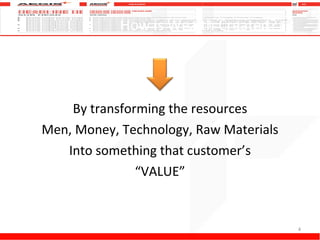
How is Wealth Created? By transforming the resources Men, Money, Technology, Raw Materials Into something that customer’s “ VALUE”
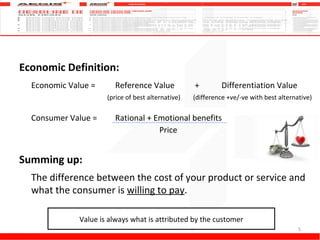
What is value? Economic Definition: Economic Value = Reference Value  +  Differentiation Value   (price of best alternative)  (difference +ve/-ve with best alternative) Consumer Value =  Rational + Emotional benefits   Price Summing up:  The difference between the cost of your product or service and what the consumer is  willing to pay . Value is always what is attributed by the customer
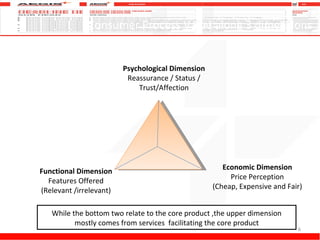
Consumer Process Value along 3 dimensions Psychological Dimension Reassurance / Status / Trust/Affection Economic Dimension Price Perception (Cheap, Expensive and Fair) Functional Dimension Features Offered (Relevant /irrelevant) While the bottom two relate to the core product ,the upper dimension mostly comes from services  facilitating the core product
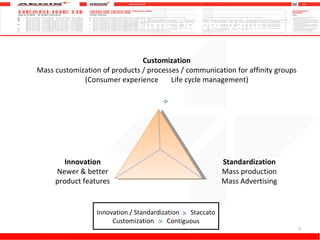
Firms Deliver Value Customization Mass customization of products / processes / communication for affinity groups (Consumer experience  Life cycle management) Standardization Mass production Mass Advertising Innovation Newer & better product features Innovation / Standardization  Staccato Customization  Contiguous
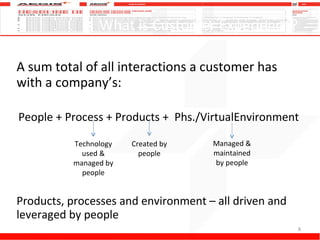
What is Customer Experience? A sum total of all interactions a customer has with a company’s: People + Process + Products +  Phs./VirtualEnvironment Products, processes and environment – all driven and leveraged by people Technology used & managed by people Created by people Managed & maintained by people
Service Profit Link
How are People Engaged? Empowerment: adequately facilitated to meet and exceed customer expectations Acknowledgement: rewarded and recognized Learning: Relevant and timely training inputs Fairness: Transparency in policy   No patronization   No discrimination
Challenges towards creating an Engaged Workforce Service Quality Gap Top Management Mindset Silo mindset – micro organization
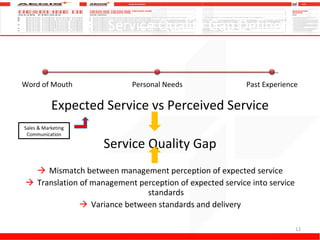
Service Quality Gap Defined Expected Service vs Perceived Service Service Quality Gap Mismatch between management perception of expected service Translation of management perception of expected service into service standards Variance between standards and delivery Word of Mouth Personal Needs Past Experience Sales & Marketing Communication
Remedial Measures Audit of data capture mechanism and nomenclature Cross-verification of qualitative inputs and external research Process blue printing Process fail-safing Service recovery procedures
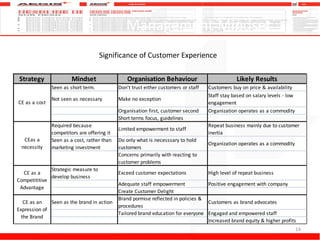
Management Mindset Significance of Customer Experience
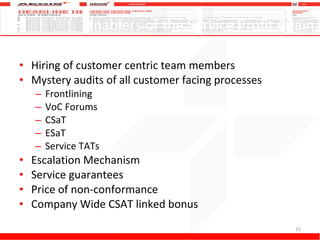
Enablers of the Service Profit Chain Hiring of customer centric team members Mystery audits of all customer facing processes Frontlining VoC Forums CSaT ESaT Service TATs Escalation Mechanism Service guarantees Price of non-conformance Company Wide CSAT linked bonus
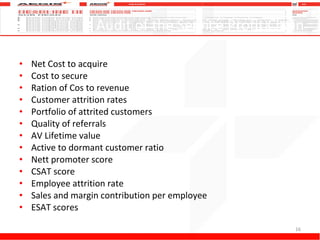
Audit of the Service Profit Chain Net Cost to acquire  Cost to secure Ration of Cos to revenue Customer attrition rates Portfolio of attrited customers Quality of referrals AV Lifetime value Active to dormant customer ratio Nett promoter score CSAT score Employee attrition rate Sales and margin contribution per employee ESAT scores
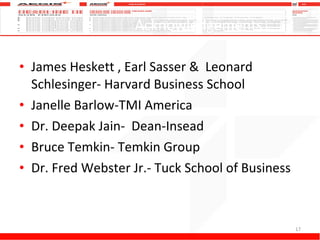
Acknowledgements James Heskett , Earl Sasser &  Leonard Schlesinger- Harvard Business School Janelle Barlow-TMI America  Dr. Deepak Jain-  Dean-Insead Bruce Temkin- Temkin Group Dr. Fred Webster Jr.- Tuck School of Business
Let’s begin

Service profit link

  • 1.
    Welcome to the World’s First Institute of Customer Experience Management Addressing Business growth and profitability challenges through the science of customer experience
  • 2.
    Understanding and managingthe Service Profit Link.
  • 3.
    What is theobjective of the business Creation of Wealth For Whom Employees? Shareholders? Customers / Society? Ok, let’s agree it is for shareholders.
  • 4.
    How is WealthCreated? By transforming the resources Men, Money, Technology, Raw Materials Into something that customer’s “ VALUE”
  • 5.
    What is value?Economic Definition: Economic Value = Reference Value + Differentiation Value (price of best alternative) (difference +ve/-ve with best alternative) Consumer Value = Rational + Emotional benefits Price Summing up: The difference between the cost of your product or service and what the consumer is willing to pay . Value is always what is attributed by the customer
  • 6.
    Consumer Process Valuealong 3 dimensions Psychological Dimension Reassurance / Status / Trust/Affection Economic Dimension Price Perception (Cheap, Expensive and Fair) Functional Dimension Features Offered (Relevant /irrelevant) While the bottom two relate to the core product ,the upper dimension mostly comes from services facilitating the core product
  • 7.
    Firms Deliver ValueCustomization Mass customization of products / processes / communication for affinity groups (Consumer experience Life cycle management) Standardization Mass production Mass Advertising Innovation Newer & better product features Innovation / Standardization Staccato Customization Contiguous
  • 8.
    What is CustomerExperience? A sum total of all interactions a customer has with a company’s: People + Process + Products + Phs./VirtualEnvironment Products, processes and environment – all driven and leveraged by people Technology used & managed by people Created by people Managed & maintained by people
  • 9.
  • 10.
    How are PeopleEngaged? Empowerment: adequately facilitated to meet and exceed customer expectations Acknowledgement: rewarded and recognized Learning: Relevant and timely training inputs Fairness: Transparency in policy No patronization No discrimination
  • 11.
    Challenges towards creatingan Engaged Workforce Service Quality Gap Top Management Mindset Silo mindset – micro organization
  • 12.
    Service Quality GapDefined Expected Service vs Perceived Service Service Quality Gap Mismatch between management perception of expected service Translation of management perception of expected service into service standards Variance between standards and delivery Word of Mouth Personal Needs Past Experience Sales & Marketing Communication
  • 13.
    Remedial Measures Auditof data capture mechanism and nomenclature Cross-verification of qualitative inputs and external research Process blue printing Process fail-safing Service recovery procedures
  • 14.
    Management Mindset Significanceof Customer Experience
  • 15.
    Enablers of theService Profit Chain Hiring of customer centric team members Mystery audits of all customer facing processes Frontlining VoC Forums CSaT ESaT Service TATs Escalation Mechanism Service guarantees Price of non-conformance Company Wide CSAT linked bonus
  • 16.
    Audit of theService Profit Chain Net Cost to acquire Cost to secure Ration of Cos to revenue Customer attrition rates Portfolio of attrited customers Quality of referrals AV Lifetime value Active to dormant customer ratio Nett promoter score CSAT score Employee attrition rate Sales and margin contribution per employee ESAT scores
  • 17.
    Acknowledgements James Heskett, Earl Sasser & Leonard Schlesinger- Harvard Business School Janelle Barlow-TMI America Dr. Deepak Jain- Dean-Insead Bruce Temkin- Temkin Group Dr. Fred Webster Jr.- Tuck School of Business
  • 18.