MANAGING CUSTOMER
   EXPECTATIONS
Objectives

• At the end of this training, you will be able to
 • Identify the elements of a good customer service
   encounter
 • Note the two elements of service that must be
   provided to meet every customer‟s basic
   expectations
 • Identify key expectations customers have of
   service providers and how to influence these
   expectations
 • Determine how to handle customer complaints
   and ensure service recovery
Content

•   The Customer Service Encounter
•   Customer Expectations… What are they?
•   Managing and Influencing Customer Expectations
•   Handling Customer Complaints
•   Service Recovery
SESSION ONE
THE CUSTOMER SERVICE ENCOUNTER
Customer Service

• Customer service is an organization's ability to
  identify and supply their customers' wants and
  needs.


• The Institute of Customer Service (ICS) defines it as


  “…The sum total of what an organization does to
       1. meet customer expectations and
       2. produce customer satisfaction. ..”
Customer Service

• You therefore, need to know what the customer‟s
  expectations are to ensure
 •   Customer satisfaction
 •   That activities are occurring as expected
 •   That deliverables or output meet expectations
 •   That deliverables are received when expected
 •   That anticipated value is received
The Customer Service Encounter

• An interaction you have with your customers
  • face to face / in person
  • by e-mail
  • over the telephone
  • anything that involves an “exchange” of
   • information, advice, ideas, physical resources, etc
The Customer Service Encounter

• During a service encounter the customer will form a
  judgement on the service provided based on their
  personal:
  •   expectations
  •   perceptions
  •   desires
  •   feelings
  •   needs
  •   wants
  •   values
The Customer Service Encounter

• Based on the quality of the service encounter a
  customer will either be
  • satisfied,
  • dissatisfied or
  • delighted.


• Knowing a customer‟s expectation is instrumental in
  developing a strategy for meeting and exceeding
  customer expectations.
The Customer Service Encounter

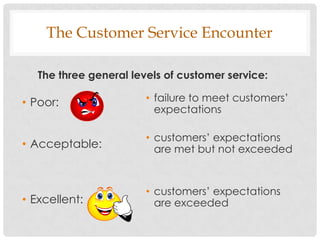
   The three general levels of customer service:

• Poor:                 • failure to meet customers‟
                          expectations

                        • customers‟ expectations
• Acceptable:             are met but not exceeded


                        • customers‟ expectations
• Excellent:              are exceeded
The 10 Attributes of Good Customer Service

• The 4 „management‟ attributes
   • Security:
     • safety of the environment and the customers
   • Tangibles:
     • products, resources
   • Access:
     • ease of access to service, opening hours
   • Reliability:
     • does equipment work properly, robust
       operational procedures
The 10 Attributes of Good Customer Service

• The 6 “soft” attributes
   • Courtesy:
     • politeness and respect for others
   • Communication:
     • staff have appropriate interpersonal skills
   • Competence:
     • staff have been trained to an appropriate level
The 10 Attributes of Good Customer Service

  • Responsiveness:
    • willingness to help, go the “extra mile”
  • Credibility:
    • customer-centric: customer first, will you keep
      your promises?
  • Understanding the customer:
    • talk and listen to your customers, are you giving
      them the service they require?
SESSION 2
CUSTOMER EXPECTATIONS…WHAT ARE THEY?
Customer Expectations?

• Expectations…
 • What are they?

 • They are your customer‟s vision of a future state or
   action, usually unstated but which is critical to your
   success.

 • Expectations are not constant, they constantly
   change over time, usually becoming more
   demanding and are influenced by their previous
   experiences and their experiences of dealing with
   other organisations, particularly your competitors.
Customer Expectations?

• Quality of a service is about customer expectation
  and perception.

• Exactly the same product or service may be
  perceived as being good or poor depending upon
  the customer’s expectations.
Customer Expectations?


• So what do customers expect from
      you the service provider?
Customer Expectations?

• When you're a customer, what matters to
  you?
 • What matters when you're
   •   At the hospital
   •   At the Trotro station?
   •   Buying food stuff from the market or buying from a shop?
   •   Going to pay your electricity or water bill?
   •   Buying waakye at the roadside?
Customer Expectations?

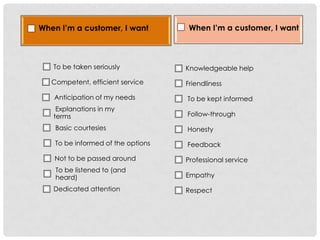
• A survey was carried out to sample customer
  expectations and the responses obtained were very
  similar, demonstrating that most of us want the
  same things when we are customers
When I’m a customer, I want          When I’m a customer, I want


   To be taken seriously            Knowledgeable help

   Competent, efficient service     Friendliness

   Anticipation of my needs         To be kept informed
    Explanations in my
   terms                            Follow-through

    Basic courtesies                Honesty

    To be informed of the options   Feedback

    Not to be passed around         Professional service
    To be listened to (and
    heard)                          Empathy

   Dedicated attention              Respect
Customer Expectations?

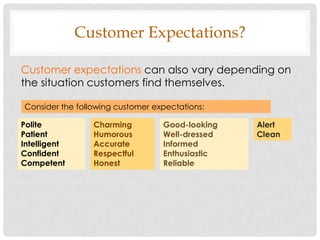
Customer expectations can also vary depending on
the situation customers find themselves.

Consider the following customer expectations:

Polite           Charming         Good-looking   Alert
Patient          Humorous         Well-dressed   Clean
Intelligent      Accurate         Informed
Confident        Respectful       Enthusiastic
Competent        Honest           Reliable
Customer Expectations?

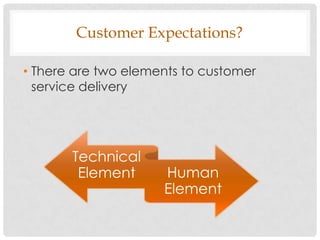
• There are two elements to customer
  service delivery


       Technical
        Element      Human
                     Element
Customer Expectations?

• The technical element refers to the product
  • The solution, loan, system, response, resolution, deliverable or
    result or whatever you are providing your customers.
  • Whatever form the product takes, customers want it to work
    properly, to meet their needs,
  • This is the technical element of service, and you will not have
    happy customers without it.

• But excelling in the technical element alone may not keep
  customers coming back unless you also excel in the process.
Customer Expectations?

• The human element refers to the process
 • How customers feel they have been treated.
   • Not how customers are treated! How they feel they have
     been treated.
 • This is the human element of service which is
   exceedingly important in achieving a high level of
   customer satisfaction.
 • In fact, for many customers, the process is more
   important than the product.
Customer Expectations?

• For example, a person visits a restaurant primarily for
  the food it serves.
  • That is the customer‟s need/technical element.
• However, the customer expects polite staff, attentive
  yet non intrusive service and a pleasant ambience.
  • The human element.
• If these expectations are not properly met the guest
  would leave the restaurant dissatisfied even if the
  technical aspect, which is eating a meal, has been
  met.
Customer Expectations?
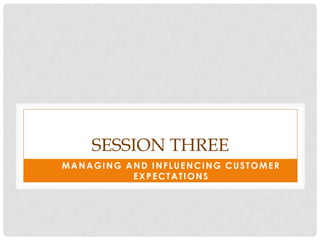
All customers are likely to have special needs, which organizations
must cater for. These needs may be related to:

circumstances – requiring a product or information before a certain
time or for a set purpose

personal requirements – needing a product or information customized or
adapted in a specific way

individual traits – requiring different products or information because of
beliefs, age, fashion preferences, etc.

disability – needing special help due to problems
with mobility or another impairment.
SESSION THREE
MANAGING AND INFLUENCING CUSTOMER
          EXPECTATIONS
Managing Customer Expectations

• At every stage in the customer‟s relationship with your
  organization or in the buying process, customers have a different
  set of expectations.
  • At the pre-purchase stage when customers are still in doubt on
    whether to establish a relationship with your organization
      What would their expectations be?

  • During the customer service encounter, when they are in the
    process of using your services
    • What would their expectations be?

  • After the service has been accessed,
    • what would be their expectations of you ?
Managing Customer Expectations Prior to
               Purchase
Learn what customers expect.
 Ask employees and customers.

Tell customers what to expect.

Consistently provide the service customers
 expect.
 This concretizes their expectations
Managing Customer Expectations during
          Service Encounter

Communicate with customers during
 the service.

If possible,
  modify the service to meet customer
   expectations or
  explain why service cannot be modified.
Managing Customer Expectations after
           the Purchase

Communicate - were expectations met?
Follow up on customers to get their views
Develop a procedure for dealing with
 dissatisfied customers.
Influencing Customer Expectations

• Sometimes we as service providers realise that
  what our customers want is
  • unrealistic,
  • not in their own interests,
  • Cannot be provided by our organization etc.


• In situations such as these, we need to influence
  their expectations so as not to lose potential
  customers or to be able to provide them with
  services that will inure to their benefit.
Influencing Customer Expectations

• How do you influence a customer‟s expectations?

• Establish trust: People buy only from those whom
  they trust. And trust needs to be earned and
  sustained through constant follow-up and customer
  care.
Influencing Customer Expectations

• Explain why: Customers like to be given information
  and not told “this is how it is done”. Tell them why
  •    the process is cumbersome
  •    They need to provide various documentation prior to
       receiving loans etc.


• Educate: The more your customers know, the
  better they understand the complexity of your work
  and the impact their expectations have.
  • The customer is not always right. He should be educated to
    take the best decisions in the interest of both himself and
    you the service provider.
Influencing Customer Expectations

• Give more than you take: See if you can identify
  one or two of your customer‟s expectations that
  you haven't acted on and which are relatively easy
  to satisfy.
 • Ensure they're satisfied.
 • Then bring up some expectation you would like to change.
   When the customer perceives that you usually give more
   than what he demands, he will start having faith in your
   decisions.
Influencing Customer Expectations

• Under promise and Over-deliver

• Once the expectations are clearly spelt out, give your
  customer some extra services for free. Remember that
  what you give as extras is as important as the act of
  giving.

• To know what to give as extras, ask yourself:
  • What would you like to see in the product/service in case you were
    buying it yourself.
  • Give the level of service and support that you expect from others to
    your own clients.
SESSION FOUR
HANDLING CUSTOMER COMPLAINTS
Handling Customer Complaints

• When a customer complains, look at it as an
  opportunity to improve.
    • Share some scenarios or experiences when a bad customer
      experience happened.


 Customers may be difficult for several reasons:
    •   upset because something was mishandled by the company
    •   frustrated about a delay in handling a request
    •   Impatient about a company‟s response time
    •   Just having a bad day
5 Steps for Handling Customer Complaints
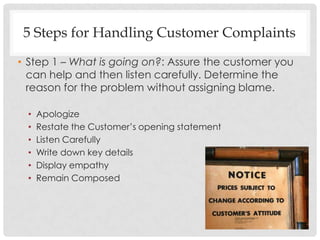
• Step 1 – What is going on?: Assure the customer you
  can help and then listen carefully. Determine the
  reason for the problem without assigning blame.

 •   Apologize
 •   Restate the Customer‟s opening statement
 •   Listen Carefully
 •   Write down key details
 •   Display empathy
 •   Remain Composed
5 Steps for Handling Customer Complaints

• Step 2 – What caused the problem?: Identify the
  root cause.

 •   Investigate the situation.
 •   Determine if the customer has a valid complaint.
 •   Apologize again, if necessary.
 •   Explain what happened: stick to the facts. Keep emotion
     out of it.
5 Steps for Handling Customer Complaints

• Step 3 – What can I do?: Thank the customer for the
  opportunity to fix things. Rectify the situation.

  • Tell the customer what you are going to do to solve the
    problem.
  • Focus on What You CAN do.
  • Offer the best solution you can.
  • Never Assign blame.
  • Show Compassion.
  • Offer an alternative solution.
5 Steps for Handling Customer Complaints
• Step 4 – What can I say?: Restore the
  relationship. Follow up to make sure customer is
  now satisfied.


  • Thank the customer for allowing you to
  make things right.
  • Tell what you will do to avoid future problems.
  • Offer some sort of compensation or restitution.
  • Make a follow-up call or visit.
5 Steps for Handling Customer Complaints

• Step 5 – What needs to be done?: Fix any practices
  or procedures so the problem doesn‟t occur again.

 • Analyze what went wrong.
 • Review company‟s policies & procedures
 • Change to make things better.
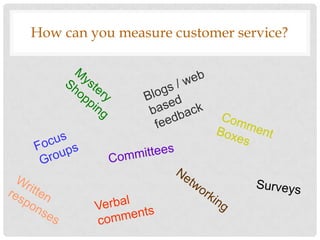
How can you measure customer service?
SESSION FIVE
SERVICE RECOVERY
Service Recovery?

• When customer expectations are not met or customers feel
  that the service they have received is below standard, it may
  affect their decision to further do business with the
  organization.
  • This calls for service recovery.

• Service recovery has been defined variously as :

“ the effort an organisation expends to win back customers
  goodwill once it has been lost due to service failure”

“actions taken by an organisation in response to some service
  failures”

“doing the service very right the second time”
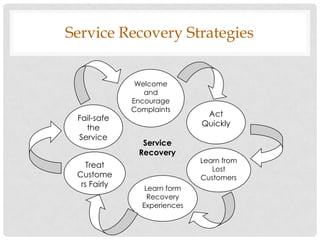
Service Recovery Strategies


               Welcome
                 and
              Encourage
              Complaints
                               Act
 Fail-safe
                              Quickly
   the
 Service
                Service
               Recovery
                              Learn from
    Treat                        Lost
 Custome                      Customers
  rs Fairly      Learn form
                  Recovery
                Experiences
Service Recovery

• We do not have to wait for customer complaints to
  initiate the service recovery process
 • Customers usually do not have the propensity to complain
   especially in Ghana.
   • They endure the poor service until they are fed up and move to
     a competitor

                             • OR
 • Complaints often don‟t identify the root of the problem
 • Complaints often don‟t reach management.

                           • MEANWHILE

 • Dissatisfied customers spread negative WOM.
Service Recovery

• We therefore need to be more proactive in
  ensuring service recovery. How?
 • Are you losing customers? Find out why
 • Constantly seek feedback from customers about your
   organization
 • Find out about what the competition is doing which you are
   not doing and see how to integrate it into your service


                      Other
                  strategies???
Service Recovery


• It is important to note that dissatisfied
  customers have options… They either:
  •   Do Nothing
  •   Complain in some form to the Service Organization
  •   Take Action Through a 3rd Party or
  •   Switch to a Competitor & Spread Negative Word
      of Mouth (WOM)

• This emphasizes the need for service
  recovery to ensure that dissatisfied customers
  are heard and their issues addressed.

Managing Customer Expectations

  • 1.
    MANAGING CUSTOMER EXPECTATIONS
  • 2.
    Objectives • At theend of this training, you will be able to • Identify the elements of a good customer service encounter • Note the two elements of service that must be provided to meet every customer‟s basic expectations • Identify key expectations customers have of service providers and how to influence these expectations • Determine how to handle customer complaints and ensure service recovery
  • 3.
    Content • The Customer Service Encounter • Customer Expectations… What are they? • Managing and Influencing Customer Expectations • Handling Customer Complaints • Service Recovery
  • 4.
    SESSION ONE THE CUSTOMERSERVICE ENCOUNTER
  • 5.
    Customer Service • Customerservice is an organization's ability to identify and supply their customers' wants and needs. • The Institute of Customer Service (ICS) defines it as “…The sum total of what an organization does to 1. meet customer expectations and 2. produce customer satisfaction. ..”
  • 6.
    Customer Service • Youtherefore, need to know what the customer‟s expectations are to ensure • Customer satisfaction • That activities are occurring as expected • That deliverables or output meet expectations • That deliverables are received when expected • That anticipated value is received
  • 7.
    The Customer ServiceEncounter • An interaction you have with your customers • face to face / in person • by e-mail • over the telephone • anything that involves an “exchange” of • information, advice, ideas, physical resources, etc
  • 8.
    The Customer ServiceEncounter • During a service encounter the customer will form a judgement on the service provided based on their personal: • expectations • perceptions • desires • feelings • needs • wants • values
  • 9.
    The Customer ServiceEncounter • Based on the quality of the service encounter a customer will either be • satisfied, • dissatisfied or • delighted. • Knowing a customer‟s expectation is instrumental in developing a strategy for meeting and exceeding customer expectations.
  • 10.
    The Customer ServiceEncounter The three general levels of customer service: • Poor: • failure to meet customers‟ expectations • customers‟ expectations • Acceptable: are met but not exceeded • customers‟ expectations • Excellent: are exceeded
  • 11.
    The 10 Attributesof Good Customer Service • The 4 „management‟ attributes • Security: • safety of the environment and the customers • Tangibles: • products, resources • Access: • ease of access to service, opening hours • Reliability: • does equipment work properly, robust operational procedures
  • 12.
    The 10 Attributesof Good Customer Service • The 6 “soft” attributes • Courtesy: • politeness and respect for others • Communication: • staff have appropriate interpersonal skills • Competence: • staff have been trained to an appropriate level
  • 13.
    The 10 Attributesof Good Customer Service • Responsiveness: • willingness to help, go the “extra mile” • Credibility: • customer-centric: customer first, will you keep your promises? • Understanding the customer: • talk and listen to your customers, are you giving them the service they require?
  • 14.
  • 15.
    Customer Expectations? • Expectations… • What are they? • They are your customer‟s vision of a future state or action, usually unstated but which is critical to your success. • Expectations are not constant, they constantly change over time, usually becoming more demanding and are influenced by their previous experiences and their experiences of dealing with other organisations, particularly your competitors.
  • 16.
    Customer Expectations? • Qualityof a service is about customer expectation and perception. • Exactly the same product or service may be perceived as being good or poor depending upon the customer’s expectations.
  • 17.
    Customer Expectations? • Sowhat do customers expect from you the service provider?
  • 18.
    Customer Expectations? • Whenyou're a customer, what matters to you? • What matters when you're • At the hospital • At the Trotro station? • Buying food stuff from the market or buying from a shop? • Going to pay your electricity or water bill? • Buying waakye at the roadside?
  • 19.
    Customer Expectations? • Asurvey was carried out to sample customer expectations and the responses obtained were very similar, demonstrating that most of us want the same things when we are customers
  • 20.
    When I’m acustomer, I want When I’m a customer, I want To be taken seriously Knowledgeable help Competent, efficient service Friendliness Anticipation of my needs To be kept informed Explanations in my terms Follow-through Basic courtesies Honesty To be informed of the options Feedback Not to be passed around Professional service To be listened to (and heard) Empathy Dedicated attention Respect
  • 21.
    Customer Expectations? Customer expectationscan also vary depending on the situation customers find themselves. Consider the following customer expectations: Polite Charming Good-looking Alert Patient Humorous Well-dressed Clean Intelligent Accurate Informed Confident Respectful Enthusiastic Competent Honest Reliable
  • 22.
    Customer Expectations? • Thereare two elements to customer service delivery Technical Element Human Element
  • 23.
    Customer Expectations? • Thetechnical element refers to the product • The solution, loan, system, response, resolution, deliverable or result or whatever you are providing your customers. • Whatever form the product takes, customers want it to work properly, to meet their needs, • This is the technical element of service, and you will not have happy customers without it. • But excelling in the technical element alone may not keep customers coming back unless you also excel in the process.
  • 24.
    Customer Expectations? • Thehuman element refers to the process • How customers feel they have been treated. • Not how customers are treated! How they feel they have been treated. • This is the human element of service which is exceedingly important in achieving a high level of customer satisfaction. • In fact, for many customers, the process is more important than the product.
  • 25.
    Customer Expectations? • Forexample, a person visits a restaurant primarily for the food it serves. • That is the customer‟s need/technical element. • However, the customer expects polite staff, attentive yet non intrusive service and a pleasant ambience. • The human element. • If these expectations are not properly met the guest would leave the restaurant dissatisfied even if the technical aspect, which is eating a meal, has been met.
  • 26.
    Customer Expectations? All customersare likely to have special needs, which organizations must cater for. These needs may be related to: circumstances – requiring a product or information before a certain time or for a set purpose personal requirements – needing a product or information customized or adapted in a specific way individual traits – requiring different products or information because of beliefs, age, fashion preferences, etc. disability – needing special help due to problems with mobility or another impairment.
  • 27.
    SESSION THREE MANAGING ANDINFLUENCING CUSTOMER EXPECTATIONS
  • 28.
    Managing Customer Expectations •At every stage in the customer‟s relationship with your organization or in the buying process, customers have a different set of expectations. • At the pre-purchase stage when customers are still in doubt on whether to establish a relationship with your organization What would their expectations be? • During the customer service encounter, when they are in the process of using your services • What would their expectations be? • After the service has been accessed, • what would be their expectations of you ?
  • 29.
    Managing Customer ExpectationsPrior to Purchase Learn what customers expect. Ask employees and customers. Tell customers what to expect. Consistently provide the service customers expect. This concretizes their expectations
  • 30.
    Managing Customer Expectationsduring Service Encounter Communicate with customers during the service. If possible, modify the service to meet customer expectations or explain why service cannot be modified.
  • 31.
    Managing Customer Expectationsafter the Purchase Communicate - were expectations met? Follow up on customers to get their views Develop a procedure for dealing with dissatisfied customers.
  • 32.
    Influencing Customer Expectations •Sometimes we as service providers realise that what our customers want is • unrealistic, • not in their own interests, • Cannot be provided by our organization etc. • In situations such as these, we need to influence their expectations so as not to lose potential customers or to be able to provide them with services that will inure to their benefit.
  • 33.
    Influencing Customer Expectations •How do you influence a customer‟s expectations? • Establish trust: People buy only from those whom they trust. And trust needs to be earned and sustained through constant follow-up and customer care.
  • 34.
    Influencing Customer Expectations •Explain why: Customers like to be given information and not told “this is how it is done”. Tell them why • the process is cumbersome • They need to provide various documentation prior to receiving loans etc. • Educate: The more your customers know, the better they understand the complexity of your work and the impact their expectations have. • The customer is not always right. He should be educated to take the best decisions in the interest of both himself and you the service provider.
  • 35.
    Influencing Customer Expectations •Give more than you take: See if you can identify one or two of your customer‟s expectations that you haven't acted on and which are relatively easy to satisfy. • Ensure they're satisfied. • Then bring up some expectation you would like to change. When the customer perceives that you usually give more than what he demands, he will start having faith in your decisions.
  • 36.
    Influencing Customer Expectations •Under promise and Over-deliver • Once the expectations are clearly spelt out, give your customer some extra services for free. Remember that what you give as extras is as important as the act of giving. • To know what to give as extras, ask yourself: • What would you like to see in the product/service in case you were buying it yourself. • Give the level of service and support that you expect from others to your own clients.
  • 37.
  • 38.
    Handling Customer Complaints •When a customer complains, look at it as an opportunity to improve. • Share some scenarios or experiences when a bad customer experience happened. Customers may be difficult for several reasons: • upset because something was mishandled by the company • frustrated about a delay in handling a request • Impatient about a company‟s response time • Just having a bad day
  • 39.
    5 Steps forHandling Customer Complaints • Step 1 – What is going on?: Assure the customer you can help and then listen carefully. Determine the reason for the problem without assigning blame. • Apologize • Restate the Customer‟s opening statement • Listen Carefully • Write down key details • Display empathy • Remain Composed
  • 40.
    5 Steps forHandling Customer Complaints • Step 2 – What caused the problem?: Identify the root cause. • Investigate the situation. • Determine if the customer has a valid complaint. • Apologize again, if necessary. • Explain what happened: stick to the facts. Keep emotion out of it.
  • 41.
    5 Steps forHandling Customer Complaints • Step 3 – What can I do?: Thank the customer for the opportunity to fix things. Rectify the situation. • Tell the customer what you are going to do to solve the problem. • Focus on What You CAN do. • Offer the best solution you can. • Never Assign blame. • Show Compassion. • Offer an alternative solution.
  • 42.
    5 Steps forHandling Customer Complaints • Step 4 – What can I say?: Restore the relationship. Follow up to make sure customer is now satisfied. • Thank the customer for allowing you to make things right. • Tell what you will do to avoid future problems. • Offer some sort of compensation or restitution. • Make a follow-up call or visit.
  • 43.
    5 Steps forHandling Customer Complaints • Step 5 – What needs to be done?: Fix any practices or procedures so the problem doesn‟t occur again. • Analyze what went wrong. • Review company‟s policies & procedures • Change to make things better.
  • 44.
    How can youmeasure customer service?
  • 45.
  • 46.
    Service Recovery? • Whencustomer expectations are not met or customers feel that the service they have received is below standard, it may affect their decision to further do business with the organization. • This calls for service recovery. • Service recovery has been defined variously as : “ the effort an organisation expends to win back customers goodwill once it has been lost due to service failure” “actions taken by an organisation in response to some service failures” “doing the service very right the second time”
  • 47.
    Service Recovery Strategies Welcome and Encourage Complaints Act Fail-safe Quickly the Service Service Recovery Learn from Treat Lost Custome Customers rs Fairly Learn form Recovery Experiences
  • 48.
    Service Recovery • Wedo not have to wait for customer complaints to initiate the service recovery process • Customers usually do not have the propensity to complain especially in Ghana. • They endure the poor service until they are fed up and move to a competitor • OR • Complaints often don‟t identify the root of the problem • Complaints often don‟t reach management. • MEANWHILE • Dissatisfied customers spread negative WOM.
  • 49.
    Service Recovery • Wetherefore need to be more proactive in ensuring service recovery. How? • Are you losing customers? Find out why • Constantly seek feedback from customers about your organization • Find out about what the competition is doing which you are not doing and see how to integrate it into your service Other strategies???
  • 50.
    Service Recovery • Itis important to note that dissatisfied customers have options… They either: • Do Nothing • Complain in some form to the Service Organization • Take Action Through a 3rd Party or • Switch to a Competitor & Spread Negative Word of Mouth (WOM) • This emphasizes the need for service recovery to ensure that dissatisfied customers are heard and their issues addressed.