Topic 4

             SOA Governance


Assoc.Prof.Dr. Thanachart Numnonda
        www.imcinstitute.com
Agenda
 SOA Challenge

 What   is SOA Governance?
 SOA Governance   : Technologies and Products
 SOA Governance   : Implementation


                                      2
SOA Challenge
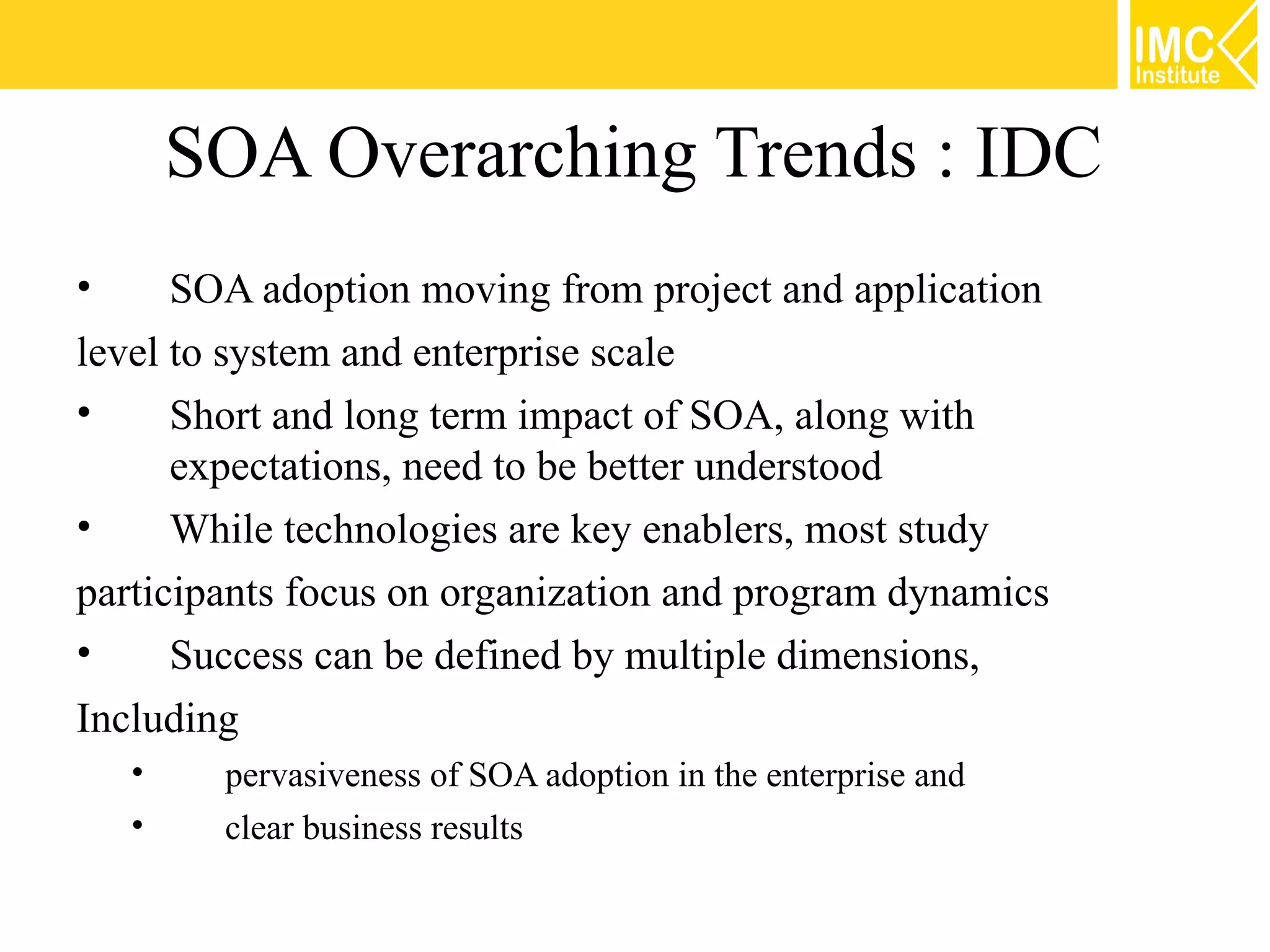
SOA Overarching Trends : IDC
•     SOA adoption moving from project and application
level to system and enterprise scale
•     Short and long term impact of SOA, along with
      expectations, need to be better understood
•     While technologies are key enablers, most study
participants focus on organization and program dynamics
•     Success can be defined by multiple dimensions,
Including
    •    pervasiveness of SOA adoption in the enterprise and
    •    clear business results
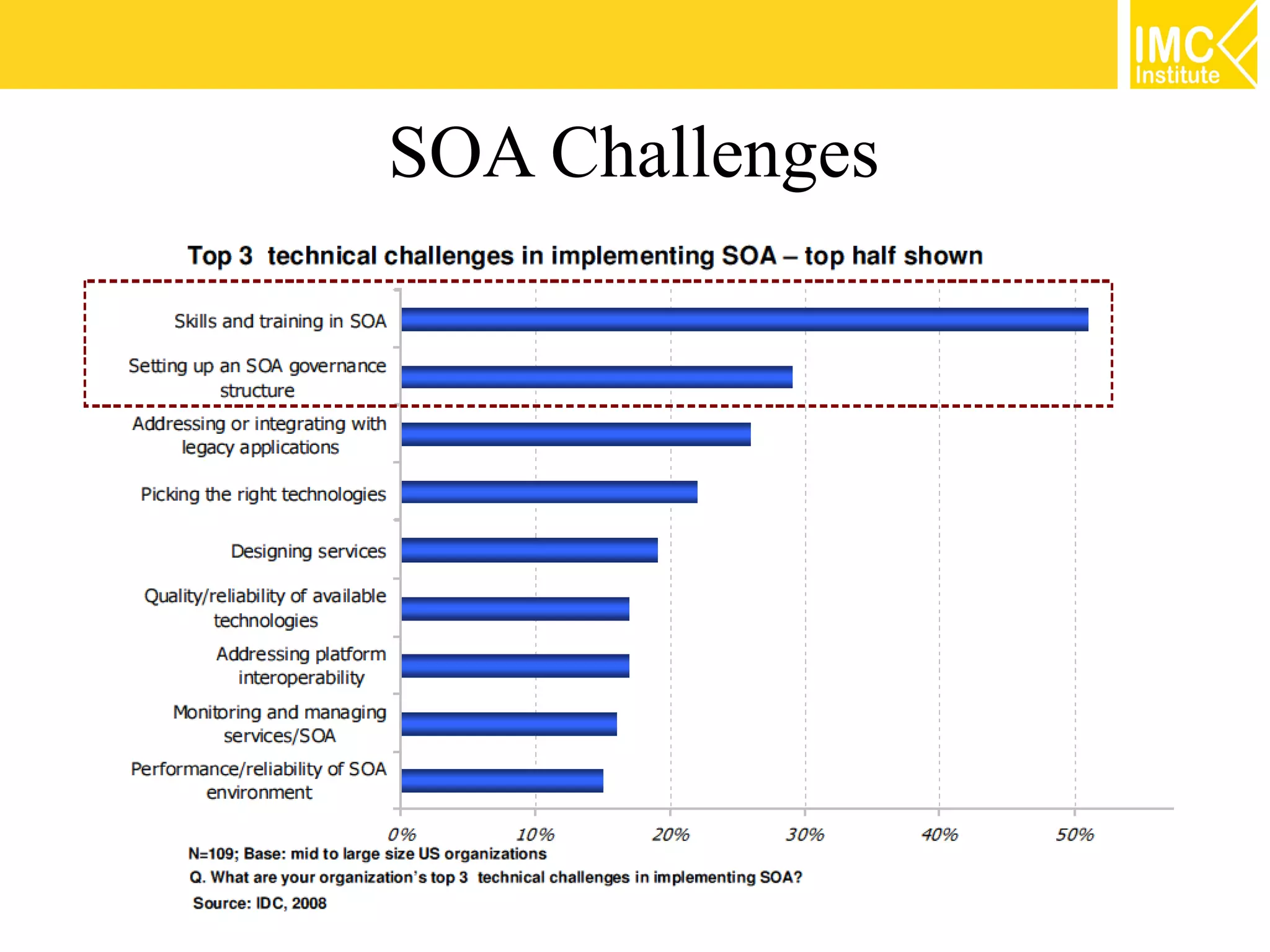
SOA Challenges


                 5
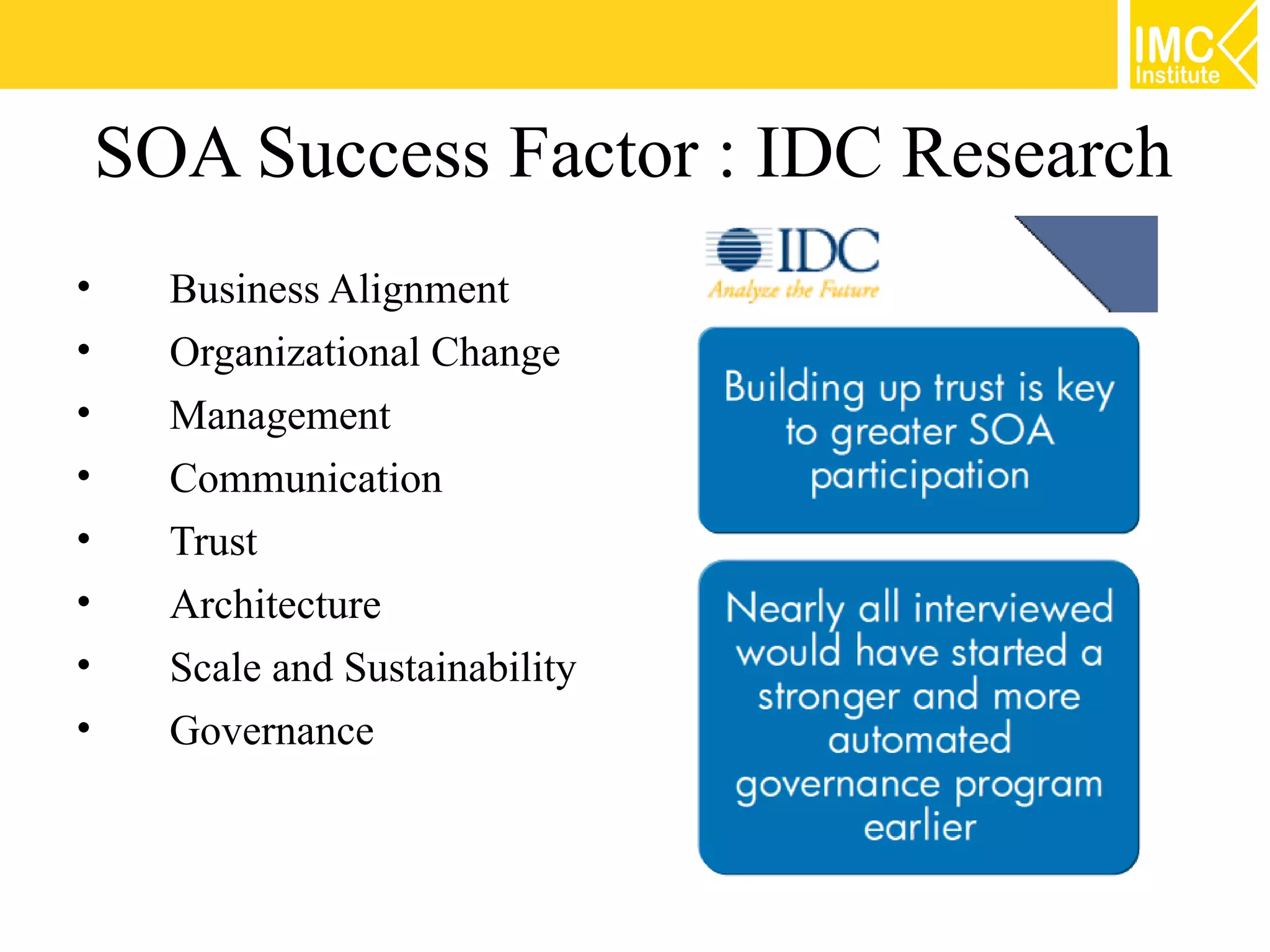
SOA Success Factor : IDC Research
•     Business Alignment
•     Organizational Change
•     Management
•     Communication
•     Trust
•     Architecture
•     Scale and Sustainability
•     Governance
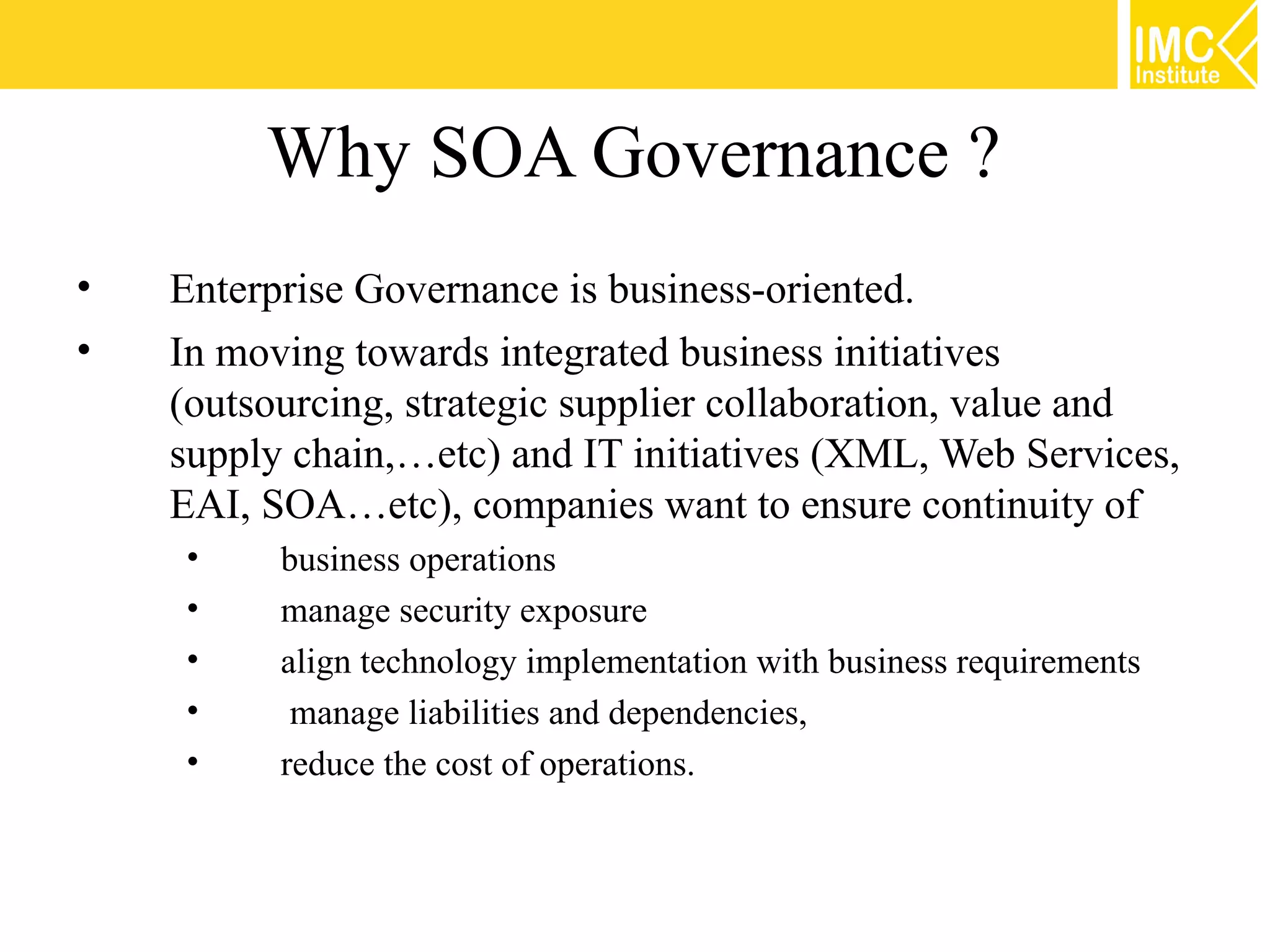
Why SOA Governance ?
•   Enterprise Governance is business-oriented.
•   In moving towards integrated business initiatives
    (outsourcing, strategic supplier collaboration, value and
    supply chain,…etc) and IT initiatives (XML, Web Services,
    EAI, SOA…etc), companies want to ensure continuity of
    •     business operations
    •     manage security exposure
    •     align technology implementation with business requirements
    •      manage liabilities and dependencies,
    •     reduce the cost of operations.
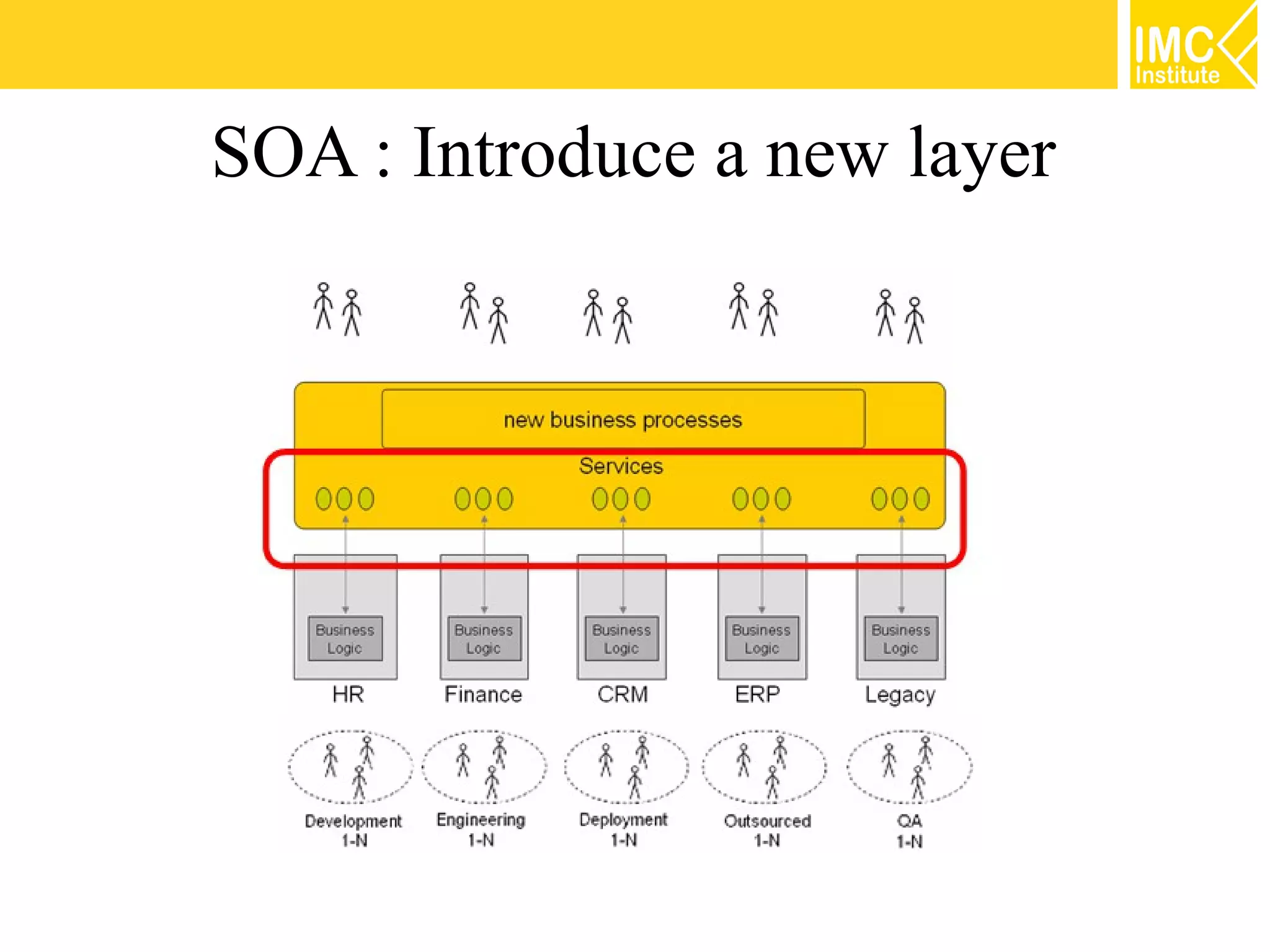
SOA : Introduce a new layer
SOA Challenges
•   It is so easy to create and utilize web services.
•   Evolving Standards for Business Compliance, IT
    Standards and Web Service Technologies .
•   Lack of one Standards enforcement .
•   A Variety of Vendors.
•   Inadequate Tooling .
•   New Layer - New Challenges
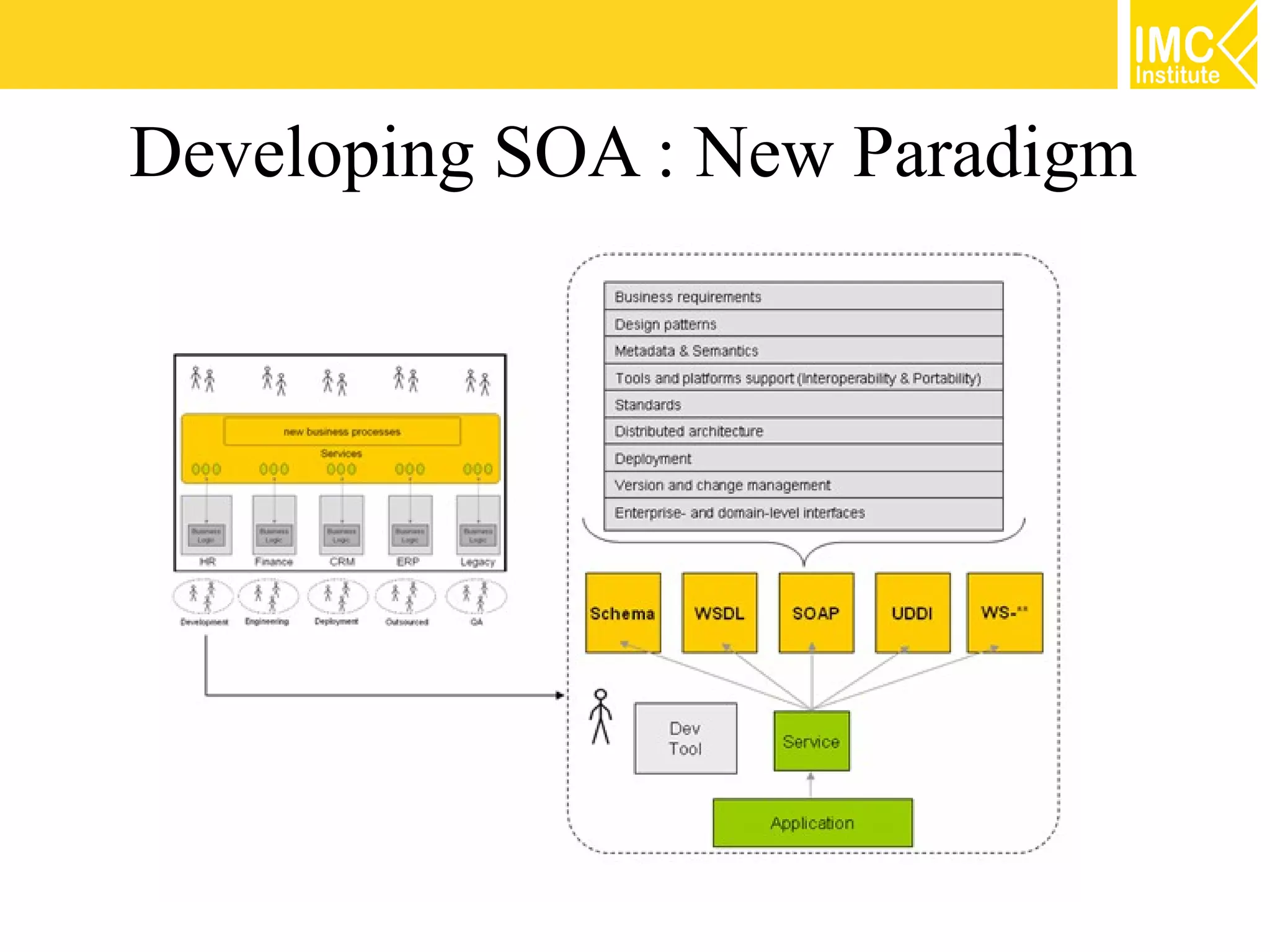
Developing SOA : New Paradigm
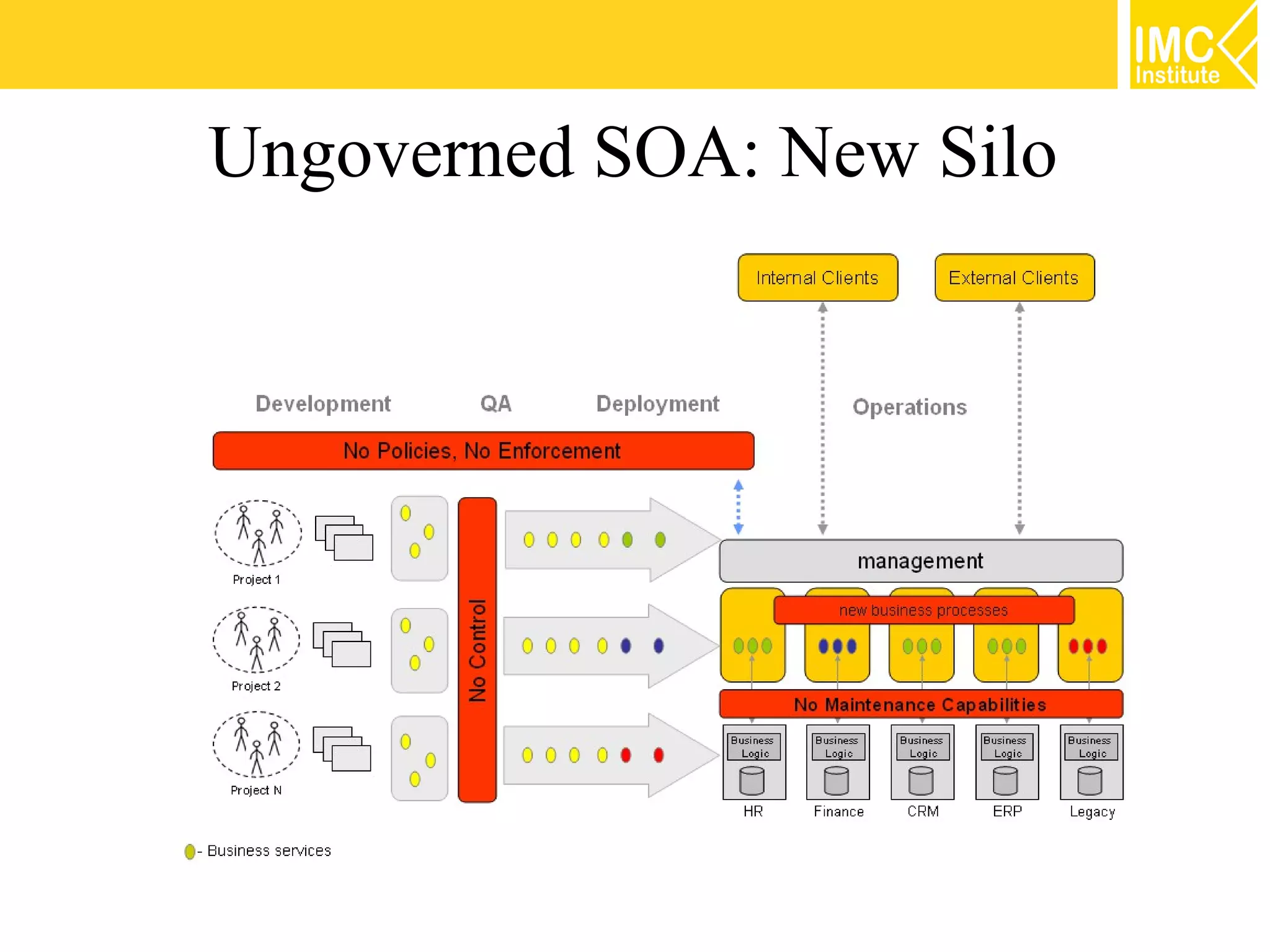
Ungoverned SOA: New Silo
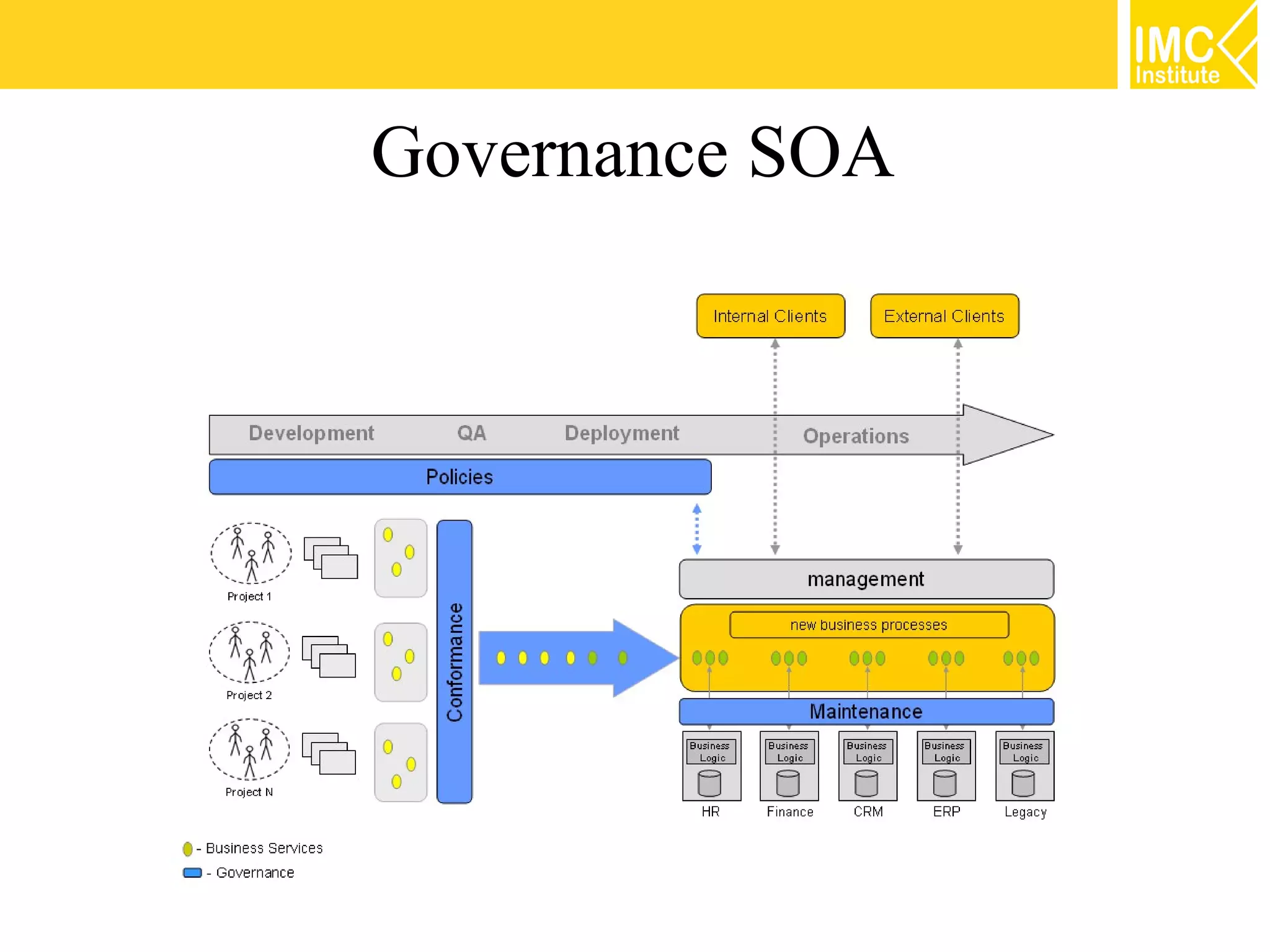
Governance SOA
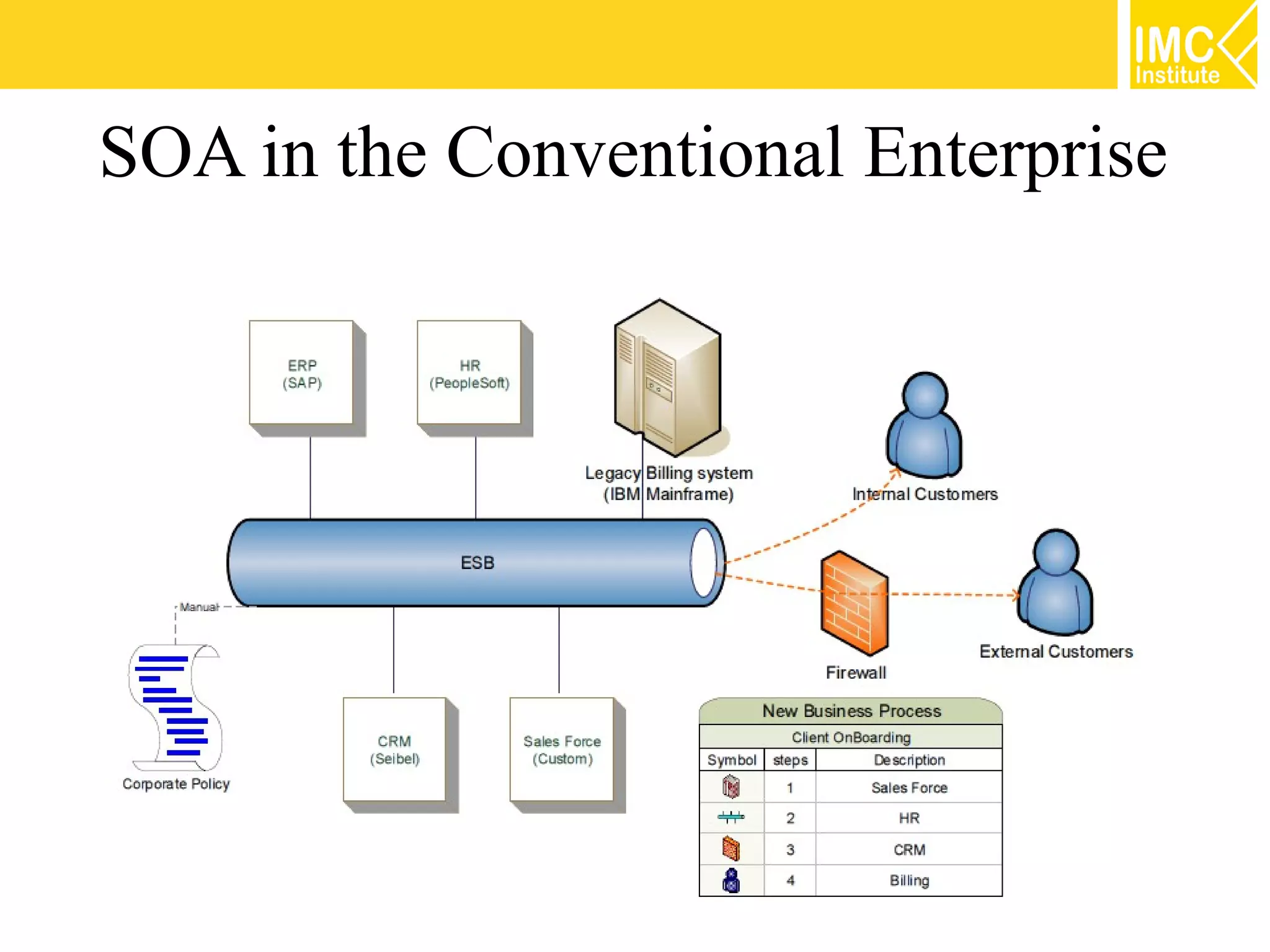
SOA in the Conventional Enterprise
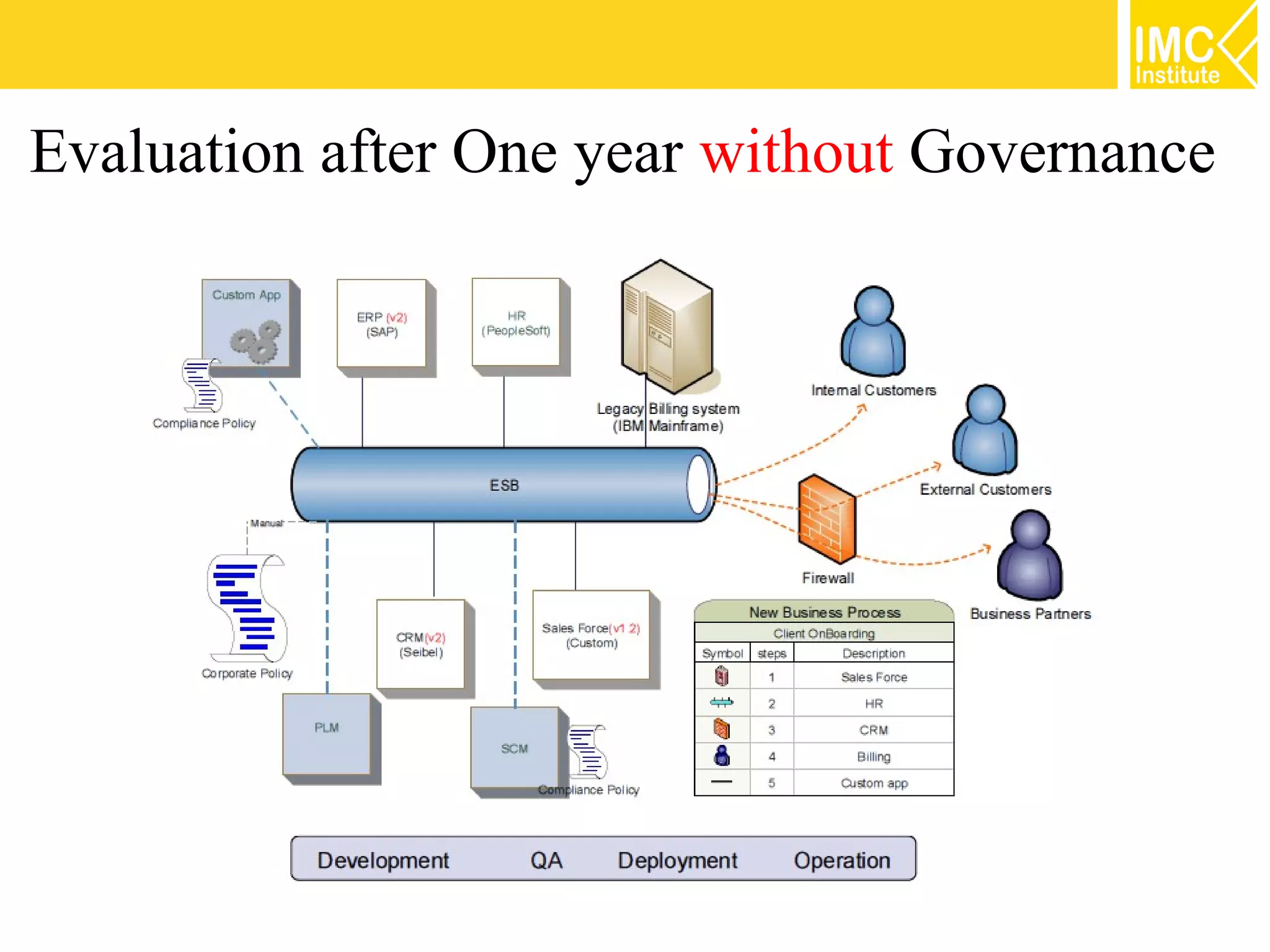
Evaluation after One year without Governance
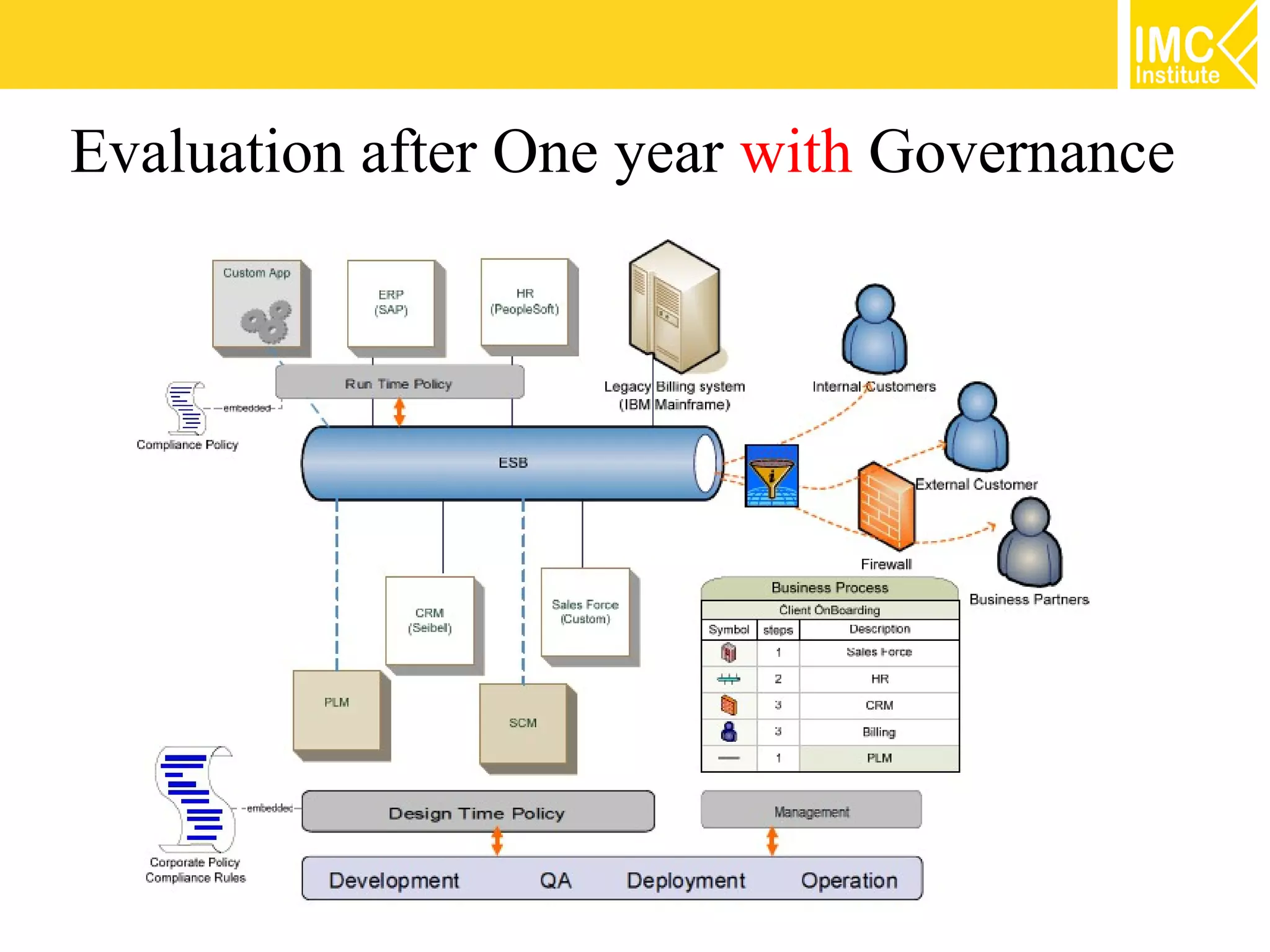
Evaluation after One year with Governance
What is SOA Governance?
SOA Governance : Definition
•   The processes used to oversee and control the
    adoption and implementation of SOA in
    accordance with recognized practices, principles
    and government regulations.
•   SOA governance provides optimum service quality,
    consistency, predictability and performance
SOA Governance : Components
•   SOA registry : an evolving catalog of information
    about the available services in the SOA
    implementation.
•   SOA policy : a set of behavioral restrictions
    intended to ensure that services remain consistent.
•   SOA testing : a comprehensive schedule of audits
    and performance-monitoring procedures.
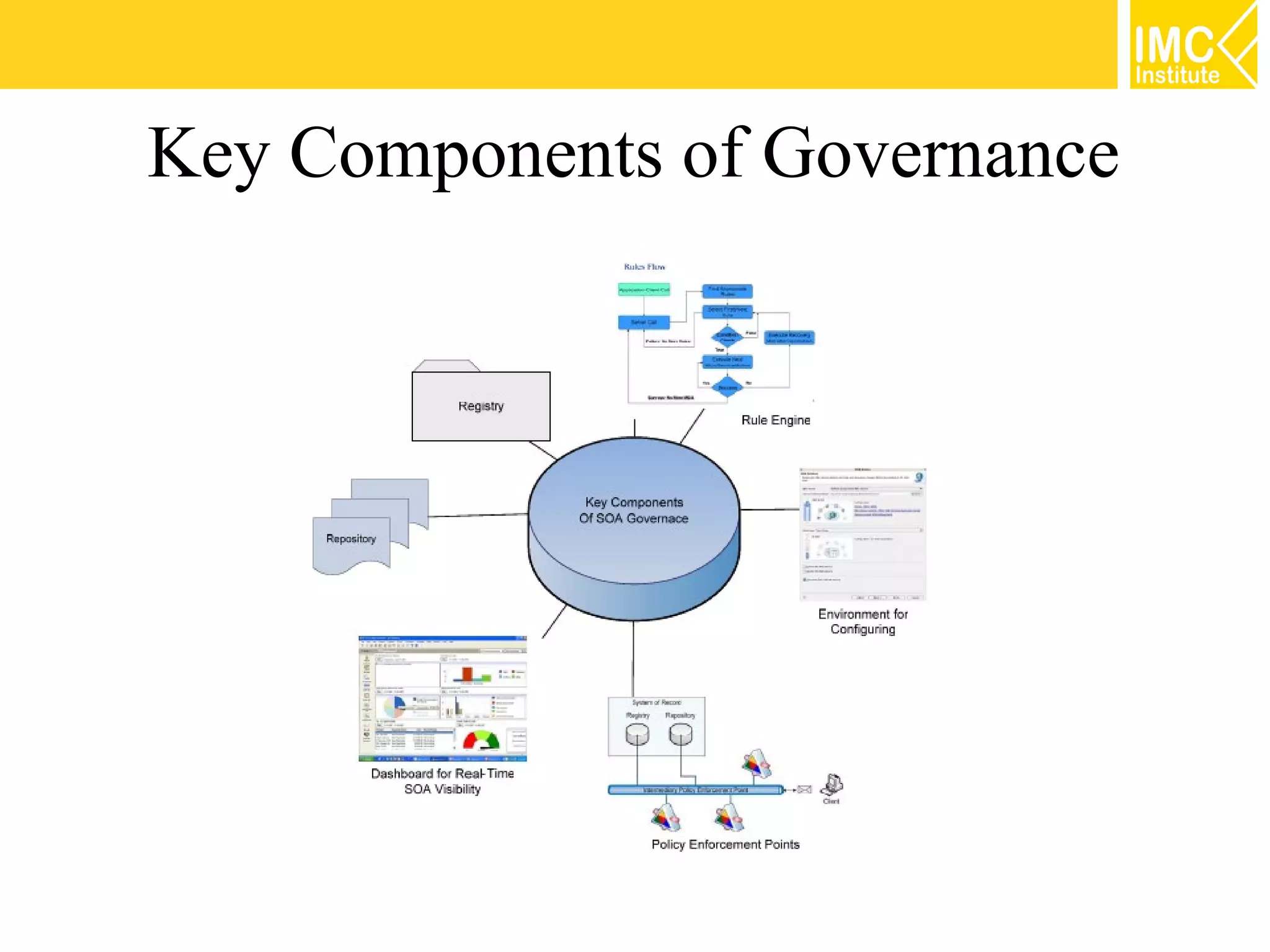
Key Components of Governance
Services in SOA

•       Heart of SOA
•       Life Cycle
    •     Designed
    •     Developed
    •     QA passed
    •     In production
•       Metadata
    •     WSDL
    •     Schema
    •     Policy
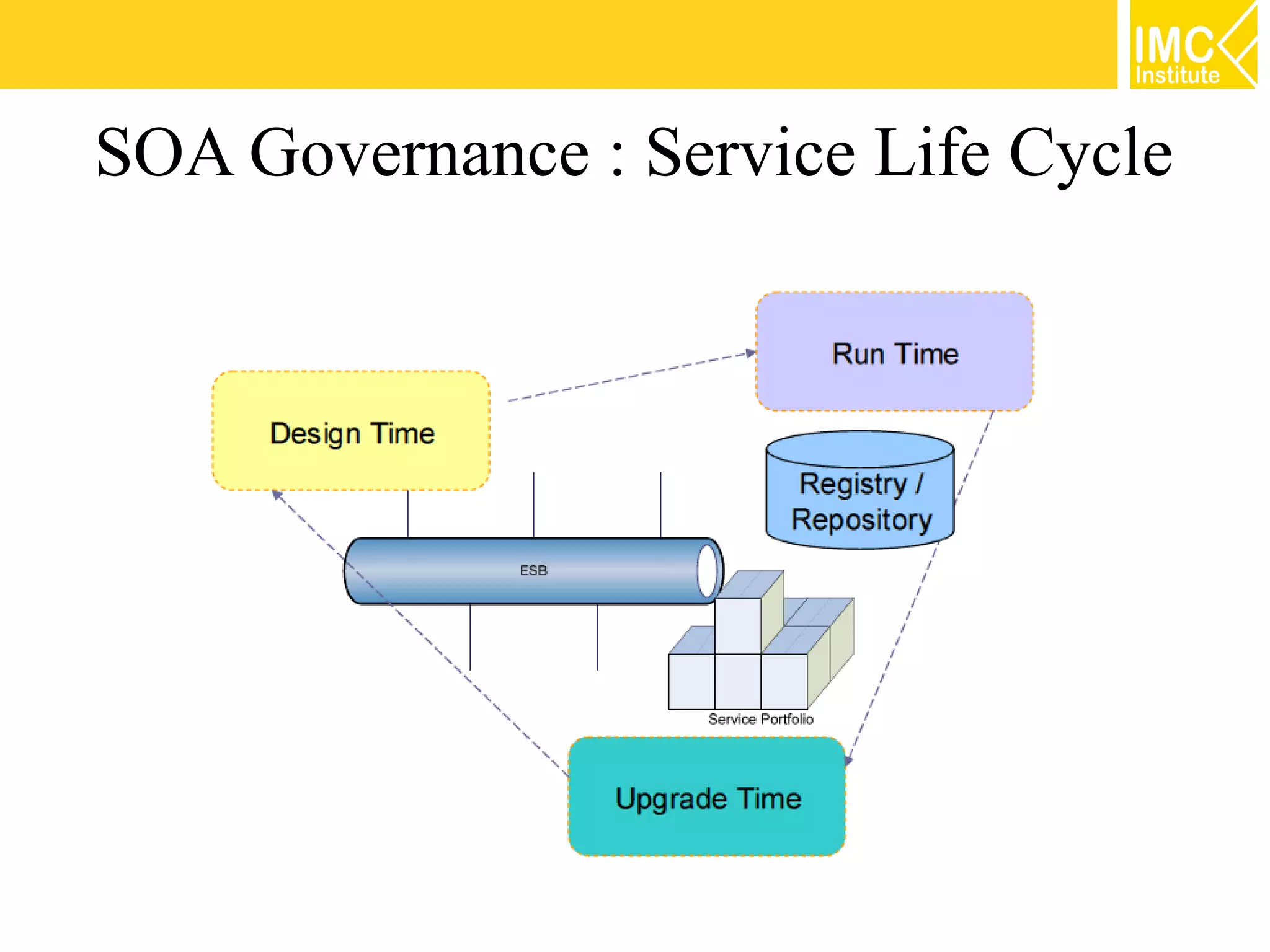
SOA Governance : Service Life Cycle
SOA Governance : Phases
•   SOA governance is divided between design time
    governance and runtime governance.
•   One way to make both design and runtime
    governance more effective is through centralized
    policy management.
•   If the architecture is designed with all the policies
    in an easily accessible location, then making
    updates to an SOA after it has been implemented is
    much easier.
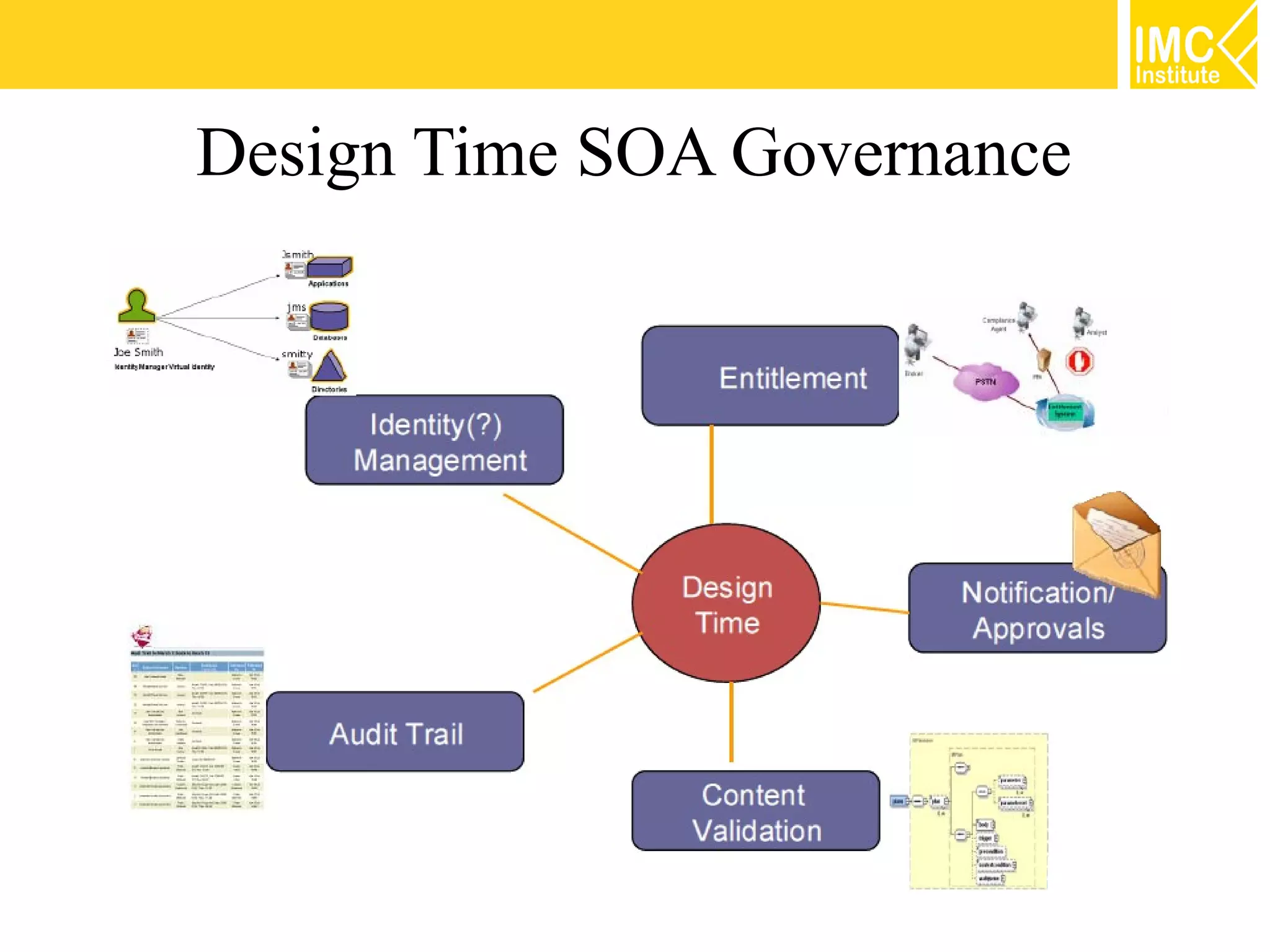
Design Time SOA Governance
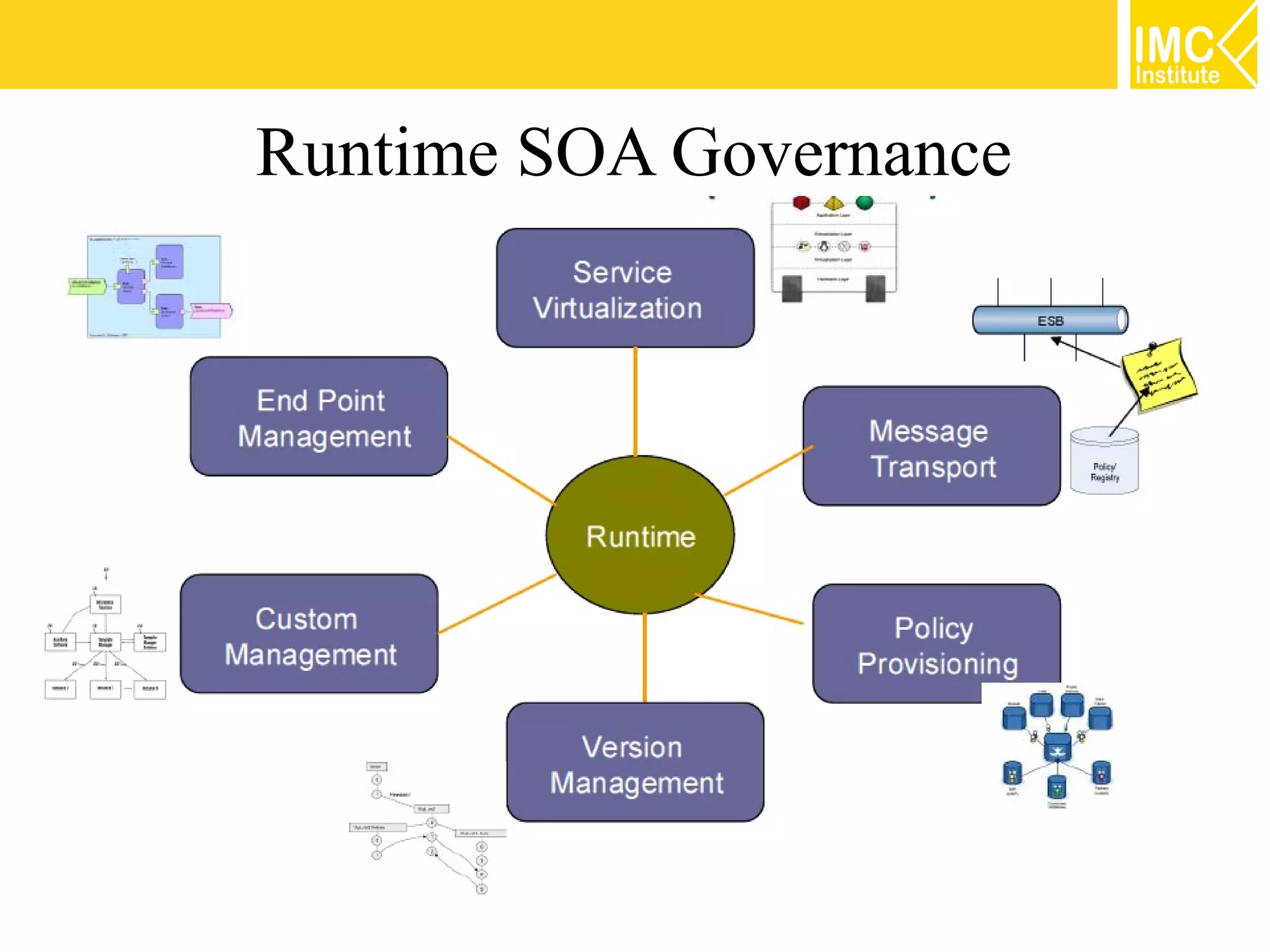
Runtime SOA Governance


                   24
Enterprise SOA Policies
•   Policies set the goals that you use to direct and
    measure success.
•   Without policies, there is no Governance
•   Policies need to address the overall impact to the
    business of the Services that are being created and
    deployed.
•   Policies need to create a strong connection between
    the business and technology.
Enterprise SOA Policies (cont.)
•       Policies might start at the business level:
    •     Projects must comply with Internal Architecture
          guidelines
    •     Security and regulatory compliance policy reviews are
          mandatory for all IT projects
•       Policies could represent more specific regulatory
        compliance issues: (SOX, HIPPA)
SOA Governance : Benefits
•       Greater alignment with business objectives
•       Greater control over creation, deployment
        and consumption of services
•       Centralized management of policies and regulation
•       Can embed compliance with government and indus
        try regulations
    •     Sarbanes‐Oxley, MiFID, HIPAA, GLBA
SOA Governance :
Technologies and Products
Technologies behind SOA Governance
•   Enterprise Service Bus (ESB)
•   Repository
•   Registry
Role of ESB in Governance
•       Security
    •     Ensure Privacy, Authenticity, Authorization and
          Auditing of all Message exchanged
•       Mediation
    •     Policy based mediation (protocol/invocation)
•       Management
    •     Holistic view of Transactions that passes through
    •     Intercept Service call
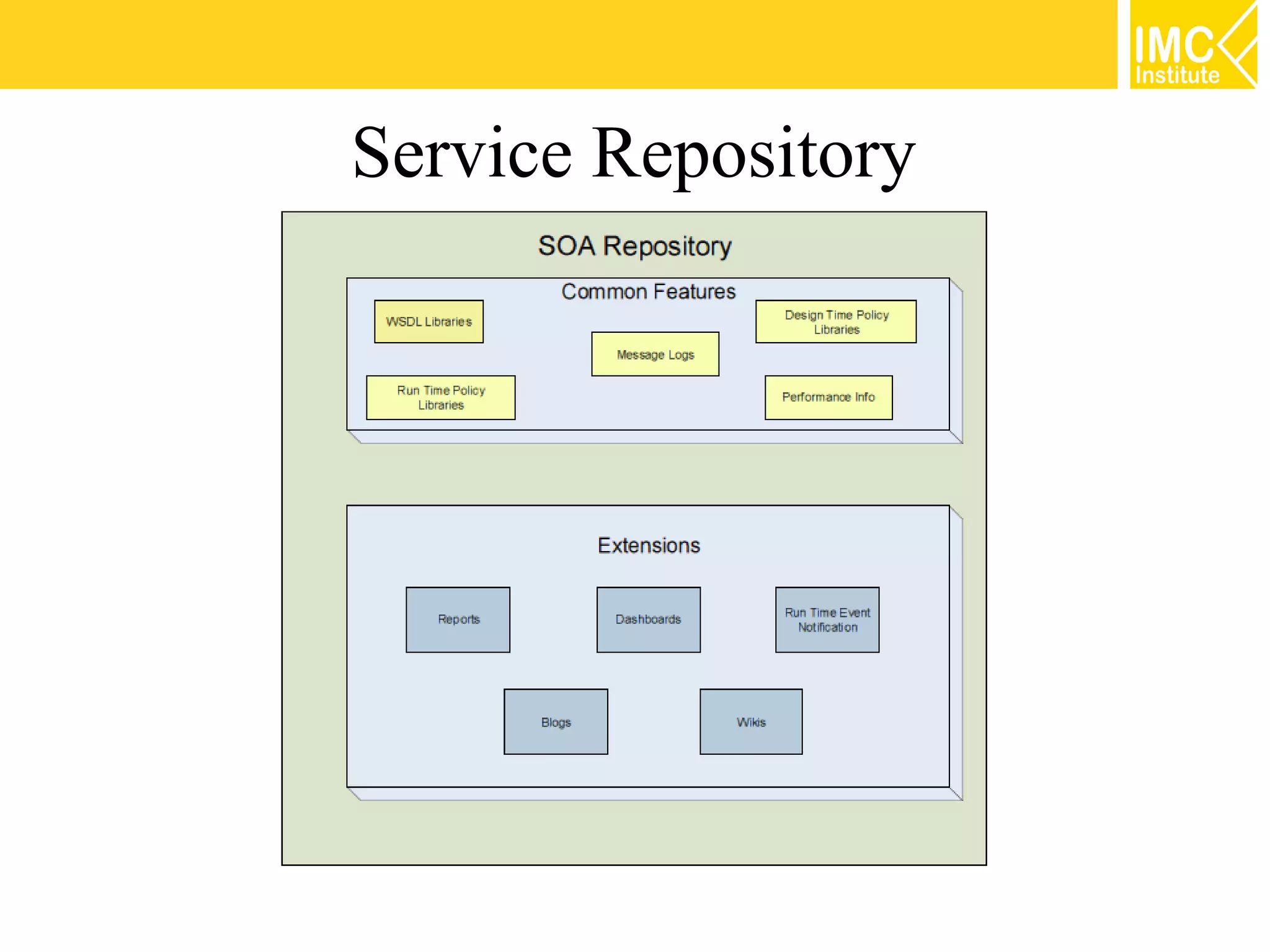
Role of Service Registry/Repository
•     Where all Services are published
•     Implements process to publish service that
      matches Governance model
•     Contains Policies applicable to each service
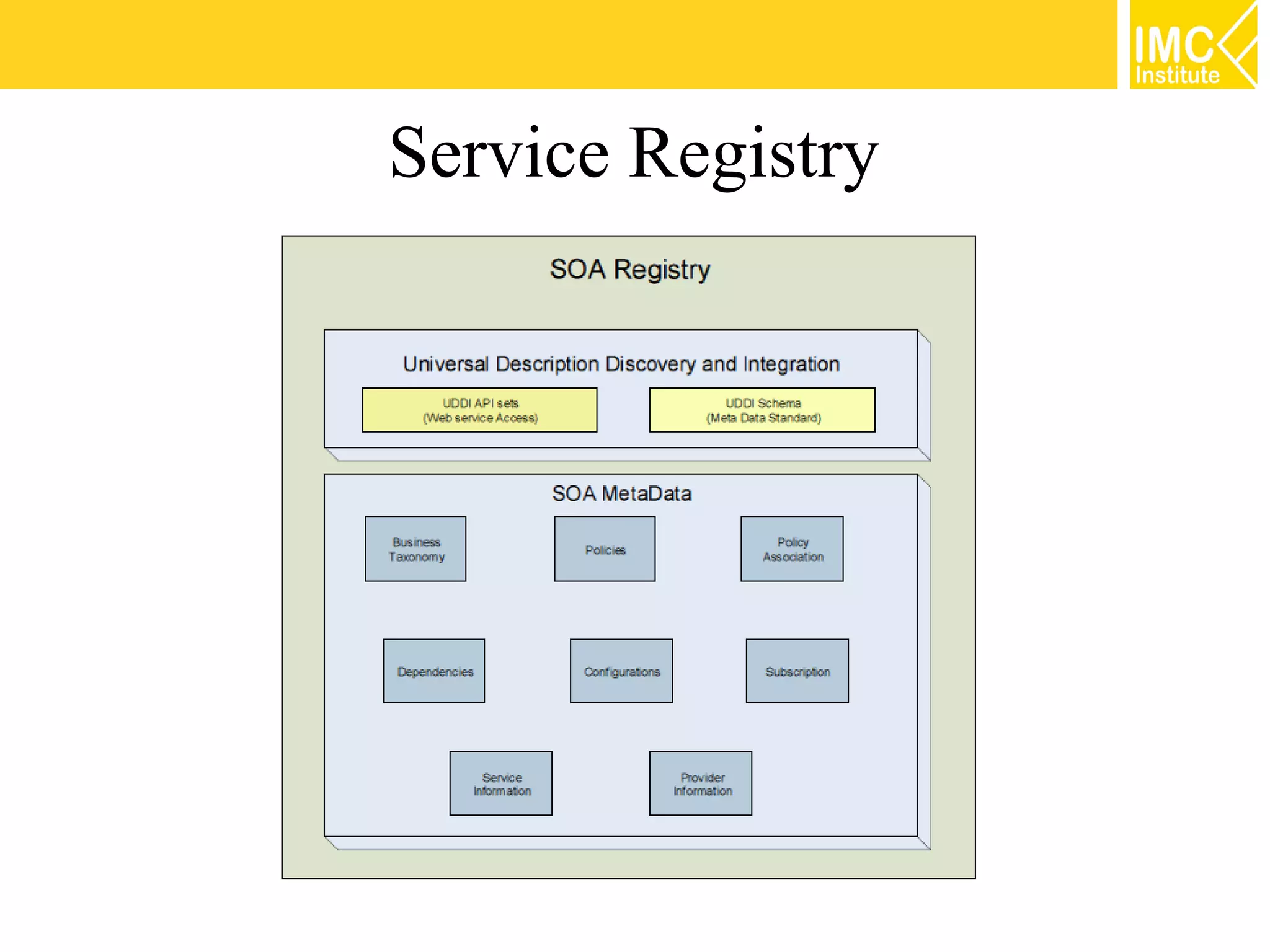
Service Registry
Service Repository
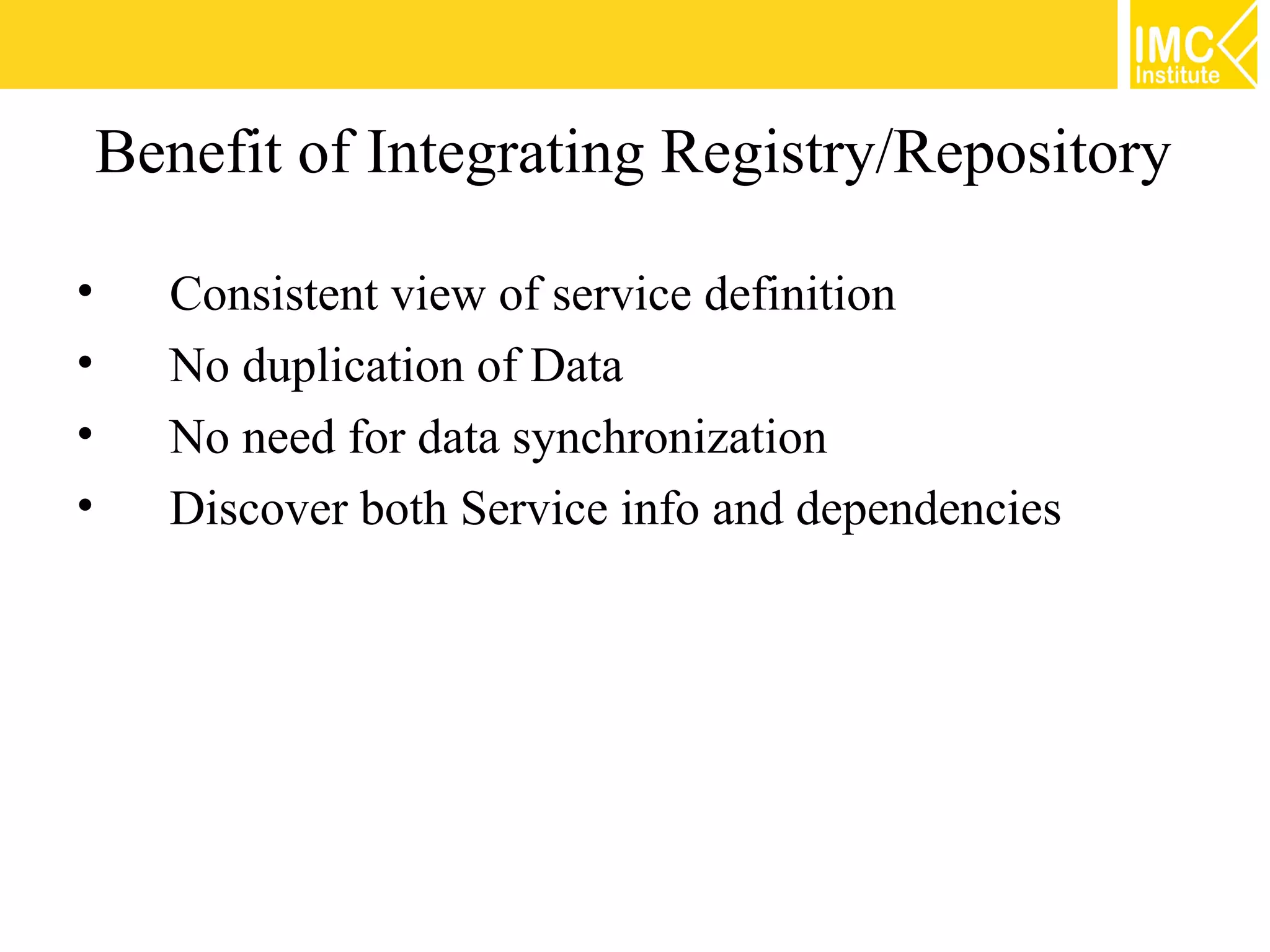
Benefit of Integrating Registry/Repository

•     Consistent view of service definition
•     No duplication of Data
•     No need for data synchronization
•     Discover both Service info and dependencies
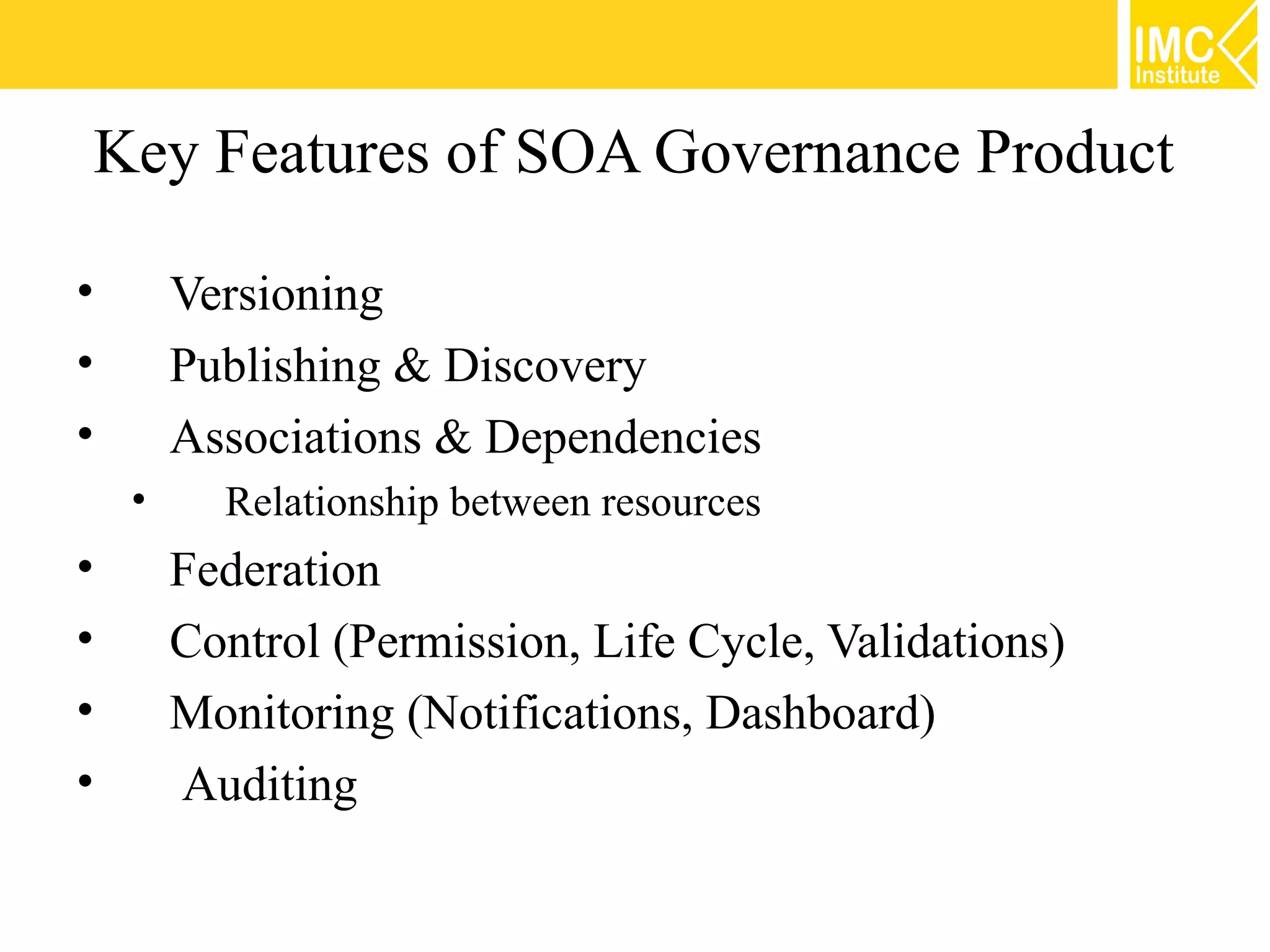
Key Features of SOA Governance Product

•       Versioning
•       Publishing & Discovery
•       Associations & Dependencies
    •     Relationship between resources
•       Federation
•       Control (Permission, Life Cycle, Validations)
•       Monitoring (Notifications, Dashboard)
•       Auditing
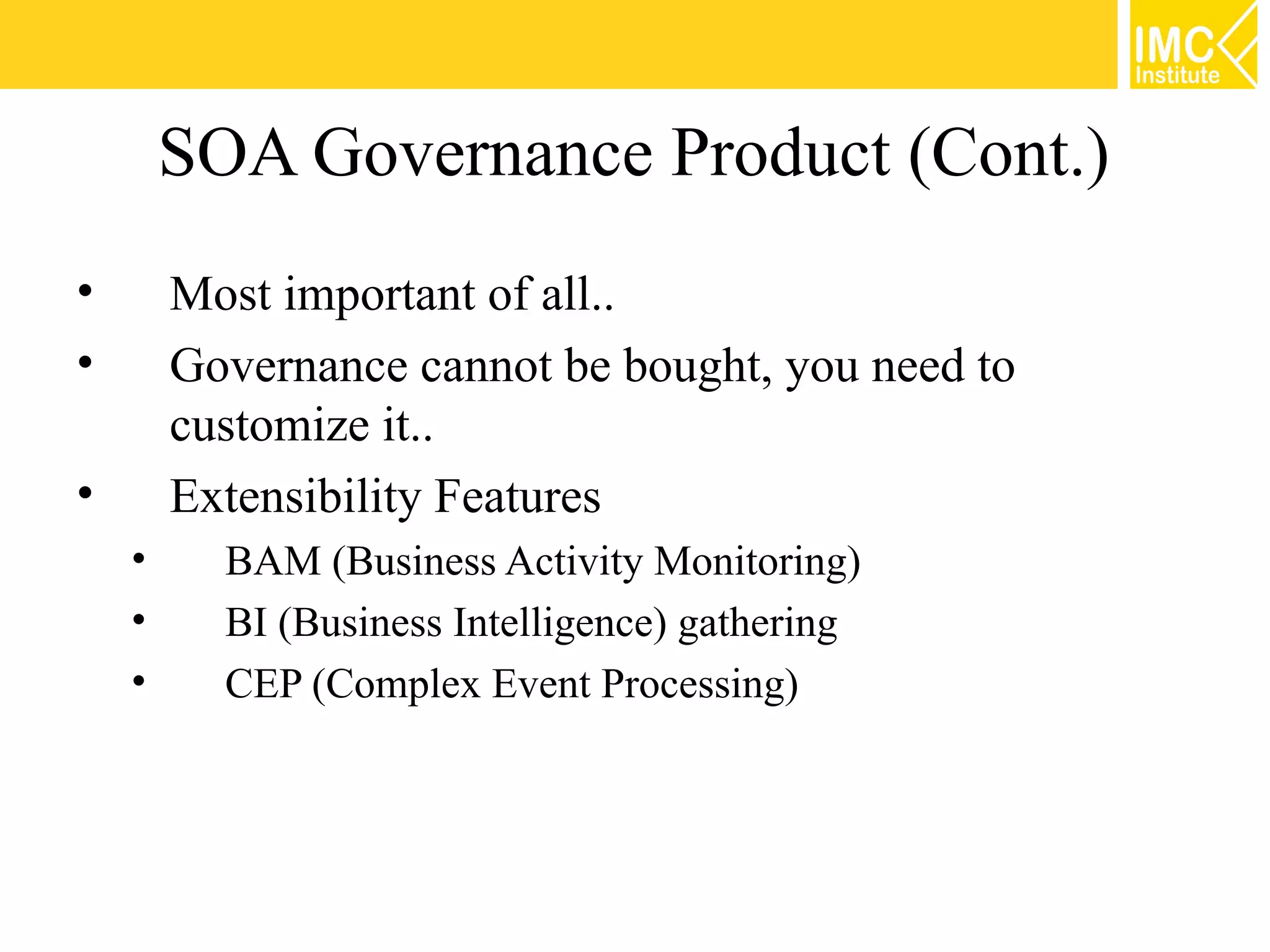
SOA Governance Product (Cont.)
•       Most important of all..
•       Governance cannot be bought, you need to
        customize it..
•       Extensibility Features
    •     BAM (Business Activity Monitoring)
    •     BI (Business Intelligence) gathering
    •     CEP (Complex Event Processing)
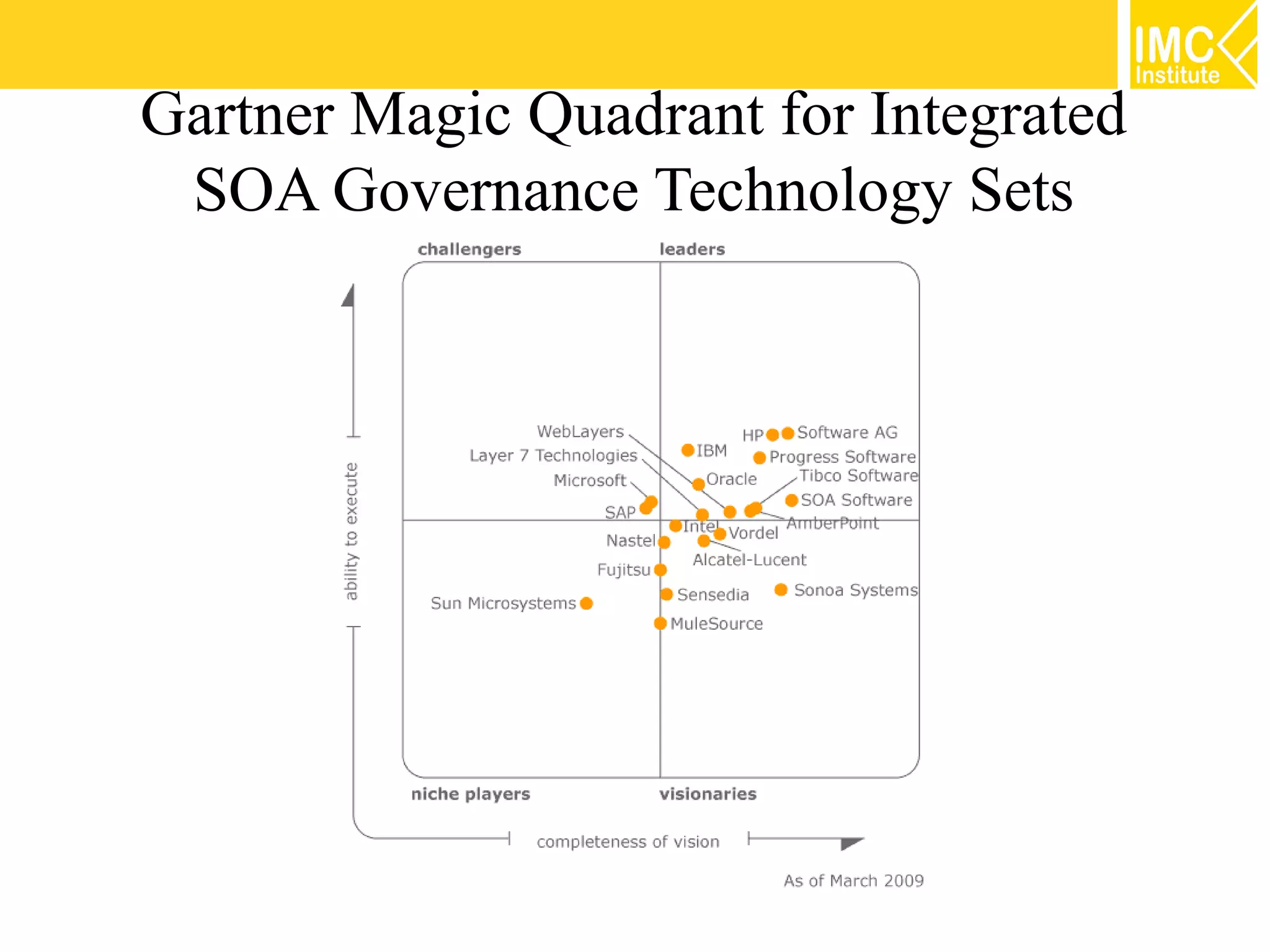
Gartner Magic Quadrant for Integrated
 SOA Governance Technology Sets
SOA Governance Products : Example
•       SOA Software
    •     Portfolio Manager
    •     Policy Manager
    •     Repository Manager
    •     Service Manager
•       Oracle SOA Governance
    •     Oracle Enterprise Repository
    •     Oracle Web Services Manager
    •     Oracle Service Registry
SOA Governance Product : Example
•       SOA Software
    •     Portfolio Manager
    •     Policy Manager
    •     Repository Manager
    •     Service Manager
•       Oracle SOA Governance
    •     Oracle Enterprise Repository
    •     Oracle Web Services Manager
    •     Oracle Service Registry
•       WSO2 (Open source)
    •     Governance Registry
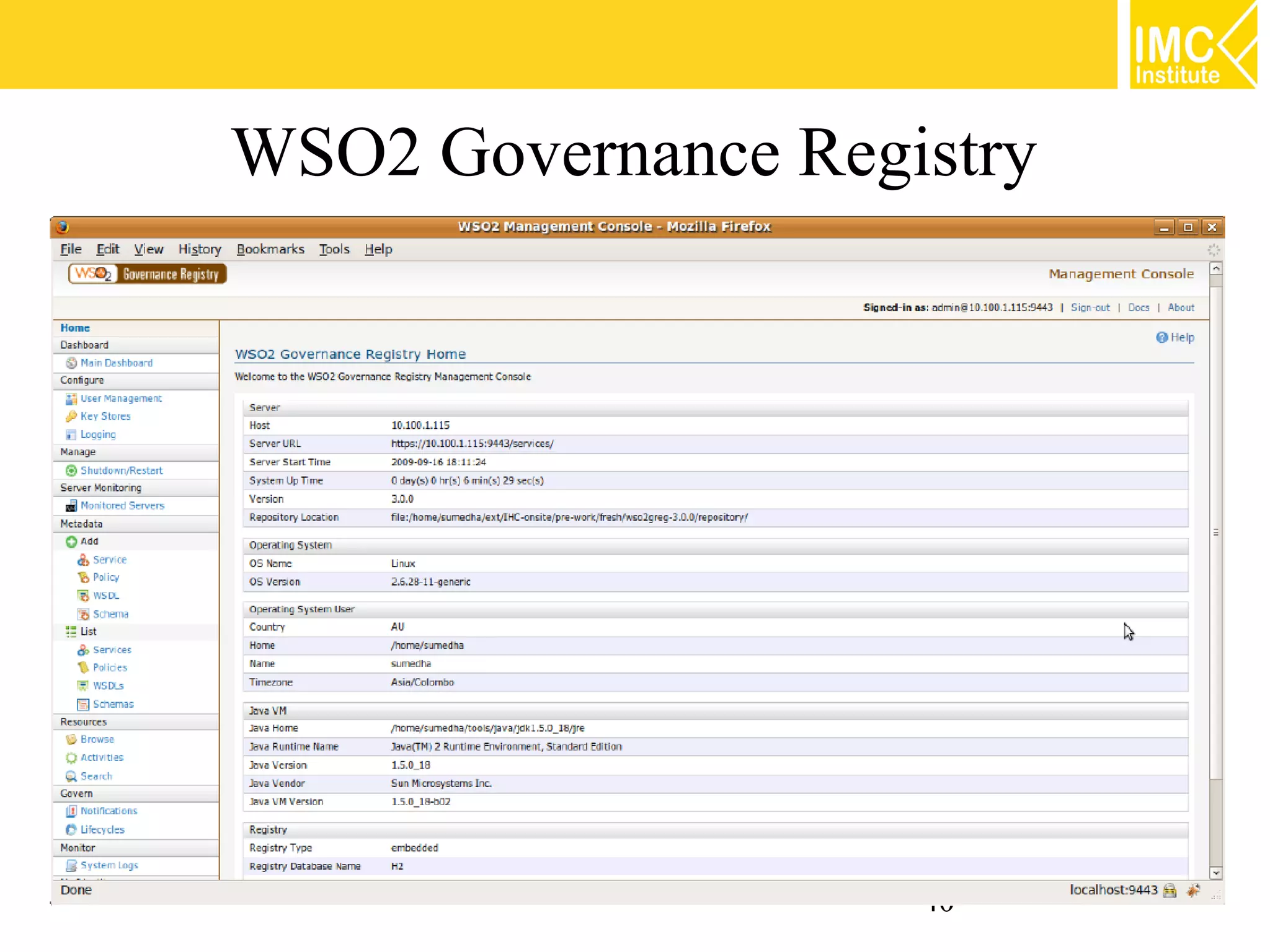
WSO2 Governance Registry


                    40
SOA Governance :Implementation
SOA Governance : Checklist -1
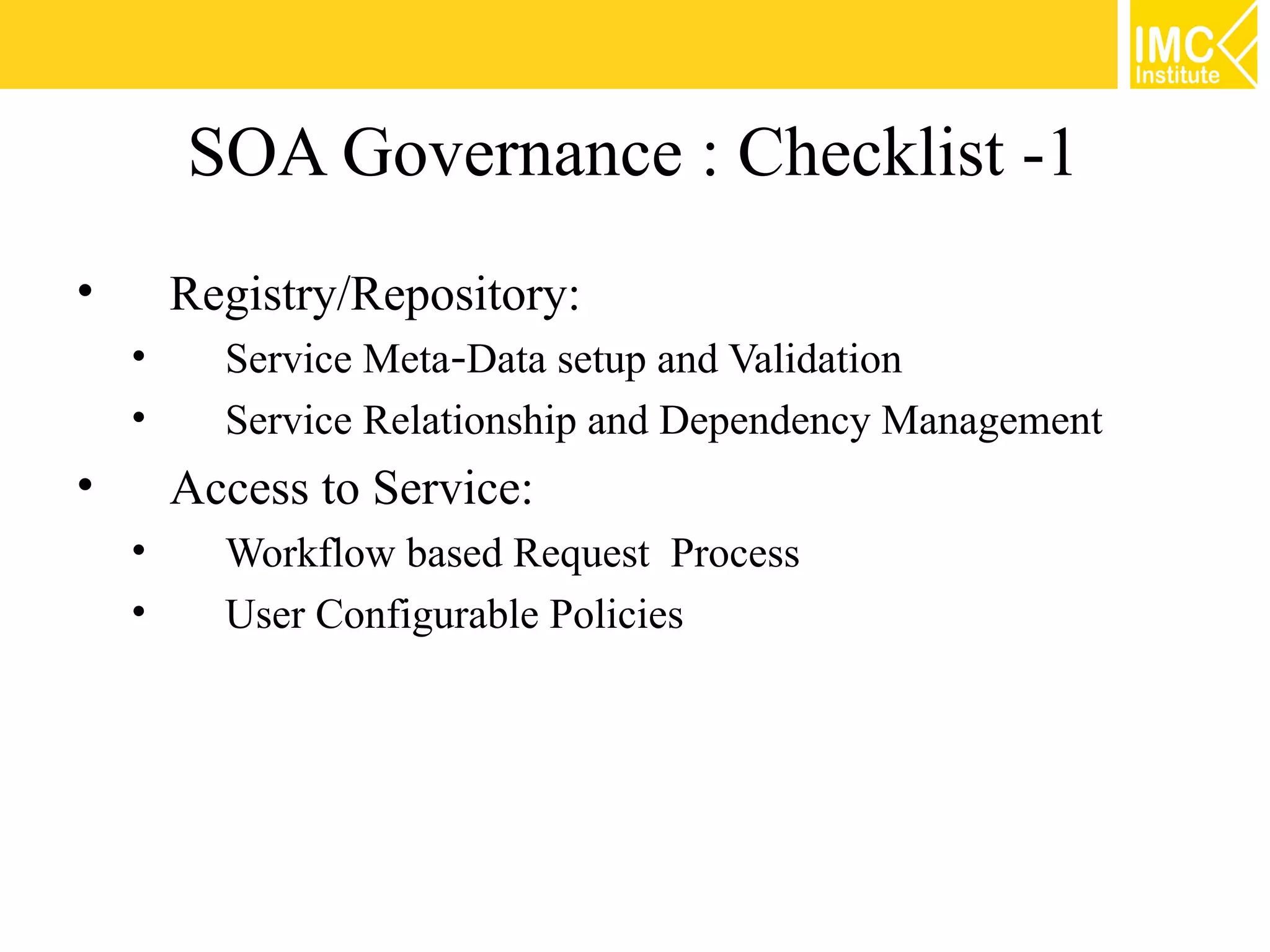
•       Registry/Repository:
    •     Service Meta‐Data setup and Validation
    •     Service Relationship and Dependency Management
•       Access to Service:
    •     Workflow based Request Process
    •     User Configurable Policies
SOA Governance : Checklist -2
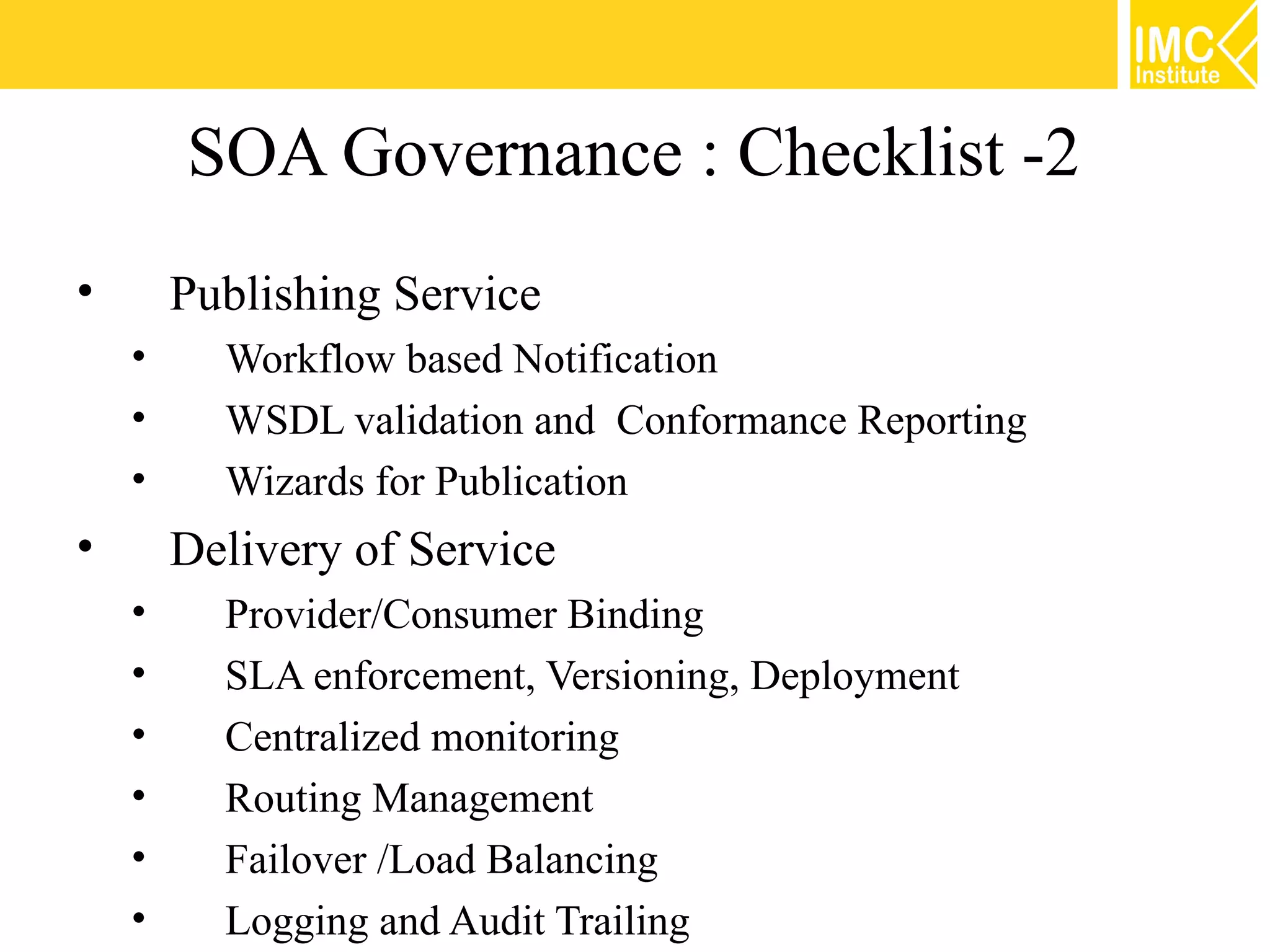
•       Publishing Service
    •     Workflow based Notification
    •     WSDL validation and Conformance Reporting
    •     Wizards for Publication
•       Delivery of Service
    •     Provider/Consumer Binding
    •     SLA enforcement, Versioning, Deployment
    •     Centralized monitoring
    •     Routing Management
    •     Failover /Load Balancing
    •     Logging and Audit Trailing
SOA Governance : Checklist -3
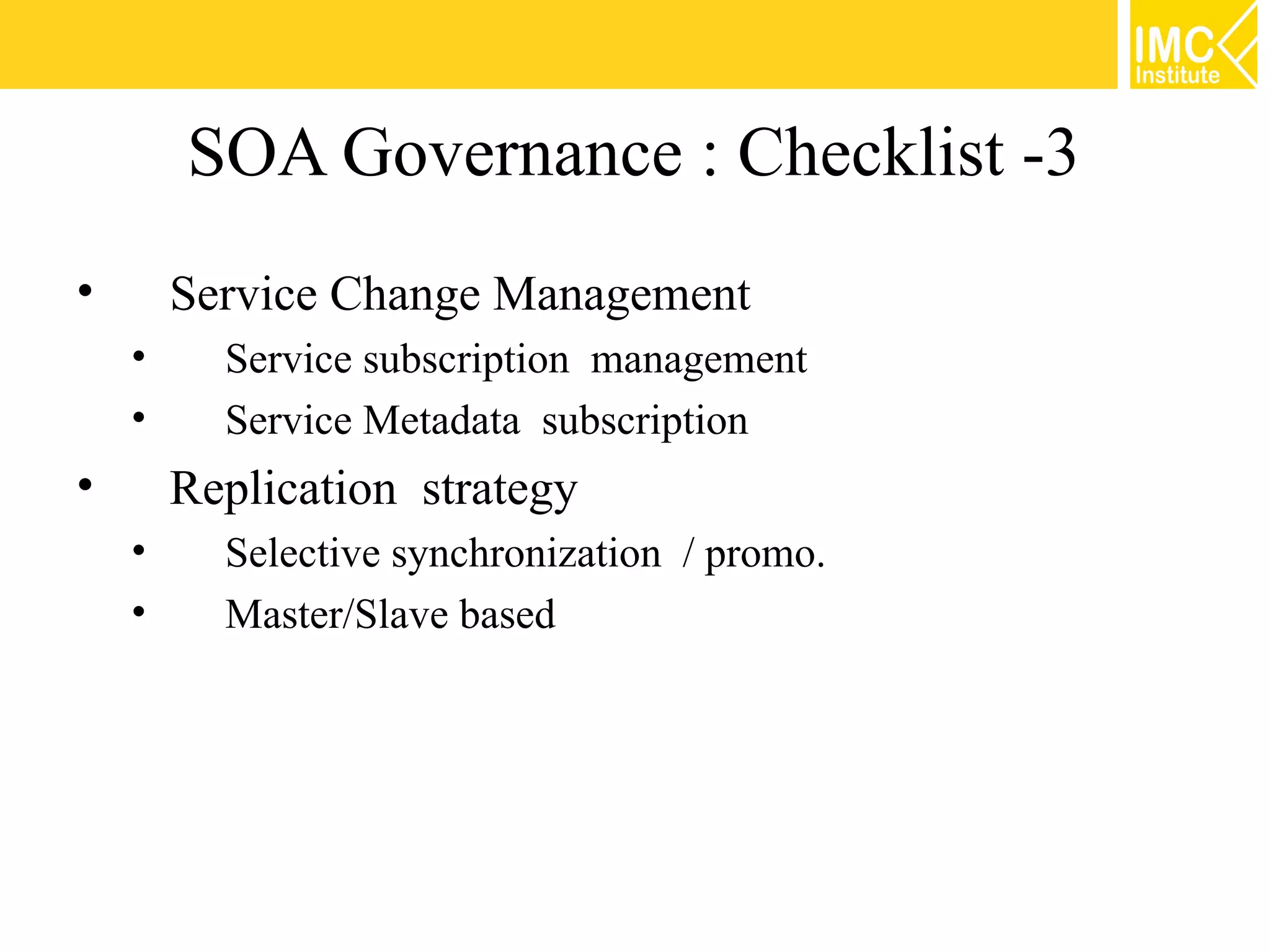
•       Service Change Management
    •     Service subscription management
    •     Service Metadata subscription
•       Replication strategy
    •     Selective synchronization / promo.
    •     Master/Slave based
SOA Governance : Checklist -4
•       Enforcement of Security
    •     Role based
    •     ACL
    •     Fixed and Configurable Roles
    •     Support for LDAP
•       Interoperability
    •     Handling any URI data
    •     Java Rule Engine API
SOA Governance : Best Practices
•   Establish early
•   Organizational acceptance for Governance
•   Communicate relentlessly
•   Automate
•   Govern the entire service lifecycle
•   Anticipate mixed technologies
•   Monitory, access & report business value
•   Consider cross organizational boundaries
SOA Governance Success Factors
•   Align with internal software development
    methodology.
•   Minimize overhead.
•   Maximize synergy with existing IT governance
    processes.
•   Gain visibility of project pipeline as early as
    possible.
•   Prefer influence over enforcement.
Resources
 SOA Governance, WSO2 SOA Workshop, 2009
 Governance: Fundamental to SOA’s Success, Ari Roy,
  DATA Inc.
 Policy Based Governance for the Enterprise, Web
  Layers
Thank you

   thananum@gmail.com
www.facebook.com/imcinstitute
   www.imcinstitute.com

Service Oriented Architecture (SOA) [4/5] : SOA Governance

  • 1.
    Topic 4 SOA Governance Assoc.Prof.Dr. Thanachart Numnonda www.imcinstitute.com
  • 2.
    Agenda  SOA Challenge What is SOA Governance?  SOA Governance : Technologies and Products  SOA Governance : Implementation 2
  • 3.
  • 4.
    SOA Overarching Trends: IDC • SOA adoption moving from project and application level to system and enterprise scale • Short and long term impact of SOA, along with expectations, need to be better understood • While technologies are key enablers, most study participants focus on organization and program dynamics • Success can be defined by multiple dimensions, Including • pervasiveness of SOA adoption in the enterprise and • clear business results
  • 5.
  • 6.
    SOA Success Factor: IDC Research • Business Alignment • Organizational Change • Management • Communication • Trust • Architecture • Scale and Sustainability • Governance
  • 7.
    Why SOA Governance? • Enterprise Governance is business-oriented. • In moving towards integrated business initiatives (outsourcing, strategic supplier collaboration, value and supply chain,…etc) and IT initiatives (XML, Web Services, EAI, SOA…etc), companies want to ensure continuity of • business operations • manage security exposure • align technology implementation with business requirements • manage liabilities and dependencies, • reduce the cost of operations.
  • 8.
    SOA : Introducea new layer
  • 9.
    SOA Challenges • It is so easy to create and utilize web services. • Evolving Standards for Business Compliance, IT Standards and Web Service Technologies . • Lack of one Standards enforcement . • A Variety of Vendors. • Inadequate Tooling . • New Layer - New Challenges
  • 10.
    Developing SOA :New Paradigm
  • 11.
  • 12.
  • 13.
    SOA in theConventional Enterprise
  • 14.
    Evaluation after Oneyear without Governance
  • 15.
    Evaluation after Oneyear with Governance
  • 16.
    What is SOAGovernance?
  • 17.
    SOA Governance :Definition • The processes used to oversee and control the adoption and implementation of SOA in accordance with recognized practices, principles and government regulations. • SOA governance provides optimum service quality, consistency, predictability and performance
  • 18.
    SOA Governance :Components • SOA registry : an evolving catalog of information about the available services in the SOA implementation. • SOA policy : a set of behavioral restrictions intended to ensure that services remain consistent. • SOA testing : a comprehensive schedule of audits and performance-monitoring procedures.
  • 19.
  • 20.
    Services in SOA • Heart of SOA • Life Cycle • Designed • Developed • QA passed • In production • Metadata • WSDL • Schema • Policy
  • 21.
    SOA Governance :Service Life Cycle
  • 22.
    SOA Governance :Phases • SOA governance is divided between design time governance and runtime governance. • One way to make both design and runtime governance more effective is through centralized policy management. • If the architecture is designed with all the policies in an easily accessible location, then making updates to an SOA after it has been implemented is much easier.
  • 23.
    Design Time SOAGovernance
  • 24.
  • 25.
    Enterprise SOA Policies • Policies set the goals that you use to direct and measure success. • Without policies, there is no Governance • Policies need to address the overall impact to the business of the Services that are being created and deployed. • Policies need to create a strong connection between the business and technology.
  • 26.
    Enterprise SOA Policies(cont.) • Policies might start at the business level: • Projects must comply with Internal Architecture guidelines • Security and regulatory compliance policy reviews are mandatory for all IT projects • Policies could represent more specific regulatory compliance issues: (SOX, HIPPA)
  • 27.
    SOA Governance :Benefits • Greater alignment with business objectives • Greater control over creation, deployment and consumption of services • Centralized management of policies and regulation • Can embed compliance with government and indus try regulations • Sarbanes‐Oxley, MiFID, HIPAA, GLBA
  • 28.
  • 29.
    Technologies behind SOAGovernance • Enterprise Service Bus (ESB) • Repository • Registry
  • 30.
    Role of ESBin Governance • Security • Ensure Privacy, Authenticity, Authorization and Auditing of all Message exchanged • Mediation • Policy based mediation (protocol/invocation) • Management • Holistic view of Transactions that passes through • Intercept Service call
  • 31.
    Role of ServiceRegistry/Repository • Where all Services are published • Implements process to publish service that matches Governance model • Contains Policies applicable to each service
  • 32.
  • 33.
  • 34.
    Benefit of IntegratingRegistry/Repository • Consistent view of service definition • No duplication of Data • No need for data synchronization • Discover both Service info and dependencies
  • 35.
    Key Features ofSOA Governance Product • Versioning • Publishing & Discovery • Associations & Dependencies • Relationship between resources • Federation • Control (Permission, Life Cycle, Validations) • Monitoring (Notifications, Dashboard) • Auditing
  • 36.
    SOA Governance Product(Cont.) • Most important of all.. • Governance cannot be bought, you need to customize it.. • Extensibility Features • BAM (Business Activity Monitoring) • BI (Business Intelligence) gathering • CEP (Complex Event Processing)
  • 37.
    Gartner Magic Quadrantfor Integrated SOA Governance Technology Sets
  • 38.
    SOA Governance Products: Example • SOA Software • Portfolio Manager • Policy Manager • Repository Manager • Service Manager • Oracle SOA Governance • Oracle Enterprise Repository • Oracle Web Services Manager • Oracle Service Registry
  • 39.
    SOA Governance Product: Example • SOA Software • Portfolio Manager • Policy Manager • Repository Manager • Service Manager • Oracle SOA Governance • Oracle Enterprise Repository • Oracle Web Services Manager • Oracle Service Registry • WSO2 (Open source) • Governance Registry
  • 40.
  • 41.
  • 42.
    SOA Governance :Checklist -1 • Registry/Repository: • Service Meta‐Data setup and Validation • Service Relationship and Dependency Management • Access to Service: • Workflow based Request Process • User Configurable Policies
  • 43.
    SOA Governance :Checklist -2 • Publishing Service • Workflow based Notification • WSDL validation and Conformance Reporting • Wizards for Publication • Delivery of Service • Provider/Consumer Binding • SLA enforcement, Versioning, Deployment • Centralized monitoring • Routing Management • Failover /Load Balancing • Logging and Audit Trailing
  • 44.
    SOA Governance :Checklist -3 • Service Change Management • Service subscription management • Service Metadata subscription • Replication strategy • Selective synchronization / promo. • Master/Slave based
  • 45.
    SOA Governance :Checklist -4 • Enforcement of Security • Role based • ACL • Fixed and Configurable Roles • Support for LDAP • Interoperability • Handling any URI data • Java Rule Engine API
  • 46.
    SOA Governance :Best Practices • Establish early • Organizational acceptance for Governance • Communicate relentlessly • Automate • Govern the entire service lifecycle • Anticipate mixed technologies • Monitory, access & report business value • Consider cross organizational boundaries
  • 47.
    SOA Governance SuccessFactors • Align with internal software development methodology. • Minimize overhead. • Maximize synergy with existing IT governance processes. • Gain visibility of project pipeline as early as possible. • Prefer influence over enforcement.
  • 48.
    Resources  SOA Governance,WSO2 SOA Workshop, 2009  Governance: Fundamental to SOA’s Success, Ari Roy, DATA Inc.  Policy Based Governance for the Enterprise, Web Layers
  • 49.
    Thank you thananum@gmail.com www.facebook.com/imcinstitute www.imcinstitute.com