Service Failure and
Recovery
Service Failure
• A service failure is the service performance that falls below
customer’s expectations in such a way that leads to customer
dissatisfaction
• Service failure is the gap between expectation and perception
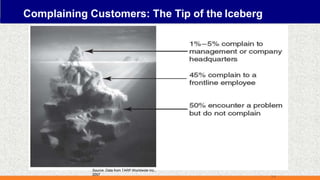
Complaining Customers: The Tip of the Iceberg
Source: Data from TARP Worldwide Inc.,
2007
7-3
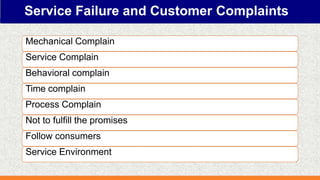
Service Failure and Customer Complaints
Mechanical Complain
Service Complain
Behavioral complain
Time complain
Process Complain
Not to fulfill the promises
Follow consumers
Service Environment
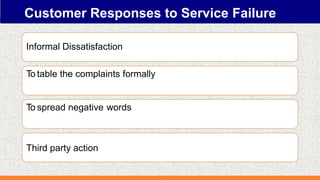
Customer Responses to Service Failure
Informal Dissatisfaction
To table the complaints formally
To spread negative words
Third party action
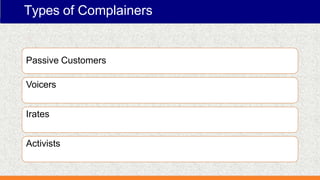
Types of Complainers
Passive Customers
Voicers
Irates
Activists
Service Recovery
Service recovery refers to the actions taken by a firm in
response to service failure.
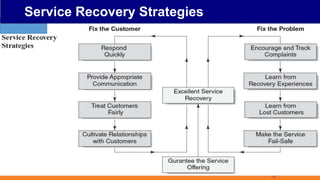
Service Recovery Strategies
7-8
Fixing the Customer
• When customers take the time to complain, they generally have
high expectations.
• They expect the company to respond quickly and to be
accountable.
• They expect to be compensated for their grief and for the
hassle of being inconvenienced.
• They expect to be treated nicely in the process!
7-9
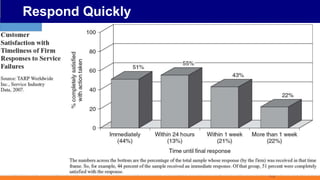
Respond Quickly
• Complaining customers want quick responses
• Ping-Ponging should not be done
• Quick response can be attained by employee empowerment
• Development of technology which helps consumer to fix their
own problems
Respond Quickly
7-11
Provide Appropriate Communication
Display Understanding
• Firms need to be accountable for their actions and inactions
• Customers expect an apology when things go wrong
• Customers need courtesy and respect
• Customers want to know what company is going to do to prevent
problem from occurring again
Supply Adequate explanation
• Customers try to understand why failure has occurred
• Explanations diffuse negative reactions and convey respect for the
customer
• Explanation should have two characteristics
• Content of the explanation should be accurate
• Style (credibility/sincerity) of the delivery of the explanation
Treat Customers Fairly
• Customers want justice and fairness in handling their complaints
• There should be outcome fairness, procedural fairness, and
interactional fairness
• Outcome Fairness
• Fairness in actual monetary compensation, an apology, future free service,
reduced charges, repairs, and /or replacements
• Procedural Fairness
• Fairness in terms of policies, rules, and timeliness of the complaint process
• Fair processes are characterized by clarity, speed, and absence of hassles
• Interactional Fairness
• Firms need to treat customers politely, with care and honesty, during the
service recovery process
Cultivate Relationships with Customers
• Firm relationships can help shield the firm from the negative
effects of failures on customer satisfaction
• Better relationship lowers service recovery expectations and
minimizes the demand for compensation
Fixing the Problem
• After “fixing the customer” the company should address the
actual problem that created the poor service delivery in the first
place.
• Strategies for fixing the problem include
• Encouraging and tracking complaints,
• Learning from recovery experiences
• Learning from lost customers
• Making the service fail-safe.
• Encourage and Track Complaints
• Toll-free call centers, email, and social medias can be used
to encourage and track complaints
• Satisfaction surveys, critical incident studies and lost
customer research can be used to capture complaints
• Learn from Recovery Experiences
• By tracking service recovery efforts and solutions, managers
can learn systematic problems
• By conducting root cause analysis firms can identify the
sources of the problems
Learn from Lost Customers
• Formal marketing research to discover the reasons customers
have left can assist in preventing failures in the future
• In-depth interview method can be used to collect information
Make the Service Fail-
Safe
• Related with Reliability, do it right the first time
• Customers get what they want and minimizes the costs
• Poka-yokes need to be implemented to improve service
reliability
• Poka-yokes are automatic warnings or controls in places to
ensure that mistakes are not made
Service Guarantees
• It is a particular type of recovery tool that can be used to both ‘fix
the customer’ and ‘fix the problem’
• It is a pledge or assurance that a product offered by a firm will
perform as promised, and if not then some form of reparation will
be undertaken
• It assures that the product or firm will offer certain level of
satisfaction, if not firm will pay for the compensation
Characteristics of Effective Guarantee
• Unconditional
• Effective guarantee should be unconditional-no strings
attached
• Meaningful
• ‘Do not guarantee ink in a dot pen’
• Easy to Understand
• Easy to understand and communicate to both employee and
customer
• Trust
• Good service guarantee generates trust on the part of
customers
• Acceptance
• Employee should accept the service guarantee
• Supported by Staff motivation and Training
• Employee should know the consequences of service failure
• They should know the process and procedures of “undo”,
refund, or compensate
• Easy to Invoke
• The process and cost of recovery must be easy and
immediate
Benefits of Service Guarantee
• Helps to focus on quality and customer satisfaction
• Saves unnecessary costs
• Guarantee sets clear standard for employees. It will motivate
staffs to do right the first time
• Helps to generate record system
• Helps to control negative word of mouth publicity
• Helps to generate trust and confidence among customers
Types of Service Guarantee
• Unconditional Guarantee
• Conditional Guarantee
• Service Attribute Guarantee
• Combined Guarantee
• External Guarantee
• Internal Guarantee
When to Use Guarantee?
• Service Quality of the Company
• If the existing service quality in the company is poor, do not
introduce guarantee
• Company’s Image
• If company has high reputation, do not go for minor service
guarantees
• Uncontrollable Variables
• If service quality depends on too many uncontrollable variables,
do not introduce guarantee
• Abuse
• If chances of abuse of service guarantee by customer is high,
do not introduce it
• Costs
• Look at the costs of guarantee cautiously
• Customer Perception of Risk
• If customer do not perceive risk then guarantee is likely to produce little
effectiveness
• Check with customer
• Offered guarantee should be competitive
servicefailurerecovery-180811091057.pptx

servicefailurerecovery-180811091057.pptx

  • 1.
  • 2.
    Service Failure • Aservice failure is the service performance that falls below customer’s expectations in such a way that leads to customer dissatisfaction • Service failure is the gap between expectation and perception
  • 3.
    Complaining Customers: TheTip of the Iceberg Source: Data from TARP Worldwide Inc., 2007 7-3
  • 4.
    Service Failure andCustomer Complaints Mechanical Complain Service Complain Behavioral complain Time complain Process Complain Not to fulfill the promises Follow consumers Service Environment
  • 5.
    Customer Responses toService Failure Informal Dissatisfaction To table the complaints formally To spread negative words Third party action
  • 6.
    Types of Complainers PassiveCustomers Voicers Irates Activists
  • 7.
    Service Recovery Service recoveryrefers to the actions taken by a firm in response to service failure.
  • 8.
  • 9.
    Fixing the Customer •When customers take the time to complain, they generally have high expectations. • They expect the company to respond quickly and to be accountable. • They expect to be compensated for their grief and for the hassle of being inconvenienced. • They expect to be treated nicely in the process! 7-9
  • 10.
    Respond Quickly • Complainingcustomers want quick responses • Ping-Ponging should not be done • Quick response can be attained by employee empowerment • Development of technology which helps consumer to fix their own problems
  • 11.
  • 12.
    Provide Appropriate Communication DisplayUnderstanding • Firms need to be accountable for their actions and inactions • Customers expect an apology when things go wrong • Customers need courtesy and respect • Customers want to know what company is going to do to prevent problem from occurring again Supply Adequate explanation • Customers try to understand why failure has occurred • Explanations diffuse negative reactions and convey respect for the customer • Explanation should have two characteristics • Content of the explanation should be accurate • Style (credibility/sincerity) of the delivery of the explanation
  • 13.
    Treat Customers Fairly •Customers want justice and fairness in handling their complaints • There should be outcome fairness, procedural fairness, and interactional fairness • Outcome Fairness • Fairness in actual monetary compensation, an apology, future free service, reduced charges, repairs, and /or replacements • Procedural Fairness • Fairness in terms of policies, rules, and timeliness of the complaint process • Fair processes are characterized by clarity, speed, and absence of hassles • Interactional Fairness • Firms need to treat customers politely, with care and honesty, during the service recovery process
  • 14.
    Cultivate Relationships withCustomers • Firm relationships can help shield the firm from the negative effects of failures on customer satisfaction • Better relationship lowers service recovery expectations and minimizes the demand for compensation
  • 15.
    Fixing the Problem •After “fixing the customer” the company should address the actual problem that created the poor service delivery in the first place. • Strategies for fixing the problem include • Encouraging and tracking complaints, • Learning from recovery experiences • Learning from lost customers • Making the service fail-safe.
  • 16.
    • Encourage andTrack Complaints • Toll-free call centers, email, and social medias can be used to encourage and track complaints • Satisfaction surveys, critical incident studies and lost customer research can be used to capture complaints • Learn from Recovery Experiences • By tracking service recovery efforts and solutions, managers can learn systematic problems • By conducting root cause analysis firms can identify the sources of the problems
  • 17.
    Learn from LostCustomers • Formal marketing research to discover the reasons customers have left can assist in preventing failures in the future • In-depth interview method can be used to collect information Make the Service Fail- Safe • Related with Reliability, do it right the first time • Customers get what they want and minimizes the costs • Poka-yokes need to be implemented to improve service reliability • Poka-yokes are automatic warnings or controls in places to ensure that mistakes are not made
  • 18.
    Service Guarantees • Itis a particular type of recovery tool that can be used to both ‘fix the customer’ and ‘fix the problem’ • It is a pledge or assurance that a product offered by a firm will perform as promised, and if not then some form of reparation will be undertaken • It assures that the product or firm will offer certain level of satisfaction, if not firm will pay for the compensation
  • 19.
    Characteristics of EffectiveGuarantee • Unconditional • Effective guarantee should be unconditional-no strings attached • Meaningful • ‘Do not guarantee ink in a dot pen’ • Easy to Understand • Easy to understand and communicate to both employee and customer • Trust • Good service guarantee generates trust on the part of customers
  • 20.
    • Acceptance • Employeeshould accept the service guarantee • Supported by Staff motivation and Training • Employee should know the consequences of service failure • They should know the process and procedures of “undo”, refund, or compensate • Easy to Invoke • The process and cost of recovery must be easy and immediate
  • 21.
    Benefits of ServiceGuarantee • Helps to focus on quality and customer satisfaction • Saves unnecessary costs • Guarantee sets clear standard for employees. It will motivate staffs to do right the first time • Helps to generate record system • Helps to control negative word of mouth publicity • Helps to generate trust and confidence among customers
  • 22.
    Types of ServiceGuarantee • Unconditional Guarantee • Conditional Guarantee • Service Attribute Guarantee • Combined Guarantee
  • 23.
    • External Guarantee •Internal Guarantee
  • 24.
    When to UseGuarantee? • Service Quality of the Company • If the existing service quality in the company is poor, do not introduce guarantee • Company’s Image • If company has high reputation, do not go for minor service guarantees • Uncontrollable Variables • If service quality depends on too many uncontrollable variables, do not introduce guarantee • Abuse • If chances of abuse of service guarantee by customer is high, do not introduce it
  • 25.
    • Costs • Lookat the costs of guarantee cautiously • Customer Perception of Risk • If customer do not perceive risk then guarantee is likely to produce little effectiveness • Check with customer • Offered guarantee should be competitive