SERVE-LEARN-SUSTAIN’S
LINKED COURSES FOR
TRANSDISCIPLINARY LEARNING
RUTHIE YOW,
SERVICE LEARNING & PARTNERSHIPS SPECIALIST
DAVID EADY,
INDUSTRY ENGAGEMENT MANAGER
WHAT DOES SLS DO?
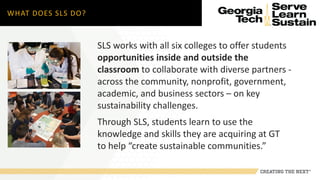
SLS works with all six colleges to offer students
opportunities inside and outside the
classroom to collaborate with diverse partners -
across the community, nonprofit, government,
academic, and business sectors – on key
sustainability challenges.
Through SLS, students learn to use the
knowledge and skills they are acquiring at GT
to help “create sustainable communities.”
 Systems thinking
 Collaborative inquiry
 Support for ongoing learning
 Emergent design
 Multiple strands of inquiry and action
 Transdisciplinarity
SYSTEMIC ENGAGEMENT: KEY PRINCIPLES
McNall, M., Barnes-Najor, J., Brown, R., Doberneck, D., & Fitzgerald, H. (2015). Systemic Engagement: Universities as Partners in Systemic
Approaches to Community Change. Journal of Higher Education Outreach and Engagement, 19(1), 7-32.
Retrieved from http://openjournals.libs.uga.edu/index.php/jheoe/article/view/1390
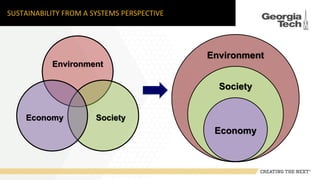
SUSTAINABILITY FROM A SYSTEMS PERSPECTIVE
Environment
SocietyEconomy
Environment
Society
Economy
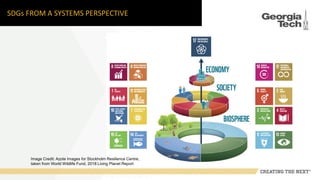
SDGs FROM A SYSTEMS PERSPECTIVE
Image Credit: Azote Images for Stockholm Resilience Centre,
taken from World Wildlife Fund, 2018 Living Planet Report
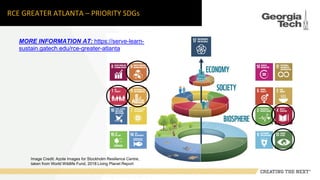
RCE GREATER ATLANTA – PRIORITY SDGs
Image Credit: Azote Images for Stockholm Resilience Centre,
taken from World Wildlife Fund, 2018 Living Planet Report
MORE INFORMATION AT: https://serve-learn-
sustain.gatech.edu/rce-greater-atlanta
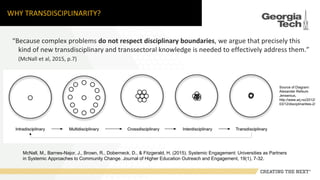
WHY TRANSDISCIPLINARITY?
“Because complex problems do not respect disciplinary boundaries, we argue that precisely this
kind of new transdisciplinary and transsectoral knowledge is needed to effectively address them.”
(McNall et al, 2015, p.7)
McNall, M., Barnes-Najor, J., Brown, R., Doberneck, D., & Fitzgerald, H. (2015). Systemic Engagement: Universities as Partners
in Systemic Approaches to Community Change. Journal of Higher Education Outreach and Engagement, 19(1), 7-32.
Source of Diagram:
Alexander Refsum
Jensenius,
http://www.arj.no/2012/
03/12/disciplinarities-2/
CHARACTERISTICS OF TRANSDISCIPLINARY APPROACHES
The joining of . . .
 Diverse academic disciplines and non-academic experiences and perspectives
 Academic approaches and “real world” challenges
 Faculty and courses from fields with different fundamental assumptions
. . . Leads to:
 Fresh questions
 New relationships
 Experimental, non discipline-bound ways of thinking, teaching, and acting together
WHAT ARE “LINKED COURSES”?
SLS links together classes from
multiple GT colleges and schools
with some key community partners,
under broad sustainable
communities themes. Through a
series of joint workshops and
activities, students, faculty, and
partners together explore problems
and solutions from different
academic and practitioner
perspectives.
Example theme: Equitable and Sustainable
Development, Summer 2018 & 2019
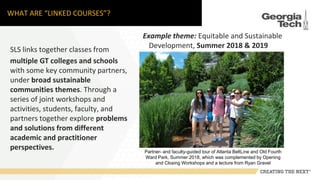
Partner- and faculty-guided tour of Atlanta BeltLine and Old Fourth
Ward Park, Summer 2018, which was complemented by Opening
and Closing Workshops and a lecture from Ryan Gravel
WHAT DO LINKED COURSES LOOK LIKE IN ACTION?
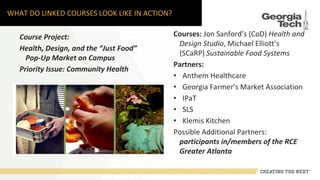
Course Project:
Health, Design, and the “Just Food”
Pop-Up Market on Campus
Priority Issue: Community Health
Courses: Jon Sanford’s (CoD) Health and
Design Studio, Michael Elliott’s
(SCaRP) Sustainable Food Systems
Partners:
• Anthem Healthcare
• Georgia Farmer’s Market Association
• IPaT
• SLS
• Klemis Kitchen
Possible Additional Partners:
participants in/members of the RCE
Greater Atlanta
WHAT DO LINKED COURSES LOOK LIKE IN ACTION?
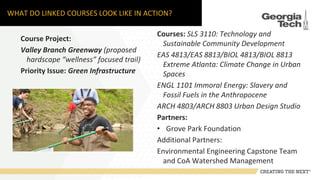
Course Project:
Valley Branch Greenway (proposed
hardscape “wellness” focused trail)
Priority Issue: Green Infrastructure
Courses: SLS 3110: Technology and
Sustainable Community Development
EAS 4813/EAS 8813/BIOL 4813/BIOL 8813
Extreme Atlanta: Climate Change in Urban
Spaces
ENGL 1101 Immoral Energy: Slavery and
Fossil Fuels in the Anthropocene
ARCH 4803/ARCH 8803 Urban Design Studio
Partners:
• Grove Park Foundation
Additional Partners:
Environmental Engineering Capstone Team
and CoA Watershed Management
LINKED COURSE GOALS // BIG PICTURE PRIORITIES
GOALS:
1. Lead students to question a single-discipline
or single-perspective approach
2. Expose students to a framework that
incorporates multiple intellectual and
methodological approaches to a single topic
3. Urge students to pause to problem-frame
rather than rush to problem-solve
4. Engage students in collaboration and co-
learning outside academia in communities
possessing expertise different from their own.
BUILDING RELATIONSHIPS FOR
SYSTEMS CHANGE:
3 of SLS’s Key Principles
1. Engage in “collaborative inquiry”
2. Incorporate technological expertise
as one of many types of expertise.
3. Highlight community expertise and
assets.
QUESTIONS?
David Eady
Industry Engagement Manager
Serve-Learn-Sustain
Georgia Institute of Technology
+1 678-570-9030
david.eady@gatech.edu
Ruthie Yow
Service-Learning and Partnerships Specialist
Serve-Learn-Sustain
Georgia Institute of Technology
+1 404-394-9220
ruth.yow@gatech.edu

Serve-Learn-Sustain's Linked Courses for Trandisciplinary Learning

  • 1.
    SERVE-LEARN-SUSTAIN’S LINKED COURSES FOR TRANSDISCIPLINARYLEARNING RUTHIE YOW, SERVICE LEARNING & PARTNERSHIPS SPECIALIST DAVID EADY, INDUSTRY ENGAGEMENT MANAGER
  • 2.
    WHAT DOES SLSDO? SLS works with all six colleges to offer students opportunities inside and outside the classroom to collaborate with diverse partners - across the community, nonprofit, government, academic, and business sectors – on key sustainability challenges. Through SLS, students learn to use the knowledge and skills they are acquiring at GT to help “create sustainable communities.”
  • 3.
     Systems thinking Collaborative inquiry  Support for ongoing learning  Emergent design  Multiple strands of inquiry and action  Transdisciplinarity SYSTEMIC ENGAGEMENT: KEY PRINCIPLES McNall, M., Barnes-Najor, J., Brown, R., Doberneck, D., & Fitzgerald, H. (2015). Systemic Engagement: Universities as Partners in Systemic Approaches to Community Change. Journal of Higher Education Outreach and Engagement, 19(1), 7-32. Retrieved from http://openjournals.libs.uga.edu/index.php/jheoe/article/view/1390
  • 4.
    SUSTAINABILITY FROM ASYSTEMS PERSPECTIVE Environment SocietyEconomy Environment Society Economy
  • 5.
    SDGs FROM ASYSTEMS PERSPECTIVE Image Credit: Azote Images for Stockholm Resilience Centre, taken from World Wildlife Fund, 2018 Living Planet Report
  • 6.
    RCE GREATER ATLANTA– PRIORITY SDGs Image Credit: Azote Images for Stockholm Resilience Centre, taken from World Wildlife Fund, 2018 Living Planet Report MORE INFORMATION AT: https://serve-learn- sustain.gatech.edu/rce-greater-atlanta
  • 7.
    WHY TRANSDISCIPLINARITY? “Because complexproblems do not respect disciplinary boundaries, we argue that precisely this kind of new transdisciplinary and transsectoral knowledge is needed to effectively address them.” (McNall et al, 2015, p.7) McNall, M., Barnes-Najor, J., Brown, R., Doberneck, D., & Fitzgerald, H. (2015). Systemic Engagement: Universities as Partners in Systemic Approaches to Community Change. Journal of Higher Education Outreach and Engagement, 19(1), 7-32. Source of Diagram: Alexander Refsum Jensenius, http://www.arj.no/2012/ 03/12/disciplinarities-2/
  • 8.
    CHARACTERISTICS OF TRANSDISCIPLINARYAPPROACHES The joining of . . .  Diverse academic disciplines and non-academic experiences and perspectives  Academic approaches and “real world” challenges  Faculty and courses from fields with different fundamental assumptions . . . Leads to:  Fresh questions  New relationships  Experimental, non discipline-bound ways of thinking, teaching, and acting together
  • 9.
    WHAT ARE “LINKEDCOURSES”? SLS links together classes from multiple GT colleges and schools with some key community partners, under broad sustainable communities themes. Through a series of joint workshops and activities, students, faculty, and partners together explore problems and solutions from different academic and practitioner perspectives. Example theme: Equitable and Sustainable Development, Summer 2018 & 2019 Partner- and faculty-guided tour of Atlanta BeltLine and Old Fourth Ward Park, Summer 2018, which was complemented by Opening and Closing Workshops and a lecture from Ryan Gravel
  • 10.
    WHAT DO LINKEDCOURSES LOOK LIKE IN ACTION? Course Project: Health, Design, and the “Just Food” Pop-Up Market on Campus Priority Issue: Community Health Courses: Jon Sanford’s (CoD) Health and Design Studio, Michael Elliott’s (SCaRP) Sustainable Food Systems Partners: • Anthem Healthcare • Georgia Farmer’s Market Association • IPaT • SLS • Klemis Kitchen Possible Additional Partners: participants in/members of the RCE Greater Atlanta
  • 11.
    WHAT DO LINKEDCOURSES LOOK LIKE IN ACTION? Course Project: Valley Branch Greenway (proposed hardscape “wellness” focused trail) Priority Issue: Green Infrastructure Courses: SLS 3110: Technology and Sustainable Community Development EAS 4813/EAS 8813/BIOL 4813/BIOL 8813 Extreme Atlanta: Climate Change in Urban Spaces ENGL 1101 Immoral Energy: Slavery and Fossil Fuels in the Anthropocene ARCH 4803/ARCH 8803 Urban Design Studio Partners: • Grove Park Foundation Additional Partners: Environmental Engineering Capstone Team and CoA Watershed Management
  • 12.
    LINKED COURSE GOALS// BIG PICTURE PRIORITIES GOALS: 1. Lead students to question a single-discipline or single-perspective approach 2. Expose students to a framework that incorporates multiple intellectual and methodological approaches to a single topic 3. Urge students to pause to problem-frame rather than rush to problem-solve 4. Engage students in collaboration and co- learning outside academia in communities possessing expertise different from their own. BUILDING RELATIONSHIPS FOR SYSTEMS CHANGE: 3 of SLS’s Key Principles 1. Engage in “collaborative inquiry” 2. Incorporate technological expertise as one of many types of expertise. 3. Highlight community expertise and assets.
  • 13.
    QUESTIONS? David Eady Industry EngagementManager Serve-Learn-Sustain Georgia Institute of Technology +1 678-570-9030 david.eady@gatech.edu Ruthie Yow Service-Learning and Partnerships Specialist Serve-Learn-Sustain Georgia Institute of Technology +1 404-394-9220 ruth.yow@gatech.edu