Schools’ Transition to Innovative
Learning Ecosystem
Supervisor: Kai Pata
Eka Jeladze
PhD student
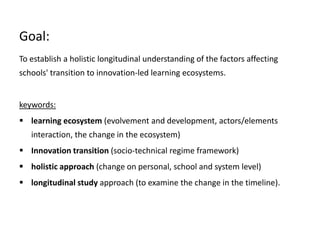
Goal:
To establish a holistic longitudinal understanding of the factors affecting
schools' transition to innovation-led learning ecosystems.
keywords:
 learning ecosystem (evolvement and development, actors/elements
interaction, the change in the ecosystem)
 Innovation transition (socio-technical regime framework)
 holistic approach (change on personal, school and system level)
 longitudinal study approach (to examine the change in the timeline).
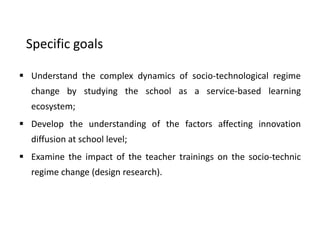
Specific goals
 Understand the complex dynamics of socio-technological regime
change by studying the school as a service-based learning
ecosystem;
 Develop the understanding of the factors affecting innovation
diffusion at school level;
 Examine the impact of the teacher trainings on the socio-technic
regime change (design research).
Approach
 Case study analysis using qualitative and quantitate
data collections;
 longitudinal approach of data analysis to understand
different level phenomena in the holistic setting;
 Interviews with stakeholders;
 intervention study (design research).
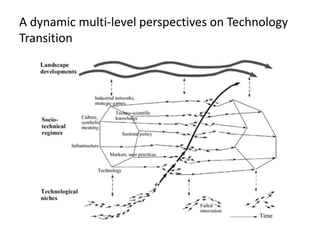
A dynamic multi-level perspectives on Technology
Transition
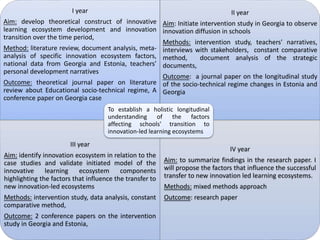
I year
Aim: develop theoretical construct of innovative
learning ecosystem development and innovation
transition over the time period,
Method: literature review, document analysis, meta-
analysis of specific innovation ecosystem factors,
national data from Georgia and Estonia, teachers’
personal development narratives
Outcome: theoretical journal paper on literature
review about Educational socio-technical regime, A
conference paper on Georgia case
II year
Aim: Initiate intervention study in Georgia to observe
innovation diffusion in schools
Methods: intervention study, teachers' narratives,
interviews with stakeholders, constant comparative
method, document analysis of the strategic
documents,
Outcome: a journal paper on the longitudinal study
of the socio-technical regime changes in Estonia and
Georgia
III year
Aim: identify innovation ecosystem in relation to the
case studies and validate initiated model of the
innovative learning ecosystem components
highlighting the factors that influence the transfer to
new innovation-led ecosystems
Methods: intervention study, data analysis, constant
comparative method,
Outcome: 2 conference papers on the intervention
study in Georgia and Estonia,
IV year
Aim: to summarize findings in the research paper. I
will propose the factors that influence the successful
transfer to new innovation led learning ecosystems.
Methods: mixed methods approach
Outcome: research paper
To establish a holistic longitudinal
understanding of the factors
affecting schools' transition to
innovation-led learning ecosystems
Service-based ecosystem concept by Moore
 Company is a part of business ecosystem not a member of single industry;
 Company produces goods and services;
 Customers function in an ecosystem together with different social groups. They are
organisms of the ecosystem;
 Organisms coevolve capabilities and roles to be in line with the directions set by the
central companies;
 Leader position change over time; Leader’s function is valued as to move members
toward shared vision;
 Competition is among the ecosystem and not among the individual companies, this
fuels transformation;
 Ecosystem develops in 4 stages: birth, expansion, leadership, self-renewal.
Schools as service-based ecosystem
In business ecosystem the services are specimen, so:
 Can we imagine that schools also develop services?
 How such services are created at school? Produced by the interaction of
individual organisms (humans and technologies)?
 What is the purpose of such an ecosystem?
 If the teacher trainings are considered to be niches (an abstract
conceptualization what species would need for fitness), were these niches
(training) able to enter socio-technic regime? do they transform
innovation ecosystem?
School-service groups
Infrastructure Services
 Internet connection services
 Digital device services
 E-services
Learning and teaching services
 Learning goals management services
 Learning process management services
 Learning tools/resources management services
 Learning organization management services
Change management services
 Strategic planning service
 Involvement and partnership services
 Monitoring and analysis services
 Exchange of experiences services
 Leadership and support services
 Teacher professional development services
Next steps/thoughts
 While studying schools as service-based systems, what are the
interactions between human agency, social structures and
organizations that allows socio-technical regime to be established
and function?
 Are there particular patterns and mechanisms in school transition
process. What kind of configuration “work together” to fulfill the
service/function?
Thank You

2015 10-14 research seminar 1

  • 1.
    Schools’ Transition toInnovative Learning Ecosystem Supervisor: Kai Pata Eka Jeladze PhD student
  • 2.
    Goal: To establish aholistic longitudinal understanding of the factors affecting schools' transition to innovation-led learning ecosystems. keywords:  learning ecosystem (evolvement and development, actors/elements interaction, the change in the ecosystem)  Innovation transition (socio-technical regime framework)  holistic approach (change on personal, school and system level)  longitudinal study approach (to examine the change in the timeline).
  • 3.
    Specific goals  Understandthe complex dynamics of socio-technological regime change by studying the school as a service-based learning ecosystem;  Develop the understanding of the factors affecting innovation diffusion at school level;  Examine the impact of the teacher trainings on the socio-technic regime change (design research).
  • 4.
    Approach  Case studyanalysis using qualitative and quantitate data collections;  longitudinal approach of data analysis to understand different level phenomena in the holistic setting;  Interviews with stakeholders;  intervention study (design research).
  • 5.
    A dynamic multi-levelperspectives on Technology Transition
  • 6.
    I year Aim: developtheoretical construct of innovative learning ecosystem development and innovation transition over the time period, Method: literature review, document analysis, meta- analysis of specific innovation ecosystem factors, national data from Georgia and Estonia, teachers’ personal development narratives Outcome: theoretical journal paper on literature review about Educational socio-technical regime, A conference paper on Georgia case II year Aim: Initiate intervention study in Georgia to observe innovation diffusion in schools Methods: intervention study, teachers' narratives, interviews with stakeholders, constant comparative method, document analysis of the strategic documents, Outcome: a journal paper on the longitudinal study of the socio-technical regime changes in Estonia and Georgia III year Aim: identify innovation ecosystem in relation to the case studies and validate initiated model of the innovative learning ecosystem components highlighting the factors that influence the transfer to new innovation-led ecosystems Methods: intervention study, data analysis, constant comparative method, Outcome: 2 conference papers on the intervention study in Georgia and Estonia, IV year Aim: to summarize findings in the research paper. I will propose the factors that influence the successful transfer to new innovation led learning ecosystems. Methods: mixed methods approach Outcome: research paper To establish a holistic longitudinal understanding of the factors affecting schools' transition to innovation-led learning ecosystems
  • 7.
    Service-based ecosystem conceptby Moore  Company is a part of business ecosystem not a member of single industry;  Company produces goods and services;  Customers function in an ecosystem together with different social groups. They are organisms of the ecosystem;  Organisms coevolve capabilities and roles to be in line with the directions set by the central companies;  Leader position change over time; Leader’s function is valued as to move members toward shared vision;  Competition is among the ecosystem and not among the individual companies, this fuels transformation;  Ecosystem develops in 4 stages: birth, expansion, leadership, self-renewal.
  • 8.
    Schools as service-basedecosystem In business ecosystem the services are specimen, so:  Can we imagine that schools also develop services?  How such services are created at school? Produced by the interaction of individual organisms (humans and technologies)?  What is the purpose of such an ecosystem?  If the teacher trainings are considered to be niches (an abstract conceptualization what species would need for fitness), were these niches (training) able to enter socio-technic regime? do they transform innovation ecosystem?
  • 9.
    School-service groups Infrastructure Services Internet connection services  Digital device services  E-services Learning and teaching services  Learning goals management services  Learning process management services  Learning tools/resources management services  Learning organization management services Change management services  Strategic planning service  Involvement and partnership services  Monitoring and analysis services  Exchange of experiences services  Leadership and support services  Teacher professional development services
  • 10.
    Next steps/thoughts  Whilestudying schools as service-based systems, what are the interactions between human agency, social structures and organizations that allows socio-technical regime to be established and function?  Are there particular patterns and mechanisms in school transition process. What kind of configuration “work together” to fulfill the service/function?
  • 11.

Editor's Notes

  • #4 1. What are the elements of socio-technical configuration? What are governing regimes? What do we mean in “schools as a service-based innovative ecosystem”? what are the elements of the ecosystem, who are the actors in it, what are linkages between elements and actors, how they function, what are the purpose of their function? What are the external factors/or context in which the actors interact? How this ecosystem evolves, expanses, takes lead and renewals? 2. What are novel ecosystem models for schools? What factors contribute to innovation diffusion at school level? When and how these factors interact and work at their best? How these factors were changing over the time? What are the types of niches that transform innovation? If we imagine schools as service-based system what are these services and how are they created? Who is involved and what mediates the processes? 3. Were the niches, in my case - training models, able to enter socio-technical regimes? Has the skills acquired at the trainings transformed learning ecosystem? What are governing principles and methods (pedagogy), process and system (technology), content (management of learning resources) and what are overarching strategies and policies at schools? What factors influence personal decisions of the teachers to adopt technology? What strategies, practices and tools do teachers use to embrace technology? Why do they select those strategies, practices and tools? How these strategies, practices and tools are translated into the success? How ICT and digital competencies were developed in teachers over the time period?