INTERNATIONAL DESIGN/BUILD
                                        -   poverty or disaster relief
MAIN OBJECTIVES                         -   sustainable community development
                                        -   expose students to other cultures
                                        -   foster international relationships


INTEGRATION:
•	   Can	look	into	working	together	with	institutions/centers	on	campus	that	works	overseas
•	   Can	be	a	part	of	Summer	Program	or	Study	Abroad	program
•	   High	Volt	Lab	can	be	a	place	for	Pre-Fabrication	or	Prototyping	before	shipping
•	   Communication	team	can	gear	towards	looking	for	sponsors	and	local	non-profit	partners
•	   Partnering	local	universities	help	to	develop	overseas	ties
•	   Social	design	firms	or	individuals	can	become	advisor	or	collaborator
•	   There	are	extensive	opportunities	and	a	lot	of	work	to	be	done
PROS:                                            CONS:
•	 Relationships	and	networks	can	be	fostered	   •	 Project	construction	will	most	likely	be	dur-
through	international	collaboration              ing	summer	or	winter	breaks
•	 Increase	Cornell’s	outreach	effort	and	glo-   •	 Can	be	more	expensive	because	of	travel
bal presence                                     •	 Uncertainties	in	travelling	to	developing	
•	 Developing	nations	have	more	urgent	and	      countries
pertinent problems                               •	 Transportation	of	materials	and	labor	can	
•	 Limited	resources	means	more	creativity       be difficult
•	 Opportunities	for	impactful	interventions	    •	 There	is	a	concern	about	coming	as	aid	or	
that entail economic development                 an	‘expert’	creating	dependency
•	 Students	tends	to	be	more	excited	about	
going	abroad
•	 Media	and	sponsorship	opportunities	will	
be plenty
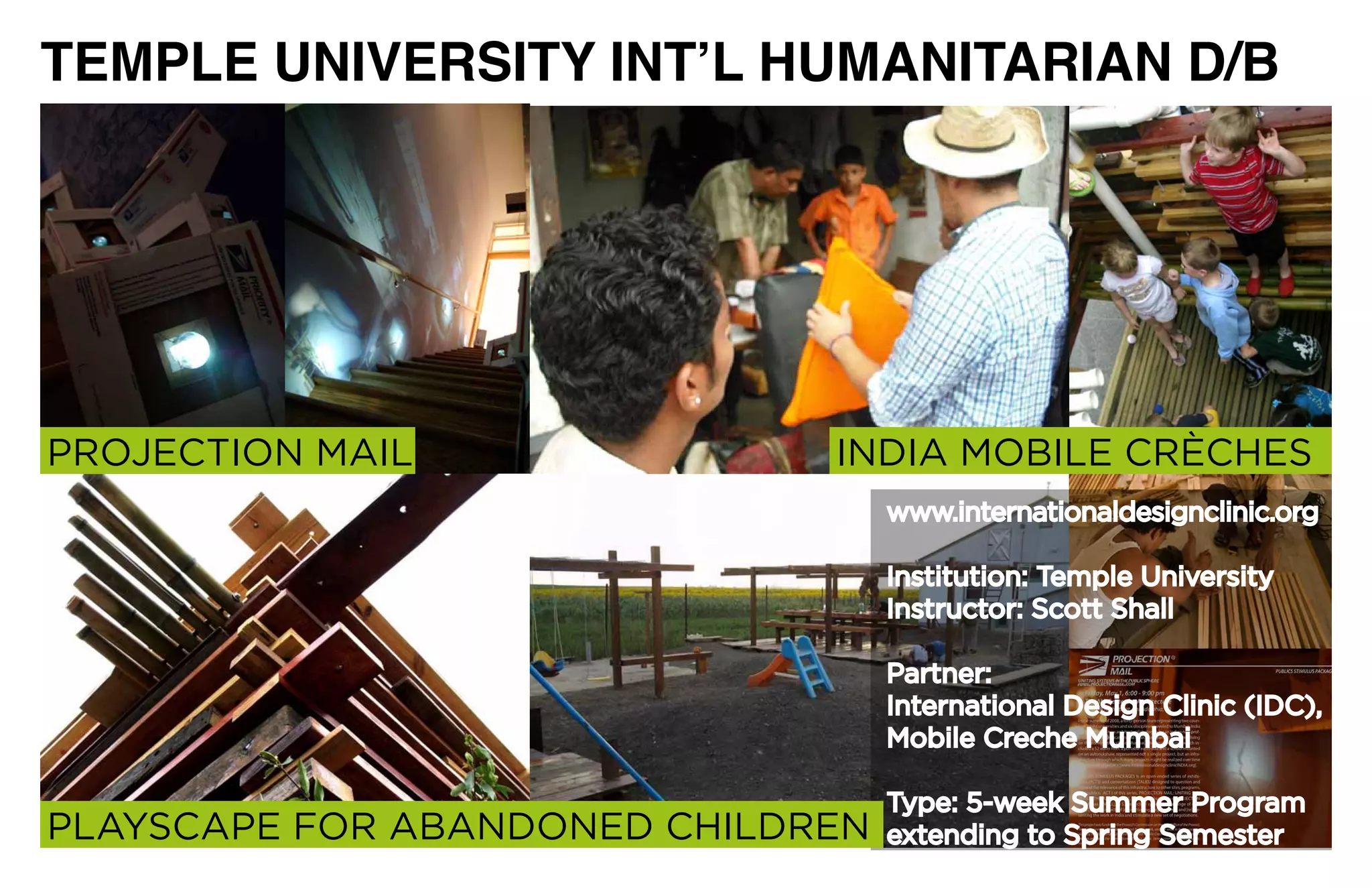
TEMPLE UNIVERSITY INT’L HUMANITARIAN D/B


PROJECTION	MAIL               INDIA	MOBILE	CRÈCHES
                                   www.internationaldesignclinic.org

                                   Institution:	Temple	University
                                   Instructor: Scott Shall

                                   Partner:	
                                   International	Design	Clinic	(IDC),	
                                   Mobile Creche Mumbai

                                   Type:	5-week	Summer	Program	
PLAYSCAPE	FOR	ABANDONED	CHILDREN   extending	to	Spring	Semester
PROS:                                            CONS
•	 Diverse	small-scale	but	effective	projects	   •	 The	projects	may	not	necessarily	ad-
are	created	such	as	in	the	Mumbai	project        dress	true	sustainability	at	large
•	 The	projects	are	quick	and	can	be	done	       •	 Projects	were	based	on	affordability	
with	only	individuals	or	teams                   and	using	innovative	(re-used)	materials	
•	 This	will	create	a	more	umbrella	structure	   rather than prototyped innovation
rather	than	a	design/build	team                  •	 Because	it	is	a	summer	program,	it	is	
•	 Partner	with	non-profit	organizations	lo-     too	short	for	more	ambitious	programs
cally	such	as	Mobile	Creche	and	IDC
•	 Summer	program	means	that	time	would	
be less of an issue
•	 Students	from	other	schools	can	join


INTEGRATION:
•	 Summer	Program	can	be	under	Summer	Abroad	or	Summer	School	programs	in	Cornell	that	
is open to everyone
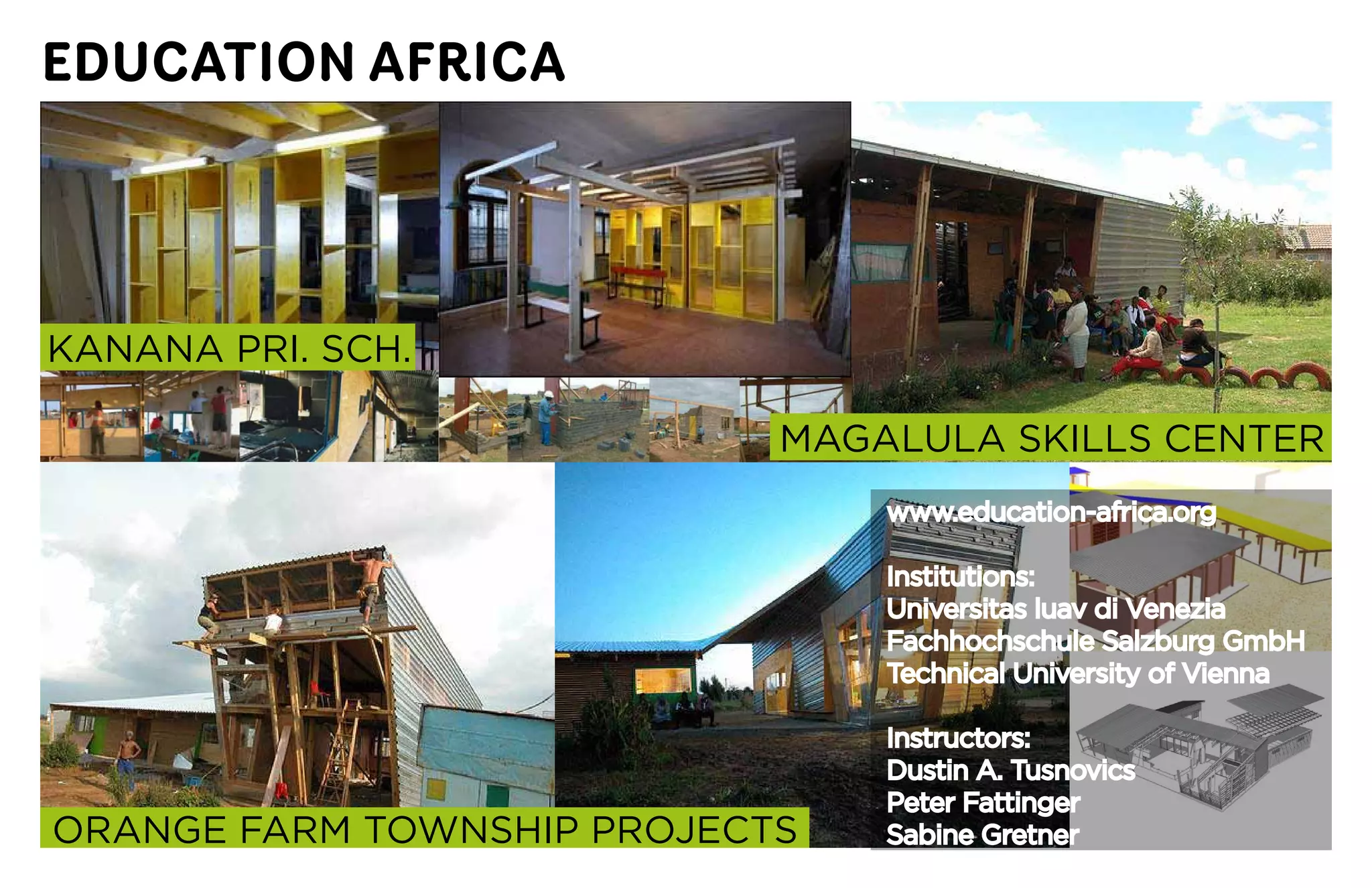
EDUCATION AFRICA


KANANA	PRI.	SCH.

                            MAGALULA	SKILLS	CENTER
                                www.education-africa.org

                                Institutions:
                                Universitas	luav	di	Venezia
                                Fachhochschule	Salzburg	GmbH
                                Technical	University	of	Vienna

                                Instructors:
                                Dustin	A.	Tusnovics
                                Peter	Fattinger
ORANGE	FARM	TOWNSHIP	PROJECTS   Sabine Gretner
PROS:                                          CONS

•	 Education	Africa	can	connect	the	schools	   •	 The	participating	institutions	have	to	ar-
to local partners and have readily available   range	their	own	funding	for	travel
projects	to	work	on                            •	 Materials	and	student	participants	have	
•	 They	were	promoting	in	CU	two	years	        to	be	sent	to	the	site	which	may	become	
ago,	brought	by	Mark	Cruvellier                logistical	difficulties
•	 Local	partners	create	longevity	where	      •	 Transportation	may	not	be	sustainable
more	projects	can	be	done	in	the	future
•	 Trust	from	community	and	ease	of	
project	grows	over	time	such	as	the	Orange	
Farm	Township
•	 Relationships	are	created	amongst	insti-
tutions,	communities	and	cities
•	 International	‘poverty	relief’	projects	
are	very	likely	to	gain	media	attention	and	   INTEGRATION
sponsorships
•	 Local	partners	/	non-profits	funds	the	     •	 Pre-Fab	or	‘ReadyMix’	constructions	can	
project	which	includes	materials	and	labor	    be	done	in	the	High	Volt	Lab	upon	which	
since they are the clients                     construction	can	be	done	in	6	weeks
•	 The	program	becomes	more	value	add-         •	 There	are	professors	in	various	depart-
ed	because	of	friendships	and	technology	      ments	that	are	connected	to	developing	
transfer                                       communities	(e.g.	AguaClara	–	Honduras,	
                                               CIIFAD,	etc.)
GSD: SoCA [ Social Change and Activism ]
www.gsdsoca.blogspot.com
www.harvardpk.blogspot.com

Institution:	Harvard	GSD
Type: Student Group
Partners:
Art Aids Art
MonkeyBiz
DesignCorps


                                  INSERT!	Chinatown


projectKhayelitsha                  SFI	8	conference
PROS:                                                  CONS
•	 A	student	group	umbrella	structure	al-              •	 If	not	tightly	integrated	into	curriculum,	
lows	for	a	much	loser	organization                     there	may	be	a	lack	of	commitment
•	 The	organization	can	fund	multiple	                 •	 Participatory	process	would	require	
projects	at	once	increasing	the	opportuni-             more	time	and	more	ground	work	which	
ties for students to participate or create             may cost more
their	own	initiatives                                  •	 In	this	case,	not	many	students	can	trav-
•	 Participatory	process	was	included	in	the	          el to the site
design	workflow	to	create	transparency	and	
increase buy-in from clients and users


INTEGRATION:
•	 Form	a	university	organization	or	an	institute	that	creates	an	umbrella	group	for	initiatives
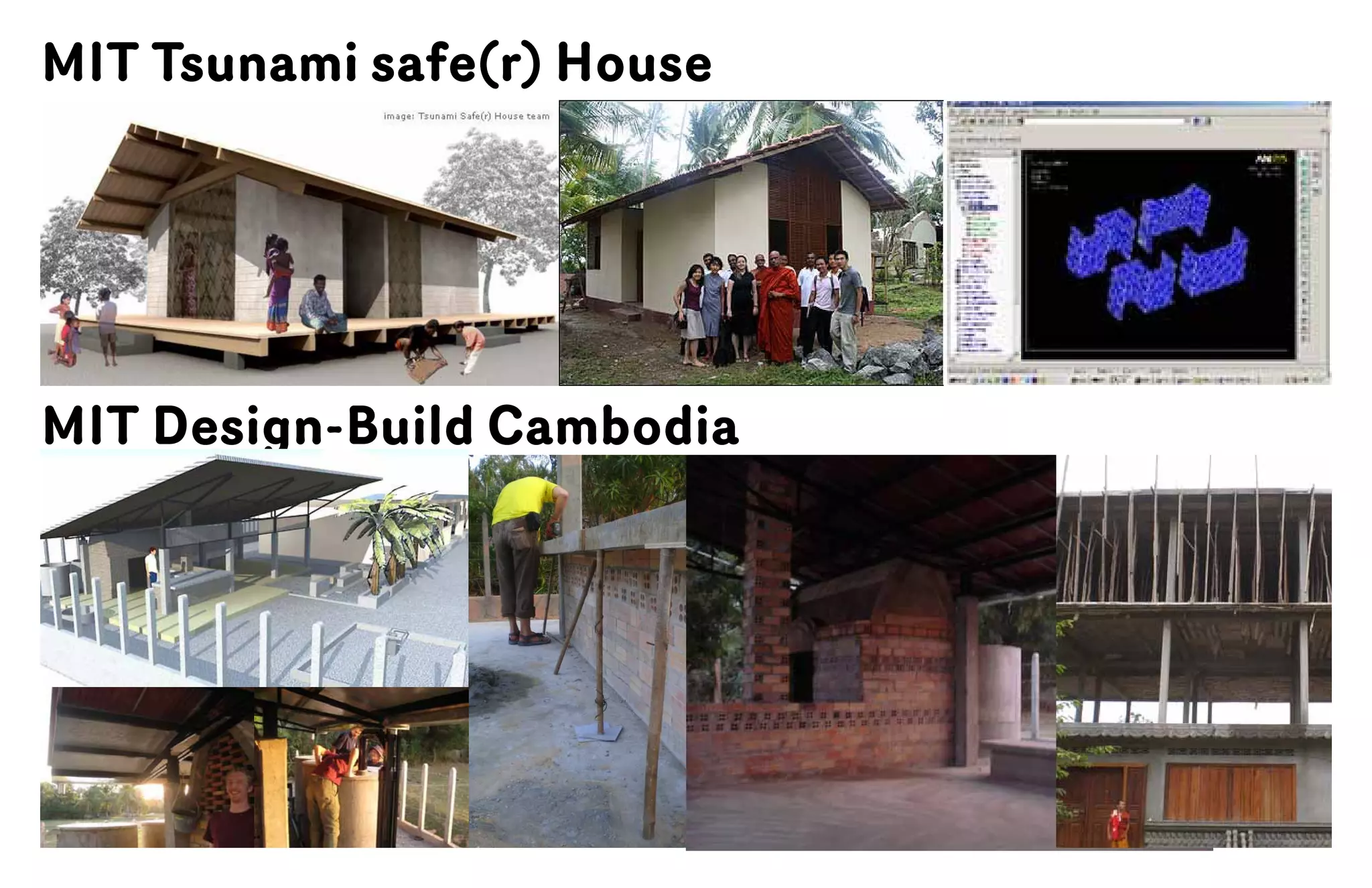
MIT Tsunami safe(r) House


MIT Design-Build Cambodia
PROS:                                              CONS
•	 Because	it	is	under	the	SENSEable	City	         •	 It	requires	a	committed	long-term	fac-
Lab,	the	projects	call	for	an	innovative	multi-    ulty	or	advisory	to	organize	a	“lab”
disciplinary approach                              •	 The	project	timeline	may	not	be	suitable	
•	 The	“lab”	structure	allows	for	continued	       for the semester structure of Cornell
research	and	long-term	commitment	that	            •	 Short	term	projects	may	not	allow	for	
can be passed on or around                         post-occupancy evaluation
•	 Research,	Design,	Development	and	
Build	workflow
•	 Consultation	were	done	by	large	firms	
such	as	Buro	Happold
•	 The	project	is	a	combination	of	high-
tech	and	low-tech	with	in-depth	research	on	
technology	and	socio-aesthetic	components
•	 It	is	a	prototype	project	that	is	replicable	   INTEGRATION
and scalable
•	 The	project	included	architects	and	engi-       •	 Create	a	lab	or	institute	rather	than	a	
neers	and	a	few	students	from	Harvard	(out-        course	in	the	long-run
side	of	the	institution)                           •	 Projects	can	be	a	mix	of	prototyping	
•	 The	project	was	done	in	a	short	amount	         and	low-tech	design/build
of time
•	 Locally	derived	materials	and	building	
technologies	were	used	for	efficiency
•	 Local	builders	work	alongside	students
EXTERNAL
ORGANIZATIONS /
FIRMS
Potential	Integration:
•	 Firms	or	individuals	can	be	invited	as	visiting	faculties	or	advisors
•	 CUSD	can	jump	on	board	their	projects	in	the	summer	and	help	with	re-
search	and	development	during	the	semesters
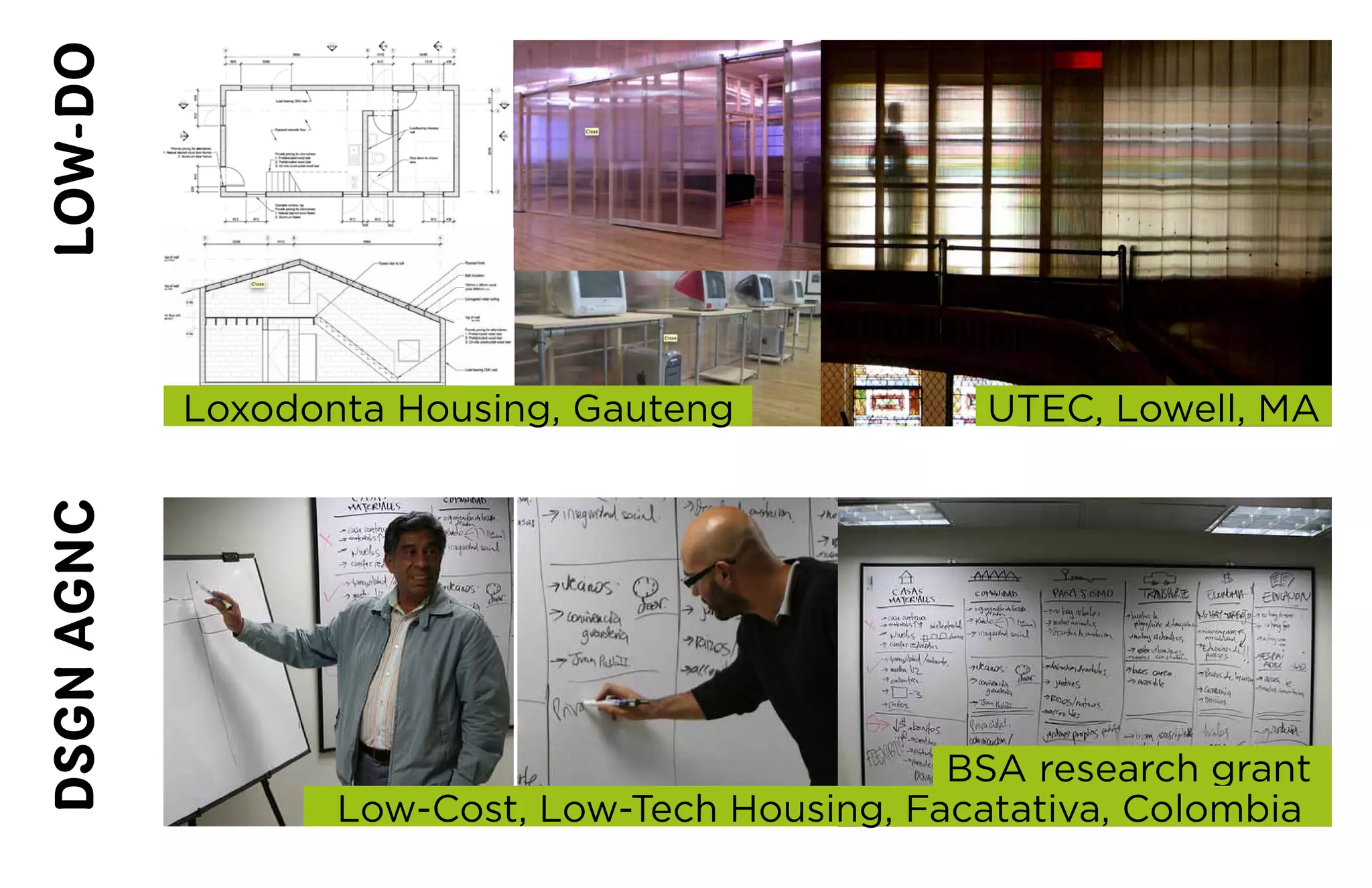
LOW-DO


            Loxodonta	Housing,	Gauteng             UTEC,	Lowell,	MA
DSGN AGNC


                                                 BSA	research	grant
                   Low-Cost,	Low-Tech	Housing,	Facatativa,	Colombia
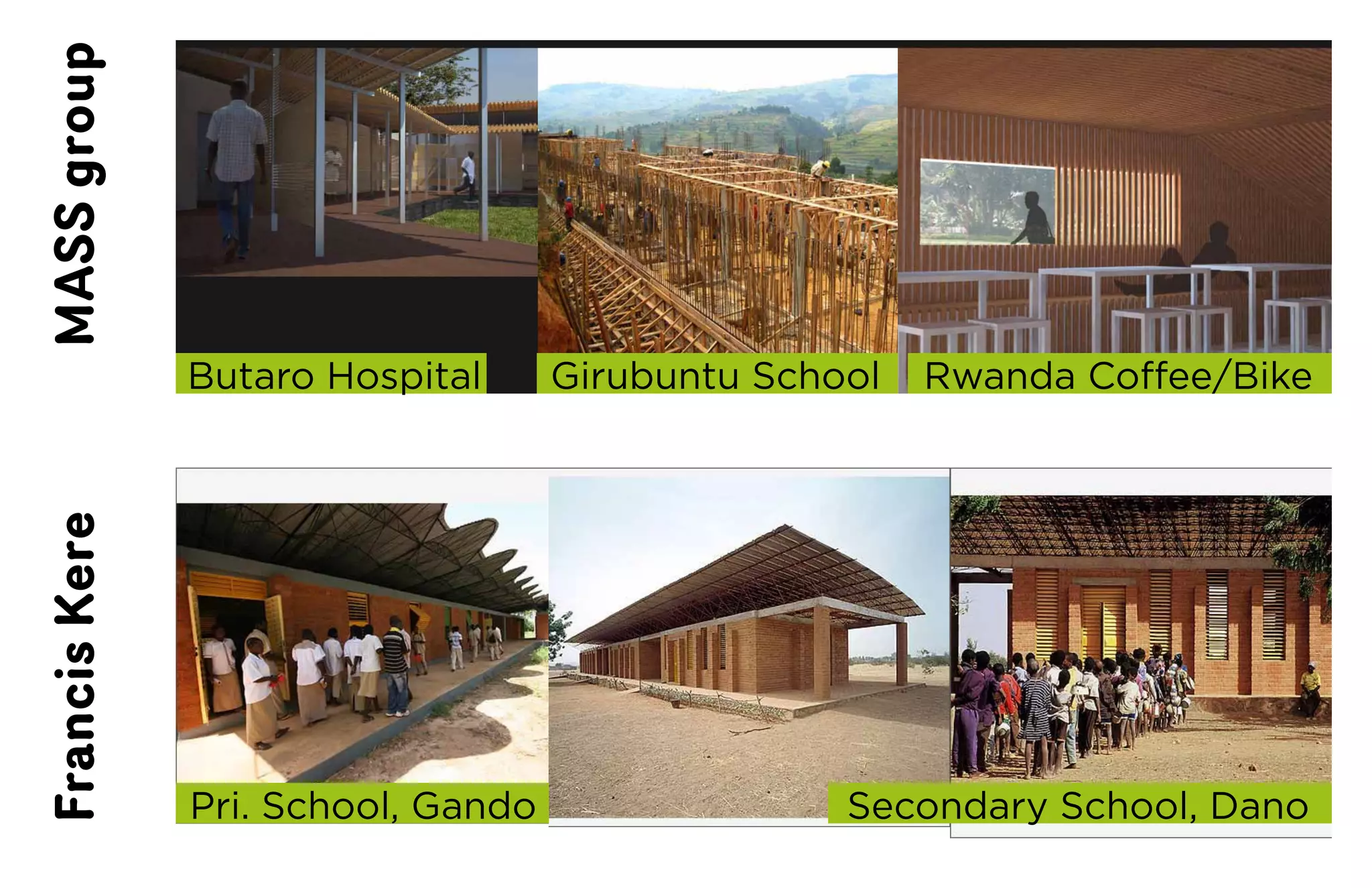
MASS group


               Butaro	Hospital      Girubuntu School   Rwanda	Coffee/Bike
Francis Kere


               Pri.	School,	Gando                 Secondary	School,	Dano
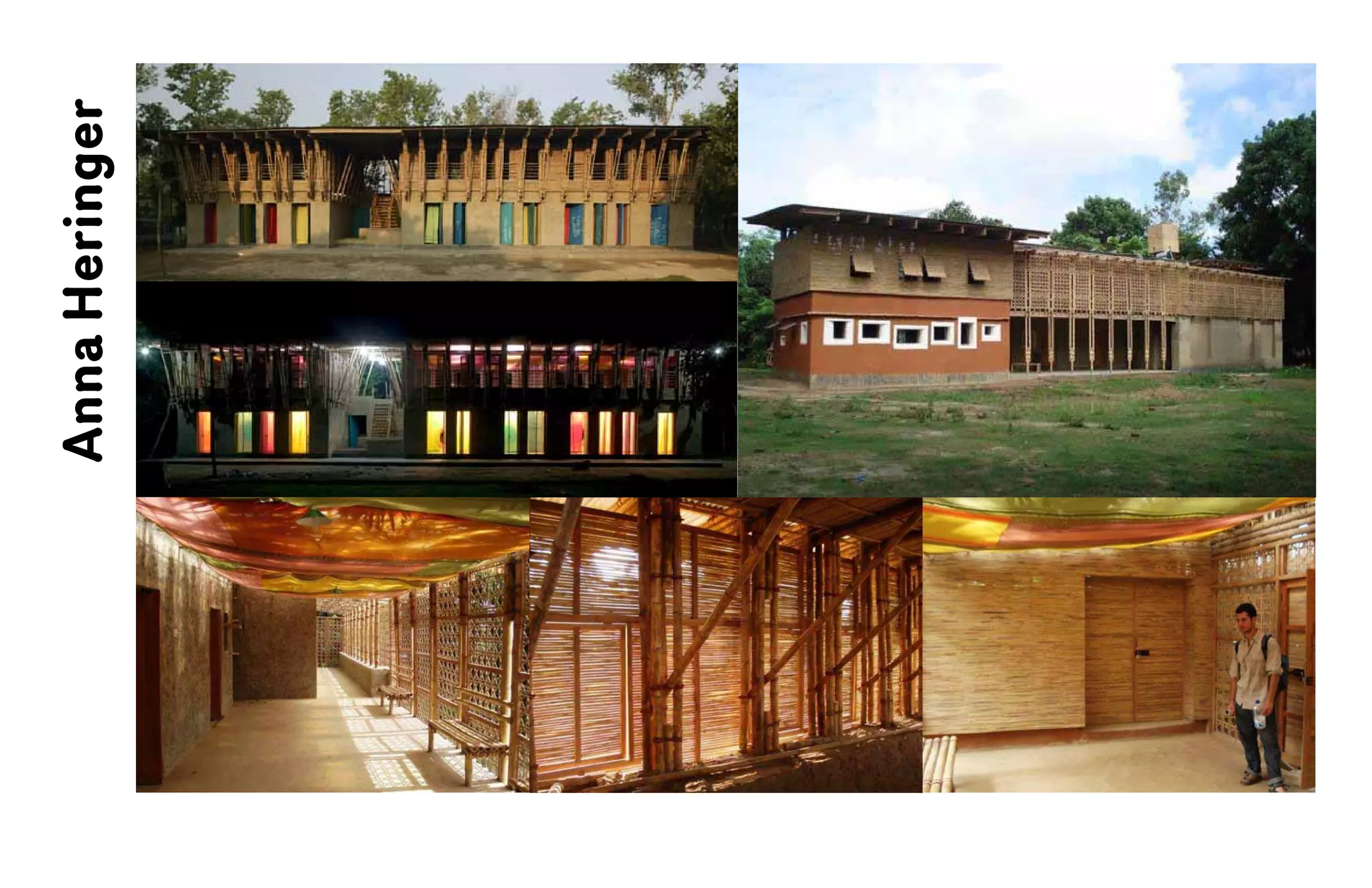
Anna Heringer
CORNELL UNIV.
POTENTIAL
COLLABORATORS
Potential	Integration:
•	 New	projects	can	be	developed	with	the	institutions	in	Cornell	University
•	 We	can	latch	on	to	the	contacts	that	have	been	established
•	 Each	center	has	allocated	funds	and	they	can	be	combined	with	careful	planning
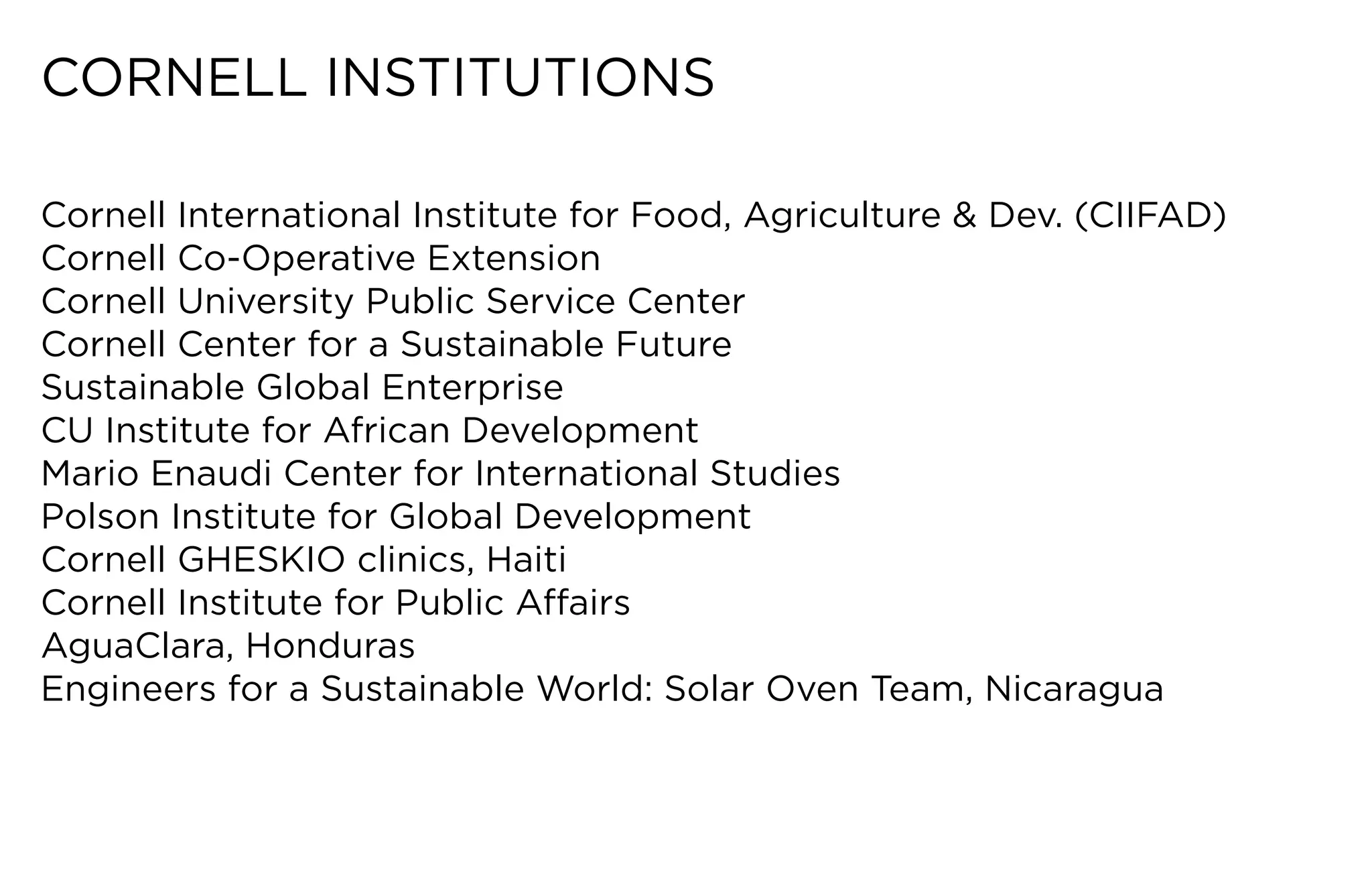
CORNELL	INSTITUTIONS

Cornell	International	Institute	for	Food,	Agriculture	&	Dev.	(CIIFAD)
Cornell Co-Operative Extension
Cornell	University	Public	Service	Center
Cornell	Center	for	a	Sustainable	Future
Sustainable Global Enterprise
CU	Institute	for	African	Development
Mario Enaudi Center for International Studies
Polson	Institute	for	Global	Development
Cornell	GHESKIO	clinics,	Haiti
Cornell	Institute	for	Public	Affairs
AguaClara,	Honduras
Engineers	for	a	Sustainable	World:	Solar	Oven	Team,	Nicaragua

CUSD other international projects

  • 1.
    INTERNATIONAL DESIGN/BUILD - poverty or disaster relief MAIN OBJECTIVES - sustainable community development - expose students to other cultures - foster international relationships INTEGRATION: • Can look into working together with institutions/centers on campus that works overseas • Can be a part of Summer Program or Study Abroad program • High Volt Lab can be a place for Pre-Fabrication or Prototyping before shipping • Communication team can gear towards looking for sponsors and local non-profit partners • Partnering local universities help to develop overseas ties • Social design firms or individuals can become advisor or collaborator • There are extensive opportunities and a lot of work to be done
  • 2.
    PROS: CONS: • Relationships and networks can be fostered • Project construction will most likely be dur- through international collaboration ing summer or winter breaks • Increase Cornell’s outreach effort and glo- • Can be more expensive because of travel bal presence • Uncertainties in travelling to developing • Developing nations have more urgent and countries pertinent problems • Transportation of materials and labor can • Limited resources means more creativity be difficult • Opportunities for impactful interventions • There is a concern about coming as aid or that entail economic development an ‘expert’ creating dependency • Students tends to be more excited about going abroad • Media and sponsorship opportunities will be plenty
  • 3.
    TEMPLE UNIVERSITY INT’LHUMANITARIAN D/B PROJECTION MAIL INDIA MOBILE CRÈCHES www.internationaldesignclinic.org Institution: Temple University Instructor: Scott Shall Partner: International Design Clinic (IDC), Mobile Creche Mumbai Type: 5-week Summer Program PLAYSCAPE FOR ABANDONED CHILDREN extending to Spring Semester
  • 4.
    PROS: CONS • Diverse small-scale but effective projects • The projects may not necessarily ad- are created such as in the Mumbai project dress true sustainability at large • The projects are quick and can be done • Projects were based on affordability with only individuals or teams and using innovative (re-used) materials • This will create a more umbrella structure rather than prototyped innovation rather than a design/build team • Because it is a summer program, it is • Partner with non-profit organizations lo- too short for more ambitious programs cally such as Mobile Creche and IDC • Summer program means that time would be less of an issue • Students from other schools can join INTEGRATION: • Summer Program can be under Summer Abroad or Summer School programs in Cornell that is open to everyone
  • 5.
    EDUCATION AFRICA KANANA PRI. SCH. MAGALULA SKILLS CENTER www.education-africa.org Institutions: Universitas luav di Venezia Fachhochschule Salzburg GmbH Technical University of Vienna Instructors: Dustin A. Tusnovics Peter Fattinger ORANGE FARM TOWNSHIP PROJECTS Sabine Gretner
  • 6.
    PROS: CONS • Education Africa can connect the schools • The participating institutions have to ar- to local partners and have readily available range their own funding for travel projects to work on • Materials and student participants have • They were promoting in CU two years to be sent to the site which may become ago, brought by Mark Cruvellier logistical difficulties • Local partners create longevity where • Transportation may not be sustainable more projects can be done in the future • Trust from community and ease of project grows over time such as the Orange Farm Township • Relationships are created amongst insti- tutions, communities and cities • International ‘poverty relief’ projects are very likely to gain media attention and INTEGRATION sponsorships • Local partners / non-profits funds the • Pre-Fab or ‘ReadyMix’ constructions can project which includes materials and labor be done in the High Volt Lab upon which since they are the clients construction can be done in 6 weeks • The program becomes more value add- • There are professors in various depart- ed because of friendships and technology ments that are connected to developing transfer communities (e.g. AguaClara – Honduras, CIIFAD, etc.)
  • 7.
    GSD: SoCA [Social Change and Activism ] www.gsdsoca.blogspot.com www.harvardpk.blogspot.com Institution: Harvard GSD Type: Student Group Partners: Art Aids Art MonkeyBiz DesignCorps INSERT! Chinatown projectKhayelitsha SFI 8 conference
  • 8.
    PROS: CONS • A student group umbrella structure al- • If not tightly integrated into curriculum, lows for a much loser organization there may be a lack of commitment • The organization can fund multiple • Participatory process would require projects at once increasing the opportuni- more time and more ground work which ties for students to participate or create may cost more their own initiatives • In this case, not many students can trav- • Participatory process was included in the el to the site design workflow to create transparency and increase buy-in from clients and users INTEGRATION: • Form a university organization or an institute that creates an umbrella group for initiatives
  • 9.
    MIT Tsunami safe(r)House MIT Design-Build Cambodia
  • 10.
    PROS: CONS • Because it is under the SENSEable City • It requires a committed long-term fac- Lab, the projects call for an innovative multi- ulty or advisory to organize a “lab” disciplinary approach • The project timeline may not be suitable • The “lab” structure allows for continued for the semester structure of Cornell research and long-term commitment that • Short term projects may not allow for can be passed on or around post-occupancy evaluation • Research, Design, Development and Build workflow • Consultation were done by large firms such as Buro Happold • The project is a combination of high- tech and low-tech with in-depth research on technology and socio-aesthetic components • It is a prototype project that is replicable INTEGRATION and scalable • The project included architects and engi- • Create a lab or institute rather than a neers and a few students from Harvard (out- course in the long-run side of the institution) • Projects can be a mix of prototyping • The project was done in a short amount and low-tech design/build of time • Locally derived materials and building technologies were used for efficiency • Local builders work alongside students
  • 11.
    EXTERNAL ORGANIZATIONS / FIRMS Potential Integration: • Firms or individuals can be invited as visiting faculties or advisors • CUSD can jump on board their projects in the summer and help with re- search and development during the semesters
  • 12.
    LOW-DO Loxodonta Housing, Gauteng UTEC, Lowell, MA DSGN AGNC BSA research grant Low-Cost, Low-Tech Housing, Facatativa, Colombia
  • 13.
    MASS group Butaro Hospital Girubuntu School Rwanda Coffee/Bike Francis Kere Pri. School, Gando Secondary School, Dano
  • 14.
  • 15.
    CORNELL UNIV. POTENTIAL COLLABORATORS Potential Integration: • New projects can be developed with the institutions in Cornell University • We can latch on to the contacts that have been established • Each center has allocated funds and they can be combined with careful planning
  • 16.
    CORNELL INSTITUTIONS Cornell International Institute for Food, Agriculture & Dev. (CIIFAD) Cornell Co-Operative Extension Cornell University Public Service Center Cornell Center for a Sustainable Future SustainableGlobal Enterprise CU Institute for African Development Mario Enaudi Center for International Studies Polson Institute for Global Development Cornell GHESKIO clinics, Haiti Cornell Institute for Public Affairs AguaClara, Honduras Engineers for a Sustainable World: Solar Oven Team, Nicaragua