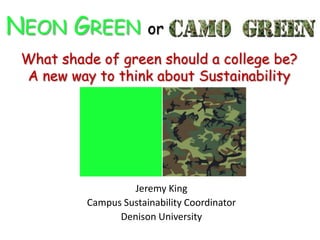
NEON GREEN or
 What shade of green should a college be?
 A new way to think about Sustainability


                   Jeremy King
          Campus Sustainability Coordinator
                Denison University
Environmentalists
   What comes to mind?
What do we relate to?


http://www.youtube.com/watch?v=Ml54UuAoLSo
Oberlin College’s Environmental Center
Sustainability on most Campuses

• LEED Buildings              •   Low VOC paints
• Energy-Efficient Lighting   •   Composting Programs
  Upgrades                    •   Renewable Energy
• Recycling Programs          •   “Green-Vehicle” Parking Spaces
• Trayless Dining             •
• Local Foods Initiatives     •   Reduction of printed materials
• Recycled Paper Purchasing   •   RecycleMania
• Duplex Printing             •   Waste Reduction Programs
• Use of “Green” cleaning     •   Bike Share & Car Share
  supplies
                              •   Water conservation
• Tree Campus USA
                              •   Eco-Reps Program
• Campus Gardens/Farms
                              •   Green Office Certification
What’s Happening on Your Campus?

What are the big projects?

Who’s supporting them?

What impact are you having?
Why are we Doing This?
            Marketing
            Remember… NEON or

            It saves money and resources

            Everyone else is doing it

            It is the “right” thing to do
Talloires
Declaration
Do we want to be Neon? Like
Pomona, Oberlin, Middlebury…..


                       Do we just want to blend in?


  I’M NOT SURE IT MATTERS UNLESS WE RETHINK SUSTAINABILITY
What is Sustainability
  The capacity to endure and/or remain in balance
Sustainable development is a pattern of resource use
that aims to meet human needs while preserving the
environment so that these needs can be met not only
in the present, but also for future generations.
                                 -Brudntland Commission 1987
In order to build a sustainable society, diverse groups will need to
be able to come together and work collaboratively to address
sustainability challenges. People of color and low-income
communities tend to suffer disproportionate exposure to
environmental problems. This environmental injustice happens as a
result of unequal and segregated communities. To achieve
environmental and social justice, society must work to address
discrimination and promote equality. The historical legacy and
persistence of discrimination based on racial, gender, religious, and
other differences makes a proactive approach to promoting a
culture of inclusiveness an important component of creating an
equitable society. Higher education opens doors to opportunities
that can help create a more equitable world.

Association for the Advancement of Sustainability in Higher Education - AASHE
Sustainability is NOT a normal
     problem, it is a game changer

Normal Problem: can be addressed with familiar tools
and strategies because it does not call into question
fundamental assumptions (e.g. DDT)

Game Changer: questions fundamental
assumptions, institutions, and cultural values
(worldview), and so requires very different tools and
strategies
A Hard Truth
“Almost everything being done in the
name of sustainable development
addresses and attempts to reduce
unsustainability. But reducing
unsustainability, although critical, does
not and will not create sustainability”
             --John R. Ehrenfeld, Sustainability by Design
Green Roof atSomeFord Plant in Michigan
                  a Problems
          Deliberate worldview change is
                    1) Unprecedented
                  2) Not widely desired
                3) Fraught with paradoxes


Less Unsustainable
Our students and our society as a whole recognize these curves
Keeling Curve
Less than 5% of our students recognize this curve
CIRP DATAEducational Research Institute
 Cooperative Institutional Research Program – Higher


Anecdotal Evidence: Students in the FYS Class Energy and the Environment
admitted that they didn’t know what petroleum was used for
How in Tune are Your Students?

Do your students connect with your sustainability efforts?

What projects and activities resonate well with them?

Do they relate well with outdoor sustainability themes?

What are some of those outdoor initiatives?
Where to?
Because sustainability is a fundamentally different kind
of challenge, it requires a very different strategy with a
    different objective. Our aim is not to win the old
   game, but rather, to help catalyze a new game and
                 culture. To get off track!


     While progress in institutionalizing sustainability is
 satisfying, these “little successes” risk distracting attention
from the primary conundrum: Reducing unsustainability will
                  never create sustainability.

                 - Dr. Paul Morgan – West Chester University
A creative leap?
What better place to begin to address the
complex issues surrounding sustainability than
on college campuses?
NEON or Camo ?


At Denison we are trying to find a different path
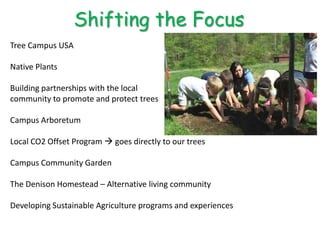
Shifting the Focus
Tree Campus USA

Native Plants

Building partnerships with the local
community to promote and protect trees

Campus Arboretum

Local CO2 Offset Program  goes directly to our trees

Campus Community Garden

The Denison Homestead – Alternative living community

Developing Sustainable Agriculture programs and experiences
Denison in the early days
     1880s - 1890s
Building a Treescape
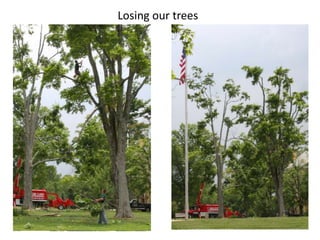
Losing our trees
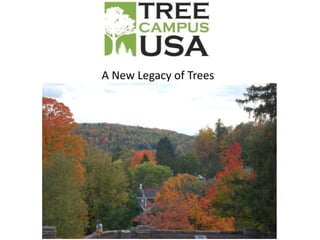
A New Legacy of Trees
Campus Arboretum
  http://www.denison.edu/sustainability/denison_university_arboretum.html


Strategic Native Plantings

Memorial Trees

Educational Resource

Environmental Attributes

CO2 Offsets

Comprehensive Inventory to track our trees

       The Arboretum is creating a buzz both on and off campus
Community Garden
The Denison Homestead
How to Move Sustainability Outside –
Reconnecting with the Natural World

•   Sustainable Sites Initiative
•   Finding friends in unfamiliar places
•   Connect with teaching faculty
•   Alumni love preserving the college “look”
•   Strategic planning that allows for
    multipurpose use of spaces and places
http://www.youtube.com/watch?v=aMfSGt6rHos
By Joel Pett, Lexington (Ky.) Herald-Leader, Cartoonists and Writers Syndicate, for USA TODAY
Jeremy King
Campus Sustainability Coordinator
      Denison University

     kingje@denison.edu
        740-587-8680

Arbor Day Foundation

  • 1.
    NEON GREEN or What shade of green should a college be? A new way to think about Sustainability Jeremy King Campus Sustainability Coordinator Denison University
  • 2.
    Environmentalists What comes to mind?
  • 3.
    What do werelate to? http://www.youtube.com/watch?v=Ml54UuAoLSo
  • 5.
  • 6.
    Sustainability on mostCampuses • LEED Buildings • Low VOC paints • Energy-Efficient Lighting • Composting Programs Upgrades • Renewable Energy • Recycling Programs • “Green-Vehicle” Parking Spaces • Trayless Dining • • Local Foods Initiatives • Reduction of printed materials • Recycled Paper Purchasing • RecycleMania • Duplex Printing • Waste Reduction Programs • Use of “Green” cleaning • Bike Share & Car Share supplies • Water conservation • Tree Campus USA • Eco-Reps Program • Campus Gardens/Farms • Green Office Certification
  • 7.
    What’s Happening onYour Campus? What are the big projects? Who’s supporting them? What impact are you having?
  • 8.
    Why are weDoing This? Marketing Remember… NEON or It saves money and resources Everyone else is doing it It is the “right” thing to do
  • 9.
  • 10.
    Do we wantto be Neon? Like Pomona, Oberlin, Middlebury….. Do we just want to blend in? I’M NOT SURE IT MATTERS UNLESS WE RETHINK SUSTAINABILITY
  • 11.
    What is Sustainability The capacity to endure and/or remain in balance Sustainable development is a pattern of resource use that aims to meet human needs while preserving the environment so that these needs can be met not only in the present, but also for future generations. -Brudntland Commission 1987
  • 13.
    In order tobuild a sustainable society, diverse groups will need to be able to come together and work collaboratively to address sustainability challenges. People of color and low-income communities tend to suffer disproportionate exposure to environmental problems. This environmental injustice happens as a result of unequal and segregated communities. To achieve environmental and social justice, society must work to address discrimination and promote equality. The historical legacy and persistence of discrimination based on racial, gender, religious, and other differences makes a proactive approach to promoting a culture of inclusiveness an important component of creating an equitable society. Higher education opens doors to opportunities that can help create a more equitable world. Association for the Advancement of Sustainability in Higher Education - AASHE
  • 14.
    Sustainability is NOTa normal problem, it is a game changer Normal Problem: can be addressed with familiar tools and strategies because it does not call into question fundamental assumptions (e.g. DDT) Game Changer: questions fundamental assumptions, institutions, and cultural values (worldview), and so requires very different tools and strategies
  • 15.
    A Hard Truth “Almosteverything being done in the name of sustainable development addresses and attempts to reduce unsustainability. But reducing unsustainability, although critical, does not and will not create sustainability” --John R. Ehrenfeld, Sustainability by Design
  • 16.
    Green Roof atSomeFordPlant in Michigan a Problems Deliberate worldview change is 1) Unprecedented 2) Not widely desired 3) Fraught with paradoxes Less Unsustainable
  • 23.
    Our students andour society as a whole recognize these curves
  • 24.
    Keeling Curve Less than5% of our students recognize this curve
  • 25.
    CIRP DATAEducational ResearchInstitute Cooperative Institutional Research Program – Higher Anecdotal Evidence: Students in the FYS Class Energy and the Environment admitted that they didn’t know what petroleum was used for
  • 26.
    How in Tuneare Your Students? Do your students connect with your sustainability efforts? What projects and activities resonate well with them? Do they relate well with outdoor sustainability themes? What are some of those outdoor initiatives?
  • 29.
    Where to? Because sustainabilityis a fundamentally different kind of challenge, it requires a very different strategy with a different objective. Our aim is not to win the old game, but rather, to help catalyze a new game and culture. To get off track! While progress in institutionalizing sustainability is satisfying, these “little successes” risk distracting attention from the primary conundrum: Reducing unsustainability will never create sustainability. - Dr. Paul Morgan – West Chester University
  • 30.
  • 31.
    What better placeto begin to address the complex issues surrounding sustainability than on college campuses?
  • 32.
    NEON or Camo? At Denison we are trying to find a different path
  • 33.
    Shifting the Focus TreeCampus USA Native Plants Building partnerships with the local community to promote and protect trees Campus Arboretum Local CO2 Offset Program  goes directly to our trees Campus Community Garden The Denison Homestead – Alternative living community Developing Sustainable Agriculture programs and experiences
  • 34.
    Denison in theearly days 1880s - 1890s
  • 35.
  • 36.
  • 37.
    A New Legacyof Trees
  • 38.
    Campus Arboretum http://www.denison.edu/sustainability/denison_university_arboretum.html Strategic Native Plantings Memorial Trees Educational Resource Environmental Attributes CO2 Offsets Comprehensive Inventory to track our trees The Arboretum is creating a buzz both on and off campus
  • 39.
  • 40.
  • 41.
    How to MoveSustainability Outside – Reconnecting with the Natural World • Sustainable Sites Initiative • Finding friends in unfamiliar places • Connect with teaching faculty • Alumni love preserving the college “look” • Strategic planning that allows for multipurpose use of spaces and places
  • 42.
  • 43.
    By Joel Pett,Lexington (Ky.) Herald-Leader, Cartoonists and Writers Syndicate, for USA TODAY
  • 44.
    Jeremy King Campus SustainabilityCoordinator Denison University kingje@denison.edu 740-587-8680

Editor's Notes

  • #8 Group discussion 5-10 minutes
  • #11 Most schools go with some theme of a recycling logo and “go green” My college is no different – we blend in – something I’m working to change.
  • #19 We are on the tracks leading to major environmental problems i.e. global warming.
  • #20 We are all on the train together
  • #21 Here in the U.S. we don’t like public transportation – we like our individual cars – so perhaps our train looks like this
  • #22 In an effort to be “sustainable” we make our train green – we light it with LEDs, use recycled material for the seats, we even fuel it with bio diesel.
  • #23 The problem is….we are still on the same tracks heading in the same direction – we are just being less unsustainable
  • #27 Group discussion – 5 to 10 minutes
  • #28 We need to abandon the tracks and chart a new course
  • #34 I will elaborate more on these slides – this is the new section that I want to do after our conversation today