Science and Technology Studies
The study of science as a social system
CENTRE FOR RESEARCH ON
EVALUATION, SCIENCE AND TECHNOLOGY
2
POSTGRADUATE PROGRAMMES IN
SCIENCE AND TECHNOLOGY STUDIES
INTRODUCTION
This is the age of knowledge. We live in the knowledge society which means that knowledge forms a major
component of any human activity. Economic, social, cultural, and all other human activities become
dependent on a huge volume of knowledge and information. A knowledge society is one in which knowledge
becomes a major creative force. More specifically, scientific knowledge is seen as the major force behind all
significant technological innovations – from penicillin to DNA and genetic engineering; from microchips to
antibiotics. Science is seen as the engine for development and progress – although this is not an uncontested
notion. At the same time that science has been praised and acclaimed for its positive impact on economic
development and human prosperity, it has also been critiqued for creating new inequalities and destruction
(as evidenced by weapons of mass destruction).
Science is a human and therefore social endeavour. Scientific research is practised within various institutional
contexts: universities, science councils, national research institutes and laboratories, private firms and
NGO’s. Scientists form epistemic communities with their rules and norms. They communicate in certain
ways and form “citation cultures” that identify bodies of scholarship.
This course introduces the student to the social, political, economic, epistemological, historical and ethical
dimension of science as a complex human system. Our focus is on Africa and South Africa which means that
we are particularly interested in topics related to science and development, the nature and formations of
research systems in developing countries and ways of measuring knowledge production in conditions of
adversity (such as de-institutionalised research systems, lack of national funding, poor research infrastructure
and continuing brain drain).
WHO SHOULD ENROL?
The programme will be of value to a variety of professionals, academics and managers. More specifically the
following people will find the course of value:
Programme officers in ministries and departments of science and technology
Programme officers in research funding agencies, such as the National Research Foundation
Research directors and professionals working in research management offices at universities and
scientific institutions
Scholars interested in scientific knowledge production: how science is generated, disseminated and
utilised.
Scholars who are interested in the history of science and scientific institutions (such as universities,
science councils, institutes) on the African continent
PROGRAMMES
The Centre for Research on Evaluation, Science and Technology at Stellenbosch University offers two post-
graduate programmes in science and technology studies:
MPhil in Science and Technology Studies
PhD in Science and Technology Studies
3
MPHIL in SCIENCE AND TECHNOLOGY STUDIES
REQUIREMENTS AND ASSESSMENT
Candidates obtain the MPhil degree after successful completion of eight structured modules as well as a
research report. Attendance of all eight course modules is compulsory. The topic of the research
report must be chosen in consultation with the Course Director. The modules are assessed by assignments.
Students must achieve at least 50% in each of the modules AND a grade average of 50% or higher. The
research report (approximately 15,000 words) will be internally examined and externally moderated. The
eight modules constitute 120 credits (15 credits each) and the research report 60 credits.
The admission requirement is an Honours degree in any field of science (the social sciences and humanities
included), with an average of 65%.
APPLICATION PROCESS
Applications to the postgraduate programmes close on 31 August (non-South African citizens) / 30
September (South African citizens) prior to the year that studies will commence.
All applicants are encouraged to use the e-application system (http://web-
apps.sun.ac.za/eAansoek2/alg.jsp?Tl=1 ). An electronic version of the application form is available in
exceptional cases and on request from info@sun.ac.za
Prospective students must submit the following:
 a full CV detailing academic as well as professional history and experience;
 a certified copy of their academic transcript;
 a certified copy of their degree/s obtained; and
 a typed one page motivation for acceptance to the relevant Programme. (The motivation should
include a description of your professional goals, and an explanation of the connection between it and
your studies.)
The complete Application Package must be submitted to the Admissions Department of the University.
Incomplete and late applications cannot be considered.
When the application has been provisionally approved by the Programme Committee, a supplementary
assignment will be requested. Upon successful completion of the assignment a letter of acceptance and other
relevant information is sent to the candidate.
Please note that submitting an application form does not guarantee automatic acceptance to the
University or programme.
4
STEP 1
STEP 2
PHD IN SCIENCE AND TECHNOLOGY STUDIES
REQUIREMENTS AND ASSESSMENT
As is the case with all doctoral studies, doctoral candidates must complete a doctoral thesis that makes an
original and novel contribution to the body of evaluation knowledge. The topic of the thesis must be
selected in consultation with the Course Director. In addition, all doctoral candidates also have to complete
four modules which are selected from the list of modules offered by the MPhil in Science and Technology
Studies.
The admission requirement is a Master’s degree in any field of science (the social sciences and humanities
included), with an average of 65%.
APPLICATION PROCESS
Application form and CV
Interested candidates are required to complete an application form. All applicants are encouraged to use the
e-application system (http://web-apps.sun.ac.za/eAansoek2/alg.jsp?Tl=1 ). An electronic version of the
application form is available in exceptional cases and on request from info@sun.ac.za
A letter of motivation as well as a comprehensive curriculum vitae must be submitted to the postgraduate
administrator, Melinda Rust (mrust@sun.ac.za). Once your application and CV has been screened, you
will be informed whether you may submit a pre-proposal (Step 2)
Pre-proposal
The university will register you as a doctoral student only once you have submitted a doctoral proposal and
this had been approved by the various committees of the university. In order to avoid wasting time on the
development of a proposal which is not acceptable to CREST, we have decided that all prospective doctoral
students must FIRST submit a doctoral pre-proposal. CREST assesses pre-proposals for two reasons. Firstly,
we need to assess whether your interests coincide with the research expertise and interests of the staff
members of the department. There is no point, we believe, in accepting a doctoral student, if we do not
have an expert and experienced potential promoter in the department. Secondly, this process allows us to
identify the most likely supervisor(s) and to assign such a person to work with you on the final doctoral
proposal.
The doctoral pre-proposal must not exceed three pages in length and must include the following:
 Working title of the doctoral thesis
 The motivation or rationale behind the proposed study
 Broad description of the research aims and objectives of the study
 The design and methodology of the proposed study
 An indication of the readings that you have already done or intend doing on the topic
5
STEP 3
STEP 4
STEP 5
Once we have received your pre-proposal, it will be discussed at the next departmental meeting after which
you will be informed (1) whether you have been conditionally accepted as a doctoral student, and (2) who
the person in the department is with whom you should further correspond. If you have been conditionally
accepted, you will then be invited to submit a full doctoral proposal (Step 3).
The doctoral proposal
Once you have received the go-ahead on the basis of the pre-proposal that you have
submitted, you must now concentrate on developing a full doctoral proposal that meets the
university guidelines. During this period, you will be registered as a prospective doctoral student (maximum
of one year) in order for you to gain access to the information and library resources of the University. In our
experience, it takes the average doctoral candidate between three and six months to develop a proper
doctoral proposal that meets the requirements of the university. The doctoral proposal is a document that is
interactively developed between you and your supervisor. Your supervisor will give you continuous
feedback, until all parties are satisfied that the proposal meets all the requirements. Once you have reached
this stage, your proposal is submitted for review within the university system.
The review process
Your doctoral proposal essentially moves through three stages of review within the university system:
1. A departmental review committee. This committee consists of the head of CREST, your
supervisor(s), and two members of other academic departments in the Faculty of Arts and Social
Sciences. Where possible, we request that doctoral candidates be present during this discussion of
their doctoral proposals before this committee.
2. The Faculty Research Committee. Once the departmental review committee has approved it, it is
forwarded to the Faculty Research Committee for assessment. It must be submitted to the last
meeting of the year (usually in October).
3. The Faculty Council. If the Faculty Research Committee approves the doctoral proposal, a
recommendation to this effect is sent to the next Faculty Council meeting and subsequently goes for
ratification to Senate.
The doctoral proposal may at any stage of this process be referred back to the candidate for changes and
revisions.
Registration
You will finally be registered as a doctoral student once your doctoral proposal has been
approved by the Senate of the University. Registration takes place in January.
6
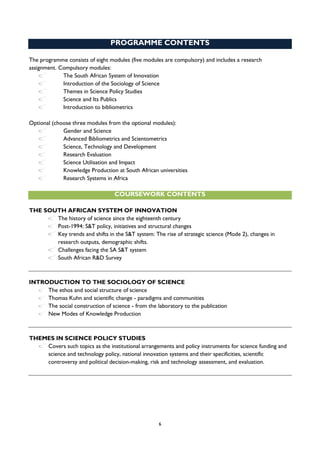
PROGRAMME CONTENTS
The programme consists of eight modules (five modules are compulsory) and includes a research
assignment. Compulsory modules:
The South African System of Innovation
Introduction of the Sociology of Science
Themes in Science Policy Studies
Science and Its Publics
Introduction to bibliometrics
Optional (choose three modules from the optional modules):
Gender and Science
Advanced Bibliometrics and Scientometrics
Science, Technology and Development
Research Evaluation
Science Utilisation and Impact
Knowledge Production at South African universities
Research Systems in Africa
COURSEWORK CONTENTS
THE SOUTH AFRICAN SYSTEM OF INNOVATION
The history of science since the eighteenth century
Post-1994: S&T policy, initiatives and structural changes
Key trends and shifts in the S&T system: The rise of strategic science (Mode 2), changes in
research outputs, demographic shifts.
Challenges facing the SA S&T system
South African R&D Survey
INTRODUCTION TO THE SOCIOLOGY OF SCIENCE
The ethos and social structure of science
Thomas Kuhn and scientific change - paradigms and communities
The social construction of science - from the laboratory to the publication
New Modes of Knowledge Production
THEMES IN SCIENCE POLICY STUDIES
Covers such topics as the institutional arrangements and policy instruments for science funding and
science and technology policy, national innovation systems and their specificities, scientific
controversy and political decision-making, risk and technology assessment, and evaluation.
7
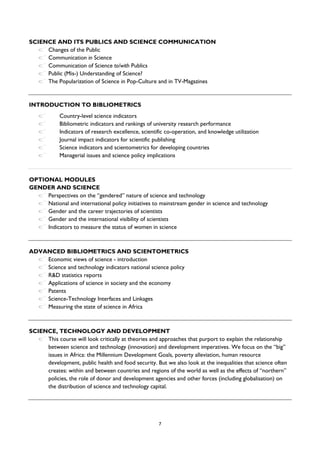
SCIENCE AND ITS PUBLICS AND SCIENCE COMMUNICATION
Changes of the Public
Communication in Science
Communication of Science to/with Publics
Public (Mis-) Understanding of Science?
The Popularization of Science in Pop-Culture and in TV-Magazines
INTRODUCTION TO BIBLIOMETRICS
Country-level science indicators
Bibliometric indicators and rankings of university research performance
Indicators of research excellence, scientific co-operation, and knowledge utilization
Journal impact indicators for scientific publishing
Science indicators and scientometrics for developing countries
Managerial issues and science policy implications
OPTIONAL MODULES
GENDER AND SCIENCE
Perspectives on the “gendered” nature of science and technology
National and international policy initiatives to mainstream gender in science and technology
Gender and the career trajectories of scientists
Gender and the international visibility of scientists
Indicators to measure the status of women in science
ADVANCED BIBLIOMETRICS AND SCIENTOMETRICS
Economic views of science - introduction
Science and technology indicators national science policy
R&D statistics reports
Applications of science in society and the economy
Patents
Science-Technology Interfaces and Linkages
Measuring the state of science in Africa
SCIENCE, TECHNOLOGY AND DEVELOPMENT
This course will look critically at theories and approaches that purport to explain the relationship
between science and technology (innovation) and development imperatives. We focus on the “big”
issues in Africa: the Millennium Development Goals, poverty alleviation, human resource
development, public health and food security. But we also look at the inequalities that science often
creates: within and between countries and regions of the world as well as the effects of “northern”
policies, the role of donor and development agencies and other forces (including globalisation) on
the distribution of science and technology capital.
8
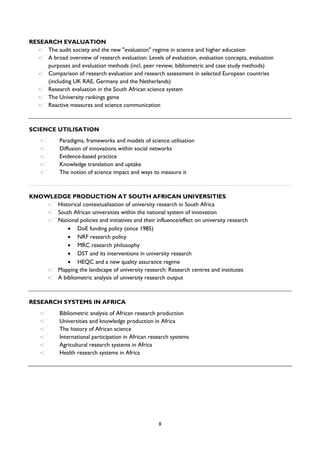
RESEARCH EVALUATION
The audit society and the new "evaluation" regime in science and higher education
A broad overview of research evaluation: Levels of evaluation, evaluation concepts, evaluation
purposes and evaluation methods (incl. peer review, bibliometric and case study methods)
Comparison of research evaluation and research assessment in selected European countries
(including UK RAE, Germany and the Netherlands)
Research evaluation in the South African science system
The University rankings game
Reactive measures and science communication
SCIENCE UTILISATION
Paradigms, frameworks and models of science utilisation
Diffusion of innovations within social networks
Evidence-based practice
Knowledge translation and uptake
The notion of science impact and ways to measure it
KNOWLEDGE PRODUCTION AT SOUTH AFRICAN UNIVERSITIES
Historical contextualisation of university research in South Africa
South African universities within the national system of innovation
National policies and initiatives and their influence/effect on university research
 DoE funding policy (since 1985)
 NRF research policy
 MRC research philosophy
 DST and its interventions in university research
 HEQC and a new quality assurance regime
Mapping the landscape of university research: Research centres and institutes
A bibliometric analysis of university research output
RESEARCH SYSTEMS IN AFRICA
Bibliometric analysis of African research production
Universities and knowledge production in Africa
The history of African science
International participation in African research systems
Agricultural research systems in Africa
Health research systems in Africa
9
CREST PROGRAMME STAFF
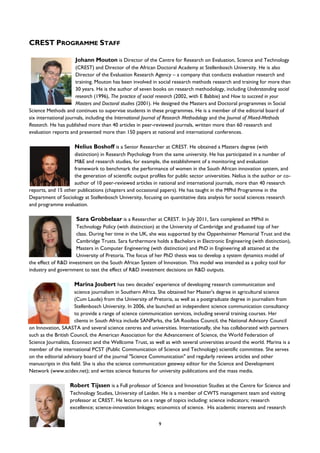
Johann Mouton is Director of the Centre for Research on Evaluation, Science and Technology
(CREST) and Director of the African Doctoral Academy at Stellenbosch University. He is also
Director of the Evaluation Research Agency – a company that conducts evaluation research and
training. Mouton has been involved in social research methods research and training for more than
30 years. He is the author of seven books on research methodology, including Understanding social
research (1996), The practice of social research (2002, with E Babbie) and How to succeed in your
Masters and Doctoral studies (2001). He designed the Masters and Doctoral programmes in Social
Science Methods and continues to supervise students in these programmes. He is a member of the editorial board of
six international journals, including the International Journal of Research Methodology and the Journal of Mixed-Methods
Research. He has published more than 40 articles in peer-reviewed journals, written more than 60 research and
evaluation reports and presented more than 150 papers at national and international conferences.
Nelius Boshoff is a Senior Researcher at CREST. He obtained a Masters degree (with
distinction) in Research Psychology from the same university. He has participated in a number of
M&E and research studies, for example, the establishment of a monitoring and evaluation
framework to benchmark the performance of women in the South African innovation system, and
the generation of scientific output profiles for public sector universities. Nelius is the author or co-
author of 10 peer-reviewed articles in national and international journals, more than 40 research
reports, and 15 other publications (chapters and occasional papers). He has taught in the MPhil Programme in the
Department of Sociology at Stellenbosch University, focusing on quantitative data analysis for social sciences research
and programme evaluation.
Sara Grobbelaar is a Researcher at CREST. In July 2011, Sara completed an MPhil in
Technology Policy (with distinction) at the University of Cambridge and graduated top of her
class. During her time in the UK, she was supported by the Oppenheimer Memorial Trust and the
Cambridge Trusts. Sara furthermore holds a Bachelors in Electronic Engineering (with distinction),
Masters in Computer Engineering (with distinction) and PhD in Engineering all attained at the
University of Pretoria. The focus of her PhD thesis was to develop a system dynamics model of
the effect of R&D investment on the South African System of Innovation. This model was intended as a policy tool for
industry and government to test the effect of R&D investment decisions on R&D outputs.
Marina Joubert has two decades' experience of developing research communication and
science journalism in Southern Africa. She obtained her Master's degree in agricultural science
(Cum Laude) from the University of Pretoria, as well as a postgraduate degree in journalism from
Stellenbosch University. In 2006, she launched an independent science communication consultancy
to provide a range of science communication services, including several training courses. Her
clients in South Africa include SANParks, the SA Rooibos Council, the National Advisory Council
on Innovation, SAASTA and several science centres and universities. Internationally, she has collaborated with partners
such as the British Council, the American Association for the Advancement of Science, the World Federation of
Science Journalists, Econnect and the Wellcome Trust, as well as with several universities around the world. Marina is a
member of the international PCST (Public Communication of Science and Technology) scientific committee. She serves
on the editorial advisory board of the journal "Science Communication" and regularly reviews articles and other
manuscripts in this field. She is also the science communication gateway editor for the Science and Development
Network (www.scidev.net); and writes science features for university publications and the mass media.
Robert Tijssen is a Full professor of Science and Innovation Studies at the Centre for Science and
Technology Studies, University of Leiden. He is a member of CWTS management team and visiting
professor at CREST. He lectures on a range of topics including: science indicators; research
excellence; science-innovation linkages; economics of science. His academic interests and research
10
activities are broad, varying from research assessment methodologies, bibliometric evaluation of research performance,
science indicators and university rankings, as well as studies of university-industry R&D and science-innovation linkages.
His scientific publication output includes more than 40 research articles in variety of journals: Research Policy, Evaluation
Review, Research Evaluation, Technology Analysis and Strategic Management, Scientometrics, Journal of Information Science,
Journal of the American Society for Information Science and Technology.
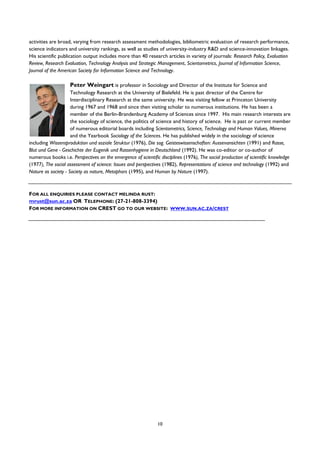
Peter Weingart is professor in Sociology and Director of the Institute for Science and
Technology Research at the University of Bielefeld. He is past director of the Centre for
Interdisciplinary Research at the same university. He was visiting fellow at Princeton University
during 1967 and 1968 and since then visiting scholar to numerous institutions. He has been a
member of the Berlin-Brandenburg Academy of Sciences since 1997. His main research interests are
the sociology of science, the politics of science and history of science. He is past or current member
of numerous editorial boards including Scientometrics, Science, Technology and Human Values, Minerva
and the Yearbook Sociology of the Sciences. He has published widely in the sociology of science
including Wissensproduktion und soziale Struktur (1976), Die sog. Geisteswissenschaften: Aussenansichten (1991) and Rasse,
Blut und Gene - Geschichte der Eugenik und Rassenhygiene in Deutschland (1992). He was co-editor or co-author of
numerous books i.e. Perspectives on the emergence of scientific disciplines (1976), The social production of scientific knowledge
(1977), The social assessment of science: Issues and perspectives (1982), Representations of science and technology (1992) and
Nature as society - Society as nature, Metaphors (1995), and Human by Nature (1997).
FOR ALL ENQUIRIES PLEASE CONTACT MELINDA RUST:
mrust@sun.ac.za OR TELEPHONE: (27-21-808-3394)
FOR MORE INFORMATION ON CREST GO TO OUR WEBSITE: WWW.SUN.AC.ZA/CREST

2016 sts

  • 1.
    Science and TechnologyStudies The study of science as a social system CENTRE FOR RESEARCH ON EVALUATION, SCIENCE AND TECHNOLOGY
  • 2.
    2 POSTGRADUATE PROGRAMMES IN SCIENCEAND TECHNOLOGY STUDIES INTRODUCTION This is the age of knowledge. We live in the knowledge society which means that knowledge forms a major component of any human activity. Economic, social, cultural, and all other human activities become dependent on a huge volume of knowledge and information. A knowledge society is one in which knowledge becomes a major creative force. More specifically, scientific knowledge is seen as the major force behind all significant technological innovations – from penicillin to DNA and genetic engineering; from microchips to antibiotics. Science is seen as the engine for development and progress – although this is not an uncontested notion. At the same time that science has been praised and acclaimed for its positive impact on economic development and human prosperity, it has also been critiqued for creating new inequalities and destruction (as evidenced by weapons of mass destruction). Science is a human and therefore social endeavour. Scientific research is practised within various institutional contexts: universities, science councils, national research institutes and laboratories, private firms and NGO’s. Scientists form epistemic communities with their rules and norms. They communicate in certain ways and form “citation cultures” that identify bodies of scholarship. This course introduces the student to the social, political, economic, epistemological, historical and ethical dimension of science as a complex human system. Our focus is on Africa and South Africa which means that we are particularly interested in topics related to science and development, the nature and formations of research systems in developing countries and ways of measuring knowledge production in conditions of adversity (such as de-institutionalised research systems, lack of national funding, poor research infrastructure and continuing brain drain). WHO SHOULD ENROL? The programme will be of value to a variety of professionals, academics and managers. More specifically the following people will find the course of value: Programme officers in ministries and departments of science and technology Programme officers in research funding agencies, such as the National Research Foundation Research directors and professionals working in research management offices at universities and scientific institutions Scholars interested in scientific knowledge production: how science is generated, disseminated and utilised. Scholars who are interested in the history of science and scientific institutions (such as universities, science councils, institutes) on the African continent PROGRAMMES The Centre for Research on Evaluation, Science and Technology at Stellenbosch University offers two post- graduate programmes in science and technology studies: MPhil in Science and Technology Studies PhD in Science and Technology Studies
  • 3.
    3 MPHIL in SCIENCEAND TECHNOLOGY STUDIES REQUIREMENTS AND ASSESSMENT Candidates obtain the MPhil degree after successful completion of eight structured modules as well as a research report. Attendance of all eight course modules is compulsory. The topic of the research report must be chosen in consultation with the Course Director. The modules are assessed by assignments. Students must achieve at least 50% in each of the modules AND a grade average of 50% or higher. The research report (approximately 15,000 words) will be internally examined and externally moderated. The eight modules constitute 120 credits (15 credits each) and the research report 60 credits. The admission requirement is an Honours degree in any field of science (the social sciences and humanities included), with an average of 65%. APPLICATION PROCESS Applications to the postgraduate programmes close on 31 August (non-South African citizens) / 30 September (South African citizens) prior to the year that studies will commence. All applicants are encouraged to use the e-application system (http://web- apps.sun.ac.za/eAansoek2/alg.jsp?Tl=1 ). An electronic version of the application form is available in exceptional cases and on request from info@sun.ac.za Prospective students must submit the following:  a full CV detailing academic as well as professional history and experience;  a certified copy of their academic transcript;  a certified copy of their degree/s obtained; and  a typed one page motivation for acceptance to the relevant Programme. (The motivation should include a description of your professional goals, and an explanation of the connection between it and your studies.) The complete Application Package must be submitted to the Admissions Department of the University. Incomplete and late applications cannot be considered. When the application has been provisionally approved by the Programme Committee, a supplementary assignment will be requested. Upon successful completion of the assignment a letter of acceptance and other relevant information is sent to the candidate. Please note that submitting an application form does not guarantee automatic acceptance to the University or programme.
  • 4.
    4 STEP 1 STEP 2 PHDIN SCIENCE AND TECHNOLOGY STUDIES REQUIREMENTS AND ASSESSMENT As is the case with all doctoral studies, doctoral candidates must complete a doctoral thesis that makes an original and novel contribution to the body of evaluation knowledge. The topic of the thesis must be selected in consultation with the Course Director. In addition, all doctoral candidates also have to complete four modules which are selected from the list of modules offered by the MPhil in Science and Technology Studies. The admission requirement is a Master’s degree in any field of science (the social sciences and humanities included), with an average of 65%. APPLICATION PROCESS Application form and CV Interested candidates are required to complete an application form. All applicants are encouraged to use the e-application system (http://web-apps.sun.ac.za/eAansoek2/alg.jsp?Tl=1 ). An electronic version of the application form is available in exceptional cases and on request from info@sun.ac.za A letter of motivation as well as a comprehensive curriculum vitae must be submitted to the postgraduate administrator, Melinda Rust (mrust@sun.ac.za). Once your application and CV has been screened, you will be informed whether you may submit a pre-proposal (Step 2) Pre-proposal The university will register you as a doctoral student only once you have submitted a doctoral proposal and this had been approved by the various committees of the university. In order to avoid wasting time on the development of a proposal which is not acceptable to CREST, we have decided that all prospective doctoral students must FIRST submit a doctoral pre-proposal. CREST assesses pre-proposals for two reasons. Firstly, we need to assess whether your interests coincide with the research expertise and interests of the staff members of the department. There is no point, we believe, in accepting a doctoral student, if we do not have an expert and experienced potential promoter in the department. Secondly, this process allows us to identify the most likely supervisor(s) and to assign such a person to work with you on the final doctoral proposal. The doctoral pre-proposal must not exceed three pages in length and must include the following:  Working title of the doctoral thesis  The motivation or rationale behind the proposed study  Broad description of the research aims and objectives of the study  The design and methodology of the proposed study  An indication of the readings that you have already done or intend doing on the topic
  • 5.
    5 STEP 3 STEP 4 STEP5 Once we have received your pre-proposal, it will be discussed at the next departmental meeting after which you will be informed (1) whether you have been conditionally accepted as a doctoral student, and (2) who the person in the department is with whom you should further correspond. If you have been conditionally accepted, you will then be invited to submit a full doctoral proposal (Step 3). The doctoral proposal Once you have received the go-ahead on the basis of the pre-proposal that you have submitted, you must now concentrate on developing a full doctoral proposal that meets the university guidelines. During this period, you will be registered as a prospective doctoral student (maximum of one year) in order for you to gain access to the information and library resources of the University. In our experience, it takes the average doctoral candidate between three and six months to develop a proper doctoral proposal that meets the requirements of the university. The doctoral proposal is a document that is interactively developed between you and your supervisor. Your supervisor will give you continuous feedback, until all parties are satisfied that the proposal meets all the requirements. Once you have reached this stage, your proposal is submitted for review within the university system. The review process Your doctoral proposal essentially moves through three stages of review within the university system: 1. A departmental review committee. This committee consists of the head of CREST, your supervisor(s), and two members of other academic departments in the Faculty of Arts and Social Sciences. Where possible, we request that doctoral candidates be present during this discussion of their doctoral proposals before this committee. 2. The Faculty Research Committee. Once the departmental review committee has approved it, it is forwarded to the Faculty Research Committee for assessment. It must be submitted to the last meeting of the year (usually in October). 3. The Faculty Council. If the Faculty Research Committee approves the doctoral proposal, a recommendation to this effect is sent to the next Faculty Council meeting and subsequently goes for ratification to Senate. The doctoral proposal may at any stage of this process be referred back to the candidate for changes and revisions. Registration You will finally be registered as a doctoral student once your doctoral proposal has been approved by the Senate of the University. Registration takes place in January.
  • 6.
    6 PROGRAMME CONTENTS The programmeconsists of eight modules (five modules are compulsory) and includes a research assignment. Compulsory modules: The South African System of Innovation Introduction of the Sociology of Science Themes in Science Policy Studies Science and Its Publics Introduction to bibliometrics Optional (choose three modules from the optional modules): Gender and Science Advanced Bibliometrics and Scientometrics Science, Technology and Development Research Evaluation Science Utilisation and Impact Knowledge Production at South African universities Research Systems in Africa COURSEWORK CONTENTS THE SOUTH AFRICAN SYSTEM OF INNOVATION The history of science since the eighteenth century Post-1994: S&T policy, initiatives and structural changes Key trends and shifts in the S&T system: The rise of strategic science (Mode 2), changes in research outputs, demographic shifts. Challenges facing the SA S&T system South African R&D Survey INTRODUCTION TO THE SOCIOLOGY OF SCIENCE The ethos and social structure of science Thomas Kuhn and scientific change - paradigms and communities The social construction of science - from the laboratory to the publication New Modes of Knowledge Production THEMES IN SCIENCE POLICY STUDIES Covers such topics as the institutional arrangements and policy instruments for science funding and science and technology policy, national innovation systems and their specificities, scientific controversy and political decision-making, risk and technology assessment, and evaluation.
  • 7.
    7 SCIENCE AND ITSPUBLICS AND SCIENCE COMMUNICATION Changes of the Public Communication in Science Communication of Science to/with Publics Public (Mis-) Understanding of Science? The Popularization of Science in Pop-Culture and in TV-Magazines INTRODUCTION TO BIBLIOMETRICS Country-level science indicators Bibliometric indicators and rankings of university research performance Indicators of research excellence, scientific co-operation, and knowledge utilization Journal impact indicators for scientific publishing Science indicators and scientometrics for developing countries Managerial issues and science policy implications OPTIONAL MODULES GENDER AND SCIENCE Perspectives on the “gendered” nature of science and technology National and international policy initiatives to mainstream gender in science and technology Gender and the career trajectories of scientists Gender and the international visibility of scientists Indicators to measure the status of women in science ADVANCED BIBLIOMETRICS AND SCIENTOMETRICS Economic views of science - introduction Science and technology indicators national science policy R&D statistics reports Applications of science in society and the economy Patents Science-Technology Interfaces and Linkages Measuring the state of science in Africa SCIENCE, TECHNOLOGY AND DEVELOPMENT This course will look critically at theories and approaches that purport to explain the relationship between science and technology (innovation) and development imperatives. We focus on the “big” issues in Africa: the Millennium Development Goals, poverty alleviation, human resource development, public health and food security. But we also look at the inequalities that science often creates: within and between countries and regions of the world as well as the effects of “northern” policies, the role of donor and development agencies and other forces (including globalisation) on the distribution of science and technology capital.
  • 8.
    8 RESEARCH EVALUATION The auditsociety and the new "evaluation" regime in science and higher education A broad overview of research evaluation: Levels of evaluation, evaluation concepts, evaluation purposes and evaluation methods (incl. peer review, bibliometric and case study methods) Comparison of research evaluation and research assessment in selected European countries (including UK RAE, Germany and the Netherlands) Research evaluation in the South African science system The University rankings game Reactive measures and science communication SCIENCE UTILISATION Paradigms, frameworks and models of science utilisation Diffusion of innovations within social networks Evidence-based practice Knowledge translation and uptake The notion of science impact and ways to measure it KNOWLEDGE PRODUCTION AT SOUTH AFRICAN UNIVERSITIES Historical contextualisation of university research in South Africa South African universities within the national system of innovation National policies and initiatives and their influence/effect on university research  DoE funding policy (since 1985)  NRF research policy  MRC research philosophy  DST and its interventions in university research  HEQC and a new quality assurance regime Mapping the landscape of university research: Research centres and institutes A bibliometric analysis of university research output RESEARCH SYSTEMS IN AFRICA Bibliometric analysis of African research production Universities and knowledge production in Africa The history of African science International participation in African research systems Agricultural research systems in Africa Health research systems in Africa
  • 9.
    9 CREST PROGRAMME STAFF JohannMouton is Director of the Centre for Research on Evaluation, Science and Technology (CREST) and Director of the African Doctoral Academy at Stellenbosch University. He is also Director of the Evaluation Research Agency – a company that conducts evaluation research and training. Mouton has been involved in social research methods research and training for more than 30 years. He is the author of seven books on research methodology, including Understanding social research (1996), The practice of social research (2002, with E Babbie) and How to succeed in your Masters and Doctoral studies (2001). He designed the Masters and Doctoral programmes in Social Science Methods and continues to supervise students in these programmes. He is a member of the editorial board of six international journals, including the International Journal of Research Methodology and the Journal of Mixed-Methods Research. He has published more than 40 articles in peer-reviewed journals, written more than 60 research and evaluation reports and presented more than 150 papers at national and international conferences. Nelius Boshoff is a Senior Researcher at CREST. He obtained a Masters degree (with distinction) in Research Psychology from the same university. He has participated in a number of M&E and research studies, for example, the establishment of a monitoring and evaluation framework to benchmark the performance of women in the South African innovation system, and the generation of scientific output profiles for public sector universities. Nelius is the author or co- author of 10 peer-reviewed articles in national and international journals, more than 40 research reports, and 15 other publications (chapters and occasional papers). He has taught in the MPhil Programme in the Department of Sociology at Stellenbosch University, focusing on quantitative data analysis for social sciences research and programme evaluation. Sara Grobbelaar is a Researcher at CREST. In July 2011, Sara completed an MPhil in Technology Policy (with distinction) at the University of Cambridge and graduated top of her class. During her time in the UK, she was supported by the Oppenheimer Memorial Trust and the Cambridge Trusts. Sara furthermore holds a Bachelors in Electronic Engineering (with distinction), Masters in Computer Engineering (with distinction) and PhD in Engineering all attained at the University of Pretoria. The focus of her PhD thesis was to develop a system dynamics model of the effect of R&D investment on the South African System of Innovation. This model was intended as a policy tool for industry and government to test the effect of R&D investment decisions on R&D outputs. Marina Joubert has two decades' experience of developing research communication and science journalism in Southern Africa. She obtained her Master's degree in agricultural science (Cum Laude) from the University of Pretoria, as well as a postgraduate degree in journalism from Stellenbosch University. In 2006, she launched an independent science communication consultancy to provide a range of science communication services, including several training courses. Her clients in South Africa include SANParks, the SA Rooibos Council, the National Advisory Council on Innovation, SAASTA and several science centres and universities. Internationally, she has collaborated with partners such as the British Council, the American Association for the Advancement of Science, the World Federation of Science Journalists, Econnect and the Wellcome Trust, as well as with several universities around the world. Marina is a member of the international PCST (Public Communication of Science and Technology) scientific committee. She serves on the editorial advisory board of the journal "Science Communication" and regularly reviews articles and other manuscripts in this field. She is also the science communication gateway editor for the Science and Development Network (www.scidev.net); and writes science features for university publications and the mass media. Robert Tijssen is a Full professor of Science and Innovation Studies at the Centre for Science and Technology Studies, University of Leiden. He is a member of CWTS management team and visiting professor at CREST. He lectures on a range of topics including: science indicators; research excellence; science-innovation linkages; economics of science. His academic interests and research
  • 10.
    10 activities are broad,varying from research assessment methodologies, bibliometric evaluation of research performance, science indicators and university rankings, as well as studies of university-industry R&D and science-innovation linkages. His scientific publication output includes more than 40 research articles in variety of journals: Research Policy, Evaluation Review, Research Evaluation, Technology Analysis and Strategic Management, Scientometrics, Journal of Information Science, Journal of the American Society for Information Science and Technology. Peter Weingart is professor in Sociology and Director of the Institute for Science and Technology Research at the University of Bielefeld. He is past director of the Centre for Interdisciplinary Research at the same university. He was visiting fellow at Princeton University during 1967 and 1968 and since then visiting scholar to numerous institutions. He has been a member of the Berlin-Brandenburg Academy of Sciences since 1997. His main research interests are the sociology of science, the politics of science and history of science. He is past or current member of numerous editorial boards including Scientometrics, Science, Technology and Human Values, Minerva and the Yearbook Sociology of the Sciences. He has published widely in the sociology of science including Wissensproduktion und soziale Struktur (1976), Die sog. Geisteswissenschaften: Aussenansichten (1991) and Rasse, Blut und Gene - Geschichte der Eugenik und Rassenhygiene in Deutschland (1992). He was co-editor or co-author of numerous books i.e. Perspectives on the emergence of scientific disciplines (1976), The social production of scientific knowledge (1977), The social assessment of science: Issues and perspectives (1982), Representations of science and technology (1992) and Nature as society - Society as nature, Metaphors (1995), and Human by Nature (1997). FOR ALL ENQUIRIES PLEASE CONTACT MELINDA RUST: mrust@sun.ac.za OR TELEPHONE: (27-21-808-3394) FOR MORE INFORMATION ON CREST GO TO OUR WEBSITE: WWW.SUN.AC.ZA/CREST