
INTRODUCTION TO COOLING
IN OUR PREVIOUS CLASSES WE HAVE LEARNT ABOUT KINETIC
THEORY OF GAS MOLECULES ACCORDING TO WHICH
                 T = 2 __K___
                     3 N.Kb
WHERE T IS TEMPERATURE OF THE MOLECULE
        K IS KINETIC ENERGY OF GAS MOLECULES
        N IS NUMBER OF MOLECULES
        Kb IS BOLTZMANN CONSTANT
                 HERE WE CAN CLEARLY SAY THAT THE
TEMPERATURE IS DIRECTLY PROPORTIONAL TO KINETIC ENERGY OF
THE GAS MOLECULE SO BASICALLY THE COOLING IS SOMETHING
WHICH HAPPENS DUE TO DECREASE IN THE KINETIC ENERGY OF THE
MOLECULES IN THE PRESENT SAMPLE OF GASES .
        IF WE TAKE EXAMPLE IN OUR EVERY DAY LIFE WHEN WE BOIL
WATER THE KINETIC ENERGY OF THE WATER MOLECULES
INCREASES AS A RESULT THE TEMPERATURE OF THE WATER SAMPLE
INCRESES.
        THIS IS THE BASIC PRINCIPLE WHICH WE ARE GOING TO APPLY
INTO OUR PROJECT.
COOLING USING LASERS
LASER COOLING REFERS TO THE NUMBER OF TECHNIQUES IN WHICH
ATOMIC AND MOLECULAR SAMPLES ARE COOLED THROUGH THE
INTERACTION WITH ONE OR MORE LASER LIGHT FIELDS.

• THERE ARE MANY TECHNIQUES WHICH ARE USING THIS PRINCIPLE FOR
  COOLING THE GAS BY APPLYING LASERS FROM DIFFERENT
  DIRECTIONS.

• SOME EXAMPLES ARE

    Doppler cooling
   Sisyphus cooling Resolved sideband cooling
   Velocity selective coherent population trapping (VSCPT)
   Anti-Stokes inelastic light scattering (typically in the form of fluorescence or
  Raman scattering)
   Cavity mediated cooling
   Sympathetic cooling

• Laser cooling is primarily used for experiments in Quantum Physics to achieve
  temperatures of near absolute zero (−273.15°C, −459.67°F). This is done to
  observe the unique quantum effects that can only occur at this heat level.
  Generally, laser cooling has been only used on the atomic level to cool down
DOPPLER COOLING
Brief Explanation
Doppler cooling involves light whose frequency is tuned slightly below
an electronic transition in an atom. Because the light is detuned to the
"red" (i.e. at lower frequency) of the transition, the atoms will absorb
more photons if they move towards the light source, due to the
Doppler effect. Thus if one applies light from two opposite directions,
the atoms will always absorb more photons from the laser beam
pointing opposite to their direction of motion. In each absorption
event, the atom loses a momentum equal to the momentum of the
photon. If the atom, which is now in the excited state, emits a photon
spontaneously, it will be kicked by the same amount of momentum but
in a random direction. The result of the absorption and emission
process is a reduced speed of the atom, provided its initial speed is
larger than the recoil velocity from scattering a single photon. If the
absorption and emission are repeated many times, the mean velocity,
and therefore the kinetic energy of the atom will be reduced. Since
the temperature of an ensemble of atoms is a measure of the random
Some Questions which Need to be
            Answered
       1. Usually light incident on any matter just
increases its temperature but in this case lasers are
cooling it down how?
Ans. The basic theory used behind this is let the
photon bounce back from the atom for ex. If we
have a big rubber ball rolling we can hit it with small
rubber balls and can slow down the speed of the
big ball by transferring the momentum. In this case
laser lights photon is the smaller rubber ball and the
atom is the big rubber ball which is bouncing the
photons from the surface.
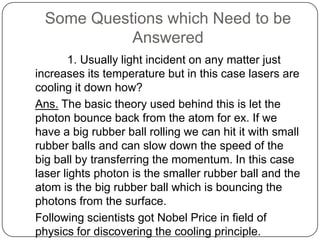
Following scientists got Nobel Price in field of
physics for discovering the cooling principle.
Born: 28 February 1948, St. Louis, MO,
USA
Affiliation at the time of the award:
Stanford University, Stanford, CA, USA
Prize motivation: "for development of
methods to cool and trap atoms with laser
light"
Field: Atomic physics


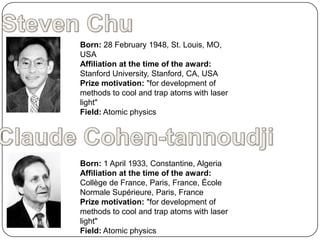
Born: 1 April 1933, Constantine, Algeria
Affiliation at the time of the award:
Collège de France, Paris, France, École
Normale Supérieure, Paris, France
Prize motivation: "for development of
methods to cool and trap atoms with laser
light"
Field: Atomic physics
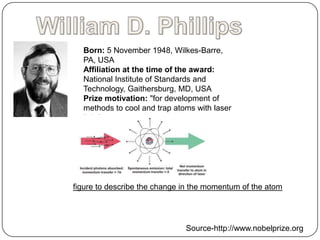
Born: 5 November 1948, Wilkes-Barre,
  PA, USA
  Affiliation at the time of the award:
  National Institute of Standards and
  Technology, Gaithersburg, MD, USA
  Prize motivation: "for development of
  methods to cool and trap atoms with laser
  light"
  Field: Atomic physics


figure to describe the change in the momentum of the atom


                              Source-http://www.nobelprize.org
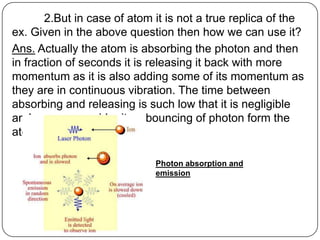
2.But in case of atom it is not a true replica of the
ex. Given in the above question then how we can use it?
Ans. Actually the atom is absorbing the photon and then
in fraction of seconds it is releasing it back with more
momentum as it is also adding some of its momentum as
they are in continuous vibration. The time between
absorbing and releasing is such low that it is negligible
and we can consider it as bouncing of photon form the
atom.

                             Photon absorption and
                             emission
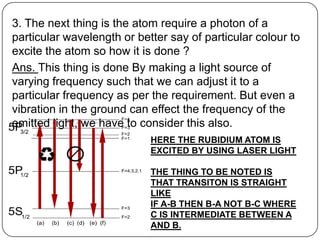
3. The next thing is the atom require a photon of a
particular wavelength or better say of particular colour to
excite the atom so how it is done ?
Ans. This thing is done By making a light source of
varying frequency such that we can adjust it to a
particular frequency as per the requirement. But even a
vibration in the ground can effect the frequency of the
emitted light, we have to consider this also.
                            HERE THE RUBIDIUM ATOM IS
                            EXCITED BY USING LASER LIGHT

                            THE THING TO BE NOTED IS
                            THAT TRANSITON IS STRAIGHT
                            LIKE
                            IF A-B THEN B-A NOT B-C WHERE
                            C IS INTERMEDIATE BETWEEN A
                            AND B.
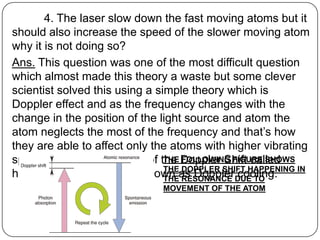
4. The laser slow down the fast moving atoms but it
should also increase the speed of the slower moving atom
why it is not doing so?
Ans. This question was one of the most difficult question
which almost made this theory a waste but some clever
scientist solved this using a simple theory which is
Doppler effect and as the frequency changes with the
change in the position of the light source and atom the
atom neglects the most of the frequency and that’s how
they are able to affect only the atoms with higher vibrating
speed. This was the basis of the Doppler Shift called
                                THE FOLLOWING FIGURE SHOWS
                                THE DOPPLER SHIFT HAPPENING IN
hence the cooling is also known as DopplerDUE TO
                                THE RESONANCE
                                               cooling.
                               MOVEMENT OF THE ATOM
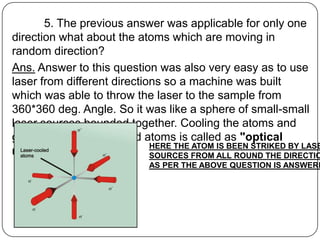
5. The previous answer was applicable for only one
direction what about the atoms which are moving in
random direction?
Ans. Answer to this question was also very easy as to use
laser from different directions so a machine was built
which was able to throw the laser to the sample from
360*360 deg. Angle. So it was like a sphere of small-small
laser sources bounded together. Cooling the atoms and
getting a bunch of cooled atoms is called as "optical
                             HERE THE ATOM IS BEEN STRIKED BY LASE
molasses“                    SOURCES FROM ALL ROUND THE DIRECTIO
                             AS PER THE ABOVE QUESTION IS ANSWERE
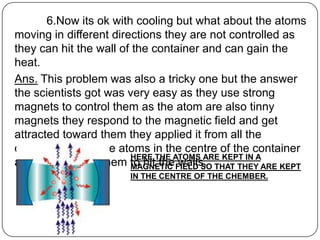
6.Now its ok with cooling but what about the atoms
moving in different directions they are not controlled as
they can hit the wall of the container and can gain the
heat.
Ans. This problem was also a tricky one but the answer
the scientists got was very easy as they use strong
magnets to control them as the atom are also tinny
magnets they respond to the magnetic field and get
attracted toward them they applied it from all the
directions to get the atoms in the centre of the container
                        HERE THE ATOMS ARE KEPT IN A
and not allowing them to hit the FIELD SO THAT THEY ARE KEPT
                        MAGNETIC walls.
                       IN THE CENTRE OF THE CHEMBER.
7. Now what if the atoms in between themselves only
hit each other and get heated up.
Ans. For this the machine is having vacuum pumps
so there are no any excess air atoms also the
amount of atom taken in the container is very low as
it would not allow the atoms to hit each other.
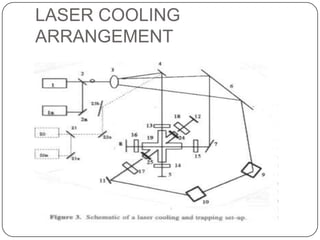
LASER COOLING
ARRANGEMENT
WORK OF DIFFERENT PARTS
 1- Frequency stabilised laser diode.
 3-Two lens telescope arrangement which
  expands the laser beam.
 4,6,7,9,10,11- divide the incident beam into three
  beams of nearly equal width and equal intensity
  travelling in the three mutually orthogonal
  directions in the trapping cell.
 13,14,15 and 16 -The beam along the axis of the
  magnetic coils should be circularly polarized in
  the opposite direction which is achieved by
  setting the axes of the four quarter wave plates
  13, 14, 15 and 16.
• 5,8 and 12- Mirrors which retro-reflect the
  circularly polarized light beams along the
  three orthogonal directions after they pass
  through the quarterwave plates(14,16 and
  18).
• 20 – Laser diode which produces frequency
  stabilised hyperfine laser beam.
• 23a and 23b – Pair of mirors.
• 24 and 25 – Circular coils which produce a
  quadrupolar magnetic field
Cooling using lasers

Cooling using lasers

  • 2.
    INTRODUCTION TO COOLING INOUR PREVIOUS CLASSES WE HAVE LEARNT ABOUT KINETIC THEORY OF GAS MOLECULES ACCORDING TO WHICH T = 2 __K___ 3 N.Kb WHERE T IS TEMPERATURE OF THE MOLECULE K IS KINETIC ENERGY OF GAS MOLECULES N IS NUMBER OF MOLECULES Kb IS BOLTZMANN CONSTANT HERE WE CAN CLEARLY SAY THAT THE TEMPERATURE IS DIRECTLY PROPORTIONAL TO KINETIC ENERGY OF THE GAS MOLECULE SO BASICALLY THE COOLING IS SOMETHING WHICH HAPPENS DUE TO DECREASE IN THE KINETIC ENERGY OF THE MOLECULES IN THE PRESENT SAMPLE OF GASES . IF WE TAKE EXAMPLE IN OUR EVERY DAY LIFE WHEN WE BOIL WATER THE KINETIC ENERGY OF THE WATER MOLECULES INCREASES AS A RESULT THE TEMPERATURE OF THE WATER SAMPLE INCRESES. THIS IS THE BASIC PRINCIPLE WHICH WE ARE GOING TO APPLY INTO OUR PROJECT.
  • 3.
    COOLING USING LASERS LASERCOOLING REFERS TO THE NUMBER OF TECHNIQUES IN WHICH ATOMIC AND MOLECULAR SAMPLES ARE COOLED THROUGH THE INTERACTION WITH ONE OR MORE LASER LIGHT FIELDS. • THERE ARE MANY TECHNIQUES WHICH ARE USING THIS PRINCIPLE FOR COOLING THE GAS BY APPLYING LASERS FROM DIFFERENT DIRECTIONS. • SOME EXAMPLES ARE  Doppler cooling  Sisyphus cooling Resolved sideband cooling  Velocity selective coherent population trapping (VSCPT)  Anti-Stokes inelastic light scattering (typically in the form of fluorescence or Raman scattering)  Cavity mediated cooling  Sympathetic cooling • Laser cooling is primarily used for experiments in Quantum Physics to achieve temperatures of near absolute zero (−273.15°C, −459.67°F). This is done to observe the unique quantum effects that can only occur at this heat level. Generally, laser cooling has been only used on the atomic level to cool down
  • 4.
    DOPPLER COOLING Brief Explanation Dopplercooling involves light whose frequency is tuned slightly below an electronic transition in an atom. Because the light is detuned to the "red" (i.e. at lower frequency) of the transition, the atoms will absorb more photons if they move towards the light source, due to the Doppler effect. Thus if one applies light from two opposite directions, the atoms will always absorb more photons from the laser beam pointing opposite to their direction of motion. In each absorption event, the atom loses a momentum equal to the momentum of the photon. If the atom, which is now in the excited state, emits a photon spontaneously, it will be kicked by the same amount of momentum but in a random direction. The result of the absorption and emission process is a reduced speed of the atom, provided its initial speed is larger than the recoil velocity from scattering a single photon. If the absorption and emission are repeated many times, the mean velocity, and therefore the kinetic energy of the atom will be reduced. Since the temperature of an ensemble of atoms is a measure of the random
  • 5.
    Some Questions whichNeed to be Answered 1. Usually light incident on any matter just increases its temperature but in this case lasers are cooling it down how? Ans. The basic theory used behind this is let the photon bounce back from the atom for ex. If we have a big rubber ball rolling we can hit it with small rubber balls and can slow down the speed of the big ball by transferring the momentum. In this case laser lights photon is the smaller rubber ball and the atom is the big rubber ball which is bouncing the photons from the surface. Following scientists got Nobel Price in field of physics for discovering the cooling principle.
  • 6.
    Born: 28 February1948, St. Louis, MO, USA Affiliation at the time of the award: Stanford University, Stanford, CA, USA Prize motivation: "for development of methods to cool and trap atoms with laser light" Field: Atomic physics Born: 1 April 1933, Constantine, Algeria Affiliation at the time of the award: Collège de France, Paris, France, École Normale Supérieure, Paris, France Prize motivation: "for development of methods to cool and trap atoms with laser light" Field: Atomic physics
  • 7.
    Born: 5 November1948, Wilkes-Barre, PA, USA Affiliation at the time of the award: National Institute of Standards and Technology, Gaithersburg, MD, USA Prize motivation: "for development of methods to cool and trap atoms with laser light" Field: Atomic physics figure to describe the change in the momentum of the atom Source-http://www.nobelprize.org
  • 8.
    2.But in caseof atom it is not a true replica of the ex. Given in the above question then how we can use it? Ans. Actually the atom is absorbing the photon and then in fraction of seconds it is releasing it back with more momentum as it is also adding some of its momentum as they are in continuous vibration. The time between absorbing and releasing is such low that it is negligible and we can consider it as bouncing of photon form the atom. Photon absorption and emission
  • 9.
    3. The nextthing is the atom require a photon of a particular wavelength or better say of particular colour to excite the atom so how it is done ? Ans. This thing is done By making a light source of varying frequency such that we can adjust it to a particular frequency as per the requirement. But even a vibration in the ground can effect the frequency of the emitted light, we have to consider this also. HERE THE RUBIDIUM ATOM IS EXCITED BY USING LASER LIGHT THE THING TO BE NOTED IS THAT TRANSITON IS STRAIGHT LIKE IF A-B THEN B-A NOT B-C WHERE C IS INTERMEDIATE BETWEEN A AND B.
  • 10.
    4. The laserslow down the fast moving atoms but it should also increase the speed of the slower moving atom why it is not doing so? Ans. This question was one of the most difficult question which almost made this theory a waste but some clever scientist solved this using a simple theory which is Doppler effect and as the frequency changes with the change in the position of the light source and atom the atom neglects the most of the frequency and that’s how they are able to affect only the atoms with higher vibrating speed. This was the basis of the Doppler Shift called THE FOLLOWING FIGURE SHOWS THE DOPPLER SHIFT HAPPENING IN hence the cooling is also known as DopplerDUE TO THE RESONANCE cooling. MOVEMENT OF THE ATOM
  • 11.
    5. The previousanswer was applicable for only one direction what about the atoms which are moving in random direction? Ans. Answer to this question was also very easy as to use laser from different directions so a machine was built which was able to throw the laser to the sample from 360*360 deg. Angle. So it was like a sphere of small-small laser sources bounded together. Cooling the atoms and getting a bunch of cooled atoms is called as "optical HERE THE ATOM IS BEEN STRIKED BY LASE molasses“ SOURCES FROM ALL ROUND THE DIRECTIO AS PER THE ABOVE QUESTION IS ANSWERE
  • 12.
    6.Now its okwith cooling but what about the atoms moving in different directions they are not controlled as they can hit the wall of the container and can gain the heat. Ans. This problem was also a tricky one but the answer the scientists got was very easy as they use strong magnets to control them as the atom are also tinny magnets they respond to the magnetic field and get attracted toward them they applied it from all the directions to get the atoms in the centre of the container HERE THE ATOMS ARE KEPT IN A and not allowing them to hit the FIELD SO THAT THEY ARE KEPT MAGNETIC walls. IN THE CENTRE OF THE CHEMBER.
  • 13.
    7. Now whatif the atoms in between themselves only hit each other and get heated up. Ans. For this the machine is having vacuum pumps so there are no any excess air atoms also the amount of atom taken in the container is very low as it would not allow the atoms to hit each other.
  • 14.
  • 15.
    WORK OF DIFFERENTPARTS  1- Frequency stabilised laser diode.  3-Two lens telescope arrangement which expands the laser beam.  4,6,7,9,10,11- divide the incident beam into three beams of nearly equal width and equal intensity travelling in the three mutually orthogonal directions in the trapping cell.  13,14,15 and 16 -The beam along the axis of the magnetic coils should be circularly polarized in the opposite direction which is achieved by setting the axes of the four quarter wave plates 13, 14, 15 and 16.
  • 16.
    • 5,8 and12- Mirrors which retro-reflect the circularly polarized light beams along the three orthogonal directions after they pass through the quarterwave plates(14,16 and 18). • 20 – Laser diode which produces frequency stabilised hyperfine laser beam. • 23a and 23b – Pair of mirors. • 24 and 25 – Circular coils which produce a quadrupolar magnetic field