21cm cosmology with ANN
Hayato Shimabukuro (Yunnan university,SWIFAR)
Contents
• Basics of 21cm signal
• Basics of artificial neural networks (ANN)
• Parameter studies
• Recover ionised bubble size distribution
• Generating 21cm distribution from LAE
• Our on-going work
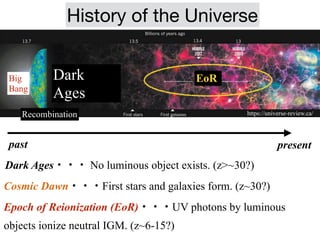
History of the Universe
presentpast
https://universe-review.ca/
EoRDark
Ages
Recombination
Big
Bang
Dark Ages・・・ No luminous object exists. (z>~30?)
Epoch of Reionization (EoR)・・・UV photons by luminous
objects ionize neutral IGM. (z~6-15?)
Cosmic Dawn・・・First stars and galaxies form. (z~30?)
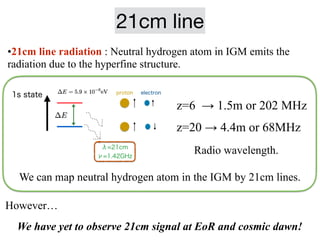
21cm line
•21cm line radiation : Neutral hydrogen atom in IGM emits the
radiation due to the hyperfine structure.
z=6 → 1.5m or 202 MHz
z=20 → 4.4m or 68MHz
Radio wavelength.
We have yet to observe 21cm signal at EoR and cosmic dawn!
We can map neutral hydrogen atom in the IGM by 21cm lines.
However…
Red : cosmology Blue : astrophysicsTb =
TS T
1 + z
(1 exp(⌧⌫))
⇠ 27xH(1 + m)
✓
H
dvr/dr + H
◆ ✓
1
T
TS
◆ ✓
1 + z
10
0.15
⌦mh2
◆1/2 ✓
⌦bh2
0.023
◆
[mK]
Brightness temperature
21cm power spectrum (PS) : h Tb(k) Tb(k
0
)i = (2⇡)3
(k + k
0
)P21
Scale dependence
21cm line signal
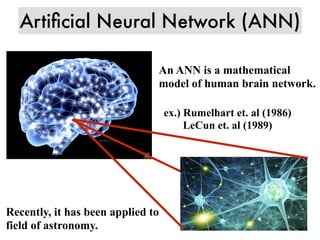
Artificial Neural Network (ANN)
An ANN is a mathematical
model of human brain network.
ex.) Rumelhart et. al (1986)
LeCun et. al (1989)
Recently, it has been applied to
field of astronomy.
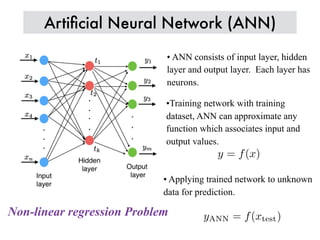
Artificial Neural Network (ANN)
•Training network with training
dataset, ANN can approximate any
function which associates input and
output values.
y = f(x)
• Applying trained network to unknown
data for prediction.
yANN = f(xtest)
• ANN consists of input layer, hidden
layer and output layer. Each layer has
neurons.
Non-linear regression Problem
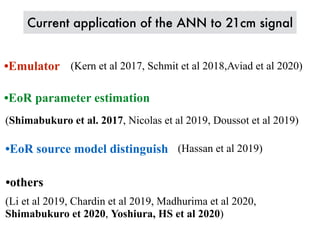
Current application of the ANN to 21cm signal
•Emulator
•EoR parameter estimation
•EoR source model distinguish (Hassan et al 2019)
•others
(Li et al 2019, Chardin et al 2019, Madhurima et al 2020,
Shimabukuro et 2020, Yoshiura, HS et al 2020)
(Kern et al 2017, Schmit et al 2018,Aviad et al 2020)
(Shimabukuro et al. 2017, Nicolas et al 2019, Doussot et al 2019)
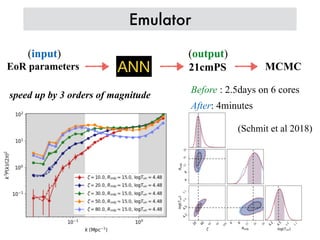
Emulator
EoR parameters 21cmPSANN MCMC
Before : 2.5days on 6 cores
After: 4minutes
speed up by 3 orders of magnitude
(Schmit et al 2018)
(input) (output)
Parameter studies
(Shimabukuro et al 2017)
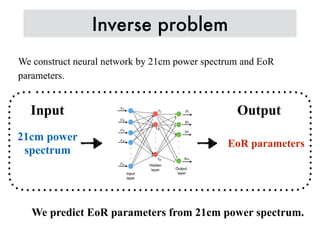
21cm power
spectrum
Input Output
EoR parameters
We construct neural network by 21cm power spectrum and EoR
parameters.
Inverse problem
We predict EoR parameters from 21cm power spectrum.
z=9, 10, 11. PS with thermal noise and cosmic variance
Reconstructed by 21cm PS at z=9,10,11
Rmfp ⇣
Tvir
10
20
30
40
50
60
10 20 30 40 50 60
Rmfp,ANN[Mpc]
Rmfp,true[Mpc]
10
20
30
40
50
60
10 20 30 40 50 60
ζANN
ζtrue
1
10
100
1 10 100
Tvir,ANN[K/10
3
]
Tvir,true[K/10
3
]
Red : z=9,10,11
Blue : z=9
EoR parameters can be reconstructed from
21cm PS well.
Shimabukuro & Semelin, 2017
Recover bubble size distribution
(Shimabukuro et al 2020)
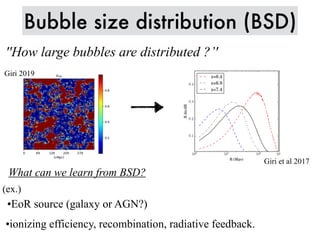
Bubble size distribution (BSD)
''How large bubbles are distributed ?’'
Giri 2019
What can we learn from BSD?
Giri et al 2017
•EoR source (galaxy or AGN?)
•ionizing efficiency, recombination, radiative feedback.
(ex.)
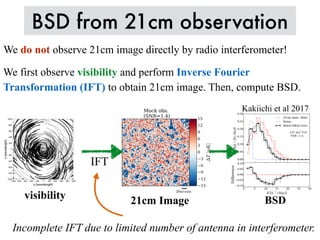
BSD from 21cm observation
Kakiichi et al 2017
IFT
21cm Image BSD
Incomplete IFT due to limited number of antenna in interferometer.
visibility
We do not observe 21cm image directly by radio interferometer!
We first observe visibility and perform Inverse Fourier
Transformation (IFT) to obtain 21cm image. Then, compute BSD.
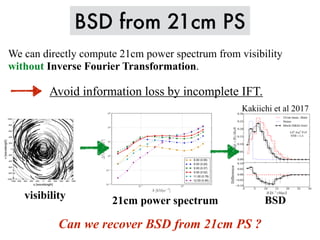
BSD from 21cm PS
Kakiichi et al 2017
21cm power spectrum BSDvisibility
We can directly compute 21cm power spectrum from visibility
without Inverse Fourier Transformation.
Can we recover BSD from 21cm PS ?
Avoid information loss by incomplete IFT.
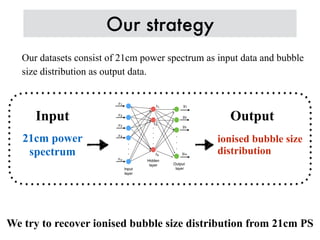
21cm power
spectrum
Input Output
ionised bubble size
distribution
Our datasets consist of 21cm power spectrum as input data and bubble
size distribution as output data.
Our strategy
We try to recover ionised bubble size distribution from 21cm PS
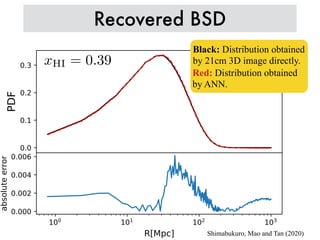
Recovered BSD
Black: Distribution obtained
by 21cm 3D image directly.
Red: Distribution obtained
by ANN.
xHI = 0.39
Shimabukuro, Mao and Tan (2020)
Generating 21cm distribution
from LAE galaxies with GAN
(Yoshiura, HS et al 2020)
Dr. Shintaro Yoshiura (University of Melbourne)
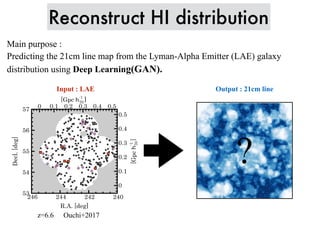
Reconstruct HI distribution
Main purpose :
Predicting the 21cm line map from the Lyman-Alpha Emitter (LAE) galaxy
distribution using Deep Learning(GAN).
Fig. 5. Same as Figure 4, but for the LAEs z = 6.6. The large red open squares indicate the LAEs with spatially extended
(Ouchi et al. 2009a) and CR7 (Sobral et al. 2015). See Shibuya et al. (2017b) for more details.
Ouchi+2017z=6.6
?
Input : LAE Output : 21cm line
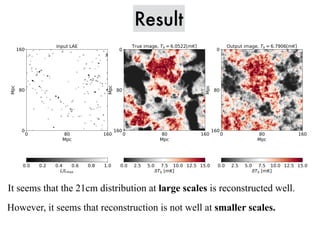
Result
It seems that the 21cm distribution at large scales is reconstructed well.
However, it seems that reconstruction is not well at smaller scales.
Power spectrum
21cm power spectrum
.
.
o
n
αesc
˙Nion,int[number/yr], (4)
fesc,c, critical halo mass Mturn =1010
,
.
lanetto 2007 Zahn 2011, 21cmFAST
. R ,
,
)tage (5)
(x) R
, tage z = 15 z = 6.6
,
l(R) (6)
, Vcell . R
work is trained using ‘H-f02’ model at neutral f
ber 2 and the input is LAE of ‘H-mid’ model at
bin number 3, the output image is named “Hf02
models used in this work is listed in Table. 3.
A measure tool to study the 21cm line is the a
trum, which is given by
Pi(|k|) = (2π)2
δD(k − k′
)⟨δi(k)δ∗
i (k′
)⟩
where k is wavenumber in 2D Fourier space an
observation or the output of network. The auto
of observed data (reconstruct image) is repre
Ppix. To detect the 21cm signal from the 21
we consider the cross correlation between the
and reconstruct image, which is given as
PX (|k|) = (2π)2
δD⟨δobs(k)δ∗
pix(k′
)⟩
where δobs and δpix are fluctuation in observe
construct image, respectively. The correlatio
given as
PX (k)
Red : true
Black : output
This result indicates that the network successes to learn statistical property
of the 21cm-line fluctuations.
S. Yoshiura et al.
Ongoing works
21cm power
spectrum
Input Output
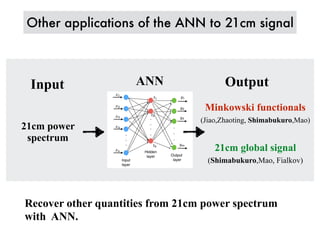
Minkowski functionals
ANN
21cm global signal
Other applications of the ANN to 21cm signal
Recover other quantities from 21cm power spectrum
with ANN.
(Shimabukuro,Mao, Fialkov)
(Jiao,Zhaoting, Shimabukuro,Mao)
Summary
• The ANN constructs approximate function between
input and output.
• We recover statistical quantities from the 21cm PS
with the ANN.
• We also applied deep learning to 21cm image
prediction.
Bakcup
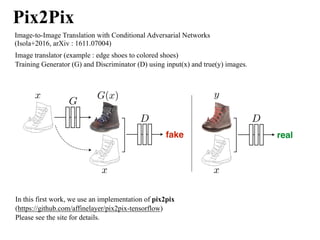
Pix2Pix
Image-to-Image Translation with Conditional Adversarial Networks
(Isola+2016, arXiv : 1611.07004)
Image translator (example : edge shoes to colored shoes)
Training Generator (G) and Discriminator (D) using input(x) and true(y) images.
In this first work, we use an implementation of pix2pix
(https://github.com/affinelayer/pix2pix-tensorflow)
Please see the site for details.
fake
G(x)
x
D
real
D
G
x y
x
Figure 2: Training a conditional GAN to map edges!photo. The
discriminator, D, learns to classify between fake (synthesized by
the generator) and real {edge, photo} tuples. The generator, G,
learns to fool the discriminator. Unlike an unconditional GAN,

21cm cosmology with ANN

  • 1.
    21cm cosmology withANN Hayato Shimabukuro (Yunnan university,SWIFAR)
  • 2.
    Contents • Basics of21cm signal • Basics of artificial neural networks (ANN) • Parameter studies • Recover ionised bubble size distribution • Generating 21cm distribution from LAE • Our on-going work
  • 3.
    History of theUniverse presentpast https://universe-review.ca/ EoRDark Ages Recombination Big Bang Dark Ages・・・ No luminous object exists. (z>~30?) Epoch of Reionization (EoR)・・・UV photons by luminous objects ionize neutral IGM. (z~6-15?) Cosmic Dawn・・・First stars and galaxies form. (z~30?)
  • 4.
    21cm line •21cm lineradiation : Neutral hydrogen atom in IGM emits the radiation due to the hyperfine structure. z=6 → 1.5m or 202 MHz z=20 → 4.4m or 68MHz Radio wavelength. We have yet to observe 21cm signal at EoR and cosmic dawn! We can map neutral hydrogen atom in the IGM by 21cm lines. However…
  • 5.
    Red : cosmologyBlue : astrophysicsTb = TS T 1 + z (1 exp(⌧⌫)) ⇠ 27xH(1 + m) ✓ H dvr/dr + H ◆ ✓ 1 T TS ◆ ✓ 1 + z 10 0.15 ⌦mh2 ◆1/2 ✓ ⌦bh2 0.023 ◆ [mK] Brightness temperature 21cm power spectrum (PS) : h Tb(k) Tb(k 0 )i = (2⇡)3 (k + k 0 )P21 Scale dependence 21cm line signal
  • 6.
    Artificial Neural Network(ANN) An ANN is a mathematical model of human brain network. ex.) Rumelhart et. al (1986) LeCun et. al (1989) Recently, it has been applied to field of astronomy.
  • 7.
    Artificial Neural Network(ANN) •Training network with training dataset, ANN can approximate any function which associates input and output values. y = f(x) • Applying trained network to unknown data for prediction. yANN = f(xtest) • ANN consists of input layer, hidden layer and output layer. Each layer has neurons. Non-linear regression Problem
  • 8.
    Current application ofthe ANN to 21cm signal •Emulator •EoR parameter estimation •EoR source model distinguish (Hassan et al 2019) •others (Li et al 2019, Chardin et al 2019, Madhurima et al 2020, Shimabukuro et 2020, Yoshiura, HS et al 2020) (Kern et al 2017, Schmit et al 2018,Aviad et al 2020) (Shimabukuro et al. 2017, Nicolas et al 2019, Doussot et al 2019)
  • 9.
    Emulator EoR parameters 21cmPSANNMCMC Before : 2.5days on 6 cores After: 4minutes speed up by 3 orders of magnitude (Schmit et al 2018) (input) (output)
  • 10.
  • 11.
    21cm power spectrum Input Output EoRparameters We construct neural network by 21cm power spectrum and EoR parameters. Inverse problem We predict EoR parameters from 21cm power spectrum.
  • 12.
    z=9, 10, 11.PS with thermal noise and cosmic variance Reconstructed by 21cm PS at z=9,10,11 Rmfp ⇣ Tvir 10 20 30 40 50 60 10 20 30 40 50 60 Rmfp,ANN[Mpc] Rmfp,true[Mpc] 10 20 30 40 50 60 10 20 30 40 50 60 ζANN ζtrue 1 10 100 1 10 100 Tvir,ANN[K/10 3 ] Tvir,true[K/10 3 ] Red : z=9,10,11 Blue : z=9 EoR parameters can be reconstructed from 21cm PS well. Shimabukuro & Semelin, 2017
  • 13.
    Recover bubble sizedistribution (Shimabukuro et al 2020)
  • 14.
    Bubble size distribution(BSD) ''How large bubbles are distributed ?’' Giri 2019 What can we learn from BSD? Giri et al 2017 •EoR source (galaxy or AGN?) •ionizing efficiency, recombination, radiative feedback. (ex.)
  • 15.
    BSD from 21cmobservation Kakiichi et al 2017 IFT 21cm Image BSD Incomplete IFT due to limited number of antenna in interferometer. visibility We do not observe 21cm image directly by radio interferometer! We first observe visibility and perform Inverse Fourier Transformation (IFT) to obtain 21cm image. Then, compute BSD.
  • 16.
    BSD from 21cmPS Kakiichi et al 2017 21cm power spectrum BSDvisibility We can directly compute 21cm power spectrum from visibility without Inverse Fourier Transformation. Can we recover BSD from 21cm PS ? Avoid information loss by incomplete IFT.
  • 17.
    21cm power spectrum Input Output ionisedbubble size distribution Our datasets consist of 21cm power spectrum as input data and bubble size distribution as output data. Our strategy We try to recover ionised bubble size distribution from 21cm PS
  • 18.
    Recovered BSD Black: Distributionobtained by 21cm 3D image directly. Red: Distribution obtained by ANN. xHI = 0.39 Shimabukuro, Mao and Tan (2020)
  • 19.
    Generating 21cm distribution fromLAE galaxies with GAN (Yoshiura, HS et al 2020) Dr. Shintaro Yoshiura (University of Melbourne)
  • 20.
    Reconstruct HI distribution Mainpurpose : Predicting the 21cm line map from the Lyman-Alpha Emitter (LAE) galaxy distribution using Deep Learning(GAN). Fig. 5. Same as Figure 4, but for the LAEs z = 6.6. The large red open squares indicate the LAEs with spatially extended (Ouchi et al. 2009a) and CR7 (Sobral et al. 2015). See Shibuya et al. (2017b) for more details. Ouchi+2017z=6.6 ? Input : LAE Output : 21cm line
  • 21.
    Result It seems thatthe 21cm distribution at large scales is reconstructed well. However, it seems that reconstruction is not well at smaller scales.
  • 22.
    Power spectrum 21cm powerspectrum . . o n αesc ˙Nion,int[number/yr], (4) fesc,c, critical halo mass Mturn =1010 , . lanetto 2007 Zahn 2011, 21cmFAST . R , , )tage (5) (x) R , tage z = 15 z = 6.6 , l(R) (6) , Vcell . R work is trained using ‘H-f02’ model at neutral f ber 2 and the input is LAE of ‘H-mid’ model at bin number 3, the output image is named “Hf02 models used in this work is listed in Table. 3. A measure tool to study the 21cm line is the a trum, which is given by Pi(|k|) = (2π)2 δD(k − k′ )⟨δi(k)δ∗ i (k′ )⟩ where k is wavenumber in 2D Fourier space an observation or the output of network. The auto of observed data (reconstruct image) is repre Ppix. To detect the 21cm signal from the 21 we consider the cross correlation between the and reconstruct image, which is given as PX (|k|) = (2π)2 δD⟨δobs(k)δ∗ pix(k′ )⟩ where δobs and δpix are fluctuation in observe construct image, respectively. The correlatio given as PX (k) Red : true Black : output This result indicates that the network successes to learn statistical property of the 21cm-line fluctuations. S. Yoshiura et al.
  • 23.
  • 24.
    21cm power spectrum Input Output Minkowskifunctionals ANN 21cm global signal Other applications of the ANN to 21cm signal Recover other quantities from 21cm power spectrum with ANN. (Shimabukuro,Mao, Fialkov) (Jiao,Zhaoting, Shimabukuro,Mao)
  • 25.
    Summary • The ANNconstructs approximate function between input and output. • We recover statistical quantities from the 21cm PS with the ANN. • We also applied deep learning to 21cm image prediction.
  • 26.
  • 27.
    Pix2Pix Image-to-Image Translation withConditional Adversarial Networks (Isola+2016, arXiv : 1611.07004) Image translator (example : edge shoes to colored shoes) Training Generator (G) and Discriminator (D) using input(x) and true(y) images. In this first work, we use an implementation of pix2pix (https://github.com/affinelayer/pix2pix-tensorflow) Please see the site for details. fake G(x) x D real D G x y x Figure 2: Training a conditional GAN to map edges!photo. The discriminator, D, learns to classify between fake (synthesized by the generator) and real {edge, photo} tuples. The generator, G, learns to fool the discriminator. Unlike an unconditional GAN,