Separable Phrasal Verbs
The object may come after the following phrasal verbs or it may separate the two
parts:
 You have to do this paint job over.
 You have to do over this paint job.
When the object of the following phrasal verbs is a pronoun, the two parts of the
phrasal verb must be separated:
 You have to do it over.
Verb

Meaning

Example

blow
up

explode

The terrorists tried to blow up the railroad station.

bring
up

mention a topic

My mother brought up that little matter of my prison
record again.

bring
up

raise children

It isn't easy to bring up children nowadays.

call off

cancel

They called off this afternoon's meeting

do over

repeat a job

Do this homework over.

fill out

complete a form

Fill out this application form and mail it in.

fill up

fill to capacity

She filled up the grocery cart with free food.

find out

discover

My sister found out that her husband had been planning a
surprise party for her.

give
away

give something to
someone else for
free

The filling station was giving away free gas.

give
back

return an object

My brother borrowed my car. I have a feeling he's not
about to give it back.

hand in

submit something
(assignment)

The students handed in their papers and left the room.

hang
up

put something on
hook or receiver

She hung up the phone before she hung up her clothes.

hold up

delay

I hate to hold up the meeting, but I have to go to the
bathroom.
hold up
(2)

rob

Three masked gunmen held up the Security Bank this
afternoon.

leave
out

omit

You left out the part about the police chase down
Asylum Avenue.

look
over

examine, check

The lawyers looked over the papers carefully before
questioning the witness.
(They looked them over carefully.)

look up

search in a list

You've misspelled this word again. You'd
better look it up.

make
up

invent a story or lie

She knew she was in trouble, so she made up a story
about going to the movies with her friends.

make
out

hear, understand

He was so far away, we really couldn't make out what he
was saying.

pick
out

choose

There were three men in the line-up. She picked out the
guy she thought had stolen her purse.

pick up

lift something off
something else

The crane picked up the entire house. (Watch
them pick itup.)

point
out

call attention to

As we drove through Paris, Francoise pointed out the
major historical sites.

put
away

save or store

We put away money for our retirement. She put away the
cereal boxes.

put off

postpone

We asked the boss to put off the meeting until tomorrow.
(Please put it off for another day.)

put on

put clothing on the
body

I put on a sweater and a jacket. (I put them on quickly.)

put out

extinguish

The firefighters put out the house fire before it could
spread. (They put it out quickly.)

read
over

peruse

I read over the homework, but couldn't make any sense
of it.

set up

to arrange, begin

My wife set up the living room exactly the way she
wanted it. She set it up.

take
down

make a written note

These are your instructions. Write them down before you
forget.

take off

remove clothing

It was so hot that I had to take off my shirt.
talk
over

discuss

We have serious problems here. Let's talk them over like
adults.

throw
away

discard

That's a lot of money! Don't just throw it away.

try on

put clothing on to
see if it fits

She tried on fifteen dresses before she found one she
liked.

try out

test

I tried out four cars before I could find one that pleased
me.

turn
down

lower volume

Your radio is driving me crazy! Please turn it down.

turn
down
(2)

reject

He applied for a promotion twice this year, but he
was turned down both times.

turn up

raise the volume

Grandpa couldn't hear, so he turned up his hearing aid.

turn off

switch off
electricity

We turned off the lights before anyone could see us.

turn off
(2)

repulse

It was a disgusting movie. It really turned me off.

turn on

switch on the
electricity

Turn on the CD player so we can dance.

use up

exhaust, use
completely

The gang members used up all the money and went out
to rob some more banks.
Inseparable Phrasal Verbs (Transitive)
With the following phrasal verbs, the lexical part of the verb (the part of the phrasal
verb that carries the "verb-meaning") cannot be separated from the prepositions (or
other parts) that accompany it: "Who will look after my estate when I'm gone?"
Verb

Meaning

Example

call on

ask to recite in class

The teacher called on students in the back row.

call on
(2)

visit

The old minister continued to call on his sick
parishioners.

get over

recover from sickness or
disappointment

I got over the flu, but I don't know if I'll ever get
overmy broken heart.

go over

review

The students went over the material before the
exam. They should have gone over it twice.

go
through

use up; consume

They country went through most of its coal
reserves in one year. Did he go through all his
money already?

look after

take care of

My mother promised to look after my dog while
I was gone.

look into

investigate

The police will look into the possibilities of
embezzlement.

run across

find by chance

I ran across my old roommate at the college
reunion.

run into

meet

Carlos ran into his English professor in the
hallway.

take after

resemble

My second son seems to take after his mother.

wait on

serve

It seemed strange to see my old boss wait
on tables.
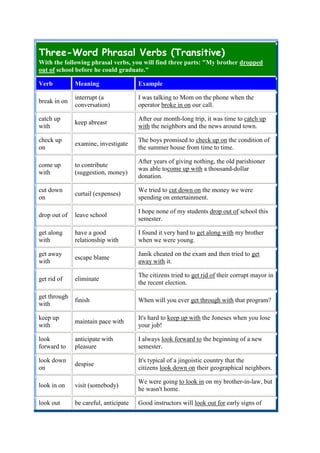
Three-Word Phrasal Verbs (Transitive)
With the following phrasal verbs, you will find three parts: "My brother dropped
out of school before he could graduate."
Verb

Meaning

Example

break in on

interrupt (a
conversation)

I was talking to Mom on the phone when the
operator broke in on our call.

catch up
with

keep abreast

After our month-long trip, it was time to catch up
with the neighbors and the news around town.

check up
on

examine, investigate

The boys promised to check up on the condition of
the summer house from time to time.

come up
with

to contribute
(suggestion, money)

After years of giving nothing, the old parishioner
was able tocome up with a thousand-dollar
donation.

cut down
on

curtail (expenses)

We tried to cut down on the money we were
spending on entertainment.

drop out of

leave school

I hope none of my students drop out of school this
semester.

get along
with

have a good
relationship with

I found it very hard to get along with my brother
when we were young.

get away
with

escape blame

Janik cheated on the exam and then tried to get
away with it.

get rid of

eliminate

The citizens tried to get rid of their corrupt mayor in
the recent election.

get through
with

finish

When will you ever get through with that program?

keep up
with

maintain pace with

It's hard to keep up with the Joneses when you lose
your job!

look
forward to

anticipate with
pleasure

I always look forward to the beginning of a new
semester.

look down
on

despise

It's typical of a jingoistic country that the
citizens look down on their geographical neighbors.

look in on

visit (somebody)

We were going to look in on my brother-in-law, but
he wasn't home.

look out

be careful, anticipate

Good instructors will look out for early signs of
for

failure in their students

look up to

respect

First-graders really look up to their teachers.

make sure
of

verify

Make sure of the student's identity before you let
him into the classroom.

put up with

tolerate

The teacher had to put up with a great deal of
nonsense from the new students.

run out of

exhaust supply

The runners ran out of energy before the end of the
race.

take care
of

be responsible for

My oldest sister took care of us younger children
after Mom died.

talk back
to

answer impolitely

The star player talked back to the coach and was
thrown off the team.

think back
on

recall

I often think back on my childhood with great
pleasure.

walk out
on

abandon

Her husband walked out on her and their three
children.
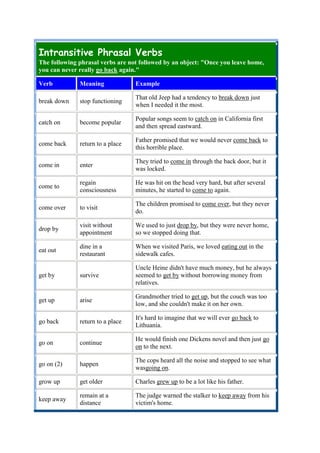
Intransitive Phrasal Verbs
The following phrasal verbs are not followed by an object: "Once you leave home,
you can never really go back again."
Verb

Meaning

Example

break down

stop functioning

That old Jeep had a tendency to break down just
when I needed it the most.

catch on

become popular

Popular songs seem to catch on in California first
and then spread eastward.

come back

return to a place

Father promised that we would never come back to
this horrible place.

come in

enter

They tried to come in through the back door, but it
was locked.

come to

regain
consciousness

He was hit on the head very hard, but after several
minutes, he started to come to again.

come over

to visit

The children promised to come over, but they never
do.

drop by

visit without
appointment

We used to just drop by, but they were never home,
so we stopped doing that.

eat out

dine in a
restaurant

When we visited Paris, we loved eating out in the
sidewalk cafes.

get by

survive

Uncle Heine didn't have much money, but he always
seemed to get by without borrowing money from
relatives.

get up

arise

Grandmother tried to get up, but the couch was too
low, and she couldn't make it on her own.

go back

return to a place

It's hard to imagine that we will ever go back to
Lithuania.

go on

continue

He would finish one Dickens novel and then just go
on to the next.

go on (2)

happen

The cops heard all the noise and stopped to see what
wasgoing on.

grow up

get older

Charles grew up to be a lot like his father.

keep away

remain at a
distance

The judge warned the stalker to keep away from his
victim's home.
keep on
(with
gerund)

continue with the
same

He tried to keep on singing long after his voice was
ruined.

pass out

lose
consciousness,
faint

He had drunk too much; he passed out on the
sidewalk outside the bar.

show off

demonstrate
haughtily

Whenever he sat down at the piano, we knew he was
going toshow off.

show up

arrive

Day after day, Efrain showed up for class twenty
minutes late.

wake up

arouse from sleep

I woke up when the rooster crowed.

Separable phrasal verbs

  • 1.
    Separable Phrasal Verbs Theobject may come after the following phrasal verbs or it may separate the two parts:  You have to do this paint job over.  You have to do over this paint job. When the object of the following phrasal verbs is a pronoun, the two parts of the phrasal verb must be separated:  You have to do it over. Verb Meaning Example blow up explode The terrorists tried to blow up the railroad station. bring up mention a topic My mother brought up that little matter of my prison record again. bring up raise children It isn't easy to bring up children nowadays. call off cancel They called off this afternoon's meeting do over repeat a job Do this homework over. fill out complete a form Fill out this application form and mail it in. fill up fill to capacity She filled up the grocery cart with free food. find out discover My sister found out that her husband had been planning a surprise party for her. give away give something to someone else for free The filling station was giving away free gas. give back return an object My brother borrowed my car. I have a feeling he's not about to give it back. hand in submit something (assignment) The students handed in their papers and left the room. hang up put something on hook or receiver She hung up the phone before she hung up her clothes. hold up delay I hate to hold up the meeting, but I have to go to the bathroom.
  • 2.
    hold up (2) rob Three maskedgunmen held up the Security Bank this afternoon. leave out omit You left out the part about the police chase down Asylum Avenue. look over examine, check The lawyers looked over the papers carefully before questioning the witness. (They looked them over carefully.) look up search in a list You've misspelled this word again. You'd better look it up. make up invent a story or lie She knew she was in trouble, so she made up a story about going to the movies with her friends. make out hear, understand He was so far away, we really couldn't make out what he was saying. pick out choose There were three men in the line-up. She picked out the guy she thought had stolen her purse. pick up lift something off something else The crane picked up the entire house. (Watch them pick itup.) point out call attention to As we drove through Paris, Francoise pointed out the major historical sites. put away save or store We put away money for our retirement. She put away the cereal boxes. put off postpone We asked the boss to put off the meeting until tomorrow. (Please put it off for another day.) put on put clothing on the body I put on a sweater and a jacket. (I put them on quickly.) put out extinguish The firefighters put out the house fire before it could spread. (They put it out quickly.) read over peruse I read over the homework, but couldn't make any sense of it. set up to arrange, begin My wife set up the living room exactly the way she wanted it. She set it up. take down make a written note These are your instructions. Write them down before you forget. take off remove clothing It was so hot that I had to take off my shirt.
  • 3.
    talk over discuss We have seriousproblems here. Let's talk them over like adults. throw away discard That's a lot of money! Don't just throw it away. try on put clothing on to see if it fits She tried on fifteen dresses before she found one she liked. try out test I tried out four cars before I could find one that pleased me. turn down lower volume Your radio is driving me crazy! Please turn it down. turn down (2) reject He applied for a promotion twice this year, but he was turned down both times. turn up raise the volume Grandpa couldn't hear, so he turned up his hearing aid. turn off switch off electricity We turned off the lights before anyone could see us. turn off (2) repulse It was a disgusting movie. It really turned me off. turn on switch on the electricity Turn on the CD player so we can dance. use up exhaust, use completely The gang members used up all the money and went out to rob some more banks.
  • 4.
    Inseparable Phrasal Verbs(Transitive) With the following phrasal verbs, the lexical part of the verb (the part of the phrasal verb that carries the "verb-meaning") cannot be separated from the prepositions (or other parts) that accompany it: "Who will look after my estate when I'm gone?" Verb Meaning Example call on ask to recite in class The teacher called on students in the back row. call on (2) visit The old minister continued to call on his sick parishioners. get over recover from sickness or disappointment I got over the flu, but I don't know if I'll ever get overmy broken heart. go over review The students went over the material before the exam. They should have gone over it twice. go through use up; consume They country went through most of its coal reserves in one year. Did he go through all his money already? look after take care of My mother promised to look after my dog while I was gone. look into investigate The police will look into the possibilities of embezzlement. run across find by chance I ran across my old roommate at the college reunion. run into meet Carlos ran into his English professor in the hallway. take after resemble My second son seems to take after his mother. wait on serve It seemed strange to see my old boss wait on tables.
  • 5.
    Three-Word Phrasal Verbs(Transitive) With the following phrasal verbs, you will find three parts: "My brother dropped out of school before he could graduate." Verb Meaning Example break in on interrupt (a conversation) I was talking to Mom on the phone when the operator broke in on our call. catch up with keep abreast After our month-long trip, it was time to catch up with the neighbors and the news around town. check up on examine, investigate The boys promised to check up on the condition of the summer house from time to time. come up with to contribute (suggestion, money) After years of giving nothing, the old parishioner was able tocome up with a thousand-dollar donation. cut down on curtail (expenses) We tried to cut down on the money we were spending on entertainment. drop out of leave school I hope none of my students drop out of school this semester. get along with have a good relationship with I found it very hard to get along with my brother when we were young. get away with escape blame Janik cheated on the exam and then tried to get away with it. get rid of eliminate The citizens tried to get rid of their corrupt mayor in the recent election. get through with finish When will you ever get through with that program? keep up with maintain pace with It's hard to keep up with the Joneses when you lose your job! look forward to anticipate with pleasure I always look forward to the beginning of a new semester. look down on despise It's typical of a jingoistic country that the citizens look down on their geographical neighbors. look in on visit (somebody) We were going to look in on my brother-in-law, but he wasn't home. look out be careful, anticipate Good instructors will look out for early signs of
  • 6.
    for failure in theirstudents look up to respect First-graders really look up to their teachers. make sure of verify Make sure of the student's identity before you let him into the classroom. put up with tolerate The teacher had to put up with a great deal of nonsense from the new students. run out of exhaust supply The runners ran out of energy before the end of the race. take care of be responsible for My oldest sister took care of us younger children after Mom died. talk back to answer impolitely The star player talked back to the coach and was thrown off the team. think back on recall I often think back on my childhood with great pleasure. walk out on abandon Her husband walked out on her and their three children.
  • 7.
    Intransitive Phrasal Verbs Thefollowing phrasal verbs are not followed by an object: "Once you leave home, you can never really go back again." Verb Meaning Example break down stop functioning That old Jeep had a tendency to break down just when I needed it the most. catch on become popular Popular songs seem to catch on in California first and then spread eastward. come back return to a place Father promised that we would never come back to this horrible place. come in enter They tried to come in through the back door, but it was locked. come to regain consciousness He was hit on the head very hard, but after several minutes, he started to come to again. come over to visit The children promised to come over, but they never do. drop by visit without appointment We used to just drop by, but they were never home, so we stopped doing that. eat out dine in a restaurant When we visited Paris, we loved eating out in the sidewalk cafes. get by survive Uncle Heine didn't have much money, but he always seemed to get by without borrowing money from relatives. get up arise Grandmother tried to get up, but the couch was too low, and she couldn't make it on her own. go back return to a place It's hard to imagine that we will ever go back to Lithuania. go on continue He would finish one Dickens novel and then just go on to the next. go on (2) happen The cops heard all the noise and stopped to see what wasgoing on. grow up get older Charles grew up to be a lot like his father. keep away remain at a distance The judge warned the stalker to keep away from his victim's home.
  • 8.
    keep on (with gerund) continue withthe same He tried to keep on singing long after his voice was ruined. pass out lose consciousness, faint He had drunk too much; he passed out on the sidewalk outside the bar. show off demonstrate haughtily Whenever he sat down at the piano, we knew he was going toshow off. show up arrive Day after day, Efrain showed up for class twenty minutes late. wake up arouse from sleep I woke up when the rooster crowed.