Term: Phrasal Verbs
Definition:
A phrasal verb consists of a verb and a preposition or adverb that modifies or changes the meaning;
'give up' is a phrasal verb that means 'stop doing' something, which is very different from 'give'. The
word or words that modify a verb in this manner can also go under the name particle.
Phrasal verbs can be divided into groups:
Intransitive verbs
These don't take an object
They had an argument, but they've made up now.
Inseparable verbs
The object must come after the particle.
They are looking after their grandchildren.
Separable verbs
With some separable verbs, the object must come between the verb and the particle:
The quality of their work sets them apart from their rivals.
In our phrasal verb dictionary, we classify these as Separable [obligatory]
With some separable verbs, the object can before or after the particle, though when a pronoun is
used it comes before the particle:
Turn the TV off.
Turn off the TV.
Turn it off.
In our phrasal verb dictionary, we classify these as Separable [optional]
What is a Phrasal Verb?
Phrasal verbs are idiomatic expressions, combining verbs and prepositions to make new verbs
whose meaning is often not obvious from the dictionary definitions of the individual words.
They are widely used in both written and spoken English, and new ones are formed all the time
as they are a flexible way of creating new terms.
Phrasal Verbs List
Phrasal verbs are usually two-word phrases consisting of verb + adverb or verb + preposition.
Think of them as you would any other English vocabulary. Study them as you come across them,
rather than trying to memorize many at once. Use the list below as a reference guide when you
find an expression that you don't recognize. The examples will help you understand the
meanings. If you think of each phrasal verb as a separate verb with a specific meaning, you will
be able to remember it more easily. Like many other verbs, phrasal verbs often have more than
one meaning.
This list shows about 200 common phrasal verbs, with meanings and examples. Only the most
usual meanings are given. Some phrasal verbs may have additional meanings.
As well as learning their meanings, you need to learn how to use phrasal verbs properly. Some
phrasal verbs require a direct object (someone/something), while others do not. Some phrasal
verbs can be separated by the object, while others cannot. Review this phrasal verbs grammar
from time to time so that you don't forget the rules!
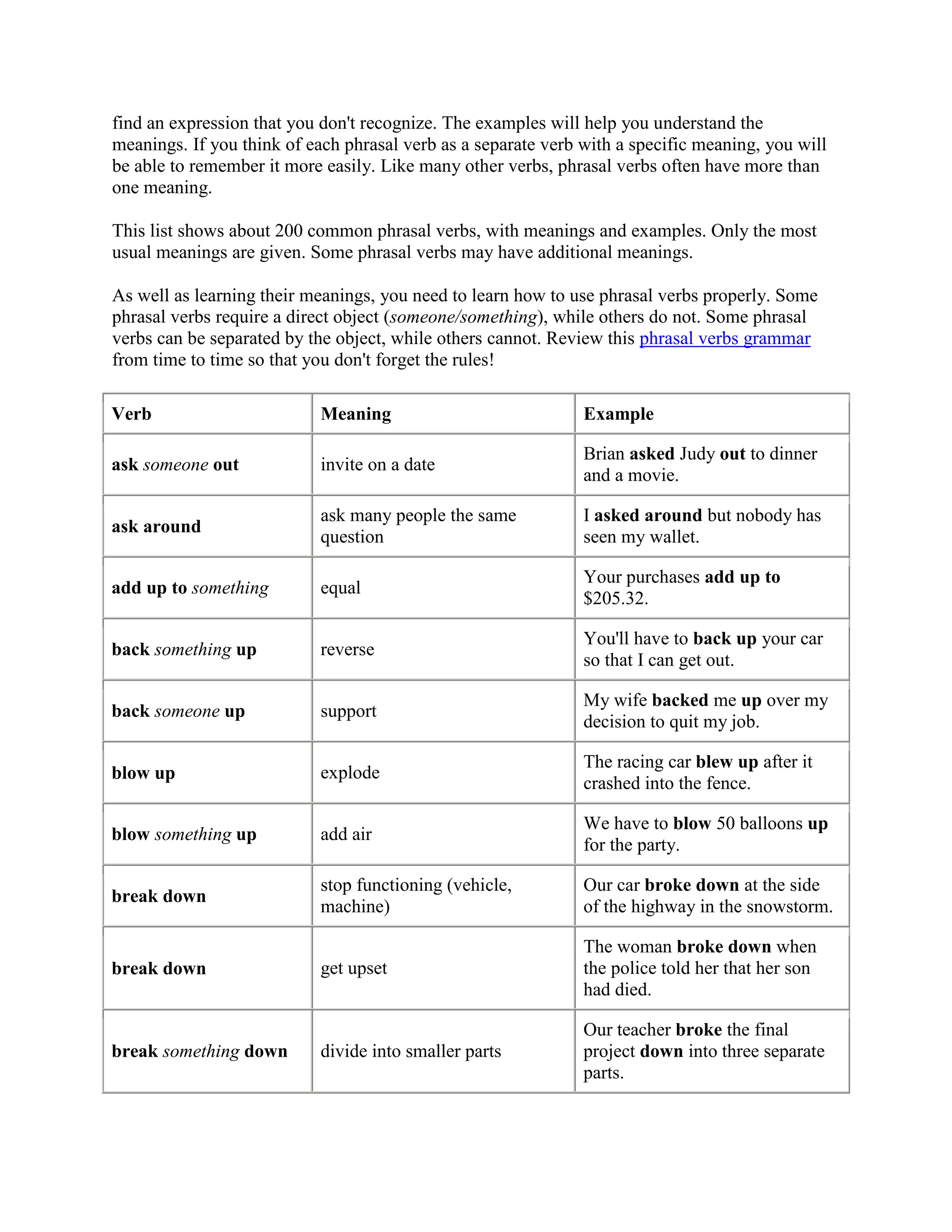
Verb Meaning Example
ask someone out invite on a date
Brian asked Judy out to dinner
and a movie.
ask around
ask many people the same
question
I asked around but nobody has
seen my wallet.
add up to something equal
Your purchases add up to
$205.32.
back something up reverse
You'll have to back up your car
so that I can get out.
back someone up support
My wife backed me up over my
decision to quit my job.
blow up explode
The racing car blew up after it
crashed into the fence.
blow something up add air
We have to blow 50 balloons up
for the party.
break down
stop functioning (vehicle,
machine)
Our car broke down at the side
of the highway in the snowstorm.
break down get upset
The woman broke down when
the police told her that her son
had died.
break something down divide into smaller parts
Our teacher broke the final
project down into three separate
parts.
break in force entry to a building
Somebody broke in last night
and stole our stereo.
break into something enter forcibly
The firemen had to break into
the room to rescue the children.
break something in
wear something a few times so
that it doesn't look/feel new
I need to break these shoes in
before we run next week.
break in interrupt
The TV station broke in to report
the news of the president's death.
break up end a relationship
My boyfriend and I broke up
before I moved to America.
break up start laughing (informal)
The kids just broke up as soon as
the clown started talking.
break out escape
The prisoners broke out of jail
when the guards weren't looking.
break out in something develop a skin condition
I broke out in a rash after our
camping trip.
bring someone down make unhappy
This sad music is bringing me
down.
bring someone up raise a child
My grandparents brought me up
after my parents died.
bring something up start talking about a subject
My mother walks out of the room
when my father brings up sports.
bring something up vomit
He drank so much that he
brought his dinner up in the
toilet.
call around
phone many different
places/people
We called around but we weren't
able to find the car part we
needed.
call someone back return a phone call
I called the company back but
the offices were closed for the
weekend.
call something off cancel
Jason called the wedding off
because he wasn't in love with his
fiancé.
call on someone ask for an answer or opinion
The professor called on me for
question 1.
call on someone visit someone
We called on you last night but
you weren't home.
call someone up phone
Give me your phone number and
I will call you up when we are in
town.
calm down relax after being angry
You are still mad. You need to
calm down before you drive the
car.
not care for
someone/something
not like (formal) I don't care for his behaviour.
catch up
get to the same point as
someone else
You'll have to run faster than that
if you want to catch up with
Marty.
check in
arrive and register at a hotel or
airport
We will get the hotel keys when
we check in.
check out leave a hotel
You have to check out of the
hotel before 11:00 AM.
check
someone/something out
look at carefully, investigate
The company checks out all new
employees.
check out
someone/something
look at (informal)
Check out the crazy hair on that
guy!
cheer up become happier
She cheered up when she heard
the good news.
cheer someone up make happier
I brought you some flowers to
cheer you up.
chip in help
If everyone chips in we can get
the kitchen painted by noon.
clean something up tidy, clean
Please clean up your bedroom
before you go outside.
come across something find unexpectedly
I came across these old photos
when I was tidying the closet.
come apart separate
The top and bottom come apart
if you pull hard enough.
come down with
something
become sick
My nephew came down with
chicken pox this weekend.
come forward
volunteer for a task or to give
evidence
The woman came forward with
her husband's finger prints.
come from somewhere originate in
The art of origami comes from
Asia.
count on
someone/something
rely on
I am counting on you to make
dinner while I am out.
cross something out draw a line through
Please cross out your old address
and write your new one.
cut back on something consume less
My doctor wants me to cut back
on sweets and fatty foods.
cut something down
make something fall to the
ground
We had to cut the old tree in our
yard down after the storm.
cut in interrupt
Your father cut in while I was
dancing with your uncle.
cut in
pull in too closely in front of
another vehicle
The bus driver got angry when
that car cut in.
cut in
start operating (of an engine or
electrical device)
The air conditioner cuts in when
the temperature gets to 22°C.
cut something off remove with something sharp
The doctors cut off his leg
because it was severely injured.
cut something off stop providing
The phone company cut off our
phone because we didn't pay the
bill.
cut someone off take out of a will
My grandparents cut my father
off when he remarried.
cut something out remove part of something I cut this ad out of the
(usually with scissors and
paper)
newspaper.
do someone/something
over
beat up, ransack (Br.E.,
informal)
He's lucky to be alive. His shop
was done over by a street gang.
do something over do again (N.Amer.)
My teacher wants me to do my
essay over because she doesn't
like my topic.
do away with something discard
It's time to do away with all of
these old tax records.
do something up fasten, close
Do your coat up before you go
outside. It's snowing!
dress up wear nice clothing
It's a fancy restaurant so we have
to dress up.
drop back move back in a position/group
Andrea dropped back to third
place when she fell off her bike.
drop in/by/over come without an appointment
I might drop in/by/over for tea
sometime this week.
drop someone/something
off
take someone/something
somewhere and leave them/it
there
I have to drop my sister off at
work before I come over.
drop out quit a class, school etc
I dropped out of Science because
it was too difficult.
eat out eat at a restaurant
I don't feel like cooking tonight.
Let's eat out.
end up eventually reach/do/decide
We ended up renting a movie
instead of going to the theatre.
fall apart break into pieces
My new dress fell apart in the
washing machine.
fall down fall to the ground
The picture that you hung up last
night fell down this morning.
fall out separate from an interior
The money must have fallen out
of my pocket.
fall out
(of hair, teeth) become loose
and unattached
His hair started to fall out when
he was only 35.
figure something out understand, find the answer
I need to figure out how to fit the
piano and the bookshelf in this
room.
fill something in
to write information in blanks
(Br.E.)
Please fill in the form with your
name, address, and phone
number.
fill something out
to write information in blanks
(N.Amer.)
The form must be filled out in
capital letters.
fill something up fill to the top
I always fill the water jug up
when it is empty.
find out discover
We don't know where he lives.
How can we find out?
find something out discover
We tried to keep the time of the
party a secret, but Samantha
found it out.
get something
across/over
communicate, make
understandable
I tried to get my point
across/over to the judge but she
wouldn't listen.
get along/on like each other
I was surprised how well my new
girlfriend and my sister got
along/on.
get around have mobility
My grandfather can get around
fine in his new wheelchair.
get away go on a vacation
We worked so hard this year that
we had to get away for a week.
get away with
something
do without being noticed or
punished
Jason always gets away with
cheating in his maths tests.
get back return
We got back from our vacation
last week.
get something back
receive something you had
before
Liz finally got her Science notes
back from my room-mate.
get back at someone retaliate, take revenge
My sister got back at me for
stealing her shoes. She stole my
favourite hat.
get back into something
become interested in something
again
I finally got back into my novel
and finished it.
get on something step onto a vehicle
We're going to freeze out here if
you don't let us get on the bus.
get over something
recover from an illness, loss,
difficulty
I just got over the flu and now
my sister has it.
get over something overcome a problem
The company will have to close if
it can't get over the new
regulations.
get round to something
finally find time to do
(N.Amer.: get around to
something)
I don't know when I am going to
get round to writing the thank
you cards.
get together meet (usually for social reasons)
Let's get together for a BBQ this
weekend.
get up get out of bed
I got up early today to study for
my exam.
get up stand
You should get up and give the
elderly man your seat.
give someone away
reveal hidden information about
someone
His wife gave him away to the
police.
give someone away take the bride to the altar
My father gave me away at my
wedding.
give something away ruin a secret
My little sister gave the surprise
party away by accident.
give something away
give something to someone for
free
The library was giving away old
books on Friday.
give something back return a borrowed item
I have to give these skates back
to Franz before his hockey game.
give in
reluctantly stop fighting or
arguing
My boyfriend didn't want to go to
the ballet, but he finally gave in.
give something out
give to many people (usually at
no cost)
They were giving out free
perfume samples at the
department store.
give something up quit a habit
I am giving up smoking as of
January 1st.
give up stop trying
My maths homework was too
difficult so I gave up.
go after someone follow someone
My brother tried to go after the
thief in his car.
go after something try to achieve something
I went after my dream and now I
am a published writer.
go against someone compete, oppose
We are going against the best
soccer team in the city tonight.
go ahead start, proceed
Please go ahead and eat before
the food gets cold.
go back return to a place
I have to go back home and get
my lunch.
go out
leave home to go on a social
event
We're going out for dinner
tonight.
go out with someone date
Jesse has been going out with
Luke since they met last winter.
go over something review
Please go over your answers
before you submit your test.
go over visit someone nearby
I haven't seen Tina for a long
time. I think I'll go over for an
hour or two.
go without something suffer lack or deprivation
When I was young, we went
without winter boots.
grow apart stop being friends over time
My best friend and I grew apart
after she changed schools.
grow back regrow
My roses grew back this
summer.
grow up become an adult
When Jack grows up he wants to
be a fireman.
grow out of something get too big for
Elizabeth needs a new pair of
shoes because she has grown out
of her old ones.
grow into something grow big enough to fit
This bike is too big for him now,
but he should grow into it by
next year.
hand something down
give something used to someone
else
I handed my old comic books
down to my little cousin.
hand something in submit
I have to hand in my essay by
Friday.
hand something out
to distribute to a group of
people
We will hand out the invitations
at the door.
hand something over give (usually unwillingly)
The police asked the man to hand
over his wallet and his weapons.
hang in
stay positive (N.Amer.,
informal)
Hang in there. I'm sure you'll find
a job very soon.
hang on wait a short time (informal)
Hang on while I grab my coat
and shoes!
hang out spend time relaxing (informal)
Instead of going to the party we
are just going to hang out at my
place.
hang up end a phone call
He didn't say goodbye before he
hung up.
hold someone/something
back
prevent from doing/going
I had to hold my dog back
because there was a cat in the
park.
hold something back hide an emotion
Jamie held back his tears at his
grandfather's funeral.
hold on wait a short time
Please hold on while I transfer
you to the Sales Department.
hold onto hold firmly using your hands or Hold onto your hat because it's
someone/something arms very windy outside.
hold
someone/somethingup
rob
A man in a black mask held the
bank up this morning.
keep on doing
something
continue doing
Keep on stirring until the liquid
comes to a boil.
keep something from
someone
not tell
We kept our relationship from
our parents for two years.
keep someone/something
out
stop from entering
Try to keep the wet dog out of
the living room.
keep something up continue at the same rate
If you keep those results up you
will get into a great college.
let someone down
fail to support or help,
disappoint
I need you to be on time. Don't let
me down this time.
let someone in allow to enter
Can you let the cat in before you
go to school?
look after
someone/something
take care of
I have to look after my sick
grandmother.
look down on someone think less of, consider inferior
Ever since we stole that chocolate
bar your dad has looked down on
me.
look for
someone/something
try to find
I'm looking for a red dress for the
wedding.
look forward to
something
be excited about the future
I'm looking forward to the
Christmas break.
look into something investigate
We are going to look into the
price of snowboards today.
look out
be careful, vigilant, and take
notice
Look out! That car's going to hit
you!
look out for
someone/something
be especially vigilant for
Don't forget to look out for
snakes on the hiking trail.
look something over check, examine
Can you look over my essay for
spelling mistakes?
look something up
search and find information in a
reference book or database
We can look her phone number
up on the Internet.
look up to someone have a lot of respect for
My little sister has always looked
up to me.
make something up invent, lie about something
Josie made up a story about why
we were late.
make up forgive each other
We were angry last night, but we
made up at breakfast.
make someone up apply cosmetics to
My sisters made me up for my
graduation party.
mix something up confuse two or more things
I mixed up the twins' names
again!
pass away die
His uncle passed away last night
after a long illness.
pass out faint
It was so hot in the church that an
elderly lady passed out.
pass something out
give the same thing to many
people
The professor passed the
textbooks out before class.
pass something up
decline (usually something
good)
I passed up the job because I am
afraid of change.
pay someone back return owed money
Thanks for buying my ticket. I'll
pay you back on Friday.
pay for something
be punished for doing
something bad
That bully will pay for being
mean to my little brother.
pick something out choose
I picked out three sweaters for
you to try on.
point
someone/something out
indicate with your finger
I'll point my boyfriend out when
he runs by.
put something down
put what you are holding on a
surface or floor
You can put the groceries down
on the kitchen counter.
put someone down
insult, make someone feel
stupid
The students put the substitute
teacher down because his pants
were too short.
put something off postpone
We are putting off our trip until
January because of the hurricane.
put something out extinguish
The neighbours put the fire out
before the firemen arrived.
put something together assemble
I have to put the crib together
before the baby arrives.
put up with
someone/something
tolerate
I don't think I can put up with
three small children in the car.
put something on
put clothing/accessories on your
body
Don't forget to put on your new
earrings for the party.
run into
someone/something
meet unexpectedly
I ran into an old school-friend at
the mall.
run over
someone/something
drive a vehicle over a person or
thing
I accidentally ran over your
bicycle in the driveway.
run over/through
something
rehearse, review
Let's run over/through these
lines one more time before the
show.
run away leave unexpectedly, escape
The child ran away from home
and has been missing for three
days.
run out have none left
We ran out of shampoo so I had
to wash my hair with soap.
send something back return (usually by mail)
My letter got sent back to me
because I used the wrong stamp.
set something up arrange, organize
Our boss set a meeting up with
the president of the company.
set someone up trick, trap
The police set up the car thief by
using a hidden camera.
shop around compare prices
I want to shop around a little
before I decide on these boots.
show off act extra special for people He always shows off on his
watching (usually boastfully) skateboard
sleep over
stay somewhere for the night
(informal)
You should sleep over tonight if
the weather is too bad to drive
home.
sort something out organize, resolve a problem
We need to sort the bills out
before the first of the month.
stick to something
continue doing something, limit
yourself to one particular thing
You will lose weight if you stick
to the diet.
switch something off stop the energy flow, turn off
The light's too bright. Could you
switch it off.
switch something on start the energy flow, turn on
We heard the news as soon as we
switched on the car radio.
take after someone resemble a family member
I take after my mother. We are
both impatient.
take something apart purposely break into pieces
He took the car brakes apart and
found the problem.
take something back return an item
I have to take our new TV back
because it doesn't work.
take off start to fly
My plane takes off in five
minutes.
take something off
remove something (usually
clothing)
Take off your socks and shoes
and come in the lake!
take something out remove from a place or thing
Can you take the garbage out to
the street for me?
take someone out
pay for someone to go
somewhere with you
My grandparents took us out for
dinner and a movie.
tear something up rip into pieces
I tore up my ex-boyfriend's
letters and gave them back to
him.
think back
remember (often + to,
sometimes + on)
When I think back on my youth,
I wish I had studied harder.
think something over consider I'll have to think this job offer
over before I make my final
decision.
throw something away dispose of
We threw our old furniture away
when we won the lottery.
turn something down
decrease the volume or strength
(heat, light etc)
Please turn the TV down while
the guests are here.
turn something down refuse
I turned the job down because I
don't want to move.
turn something off stop the energy flow, switch off
Your mother wants you to turn
the TV off and come for dinner.
turn something on start the energy, switch on
It's too dark in here. Let's turn
some lights on.
turn something up
increase the volume or strength
(heat, light etc)
Can you turn the music up? This
is my favourite song.
turn up appear suddenly
Our cat turned up after we put
posters up all over the
neighbourhood.
try something on sample clothing
I'm going to try these jeans on,
but I don't think they will fit.
try something out test
I am going to try this new brand
of detergent out.
use something up finish the supply
The kids used all of the
toothpaste up so we need to buy
some more.
wake up stop sleeping
We have to wake up early for
work on Monday.
warm
someone/something up
increase the temperature
You can warm your feet up in
front of the fireplace.
warm up prepare body for exercise
I always warm up by doing sit-
ups before I go for a run.
wear off fade away
Most of my make-up wore off
before I got to the party.
work out exercise
I work out at the gym three times
a week.
work out be successful Our plan worked out fine.
work something out make a calculation
We have to work out the total
cost before we buy the house.
Phrasal Verbs Quiz
1 Would you look after my dog for me this weekend?
2 My neighbour ran out of eggs yesterday.
3 I broke my leg at my baseball game.
4 Our put off boss our meeting until next week.
5 Could you turn off the music while I'm on the phone.
6 I don't get on with my new Science teacher.
7 I look forward to meeting your new girlfriend.
8 My car broke down on the highway today.
9 It will be easier to read if you switch on the lights.
10 I have to run to the finish line and back.
Frequently used Phrasal Verbs
Phrasal Verbs with: break, bring, call, carry, come, do, fall, get, go, keep, look, make, put, run,
set, take, turn
break
break down
fail to function
have a physical or mental collapse
break in interrupt a discussion
burgle
soften with use (shoes)
break off discontinue (therapy, relationship)
break out escape from prison, begin suddenly
break up end a relationship
bring
bring about cause to happen
bring forth give birth to
bring forward draw attention to sth
bring on cause to happen or appear
bring round
persuade
cause to recover consciousness
bring up
rear, educate a child
mention
vomit
call
call back return a phone call
call for require
call in
communicate by phone
consult a specialist
call off cancel
call out
read names aloud
order workers to strike
call on request sb to do sth
call up
reach by phone
summon for military services
carry
carry away
remove
inspire, affect emotionally
carry off
take away (by force)
win
remove, degrade (earth)
carry on continue
carry out accomplish, make
carry through
complete
bring out of difficulties
come
come about happen, to be achieved
come across find/meet by chance
come after follow
come at
attack
reach, discover
come back return
come by
pass, go past, visit
buy, get
come down fall (price)
come down to mean, signify
come down with fall sick with
come in
enter, be received
prove to be
come in for receive, be object of (criticism)
come off become detached
come out
become known, be published
be removed (stain)
come over come from a distance
come round
visit sb
recover consciousness
come to
amount to
arrive/reach a place
come up
be mentioned/discussed
(problem) arise
come up against be faced with (problems)
come upon find/meet by chance
come up to match (a standard)
come up with produce an idea
do
do away with
abolish
kill
do up
dress up
fasten, secure (clothing)
do with need
do without not require
fall
fall apart fall into pieces
fall behind fail to keep up pace
fall for
be in love with
be deceived by
fall in with
meet by chance
coincide with
fall off
decrease
drop from
fall out quarrel
fall out with quarrel with
fall through fail, miscarry
fall to start an activity eagerly
get
get across communicate (an idea)
get along be in good terms with somebody
get away escape
get away with escape (punishment)
get by manage, cope
get down to turn one's attention to sth
get in enter (car, taxi)
get off disembark (bus, train etc.)
get on enter (bus, train etc.)
get out disembark (car, taxi)
get over recover (illness, upset)
get through
pass (an exam)
be connected on the phone
get to reach
get up rise from bed after sleeping
go
go against be contrary to (principles, rules)
go along with take the same view
go away depart
go down
become less
decrese in price
sink (ship)
set (sun)
go for pick up, go and get
go off
explode
deteriorate (food)
begin to sound (alarm)
go on continue
go out
leave the house
strike
go over inspect the details of sth
go past pass
go round visit informally
go through
deal with
discuss in detail
experience sth (usually bad)
go up
increase in price
explode
go with match
keep
keep away prevent from / avoid being near
keep back withhold
keep down not to increase
keep off
avoid (a topic)
stay away
keep on not stopping doing sth
keep up continue, carry on
keep up with not to fall behind sb
look
look after take care of
look down on regard with a feeling of superiority
look for seek
look forward to anticipate with pleasure
look into investigate (a crime)
look on
be a spectator
regard
look out be careful
look over inspect hastily
look through
pretend not to see
examine the contents of sth
look up consult a reference book
look up to respect
make
make for have/produce a particular effect
make off run away
make out recognise, distinguish
make up
constitute, form
invent a lie
put together, prepare
apply cosmetics
make up for
compensate
regain (time)
put
put across express in an understandable way
put back
put sth to its proper place
lay money aside for the future
move back the hands of a clock
put by save for later use
put down
repress
write down
store (food)
put down to give as a reason, attribute to
put forward
move forward the hands of a clock
suggest, propose
put in for be a candidate for an election
put on
dress oneself with
tease
gain (weight)
put off postpone
put out extinguish (a fire, light)
put through connect sb by phone
put up
build
raise (hand)
provide accomodation for
offer for sale
put up with tolerate, accept
run
run after chase
run away escape, flee
run down
knock down, collide with
feel weak due to overwork
run in imprison
run into meet by chance
run off escape, flee
run out
run outside
become used up
run out of exhaust one's stock
run over
overflow
study quickly
pass over, knock down
run up against meet with difficulties
set
set aside reserve for later use
set back hinder, slow down a progress
set down write down
set off
cause to explode
start a journey
set up start business
take
take after
follow sb as an example
resemble in appearance
take down write down
take in
understand (meaning)
deceive
take off
undress
begin flight (plane)
take to develop a habit
take up
continue, proceed
become interested in
take up with begin to associate with
turn
turn down
diminish the intensity
reject
turn in hand in
turn off switch off
turn on switch on
turn out switch off
turn over bring the reverse side up
turn up
increase the intensity
make an appearance
Dennis Oliver's Phrasal Verbs: A
act up (no object): misbehave (for people); not work properly (for machines).
"The babysitter had a difficult time. The children acted up all evening."
"I guess I'd better take my car to the garage. It's been acting up lately."
act like (inseparable): behave in a way that's like _____ .
"What's wrong with Bob? He's acting like an idiot."
Note: This phrasal verb is very informal.
add up (1. no object): logically fit together.
"His theory is hard to believe, but his research adds up."
Note: This phrasal verb is often negative.
"His theory seems, at first, to be plausible, but the facts in his research don't add up."
add up (2. separable): find the total.
"What's the total of those bills? Could you add them up and see?"
add up to (inseparable): to total.
"The bills add up to $734.96. That's more than I expected!"
ask out (separable): ask for a date.
"Nancy has a new boy friend. Joe asked her out last night."
Dennis Oliver's Phrasal Verbs: B
back down (no object): not follow a threat.
"Tom was going to call the police when I told him I'd wrecked his car, but he backed down
when I said I'd pay for the damages."
back off (no object): not follow a threat.
"Tom was ready to call the police when I told him I'd wrecked his car, but he backed off when I
said I'd pay for the damages."
back up (1. no object): move backward; move in reverse.
"You missed the lines in the parking space. You'll have to back up and try again."
"The people waiting in line are too close to the door. We won't be able to open it unless they
back up."
back up (2. separable): drive a vehicle backwards (in reverse).
"You're too close! Back your car up so I can open the garage door."
back up (3. separable): confirm a story, facts, or information.
"If you don't believe me, talk to Dave. He'll back me up."
back up (4. separable): make a "protection" copy to use if there are problems with the original.
"When my computer crashed, I lost many of my files. It's a good thing I backed them up."
beg off (no object): decline an invitation; ask to be excused from doing something.
"At first Lily said she would be at the party. Later she begged off."
blow up (1. separable): inflate.
"We needs lots of balloons for the party. Will you blow them up?"
blow up (2. separable): explode; destroy by exploding.
A: "That old building really came down quickly!"
B: "That's because the construction company used dynamite to blow it up."
blow up (3. no object): suddenly become very angry.
"When I told Jerry that I'd had an accident with his car, he blew up."
bone up on (inseparable): review / study thoroughly for a short time.
"If you're going to travel to Peru, you'd better bone up on your Spanish."
break down (1. separable): separate something into component parts.
"We spent a lot of money at the supermarket. When we broke the total cost down, we spent
more on cleaning supplies than food."
break down (2. no object): stop working / functioning.
"Sharon will be late for work today. Her car broke down on the freeway."
break in (1. often no object; with an object, break into--inseparable): enter by using force (and
breaking a lock, window, etc.)
"Jane's apartment was burglarized last night. Someone broke in while Jane was at the movies." /
"Somebody broke into Jane's apartment while she was at the movies.
break in (2. separable): wear something new until it's / they're comfortable.
"These are nice shoes, but they're too stiff. I hope it doesn't take too long to break them in."
break in (3. separable): train; get someone / something accustomed to a new routine.
"I hope I can learn my new job quickly. The manager hasn't scheduled much time for breaking
me in."
break up (1. no object): disperse; scatter.
"What time did the party break up last night?"
break up (2. usually no object; with an object, break up with [inseparable)]): end a personal
relationship.
"Tim and Julie aren't going steady any more. They got really angry with each other and broke
up."
"Have you heard the news? Julie broke up with Tim!"
"I'm sorry to hear that their marriage broke up. I'm sure the divorce will be difficult for the
children."
bring / take back (separable): return something.
"Yes, you can borrow my pen, don't forget to bring it back to me when you're finished."
"This book is due tomorrow. I guess I should take it back to the library."
bring off (separable): accomplish something difficult; accomplish something people had
considered impossible or unlikely.
"No one thought Chuck could get an A in that course, but he brought it off. "
bring up (1. separable): mention (as a topic of discussion).
"We planned to discuss overtime pay in the meeting. Why didn't someone bring that topic up?"
bring up (2. separable): raise; rear.
"Lucy's parents died when she was a baby. Her grandparents brought her up."
brush up on (inseparable): review / study thoroughly for a short time.
"If you're going to travel to Peru, you'd better brush up on your Spanish."
burn down (no object): become destroyed / consumed by fire.
Note: For upright things--trees, buildings, etc.--only.
"Lightning struck Mr. Kennedy's barn last night. It burned down before the fire fighters
arrived."
burn up (1. no object): become destroyed / consumed by fire.
Note: For people and non-upright things only.
"All of Mr. Kennedy's hay burned up when his barn burned down."
burn up (2. separable): cause someone to become very angry.
"Did you hear how rudely Fred talked to me? That really burned me up!"
butt in (no object): impolitely interrupt (a conversation, an action).
"Hey, you! Don't butt in! Wait for your turn!"
butter up (separable): praise someone excessively with the hope of getting some benefit.
"I guess Marty reall wants to be promoted. He's been buttering his boss up all week."
Dennis Oliver's Phrasal Verbs: C
call off (separable): cancel something that has been scheduled.
"We don't have school today. The mayor called classes off because of the snow."
call on (inseparable): ask someone for an answer in class.
"I don't know why the teacher never calls on you. You always know the answer."
calm down (with or without an object; with an object, separable): become calm / less agitated or
upset; help someone become calm / less agitated or upset.
"Why are you so upset? Suzie didn't intend to spill orange juice on you. Calm down!"
"I know Ralph is upset, but can you calm him down? He's making so much noise that he's
irritating everyone in the office."
(not) care for (1. inseparable): like; want.
Note: This phrasal verb is usually negative, though it may be used affirmatively in questions.
A: "Would you care for something to drink? We have coffee, tea, or orange juice."
B: "Could I have water, please? I don't care for coffee, tea, or juice."
care for (2. inseparable): take care of; supply care to; attend / watch..
"Amy's father got out of the hospital last week. The family is caring for him at home."
catch on (no object): develop understanding or knowledge of something.
"Bill had never used a computer until he took this class, but he caught on very quickly and is
now one of the best students."
catch up (with) (often without an object; with an object, inseparable): stop being behind.
"Terry stopped to rest for a few minutes. He'll catch up / catch up with us later."
check in(to) (inseparable): register for / at a hotel, conference, etc.; let someone know officially
that you have arrived.
"My plane will arrive around 5:00 PM. I should be able to check into the hotel by 6:00 or 6:30."
"When you arrive at the convention, be sure to check in at the registration desk."
check off (separable): make a mark to indicate that something on a list has been completed.
"Here are the things you need to do. Please check each one off when you've finished it."
check out (of) (1. inseparable): follow procedures for leaving (a hotel, etc.)
"Don't forget to take your room key to the front desk when you check out (when you check out
of the hotel)."
check out (2. separable): follow procedures for borrowing something (usually for a limited
period of time).
"I'm sorry, but you can't take that encyclopedia home. The library won't allow you to check
reference books out."
cheer up (separable): help someone feel less worried / depressed / sad.
"Suzie's brother was depressed about not getting a promotion, so she sent him a funny card to
cheer him up."
chew out (separable): scold someone severely; berate.
"Tom's father was really angry when Tom didn't come home until 3:00 AM. He chewed Tom
out and then said Tom had to stay at home for two weeks."
chicken out (no object): lose the courage or confidence to do something--often at the last
minute.
"Sam said he was going to ask Lulu for a date, but he chickened out."
chip in (inseparable): contribute / donate (often money) to something done by a group.
"We're going to buy a birthday cake for our boss and I'm collecting donations. Do you want to
chip in?"
clam up (inseparable): suddenly become quiet / refuse to talk about something.
"Lila wouldn't talk about the accident. When I asked her what happened, she clammed up."
come across (inseparable): find (unexpectedly).
"I've lost my extra car keys. If you come across them while your're
cleaning the room, please put them in a safe place."
come down with _____ (inseparable): become ill with _____ .
"George won't be at the office today. He came down with the flu over the weekend."
come to (1. inseparable): total.
"Your charges come to $124.38. Will you pay by check, in cash, or
with a credit card?"
come to (2. no object): regain consciousness.
"When I told Gina that she'd won a million dollars, she fainted. When she
came to, I told her it was a joke and she almost hit me!"
count on (inseparable): depend on; trust that something will happen or that someone
will do as expected.
"I'm counting on you to wake me up tomorrow. I know I won't hear the alarm."
cross out (separable): show that something written is wrong or unnecessary by making an X
across it.
"We can't afford to buy everything on your shopping list, so I've crossed all the unnecessary
things out."
cut back (on) (often without an object; with an object, cut back on [inseparable]): use less of
something.
"You drink too much coffee. You should cut back."
"You should cut back on the amount of coffee that you drink."
Dennis Oliver's Phrasal Verbs: D
do in (1. separable): cause to become very tired.
"Those three games of tennis yesterday afternoon really did me in. I slept for ten hours after I
got home."
do in (2. separable): to kill; to murder.
"The said that the murdered man was done in between 10 and 11 o'clock last night."
do over (separable): do something again.
"Oh, no! I forgot to save my report before I turned the computer off! Now I'll have to do it
over!"
drag on (no object): last much longer than expected or is necessary.
"I thought the meeting would be a short one, but it dragged on for more than three hours."
draw up (separable): create a formal document.
"The Ajax and Tip-Top Banks have decided to merge. Their lawyers will draw all the official
documents up sometime this month."
drop off (separable): deliver something; deliver someone (by giving him/her a ride).
"Yes, I can take those letters to the post office. I'll drop them off as I go home from work."
"You don't have to take a taxi. You live fairly close to me, so I'll be happy to drop you off."
drop in (on) (inseparable): visit informally (and usually usually without scheduling a specific
time).
"If you're in town next month, we'd love to see you. Please try to drop in. (Please try to drop in
on us."
drop by (inseparable): visit informally (and usually without scheduling a specific time).
"If you're in town next month, we'd love to see you. Please try to drop by the house."
drop out (of) (inseparable): stop attending / leave school or an organization.
"No, Paul isn't at the university. He dropped out. / He dropped out of school."
draw out (separable): prolong something (usually far beyond the normal limits).
"I thought that speech would never end. The speaker could have said everything important in
about five minutes, but he drew the speech out for over an hour!"
Dennis Oliver's Phrasal Verbs: E
eat out (no object): have a meal in a restaurant.
"I'm too tired to cook tonight. Why don't we eat out?"
egg on (separable): urge / encourage greatly toward doing something (usually something
negative).
"At first Bob and Chuck were just having a mild argument, but Bob's friends egged them on
until they started fighting."
end up (1. no object): finally arrive at; arrive at an unexpected place.
"We got lost last night and ended up in the next town."
end up (2. no object): arrive somewhere as a result or consequence.
"You're working too hard. If you don't take it easy, you'll end up in the hospital!"
Dennis Oliver's Phrasal Verbs: F
face up to (inseparable): admit to; take responsibility for.
"You can't pretend that you're doing OK in this course, Joe. Sooner or later, you'll have to face
up to the fact that you're failing it."
fall through (no object): not happen. (Note: describes something that was planned but didn't
happen.)
"We had originally intended to go to Mexico for our vacation, but our trip fell through when I
got sick."
fall through (no object): not happen. (Note: describes something that was planned but didn't
happen.)
"We had originally intended to go to Mexico for our vacation, but our trip fell through when I
got sick."
feel up to (inseparable): feel strong enough or comfortable enough to do something.
"I know the accident was a terrible shock. Do you feel up to talking about it?"
figure out (1. separable): logically find the answer to a problem; solve a problem by thinking
about it carefully.
"For a long time I couldn't understand the last problem, but I finally figured it out."
figure out (2. separable): understand why someone behaves the way she/he does.
"I can't figure Margie out. Sometimes she's very warm and friendly and sometimes she acts as if
she doesn't know me."
fill in (1. separable): add information to a form.
"The office needs to know your home address and phone number. Could you fill them in on this
form?"
fill in (on) (2. separable): supply information that someone doesn't know.
"I wasn't able to attend the meeting yesterday, but I understand that it was important. Could you
fill me in? / Could you fill me in on what was discussed?"
fill in for (inseparable): temporarily do someone else's work; temporarily substitute for another
person.
"Professor Newton is in the hospital and won't be able to teach for the rest of the term. Do you
know who's going to fill in for her?"
fill out (1. separable): complete a form by adding required information.
"Of course I completed my application! I filled it out and mailed it over three weeks ago!"
fill out (2. no object): become less thin; gain weight.
"Jerry used to be really skinny, but in the last year he's begun to fill out."
find out (about) (inseparable): learn / get information (about).
"I'm sorry that you didn't know the meeting had been canceled. I didn't find out (find out about
it) myself until just a few minutes ago."
Dennis Oliver's Phrasal Verbs: G
get across (separable): make something understood; communicate something understandably.
"Alan is really intelligent but sometimes he has problems getting his ideas across."
get along (with) (inseparable): have a friendly relationship (with); be friendly (toward).
"Why can't you and your sister get along? Everyone else gets along with her just fine!"
get around (1. inseparable): avoid having to do something.
"Teresa got around the required math classes by doing well on a math proficiency test."
get around (2. no object): move from place to place.
"She doesn't have a car. She gets around by bicycle, bus, or taxi."
get around to (inseparable): do something eventually.
"I really should wash the dishes, but I don't feel like it. Maybe I'll get around to them tomorrow
morning."
get by (no object): survive, financially, in a difficult situation.
"It's going to be hard to pay the rent now that you've lost your job, but somehow we'll get by."
get in (1. inseparable): enter a small, closed vehicle.
"I don't know where Carole was going. She just got in her car and drove away."
get in (2. no object): arrive.
"Do you know what time Fred's plane gets in?"
get on (inseparable): enter a large, closed vehicle.
"I'm sorry, but you're too late to say goodbye to Angela. She got on the plane about 20 minutes
ago."
get off (1. inseparable): leave a large, closed vehicle.
"When you get off the bus, cross the street, turn right on Oak Street, and keep going until you're
at the corner of Oak and Lincoln Boulevard."
get off (2. separable): be excused (for a period of time) from work, class, or other regularly
scheduled activities.
"Some schools got President's Day off but ours didn't. We had classes as usual."
get off (3. separable): make it possible for someone to avoid punishment.
"Everyone knew he was guilty, but his lawyer was clever and got him off."
get out of (1. inseparable): leave a small, closed vehicle.
"There's something wrong with the garage door opener. You'll have to get out of the car and
open it by hand."
get out of (2. inseparable): escape having to do something.
"Lisa said she had a terrible headache and got out of giving her speech today."
get over (1. no object): finish. (Note: for individual activities, not ones that happen again and
again.)
"What time do your classes get over?"
get over (2. inseparable): recover from an illness or painful experience.
"Katy was really upset when she failed the test. She thought she would never get over feeling so
stupid."
get rid of (1. inseparable): dispose of; give away or throw away.
"That shirt is really ugly. Why don't you get rid of it?"
get rid of (2. inseparable): dismiss someone; fire someone from a job; cause someone to leave.
"The treasurer of the XYZ company was spending too much money so the company president
got rid of him."
get up (usually no object; with an object, separable): leave bed after sleeping and begin your
daily activities.
"You'll have to get up much earlier than usual tomorrow. We have to leave by no later than 6:00
AM."
"I know I won't hear the alarm tomorrow morning. Can you get me up at 6:00 AM?"
give up (1. separable): stop doing something (usually a habit).
"He knows smoking isn't good for his health, but he can't give it up."
give up (2. no object): decide not to try (unsuccessfully) to solve a problem.
A: "What's black and white and red all over?"
B: "I give up. What?"
A: "An embarrassed zebra!"
go out with (inseparable): have a date with.
"You went out with Sharon last night, didn't you?"
go with (1. no object): look pleasing together. (Note: for clothes, furniture, etc.)
"You should buy that shirt. It will go well with your dark brown suit."
go with (2. no object): date regularly and steadily.
"Is Gina going with Jim? I see them together all the time."
goof off (no object): be lazy; do nothing in particular.
A: "Do you have any special plans for your vacation?"
B: "No. I'm just going to stay home and goof off."
grow up (1. no object): spend the years between being a child and being an adult.
"Did you know that Frank grew up in Malaysia?"
grow up (2. no object): behave responsibly; behave as an adult, not a child.
A: "Lee really irritates me sometimes. He's really silly and childish."
B: "I agree. I wish he would grow up."
Dennis Oliver's Phrasal Verbs: H
hand in (separable): submit homework, an assignment, etc.
"You'd better get started on your report. You know that you have to hand it in at 8:30 tomorrow
morning!"
hand out (separable): distribute.
"Why don't you have a course description and list of assignments? The teacher handed them out
on the first day of class."
hang up (no object): end a phone conversation by replacing the receiver.
"I'd like to talk longer, but I'd better hang up. My sister needs to make a call."
have to do with (inseparable): be about.
"This class has to do with the behavior of people in groups."
hold up (1. separable): raise; lift to a higher-than-normal position.
"The winner of the race proudly held his trophy up for all to see."
hold up (2. separable): delay.
"I'm sorry I'm late. There was an accident on the freeway and traffic held me up."
hold up (3. separable): rob; threaten someone with harm unless he/she gives her/his money or
other valuable things.
"Sarah is very upset. When she was walking home last night, two men held her up and took her
purse and jewelry."
Dennis Oliver's Phrasal Verbs: I
iron out (separable): mutually reach an agreement; mutually resolve difficulties
"Yes, I know we disagree on lots of things, Susan, but we can iron them out."
Dennis Oliver's Phrasal Verbs: J
jack up (1. separable): raise / life by using a jack.
"We'll have to jack the back of the car up before we can change the tire."
jack up (2. separable): raise (used for prices).
"The car dealer bought my old Ford for $750 and jacked the price up to $1,500 when they sold
it."
jump all over (inseparable): severely scold someone; berate someone.
"Arthur is really upset. His boss jumped all over him because he's been late for work three times
this week."
Dennis Oliver's Phrasal Verbs: K
keep on (1. inseparable--followed by an -ing verb): continue
"I'm not ready to stop yet. I think I'll keep on working for a while."
keep on (someone) (2. inseparable): continue to remind someone to do something until he/she
does it (even if this irritates her/him).
"Bill's very forgetful. You'll have to keep on him or he'll never do all the things you want him to
do."
kick out (separable): expel; force someone to leave because of his/her poor performance or
unacceptable behavior.
"Jim's club kicked him out because he didn't pay his dues or come to meetings."
knock out (separable): make unconscious.
"The boxing match ended when one boxer knocked the other one out."
"That medicine really knocked me out. I slept for 14 hours straight!"
knock oneself out (separable): work much harder than normal or than what is expected.
"We completed the project on timebecause of Chuck. He knocked himself out to be sure we
didn't miss the deadline."
Dennis Oliver's Phrasal Verbs: L
lay off (separable): dismiss someone from a job because of lack of work or money (not because
of poor performance)
"I feel really sorry Sally's family. Her father was laid off yesterday."
leave out (separable): forget; omit.
"Oh, no! When I made the list of those who attended the meeting, I left your name out!"
let down (separable): disappoint.
"I know I let you down when I didn't do what I promised. I'm really sorry."
let up (no object): become less intense or slower.
"It's been raining hard for a long time. Will it ever let up?"
look back on (inseparable): remember; reflect on / consider something in the past.
"When they looked back on their many years together, they realized that their marriage had
been a very happy one."
look down on (inseparable): hold in contempt; regard as inferior.
"It's not surprising that Fred has few friends. He seems to look down on anyone who doesn't like
the same things that he does."
look forward to (inseparable): anticipate pleasantly; think about a pleasant thing before it
happens
"I'm really looking forward to vacation. I can't wait for it to begin!"
look in on (inseparable): visit in order to check something's / someone's condition.
"My father just came home from the hospital. I plan to look in on him today after I finish work."
look into (inseparable): investigate / get more details about something.
"Someone said there was a meeting at 9:30 but I haven't heard anything about it. Shall I look
into it?"
look like (inseparable): resemble (in appearance).
"Does he look like his father or his mother?"
look over (separable): check; review.
"I think I may have some typos in this report. Could you look it over?"
look up (1. separable): find something in a reference work.
"I'm sorry, but I don't know what that word means. I'll have to look it up."
look up (2. separable): find where someone lives or works and visit him/her.
"Thanks for giving me your brother's address. When I'm in Chicago next month, I'll be sure to
look him up."
look up to (inseparable): respect.
"Everyone looks up to Joyce because she always makes time to help others."
luck out (no object): be unexpectedly lucky.
"Gloria was worried because she wasn't prepared to give a report at the meeting, but she lucked
out because the meeting was postponed."
Dennis Oliver's Phrasal Verbs: M
make fun of (inseparable): make jokes about (usually unkindly).
"I agree that Bob looks ridiculous since he shaved his head, but don't make fun of him. You'll
hurt his feelings."
make up (1. separable): invent / create (imaginary) information.
"Judy's story is hard to believe. I'm sure she made it up."
make up (2. separable): compensate for something missed or not done by doing extra or
equivalent work.
"I'm sorry I missed the test. May I make it up?"
make up (with) (3. inseparable): re-establish a friendly relationship by admitting guilt.
"Jack and his girlfriend were very angry with each other, but last night they finally made up."
"Jack and his girlfriend were very angry with each other, but last night they finally made up
with each other."
make out (separable): see / hear something well enough to understand what it means. (Note:
often negative.)
"Ruth's writing is very small. I almost need a magnify glass to make it out."
"What were the last two examples that he gave? I couldn't make them out."
make for (1. inseparable): go to or toward.
"Her teen-aged children are always hungry. As soon as they arrive home from school, they make
for the refrigerator."
make for (2. inseparable): result in; cause.
"Many hands make for light work. (If many people work together, there's less work for
everyone.)"
mark up (separable): increase the price (for resale).
"Mrs. White's import shop is profitable because she buys things inexpensively and then marks
them up."
mark down (separable): reduce the price (as an incentive to buy).
"These shoes were really a bargain! The store marked them down by 40%!"
mix up (separable): cause to become confused.
"I didn't complete the assignment because I didn't know how. The directions mixed me up."
Dennis Oliver's Phrasal Verbs: N
nod off (no object): fall sleep (usually unintentionally).
"The speech was so boring that several people in the audience nodded off before it was
finished."
Dennis Oliver's Phrasal Verbs: P
pan out (no object): succeed; happen as expected (for plans). (Note: almost always negative
when in statements.)
"I'll be here next week after all. My trip to Chicago didn't pan out."
pass away (no object): die.
"I was very sorry to hear that your grandfather passed away."
pass out (1. no object): faint; lose consciousness.
"When Ella heard that she'd won a million dollars, she was so shocked that she passed out."
pass out (2. separable): distribute.
"Everyone in the room needs one of these information sheets. Who will help me pass them out?"
pick out (separable): choose; select.
"Billy's grandmother especially liked her birthday card because Billy had picked it out himself."
pick up (1. separable): lift; take up.
"Those books don't belong on the floor. Will you help me pick them up?"
pick up (2. separable): arrange to meet someone and give her/him a ride.
"Of course we can go there together. What time should I pick you up?"
pick up (3. separable): get; buy.
"The children just drank the last of the milk. Could you pick some more up on your way home
this evening?"
pick up (4. separable): refresh; revitalize.
"He was feeling a little tired, so he drank a glass of orange juice. It picked him up enough to
finish his work."
pick on (inseparable): bully; intentionally try to make someone upset.
"You should be ashamed of teasing your little brother, Bob! Pick on someone your own size!"
pitch in (no object): help; join together to accomplish something.
"We'll be finished soon if everyone pitches in."
pull over (no object): drive a vehicle to the side of the rode.
"When the policeman indicated that I should pull over, I knew he was going to give me a ticket."
put away (separable): return something to the proper place.
"I just took these clothes out of the dryer. Will you help me put them away?"
put off (1. separable): postpone; delay; avoid
"I can't put this work off any longer. If I don't do it soon, it'll be impossible to finish it in time."
"When will Mr. Smith agree to a meeting? I keep asking for an appointment, but he keeps
putting me off."
put on (1. separable): begin to wear; don.
"It's a little bit chilly outside. You'd better put a sweater on."
put on (2. separable): try to make someone believe something that is ridiculous or untrue.
"Don't believe a word of what Jim was saying. He was just putting us on."
put (someone) out (separable): inconvenience someone.
"I hate to put you out, but I need a ride to the train station and hope you can take me."
put up (1. separable): return something to the proper place.
"Your toys are all over the floor, Timmy. Please put them up."
put up (2. separable): provide someone with a place to sleep.
"There's no need for you to check into a hotel. I'll be happy to put you up."
put up with (inseparable): tolerate.
"It's really important to come to work on time. The boss won't put up with tardiness."
put back (separable): return something to the proper place.
"I've finished with these books. Do you want me to put them back on the shelves?"
Dennis Oliver's Phrasal Verbs: R
rip off (separable): cheat; take advantage of; charge too much.
"Don't even think about buying a car there. They'll rip you off."
round off (separable): change from a fraction to the nearest whole number.
"Round all prices off to the closest whole-dollar amounts. For example, round $33.73 off to
$34.00."
run into (inseparable): meet by chance.
"Yesterday at the supermarket, Jan ran into her former roommate. Before yesterday, they hadn't
seen each other for nearly five years."
run out of (inseparable): use the last of.
"On the way home from work, Art ran out of gas."
Dennis Oliver's Phrasal Verbs: S
set up (separable): make arrangements for something.
"You'll see Mr. Thomas tomorrow. I've set a meeting up for 9:30 AM."
set back (1. separable): cause a delay in scheduling.
"We've had some problems with the project that have set us back at least two days . We'll give
you a progress report tomorrow."
set back (2. separable): cost.
"I wonder how much Bill's new car set him back?"
slip up (no object): make a mistake.
"You slipped up here. The amount should be $135.28, not $132.58."
stand out (no object): be noticeably better than other similar people or things.
"Good job, Ann! Your work really stands out!"
stand up (1. no object): rise to a standing position.
"When the Chairperson entered the room, everyone stood up."
stand up (2. separable): make a date but not keep it.
"Angela was supposed to go to the dance with Fred, but she stood him up and went with Chuck
instead."
show up (1. no object): arrive; appear.
"The boss was very upset when you didn't show up for the meeting. What happened?"
show up (2. separable): do a noticeably better job (often unexpectedly) than someone else.
"Everyone thought Marsha would win, but Jean did. Actually, Jean really showed Marsha up."
stand for (1. no object): represent.
"These letters seem to be an abbreviation. Do you know what they stand for?"
stand for (2. inseparable): tolerate; permit (usually negative).
"I'm not surprised that Mrs. Johnson rejected your report. She won't stand for shoddy work."
Dennis Oliver's Phrasal Verbs: T
take after (inseparable): resemble; favor (in appearance).
Note: used for people.
"Both my sister and I take after our father."
take / bring back (separable): return.
"This book is due tomorrow. I guess I should take it back to the library."
"Yes, you can borrow my pen, but don't forget to bring it back to me when you're finished."
take care of (1. inseparable): provide care for; watch one's health.
"Lois has been taking care of her father since he returned home from the hospital."
"You've been working too hard lately. You'd better take care of yourself!"
take care of (2. ineparable): make arrangements (for something to happen); take responsibility
for.
"Will you take care of making reservations for our flight to Boston?"
take off (1. separable): remove (something you're wearing).
"Please take your hat off when you go inside a building."
take off (2. no object): leave; depart (often suddenly or quickly).
"Was something wrong with Jill? She took off without saying goodbye."
"When does your plane take off?"
take off (3. separable): make arrangements to be absent from work.
"Susan isn't here today. She's taking today and tomorrow off."
take up (separable): begin (a hobby or leisure-time activity).
A: "Do you like to ski?"
B: "I've never been skiing, but I think I'd like to take it up."
tell (someone) off (separable): speak to someone bluntly and negatively, saying exactly what
she/he did wrong.
"Julie was really angry at Bob; she told him off in front of all of us."
tick off (1. separable): irritate someone; make someone upset or angry.
"It really ticks her off when someone is late for an appointment."
tick off (2. separable): show that something has been completed by putting a tick (check) beside
it.
"Here are the things you need to do. Tick each one off when you finish it."
throw away (separable): discard; put in the garbage.
"You shouldn't throw those newspapers away; they're recyclable."
throw out (1. separable): discard; put in the garbage.
"This food smells bad. You'd better throw it out."
throw out (2. separable): forcibly make someone leave (usually because of bad behavior).
"Those people are drunk and making everyone uncomfortable. The manager should throw them
out."
throw up (usually no object; with an object, separable): vomit.
"Paul was so nervous about his job interview that he threw up just before he left for it."
try on (separable): wear something briefly to check its fit, how it looks, etc.
"I'm not sure that jacket is large enough. May I try it on?"
try out (separable): use a machine briefly to determine how well it works.
"I really like the way this car looks. May I try it out?"
try out (for) (inseparable): try to win a place on a team or other organization.
"I know you want to be on the football team. Are you going to try out?"
"If you like to sing, you should try out for the choir.
turn around (1. usually no object): move so that you are facing the opposite direction.
"Everyone turned around and stared when I entered the meeting late."
turn around (2. separable): move so that someone / something is facing the opposite direction.
"I don't want this chair facing the window. Will you help me turn it around?"
turn around (3. separable): make changes so that something that was unprofitable is profitable.
"The company was doing poorly until it hired a new president. He turned it around in about six
months and now it's doing quite well."
turn down (1. separable): decrease the volume.
"Your music is giving me a headache! Please turn it down or use your headphones!"
turn down (2. separable): refuse.
"I thought I could borrow some money from Joe, but when I asked, he turned me down."
turn in (1. separable): give / deliver / submit to someone.
"I've written my report, but I haven't turned it in."
turn in (2. no object): go to bed.
"I'm pretty tired. I guess I'll turn in."
turn in (3. separable): report or deliver wrongdoers to the authorities.
"Two days after the robbery, the thieves turned themselves in."
turn off (1. separable): stop by turning a handle or switch.
"I'm cold. Do you mind if I turn the air conditioner off?"
turn off (2. separable): bore; repel (very informal).
"That music turns me off. Please play something else!"
turn on (1. separable): start by turning a handle or switch.
"It's cold in here. I'm going to turn the heater on"
turn on (2. separable): interest very much; excite (very informal).
"What kind of music turns you on?"
turn up (1. separable): increase the volume.
"I can barely hear the TV. Can you turn it up a little?"
turn up (2. no object): appear unexpectedly.
"We were all surprised when Pam turned up at the party. We didn't even know she was in
town."
Dennis Oliver's Phrasal Verbs: W
wait on (1. inseparable): serve (usually customers in a restaurant, shop, etc.)
"I want to make a complaint. The person who just waited on me was very impolite."
wait for (inseparable): wait until someone / something arrives or is finished with something else.
"When will Kenny be finished with work? I've been waiting for him for almost an hour!"
"I'm tired of waiting for the bus. I guess I'll take a taxi instead."
wake up (1. no object): stop sleeping.
"I usually wake up around 5:00 AM each day."
wake up (2. separable): rouse someone; cause someone to stop sleeping.
"I have an important meeting tomorrow and I'm afraid I won't hear my alarm. Will you wake me
up at 6:00 AM?"
watch out for (inseparable): be careful of; beware of.
"There's a school at the end of this block. Watch out for children crossing the street."
"If you take that road, watch out for ice during the winter."
wear out (1. separable): wear something / use something until it can no longer be worn / be used.
"I need a new pencil sharpener. I wore this one out."
"I suppose I should get some new shoes. I've almost worn this pair out."
wear out (2. separable): cause to become exhausted; cause to become very tired.
"I had four different meetings today. They wore me out."
"I suppose I should get some new shoes. I've almost worn this pair out."
work out (1. no object): exercise (usually in a gym, etc.) to build muscles, body tone, etc.
"Instead of eating lunch on Monday, Wednesday, and Friday, Sheila goes to the recreation center
to work out."
work out (2. separable): solve a problem / resolve a difficult situation (usually by working
together).
"I know we disagree on many points, but I believe we can work things out."
wrap up (1. no object): wear enough clothes to keep warm.
"It's really cold today. Be sure you wrap up when you leave the house."
wrap up (2. separable): finish something; bring something to a conclusion.
"We've been talking about the problem for nearly three hours.
I hope we'll be able to wrap the discussion up soon."
write down (separable): record something in writing.
"Could you tell me your e-mail address again? I want to write it down."
write up (separable): record; report in writing.
"You'll need to make a report on your business meetings. Be sure you write them up as soon as
possible after you return from your trip."
Dennis Oliver's Phrasal Verbs: Z
zonk out (no object): fall asleep quickly because of exhaustion.
"I intended to go shopping after work, but I was so tired that I zonked out as soon as I got
home."
Common
Phrasal Verbs
Separable Phrasal Verbs
The object may come after the following phrasal verbs or it may separate the two
parts:
 You have to do this paint job over.
 You have to do over this paint job.
When the object of the following phrasal verbs is a pronoun, the two parts of the
phrasal verb must be separated:
 You have to do it over.
Verb Meaning Example
blow up explode The terrorists tried to blow up the railroad station.
bring up mention a topic
My mother brought up that little matter of my prison
record again.
bring up raise children It isn't easy to bring up children nowadays.
call off cancel They called off this afternoon's meeting
do over repeat a job Do this homework over.
fill out complete a form Fill out this application form and mail it in.
fill up fill to capacity She filled up the grocery cart with free food.
find out discover
My sister found out that her husband had been
planning a surprise party for her.
give
away
give something to
someone else for free
The filling station was giving away free gas.
give
back
return an object
My brother borrowed my car. I have a feeling he's
not about to give it back.
hand in
submit something
(assignment)
The students handed in their papers and left the
room.
hang up
put something on hook
or receiver
She hung up the phone before she hung up her
clothes.
hold up delay
I hate to hold up the meeting, but I have to go to the
bathroom.
hold up
(2)
rob
Three masked gunmen held up the Security Bank
this afternoon.
leave
out
omit
You left out the part about the police chase down
Asylum Avenue.
look
over
examine, check
The lawyers looked over the papers carefully before
questioning the witness. (They looked them over
carefully.)
look up search in a list
You've misspelled this word again. You'd better
look it up.
make up invent a story or lie
She knew she was in trouble, so she made up a story
about going to the movies with her friends.
make
out
hear, understand
He was so far away, we really couldn't make out
what he was saying.
pick out choose
There were three men in the line-up. She picked out
the guy she thought had stolen her purse.
pick up
lift something off
something else
The crane picked up the entire house. (Watch them
pick it up.)
point out call attention to
As we drove through Paris, Francoise pointed out
the major historical sites.
put
away
save or store
We put away money for our retirement. She put
away the cereal boxes.
put off postpone
We asked the boss to put off the meeting until
tomorrow. (Please put it off for another day.)
put on
put clothing on the
body
I put on a sweater and a jacket. (I put them on
quickly.)
put out extinguish
The firefighters put out the house fire before it could
spread. (They put it out quickly.)
read
over
peruse
I read over the homework, but couldn't make any
sense of it.
set up to arrange, begin
My wife set up the living room exactly the way she
wanted it. She set it up.
take
down
make a written note
These are your instructions. Write them down before
you forget.
take off remove clothing It was so hot that I had to take off my shirt.
talk over discuss
We have serious problems here. Let's talk them over
like adults.
throw
away
discard That's a lot of money! Don't just throw it away.
try on
put clothing on to see if
it fits
She tried on fifteen dresses before she found one she
liked.
try out test
I tried out four cars before I could find one that
pleased me.
turn
down
lower volume Your radio is driving me crazy! Please turn it down.
turn
down
(2)
reject
He applied for a promotion twice this year, but he
was turned down both times.
turn up raise the volume
Grandpa couldn't hear, so he turned up his hearing
aid.
turn off switch off electricity We turned off the lights before anyone could see us.
turn off
(2)
repulse It was a disgusting movie. It really turned me off.
turn on
switch on the
electricity
Turn on the CD player so we can dance.
use up
exhaust, use
completely
The gang members used up all the money and went
out to rob some more banks.
Inseparable Phrasal Verbs (Transitive)
With the following phrasal verbs, the lexical part of the verb (the part of the phrasal
verb that carries the "verb-meaning") cannot be separated from the prepositions (or
other parts) that accompany it: "Who will look after my estate when I'm gone?"
Verb Meaning Example
call on ask to recite in class The teacher called on students in the back row.
call on
(2)
visit
The old minister continued to call on his sick
parishioners.
get over
recover from sickness or
disappointment
I got over the flu, but I don't know if I'll ever get
over my broken heart.
go over review
The students went over the material before the
exam. They should have gone over it twice.
go
through
use up; consume
They country went through most of its coal
reserves in one year. Did he go through all his
money already?
look after take care of
My mother promised to look after my dog while
I was gone.
look into investigate
The police will look into the possibilities of
embezzlement.
run across find by chance
I ran across my old roommate at the college
reunion.
run into meet
Carlos ran into his English professor in the
hallway.
take after resemble My second son seems to take after his mother.
wait on serve
It seemed strange to see my old boss wait on
tables.
Three-Word Phrasal Verbs (Transitive)
With the following phrasal verbs, you will find three parts: "My brother dropped
out of school before he could graduate."
Verb Meaning Example
break in on
interrupt (a
conversation)
I was talking to Mom on the phone when the
operator broke in on our call.
catch up
with
keep abreast
After our month-long trip, it was time to catch up
with the neighbors and the news around town.
check up
on
examine, investigate
The boys promised to check up on the condition of
the summer house from time to time.
come up
with
to contribute
(suggestion, money)
After years of giving nothing, the old parishioner
was able to come up with a thousand-dollar
donation.
cut down
on
curtail (expenses)
We tried to cut down on the money we were
spending on entertainment.
drop out of leave school
I hope none of my students drop out of school this
semester.
get along
with
have a good
relationship with
I found it very hard to get along with my brother
when we were young.
get away escape blame Janik cheated on the exam and then tried to get
with away with it.
get rid of eliminate
The citizens tried to get rid of their corrupt mayor
in the recent election.
get through
with
finish When will you ever get through with that program?
keep up
with
maintain pace with
It's hard to keep up with the Joneses when you lose
your job!
look
forward to
anticipate with
pleasure
I always look forward to the beginning of a new
semester.
look down
on
despise
It's typical of a jingoistic country that the citizens
look down on their geographical neighbors.
look in on visit (somebody)
We were going to look in on my brother-in-law, but
he wasn't home.
look out
for
be careful, anticipate
Good instructors will look out for early signs of
failure in their students
look up to respect First-graders really look up to their teachers.
make sure
of
verify
Make sure of the student's identity before you let
him into the classroom.
put up with tolerate
The teacher had to put up with a great deal of
nonsense from the new students.
run out of exhaust supply
The runners ran out of energy before the end of the
race.
take care
of
be responsible for
My oldest sister took care of us younger children
after Mom died.
talk back
to
answer impolitely
The star player talked back to the coach and was
thrown off the team.
think back
on
recall
I often think back on my childhood with great
pleasure.
walk out
on
abandon
Her husband walked out on her and their three
children.
Intransitive Phrasal Verbs
The following phrasal verbs are not followed by an object: "Once you leave home,
you can never really go back again."
Verb Meaning Example
break down stop functioning
That old Jeep had a tendency to break down just
when I needed it the most.
catch on become popular
Popular songs seem to catch on in California first
and then spread eastward.
come back return to a place
Father promised that we would never come back to
this horrible place.
come in enter
They tried to come in through the back door, but it
was locked.
come to
regain
consciousness
He was hit on the head very hard, but after several
minutes, he started to come to again.
come over to visit
The children promised to come over, but they never
do.
drop by
visit without
appointment
We used to just drop by, but they were never home,
so we stopped doing that.
eat out dine in a restaurant
When we visited Paris, we loved eating out in the
sidewalk cafes.
get by survive
Uncle Heine didn't have much money, but he always
seemed to get by without borrowing money from
relatives.
get up arise
Grandmother tried to get up, but the couch was too
low, and she couldn't make it on her own.
go back return to a place
It's hard to imagine that we will ever go back to
Lithuania.
go on continue
He would finish one Dickens novel and then just go
on to the next.
go on (2) happen
The cops heard all the noise and stopped to see what
was going on.
grow up get older Charles grew up to be a lot like his father.
keep away
remain at a
distance
The judge warned the stalker to keep away from his
victim's home.
keep on
(with
gerund)
continue with the
same
He tried to keep on singing long after his voice was
ruined.
pass out
lose
consciousness,
faint
He had drunk too much; he passed out on the
sidewalk outside the bar.
show off
demonstrate
haughtily
Whenever he sat down at the piano, we knew he was
going to show off.
show up arrive
Day after day, Efrain showed up for class twenty
minutes late.
wake up arouse from sleep I woke up when the rooster crowed.
Many of these verbs and definitions (but by no means all) are adopted from Grammar Context by
Sandra N. Elbaum. Second Edition, Book 2. (Heinle & Heinle Publishers, Boston, 1996.) The
examples are our own.
An Extensive List of Phrasal Verbs
 Home
 Verbs
 An Extensive List of Phrasal Verbs
Phrasal Verb Meaning Example
abide by
To respect or obey a decision, a
law or a rule
If you want to keep your job here, you must
abide by our rules.
account for To explain, give a reason
I hope you can account for the time you
were out!
add up To make sense, seem reasonable The facts in the case just don’t add up.
advise against
To recommend not doing
something
I advise against walking alone in this
neighborhood.
agree with
To have the same opinion as
someone else.
I agree with you. I think you should go as
well.
allow for To take into consideration
We need to allow for unexpected charges
along the way.
Phrasal Verb Meaning Example
appeal to
1. To plead or make a
request
2. To be attractive or
interesting
1. He appealed to the court to change
its decision.
2. A vacation of sunbathing doesn’t
appeal to me.
apply for
To make a formal request for
something (job, permit, loan etc.)
He applied for a scholarship for next
semester.
back away
To move backwards, in fear or
dislike
When he saw the bear, he backed away in
fright.
back down To withdraw, concede defeat
Local authorities backed down on their
threats to build on that part of the beach.
back up
1. To give support or
encouragement
2. To make a copy of (file,
program, etc.)
1. I’m going to be very strict with him.
I hope you’ll back me up on this?
2. You should back up all your
computer files in a secure location.
bank on
To base your hopes on something
/ someone
I’m banking on you to help with the
charity event.
black out To faint, lose consciousness
Jenna fell in the parking lot and blacked
out.
block off To separate using a barrier.
The police blocked off the street after the
explosion.
blow up
1. To explode
2. To get angry
1. Tommy blew up the red balloon.
2. Don’t blow up at me. It’s not my
fault.
boil down to To be summarized as It all boils down to who has more power.
boot up
To start a computer by loading an
operating system or program
You need to boot up your computer before
you begin to work.
break away To separate from a crowd
One of the wolves broke away from his
pack.
break down
1. To go out of order, cease
to function
2. To lose control of one’s
emotions
1. The washing machine broke down
so we had to call in the repair
technician.
2. John broke down when he heard
the news.
break into To enter by force Burglars broke into my car last night.
break out To start suddenly
Rioting broke out after the government
raised the fuel prices again.
break out of To escape from a place by force Several prisoners broke out of jail.
Phrasal Verb Meaning Example
break up
To come to an end (marriage,
relationship)
She broke up with Daniel after dating him
for five years.
bring up To raise (a child) Sara is bringing up her children by herself.
brush up on
To improve, refresh one’s
knowledge of something
I must brush up on my French before
going to Paris next month.
bump into
To meet by chance or
unexpectedly
I bumped into Adam at the bank. He says
“hello”.
burn out
1. stop (something) working
2. become exhausted from
over-working
1. The light bulb burnt out. Please
change it.
2. She needs to work fewer hours.
Otherwise she will burn out.
call back To return a phone call Could please call back in ten minutes?
call off To cancel
The game was called off because of bad
weather.
calm down
To become more relaxed, less
angry or upset
It took Kylie several hours to calm down
after she saw the accident.
carry on To continue
The soldiers carried on walking in order to
get to their post before dark.
carry out
1. To do something as
specified (a plan, an
order, a threat)
2. To perform or conduct
(test, experiment)
1. His orders were carried out to the
letter.
2. That company does not carry out
tests on animals.
check in To register at a hotel or airport
They said I must check in at least three
hours before my flight.
check out
1. To pay one’s bill and
leave (a hotel)
2. To investigate
1. Donna checked out of the hotel this
morning.
2. I don’t know if this price is correct.
I’ll check it out online.
clam up To refuse to speak
When the police started asking questions,
the suspect clammed up.
clamp down on
To act strictly to prevent
something
The local authorities have decided to clamp
down on illegal parking in handicapped
parking places.
come across
1. To find by chance
2. To appear, seem, make an
impression
1. I was cleaning up and came across
some old photos of you.
2. The politician came across as a
complete fool during the TV
Phrasal Verb Meaning Example
interview.
come forward To present oneself
Has the owner of the winning lotto ticket
come forward?
count on To rely or depend on (for help) You can count on me to keep your secret.
cut down on To reduce in number or size
I’ve decided to cut down on the amount of
sweets I eat.
cut out
1. To remove using scissors
2. To stop doing something
1. She cut out a coupon from the
newspaper.
2. You need to cut out all red meat
from your diet.
deal with
To handle, take care of (problem,
situation)
Catherine is not good at dealing with
stress.
die down
To calm down, become less
strong
After the storm died down, we went
outside to see the damage it had caused.
do without To manage without
She didn’t get a salary this month, so she’ll
have to do without extra treats.
drag on To last longer than expected
The suspect’s trial dragged on longer than
we had expected!
draw up
To write (contract, agreement,
document)
They drew up a contract and had me sign
it.
dress up wear elegant clothes
Their wedding gave us a chance to dress
up and get out of the house.
drop in
To visit, usually on the way
somewhere
Why don’t you drop in to see us on your
way home?
drop off
1. To deliver someone or
something
2. To fall asleep
1. I’ll drop off the papers later today.
2. I often drop off in front of the TV.
drop out To leave school without finishing
Zack dropped out of college and joined the
army.
ease off
To reduce, become less severe or
slow down (pain, traffic, work)
Traffic usually eases off about 7pm
end in
To finish in a certain way; result
in
Her marriage ended in divorce.
end up
To finally reach a state, place or
action
If you don’t improve your work habits,
you’ll end up being fired.
fall through To fail; doesn’t happen
His plans to trek through South America
fell through when he got sick.
figure out To understand, find the answer He’s trying to figure out how to earn
Phrasal Verb Meaning Example
enough money to go on the trip to Spain.
fill out
To complete (a form/an
application)
Please fill out the enclosed form and return
it as soon as possible.
find out
To discover or obtain
information
I’m going to to find out who’s responsible
for the power cut.
focus on To concentrate on something
Tom had difficultty focusing on work the
day before his holiday started.
get along (with)
To be on good terms; work well
with
It’s important to get along with your team
supervisor.
get at To imply
What are you getting at? Do you think I’m
to blame?
get away To escape
I think we should get away for the
weekend.
get by To manage to cope or to survive
Students without jobs have a hard time
getting by.
get in To enter When did you get in last night?
get into (+noun) To enter
How did you get into your car without the
keys?
get off
1. To leave (bus, train,
plane)
2. To remove
1. You should get off the train in
Kings Heath.
2. I can’t get the ink stain off my shirt.
get on To board (bus, train, plane) I’m trying to get on the flight to Brussels.
get on with
(something)
To continue to do; make progress
After they split up, she had a hard time
getting on with her life.
get on (well)
with (somebody)
To have a good relationship with
He doesnt get on very well with the other
members of the committee.
get out To leave
He had a hard time getting out of Newark
because of the snow?
get out of To avoid doing something
Edna’s trying to get out of working the
night shift.
get over
To recover from (illness,
disappointment)
Has she gotten over the flu?
get over
To recover from (illness,
disappointment)
Mary had the chickenpox last week but she
got over it.
get rid of To eliminate
Please get rid of that old t-shirt. It’s so
ragged.
get together To meet each other
Let’s get together for your birthday on
Saturday.
get up To rise, leave bed
Will you please get up? You’ve got a class
in 20 minutes.
Phrasal Verb Meaning Example
give in
1. To cease opposition;
yield
2. To To hand in; submit
1. We will never give in to the
terrorists’ demands.
2. I’ll give in my paper tomorrow.
give up To stop doing something Morris gave up drinking 10 years ago.
go through To experience
Andy went through a lot of pain after his
mother died.
grow up
To spend one’s childhood;
develop; become an adult
He’s like Peter Pan. He never really grew
up at all.
hand in To submit (report, homework) Please hand in your papers before Friday.
hand out To distribute
Susan volunteered at the shelter where she
handed out warm clothes.
hang out
To spend time in a particular
place or with a group of friends
Which pub does the team hang out at after
the game?
hang up To end a phone conversation
If you hang up now, I’ll never speak to you
again.
hold on
1. To wait
2. To grip tightly
1. Please hold on and a representative
will answer your call.
2. She was so scared on the
rollercoaster ride that she held on
for dear life.
hurry up To be quick, act speedily
Hurry up and finish your lunch or we’ll
miss the train.
iron out
To resolve by discussion,
eliminate differences
The two countries met at the conference to
iron out their differences.
join in To participate
Yes David, you can join in the discussion
any time you like.
join up
1. To engage in, become a
member of
2. To meet and unite with
1. There was a war on, so some kids
were only sixteen when they joined
up.
2. Let’s separate now and join up later
at the restaurant.
keep on To continue doing something
If you keep on making that noise I will get
annoyed.
keep up with
To stay at the same level as
someone or something
I read the paper every day to keep up with
the news.
kick off To begin, start The rugby match kicked off at 3 o’clock.
leave out To omit, not mention
Please check your form again and make
sure nothing is left out.
Phrasal Verb Meaning Example
let down To disappoint
I feel so let down because they promised
me a puppy but all I got was a doll.
look after To take care of
Andy can you look after your sister until I
get back?
look down on To consider as inferior
She’s such a snob. She always looks down
on anyone who is poor.
look on To be a spectator at an event
If you don’t want to take part in the game
you can look on for now.
look for To try to find something
Harry went to the shop to look for a new
computer.
look forward to
To await or anticipate with
pleasure
I’m looking forward to my birthday. It’s
in two days time.
look up to To admire
I always looked up to my father. He was a
great man.
make fun of To laugh at/ make jokes about
It’s not nice to make fun of people in
wheelchairs.
make up To invent (excuse, story)
That’s a good excuse. Did you make up it
up yourself?
mix up
To mistake one thing or person
for another
She had so many cats that she kept mixing
up their names.
move in To arrive in a new home or office
Did you hear? Our new neighbors are
moving in this afternoon.
move out
To leave your home/office for
another one.
When are you moving out? We need your
office for the new guy.
nod off To fall asleep
You were so tired after the game that you
nodded off on the couch.
own up To admit or confess something Come on. Own up. We know you did it!
pass away To die
Your grandfather passed away peacefully
in his sleep last night.
pass out To faint
He didn’t drink enough water so he passed
out at the end of the race.
pay back To reimburse I’ll pay you back as soon as I get the loan.
put off To postpone, arrange a later date
Don’t put off until tomorrow, what you can
do today.
put on To turn on, switch on
It’s very dark in here. Please put on the
light on.
put out To extinguish
The fire fighters were able to put out fire in
ten minutes.
put up
To accommodate, give somebody
a bed
I can put you up until the weekend but then
I’m going away.
Phrasal Verb Meaning Example
pick up To collect somebody
I’ll pick you up at around 7:00 to take you
to the airport.
point out
To indicate/direct attention to
something
As I already pointed out, there was a
mistake in your calculation.
rely on To count on, depend on, trust
You can rely on me. I always arrive on
time.
rule out To eliminate
Since he had a sound alibi, the police ruled
him out as a suspect.
run away
To escape from a place or
suddenly leave
He ran away from home and joined the
circus.
run into
To meet by accident or
unexpectedly (also: bump into)
I’m so glad I ran into you. I need to ask
you something.
run out of To have no more of something.
We’ve run out of milk. I’ll just pop next
door to borrow some.
set off To start a journey;
Let’s set off early to miss the rush hour
traffic.
set up To start a business
They set up their own company when they
were still in high school.
shop around To compare prices
Don’t buy that. Let’s shop around and see
if we can find something cheaper.
show off To brag or want to be admired
He’s such a show off. He has to tell
everybody about his new computer.
show up To appear/arrive
I don’t think she’ll show up tonight. Her
daughter is sick.
shut up
(impolite)
To be silent, stop talking Shut up, you’re spoiling the movie!
sit down To take a seat I think you should sit down. It’s bad news.
stand up To rise from a sitting position
The whole stadium stood up for the
national anthem.
stick up for To defend
My big brother always stuck up for me
when I got into a fight.
take after
To resemble, in appearance or
character
Angie really takes after her grandmother.
take care of To look after Please take care of my cat when I’m away.
take off To leave the ground
The plane will take off as soon as the fog
lifts.
take on To hire or engage staff
I hear they’re taking on extra staff for this
event.
take out To remove; extract
Please take out your mobile phones and
turn them off.
Phrasal Verb Meaning Example
tell off To reprimand/criticize severely
The coach told her off for not trying hard
enough.
think over To consider
Take your time and think it over before
you decide.
try on
To wear something to see if it
suits or fits
Go ahead, try it on and see if it fits?
turn down To refuse
I asked her out but she turned me down
flat.
use up
To finish a product (so that
there’s none left)
Your parents used up all the coffee!
watch out To be careful Watch out! There’s a dog in the road.
wear out
1. To become unusable
2. To become very tired
1. Julie wore out her shoes running
the marathons.
2. Julie was worn out after all that
running.
work out
1. To do physical exercise
2. To find a solution or
calculate something
1. You should work out twice a week
at the gym.
2. Can you work this out? I’m no
good at math.
wipe off To clean (board, table). I’ll wash up if you wipe off the table.
Phrasal Verbs - Ordered List by Verbs
Phrasal Verb Meaning Examples
act like
(inseparable)
behave in a way that's like
_____ Note: This phrasal
verb is very informal.
What's wrong with Bob? He's acting like
an idiot.
act up (no
object)
misbehave (for people); not
work properly (for
machines)
The baby sitter had a difficult time. The
children acted up all evening. "I guess I'd
better take my car to the garage. It's been
acting up lately."
Add up (make sense) His evidence just doesn 't add up.
add up (1. no
object)
logically fit together Note:
This phrasal verb is often
negative
His theory is hard to believe, but his
research adds up. "His theory seems, at
first, to be plausible, but the facts in his
research don't add up."
add up (2.
separable)
find the total. What's the total of those bills? Could you
add them up and see?
add up to
(inseparable)
to total. The bills add up to $734.96. That's more
than I expected!
Ask after (inquire about) Jim was asking after you.
ask out
(separable)
ask for a date. Nancy has a new boy friend. Joe asked her
out last night.
back down (no
object)
not follow a threat; yield In
an argument
Tom was going to call the police when I
told him I'd wrecked his car, but he backed
down when I said I'd pay for the damages.
Shella was right, so Paul had to back
down.
back off (no
object)
not follow a threat Tom was ready to call the police when I
told him I'd wrecked his car, but he backed
off when I said I'd pay for the damages.
back up (1. no
object)
move backward; move in
reverse
You missed the lines in the parking space.
You'll have to back up and try again. "The
people waiting in line are too close to the
door. We won't be able to open it unless
they back up."
back up (2.
separable)
drive a vehicle backwards
(in reverse)
You're too close! Back your car up so I can
open the garage door.
back up (3.
separable)
confirm a story, facts, or
information
If you don't believe me, talk to Dave. He'll
back me up.
back up (4.
separable)
make a "protection" copy to
use if there are problems
with the original
When my computer crashed, I lost many of
my files. It's a good thing I backed them
up.
Bargain for (take into acount) We hadn't bargained for there being so
much traffic, and we missed the plane.
be off (1)
usually used in
the present
tense (of an
event / an
arrangement
etc.)
to be cancelled The lead singer of 'The Rolling Beatles'
pop group is ill, so tonight's concert is off.
The concert is off.
be off (2) (of
food)
to have gone bad Nick decided to have a fried egg for
breakfast, but there was a terrible smell
when he cracked the egg. 'This egg is off,'
he thought. I can't eat it.' The egg is off.
be over to be finished The storm is over; it has stopped raining
and the sun is shining. The storm is over.
be taken aback
used in the
passive
to be surprised and confused Jeff was taken aback when he opened the
door and discovered an elephant. Jeff was
taken aback by the discovery of an
elephant. Jeff was taken aback.
Bear out (confirm the truth) Helen's alibi was borne out by her sister.
beat up to hurt someone badly by
hitting and punching
Two men beat Fred up and left him lying
unconscious on the pavement. They beat
up Fred. They beat Fred up. They beat him
up.
beg off (no
object)
decline an invitation; ask to
be excused from doing
something
At first Lily said she would be at the party.
Later she begged off.
blow up (1) to destroy (something or
someone) by explosion; to
explode
Mr Trent hated his house, so he blew it up
with dynamite and built a new one instead.
Mr Trent blew up his house. Mr Trent
blew his house up. Mr Trent blew it up.
The house blew up.
blow up (1.
separable)
inflate We needs lots of balloons for the party.
Will you blow them up?
blow up (2) a balloon/a tyre /a football
etc. to fill with air; to inflate
Uncle Joe blew up the balloons for the
Christmas party. Uncle Joe blew up the
balloons. Uncle Joe blew the balloons up.
Uncle Joe blew them up.
blow up (2.
separable)
explode; destroy by
exploding
A: "That old building really came down
quickly!" B: "That's because the
construction company used dynamite to
blow it up."
blow up (3. no
object)
suddenly become very angry Whe I told Jerry that I'd had an accident
with his car, he blew up.
bone up on
(inseparable)
review / study thoroughly
for a short time
If you're going to travel to Peru, you'd
better bone up on your Spanish.
break down (1)
(of machinery)
to stop working. Tom's car broke down on the way to the
airport, and he had to get a taxi. I His car
broke down.
break down (1.
separable)
separate something into
component parts
We spent a lot of money at the
supermarket. When we broke the total cost
down, we spent more on cleaning supplies
than food.
break down (2) to lose control emotionally
or mentally.
Alec broke down and cried when his
mother died. I Alec broke down. David
broke down and wept when he heard the
news.
break down (2.
no object)
stop working / functioning Sharon will be late for work today. Her car
broke down on the freeway.
break in (1.
often no
object; with an
object, break
into--
inseparable)
enter by using force (and
breaking a lock, window,
etc.)
Jane's apartment was burglarized last
night. Someone broke in while Jane was at
the movies. / "Somebody broke into Jane's
apartment while she was at the movies.
break in (2.
separable)
wear something new until
it's / they're comfortable
These are nice shoes, but they're too stiff. I
hope it doesn't take too long to break them
in.
break in (3.
separable)
train; get someone /
something accustomed to a
new routine
I hope I can learn my new job quickly. The
manager hasn't scheduled much time for
breaking me in.
break into a
building / a
bank / a house
etc.
to enter somewhere (e.g. a
house) illegally, especially
by force.
Last night a burglar broke into my house
and stole my television set. A burglar
broke into my house. A burglar broke into
it.
break off talks
/ negotiations /
an engagement
/ a relationship
/ an agreement
etc.
to end; to interrupt; to
discontinue, stop talking
Peace talks between the U.S.S.R. and the
U.S.A. have broken off after three days of
serious disagreement. Peace talks between
the U.S.S.R. and the U.S.A. have broken
off. The U.S.A. has broken off peace talks
with the U.S.S.R. They have broken off
peace t
break out (of
unpleasant
things e.g.
wars,
epidemics,
fires, violence
etc.)
to start, usually suddenly The Second World War broke out on 3
September, 1939. In 1939 World War Two
broke out. World War Two broke out in
1939. World War Two broke out on 3
September, 1939.
Break out in
spots / a rash /
a cold sweat
('to show signs
of great fear)
to become covered by
(something).
Cyril broke out in spots this morning. He
broke out in spots. He broke out in them.
break up (1. no
object)
disperse; scatter; come to an
end
What time did the party break up last
night? The party finally broke up at 3.00
am.
Break up (2)
(of a marriage /
a family / a
relationship
etc.)
to end; to separate. The Greens' marriage broke up in 1985
after only two years. Their marriage broke
up. They broke up. Money trouble broke
up their marriage. Money trouble broke it
up.
Break up (2)
an activity
to stop. The headmaster broke up the fight between
Roger and Clive. The headmaster broke up
the fight. The headmaster broke the fight
up. The headmaster broke it up. The fight
broke up.
break up (2.
usually no
object; with an
object, break
up with
[inseparable)])
end a personal relationship Tim and Julie aren't going steady any
more. They got really angry with each
other and broke up. "Have you heard the
news? Julie broke up with Tim!" "I'm
sorry to hear that their marriage broke up.
I'm sure the divorce will be difficult for the
children."
bring / take
back
(separable)
return something Yes, you can borrow my pen, don't forget
to bring it back to me when you're
finished. "This book is due tomorrow. I
guess I should take it back to the library."
Bring about (cause to happen) The crisis was brought about by Brenda 's
resignation.
Bring off (succeed in doing
something)
The team tried few ears to win the
competition and they finally brought it off.
bring off
(separable)
accomplish something
difficult; accomplish
something people had
considered impossible or
unlikely
No one thought Chuck could get an A in
that course, but he brought it off.
Bring on (1) (cause the onset of an
illness)
Sitting in the damp brought on his
rheumatism.
Bring on (2) (cause trouble to happen to)
oneself
You have brought this on/upon yourself.
Bring round (influence someone to your
point of view)
After much discussion, I brought the
committee round to my point of view.
bring up (1.
separable)
mention (as a topic of
discussion)
We planned to discuss overtime pay in the
meeting. Why didn't someone bring that
topic up? I feel I ought to bring up another
small matter.
bring up (2.
separable)
raise; rear; to take care of a
child until it is fully grown
and able to care for itself; to
train and prepare a child for
adult life. Note: Children are
educated at school.
Lucy's parents died when she was a baby.
Her grandparents brought her up. Joe's
mother brought him up well. She loved
him, cared for him and taught him how to
behave himself. Now he is a polite young
man and his mother is proud of him. She
brought up Joe.
brush up to improve your knowledge,
skill, or memory of
(something you used to
know, or do, but have now
partly forgotten).
Frank's visit to the international business
conference in Paris was a disaster because
his French was so bad. His boss said,
'When you get back to England you must
brush up your French by enrolling in an
evening class.' Frank must brush up his
French. Fra
brush up on
(inseparable)
review / study thoroughly
for a short time
If you're going to travel to Peru, you'd
better brush up on your Spanish.
burn down (no
object)
become destroyed /
consumed by fire Note: For
upright things--trees,
buildings, etc.—only
Lightning struck Mr. Kennedy's barn last
night. It burned down before the fire
fighters arrived.
burn down
(usually of
buildings)
to destroy by burning. My house burned down last night. In the
morning it was just a pile of ashes. My
house burned down. Someone burned
down my house. Someone burned my
house down. Someone burned It down.
burn up (1. no
object)
become destroyed /
consumed by fire Note: For
people and non-upright
things only
All of Mr. Kennedy's hay burned up when
his barn burned down.
burn up (2.
separable)
cause someone to become
very angry
Did you hear how rudely Fred talked to
me? That really burned me up!
butt in (no
object)
impolitely interrupt (a
conversation, an action)
Hey, you! Don't butt in! Wait for your
turn!
butter up
(separable)
praise someone excessively
with the hope of getting
some benefit
I guess Martin really wants to be
promoted. He's been buttering his boss up
all week.
call off an
event / an
arrangement /
an activity etc.
often used in
the passive
(separable)
cancel something that has
been scheduled; to abandon
something that has already
begun.
The Football Association called off the
match between England and Greece
because of bad weather. The Football
Association called off the match. The
Football Association called the match off.
The Football Association called it off. The
match was called off
call on
(inseparable)
ask someone for an answer
in class
I don't know why the teacher never calls
on you. You always know the answer.
Call up (mobilise for military
service)
Mark was called up when the war broke
out.
calm down a
person / a
difficult
situation etc.
(with or
without an
object; with an
object,
separable)
become calm / less agitated
or upset; help someone
become calm / less agitated
or upset
Why are you so upset? Suzie didn't intend
to spill orange juice on you. Calm down!
"I know Ralph is upset, but can you calm
him down? He's making so much noise
that he's irritating everyone in the office."
My father was very angry and it took him
ten minu
care for (1.
inseparable)
Note. used
with (not)
like; want Note: This
phrasal verb is usually
negative, though it may be
used affirmatively in
questions
A: "Would you care for something to
drink? We have coffee, tea, or orange
juice." B: "Could I have water, please? I
don't care for coffee, tea, or juice."
care for (2.
inseparable)
take care of; supply care to;
attend / watch.
Amy's father got out of the hospital last
week. The family is caring for him at
home.
Carry off (complete successfully -
perhaps despite a problem)
Jane had a difficult role to play, but she
carried it off.
Carry out (complete a plan) The attack was successfully carried out.
carry out
instructions / a
duty / an order
/ a threat / a
test etc.
to fulfill or perform
(something).
Sergeant Jones ordered Private Wilson to
push the waggon across the field. The
waggon was very heavy but Private
Wilson carried out his orders without
complaining. He carried out his orders. He
carried his orders out. He carried them out.
Cash in obtain cash for
catch on to become popular
(colloquial)
David's strange new hair-style is really
catching on; all the young boys in the
neighbourhood are copying it. I David's
new hai r-style is catching on. This new
hair style is beginning to catch on.
catch on (no
object)
develop understanding or
knowledge of something
Bill had never used a computer until he
took this class, but he caught on very
quickly and is now one of the best
students.
catch up (with)
(often without
an object; with
stop being behind Terry stopped to rest for a few minutes.
He'll catch up / catch up with us later.
an object,
inseparable)
check in(to) at
a hotel, an
airport etc.
(inseparable)
to report one's arrival;
register for / at a hotel,
conference, etc.; let
someone know officially
that you have arrived
Jack took a taxi to the hotel and checked
in. Jack checked in. Jack checked in at the
hotel. Jack checked in to the hotel. Note:
When Jack left the hotel he checked out.
My plane will arrive around 5:00 PM. I
should be able to check into the hotel by
6:00
check off
(separable)
make a mark to indicate that
something on a list has been
completed
Here are the things you need to do. Please
check each one off when you've finished
it.
check out (2.
separable)
follow procedures for
borrowing something
(usually for a limited period
of time)
I'm sorry, but you can't take that
encyclopedia home. The library won't
allow you to check reference books out.
check out (of)
(1.
inseparable)
follow procedures for
leaving (a hotel, etc.)
Don't forget to take your room key to the
front desk when you check out (when you
check out of the hotel).
cheer up
(separable)
to become happier; help
someone feel less worried /
depressed / sad
Jack was feeling unhappy, but he cheered
up when he heard that he had passed his
exam. Jack cheered up. The good news
cheered Jack up. The good news cheered
up Jack. The good news cheered him up.
Suzie's brother was depressed about not
getting a promotion
chew out
(separable)
scold someone severely;
berate
Tom's father was really angry when Tom
didn't come home until 3:00 AM. He
chewed Tom out and then said Tom had to
stay at home for two weeks.
chicken out
(no object)
lose the courage or
confidence to do something-
-often at the last minute
Sam said he was going to ask Lulu for a
date, but he chickened out.
chip in
(inseparable)
contribute / donate (often
money) to something done
by a group
We're going to buy a birthday cake for our
boss and I'm collecting donations. Do you
want to chip in?
clam up
(inseparable)
suddenly become quiet /
refuse to talk about
something
Lila wouldn't talk about the accident.
When I asked her what happened, she
clammed up.
Come about (happen) Let me explain how the situation came
about.
come across
something or
someone
(inseparable)
to find (unexpectedly) or
meet by chance
A lucky tramp came across a wallet full of
money as he was walking down the street.
He came across a wallet. He came across
it. I've lost my extra car keys. If you come
across them while your're cleaning the
room, please put them in a safe place.
Come down to (be in the end a matter of) It all comes down to whether you are
prepared to accept less money.
come down
with _____
(inseparable)
become ill with _____ George won't be at the office today. He
came down with the flu over the weekend.
Come in for (receive - especially
criticism, blame)
The government has come in for a lot of
criticism over the decision.
come into
money /
property / a
fortune etc
to receive something
(usually money or property)
after someone's death.
Peter came into a fortune when his father
died. Peter came into a fortune. Peter came
into it.
Come off (take place successfully) I'm afraid that deal didn 't come off after
all.
Come out (appear) All the flowers have come out. When the
news came out, everyone was shocked. My
photos didn't come out very well.
come round or
come to
to regain consciousness James fainted when the air-conditioning
stopped working. Two of his colleagues
took care of him until he came round
(came to). James came round. James came
to.
come to (1.
inseparable)
total Your charges come to $124.38. Will you
pay by check, in cash, or with a credit
card?
come to (2. no
object)
regain consciousness When I told Gina that she'd won a million
dollars, she fainted. When she came to, I
told her it was a joke and she almost hit
me!
Come up (occur- usually a problem -
colloquial)
Look, something has come up, and I can't
meet you.
Come up
against
(meet a difficulty) We've come up against a bit of a problem.
Come up to (equal - especially
expectations, standard)
The play didn't come up to expectations.
come up with
an idea/a
plan/a
suggestion etc.
to think of; to produce; think
of-especially an answer, a
plan, a solution
Arnold and his girifriend were separated
by a deep ravine. Eventually, Arnold came
up with the idea of cutting down a tree and
using it as a bridge. He came up with the
idea. He came up with it. We still haven't
come up with a solution to the problem.
count on
(inseparable)
depend on; rely on; trust that
something will happen or
that someone will do as
expected
I'm counting on you to wake me up
tomorrow. I know I won't hear the alarm.
Don't worry, you can count on me.
Crop up (happen unexpectedly -
colloquial)
I can't come to your party, something has
cropped up.
cross out
(separable)
show that something written
is wrong or unnecessary by
making an X across it
We can't afford to buy everything on your
shopping list, so I've crossed all the
unnecessary things out.
cut back (on)
(often without
an object; with
an object, cut
back on
[inseparable])
use less of something You drink too much coffee. You should
cut back. "You should cut back on the
amount of coffee that you drink."
cut down on
smoking /
cigarettes /
drinking /
spending /
production etc.
to reduce in size or amount. Last year Peter was very ill and his doctor
told him to cut down on the number of
cigarettes he smoked. This year Peter
smokes much less and feels a lot better.
Peter cut down on cigarettes. Peter cut
down on them. Peter cut down on
smoking.
cut off (often
used in the
passive)
This verb can refer to either:
a) the service or supply that
is cut off e.g. water,
electricity, etc. or b) the
person who is cut off to
disconnect, interrupt or
discontinue something or
someone.
Paul was talking to Anna on the telephone.
Suddenly they couldn't hear each other.
Paul phoned Anna again immediately.
'What happened?' Anna asked him. 'We
were cut off,' replied Paul. The operator
cut them off. The operator cut off their
call. They were
die out to disappear completely; to
become extinct
The great dinosaurs died out millions of
years ago. The dinosaurs died out.
Do away with
(1)
(abolish-colloquial) Dog licences have been done away with.
Do away with
(2)
(murder - colloquial) What if they do away with the old man ?
do in (1.
separable)
cause to become very tired The Ajax and Tip-Top Banks have decided
to merge. Their lawyers will draw all the
official documents up sometime this
month.
do in (2.
separable)
to kill; to murder The said that the murdered man was done
in between 10 and 11 o'clock last night.
do over
(separable)
do something again Oh, no! I forgot to save my report before I
turned the computer off! Now I'll have to
do it over!
do up (1) a
house / a room
/a flat/an old
car etc.
to repair; to improve the
condition and appearance of
something; decorate
(colloquial)
We are having our living room done up.
When Bob and Sally bought their house it
was in a bad state, so they spent six
months doing it up. The house looked
beautiful by the time they finished. They
did the house up. They did up the house.
They did it up.
do up (2) a
shoelace / a zip
/ a dress / a
coat etc.
to fasten; to button; to zip;
to tie.
It was a very cold day, so Brian did up all
the buttons on his overcoat. He did up the
buttons. He did the buttons up. He did
them up.
drag on (no
object)
last much longer than
expected or is necessary
I thought the meeting would be a short
one, but it dragged on for more than three
hours.
draw out
(separable)
prolong something (usually
far beyond the normal
limits)
I thought that speech would never end. The
speaker could have said everything
important in about five minutes, but he
drew the speech out for over an hour!
Draw up (1) (come to a stop) A white sports car drew up outside the
door.
draw up (2.
separable)
organise — especially a
document; create a formal
document
The contract is being drawn up at the
moment. The Ajax and Tip-Top Banks
have decided to merge. Their lawyers will
draw all the official documents up
sometime this month.
drop by
(inseparable)
visit informally (and usually
without scheduling a
specific time)
If you're in town next month, we'd love to
see you. Please try to drop by the house.
drop in to pay a short visit, often
without warning.
Laura was shopping near her friend, Lynn,
and decided to drop in and see her. Laura
dropped in to see Lynn. Laura dropped in
to see her. Laura dropped in on Lynn.
Laura dropped in on her. Laura dropped in.
drop in (on)
(inseparable)
visit informally (and usually
usually without scheduling a
specific time); pay a visit
(colloquial)
If you're in town next month, we'd love to
see you. Please try to drop in. (Please try
to drop in on us. Drop in any time you 're
passing.
drop off (1)
something or
someone
to stop a vehicle and let
someone get out; to take
something (or someone) to a
place and leave it there.
David drove his wife, Sue, into town and
dropped her off in the cinema. David
dropped oft his wife. David dropped his
wife off. David dropped her off.
drop off (2) to fall asleep (often
unintentionally).
The baby has just dropped off. John sat in
his favourite armchair and dropped off.
Five minutes later, his young son came
into the room and woke him. He dropped
off.
drop off
(separable)
deliver something; deliver
someone (by giving him/her
a ride)
Yes, I can take those letters to the post
office. I'll drop them off as I go home from
work. "You don't have to take a taxi. You
live fairly close to me, so I'll be happy to
drop you off."
drop out to withdraw from, or stop
taking part in (a
competition, a social group,
a school, a university, a job
etc.)
Sam dropped out of the race because he
felt tired and ill. He dropped out of the
race. He dropped out.
drop out (of)
(inseparable)
stop attending / leave school
or an organization
No, Paul isn't at the university. He dropped
out. / He dropped out of school.
eat out (no
object)
have a meal in a restaurant I'm too tired to cook tonight. Why don't we
eat out?
egg on
(separable)
urge / encourage greatly
toward doing something
(usually something
negative)
At first Bob and Chuck were just having a
mild argument, but Bob's friends egged
them on until they started fighting.
end up (1. no
object)
finish in a certain way, or
place; finally arrive at;
arrive at an unexpected
place
We got lost last night and ended up in the
next town. We ended up staying there for
lunch. The car ended up in a ditch.
end up (2. no
object)
arrive somewhere as a result
or consequence
You're working too hard. If you don't take
it easy, you'll end up in the hospital!
face up to
(inseparable)
have courage to deal with -
especially responsibilities;
admit to; take responsibility
for
You have to face up to your
responsibilities. You can't pretend that
you're doing OK in this course, Joe.
Sooner or later, you'll have to face up to
the fact that you're failing it.
Fall about (show amusement - Every one fell about when Jane told her
especially laughing -
colloquial)
joke.
Fall back on (use as a last resort) If the worst comes to the worst, we've got
our savings to fall back on.
Fall for (1) (be deceived by - colloquial) It was an unlikely story but h e fell for it.
Fall for (2) (fall in love with -
colloquial)
I fell for you the moment I saw you.
fall out to quarrel George and Sam went out for dinner
together. The evening ended badly because
they fell out over who should pay the bill.
George tell out with' Sam over' ' the bill.
George and Sam fell out.. Note. "fall out
with a person " fall out over something
Fall out with (quarrel with) Peter has fallen out with his boss.
Fall through (fail to come to completion) The plan fell through at the last minute.
fall through
(no object)
not happen. (Note: describes
something that was planned
but didn't happen.)
We had originally intended to go to
Mexico for our vacation, but our trip fell
through when I got sick.
feel up to
(inseparable)
feel strong enough or
comfortable enough to do
something
Old Mr Smith didn 'tfeel up to walking all
that way. I know the accident was a
terrible shock. Do you feel up to talking
about it?
figure out (1.
separable)
logically find the answer to
a problem; solve a problem
by thinking about it
carefully
For a long time I couldn't understand the
last problem, but I finally figured it out.
figure out (2.
separable)
understand why someone
behaves the way she/he does
I can't figure Margie out. Sometimes she's
very warm and friendly and sometimes she
acts as if she doesn't know me.
fill in (1.
separable) a
form / a
questionnaire
etc.
add information to a form;
to complete (a form)
The office needs to know your home
address and phone number. Could you fill
them in on this form? It took me an hour to
fill in the application form. It took me an
hour to fill in the form. It took me an hour
to fill the form in, It took me an hour to fil
fill in (on) (2.
separable)
supply information that
someone doesn't know
I wasn't able to attend the meeting
yesterday, but I understand that it was
important. Could you fill me in? / Could
you fill me in on what was discussed?
fill in for
(inseparable)
temporarily do someone
else's work; temporarily
substitute for another person
Professor Newton is in the hospital and
won't be able to teach for the rest of the
term. Do you know who's going to fill in
for her?
fill out (1.
separable)
complete a form by adding
required information
Of course I completed my application! I
filled it out and mailed it over three weeks
ago!
fill out (2. no
object)
become less thin; gain
weight
Jerry used to be really skinny, but in the
last year he's begun to fill out.
find out
(about)
(inseparable)
learn / get information
(about)
I'm sorry that you didn't know the meeting
had been canceled. I didn't find out (find
out about it) myself until just a few
minutes ago.
find out the
truth / a secret
/ an address /
the time i when
/ what / why /
where / who /
which etc.
to make an effort to discover
or get to know (something)
Mr Jones wanted to catch the train to
London. He was late and he didn't know
which platform the London train left from.
He found out which platform by asking a
ticket collector. He found out which
platform the train left from. He didn't
know which platfor
Follow up (1) (act upon a suggestion) Thanks for the information about that
book. I'll follow it up.
Follow up (2) (take more action) We'll follow up this lesson next week.
get across
(separable)
make something understood;
communicate something
understandably; be
understood - especially get
an idea across
Alan is really intelligent but sometimes he
has problems getting his ideas across. I had
the feeling I wasn 't getting across.
get along
(with)
(inseparable)
have a friendly relationship
(with); be friendly (toward)
Why can't you and your sister get along?
Everyone else gets along with her just
fine!
get around (1.
inseparable)
avoid having to do
something
Teresa got around the required math
classes by doing well on a math
proficiency test.
get around (2.
no object)
move from place to place She doesn't have a car. She gets around by
bicycle, bus, or taxi.
get around to
(inseparable)
do something eventually I really should wash the dishes, but I don't
feel like it. Maybe I'll get around to them
tomorrow morning.
Get at (imply - about personal
matters - colloquial)
What are you getting at exactly ?
get away to escape The prisoner got away from his guards and
ran into the forest. The prisoner got away
from his guards. The prisoner got away
from them. The prisoner got away.
get away with to do something wrong or
illegal without being
punished (usually without
even being discovered or
caught)
Last year Jack robbed a bank and got away
with it; the police didn't even find his
fingerprints. Nowadays Jack lives a life of
luxury on a beautiful tropical island. Jack
got away with the bank robbery. Jack got
away with robbing the bank. Jack got away
w
get by (no
object)
survive, financially, in a
difficult situation
It's going to be hard to pay the rent now
that you've lost your job, but somehow
we'll get by.
Get down (make to feel depressed -
colloquial)
This cold weather really gets me down.
Get down to (begin to seriously deal
with)
It's time we got down to some real work.
get in (1.
inseparable)
enter a small, closed vehicle I don't know where Carole was going. She
just got in her car and drove away.
get in (2. no
object)
arrive Do you know what time Fred's plane gets
in?
get off (1.
inseparable)
leave a large, closed vehicle When you get off the bus, cross the street,
turn right on Oak Street, and keep going
until you're at the corner of Oak and
Lincoln Boulevard.
get off (2.
separable)
be excused (for a period of
time) from work, class, or
other regularly scheduled
activities
Some schools got President's Day off but
ours didn't. We had classes as usual.
get off (3.
separable)
make it possible for
someone to avoid
punishment
Everyone knew he was guilty, but his
lawyer was clever and got him off.
Get off with (avoid punishment) They were lucky to get off with such light
sentences.
Get on (make progress - especially
in life)
Sue is getting on very well in her new job.
get on
(inseparable)
enter a large, closed vehicle I'm sorry, but you're too late to say
goodbye to Angela. She got on the plane
about 20 minutes ago.
Get on for (approach a certain
age/time/number)
He must begetting on for seventy.
get out of (1.
inseparable)
leave a small, closed vehicle There's something wrong with the garage
door opener. You'll have to get out of the
car and open it by hand.
get out of (2. escape having to do Lisa said she had a terrible headache and
inseparable) something got out of giving her speech today.
Get over (be surprised) I couldn 't get over how well she looked.
get over (1. no
object)
finish. (Note: for individual
activities, not ones that
happen again and again.)
What time do your classes get over?
get over (2.
inseparable) an
illness /a
failure/a
difficulty/a
shock etc.
recover from an illness or
painful experience
Katy was really upset when she failed the
test. She thought she would never get over
feeling so stupid. Sam has got over his
operation and expects to leave hospital
tomorrow. He has got over his operation.
He has got over it.
Get over with (come to the end of
something, usually
unpleasant)
I'll be glad to get this awful business over
with.
get rid of (1.
inseparable)
dispose of; give away or
throw away
That shirt is really ugly. Why don't you get
rid of it?
get rid of (2.
inseparable)
dismiss someone; fire
someone from a job; cause
someone to leave
The treasurer of the XYZ company was
spending too much money so the company
president got rid of him.
get round (1) a problem / a difficulty etc.
to solve or avoid a problem
Brian and Dan couldn't move the wardrobe
because it was too heavy. They got round
the problem by putting the wardrobe on a
trolley and pushing it. They got round the
problem. They got round it.
get round (2)
someone
to persuade someone to do
what you want; to persuade
someone to let you do what
you want
Tim wanted some sweets, but his father
told him they were bad for his teeth. After
five minutes of persuasion, Tim managed
to get round his father and they both went
into the sweet shop. Tim got round his
father. Tim got round him.
Get round to (find time to do - also
around)
Sorry, but I haven't got round to fixing the
tap yet.
get through (1) to contact someone (usually
by telephone)
Jim (phoning his friend Roger): Hello,
Roger. I've been trying to get through to
you for hours! Roger: Sorry, Jim. I had to
make a lot of calls this morning. Jim tried
to get through to Roger. Jim tried to get
through to him. Jim tried to get through,
get through (2)
some work / at
ask / a book
etc.
to finish; to complete Roger had a lot of work to do yesterday,
but he got through it all by five o'clock.
Roger got through his work. Roger got
through it.
get up (usually
no object; with
an object,
separable)
leave bed after sleeping and
begin your daily activities
You'll have to get up much earlier than
usual tomorrow. We have to leave by no
later than 6:00 AM. "I know I won't hear
the alarm tomorrow morning. Can you get
me up at 6:00 AM?"
Get up to (do something - usually bad
when about children -
colloquial)
The children are getting up to something in
the garden. What have you been getting up
to lately?
Give away (betray) His false identity papers gave him away.
give in to stop resisting; to
surrender
The fight between Tom and Dick stopped
when Tom hurt his hand and had to give
in. Tom gave In.
Give off (send off a smell - liquid or
gas)
The cheese had begun to give off a strange
smell.
Give out (be exhausted) When our money gave out we had to
borrow.
give out books
/ examination
papers / pills
etc
to give(some thing or
things) to each person in a
group of people; to
distribute
The teacher gave out the books, so that the
pupils could read the story. The teacher
gave out the books. The teacher gave the
books out. The teacher gave them out.
Give over (1) (abandon, devote) The rest of the time was given over to
playing cards.
Give over (2) (stop - colloquial) Why don't you give over! You 're getting
on my nerves!
give up (1.
separable)
stop doing something
(usually a habit)
He knows smoking isn't good for his
health, but he can't give it up.
give up (1.
separable) /
give (oneself)
up
to surrender oneself (usually
to someone)
The police surrounded the criminal's house
and ordered him to give himself up. After
a few minutes, he came out and they took
him to the police station. The criminal
gave himself up to the police. The criminal
gave himself up. The escaped prisoner
gave he
give up (2) to stop trying to do
something (often because it
is too difficult)
One day a hungry dog saw a bunch of
juicy grapes hanging from a vine. The dog
tried very hard to get the grapes, but it
couldn't jump high enough to reach them.
After ten frustrating minutes, the dog gave
up the attempt and walked home angrily.
The dog ga
give up (2. no
object)
decide not to try
(unsuccessfully) to solve a
problem; believed to be
After ten days the ship was given up for
lost. A: "What's black and white and red
all over?" B: "I give up. What?" A: "An
dead or lost embarrassed zebra!"
give up (3) (of
an habitual
activity,
smoking /
drinking / a job
etc.)
to stop doing or having
(something)
Howard decided to give up cigarettes after
seeing a poster on the dangers of smoking.
Howard gave up cigarettes. Howard gave
cigarettes up. Howard gave them up.
Howard gave up smoking.
Go back on (break a promise) The management has gone back on its
promise.
go down to become less swollen Phil's cheek became swollen because he
had a bad tooth ache. The dentist treated
his bad tooth and his swollen cheek soon
went down. His swollen cheek went down.
go for a person, an animal to attack The dog went for Joe and hurt his arm. The
dog went for Joe. The dog went for him.
Note: this verb is not used in the passive.
Go in for (1) (make a habit of) I don 't go in for that kind of thing.
Go in for (2) (enter a competition) Are you thinking of going in for the race?
Go off (become bad - food) This milk has gone off.
go off (of
explosive
devices e.g.
bombs, guns
etc.)
to explode or fire; (of alarms
or alarm clocks) to ring
suddenly
Many people were killed when the bomb
went off. The bomb went off.
Go on (happen - usually negative) Something funny is going on.
go out with
(inseparable)
have a date with You went out with Sharon last night, didn't
you?
Go round (be enough) There weren't enough life-jackets to go
round.
go through to examine (something) When Ben entered this country, a custom's
officer went through his suitcase. The
officer took all of Ben's clothes out of his
suitcase and looked at them very carefully.
A custom's officer went through Ben's
suitcase. A custom's officerwent through
it.
Go through
with
(complete a promise or plan
- usually unwillingly)
When it came to actually stealing the
money, Nora couldn't go through with it.
go with (1. no
object)
to match or suit
(something); look pleasing
together. (Note: for clothes,
furniture, etc.)
You should buy that shirt. It will go well
with your dark brown suit. Tom wanted to
see if checked trousers go with a striped
jacket; he looked in a mirror and thought
they looked horrible together. After trying
a few other pairs of trousers he decided th
go with (2. no
object)
date regularly and steadily Is Gina going with Jim? I see them
together all the time.
goof off (no
object)
be lazy; do nothing in
particular
A: "Do you have any special plans for
your vacation?" B: "No. I'm just going to
stay home and goof off."
Grow on (become more liked -
colloquial)
This new record is growing on me.
grow up (1. no
object)
to develop from a child into
an adult; spend the years
between being a child and
being an adult
Joe has grown up into a fine young man.
Joe has grown up. Did you know that
Frank grew up in Malaysia?
grow up (2. no
object)
behave responsibly; behave
as an adult, not a child
A: "Lee really irritates me sometimes. He's
really silly and childish." B: "I agree. I
wish he would grow up."
hand in
(separable)
submit homework, an
assignment, etc.
You'd better get started on your report.
You know that you have to hand it in at
8:30 tomorrow morning!
hand out
(separable)
distribute Why don't you have a course description
and list of assignments? The teacher
handed them out on the first day of class.
hand over
Hang onto (keep - colloquial) I think we should hang onto the car until
next year.
hang up (no
object)
end a phone conversation by
replacing the receiver
I'd like to talk longer, but I'd better hang
up. My sister needs to make a call.
Have it in for (be deliberately unkind to
someone - also as have got)
My teacher has (got) it in for me.
Have it out
with
(express feelings so as to
settle a problem)
I put up with the problem for a while but in
the end I had it out with her.
Have someone
on
(deceive - colloquial) I don't believe you. You 're having me on.
have to do with
(inseparable)
be about This class has to do with the behavior of
people in groups.
Hit it off (get on well with -
colloquial)
Mark and Sarah really hit it off at the
party.
Hit upon/on (discover by chance - often
an idea)
They hit upon the solution quite by chance.
hold on to wait (especially on the
telephone)
George phoned his office because he
wanted some information. 'Hold on a
minute and I'll get it for you,' said his
assistant. His assistant asked him to hold
on.
Hold out (offer - especially with
hope)
We don't hold out much hope that the price
will fall.
hold up (1.
separable)
raise; lift to a higher-than-
normal position
The winner of the race proudly held his
trophy up for all to see.
Hold up (2) (use as an example - i.e. a
model of good behaviour)
Jack was always held up as an example to
me.
hold up (2) a
person / a bank
/ a vehicle etc.
to rob, especially using a
weapon (e.g. a gun)
Earlier today a masked robber with a gun
held up the bank and escaped with a
hundred thousand pounds. A robber held
up the bank. A robber held the bank up. A
robber held it up.
hold up (2.
Separable,
usually used in
the passive)
to stop; to delay I'm sorry I'm late. There was an accident
on the freeway and traffic held me up.
Sorry I'm late, I was held up in the traffic.
The traffic was held up for a few hours
because of an accident that blocked the
road. The accident held up the traffic. The
acci
hold up (3.
separable)
rob; threaten someone with
harm unless he/she gives
her/his money or other
valuable things
Sarah is very upset. When she was walking
home last night, two men held her up and
took her purse and jewelry.
Hold with (agree with - an idea) I don't hold with the idea of using force.
iron out
(separable)
mutually reach an
agreement; mutually resolve
difficulties
Yes, I know we disagree on lots of things,
Susan, but we can iron them out.
jack in abandon
jack up (1.
separable)
raise / life by using a jack We'll have to jack the back of the car up
before we can change the tire.
jack up (2.
separable)
raise (used for prices) The car dealer bought my old Ford for
$750 and jacked the price up to $1,500
when they sold it.
jump all over
(inseparable)
severely scold someone;
berate someone
Arthur is really upset. His boss jumped all
over him because he's been late for work
three times this week.
keep on (1.
inseparable--
followed by an
-ing verb)
continue I'm not ready to stop yet. I think I'll keep
on working for a while.
keep on
(someone) (2.
inseparable)
continue to remind someone
to do something until he/she
does it (even if this irritates
her/him)
Bill's very forgetful. You'll have to keep
on him or he'll never do all the things you
want him to do.
Keep up (continue) Well done' Keep up the good work.
kick out
(separable)
expel; force someone to
leave because of his/her
poor performance or
unacceptable behavior
Jim's club kicked him out because he didn't
pay his dues or come to meetings.
knock oneself
out (separable)
work much harder than
normal or than what is
expected
We completed the project on time because
of Chuck. He knocked himself out to be
sure we didn't miss the deadline.
knock out
(separable)
make unconscious The boxing match ended when one boxer
knocked the other one out. "That medicine
really knocked me out. I slept for 14 hours
straight!"
Lay down (state arule- especially lay
down the law)
The company has laid down strict
procedures for this kind of situation.
lay off
(separable;
often passive)
to stop employing (a
worker), often for a short
time because there is not
enough work (not because
of poor performance)
Last year the manager of Bloggs Ltd laid
off a hundred workers because business
was very bad. He laid off a hundred
workers. He laid a hundred workers off.
He laid them off. They were laid off. I feel
really sorry Sally's family. Her father was
laid off y
leave out
(separable)
forget; omit Oh, no! When I made the list of those who
attended the meeting, I left your name out!
let down
(separable)
to disappoint someone
(often by breaking a promise
or an agreement)
Sorry to let you down, but I can't give you
a lift today. Julia promised to meet Rick
outside the cinema at eight o'clock, but she
let him down. He waited for two hours and
then he went home angrily. Julia let Rick
down. Julia let him down. I know I let
Let in on (allow to be part of a secret) We haven't let Tina in on the plans yet.
let off to excuse (someone) from (a
punishment, a duty, or doing
something)
As Dave was young, the judge let him off
with a fine. Bill should have been sent to
prison for six months, but the judge
decided to let him off so that he could stay
out of prison and take care of his family.
The judge let Bill off going to prison. The
ju
Let on (inform about a secret -
colloquial)
We're planning a surprise for Helen, but
don't let on.
let out to allow (a person or an
animal) to leave (a place); to
release
They let Fred out of prison after five years.
They let Fred out of prison. They let Fred
out. They let him out.
let up (no
object)
become less intense or
slower
It's been raining hard for a long time. Will
it ever let up?
Live down
Note. used
with (not)
(suffer a loss of reputation) If City lose, they'll never live it down.
Live up to (reach an expected standard) The play quite lived up to my expectations.
look after
someone or
something
to take care of someone or
something
Looking after a baby is a full-time job.
You have to bath it, dress it and feed it.
She looks after the baby. She looks after It.
look back on
(inseparable)
to remember and think about
the past; reflect on / consider
something in the past
When they looked back on their many
years together, they realized that their
marriage had been a very happy one. The
Blacks have been married for many years.
They like talking about the past and
looking back on old times. At the moment
they are looking at
look down on
(inseparable)
hold in contempt; regard as
inferior
It's not surprising that Fred has few
friends. He seems to look down on anyone
who doesn't like the same things that he
does.
look down on
someone or
something
to think that someone (or
something) is inferior, low
or worthless; to disapprove
of (someone or something)
Sir Douglas is a very rich aristocrat. Fred
is a very poor tramp. Sir Douglas thinks
that he is a much better person than Fred-
he looks down on Fred. Sir Douglas looks
down on Fred. Sir Douglas looks down on
him.
look for
something or
someone
to try to find (something or
someone), often athing or
person that is lost
Fred wanted to open his front door but he
couldn't find his key. He looked for it
everywhere. It's in one of my pockets,' he
thought. He looked for his key. He looked
for it.
look forward
to a future
event
(inseparable)
anticipate pleasantly; to
think with pleasure about a
future event that you expect
to enjoy
I'm really looking forward to vacation. I
can't wait for it to begin! Bill Bloggs has
been in prison for the last ten years. Next
year he'll be released from prison and he'll
be a free man. Bill is looking forward to
next year. Bill is looking forward to
look in on
(inseparable)
visit in order to check
something's / someone's
condition
My father just came home from the
hospital. I plan to look in on him today
after I finish work.
look into a
situation / a
crime / a
problem /a
complaint etc.
(inseparable)
investigate / get more details
about something; to
carefully examine a situation
or event and try to discover
the reasons for it
The police have promised to look into the
problem. Someone said there was a
meeting at 9:30 but I haven't heard
anything about it. Shall I look into it? The
police are looking into the death of Mr
James. They want to know how he was
murdered. They are loo
look like
(inseparable)
resemble (in appearance) Does he look like his father or his mother?
Look on (consider) We look on this town as our real home.
look over some
work / a car / a
house / a
document / a
suggestion / an
applicant etc.
(separable)
check; review; to examine
(someone or something)
carefully and fully
I think I may have some typos in this
report. Could you look it over? Joe wanted
to buy a second-hand car. 'That one looks
good,' he said to the salesman. 'Give me
some time to look it over. If it's in good
condition, I'll buy it.' He looked the car
over.
look round a
house / a shop
/ a town / a
factory / an
exhibition etc.
to visit and tour round a
place.
Mr and Mrs Smith wanted to buy a house.
The estate agent took them to see a house
in the centre of town and said, 'Look round
the house and see if it's what you want.'
They looked round the house. They looked
round it. They went into the house and
looked
look up (1.
separable) a
word / a
telephone
number / an
address / a
train time/a
date etc.
to find (or try to find)
something (e.g. a telephone
number) in a book (e.g. a
telephone directory)
"I'm sorry, but I don't know what that word
means. I'll have to look it up." While Peter
was reading he found a word that he didn't
understand. 'This is a difficult word,' he
thought. I'll look it up in the dictionary and
see what it means. He looked up
look up (2.
separable)
visit when in the area; find
where someone lives or
works and visit him/her
If you're passing through Athens, look me
up. Thanks for giving me your brother's
address. When I'm in Chicago next month,
I'll be sure to look him up.
look up to
someone
(inseparable)
to respect (someone); to
admire (someone)
Everyone looks up to Joyce because she
always makes time to help others. Young
Jimmy's favourite footballer is Ted Ross of
Arsenal. Jimmy looks up to Ted and he
tries to be like him. Jimmy looks up to Ted
Ross. Jimmy looks up to him.
luck out (no
object)
be unexpectedly lucky Gloria was worried because she wasn't
prepared to give a report at the meeting,
but she lucked out because the meeting
was postponed.
make for (1.
inseparable)
go to or toward Her teen-aged children are always hungry.
As soon as they arrive home from school,
they make for the refrigerator.
make for (2.
inseparable)
result in; cause Many hands make for light work. (If many
people work together, there's less work for
everyone.) The power steering makes for
easier parking.
make fun of
(inseparable)
make jokes about (usually
unkindly)
I agree that Bob looks ridiculous since he
shaved his head, but don't make fun of
him. You'll hurt his feelings.
Make off with (run away with) The thief made off with a valuable
necklace.
Make out (1) (pretend) Tim made out that he hadn 't seen the No
Smoking sign.
make out (1)
often used in
the negative
with can't and
couldn 't
manage to see or
understand; to see, hear, or
understand (something or
someone), often with
difficulty; see / hear
something well enough to
understand what it means.
(Note: often negative.)
I couldn 't quite make out what the notice
said. Bob saw something on the horizon as
he was looking through his binoculars. At
first he couldn't make out what it was, but
after a few minutes he could just make out
the shape of a yacht. He couldn't make ou
make out (2) a
cheque
to write (a cheque) I made out a cheque for ten pounds. I made
out a cheque. I made a cheq ue out. I made
it out.
Make someone
out
(understand someone's
behaviour)
Janet is really odd. I can't make her out.
make up (1) to become friends again
after a quarrel
Yesterday Joan and Jack had a big
argument about politics. Earlier today they
decided to forget their differences and
make up. Joan and Jack made up. Joan and
Jack made up their quarrel. Joan and Jack
made it up. Jack made up with Joan. Jack
made it up wi
make up (1.
separable)
invent / create (imaginary)
information
Judy's story is hard to believe. I'm sure she
made it up. I think you made up the whole
story.
make up (2) a
story / a poem
/ an excuse / an
explanation
etc.
to invent, sometimes with
the purpose of deception
Colin overslept and was late for work. It
was the third time he had overslept that
month, so he decided to make up an
excuse. He told his boss that the engine of
his car had exploded. He made up an
excuse. He made an excuse up. He made It
up.
make up (2.
separable)
compensate for something
missed or not done by doing
extra or equivalent work
I'm sorry I missed the test. May I make it
up?
make up (with)
(3.
inseparable)
re-establish a friendly
relationship by admitting
guilt
Jack and his girlfriend were very angry
with each other, but last night they finally
made up. "Jack and his girlfriend were
very angry with each other, but last night
they finally made up with each other."
make up for a
mistake /doing
or not doing
something etc.
to compensate for Our success makes up for all the hard
times. June and Ron arranged to meet
outside the cinema at 7.30 p.m. June was
very upset when Ron arrived an hour late.
Ron made up for being late by apologizing
to June and giving her a big bunch of
flowers. He made
mark down
(separable)
reduce the price (as an
incentive to buy)
These shoes were really a bargain! The
store marked them down by 40%!
mark up
(separable)
increase the price (for
resale)
Mrs. White's import shop is profitable
because she buys things inexpensively and
then marks them up.
Miss out (1) (fail to include) You have missed out a word here.
Miss out (2) (lose a chance - colloquial) Five people got promoted, but I missed out
again.
mistake for to think wrongly that (one
thing or person) is (another
thing or person)
I frightened rpyself last night when I
mistook a piece of old rope for a
dangerous snake. I mistook a piece of old
rope for a dangerous snake. I saw a piece
of old rope and I mistook it for a
dangerous snake.
mix up
(separable)
cause to become confused I didn't complete the assignment because I
didn't know how. The directions mixed me
up.
nod off (no
object)
fall sleep (usually
unintentionally)
The speech was so boring that several
people in the audience nodded off before it
was finished.
own up confess - colloquial; to tell
(someone) that you have
done something wrong, or
that you are at fault
James owned up to drawing a silly picture
of his teacher on the board. None of the
children would own up to breaking the
window.
Pack in (stop an activity -
colloquial)
John has packed in his job.
pan out (no
object)
succeed; happen as expected
(for plans). (Note: almost
always negative when in
statements.)
I'll be here next week after all. My trip to
Chicago didn't pan out.
pass away pass
on pass over
(usually of a
person) (no
object)
to die Fred Bloggs passed away (passed
on/passed over) in 1985afteralong illness.
Fred passed away. Fred passed on. Fred
passed over. I was very sorry to hear that
your grandfather passed away.
pass out (1. no
object)
faint; lose consciousness When Ella heard that she'd won a million
dollars, she was so shocked that she passed
out. When the air-conditioning stopped
working, James found it difficult to
breathe and passed out. He passed out.
pass out (2.
separable)
distribute Everyone in the room needs one of these
information sheets. Who will help me pass
them out?
Pay back (take revenge - colloquial) She paid him back for all his insults.
pick on
(inseparable)
bully; intentionally try to
make someone upset
You should be ashamed of teasing your
little brother, Bob! Pick on someone your
own size!
pick out
(separable)
choose; select Billy's grandmother especially liked her
birthday card because Billy had picked it
out himself.
pick up (1.
separable)
lift; take up Those books don't belong on the floor.
Will you help me pick them up?
pick up (2.
separable)
something or
someone
arrange to meet someone
and give her/him a ride; to
collect someone or
something (sometimes in a
vehicle)
Of course we can go there together. What
time should I pick you up? Jeff was
driving home when he saw a hitchhiker.
He stopped the car and picked the
hitchhiker up. Jeff picked up the
hitchhiker. Jeff picked the hitchhiker up.
Jeff picked him up.
pick up (3.
separable)
get; buy The children just drank the last of the milk.
Could you pick some more up on your way
home this evening?
pick up (4.
separable)
refresh; revitalize; improve
(colloquial)
The weather seems to be picking up. He
was feeling a little tired, so he drank a
glass of orange juice. It picked him up
enough to finish his work.
Pin someone
down
(force to give a clear
statement)
I asked Jim to name a suitable day, but I
couldn't pin him down.
pitch in (no
object)
help; join together to
accomplish something
We'll be finished soon if everyone pitches
in.
Play up (behave or work badly) The car is playing up again. It won't start.
point out
something or
someone
to draw attention to
something or someone
I pointed out that I would be on holiday
anyway. My uncle showed me the building
he used to work in and he pointed out his
old office on the sixth floor. He pointed
out his office. He pointed his office out.
He pointed it out.
Pull off (manage to succeed) It was a tricky plan, but we pulled it off.
pull over (no
object)
drive a vehicle to the side of
the rode
When the policeman indicated that I
should pull over, I knew he was going to
give me a ticket.
Push on (continue with some effort -
colloquial)
Let's push on and try to reach the coast by
tonight.
put (someone)
out (separable)
inconvenience someone I hate to put you out, but I need a ride to
the train station and hope you can take me.
Put across (communicate ideas) Harry is clever but he can't put his ideas
across.
put away
(separable)
return something to the
proper place
I just took these clothes out of the dryer.
Will you help me put them away?
put back
(separable)
return something to the
proper place
I've finished with these books. Do you
want me to put them back on the shelves?
Put down to (explain the cause of) Diane's poor performance was put down to
nerves.
put forward a
proposal / a
plan / a
suggestion / an
to offer (a proposal / a plan
etc.) for consideration
Mr Smith put forward the idea of
introducing traffic lights at the crossroads
as a way of preventing traffic jams. The
planning committee thought his idea was
idea etc. very good. He put forward the idea. He put
the idea forward. He put it forward.
Put in for (apply for a job) Sue has put in for a teaching job.
Put off (1) an
event / doing
something etc.
to delay doing something
until a late date; to delay an
event or arrangement until a
later date
Martin v/as very unhappy when he saw the
huge pile of dirty dishes in the kitchen. He
felt a little happier after deciding to put off
the washing-up until the next day. Martin
put off the washing-up until the next day.
Martin put the washing-up off till t
put off (1.
separable)
postpone; delay; avoid I can't put this work off any longer. If I
don't do it soon, it'll be impossible to finish
it in time. "When will Mr. Smith agree to a
meeting? I keep asking for an
appointment, but he keeps putting me off."
put off (2) / put
(someone) off
(2)
to discourage, or distract,
(someone) from doing
doing, upset
The crowd put the gymnast off, and be fell.
Ron was trying to read, but the noise from
the television put him off and he had to
stop. The noise from the TV put Ron off
his book. The noise from the TV put him
off his bOOK. The noise from the TV put
Ron oft
put on (1.
separable)
clothes /
glasses I a ring
/ a necklace
etc.
begin to wear; don; to dress
oneself
It's a little bit chilly outside. You'd better
put a sweater on. Perry put on his nevi'
sweater because he wanted to wear it for
work. Perry put on his sweater. Perry put
his sweater on. Perry put it on.
put on (2.
separable)
try to make someone believe
something that is ridiculous
or untrue
Don't believe a word of what Jim was
saying. He was just putting us on.
Put oneself out (take trouble - to help
someone)
Please don't put yourself out making a
meal. A sandwich will do.
put out a
cigarette / a
light / a fire
etc.
to extinguish Steve put out the light in the lounge before
going upstairs to bed. Steve put out the
light. Steve put the light out. Steve put it
out.
put through to connect a telephone caller
to the number he or she
wants
Mr Pratt phoned the offices of Gunn and
Company. 'Who would you like to speak
to?' asked the switchboard operator. 'Put
me through to Mr Guhn please,' Mr Pratt
replied. She put Mr Pratt through to Mr
Gunn. She put him through to Mr Gunn.
She put through M
put up (1.
separable)
return something to the
proper place
Your toys are all over the floor, Timmy.
Please put them up.
put up (2.
separable)
offer accommodation;
provide someone with a
place to sleep
There's no need for you to check into a
hotel. I'll be happy to put you up. We can
put you up for a few days.
put up with to suffer (a difficult situation
or person) without
complaining
When Uncle Mike comes to visit us, the
children behave very badly. They hit him,
they play tricks on him and they make a lot
of noise. Uncle Mike must love them very
much because he puts up with everything
they do, and he never gets annoyed with
them. Unc
put up with
(inseparable)
tolerate; bear I can 't put up with all this noise! It's really
important to come to work on time. The
boss won't put up with tardiness.
rip off
(separable)
cheat; take advantage of;
charge too much; charge too
much (colloquial)
Don't even think about buying a car there.
They'll rip you off. You paid £50? They
really ripped you off!
round off
(separable)
change from a fraction to the
nearest whole number
Round all prices off to the closest whole-
dollar amounts. For example, round $33.73
off to $34.00.
Run down (1) (criticise) She's always running down her husband.
Run down (2) (lose power, allow to
decline)
/ think the batteries are running down.
run in a motor
cycle / a new
car / a machine
etc.
to use a new (or
reconditioned) engine
carefully until it is ready for
normal use
George is running in his new car. so he
can't drive fast. George is running in his
hew car. George is running it in. Running
in, please pass. (a notice sometimes seen
on new cars)
run into
(inseparable)
someone
meet by chance Guess who I ran into at the supermarket!
Yesterday at the supermarket, Jan ran into
her former roommate. Before yesterday,
they hadn't seen each other for nearly five
years. I was on my way to work when I ran
into Jeremy Thomas. It was a lovely
surprise b
run out of
(inseparable)
coffee / sugar /
money /'
patience / time
etc.
to use all of (something) and
have no more left
On the way home from work, Art ran out
of gas. Howard has run out. of bread, so he
can't make himself a sandwich. If he wants
a sandwich, he'll have to go to the baker's
shop and buy some more bread. Howard
has run out of bread. Howard has run out
of it.
Run over (check - also run through) Let's run over the plan once more.
Run to (have enough money) I don't think we can run to a holiday
abroad this year.
Run up (a bill - let a bill get longer
without paying)
I ran up a huge telephone bill at the hotel.
Run up against (encounter - usually a
problem)
We've run up against a slight problem.
see someone
off
to say goodbye to someone
who is going on a journey at
the place (e.g. airport,
station etc.) where the
journey begins; go to
station, airport, etc to say
goodbye to someone
Bill arranged to go to Scotland to stay with
his grandmother for a few days. His father,
Frank, drove him to the railway station and
saw him off. Frank saw Bill off. Frank saw
him off. I went to the station to see them
off.
See through (realise the truth about) I saw through his intentions at once.
Send up (make fun of by Imitating) Jean is always sending up the French
teacher.
Set about (start working) We must set about re-organising the office.
set back (1.
separable)
cause a delay in scheduling We've had some problems with the project
that have set us back at least two days .
We'll give you a progress report tomorrow.
set back (2.
separable)
cost I wonder how much Bill's new car set him
back?
Set in (establish itself-especially
weather)
/ think this ram has set infer the day.
set off to start a journey Barry set off on his camping holiday at six
o'clock in the morning and reached the
campsite, in France, at midday. Barry set
off. Barry set off at six o'clock. Barry set
off on a camping holiday. Barry set off for
France.
Set on / set
(up) on
(attack) We were set upon by a gang of hooligans.
Set out (1) (give in detail in writing) This document sets out all the Union
demands.
Set out (2) (arrange) I've set out the refreshments in the hall.
Set out (3) (start an action) Sue set out to write a biography hut it
became a novel.
set up
(separable)
make arrangements for
something; establish
An inquiry into the accident has been set
up. You'll see Mr. Thomas tomorrow. I've
set a meeting up for 9:30 AM.
show up (1. no
object)
arrive; appear The boss was very upset when you didn't
show up for the meeting. What happened?
show up (2.
separable)
do a noticeably better job
(often unexpectedly) than
someone else
Everyone thought Marsha would win, but
Jean did. Actually, Jean really showed
Marsha up.
Sink in (realise slowly - colloquial,
Intransitive)
Slowly the realisation that I had won
began to sink in.
slip up (no
object)
make a mistake (colloquial) Someone slipped up and my application
was lost. You slipped up here. The amount
should be $135.28, not $132.58.
soak up a
liquid /
information /
knowledge /
punishment
etc.
to absorb; to become filled
with (something)
The sponge soaked up the spilt milk. The
sponge soaked up the milk. The sponge
soaked the milk up. The sponge soaked it
up.
Sort out (find a solution - colloquial) Don't worry, Mary will sort out your
problem.
speak up often
used in the
imperative
to speak louder Terry was talking to his grandfather.
'Speak up, Terry,' his grandfather said. I'm
a bit deaf and I can't hear you.' Grandfather
told Terry to speak up. Grandfather said,
'Speak up'.
Stand by (keep to an agreement) The company agreed to stand by its
original commitment.
stand for (1) to represent or mean; to be a
sign or short form of
something else; initials
The letters B.B.C. stand for the British
Broadcasting Corporation. B.B.C. stands
for British Broadcasting Corporation.
What do the letters B.B.C. stand tor? e.g.
stands for exempli gratia, it's Latin.
stand for (1. no
object)
represent These letters seem to be an abbreviation.
Do you know what they stand for?
Stand for (2) (tolerate) / will not stand for this kind of behaviour
in my house!
stand for (2.
inseparable)
tolerate; permit (usually
negative)
I'm not surprised that Mrs. Johnson
rejected your report. She won't stand for
shoddy work.
Stand in for (take the place of) Carol has kindly agreed to stand in for
Graham at the monthly meeting.
stand out (no
object)
be noticeably better than
other similar people or
things
Good job, Ann! Your work really stands
out!
stand up (1. no
object)
rise to a standing position When the Chairperson entered the room,
everyone stood up.
stand up (2.
separable)
make a date but not keep it Angela was supposed to go to the dance
with Fred, but she stood him up and went
with Chuck instead.
Stand up to (resist, bear stress) The engine won 't stand up to the strain.
Step down (resign - colloquial) The Chairman has stepped down after
criticism from shareholders.
Step up (increase) Production at the Leeds plant has been
stepped up.
Stick up for (defend- especially yourself,
your rights -colloquial)
You must learn to stick up for yourself.
Take (it) out
on
(make someone else suffer
because of one's own
sufferings)
/ know you are unhappy, but don't take it
out on me!
take / bring
back
(separable)
return This book is due tomorrow. I guess I
should take it back to the library. "Yes,
you can borrow my pen, but don't forget to
bring it back to me when you're finished."
take after
(inseparable)
resemble; favor (in
appearance) Note: used for
people
Both my sister and I take after our father.
take after
someone
to look or be like an older
relative
Little Christopher takes after his father. He
has black hair, big feet and a bad temper
just like his dad. Christopher takes alter his
father. Christopher takes after him.
take care of (1.
inseparable)
provide care for; watch one's
health
Lois has been taking care of her father
since he returned home from the hospital.
"You've been working too hard lately.
You'd better take care of yourself!"
take care of (2.
inseparable)
make arrangements (for
something to happen); take
responsibility for
Will you take care of making reservations
for our flight to Boston?
take down a
statement / a
telephone
to record in writing When the policeman arrived at the scene
of the accident he took down the witness's
statement. He took down the statement. He
number / some
information
etc.
took the statement down. He took it down.
take in (often
used in the
passive)
to deceive (someone); to
cheat (someone)
Don't be taken in by her apparent shyness.
The hungry wolf had a problem: all the
sheep in the neighbourhood knew him and
ran away when they saw him. After some
thought he decided to disguise himself as a
sheep. The neighbourhood sheep were
taken In by th
take off (1) (of
an aeroplane)
to rise from the ground At the beginning of a journey an aeroplane
takes off. At the end of a journey an
aeroplane lands. The aeroplane took off.
take off (1.
separable)
remove (something you're
wearing)
Please take your hat off when you go
inside a building.
take off (2) to remove anything that is
worn on the body
(especially clothes)
Nick took off his jacket because he was
feeling very hot. Nick took off his jacket.
Nick took his jacket off. Nick took it off.
take off (2. no
object)
leave; depart (often
suddenly or quickly)
Was something wrong with Jill? She took
off without saying goodbye. "When does
your plane take off?"
take off (3.
separable)
make arrangements to be
absent from work
Susan isn't here today. She's taking today
and tomorrow off.
Take off (4) (imitate - colloquial) Dave takes off the Prime Minister really
well.
Take on (1) (acquire a new
characteristic)
My grandmother has taken on a new lease
of life since her operation.
Take on (2) (do something extra) She has taken on too much with a full-time
job as well.
Take out (insurance - sign an
insurance agreement)
Ann has taken out life insurance.
take over gain control of; to assume
responsibility for, or control
of, (something or a
situation) from someone else
The army tried to take over the country.
Simon took over the manager's job from
Mr Jones when he retired. Simon took over
the manager's job from Mr Jones. Simon
took over the manager's job. Simon took
the manager's job over. Simon took it over.
Simon too
Take to
someone
(develop a liking for) You'll soon take to your new boss, I'm
sure.
Take up (time - occupy time) The meeting took up a whole morning
take up begin (a hobby or leisure- A: "Do you like to ski?" B: "I've never
(separable) time activity) been skiing, but I think I'd like to take it
up."
take up a
hobby / a sport
/ a job / a habit
etc.
to begin to Study, practice,
or do (something)
Tim wanted to take up painting, so he
joined an evening class at the local College
of Art. He took up painting. He took
painting up. He took it up. He took up a
new hobby.
Talk out of or
into
(dissuade from, persuade
into)
Paul talked me into going skiing, against
my better judgement.
tall through to fail to happen or be
completed (of plans,
arrangements, schemes etc.)
Eric's plan to go on a skiing holiday fell
through because he broke his leg. His plan
fell through.
tear up a piece
of paper / a
letter / a
newspaper etc.
to destroy completely by
tearing.
Brian tore up the letter angrily.Brian tore
up the letter. Brian tore the letter up. Brian
tore it up.
tell (someone)
off (separable)
speak to someone bluntly
and negatively, saying
exactly what she/he did
wrong; to speak angrily to
someone who has done
something wrong; to find
fault with someone
Our teacher told us off for being late. Julie
was really angry at Bob; she told him off
in front of all of us. Howard told his son
oH for breaking a window with his
football. Howard told oil his son. Howard
told his son off. Howard told him off.
Howard to
think over a
problem / a
proposal / a
situation etc.
to consider (something)
carefully
Owen is playing chess with a friend. At the
moment he is thinking over his next move.
He is thinking over his next move. He is
thinking his next move over. He is
thinking it over.
throw away
(separable)
discard; put in the garbage You shouldn't throw those newspapers
away; they're recyclable.
throw out (1.
separable)
discard; put in the garbage This food smells bad. You'd better throw it
out.
throw out (2.
separable)
forcibly make someone
leave (usually because of
bad behavior)
Those people are drunk and making
everyone uncomfortable. The manager
should throw them out.
throw up
(usually no
object; with an
object,
separable)
vomit Paul was so nervous about his job
interview that he threw up just before he
left for it.
tick off (1.
separable)
irritate someone; make
someone upset or angry
It really ticks her off when someone is late
for an appointment.
tick off (2.
separable)
show that something has
been completed by putting a
tick (check) beside it
Here are the things you need to do. Tick
each one off when you finish it.
Tie in with be in agreement with I'm afraid your party doesn't quite tie in
with aor arrangements.
Track down trace the whereabouts of The police tracked down killer and
arrested him.
try on
(separable)
wear something briefly to
check its fit, how it looks,
etc.
I'm not sure that jacket is large enough.
May I try it on?
try on a hat / a
new pair of
shoes / a dress
etc.
to put on an article of
clothing to see if it fits and
how it looks
Last week I went into a shop and tried on
three hats. The first hat was too big; the
second one was too small; but the third one
fitted me perfectly and looked good, so I
bought it. I tried on three hats. I tried three
hats on. I tried them on.
try out (for)
(inseparable)
try to win a place on a team
or other organization
I know you want to be on the football
team. Are you going to try out? "If you
like to sing, you should try out for the
choir.
try out
(separable)
test - a machine; use a
machine briefly to determine
how well it works
I really like the way this car looks. May I
try it out? Let's try out the new washing
machine.
try out
something or
someone
to test something (or
someone) by using it
Angela saw an advertisement for a new
soap powder called 'Zap'. She decided to
try it out because she wanted to see if it
was better than her usual soap powder.
Angela tried out new 'Zap'. Angela tried
new 'Zap' out. Angela tried it out.
turn around (1.
usually no
object)
move so that you are facing
the opposite direction
Everyone turned around and stared when I
entered the meeting late.
turn around (2.
separable)
move so that someone /
something is facing the
opposite direction
I don't want this chair facing the window.
Will you help me turn it around?
turn around (3.
separable)
make changes so that
something that was
unprofitable is profitable
The company was doing poorly until it
hired a new president. He turned it around
in about six months and now it's doing
quite well.
turn down (1.
separable)
decrease the volume Your music is giving me a headache!
Please turn it down or use your
headphones!
turn down (2.
separable) a
request / an
offer / an
applicant / an
application etc.
to refuse or reject
(something or someone)
Another company offered me a job but I
turned them down. I thought I could
borrow some money from Joe, but when I
asked, he turned me down. Jeff was
interviewed for the job at Bloggs Ltd but
they turned him down because he was too
young. They turned down
turn in (1.
separable)
give / deliver / submit to
someone
I've written my report, but I haven't turned
it in.
turn in (2. no
object)
go to bed I'm pretty tired. I guess I'll turn in.
turn in (3.
separable)
report or deliver wrongdoers
to the authorities
Two days after the robbery, the thieves
turned themselves in.
turn into
something or
someone
to change; to become The beautiful princess kissed the frog and
it turned into a handsome prince. The frog
turned into a prince. The kiss turned the
frog into a prince,
turn off (1.
separable)
stop by turning a handle or
switch
I'm cold. Do you mind if I turn the air
conditioner off?
turn off (2.
separable)
bore; repel (very informal) That music turns me off. Please play
something else!
turn on (1.
separable)
start by turning a handle or
switch
It's cold in here. I'm going to turn the
heater on
turn on (2.
separable)
interest very much; excite
(very informal)
What kind of music turns you on?
turn out happen to be in the end He turned out to be an old friend of
Helen's.
turn out come to a meeting or to
form a crowd
Thousands of fans turned out to welcome
the team.
turn up (1.
separable)
increase the volume I can barely hear the TV. Can you turn it
up a little?
turn up (2. no
object)
appear, arrive unexpectedly We were all surprised when Pam turned up
at the party. We didn't even know she was
in town. Not many people turned up for
the lesson.
turn up (3) be discovered by chance Don't worry about that missing book, it's
bound to turn up sooner or later.
wait for
(inseparable)
wait until someone /
something arrives or is
finished with something else
When will Kenny be finished with work?
I've been waiting for him for almost an
hour! "I'm tired of waiting for the bus. I
guess I'll take a taxi instead."
wait on (1. serve (usually customers in I want to make a complaint. The person
inseparable) a restaurant, shop, etc.) who just waited on me was very impolite.
wake up (1. no
object)
stop sleeping I usually wake up around 5:00 AM each
day.
wake up (2.
separable)
rouse someone; cause
someone to stop sleeping
I have an important meeting tomorrow and
I'm afraid I won't hear my alarm. Will you
wake me up at 6:00 AM?
watch out for
(inseparable)
be careful of; beware of There's a school at the end of this block.
Watch out for children crossing the street.
"If you take that road, watch out for ice
during the winter."
wear off (1) to disappear gradually The pain in Jim's foot wore off after he
took some painkiller. The pain wore off.
wear off (2) loose effect - especially a
drug
These painkillers wear off after about two
hours.
wear out (1) to use (something) until it
becomes unfit for further
use; to become unusable
after excessive use
Paul wore out his favourite jumper after
wearing it every day for ten years. Paul
wore out his jumper. Paul wore his jumper
out. Paul wore it out. The jumper wore out.
wear out (1.
separable)
wear something / use
something until it can no
longer be worn / be used
I need a new pencil sharpener. I wore this
one out. "I suppose I should get some new
shoes. I've almost worn this pair out."
wear out (2)
often used in
the passive
to tire greatly; to exhaust Carrying the heavy box across the street
wore Fred out. When he got home he went
straight to bed. Carrying the heavy box
wore out Fred. Carrying the heavy box
wore Fred out. Carrying the heavy box
wore him out. Fred was worn out by
carrying the heavy box.
wear out (2.
separable)
cause to become exhausted;
cause to become very tired
I had four different meetings today. They
wore me out. "I suppose I should get some
new shoes. I've almost worn this pair out."
work out (1. no
object)
exercise (usually in a gym,
etc.) to build muscles, body
tone, etc
Instead of eating lunch on Monday,
Wednesday, and Friday, Sheila goes to the
recreation center to work out.
work out (2.
separable) a
problem /a
plan/a method
etc.
solve a problem / resolve a
difficult situation (usually
by working together); to
produce a way of dealing
with a problem or situation
by thinking
I know we disagree on many points, but I
believe we can work things out. Jimmy is
busy doing his homework. At the moment
he is working out the answer to a sum. He
is working out the answer. He is working
the answer out. He is working it out.
work out (3) a
sum
calculate - also work out for
a specific ammount; to solve
The hotel bill worked out at over $500.
a problem by calculation or
study
wrap up (1. no
object)
wear enough clothes to keep
warm
It's really cold today. Be sure you wrap up
when you leave the house.
wrap up (2.
separable)
finish something; bring
something to a conclusion
We've been talking about the problem for
nearly three hours. I hope we'll be able to
wrap the discussion up soon.
write down
(separable)
record something in writing Could you tell me your e-mail address
again? I want to write it down.
write up
(separable)
record; report in writing You'll need to make a report on your
business meetings. Be sure you write them
up as soon as possible after you return
from your trip.
zonk out (no
object)
fall asleep quickly because
of exhaustion
I intended to go shopping after work, but I
was so tired that I zonked out as soon as I
got home.
PHRASAL VERB
Definition :
A phrasal verb is made up of a verb and an adverbial or a prepositional particle. It is used idiomatically to
convey a special meaning completely different from the meaning expressed by the verb or the particle.
The same verb followed by different particles conveys different meanings.
Phrasal verbs are consist of two or three parts - an ordinary verb and another word or words like
in, for or off. They are very common in English.
LIST OF PHRASAL VERBS
e.g.
account for fixed up get out of
back out keep in make up
deal with ran after looked after
care about watching for work out
got on with left off made up
feel out my mind join up
keep up with looked up hold on
get out ask after asked for
help up keep down hold off
died away drew back took out
set in worked up threw away
A GROUP OF PHRASAL VERBS AND THEIR MEANINGS
PHRASAL VERB MEANING
BACK
back up support
back out withdraw
PHRASAL VERB MEANING
BEAR
bear down defeat, overcome, crush
bear out carry
bear up have courage
bear with endure, tolerate
PHRASAL VERB MEANING
BLOW
blow out extinguish
blow up explode
PHRASAL VERB MEANING
BREAK
break up disperse, shatter
break down fall, stop working / collapse
break in / into enter by force
break out appear and force out escape, spread suddenly
break thro’ penetrate
break off end
PHRASAL VERB MEANING
BRING
bring forth produce
bring about happen
bring down fall
bring out publish
bring up educate, rear
PHRASAL VERB MEANING
CALL
call for demand, wanted
call in request to help, summon
call off cancel
call out shout
call on to pay a short visit to a person
call at to pay a short visit to a place
PHRASAL VERB MEANING
CARRY
carry off win, snatch
carry on continue
carry out execute
PHRASAL VERB MEANING
COME
come round recover
come over affected
come about happen, occur
come cross to meet by chance, discover
come off take place
come on hurry
come up move to a higher level or position
PHRASAL VERB MEANING
DROP
drop in visit
drop out discountinue
PHRASAL VERB MEANING
FALL
fall for admire
fall off decrease
fall out quarrel
fall through fail to be successfully completed, collapse
fall upon attack
PHRASAL VERB MEANING
GET
get away escape
get on make progress, climb
get over overcome, recover
get round persuade
get through pass
get up rise
PHRASAL VERB MEANING
GIVE
give in surrender, collapse
give out announce
give up discountinue
give way yield
give away present, distribute
PHRASAL VERB MEANING
GO
go about preform, do
go after chase, follow
go down to be recorded, believe will be remembered
go into examine, investigate
go on continue, hurry
go through endure
PHRASAL VERB MEANING
HOLD
hold on catch
hold out give, offer
hold back withhold
hold up delay
PHRASAL VERB MEANING
KEEP
keep back with hold
keep down control, repress
keep going on continue
keep on continue
keep to adhere to
keep it up continue, maintain
PHRASAL VERB MEANING
LAY
lay by save
lay down (arm) surrender
lay down (life) sacrifice
PHRASAL VERB MEANING
LOOK
look back contemplate, reflect
look after take care of
look down despise, hate
look for to try to find / search
look into examine
look over into examine, investigate
look on consider, regard
look out watchful, beware
look to depend on
look up (book) scarch for, refer
look upto respect
PHRASAL VERB MEANING
MAKE
make after follow
make for setout
make away steal
make out understand
make up compensate / invent
make fast secure
make off run away
PHRASAL VERB MEANING
PASS
pass away die
pass for considered as
pass off falsely present, ignore
pass through undergo
pass out faint
PHRASAL VERB MEANING
PUT
put across narrate
put by save
put down crush / write
put forth announce
put off postpone, delay
put on wear
put out extinguish
put through implement
put up stay / provide
put up with endure, tolerate
PHRASAL VERB MEANING
RUN
run across meet
run after chase, seek
run down decline, collide, deteriorate
run out exhaust, expire, completely used up
run over overflow
run on hurry
PHRASAL VERB MEANING
SEE
see about deal
see off witness one’s departure
see through detect / penetrate
see to attend
PHRASAL VERB MEANING
SET
set against oppose
set about / on start
set in begin
set out / off start
set up establish
set to with determination, fight, active
set aside disregard
PHRASAL VERB MEANING
STAND
stand up rise
stand by support, wait
stand up oppose, noticeable
PHRASAL VERB MEANING
TAKE
take down write
take out extract
take after resemble
take in deceive
take on fight with, assume
take up occupy, raise at
take off leave, remove
PHRASAL VERB MEANING
THROW
throw away waste
throw up resign
PHRASAL VERB MEANING
TURN
turn against dislike
turn away refuse admission
turn down reject, refuse
turn on cause ot flow by unscrewing water, gas etc., gas
turn off stop
turn out produce
turn up arrive, appear
turn in sleep
turn upon attack
Note : The phrasal verb may be in past tense like took out, passed away, brought up etc.,

Phrasal verbs

  • 1.
    Term: Phrasal Verbs Definition: Aphrasal verb consists of a verb and a preposition or adverb that modifies or changes the meaning; 'give up' is a phrasal verb that means 'stop doing' something, which is very different from 'give'. The word or words that modify a verb in this manner can also go under the name particle. Phrasal verbs can be divided into groups: Intransitive verbs These don't take an object They had an argument, but they've made up now. Inseparable verbs The object must come after the particle. They are looking after their grandchildren. Separable verbs With some separable verbs, the object must come between the verb and the particle: The quality of their work sets them apart from their rivals. In our phrasal verb dictionary, we classify these as Separable [obligatory] With some separable verbs, the object can before or after the particle, though when a pronoun is used it comes before the particle: Turn the TV off. Turn off the TV. Turn it off. In our phrasal verb dictionary, we classify these as Separable [optional] What is a Phrasal Verb? Phrasal verbs are idiomatic expressions, combining verbs and prepositions to make new verbs whose meaning is often not obvious from the dictionary definitions of the individual words. They are widely used in both written and spoken English, and new ones are formed all the time as they are a flexible way of creating new terms. Phrasal Verbs List Phrasal verbs are usually two-word phrases consisting of verb + adverb or verb + preposition. Think of them as you would any other English vocabulary. Study them as you come across them, rather than trying to memorize many at once. Use the list below as a reference guide when you
  • 2.
    find an expressionthat you don't recognize. The examples will help you understand the meanings. If you think of each phrasal verb as a separate verb with a specific meaning, you will be able to remember it more easily. Like many other verbs, phrasal verbs often have more than one meaning. This list shows about 200 common phrasal verbs, with meanings and examples. Only the most usual meanings are given. Some phrasal verbs may have additional meanings. As well as learning their meanings, you need to learn how to use phrasal verbs properly. Some phrasal verbs require a direct object (someone/something), while others do not. Some phrasal verbs can be separated by the object, while others cannot. Review this phrasal verbs grammar from time to time so that you don't forget the rules! Verb Meaning Example ask someone out invite on a date Brian asked Judy out to dinner and a movie. ask around ask many people the same question I asked around but nobody has seen my wallet. add up to something equal Your purchases add up to $205.32. back something up reverse You'll have to back up your car so that I can get out. back someone up support My wife backed me up over my decision to quit my job. blow up explode The racing car blew up after it crashed into the fence. blow something up add air We have to blow 50 balloons up for the party. break down stop functioning (vehicle, machine) Our car broke down at the side of the highway in the snowstorm. break down get upset The woman broke down when the police told her that her son had died. break something down divide into smaller parts Our teacher broke the final project down into three separate parts.
  • 3.
    break in forceentry to a building Somebody broke in last night and stole our stereo. break into something enter forcibly The firemen had to break into the room to rescue the children. break something in wear something a few times so that it doesn't look/feel new I need to break these shoes in before we run next week. break in interrupt The TV station broke in to report the news of the president's death. break up end a relationship My boyfriend and I broke up before I moved to America. break up start laughing (informal) The kids just broke up as soon as the clown started talking. break out escape The prisoners broke out of jail when the guards weren't looking. break out in something develop a skin condition I broke out in a rash after our camping trip. bring someone down make unhappy This sad music is bringing me down. bring someone up raise a child My grandparents brought me up after my parents died. bring something up start talking about a subject My mother walks out of the room when my father brings up sports. bring something up vomit He drank so much that he brought his dinner up in the toilet. call around phone many different places/people We called around but we weren't able to find the car part we needed. call someone back return a phone call I called the company back but the offices were closed for the weekend. call something off cancel Jason called the wedding off because he wasn't in love with his
  • 4.
    fiancé. call on someoneask for an answer or opinion The professor called on me for question 1. call on someone visit someone We called on you last night but you weren't home. call someone up phone Give me your phone number and I will call you up when we are in town. calm down relax after being angry You are still mad. You need to calm down before you drive the car. not care for someone/something not like (formal) I don't care for his behaviour. catch up get to the same point as someone else You'll have to run faster than that if you want to catch up with Marty. check in arrive and register at a hotel or airport We will get the hotel keys when we check in. check out leave a hotel You have to check out of the hotel before 11:00 AM. check someone/something out look at carefully, investigate The company checks out all new employees. check out someone/something look at (informal) Check out the crazy hair on that guy! cheer up become happier She cheered up when she heard the good news. cheer someone up make happier I brought you some flowers to cheer you up. chip in help If everyone chips in we can get the kitchen painted by noon. clean something up tidy, clean Please clean up your bedroom before you go outside.
  • 5.
    come across somethingfind unexpectedly I came across these old photos when I was tidying the closet. come apart separate The top and bottom come apart if you pull hard enough. come down with something become sick My nephew came down with chicken pox this weekend. come forward volunteer for a task or to give evidence The woman came forward with her husband's finger prints. come from somewhere originate in The art of origami comes from Asia. count on someone/something rely on I am counting on you to make dinner while I am out. cross something out draw a line through Please cross out your old address and write your new one. cut back on something consume less My doctor wants me to cut back on sweets and fatty foods. cut something down make something fall to the ground We had to cut the old tree in our yard down after the storm. cut in interrupt Your father cut in while I was dancing with your uncle. cut in pull in too closely in front of another vehicle The bus driver got angry when that car cut in. cut in start operating (of an engine or electrical device) The air conditioner cuts in when the temperature gets to 22°C. cut something off remove with something sharp The doctors cut off his leg because it was severely injured. cut something off stop providing The phone company cut off our phone because we didn't pay the bill. cut someone off take out of a will My grandparents cut my father off when he remarried. cut something out remove part of something I cut this ad out of the
  • 6.
    (usually with scissorsand paper) newspaper. do someone/something over beat up, ransack (Br.E., informal) He's lucky to be alive. His shop was done over by a street gang. do something over do again (N.Amer.) My teacher wants me to do my essay over because she doesn't like my topic. do away with something discard It's time to do away with all of these old tax records. do something up fasten, close Do your coat up before you go outside. It's snowing! dress up wear nice clothing It's a fancy restaurant so we have to dress up. drop back move back in a position/group Andrea dropped back to third place when she fell off her bike. drop in/by/over come without an appointment I might drop in/by/over for tea sometime this week. drop someone/something off take someone/something somewhere and leave them/it there I have to drop my sister off at work before I come over. drop out quit a class, school etc I dropped out of Science because it was too difficult. eat out eat at a restaurant I don't feel like cooking tonight. Let's eat out. end up eventually reach/do/decide We ended up renting a movie instead of going to the theatre. fall apart break into pieces My new dress fell apart in the washing machine. fall down fall to the ground The picture that you hung up last night fell down this morning. fall out separate from an interior The money must have fallen out of my pocket.
  • 7.
    fall out (of hair,teeth) become loose and unattached His hair started to fall out when he was only 35. figure something out understand, find the answer I need to figure out how to fit the piano and the bookshelf in this room. fill something in to write information in blanks (Br.E.) Please fill in the form with your name, address, and phone number. fill something out to write information in blanks (N.Amer.) The form must be filled out in capital letters. fill something up fill to the top I always fill the water jug up when it is empty. find out discover We don't know where he lives. How can we find out? find something out discover We tried to keep the time of the party a secret, but Samantha found it out. get something across/over communicate, make understandable I tried to get my point across/over to the judge but she wouldn't listen. get along/on like each other I was surprised how well my new girlfriend and my sister got along/on. get around have mobility My grandfather can get around fine in his new wheelchair. get away go on a vacation We worked so hard this year that we had to get away for a week. get away with something do without being noticed or punished Jason always gets away with cheating in his maths tests. get back return We got back from our vacation last week. get something back receive something you had before Liz finally got her Science notes back from my room-mate.
  • 8.
    get back atsomeone retaliate, take revenge My sister got back at me for stealing her shoes. She stole my favourite hat. get back into something become interested in something again I finally got back into my novel and finished it. get on something step onto a vehicle We're going to freeze out here if you don't let us get on the bus. get over something recover from an illness, loss, difficulty I just got over the flu and now my sister has it. get over something overcome a problem The company will have to close if it can't get over the new regulations. get round to something finally find time to do (N.Amer.: get around to something) I don't know when I am going to get round to writing the thank you cards. get together meet (usually for social reasons) Let's get together for a BBQ this weekend. get up get out of bed I got up early today to study for my exam. get up stand You should get up and give the elderly man your seat. give someone away reveal hidden information about someone His wife gave him away to the police. give someone away take the bride to the altar My father gave me away at my wedding. give something away ruin a secret My little sister gave the surprise party away by accident. give something away give something to someone for free The library was giving away old books on Friday. give something back return a borrowed item I have to give these skates back to Franz before his hockey game. give in reluctantly stop fighting or arguing My boyfriend didn't want to go to the ballet, but he finally gave in.
  • 9.
    give something out giveto many people (usually at no cost) They were giving out free perfume samples at the department store. give something up quit a habit I am giving up smoking as of January 1st. give up stop trying My maths homework was too difficult so I gave up. go after someone follow someone My brother tried to go after the thief in his car. go after something try to achieve something I went after my dream and now I am a published writer. go against someone compete, oppose We are going against the best soccer team in the city tonight. go ahead start, proceed Please go ahead and eat before the food gets cold. go back return to a place I have to go back home and get my lunch. go out leave home to go on a social event We're going out for dinner tonight. go out with someone date Jesse has been going out with Luke since they met last winter. go over something review Please go over your answers before you submit your test. go over visit someone nearby I haven't seen Tina for a long time. I think I'll go over for an hour or two. go without something suffer lack or deprivation When I was young, we went without winter boots. grow apart stop being friends over time My best friend and I grew apart after she changed schools. grow back regrow My roses grew back this summer.
  • 10.
    grow up becomean adult When Jack grows up he wants to be a fireman. grow out of something get too big for Elizabeth needs a new pair of shoes because she has grown out of her old ones. grow into something grow big enough to fit This bike is too big for him now, but he should grow into it by next year. hand something down give something used to someone else I handed my old comic books down to my little cousin. hand something in submit I have to hand in my essay by Friday. hand something out to distribute to a group of people We will hand out the invitations at the door. hand something over give (usually unwillingly) The police asked the man to hand over his wallet and his weapons. hang in stay positive (N.Amer., informal) Hang in there. I'm sure you'll find a job very soon. hang on wait a short time (informal) Hang on while I grab my coat and shoes! hang out spend time relaxing (informal) Instead of going to the party we are just going to hang out at my place. hang up end a phone call He didn't say goodbye before he hung up. hold someone/something back prevent from doing/going I had to hold my dog back because there was a cat in the park. hold something back hide an emotion Jamie held back his tears at his grandfather's funeral. hold on wait a short time Please hold on while I transfer you to the Sales Department. hold onto hold firmly using your hands or Hold onto your hat because it's
  • 11.
    someone/something arms verywindy outside. hold someone/somethingup rob A man in a black mask held the bank up this morning. keep on doing something continue doing Keep on stirring until the liquid comes to a boil. keep something from someone not tell We kept our relationship from our parents for two years. keep someone/something out stop from entering Try to keep the wet dog out of the living room. keep something up continue at the same rate If you keep those results up you will get into a great college. let someone down fail to support or help, disappoint I need you to be on time. Don't let me down this time. let someone in allow to enter Can you let the cat in before you go to school? look after someone/something take care of I have to look after my sick grandmother. look down on someone think less of, consider inferior Ever since we stole that chocolate bar your dad has looked down on me. look for someone/something try to find I'm looking for a red dress for the wedding. look forward to something be excited about the future I'm looking forward to the Christmas break. look into something investigate We are going to look into the price of snowboards today. look out be careful, vigilant, and take notice Look out! That car's going to hit you! look out for someone/something be especially vigilant for Don't forget to look out for snakes on the hiking trail. look something over check, examine Can you look over my essay for spelling mistakes?
  • 12.
    look something up searchand find information in a reference book or database We can look her phone number up on the Internet. look up to someone have a lot of respect for My little sister has always looked up to me. make something up invent, lie about something Josie made up a story about why we were late. make up forgive each other We were angry last night, but we made up at breakfast. make someone up apply cosmetics to My sisters made me up for my graduation party. mix something up confuse two or more things I mixed up the twins' names again! pass away die His uncle passed away last night after a long illness. pass out faint It was so hot in the church that an elderly lady passed out. pass something out give the same thing to many people The professor passed the textbooks out before class. pass something up decline (usually something good) I passed up the job because I am afraid of change. pay someone back return owed money Thanks for buying my ticket. I'll pay you back on Friday. pay for something be punished for doing something bad That bully will pay for being mean to my little brother. pick something out choose I picked out three sweaters for you to try on. point someone/something out indicate with your finger I'll point my boyfriend out when he runs by. put something down put what you are holding on a surface or floor You can put the groceries down on the kitchen counter. put someone down insult, make someone feel stupid The students put the substitute teacher down because his pants
  • 13.
    were too short. putsomething off postpone We are putting off our trip until January because of the hurricane. put something out extinguish The neighbours put the fire out before the firemen arrived. put something together assemble I have to put the crib together before the baby arrives. put up with someone/something tolerate I don't think I can put up with three small children in the car. put something on put clothing/accessories on your body Don't forget to put on your new earrings for the party. run into someone/something meet unexpectedly I ran into an old school-friend at the mall. run over someone/something drive a vehicle over a person or thing I accidentally ran over your bicycle in the driveway. run over/through something rehearse, review Let's run over/through these lines one more time before the show. run away leave unexpectedly, escape The child ran away from home and has been missing for three days. run out have none left We ran out of shampoo so I had to wash my hair with soap. send something back return (usually by mail) My letter got sent back to me because I used the wrong stamp. set something up arrange, organize Our boss set a meeting up with the president of the company. set someone up trick, trap The police set up the car thief by using a hidden camera. shop around compare prices I want to shop around a little before I decide on these boots. show off act extra special for people He always shows off on his
  • 14.
    watching (usually boastfully)skateboard sleep over stay somewhere for the night (informal) You should sleep over tonight if the weather is too bad to drive home. sort something out organize, resolve a problem We need to sort the bills out before the first of the month. stick to something continue doing something, limit yourself to one particular thing You will lose weight if you stick to the diet. switch something off stop the energy flow, turn off The light's too bright. Could you switch it off. switch something on start the energy flow, turn on We heard the news as soon as we switched on the car radio. take after someone resemble a family member I take after my mother. We are both impatient. take something apart purposely break into pieces He took the car brakes apart and found the problem. take something back return an item I have to take our new TV back because it doesn't work. take off start to fly My plane takes off in five minutes. take something off remove something (usually clothing) Take off your socks and shoes and come in the lake! take something out remove from a place or thing Can you take the garbage out to the street for me? take someone out pay for someone to go somewhere with you My grandparents took us out for dinner and a movie. tear something up rip into pieces I tore up my ex-boyfriend's letters and gave them back to him. think back remember (often + to, sometimes + on) When I think back on my youth, I wish I had studied harder. think something over consider I'll have to think this job offer
  • 15.
    over before Imake my final decision. throw something away dispose of We threw our old furniture away when we won the lottery. turn something down decrease the volume or strength (heat, light etc) Please turn the TV down while the guests are here. turn something down refuse I turned the job down because I don't want to move. turn something off stop the energy flow, switch off Your mother wants you to turn the TV off and come for dinner. turn something on start the energy, switch on It's too dark in here. Let's turn some lights on. turn something up increase the volume or strength (heat, light etc) Can you turn the music up? This is my favourite song. turn up appear suddenly Our cat turned up after we put posters up all over the neighbourhood. try something on sample clothing I'm going to try these jeans on, but I don't think they will fit. try something out test I am going to try this new brand of detergent out. use something up finish the supply The kids used all of the toothpaste up so we need to buy some more. wake up stop sleeping We have to wake up early for work on Monday. warm someone/something up increase the temperature You can warm your feet up in front of the fireplace. warm up prepare body for exercise I always warm up by doing sit- ups before I go for a run. wear off fade away Most of my make-up wore off before I got to the party.
  • 16.
    work out exercise Iwork out at the gym three times a week. work out be successful Our plan worked out fine. work something out make a calculation We have to work out the total cost before we buy the house. Phrasal Verbs Quiz 1 Would you look after my dog for me this weekend? 2 My neighbour ran out of eggs yesterday. 3 I broke my leg at my baseball game. 4 Our put off boss our meeting until next week. 5 Could you turn off the music while I'm on the phone. 6 I don't get on with my new Science teacher. 7 I look forward to meeting your new girlfriend. 8 My car broke down on the highway today. 9 It will be easier to read if you switch on the lights. 10 I have to run to the finish line and back. Frequently used Phrasal Verbs Phrasal Verbs with: break, bring, call, carry, come, do, fall, get, go, keep, look, make, put, run, set, take, turn break break down fail to function have a physical or mental collapse break in interrupt a discussion
  • 17.
    burgle soften with use(shoes) break off discontinue (therapy, relationship) break out escape from prison, begin suddenly break up end a relationship bring bring about cause to happen bring forth give birth to bring forward draw attention to sth bring on cause to happen or appear bring round persuade cause to recover consciousness bring up rear, educate a child mention vomit call call back return a phone call call for require call in communicate by phone consult a specialist call off cancel call out read names aloud order workers to strike call on request sb to do sth call up reach by phone summon for military services carry carry away remove inspire, affect emotionally carry off take away (by force) win remove, degrade (earth) carry on continue carry out accomplish, make carry through complete bring out of difficulties come come about happen, to be achieved come across find/meet by chance come after follow come at attack reach, discover
  • 18.
    come back return comeby pass, go past, visit buy, get come down fall (price) come down to mean, signify come down with fall sick with come in enter, be received prove to be come in for receive, be object of (criticism) come off become detached come out become known, be published be removed (stain) come over come from a distance come round visit sb recover consciousness come to amount to arrive/reach a place come up be mentioned/discussed (problem) arise come up against be faced with (problems) come upon find/meet by chance come up to match (a standard) come up with produce an idea do do away with abolish kill do up dress up fasten, secure (clothing) do with need do without not require fall fall apart fall into pieces fall behind fail to keep up pace fall for be in love with be deceived by fall in with meet by chance coincide with fall off decrease drop from fall out quarrel fall out with quarrel with fall through fail, miscarry
  • 19.
    fall to startan activity eagerly get get across communicate (an idea) get along be in good terms with somebody get away escape get away with escape (punishment) get by manage, cope get down to turn one's attention to sth get in enter (car, taxi) get off disembark (bus, train etc.) get on enter (bus, train etc.) get out disembark (car, taxi) get over recover (illness, upset) get through pass (an exam) be connected on the phone get to reach get up rise from bed after sleeping go go against be contrary to (principles, rules) go along with take the same view go away depart go down become less decrese in price sink (ship) set (sun) go for pick up, go and get go off explode deteriorate (food) begin to sound (alarm) go on continue go out leave the house strike go over inspect the details of sth go past pass go round visit informally go through deal with discuss in detail experience sth (usually bad) go up increase in price explode go with match keep
  • 20.
    keep away preventfrom / avoid being near keep back withhold keep down not to increase keep off avoid (a topic) stay away keep on not stopping doing sth keep up continue, carry on keep up with not to fall behind sb look look after take care of look down on regard with a feeling of superiority look for seek look forward to anticipate with pleasure look into investigate (a crime) look on be a spectator regard look out be careful look over inspect hastily look through pretend not to see examine the contents of sth look up consult a reference book look up to respect make make for have/produce a particular effect make off run away make out recognise, distinguish make up constitute, form invent a lie put together, prepare apply cosmetics make up for compensate regain (time) put put across express in an understandable way put back put sth to its proper place lay money aside for the future move back the hands of a clock put by save for later use put down repress write down store (food) put down to give as a reason, attribute to
  • 21.
    put forward move forwardthe hands of a clock suggest, propose put in for be a candidate for an election put on dress oneself with tease gain (weight) put off postpone put out extinguish (a fire, light) put through connect sb by phone put up build raise (hand) provide accomodation for offer for sale put up with tolerate, accept run run after chase run away escape, flee run down knock down, collide with feel weak due to overwork run in imprison run into meet by chance run off escape, flee run out run outside become used up run out of exhaust one's stock run over overflow study quickly pass over, knock down run up against meet with difficulties set set aside reserve for later use set back hinder, slow down a progress set down write down set off cause to explode start a journey set up start business take take after follow sb as an example resemble in appearance take down write down take in understand (meaning) deceive
  • 22.
    take off undress begin flight(plane) take to develop a habit take up continue, proceed become interested in take up with begin to associate with turn turn down diminish the intensity reject turn in hand in turn off switch off turn on switch on turn out switch off turn over bring the reverse side up turn up increase the intensity make an appearance Dennis Oliver's Phrasal Verbs: A act up (no object): misbehave (for people); not work properly (for machines). "The babysitter had a difficult time. The children acted up all evening." "I guess I'd better take my car to the garage. It's been acting up lately." act like (inseparable): behave in a way that's like _____ . "What's wrong with Bob? He's acting like an idiot." Note: This phrasal verb is very informal. add up (1. no object): logically fit together. "His theory is hard to believe, but his research adds up."
  • 23.
    Note: This phrasalverb is often negative. "His theory seems, at first, to be plausible, but the facts in his research don't add up." add up (2. separable): find the total. "What's the total of those bills? Could you add them up and see?" add up to (inseparable): to total. "The bills add up to $734.96. That's more than I expected!" ask out (separable): ask for a date. "Nancy has a new boy friend. Joe asked her out last night." Dennis Oliver's Phrasal Verbs: B back down (no object): not follow a threat. "Tom was going to call the police when I told him I'd wrecked his car, but he backed down when I said I'd pay for the damages." back off (no object): not follow a threat. "Tom was ready to call the police when I told him I'd wrecked his car, but he backed off when I said I'd pay for the damages." back up (1. no object): move backward; move in reverse. "You missed the lines in the parking space. You'll have to back up and try again." "The people waiting in line are too close to the door. We won't be able to open it unless they back up."
  • 24.
    back up (2.separable): drive a vehicle backwards (in reverse). "You're too close! Back your car up so I can open the garage door." back up (3. separable): confirm a story, facts, or information. "If you don't believe me, talk to Dave. He'll back me up." back up (4. separable): make a "protection" copy to use if there are problems with the original. "When my computer crashed, I lost many of my files. It's a good thing I backed them up." beg off (no object): decline an invitation; ask to be excused from doing something. "At first Lily said she would be at the party. Later she begged off." blow up (1. separable): inflate. "We needs lots of balloons for the party. Will you blow them up?" blow up (2. separable): explode; destroy by exploding. A: "That old building really came down quickly!" B: "That's because the construction company used dynamite to blow it up." blow up (3. no object): suddenly become very angry. "When I told Jerry that I'd had an accident with his car, he blew up." bone up on (inseparable): review / study thoroughly for a short time. "If you're going to travel to Peru, you'd better bone up on your Spanish."
  • 25.
    break down (1.separable): separate something into component parts. "We spent a lot of money at the supermarket. When we broke the total cost down, we spent more on cleaning supplies than food." break down (2. no object): stop working / functioning. "Sharon will be late for work today. Her car broke down on the freeway." break in (1. often no object; with an object, break into--inseparable): enter by using force (and breaking a lock, window, etc.) "Jane's apartment was burglarized last night. Someone broke in while Jane was at the movies." / "Somebody broke into Jane's apartment while she was at the movies. break in (2. separable): wear something new until it's / they're comfortable. "These are nice shoes, but they're too stiff. I hope it doesn't take too long to break them in." break in (3. separable): train; get someone / something accustomed to a new routine. "I hope I can learn my new job quickly. The manager hasn't scheduled much time for breaking me in." break up (1. no object): disperse; scatter. "What time did the party break up last night?" break up (2. usually no object; with an object, break up with [inseparable)]): end a personal relationship.
  • 26.
    "Tim and Juliearen't going steady any more. They got really angry with each other and broke up." "Have you heard the news? Julie broke up with Tim!" "I'm sorry to hear that their marriage broke up. I'm sure the divorce will be difficult for the children." bring / take back (separable): return something. "Yes, you can borrow my pen, don't forget to bring it back to me when you're finished." "This book is due tomorrow. I guess I should take it back to the library." bring off (separable): accomplish something difficult; accomplish something people had considered impossible or unlikely. "No one thought Chuck could get an A in that course, but he brought it off. " bring up (1. separable): mention (as a topic of discussion). "We planned to discuss overtime pay in the meeting. Why didn't someone bring that topic up?" bring up (2. separable): raise; rear. "Lucy's parents died when she was a baby. Her grandparents brought her up." brush up on (inseparable): review / study thoroughly for a short time. "If you're going to travel to Peru, you'd better brush up on your Spanish." burn down (no object): become destroyed / consumed by fire. Note: For upright things--trees, buildings, etc.--only.
  • 27.
    "Lightning struck Mr.Kennedy's barn last night. It burned down before the fire fighters arrived." burn up (1. no object): become destroyed / consumed by fire. Note: For people and non-upright things only. "All of Mr. Kennedy's hay burned up when his barn burned down." burn up (2. separable): cause someone to become very angry. "Did you hear how rudely Fred talked to me? That really burned me up!" butt in (no object): impolitely interrupt (a conversation, an action). "Hey, you! Don't butt in! Wait for your turn!" butter up (separable): praise someone excessively with the hope of getting some benefit. "I guess Marty reall wants to be promoted. He's been buttering his boss up all week." Dennis Oliver's Phrasal Verbs: C call off (separable): cancel something that has been scheduled. "We don't have school today. The mayor called classes off because of the snow." call on (inseparable): ask someone for an answer in class. "I don't know why the teacher never calls on you. You always know the answer." calm down (with or without an object; with an object, separable): become calm / less agitated or upset; help someone become calm / less agitated or upset.
  • 28.
    "Why are youso upset? Suzie didn't intend to spill orange juice on you. Calm down!" "I know Ralph is upset, but can you calm him down? He's making so much noise that he's irritating everyone in the office." (not) care for (1. inseparable): like; want. Note: This phrasal verb is usually negative, though it may be used affirmatively in questions. A: "Would you care for something to drink? We have coffee, tea, or orange juice." B: "Could I have water, please? I don't care for coffee, tea, or juice." care for (2. inseparable): take care of; supply care to; attend / watch.. "Amy's father got out of the hospital last week. The family is caring for him at home." catch on (no object): develop understanding or knowledge of something. "Bill had never used a computer until he took this class, but he caught on very quickly and is now one of the best students." catch up (with) (often without an object; with an object, inseparable): stop being behind. "Terry stopped to rest for a few minutes. He'll catch up / catch up with us later." check in(to) (inseparable): register for / at a hotel, conference, etc.; let someone know officially that you have arrived. "My plane will arrive around 5:00 PM. I should be able to check into the hotel by 6:00 or 6:30." "When you arrive at the convention, be sure to check in at the registration desk." check off (separable): make a mark to indicate that something on a list has been completed.
  • 29.
    "Here are thethings you need to do. Please check each one off when you've finished it." check out (of) (1. inseparable): follow procedures for leaving (a hotel, etc.) "Don't forget to take your room key to the front desk when you check out (when you check out of the hotel)." check out (2. separable): follow procedures for borrowing something (usually for a limited period of time). "I'm sorry, but you can't take that encyclopedia home. The library won't allow you to check reference books out." cheer up (separable): help someone feel less worried / depressed / sad. "Suzie's brother was depressed about not getting a promotion, so she sent him a funny card to cheer him up." chew out (separable): scold someone severely; berate. "Tom's father was really angry when Tom didn't come home until 3:00 AM. He chewed Tom out and then said Tom had to stay at home for two weeks." chicken out (no object): lose the courage or confidence to do something--often at the last minute. "Sam said he was going to ask Lulu for a date, but he chickened out." chip in (inseparable): contribute / donate (often money) to something done by a group. "We're going to buy a birthday cake for our boss and I'm collecting donations. Do you want to chip in?"
  • 30.
    clam up (inseparable):suddenly become quiet / refuse to talk about something. "Lila wouldn't talk about the accident. When I asked her what happened, she clammed up." come across (inseparable): find (unexpectedly). "I've lost my extra car keys. If you come across them while your're cleaning the room, please put them in a safe place." come down with _____ (inseparable): become ill with _____ . "George won't be at the office today. He came down with the flu over the weekend." come to (1. inseparable): total. "Your charges come to $124.38. Will you pay by check, in cash, or with a credit card?" come to (2. no object): regain consciousness. "When I told Gina that she'd won a million dollars, she fainted. When she came to, I told her it was a joke and she almost hit me!" count on (inseparable): depend on; trust that something will happen or that someone will do as expected. "I'm counting on you to wake me up tomorrow. I know I won't hear the alarm." cross out (separable): show that something written is wrong or unnecessary by making an X across it. "We can't afford to buy everything on your shopping list, so I've crossed all the unnecessary things out."
  • 31.
    cut back (on)(often without an object; with an object, cut back on [inseparable]): use less of something. "You drink too much coffee. You should cut back." "You should cut back on the amount of coffee that you drink." Dennis Oliver's Phrasal Verbs: D do in (1. separable): cause to become very tired. "Those three games of tennis yesterday afternoon really did me in. I slept for ten hours after I got home." do in (2. separable): to kill; to murder. "The said that the murdered man was done in between 10 and 11 o'clock last night." do over (separable): do something again. "Oh, no! I forgot to save my report before I turned the computer off! Now I'll have to do it over!" drag on (no object): last much longer than expected or is necessary. "I thought the meeting would be a short one, but it dragged on for more than three hours." draw up (separable): create a formal document. "The Ajax and Tip-Top Banks have decided to merge. Their lawyers will draw all the official documents up sometime this month." drop off (separable): deliver something; deliver someone (by giving him/her a ride).
  • 32.
    "Yes, I cantake those letters to the post office. I'll drop them off as I go home from work." "You don't have to take a taxi. You live fairly close to me, so I'll be happy to drop you off." drop in (on) (inseparable): visit informally (and usually usually without scheduling a specific time). "If you're in town next month, we'd love to see you. Please try to drop in. (Please try to drop in on us." drop by (inseparable): visit informally (and usually without scheduling a specific time). "If you're in town next month, we'd love to see you. Please try to drop by the house." drop out (of) (inseparable): stop attending / leave school or an organization. "No, Paul isn't at the university. He dropped out. / He dropped out of school." draw out (separable): prolong something (usually far beyond the normal limits). "I thought that speech would never end. The speaker could have said everything important in about five minutes, but he drew the speech out for over an hour!" Dennis Oliver's Phrasal Verbs: E eat out (no object): have a meal in a restaurant. "I'm too tired to cook tonight. Why don't we eat out?" egg on (separable): urge / encourage greatly toward doing something (usually something negative). "At first Bob and Chuck were just having a mild argument, but Bob's friends egged them on until they started fighting."
  • 33.
    end up (1.no object): finally arrive at; arrive at an unexpected place. "We got lost last night and ended up in the next town." end up (2. no object): arrive somewhere as a result or consequence. "You're working too hard. If you don't take it easy, you'll end up in the hospital!" Dennis Oliver's Phrasal Verbs: F face up to (inseparable): admit to; take responsibility for. "You can't pretend that you're doing OK in this course, Joe. Sooner or later, you'll have to face up to the fact that you're failing it." fall through (no object): not happen. (Note: describes something that was planned but didn't happen.) "We had originally intended to go to Mexico for our vacation, but our trip fell through when I got sick." fall through (no object): not happen. (Note: describes something that was planned but didn't happen.) "We had originally intended to go to Mexico for our vacation, but our trip fell through when I got sick." feel up to (inseparable): feel strong enough or comfortable enough to do something. "I know the accident was a terrible shock. Do you feel up to talking about it?" figure out (1. separable): logically find the answer to a problem; solve a problem by thinking about it carefully. "For a long time I couldn't understand the last problem, but I finally figured it out."
  • 34.
    figure out (2.separable): understand why someone behaves the way she/he does. "I can't figure Margie out. Sometimes she's very warm and friendly and sometimes she acts as if she doesn't know me." fill in (1. separable): add information to a form. "The office needs to know your home address and phone number. Could you fill them in on this form?" fill in (on) (2. separable): supply information that someone doesn't know. "I wasn't able to attend the meeting yesterday, but I understand that it was important. Could you fill me in? / Could you fill me in on what was discussed?" fill in for (inseparable): temporarily do someone else's work; temporarily substitute for another person. "Professor Newton is in the hospital and won't be able to teach for the rest of the term. Do you know who's going to fill in for her?" fill out (1. separable): complete a form by adding required information. "Of course I completed my application! I filled it out and mailed it over three weeks ago!" fill out (2. no object): become less thin; gain weight. "Jerry used to be really skinny, but in the last year he's begun to fill out." find out (about) (inseparable): learn / get information (about).
  • 35.
    "I'm sorry thatyou didn't know the meeting had been canceled. I didn't find out (find out about it) myself until just a few minutes ago." Dennis Oliver's Phrasal Verbs: G get across (separable): make something understood; communicate something understandably. "Alan is really intelligent but sometimes he has problems getting his ideas across." get along (with) (inseparable): have a friendly relationship (with); be friendly (toward). "Why can't you and your sister get along? Everyone else gets along with her just fine!" get around (1. inseparable): avoid having to do something. "Teresa got around the required math classes by doing well on a math proficiency test." get around (2. no object): move from place to place. "She doesn't have a car. She gets around by bicycle, bus, or taxi." get around to (inseparable): do something eventually. "I really should wash the dishes, but I don't feel like it. Maybe I'll get around to them tomorrow morning." get by (no object): survive, financially, in a difficult situation. "It's going to be hard to pay the rent now that you've lost your job, but somehow we'll get by." get in (1. inseparable): enter a small, closed vehicle. "I don't know where Carole was going. She just got in her car and drove away."
  • 36.
    get in (2.no object): arrive. "Do you know what time Fred's plane gets in?" get on (inseparable): enter a large, closed vehicle. "I'm sorry, but you're too late to say goodbye to Angela. She got on the plane about 20 minutes ago." get off (1. inseparable): leave a large, closed vehicle. "When you get off the bus, cross the street, turn right on Oak Street, and keep going until you're at the corner of Oak and Lincoln Boulevard." get off (2. separable): be excused (for a period of time) from work, class, or other regularly scheduled activities. "Some schools got President's Day off but ours didn't. We had classes as usual." get off (3. separable): make it possible for someone to avoid punishment. "Everyone knew he was guilty, but his lawyer was clever and got him off." get out of (1. inseparable): leave a small, closed vehicle. "There's something wrong with the garage door opener. You'll have to get out of the car and open it by hand." get out of (2. inseparable): escape having to do something. "Lisa said she had a terrible headache and got out of giving her speech today."
  • 37.
    get over (1.no object): finish. (Note: for individual activities, not ones that happen again and again.) "What time do your classes get over?" get over (2. inseparable): recover from an illness or painful experience. "Katy was really upset when she failed the test. She thought she would never get over feeling so stupid." get rid of (1. inseparable): dispose of; give away or throw away. "That shirt is really ugly. Why don't you get rid of it?" get rid of (2. inseparable): dismiss someone; fire someone from a job; cause someone to leave. "The treasurer of the XYZ company was spending too much money so the company president got rid of him." get up (usually no object; with an object, separable): leave bed after sleeping and begin your daily activities. "You'll have to get up much earlier than usual tomorrow. We have to leave by no later than 6:00 AM." "I know I won't hear the alarm tomorrow morning. Can you get me up at 6:00 AM?" give up (1. separable): stop doing something (usually a habit). "He knows smoking isn't good for his health, but he can't give it up." give up (2. no object): decide not to try (unsuccessfully) to solve a problem.
  • 38.
    A: "What's blackand white and red all over?" B: "I give up. What?" A: "An embarrassed zebra!" go out with (inseparable): have a date with. "You went out with Sharon last night, didn't you?" go with (1. no object): look pleasing together. (Note: for clothes, furniture, etc.) "You should buy that shirt. It will go well with your dark brown suit." go with (2. no object): date regularly and steadily. "Is Gina going with Jim? I see them together all the time." goof off (no object): be lazy; do nothing in particular. A: "Do you have any special plans for your vacation?" B: "No. I'm just going to stay home and goof off." grow up (1. no object): spend the years between being a child and being an adult. "Did you know that Frank grew up in Malaysia?" grow up (2. no object): behave responsibly; behave as an adult, not a child. A: "Lee really irritates me sometimes. He's really silly and childish." B: "I agree. I wish he would grow up." Dennis Oliver's Phrasal Verbs: H hand in (separable): submit homework, an assignment, etc.
  • 39.
    "You'd better getstarted on your report. You know that you have to hand it in at 8:30 tomorrow morning!" hand out (separable): distribute. "Why don't you have a course description and list of assignments? The teacher handed them out on the first day of class." hang up (no object): end a phone conversation by replacing the receiver. "I'd like to talk longer, but I'd better hang up. My sister needs to make a call." have to do with (inseparable): be about. "This class has to do with the behavior of people in groups." hold up (1. separable): raise; lift to a higher-than-normal position. "The winner of the race proudly held his trophy up for all to see." hold up (2. separable): delay. "I'm sorry I'm late. There was an accident on the freeway and traffic held me up." hold up (3. separable): rob; threaten someone with harm unless he/she gives her/his money or other valuable things. "Sarah is very upset. When she was walking home last night, two men held her up and took her purse and jewelry." Dennis Oliver's Phrasal Verbs: I iron out (separable): mutually reach an agreement; mutually resolve difficulties
  • 40.
    "Yes, I knowwe disagree on lots of things, Susan, but we can iron them out." Dennis Oliver's Phrasal Verbs: J jack up (1. separable): raise / life by using a jack. "We'll have to jack the back of the car up before we can change the tire." jack up (2. separable): raise (used for prices). "The car dealer bought my old Ford for $750 and jacked the price up to $1,500 when they sold it." jump all over (inseparable): severely scold someone; berate someone. "Arthur is really upset. His boss jumped all over him because he's been late for work three times this week." Dennis Oliver's Phrasal Verbs: K keep on (1. inseparable--followed by an -ing verb): continue "I'm not ready to stop yet. I think I'll keep on working for a while." keep on (someone) (2. inseparable): continue to remind someone to do something until he/she does it (even if this irritates her/him). "Bill's very forgetful. You'll have to keep on him or he'll never do all the things you want him to do." kick out (separable): expel; force someone to leave because of his/her poor performance or unacceptable behavior. "Jim's club kicked him out because he didn't pay his dues or come to meetings."
  • 41.
    knock out (separable):make unconscious. "The boxing match ended when one boxer knocked the other one out." "That medicine really knocked me out. I slept for 14 hours straight!" knock oneself out (separable): work much harder than normal or than what is expected. "We completed the project on timebecause of Chuck. He knocked himself out to be sure we didn't miss the deadline." Dennis Oliver's Phrasal Verbs: L lay off (separable): dismiss someone from a job because of lack of work or money (not because of poor performance) "I feel really sorry Sally's family. Her father was laid off yesterday." leave out (separable): forget; omit. "Oh, no! When I made the list of those who attended the meeting, I left your name out!" let down (separable): disappoint. "I know I let you down when I didn't do what I promised. I'm really sorry." let up (no object): become less intense or slower. "It's been raining hard for a long time. Will it ever let up?" look back on (inseparable): remember; reflect on / consider something in the past. "When they looked back on their many years together, they realized that their marriage had been a very happy one."
  • 42.
    look down on(inseparable): hold in contempt; regard as inferior. "It's not surprising that Fred has few friends. He seems to look down on anyone who doesn't like the same things that he does." look forward to (inseparable): anticipate pleasantly; think about a pleasant thing before it happens "I'm really looking forward to vacation. I can't wait for it to begin!" look in on (inseparable): visit in order to check something's / someone's condition. "My father just came home from the hospital. I plan to look in on him today after I finish work." look into (inseparable): investigate / get more details about something. "Someone said there was a meeting at 9:30 but I haven't heard anything about it. Shall I look into it?" look like (inseparable): resemble (in appearance). "Does he look like his father or his mother?" look over (separable): check; review. "I think I may have some typos in this report. Could you look it over?" look up (1. separable): find something in a reference work. "I'm sorry, but I don't know what that word means. I'll have to look it up." look up (2. separable): find where someone lives or works and visit him/her.
  • 43.
    "Thanks for givingme your brother's address. When I'm in Chicago next month, I'll be sure to look him up." look up to (inseparable): respect. "Everyone looks up to Joyce because she always makes time to help others." luck out (no object): be unexpectedly lucky. "Gloria was worried because she wasn't prepared to give a report at the meeting, but she lucked out because the meeting was postponed." Dennis Oliver's Phrasal Verbs: M make fun of (inseparable): make jokes about (usually unkindly). "I agree that Bob looks ridiculous since he shaved his head, but don't make fun of him. You'll hurt his feelings." make up (1. separable): invent / create (imaginary) information. "Judy's story is hard to believe. I'm sure she made it up." make up (2. separable): compensate for something missed or not done by doing extra or equivalent work. "I'm sorry I missed the test. May I make it up?" make up (with) (3. inseparable): re-establish a friendly relationship by admitting guilt. "Jack and his girlfriend were very angry with each other, but last night they finally made up." "Jack and his girlfriend were very angry with each other, but last night they finally made up with each other."
  • 44.
    make out (separable):see / hear something well enough to understand what it means. (Note: often negative.) "Ruth's writing is very small. I almost need a magnify glass to make it out." "What were the last two examples that he gave? I couldn't make them out." make for (1. inseparable): go to or toward. "Her teen-aged children are always hungry. As soon as they arrive home from school, they make for the refrigerator." make for (2. inseparable): result in; cause. "Many hands make for light work. (If many people work together, there's less work for everyone.)" mark up (separable): increase the price (for resale). "Mrs. White's import shop is profitable because she buys things inexpensively and then marks them up." mark down (separable): reduce the price (as an incentive to buy). "These shoes were really a bargain! The store marked them down by 40%!" mix up (separable): cause to become confused. "I didn't complete the assignment because I didn't know how. The directions mixed me up." Dennis Oliver's Phrasal Verbs: N nod off (no object): fall sleep (usually unintentionally). "The speech was so boring that several people in the audience nodded off before it was finished."
  • 45.
    Dennis Oliver's PhrasalVerbs: P pan out (no object): succeed; happen as expected (for plans). (Note: almost always negative when in statements.) "I'll be here next week after all. My trip to Chicago didn't pan out." pass away (no object): die. "I was very sorry to hear that your grandfather passed away." pass out (1. no object): faint; lose consciousness. "When Ella heard that she'd won a million dollars, she was so shocked that she passed out." pass out (2. separable): distribute. "Everyone in the room needs one of these information sheets. Who will help me pass them out?" pick out (separable): choose; select. "Billy's grandmother especially liked her birthday card because Billy had picked it out himself." pick up (1. separable): lift; take up. "Those books don't belong on the floor. Will you help me pick them up?" pick up (2. separable): arrange to meet someone and give her/him a ride. "Of course we can go there together. What time should I pick you up?" pick up (3. separable): get; buy.
  • 46.
    "The children justdrank the last of the milk. Could you pick some more up on your way home this evening?" pick up (4. separable): refresh; revitalize. "He was feeling a little tired, so he drank a glass of orange juice. It picked him up enough to finish his work." pick on (inseparable): bully; intentionally try to make someone upset. "You should be ashamed of teasing your little brother, Bob! Pick on someone your own size!" pitch in (no object): help; join together to accomplish something. "We'll be finished soon if everyone pitches in." pull over (no object): drive a vehicle to the side of the rode. "When the policeman indicated that I should pull over, I knew he was going to give me a ticket." put away (separable): return something to the proper place. "I just took these clothes out of the dryer. Will you help me put them away?" put off (1. separable): postpone; delay; avoid "I can't put this work off any longer. If I don't do it soon, it'll be impossible to finish it in time." "When will Mr. Smith agree to a meeting? I keep asking for an appointment, but he keeps putting me off." put on (1. separable): begin to wear; don.
  • 47.
    "It's a littlebit chilly outside. You'd better put a sweater on." put on (2. separable): try to make someone believe something that is ridiculous or untrue. "Don't believe a word of what Jim was saying. He was just putting us on." put (someone) out (separable): inconvenience someone. "I hate to put you out, but I need a ride to the train station and hope you can take me." put up (1. separable): return something to the proper place. "Your toys are all over the floor, Timmy. Please put them up." put up (2. separable): provide someone with a place to sleep. "There's no need for you to check into a hotel. I'll be happy to put you up." put up with (inseparable): tolerate. "It's really important to come to work on time. The boss won't put up with tardiness." put back (separable): return something to the proper place. "I've finished with these books. Do you want me to put them back on the shelves?" Dennis Oliver's Phrasal Verbs: R rip off (separable): cheat; take advantage of; charge too much. "Don't even think about buying a car there. They'll rip you off."
  • 48.
    round off (separable):change from a fraction to the nearest whole number. "Round all prices off to the closest whole-dollar amounts. For example, round $33.73 off to $34.00." run into (inseparable): meet by chance. "Yesterday at the supermarket, Jan ran into her former roommate. Before yesterday, they hadn't seen each other for nearly five years." run out of (inseparable): use the last of. "On the way home from work, Art ran out of gas." Dennis Oliver's Phrasal Verbs: S set up (separable): make arrangements for something. "You'll see Mr. Thomas tomorrow. I've set a meeting up for 9:30 AM." set back (1. separable): cause a delay in scheduling. "We've had some problems with the project that have set us back at least two days . We'll give you a progress report tomorrow." set back (2. separable): cost. "I wonder how much Bill's new car set him back?" slip up (no object): make a mistake. "You slipped up here. The amount should be $135.28, not $132.58." stand out (no object): be noticeably better than other similar people or things.
  • 49.
    "Good job, Ann!Your work really stands out!" stand up (1. no object): rise to a standing position. "When the Chairperson entered the room, everyone stood up." stand up (2. separable): make a date but not keep it. "Angela was supposed to go to the dance with Fred, but she stood him up and went with Chuck instead." show up (1. no object): arrive; appear. "The boss was very upset when you didn't show up for the meeting. What happened?" show up (2. separable): do a noticeably better job (often unexpectedly) than someone else. "Everyone thought Marsha would win, but Jean did. Actually, Jean really showed Marsha up." stand for (1. no object): represent. "These letters seem to be an abbreviation. Do you know what they stand for?" stand for (2. inseparable): tolerate; permit (usually negative). "I'm not surprised that Mrs. Johnson rejected your report. She won't stand for shoddy work." Dennis Oliver's Phrasal Verbs: T take after (inseparable): resemble; favor (in appearance). Note: used for people. "Both my sister and I take after our father."
  • 50.
    take / bringback (separable): return. "This book is due tomorrow. I guess I should take it back to the library." "Yes, you can borrow my pen, but don't forget to bring it back to me when you're finished." take care of (1. inseparable): provide care for; watch one's health. "Lois has been taking care of her father since he returned home from the hospital." "You've been working too hard lately. You'd better take care of yourself!" take care of (2. ineparable): make arrangements (for something to happen); take responsibility for. "Will you take care of making reservations for our flight to Boston?" take off (1. separable): remove (something you're wearing). "Please take your hat off when you go inside a building." take off (2. no object): leave; depart (often suddenly or quickly). "Was something wrong with Jill? She took off without saying goodbye." "When does your plane take off?" take off (3. separable): make arrangements to be absent from work. "Susan isn't here today. She's taking today and tomorrow off." take up (separable): begin (a hobby or leisure-time activity).
  • 51.
    A: "Do youlike to ski?" B: "I've never been skiing, but I think I'd like to take it up." tell (someone) off (separable): speak to someone bluntly and negatively, saying exactly what she/he did wrong. "Julie was really angry at Bob; she told him off in front of all of us." tick off (1. separable): irritate someone; make someone upset or angry. "It really ticks her off when someone is late for an appointment." tick off (2. separable): show that something has been completed by putting a tick (check) beside it. "Here are the things you need to do. Tick each one off when you finish it." throw away (separable): discard; put in the garbage. "You shouldn't throw those newspapers away; they're recyclable." throw out (1. separable): discard; put in the garbage. "This food smells bad. You'd better throw it out." throw out (2. separable): forcibly make someone leave (usually because of bad behavior). "Those people are drunk and making everyone uncomfortable. The manager should throw them out." throw up (usually no object; with an object, separable): vomit.
  • 52.
    "Paul was sonervous about his job interview that he threw up just before he left for it." try on (separable): wear something briefly to check its fit, how it looks, etc. "I'm not sure that jacket is large enough. May I try it on?" try out (separable): use a machine briefly to determine how well it works. "I really like the way this car looks. May I try it out?" try out (for) (inseparable): try to win a place on a team or other organization. "I know you want to be on the football team. Are you going to try out?" "If you like to sing, you should try out for the choir. turn around (1. usually no object): move so that you are facing the opposite direction. "Everyone turned around and stared when I entered the meeting late." turn around (2. separable): move so that someone / something is facing the opposite direction. "I don't want this chair facing the window. Will you help me turn it around?" turn around (3. separable): make changes so that something that was unprofitable is profitable. "The company was doing poorly until it hired a new president. He turned it around in about six months and now it's doing quite well." turn down (1. separable): decrease the volume. "Your music is giving me a headache! Please turn it down or use your headphones!"
  • 53.
    turn down (2.separable): refuse. "I thought I could borrow some money from Joe, but when I asked, he turned me down." turn in (1. separable): give / deliver / submit to someone. "I've written my report, but I haven't turned it in." turn in (2. no object): go to bed. "I'm pretty tired. I guess I'll turn in." turn in (3. separable): report or deliver wrongdoers to the authorities. "Two days after the robbery, the thieves turned themselves in." turn off (1. separable): stop by turning a handle or switch. "I'm cold. Do you mind if I turn the air conditioner off?" turn off (2. separable): bore; repel (very informal). "That music turns me off. Please play something else!" turn on (1. separable): start by turning a handle or switch. "It's cold in here. I'm going to turn the heater on" turn on (2. separable): interest very much; excite (very informal).
  • 54.
    "What kind ofmusic turns you on?" turn up (1. separable): increase the volume. "I can barely hear the TV. Can you turn it up a little?" turn up (2. no object): appear unexpectedly. "We were all surprised when Pam turned up at the party. We didn't even know she was in town." Dennis Oliver's Phrasal Verbs: W wait on (1. inseparable): serve (usually customers in a restaurant, shop, etc.) "I want to make a complaint. The person who just waited on me was very impolite." wait for (inseparable): wait until someone / something arrives or is finished with something else. "When will Kenny be finished with work? I've been waiting for him for almost an hour!" "I'm tired of waiting for the bus. I guess I'll take a taxi instead." wake up (1. no object): stop sleeping. "I usually wake up around 5:00 AM each day." wake up (2. separable): rouse someone; cause someone to stop sleeping. "I have an important meeting tomorrow and I'm afraid I won't hear my alarm. Will you wake me up at 6:00 AM?" watch out for (inseparable): be careful of; beware of.
  • 55.
    "There's a schoolat the end of this block. Watch out for children crossing the street." "If you take that road, watch out for ice during the winter." wear out (1. separable): wear something / use something until it can no longer be worn / be used. "I need a new pencil sharpener. I wore this one out." "I suppose I should get some new shoes. I've almost worn this pair out." wear out (2. separable): cause to become exhausted; cause to become very tired. "I had four different meetings today. They wore me out." "I suppose I should get some new shoes. I've almost worn this pair out." work out (1. no object): exercise (usually in a gym, etc.) to build muscles, body tone, etc. "Instead of eating lunch on Monday, Wednesday, and Friday, Sheila goes to the recreation center to work out." work out (2. separable): solve a problem / resolve a difficult situation (usually by working together). "I know we disagree on many points, but I believe we can work things out." wrap up (1. no object): wear enough clothes to keep warm. "It's really cold today. Be sure you wrap up when you leave the house." wrap up (2. separable): finish something; bring something to a conclusion. "We've been talking about the problem for nearly three hours. I hope we'll be able to wrap the discussion up soon."
  • 56.
    write down (separable):record something in writing. "Could you tell me your e-mail address again? I want to write it down." write up (separable): record; report in writing. "You'll need to make a report on your business meetings. Be sure you write them up as soon as possible after you return from your trip." Dennis Oliver's Phrasal Verbs: Z zonk out (no object): fall asleep quickly because of exhaustion. "I intended to go shopping after work, but I was so tired that I zonked out as soon as I got home." Common Phrasal Verbs Separable Phrasal Verbs The object may come after the following phrasal verbs or it may separate the two parts:  You have to do this paint job over.  You have to do over this paint job. When the object of the following phrasal verbs is a pronoun, the two parts of the phrasal verb must be separated:  You have to do it over. Verb Meaning Example blow up explode The terrorists tried to blow up the railroad station. bring up mention a topic My mother brought up that little matter of my prison record again.
  • 57.
    bring up raisechildren It isn't easy to bring up children nowadays. call off cancel They called off this afternoon's meeting do over repeat a job Do this homework over. fill out complete a form Fill out this application form and mail it in. fill up fill to capacity She filled up the grocery cart with free food. find out discover My sister found out that her husband had been planning a surprise party for her. give away give something to someone else for free The filling station was giving away free gas. give back return an object My brother borrowed my car. I have a feeling he's not about to give it back. hand in submit something (assignment) The students handed in their papers and left the room. hang up put something on hook or receiver She hung up the phone before she hung up her clothes. hold up delay I hate to hold up the meeting, but I have to go to the bathroom. hold up (2) rob Three masked gunmen held up the Security Bank this afternoon. leave out omit You left out the part about the police chase down Asylum Avenue. look over examine, check The lawyers looked over the papers carefully before questioning the witness. (They looked them over carefully.) look up search in a list You've misspelled this word again. You'd better look it up. make up invent a story or lie She knew she was in trouble, so she made up a story about going to the movies with her friends. make out hear, understand He was so far away, we really couldn't make out what he was saying.
  • 58.
    pick out choose Therewere three men in the line-up. She picked out the guy she thought had stolen her purse. pick up lift something off something else The crane picked up the entire house. (Watch them pick it up.) point out call attention to As we drove through Paris, Francoise pointed out the major historical sites. put away save or store We put away money for our retirement. She put away the cereal boxes. put off postpone We asked the boss to put off the meeting until tomorrow. (Please put it off for another day.) put on put clothing on the body I put on a sweater and a jacket. (I put them on quickly.) put out extinguish The firefighters put out the house fire before it could spread. (They put it out quickly.) read over peruse I read over the homework, but couldn't make any sense of it. set up to arrange, begin My wife set up the living room exactly the way she wanted it. She set it up. take down make a written note These are your instructions. Write them down before you forget. take off remove clothing It was so hot that I had to take off my shirt. talk over discuss We have serious problems here. Let's talk them over like adults. throw away discard That's a lot of money! Don't just throw it away. try on put clothing on to see if it fits She tried on fifteen dresses before she found one she liked. try out test I tried out four cars before I could find one that pleased me. turn down lower volume Your radio is driving me crazy! Please turn it down.
  • 59.
    turn down (2) reject He applied fora promotion twice this year, but he was turned down both times. turn up raise the volume Grandpa couldn't hear, so he turned up his hearing aid. turn off switch off electricity We turned off the lights before anyone could see us. turn off (2) repulse It was a disgusting movie. It really turned me off. turn on switch on the electricity Turn on the CD player so we can dance. use up exhaust, use completely The gang members used up all the money and went out to rob some more banks. Inseparable Phrasal Verbs (Transitive) With the following phrasal verbs, the lexical part of the verb (the part of the phrasal verb that carries the "verb-meaning") cannot be separated from the prepositions (or other parts) that accompany it: "Who will look after my estate when I'm gone?" Verb Meaning Example call on ask to recite in class The teacher called on students in the back row. call on (2) visit The old minister continued to call on his sick parishioners. get over recover from sickness or disappointment I got over the flu, but I don't know if I'll ever get over my broken heart. go over review The students went over the material before the exam. They should have gone over it twice. go through use up; consume They country went through most of its coal reserves in one year. Did he go through all his money already? look after take care of My mother promised to look after my dog while I was gone.
  • 60.
    look into investigate Thepolice will look into the possibilities of embezzlement. run across find by chance I ran across my old roommate at the college reunion. run into meet Carlos ran into his English professor in the hallway. take after resemble My second son seems to take after his mother. wait on serve It seemed strange to see my old boss wait on tables. Three-Word Phrasal Verbs (Transitive) With the following phrasal verbs, you will find three parts: "My brother dropped out of school before he could graduate." Verb Meaning Example break in on interrupt (a conversation) I was talking to Mom on the phone when the operator broke in on our call. catch up with keep abreast After our month-long trip, it was time to catch up with the neighbors and the news around town. check up on examine, investigate The boys promised to check up on the condition of the summer house from time to time. come up with to contribute (suggestion, money) After years of giving nothing, the old parishioner was able to come up with a thousand-dollar donation. cut down on curtail (expenses) We tried to cut down on the money we were spending on entertainment. drop out of leave school I hope none of my students drop out of school this semester. get along with have a good relationship with I found it very hard to get along with my brother when we were young. get away escape blame Janik cheated on the exam and then tried to get
  • 61.
    with away withit. get rid of eliminate The citizens tried to get rid of their corrupt mayor in the recent election. get through with finish When will you ever get through with that program? keep up with maintain pace with It's hard to keep up with the Joneses when you lose your job! look forward to anticipate with pleasure I always look forward to the beginning of a new semester. look down on despise It's typical of a jingoistic country that the citizens look down on their geographical neighbors. look in on visit (somebody) We were going to look in on my brother-in-law, but he wasn't home. look out for be careful, anticipate Good instructors will look out for early signs of failure in their students look up to respect First-graders really look up to their teachers. make sure of verify Make sure of the student's identity before you let him into the classroom. put up with tolerate The teacher had to put up with a great deal of nonsense from the new students. run out of exhaust supply The runners ran out of energy before the end of the race. take care of be responsible for My oldest sister took care of us younger children after Mom died. talk back to answer impolitely The star player talked back to the coach and was thrown off the team. think back on recall I often think back on my childhood with great pleasure. walk out on abandon Her husband walked out on her and their three children.
  • 62.
    Intransitive Phrasal Verbs Thefollowing phrasal verbs are not followed by an object: "Once you leave home, you can never really go back again." Verb Meaning Example break down stop functioning That old Jeep had a tendency to break down just when I needed it the most. catch on become popular Popular songs seem to catch on in California first and then spread eastward. come back return to a place Father promised that we would never come back to this horrible place. come in enter They tried to come in through the back door, but it was locked. come to regain consciousness He was hit on the head very hard, but after several minutes, he started to come to again. come over to visit The children promised to come over, but they never do. drop by visit without appointment We used to just drop by, but they were never home, so we stopped doing that. eat out dine in a restaurant When we visited Paris, we loved eating out in the sidewalk cafes. get by survive Uncle Heine didn't have much money, but he always seemed to get by without borrowing money from relatives. get up arise Grandmother tried to get up, but the couch was too low, and she couldn't make it on her own. go back return to a place It's hard to imagine that we will ever go back to Lithuania. go on continue He would finish one Dickens novel and then just go on to the next. go on (2) happen The cops heard all the noise and stopped to see what was going on.
  • 63.
    grow up getolder Charles grew up to be a lot like his father. keep away remain at a distance The judge warned the stalker to keep away from his victim's home. keep on (with gerund) continue with the same He tried to keep on singing long after his voice was ruined. pass out lose consciousness, faint He had drunk too much; he passed out on the sidewalk outside the bar. show off demonstrate haughtily Whenever he sat down at the piano, we knew he was going to show off. show up arrive Day after day, Efrain showed up for class twenty minutes late. wake up arouse from sleep I woke up when the rooster crowed. Many of these verbs and definitions (but by no means all) are adopted from Grammar Context by Sandra N. Elbaum. Second Edition, Book 2. (Heinle & Heinle Publishers, Boston, 1996.) The examples are our own. An Extensive List of Phrasal Verbs  Home  Verbs  An Extensive List of Phrasal Verbs Phrasal Verb Meaning Example abide by To respect or obey a decision, a law or a rule If you want to keep your job here, you must abide by our rules. account for To explain, give a reason I hope you can account for the time you were out! add up To make sense, seem reasonable The facts in the case just don’t add up. advise against To recommend not doing something I advise against walking alone in this neighborhood. agree with To have the same opinion as someone else. I agree with you. I think you should go as well. allow for To take into consideration We need to allow for unexpected charges along the way.
  • 64.
    Phrasal Verb MeaningExample appeal to 1. To plead or make a request 2. To be attractive or interesting 1. He appealed to the court to change its decision. 2. A vacation of sunbathing doesn’t appeal to me. apply for To make a formal request for something (job, permit, loan etc.) He applied for a scholarship for next semester. back away To move backwards, in fear or dislike When he saw the bear, he backed away in fright. back down To withdraw, concede defeat Local authorities backed down on their threats to build on that part of the beach. back up 1. To give support or encouragement 2. To make a copy of (file, program, etc.) 1. I’m going to be very strict with him. I hope you’ll back me up on this? 2. You should back up all your computer files in a secure location. bank on To base your hopes on something / someone I’m banking on you to help with the charity event. black out To faint, lose consciousness Jenna fell in the parking lot and blacked out. block off To separate using a barrier. The police blocked off the street after the explosion. blow up 1. To explode 2. To get angry 1. Tommy blew up the red balloon. 2. Don’t blow up at me. It’s not my fault. boil down to To be summarized as It all boils down to who has more power. boot up To start a computer by loading an operating system or program You need to boot up your computer before you begin to work. break away To separate from a crowd One of the wolves broke away from his pack. break down 1. To go out of order, cease to function 2. To lose control of one’s emotions 1. The washing machine broke down so we had to call in the repair technician. 2. John broke down when he heard the news. break into To enter by force Burglars broke into my car last night. break out To start suddenly Rioting broke out after the government raised the fuel prices again. break out of To escape from a place by force Several prisoners broke out of jail.
  • 65.
    Phrasal Verb MeaningExample break up To come to an end (marriage, relationship) She broke up with Daniel after dating him for five years. bring up To raise (a child) Sara is bringing up her children by herself. brush up on To improve, refresh one’s knowledge of something I must brush up on my French before going to Paris next month. bump into To meet by chance or unexpectedly I bumped into Adam at the bank. He says “hello”. burn out 1. stop (something) working 2. become exhausted from over-working 1. The light bulb burnt out. Please change it. 2. She needs to work fewer hours. Otherwise she will burn out. call back To return a phone call Could please call back in ten minutes? call off To cancel The game was called off because of bad weather. calm down To become more relaxed, less angry or upset It took Kylie several hours to calm down after she saw the accident. carry on To continue The soldiers carried on walking in order to get to their post before dark. carry out 1. To do something as specified (a plan, an order, a threat) 2. To perform or conduct (test, experiment) 1. His orders were carried out to the letter. 2. That company does not carry out tests on animals. check in To register at a hotel or airport They said I must check in at least three hours before my flight. check out 1. To pay one’s bill and leave (a hotel) 2. To investigate 1. Donna checked out of the hotel this morning. 2. I don’t know if this price is correct. I’ll check it out online. clam up To refuse to speak When the police started asking questions, the suspect clammed up. clamp down on To act strictly to prevent something The local authorities have decided to clamp down on illegal parking in handicapped parking places. come across 1. To find by chance 2. To appear, seem, make an impression 1. I was cleaning up and came across some old photos of you. 2. The politician came across as a complete fool during the TV
  • 66.
    Phrasal Verb MeaningExample interview. come forward To present oneself Has the owner of the winning lotto ticket come forward? count on To rely or depend on (for help) You can count on me to keep your secret. cut down on To reduce in number or size I’ve decided to cut down on the amount of sweets I eat. cut out 1. To remove using scissors 2. To stop doing something 1. She cut out a coupon from the newspaper. 2. You need to cut out all red meat from your diet. deal with To handle, take care of (problem, situation) Catherine is not good at dealing with stress. die down To calm down, become less strong After the storm died down, we went outside to see the damage it had caused. do without To manage without She didn’t get a salary this month, so she’ll have to do without extra treats. drag on To last longer than expected The suspect’s trial dragged on longer than we had expected! draw up To write (contract, agreement, document) They drew up a contract and had me sign it. dress up wear elegant clothes Their wedding gave us a chance to dress up and get out of the house. drop in To visit, usually on the way somewhere Why don’t you drop in to see us on your way home? drop off 1. To deliver someone or something 2. To fall asleep 1. I’ll drop off the papers later today. 2. I often drop off in front of the TV. drop out To leave school without finishing Zack dropped out of college and joined the army. ease off To reduce, become less severe or slow down (pain, traffic, work) Traffic usually eases off about 7pm end in To finish in a certain way; result in Her marriage ended in divorce. end up To finally reach a state, place or action If you don’t improve your work habits, you’ll end up being fired. fall through To fail; doesn’t happen His plans to trek through South America fell through when he got sick. figure out To understand, find the answer He’s trying to figure out how to earn
  • 67.
    Phrasal Verb MeaningExample enough money to go on the trip to Spain. fill out To complete (a form/an application) Please fill out the enclosed form and return it as soon as possible. find out To discover or obtain information I’m going to to find out who’s responsible for the power cut. focus on To concentrate on something Tom had difficultty focusing on work the day before his holiday started. get along (with) To be on good terms; work well with It’s important to get along with your team supervisor. get at To imply What are you getting at? Do you think I’m to blame? get away To escape I think we should get away for the weekend. get by To manage to cope or to survive Students without jobs have a hard time getting by. get in To enter When did you get in last night? get into (+noun) To enter How did you get into your car without the keys? get off 1. To leave (bus, train, plane) 2. To remove 1. You should get off the train in Kings Heath. 2. I can’t get the ink stain off my shirt. get on To board (bus, train, plane) I’m trying to get on the flight to Brussels. get on with (something) To continue to do; make progress After they split up, she had a hard time getting on with her life. get on (well) with (somebody) To have a good relationship with He doesnt get on very well with the other members of the committee. get out To leave He had a hard time getting out of Newark because of the snow? get out of To avoid doing something Edna’s trying to get out of working the night shift. get over To recover from (illness, disappointment) Has she gotten over the flu? get over To recover from (illness, disappointment) Mary had the chickenpox last week but she got over it. get rid of To eliminate Please get rid of that old t-shirt. It’s so ragged. get together To meet each other Let’s get together for your birthday on Saturday. get up To rise, leave bed Will you please get up? You’ve got a class in 20 minutes.
  • 68.
    Phrasal Verb MeaningExample give in 1. To cease opposition; yield 2. To To hand in; submit 1. We will never give in to the terrorists’ demands. 2. I’ll give in my paper tomorrow. give up To stop doing something Morris gave up drinking 10 years ago. go through To experience Andy went through a lot of pain after his mother died. grow up To spend one’s childhood; develop; become an adult He’s like Peter Pan. He never really grew up at all. hand in To submit (report, homework) Please hand in your papers before Friday. hand out To distribute Susan volunteered at the shelter where she handed out warm clothes. hang out To spend time in a particular place or with a group of friends Which pub does the team hang out at after the game? hang up To end a phone conversation If you hang up now, I’ll never speak to you again. hold on 1. To wait 2. To grip tightly 1. Please hold on and a representative will answer your call. 2. She was so scared on the rollercoaster ride that she held on for dear life. hurry up To be quick, act speedily Hurry up and finish your lunch or we’ll miss the train. iron out To resolve by discussion, eliminate differences The two countries met at the conference to iron out their differences. join in To participate Yes David, you can join in the discussion any time you like. join up 1. To engage in, become a member of 2. To meet and unite with 1. There was a war on, so some kids were only sixteen when they joined up. 2. Let’s separate now and join up later at the restaurant. keep on To continue doing something If you keep on making that noise I will get annoyed. keep up with To stay at the same level as someone or something I read the paper every day to keep up with the news. kick off To begin, start The rugby match kicked off at 3 o’clock. leave out To omit, not mention Please check your form again and make sure nothing is left out.
  • 69.
    Phrasal Verb MeaningExample let down To disappoint I feel so let down because they promised me a puppy but all I got was a doll. look after To take care of Andy can you look after your sister until I get back? look down on To consider as inferior She’s such a snob. She always looks down on anyone who is poor. look on To be a spectator at an event If you don’t want to take part in the game you can look on for now. look for To try to find something Harry went to the shop to look for a new computer. look forward to To await or anticipate with pleasure I’m looking forward to my birthday. It’s in two days time. look up to To admire I always looked up to my father. He was a great man. make fun of To laugh at/ make jokes about It’s not nice to make fun of people in wheelchairs. make up To invent (excuse, story) That’s a good excuse. Did you make up it up yourself? mix up To mistake one thing or person for another She had so many cats that she kept mixing up their names. move in To arrive in a new home or office Did you hear? Our new neighbors are moving in this afternoon. move out To leave your home/office for another one. When are you moving out? We need your office for the new guy. nod off To fall asleep You were so tired after the game that you nodded off on the couch. own up To admit or confess something Come on. Own up. We know you did it! pass away To die Your grandfather passed away peacefully in his sleep last night. pass out To faint He didn’t drink enough water so he passed out at the end of the race. pay back To reimburse I’ll pay you back as soon as I get the loan. put off To postpone, arrange a later date Don’t put off until tomorrow, what you can do today. put on To turn on, switch on It’s very dark in here. Please put on the light on. put out To extinguish The fire fighters were able to put out fire in ten minutes. put up To accommodate, give somebody a bed I can put you up until the weekend but then I’m going away.
  • 70.
    Phrasal Verb MeaningExample pick up To collect somebody I’ll pick you up at around 7:00 to take you to the airport. point out To indicate/direct attention to something As I already pointed out, there was a mistake in your calculation. rely on To count on, depend on, trust You can rely on me. I always arrive on time. rule out To eliminate Since he had a sound alibi, the police ruled him out as a suspect. run away To escape from a place or suddenly leave He ran away from home and joined the circus. run into To meet by accident or unexpectedly (also: bump into) I’m so glad I ran into you. I need to ask you something. run out of To have no more of something. We’ve run out of milk. I’ll just pop next door to borrow some. set off To start a journey; Let’s set off early to miss the rush hour traffic. set up To start a business They set up their own company when they were still in high school. shop around To compare prices Don’t buy that. Let’s shop around and see if we can find something cheaper. show off To brag or want to be admired He’s such a show off. He has to tell everybody about his new computer. show up To appear/arrive I don’t think she’ll show up tonight. Her daughter is sick. shut up (impolite) To be silent, stop talking Shut up, you’re spoiling the movie! sit down To take a seat I think you should sit down. It’s bad news. stand up To rise from a sitting position The whole stadium stood up for the national anthem. stick up for To defend My big brother always stuck up for me when I got into a fight. take after To resemble, in appearance or character Angie really takes after her grandmother. take care of To look after Please take care of my cat when I’m away. take off To leave the ground The plane will take off as soon as the fog lifts. take on To hire or engage staff I hear they’re taking on extra staff for this event. take out To remove; extract Please take out your mobile phones and turn them off.
  • 71.
    Phrasal Verb MeaningExample tell off To reprimand/criticize severely The coach told her off for not trying hard enough. think over To consider Take your time and think it over before you decide. try on To wear something to see if it suits or fits Go ahead, try it on and see if it fits? turn down To refuse I asked her out but she turned me down flat. use up To finish a product (so that there’s none left) Your parents used up all the coffee! watch out To be careful Watch out! There’s a dog in the road. wear out 1. To become unusable 2. To become very tired 1. Julie wore out her shoes running the marathons. 2. Julie was worn out after all that running. work out 1. To do physical exercise 2. To find a solution or calculate something 1. You should work out twice a week at the gym. 2. Can you work this out? I’m no good at math. wipe off To clean (board, table). I’ll wash up if you wipe off the table. Phrasal Verbs - Ordered List by Verbs Phrasal Verb Meaning Examples act like (inseparable) behave in a way that's like _____ Note: This phrasal verb is very informal. What's wrong with Bob? He's acting like an idiot. act up (no object) misbehave (for people); not work properly (for machines) The baby sitter had a difficult time. The children acted up all evening. "I guess I'd better take my car to the garage. It's been acting up lately." Add up (make sense) His evidence just doesn 't add up.
  • 72.
    add up (1.no object) logically fit together Note: This phrasal verb is often negative His theory is hard to believe, but his research adds up. "His theory seems, at first, to be plausible, but the facts in his research don't add up." add up (2. separable) find the total. What's the total of those bills? Could you add them up and see? add up to (inseparable) to total. The bills add up to $734.96. That's more than I expected! Ask after (inquire about) Jim was asking after you. ask out (separable) ask for a date. Nancy has a new boy friend. Joe asked her out last night. back down (no object) not follow a threat; yield In an argument Tom was going to call the police when I told him I'd wrecked his car, but he backed down when I said I'd pay for the damages. Shella was right, so Paul had to back down. back off (no object) not follow a threat Tom was ready to call the police when I told him I'd wrecked his car, but he backed off when I said I'd pay for the damages. back up (1. no object) move backward; move in reverse You missed the lines in the parking space. You'll have to back up and try again. "The people waiting in line are too close to the door. We won't be able to open it unless they back up." back up (2. separable) drive a vehicle backwards (in reverse) You're too close! Back your car up so I can open the garage door. back up (3. separable) confirm a story, facts, or information If you don't believe me, talk to Dave. He'll back me up. back up (4. separable) make a "protection" copy to use if there are problems with the original When my computer crashed, I lost many of my files. It's a good thing I backed them up. Bargain for (take into acount) We hadn't bargained for there being so much traffic, and we missed the plane. be off (1) usually used in the present tense (of an event / an arrangement etc.) to be cancelled The lead singer of 'The Rolling Beatles' pop group is ill, so tonight's concert is off. The concert is off. be off (2) (of food) to have gone bad Nick decided to have a fried egg for breakfast, but there was a terrible smell when he cracked the egg. 'This egg is off,'
  • 73.
    he thought. Ican't eat it.' The egg is off. be over to be finished The storm is over; it has stopped raining and the sun is shining. The storm is over. be taken aback used in the passive to be surprised and confused Jeff was taken aback when he opened the door and discovered an elephant. Jeff was taken aback by the discovery of an elephant. Jeff was taken aback. Bear out (confirm the truth) Helen's alibi was borne out by her sister. beat up to hurt someone badly by hitting and punching Two men beat Fred up and left him lying unconscious on the pavement. They beat up Fred. They beat Fred up. They beat him up. beg off (no object) decline an invitation; ask to be excused from doing something At first Lily said she would be at the party. Later she begged off. blow up (1) to destroy (something or someone) by explosion; to explode Mr Trent hated his house, so he blew it up with dynamite and built a new one instead. Mr Trent blew up his house. Mr Trent blew his house up. Mr Trent blew it up. The house blew up. blow up (1. separable) inflate We needs lots of balloons for the party. Will you blow them up? blow up (2) a balloon/a tyre /a football etc. to fill with air; to inflate Uncle Joe blew up the balloons for the Christmas party. Uncle Joe blew up the balloons. Uncle Joe blew the balloons up. Uncle Joe blew them up. blow up (2. separable) explode; destroy by exploding A: "That old building really came down quickly!" B: "That's because the construction company used dynamite to blow it up." blow up (3. no object) suddenly become very angry Whe I told Jerry that I'd had an accident with his car, he blew up. bone up on (inseparable) review / study thoroughly for a short time If you're going to travel to Peru, you'd better bone up on your Spanish. break down (1) (of machinery) to stop working. Tom's car broke down on the way to the airport, and he had to get a taxi. I His car broke down. break down (1. separable) separate something into component parts We spent a lot of money at the supermarket. When we broke the total cost down, we spent more on cleaning supplies than food.
  • 74.
    break down (2)to lose control emotionally or mentally. Alec broke down and cried when his mother died. I Alec broke down. David broke down and wept when he heard the news. break down (2. no object) stop working / functioning Sharon will be late for work today. Her car broke down on the freeway. break in (1. often no object; with an object, break into-- inseparable) enter by using force (and breaking a lock, window, etc.) Jane's apartment was burglarized last night. Someone broke in while Jane was at the movies. / "Somebody broke into Jane's apartment while she was at the movies. break in (2. separable) wear something new until it's / they're comfortable These are nice shoes, but they're too stiff. I hope it doesn't take too long to break them in. break in (3. separable) train; get someone / something accustomed to a new routine I hope I can learn my new job quickly. The manager hasn't scheduled much time for breaking me in. break into a building / a bank / a house etc. to enter somewhere (e.g. a house) illegally, especially by force. Last night a burglar broke into my house and stole my television set. A burglar broke into my house. A burglar broke into it. break off talks / negotiations / an engagement / a relationship / an agreement etc. to end; to interrupt; to discontinue, stop talking Peace talks between the U.S.S.R. and the U.S.A. have broken off after three days of serious disagreement. Peace talks between the U.S.S.R. and the U.S.A. have broken off. The U.S.A. has broken off peace talks with the U.S.S.R. They have broken off peace t break out (of unpleasant things e.g. wars, epidemics, fires, violence etc.) to start, usually suddenly The Second World War broke out on 3 September, 1939. In 1939 World War Two broke out. World War Two broke out in 1939. World War Two broke out on 3 September, 1939. Break out in spots / a rash / a cold sweat ('to show signs of great fear) to become covered by (something). Cyril broke out in spots this morning. He broke out in spots. He broke out in them. break up (1. no object) disperse; scatter; come to an end What time did the party break up last night? The party finally broke up at 3.00 am.
  • 75.
    Break up (2) (ofa marriage / a family / a relationship etc.) to end; to separate. The Greens' marriage broke up in 1985 after only two years. Their marriage broke up. They broke up. Money trouble broke up their marriage. Money trouble broke it up. Break up (2) an activity to stop. The headmaster broke up the fight between Roger and Clive. The headmaster broke up the fight. The headmaster broke the fight up. The headmaster broke it up. The fight broke up. break up (2. usually no object; with an object, break up with [inseparable)]) end a personal relationship Tim and Julie aren't going steady any more. They got really angry with each other and broke up. "Have you heard the news? Julie broke up with Tim!" "I'm sorry to hear that their marriage broke up. I'm sure the divorce will be difficult for the children." bring / take back (separable) return something Yes, you can borrow my pen, don't forget to bring it back to me when you're finished. "This book is due tomorrow. I guess I should take it back to the library." Bring about (cause to happen) The crisis was brought about by Brenda 's resignation. Bring off (succeed in doing something) The team tried few ears to win the competition and they finally brought it off. bring off (separable) accomplish something difficult; accomplish something people had considered impossible or unlikely No one thought Chuck could get an A in that course, but he brought it off. Bring on (1) (cause the onset of an illness) Sitting in the damp brought on his rheumatism. Bring on (2) (cause trouble to happen to) oneself You have brought this on/upon yourself. Bring round (influence someone to your point of view) After much discussion, I brought the committee round to my point of view. bring up (1. separable) mention (as a topic of discussion) We planned to discuss overtime pay in the meeting. Why didn't someone bring that topic up? I feel I ought to bring up another small matter.
  • 76.
    bring up (2. separable) raise;rear; to take care of a child until it is fully grown and able to care for itself; to train and prepare a child for adult life. Note: Children are educated at school. Lucy's parents died when she was a baby. Her grandparents brought her up. Joe's mother brought him up well. She loved him, cared for him and taught him how to behave himself. Now he is a polite young man and his mother is proud of him. She brought up Joe. brush up to improve your knowledge, skill, or memory of (something you used to know, or do, but have now partly forgotten). Frank's visit to the international business conference in Paris was a disaster because his French was so bad. His boss said, 'When you get back to England you must brush up your French by enrolling in an evening class.' Frank must brush up his French. Fra brush up on (inseparable) review / study thoroughly for a short time If you're going to travel to Peru, you'd better brush up on your Spanish. burn down (no object) become destroyed / consumed by fire Note: For upright things--trees, buildings, etc.—only Lightning struck Mr. Kennedy's barn last night. It burned down before the fire fighters arrived. burn down (usually of buildings) to destroy by burning. My house burned down last night. In the morning it was just a pile of ashes. My house burned down. Someone burned down my house. Someone burned my house down. Someone burned It down. burn up (1. no object) become destroyed / consumed by fire Note: For people and non-upright things only All of Mr. Kennedy's hay burned up when his barn burned down. burn up (2. separable) cause someone to become very angry Did you hear how rudely Fred talked to me? That really burned me up! butt in (no object) impolitely interrupt (a conversation, an action) Hey, you! Don't butt in! Wait for your turn! butter up (separable) praise someone excessively with the hope of getting some benefit I guess Martin really wants to be promoted. He's been buttering his boss up all week. call off an event / an arrangement / an activity etc. often used in the passive (separable) cancel something that has been scheduled; to abandon something that has already begun. The Football Association called off the match between England and Greece because of bad weather. The Football Association called off the match. The Football Association called the match off. The Football Association called it off. The match was called off
  • 77.
    call on (inseparable) ask someonefor an answer in class I don't know why the teacher never calls on you. You always know the answer. Call up (mobilise for military service) Mark was called up when the war broke out. calm down a person / a difficult situation etc. (with or without an object; with an object, separable) become calm / less agitated or upset; help someone become calm / less agitated or upset Why are you so upset? Suzie didn't intend to spill orange juice on you. Calm down! "I know Ralph is upset, but can you calm him down? He's making so much noise that he's irritating everyone in the office." My father was very angry and it took him ten minu care for (1. inseparable) Note. used with (not) like; want Note: This phrasal verb is usually negative, though it may be used affirmatively in questions A: "Would you care for something to drink? We have coffee, tea, or orange juice." B: "Could I have water, please? I don't care for coffee, tea, or juice." care for (2. inseparable) take care of; supply care to; attend / watch. Amy's father got out of the hospital last week. The family is caring for him at home. Carry off (complete successfully - perhaps despite a problem) Jane had a difficult role to play, but she carried it off. Carry out (complete a plan) The attack was successfully carried out. carry out instructions / a duty / an order / a threat / a test etc. to fulfill or perform (something). Sergeant Jones ordered Private Wilson to push the waggon across the field. The waggon was very heavy but Private Wilson carried out his orders without complaining. He carried out his orders. He carried his orders out. He carried them out. Cash in obtain cash for catch on to become popular (colloquial) David's strange new hair-style is really catching on; all the young boys in the neighbourhood are copying it. I David's new hai r-style is catching on. This new hair style is beginning to catch on. catch on (no object) develop understanding or knowledge of something Bill had never used a computer until he took this class, but he caught on very quickly and is now one of the best students. catch up (with) (often without an object; with stop being behind Terry stopped to rest for a few minutes. He'll catch up / catch up with us later.
  • 78.
    an object, inseparable) check in(to)at a hotel, an airport etc. (inseparable) to report one's arrival; register for / at a hotel, conference, etc.; let someone know officially that you have arrived Jack took a taxi to the hotel and checked in. Jack checked in. Jack checked in at the hotel. Jack checked in to the hotel. Note: When Jack left the hotel he checked out. My plane will arrive around 5:00 PM. I should be able to check into the hotel by 6:00 check off (separable) make a mark to indicate that something on a list has been completed Here are the things you need to do. Please check each one off when you've finished it. check out (2. separable) follow procedures for borrowing something (usually for a limited period of time) I'm sorry, but you can't take that encyclopedia home. The library won't allow you to check reference books out. check out (of) (1. inseparable) follow procedures for leaving (a hotel, etc.) Don't forget to take your room key to the front desk when you check out (when you check out of the hotel). cheer up (separable) to become happier; help someone feel less worried / depressed / sad Jack was feeling unhappy, but he cheered up when he heard that he had passed his exam. Jack cheered up. The good news cheered Jack up. The good news cheered up Jack. The good news cheered him up. Suzie's brother was depressed about not getting a promotion chew out (separable) scold someone severely; berate Tom's father was really angry when Tom didn't come home until 3:00 AM. He chewed Tom out and then said Tom had to stay at home for two weeks. chicken out (no object) lose the courage or confidence to do something- -often at the last minute Sam said he was going to ask Lulu for a date, but he chickened out. chip in (inseparable) contribute / donate (often money) to something done by a group We're going to buy a birthday cake for our boss and I'm collecting donations. Do you want to chip in? clam up (inseparable) suddenly become quiet / refuse to talk about something Lila wouldn't talk about the accident. When I asked her what happened, she clammed up. Come about (happen) Let me explain how the situation came about.
  • 79.
    come across something or someone (inseparable) tofind (unexpectedly) or meet by chance A lucky tramp came across a wallet full of money as he was walking down the street. He came across a wallet. He came across it. I've lost my extra car keys. If you come across them while your're cleaning the room, please put them in a safe place. Come down to (be in the end a matter of) It all comes down to whether you are prepared to accept less money. come down with _____ (inseparable) become ill with _____ George won't be at the office today. He came down with the flu over the weekend. Come in for (receive - especially criticism, blame) The government has come in for a lot of criticism over the decision. come into money / property / a fortune etc to receive something (usually money or property) after someone's death. Peter came into a fortune when his father died. Peter came into a fortune. Peter came into it. Come off (take place successfully) I'm afraid that deal didn 't come off after all. Come out (appear) All the flowers have come out. When the news came out, everyone was shocked. My photos didn't come out very well. come round or come to to regain consciousness James fainted when the air-conditioning stopped working. Two of his colleagues took care of him until he came round (came to). James came round. James came to. come to (1. inseparable) total Your charges come to $124.38. Will you pay by check, in cash, or with a credit card? come to (2. no object) regain consciousness When I told Gina that she'd won a million dollars, she fainted. When she came to, I told her it was a joke and she almost hit me! Come up (occur- usually a problem - colloquial) Look, something has come up, and I can't meet you. Come up against (meet a difficulty) We've come up against a bit of a problem. Come up to (equal - especially expectations, standard) The play didn't come up to expectations.
  • 80.
    come up with anidea/a plan/a suggestion etc. to think of; to produce; think of-especially an answer, a plan, a solution Arnold and his girifriend were separated by a deep ravine. Eventually, Arnold came up with the idea of cutting down a tree and using it as a bridge. He came up with the idea. He came up with it. We still haven't come up with a solution to the problem. count on (inseparable) depend on; rely on; trust that something will happen or that someone will do as expected I'm counting on you to wake me up tomorrow. I know I won't hear the alarm. Don't worry, you can count on me. Crop up (happen unexpectedly - colloquial) I can't come to your party, something has cropped up. cross out (separable) show that something written is wrong or unnecessary by making an X across it We can't afford to buy everything on your shopping list, so I've crossed all the unnecessary things out. cut back (on) (often without an object; with an object, cut back on [inseparable]) use less of something You drink too much coffee. You should cut back. "You should cut back on the amount of coffee that you drink." cut down on smoking / cigarettes / drinking / spending / production etc. to reduce in size or amount. Last year Peter was very ill and his doctor told him to cut down on the number of cigarettes he smoked. This year Peter smokes much less and feels a lot better. Peter cut down on cigarettes. Peter cut down on them. Peter cut down on smoking. cut off (often used in the passive) This verb can refer to either: a) the service or supply that is cut off e.g. water, electricity, etc. or b) the person who is cut off to disconnect, interrupt or discontinue something or someone. Paul was talking to Anna on the telephone. Suddenly they couldn't hear each other. Paul phoned Anna again immediately. 'What happened?' Anna asked him. 'We were cut off,' replied Paul. The operator cut them off. The operator cut off their call. They were die out to disappear completely; to become extinct The great dinosaurs died out millions of years ago. The dinosaurs died out. Do away with (1) (abolish-colloquial) Dog licences have been done away with. Do away with (2) (murder - colloquial) What if they do away with the old man ?
  • 81.
    do in (1. separable) causeto become very tired The Ajax and Tip-Top Banks have decided to merge. Their lawyers will draw all the official documents up sometime this month. do in (2. separable) to kill; to murder The said that the murdered man was done in between 10 and 11 o'clock last night. do over (separable) do something again Oh, no! I forgot to save my report before I turned the computer off! Now I'll have to do it over! do up (1) a house / a room /a flat/an old car etc. to repair; to improve the condition and appearance of something; decorate (colloquial) We are having our living room done up. When Bob and Sally bought their house it was in a bad state, so they spent six months doing it up. The house looked beautiful by the time they finished. They did the house up. They did up the house. They did it up. do up (2) a shoelace / a zip / a dress / a coat etc. to fasten; to button; to zip; to tie. It was a very cold day, so Brian did up all the buttons on his overcoat. He did up the buttons. He did the buttons up. He did them up. drag on (no object) last much longer than expected or is necessary I thought the meeting would be a short one, but it dragged on for more than three hours. draw out (separable) prolong something (usually far beyond the normal limits) I thought that speech would never end. The speaker could have said everything important in about five minutes, but he drew the speech out for over an hour! Draw up (1) (come to a stop) A white sports car drew up outside the door. draw up (2. separable) organise — especially a document; create a formal document The contract is being drawn up at the moment. The Ajax and Tip-Top Banks have decided to merge. Their lawyers will draw all the official documents up sometime this month. drop by (inseparable) visit informally (and usually without scheduling a specific time) If you're in town next month, we'd love to see you. Please try to drop by the house. drop in to pay a short visit, often without warning. Laura was shopping near her friend, Lynn, and decided to drop in and see her. Laura dropped in to see Lynn. Laura dropped in to see her. Laura dropped in on Lynn. Laura dropped in on her. Laura dropped in.
  • 82.
    drop in (on) (inseparable) visitinformally (and usually usually without scheduling a specific time); pay a visit (colloquial) If you're in town next month, we'd love to see you. Please try to drop in. (Please try to drop in on us. Drop in any time you 're passing. drop off (1) something or someone to stop a vehicle and let someone get out; to take something (or someone) to a place and leave it there. David drove his wife, Sue, into town and dropped her off in the cinema. David dropped oft his wife. David dropped his wife off. David dropped her off. drop off (2) to fall asleep (often unintentionally). The baby has just dropped off. John sat in his favourite armchair and dropped off. Five minutes later, his young son came into the room and woke him. He dropped off. drop off (separable) deliver something; deliver someone (by giving him/her a ride) Yes, I can take those letters to the post office. I'll drop them off as I go home from work. "You don't have to take a taxi. You live fairly close to me, so I'll be happy to drop you off." drop out to withdraw from, or stop taking part in (a competition, a social group, a school, a university, a job etc.) Sam dropped out of the race because he felt tired and ill. He dropped out of the race. He dropped out. drop out (of) (inseparable) stop attending / leave school or an organization No, Paul isn't at the university. He dropped out. / He dropped out of school. eat out (no object) have a meal in a restaurant I'm too tired to cook tonight. Why don't we eat out? egg on (separable) urge / encourage greatly toward doing something (usually something negative) At first Bob and Chuck were just having a mild argument, but Bob's friends egged them on until they started fighting. end up (1. no object) finish in a certain way, or place; finally arrive at; arrive at an unexpected place We got lost last night and ended up in the next town. We ended up staying there for lunch. The car ended up in a ditch. end up (2. no object) arrive somewhere as a result or consequence You're working too hard. If you don't take it easy, you'll end up in the hospital! face up to (inseparable) have courage to deal with - especially responsibilities; admit to; take responsibility for You have to face up to your responsibilities. You can't pretend that you're doing OK in this course, Joe. Sooner or later, you'll have to face up to the fact that you're failing it. Fall about (show amusement - Every one fell about when Jane told her
  • 83.
    especially laughing - colloquial) joke. Fallback on (use as a last resort) If the worst comes to the worst, we've got our savings to fall back on. Fall for (1) (be deceived by - colloquial) It was an unlikely story but h e fell for it. Fall for (2) (fall in love with - colloquial) I fell for you the moment I saw you. fall out to quarrel George and Sam went out for dinner together. The evening ended badly because they fell out over who should pay the bill. George tell out with' Sam over' ' the bill. George and Sam fell out.. Note. "fall out with a person " fall out over something Fall out with (quarrel with) Peter has fallen out with his boss. Fall through (fail to come to completion) The plan fell through at the last minute. fall through (no object) not happen. (Note: describes something that was planned but didn't happen.) We had originally intended to go to Mexico for our vacation, but our trip fell through when I got sick. feel up to (inseparable) feel strong enough or comfortable enough to do something Old Mr Smith didn 'tfeel up to walking all that way. I know the accident was a terrible shock. Do you feel up to talking about it? figure out (1. separable) logically find the answer to a problem; solve a problem by thinking about it carefully For a long time I couldn't understand the last problem, but I finally figured it out. figure out (2. separable) understand why someone behaves the way she/he does I can't figure Margie out. Sometimes she's very warm and friendly and sometimes she acts as if she doesn't know me. fill in (1. separable) a form / a questionnaire etc. add information to a form; to complete (a form) The office needs to know your home address and phone number. Could you fill them in on this form? It took me an hour to fill in the application form. It took me an hour to fill in the form. It took me an hour to fill the form in, It took me an hour to fil fill in (on) (2. separable) supply information that someone doesn't know I wasn't able to attend the meeting yesterday, but I understand that it was important. Could you fill me in? / Could you fill me in on what was discussed? fill in for (inseparable) temporarily do someone else's work; temporarily substitute for another person Professor Newton is in the hospital and won't be able to teach for the rest of the term. Do you know who's going to fill in for her?
  • 84.
    fill out (1. separable) completea form by adding required information Of course I completed my application! I filled it out and mailed it over three weeks ago! fill out (2. no object) become less thin; gain weight Jerry used to be really skinny, but in the last year he's begun to fill out. find out (about) (inseparable) learn / get information (about) I'm sorry that you didn't know the meeting had been canceled. I didn't find out (find out about it) myself until just a few minutes ago. find out the truth / a secret / an address / the time i when / what / why / where / who / which etc. to make an effort to discover or get to know (something) Mr Jones wanted to catch the train to London. He was late and he didn't know which platform the London train left from. He found out which platform by asking a ticket collector. He found out which platform the train left from. He didn't know which platfor Follow up (1) (act upon a suggestion) Thanks for the information about that book. I'll follow it up. Follow up (2) (take more action) We'll follow up this lesson next week. get across (separable) make something understood; communicate something understandably; be understood - especially get an idea across Alan is really intelligent but sometimes he has problems getting his ideas across. I had the feeling I wasn 't getting across. get along (with) (inseparable) have a friendly relationship (with); be friendly (toward) Why can't you and your sister get along? Everyone else gets along with her just fine! get around (1. inseparable) avoid having to do something Teresa got around the required math classes by doing well on a math proficiency test. get around (2. no object) move from place to place She doesn't have a car. She gets around by bicycle, bus, or taxi. get around to (inseparable) do something eventually I really should wash the dishes, but I don't feel like it. Maybe I'll get around to them tomorrow morning. Get at (imply - about personal matters - colloquial) What are you getting at exactly ? get away to escape The prisoner got away from his guards and ran into the forest. The prisoner got away from his guards. The prisoner got away from them. The prisoner got away.
  • 85.
    get away withto do something wrong or illegal without being punished (usually without even being discovered or caught) Last year Jack robbed a bank and got away with it; the police didn't even find his fingerprints. Nowadays Jack lives a life of luxury on a beautiful tropical island. Jack got away with the bank robbery. Jack got away with robbing the bank. Jack got away w get by (no object) survive, financially, in a difficult situation It's going to be hard to pay the rent now that you've lost your job, but somehow we'll get by. Get down (make to feel depressed - colloquial) This cold weather really gets me down. Get down to (begin to seriously deal with) It's time we got down to some real work. get in (1. inseparable) enter a small, closed vehicle I don't know where Carole was going. She just got in her car and drove away. get in (2. no object) arrive Do you know what time Fred's plane gets in? get off (1. inseparable) leave a large, closed vehicle When you get off the bus, cross the street, turn right on Oak Street, and keep going until you're at the corner of Oak and Lincoln Boulevard. get off (2. separable) be excused (for a period of time) from work, class, or other regularly scheduled activities Some schools got President's Day off but ours didn't. We had classes as usual. get off (3. separable) make it possible for someone to avoid punishment Everyone knew he was guilty, but his lawyer was clever and got him off. Get off with (avoid punishment) They were lucky to get off with such light sentences. Get on (make progress - especially in life) Sue is getting on very well in her new job. get on (inseparable) enter a large, closed vehicle I'm sorry, but you're too late to say goodbye to Angela. She got on the plane about 20 minutes ago. Get on for (approach a certain age/time/number) He must begetting on for seventy. get out of (1. inseparable) leave a small, closed vehicle There's something wrong with the garage door opener. You'll have to get out of the car and open it by hand. get out of (2. escape having to do Lisa said she had a terrible headache and
  • 86.
    inseparable) something gotout of giving her speech today. Get over (be surprised) I couldn 't get over how well she looked. get over (1. no object) finish. (Note: for individual activities, not ones that happen again and again.) What time do your classes get over? get over (2. inseparable) an illness /a failure/a difficulty/a shock etc. recover from an illness or painful experience Katy was really upset when she failed the test. She thought she would never get over feeling so stupid. Sam has got over his operation and expects to leave hospital tomorrow. He has got over his operation. He has got over it. Get over with (come to the end of something, usually unpleasant) I'll be glad to get this awful business over with. get rid of (1. inseparable) dispose of; give away or throw away That shirt is really ugly. Why don't you get rid of it? get rid of (2. inseparable) dismiss someone; fire someone from a job; cause someone to leave The treasurer of the XYZ company was spending too much money so the company president got rid of him. get round (1) a problem / a difficulty etc. to solve or avoid a problem Brian and Dan couldn't move the wardrobe because it was too heavy. They got round the problem by putting the wardrobe on a trolley and pushing it. They got round the problem. They got round it. get round (2) someone to persuade someone to do what you want; to persuade someone to let you do what you want Tim wanted some sweets, but his father told him they were bad for his teeth. After five minutes of persuasion, Tim managed to get round his father and they both went into the sweet shop. Tim got round his father. Tim got round him. Get round to (find time to do - also around) Sorry, but I haven't got round to fixing the tap yet. get through (1) to contact someone (usually by telephone) Jim (phoning his friend Roger): Hello, Roger. I've been trying to get through to you for hours! Roger: Sorry, Jim. I had to make a lot of calls this morning. Jim tried to get through to Roger. Jim tried to get through to him. Jim tried to get through, get through (2) some work / at ask / a book etc. to finish; to complete Roger had a lot of work to do yesterday, but he got through it all by five o'clock. Roger got through his work. Roger got through it.
  • 87.
    get up (usually noobject; with an object, separable) leave bed after sleeping and begin your daily activities You'll have to get up much earlier than usual tomorrow. We have to leave by no later than 6:00 AM. "I know I won't hear the alarm tomorrow morning. Can you get me up at 6:00 AM?" Get up to (do something - usually bad when about children - colloquial) The children are getting up to something in the garden. What have you been getting up to lately? Give away (betray) His false identity papers gave him away. give in to stop resisting; to surrender The fight between Tom and Dick stopped when Tom hurt his hand and had to give in. Tom gave In. Give off (send off a smell - liquid or gas) The cheese had begun to give off a strange smell. Give out (be exhausted) When our money gave out we had to borrow. give out books / examination papers / pills etc to give(some thing or things) to each person in a group of people; to distribute The teacher gave out the books, so that the pupils could read the story. The teacher gave out the books. The teacher gave the books out. The teacher gave them out. Give over (1) (abandon, devote) The rest of the time was given over to playing cards. Give over (2) (stop - colloquial) Why don't you give over! You 're getting on my nerves! give up (1. separable) stop doing something (usually a habit) He knows smoking isn't good for his health, but he can't give it up. give up (1. separable) / give (oneself) up to surrender oneself (usually to someone) The police surrounded the criminal's house and ordered him to give himself up. After a few minutes, he came out and they took him to the police station. The criminal gave himself up to the police. The criminal gave himself up. The escaped prisoner gave he give up (2) to stop trying to do something (often because it is too difficult) One day a hungry dog saw a bunch of juicy grapes hanging from a vine. The dog tried very hard to get the grapes, but it couldn't jump high enough to reach them. After ten frustrating minutes, the dog gave up the attempt and walked home angrily. The dog ga give up (2. no object) decide not to try (unsuccessfully) to solve a problem; believed to be After ten days the ship was given up for lost. A: "What's black and white and red all over?" B: "I give up. What?" A: "An
  • 88.
    dead or lostembarrassed zebra!" give up (3) (of an habitual activity, smoking / drinking / a job etc.) to stop doing or having (something) Howard decided to give up cigarettes after seeing a poster on the dangers of smoking. Howard gave up cigarettes. Howard gave cigarettes up. Howard gave them up. Howard gave up smoking. Go back on (break a promise) The management has gone back on its promise. go down to become less swollen Phil's cheek became swollen because he had a bad tooth ache. The dentist treated his bad tooth and his swollen cheek soon went down. His swollen cheek went down. go for a person, an animal to attack The dog went for Joe and hurt his arm. The dog went for Joe. The dog went for him. Note: this verb is not used in the passive. Go in for (1) (make a habit of) I don 't go in for that kind of thing. Go in for (2) (enter a competition) Are you thinking of going in for the race? Go off (become bad - food) This milk has gone off. go off (of explosive devices e.g. bombs, guns etc.) to explode or fire; (of alarms or alarm clocks) to ring suddenly Many people were killed when the bomb went off. The bomb went off. Go on (happen - usually negative) Something funny is going on. go out with (inseparable) have a date with You went out with Sharon last night, didn't you? Go round (be enough) There weren't enough life-jackets to go round. go through to examine (something) When Ben entered this country, a custom's officer went through his suitcase. The officer took all of Ben's clothes out of his suitcase and looked at them very carefully. A custom's officer went through Ben's suitcase. A custom's officerwent through it. Go through with (complete a promise or plan - usually unwillingly) When it came to actually stealing the money, Nora couldn't go through with it.
  • 89.
    go with (1.no object) to match or suit (something); look pleasing together. (Note: for clothes, furniture, etc.) You should buy that shirt. It will go well with your dark brown suit. Tom wanted to see if checked trousers go with a striped jacket; he looked in a mirror and thought they looked horrible together. After trying a few other pairs of trousers he decided th go with (2. no object) date regularly and steadily Is Gina going with Jim? I see them together all the time. goof off (no object) be lazy; do nothing in particular A: "Do you have any special plans for your vacation?" B: "No. I'm just going to stay home and goof off." Grow on (become more liked - colloquial) This new record is growing on me. grow up (1. no object) to develop from a child into an adult; spend the years between being a child and being an adult Joe has grown up into a fine young man. Joe has grown up. Did you know that Frank grew up in Malaysia? grow up (2. no object) behave responsibly; behave as an adult, not a child A: "Lee really irritates me sometimes. He's really silly and childish." B: "I agree. I wish he would grow up." hand in (separable) submit homework, an assignment, etc. You'd better get started on your report. You know that you have to hand it in at 8:30 tomorrow morning! hand out (separable) distribute Why don't you have a course description and list of assignments? The teacher handed them out on the first day of class. hand over Hang onto (keep - colloquial) I think we should hang onto the car until next year. hang up (no object) end a phone conversation by replacing the receiver I'd like to talk longer, but I'd better hang up. My sister needs to make a call. Have it in for (be deliberately unkind to someone - also as have got) My teacher has (got) it in for me. Have it out with (express feelings so as to settle a problem) I put up with the problem for a while but in the end I had it out with her. Have someone on (deceive - colloquial) I don't believe you. You 're having me on. have to do with (inseparable) be about This class has to do with the behavior of people in groups. Hit it off (get on well with - colloquial) Mark and Sarah really hit it off at the party.
  • 90.
    Hit upon/on (discoverby chance - often an idea) They hit upon the solution quite by chance. hold on to wait (especially on the telephone) George phoned his office because he wanted some information. 'Hold on a minute and I'll get it for you,' said his assistant. His assistant asked him to hold on. Hold out (offer - especially with hope) We don't hold out much hope that the price will fall. hold up (1. separable) raise; lift to a higher-than- normal position The winner of the race proudly held his trophy up for all to see. Hold up (2) (use as an example - i.e. a model of good behaviour) Jack was always held up as an example to me. hold up (2) a person / a bank / a vehicle etc. to rob, especially using a weapon (e.g. a gun) Earlier today a masked robber with a gun held up the bank and escaped with a hundred thousand pounds. A robber held up the bank. A robber held the bank up. A robber held it up. hold up (2. Separable, usually used in the passive) to stop; to delay I'm sorry I'm late. There was an accident on the freeway and traffic held me up. Sorry I'm late, I was held up in the traffic. The traffic was held up for a few hours because of an accident that blocked the road. The accident held up the traffic. The acci hold up (3. separable) rob; threaten someone with harm unless he/she gives her/his money or other valuable things Sarah is very upset. When she was walking home last night, two men held her up and took her purse and jewelry. Hold with (agree with - an idea) I don't hold with the idea of using force. iron out (separable) mutually reach an agreement; mutually resolve difficulties Yes, I know we disagree on lots of things, Susan, but we can iron them out. jack in abandon jack up (1. separable) raise / life by using a jack We'll have to jack the back of the car up before we can change the tire. jack up (2. separable) raise (used for prices) The car dealer bought my old Ford for $750 and jacked the price up to $1,500 when they sold it. jump all over (inseparable) severely scold someone; berate someone Arthur is really upset. His boss jumped all over him because he's been late for work three times this week.
  • 91.
    keep on (1. inseparable-- followedby an -ing verb) continue I'm not ready to stop yet. I think I'll keep on working for a while. keep on (someone) (2. inseparable) continue to remind someone to do something until he/she does it (even if this irritates her/him) Bill's very forgetful. You'll have to keep on him or he'll never do all the things you want him to do. Keep up (continue) Well done' Keep up the good work. kick out (separable) expel; force someone to leave because of his/her poor performance or unacceptable behavior Jim's club kicked him out because he didn't pay his dues or come to meetings. knock oneself out (separable) work much harder than normal or than what is expected We completed the project on time because of Chuck. He knocked himself out to be sure we didn't miss the deadline. knock out (separable) make unconscious The boxing match ended when one boxer knocked the other one out. "That medicine really knocked me out. I slept for 14 hours straight!" Lay down (state arule- especially lay down the law) The company has laid down strict procedures for this kind of situation. lay off (separable; often passive) to stop employing (a worker), often for a short time because there is not enough work (not because of poor performance) Last year the manager of Bloggs Ltd laid off a hundred workers because business was very bad. He laid off a hundred workers. He laid a hundred workers off. He laid them off. They were laid off. I feel really sorry Sally's family. Her father was laid off y leave out (separable) forget; omit Oh, no! When I made the list of those who attended the meeting, I left your name out! let down (separable) to disappoint someone (often by breaking a promise or an agreement) Sorry to let you down, but I can't give you a lift today. Julia promised to meet Rick outside the cinema at eight o'clock, but she let him down. He waited for two hours and then he went home angrily. Julia let Rick down. Julia let him down. I know I let Let in on (allow to be part of a secret) We haven't let Tina in on the plans yet. let off to excuse (someone) from (a punishment, a duty, or doing something) As Dave was young, the judge let him off with a fine. Bill should have been sent to prison for six months, but the judge decided to let him off so that he could stay out of prison and take care of his family.
  • 92.
    The judge letBill off going to prison. The ju Let on (inform about a secret - colloquial) We're planning a surprise for Helen, but don't let on. let out to allow (a person or an animal) to leave (a place); to release They let Fred out of prison after five years. They let Fred out of prison. They let Fred out. They let him out. let up (no object) become less intense or slower It's been raining hard for a long time. Will it ever let up? Live down Note. used with (not) (suffer a loss of reputation) If City lose, they'll never live it down. Live up to (reach an expected standard) The play quite lived up to my expectations. look after someone or something to take care of someone or something Looking after a baby is a full-time job. You have to bath it, dress it and feed it. She looks after the baby. She looks after It. look back on (inseparable) to remember and think about the past; reflect on / consider something in the past When they looked back on their many years together, they realized that their marriage had been a very happy one. The Blacks have been married for many years. They like talking about the past and looking back on old times. At the moment they are looking at look down on (inseparable) hold in contempt; regard as inferior It's not surprising that Fred has few friends. He seems to look down on anyone who doesn't like the same things that he does. look down on someone or something to think that someone (or something) is inferior, low or worthless; to disapprove of (someone or something) Sir Douglas is a very rich aristocrat. Fred is a very poor tramp. Sir Douglas thinks that he is a much better person than Fred- he looks down on Fred. Sir Douglas looks down on Fred. Sir Douglas looks down on him. look for something or someone to try to find (something or someone), often athing or person that is lost Fred wanted to open his front door but he couldn't find his key. He looked for it everywhere. It's in one of my pockets,' he thought. He looked for his key. He looked for it.
  • 93.
    look forward to afuture event (inseparable) anticipate pleasantly; to think with pleasure about a future event that you expect to enjoy I'm really looking forward to vacation. I can't wait for it to begin! Bill Bloggs has been in prison for the last ten years. Next year he'll be released from prison and he'll be a free man. Bill is looking forward to next year. Bill is looking forward to look in on (inseparable) visit in order to check something's / someone's condition My father just came home from the hospital. I plan to look in on him today after I finish work. look into a situation / a crime / a problem /a complaint etc. (inseparable) investigate / get more details about something; to carefully examine a situation or event and try to discover the reasons for it The police have promised to look into the problem. Someone said there was a meeting at 9:30 but I haven't heard anything about it. Shall I look into it? The police are looking into the death of Mr James. They want to know how he was murdered. They are loo look like (inseparable) resemble (in appearance) Does he look like his father or his mother? Look on (consider) We look on this town as our real home. look over some work / a car / a house / a document / a suggestion / an applicant etc. (separable) check; review; to examine (someone or something) carefully and fully I think I may have some typos in this report. Could you look it over? Joe wanted to buy a second-hand car. 'That one looks good,' he said to the salesman. 'Give me some time to look it over. If it's in good condition, I'll buy it.' He looked the car over. look round a house / a shop / a town / a factory / an exhibition etc. to visit and tour round a place. Mr and Mrs Smith wanted to buy a house. The estate agent took them to see a house in the centre of town and said, 'Look round the house and see if it's what you want.' They looked round the house. They looked round it. They went into the house and looked look up (1. separable) a word / a telephone number / an address / a train time/a date etc. to find (or try to find) something (e.g. a telephone number) in a book (e.g. a telephone directory) "I'm sorry, but I don't know what that word means. I'll have to look it up." While Peter was reading he found a word that he didn't understand. 'This is a difficult word,' he thought. I'll look it up in the dictionary and see what it means. He looked up look up (2. separable) visit when in the area; find where someone lives or works and visit him/her If you're passing through Athens, look me up. Thanks for giving me your brother's address. When I'm in Chicago next month,
  • 94.
    I'll be sureto look him up. look up to someone (inseparable) to respect (someone); to admire (someone) Everyone looks up to Joyce because she always makes time to help others. Young Jimmy's favourite footballer is Ted Ross of Arsenal. Jimmy looks up to Ted and he tries to be like him. Jimmy looks up to Ted Ross. Jimmy looks up to him. luck out (no object) be unexpectedly lucky Gloria was worried because she wasn't prepared to give a report at the meeting, but she lucked out because the meeting was postponed. make for (1. inseparable) go to or toward Her teen-aged children are always hungry. As soon as they arrive home from school, they make for the refrigerator. make for (2. inseparable) result in; cause Many hands make for light work. (If many people work together, there's less work for everyone.) The power steering makes for easier parking. make fun of (inseparable) make jokes about (usually unkindly) I agree that Bob looks ridiculous since he shaved his head, but don't make fun of him. You'll hurt his feelings. Make off with (run away with) The thief made off with a valuable necklace. Make out (1) (pretend) Tim made out that he hadn 't seen the No Smoking sign. make out (1) often used in the negative with can't and couldn 't manage to see or understand; to see, hear, or understand (something or someone), often with difficulty; see / hear something well enough to understand what it means. (Note: often negative.) I couldn 't quite make out what the notice said. Bob saw something on the horizon as he was looking through his binoculars. At first he couldn't make out what it was, but after a few minutes he could just make out the shape of a yacht. He couldn't make ou make out (2) a cheque to write (a cheque) I made out a cheque for ten pounds. I made out a cheque. I made a cheq ue out. I made it out. Make someone out (understand someone's behaviour) Janet is really odd. I can't make her out. make up (1) to become friends again after a quarrel Yesterday Joan and Jack had a big argument about politics. Earlier today they decided to forget their differences and make up. Joan and Jack made up. Joan and
  • 95.
    Jack made uptheir quarrel. Joan and Jack made it up. Jack made up with Joan. Jack made it up wi make up (1. separable) invent / create (imaginary) information Judy's story is hard to believe. I'm sure she made it up. I think you made up the whole story. make up (2) a story / a poem / an excuse / an explanation etc. to invent, sometimes with the purpose of deception Colin overslept and was late for work. It was the third time he had overslept that month, so he decided to make up an excuse. He told his boss that the engine of his car had exploded. He made up an excuse. He made an excuse up. He made It up. make up (2. separable) compensate for something missed or not done by doing extra or equivalent work I'm sorry I missed the test. May I make it up? make up (with) (3. inseparable) re-establish a friendly relationship by admitting guilt Jack and his girlfriend were very angry with each other, but last night they finally made up. "Jack and his girlfriend were very angry with each other, but last night they finally made up with each other." make up for a mistake /doing or not doing something etc. to compensate for Our success makes up for all the hard times. June and Ron arranged to meet outside the cinema at 7.30 p.m. June was very upset when Ron arrived an hour late. Ron made up for being late by apologizing to June and giving her a big bunch of flowers. He made mark down (separable) reduce the price (as an incentive to buy) These shoes were really a bargain! The store marked them down by 40%! mark up (separable) increase the price (for resale) Mrs. White's import shop is profitable because she buys things inexpensively and then marks them up. Miss out (1) (fail to include) You have missed out a word here. Miss out (2) (lose a chance - colloquial) Five people got promoted, but I missed out again. mistake for to think wrongly that (one thing or person) is (another thing or person) I frightened rpyself last night when I mistook a piece of old rope for a dangerous snake. I mistook a piece of old rope for a dangerous snake. I saw a piece of old rope and I mistook it for a dangerous snake.
  • 96.
    mix up (separable) cause tobecome confused I didn't complete the assignment because I didn't know how. The directions mixed me up. nod off (no object) fall sleep (usually unintentionally) The speech was so boring that several people in the audience nodded off before it was finished. own up confess - colloquial; to tell (someone) that you have done something wrong, or that you are at fault James owned up to drawing a silly picture of his teacher on the board. None of the children would own up to breaking the window. Pack in (stop an activity - colloquial) John has packed in his job. pan out (no object) succeed; happen as expected (for plans). (Note: almost always negative when in statements.) I'll be here next week after all. My trip to Chicago didn't pan out. pass away pass on pass over (usually of a person) (no object) to die Fred Bloggs passed away (passed on/passed over) in 1985afteralong illness. Fred passed away. Fred passed on. Fred passed over. I was very sorry to hear that your grandfather passed away. pass out (1. no object) faint; lose consciousness When Ella heard that she'd won a million dollars, she was so shocked that she passed out. When the air-conditioning stopped working, James found it difficult to breathe and passed out. He passed out. pass out (2. separable) distribute Everyone in the room needs one of these information sheets. Who will help me pass them out? Pay back (take revenge - colloquial) She paid him back for all his insults. pick on (inseparable) bully; intentionally try to make someone upset You should be ashamed of teasing your little brother, Bob! Pick on someone your own size! pick out (separable) choose; select Billy's grandmother especially liked her birthday card because Billy had picked it out himself. pick up (1. separable) lift; take up Those books don't belong on the floor. Will you help me pick them up? pick up (2. separable) something or someone arrange to meet someone and give her/him a ride; to collect someone or something (sometimes in a vehicle) Of course we can go there together. What time should I pick you up? Jeff was driving home when he saw a hitchhiker. He stopped the car and picked the hitchhiker up. Jeff picked up the
  • 97.
    hitchhiker. Jeff pickedthe hitchhiker up. Jeff picked him up. pick up (3. separable) get; buy The children just drank the last of the milk. Could you pick some more up on your way home this evening? pick up (4. separable) refresh; revitalize; improve (colloquial) The weather seems to be picking up. He was feeling a little tired, so he drank a glass of orange juice. It picked him up enough to finish his work. Pin someone down (force to give a clear statement) I asked Jim to name a suitable day, but I couldn't pin him down. pitch in (no object) help; join together to accomplish something We'll be finished soon if everyone pitches in. Play up (behave or work badly) The car is playing up again. It won't start. point out something or someone to draw attention to something or someone I pointed out that I would be on holiday anyway. My uncle showed me the building he used to work in and he pointed out his old office on the sixth floor. He pointed out his office. He pointed his office out. He pointed it out. Pull off (manage to succeed) It was a tricky plan, but we pulled it off. pull over (no object) drive a vehicle to the side of the rode When the policeman indicated that I should pull over, I knew he was going to give me a ticket. Push on (continue with some effort - colloquial) Let's push on and try to reach the coast by tonight. put (someone) out (separable) inconvenience someone I hate to put you out, but I need a ride to the train station and hope you can take me. Put across (communicate ideas) Harry is clever but he can't put his ideas across. put away (separable) return something to the proper place I just took these clothes out of the dryer. Will you help me put them away? put back (separable) return something to the proper place I've finished with these books. Do you want me to put them back on the shelves? Put down to (explain the cause of) Diane's poor performance was put down to nerves. put forward a proposal / a plan / a suggestion / an to offer (a proposal / a plan etc.) for consideration Mr Smith put forward the idea of introducing traffic lights at the crossroads as a way of preventing traffic jams. The planning committee thought his idea was
  • 98.
    idea etc. verygood. He put forward the idea. He put the idea forward. He put it forward. Put in for (apply for a job) Sue has put in for a teaching job. Put off (1) an event / doing something etc. to delay doing something until a late date; to delay an event or arrangement until a later date Martin v/as very unhappy when he saw the huge pile of dirty dishes in the kitchen. He felt a little happier after deciding to put off the washing-up until the next day. Martin put off the washing-up until the next day. Martin put the washing-up off till t put off (1. separable) postpone; delay; avoid I can't put this work off any longer. If I don't do it soon, it'll be impossible to finish it in time. "When will Mr. Smith agree to a meeting? I keep asking for an appointment, but he keeps putting me off." put off (2) / put (someone) off (2) to discourage, or distract, (someone) from doing doing, upset The crowd put the gymnast off, and be fell. Ron was trying to read, but the noise from the television put him off and he had to stop. The noise from the TV put Ron off his book. The noise from the TV put him off his bOOK. The noise from the TV put Ron oft put on (1. separable) clothes / glasses I a ring / a necklace etc. begin to wear; don; to dress oneself It's a little bit chilly outside. You'd better put a sweater on. Perry put on his nevi' sweater because he wanted to wear it for work. Perry put on his sweater. Perry put his sweater on. Perry put it on. put on (2. separable) try to make someone believe something that is ridiculous or untrue Don't believe a word of what Jim was saying. He was just putting us on. Put oneself out (take trouble - to help someone) Please don't put yourself out making a meal. A sandwich will do. put out a cigarette / a light / a fire etc. to extinguish Steve put out the light in the lounge before going upstairs to bed. Steve put out the light. Steve put the light out. Steve put it out. put through to connect a telephone caller to the number he or she wants Mr Pratt phoned the offices of Gunn and Company. 'Who would you like to speak to?' asked the switchboard operator. 'Put me through to Mr Guhn please,' Mr Pratt replied. She put Mr Pratt through to Mr Gunn. She put him through to Mr Gunn.
  • 99.
    She put throughM put up (1. separable) return something to the proper place Your toys are all over the floor, Timmy. Please put them up. put up (2. separable) offer accommodation; provide someone with a place to sleep There's no need for you to check into a hotel. I'll be happy to put you up. We can put you up for a few days. put up with to suffer (a difficult situation or person) without complaining When Uncle Mike comes to visit us, the children behave very badly. They hit him, they play tricks on him and they make a lot of noise. Uncle Mike must love them very much because he puts up with everything they do, and he never gets annoyed with them. Unc put up with (inseparable) tolerate; bear I can 't put up with all this noise! It's really important to come to work on time. The boss won't put up with tardiness. rip off (separable) cheat; take advantage of; charge too much; charge too much (colloquial) Don't even think about buying a car there. They'll rip you off. You paid £50? They really ripped you off! round off (separable) change from a fraction to the nearest whole number Round all prices off to the closest whole- dollar amounts. For example, round $33.73 off to $34.00. Run down (1) (criticise) She's always running down her husband. Run down (2) (lose power, allow to decline) / think the batteries are running down. run in a motor cycle / a new car / a machine etc. to use a new (or reconditioned) engine carefully until it is ready for normal use George is running in his new car. so he can't drive fast. George is running in his hew car. George is running it in. Running in, please pass. (a notice sometimes seen on new cars) run into (inseparable) someone meet by chance Guess who I ran into at the supermarket! Yesterday at the supermarket, Jan ran into her former roommate. Before yesterday, they hadn't seen each other for nearly five years. I was on my way to work when I ran into Jeremy Thomas. It was a lovely surprise b
  • 100.
    run out of (inseparable) coffee/ sugar / money /' patience / time etc. to use all of (something) and have no more left On the way home from work, Art ran out of gas. Howard has run out. of bread, so he can't make himself a sandwich. If he wants a sandwich, he'll have to go to the baker's shop and buy some more bread. Howard has run out of bread. Howard has run out of it. Run over (check - also run through) Let's run over the plan once more. Run to (have enough money) I don't think we can run to a holiday abroad this year. Run up (a bill - let a bill get longer without paying) I ran up a huge telephone bill at the hotel. Run up against (encounter - usually a problem) We've run up against a slight problem. see someone off to say goodbye to someone who is going on a journey at the place (e.g. airport, station etc.) where the journey begins; go to station, airport, etc to say goodbye to someone Bill arranged to go to Scotland to stay with his grandmother for a few days. His father, Frank, drove him to the railway station and saw him off. Frank saw Bill off. Frank saw him off. I went to the station to see them off. See through (realise the truth about) I saw through his intentions at once. Send up (make fun of by Imitating) Jean is always sending up the French teacher. Set about (start working) We must set about re-organising the office. set back (1. separable) cause a delay in scheduling We've had some problems with the project that have set us back at least two days . We'll give you a progress report tomorrow. set back (2. separable) cost I wonder how much Bill's new car set him back? Set in (establish itself-especially weather) / think this ram has set infer the day. set off to start a journey Barry set off on his camping holiday at six o'clock in the morning and reached the campsite, in France, at midday. Barry set off. Barry set off at six o'clock. Barry set off on a camping holiday. Barry set off for France. Set on / set (up) on (attack) We were set upon by a gang of hooligans. Set out (1) (give in detail in writing) This document sets out all the Union demands.
  • 101.
    Set out (2)(arrange) I've set out the refreshments in the hall. Set out (3) (start an action) Sue set out to write a biography hut it became a novel. set up (separable) make arrangements for something; establish An inquiry into the accident has been set up. You'll see Mr. Thomas tomorrow. I've set a meeting up for 9:30 AM. show up (1. no object) arrive; appear The boss was very upset when you didn't show up for the meeting. What happened? show up (2. separable) do a noticeably better job (often unexpectedly) than someone else Everyone thought Marsha would win, but Jean did. Actually, Jean really showed Marsha up. Sink in (realise slowly - colloquial, Intransitive) Slowly the realisation that I had won began to sink in. slip up (no object) make a mistake (colloquial) Someone slipped up and my application was lost. You slipped up here. The amount should be $135.28, not $132.58. soak up a liquid / information / knowledge / punishment etc. to absorb; to become filled with (something) The sponge soaked up the spilt milk. The sponge soaked up the milk. The sponge soaked the milk up. The sponge soaked it up. Sort out (find a solution - colloquial) Don't worry, Mary will sort out your problem. speak up often used in the imperative to speak louder Terry was talking to his grandfather. 'Speak up, Terry,' his grandfather said. I'm a bit deaf and I can't hear you.' Grandfather told Terry to speak up. Grandfather said, 'Speak up'. Stand by (keep to an agreement) The company agreed to stand by its original commitment. stand for (1) to represent or mean; to be a sign or short form of something else; initials The letters B.B.C. stand for the British Broadcasting Corporation. B.B.C. stands for British Broadcasting Corporation. What do the letters B.B.C. stand tor? e.g. stands for exempli gratia, it's Latin. stand for (1. no object) represent These letters seem to be an abbreviation. Do you know what they stand for? Stand for (2) (tolerate) / will not stand for this kind of behaviour in my house! stand for (2. inseparable) tolerate; permit (usually negative) I'm not surprised that Mrs. Johnson rejected your report. She won't stand for
  • 102.
    shoddy work. Stand infor (take the place of) Carol has kindly agreed to stand in for Graham at the monthly meeting. stand out (no object) be noticeably better than other similar people or things Good job, Ann! Your work really stands out! stand up (1. no object) rise to a standing position When the Chairperson entered the room, everyone stood up. stand up (2. separable) make a date but not keep it Angela was supposed to go to the dance with Fred, but she stood him up and went with Chuck instead. Stand up to (resist, bear stress) The engine won 't stand up to the strain. Step down (resign - colloquial) The Chairman has stepped down after criticism from shareholders. Step up (increase) Production at the Leeds plant has been stepped up. Stick up for (defend- especially yourself, your rights -colloquial) You must learn to stick up for yourself. Take (it) out on (make someone else suffer because of one's own sufferings) / know you are unhappy, but don't take it out on me! take / bring back (separable) return This book is due tomorrow. I guess I should take it back to the library. "Yes, you can borrow my pen, but don't forget to bring it back to me when you're finished." take after (inseparable) resemble; favor (in appearance) Note: used for people Both my sister and I take after our father. take after someone to look or be like an older relative Little Christopher takes after his father. He has black hair, big feet and a bad temper just like his dad. Christopher takes alter his father. Christopher takes after him. take care of (1. inseparable) provide care for; watch one's health Lois has been taking care of her father since he returned home from the hospital. "You've been working too hard lately. You'd better take care of yourself!" take care of (2. inseparable) make arrangements (for something to happen); take responsibility for Will you take care of making reservations for our flight to Boston? take down a statement / a telephone to record in writing When the policeman arrived at the scene of the accident he took down the witness's statement. He took down the statement. He
  • 103.
    number / some information etc. tookthe statement down. He took it down. take in (often used in the passive) to deceive (someone); to cheat (someone) Don't be taken in by her apparent shyness. The hungry wolf had a problem: all the sheep in the neighbourhood knew him and ran away when they saw him. After some thought he decided to disguise himself as a sheep. The neighbourhood sheep were taken In by th take off (1) (of an aeroplane) to rise from the ground At the beginning of a journey an aeroplane takes off. At the end of a journey an aeroplane lands. The aeroplane took off. take off (1. separable) remove (something you're wearing) Please take your hat off when you go inside a building. take off (2) to remove anything that is worn on the body (especially clothes) Nick took off his jacket because he was feeling very hot. Nick took off his jacket. Nick took his jacket off. Nick took it off. take off (2. no object) leave; depart (often suddenly or quickly) Was something wrong with Jill? She took off without saying goodbye. "When does your plane take off?" take off (3. separable) make arrangements to be absent from work Susan isn't here today. She's taking today and tomorrow off. Take off (4) (imitate - colloquial) Dave takes off the Prime Minister really well. Take on (1) (acquire a new characteristic) My grandmother has taken on a new lease of life since her operation. Take on (2) (do something extra) She has taken on too much with a full-time job as well. Take out (insurance - sign an insurance agreement) Ann has taken out life insurance. take over gain control of; to assume responsibility for, or control of, (something or a situation) from someone else The army tried to take over the country. Simon took over the manager's job from Mr Jones when he retired. Simon took over the manager's job from Mr Jones. Simon took over the manager's job. Simon took the manager's job over. Simon took it over. Simon too Take to someone (develop a liking for) You'll soon take to your new boss, I'm sure. Take up (time - occupy time) The meeting took up a whole morning take up begin (a hobby or leisure- A: "Do you like to ski?" B: "I've never
  • 104.
    (separable) time activity)been skiing, but I think I'd like to take it up." take up a hobby / a sport / a job / a habit etc. to begin to Study, practice, or do (something) Tim wanted to take up painting, so he joined an evening class at the local College of Art. He took up painting. He took painting up. He took it up. He took up a new hobby. Talk out of or into (dissuade from, persuade into) Paul talked me into going skiing, against my better judgement. tall through to fail to happen or be completed (of plans, arrangements, schemes etc.) Eric's plan to go on a skiing holiday fell through because he broke his leg. His plan fell through. tear up a piece of paper / a letter / a newspaper etc. to destroy completely by tearing. Brian tore up the letter angrily.Brian tore up the letter. Brian tore the letter up. Brian tore it up. tell (someone) off (separable) speak to someone bluntly and negatively, saying exactly what she/he did wrong; to speak angrily to someone who has done something wrong; to find fault with someone Our teacher told us off for being late. Julie was really angry at Bob; she told him off in front of all of us. Howard told his son oH for breaking a window with his football. Howard told oil his son. Howard told his son off. Howard told him off. Howard to think over a problem / a proposal / a situation etc. to consider (something) carefully Owen is playing chess with a friend. At the moment he is thinking over his next move. He is thinking over his next move. He is thinking his next move over. He is thinking it over. throw away (separable) discard; put in the garbage You shouldn't throw those newspapers away; they're recyclable. throw out (1. separable) discard; put in the garbage This food smells bad. You'd better throw it out. throw out (2. separable) forcibly make someone leave (usually because of bad behavior) Those people are drunk and making everyone uncomfortable. The manager should throw them out. throw up (usually no object; with an object, separable) vomit Paul was so nervous about his job interview that he threw up just before he left for it. tick off (1. separable) irritate someone; make someone upset or angry It really ticks her off when someone is late for an appointment.
  • 105.
    tick off (2. separable) showthat something has been completed by putting a tick (check) beside it Here are the things you need to do. Tick each one off when you finish it. Tie in with be in agreement with I'm afraid your party doesn't quite tie in with aor arrangements. Track down trace the whereabouts of The police tracked down killer and arrested him. try on (separable) wear something briefly to check its fit, how it looks, etc. I'm not sure that jacket is large enough. May I try it on? try on a hat / a new pair of shoes / a dress etc. to put on an article of clothing to see if it fits and how it looks Last week I went into a shop and tried on three hats. The first hat was too big; the second one was too small; but the third one fitted me perfectly and looked good, so I bought it. I tried on three hats. I tried three hats on. I tried them on. try out (for) (inseparable) try to win a place on a team or other organization I know you want to be on the football team. Are you going to try out? "If you like to sing, you should try out for the choir. try out (separable) test - a machine; use a machine briefly to determine how well it works I really like the way this car looks. May I try it out? Let's try out the new washing machine. try out something or someone to test something (or someone) by using it Angela saw an advertisement for a new soap powder called 'Zap'. She decided to try it out because she wanted to see if it was better than her usual soap powder. Angela tried out new 'Zap'. Angela tried new 'Zap' out. Angela tried it out. turn around (1. usually no object) move so that you are facing the opposite direction Everyone turned around and stared when I entered the meeting late. turn around (2. separable) move so that someone / something is facing the opposite direction I don't want this chair facing the window. Will you help me turn it around? turn around (3. separable) make changes so that something that was unprofitable is profitable The company was doing poorly until it hired a new president. He turned it around in about six months and now it's doing quite well. turn down (1. separable) decrease the volume Your music is giving me a headache! Please turn it down or use your headphones!
  • 106.
    turn down (2. separable)a request / an offer / an applicant / an application etc. to refuse or reject (something or someone) Another company offered me a job but I turned them down. I thought I could borrow some money from Joe, but when I asked, he turned me down. Jeff was interviewed for the job at Bloggs Ltd but they turned him down because he was too young. They turned down turn in (1. separable) give / deliver / submit to someone I've written my report, but I haven't turned it in. turn in (2. no object) go to bed I'm pretty tired. I guess I'll turn in. turn in (3. separable) report or deliver wrongdoers to the authorities Two days after the robbery, the thieves turned themselves in. turn into something or someone to change; to become The beautiful princess kissed the frog and it turned into a handsome prince. The frog turned into a prince. The kiss turned the frog into a prince, turn off (1. separable) stop by turning a handle or switch I'm cold. Do you mind if I turn the air conditioner off? turn off (2. separable) bore; repel (very informal) That music turns me off. Please play something else! turn on (1. separable) start by turning a handle or switch It's cold in here. I'm going to turn the heater on turn on (2. separable) interest very much; excite (very informal) What kind of music turns you on? turn out happen to be in the end He turned out to be an old friend of Helen's. turn out come to a meeting or to form a crowd Thousands of fans turned out to welcome the team. turn up (1. separable) increase the volume I can barely hear the TV. Can you turn it up a little? turn up (2. no object) appear, arrive unexpectedly We were all surprised when Pam turned up at the party. We didn't even know she was in town. Not many people turned up for the lesson. turn up (3) be discovered by chance Don't worry about that missing book, it's bound to turn up sooner or later. wait for (inseparable) wait until someone / something arrives or is finished with something else When will Kenny be finished with work? I've been waiting for him for almost an hour! "I'm tired of waiting for the bus. I guess I'll take a taxi instead." wait on (1. serve (usually customers in I want to make a complaint. The person
  • 107.
    inseparable) a restaurant,shop, etc.) who just waited on me was very impolite. wake up (1. no object) stop sleeping I usually wake up around 5:00 AM each day. wake up (2. separable) rouse someone; cause someone to stop sleeping I have an important meeting tomorrow and I'm afraid I won't hear my alarm. Will you wake me up at 6:00 AM? watch out for (inseparable) be careful of; beware of There's a school at the end of this block. Watch out for children crossing the street. "If you take that road, watch out for ice during the winter." wear off (1) to disappear gradually The pain in Jim's foot wore off after he took some painkiller. The pain wore off. wear off (2) loose effect - especially a drug These painkillers wear off after about two hours. wear out (1) to use (something) until it becomes unfit for further use; to become unusable after excessive use Paul wore out his favourite jumper after wearing it every day for ten years. Paul wore out his jumper. Paul wore his jumper out. Paul wore it out. The jumper wore out. wear out (1. separable) wear something / use something until it can no longer be worn / be used I need a new pencil sharpener. I wore this one out. "I suppose I should get some new shoes. I've almost worn this pair out." wear out (2) often used in the passive to tire greatly; to exhaust Carrying the heavy box across the street wore Fred out. When he got home he went straight to bed. Carrying the heavy box wore out Fred. Carrying the heavy box wore Fred out. Carrying the heavy box wore him out. Fred was worn out by carrying the heavy box. wear out (2. separable) cause to become exhausted; cause to become very tired I had four different meetings today. They wore me out. "I suppose I should get some new shoes. I've almost worn this pair out." work out (1. no object) exercise (usually in a gym, etc.) to build muscles, body tone, etc Instead of eating lunch on Monday, Wednesday, and Friday, Sheila goes to the recreation center to work out. work out (2. separable) a problem /a plan/a method etc. solve a problem / resolve a difficult situation (usually by working together); to produce a way of dealing with a problem or situation by thinking I know we disagree on many points, but I believe we can work things out. Jimmy is busy doing his homework. At the moment he is working out the answer to a sum. He is working out the answer. He is working the answer out. He is working it out. work out (3) a sum calculate - also work out for a specific ammount; to solve The hotel bill worked out at over $500.
  • 108.
    a problem bycalculation or study wrap up (1. no object) wear enough clothes to keep warm It's really cold today. Be sure you wrap up when you leave the house. wrap up (2. separable) finish something; bring something to a conclusion We've been talking about the problem for nearly three hours. I hope we'll be able to wrap the discussion up soon. write down (separable) record something in writing Could you tell me your e-mail address again? I want to write it down. write up (separable) record; report in writing You'll need to make a report on your business meetings. Be sure you write them up as soon as possible after you return from your trip. zonk out (no object) fall asleep quickly because of exhaustion I intended to go shopping after work, but I was so tired that I zonked out as soon as I got home. PHRASAL VERB Definition : A phrasal verb is made up of a verb and an adverbial or a prepositional particle. It is used idiomatically to convey a special meaning completely different from the meaning expressed by the verb or the particle. The same verb followed by different particles conveys different meanings. Phrasal verbs are consist of two or three parts - an ordinary verb and another word or words like in, for or off. They are very common in English. LIST OF PHRASAL VERBS e.g. account for fixed up get out of back out keep in make up deal with ran after looked after care about watching for work out got on with left off made up feel out my mind join up
  • 109.
    keep up withlooked up hold on get out ask after asked for help up keep down hold off died away drew back took out set in worked up threw away A GROUP OF PHRASAL VERBS AND THEIR MEANINGS PHRASAL VERB MEANING BACK back up support back out withdraw PHRASAL VERB MEANING BEAR bear down defeat, overcome, crush bear out carry bear up have courage bear with endure, tolerate PHRASAL VERB MEANING BLOW blow out extinguish blow up explode PHRASAL VERB MEANING BREAK
  • 110.
    break up disperse,shatter break down fall, stop working / collapse break in / into enter by force break out appear and force out escape, spread suddenly break thro’ penetrate break off end PHRASAL VERB MEANING BRING bring forth produce bring about happen bring down fall bring out publish bring up educate, rear PHRASAL VERB MEANING CALL call for demand, wanted call in request to help, summon call off cancel call out shout call on to pay a short visit to a person call at to pay a short visit to a place PHRASAL VERB MEANING
  • 111.
    CARRY carry off win,snatch carry on continue carry out execute PHRASAL VERB MEANING COME come round recover come over affected come about happen, occur come cross to meet by chance, discover come off take place come on hurry come up move to a higher level or position PHRASAL VERB MEANING DROP drop in visit drop out discountinue PHRASAL VERB MEANING FALL fall for admire fall off decrease fall out quarrel
  • 112.
    fall through failto be successfully completed, collapse fall upon attack PHRASAL VERB MEANING GET get away escape get on make progress, climb get over overcome, recover get round persuade get through pass get up rise PHRASAL VERB MEANING GIVE give in surrender, collapse give out announce give up discountinue give way yield give away present, distribute PHRASAL VERB MEANING GO go about preform, do go after chase, follow go down to be recorded, believe will be remembered
  • 113.
    go into examine,investigate go on continue, hurry go through endure PHRASAL VERB MEANING HOLD hold on catch hold out give, offer hold back withhold hold up delay PHRASAL VERB MEANING KEEP keep back with hold keep down control, repress keep going on continue keep on continue keep to adhere to keep it up continue, maintain PHRASAL VERB MEANING LAY lay by save lay down (arm) surrender lay down (life) sacrifice
  • 114.
    PHRASAL VERB MEANING LOOK lookback contemplate, reflect look after take care of look down despise, hate look for to try to find / search look into examine look over into examine, investigate look on consider, regard look out watchful, beware look to depend on look up (book) scarch for, refer look upto respect PHRASAL VERB MEANING MAKE make after follow make for setout make away steal make out understand make up compensate / invent make fast secure make off run away
  • 115.
    PHRASAL VERB MEANING PASS passaway die pass for considered as pass off falsely present, ignore pass through undergo pass out faint PHRASAL VERB MEANING PUT put across narrate put by save put down crush / write put forth announce put off postpone, delay put on wear put out extinguish put through implement put up stay / provide put up with endure, tolerate PHRASAL VERB MEANING RUN run across meet
  • 116.
    run after chase,seek run down decline, collide, deteriorate run out exhaust, expire, completely used up run over overflow run on hurry PHRASAL VERB MEANING SEE see about deal see off witness one’s departure see through detect / penetrate see to attend PHRASAL VERB MEANING SET set against oppose set about / on start set in begin set out / off start set up establish set to with determination, fight, active set aside disregard PHRASAL VERB MEANING STAND
  • 117.
    stand up rise standby support, wait stand up oppose, noticeable PHRASAL VERB MEANING TAKE take down write take out extract take after resemble take in deceive take on fight with, assume take up occupy, raise at take off leave, remove PHRASAL VERB MEANING THROW throw away waste throw up resign PHRASAL VERB MEANING TURN turn against dislike turn away refuse admission turn down reject, refuse turn on cause ot flow by unscrewing water, gas etc., gas
  • 118.
    turn off stop turnout produce turn up arrive, appear turn in sleep turn upon attack Note : The phrasal verb may be in past tense like took out, passed away, brought up etc.,