• Opacification is mainly due to degeneration of the
already formed normal fibres.
• Seen commonly in people of age >50 yrs if seen in
<45 yrs it is pre senile cataract
• Morphologically two types
a)cortical/soft cataract
b)Nuclear/Hard cataract
• Commonly both types co-exist in same eye
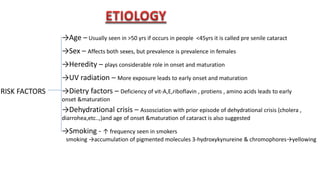
RISK FACTORS
→Age – Usually seen in >50 yrs if occurs in people <45yrs it is called pre senile cataract
→Sex – Affects both sexes, but prevalence is prevalence in females
→Heredity – plays considerable role in onset and maturation
→UV radiation – More exposure leads to early onset and maturation
→Dietry factors – Deficiency of vit-A,E,riboflavin , protiens , amino acids leads to early
onset &maturation
→Dehydrational crisis – Assosciation with prior episode of dehydrational crisis (cholera ,
diarrohea,etc..,)and age of onset &maturation of cataract is also suggested
→Smoking - ↑ frequency seen in smokers
smoking →accumulation of pigmented molecules 3-hydroxykynureine & chromophores→yellowing
• CAUSES OF PRESINLE CATARACT:-
a)Heredity – Because of heredity changes may occur at
early age in succesive geneartions
b)Diabetes mellitus – It is earlier in diabetics ,Nuclear
cataract is more common & progress rapidly
c)Myotonic dystrophy – assoscaited with subcapsular type
of presenile catract and christmas tree cataract is
commonly seen
d)Atopic dermatitis – seen in 10% of cases
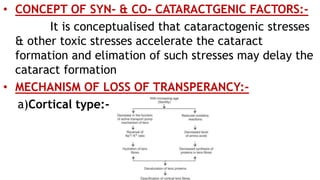
• CONCEPT OF SYN- & CO- CATARACTGENIC FACTORS:-
It is conceptualised that cataractogenic stresses
& other toxic stresses accelerate the cataract
formation and elimation of such stresses may delay the
cataract formation
• MECHANISM OF LOSS OF TRANSPERANCY:-
a)Cortical type:-
b)Nuclear senile cataract:-
Etio pathogenesis:- Intensification of age related
degenerative changes associated with dehydration &
compaction of nucleus
Features:-
- Hard cataract is formed
- Significant increase in water insoluble protein
- Lens become in elastic & looses power of
accomodation
- Changes begin centrally and slowly spreads to
periphery
- Deposition of pigments gives characteristic colour to
nucleus
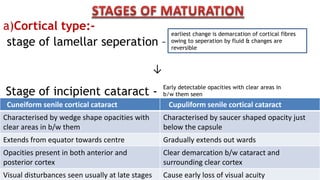
a)Cortical type:-
stage of lamellar seperation –
earliest change is demarcation of cortical fibres
owing to seperation by fluid & changes are
reversible
↓
Stage of incipient cataract -
Early detectable opacities with clear areas in
b/w them seen
Cuneiform senile cortical cataract Cupuliform senile cortical cataract
Characterised by wedge shape opacities with
clear areas in b/w them
Characterised by saucer shaped opacity just
below the capsule
Extends from equator towards centre Gradually extends out wards
Opacities present in both anterior and
posterior cortex
Clear demarcation b/w cataract and
surrounding clear cortex
Visual disturbances seen usually at late stages Cause early loss of visual acuity
↓
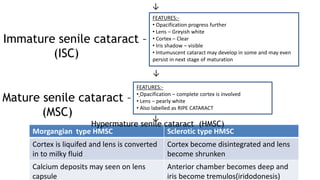
Immature senile cataract –
(ISC)
FEATURES:-
• Opacification progress further
• Lens – Greyish white
• Cortex – Clear
• Iris shadow – visible
• Intumuscent cataract may develop in some and may even
persist in next stage of maturation
↓
Mature senile cataract –
(MSC)
FEATURES:-
• Opacification – complete cortex is involved
• Lens – pearly white
• Also labelled as RIPE CATARACT
↓
Morgangian type HMSC Sclerotic type HMSC
Cortex is liquifed and lens is converted
in to milky fluid
Cortex become disintegrated and lens
become shrunken
Calcium deposits may seen on lens
capsule
Anterior chamber becomes deep and
iris become tremulos(iridodonesis)
Hypermature senile cataract (HMSC)
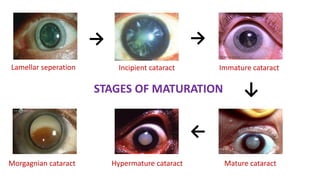
Lamellar seperation Incipient cataract Immature cataract
Mature cataractHypermature cataractMorgagnian cataract
STAGES OF MATURATION
→ →
↓
←
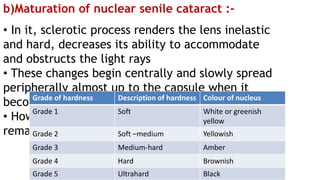
b)Maturation of nuclear senile cataract :-
• In it, sclerotic process renders the lens inelastic
and hard, decreases its ability to accommodate
and obstructs the light rays
• These changes begin centrally and slowly spread
peripherally almost up to the capsule when it
become mature
• However, a very thin layer of clear cortex may
remain unaffected
Grade of hardness Description of hardness Colour of nucleus
Grade 1 Soft White or greenish
yellow
Grade 2 Soft –medium Yellowish
Grade 3 Medium-hard Amber
Grade 4 Hard Brownish
Grade 5 Ultrahard Black
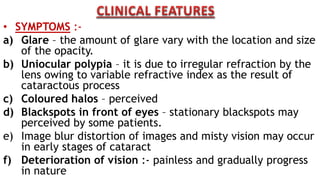
• SYMPTOMS :-
a) Glare – the amount of glare vary with the location and size
of the opacity.
b) Uniocular polypia – it is due to irregular refraction by the
lens owing to variable refractive index as the result of
cataractous process
c) Coloured halos – perceived
d) Blackspots in front of eyes – stationary blackspots may
perceived by some patients.
e) Image blur distortion of images and misty vision may occur
in early stages of cataract
f) Deterioration of vision :- painless and gradually progress
in nature
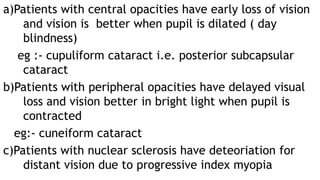
a)Patients with central opacities have early loss of vision
and vision is better when pupil is dilated ( day
blindness)
eg :- cupuliform cataract i.e. posterior subcapsular
cataract
b)Patients with peripheral opacities have delayed visual
loss and vision better in bright light when pupil is
contracted
eg:- cuneiform cataract
c)Patients with nuclear sclerosis have deteoriation for
distant vision due to progressive index myopia
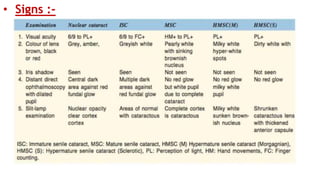
• Signs :-
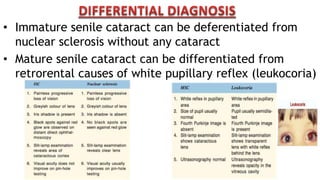
• Immature senile cataract can be deferentiated from
nuclear sclerosis without any cataract
• Mature senile cataract can be differentiated from
retrorental causes of white pupillary reflex (leukocoria)
• PHACOANAPHYLACTIC UVEITIS
• LENS INDUCED GLAUCOMA
a)phacomorphic glaucoma
b)phacolytic glaucoma
c)phacotopic glaucoma
• SUBLUXATION / DISLOCATION OF LENS
Senile cataract

Senile cataract

  • 2.
    • Opacification ismainly due to degeneration of the already formed normal fibres. • Seen commonly in people of age >50 yrs if seen in <45 yrs it is pre senile cataract • Morphologically two types a)cortical/soft cataract b)Nuclear/Hard cataract • Commonly both types co-exist in same eye
  • 3.
    RISK FACTORS →Age –Usually seen in >50 yrs if occurs in people <45yrs it is called pre senile cataract →Sex – Affects both sexes, but prevalence is prevalence in females →Heredity – plays considerable role in onset and maturation →UV radiation – More exposure leads to early onset and maturation →Dietry factors – Deficiency of vit-A,E,riboflavin , protiens , amino acids leads to early onset &maturation →Dehydrational crisis – Assosciation with prior episode of dehydrational crisis (cholera , diarrohea,etc..,)and age of onset &maturation of cataract is also suggested →Smoking - ↑ frequency seen in smokers smoking →accumulation of pigmented molecules 3-hydroxykynureine & chromophores→yellowing
  • 4.
    • CAUSES OFPRESINLE CATARACT:- a)Heredity – Because of heredity changes may occur at early age in succesive geneartions b)Diabetes mellitus – It is earlier in diabetics ,Nuclear cataract is more common & progress rapidly c)Myotonic dystrophy – assoscaited with subcapsular type of presenile catract and christmas tree cataract is commonly seen d)Atopic dermatitis – seen in 10% of cases
  • 5.
    • CONCEPT OFSYN- & CO- CATARACTGENIC FACTORS:- It is conceptualised that cataractogenic stresses & other toxic stresses accelerate the cataract formation and elimation of such stresses may delay the cataract formation • MECHANISM OF LOSS OF TRANSPERANCY:- a)Cortical type:-
  • 6.
    b)Nuclear senile cataract:- Etiopathogenesis:- Intensification of age related degenerative changes associated with dehydration & compaction of nucleus Features:- - Hard cataract is formed - Significant increase in water insoluble protein - Lens become in elastic & looses power of accomodation - Changes begin centrally and slowly spreads to periphery - Deposition of pigments gives characteristic colour to nucleus
  • 7.
    a)Cortical type:- stage oflamellar seperation – earliest change is demarcation of cortical fibres owing to seperation by fluid & changes are reversible ↓ Stage of incipient cataract - Early detectable opacities with clear areas in b/w them seen Cuneiform senile cortical cataract Cupuliform senile cortical cataract Characterised by wedge shape opacities with clear areas in b/w them Characterised by saucer shaped opacity just below the capsule Extends from equator towards centre Gradually extends out wards Opacities present in both anterior and posterior cortex Clear demarcation b/w cataract and surrounding clear cortex Visual disturbances seen usually at late stages Cause early loss of visual acuity
  • 8.
    ↓ Immature senile cataract– (ISC) FEATURES:- • Opacification progress further • Lens – Greyish white • Cortex – Clear • Iris shadow – visible • Intumuscent cataract may develop in some and may even persist in next stage of maturation ↓ Mature senile cataract – (MSC) FEATURES:- • Opacification – complete cortex is involved • Lens – pearly white • Also labelled as RIPE CATARACT ↓ Morgangian type HMSC Sclerotic type HMSC Cortex is liquifed and lens is converted in to milky fluid Cortex become disintegrated and lens become shrunken Calcium deposits may seen on lens capsule Anterior chamber becomes deep and iris become tremulos(iridodonesis) Hypermature senile cataract (HMSC)
  • 9.
    Lamellar seperation Incipientcataract Immature cataract Mature cataractHypermature cataractMorgagnian cataract STAGES OF MATURATION → → ↓ ←
  • 10.
    b)Maturation of nuclearsenile cataract :- • In it, sclerotic process renders the lens inelastic and hard, decreases its ability to accommodate and obstructs the light rays • These changes begin centrally and slowly spread peripherally almost up to the capsule when it become mature • However, a very thin layer of clear cortex may remain unaffected Grade of hardness Description of hardness Colour of nucleus Grade 1 Soft White or greenish yellow Grade 2 Soft –medium Yellowish Grade 3 Medium-hard Amber Grade 4 Hard Brownish Grade 5 Ultrahard Black
  • 11.
    • SYMPTOMS :- a)Glare – the amount of glare vary with the location and size of the opacity. b) Uniocular polypia – it is due to irregular refraction by the lens owing to variable refractive index as the result of cataractous process c) Coloured halos – perceived d) Blackspots in front of eyes – stationary blackspots may perceived by some patients. e) Image blur distortion of images and misty vision may occur in early stages of cataract f) Deterioration of vision :- painless and gradually progress in nature
  • 12.
    a)Patients with centralopacities have early loss of vision and vision is better when pupil is dilated ( day blindness) eg :- cupuliform cataract i.e. posterior subcapsular cataract b)Patients with peripheral opacities have delayed visual loss and vision better in bright light when pupil is contracted eg:- cuneiform cataract c)Patients with nuclear sclerosis have deteoriation for distant vision due to progressive index myopia
  • 13.
  • 14.
    • Immature senilecataract can be deferentiated from nuclear sclerosis without any cataract • Mature senile cataract can be differentiated from retrorental causes of white pupillary reflex (leukocoria)
  • 15.
    • PHACOANAPHYLACTIC UVEITIS •LENS INDUCED GLAUCOMA a)phacomorphic glaucoma b)phacolytic glaucoma c)phacotopic glaucoma • SUBLUXATION / DISLOCATION OF LENS