SAKIL HOSSAIN
5TH SEMESTER
REG. NO. -0152005010382
DEPARTMENT OF GEOGRAPHY
FALAKATA COLLEGE
UNIVERSITY OF NORTH BENGAL
CONTENT
• LEARNING OBJECTIVES
• INTRODUCTION
• DEFINITION
• CAUSES OF MORTALITY
• REPRODUCTIVE WASTAGE
• TYPES OF CHILD MORTALITY
• CAUSES OF CHILD MORTALITY
• FACTORS AFFECTING MORTALITY
• RISK OF DYING
• MEASURMENT OF MORTALITY
• CONCLUSION
1. Understand the concept of Mortality.
2. List the main measures of mortality.
3. Define Mortality Rates.
4. Undusted the factors affecting mortality
LEARNING OBJECTIVES
Birth and death are integral parts of human life.
Humans are mortal. A person is considered dead if
there are no signs of life. Mortality is the death of a
human being in any condition after birth from
infancy.
INTRODUCTION
According to WHO mortality is “ all live born infants should
be registered and counted as such irrespective of the period
of gestation and if they die any time following birth they
should also be registered and counted as death.
DEFINITION
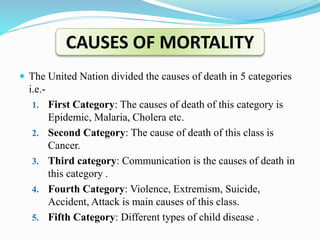
 The United Nation divided the causes of death in 5 categories
i.e.-
1. First Category: The causes of death of this category is
Epidemic, Malaria, Cholera etc.
2. Second Category: The cause of death of this class is
Cancer.
3. Third category: Communication is the causes of death in
this category .
4. Fourth Category: Violence, Extremism, Suicide,
Accident, Attack is main causes of this class.
5. Fifth Category: Different types of child disease .
CAUSES OF MORTALITY
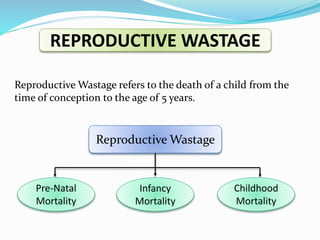
Reproductive Wastage refers to the death of a child from the
time of conception to the age of 5 years.
REPRODUCTIVE WASTAGE
Reproductive Wastage
Pre-Natal
Mortality
Infancy
Mortality
Childhood
Mortality
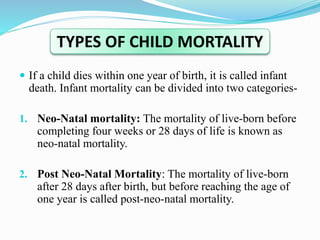
 If a child dies within one year of birth, it is called infant
death. Infant mortality can be divided into two categories-
1. Neo-Natal mortality: The mortality of live-born before
completing four weeks or 28 days of life is known as
neo-natal mortality.
2. Post Neo-Natal Mortality: The mortality of live-born
after 28 days after birth, but before reaching the age of
one year is called post-neo-natal mortality.
TYPES OF CHILD MORTALITY
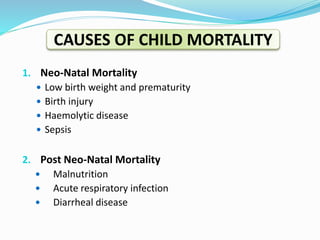
1. Neo-Natal Mortality
 Low birth weight and prematurity
 Birth injury
 Haemolytic disease
 Sepsis
2. Post Neo-Natal Mortality
 Malnutrition
 Acute respiratory infection
 Diarrheal disease
CAUSES OF CHILD MORTALITY
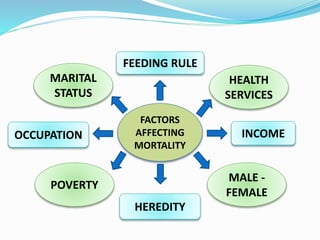
FACTORS
AFFECTING
MORTALITY
INCOME
OCCUPATION
HEREDITY
FEEDING RULE
HEALTH
SERVICES
MALE -
FEMALE
POVERTY
MARITAL
STATUS
The time in life when the probability of death is high is
called Risk of Dying.
The probability of dying at birth is
equal to the probability of dying at age 70, and the
probability of dying in the first year after birth is equal
to the probability of dying at age 60.
RISK OF DYING
 Crude Death Rate (CDR): The crude death rate is calculated
by dividing the number of registered deaths in a year by the
mid-year population for the same year.
 Formula:
CDR =
 Infant Mortality Rate(IMR): If a child dies within one
year of birth, it is called infant death.
 Formula :
IMR =
Total number of death
Total mid-year population
x 1000
Number of infant deaths in a year
Total number of live birth in a same year
x 1000
MEASUREMENT OF MORTALITY
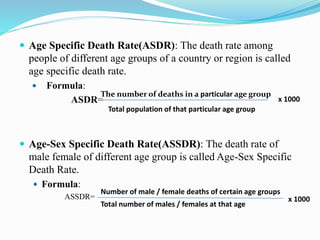
 Age Specific Death Rate(ASDR): The death rate among
people of different age groups of a country or region is called
age specific death rate.
 Formula:
ASDR=
 Age-Sex Specific Death Rate(ASSDR): The death rate of
male female of different age group is called Age-Sex Specific
Death Rate.
 Formula:
ASSDR=
The number of deaths in a particular age group
Total population of that particular age group
x 1000
Number of male / female deaths of certain age groups
Total number of males / females at that age
x 1000
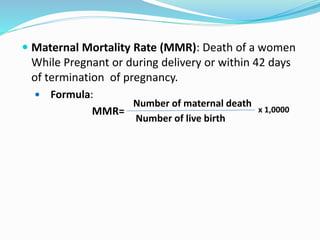
 Maternal Mortality Rate (MMR): Death of a women
While Pregnant or during delivery or within 42 days
of termination of pregnancy.
 Formula:
MMR=
Number of maternal death
Number of live birth
x 1,0000
 At last it can be said that, death rate mainly refers to
manpower loss or population loss. Mortality affects
population structure. Mortality is an important
concept like reproduction and migration.
CONCLUSION
SEMINAR ON MORTALITY

SEMINAR ON MORTALITY

  • 1.
    SAKIL HOSSAIN 5TH SEMESTER REG.NO. -0152005010382 DEPARTMENT OF GEOGRAPHY FALAKATA COLLEGE UNIVERSITY OF NORTH BENGAL
  • 2.
    CONTENT • LEARNING OBJECTIVES •INTRODUCTION • DEFINITION • CAUSES OF MORTALITY • REPRODUCTIVE WASTAGE • TYPES OF CHILD MORTALITY • CAUSES OF CHILD MORTALITY • FACTORS AFFECTING MORTALITY • RISK OF DYING • MEASURMENT OF MORTALITY • CONCLUSION
  • 3.
    1. Understand theconcept of Mortality. 2. List the main measures of mortality. 3. Define Mortality Rates. 4. Undusted the factors affecting mortality LEARNING OBJECTIVES
  • 4.
    Birth and deathare integral parts of human life. Humans are mortal. A person is considered dead if there are no signs of life. Mortality is the death of a human being in any condition after birth from infancy. INTRODUCTION
  • 5.
    According to WHOmortality is “ all live born infants should be registered and counted as such irrespective of the period of gestation and if they die any time following birth they should also be registered and counted as death. DEFINITION
  • 6.
     The UnitedNation divided the causes of death in 5 categories i.e.- 1. First Category: The causes of death of this category is Epidemic, Malaria, Cholera etc. 2. Second Category: The cause of death of this class is Cancer. 3. Third category: Communication is the causes of death in this category . 4. Fourth Category: Violence, Extremism, Suicide, Accident, Attack is main causes of this class. 5. Fifth Category: Different types of child disease . CAUSES OF MORTALITY
  • 7.
    Reproductive Wastage refersto the death of a child from the time of conception to the age of 5 years. REPRODUCTIVE WASTAGE Reproductive Wastage Pre-Natal Mortality Infancy Mortality Childhood Mortality
  • 8.
     If achild dies within one year of birth, it is called infant death. Infant mortality can be divided into two categories- 1. Neo-Natal mortality: The mortality of live-born before completing four weeks or 28 days of life is known as neo-natal mortality. 2. Post Neo-Natal Mortality: The mortality of live-born after 28 days after birth, but before reaching the age of one year is called post-neo-natal mortality. TYPES OF CHILD MORTALITY
  • 9.
    1. Neo-Natal Mortality Low birth weight and prematurity  Birth injury  Haemolytic disease  Sepsis 2. Post Neo-Natal Mortality  Malnutrition  Acute respiratory infection  Diarrheal disease CAUSES OF CHILD MORTALITY
  • 10.
  • 11.
    The time inlife when the probability of death is high is called Risk of Dying. The probability of dying at birth is equal to the probability of dying at age 70, and the probability of dying in the first year after birth is equal to the probability of dying at age 60. RISK OF DYING
  • 12.
     Crude DeathRate (CDR): The crude death rate is calculated by dividing the number of registered deaths in a year by the mid-year population for the same year.  Formula: CDR =  Infant Mortality Rate(IMR): If a child dies within one year of birth, it is called infant death.  Formula : IMR = Total number of death Total mid-year population x 1000 Number of infant deaths in a year Total number of live birth in a same year x 1000 MEASUREMENT OF MORTALITY
  • 13.
     Age SpecificDeath Rate(ASDR): The death rate among people of different age groups of a country or region is called age specific death rate.  Formula: ASDR=  Age-Sex Specific Death Rate(ASSDR): The death rate of male female of different age group is called Age-Sex Specific Death Rate.  Formula: ASSDR= The number of deaths in a particular age group Total population of that particular age group x 1000 Number of male / female deaths of certain age groups Total number of males / females at that age x 1000
  • 14.
     Maternal MortalityRate (MMR): Death of a women While Pregnant or during delivery or within 42 days of termination of pregnancy.  Formula: MMR= Number of maternal death Number of live birth x 1,0000
  • 15.
     At lastit can be said that, death rate mainly refers to manpower loss or population loss. Mortality affects population structure. Mortality is an important concept like reproduction and migration. CONCLUSION