Prabesh Ghimire
MPH 341
International Health Partnership
A class presentation on:
Paper IV: Health System Management and International Hea
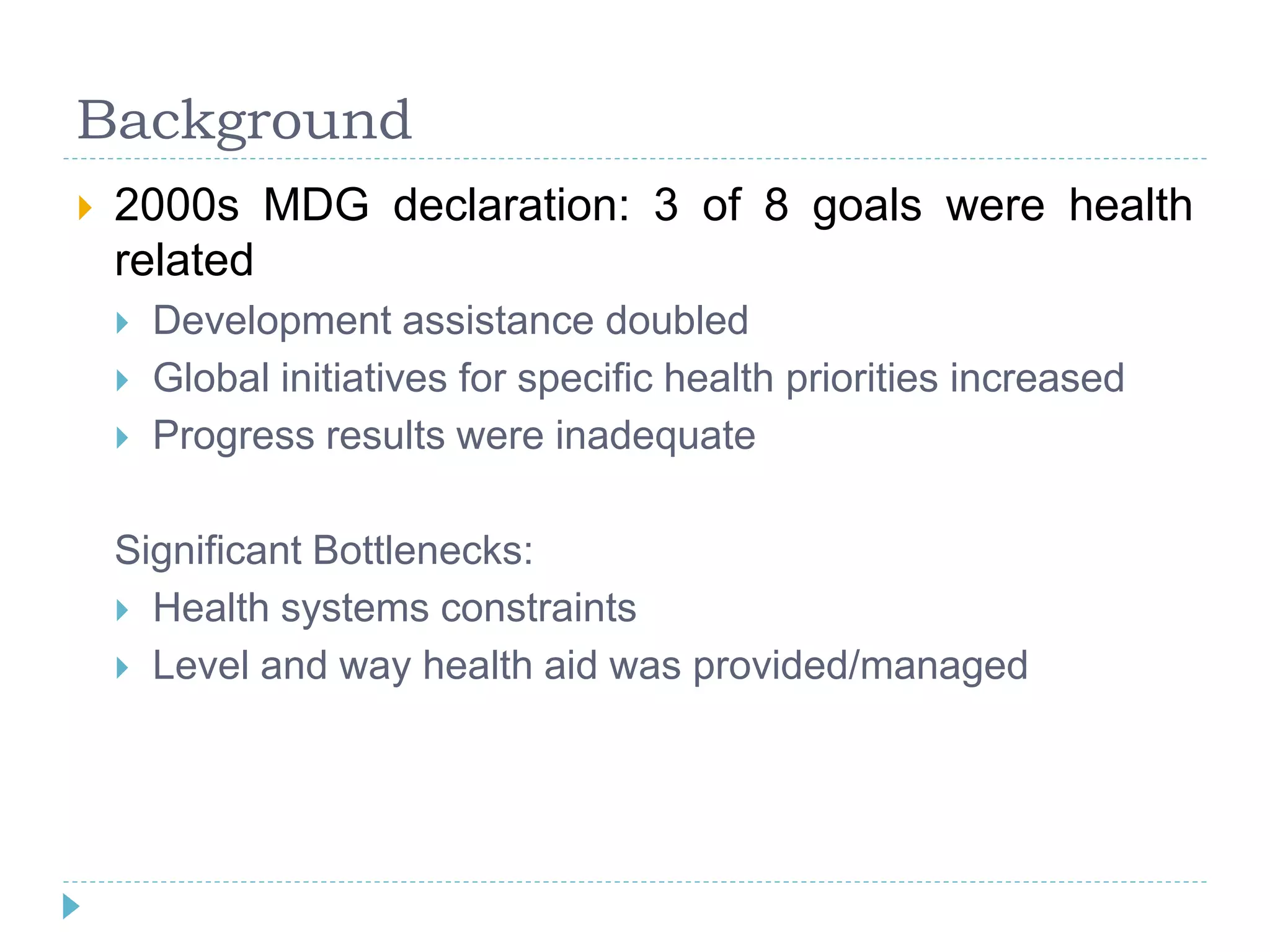
Background
2
 2000s MDG declaration: 3 of 8 goals were health
related
 Development assistance doubled
 Global initiatives for specific health priorities increased
 Progress results were inadequate
Significant Bottlenecks:
 Health systems constraints
 Level and way health aid was provided/managed
Progress towards MDG: Inadequate
3
2.9 3.2 3.5 4.1 4.6 4.9
2
5.1
13.5
10.9
8.3 7 5.1 4.1
2.2
3
4.1
3.6
2.7
1.8
1.4
1.1
0.1
0.8
0
5
10
15
20
25
Other
Asia
Africa
Trends in U-5 deaths, 1960-2015 (million deaths per year)
Investment in Health: Insufficient
4
International Funding: Irregular
5
0
5
10
15
20
25
30
35
40
2000 2001 2002 2003 2004
Benin
Burundi
Ethiopia
Mali
Niger
Background contd.
6
 2001: Report of Commission on Macro Economics
and Health
 Low income countries are not capable of financing
modest package of essential health services by
themselves.
 recommendation for poor countries to work in partnership
with high income countries to scale up their health
systems
 Donors support low income countries
Background contd.
7
 Feb 2007: Paris declaration on Aid effectiveness
Birth of IHP
8
 Sep 2007: Global partnership launched under UK
government initiative as International Health Partnership
 Built on core principles of Paris declaration, 2007
 Accra Agenda for Action, 2008
 Busan Partnership for Effective Development Co-
operation (2011)
 Four main objectives:
 Results-focused, country-led compacts
 Generating and disseminating relevant knowledge, guidance
and tools
 Coordination and efficiency
 Mutual accountability and monitoring of performance
What IHP does?
9
 Putting principles into practice
 Support inclusive national planning processes
 Jointly assess national health strategies and plans
(JANS)
 Negotiate and agree country compacts or their equivalent
 Report on progress in a more unified way, based on one
common results monitoring framework
 Ensure mutual accountability between all stakeholders.
 Small country grants, as flexible funds
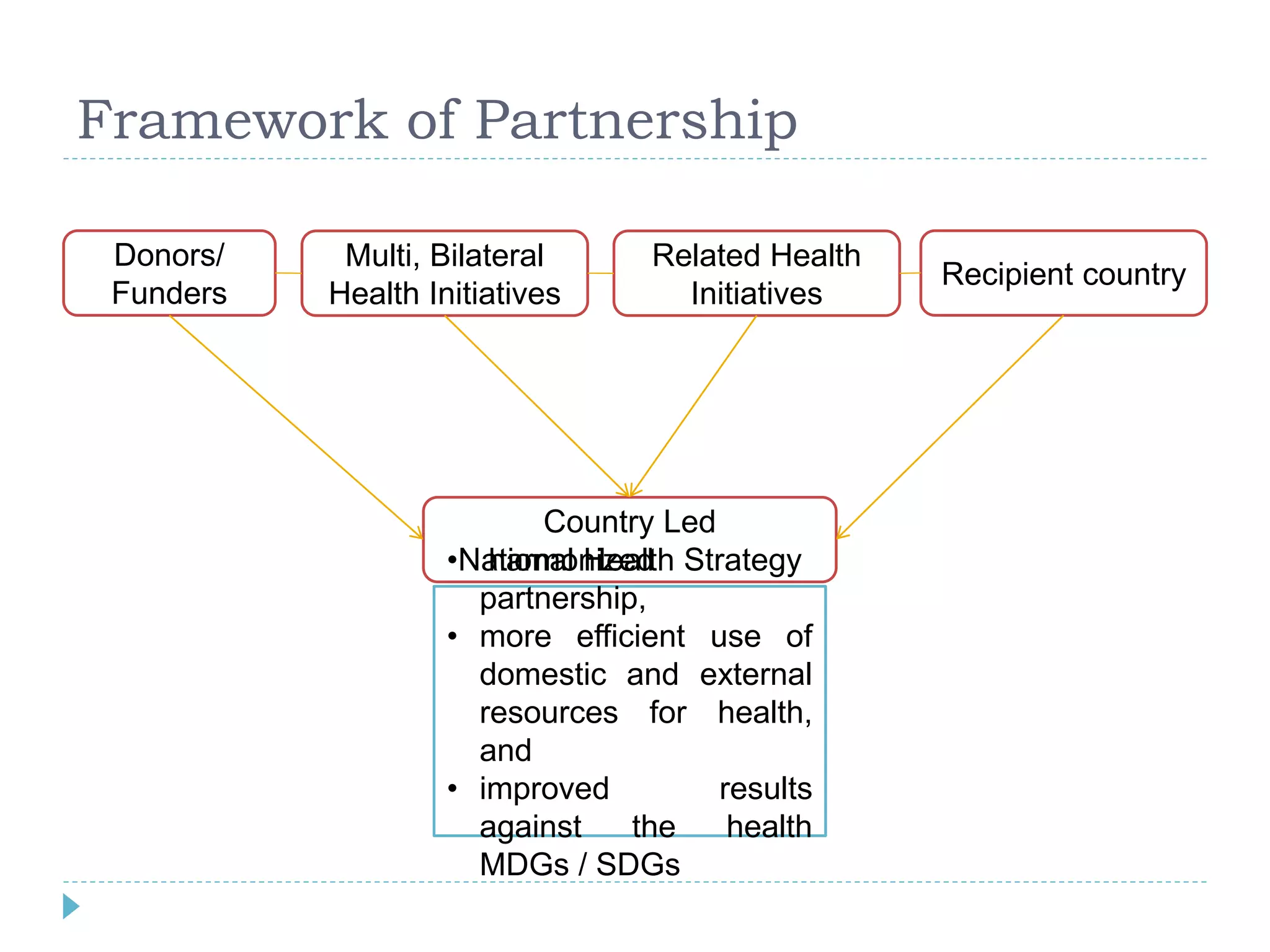
Framework of Partnership
10
Donors/
Funders
Recipient country
Multi, Bilateral
Health Initiatives
Related Health
Initiatives
Country Led
National Health Strategy• harmonized
partnership,
• more efficient use of
domestic and external
resources for health,
and
• improved results
against the health
MDGs / SDGs
Related initiatives
11
 Related initiatives came at same time to scale-up
access and interventions to address health system
bottlenecks.
 Coordination with multitude of global/ donor
initiatives and a common workplan
 Initiated in 2008
 Called as the international health partnership and
related initiatives (IHP+)
IHP + Related Initiatives
12
IHP+ Partners
13
 26 Partners in 2007
 Currently 66 partners
 37 Partner countries
 29 Development Partners
 Civil Societies
Compacts
14
 Global Compacts
 Foundation global document for IHP+
 All partner countries, international agencies and bilateral
donors sign it when they join IHP+
 sets out the goals and approach of IHP+
 Signatories make collective and individual commitments
to adhere to agreed aid effectiveness principles in the
health sector
Compacts contd.
15
 Country Compacts
 negotiated agreement between a government and
development partners
 Set out points on how to work together to improve health
outcomes
Benefits:
 improve partner alignment with country systems;
 brings new partners into health sector coordination efforts;
 addresses the fragmentation and volatility of health aid, and
 reduces transaction costs
 tool for mutual accountability
Country Led National Health Plan
16
 Central to the compact is the country led national
health plan
 one costed, results-oriented
 IHP + shifts in aid environment
Results and Evidences
17 Source: IHP + 2014 Progress Report
Overall country performance
scores were positively
correlated with the number of
years a country participated in
the IHP+
There was also a positive
correlation between overall
country performance
scores and level of external
funding
Results and Evidences
18
 Democratic Republic of Congo,
 New MOH single donor coordination arrangement led to a
significant reduction in management costs for donor funds from
28 percent to nine percent.
 Ethiopia
 Progressive alignment of donors helped increase Primary
Health Care coverage.
 Nepal:
 Impressive results from free maternal health care launched in
few districts in 2007.
 Nationwide scale up because government and donors acted
collectively to ensure the necessary resources reached all
districts.
IHP+ Recent Developments
19
 2011: 4th High Level Forum on Aid Effectiveness in
Busan
 IHP+ changed its focus from aid effectiveness to effective
development cooperation
 South-south and triangular cooperation
 Engaging private sector and emerging economies
 2012: Seven systems-focused behaviours identified
for international partners
 2016: Commitments to Sustainable Development
Goals
 Replaced MDG with SDG ----- attain universal health
coverage
How development partners can change for
better health?
20
Nepal in International Health Partnership
21
 First South Asian country to sign global compact in
Sep 2007
 Third country to sign country compact in Feb 2009
 IHP+ Nepal Country Compact: Nepal Health
Development Partnership
 Signed by 8 EDPs
 7 commitment areas, joint and separate
responsibilities
References
1. Sharma N. The International Health Partnership (IHP) and Related
Initiatives (IHP+)and Nepal’s Experience. [Presentation]. 2009.
2. International Health Partnership official webpage
http://www.internationalhealthpartnership.net/
3. Paris Declaration on Aid Effectiveness, 2007
4. IHP + Strategic Directions 2016-17
5. Nepal Health Development Partnership. Kathmandu: Government
of Nepal; 2009.
6. Progress in the International Health Partnership & Related
Initiatives (IHP+). 2014.
7. Holzcheiter A. The Handbook of Transnational Governance:
Institutions and Innovations. UK: Polity Press; 2012.
22

International Health Partnership

  • 1.
    Prabesh Ghimire MPH 341 InternationalHealth Partnership A class presentation on: Paper IV: Health System Management and International Hea
  • 2.
    Background 2  2000s MDGdeclaration: 3 of 8 goals were health related  Development assistance doubled  Global initiatives for specific health priorities increased  Progress results were inadequate Significant Bottlenecks:  Health systems constraints  Level and way health aid was provided/managed
  • 3.
    Progress towards MDG:Inadequate 3 2.9 3.2 3.5 4.1 4.6 4.9 2 5.1 13.5 10.9 8.3 7 5.1 4.1 2.2 3 4.1 3.6 2.7 1.8 1.4 1.1 0.1 0.8 0 5 10 15 20 25 Other Asia Africa Trends in U-5 deaths, 1960-2015 (million deaths per year)
  • 4.
    Investment in Health:Insufficient 4
  • 5.
    International Funding: Irregular 5 0 5 10 15 20 25 30 35 40 20002001 2002 2003 2004 Benin Burundi Ethiopia Mali Niger
  • 6.
    Background contd. 6  2001:Report of Commission on Macro Economics and Health  Low income countries are not capable of financing modest package of essential health services by themselves.  recommendation for poor countries to work in partnership with high income countries to scale up their health systems  Donors support low income countries
  • 7.
    Background contd. 7  Feb2007: Paris declaration on Aid effectiveness
  • 8.
    Birth of IHP 8 Sep 2007: Global partnership launched under UK government initiative as International Health Partnership  Built on core principles of Paris declaration, 2007  Accra Agenda for Action, 2008  Busan Partnership for Effective Development Co- operation (2011)  Four main objectives:  Results-focused, country-led compacts  Generating and disseminating relevant knowledge, guidance and tools  Coordination and efficiency  Mutual accountability and monitoring of performance
  • 9.
    What IHP does? 9 Putting principles into practice  Support inclusive national planning processes  Jointly assess national health strategies and plans (JANS)  Negotiate and agree country compacts or their equivalent  Report on progress in a more unified way, based on one common results monitoring framework  Ensure mutual accountability between all stakeholders.  Small country grants, as flexible funds
  • 10.
    Framework of Partnership 10 Donors/ Funders Recipientcountry Multi, Bilateral Health Initiatives Related Health Initiatives Country Led National Health Strategy• harmonized partnership, • more efficient use of domestic and external resources for health, and • improved results against the health MDGs / SDGs
  • 11.
    Related initiatives 11  Relatedinitiatives came at same time to scale-up access and interventions to address health system bottlenecks.  Coordination with multitude of global/ donor initiatives and a common workplan  Initiated in 2008  Called as the international health partnership and related initiatives (IHP+)
  • 12.
    IHP + RelatedInitiatives 12
  • 13.
    IHP+ Partners 13  26Partners in 2007  Currently 66 partners  37 Partner countries  29 Development Partners  Civil Societies
  • 14.
    Compacts 14  Global Compacts Foundation global document for IHP+  All partner countries, international agencies and bilateral donors sign it when they join IHP+  sets out the goals and approach of IHP+  Signatories make collective and individual commitments to adhere to agreed aid effectiveness principles in the health sector
  • 15.
    Compacts contd. 15  CountryCompacts  negotiated agreement between a government and development partners  Set out points on how to work together to improve health outcomes Benefits:  improve partner alignment with country systems;  brings new partners into health sector coordination efforts;  addresses the fragmentation and volatility of health aid, and  reduces transaction costs  tool for mutual accountability
  • 16.
    Country Led NationalHealth Plan 16  Central to the compact is the country led national health plan  one costed, results-oriented  IHP + shifts in aid environment
  • 17.
    Results and Evidences 17Source: IHP + 2014 Progress Report Overall country performance scores were positively correlated with the number of years a country participated in the IHP+ There was also a positive correlation between overall country performance scores and level of external funding
  • 18.
    Results and Evidences 18 Democratic Republic of Congo,  New MOH single donor coordination arrangement led to a significant reduction in management costs for donor funds from 28 percent to nine percent.  Ethiopia  Progressive alignment of donors helped increase Primary Health Care coverage.  Nepal:  Impressive results from free maternal health care launched in few districts in 2007.  Nationwide scale up because government and donors acted collectively to ensure the necessary resources reached all districts.
  • 19.
    IHP+ Recent Developments 19 2011: 4th High Level Forum on Aid Effectiveness in Busan  IHP+ changed its focus from aid effectiveness to effective development cooperation  South-south and triangular cooperation  Engaging private sector and emerging economies  2012: Seven systems-focused behaviours identified for international partners  2016: Commitments to Sustainable Development Goals  Replaced MDG with SDG ----- attain universal health coverage
  • 20.
    How development partnerscan change for better health? 20
  • 21.
    Nepal in InternationalHealth Partnership 21  First South Asian country to sign global compact in Sep 2007  Third country to sign country compact in Feb 2009  IHP+ Nepal Country Compact: Nepal Health Development Partnership  Signed by 8 EDPs  7 commitment areas, joint and separate responsibilities
  • 22.
    References 1. Sharma N.The International Health Partnership (IHP) and Related Initiatives (IHP+)and Nepal’s Experience. [Presentation]. 2009. 2. International Health Partnership official webpage http://www.internationalhealthpartnership.net/ 3. Paris Declaration on Aid Effectiveness, 2007 4. IHP + Strategic Directions 2016-17 5. Nepal Health Development Partnership. Kathmandu: Government of Nepal; 2009. 6. Progress in the International Health Partnership & Related Initiatives (IHP+). 2014. 7. Holzcheiter A. The Handbook of Transnational Governance: Institutions and Innovations. UK: Polity Press; 2012. 22

Editor's Notes

  • #8 Ownership: Funded countries exercise leadership over their development policies and strategies Alignment: Donors base their support on funded countries' strategies, institutions and procedures Harmonization: Donors’ actions are more harmonised, transparent and collectively effective Result based Management: Managing resources and improving decision making for results Mutual Accountability: Donors and partners are accountable for development results
  • #9 Four main objectives: Developing results-focused, country-led compacts that rally all development partners around one national health plan; one M&E framework; and one review process, Generating and disseminating relevant knowledge, guidance and tools Enhancing coordination and efficiency at country, regional and global levels Ensuring mutual accountability and monitoring of performance
  • #21 In Dec 2012, IHP+ identified seven systems-focused behaviours that international partners needed to adopt in order to be more effective, partly because donors were making progress than developing country governments in putting IHP+ principles into practice. At the  IHP+ meeting in Nairobi, December 2012, participants identified a number of critical areas where international development partners need to change their behaviour in order to accelerate progress on the MDGs. Recent meetings of global health leaders have strongly supported renewed action on these seven behaviours which, if implemented, would bring visible results. The seven behaviours Agreement on priorities that are reflected in a single national health strategy and underpinning sub-sector strategies, through a process of inclusive development and joint assessment, and a reduction in separate exercises. Resource inputs recorded on budget and in line with national priorities Financial management systems harmonized and aligned; requisite capacity building done or underway, and country systems strengthened and used. Procurement/supply systems harmonized and aligned, parallel systems phased out, country systems strengthened and used with a focus on best value for money. National ownership can include benefiting from global procurement. Joint monitoring of process and results is based on one information and accountability platform including joint annual reviews that define actions that are implemented and reinforce mutual accountability. Opportunities for systematic learning between countries developed and supported by agencies (south-south/triangular cooperation). Provision of strategically planned and well-coordinated technical support.