Seminar On Computational
Methods Of Drug Disposition
Presented By-Rashmi Sinha
M.Pharm 1st year(pharmaceutics)
Regd no-1961611011
Subject Code-(203 T)
Subject Name-Computer Aided Drug
Design
Approaches of Drug
Disposition
There are two approaches-
1)QUALITATIVE APPROACH
2)QUANTITATIVE APPROACH
MODELLING TECHNIQUE: 2
APPROACHES
> The QUANTITATIVE APPROACHES
represented by pharmacophore modeling
and flexible docking studies investigate
the structural requirements for the
interaction between drugs and the targets
that are involved in ADMET processes.
>Three widely used automated
pharmacophore perception tools are
DISCO (DIStance COmparisons), GASP
(Genetic Algorithm Similarity Program)
and Catalyst/HIPHOP.
> The QUALITATIVE APPROACHES,
represented by Quantitative Structure-
Activity Relationship (QSAR) and
Quantitative Structure-Property
Relationship (QSPR) studies utilize
multivariate analysis to
correlate molecular descriptors with
ADMET-related properties.
> A diverse range of molecular descriptors
can be calculated based on the drug
structure. Some of these descriptors can
be calculated based on drug structure.
> It is essential to select the right
Types Of Drug Disposition
1)ABSORPTION
2)DISTRIBUTION
3)METABOLISM
(BIOTRANSFORMATION)
4)EXCRETION
ABSORPTION
Absorption is movement of the drug from
its site of administration into the
circulation.
• Not only the fraction of the administered
dose that gets absorbed , but also the rate
of absorption is important.
• The drug has to cross biological
membranes; absorption is governed by.
• Passive diffusion depends on
concentration gradient; drug given as
concentrated solution is absorbed faster
DISTRIBUTION
Once a drug has gained access to the blood stream, it
gets
distributed to other tissues that initially had drug,
concentration gradient.
Highly lipid-soluble drugs get initially distributed to
organs with high blood flow, i.e. brain, heart, kidney, etc.
Later, less vascular.
Greater the lipid solubility of the drug, faster is its
redistribution.
Plasma protein binding: Most drugs possess
physicochemical affinity for plasma proteins and get
reversibly bound to these.
EXAMPLE- Acidic drugs generally bind to plasma
albumin and basic drugs to α1 acid glycoprotein.
METABOLISM(BIOTRANSFORMATIO
N)
Chemical alteration of the drug in the body.
• Compounds begin to break down as soon as they
enter the body.
• The majority of small-molecule drug metabolism is
carried out in the liver by redox enzymes, termed
cytochrome P450 enzymes.
• As metabolism occurs, the initial compound is
converted to new compounds called metabolites.
This is carried out in two phases-
a)Phase I-Activation of inactive drug.
b)Phase II-Inactivation.
PHASE I(Activation of inactive drug)
 Few drugs are inactive as such and
need conversion in the body to one or
more active metabolites. Such a drug is
called a prodrug.
 Metabolic activation means that a less
reactive compound is converted to a
more reactive molecule. This usually
occurs during Phase 1 reactions.
 Phase 1 reaction refers to the first step
in metabolism. It usually means that the
compound is oxidized. Oxidation usually
makes the compound more water
soluble and facilitates further reactions.
PHASE II (Inactivation)
 Most drugs and their active metabolites
are rendered inactive or less active, e.g.
ibuprofen, paracetamol.
 Metabolic inactivation means that an
active or toxic molecule is converted to a
less active metabolite. This usually
occurs during Phase 2 reactions.
 Phase 2 reaction refers to the second
step in xenobiotic metabolism. It usually
means that the oxidized compound is
conjugated with an endogenous
molecule. This reaction increases the
EXCRETION
Excretion is the exit of a substance and its
biotransformation products from the
organism.
1. Urine: Through the kidney. It is the
most important channel of excretion for
majority of drugs.
2. Faeces: Apart from the unabsorbed
fraction, most of the drug present in faeces
is derived from bile.
3. Elimination by exhaled air via lungs:
Gases and vapours with low solubility in
blood will be quickly eliminated this way.
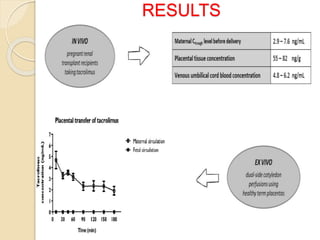
RESEARCH ARTICLE-1
Placental disposition of the immunosuppressive drug
tacrolimus in in-vivo renal transplant recipients and in ex
vivo perfused placental tissue.
J.J.M. Freriksen et.al,predicted that currently ,tacrolimus is the
most potent immunosuppressive agent for renal transplant
recipients and is commonly prescribed during pregnancy.
Transfer to venous umbilical cord blood was particularly noted a
strong placental accumulation. In in vivo patient samples, tissue
concentrations in a range of 55 – 82 ng /g were found.
During the 3 hour ex vivo perfusion interval no placental transfer to
the fetal circulation was observed.
RESULTS
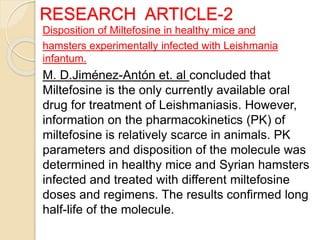
RESEARCH ARTICLE-2
Disposition of Miltefosine in healthy mice and
hamsters experimentally infected with Leishmania
infantum.
M. D.Jiménez-Antón et. al concluded that
Miltefosine is the only currently available oral
drug for treatment of Leishmaniasis. However,
information on the pharmacokinetics (PK) of
miltefosine is relatively scarce in animals. PK
parameters and disposition of the molecule was
determined in healthy mice and Syrian hamsters
infected and treated with different miltefosine
doses and regimens. The results confirmed long
half-life of the molecule.
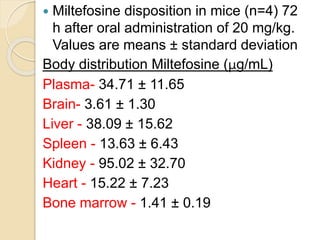
 Miltefosine disposition in mice (n=4) 72
h after oral administration of 20 mg/kg.
Values are means ± standard deviation
Body distribution Miltefosine (μg/mL)
Plasma- 34.71 ± 11.65
Brain- 3.61 ± 1.30
Liver - 38.09 ± 15.62
Spleen - 13.63 ± 6.43
Kidney - 95.02 ± 32.70
Heart - 15.22 ± 7.23
Bone marrow - 1.41 ± 0.19
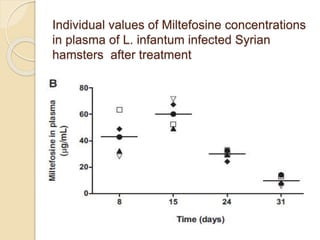
Individual values of Miltefosine concentrations
in plasma of L. infantum infected Syrian
hamsters after treatment
REFERENCES
1. M. Dolores Jiménez - Antona , B. Estefanía García-
Calvoc, Cristina Gutiérrezc, M.D. Escribanod,Nour
Kayalic ; European Journal of Pharmaceutical
Sciences; Pharmacokinetics and disposition of
miltefosine in healthy mice and hamsters
experimentally infected with Leishmania infantum
;page no-281-286.
2. J.J.M. Freriksen, D. Feyaerts, P.H.H. van den Broek;
European Journal of Pharmaceutical Sciences ;
Placental disposition of the immunosuppressive drug
tacrolimus in renal transplant recipients and in ex
vivo perfused placental tissue .
3. Ekins S, Nikolsky Y and Nikolskaya T. Techniques:
Application of systems biology to absorption,
distribution, metabolism, excretion and toxicity

Seminar on drug disposition

  • 1.
    Seminar On Computational MethodsOf Drug Disposition Presented By-Rashmi Sinha M.Pharm 1st year(pharmaceutics) Regd no-1961611011 Subject Code-(203 T) Subject Name-Computer Aided Drug Design
  • 2.
    Approaches of Drug Disposition Thereare two approaches- 1)QUALITATIVE APPROACH 2)QUANTITATIVE APPROACH
  • 3.
    MODELLING TECHNIQUE: 2 APPROACHES >The QUANTITATIVE APPROACHES represented by pharmacophore modeling and flexible docking studies investigate the structural requirements for the interaction between drugs and the targets that are involved in ADMET processes. >Three widely used automated pharmacophore perception tools are DISCO (DIStance COmparisons), GASP (Genetic Algorithm Similarity Program) and Catalyst/HIPHOP.
  • 4.
    > The QUALITATIVEAPPROACHES, represented by Quantitative Structure- Activity Relationship (QSAR) and Quantitative Structure-Property Relationship (QSPR) studies utilize multivariate analysis to correlate molecular descriptors with ADMET-related properties. > A diverse range of molecular descriptors can be calculated based on the drug structure. Some of these descriptors can be calculated based on drug structure. > It is essential to select the right
  • 5.
    Types Of DrugDisposition 1)ABSORPTION 2)DISTRIBUTION 3)METABOLISM (BIOTRANSFORMATION) 4)EXCRETION
  • 6.
    ABSORPTION Absorption is movementof the drug from its site of administration into the circulation. • Not only the fraction of the administered dose that gets absorbed , but also the rate of absorption is important. • The drug has to cross biological membranes; absorption is governed by. • Passive diffusion depends on concentration gradient; drug given as concentrated solution is absorbed faster
  • 7.
    DISTRIBUTION Once a drughas gained access to the blood stream, it gets distributed to other tissues that initially had drug, concentration gradient. Highly lipid-soluble drugs get initially distributed to organs with high blood flow, i.e. brain, heart, kidney, etc. Later, less vascular. Greater the lipid solubility of the drug, faster is its redistribution. Plasma protein binding: Most drugs possess physicochemical affinity for plasma proteins and get reversibly bound to these. EXAMPLE- Acidic drugs generally bind to plasma albumin and basic drugs to α1 acid glycoprotein.
  • 8.
    METABOLISM(BIOTRANSFORMATIO N) Chemical alteration ofthe drug in the body. • Compounds begin to break down as soon as they enter the body. • The majority of small-molecule drug metabolism is carried out in the liver by redox enzymes, termed cytochrome P450 enzymes. • As metabolism occurs, the initial compound is converted to new compounds called metabolites. This is carried out in two phases- a)Phase I-Activation of inactive drug. b)Phase II-Inactivation.
  • 9.
    PHASE I(Activation ofinactive drug)  Few drugs are inactive as such and need conversion in the body to one or more active metabolites. Such a drug is called a prodrug.  Metabolic activation means that a less reactive compound is converted to a more reactive molecule. This usually occurs during Phase 1 reactions.  Phase 1 reaction refers to the first step in metabolism. It usually means that the compound is oxidized. Oxidation usually makes the compound more water soluble and facilitates further reactions.
  • 10.
    PHASE II (Inactivation) Most drugs and their active metabolites are rendered inactive or less active, e.g. ibuprofen, paracetamol.  Metabolic inactivation means that an active or toxic molecule is converted to a less active metabolite. This usually occurs during Phase 2 reactions.  Phase 2 reaction refers to the second step in xenobiotic metabolism. It usually means that the oxidized compound is conjugated with an endogenous molecule. This reaction increases the
  • 11.
    EXCRETION Excretion is theexit of a substance and its biotransformation products from the organism. 1. Urine: Through the kidney. It is the most important channel of excretion for majority of drugs. 2. Faeces: Apart from the unabsorbed fraction, most of the drug present in faeces is derived from bile. 3. Elimination by exhaled air via lungs: Gases and vapours with low solubility in blood will be quickly eliminated this way.
  • 12.
    RESEARCH ARTICLE-1 Placental dispositionof the immunosuppressive drug tacrolimus in in-vivo renal transplant recipients and in ex vivo perfused placental tissue. J.J.M. Freriksen et.al,predicted that currently ,tacrolimus is the most potent immunosuppressive agent for renal transplant recipients and is commonly prescribed during pregnancy. Transfer to venous umbilical cord blood was particularly noted a strong placental accumulation. In in vivo patient samples, tissue concentrations in a range of 55 – 82 ng /g were found. During the 3 hour ex vivo perfusion interval no placental transfer to the fetal circulation was observed.
  • 13.
  • 14.
    RESEARCH ARTICLE-2 Disposition ofMiltefosine in healthy mice and hamsters experimentally infected with Leishmania infantum. M. D.Jiménez-Antón et. al concluded that Miltefosine is the only currently available oral drug for treatment of Leishmaniasis. However, information on the pharmacokinetics (PK) of miltefosine is relatively scarce in animals. PK parameters and disposition of the molecule was determined in healthy mice and Syrian hamsters infected and treated with different miltefosine doses and regimens. The results confirmed long half-life of the molecule.
  • 15.
     Miltefosine dispositionin mice (n=4) 72 h after oral administration of 20 mg/kg. Values are means ± standard deviation Body distribution Miltefosine (μg/mL) Plasma- 34.71 ± 11.65 Brain- 3.61 ± 1.30 Liver - 38.09 ± 15.62 Spleen - 13.63 ± 6.43 Kidney - 95.02 ± 32.70 Heart - 15.22 ± 7.23 Bone marrow - 1.41 ± 0.19
  • 16.
    Individual values ofMiltefosine concentrations in plasma of L. infantum infected Syrian hamsters after treatment
  • 17.
    REFERENCES 1. M. DoloresJiménez - Antona , B. Estefanía García- Calvoc, Cristina Gutiérrezc, M.D. Escribanod,Nour Kayalic ; European Journal of Pharmaceutical Sciences; Pharmacokinetics and disposition of miltefosine in healthy mice and hamsters experimentally infected with Leishmania infantum ;page no-281-286. 2. J.J.M. Freriksen, D. Feyaerts, P.H.H. van den Broek; European Journal of Pharmaceutical Sciences ; Placental disposition of the immunosuppressive drug tacrolimus in renal transplant recipients and in ex vivo perfused placental tissue . 3. Ekins S, Nikolsky Y and Nikolskaya T. Techniques: Application of systems biology to absorption, distribution, metabolism, excretion and toxicity