Unit 1
Basics of Logistics: Basic concept - Importance –
Evolution of Logistics & Supply Chain Management
Objectives of Logistics – Outsourcing - Logistical Activities
- 3rd and 4th party Logistics – Logistics Information
System
Introduction
Logistics is the one of the most important segment of the
phenomenon of Marketing in business.
It is a subset of Supply Chain Management. In the business
functioning, the trader gets order for supply of his goods or
services through his marketing executives or directly from
customers and then to execute the order to the satisfaction of
the customer, the trader or his supplier company prepares the
Logistics
i.e., procures the product or services, puts labels on
them, or gives some identification trademark name to them,
makes necessary packing and packaging so as to save them
from damage of any kind during loading, unloading, handling,
transportation etc., till is supplied to the end customer.
More simply, it is a bundle of goods finally ready to be
supplied to the customer. In Logistics study, all factors
contributing till the last stage, when the goods or service is
finally supplied to the consumer are systematically studied.
Definition and Concept of Logistics
The word, ‘Logistics’ is derived from French word
‘Loger’, which means art of war pertaining to
movement and supply of armies.
1. A military concept
2. Fighting a war requires:
(i) Setting an objective
(ii) Meticulous planning to achieve the objective
(iii) Proper deployment of troops
(iv) Supply lines consisting of weaponry, food, etc.
A logistics plan should be such that there is minimum
loss of men and material.
Cont.,
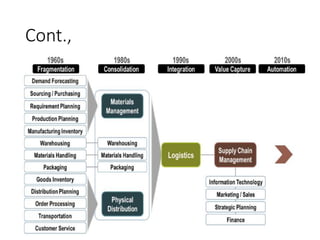
Inbound logistics + Material Management + Physical
Distribution = Logistics
1. Inbound logistics means the movement of materials
received from suppliers.
2. Material management means the movement of material
and components inside a firm.
3. Physical distribution refers to movement of goods
outward from the end of the assembly line to the
customer.
4. Supply-chain management is larger than logistics and it
links logistics more directly within the user’s total
communication network and with the firm engineering
staff. It not only includes manufacturer and suppliers but
also transporters, warehouses, retailers and customers
themselves
Cont.,
5. According to Council of Logistics Management:
“Logistics is the process of planning, implementing
and controlling the efficient, effective flow and
storage of goods, services and related information
from the point of origin to the point of consumption
for the purpose of conforming the customer
requirement”.
Cont.,
• Logistics management includes the design and
administration of systems to control the flow of
material, work-in-process, and finished inventory to
support business unit strategy.
Concept of Logistics
• Logistics is that part of the supply chain process
that plans, implements and controls the effective
forward and reverse flow and storage of goods,
services, and related information between the
point of origin and the point of consumption, in
order to meet the customer’s requirements.
Logistics Activities (14)
• Customers service
• Demand forecasting
• Distribution communication
• Inventory control
• Material handling
• Order processing
• Part and service support
• Plant and warehouse side selection
Cont.,
• Procurement
• Packaging
• Return goods handling
• Salvage and scrap disposal
• Traffic and transportation
• Warehousing and storage
Cont.,
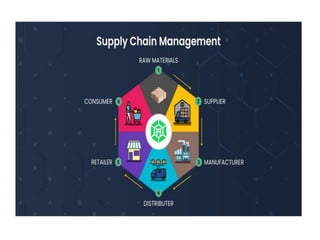
• Logistics is typically considered as a sub-set of SCM.
In SCM, five key functions are: Procure, Make,
Move, Store, and Service. Most view logistics as
the movement of products from point A to point B
and all the activities involved to make this happen
(from carrier selection to planning to execution).
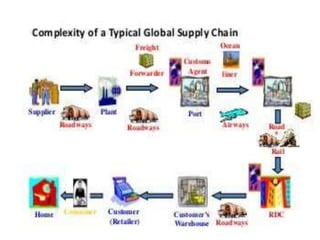
• Logistics is involved at various stages of a supply
chain; from supplier to plants, from plants to
distribution centres, from distributions centres to
stores, from stores to customers, or any of these
combinations.
• Logistics is the process of movement of materials
and products into, through and out of a firm.
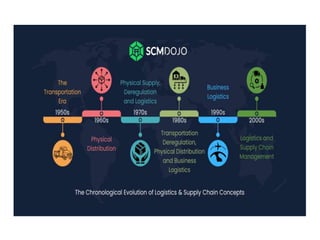
Evolution of Logistics and SCM
• Logistics typically refers to activities that occur
within the boundaries of a single organization and
Supply Chain refers to networks of companies that
work together and coordinate their actions to
deliver a product to market. Also, traditional
logistics focuses its attention on activities such
as procurement, distribution, maintenance,
and inventory management.
Cont.,

UNIT 1.pptx

  • 1.
    Unit 1 Basics ofLogistics: Basic concept - Importance – Evolution of Logistics & Supply Chain Management Objectives of Logistics – Outsourcing - Logistical Activities - 3rd and 4th party Logistics – Logistics Information System
  • 2.
    Introduction Logistics is theone of the most important segment of the phenomenon of Marketing in business. It is a subset of Supply Chain Management. In the business functioning, the trader gets order for supply of his goods or services through his marketing executives or directly from customers and then to execute the order to the satisfaction of the customer, the trader or his supplier company prepares the Logistics i.e., procures the product or services, puts labels on them, or gives some identification trademark name to them, makes necessary packing and packaging so as to save them from damage of any kind during loading, unloading, handling, transportation etc., till is supplied to the end customer. More simply, it is a bundle of goods finally ready to be supplied to the customer. In Logistics study, all factors contributing till the last stage, when the goods or service is finally supplied to the consumer are systematically studied.
  • 3.
    Definition and Conceptof Logistics The word, ‘Logistics’ is derived from French word ‘Loger’, which means art of war pertaining to movement and supply of armies. 1. A military concept 2. Fighting a war requires: (i) Setting an objective (ii) Meticulous planning to achieve the objective (iii) Proper deployment of troops (iv) Supply lines consisting of weaponry, food, etc. A logistics plan should be such that there is minimum loss of men and material.
  • 4.
    Cont., Inbound logistics +Material Management + Physical Distribution = Logistics 1. Inbound logistics means the movement of materials received from suppliers. 2. Material management means the movement of material and components inside a firm. 3. Physical distribution refers to movement of goods outward from the end of the assembly line to the customer. 4. Supply-chain management is larger than logistics and it links logistics more directly within the user’s total communication network and with the firm engineering staff. It not only includes manufacturer and suppliers but also transporters, warehouses, retailers and customers themselves
  • 5.
    Cont., 5. According toCouncil of Logistics Management: “Logistics is the process of planning, implementing and controlling the efficient, effective flow and storage of goods, services and related information from the point of origin to the point of consumption for the purpose of conforming the customer requirement”.
  • 6.
    Cont., • Logistics managementincludes the design and administration of systems to control the flow of material, work-in-process, and finished inventory to support business unit strategy.
  • 7.
    Concept of Logistics •Logistics is that part of the supply chain process that plans, implements and controls the effective forward and reverse flow and storage of goods, services, and related information between the point of origin and the point of consumption, in order to meet the customer’s requirements.
  • 8.
    Logistics Activities (14) •Customers service • Demand forecasting • Distribution communication • Inventory control • Material handling • Order processing • Part and service support • Plant and warehouse side selection
  • 9.
    Cont., • Procurement • Packaging •Return goods handling • Salvage and scrap disposal • Traffic and transportation • Warehousing and storage
  • 11.
    Cont., • Logistics istypically considered as a sub-set of SCM. In SCM, five key functions are: Procure, Make, Move, Store, and Service. Most view logistics as the movement of products from point A to point B and all the activities involved to make this happen (from carrier selection to planning to execution). • Logistics is involved at various stages of a supply chain; from supplier to plants, from plants to distribution centres, from distributions centres to stores, from stores to customers, or any of these combinations. • Logistics is the process of movement of materials and products into, through and out of a firm.
  • 12.
    Evolution of Logisticsand SCM • Logistics typically refers to activities that occur within the boundaries of a single organization and Supply Chain refers to networks of companies that work together and coordinate their actions to deliver a product to market. Also, traditional logistics focuses its attention on activities such as procurement, distribution, maintenance, and inventory management.
  • 15.