Performance Analysis of Solar Chimney
Submitted to - Presented by-
Mechanical Engg. Dept. Robin Jain
MNIT 2014PTE5059
M.Tech Thermal Engineering
MALAVIYA NATIONAL INSTITUTE OF TECHNOLOGY,
JAIPUR
Introduction
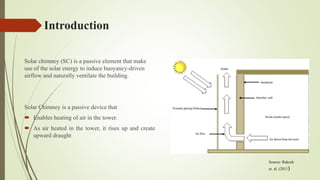
Solar chimney (SC) is a passive element that make
use of the solar energy to induce buoyancy-driven
airflow and naturally ventilate the building.
Solar Chimney is a passive device that
 Enables heating of air in the tower.
 As air heated in the tower, it rises up and create
upward draught
Source: Rakesh
et. al. (2011)
Working Principle of Solar Chimney
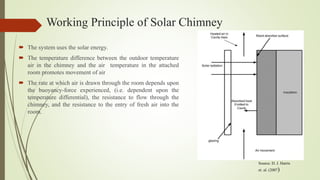
 The system uses the solar energy.
 The temperature difference between the outdoor temperature
air in the chimney and the air temperature in the attached
room promotes movement of air
 The rate at which air is drawn through the room depends upon
the buoyancy-force experienced, (i.e. dependent upon the
temperature differential), the resistance to flow through the
chimney, and the resistance to the entry of fresh air into the
room.
Source: D. J. Harris
et. al. (2007)
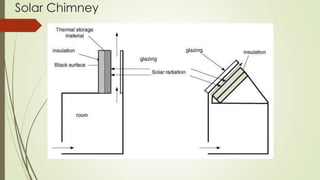
Solar Chimney
Types of Solar Chimney
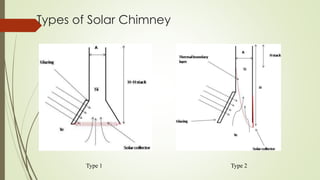
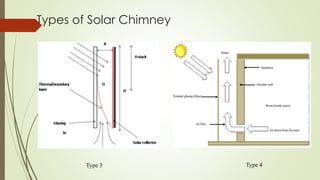
There are four general types of solar chimney:
1. Open loop system
2. Closed loop system
Types of Solar Chimney
Type 1 Type 2
Types of Solar Chimney
Type 3 Type 4
Advantages and Disadvantages of Solar Chimney
Advantages:
1. simple to use and easy to maintain.
2. low maintenance cost and the electricity cost saving
3. no harmful impact on the environment.
Disadvantages:
1. High initial investment cost.
2. Recommended for new houses which has excellent insulation and air-tightness.
3. Space requirement is the major hindrance.
4. Skilled man power required for well designing of system.
Applications of Solar Chimney
Solar Chimney can be used in a vast variety of fields:
 In the generation of electricity
 Integrated in buildings as a natural ventilation device
 Sunrooms can also be designed to function like solar
chimneys
 Integrated in buildings as a heating device
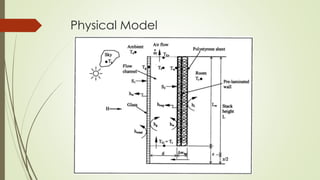
Physical Model
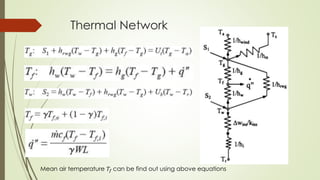
Thermal Network
Mean air temperature 𝑇𝑓 can be find out using above equations
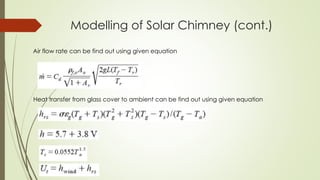
Modelling of Solar Chimney (cont.)
Air flow rate can be find out using given equation
Heat transfer from glass cover to ambient can be find out using given equation
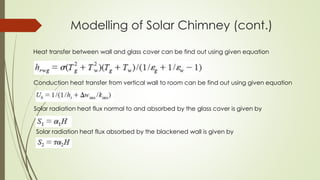
Modelling of Solar Chimney (cont.)
Heat transfer between wall and glass cover can be find out using given equation
Conduction heat transfer from vertical wall to room can be find out using given equation
Solar radiation heat flux normal to and absorbed by the glass cover is given by
Solar radiation heat flux absorbed by the blackened wall is given by
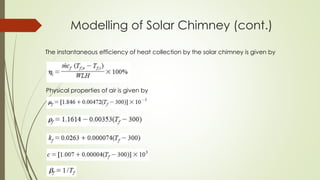
Modelling of Solar Chimney (cont.)
The instantaneous efficiency of heat collection by the solar chimney is given by
Physical properties of air is given by
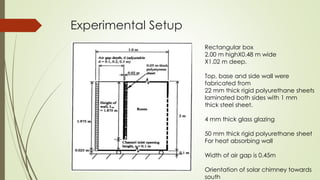
Experimental Setup
Rectangular box
2.00 m highX0.48 m wide
X1.02 m deep.
Top, base and side wall were
fabricated from
22 mm thick rigid polyurethane sheets
laminated both sides with 1 mm
thick steel sheet.
4 mm thick glass glazing
50 mm thick rigid polyurethane sheet
For heat absorbing wall
Width of air gap is 0.45m
Orientation of solar chimney towards
south
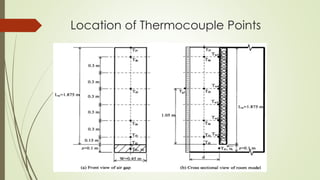
Location of Thermocouple Points
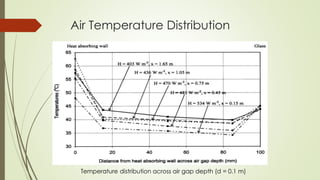
Air Temperature Distribution
Temperature distribution across air gap depth (d = 0.1 m)
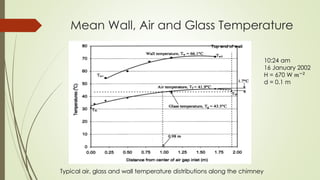
Mean Wall, Air and Glass Temperature
Typical air, glass and wall temperature distributions along the chimney
10:24 am
16 January 2002
H = 670 W 𝑚−2
d = 0.1 m
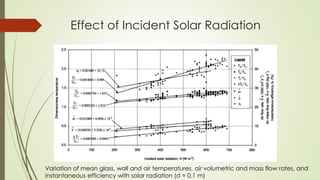
Effect of Incident Solar Radiation
Variation of mean glass, wall and air temperatures, air volumetric and mass flow rates, and
instantaneous efficiency with solar radiation (d = 0.1 m)
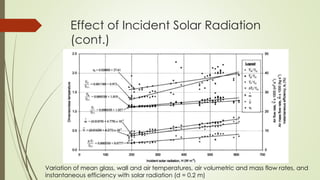
Effect of Incident Solar Radiation
(cont.)
Variation of mean glass, wall and air temperatures, air volumetric and mass flow rates, and
instantaneous efficiency with solar radiation (d = 0.2 m)
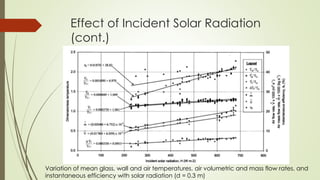
Effect of Incident Solar Radiation
(cont.)
Variation of mean glass, wall and air temperatures, air volumetric and mass flow rates, and
instantaneous efficiency with solar radiation (d = 0.3 m)
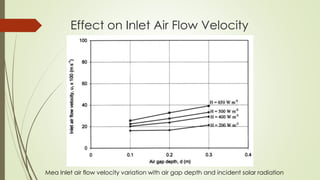
Effect on Inlet Air Flow Velocity
Mea Inlet air flow velocity variation with air gap depth and incident solar radiation
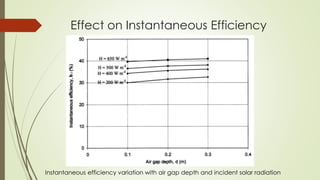
Effect on Instantaneous Efficiency
Instantaneous efficiency variation with air gap depth and incident solar radiation
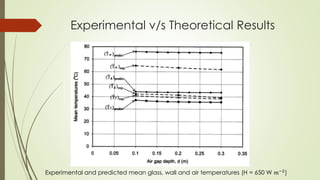
Experimental v/s Theoretical Results
Experimental and predicted mean glass, wall and air temperatures (H = 650 W 𝑚−2)
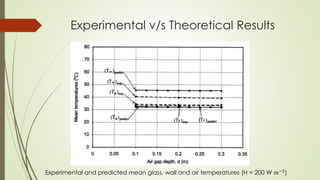
Experimental v/s Theoretical Results
Experimental and predicted mean glass, wall and air temperatures (H = 200 W 𝑚−2)
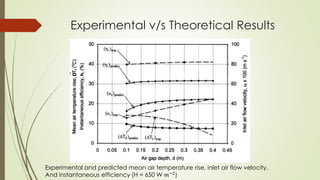
Experimental v/s Theoretical Results
Experimental and predicted mean air temperature rise, inlet air flow velocity,
And instantaneous efficiency (H = 650 W 𝑚−2
)
Experimental v/s Theoretical Results
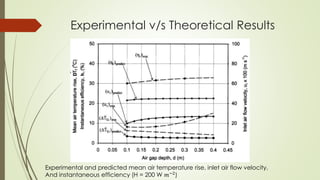
Experimental and predicted mean air temperature rise, inlet air flow velocity,
And instantaneous efficiency (H = 200 W 𝑚−2
)
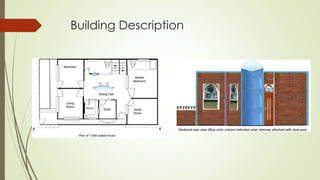
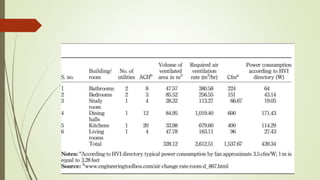
Building Description
Conclusion
 No reverse flow was observed up to 0.3 m gap
 The experimental and theoretical results have more satisfactory agreement
for large air gap.
References
 [1] K.S. Ong*, C. C. Chow, Performance of a Solar Chimney.
Solar chimney

Solar chimney

  • 1.
    Performance Analysis ofSolar Chimney Submitted to - Presented by- Mechanical Engg. Dept. Robin Jain MNIT 2014PTE5059 M.Tech Thermal Engineering MALAVIYA NATIONAL INSTITUTE OF TECHNOLOGY, JAIPUR
  • 2.
    Introduction Solar chimney (SC)is a passive element that make use of the solar energy to induce buoyancy-driven airflow and naturally ventilate the building. Solar Chimney is a passive device that  Enables heating of air in the tower.  As air heated in the tower, it rises up and create upward draught Source: Rakesh et. al. (2011)
  • 3.
    Working Principle ofSolar Chimney  The system uses the solar energy.  The temperature difference between the outdoor temperature air in the chimney and the air temperature in the attached room promotes movement of air  The rate at which air is drawn through the room depends upon the buoyancy-force experienced, (i.e. dependent upon the temperature differential), the resistance to flow through the chimney, and the resistance to the entry of fresh air into the room. Source: D. J. Harris et. al. (2007)
  • 4.
  • 5.
    Types of SolarChimney There are four general types of solar chimney: 1. Open loop system 2. Closed loop system
  • 6.
    Types of SolarChimney Type 1 Type 2
  • 7.
    Types of SolarChimney Type 3 Type 4
  • 8.
    Advantages and Disadvantagesof Solar Chimney Advantages: 1. simple to use and easy to maintain. 2. low maintenance cost and the electricity cost saving 3. no harmful impact on the environment. Disadvantages: 1. High initial investment cost. 2. Recommended for new houses which has excellent insulation and air-tightness. 3. Space requirement is the major hindrance. 4. Skilled man power required for well designing of system.
  • 9.
    Applications of SolarChimney Solar Chimney can be used in a vast variety of fields:  In the generation of electricity  Integrated in buildings as a natural ventilation device  Sunrooms can also be designed to function like solar chimneys  Integrated in buildings as a heating device
  • 11.
  • 12.
    Thermal Network Mean airtemperature 𝑇𝑓 can be find out using above equations
  • 13.
    Modelling of SolarChimney (cont.) Air flow rate can be find out using given equation Heat transfer from glass cover to ambient can be find out using given equation
  • 14.
    Modelling of SolarChimney (cont.) Heat transfer between wall and glass cover can be find out using given equation Conduction heat transfer from vertical wall to room can be find out using given equation Solar radiation heat flux normal to and absorbed by the glass cover is given by Solar radiation heat flux absorbed by the blackened wall is given by
  • 15.
    Modelling of SolarChimney (cont.) The instantaneous efficiency of heat collection by the solar chimney is given by Physical properties of air is given by
  • 16.
    Experimental Setup Rectangular box 2.00m highX0.48 m wide X1.02 m deep. Top, base and side wall were fabricated from 22 mm thick rigid polyurethane sheets laminated both sides with 1 mm thick steel sheet. 4 mm thick glass glazing 50 mm thick rigid polyurethane sheet For heat absorbing wall Width of air gap is 0.45m Orientation of solar chimney towards south
  • 18.
  • 19.
    Air Temperature Distribution Temperaturedistribution across air gap depth (d = 0.1 m)
  • 20.
    Mean Wall, Airand Glass Temperature Typical air, glass and wall temperature distributions along the chimney 10:24 am 16 January 2002 H = 670 W 𝑚−2 d = 0.1 m
  • 21.
    Effect of IncidentSolar Radiation Variation of mean glass, wall and air temperatures, air volumetric and mass flow rates, and instantaneous efficiency with solar radiation (d = 0.1 m)
  • 22.
    Effect of IncidentSolar Radiation (cont.) Variation of mean glass, wall and air temperatures, air volumetric and mass flow rates, and instantaneous efficiency with solar radiation (d = 0.2 m)
  • 23.
    Effect of IncidentSolar Radiation (cont.) Variation of mean glass, wall and air temperatures, air volumetric and mass flow rates, and instantaneous efficiency with solar radiation (d = 0.3 m)
  • 24.
    Effect on InletAir Flow Velocity Mea Inlet air flow velocity variation with air gap depth and incident solar radiation
  • 25.
    Effect on InstantaneousEfficiency Instantaneous efficiency variation with air gap depth and incident solar radiation
  • 27.
    Experimental v/s TheoreticalResults Experimental and predicted mean glass, wall and air temperatures (H = 650 W 𝑚−2)
  • 28.
    Experimental v/s TheoreticalResults Experimental and predicted mean glass, wall and air temperatures (H = 200 W 𝑚−2)
  • 29.
    Experimental v/s TheoreticalResults Experimental and predicted mean air temperature rise, inlet air flow velocity, And instantaneous efficiency (H = 650 W 𝑚−2 )
  • 30.
    Experimental v/s TheoreticalResults Experimental and predicted mean air temperature rise, inlet air flow velocity, And instantaneous efficiency (H = 200 W 𝑚−2 )
  • 34.
  • 36.
    Conclusion  No reverseflow was observed up to 0.3 m gap  The experimental and theoretical results have more satisfactory agreement for large air gap.
  • 37.
    References  [1] K.S.Ong*, C. C. Chow, Performance of a Solar Chimney.