Department of English Language and Literature
Major: English Language and Literature
Semantics Session 6
“Referring expressions, Predicator & predicate”
Dr. Badriya Al Mamari
Academic year 2021/2022
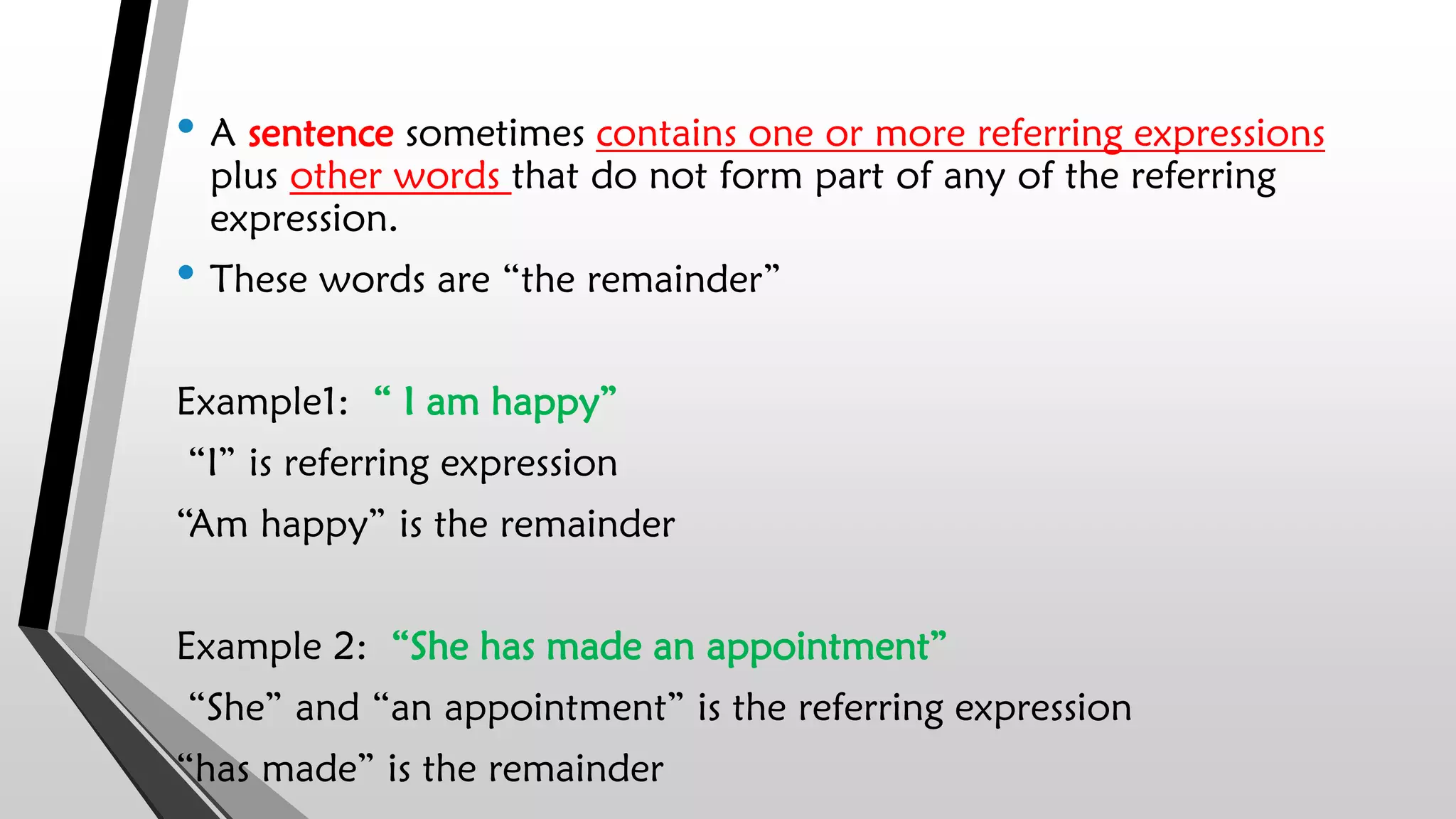
• A sentence sometimes contains one or more referring expressions
plus other words that do not form part of any of the referring
expression.
• These words are “the remainder”
Example1: “ I am happy”
“I” is referring expression
“Am happy” is the remainder
Example 2: “She has made an appointment”
“She” and “an appointment” is the referring expression
“has made” is the remainder
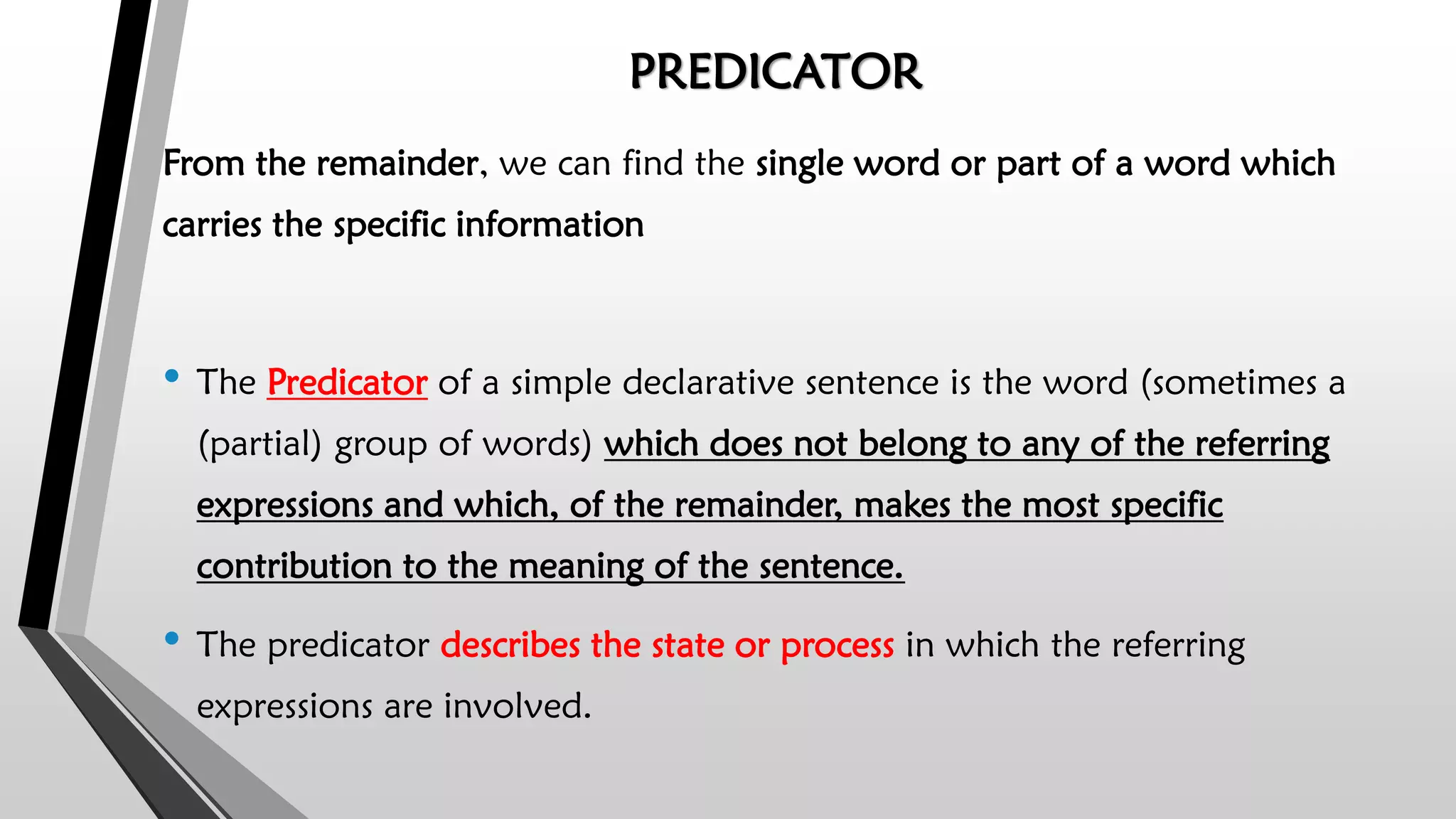
PREDICATOR
From the remainder, we can find the single word or part of a word which
carries the specific information
• The Predicator of a simple declarative sentence is the word (sometimes a
(partial) group of words) which does not belong to any of the referring
expressions and which, of the remainder, makes the most specific
contribution to the meaning of the sentence.
• The predicator describes the state or process in which the referring
expressions are involved.
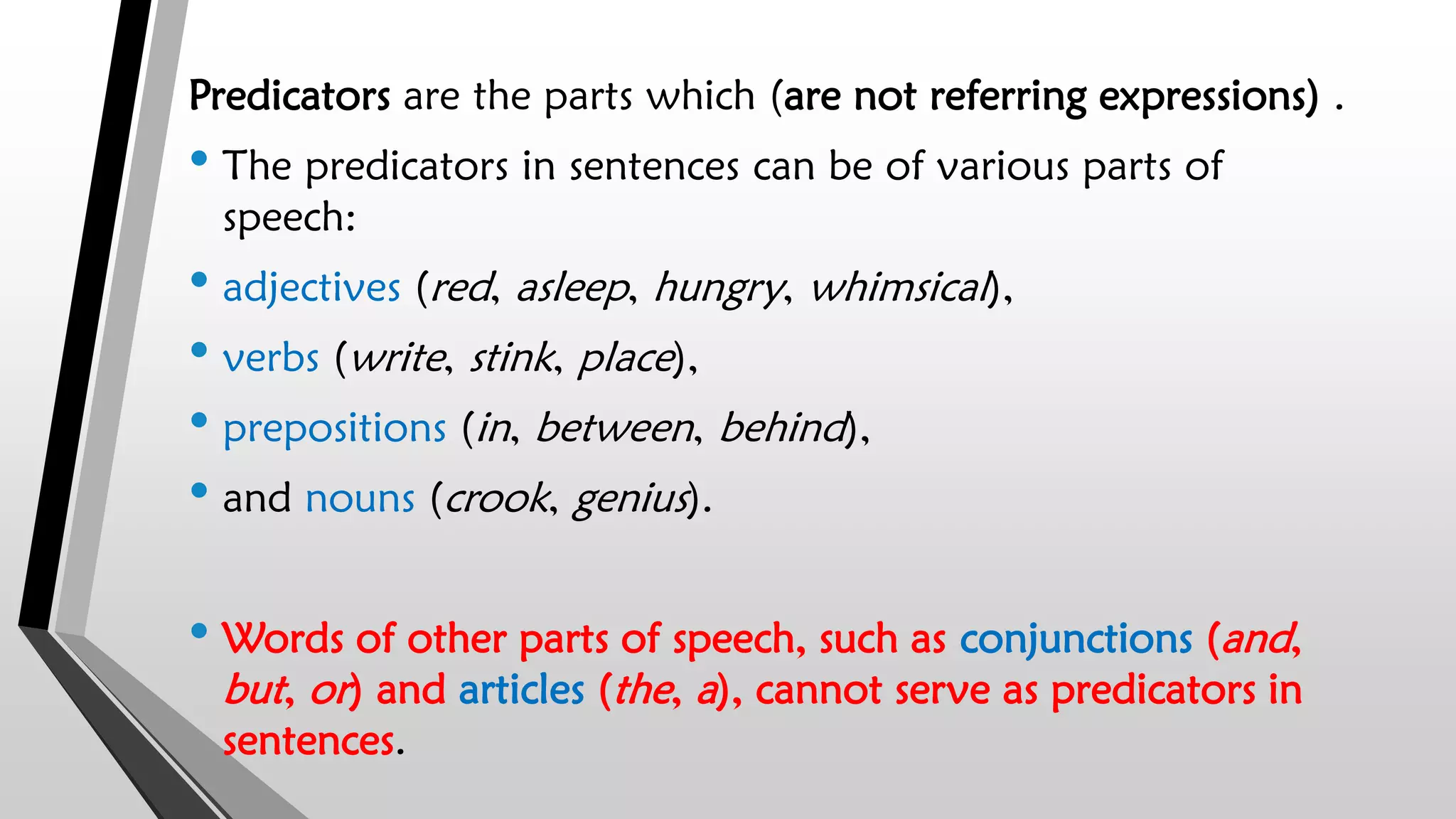
Predicators are the parts which (are not referring expressions) .
• The predicators in sentences can be of various parts of
speech:
• adjectives (red, asleep, hungry, whimsical),
• verbs (write, stink, place),
• prepositions (in, between, behind),
• and nouns (crook, genius).
• Words of other parts of speech, such as conjunctions (and,
but, or) and articles (the, a), cannot serve as predicators in
sentences.
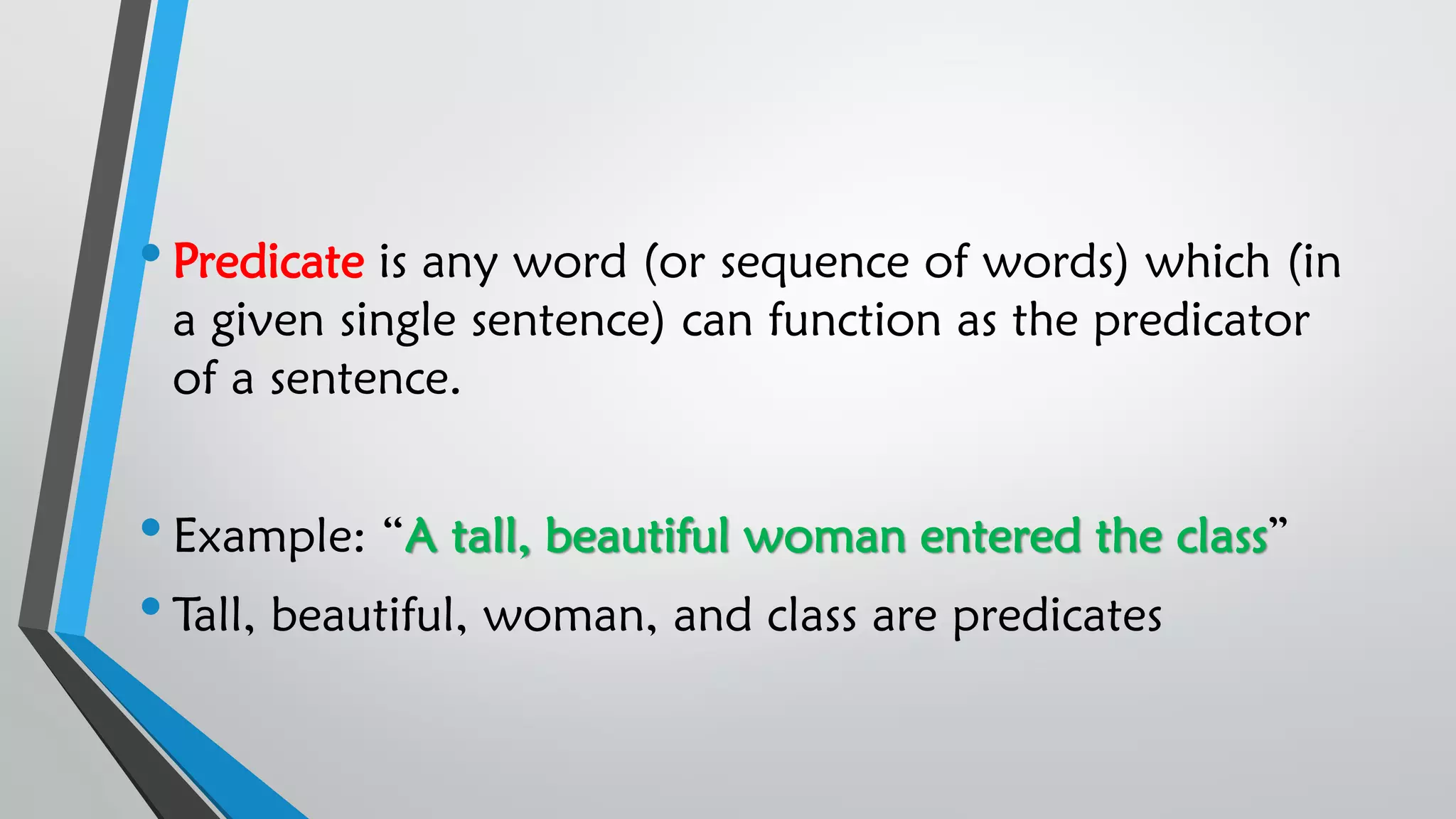
•Predicate is any word (or sequence of words) which (in
a given single sentence) can function as the predicator
of a sentence.
•Example: “A tall, beautiful woman entered the class”
•Tall, beautiful, woman, and class are predicates
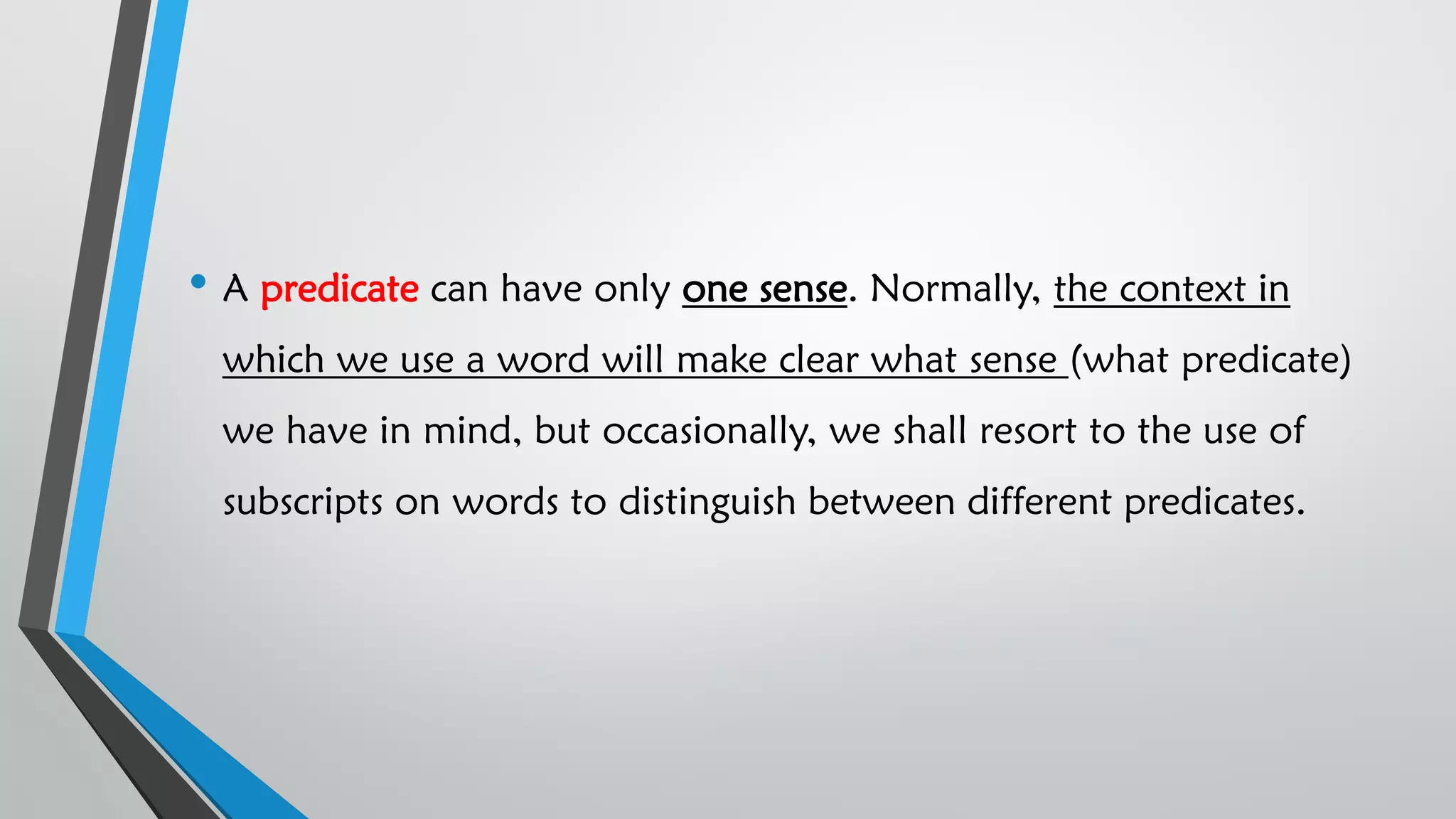
• A predicate can have only one sense. Normally, the context in
which we use a word will make clear what sense (what predicate)
we have in mind, but occasionally, we shall resort to the use of
subscripts on words to distinguish between different predicates.
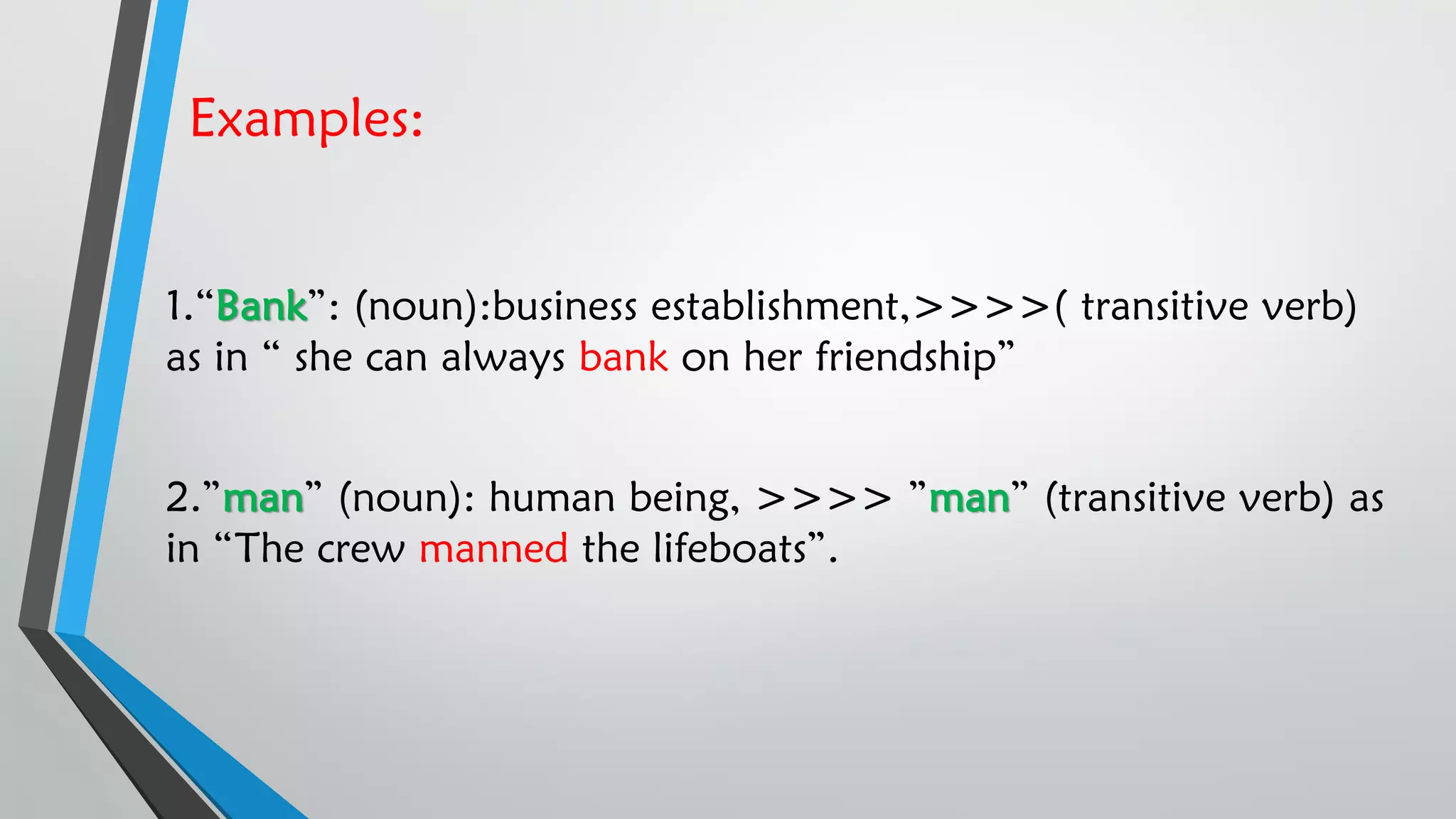
Examples:
1.“Bank”: (noun):business establishment,>>>>( transitive verb)
as in “ she can always bank on her friendship”
2.”man” (noun): human being, >>>> ”man” (transitive verb) as
in “The crew manned the lifeboats”.
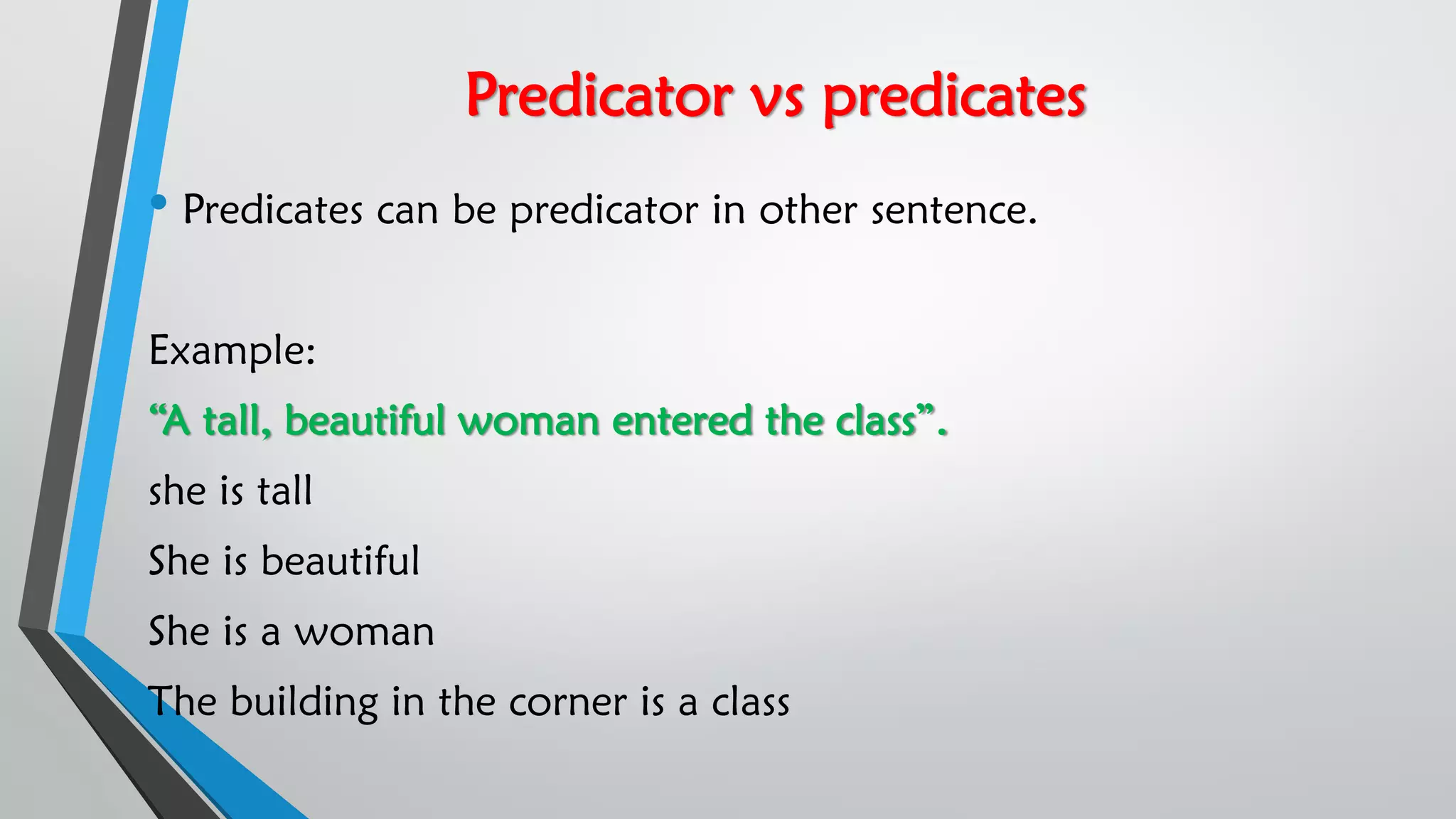
Predicator vs predicates
• Predicates can be predicator in other sentence.
Example:
“A tall, beautiful woman entered the class”.
she is tall
She is beautiful
She is a woman
The building in the corner is a class
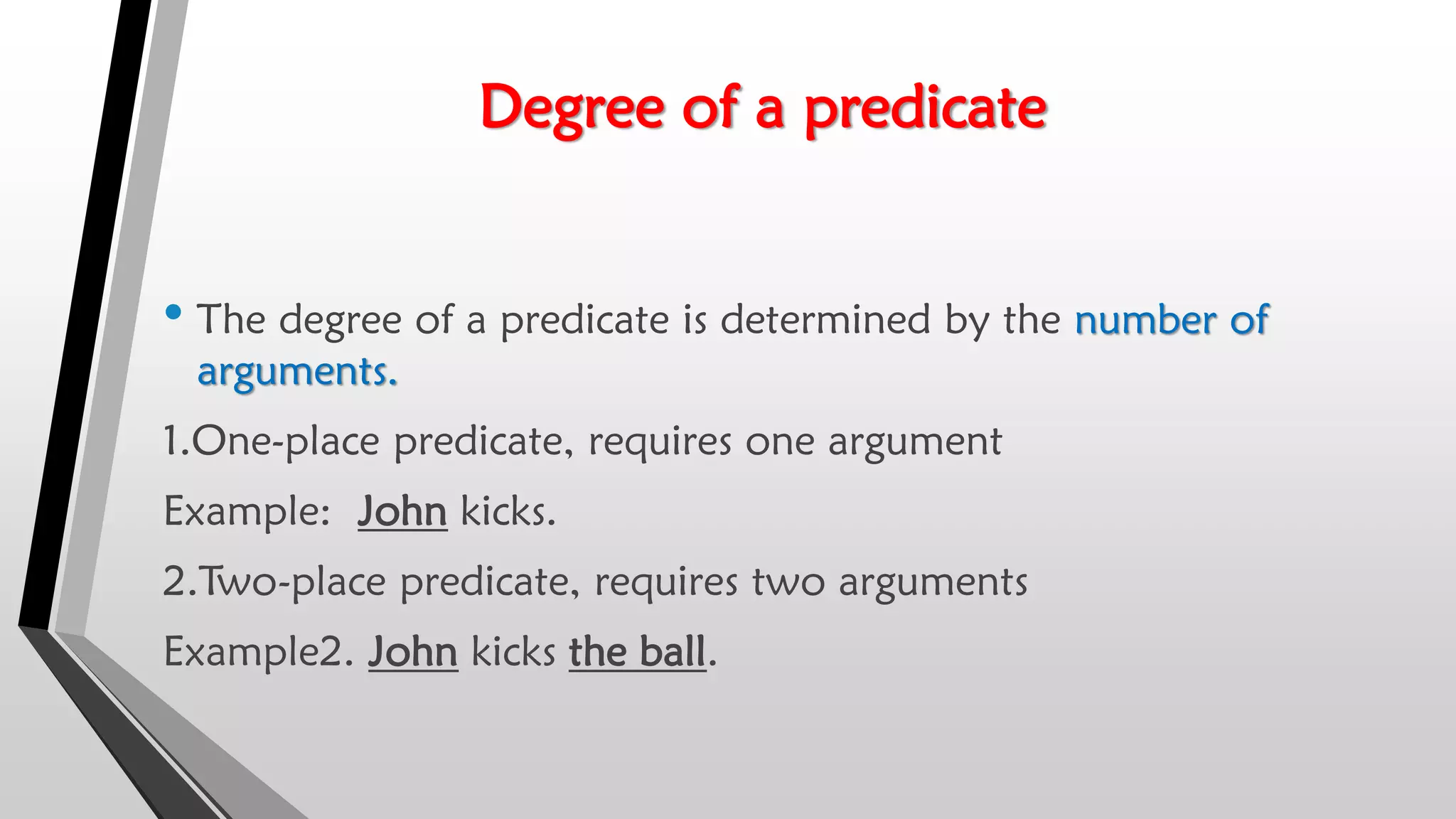
Degree of a predicate
• The degree of a predicate is determined by the number of
arguments.
1.One-place predicate, requires one argument
Example: John kicks.
2.Two-place predicate, requires two arguments
Example2. John kicks the ball.
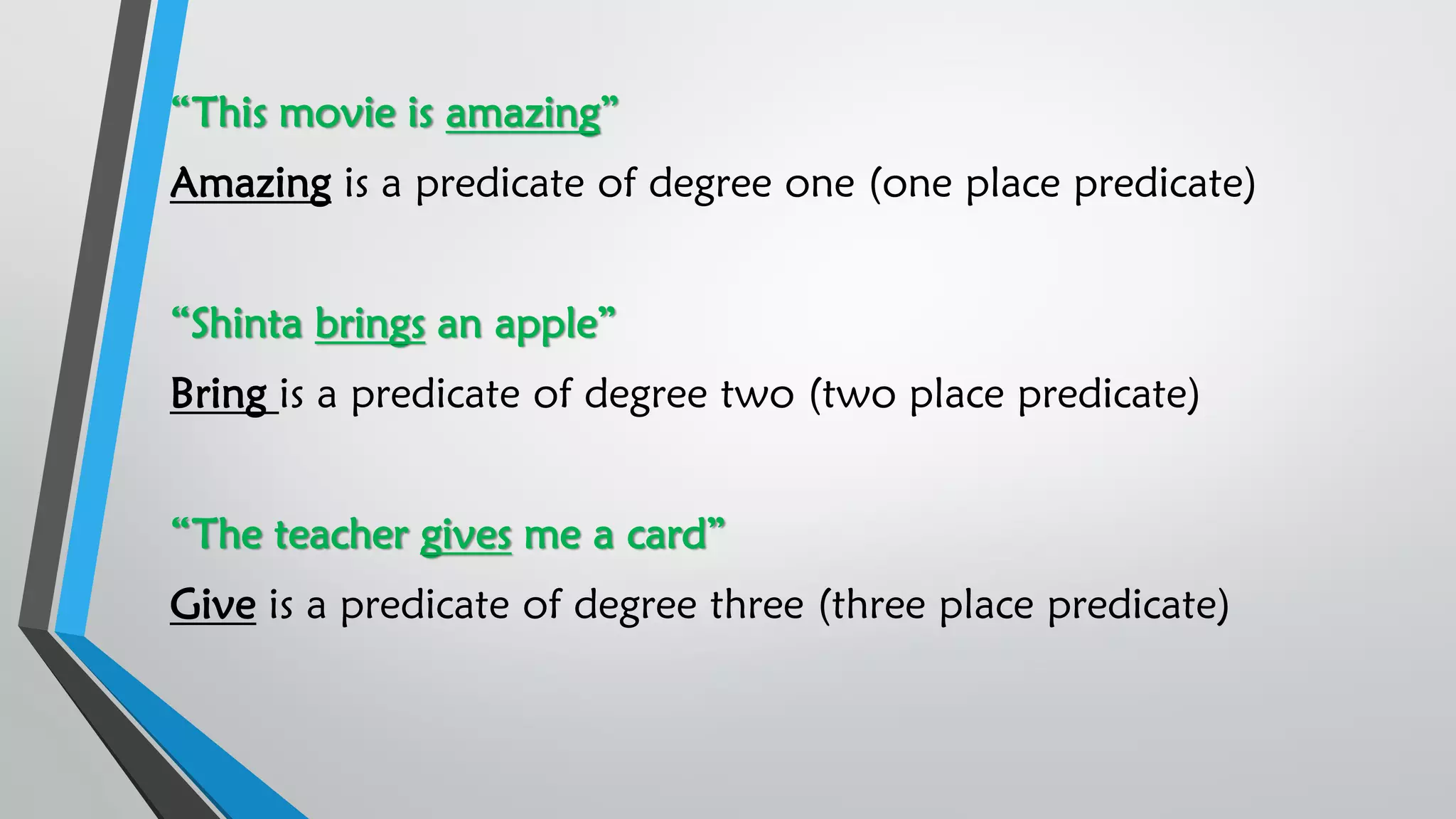
“This movie is amazing”
Amazing is a predicate of degree one (one place predicate)
“Shinta brings an apple”
Bring is a predicate of degree two (two place predicate)
“The teacher gives me a card”
Give is a predicate of degree three (three place predicate)
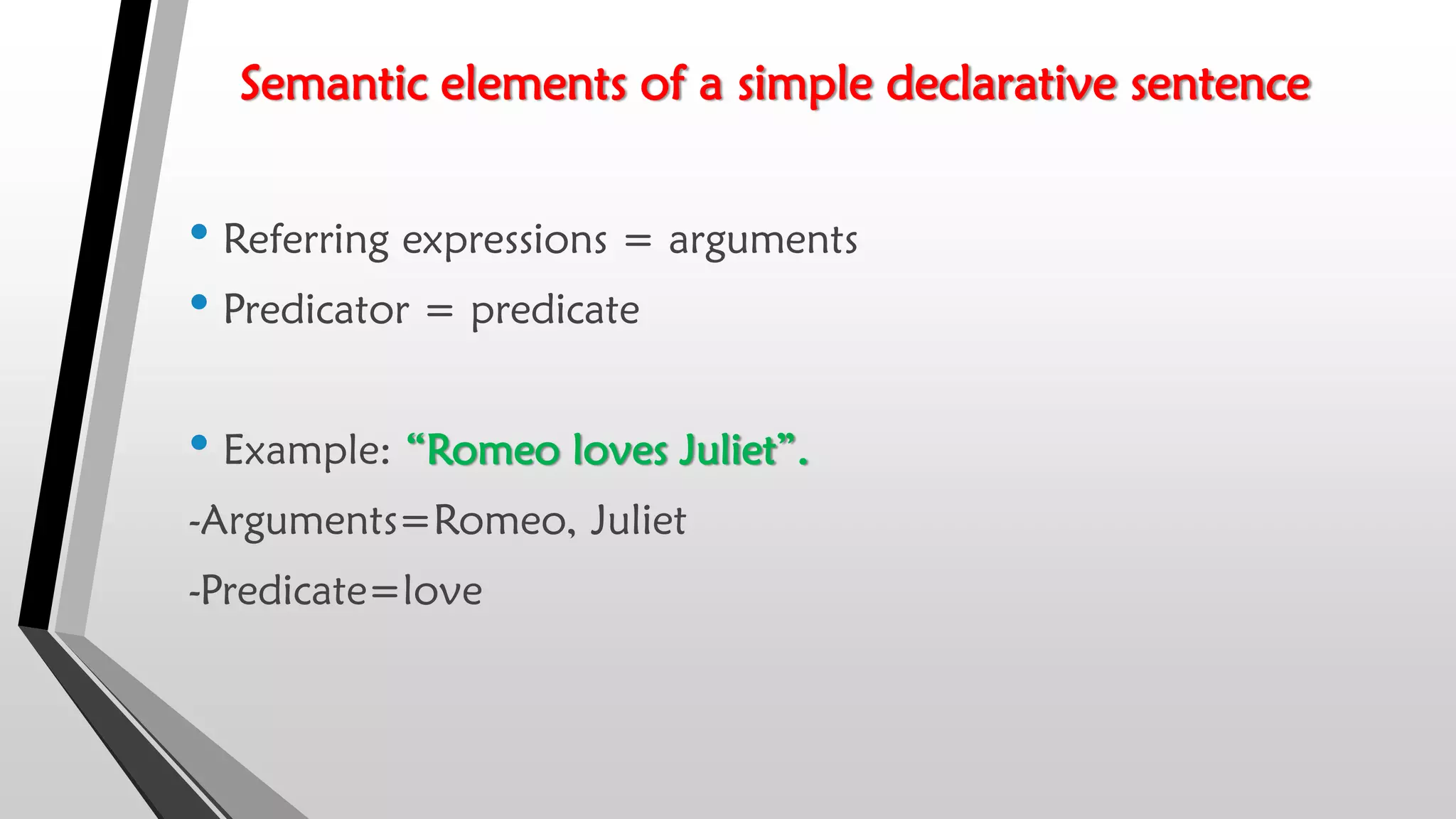
Semantic elements of a simple declarative sentence
• Referring expressions = arguments
• Predicator = predicate
• Example: “Romeo loves Juliet”.
-Arguments=Romeo, Juliet
-Predicate=love
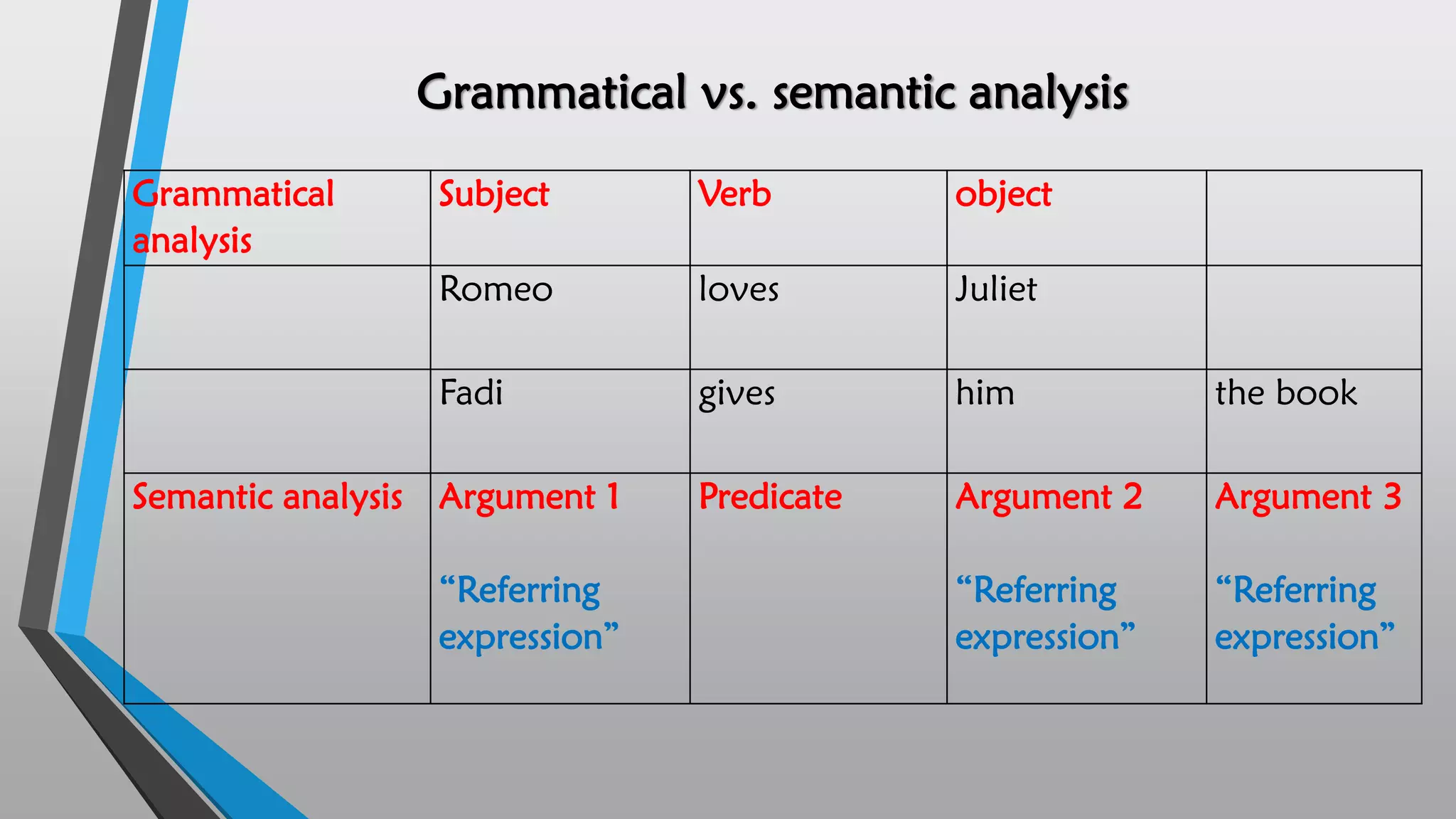
Grammatical vs. semantic analysis
Grammatical
analysis
Subject Verb object
Romeo loves Juliet
Fadi gives him the book
Semantic analysis Argument 1
“Referring
expression”
Predicate Argument 2
“Referring
expression”
Argument 3
“Referring
expression”
How do we talk about the non- existent things?
• Can language be used to talk about an unreal imaginative
world?
• 1. Narnia
• 2. Harry Potter
References:
Hurford, J. R., Heasley, B., & Smith, M. B. (2007). Semantics: a coursebook.
Cambridge university press.

Semantics session 6_27_10_2021.pdf

  • 1.
    Department of EnglishLanguage and Literature Major: English Language and Literature Semantics Session 6 “Referring expressions, Predicator & predicate” Dr. Badriya Al Mamari Academic year 2021/2022
  • 2.
    • A sentencesometimes contains one or more referring expressions plus other words that do not form part of any of the referring expression. • These words are “the remainder” Example1: “ I am happy” “I” is referring expression “Am happy” is the remainder Example 2: “She has made an appointment” “She” and “an appointment” is the referring expression “has made” is the remainder
  • 3.
    PREDICATOR From the remainder,we can find the single word or part of a word which carries the specific information • The Predicator of a simple declarative sentence is the word (sometimes a (partial) group of words) which does not belong to any of the referring expressions and which, of the remainder, makes the most specific contribution to the meaning of the sentence. • The predicator describes the state or process in which the referring expressions are involved.
  • 4.
    Predicators are theparts which (are not referring expressions) . • The predicators in sentences can be of various parts of speech: • adjectives (red, asleep, hungry, whimsical), • verbs (write, stink, place), • prepositions (in, between, behind), • and nouns (crook, genius). • Words of other parts of speech, such as conjunctions (and, but, or) and articles (the, a), cannot serve as predicators in sentences.
  • 5.
    •Predicate is anyword (or sequence of words) which (in a given single sentence) can function as the predicator of a sentence. •Example: “A tall, beautiful woman entered the class” •Tall, beautiful, woman, and class are predicates
  • 6.
    • A predicatecan have only one sense. Normally, the context in which we use a word will make clear what sense (what predicate) we have in mind, but occasionally, we shall resort to the use of subscripts on words to distinguish between different predicates.
  • 7.
    Examples: 1.“Bank”: (noun):business establishment,>>>>(transitive verb) as in “ she can always bank on her friendship” 2.”man” (noun): human being, >>>> ”man” (transitive verb) as in “The crew manned the lifeboats”.
  • 8.
    Predicator vs predicates •Predicates can be predicator in other sentence. Example: “A tall, beautiful woman entered the class”. she is tall She is beautiful She is a woman The building in the corner is a class
  • 9.
    Degree of apredicate • The degree of a predicate is determined by the number of arguments. 1.One-place predicate, requires one argument Example: John kicks. 2.Two-place predicate, requires two arguments Example2. John kicks the ball.
  • 10.
    “This movie isamazing” Amazing is a predicate of degree one (one place predicate) “Shinta brings an apple” Bring is a predicate of degree two (two place predicate) “The teacher gives me a card” Give is a predicate of degree three (three place predicate)
  • 11.
    Semantic elements ofa simple declarative sentence • Referring expressions = arguments • Predicator = predicate • Example: “Romeo loves Juliet”. -Arguments=Romeo, Juliet -Predicate=love
  • 12.
    Grammatical vs. semanticanalysis Grammatical analysis Subject Verb object Romeo loves Juliet Fadi gives him the book Semantic analysis Argument 1 “Referring expression” Predicate Argument 2 “Referring expression” Argument 3 “Referring expression”
  • 13.
    How do wetalk about the non- existent things? • Can language be used to talk about an unreal imaginative world?
  • 14.
    • 1. Narnia •2. Harry Potter
  • 15.
    References: Hurford, J. R.,Heasley, B., & Smith, M. B. (2007). Semantics: a coursebook. Cambridge university press.