Digital Enterprise Research Institute                                                www.deri.ie


                      dcat: An RDF vocabulary for
                  interoperability of data catalogues
                                Richard Cyganiak, Fadi Maali, Vassilios Peristeras


 Copyright 2009 Digital Enterprise Research Institute. All rights reserved.
Agenda
Digital Enterprise Research Institute                          www.deri.ie


           Why catalogue interoperability is important
           A survey of data catalogues
           Introducing the dcat vocabulary
           First experiments with integrated catalogue data
           Where to take this next?
Government data catalogues
Digital Enterprise Research Institute                                   www.deri.ie


           Now more than 30 catalogues online
           National
                  U.S., UK, Australia, New Zealand
           State level
                  New South Wales, California, Massachusetts, Maine
           Regional and local
                  New York, San Francisco, London, Vancouver, Kent County
           Both official and private initiatives
Digital Enterprise Research Institute     www.deri.ie


            Catalogue websites do not
           unlock the full potential of the
                collected metadata.
Beyond catalogue websites
Digital Enterprise Research Institute                                         www.deri.ie


           Querying across catalogs
                  Overlapping regional coverage – U.S., California, SF
                  Supra-national catalogs – data.gov.eu?
           New user interfaces
                  Faceted browsing
                  Specialized UI for geographical/statistical/tabular sub-
                   sections of a catalogue
                  Social annotation
           Bulk processing of datasets
                  Search indexes that inspect dataset contents
                  Update notifications
Current state of interoperability
Digital Enterprise Research Institute                                       www.deri.ie


           Most major catalogues do expose their contents in
            a structured format!
                  CSV
                  Atom feeds
                  RDFa
           But using this data is difficult
                  Different formats for each catalogue
                  Different metadata fields in each
                  Metadata fields poorly documented
                  Contents of metadata fields are inconsistent or do not
                   match documentation
A survey of data catalogues
Digital Enterprise Research Institute                                      www.deri.ie


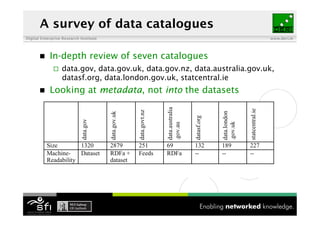
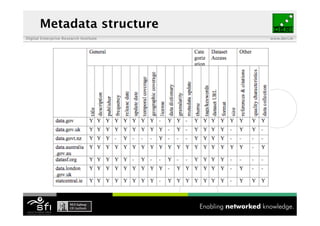
           In-depth review of seven catalogues
                  data.gov, data.gov.uk, data.gov.nz, data.australia.gov.uk,
                   datasf.org, data.london.gov.uk, statcentral.ie
           Looking at metadata, not into the datasets
Metadata structure
Digital Enterprise Research Institute   www.deri.ie
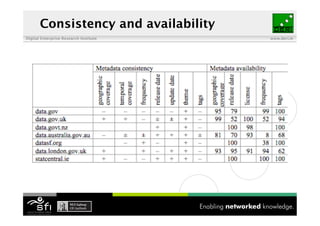
Consistency and availability
Digital Enterprise Research Institute   www.deri.ie
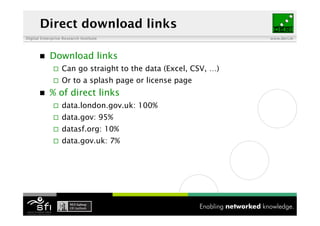
Direct download links
Digital Enterprise Research Institute                            www.deri.ie


           Download links
                  Can go straight to the data (Excel, CSV, …)
                  Or to a splash page or license page
           % of direct links
                  data.london.gov.uk: 100%
                  data.gov: 95%
                  datasf.org: 10%
                  data.gov.uk: 7%
The dcat vocabulary
Digital Enterprise Research Institute               www.deri.ie


           Intended as interoperability standard
           Vocabulary expressed in RDF Schema
           http://vocab.deri.ie/dcat#
                  Vocabulary namespace
           http://vocab.deri.ie/dcat-overview
                  Misc information
Design notes
Digital Enterprise Research Institute                          www.deri.ie


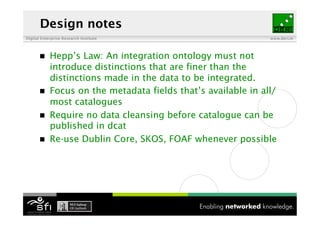
           Hepp’s Law: An integration ontology must not
            introduce distinctions that are finer than the
            distinctions made in the data to be integrated.
           Focus on the metadata fields that’s available in all/
            most catalogues
           Require no data cleansing before catalogue can be
            published in dcat
           Re-use Dublin Core, SKOS, FOAF whenever possible
Concepts
Digital Enterprise Research Institute                      www.deri.ie


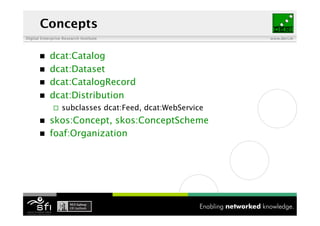
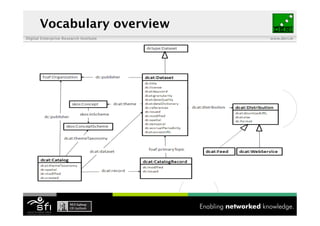
           dcat:Catalog
           dcat:Dataset
           dcat:CatalogRecord
           dcat:Distribution
                  subclasses dcat:Feed, dcat:WebService
           skos:Concept, skos:ConceptScheme
           foaf:Organization
Vocabulary overview
Digital Enterprise Research Institute   www.deri.ie
Initial experiments
Digital Enterprise Research Institute                             www.deri.ie


           Set up a D2R Server over four catalogues
                  US, AU, SF, London
                  http://lab.linkeddata.deri.ie/govcat/
                  SPARQL interface:
                   http://lab.linkeddata.deri.ie/govcat/snorql/
                  Links to Geonames, DBpedia
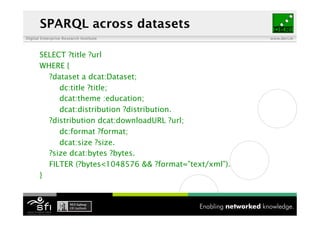
SPARQL across datasets
Digital Enterprise Research Institute                     www.deri.ie


       SELECT ?title ?url
       WHERE {
         ?dataset a dcat:Dataset;
            dc:title ?title;
            dcat:theme :education;
            dcat:distribution ?distribution.
         ?distribution dcat:downloadURL ?url;
            dc:format ?format;
            dcat:size ?size.
         ?size dcat:bytes ?bytes.
         FILTER (?bytes<1048576 && ?format=”text/xml”).
       }
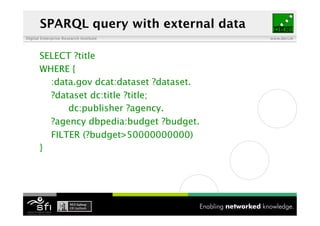
SPARQL query with external data
Digital Enterprise Research Institute       www.deri.ie


       SELECT ?title
       WHERE {
         :data.gov dcat:dataset ?dataset.
         ?dataset dc:title ?title;
             dc:publisher ?agency.
         ?agency dbpedia:budget ?budget.
         FILTER (?budget>50000000000)
       }
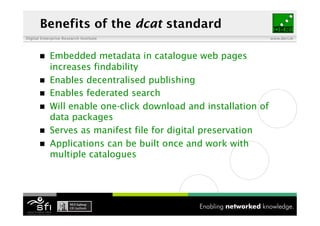
Benefits of the dcat standard
Digital Enterprise Research Institute                            www.deri.ie


           Embedded metadata in catalogue web pages
            increases findability
           Enables decentralised publishing
           Enables federated search
           Will enable one-click download and installation of
            data packages
           Serves as manifest file for digital preservation
           Applications can be built once and work with
            multiple catalogues
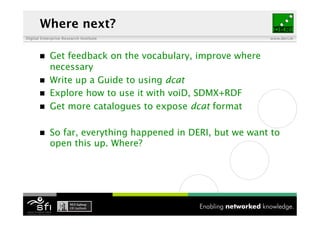
Where next?
Digital Enterprise Research Institute                       www.deri.ie


           Get feedback on the vocabulary, improve where
            necessary
           Write up a Guide to using dcat
           Explore how to use it with voiD, SDMX+RDF
           Get more catalogues to expose dcat format

           So far, everything happened in DERI, but we want to
            open this up. Where?

dcat: An RDF vocabulary for interoperability of data catalogues

  • 1.
    Digital Enterprise ResearchInstitute www.deri.ie dcat: An RDF vocabulary for interoperability of data catalogues Richard Cyganiak, Fadi Maali, Vassilios Peristeras  Copyright 2009 Digital Enterprise Research Institute. All rights reserved.
  • 2.
    Agenda Digital Enterprise ResearchInstitute www.deri.ie   Why catalogue interoperability is important   A survey of data catalogues   Introducing the dcat vocabulary   First experiments with integrated catalogue data   Where to take this next?
  • 3.
    Government data catalogues DigitalEnterprise Research Institute www.deri.ie   Now more than 30 catalogues online   National   U.S., UK, Australia, New Zealand   State level   New South Wales, California, Massachusetts, Maine   Regional and local   New York, San Francisco, London, Vancouver, Kent County   Both official and private initiatives
  • 4.
    Digital Enterprise ResearchInstitute www.deri.ie Catalogue websites do not unlock the full potential of the collected metadata.
  • 5.
    Beyond catalogue websites DigitalEnterprise Research Institute www.deri.ie   Querying across catalogs   Overlapping regional coverage – U.S., California, SF   Supra-national catalogs – data.gov.eu?   New user interfaces   Faceted browsing   Specialized UI for geographical/statistical/tabular sub- sections of a catalogue   Social annotation   Bulk processing of datasets   Search indexes that inspect dataset contents   Update notifications
  • 6.
    Current state ofinteroperability Digital Enterprise Research Institute www.deri.ie   Most major catalogues do expose their contents in a structured format!   CSV   Atom feeds   RDFa   But using this data is difficult   Different formats for each catalogue   Different metadata fields in each   Metadata fields poorly documented   Contents of metadata fields are inconsistent or do not match documentation
  • 7.
    A survey ofdata catalogues Digital Enterprise Research Institute www.deri.ie   In-depth review of seven catalogues   data.gov, data.gov.uk, data.gov.nz, data.australia.gov.uk, datasf.org, data.london.gov.uk, statcentral.ie   Looking at metadata, not into the datasets
  • 8.
    Metadata structure Digital EnterpriseResearch Institute www.deri.ie
  • 9.
    Consistency and availability DigitalEnterprise Research Institute www.deri.ie
  • 10.
    Direct download links DigitalEnterprise Research Institute www.deri.ie   Download links   Can go straight to the data (Excel, CSV, …)   Or to a splash page or license page   % of direct links   data.london.gov.uk: 100%   data.gov: 95%   datasf.org: 10%   data.gov.uk: 7%
  • 11.
    The dcat vocabulary DigitalEnterprise Research Institute www.deri.ie   Intended as interoperability standard   Vocabulary expressed in RDF Schema   http://vocab.deri.ie/dcat#   Vocabulary namespace   http://vocab.deri.ie/dcat-overview   Misc information
  • 12.
    Design notes Digital EnterpriseResearch Institute www.deri.ie   Hepp’s Law: An integration ontology must not introduce distinctions that are finer than the distinctions made in the data to be integrated.   Focus on the metadata fields that’s available in all/ most catalogues   Require no data cleansing before catalogue can be published in dcat   Re-use Dublin Core, SKOS, FOAF whenever possible
  • 13.
    Concepts Digital Enterprise ResearchInstitute www.deri.ie   dcat:Catalog   dcat:Dataset   dcat:CatalogRecord   dcat:Distribution   subclasses dcat:Feed, dcat:WebService   skos:Concept, skos:ConceptScheme   foaf:Organization
  • 14.
    Vocabulary overview Digital EnterpriseResearch Institute www.deri.ie
  • 15.
    Initial experiments Digital EnterpriseResearch Institute www.deri.ie   Set up a D2R Server over four catalogues   US, AU, SF, London   http://lab.linkeddata.deri.ie/govcat/   SPARQL interface: http://lab.linkeddata.deri.ie/govcat/snorql/   Links to Geonames, DBpedia
  • 16.
    SPARQL across datasets DigitalEnterprise Research Institute www.deri.ie SELECT ?title ?url WHERE { ?dataset a dcat:Dataset; dc:title ?title; dcat:theme :education; dcat:distribution ?distribution. ?distribution dcat:downloadURL ?url; dc:format ?format; dcat:size ?size. ?size dcat:bytes ?bytes. FILTER (?bytes<1048576 && ?format=”text/xml”). }
  • 17.
    SPARQL query withexternal data Digital Enterprise Research Institute www.deri.ie SELECT ?title WHERE { :data.gov dcat:dataset ?dataset. ?dataset dc:title ?title; dc:publisher ?agency. ?agency dbpedia:budget ?budget. FILTER (?budget>50000000000) }
  • 18.
    Benefits of thedcat standard Digital Enterprise Research Institute www.deri.ie   Embedded metadata in catalogue web pages increases findability   Enables decentralised publishing   Enables federated search   Will enable one-click download and installation of data packages   Serves as manifest file for digital preservation   Applications can be built once and work with multiple catalogues
  • 19.
    Where next? Digital EnterpriseResearch Institute www.deri.ie   Get feedback on the vocabulary, improve where necessary   Write up a Guide to using dcat   Explore how to use it with voiD, SDMX+RDF   Get more catalogues to expose dcat format   So far, everything happened in DERI, but we want to open this up. Where?