STRUCTURAL
EQUATIONS
MODELING (SEM)
Wei-Jiun, Shen Ph. D.
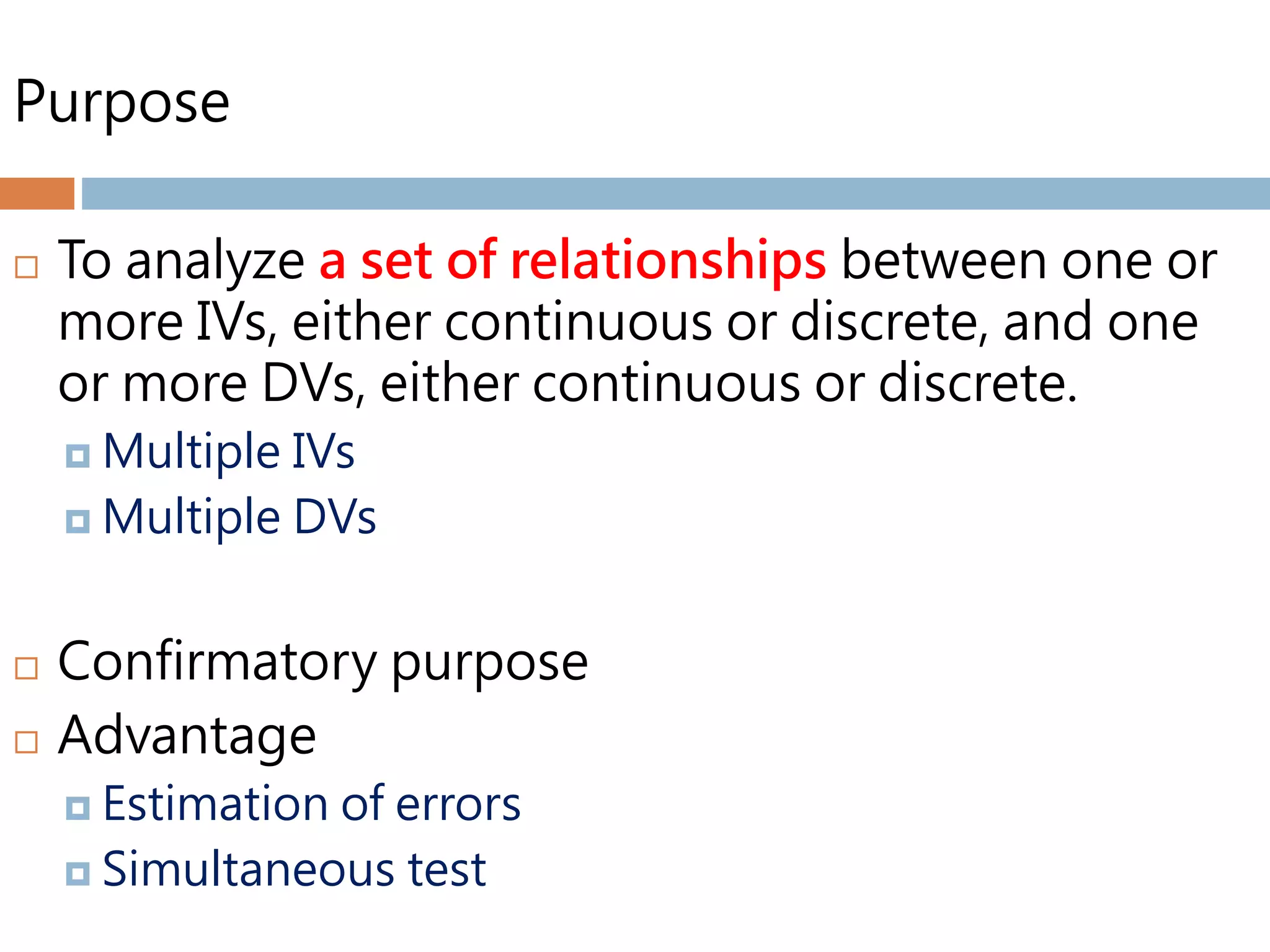
Purpose
 To analyze a set of relationships between one or
more IVs, either continuous or discrete, and one
or more DVs, either continuous or discrete.
 Multiple IVs
 Multiple DVs
 Confirmatory purpose
 Advantage
 Estimation of errors
 Simultaneous test
Kinds of research questions
 The goal of SEM is to examine whether the model
produce an estimated population covariance matrix
is fitted to the sample covariance matrix or not.
 Adequacy of model
 Testing theory
 Amount of variance in the variables accounted for by the
factors
 Reliability of the indicators
 Parameter estimates
 Intervening variables (indirect effect)
 Group difference
 Longitudinal difference
 Multilevel modeling
Limitations to factor analysis
 Theoretical issues
 Theory
 causality
 Practical issues
 Sample size and missing data
 15* umber of variable (Stevens, 1996)
 5* number of estimated parameter (Bentler & Chou, 1987)
 100 (Loehiln, 1992)
 Multivariate normality and outliers
 Linearity
 Absence of multicollinearity and singularity
 Residual
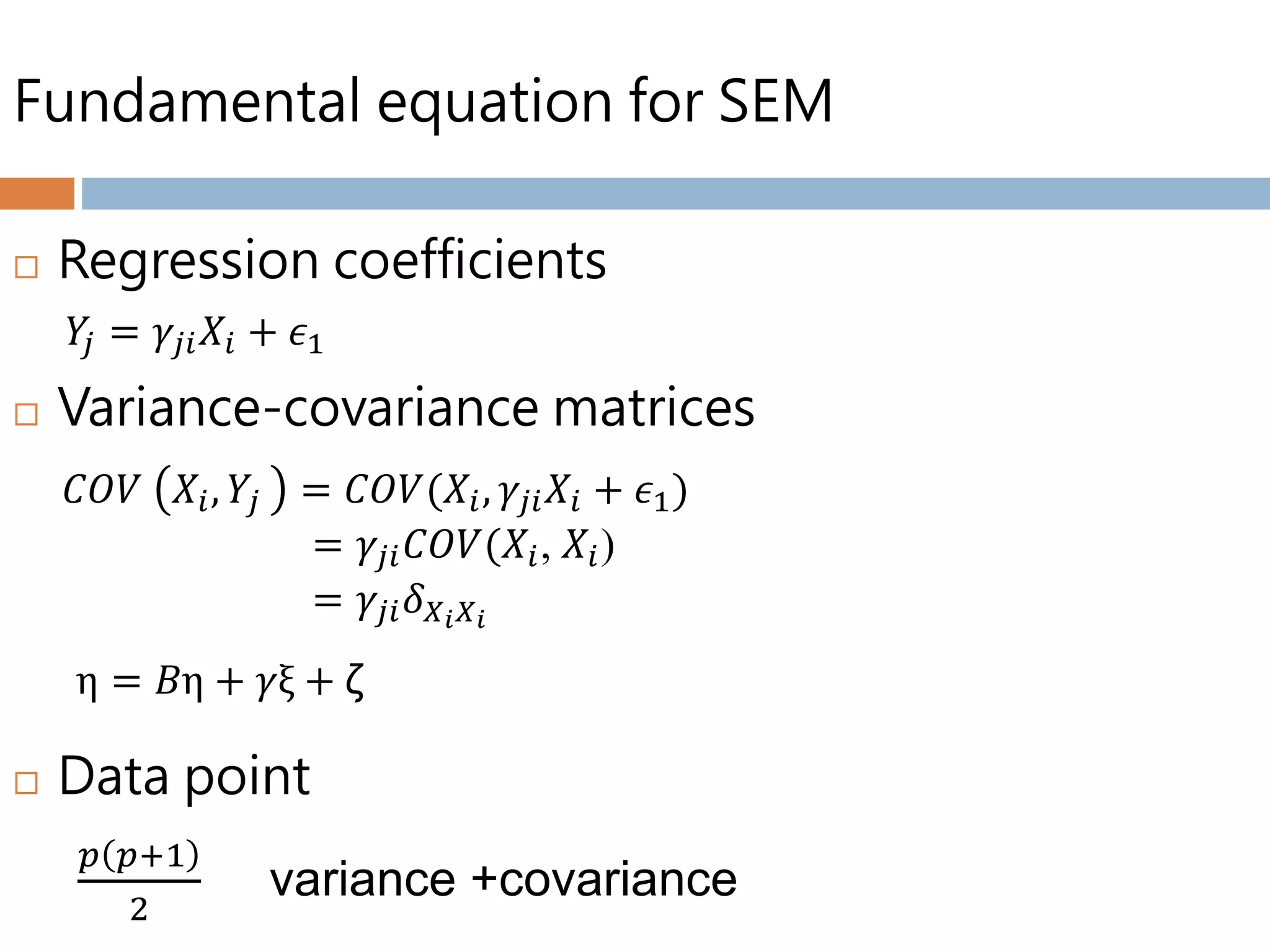
Fundamental equation for SEM
 Regression coefficients
 Variance-covariance matrices
 Data point
𝑌𝑗 = 𝛾𝑗𝑖 𝑋𝑖 + 𝜖1
𝐶𝑂𝑉 𝑋𝑖, 𝑌𝑗 = 𝐶𝑂𝑉(𝑋𝑖, 𝛾𝑗𝑖 𝑋𝑖 + 𝜖1)
= 𝛾𝑗𝑖 𝐶𝑂𝑉(𝑋𝑖, 𝑋𝑖)
= 𝛾𝑗𝑖 𝛿 𝑋 𝑖 𝑋 𝑖
η = 𝐵η + 𝛾ξ + ζ
𝑝 𝑝+1
2
variance +covariance
Graphical representation for SEM
x1
x2
x3
ξ belief η behavior
y1
y2
y3
δ1 ε1
λx1
γ
ζ
ε2
ε3
δ2
δ3
Error
Exogenous
observed
variable
Factor loading
Exogenous
latent variable
Structural parameter
Endogenous
latent variable
Factor loading
Endogenous
observed
variable
Structural
model
measurement
model
Error
λx2
λx3
λy1
λy2
λy3
measurement
model
Graphical representation for SEM
 Measurement model
 Confirmatory factor analysis (CFA)
x1
x3
x2
δ1
δ 2
δ 3
ξ1
λ11
λ21
λ31
δ[delta] ; λ[lambda]; ξ[xi]
x1= λ11 ξ1+ δ1
x2= λ21 ξ1+ δ2
x3= λ31 ξ1+ δ3
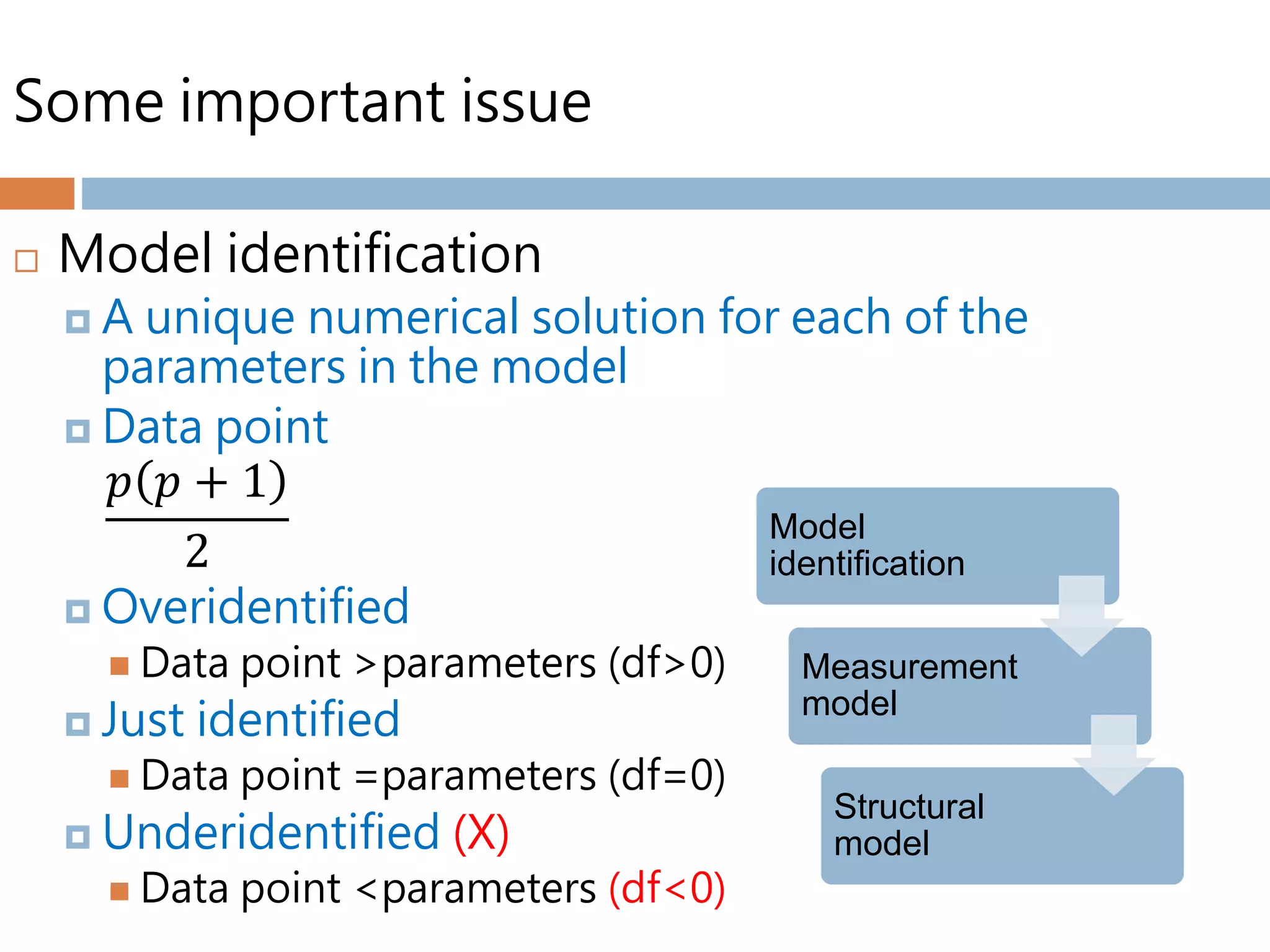
Some important issue
 Model identification
 A unique numerical solution for each of the
parameters in the model
 Data point
 Overidentified
 Data point >parameters (df>0)
 Just identified
 Data point =parameters (df=0)
 Underidentified (X)
 Data point <parameters (df<0)
𝑝 𝑝 + 1
2
Model
identification
Measurement
model
Structural
model
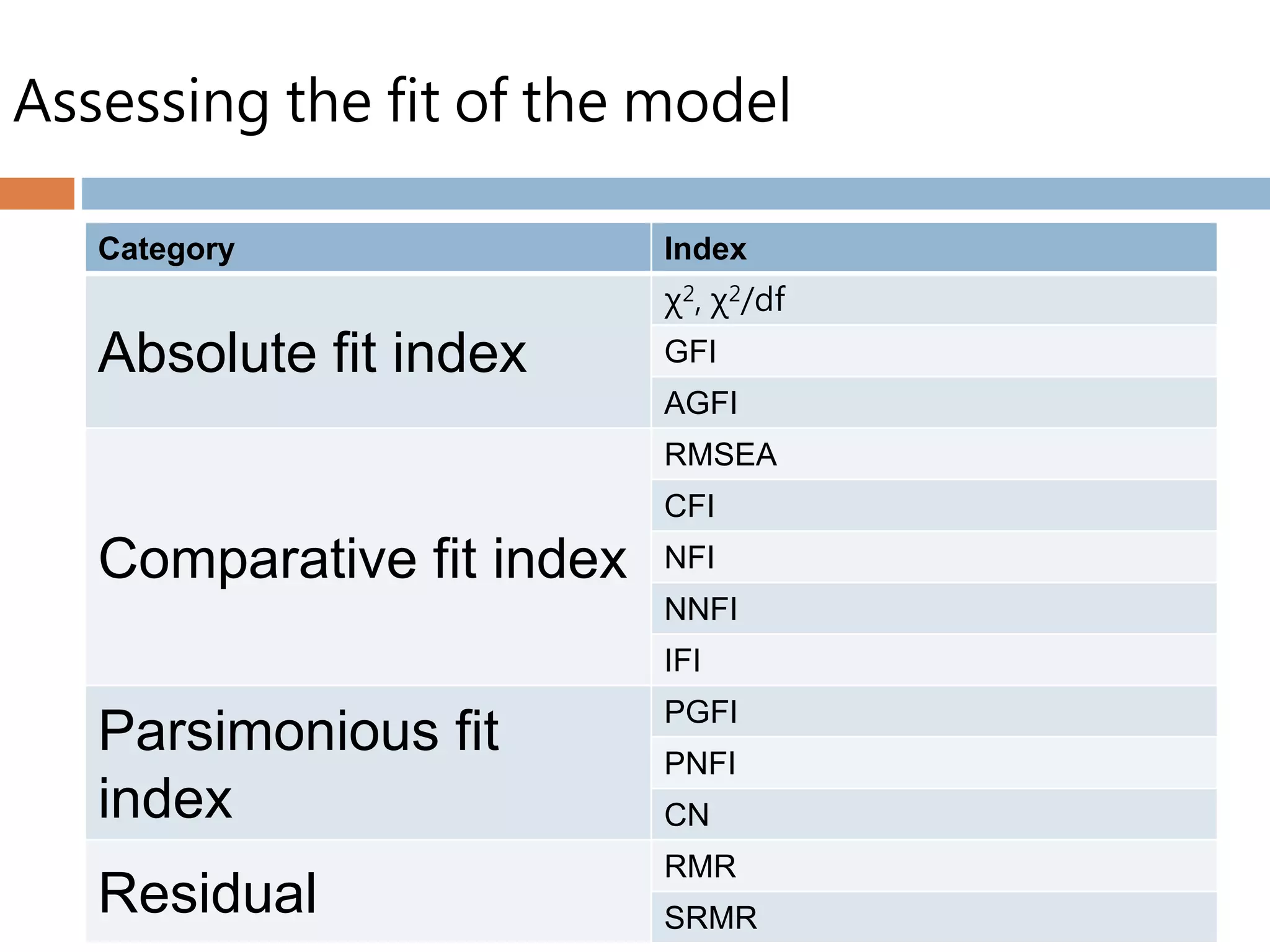
Assessing the fit of the model
Category Index
Absolute fit index
χ2, χ2/df
GFI
AGFI
Comparative fit index
RMSEA
CFI
NFI
NNFI
IFI
Parsimonious fit
index
PGFI
PNFI
CN
Residual
RMR
SRMR
Absolute fit index
 Chi-square test
 N.S.
 Chi-square / df < 2 (3)
 Indices of proportion of variance accounted
𝑔𝑜𝑜𝑑𝑛𝑒𝑠𝑠 − 𝑜𝑓 − 𝑓𝑖𝑡 𝑖𝑛𝑑𝑒𝑥 𝑮𝑭𝑰 =
𝑡𝑟( 𝜎′ 𝑊 𝜎)
𝑡𝑟(𝑠′ 𝑊𝑠)
𝑎𝑑𝑗𝑢𝑠𝑡𝑒𝑑 𝑔𝑜𝑜𝑑𝑛𝑒𝑠𝑠 − 𝑜𝑓 − 𝑓𝑖𝑡 𝑖𝑛𝑑𝑒𝑥 𝑨𝑮𝑭𝑰 =
1 − 𝐺𝐹𝐼
1 −
𝑛𝑢𝑚𝑏𝑒𝑟 𝑜𝑓 𝑒𝑠𝑡. 𝑝𝑎𝑟𝑎𝑚𝑒𝑡𝑒𝑟𝑠
𝑛𝑢𝑚𝑏𝑒𝑟 𝑜𝑓 𝑑𝑎𝑡𝑎 𝑝𝑜𝑖𝑛𝑡
Comparative fit index
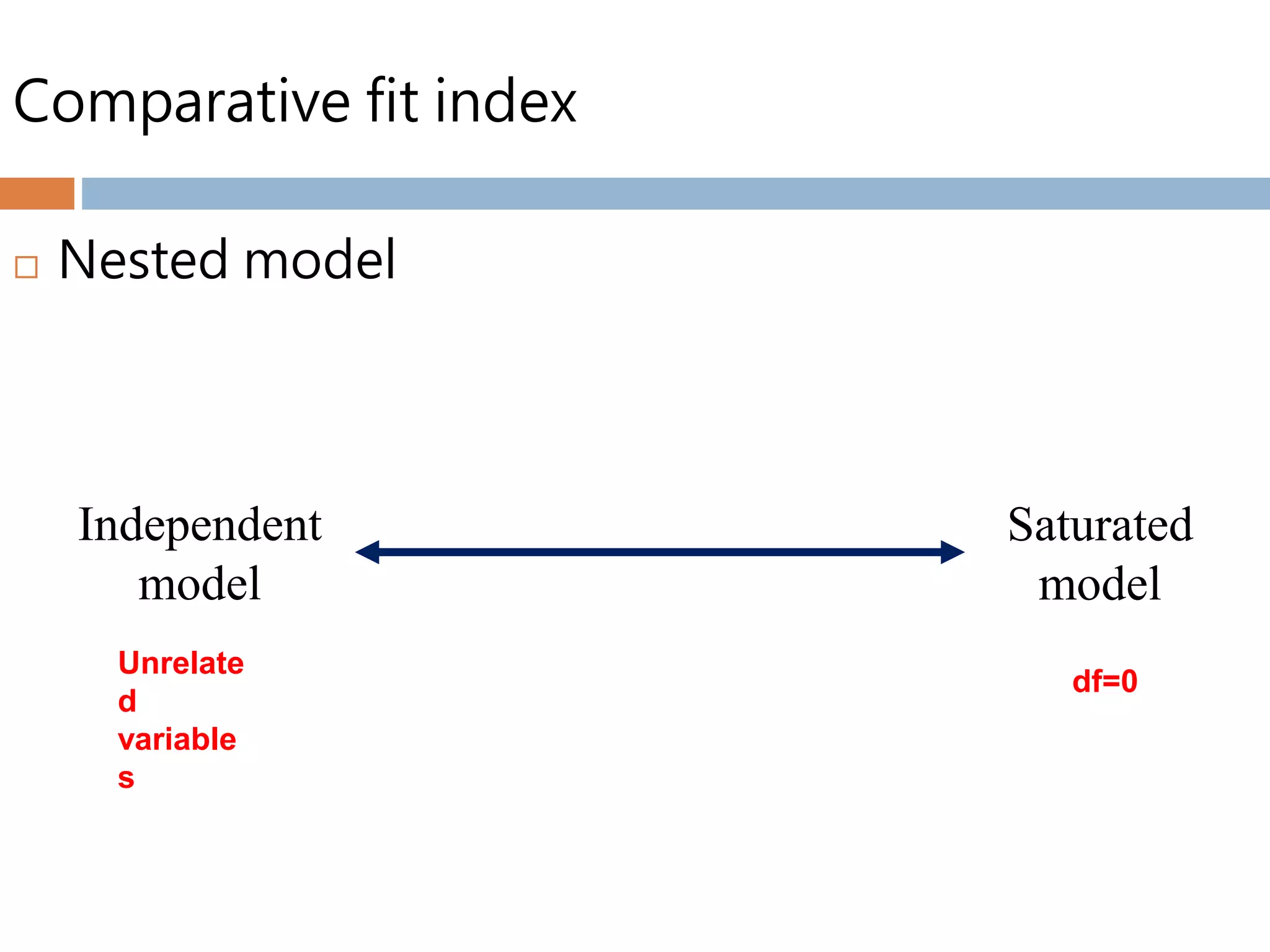
 Nested model
Independent
model
Saturated
model
Unrelate
d
variable
s
df=0
Nested model
Phenome
na
Theor
y
Systematic
description
Data
Objectively
exist
Model
0
Framed by
theoretical
basement
fit or not
parameter estimation
Nested model
Saturated model
Model 1
Model 2
Model 3
Parent model or
Full model
all parameters are freely
estimated
restriction nested in
χ2 、df ↑
Comparative fit index
 Assessing the fit of the model
𝑐𝑜𝑚𝑝𝑎𝑟𝑎𝑡𝑖𝑣𝑒 𝑓𝑖𝑡 𝑖𝑛𝑑𝑒𝑥 𝑪𝑭𝑰 = 1 −
𝜏 𝑒𝑠𝑡.𝑚𝑜𝑑𝑒𝑙
𝜏𝑖𝑛𝑑𝑒𝑝.𝑚𝑜𝑑𝑒𝑙
𝜏 𝑒𝑠𝑡.𝑚𝑜𝑑𝑒𝑙 = χ𝑖𝑛𝑑𝑒𝑝.𝑚𝑜𝑑𝑒𝑙
2
− 𝑑𝑓𝑖𝑛𝑑𝑒𝑝.𝑚𝑜𝑑𝑒𝑙
𝜏 𝑒𝑠𝑡.𝑚𝑜𝑑𝑒𝑙 = χ 𝑒𝑠𝑡.𝑚𝑜𝑑𝑒𝑙
2
− 𝑑𝑓𝑒𝑠𝑡.𝑚𝑜𝑑𝑒𝑙
𝜏𝑖 = 𝑣𝑎𝑙𝑢𝑒 𝑜𝑓 𝑚𝑖𝑠𝑠𝑝𝑒𝑐𝑖𝑓𝑖𝑐𝑎𝑡𝑖𝑜𝑛
𝑟𝑜𝑜𝑡 𝑚𝑒𝑎𝑛 𝑠𝑞𝑢𝑎𝑟𝑒 𝑒𝑟𝑟𝑜𝑟 𝑜𝑓 𝑎𝑝𝑝𝑟𝑜𝑥𝑖𝑚𝑎𝑡𝑖𝑜𝑛 𝑹𝑴𝑺𝑬𝑨 =
𝐹0
𝑑𝑓 𝑚𝑜𝑑𝑒𝑙
𝐹0 =
χ 𝑚𝑜𝑑𝑒𝑙
2
− 𝑑𝑓 𝑚𝑜𝑑𝑒𝑙
𝑁
Compare to
independent
model
Compare to
saturated
model
Comparative fit index
𝑛𝑜𝑟𝑚𝑒𝑑 𝑓𝑖𝑡 𝑖𝑛𝑑𝑒𝑥 𝑵𝑭𝑰 =
χ𝑖𝑛𝑑𝑒𝑝
2
− χ 𝑚𝑜𝑑𝑒𝑙
2
χ𝑖𝑛𝑑𝑒𝑝
2
𝑛𝑜𝑛 − 𝑛𝑜𝑟𝑚𝑒𝑑 𝑓𝑖𝑡 𝑖𝑛𝑑𝑒𝑥 𝑵𝑵𝑭𝑰/𝑻𝑳𝑰 =
χ𝑖𝑛𝑑𝑒𝑝
2
−
𝑑𝑓𝑖𝑛𝑑𝑒𝑝
𝑑𝑓 𝑚𝑜𝑑𝑒𝑙
χ 𝑚𝑜𝑑𝑒𝑙
2
χ𝑖𝑛𝑑𝑒𝑝
2
− 𝑑𝑓𝑖𝑛𝑑𝑒𝑝
Underestimate with small N
Too sensitive to stable
𝑖𝑛𝑐𝑟𝑒𝑚𝑒𝑛𝑡𝑎𝑙 𝑓𝑖𝑡 𝑖𝑛𝑑𝑒𝑥 𝑰𝑭𝑰 =
χ𝑖𝑛𝑑𝑒𝑝
2
− χ 𝑚𝑜𝑑𝑒𝑙
2
χ𝑖𝑛𝑑𝑒𝑝
2
− 𝑑𝑓 𝑚𝑜𝑑𝑒𝑙
Parsimonious fit index
𝑝𝑎𝑟𝑠𝑖𝑚𝑜𝑛𝑦 𝐺𝐹𝐼 𝑷𝑮𝑭𝑰 = 1 −
𝑛𝑢𝑚𝑏𝑒𝑟 𝑜𝑓 𝑒𝑠𝑡. 𝑝𝑎𝑟𝑎𝑚𝑒𝑡𝑒𝑡𝑠
𝑛𝑢𝑚𝑏𝑒𝑟 𝑜𝑓 𝑑𝑎𝑡𝑎 𝑝𝑜𝑖𝑛𝑡𝑠
𝐺𝐹𝐼
𝐴𝑘𝑎𝑖𝑘𝑒 𝑖𝑛𝑓𝑜𝑟𝑚𝑎𝑡𝑖𝑜𝑛 𝑐𝑟𝑖𝑡𝑒𝑟𝑖𝑜𝑛 (𝑨𝑰𝑪) = χ 𝑚𝑜𝑑𝑒𝑙
2
− 2𝑑𝑓 𝑚𝑜𝑑𝑒𝑙
𝑐𝑜𝑛𝑠𝑖𝑠𝑡𝑒𝑛𝑡 𝐴𝑘𝑎𝑖𝑘𝑒 𝑖𝑛𝑓𝑜𝑟𝑚𝑎𝑡𝑖𝑜𝑛 𝑐𝑟𝑖𝑡𝑒𝑟𝑖𝑜𝑛 (𝑪𝑨𝑰𝑪) = χ 𝑚𝑜𝑑𝑒𝑙
2
− (𝑙𝑛𝑁 + 1)2𝑑𝑓 𝑚𝑜𝑑𝑒𝑙
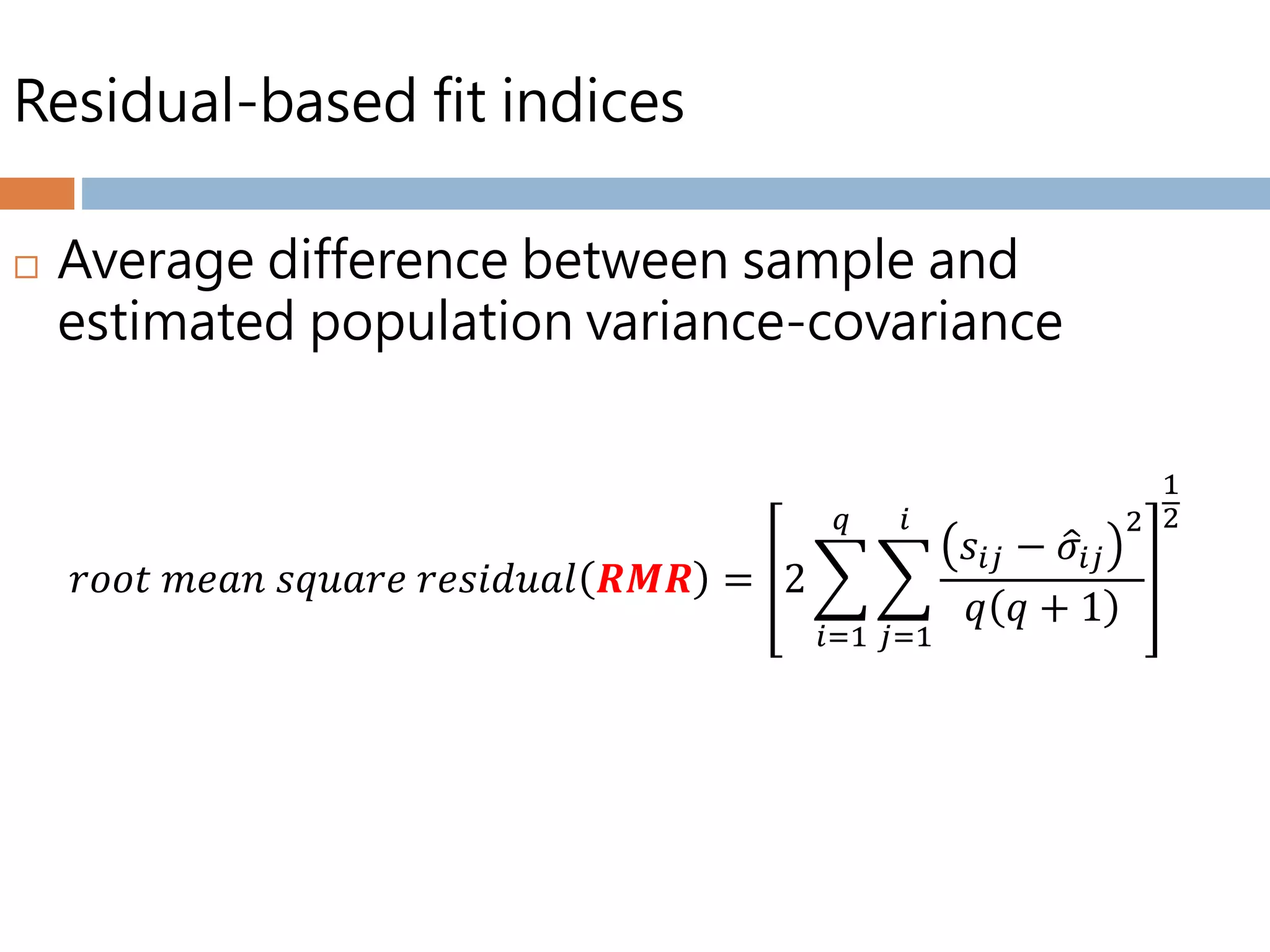
Residual-based fit indices
 Average difference between sample and
estimated population variance-covariance
𝑟𝑜𝑜𝑡 𝑚𝑒𝑎𝑛 𝑠𝑞𝑢𝑎𝑟𝑒 𝑟𝑒𝑠𝑖𝑑𝑢𝑎𝑙 𝑹𝑴𝑹 = 2
𝑖=1
𝑞
𝑗=1
𝑖
𝑠𝑖𝑗 − 𝜎𝑖𝑗
2
𝑞 𝑞 + 1
1
2
Recommended value of index
Index Value
χ2 N.S.
Χ2/df <2 (3)
NFI >.95 (.90)
NNFI >.95 (.90)
IFI >.95 (.90)
CFI >.95 (.90)
GFI >.90
AGFI >.90
PGFI >.90
AIC Small
CAIC Small
RMSEA <.05 (.06)
SRMR <.08
What indices should be presented?
 Diamantopoulo & Siguaw (2000)
 χ2, χ2/df, RMSEA, SRMR, GFI/AGFI, CFI, ECVI
 Hoyle & Panter (1995)
 χ2, χ2/df, GFI/AGFI, CFI, NNFI, IFI, RNI
Model modification
 Chi-square difference test
 (χ2
2
− χ1
2
)/(𝑑𝑓2 − 𝑑𝑓1)
 Lagrange multiplier (LM) test
 Add parameters
 Wald test
 Delete parameters
CONFIRMATORY
FACTOR ANALYSIS
(CFA)
Application of SEM
 Measurement model
 Confirmatory factor analysis (CFA)
x1
x3
x2
δ1
δ 2
δ 3
ξ1
λ11
λ21
λ31
x1= λ11 ξ1+ δ1
x2= λ21 ξ1+ δ2
x3= λ31 ξ1+ δ3
Indices
 Goodness-of fit
 Factor loading (λ >.70)
 R2
 Convergent validity
 Composite reliability
 𝜌𝑐 =
λ 2
λ 2+ 𝜃
 Average variance extracted (AVE)
 𝜌 𝑣 =
λ2
λ 2+ 𝜃
 Discriminant validity
PRACTICE
運動團隊默契量表的效化檢驗
 運動團隊默契會反應在三種向度上,分別是正確
的:
 1.任務知識
 2.能力評價
 3.情緒覺察
 請進行驗證性因素分析提供進一步的效度證據。
SEM
MODEL COMPARISON
SEM
Phenome
na
Theor
y
Systematic
description
Data
Objectively
exist
Model
0
Framed by
theoretical
basement
fit or not
parameter estimation
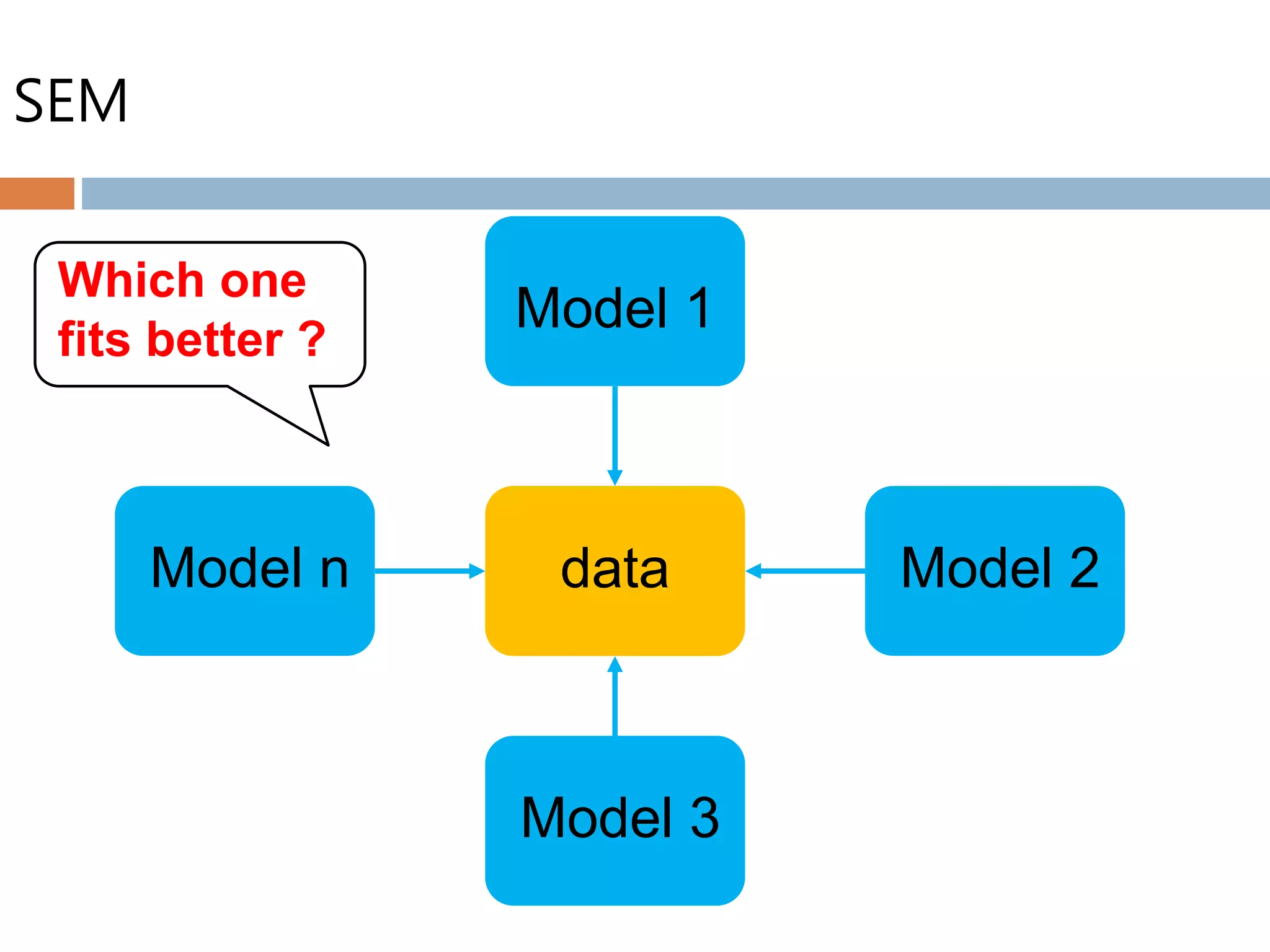
SEM
data
Model 1
Model 2
Model 3
Model n
Which one
fits better ?
Nested model
Saturated model
Model 1
Model 2
Model 3
Parent model or
Full model
all parameters are freely
estimated
restriction nested in
χ2 、df ↑
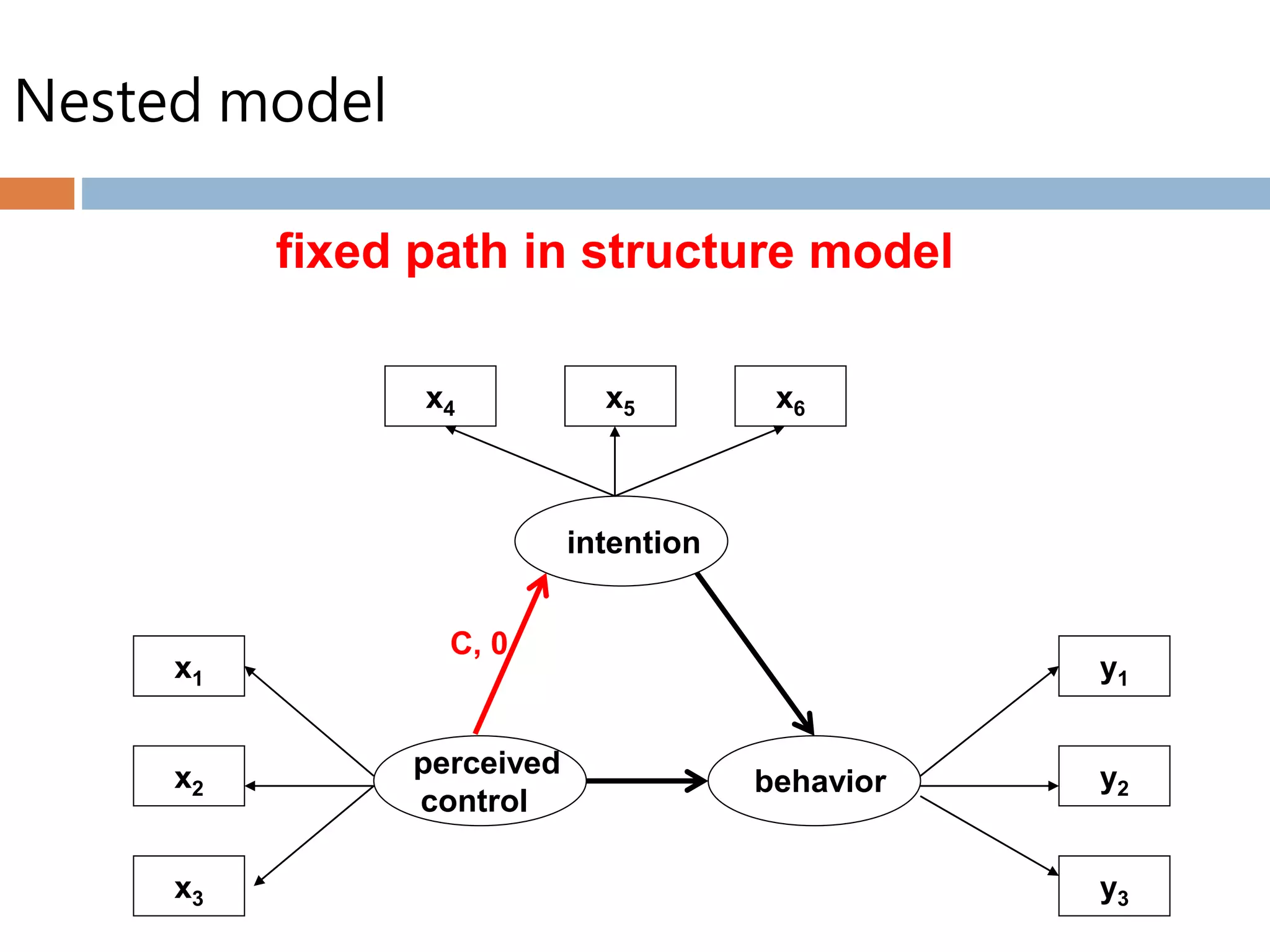
Nested model
fixed path in structure model
x1
x2
x3
perceived
control
behavior
y1
y2
y3
x4 x5 x6
intention
C, 0
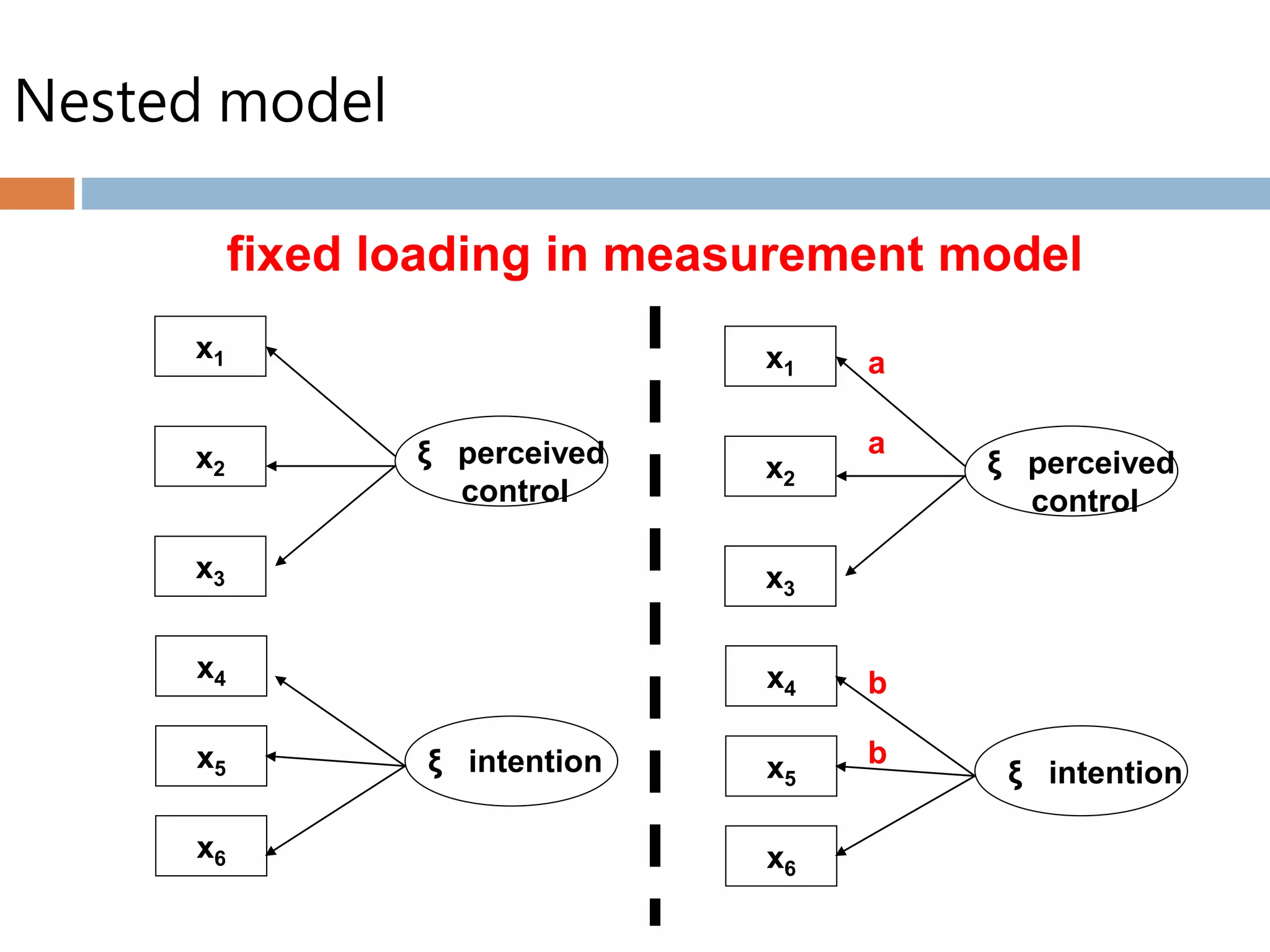
Nested model
fixed loading in measurement model
x1
x2
x3
ξ perceived
control
x4
x5
x6
ξ intention
x1
x2
x3
ξ perceived
control
x4
x5
x6
ξ intention
a
a
b
b
Nested model
fixed correlation between latent variables
in measurement model
x1
x2
x3
ξ perceived
control
x4
x5
x6
ξ intention
x1
x2
x3
ξ perceived
control
x4
x5
x6
ξ intention
C, 0
Which one fits better?
 Nested model
 △χ2 test
 Target coefficient
 Initial model χ𝑖
2
 Restricted model χ 𝑟
2
 T= χ𝑖
2
/ χ 𝑟
2
 Non-nested model
 AIC
 CAIC
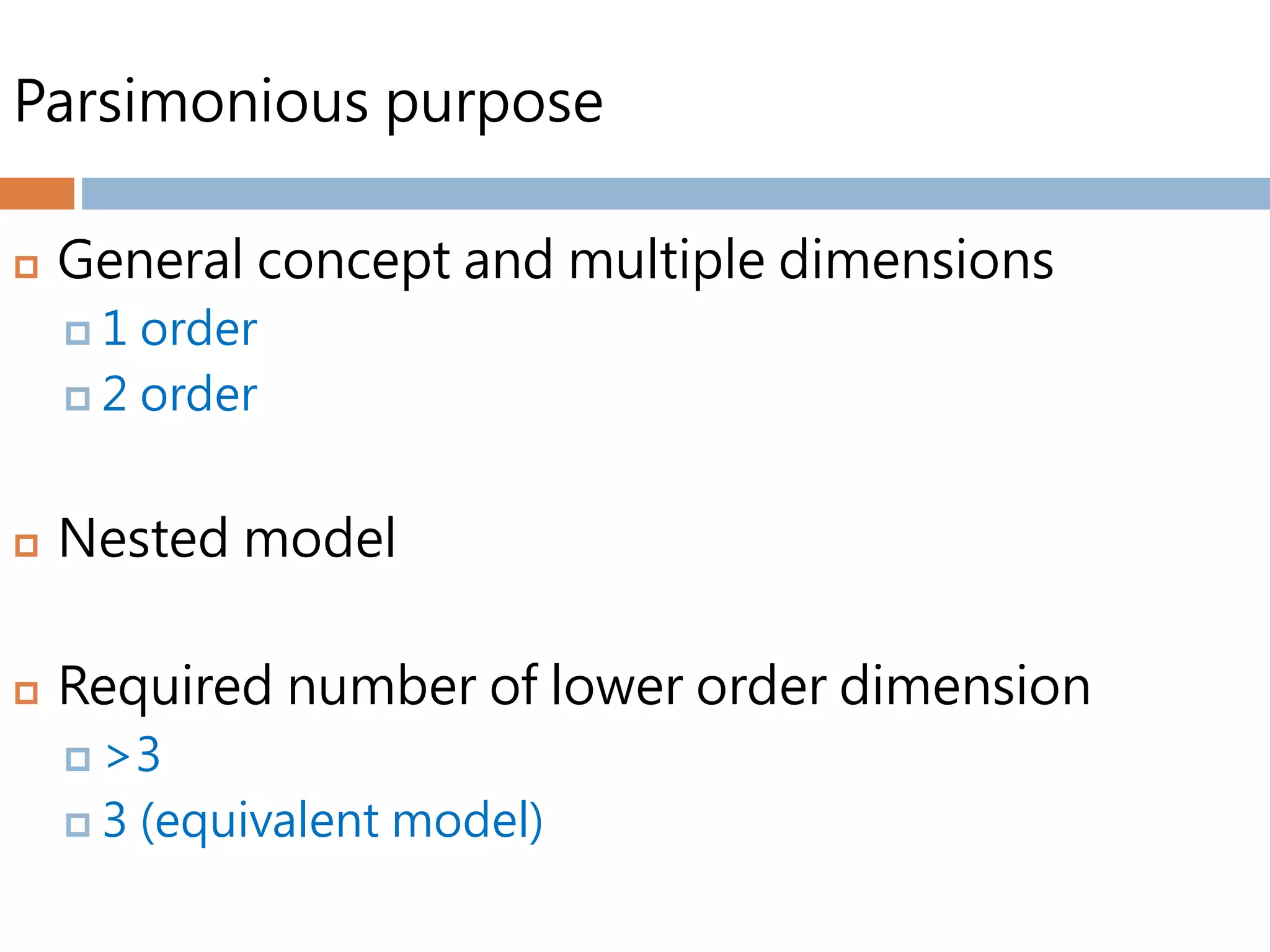
Parsimonious purpose
 General concept and multiple dimensions
 1 order
 2 order
 Nested model
 Required number of lower order dimension
 >3
 3 (equivalent model)
PRACTICE
控制型教練領導行為量表的效化檢驗
 根據相關學理,教練的控制傾向會反應在四種向度
上,分別是:
 1.酬賞控制
 2.有條件式的關愛
 3.威嚇
 4.過度控制
 研究生康挫依中文化了控制型領導行為量表,請幫
他進行驗證性因素分析提供進一步的效度證據。
SEM
MEASUREMENT
INVARIANCE
Generalization
model
data 1
Population 1
fit
fit
Can we generalize the
psychological
phenomenon of P1 to P2 ?
Population 2
data 2
are the constructs comparable
between the two populations?
(mean, variance, covariance or
correlation)
Measurement invariance
 Measurement equivalence
 Construct comparability
 Advantage
 Identical operational definition
 Generalizability
 Minimize bias (culture, translation, or survey)
 However…
So, how
 Multiple group mean and covariance structure
analysis (MACS)(Little, 1997)
 Parameters (Meredith, 1993)
 Configural invariance
 Weak factorial invariance
 Strong factorial invariance
 Strict factorial invariance
 Structural invariance
Configural invariance
 Baseline model
𝑌1 = 𝑏0 + 𝑏11 𝑋1 + 𝑏21 𝑋2 + ⋯ + 𝑏 𝑝1 𝑋 𝑝 + 𝑒1
𝑌𝑞 = 𝑏0 + 𝑏1𝑞 𝑋1 + 𝑏2𝑞 𝑋2 + ⋯ + 𝑏 𝑝𝑞 𝑋 𝑝 + 𝑒 𝑞
⋮⋮ ⋮ ⋮ ⋮
intercept
(mean)
slope
(loading)
error
(Meredith, 1993)
Weak factorial invariance 𝜦 𝟏 = 𝜦 𝟐
 Measurement weight
𝑌1 = 𝑏0 + 𝑏11 𝑋1 + 𝑏21 𝑋2 + ⋯ + 𝑏 𝑝1 𝑋 𝑝 + 𝑒1
𝑌𝑞 = 𝑏0 + 𝑏1𝑞 𝑋1 + 𝑏2𝑞 𝑋2 + ⋯ + 𝑏 𝑝𝑞 𝑋 𝑝 + 𝑒 𝑞
⋮⋮ ⋮ ⋮ ⋮
intercept
(mean)
slope
(loading)
error
(Meredith, 1993)
Strong factorial invariance 𝝉 𝟏 = 𝝉 𝟐
 Mean
𝑌1 = 𝑏0 + 𝑏11 𝑋1 + 𝑏21 𝑋2 + ⋯ + 𝑏 𝑝1 𝑋 𝑝 + 𝑒1
𝑌𝑞 = 𝑏0 + 𝑏1𝑞 𝑋1 + 𝑏2𝑞 𝑋2 + ⋯ + 𝑏 𝑝𝑞 𝑋 𝑝 + 𝑒 𝑞
⋮⋮ ⋮ ⋮ ⋮
intercept
(mean)
slope
(loading)
error
(Meredith, 1993)
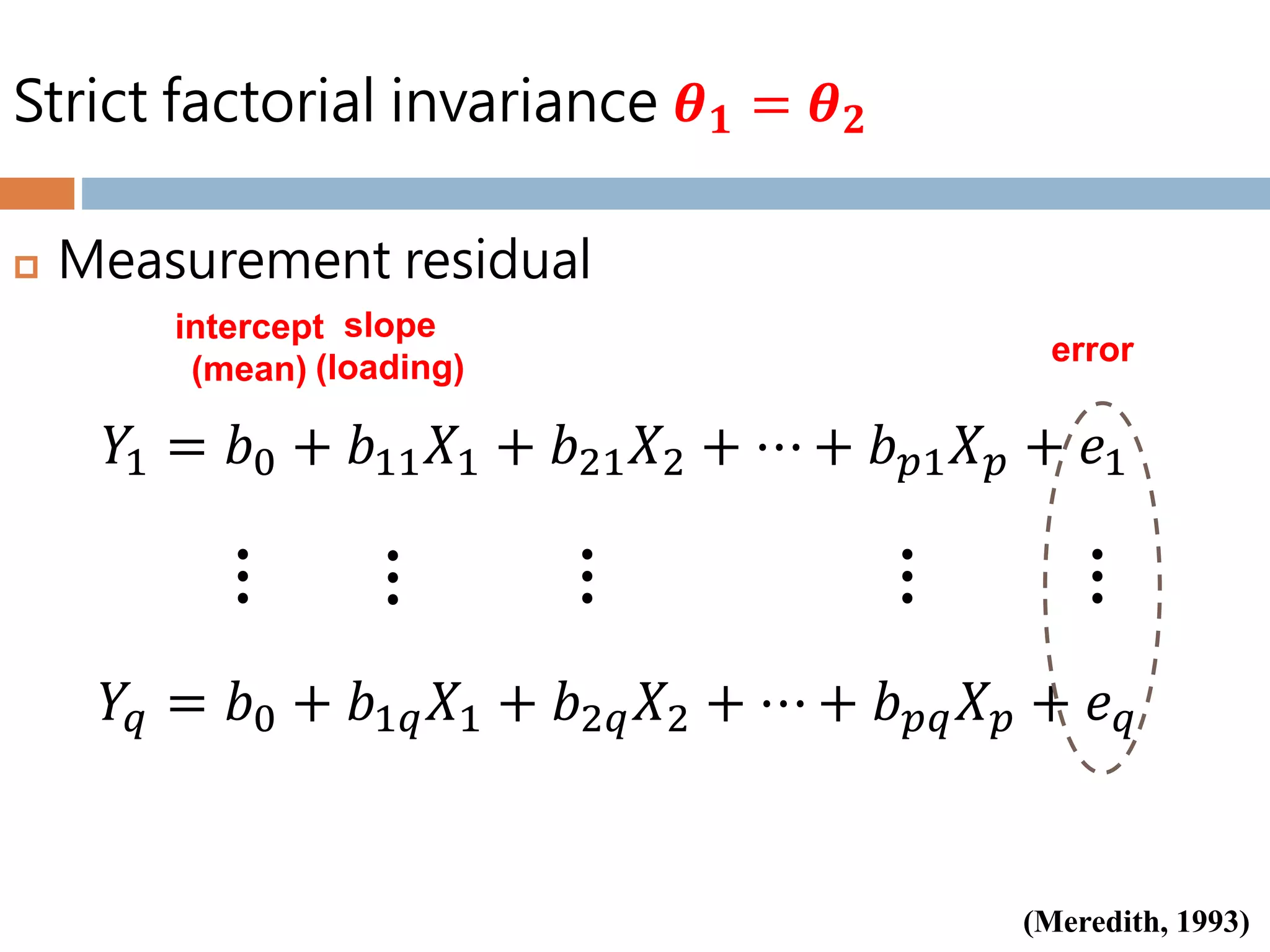
Strict factorial invariance 𝜽 𝟏 = 𝜽 𝟐
 Measurement residual
𝑌1 = 𝑏0 + 𝑏11 𝑋1 + 𝑏21 𝑋2 + ⋯ + 𝑏 𝑝1 𝑋 𝑝 + 𝑒1
𝑌𝑞 = 𝑏0 + 𝑏1𝑞 𝑋1 + 𝑏2𝑞 𝑋2 + ⋯ + 𝑏 𝑝𝑞 𝑋 𝑝 + 𝑒 𝑞
⋮⋮ ⋮ ⋮ ⋮
intercept
(mean)
slope
(loading)
error
(Meredith, 1993)
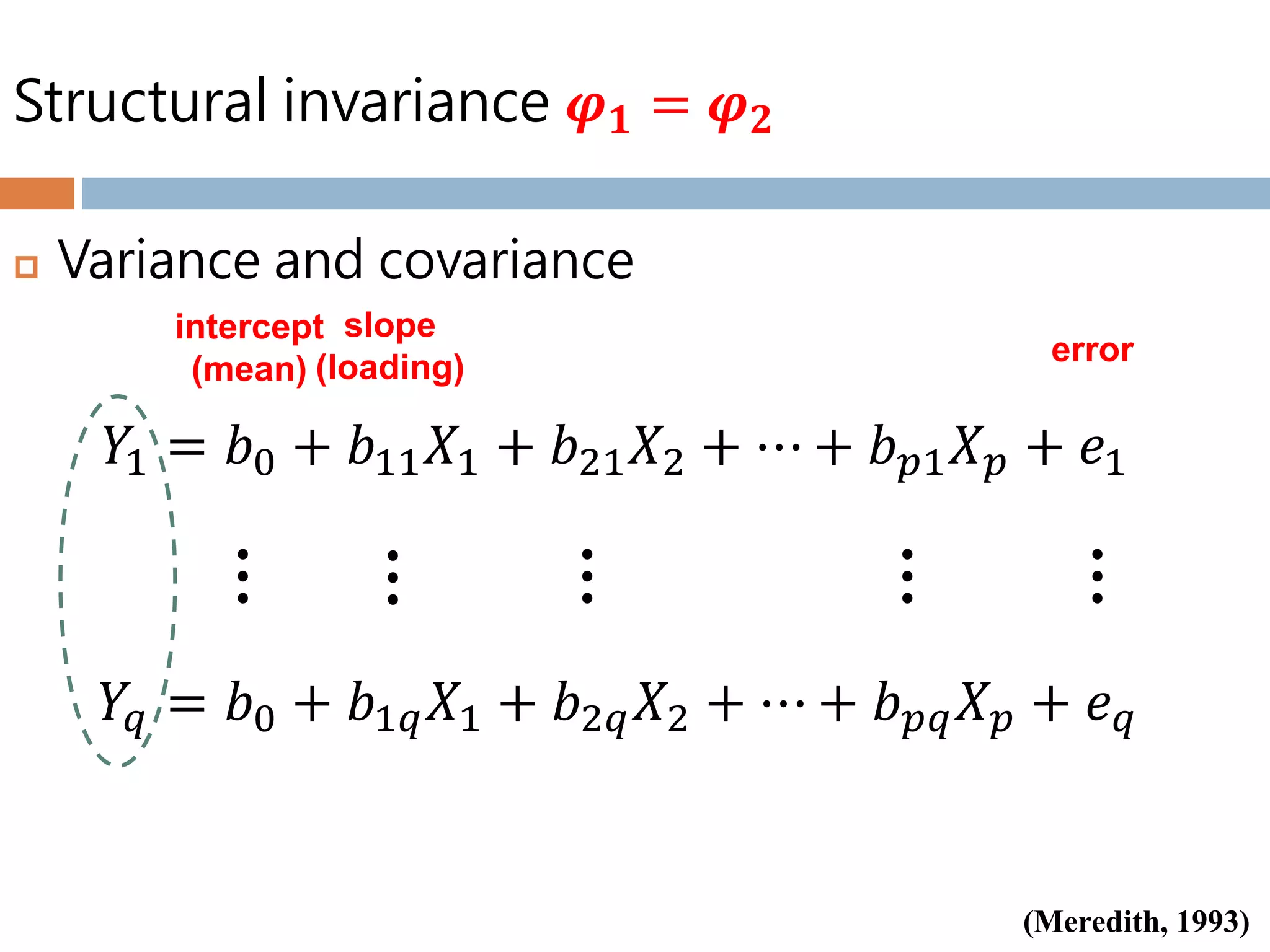
Structural invariance 𝝋 𝟏 = 𝝋 𝟐
 Variance and covariance
𝑌1 = 𝑏0 + 𝑏11 𝑋1 + 𝑏21 𝑋2 + ⋯ + 𝑏 𝑝1 𝑋 𝑝 + 𝑒1
𝑌𝑞 = 𝑏0 + 𝑏1𝑞 𝑋1 + 𝑏2𝑞 𝑋2 + ⋯ + 𝑏 𝑝𝑞 𝑋 𝑝 + 𝑒 𝑞
⋮⋮ ⋮ ⋮ ⋮
intercept
(mean)
slope
(loading)
error
(Meredith, 1993)
Model comparison-nested model
 Baseline model
 𝜦 𝟏 = 𝜦 𝟐
 𝜦 𝟏 = 𝜦 𝟐 + 𝝉 𝟏 = 𝝉 𝟐
 𝜦 𝟏 = 𝜦 𝟐 + 𝝉 𝟏 = 𝝉 𝟐 + 𝜽 𝟏 = 𝜽 𝟐
 𝜦 𝟏 = 𝜦 𝟐 + 𝝉 𝟏 = 𝝉 𝟐 + 𝜽 𝟏 = 𝜽 𝟐 + 𝝋 𝟏 = 𝝋 𝟐
(Meredith, 1993)
Configural invariance
Weak factorial
invariance
Strong factorial
invariance
Strict factorial
invariance
Structural invariance
Which one fits better?
 Nested model
 △χ2 test
 Fit index (Cheug & Rensvold, 2002; Little, 1997; McGaw & Joredkog, 1971)
 △ NNFI <.05 (.02)
 △ IFI <.05
 △CFI <.01
 △RFI <.05
PRACTICE
運動正念量表的效化檢驗
 根據相關學理,運動員的正念特性會反應在三個
向度上,分別是:
 1.覺察
 2.再專注
 3.不評價
 研究生歐芷觀發展了一份測量工具,請幫她進行
性別不變性的檢驗。

SEM

  • 1.
  • 2.
    Purpose  To analyzea set of relationships between one or more IVs, either continuous or discrete, and one or more DVs, either continuous or discrete.  Multiple IVs  Multiple DVs  Confirmatory purpose  Advantage  Estimation of errors  Simultaneous test
  • 3.
    Kinds of researchquestions  The goal of SEM is to examine whether the model produce an estimated population covariance matrix is fitted to the sample covariance matrix or not.  Adequacy of model  Testing theory  Amount of variance in the variables accounted for by the factors  Reliability of the indicators  Parameter estimates  Intervening variables (indirect effect)  Group difference  Longitudinal difference  Multilevel modeling
  • 4.
    Limitations to factoranalysis  Theoretical issues  Theory  causality  Practical issues  Sample size and missing data  15* umber of variable (Stevens, 1996)  5* number of estimated parameter (Bentler & Chou, 1987)  100 (Loehiln, 1992)  Multivariate normality and outliers  Linearity  Absence of multicollinearity and singularity  Residual
  • 5.
    Fundamental equation forSEM  Regression coefficients  Variance-covariance matrices  Data point 𝑌𝑗 = 𝛾𝑗𝑖 𝑋𝑖 + 𝜖1 𝐶𝑂𝑉 𝑋𝑖, 𝑌𝑗 = 𝐶𝑂𝑉(𝑋𝑖, 𝛾𝑗𝑖 𝑋𝑖 + 𝜖1) = 𝛾𝑗𝑖 𝐶𝑂𝑉(𝑋𝑖, 𝑋𝑖) = 𝛾𝑗𝑖 𝛿 𝑋 𝑖 𝑋 𝑖 η = 𝐵η + 𝛾ξ + ζ 𝑝 𝑝+1 2 variance +covariance
  • 6.
    Graphical representation forSEM x1 x2 x3 ξ belief η behavior y1 y2 y3 δ1 ε1 λx1 γ ζ ε2 ε3 δ2 δ3 Error Exogenous observed variable Factor loading Exogenous latent variable Structural parameter Endogenous latent variable Factor loading Endogenous observed variable Structural model measurement model Error λx2 λx3 λy1 λy2 λy3 measurement model
  • 7.
    Graphical representation forSEM  Measurement model  Confirmatory factor analysis (CFA) x1 x3 x2 δ1 δ 2 δ 3 ξ1 λ11 λ21 λ31 δ[delta] ; λ[lambda]; ξ[xi] x1= λ11 ξ1+ δ1 x2= λ21 ξ1+ δ2 x3= λ31 ξ1+ δ3
  • 8.
    Some important issue Model identification  A unique numerical solution for each of the parameters in the model  Data point  Overidentified  Data point >parameters (df>0)  Just identified  Data point =parameters (df=0)  Underidentified (X)  Data point <parameters (df<0) 𝑝 𝑝 + 1 2 Model identification Measurement model Structural model
  • 9.
    Assessing the fitof the model Category Index Absolute fit index χ2, χ2/df GFI AGFI Comparative fit index RMSEA CFI NFI NNFI IFI Parsimonious fit index PGFI PNFI CN Residual RMR SRMR
  • 10.
    Absolute fit index Chi-square test  N.S.  Chi-square / df < 2 (3)  Indices of proportion of variance accounted 𝑔𝑜𝑜𝑑𝑛𝑒𝑠𝑠 − 𝑜𝑓 − 𝑓𝑖𝑡 𝑖𝑛𝑑𝑒𝑥 𝑮𝑭𝑰 = 𝑡𝑟( 𝜎′ 𝑊 𝜎) 𝑡𝑟(𝑠′ 𝑊𝑠) 𝑎𝑑𝑗𝑢𝑠𝑡𝑒𝑑 𝑔𝑜𝑜𝑑𝑛𝑒𝑠𝑠 − 𝑜𝑓 − 𝑓𝑖𝑡 𝑖𝑛𝑑𝑒𝑥 𝑨𝑮𝑭𝑰 = 1 − 𝐺𝐹𝐼 1 − 𝑛𝑢𝑚𝑏𝑒𝑟 𝑜𝑓 𝑒𝑠𝑡. 𝑝𝑎𝑟𝑎𝑚𝑒𝑡𝑒𝑟𝑠 𝑛𝑢𝑚𝑏𝑒𝑟 𝑜𝑓 𝑑𝑎𝑡𝑎 𝑝𝑜𝑖𝑛𝑡
  • 11.
    Comparative fit index Nested model Independent model Saturated model Unrelate d variable s df=0
  • 12.
  • 13.
    Nested model Saturated model Model1 Model 2 Model 3 Parent model or Full model all parameters are freely estimated restriction nested in restriction nested in restriction nested in χ2 、df ↑
  • 14.
    Comparative fit index Assessing the fit of the model 𝑐𝑜𝑚𝑝𝑎𝑟𝑎𝑡𝑖𝑣𝑒 𝑓𝑖𝑡 𝑖𝑛𝑑𝑒𝑥 𝑪𝑭𝑰 = 1 − 𝜏 𝑒𝑠𝑡.𝑚𝑜𝑑𝑒𝑙 𝜏𝑖𝑛𝑑𝑒𝑝.𝑚𝑜𝑑𝑒𝑙 𝜏 𝑒𝑠𝑡.𝑚𝑜𝑑𝑒𝑙 = χ𝑖𝑛𝑑𝑒𝑝.𝑚𝑜𝑑𝑒𝑙 2 − 𝑑𝑓𝑖𝑛𝑑𝑒𝑝.𝑚𝑜𝑑𝑒𝑙 𝜏 𝑒𝑠𝑡.𝑚𝑜𝑑𝑒𝑙 = χ 𝑒𝑠𝑡.𝑚𝑜𝑑𝑒𝑙 2 − 𝑑𝑓𝑒𝑠𝑡.𝑚𝑜𝑑𝑒𝑙 𝜏𝑖 = 𝑣𝑎𝑙𝑢𝑒 𝑜𝑓 𝑚𝑖𝑠𝑠𝑝𝑒𝑐𝑖𝑓𝑖𝑐𝑎𝑡𝑖𝑜𝑛 𝑟𝑜𝑜𝑡 𝑚𝑒𝑎𝑛 𝑠𝑞𝑢𝑎𝑟𝑒 𝑒𝑟𝑟𝑜𝑟 𝑜𝑓 𝑎𝑝𝑝𝑟𝑜𝑥𝑖𝑚𝑎𝑡𝑖𝑜𝑛 𝑹𝑴𝑺𝑬𝑨 = 𝐹0 𝑑𝑓 𝑚𝑜𝑑𝑒𝑙 𝐹0 = χ 𝑚𝑜𝑑𝑒𝑙 2 − 𝑑𝑓 𝑚𝑜𝑑𝑒𝑙 𝑁 Compare to independent model Compare to saturated model
  • 15.
    Comparative fit index 𝑛𝑜𝑟𝑚𝑒𝑑𝑓𝑖𝑡 𝑖𝑛𝑑𝑒𝑥 𝑵𝑭𝑰 = χ𝑖𝑛𝑑𝑒𝑝 2 − χ 𝑚𝑜𝑑𝑒𝑙 2 χ𝑖𝑛𝑑𝑒𝑝 2 𝑛𝑜𝑛 − 𝑛𝑜𝑟𝑚𝑒𝑑 𝑓𝑖𝑡 𝑖𝑛𝑑𝑒𝑥 𝑵𝑵𝑭𝑰/𝑻𝑳𝑰 = χ𝑖𝑛𝑑𝑒𝑝 2 − 𝑑𝑓𝑖𝑛𝑑𝑒𝑝 𝑑𝑓 𝑚𝑜𝑑𝑒𝑙 χ 𝑚𝑜𝑑𝑒𝑙 2 χ𝑖𝑛𝑑𝑒𝑝 2 − 𝑑𝑓𝑖𝑛𝑑𝑒𝑝 Underestimate with small N Too sensitive to stable 𝑖𝑛𝑐𝑟𝑒𝑚𝑒𝑛𝑡𝑎𝑙 𝑓𝑖𝑡 𝑖𝑛𝑑𝑒𝑥 𝑰𝑭𝑰 = χ𝑖𝑛𝑑𝑒𝑝 2 − χ 𝑚𝑜𝑑𝑒𝑙 2 χ𝑖𝑛𝑑𝑒𝑝 2 − 𝑑𝑓 𝑚𝑜𝑑𝑒𝑙
  • 16.
    Parsimonious fit index 𝑝𝑎𝑟𝑠𝑖𝑚𝑜𝑛𝑦𝐺𝐹𝐼 𝑷𝑮𝑭𝑰 = 1 − 𝑛𝑢𝑚𝑏𝑒𝑟 𝑜𝑓 𝑒𝑠𝑡. 𝑝𝑎𝑟𝑎𝑚𝑒𝑡𝑒𝑡𝑠 𝑛𝑢𝑚𝑏𝑒𝑟 𝑜𝑓 𝑑𝑎𝑡𝑎 𝑝𝑜𝑖𝑛𝑡𝑠 𝐺𝐹𝐼 𝐴𝑘𝑎𝑖𝑘𝑒 𝑖𝑛𝑓𝑜𝑟𝑚𝑎𝑡𝑖𝑜𝑛 𝑐𝑟𝑖𝑡𝑒𝑟𝑖𝑜𝑛 (𝑨𝑰𝑪) = χ 𝑚𝑜𝑑𝑒𝑙 2 − 2𝑑𝑓 𝑚𝑜𝑑𝑒𝑙 𝑐𝑜𝑛𝑠𝑖𝑠𝑡𝑒𝑛𝑡 𝐴𝑘𝑎𝑖𝑘𝑒 𝑖𝑛𝑓𝑜𝑟𝑚𝑎𝑡𝑖𝑜𝑛 𝑐𝑟𝑖𝑡𝑒𝑟𝑖𝑜𝑛 (𝑪𝑨𝑰𝑪) = χ 𝑚𝑜𝑑𝑒𝑙 2 − (𝑙𝑛𝑁 + 1)2𝑑𝑓 𝑚𝑜𝑑𝑒𝑙
  • 17.
    Residual-based fit indices Average difference between sample and estimated population variance-covariance 𝑟𝑜𝑜𝑡 𝑚𝑒𝑎𝑛 𝑠𝑞𝑢𝑎𝑟𝑒 𝑟𝑒𝑠𝑖𝑑𝑢𝑎𝑙 𝑹𝑴𝑹 = 2 𝑖=1 𝑞 𝑗=1 𝑖 𝑠𝑖𝑗 − 𝜎𝑖𝑗 2 𝑞 𝑞 + 1 1 2
  • 18.
    Recommended value ofindex Index Value χ2 N.S. Χ2/df <2 (3) NFI >.95 (.90) NNFI >.95 (.90) IFI >.95 (.90) CFI >.95 (.90) GFI >.90 AGFI >.90 PGFI >.90 AIC Small CAIC Small RMSEA <.05 (.06) SRMR <.08
  • 19.
    What indices shouldbe presented?  Diamantopoulo & Siguaw (2000)  χ2, χ2/df, RMSEA, SRMR, GFI/AGFI, CFI, ECVI  Hoyle & Panter (1995)  χ2, χ2/df, GFI/AGFI, CFI, NNFI, IFI, RNI
  • 20.
    Model modification  Chi-squaredifference test  (χ2 2 − χ1 2 )/(𝑑𝑓2 − 𝑑𝑓1)  Lagrange multiplier (LM) test  Add parameters  Wald test  Delete parameters
  • 21.
  • 22.
    Application of SEM Measurement model  Confirmatory factor analysis (CFA) x1 x3 x2 δ1 δ 2 δ 3 ξ1 λ11 λ21 λ31 x1= λ11 ξ1+ δ1 x2= λ21 ξ1+ δ2 x3= λ31 ξ1+ δ3
  • 23.
    Indices  Goodness-of fit Factor loading (λ >.70)  R2  Convergent validity  Composite reliability  𝜌𝑐 = λ 2 λ 2+ 𝜃  Average variance extracted (AVE)  𝜌 𝑣 = λ2 λ 2+ 𝜃  Discriminant validity
  • 24.
  • 25.
    運動團隊默契量表的效化檢驗  運動團隊默契會反應在三種向度上,分別是正確 的:  1.任務知識 2.能力評價  3.情緒覺察  請進行驗證性因素分析提供進一步的效度證據。
  • 26.
  • 27.
  • 28.
    SEM data Model 1 Model 2 Model3 Model n Which one fits better ?
  • 29.
    Nested model Saturated model Model1 Model 2 Model 3 Parent model or Full model all parameters are freely estimated restriction nested in restriction nested in restriction nested in χ2 、df ↑
  • 30.
    Nested model fixed pathin structure model x1 x2 x3 perceived control behavior y1 y2 y3 x4 x5 x6 intention C, 0
  • 31.
    Nested model fixed loadingin measurement model x1 x2 x3 ξ perceived control x4 x5 x6 ξ intention x1 x2 x3 ξ perceived control x4 x5 x6 ξ intention a a b b
  • 32.
    Nested model fixed correlationbetween latent variables in measurement model x1 x2 x3 ξ perceived control x4 x5 x6 ξ intention x1 x2 x3 ξ perceived control x4 x5 x6 ξ intention C, 0
  • 33.
    Which one fitsbetter?  Nested model  △χ2 test  Target coefficient  Initial model χ𝑖 2  Restricted model χ 𝑟 2  T= χ𝑖 2 / χ 𝑟 2  Non-nested model  AIC  CAIC
  • 34.
    Parsimonious purpose  Generalconcept and multiple dimensions  1 order  2 order  Nested model  Required number of lower order dimension  >3  3 (equivalent model)
  • 35.
  • 36.
    控制型教練領導行為量表的效化檢驗  根據相關學理,教練的控制傾向會反應在四種向度 上,分別是:  1.酬賞控制 2.有條件式的關愛  3.威嚇  4.過度控制  研究生康挫依中文化了控制型領導行為量表,請幫 他進行驗證性因素分析提供進一步的效度證據。
  • 37.
  • 38.
    Generalization model data 1 Population 1 fit fit Canwe generalize the psychological phenomenon of P1 to P2 ? Population 2 data 2 are the constructs comparable between the two populations? (mean, variance, covariance or correlation)
  • 39.
    Measurement invariance  Measurementequivalence  Construct comparability  Advantage  Identical operational definition  Generalizability  Minimize bias (culture, translation, or survey)  However…
  • 40.
    So, how  Multiplegroup mean and covariance structure analysis (MACS)(Little, 1997)  Parameters (Meredith, 1993)  Configural invariance  Weak factorial invariance  Strong factorial invariance  Strict factorial invariance  Structural invariance
  • 41.
    Configural invariance  Baselinemodel 𝑌1 = 𝑏0 + 𝑏11 𝑋1 + 𝑏21 𝑋2 + ⋯ + 𝑏 𝑝1 𝑋 𝑝 + 𝑒1 𝑌𝑞 = 𝑏0 + 𝑏1𝑞 𝑋1 + 𝑏2𝑞 𝑋2 + ⋯ + 𝑏 𝑝𝑞 𝑋 𝑝 + 𝑒 𝑞 ⋮⋮ ⋮ ⋮ ⋮ intercept (mean) slope (loading) error (Meredith, 1993)
  • 42.
    Weak factorial invariance𝜦 𝟏 = 𝜦 𝟐  Measurement weight 𝑌1 = 𝑏0 + 𝑏11 𝑋1 + 𝑏21 𝑋2 + ⋯ + 𝑏 𝑝1 𝑋 𝑝 + 𝑒1 𝑌𝑞 = 𝑏0 + 𝑏1𝑞 𝑋1 + 𝑏2𝑞 𝑋2 + ⋯ + 𝑏 𝑝𝑞 𝑋 𝑝 + 𝑒 𝑞 ⋮⋮ ⋮ ⋮ ⋮ intercept (mean) slope (loading) error (Meredith, 1993)
  • 43.
    Strong factorial invariance𝝉 𝟏 = 𝝉 𝟐  Mean 𝑌1 = 𝑏0 + 𝑏11 𝑋1 + 𝑏21 𝑋2 + ⋯ + 𝑏 𝑝1 𝑋 𝑝 + 𝑒1 𝑌𝑞 = 𝑏0 + 𝑏1𝑞 𝑋1 + 𝑏2𝑞 𝑋2 + ⋯ + 𝑏 𝑝𝑞 𝑋 𝑝 + 𝑒 𝑞 ⋮⋮ ⋮ ⋮ ⋮ intercept (mean) slope (loading) error (Meredith, 1993)
  • 44.
    Strict factorial invariance𝜽 𝟏 = 𝜽 𝟐  Measurement residual 𝑌1 = 𝑏0 + 𝑏11 𝑋1 + 𝑏21 𝑋2 + ⋯ + 𝑏 𝑝1 𝑋 𝑝 + 𝑒1 𝑌𝑞 = 𝑏0 + 𝑏1𝑞 𝑋1 + 𝑏2𝑞 𝑋2 + ⋯ + 𝑏 𝑝𝑞 𝑋 𝑝 + 𝑒 𝑞 ⋮⋮ ⋮ ⋮ ⋮ intercept (mean) slope (loading) error (Meredith, 1993)
  • 45.
    Structural invariance 𝝋𝟏 = 𝝋 𝟐  Variance and covariance 𝑌1 = 𝑏0 + 𝑏11 𝑋1 + 𝑏21 𝑋2 + ⋯ + 𝑏 𝑝1 𝑋 𝑝 + 𝑒1 𝑌𝑞 = 𝑏0 + 𝑏1𝑞 𝑋1 + 𝑏2𝑞 𝑋2 + ⋯ + 𝑏 𝑝𝑞 𝑋 𝑝 + 𝑒 𝑞 ⋮⋮ ⋮ ⋮ ⋮ intercept (mean) slope (loading) error (Meredith, 1993)
  • 46.
    Model comparison-nested model Baseline model  𝜦 𝟏 = 𝜦 𝟐  𝜦 𝟏 = 𝜦 𝟐 + 𝝉 𝟏 = 𝝉 𝟐  𝜦 𝟏 = 𝜦 𝟐 + 𝝉 𝟏 = 𝝉 𝟐 + 𝜽 𝟏 = 𝜽 𝟐  𝜦 𝟏 = 𝜦 𝟐 + 𝝉 𝟏 = 𝝉 𝟐 + 𝜽 𝟏 = 𝜽 𝟐 + 𝝋 𝟏 = 𝝋 𝟐 (Meredith, 1993) Configural invariance Weak factorial invariance Strong factorial invariance Strict factorial invariance Structural invariance
  • 47.
    Which one fitsbetter?  Nested model  △χ2 test  Fit index (Cheug & Rensvold, 2002; Little, 1997; McGaw & Joredkog, 1971)  △ NNFI <.05 (.02)  △ IFI <.05  △CFI <.01  △RFI <.05
  • 48.
  • 49.
    運動正念量表的效化檢驗  根據相關學理,運動員的正念特性會反應在三個 向度上,分別是:  1.覺察 2.再專注  3.不評價  研究生歐芷觀發展了一份測量工具,請幫她進行 性別不變性的檢驗。