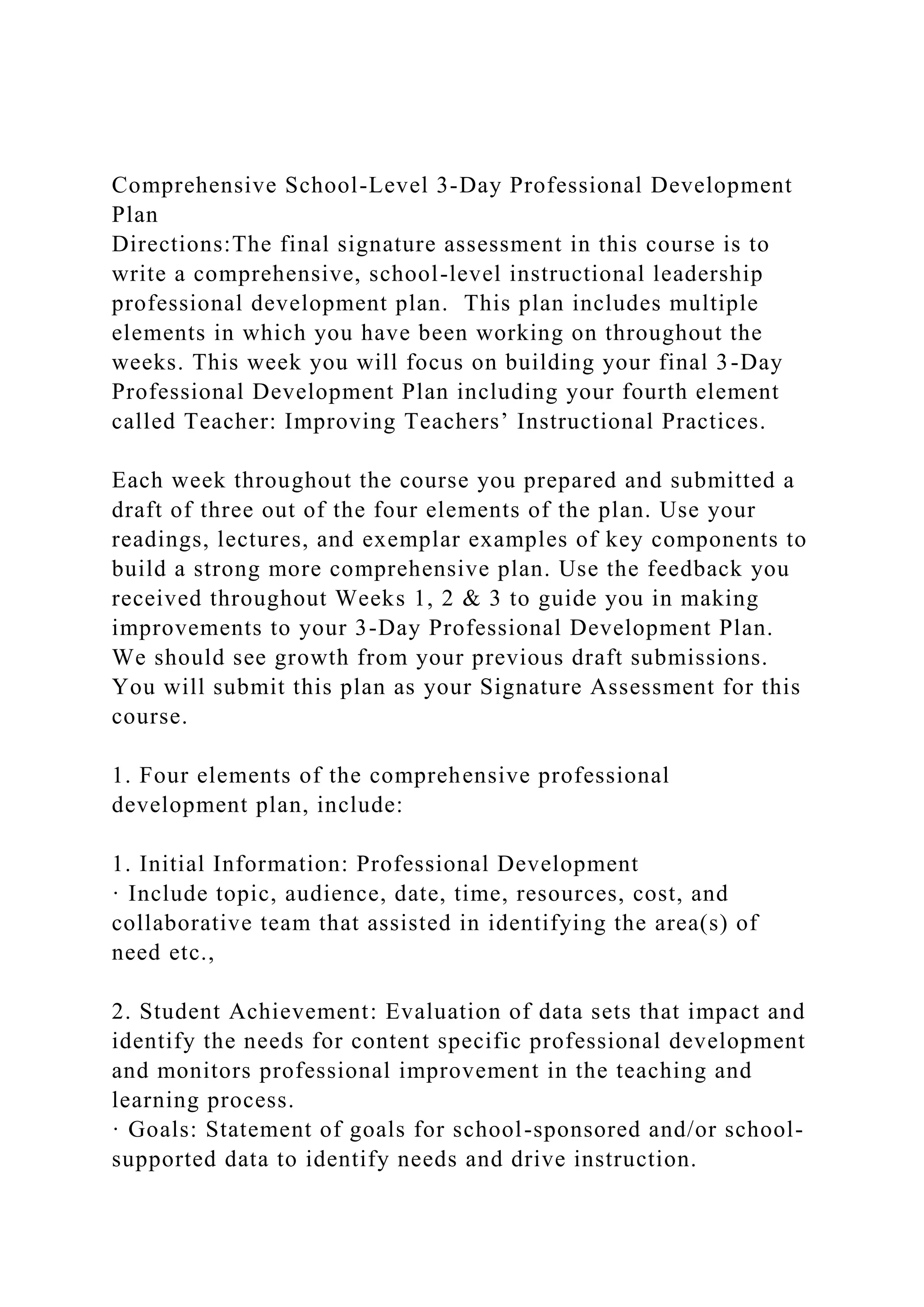
Comprehensive School-Level 3-Day Professional Development
Plan
Directions:The final signature assessment in this course is to
write a comprehensive, school-level instructional leadership
professional development plan. This plan includes multiple
elements in which you have been working on throughout the
weeks. This week you will focus on building your final 3-Day
Professional Development Plan including your fourth element
called Teacher: Improving Teachers’ Instructional Practices.
Each week throughout the course you prepared and submitted a
draft of three out of the four elements of the plan. Use your
readings, lectures, and exemplar examples of key components to
build a strong more comprehensive plan. Use the feedback you
received throughout Weeks 1, 2 & 3 to guide you in making
improvements to your 3-Day Professional Development Plan.
We should see growth from your previous draft submissions.
You will submit this plan as your Signature Assessment for this
course.
1. Four elements of the comprehensive professional
development plan, include:
1. Initial Information: Professional Development
· Include topic, audience, date, time, resources, cost, and
collaborative team that assisted in identifying the area(s) of
need etc.,
2. Student Achievement: Evaluation of data sets that impact and
identify the needs for content specific professional development
and monitors professional improvement in the teaching and
learning process.
· Goals: Statement of goals for school-sponsored and/or school-
supported data to identify needs and drive instruction.
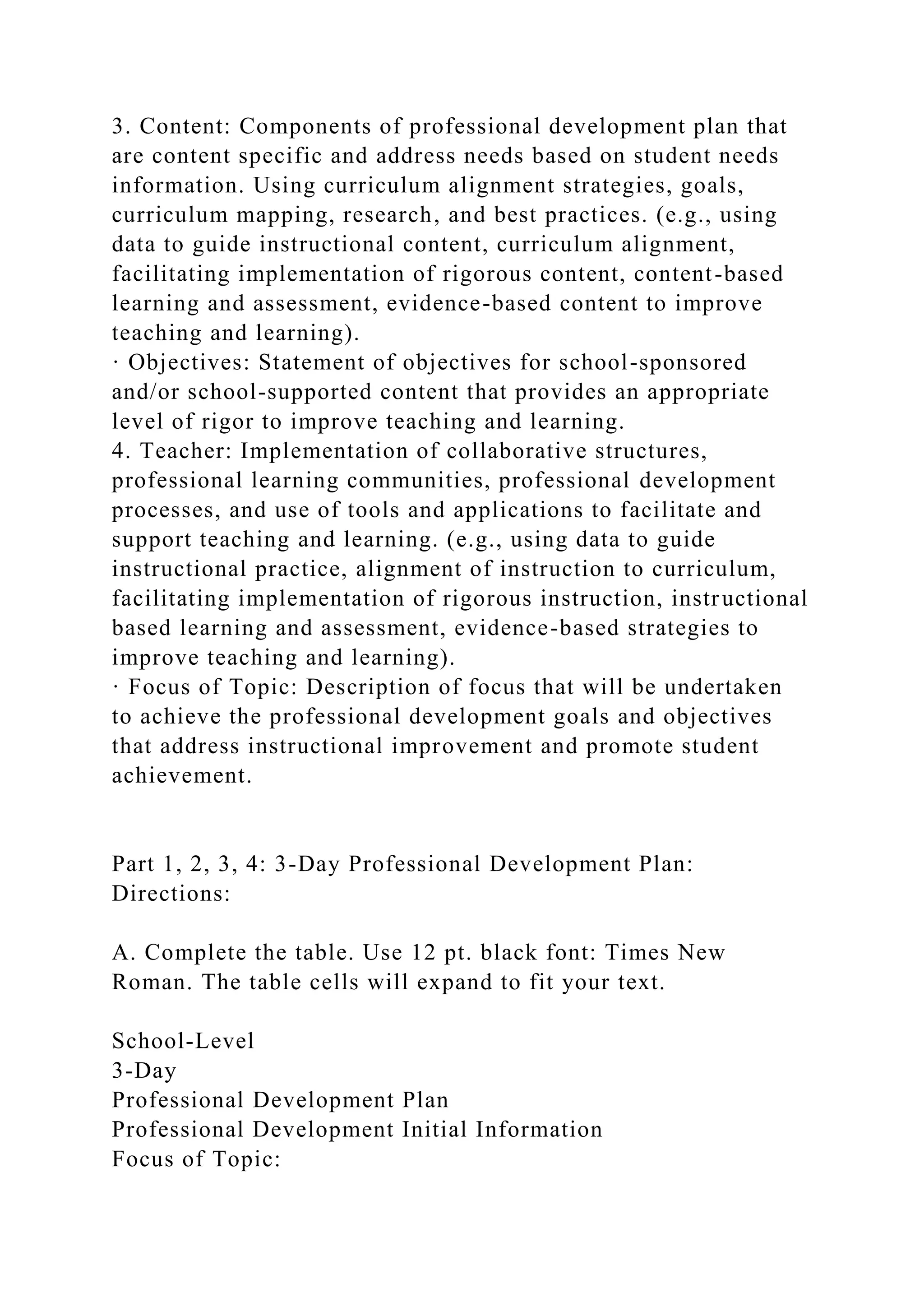
3. Content: Components of professional development plan that
are content specific and address needs based on student needs
information. Using curriculum alignment strategies, goals,
curriculum mapping, research, and best practices. (e.g., using
data to guide instructional content, curriculum alignment,
facilitating implementation of rigorous content, content-based
learning and assessment, evidence-based content to improve
teaching and learning).
· Objectives: Statement of objectives for school-sponsored
and/or school-supported content that provides an appropriate
level of rigor to improve teaching and learning.
4. Teacher: Implementation of collaborative structures,
professional learning communities, professional development
processes, and use of tools and applications to facilitate and
support teaching and learning. (e.g., using data to guide
instructional practice, alignment of instruction to curriculum,
facilitating implementation of rigorous instruction, instructional
based learning and assessment, evidence-based strategies to
improve teaching and learning).
· Focus of Topic: Description of focus that will be undertaken
to achieve the professional development goals and objectives
that address instructional improvement and promote student
achievement.
Part 1, 2, 3, 4: 3-Day Professional Development Plan:
Directions:
A. Complete the table. Use 12 pt. black font: Times New
Roman. The table cells will expand to fit your text.
School-Level
3-Day
Professional Development Plan
Professional Development Initial Information
Focus of Topic:
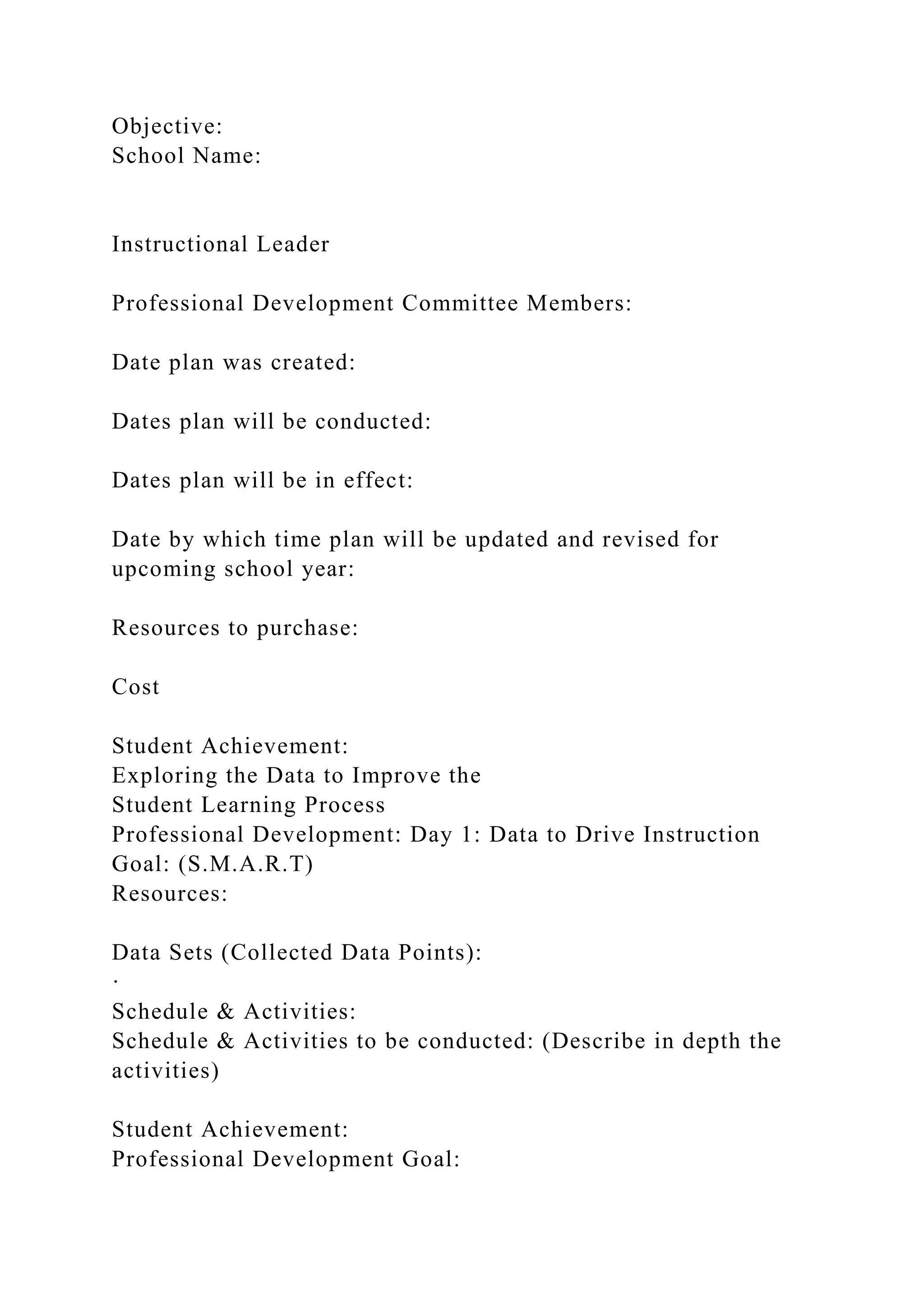
Objective:
School Name:
Instructional Leader
Professional Development Committee Members:
Date plan was created:
Dates plan will be conducted:
Dates plan will be in effect:
Date by which time plan will be updated and revised for
upcoming school year:
Resources to purchase:
Cost
Student Achievement:
Exploring the Data to Improve the
Student Learning Process
Professional Development: Day 1: Data to Drive Instruction
Goal: (S.M.A.R.T)
Resources:
Data Sets (Collected Data Points):
·
Schedule & Activities:
Schedule & Activities to be conducted: (Describe in depth the
activities)
Student Achievement:
Professional Development Goal:
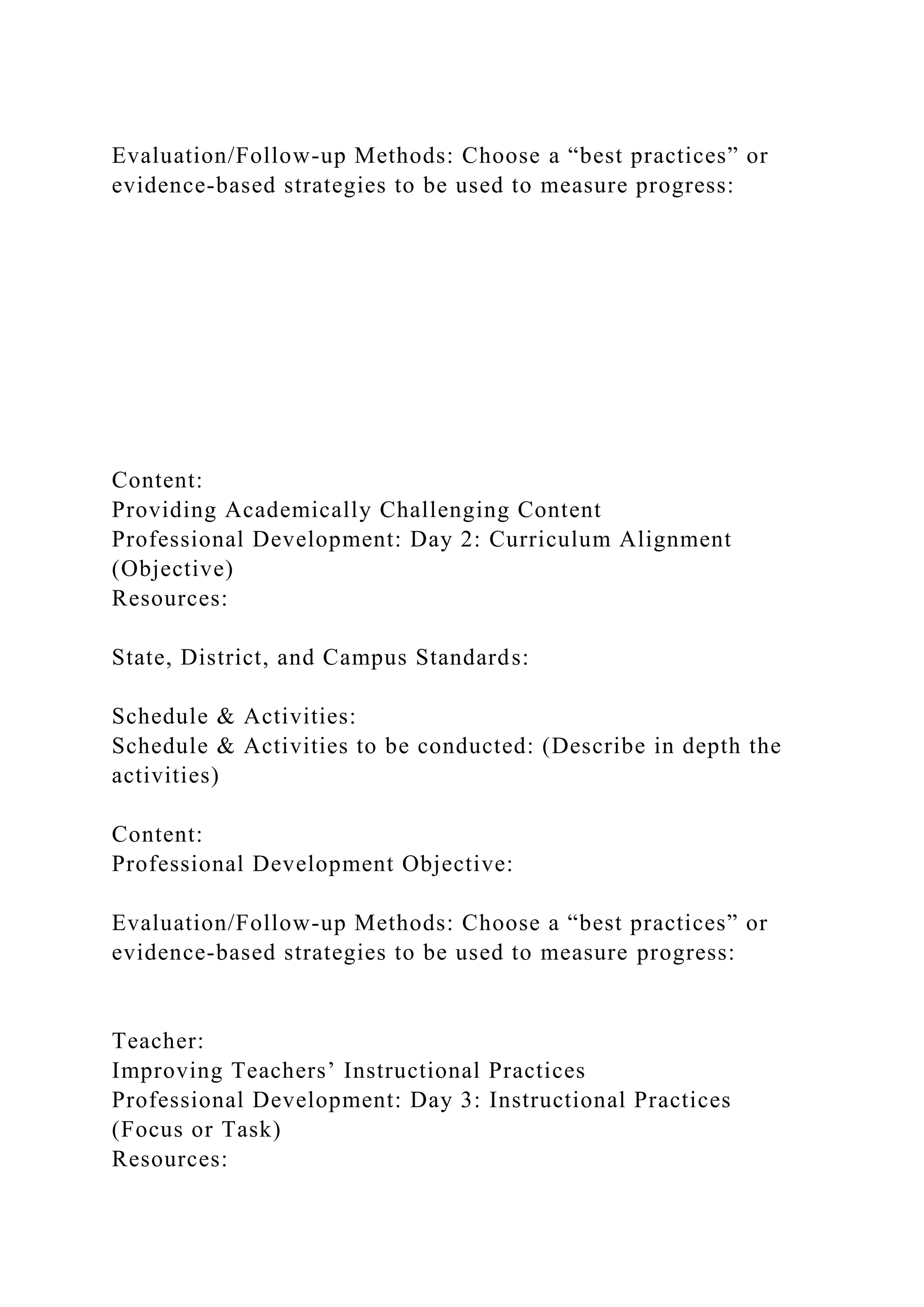
Evaluation/Follow-up Methods: Choose a “best practices” or
evidence-based strategies to be used to measure progress:
Content:
Providing Academically Challenging Content
Professional Development: Day 2: Curriculum Alignment
(Objective)
Resources:
State, District, and Campus Standards:
Schedule & Activities:
Schedule & Activities to be conducted: (Describe in depth the
activities)
Content:
Professional Development Objective:
Evaluation/Follow-up Methods: Choose a “best practices” or
evidence-based strategies to be used to measure progress:
Teacher:
Improving Teachers’ Instructional Practices
Professional Development: Day 3: Instructional Practices
(Focus or Task)
Resources:
Instructional Support:
· Collaboration
· Peer to Peer Instructional Observations
· Best Practices
· Strategies
· Evidence Based Approaches
· Research
Schedule & Activities:
Schedule & Activities to be conducted: (Describe in depth the
activities)
· “Prepare”, “See it”, “Name it”, “Do it”, Reteaching: Guided
and Modeling. (Leverage Leadership 2.0)
· 9:00am-10:00am- Prepare Lesson Plans
· 10:00am-12:00pm-See it & Name it
· 12:00pm-1:00pm- Lunch
· 1:00pm-2:00pm-Do it
· 2:00pm-3:00pm-Reteaching: Guided and Modeling
Teacher:
Professional Development Focus or Task:
Targeted linear equation scaffolding to improve instructional
impact on student learning.
Evaluation/Follow-up Methods: Choose a “best practices” or
evidence-based strategies to be used to measure progress:
· Applications
· Strategies
· Implementation Tools
· T-TESS Evaluations
· Walk Throughs
· 6- or 9-Week Check-ups-for progress monitor
· Year-long calendar to document improvement from previous
year
Part 5: Reflection: Evidence on the Impact of K-12 Student
Learning
Directions:
A. Reflections W4LO1:(CLO1 & 4), W4LO3: (CLO5):Complete
the following reflection to articulate and provide evidence on
the impact of effective professional development on K-12
student learning. Identify an area to focus on by choosing one
of the following: Data to Drive Instruction or Curriculum
Alignment or Instructional Practice. Use the Reflective Model
of What? So What? Now What? found in the Resource section
of your course.
B. Cite any sources and/or readings used as evidence to support
your statements in APA format.
Evidence on K-12 Student Learning:
Directions: Compose a 1-2 paragraph (200-word) reflection
using the What? So What? Now What? Reflective Model to
articulate and provide evidence you have revealed or expect to
find for K-12 student learning using effective Professional
Development practices. Choose one of the three areas to focus
on: Data to Drive Instruction, Curriculum Alignment, or
Instructional Practice.
The Instructional Leader moves the campus forward by
professionally developing the faculty to improve student
learning on K-12 campuses. As an administrator you must
provide evidence on the impact of student learning. Identify the
strengths and opportunities for development as you cover What
was previously done, So What did you learn needs to be done,
and Now What will you do moving forward to provide evidence
on the impact of K-12 student learning in regards to providing
effective professional development.
The research and planning of this 3-Day Professional
Development Plan revealed one area of impact on K-12 student
learning that needed to be addressed and improved. What was
previously practiced created a negative impact on student Math
scores due to weak Curriculum Alignment.
So, what needs to be done to improve this…….
Now what will be proposed to be conducted in the future is….
Reference
Bambrick-Santoyo, P. (2018). Leverage Leadership 2.0: A
Practical Guide to Building Exceptional Schools (p.365-366).
John Wiley & Sons.
ELA Mini-Lesson Plan
Part 1: Mini-Lesson Plan
Grade Level:
ELA Standards:
Learning Objectives:
Description of the unit the class is currently learning:
Book that can be used to create ELA learning activity:
Instructional Strategies:
ELA Learning Activity Description:
Assessment (to be created and administered in Clinical Field
Experience D):
Part 2: Reflection
© 2018 Grand Canyon University. All Rights Reserved.
Rubic_Print_FormatCourse CodeClass CodeAssignment
TitleTotal PointsELM-580ELM-580-O500Clinical Field
Experience C: Literacy Pre-Assessment and Lesson
Plan25.0CriteriaPercentageNo Submission (0.00%)Insufficient
(69.00%)Approaching (74.00%)Acceptable (87.00%)Target
(100.00%)CommentsPoints EarnedContent100.0%Mini-Lesson
Plan35.0%Not addressed. Mini-lesson plan has several errors.
Learning objectives, instructional strategies, ELA learning
activity, and formative assessment are poorly developed and
inadequately aligned to chosen standards.Mini-lesson plan
includes all components, with minimal errors. Learning
objectives, instructional strategies, ELA learning activity, and
formative assessment are overly simplistic and marginally align
to chosen standards.Mini-lesson plan is proficiently designed
with all components, including appropriate standards and grade
level. Learning objectives, instructional strategies, ELA
learning activity, and formative assessment are well developed
and proficiently aligned to chosen standards. Mini-lesson plan
is proficiently designed with all components, including
appropriate standards and grade level. Learning objectives,
instructional strategies, ELA learning activity, and formative
assessment are well developed and proficiently aligned to
chosen standards. Reflection 35.0%Not addressed. Reflection is
poorly written, is missing, and/or lacking in the description of
feedback regarding lesson delivery and areas of potential
growth. Reflection inadequately explains accommodations to
meet the diverse needs of students and how you will use this in
future professional practice.Reflection vaguely and superficially
describes feedback regarding lesson delivery and areas of
potential growth. Reflection is overly simplistic in explaining
accommodations to meet the diverse needs of students and how
you will use this in future professional practice.Reflection
clearly and credibly describes feedback regarding lesson
delivery and areas of potential growth. Reflection includes solid
and appropriate details on accommodations to meet the diverse
needs of students and how you will use this in future
professional practice.Reflection proficiently describes how
feedback regarding lesson delivery and areas of potential
growth. Reflection includes thoughtful and extensive details on
accommodations to meet the diverse needs of students and how
you will use this in future professional practice. Mechanics of
Writing (includes spelling, punctuation, grammar, and language
use)30.0%Not addressed. Frequent and repetitive mechanical
errors distract the reader. Inconsistencies in language choice
(register) or word choice are present. Sentence structure is
correct but not varied.Some mechanical errors or typos are
present, but they are not overly distracting to the reader.
Correct and varied sentence structure and audience-appropriate
language are employed.Prose is largely free of mechanical
errors, although a few may be present. The writer uses a variety
of effective sentence structures and figures of speech.The writer
is clearly in command of standard, written, academic
English.Total Weightage100%

Comprehensive School-Level 3-Day Professional Development PlanDi.docx

  • 1.
    Comprehensive School-Level 3-DayProfessional Development Plan Directions:The final signature assessment in this course is to write a comprehensive, school-level instructional leadership professional development plan. This plan includes multiple elements in which you have been working on throughout the weeks. This week you will focus on building your final 3-Day Professional Development Plan including your fourth element called Teacher: Improving Teachers’ Instructional Practices. Each week throughout the course you prepared and submitted a draft of three out of the four elements of the plan. Use your readings, lectures, and exemplar examples of key components to build a strong more comprehensive plan. Use the feedback you received throughout Weeks 1, 2 & 3 to guide you in making improvements to your 3-Day Professional Development Plan. We should see growth from your previous draft submissions. You will submit this plan as your Signature Assessment for this course. 1. Four elements of the comprehensive professional development plan, include: 1. Initial Information: Professional Development · Include topic, audience, date, time, resources, cost, and collaborative team that assisted in identifying the area(s) of need etc., 2. Student Achievement: Evaluation of data sets that impact and identify the needs for content specific professional development and monitors professional improvement in the teaching and learning process. · Goals: Statement of goals for school-sponsored and/or school- supported data to identify needs and drive instruction.
  • 2.
    3. Content: Componentsof professional development plan that are content specific and address needs based on student needs information. Using curriculum alignment strategies, goals, curriculum mapping, research, and best practices. (e.g., using data to guide instructional content, curriculum alignment, facilitating implementation of rigorous content, content-based learning and assessment, evidence-based content to improve teaching and learning). · Objectives: Statement of objectives for school-sponsored and/or school-supported content that provides an appropriate level of rigor to improve teaching and learning. 4. Teacher: Implementation of collaborative structures, professional learning communities, professional development processes, and use of tools and applications to facilitate and support teaching and learning. (e.g., using data to guide instructional practice, alignment of instruction to curriculum, facilitating implementation of rigorous instruction, instructional based learning and assessment, evidence-based strategies to improve teaching and learning). · Focus of Topic: Description of focus that will be undertaken to achieve the professional development goals and objectives that address instructional improvement and promote student achievement. Part 1, 2, 3, 4: 3-Day Professional Development Plan: Directions: A. Complete the table. Use 12 pt. black font: Times New Roman. The table cells will expand to fit your text. School-Level 3-Day Professional Development Plan Professional Development Initial Information Focus of Topic:
  • 3.
    Objective: School Name: Instructional Leader ProfessionalDevelopment Committee Members: Date plan was created: Dates plan will be conducted: Dates plan will be in effect: Date by which time plan will be updated and revised for upcoming school year: Resources to purchase: Cost Student Achievement: Exploring the Data to Improve the Student Learning Process Professional Development: Day 1: Data to Drive Instruction Goal: (S.M.A.R.T) Resources: Data Sets (Collected Data Points): · Schedule & Activities: Schedule & Activities to be conducted: (Describe in depth the activities) Student Achievement: Professional Development Goal:
  • 4.
    Evaluation/Follow-up Methods: Choosea “best practices” or evidence-based strategies to be used to measure progress: Content: Providing Academically Challenging Content Professional Development: Day 2: Curriculum Alignment (Objective) Resources: State, District, and Campus Standards: Schedule & Activities: Schedule & Activities to be conducted: (Describe in depth the activities) Content: Professional Development Objective: Evaluation/Follow-up Methods: Choose a “best practices” or evidence-based strategies to be used to measure progress: Teacher: Improving Teachers’ Instructional Practices Professional Development: Day 3: Instructional Practices (Focus or Task) Resources:
  • 5.
    Instructional Support: · Collaboration ·Peer to Peer Instructional Observations · Best Practices · Strategies · Evidence Based Approaches · Research Schedule & Activities: Schedule & Activities to be conducted: (Describe in depth the activities) · “Prepare”, “See it”, “Name it”, “Do it”, Reteaching: Guided and Modeling. (Leverage Leadership 2.0) · 9:00am-10:00am- Prepare Lesson Plans · 10:00am-12:00pm-See it & Name it · 12:00pm-1:00pm- Lunch · 1:00pm-2:00pm-Do it · 2:00pm-3:00pm-Reteaching: Guided and Modeling Teacher: Professional Development Focus or Task: Targeted linear equation scaffolding to improve instructional impact on student learning. Evaluation/Follow-up Methods: Choose a “best practices” or evidence-based strategies to be used to measure progress: · Applications · Strategies · Implementation Tools · T-TESS Evaluations · Walk Throughs · 6- or 9-Week Check-ups-for progress monitor · Year-long calendar to document improvement from previous year Part 5: Reflection: Evidence on the Impact of K-12 Student
  • 6.
    Learning Directions: A. Reflections W4LO1:(CLO1& 4), W4LO3: (CLO5):Complete the following reflection to articulate and provide evidence on the impact of effective professional development on K-12 student learning. Identify an area to focus on by choosing one of the following: Data to Drive Instruction or Curriculum Alignment or Instructional Practice. Use the Reflective Model of What? So What? Now What? found in the Resource section of your course. B. Cite any sources and/or readings used as evidence to support your statements in APA format. Evidence on K-12 Student Learning: Directions: Compose a 1-2 paragraph (200-word) reflection using the What? So What? Now What? Reflective Model to articulate and provide evidence you have revealed or expect to find for K-12 student learning using effective Professional Development practices. Choose one of the three areas to focus on: Data to Drive Instruction, Curriculum Alignment, or Instructional Practice. The Instructional Leader moves the campus forward by professionally developing the faculty to improve student learning on K-12 campuses. As an administrator you must provide evidence on the impact of student learning. Identify the strengths and opportunities for development as you cover What was previously done, So What did you learn needs to be done, and Now What will you do moving forward to provide evidence on the impact of K-12 student learning in regards to providing effective professional development. The research and planning of this 3-Day Professional Development Plan revealed one area of impact on K-12 student learning that needed to be addressed and improved. What was previously practiced created a negative impact on student Math scores due to weak Curriculum Alignment.
  • 7.
    So, what needsto be done to improve this……. Now what will be proposed to be conducted in the future is…. Reference Bambrick-Santoyo, P. (2018). Leverage Leadership 2.0: A Practical Guide to Building Exceptional Schools (p.365-366). John Wiley & Sons. ELA Mini-Lesson Plan Part 1: Mini-Lesson Plan Grade Level: ELA Standards: Learning Objectives: Description of the unit the class is currently learning: Book that can be used to create ELA learning activity: Instructional Strategies: ELA Learning Activity Description: Assessment (to be created and administered in Clinical Field
  • 8.
    Experience D): Part 2:Reflection © 2018 Grand Canyon University. All Rights Reserved. Rubic_Print_FormatCourse CodeClass CodeAssignment TitleTotal PointsELM-580ELM-580-O500Clinical Field Experience C: Literacy Pre-Assessment and Lesson Plan25.0CriteriaPercentageNo Submission (0.00%)Insufficient (69.00%)Approaching (74.00%)Acceptable (87.00%)Target (100.00%)CommentsPoints EarnedContent100.0%Mini-Lesson Plan35.0%Not addressed. Mini-lesson plan has several errors. Learning objectives, instructional strategies, ELA learning activity, and formative assessment are poorly developed and inadequately aligned to chosen standards.Mini-lesson plan includes all components, with minimal errors. Learning objectives, instructional strategies, ELA learning activity, and formative assessment are overly simplistic and marginally align to chosen standards.Mini-lesson plan is proficiently designed with all components, including appropriate standards and grade level. Learning objectives, instructional strategies, ELA learning activity, and formative assessment are well developed and proficiently aligned to chosen standards. Mini-lesson plan is proficiently designed with all components, including appropriate standards and grade level. Learning objectives, instructional strategies, ELA learning activity, and formative assessment are well developed and proficiently aligned to chosen standards. Reflection 35.0%Not addressed. Reflection is poorly written, is missing, and/or lacking in the description of feedback regarding lesson delivery and areas of potential growth. Reflection inadequately explains accommodations to meet the diverse needs of students and how you will use this in future professional practice.Reflection vaguely and superficially describes feedback regarding lesson delivery and areas of
  • 9.
    potential growth. Reflectionis overly simplistic in explaining accommodations to meet the diverse needs of students and how you will use this in future professional practice.Reflection clearly and credibly describes feedback regarding lesson delivery and areas of potential growth. Reflection includes solid and appropriate details on accommodations to meet the diverse needs of students and how you will use this in future professional practice.Reflection proficiently describes how feedback regarding lesson delivery and areas of potential growth. Reflection includes thoughtful and extensive details on accommodations to meet the diverse needs of students and how you will use this in future professional practice. Mechanics of Writing (includes spelling, punctuation, grammar, and language use)30.0%Not addressed. Frequent and repetitive mechanical errors distract the reader. Inconsistencies in language choice (register) or word choice are present. Sentence structure is correct but not varied.Some mechanical errors or typos are present, but they are not overly distracting to the reader. Correct and varied sentence structure and audience-appropriate language are employed.Prose is largely free of mechanical errors, although a few may be present. The writer uses a variety of effective sentence structures and figures of speech.The writer is clearly in command of standard, written, academic English.Total Weightage100%