Using Assessment to Support Teaching
and Learning in the Classroom
Cornelius Young
corneliusyoung@pdst.ie
087-6539013
The Professional Development Service for Teachers is funded by the
Department of Education and Science under the National Development Plan
1
Professional Development Service for Teachers
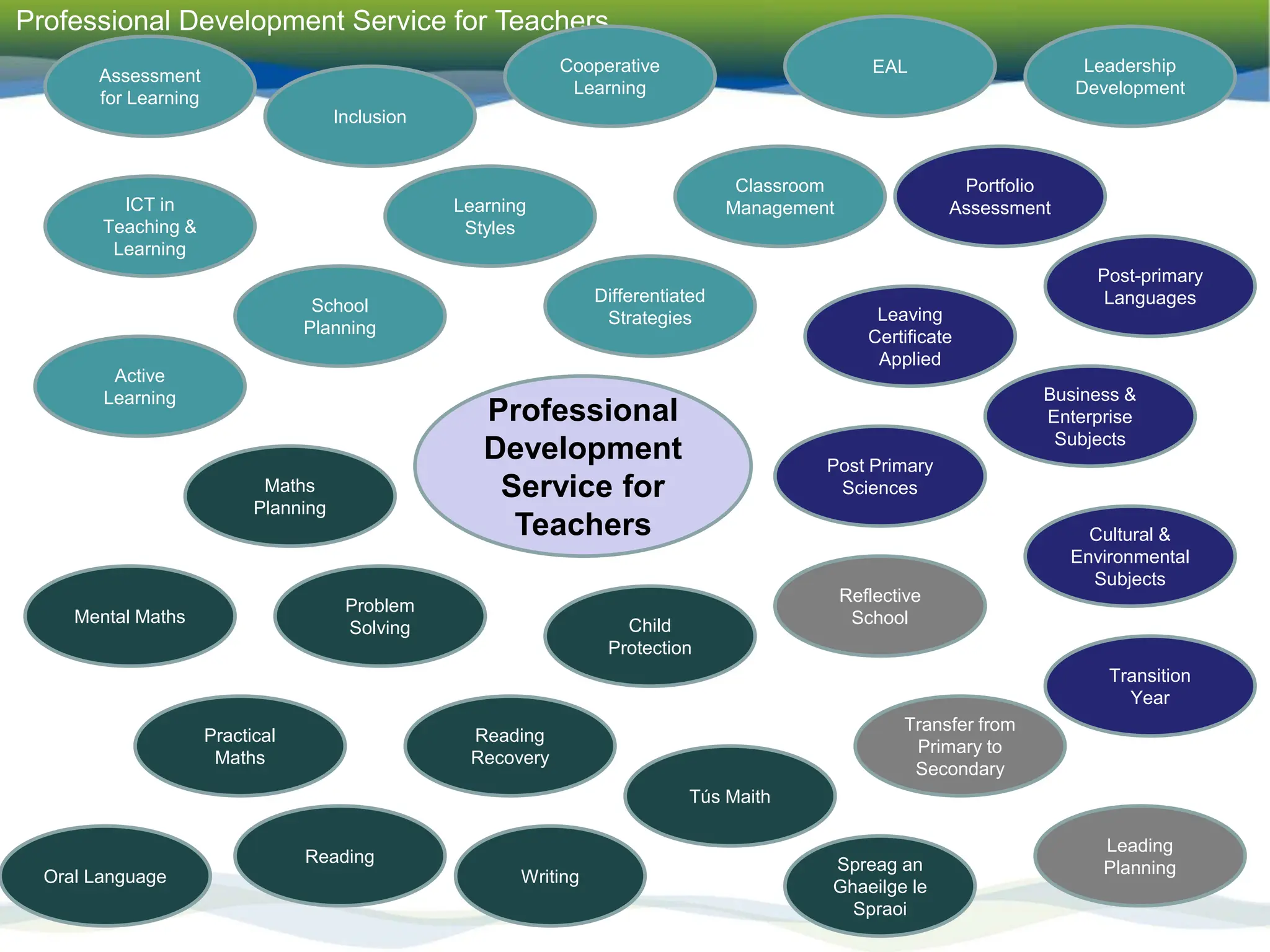
Professional
Development
Service for
Teachers
Assessment
for Learning
Oral Language
Problem
Solving
Active
Learning
Portfolio
Assessment
Inclusion
Differentiated
Strategies
Learning
Styles
ICT in
Teaching &
Learning
Classroom
Management
Cooperative
Learning
Practical
Maths
Mental Maths
Writing
Reading
Reading
Recovery
School
Planning
Maths
Planning
EAL
Tús Maith
Child
Protection
Spreag an
Ghaeilge le
Spraoi
Post-primary
Languages
Post Primary
Sciences
Leaving
Certificate
Applied
Transition
Year
Cultural &
Environmental
Subjects
Business &
Enterprise
Subjects
Leadership
Development
Reflective
School
Transfer from
Primary to
Secondary
Leading
Planning
Professional Development Service for Teachers
T.J. Ó Ceallaigh
Regional Coordinator
tjoceallaigh@pdst.ie
(087) 9135319
Cliodhna Breen
Regional Advisor
cliodhnabreen@pdst.ie
(087)1255610
Cornelius Young
Regional Advisor
corneliusyoung@pdst.ie
(087) 2699754
Elaine O' Connor
Regional Advisor
elaineoconnor@pdst.ie
(086) 8205916
Professional Development Service for Teachers
Sharing the Learning Intentions
Compare different modes of Assessment and
describe how they can be applied in your
teaching

Describe how you can develop Questioning
skills in Assessment for Learning in your
classes

Describe the benefits of Peer and Self
Assessment and how they can be applied in
your class

l... 
Professional Development Service for Teachers
5
Professional Development Service for Teachers
Assessment for Learning
What am I
learning?
How will this
inform my
teaching?
Professional Development Service for Teachers
K-W-L Chart
Know already Want to Know Learnt
7
Professional Development Service for Teachers
What do you understand by
‘Assessment’
• How do you assess your
students currently?
• What is the purpose of
assessment?
8
Professional Development Service for Teachers
Assessment is the process of gathering
information about children’s learning
Screening
Diagnosis Learning
Certification
Feedback
Purpose of
Learning
Professional Development Service for Teachers
Assessment in education is about
gathering, interpreting and using
information about the processes and
outcomes of learning.
10
Professional Development Service for Teachers
Schemes of assessment should:
• Provide information about what students know and what
they can do
• Enhance the quality of learning
• Measure progress made by students
• Certify achievement
• Motivate
• Supply information for teachers, students and parents
that enables them to direct future strategies for teaching
and learning
• Allow and encourage students to become reflective and
independent learners
11
Professional Development Service for Teachers
Types of Assessment
12
Assessment Learning
FOR
OF
AS
Professional Development Service for Teachers
Traffic Lighting
Can Not Understand
Not Too Sure
Clear Understanding
13
Professional Development Service for Teachers
Traffic Lighting
• To get an overview of the
understanding of the class
• Topic checklists are completed at
the start of a topic and the
information used by the teacher to
structure the planned learning -
greens first, reds later
• At the end of the topic, students
re-traffic light their understanding
of the learning outcomes and list
what they need to do - make the
basis of a revision lesson
14
Professional Development Service for Teachers
Assessment OF Learning
Summative Assessment
• Happens after the learning takes place
• Information is gathered by the teacher
• Information is usually transformed into
marks or grades
• Looks back on past learning
• Comparison with the performance of
others
15
Professional Development Service for Teachers
Summative Assessment
• Tests
• Practical exercises
Purpose:
• To find out what pupils know, understand
and can do (do not know, understand...)
• What progress have they made?
16
Professional Development Service for Teachers
Assessment FOR learning
Formative assessment
• An integral part of the learning process
• Clarifies for students what is to be learned and
what success would look like.
• Give useful and timely feedback to students
• Comparison with aims and objectives is
important
• Helps students to identify the next steps they
need to take and who can help them.
17
Professional Development Service for Teachers
Formative Assessment
• Questioning
• Feedback (marking and oral)
• Peer and Self Assessment
Purpose:
• To help pupils learn
18
Professional Development Service for Teachers
19
Assessment ‘processes’...
Traditional / typical:
instruct instruct instruct then assess
AfL:
assess
instruct
assess
assess
instruct
Professional Development Service for Teachers
20
Assessment OF
Learning
Assessment FOR
Learning
Happens after learning
takes place
An integral part of
learning process
Information is gathered
by teacher
Information is shared
with learner
Information is usually
transferred into marks
Information is available
on quality of learning
Comparison with
performance of others
Comparison with aims
and objectives is
important
Looks back on past
learning
Looks forward to the
next stage of learning
Professional Development Service for Teachers
21
Professional Development Service for Teachers
Assessment AS Learning
Enables students to:
• Identify and reflect on elements of their
own learning
• Set their own learning targets
• Practice self and peer assessment.
22
Professional Development Service for Teachers
23
Professional Development Service for Teachers
Research Findings OECD 2005
Formative Assessment
“The achievement gains associated with formative
assessment have been described as among the
largest ever reported for educational
interventions”
Formative assessment also improves equity of
student outcomes. Schools which use formative
assessment show not only general gains in
academic achievement, but also particularly high
gains for previously underachieving students
24
Professional Development Service for Teachers
Research Findings OECD 2005
Formative Assessment
• Attendance and retention of learning are also
improved, as well as the quality of students’
work
Formative Assessment: Improving Learning in
Secondary Classrooms (OECD 2005)
• Whole school evaluation and subject inspection
now recognise formative assessment as critical
to effective teaching and learning
25
Professional Development Service for Teachers
AfL is characterised by five
principles:
1. Sharing the Learning Intention
2. Sharing the Criteria for Success
3. Quality Questioning based on Criteria
for Success
4. Providing Feedback based on Criteria
for Success
5. Peer & Self Assessment
26
Professional Development Service for Teachers
Sharing the Learning Intentions
Compare different modes of Assessment and
describe how they can be applied in your
teaching

Describe how you can develop Questioning
skills in Assessment for Learning in your
classes

Describe the benefits of clarifying the
Learning Outcomes at the beginning of a
lesson

... 
What is the Criteria for Success?
1.
2.
3.
Professional Development Service for Teachers
How well can you draw?
• The NCCA has devised
a short course called
Houseology.
• As a student sitting the
first exam, your task is to
draw a house and give it
a name
• You have 40 seconds
• Best of luck
Professional Development Service for Teachers
Success criteria
Grade D
• The house has at least two windows
Grade C
• The house has a door, roof and a chimney
Grade B
• The drawing is three dimensional in nature
Grade A
• The house has a name that reflects its features
• At least two decorative techniques have been
used including smoke coming from the chimney
29
Professional Development Service for Teachers
Sharing the Learning Intention
• Students should have clear notion of learning intention of
each lesson (put on board at start of class)
• The learning intention is what you hope students will
know, understand or be able to do by the end of
lesson
Examples:
- By the end of this lesson you should be able to
separate sand, salt and water
- By the end of this lesson you should be able to
understand the character of ….
- By the end of this lesson you should be able to
draw a diagram of …
30
Professional Development Service for Teachers
Success Criteria
How will I know whether I've achieved the learning
intention?
We are learning to use effective adjectives in our
writing...
• What I am looking for is that you have used at
least 5 effective adjectives in your paragraph
• What I am looking for is that you have used at
least 4 adjectives which describe the jungle
Professional Development Service for Teachers
LCA Graphics & Construction 2008
Professional Development Service for Teachers
LC English 2008 Ordinary
CRITERIA FOR ASSESSMENT
The tasks set for candidates in both Paper 1 and Paper 2
will be assessed in accordance with the following criteria:
Clarity of Purpose (P) 30% of the marks available for the
task
Coherence of Delivery (C) 30% of the marks available for
the task
Efficiency of Language Use (L) 30% of the marks available
for the task
Accuracy of Mechanics (M) 10% of the marks available for
the task
Professional Development Service for Teachers
What Contribution
can Questioning
Make to Learning
Learning Intention
How would you
define a good
Question…
Criteria for Success
Professional Development Service for Teachers
A Quick Test!!!!
'Corandic is an emurient grof
with many fribs. It granks from
corite, an olg which carps like
lange.............'
35
Professional Development Service for Teachers
Good use of questions
• How would you define a good question? (Why
do you ask questions in class?)
– Causes students to think
– Promotes discussion
– One to which every child has an answer
– One which has a purpose
• Some students, for various reasons, do not
answer in class, how do you encourage these
students to answer in class?
36
Professional Development Service for Teachers
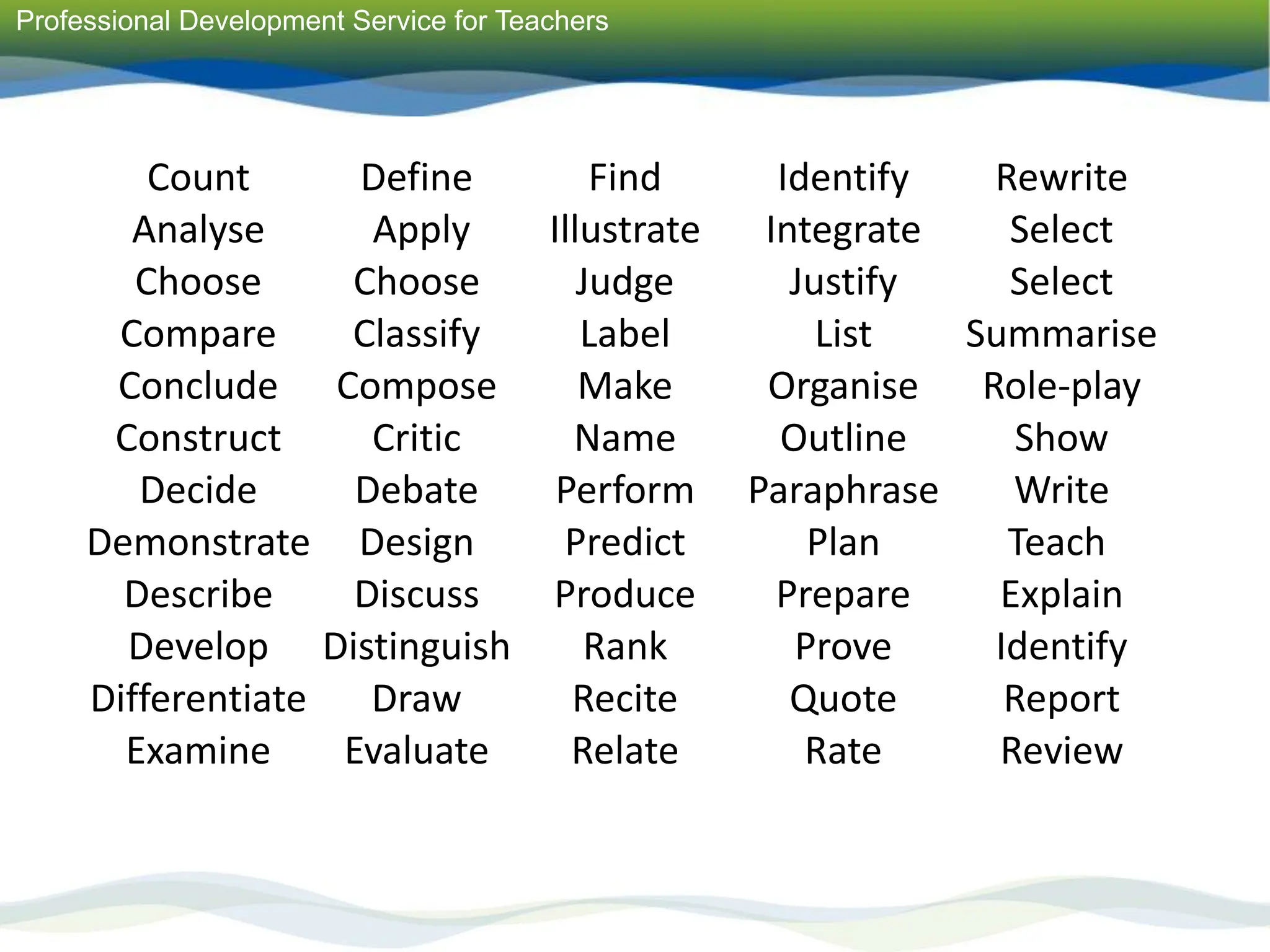
Count Define Find Identify Rewrite
Analyse Apply Illustrate Integrate Select
Choose Choose Judge Justify Select
Compare Classify Label List Summarise
Conclude Compose Make Organise Role-play
Construct Critic Name Outline Show
Decide Debate Perform Paraphrase Write
Demonstrate Design Predict Plan Teach
Describe Discuss Produce Prepare Explain
Develop Distinguish Rank Prove Identify
Differentiate Draw Recite Quote Report
Examine Evaluate Relate Rate Review
Professional Development Service for Teachers
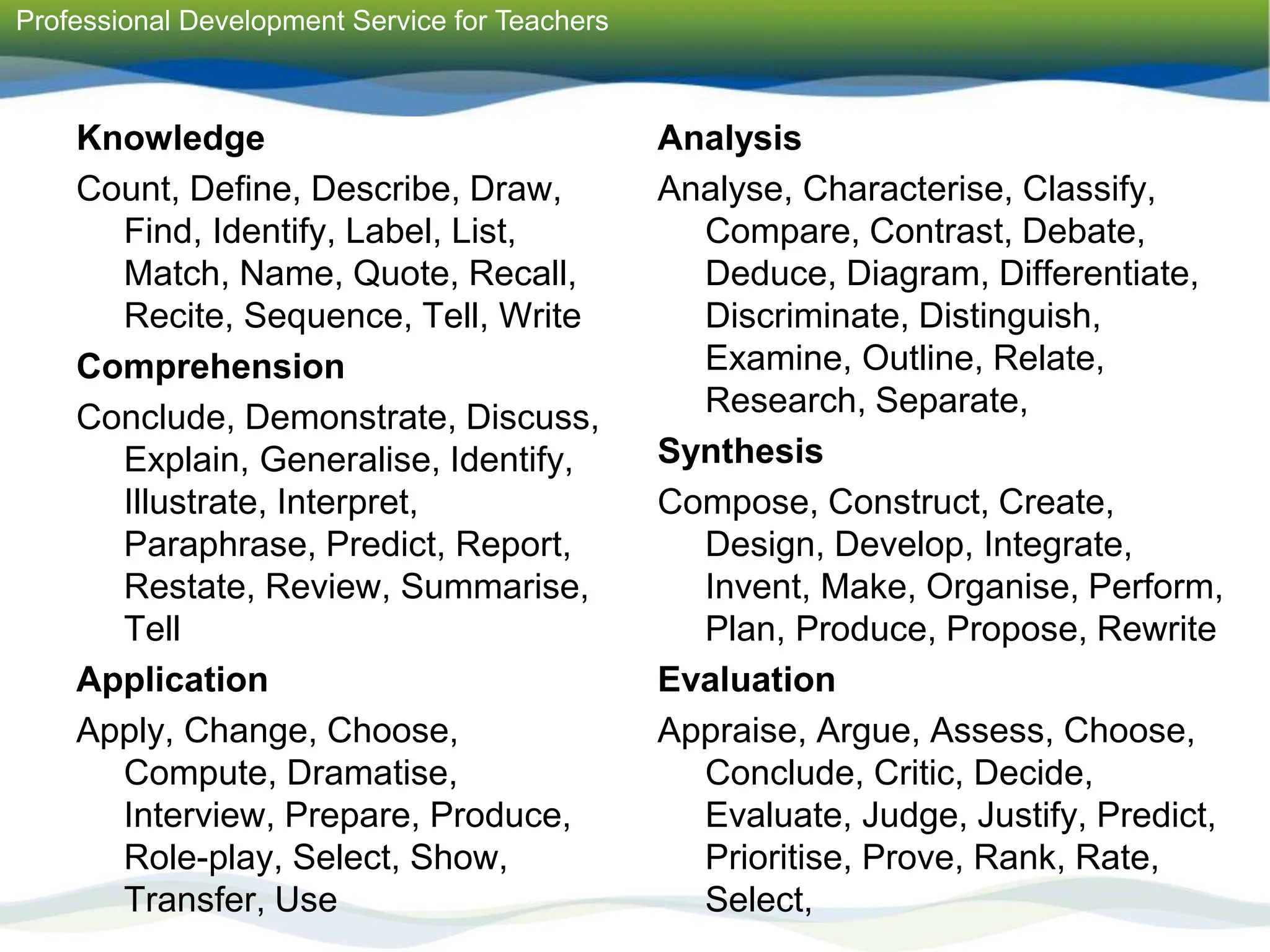
Knowledge
Count, Define, Describe, Draw,
Find, Identify, Label, List,
Match, Name, Quote, Recall,
Recite, Sequence, Tell, Write
Comprehension
Conclude, Demonstrate, Discuss,
Explain, Generalise, Identify,
Illustrate, Interpret,
Paraphrase, Predict, Report,
Restate, Review, Summarise,
Tell
Application
Apply, Change, Choose,
Compute, Dramatise,
Interview, Prepare, Produce,
Role-play, Select, Show,
Transfer, Use
Analysis
Analyse, Characterise, Classify,
Compare, Contrast, Debate,
Deduce, Diagram, Differentiate,
Discriminate, Distinguish,
Examine, Outline, Relate,
Research, Separate,
Synthesis
Compose, Construct, Create,
Design, Develop, Integrate,
Invent, Make, Organise, Perform,
Plan, Produce, Propose, Rewrite
Evaluation
Appraise, Argue, Assess, Choose,
Conclude, Critic, Decide,
Evaluate, Judge, Justify, Predict,
Prioritise, Prove, Rank, Rate,
Select,
Professional Development Service for Teachers
BLOOM’S REVISED TAXONOMY
Creating
Generating new ideas, products, or ways of viewing things
Designing, constructing, planning, producing, inventing.
Evaluating
Justifying a decision or course of action
Checking, hypothesising, critiquing, experimenting, judging
Analysing
Breaking information into parts to explore understandings and relationships
Comparing, organising, deconstructing, interrogating, finding
Applying
Using information in another familiar situation
Implementing, carrying out, using, executing
Understanding
Explaining ideas or concepts
Interpreting, summarising, paraphrasing, classifying, explaining
Remembering
Recalling information
Recognising, listing, describing, retrieving, naming, finding 39
Professional Development Service for Teachers
AfL – questioning
type of questions...
Professional Development Service for Teachers
AfL – questioning
what? who? when? how many? state...
one word type answers
useful to check who learned facts
Professional Development Service for Teachers
AfL – questioning
can you be sure that? what would happen if?
how would you explain? what does that tell
you? what is wrong with saying?
answers longer & more varied
useful to promote thinking skills
Professional Development Service for Teachers
How can we encourage
students to ask questions?
Working in pairs, list below 2 strategies for
encouraging students to ask or formulate
questions.
43
Professional Development Service for Teachers
Use of Questions
When looking at questioning in the classroom we
should consider:
– Wait time
– Variety of questioning
– Developing key questions (for key stages of the
lesson)
– Quality of questions (why does..? Could you
explain..?)
– Well thought out questions
– Involving more than one student in the answer
– No Hands Up 44
Professional Development Service for Teachers
Effects of
Increased Wait Time
• Longer answers
• Decreased failure of response
• Increased confidence of response
• Students challenged and/or
improved answers of other students
• More alternative explanations
offered
45
Professional Development Service for Teachers
Read the extracts
carefully and answer
the following questions:
• What is the teacher
doing with his
questioning?
• What is the lesson like
for the learners?
46
Professional Development Service for Teachers
Subject Specific
From a few
Questions for a
Topic you are
Covering tomorrow
Professional Development Service for Teachers
48
Classroom Strategies:
Ask Better Questions
– Ask fewer questions.
– Variety of questions
– Sequence questions.
– Prepare key questions
– Developing key
questions (for key stages
of the lesson)
– Quality of questions (why
does..? Could you
explain..?)
– Well thought out
questions
• Involve more than one
student in the answer
• Involve the whole class.
• Think, pair, share, square.
• Wait-time (1 and 2)
• Try no hands up.
• Traffic lights
Professional Development Service for Teachers
49
Question Stems
• How can we be sure that ...?
• What is the same and what is different about …?
• Is it ever/always true/false that …?
• Why do ____, ____ and ____ all give the same answer?
• How do you ….?
• How would you explain …?
• What does that tell us about …?
• What is wrong with …?
• Why is _____ true?
Professional Development Service for Teachers
50
Professional Development Service for Teachers
51
Professional Development Service for Teachers
52
Professional Development Service for Teachers
Feedback through marking
• How clear is the feedback we give the students?
– ‘you must try harder’
– ‘develop these ideas further’
– ‘good work keep it up’
– ‘more detailed needed here’
• How does the student interpret the feedback?
– ‘a tick means he probably likes it’
– ‘there is a lot of writing at end this means it is bad’
– ‘this is one of my best because my hand writing is
neat, I checked my spellings and I put in the date’
Professional Development Service for Teachers
Feedback
Teacher marking
[peer assessment]
[self assessment]
[summative as formative]
Professional Development Service for Teachers
Guidelines
1. Descriptive rather than evaluative
2. Focused on the learning goals and the success criteria
3. Limited to a few traits or characteristics of student
performance
4. Timely
5. Implemented by students and monitored by the teacher
Examples of Ineffective
Feedback
• “Good work.” “Well done!”
• “Needs more effort!”
• C+ or 67%
More Effective Feedback
“You’re paragraph has a
clear and engaging topic
sentence. Provide at least
three details from the text
to support your opinion.”
55
Professional Development Service for Teachers
56
Study 1:
4 schools, 12 classes
Lesson 1 work given, marked as follows:
• 4 classes awarded marks
• 4 classes given comments only
• 4 classes awarded both marks and
comments
Question: Which set of classes performed
best?
Professional Development Service for Teachers
57
• 2nd piece of work given. Students told they’d get
same kind of feedback
• Students given marks only made slight/no gain
• Students given comments only scored, on
average, 30% more on second occasion
• Students given both mark and grade made no
progress
Professional Development Service for Teachers
58
Study 2 –200 students
Feedback given on first piece of work as
follows:
• ¼ of students given comments
• ¼ students given grades
• ¼ students given praise
• ¼ given no feedback at all
Professional Development Service for Teachers
59
2nd piece of work done and
examined
• Those given comments had improved
substantially
• Those given grades and praise had made
no more progress than those given
absolutely no feedback
Professional Development Service for Teachers
A B
AfL – feedback
Professional Development Service for Teachers
Effective Feedback
Feedback is most effective when it
confirms the students:
• Strengths
• Weaknesses
• where to go Next
(S.W.N.)
Professional Development Service for Teachers
62
Feedback and Motivation
• Timing of feedback is crucial
• Minimal intervention promotes better learning
• Feedback should focus on what needs to be
done to improve, rather than on how well the
student has done
• Feedback should be designed to lead students
to believe ability is incremental, not fixed.
Professional Development Service for Teachers
Peer and Self Assessment
• Self Assessment
– Students are involved in and responsible for
assessing their own piece of work (students know
criteria for success)
• Peer Assessment
– Students are involved in assessment of the work of
other students (students have to have a clear
understanding of what to look for in their peers’ work)
• Peer and self assessment are often considered
together. Peer assessment can help self
assessment. By judging the work of others,
students gain insight into their own performance.
Professional Development Service for Teachers
Self assessment
• Traffic lights system
• Mark own work using marking scheme
• Use checking sheets
• Graphic Organisers
• Flash Cards
64
Professional Development Service for Teachers
Self Assessment
• Children looking at their own work in a
reflective way - metacognition
• Whole class, group , individual
• Criteria must be agreed beforehand by the
teacher
• Fosters independence and motivation and
positive classroom climate
• Can be shared with other parties
Professional Development Service for Teachers
Self assessment - How
• Writing process- drafting, revising, editing
and publishing
• Choosing the best samples of his/her work
to include in a portfolio
• Creating, talking about, and recording
musical compositions
Professional Development Service for Teachers
Peer assessment
• Mark own work in small groups using text-books
• Group marking of questions - Compare answers
and decide which is the best answer
• 1 + 1 = Students in groups given a problem or
similar exercise and asked to present findings to
class – peers asked to identify one learning
point and make one suggestion to improve
67
Caroline O’Brien Clip
Professional Development Service for Teachers
Sharing the Learning Intentions
Compare different modes of Assessment and
describe how they can be applied in your
teaching

Describe how you can develop Questioning
skills in Assessment for Learning in your
classes

Describe the benefits of Peer and Self
Assessment and how they can be applied in
your class

... 
Thank you for your
contributions during the
session
Please complete and return the
evaluation Forms.
The Second Level Support Service is funded by the Department of
Education and Science under the National Development Plan
69
Cornelius Young
corneliusyoung@pdst.ie
087-6539013
Professional Development Service for Teachers
Thinking Skills Table
A B C D
Students'
actual use
of thinking
skills
Uses strategies
and can self-
evaluate
strategies'
effectiveness; will
try new one if
needed
Will use new
strategy if
teacher
prompts
Will use
strategy only
when directed
by teacher.
Requires
teacher direct
contact and
modelling of
specific strategy
to use
Students'
awareness
of strategy
use
Student has 3 or
more strategies in
his/her repertoire
specifically taught.
Student has 2
strategies in
his/her
repertoire
specifically
taught.
Student is
aware of
generic
strategies
(study, ask,
etc.)
No strategy
awareness.
Students'
awareness
of their own
thinking
Student is lucid
and able to
expound on his
metacognitive
strategies.
Student can
verbalise
some thought
processes
behind
thinking.
Student
verbalises
awareness of
thinking but not
actual 'self-talk'
or analysis of
thinking.
Student has no
understanding
of
metacognition.
70
Professional Development Service for Teachers
Graphic Organisers
Professional Development Service for Teachers
Flash Cards
Professional Development Service for Teachers
Continuum of assessment
Professional Development Service for Teachers
KWL
• Know
• Want
• Learnt
(KWHL -How)
Professional Development Service for Teachers
PMI diagram
• Plus
• Minus
• Interesting
Professional Development Service for Teachers
Talk Partners
3 things learnt
• Easy
• Difficult
• Future learning
Professional Development Service for Teachers
Check lists
Professional Development Service for Teachers
Thumbs up – thumbs down
Professional Development Service for Teachers
Other Self assessment tools
• W W W E B I
• Ladder
• 2 stars and a wish
• Numerical scale of understanding 1-5
• Prompts –
– the most important thing I learnt was
– what I found difficult was
Professional Development Service for Teachers
Conferencing
• Sharing of knowledge and understanding
of the child’s work
• Simple conversation or planned meeting
• Encourages listening, openness and
feedback
• Could concern a single product of learning
or a general learning experience
Professional Development Service for Teachers
Portfolio
• Collection of child’s work
– shows improvement
– shows range of work
– shows strengths and interests
– shows best work
• Evidence of progress across a strand, strand
unit or a theme or topic
• Hard copy and / or electronically (e-portfolios)
• Can represent AfL and AoL
Professional Development Service for Teachers
Concept mapping
• Graphic organisers or picture summaries
of the child’s understanding of ideas and
the relationships between ideas.
• Rich insights into children’s learning and
mis –conceptions
• Used at the beginning, middle or end of a
unit of work
• Good for children with learning difficulties
Professional Development Service for Teachers
Teacher Observation
• Immediate and accurate information
• Learning needs
• How pupils acquire and master different
skills
• Ability to transfer skills and knowledge
• How a pupil collaborates with others
• Different types
Professional Development Service for Teachers
Number
Concept
Recognising
and naming
of numerals
1-5
Concept
Development
Naming
five
shapes
Naming of
five colours
Pupil 1
Pupil 2
Pupil 3
Pupil 4
Pupil 5
Pupil 6
Teacher as Observer
Some Early at Risk Indicators 4 (Numeracy)Class:
Professional Development Service for Teachers
Teacher Designed Tasks and
Tests
• Oral assignments
• Individual tasks
• Group tasks
• Paper and pencil
tests
Professional Development Service for Teachers
Guidelines for Written Tests
• identify purpose at outset
• relate to pupil’s interests
• start with easy question
• vary questions
• use subject-verb-object structure
• a single question per page
• give key information in bold
» NCCA Guidelines 2007
Professional Development Service for Teachers
Consider
• What will be assessed ?
• How will it be assessed?
• How will the assessment be used?
• Do you use assessment to support
progress or identify failure ?
Professional Development Service for Teachers
Written tests
• Teach revision strategies and study skills (appropriate to
your subject)
• Help students to identify for themselves the topics they
most need to revise
• Consider the feedback to be given. It needs to be timely,
specific and include suggestions for ways to improve:
What was good about the work
Areas for improvement
Strategies for improving the work
• Avoid a competitive environment
89
Professional Development Service for Teachers
Homework
Possible approaches:
• Set the homework at the beginning of the lesson
(particularly effective for underachieving students)
• Provide written criteria for assessment in advance
• Provide exemplars to illustrate standards
• Encourage students to reflect on and improve their work
• Consider the type of feedback (marks / written feedback
/ both?
90
Professional Development Service for Teachers
AfL as classroom practice
Plans new
learning
Share learning
intentions
Explores
success criteria
Uses variety
methodologies
and strategies
Gathers and
records
information about
what and how of
children’s learning
Using
assessment as
part of
teaching and
learning the
teacher...
Professional Development Service for Teachers
Planning for AfL (Goal setting)
Strategies Description
What are we
learning to-day?
Give learning outcomes and purpose of
lesson at start of class in ‘pupil speak’
What am I
looking for?
Show at the outset what students will be
able/required to do to demonstrate
achievement of the learning goals: ‘you
will be able to answer..’ you will know..’
Traffic Light
Grouping
Differentiate lesson according to
difficulty of task by student self grouping,
Green (confident), amber (doubtful), red
(difficulties) 92
Professional Development Service for Teachers
Planning for AfL (Questioning)
Strategies Description
Wait time Systematically allow >5 seconds for all replies to
teachers questions, without interruption
No Hands Up Select students to answer questions- no
volunteering/hands up
Distributed
Answers
Ensure all students get to answer questions fairly &
systematically calling
Open/Closed
Questions
Vary types of questions: some requiring thinking
and limit recall questions
Think, Pair,
Share
Pair students to discuss and plan questions
Traffic Light Differentiate students by Green (Known), Amber
(unsure), Red (Not Known) 93
Professional Development Service for Teachers
Watch the clip Hot Research
Assessment for Learning
Learning and write down
• Two things that you learned
• Two questions I still have
94
Professional Development Service for Teachers
CHANGE
TIME
We are here
© 2007 Marc Prensky
Discontinuity:
Digital Technology
Our Lives
Professional Development Service for Teachers
Learning Preferences of
Digital Natives
• Teamwork
• Experiential activities
• Use of technology
• Multitasking
• Goal orientation
• Collaborative
• Digital Natives are
better at:
– Taking in varied
information
– Making decisions
quickly
– Multitasking
– Parallel processing
– Thinking graphically
(rather than textually)
Oblinger, Diana. “Understanding the New Student.” Educause
Review, 38.3 (2003): 36-42.
Professional Development Service for Teachers
Integrating Technology
• Digital Educational Resources
• Presentation Tools
• Generic and Specialised
Software
• Internet for Communication
• Virtual Learning Environment
• For Publication including
Internet
• Testing
• A range of hardware incl: IWB
• Creating resources eg:
simulations and Multimedia
presentations
• Creating text based work
including Portfolios, Blogs and
typed assignments
• Creating Visual
Representations eg:
Mindmaps, Storyboards and
video
• Sound Recordings eg:
Podcasts
• Producing Multimedia
Presentations
• Online collaboration

Using Assessment to Support Teaching and Learning.ppt

  • 1.
    Using Assessment toSupport Teaching and Learning in the Classroom Cornelius Young corneliusyoung@pdst.ie 087-6539013 The Professional Development Service for Teachers is funded by the Department of Education and Science under the National Development Plan 1
  • 2.
    Professional Development Servicefor Teachers Professional Development Service for Teachers Assessment for Learning Oral Language Problem Solving Active Learning Portfolio Assessment Inclusion Differentiated Strategies Learning Styles ICT in Teaching & Learning Classroom Management Cooperative Learning Practical Maths Mental Maths Writing Reading Reading Recovery School Planning Maths Planning EAL Tús Maith Child Protection Spreag an Ghaeilge le Spraoi Post-primary Languages Post Primary Sciences Leaving Certificate Applied Transition Year Cultural & Environmental Subjects Business & Enterprise Subjects Leadership Development Reflective School Transfer from Primary to Secondary Leading Planning
  • 3.
    Professional Development Servicefor Teachers T.J. Ó Ceallaigh Regional Coordinator tjoceallaigh@pdst.ie (087) 9135319 Cliodhna Breen Regional Advisor cliodhnabreen@pdst.ie (087)1255610 Cornelius Young Regional Advisor corneliusyoung@pdst.ie (087) 2699754 Elaine O' Connor Regional Advisor elaineoconnor@pdst.ie (086) 8205916
  • 4.
    Professional Development Servicefor Teachers Sharing the Learning Intentions Compare different modes of Assessment and describe how they can be applied in your teaching  Describe how you can develop Questioning skills in Assessment for Learning in your classes  Describe the benefits of Peer and Self Assessment and how they can be applied in your class  l... 
  • 5.
  • 6.
    Professional Development Servicefor Teachers Assessment for Learning What am I learning? How will this inform my teaching?
  • 7.
    Professional Development Servicefor Teachers K-W-L Chart Know already Want to Know Learnt 7
  • 8.
    Professional Development Servicefor Teachers What do you understand by ‘Assessment’ • How do you assess your students currently? • What is the purpose of assessment? 8
  • 9.
    Professional Development Servicefor Teachers Assessment is the process of gathering information about children’s learning Screening Diagnosis Learning Certification Feedback Purpose of Learning
  • 10.
    Professional Development Servicefor Teachers Assessment in education is about gathering, interpreting and using information about the processes and outcomes of learning. 10
  • 11.
    Professional Development Servicefor Teachers Schemes of assessment should: • Provide information about what students know and what they can do • Enhance the quality of learning • Measure progress made by students • Certify achievement • Motivate • Supply information for teachers, students and parents that enables them to direct future strategies for teaching and learning • Allow and encourage students to become reflective and independent learners 11
  • 12.
    Professional Development Servicefor Teachers Types of Assessment 12 Assessment Learning FOR OF AS
  • 13.
    Professional Development Servicefor Teachers Traffic Lighting Can Not Understand Not Too Sure Clear Understanding 13
  • 14.
    Professional Development Servicefor Teachers Traffic Lighting • To get an overview of the understanding of the class • Topic checklists are completed at the start of a topic and the information used by the teacher to structure the planned learning - greens first, reds later • At the end of the topic, students re-traffic light their understanding of the learning outcomes and list what they need to do - make the basis of a revision lesson 14
  • 15.
    Professional Development Servicefor Teachers Assessment OF Learning Summative Assessment • Happens after the learning takes place • Information is gathered by the teacher • Information is usually transformed into marks or grades • Looks back on past learning • Comparison with the performance of others 15
  • 16.
    Professional Development Servicefor Teachers Summative Assessment • Tests • Practical exercises Purpose: • To find out what pupils know, understand and can do (do not know, understand...) • What progress have they made? 16
  • 17.
    Professional Development Servicefor Teachers Assessment FOR learning Formative assessment • An integral part of the learning process • Clarifies for students what is to be learned and what success would look like. • Give useful and timely feedback to students • Comparison with aims and objectives is important • Helps students to identify the next steps they need to take and who can help them. 17
  • 18.
    Professional Development Servicefor Teachers Formative Assessment • Questioning • Feedback (marking and oral) • Peer and Self Assessment Purpose: • To help pupils learn 18
  • 19.
    Professional Development Servicefor Teachers 19 Assessment ‘processes’... Traditional / typical: instruct instruct instruct then assess AfL: assess instruct assess assess instruct
  • 20.
    Professional Development Servicefor Teachers 20 Assessment OF Learning Assessment FOR Learning Happens after learning takes place An integral part of learning process Information is gathered by teacher Information is shared with learner Information is usually transferred into marks Information is available on quality of learning Comparison with performance of others Comparison with aims and objectives is important Looks back on past learning Looks forward to the next stage of learning
  • 21.
  • 22.
    Professional Development Servicefor Teachers Assessment AS Learning Enables students to: • Identify and reflect on elements of their own learning • Set their own learning targets • Practice self and peer assessment. 22
  • 23.
  • 24.
    Professional Development Servicefor Teachers Research Findings OECD 2005 Formative Assessment “The achievement gains associated with formative assessment have been described as among the largest ever reported for educational interventions” Formative assessment also improves equity of student outcomes. Schools which use formative assessment show not only general gains in academic achievement, but also particularly high gains for previously underachieving students 24
  • 25.
    Professional Development Servicefor Teachers Research Findings OECD 2005 Formative Assessment • Attendance and retention of learning are also improved, as well as the quality of students’ work Formative Assessment: Improving Learning in Secondary Classrooms (OECD 2005) • Whole school evaluation and subject inspection now recognise formative assessment as critical to effective teaching and learning 25
  • 26.
    Professional Development Servicefor Teachers AfL is characterised by five principles: 1. Sharing the Learning Intention 2. Sharing the Criteria for Success 3. Quality Questioning based on Criteria for Success 4. Providing Feedback based on Criteria for Success 5. Peer & Self Assessment 26
  • 27.
    Professional Development Servicefor Teachers Sharing the Learning Intentions Compare different modes of Assessment and describe how they can be applied in your teaching  Describe how you can develop Questioning skills in Assessment for Learning in your classes  Describe the benefits of clarifying the Learning Outcomes at the beginning of a lesson  ...  What is the Criteria for Success? 1. 2. 3.
  • 28.
    Professional Development Servicefor Teachers How well can you draw? • The NCCA has devised a short course called Houseology. • As a student sitting the first exam, your task is to draw a house and give it a name • You have 40 seconds • Best of luck
  • 29.
    Professional Development Servicefor Teachers Success criteria Grade D • The house has at least two windows Grade C • The house has a door, roof and a chimney Grade B • The drawing is three dimensional in nature Grade A • The house has a name that reflects its features • At least two decorative techniques have been used including smoke coming from the chimney 29
  • 30.
    Professional Development Servicefor Teachers Sharing the Learning Intention • Students should have clear notion of learning intention of each lesson (put on board at start of class) • The learning intention is what you hope students will know, understand or be able to do by the end of lesson Examples: - By the end of this lesson you should be able to separate sand, salt and water - By the end of this lesson you should be able to understand the character of …. - By the end of this lesson you should be able to draw a diagram of … 30
  • 31.
    Professional Development Servicefor Teachers Success Criteria How will I know whether I've achieved the learning intention? We are learning to use effective adjectives in our writing... • What I am looking for is that you have used at least 5 effective adjectives in your paragraph • What I am looking for is that you have used at least 4 adjectives which describe the jungle
  • 32.
    Professional Development Servicefor Teachers LCA Graphics & Construction 2008
  • 33.
    Professional Development Servicefor Teachers LC English 2008 Ordinary CRITERIA FOR ASSESSMENT The tasks set for candidates in both Paper 1 and Paper 2 will be assessed in accordance with the following criteria: Clarity of Purpose (P) 30% of the marks available for the task Coherence of Delivery (C) 30% of the marks available for the task Efficiency of Language Use (L) 30% of the marks available for the task Accuracy of Mechanics (M) 10% of the marks available for the task
  • 34.
    Professional Development Servicefor Teachers What Contribution can Questioning Make to Learning Learning Intention How would you define a good Question… Criteria for Success
  • 35.
    Professional Development Servicefor Teachers A Quick Test!!!! 'Corandic is an emurient grof with many fribs. It granks from corite, an olg which carps like lange.............' 35
  • 36.
    Professional Development Servicefor Teachers Good use of questions • How would you define a good question? (Why do you ask questions in class?) – Causes students to think – Promotes discussion – One to which every child has an answer – One which has a purpose • Some students, for various reasons, do not answer in class, how do you encourage these students to answer in class? 36
  • 37.
    Professional Development Servicefor Teachers Count Define Find Identify Rewrite Analyse Apply Illustrate Integrate Select Choose Choose Judge Justify Select Compare Classify Label List Summarise Conclude Compose Make Organise Role-play Construct Critic Name Outline Show Decide Debate Perform Paraphrase Write Demonstrate Design Predict Plan Teach Describe Discuss Produce Prepare Explain Develop Distinguish Rank Prove Identify Differentiate Draw Recite Quote Report Examine Evaluate Relate Rate Review
  • 38.
    Professional Development Servicefor Teachers Knowledge Count, Define, Describe, Draw, Find, Identify, Label, List, Match, Name, Quote, Recall, Recite, Sequence, Tell, Write Comprehension Conclude, Demonstrate, Discuss, Explain, Generalise, Identify, Illustrate, Interpret, Paraphrase, Predict, Report, Restate, Review, Summarise, Tell Application Apply, Change, Choose, Compute, Dramatise, Interview, Prepare, Produce, Role-play, Select, Show, Transfer, Use Analysis Analyse, Characterise, Classify, Compare, Contrast, Debate, Deduce, Diagram, Differentiate, Discriminate, Distinguish, Examine, Outline, Relate, Research, Separate, Synthesis Compose, Construct, Create, Design, Develop, Integrate, Invent, Make, Organise, Perform, Plan, Produce, Propose, Rewrite Evaluation Appraise, Argue, Assess, Choose, Conclude, Critic, Decide, Evaluate, Judge, Justify, Predict, Prioritise, Prove, Rank, Rate, Select,
  • 39.
    Professional Development Servicefor Teachers BLOOM’S REVISED TAXONOMY Creating Generating new ideas, products, or ways of viewing things Designing, constructing, planning, producing, inventing. Evaluating Justifying a decision or course of action Checking, hypothesising, critiquing, experimenting, judging Analysing Breaking information into parts to explore understandings and relationships Comparing, organising, deconstructing, interrogating, finding Applying Using information in another familiar situation Implementing, carrying out, using, executing Understanding Explaining ideas or concepts Interpreting, summarising, paraphrasing, classifying, explaining Remembering Recalling information Recognising, listing, describing, retrieving, naming, finding 39
  • 40.
    Professional Development Servicefor Teachers AfL – questioning type of questions...
  • 41.
    Professional Development Servicefor Teachers AfL – questioning what? who? when? how many? state... one word type answers useful to check who learned facts
  • 42.
    Professional Development Servicefor Teachers AfL – questioning can you be sure that? what would happen if? how would you explain? what does that tell you? what is wrong with saying? answers longer & more varied useful to promote thinking skills
  • 43.
    Professional Development Servicefor Teachers How can we encourage students to ask questions? Working in pairs, list below 2 strategies for encouraging students to ask or formulate questions. 43
  • 44.
    Professional Development Servicefor Teachers Use of Questions When looking at questioning in the classroom we should consider: – Wait time – Variety of questioning – Developing key questions (for key stages of the lesson) – Quality of questions (why does..? Could you explain..?) – Well thought out questions – Involving more than one student in the answer – No Hands Up 44
  • 45.
    Professional Development Servicefor Teachers Effects of Increased Wait Time • Longer answers • Decreased failure of response • Increased confidence of response • Students challenged and/or improved answers of other students • More alternative explanations offered 45
  • 46.
    Professional Development Servicefor Teachers Read the extracts carefully and answer the following questions: • What is the teacher doing with his questioning? • What is the lesson like for the learners? 46
  • 47.
    Professional Development Servicefor Teachers Subject Specific From a few Questions for a Topic you are Covering tomorrow
  • 48.
    Professional Development Servicefor Teachers 48 Classroom Strategies: Ask Better Questions – Ask fewer questions. – Variety of questions – Sequence questions. – Prepare key questions – Developing key questions (for key stages of the lesson) – Quality of questions (why does..? Could you explain..?) – Well thought out questions • Involve more than one student in the answer • Involve the whole class. • Think, pair, share, square. • Wait-time (1 and 2) • Try no hands up. • Traffic lights
  • 49.
    Professional Development Servicefor Teachers 49 Question Stems • How can we be sure that ...? • What is the same and what is different about …? • Is it ever/always true/false that …? • Why do ____, ____ and ____ all give the same answer? • How do you ….? • How would you explain …? • What does that tell us about …? • What is wrong with …? • Why is _____ true?
  • 50.
  • 51.
  • 52.
  • 53.
    Professional Development Servicefor Teachers Feedback through marking • How clear is the feedback we give the students? – ‘you must try harder’ – ‘develop these ideas further’ – ‘good work keep it up’ – ‘more detailed needed here’ • How does the student interpret the feedback? – ‘a tick means he probably likes it’ – ‘there is a lot of writing at end this means it is bad’ – ‘this is one of my best because my hand writing is neat, I checked my spellings and I put in the date’
  • 54.
    Professional Development Servicefor Teachers Feedback Teacher marking [peer assessment] [self assessment] [summative as formative]
  • 55.
    Professional Development Servicefor Teachers Guidelines 1. Descriptive rather than evaluative 2. Focused on the learning goals and the success criteria 3. Limited to a few traits or characteristics of student performance 4. Timely 5. Implemented by students and monitored by the teacher Examples of Ineffective Feedback • “Good work.” “Well done!” • “Needs more effort!” • C+ or 67% More Effective Feedback “You’re paragraph has a clear and engaging topic sentence. Provide at least three details from the text to support your opinion.” 55
  • 56.
    Professional Development Servicefor Teachers 56 Study 1: 4 schools, 12 classes Lesson 1 work given, marked as follows: • 4 classes awarded marks • 4 classes given comments only • 4 classes awarded both marks and comments Question: Which set of classes performed best?
  • 57.
    Professional Development Servicefor Teachers 57 • 2nd piece of work given. Students told they’d get same kind of feedback • Students given marks only made slight/no gain • Students given comments only scored, on average, 30% more on second occasion • Students given both mark and grade made no progress
  • 58.
    Professional Development Servicefor Teachers 58 Study 2 –200 students Feedback given on first piece of work as follows: • ¼ of students given comments • ¼ students given grades • ¼ students given praise • ¼ given no feedback at all
  • 59.
    Professional Development Servicefor Teachers 59 2nd piece of work done and examined • Those given comments had improved substantially • Those given grades and praise had made no more progress than those given absolutely no feedback
  • 60.
    Professional Development Servicefor Teachers A B AfL – feedback
  • 61.
    Professional Development Servicefor Teachers Effective Feedback Feedback is most effective when it confirms the students: • Strengths • Weaknesses • where to go Next (S.W.N.)
  • 62.
    Professional Development Servicefor Teachers 62 Feedback and Motivation • Timing of feedback is crucial • Minimal intervention promotes better learning • Feedback should focus on what needs to be done to improve, rather than on how well the student has done • Feedback should be designed to lead students to believe ability is incremental, not fixed.
  • 63.
    Professional Development Servicefor Teachers Peer and Self Assessment • Self Assessment – Students are involved in and responsible for assessing their own piece of work (students know criteria for success) • Peer Assessment – Students are involved in assessment of the work of other students (students have to have a clear understanding of what to look for in their peers’ work) • Peer and self assessment are often considered together. Peer assessment can help self assessment. By judging the work of others, students gain insight into their own performance.
  • 64.
    Professional Development Servicefor Teachers Self assessment • Traffic lights system • Mark own work using marking scheme • Use checking sheets • Graphic Organisers • Flash Cards 64
  • 65.
    Professional Development Servicefor Teachers Self Assessment • Children looking at their own work in a reflective way - metacognition • Whole class, group , individual • Criteria must be agreed beforehand by the teacher • Fosters independence and motivation and positive classroom climate • Can be shared with other parties
  • 66.
    Professional Development Servicefor Teachers Self assessment - How • Writing process- drafting, revising, editing and publishing • Choosing the best samples of his/her work to include in a portfolio • Creating, talking about, and recording musical compositions
  • 67.
    Professional Development Servicefor Teachers Peer assessment • Mark own work in small groups using text-books • Group marking of questions - Compare answers and decide which is the best answer • 1 + 1 = Students in groups given a problem or similar exercise and asked to present findings to class – peers asked to identify one learning point and make one suggestion to improve 67 Caroline O’Brien Clip
  • 68.
    Professional Development Servicefor Teachers Sharing the Learning Intentions Compare different modes of Assessment and describe how they can be applied in your teaching  Describe how you can develop Questioning skills in Assessment for Learning in your classes  Describe the benefits of Peer and Self Assessment and how they can be applied in your class  ... 
  • 69.
    Thank you foryour contributions during the session Please complete and return the evaluation Forms. The Second Level Support Service is funded by the Department of Education and Science under the National Development Plan 69 Cornelius Young corneliusyoung@pdst.ie 087-6539013
  • 70.
    Professional Development Servicefor Teachers Thinking Skills Table A B C D Students' actual use of thinking skills Uses strategies and can self- evaluate strategies' effectiveness; will try new one if needed Will use new strategy if teacher prompts Will use strategy only when directed by teacher. Requires teacher direct contact and modelling of specific strategy to use Students' awareness of strategy use Student has 3 or more strategies in his/her repertoire specifically taught. Student has 2 strategies in his/her repertoire specifically taught. Student is aware of generic strategies (study, ask, etc.) No strategy awareness. Students' awareness of their own thinking Student is lucid and able to expound on his metacognitive strategies. Student can verbalise some thought processes behind thinking. Student verbalises awareness of thinking but not actual 'self-talk' or analysis of thinking. Student has no understanding of metacognition. 70
  • 71.
    Professional Development Servicefor Teachers Graphic Organisers
  • 72.
    Professional Development Servicefor Teachers Flash Cards
  • 73.
    Professional Development Servicefor Teachers Continuum of assessment
  • 74.
    Professional Development Servicefor Teachers KWL • Know • Want • Learnt (KWHL -How)
  • 75.
    Professional Development Servicefor Teachers PMI diagram • Plus • Minus • Interesting
  • 76.
    Professional Development Servicefor Teachers Talk Partners 3 things learnt • Easy • Difficult • Future learning
  • 77.
    Professional Development Servicefor Teachers Check lists
  • 78.
    Professional Development Servicefor Teachers Thumbs up – thumbs down
  • 79.
    Professional Development Servicefor Teachers Other Self assessment tools • W W W E B I • Ladder • 2 stars and a wish • Numerical scale of understanding 1-5 • Prompts – – the most important thing I learnt was – what I found difficult was
  • 80.
    Professional Development Servicefor Teachers Conferencing • Sharing of knowledge and understanding of the child’s work • Simple conversation or planned meeting • Encourages listening, openness and feedback • Could concern a single product of learning or a general learning experience
  • 81.
    Professional Development Servicefor Teachers Portfolio • Collection of child’s work – shows improvement – shows range of work – shows strengths and interests – shows best work • Evidence of progress across a strand, strand unit or a theme or topic • Hard copy and / or electronically (e-portfolios) • Can represent AfL and AoL
  • 82.
    Professional Development Servicefor Teachers Concept mapping • Graphic organisers or picture summaries of the child’s understanding of ideas and the relationships between ideas. • Rich insights into children’s learning and mis –conceptions • Used at the beginning, middle or end of a unit of work • Good for children with learning difficulties
  • 83.
  • 84.
    Professional Development Servicefor Teachers Teacher Observation • Immediate and accurate information • Learning needs • How pupils acquire and master different skills • Ability to transfer skills and knowledge • How a pupil collaborates with others • Different types
  • 85.
    Professional Development Servicefor Teachers Number Concept Recognising and naming of numerals 1-5 Concept Development Naming five shapes Naming of five colours Pupil 1 Pupil 2 Pupil 3 Pupil 4 Pupil 5 Pupil 6 Teacher as Observer Some Early at Risk Indicators 4 (Numeracy)Class:
  • 86.
    Professional Development Servicefor Teachers Teacher Designed Tasks and Tests • Oral assignments • Individual tasks • Group tasks • Paper and pencil tests
  • 87.
    Professional Development Servicefor Teachers Guidelines for Written Tests • identify purpose at outset • relate to pupil’s interests • start with easy question • vary questions • use subject-verb-object structure • a single question per page • give key information in bold » NCCA Guidelines 2007
  • 88.
    Professional Development Servicefor Teachers Consider • What will be assessed ? • How will it be assessed? • How will the assessment be used? • Do you use assessment to support progress or identify failure ?
  • 89.
    Professional Development Servicefor Teachers Written tests • Teach revision strategies and study skills (appropriate to your subject) • Help students to identify for themselves the topics they most need to revise • Consider the feedback to be given. It needs to be timely, specific and include suggestions for ways to improve: What was good about the work Areas for improvement Strategies for improving the work • Avoid a competitive environment 89
  • 90.
    Professional Development Servicefor Teachers Homework Possible approaches: • Set the homework at the beginning of the lesson (particularly effective for underachieving students) • Provide written criteria for assessment in advance • Provide exemplars to illustrate standards • Encourage students to reflect on and improve their work • Consider the type of feedback (marks / written feedback / both? 90
  • 91.
    Professional Development Servicefor Teachers AfL as classroom practice Plans new learning Share learning intentions Explores success criteria Uses variety methodologies and strategies Gathers and records information about what and how of children’s learning Using assessment as part of teaching and learning the teacher...
  • 92.
    Professional Development Servicefor Teachers Planning for AfL (Goal setting) Strategies Description What are we learning to-day? Give learning outcomes and purpose of lesson at start of class in ‘pupil speak’ What am I looking for? Show at the outset what students will be able/required to do to demonstrate achievement of the learning goals: ‘you will be able to answer..’ you will know..’ Traffic Light Grouping Differentiate lesson according to difficulty of task by student self grouping, Green (confident), amber (doubtful), red (difficulties) 92
  • 93.
    Professional Development Servicefor Teachers Planning for AfL (Questioning) Strategies Description Wait time Systematically allow >5 seconds for all replies to teachers questions, without interruption No Hands Up Select students to answer questions- no volunteering/hands up Distributed Answers Ensure all students get to answer questions fairly & systematically calling Open/Closed Questions Vary types of questions: some requiring thinking and limit recall questions Think, Pair, Share Pair students to discuss and plan questions Traffic Light Differentiate students by Green (Known), Amber (unsure), Red (Not Known) 93
  • 94.
    Professional Development Servicefor Teachers Watch the clip Hot Research Assessment for Learning Learning and write down • Two things that you learned • Two questions I still have 94
  • 95.
    Professional Development Servicefor Teachers CHANGE TIME We are here © 2007 Marc Prensky Discontinuity: Digital Technology Our Lives
  • 96.
    Professional Development Servicefor Teachers Learning Preferences of Digital Natives • Teamwork • Experiential activities • Use of technology • Multitasking • Goal orientation • Collaborative • Digital Natives are better at: – Taking in varied information – Making decisions quickly – Multitasking – Parallel processing – Thinking graphically (rather than textually) Oblinger, Diana. “Understanding the New Student.” Educause Review, 38.3 (2003): 36-42.
  • 97.
    Professional Development Servicefor Teachers Integrating Technology • Digital Educational Resources • Presentation Tools • Generic and Specialised Software • Internet for Communication • Virtual Learning Environment • For Publication including Internet • Testing • A range of hardware incl: IWB • Creating resources eg: simulations and Multimedia presentations • Creating text based work including Portfolios, Blogs and typed assignments • Creating Visual Representations eg: Mindmaps, Storyboards and video • Sound Recordings eg: Podcasts • Producing Multimedia Presentations • Online collaboration