Contents
• What is SPND
• SPND - Construction
• SPND – Characteristics
• Mechanical Structure and Characteristics
• Nuclear Characteristics
• Technical Specifications of Inconel SPND
• Applications
• Advantages
• Disadvantages
What is SPND?
• Self-Powered Neutron Detectors has been used effectively as in-core flux
monitors in nuclear power reactors.
• These detectors use the basic radioactive decay process of its neutron activation
material to produce an output signal
• The basic properties of these radiation sensors include nuclear, electrical and
mechanical characteristics.
• The proper choice of the self-powered detector emitter to provide the proper
response time and radiation sensitivity desired for use in an effective in-core
radiation monitoring system.
• Depending on the response time, these detectors are broadly classified as
prompt and delayed response detectors
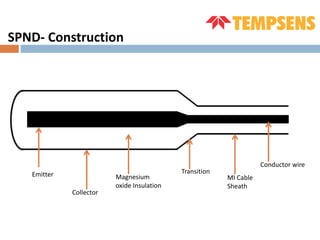
SPND- Construction
Conductor wire
Collector
Magnesium
oxide Insulation
Emitter Transition
MI Cable
Sheath
Emitter: Heart of device which is made from a material chosen for its relatively high Cross-section for
thermal neutron capture leading to beta active radioisotope.
Collector: The current corresponding primarily to the beta rays given off by the emitter is measured
between the emitter and the outer shell, called the collector. High purity stainless steel and Inconel are
most commonly used.
Insulator: The intervening space is filled with insulator, which must be chosen to withstand the
extreme temperature and radiation environment typically found in a reactor core. Metal oxides are most
commonly used insulators with aluminum and magnesium oxide most commonly used.
Detector: A composite bar made up of Inconel 600 external tube, Inconel 600 Internal wire and a small
drilled cylinder made up of Rhodium placed at the middle of the wire and annular MgO pellets as
isolation.
Wire Sheath: unique tube covering both detector and cable zone.
Wire Central Conductor: composed of Inconel 600.
SPND - Characteristics
• In Self-Powered Neutron Detectors (SPNDs), the interactions of neutrons and
atomic nuclei are used to produce a current which is proportional to the neutron
fluency rate (flux).
• Self Powered Neutron Detectors (SPNDs) are being widely used to monitor in-core
neutron flux for control, safety, and mapping applications because of their small
size, ruggedness and simplicity.
• As the name implies, no external source of ionizing or collecting voltage is
required to produce the signal current.
Mechanical structure
and characteristics
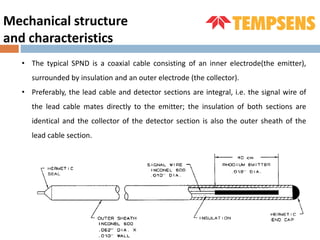
• The typical SPND is a coaxial cable consisting of an inner electrode(the emitter),
surrounded by insulation and an outer electrode (the collector).
• Preferably, the lead cable and detector sections are integral, i.e. the signal wire of
the lead cable mates directly to the emitter; the insulation of both sections are
identical and the collector of the detector section is also the outer sheath of the
lead cable section.
Nuclear Characteristics
• For power reactor applications, typical emitter materials used in SPNDs include
Rhodium, Vanadium, Cobalt, Hafnia, Platinum and Silver.
• These materials should be used because they possess relatively high melting
temperatures, relatively high cross sections to thermal neutrons and are
compatible with the SPND manufacturing process.
• Other emitters such as Cadmium, Gadolinium and Erbium may be used in
SPNDs, but are not practical for power reactor applications.
Technical Specification of
Inconel type SPND
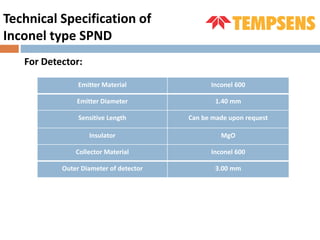
Emitter Material Inconel 600
Emitter Diameter 1.40 mm
Sensitive Length Can be made upon request
Insulator MgO
Collector Material Inconel 600
Outer Diameter of detector 3.00 mm
For Detector:
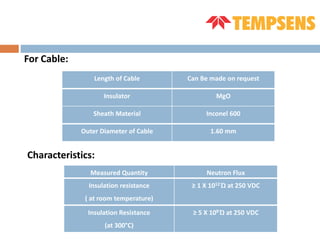
For Cable:
Length of Cable Can Be made on request
Insulator MgO
Sheath Material Inconel 600
Outer Diameter of Cable 1.60 mm
Characteristics:
Measured Quantity Neutron Flux
Insulation resistance
( at room temperature)
≥ 1 X 10¹² Ώ at 250 VDC
Insulation Resistance
(at 300°C)
≥ 5 X 10⁸ Ώ at 250 VDC
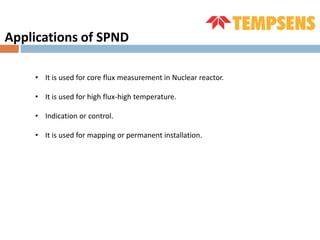
• It is used for core flux measurement in Nuclear reactor.
• It is used for high flux-high temperature.
• Indication or control.
• It is used for mapping or permanent installation.
Applications of SPND
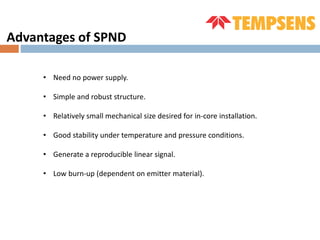
Advantages of SPND
• Need no power supply.
• Simple and robust structure.
• Relatively small mechanical size desired for in-core installation.
• Good stability under temperature and pressure conditions.
• Generate a reproducible linear signal.
• Low burn-up (dependent on emitter material).
Disadvantages of SPND
• Limited operating range due to relatively low neutron sensitivity.
• Compensation for background noise required (for some emitters).
• Delayed signal response (for some emitters).
THANK YOU!
Tempsens Instruments (I) Pvt. Ltd.
B-188 A, Road No. 5, MIA, Madri
Udaipur - 313 003 (Rajasthan) INDIA
Phone : +91-294-3057700
Fax : +91-294-3057750
E-mail : info@tempsens.com
Website : www.tempsens.com
Temperature Sensing, Heating & Cables

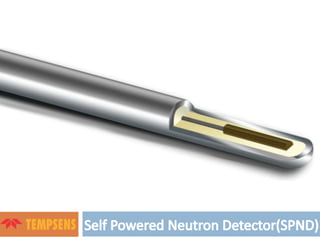
Self Powered Neutron Detectors - SPND

  • 2.
    Contents • What isSPND • SPND - Construction • SPND – Characteristics • Mechanical Structure and Characteristics • Nuclear Characteristics • Technical Specifications of Inconel SPND • Applications • Advantages • Disadvantages
  • 3.
    What is SPND? •Self-Powered Neutron Detectors has been used effectively as in-core flux monitors in nuclear power reactors. • These detectors use the basic radioactive decay process of its neutron activation material to produce an output signal • The basic properties of these radiation sensors include nuclear, electrical and mechanical characteristics. • The proper choice of the self-powered detector emitter to provide the proper response time and radiation sensitivity desired for use in an effective in-core radiation monitoring system. • Depending on the response time, these detectors are broadly classified as prompt and delayed response detectors
  • 4.
    SPND- Construction Conductor wire Collector Magnesium oxideInsulation Emitter Transition MI Cable Sheath
  • 5.
    Emitter: Heart ofdevice which is made from a material chosen for its relatively high Cross-section for thermal neutron capture leading to beta active radioisotope. Collector: The current corresponding primarily to the beta rays given off by the emitter is measured between the emitter and the outer shell, called the collector. High purity stainless steel and Inconel are most commonly used. Insulator: The intervening space is filled with insulator, which must be chosen to withstand the extreme temperature and radiation environment typically found in a reactor core. Metal oxides are most commonly used insulators with aluminum and magnesium oxide most commonly used. Detector: A composite bar made up of Inconel 600 external tube, Inconel 600 Internal wire and a small drilled cylinder made up of Rhodium placed at the middle of the wire and annular MgO pellets as isolation. Wire Sheath: unique tube covering both detector and cable zone. Wire Central Conductor: composed of Inconel 600.
  • 6.
    SPND - Characteristics •In Self-Powered Neutron Detectors (SPNDs), the interactions of neutrons and atomic nuclei are used to produce a current which is proportional to the neutron fluency rate (flux). • Self Powered Neutron Detectors (SPNDs) are being widely used to monitor in-core neutron flux for control, safety, and mapping applications because of their small size, ruggedness and simplicity. • As the name implies, no external source of ionizing or collecting voltage is required to produce the signal current.
  • 7.
    Mechanical structure and characteristics •The typical SPND is a coaxial cable consisting of an inner electrode(the emitter), surrounded by insulation and an outer electrode (the collector). • Preferably, the lead cable and detector sections are integral, i.e. the signal wire of the lead cable mates directly to the emitter; the insulation of both sections are identical and the collector of the detector section is also the outer sheath of the lead cable section.
  • 8.
    Nuclear Characteristics • Forpower reactor applications, typical emitter materials used in SPNDs include Rhodium, Vanadium, Cobalt, Hafnia, Platinum and Silver. • These materials should be used because they possess relatively high melting temperatures, relatively high cross sections to thermal neutrons and are compatible with the SPND manufacturing process. • Other emitters such as Cadmium, Gadolinium and Erbium may be used in SPNDs, but are not practical for power reactor applications.
  • 9.
    Technical Specification of Inconeltype SPND Emitter Material Inconel 600 Emitter Diameter 1.40 mm Sensitive Length Can be made upon request Insulator MgO Collector Material Inconel 600 Outer Diameter of detector 3.00 mm For Detector:
  • 10.
    For Cable: Length ofCable Can Be made on request Insulator MgO Sheath Material Inconel 600 Outer Diameter of Cable 1.60 mm Characteristics: Measured Quantity Neutron Flux Insulation resistance ( at room temperature) ≥ 1 X 10¹² Ώ at 250 VDC Insulation Resistance (at 300°C) ≥ 5 X 10⁸ Ώ at 250 VDC
  • 11.
    • It isused for core flux measurement in Nuclear reactor. • It is used for high flux-high temperature. • Indication or control. • It is used for mapping or permanent installation. Applications of SPND
  • 12.
    Advantages of SPND •Need no power supply. • Simple and robust structure. • Relatively small mechanical size desired for in-core installation. • Good stability under temperature and pressure conditions. • Generate a reproducible linear signal. • Low burn-up (dependent on emitter material).
  • 13.
    Disadvantages of SPND •Limited operating range due to relatively low neutron sensitivity. • Compensation for background noise required (for some emitters). • Delayed signal response (for some emitters).
  • 14.
    THANK YOU! Tempsens Instruments(I) Pvt. Ltd. B-188 A, Road No. 5, MIA, Madri Udaipur - 313 003 (Rajasthan) INDIA Phone : +91-294-3057700 Fax : +91-294-3057750 E-mail : info@tempsens.com Website : www.tempsens.com Temperature Sensing, Heating & Cables