International Research Journal of Engineering and Technology (IRJET) e-ISSN: 2395-0056
Volume: 04 Issue: 12 | Dec-2017 www.irjet.net p-ISSN: 2395-0072
© 2017, IRJET | Impact Factor value: 6.171 | ISO 9001:2008 Certified Journal | Page 1784
A Study on the Strength of the Bacterial Concrete Embedded with
Bacillus Megaterium
V. Nagarajan1, T. Karthik Prabhu2, M. Gowri Shankar2, P. Jagadesh2
1Associate professor, Department of Civil Engineering, Coimbatore Institute of Technology,
Coimbatore-641 014, Tamil Nadu, India
2Assistant professor, Department of Civil Engineering, Coimbatore Institute of Technology,
Coimbatore-641 014, Tamil Nadu, India
---------------------------------------------------------------------***---------------------------------------------------------------------
Abstract - This paper examines the possibility of obtaining
the strength of the concrete by the microbiologically induced
special growth or filler. Here an attempt was made by using
the bacteria “Bacillus megaterium”. Concrete cylinders and
prisms were cast with and without addition of bacteria were
cast and its split tensile strength and flexural strength were
examined. There was an increase in split tensile strength and
flexural strength with addition of bacteria. From Scanning
Electron Micrography analysis, it is noted that pores were
partially filled up by material growth with the addition of the
bacteria.
Key Words: strength, bacteria, filler, bacteria, split
tensile strength, flexural strength, scanning electron
microscope.
1.INTRODUCTION
Concrete is an important versatile construction material,
used in wide variety of situations. The steel bars providedin
concrete take over the load when the concrete cracks in
tension. The concrete on the other hand protects the steel
barsfor attack from the environment and prevent corrosion
to take place. However, the cracks in the concrete form a
problem. Here the ingress of water and ions take place and
deterioration of the structure starts with the corrosion of
steel. To increase the durability of the structure either the
cracks that are formed are repaired later or in the design
phase extra reinforcement is placed in the structure to
ensure that the crack width stays within certain limit.
The main objective of this research is to (1) To determine
the right conditions to be created for the survival of bacteria
to repair cracks. (2) To determine the tensile strength of
bacterial concrete. (3) To determine the flexural strength of
bacterial concrete. (4) To determine the optimum
percentage of addition of bacillus megaterium.
The “Bacterial Concrete” can be madebyembeddingbacteria
in the concrete that are able to constantly precipitate calcite.
This phenomenon is called microbiologically inducedcalcite
precipitation. A common soil bacterium, Bacillus
Megaterium, was used to induce CaCO3 precipitation. The
basic principle for this application are that the microbial
hydrolyzes urea to produce ammonia and carbon dioxide
and the ammonia released in surroundings subsequently
increases pH, leading to accumulation of insoluble CaCO3.
2. LITERATURE REVIEW
BC Delft, The Netherlands(2008), reportedon applicationof
bacteria as self-healing agent for the development of
sustainable concrete. A specificgroupofalkali-resistantspore
forming bacteria related to the genus Bacillus was selected
forthis purpose, a continuousdecrease in pore size diameter
during cement stone setting probably limited life span of
spores as pore widths decreased below 1 micro metre, the
typical size of Bacillus spores.
Willem De Munyck et.al (2006), reported on deposition of a
layer of calcite on the surface of the specimens resulted in a
decrease of capillary suction and a decrease in gas
permeability.
Department of Biotechnology and environmental sciences,
Thapar University (2011), reported on influence of bacteria
on the compressive strength, water absorption and rapid
chloride permeability. Influence of sporoscarcina pasteurii
bacteria on the compressive strength and rapid chloride
permeabilityof concrete. Concrete cubeswerepreparedwith
different concentration of S.pasteurii. The cel concentration
was determined from the bacterial growth curve made by
observing optical density at 600mm.
Kim Van Tittelboom (2003), reported on use of bacteria to
repair cracks in concrete. The use of this biological repair
technique is highly desirable because the mineral
precipitation induced as a result of microbial activities is
pollution free and natural. Cracked concrete samples were
prepared in two different ways. Crack sealing by means of
this biological treatment resulted in a decrease in water
permeability.
Irjet Template sample paragraph .Define abbreviations and
acronyms the first time they are used in the text, even after
theyhave been defined inthe abstract. Abbreviationssuchas
IEEE, SI, MKS, CGS, sc, dc, and rms do not have to be defined.
Do not use abbreviations in the title or heads unless they are
unavoidable.
International Research Journal of Engineering and Technology (IRJET) e-ISSN: 2395-0056
Volume: 04 Issue: 12 | Dec-2017 www.irjet.net p-ISSN: 2395-0072
© 2017, IRJET | Impact Factor value: 6.171 | ISO 9001:2008 Certified Journal | Page 1785
3. MATERIALS USED
3.1 Cement
Cement is very often the most important ingredient in
concrete because it is usually the most delicate link in the
chain.The function of cementis notonly to bind the sand but
also to fill up the voids in between sand and any coarse
grained particles to form a compact mass. For the present
investigation, “Shree Jaya Jothi” (brand name) 53 grade OPC
confirming toBIS:12269-1987 wasused.Thecementsample
was dried, powdered and freed from lumps.
3.2 Coarse Aggregate
The coarse aggregate is the strongest and the least porous
component of concrete. It is also a chemically stablematerial.
By restricting the maximum size of aggregate and also by
making s, the cement concrete becomes more homogenethe
transition zone stronger by usage of mineral admixtureous
and there is a marked enhancement in the strength
properties as well as durability characteristics of concrete.
Blue granite crushed stone for single sized aggregates of
nominal sizes12.5 mm confirming to IS-383:1970 wereused
as the coarse aggregates for this investigation. The specific
gravity of 2.74, with water absorption of 3.4%, fineness
modulus of6.35 and bulk densityof 1850 kg/m3 isselectedin
this investigation.
Table -1: Particle size distribution
Sieve Size Passing (%)
25 mm 100
20mm 100
16mm 100
12.5mm 100
10mm 33
6.3mm 3
4.75mm 0
3.3 Fine Aggregate
Grading of fine aggregate asper IS: 383-1970 shows that it is
on zone III and it is very important in maintaining water
demand, minimizing the voidsin concrete.Thefineaggregate
having a specific gravity of 2.68, water absorption of 1.23%,
fineness modulus of 5.25 and a dry density of 1240 kg/m3
used in this investigation.
3.4 Water
Water is the key ingredient,which when mixed with cement,
forms a paste that binds the aggregate together and which
stimulates hydration. Portable water confirming to the
requirements of IS: 456-2000 was used for casting and
curing.
3.5 Bacteria
Normally cement and water has pH value upto 12 when
mixed together. Most organism die in an environment with a
pH value of 10 or above. Bacillus megaterium can withstand
pH value above 12, it frequently lives in water, soil, air and
decomposing plant residue. It is also present at the root-soil
interface and also grows without oxygen in the presence of
nitrate.
Table -2: Characteristics of Bacteria
Characteristics Bacillus Megaterium
Shape Long rods
Size 0.6 to 0.8 micro metre
Gram Strain Gram positive
Colony Morphology Irregular, dry, white
Lactose No acid, No gas
Dextrose No acid, No gas
Sucrose Acid and gas
3.6 Mix Proportions
Themixproportions forM25 gradeof concrete calculated by
IS method per m3 is given as
Cement
[kg]
Fine
aggregate
[kg]
Coarse
aggregate
[kg]
Water
[litres]
518.2 755 968 197
1 1.45 1.87 0.38
Quantity of Bacteria - As per the past research by Delft
University, 5 ml of bacteria solution is adequate for per litre
of water for their efficient growth.
3.7 Experimental Investigations
This chapter presents the details of experimental
investigations carried out on the test specimens to study the
strength-related properties of the concrete containing
Bacillus megaterium. The water cement ratio is reduced to
0.31 which will greatly improve the qualities of interfacial
transition zone to give inherent qualities expected to be
satisfied by HPC. Metakaolin partially replaced for cement in
this study as mineral admixture contributes more towards
the strength development and performs well in aggressive
conditions.
Here, an attempt was made to study the strength
development atdifferentreplacementlevelsat differentages
with Eco-Sand and the results were compared.The strength-
related properties such as compressive strength, splitting
tensile strength, flexural strength were studied. Minimum
International Research Journal of Engineering and Technology (IRJET) e-ISSN: 2395-0056
Volume: 04 Issue: 12 | Dec-2017 www.irjet.net p-ISSN: 2395-0072
© 2017, IRJET | Impact Factor value: 6.171 | ISO 9001:2008 Certified Journal | Page 1786
three specimens were tested for each mix for each test. The
entire tests were conducted as per specifications required.
4. RESULTS AND DISCUSSION
4.1 Compressive Strength
For compressive strength test six cubes of size 100mm X
100mm X 100mm for each mix were cast. For each mix
proportion6 numbersof cubeswere castinwhich3numbers
were cured for 7 days and the remaining was cured for 28
days. All the cubes are tested in saturation condition, after
dryingthe surfaceof the specimen containingnomoisture in
it. For eachmix proportions, three cubesare tested at 7 days,
28 days. Using compression testing machine of 2000kN
capacity as per IS: 516 - 1959 code. From that the
compressive strength of particular mix cube calculated by
dividing the cross sectional area of cube specimen from
ultimate loadwill givea compressivestrength atfailureload.
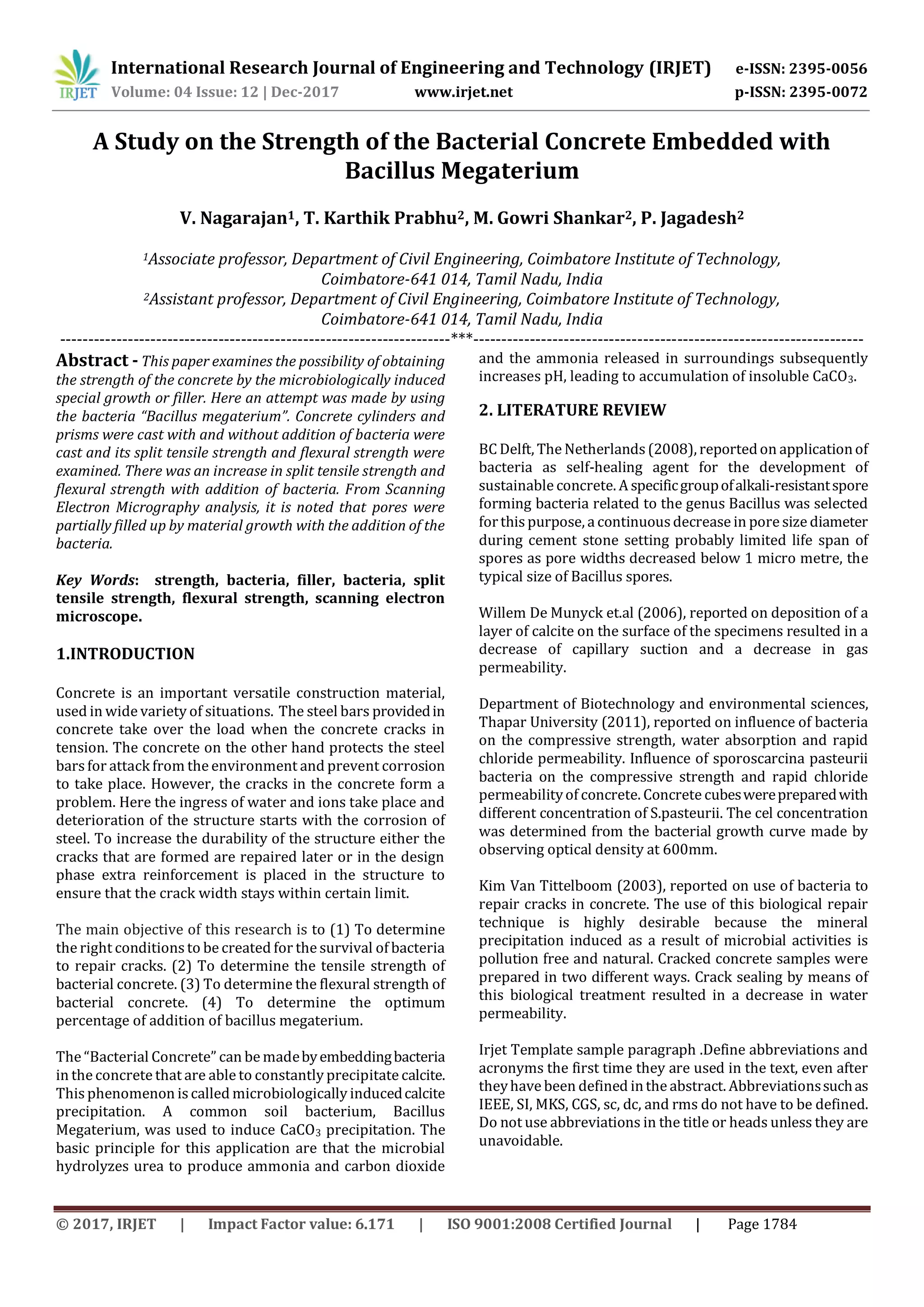
Chart -1: Cell Concentration Vs Compressive Strength
The cube compresssive strength were carried out at various
ages such as 7days, 14days and 28 days. The water binder
ratio of all mixes was fixed as constant value of 0.38. The
compressive strength for variousconcentrationsaregivenin
chart 1. The experimental set up for cube compressive
strength is shown in Figure.1.
Fig -1: Cube Compressive Strength – Experimental set up
4.2 Split Tensile Strength
For tensile strength test six cylinderofsize100mmX150mm
for each mix were cast. Cast iron steel mould was used for
casting of these cylinders. For each mix proportion 3
numbers of cylinders were cast and cured for 28 days. Split
tensile strength test are carried out at the age of 28 days
using compression testingmachineof2000kNcapacityasper
IS 516 - 1959. To avoid direct loading on the cylinder
specimen, the wooden strip are kept in between loading
portion and cylinder surface. The loading is continuedtillthe
specimen splitting an dial readings are noted as shown in
figure 2.
Where,
Ft- Split tensile strength of concrete in MPa
P - Failure load in kN
D- Diameter of cylinder (100mm)
L - Length of cylinder (150mm)
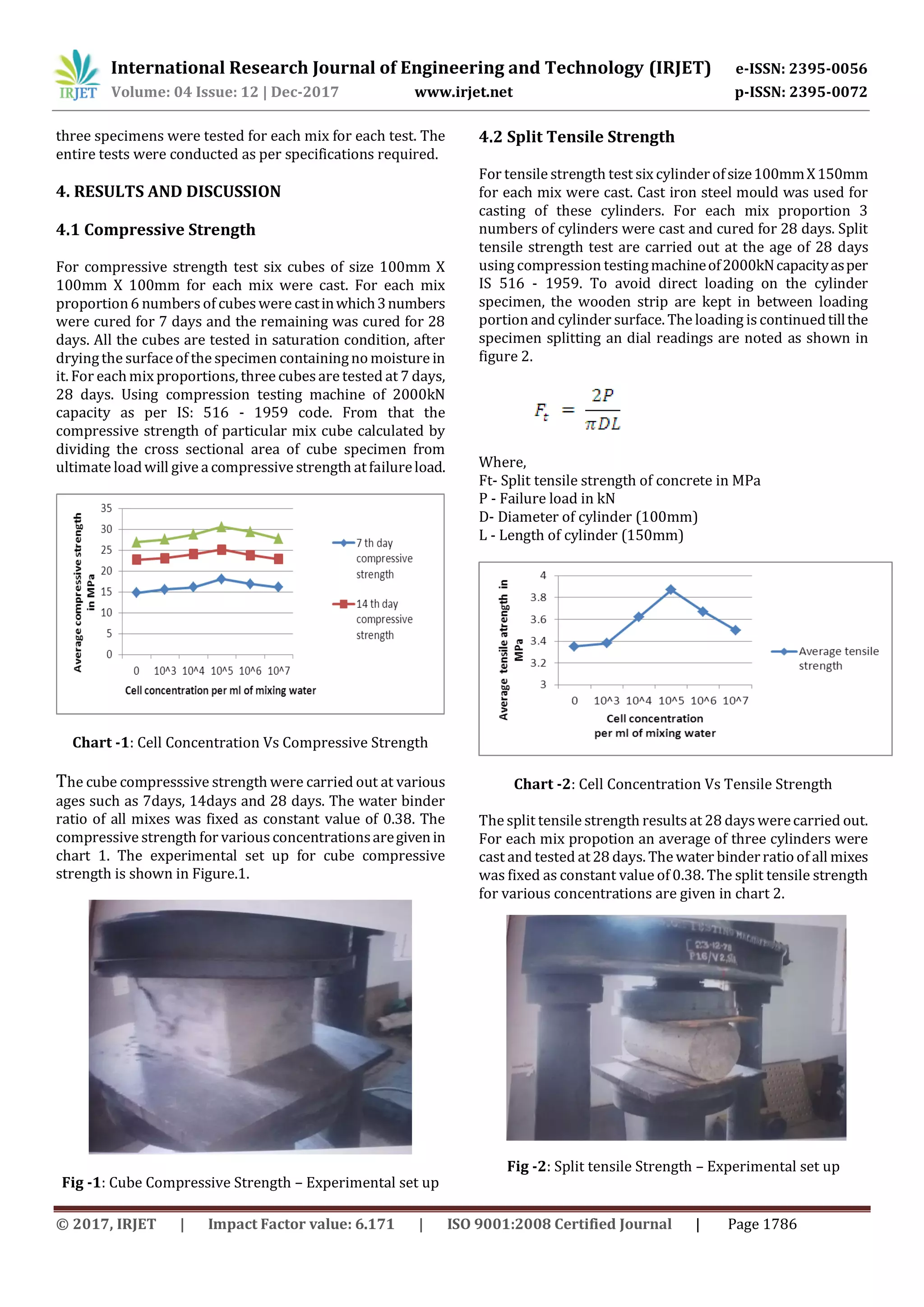
Chart -2: Cell Concentration Vs Tensile Strength
The split tensile strength results at 28 dayswerecarried out.
For each mix propotion an average of three cylinders were
cast and tested at28 days. The water binderratioof all mixes
was fixed as constant value of 0.38. The split tensile strength
for various concentrations are given in chart 2.
Fig -2: Split tensile Strength – Experimental set up
International Research Journal of Engineering and Technology (IRJET) e-ISSN: 2395-0056
Volume: 04 Issue: 12 | Dec-2017 www.irjet.net p-ISSN: 2395-0072
© 2017, IRJET | Impact Factor value: 6.171 | ISO 9001:2008 Certified Journal | Page 1787
In this present study, totally sevenmixproportions aremade
and for each mix proportions three specimens are cast.
Totally 21 specimens are cast including control beam
specimens.The size of the beam is fixed as100mm X 150mm
X 1000mm. The reinforcement details were adopted
according to IS 456 - 2000.
For a rectangular sampleunder a loadin a two-pointbending
setup where the loading span is one-third of the support
span. Flexural strength is calculated based on following
relationship
L is the length of the support (outer) span
Where, b is width of the beam
d is thickness of the beam.
F is the load (force) at the fracture point
The flexural strength results at 28 dayswere carriedout. For
each mix propotion an average of three cylinders were cast
and tested at28days. The water binderratioof all mixeswas
fixed as constant value of 0.45. The flextural strength for
various concentrations are shown in Chart 3.
Chart -3: Cell Concentration Vs Flexural Strength
4. CONCLUSION
Bacillus megaterium can be produced from lab which is
proved to be a safe and cost effective. The compressive
strength of concrete cube is maximum with the addition of
bacillus megaterium bacteria for a cell concentration of 105
cells per ml of mixing water. The addition of bacillus
megaterium bacteria increases the compressive strength of
concrete. In standard grade concrete the compressive
strength is increased up to 10.92% at 28 days by addition of
bacillus magaterium bacteria when compared to
conventional concrete. The addition of bascillusmegaterium
bacteria showed significant improvement in the split tensile
strength and flextural strength than the conventional
concrete. From the above it can concluded that bacillus
megaterium can be easily cultured and safely used in
improving the strength charecteristics of concrete.
ACKNOWLEDGEMENT
The authors gratefully acknowledgethesupportofStructural
Engineering Laboratory Technicians and usage of DST-FIST
sponsored UTM Machine of 3000 kN Capacity.
REFERENCES
[1] Ramakrishnan V, Ramesh KP, and BangSS.SouthDokata
School of minesand technology USA, BacterialConcrete,
Proceedings of SPIE,vol.4234, pp:168-176.
[2] Ramchandran SK, Ramakrishnan V, Bang SS. South
Dokata School of mines and technology USA
Remediation of concrete using Microorganisms ACI
materials Journal 28(2001),pp:3-9.
[3] Chiara Barabesi, Alessandro Galizzi, Giorgo Mastromei,
Mila Rossi, Elena, Tamburni and brunella perito pavia,
Italy Bacillus subtilis Gene Cluster involved in Gopala
Krishana S, Annie Peter J, Rajamane NP. Strength and
durability characteristics of concretes containing HVFA
with and without processing.
[4] Proceedings of the International Conference on Recent
Trends in Concrete Technology and Strucutures,
INCONTEST (2003), pp: 203-216 Calcium carbonate
Biomieralization, Journal of Bacteriology, (2007), pp:
228-235.
[5] Ramikrishnan V, Panchalan RK, Bang, SS. Improvement
of concrete durability by bacterial mineral precipitation
ICF 11, Torino , Italy, (2005).
[6] Santhosh KR, Ramakrishnan V,Duke EF,and Bang SS,
SEM Investigation of Microbial Calcite Precipitation in
Cement Proceedings of the 22nd International
Conference on Cement Microscopy ,pp,293-
305,Montreal,Canada, (2000).
[7] Day JL, Panchalan RK,RamakrishnanV,Microbiologically
induced sealant for concrete crack remediation
Proceedings of the 16th Engineering Mechanics
conference, Seattle, WA, (2003).
[8] Bang SS, Galiant JK, and Ramakrishnan V.Calcite
precipitation Induced by polyurethaneimmobilized
Baciilus pasteurii” Enzyme and Microbial
Technology,28(2001)404-409.
[9] Ramakrishnan V, Panchalan RK, BangsSS,Improvement
of concerete durability by bacterial mineral
precipitation” Proceedings ICF 11,Torino,Italy,(2005).
[10] Mehata PK, Factors influencing durability of concrete
structures, International Conference on Maintanance
and Durability of Concrete Structures, JINTU,
Hyderabad, pp, 7-12, March 4-6, (1997).
International Research Journal of Engineering and Technology (IRJET) e-ISSN: 2395-0056
Volume: 04 Issue: 12 | Dec-2017 www.irjet.net p-ISSN: 2395-0072
© 2017, IRJET | Impact Factor value: 6.171 | ISO 9001:2008 Certified Journal | Page 1788
[11] Zhong L, Islam MR. A New Microbial Process and its
Impact on Fracture PERFORMANCE OF STANDARD
GRADE BACTERIAL,Remediation,70thAnnualTechnical
Conference and Exhibition of the Society of Petroleum
Engineers, Dallas, Texas, Oct 22-25,(1995).
[12] Jagadesh P, Ramachandramurthy A, Murugesan R and
Sarayu K, “Micro Analytical Studies on Sugar Cane
Bagasse Ash”, Sadhana Academy of Science,Vol.40,No.5,
pp.1629-1638, 2015
[13] KarthikPrabhu T, SubramanianK, “ExperimentalStudies
on RCP by using Cost Effective and Recycled Materials
for Improving the Strength and Reducing the Cost of
Pavement”, Asian Journal of Research in Social Sciences
and Humanities, 6 (12), pp. 1 -14.

A Study on the Strength of the Bacterial Concrete Embedded with Bacillus Megaterium

  • 1.
    International Research Journalof Engineering and Technology (IRJET) e-ISSN: 2395-0056 Volume: 04 Issue: 12 | Dec-2017 www.irjet.net p-ISSN: 2395-0072 © 2017, IRJET | Impact Factor value: 6.171 | ISO 9001:2008 Certified Journal | Page 1784 A Study on the Strength of the Bacterial Concrete Embedded with Bacillus Megaterium V. Nagarajan1, T. Karthik Prabhu2, M. Gowri Shankar2, P. Jagadesh2 1Associate professor, Department of Civil Engineering, Coimbatore Institute of Technology, Coimbatore-641 014, Tamil Nadu, India 2Assistant professor, Department of Civil Engineering, Coimbatore Institute of Technology, Coimbatore-641 014, Tamil Nadu, India ---------------------------------------------------------------------***--------------------------------------------------------------------- Abstract - This paper examines the possibility of obtaining the strength of the concrete by the microbiologically induced special growth or filler. Here an attempt was made by using the bacteria “Bacillus megaterium”. Concrete cylinders and prisms were cast with and without addition of bacteria were cast and its split tensile strength and flexural strength were examined. There was an increase in split tensile strength and flexural strength with addition of bacteria. From Scanning Electron Micrography analysis, it is noted that pores were partially filled up by material growth with the addition of the bacteria. Key Words: strength, bacteria, filler, bacteria, split tensile strength, flexural strength, scanning electron microscope. 1.INTRODUCTION Concrete is an important versatile construction material, used in wide variety of situations. The steel bars providedin concrete take over the load when the concrete cracks in tension. The concrete on the other hand protects the steel barsfor attack from the environment and prevent corrosion to take place. However, the cracks in the concrete form a problem. Here the ingress of water and ions take place and deterioration of the structure starts with the corrosion of steel. To increase the durability of the structure either the cracks that are formed are repaired later or in the design phase extra reinforcement is placed in the structure to ensure that the crack width stays within certain limit. The main objective of this research is to (1) To determine the right conditions to be created for the survival of bacteria to repair cracks. (2) To determine the tensile strength of bacterial concrete. (3) To determine the flexural strength of bacterial concrete. (4) To determine the optimum percentage of addition of bacillus megaterium. The “Bacterial Concrete” can be madebyembeddingbacteria in the concrete that are able to constantly precipitate calcite. This phenomenon is called microbiologically inducedcalcite precipitation. A common soil bacterium, Bacillus Megaterium, was used to induce CaCO3 precipitation. The basic principle for this application are that the microbial hydrolyzes urea to produce ammonia and carbon dioxide and the ammonia released in surroundings subsequently increases pH, leading to accumulation of insoluble CaCO3. 2. LITERATURE REVIEW BC Delft, The Netherlands(2008), reportedon applicationof bacteria as self-healing agent for the development of sustainable concrete. A specificgroupofalkali-resistantspore forming bacteria related to the genus Bacillus was selected forthis purpose, a continuousdecrease in pore size diameter during cement stone setting probably limited life span of spores as pore widths decreased below 1 micro metre, the typical size of Bacillus spores. Willem De Munyck et.al (2006), reported on deposition of a layer of calcite on the surface of the specimens resulted in a decrease of capillary suction and a decrease in gas permeability. Department of Biotechnology and environmental sciences, Thapar University (2011), reported on influence of bacteria on the compressive strength, water absorption and rapid chloride permeability. Influence of sporoscarcina pasteurii bacteria on the compressive strength and rapid chloride permeabilityof concrete. Concrete cubeswerepreparedwith different concentration of S.pasteurii. The cel concentration was determined from the bacterial growth curve made by observing optical density at 600mm. Kim Van Tittelboom (2003), reported on use of bacteria to repair cracks in concrete. The use of this biological repair technique is highly desirable because the mineral precipitation induced as a result of microbial activities is pollution free and natural. Cracked concrete samples were prepared in two different ways. Crack sealing by means of this biological treatment resulted in a decrease in water permeability. Irjet Template sample paragraph .Define abbreviations and acronyms the first time they are used in the text, even after theyhave been defined inthe abstract. Abbreviationssuchas IEEE, SI, MKS, CGS, sc, dc, and rms do not have to be defined. Do not use abbreviations in the title or heads unless they are unavoidable.
  • 2.
    International Research Journalof Engineering and Technology (IRJET) e-ISSN: 2395-0056 Volume: 04 Issue: 12 | Dec-2017 www.irjet.net p-ISSN: 2395-0072 © 2017, IRJET | Impact Factor value: 6.171 | ISO 9001:2008 Certified Journal | Page 1785 3. MATERIALS USED 3.1 Cement Cement is very often the most important ingredient in concrete because it is usually the most delicate link in the chain.The function of cementis notonly to bind the sand but also to fill up the voids in between sand and any coarse grained particles to form a compact mass. For the present investigation, “Shree Jaya Jothi” (brand name) 53 grade OPC confirming toBIS:12269-1987 wasused.Thecementsample was dried, powdered and freed from lumps. 3.2 Coarse Aggregate The coarse aggregate is the strongest and the least porous component of concrete. It is also a chemically stablematerial. By restricting the maximum size of aggregate and also by making s, the cement concrete becomes more homogenethe transition zone stronger by usage of mineral admixtureous and there is a marked enhancement in the strength properties as well as durability characteristics of concrete. Blue granite crushed stone for single sized aggregates of nominal sizes12.5 mm confirming to IS-383:1970 wereused as the coarse aggregates for this investigation. The specific gravity of 2.74, with water absorption of 3.4%, fineness modulus of6.35 and bulk densityof 1850 kg/m3 isselectedin this investigation. Table -1: Particle size distribution Sieve Size Passing (%) 25 mm 100 20mm 100 16mm 100 12.5mm 100 10mm 33 6.3mm 3 4.75mm 0 3.3 Fine Aggregate Grading of fine aggregate asper IS: 383-1970 shows that it is on zone III and it is very important in maintaining water demand, minimizing the voidsin concrete.Thefineaggregate having a specific gravity of 2.68, water absorption of 1.23%, fineness modulus of 5.25 and a dry density of 1240 kg/m3 used in this investigation. 3.4 Water Water is the key ingredient,which when mixed with cement, forms a paste that binds the aggregate together and which stimulates hydration. Portable water confirming to the requirements of IS: 456-2000 was used for casting and curing. 3.5 Bacteria Normally cement and water has pH value upto 12 when mixed together. Most organism die in an environment with a pH value of 10 or above. Bacillus megaterium can withstand pH value above 12, it frequently lives in water, soil, air and decomposing plant residue. It is also present at the root-soil interface and also grows without oxygen in the presence of nitrate. Table -2: Characteristics of Bacteria Characteristics Bacillus Megaterium Shape Long rods Size 0.6 to 0.8 micro metre Gram Strain Gram positive Colony Morphology Irregular, dry, white Lactose No acid, No gas Dextrose No acid, No gas Sucrose Acid and gas 3.6 Mix Proportions Themixproportions forM25 gradeof concrete calculated by IS method per m3 is given as Cement [kg] Fine aggregate [kg] Coarse aggregate [kg] Water [litres] 518.2 755 968 197 1 1.45 1.87 0.38 Quantity of Bacteria - As per the past research by Delft University, 5 ml of bacteria solution is adequate for per litre of water for their efficient growth. 3.7 Experimental Investigations This chapter presents the details of experimental investigations carried out on the test specimens to study the strength-related properties of the concrete containing Bacillus megaterium. The water cement ratio is reduced to 0.31 which will greatly improve the qualities of interfacial transition zone to give inherent qualities expected to be satisfied by HPC. Metakaolin partially replaced for cement in this study as mineral admixture contributes more towards the strength development and performs well in aggressive conditions. Here, an attempt was made to study the strength development atdifferentreplacementlevelsat differentages with Eco-Sand and the results were compared.The strength- related properties such as compressive strength, splitting tensile strength, flexural strength were studied. Minimum
  • 3.
    International Research Journalof Engineering and Technology (IRJET) e-ISSN: 2395-0056 Volume: 04 Issue: 12 | Dec-2017 www.irjet.net p-ISSN: 2395-0072 © 2017, IRJET | Impact Factor value: 6.171 | ISO 9001:2008 Certified Journal | Page 1786 three specimens were tested for each mix for each test. The entire tests were conducted as per specifications required. 4. RESULTS AND DISCUSSION 4.1 Compressive Strength For compressive strength test six cubes of size 100mm X 100mm X 100mm for each mix were cast. For each mix proportion6 numbersof cubeswere castinwhich3numbers were cured for 7 days and the remaining was cured for 28 days. All the cubes are tested in saturation condition, after dryingthe surfaceof the specimen containingnomoisture in it. For eachmix proportions, three cubesare tested at 7 days, 28 days. Using compression testing machine of 2000kN capacity as per IS: 516 - 1959 code. From that the compressive strength of particular mix cube calculated by dividing the cross sectional area of cube specimen from ultimate loadwill givea compressivestrength atfailureload. Chart -1: Cell Concentration Vs Compressive Strength The cube compresssive strength were carried out at various ages such as 7days, 14days and 28 days. The water binder ratio of all mixes was fixed as constant value of 0.38. The compressive strength for variousconcentrationsaregivenin chart 1. The experimental set up for cube compressive strength is shown in Figure.1. Fig -1: Cube Compressive Strength – Experimental set up 4.2 Split Tensile Strength For tensile strength test six cylinderofsize100mmX150mm for each mix were cast. Cast iron steel mould was used for casting of these cylinders. For each mix proportion 3 numbers of cylinders were cast and cured for 28 days. Split tensile strength test are carried out at the age of 28 days using compression testingmachineof2000kNcapacityasper IS 516 - 1959. To avoid direct loading on the cylinder specimen, the wooden strip are kept in between loading portion and cylinder surface. The loading is continuedtillthe specimen splitting an dial readings are noted as shown in figure 2. Where, Ft- Split tensile strength of concrete in MPa P - Failure load in kN D- Diameter of cylinder (100mm) L - Length of cylinder (150mm) Chart -2: Cell Concentration Vs Tensile Strength The split tensile strength results at 28 dayswerecarried out. For each mix propotion an average of three cylinders were cast and tested at28 days. The water binderratioof all mixes was fixed as constant value of 0.38. The split tensile strength for various concentrations are given in chart 2. Fig -2: Split tensile Strength – Experimental set up
  • 4.
    International Research Journalof Engineering and Technology (IRJET) e-ISSN: 2395-0056 Volume: 04 Issue: 12 | Dec-2017 www.irjet.net p-ISSN: 2395-0072 © 2017, IRJET | Impact Factor value: 6.171 | ISO 9001:2008 Certified Journal | Page 1787 In this present study, totally sevenmixproportions aremade and for each mix proportions three specimens are cast. Totally 21 specimens are cast including control beam specimens.The size of the beam is fixed as100mm X 150mm X 1000mm. The reinforcement details were adopted according to IS 456 - 2000. For a rectangular sampleunder a loadin a two-pointbending setup where the loading span is one-third of the support span. Flexural strength is calculated based on following relationship L is the length of the support (outer) span Where, b is width of the beam d is thickness of the beam. F is the load (force) at the fracture point The flexural strength results at 28 dayswere carriedout. For each mix propotion an average of three cylinders were cast and tested at28days. The water binderratioof all mixeswas fixed as constant value of 0.45. The flextural strength for various concentrations are shown in Chart 3. Chart -3: Cell Concentration Vs Flexural Strength 4. CONCLUSION Bacillus megaterium can be produced from lab which is proved to be a safe and cost effective. The compressive strength of concrete cube is maximum with the addition of bacillus megaterium bacteria for a cell concentration of 105 cells per ml of mixing water. The addition of bacillus megaterium bacteria increases the compressive strength of concrete. In standard grade concrete the compressive strength is increased up to 10.92% at 28 days by addition of bacillus magaterium bacteria when compared to conventional concrete. The addition of bascillusmegaterium bacteria showed significant improvement in the split tensile strength and flextural strength than the conventional concrete. From the above it can concluded that bacillus megaterium can be easily cultured and safely used in improving the strength charecteristics of concrete. ACKNOWLEDGEMENT The authors gratefully acknowledgethesupportofStructural Engineering Laboratory Technicians and usage of DST-FIST sponsored UTM Machine of 3000 kN Capacity. REFERENCES [1] Ramakrishnan V, Ramesh KP, and BangSS.SouthDokata School of minesand technology USA, BacterialConcrete, Proceedings of SPIE,vol.4234, pp:168-176. [2] Ramchandran SK, Ramakrishnan V, Bang SS. South Dokata School of mines and technology USA Remediation of concrete using Microorganisms ACI materials Journal 28(2001),pp:3-9. [3] Chiara Barabesi, Alessandro Galizzi, Giorgo Mastromei, Mila Rossi, Elena, Tamburni and brunella perito pavia, Italy Bacillus subtilis Gene Cluster involved in Gopala Krishana S, Annie Peter J, Rajamane NP. Strength and durability characteristics of concretes containing HVFA with and without processing. [4] Proceedings of the International Conference on Recent Trends in Concrete Technology and Strucutures, INCONTEST (2003), pp: 203-216 Calcium carbonate Biomieralization, Journal of Bacteriology, (2007), pp: 228-235. [5] Ramikrishnan V, Panchalan RK, Bang, SS. Improvement of concrete durability by bacterial mineral precipitation ICF 11, Torino , Italy, (2005). [6] Santhosh KR, Ramakrishnan V,Duke EF,and Bang SS, SEM Investigation of Microbial Calcite Precipitation in Cement Proceedings of the 22nd International Conference on Cement Microscopy ,pp,293- 305,Montreal,Canada, (2000). [7] Day JL, Panchalan RK,RamakrishnanV,Microbiologically induced sealant for concrete crack remediation Proceedings of the 16th Engineering Mechanics conference, Seattle, WA, (2003). [8] Bang SS, Galiant JK, and Ramakrishnan V.Calcite precipitation Induced by polyurethaneimmobilized Baciilus pasteurii” Enzyme and Microbial Technology,28(2001)404-409. [9] Ramakrishnan V, Panchalan RK, BangsSS,Improvement of concerete durability by bacterial mineral precipitation” Proceedings ICF 11,Torino,Italy,(2005). [10] Mehata PK, Factors influencing durability of concrete structures, International Conference on Maintanance and Durability of Concrete Structures, JINTU, Hyderabad, pp, 7-12, March 4-6, (1997).
  • 5.
    International Research Journalof Engineering and Technology (IRJET) e-ISSN: 2395-0056 Volume: 04 Issue: 12 | Dec-2017 www.irjet.net p-ISSN: 2395-0072 © 2017, IRJET | Impact Factor value: 6.171 | ISO 9001:2008 Certified Journal | Page 1788 [11] Zhong L, Islam MR. A New Microbial Process and its Impact on Fracture PERFORMANCE OF STANDARD GRADE BACTERIAL,Remediation,70thAnnualTechnical Conference and Exhibition of the Society of Petroleum Engineers, Dallas, Texas, Oct 22-25,(1995). [12] Jagadesh P, Ramachandramurthy A, Murugesan R and Sarayu K, “Micro Analytical Studies on Sugar Cane Bagasse Ash”, Sadhana Academy of Science,Vol.40,No.5, pp.1629-1638, 2015 [13] KarthikPrabhu T, SubramanianK, “ExperimentalStudies on RCP by using Cost Effective and Recycled Materials for Improving the Strength and Reducing the Cost of Pavement”, Asian Journal of Research in Social Sciences and Humanities, 6 (12), pp. 1 -14.