Self Directed Support
and Community
Organisations
Kate Fulton
A national campaign for change –
mainstream support
2
• The NDIS provides all Australians under the age of 65 who have a
permanent and significant disability with reasonable and
necessary supports they need to enjoy an ordinary life.
• The NDIS helps people with a disability and or mental health condition
to achieve their goals.
• As an insurance scheme
the NDIS takes a lifetime approach,
investing in people with a
disability early to improve
their outcomes later on in life.
3
What is the NDIS?
• The NDIS provides reasonable and
necessary funding to people with a
permanent and significant disability
to access the supports and services
they need to live and enjoy their life.
• Every NDIS participant has an
individual plan that lists their goals
and the funding they have received.
• NDIS participants use their funding to
purchase supports and services that
will help them achieve their goals.
What does the NDIS do?
4
NDIS Overview, Access, Ineligibility & Internal Reviews5
Accessing the NDIS
✓Have a permanent disability that
significantly affects their ability
to take part in everyday
activities
✓Be aged less than 65 when
they apply and are accepted
into the NDIS
✓Be an Australian Citizen or hold
a permanent visa or a protected
special category
✓Live in Australia where the
NDIS is available
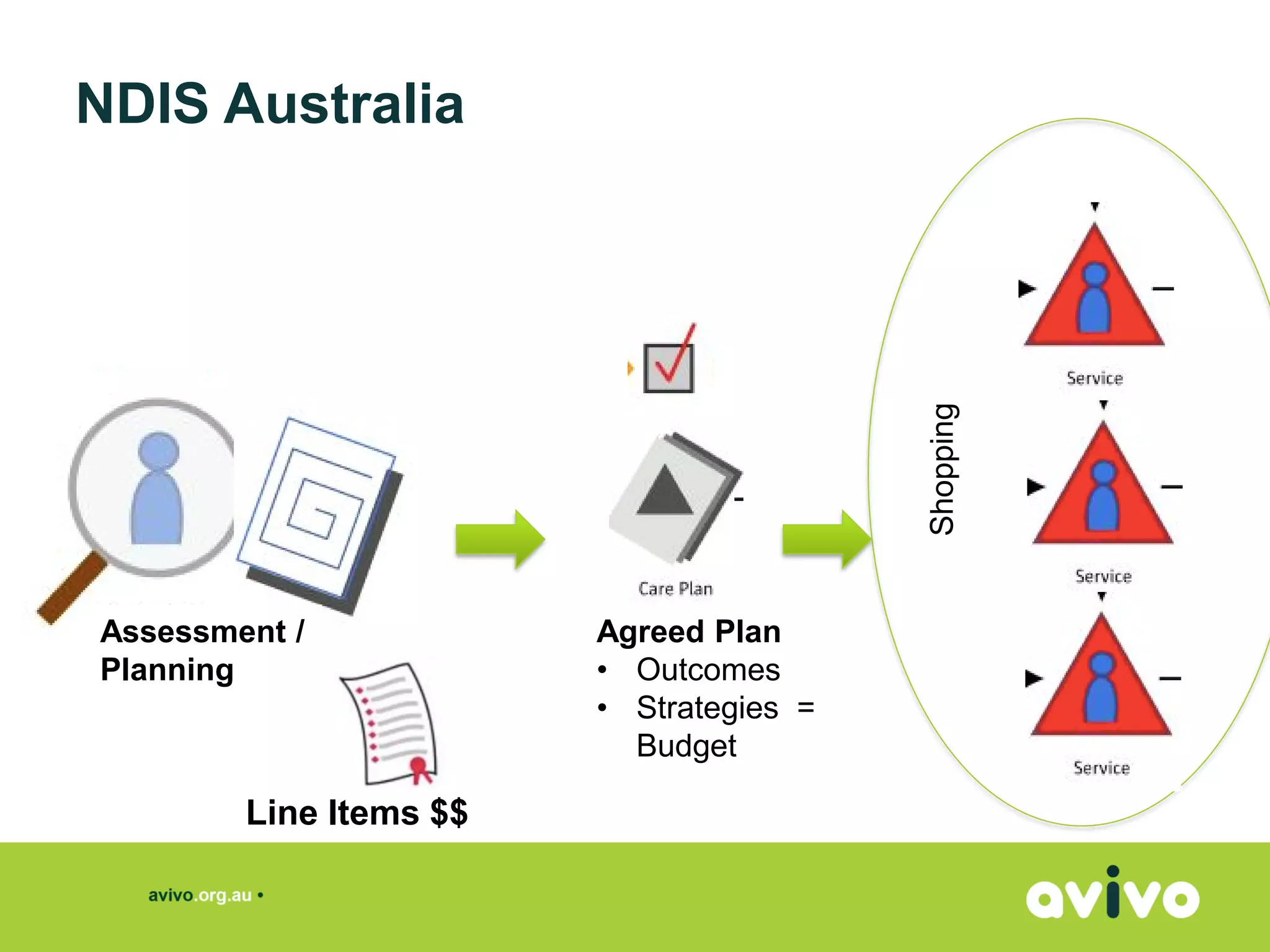
NDIS Australia
Line Items $$
Agreed Plan
• Outcomes
• Strategies =
Budget
Assessment /
Planning
Shopping
NDIS Overview7
Reasonable and necessary
Reasonable
and
necessary
Expectations
of informal
networks
Most
appropriately
funded
Value for
money
Pursue goals
and
aspirations
Social and
economical
participation
Effective and
beneficial
NDIS Session 2 – Part 1
What is the NDIS and other government
departments responsible for?
Other Government Department
• Education - Teachers, learning
assistants and other supports
such as Auslan interpreters.
• Health - Diagnosis and
assessment of health conditions,
including mental health
conditions and disabilities.
• Employer - Transport for work
activities such as meetings.
NDIS
• Self-care at school related to
the student’s disability, such as
assistance with eating.
• Prosthetics and artificial limbs
(surgery remains the
responsibility of the health
system).
• Personal care for people who
need support at work because
of their disability (for example,
assistance with personal care
or eating meals).
NDIS Session 2 – Part 1
NDIS plans have three main budget categories for Support types:
• Core Supports
For: everyday activities, current disability-related needs and work
towards goals.
• Capital Supports
For: higher-cost pieces of assistive technology, equipment and home
or vehicle modifications, and funding for one-off purchases.
• Capacity Building Supports
For: building independence and skills to help reach long-term goals.
9
Types of Support
10
Core Supports budget
• Core Supports help with
everyday activities, current
disability-related needs and
work towards goals.
• The Core Supports budget
is the most flexible.
• In most cases, you can use
the funding across any of
the following four support
categories.
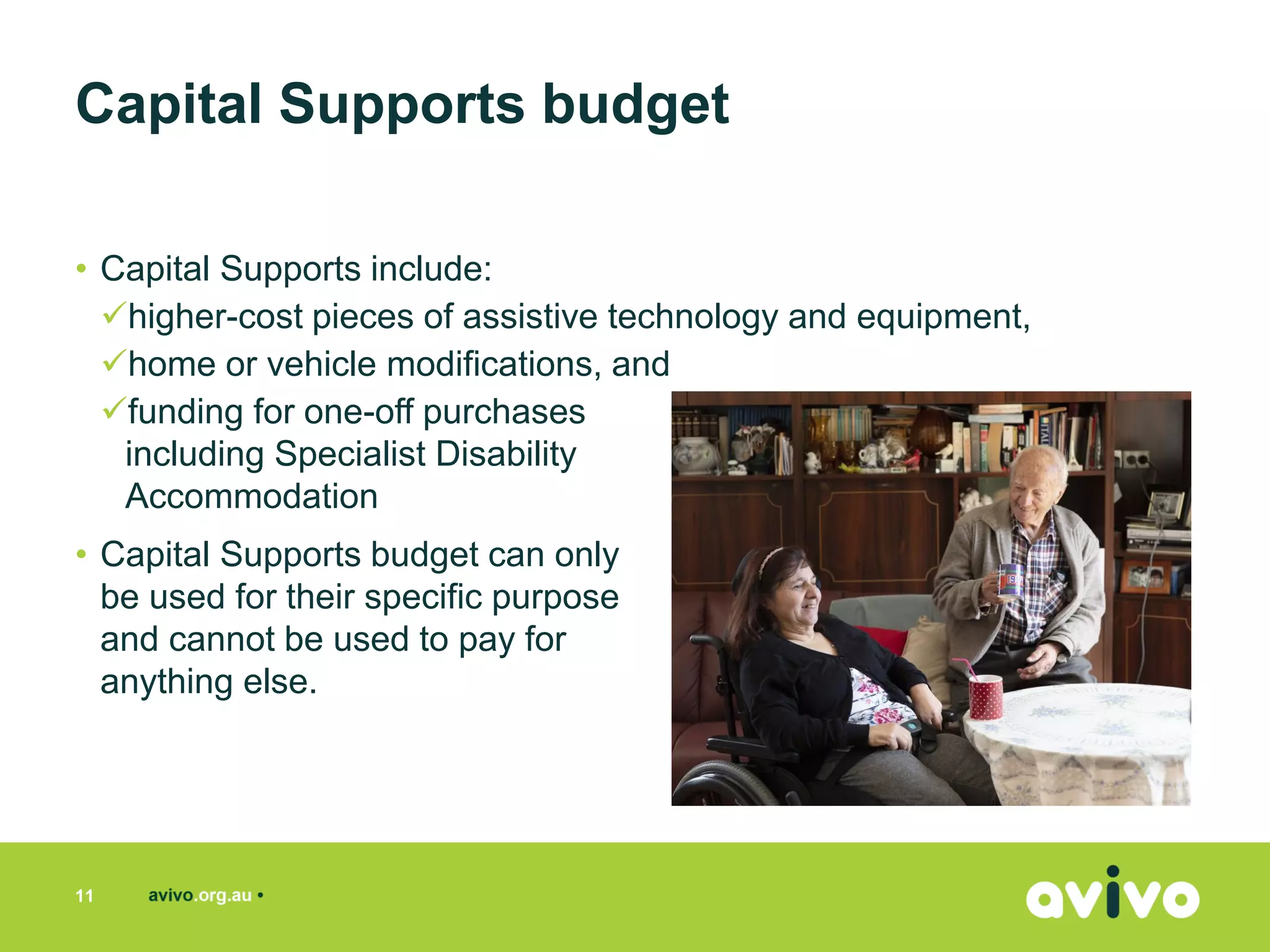
• Capital Supports include:
✓higher-cost pieces of assistive technology and equipment,
✓home or vehicle modifications, and
✓funding for one-off purchases
including Specialist Disability
Accommodation
• Capital Supports budget can only
be used for their specific purpose
and cannot be used to pay for
anything else.
11
Capital Supports budget
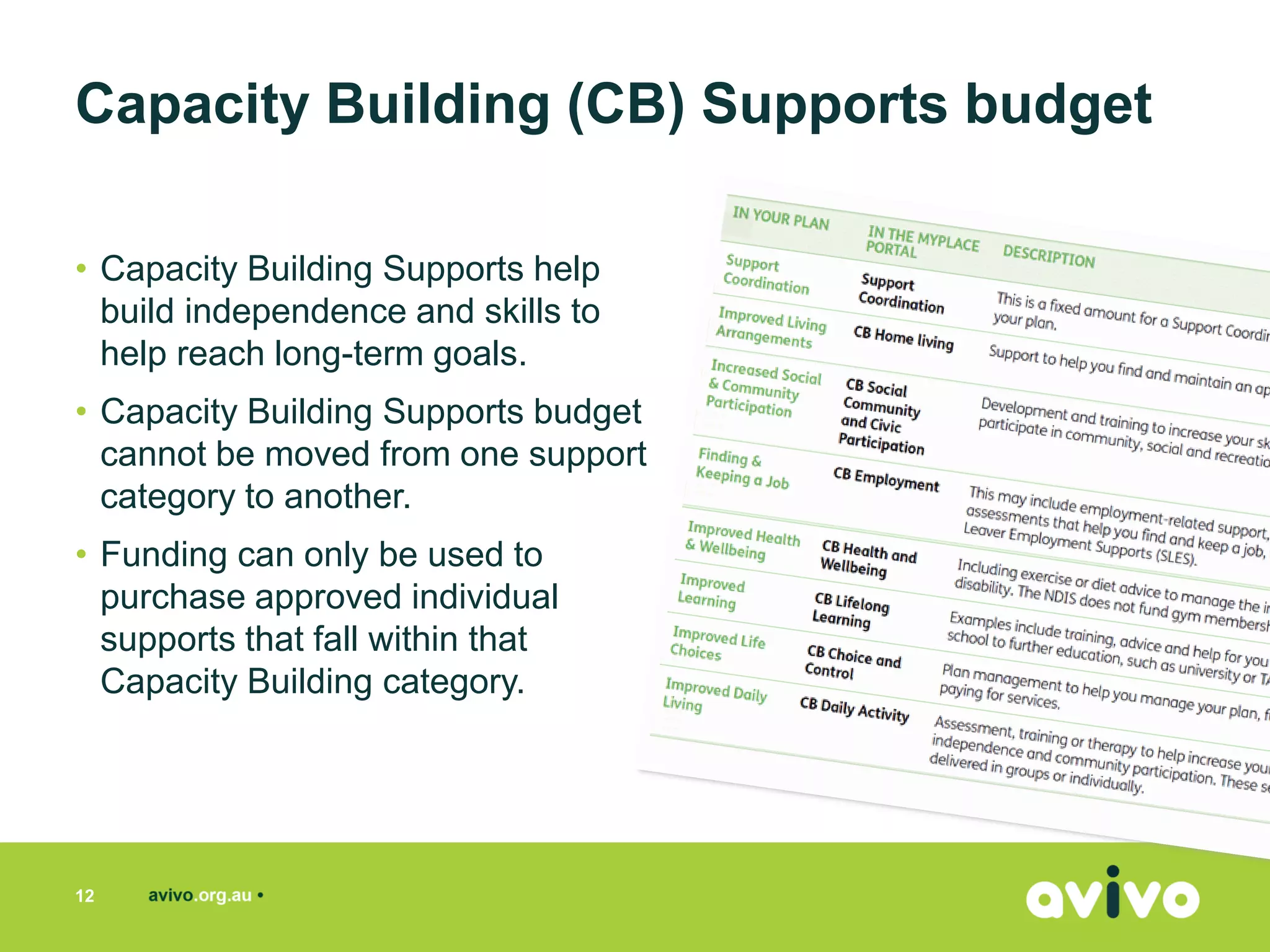
• Capacity Building Supports help
build independence and skills to
help reach long-term goals.
• Capacity Building Supports budget
cannot be moved from one support
category to another.
• Funding can only be used to
purchase approved individual
supports that fall within that
Capacity Building category.
12
Capacity Building (CB) Supports budget
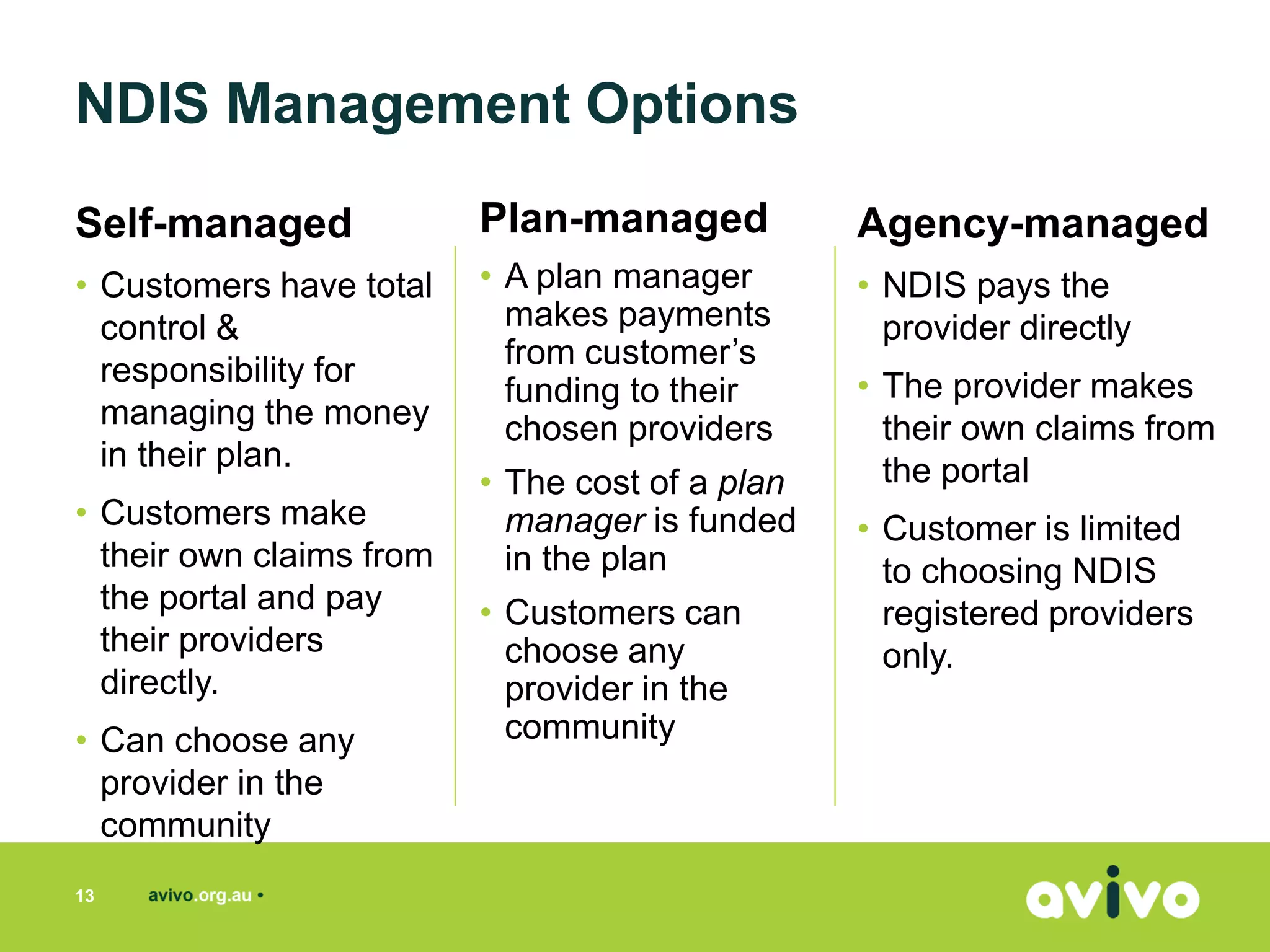
Plan-managed
• A plan manager
makes payments
from customer’s
funding to their
chosen providers
• The cost of a plan
manager is funded
in the plan
• Customers can
choose any
provider in the
community
Self-managed
• Customers have total
control &
responsibility for
managing the money
in their plan.
• Customers make
their own claims from
the portal and pay
their providers
directly.
• Can choose any
provider in the
community
NDIS Session 2 – Part 113
NDIS Management Options
Agency-managed
• NDIS pays the
provider directly
• The provider makes
their own claims from
the portal
• Customer is limited
to choosing NDIS
registered providers
only.
My reality
Consumerism Social Justice
NDIS Citizenship
• Eligibility is clear, fair and transparent
• Individual allocation of funds
• Clear distribution of resources
• Individual plans both for design and funding
• Ability to purchase support that makes sense to the person most of
the time
• Insurance actuary predicting longer term costs for all conditions (and
investments that deliver good outcomes & economical benefits)
NDIS Strengths
15
• Over engineered - inflexible funding leads to poorer outcomes
• Assessment and planning merged together and led by the NDIA,
no incentive to design uniquely and get good value for money
• Complicated, burdensome and bureaucratic
• Misunderstanding of self management and its potential for all
• Safeguarding unclear
• Regional and remote areas have no providers - community support
• Confused and unfocused investment in community infrastructure
• Challenging pricing for Providers
• Predicted to require double the current workforce
NDIS Issues
16
• Supports 3000 people across
Western Australia in their own
homes
- People with a disability
- People who experience mental
ill health
- People who are older and or frail
- Largest Shared Management
partner in WA
- Motto ‘what makes sense to
you’
[Presentation headline]17
Avivo
18
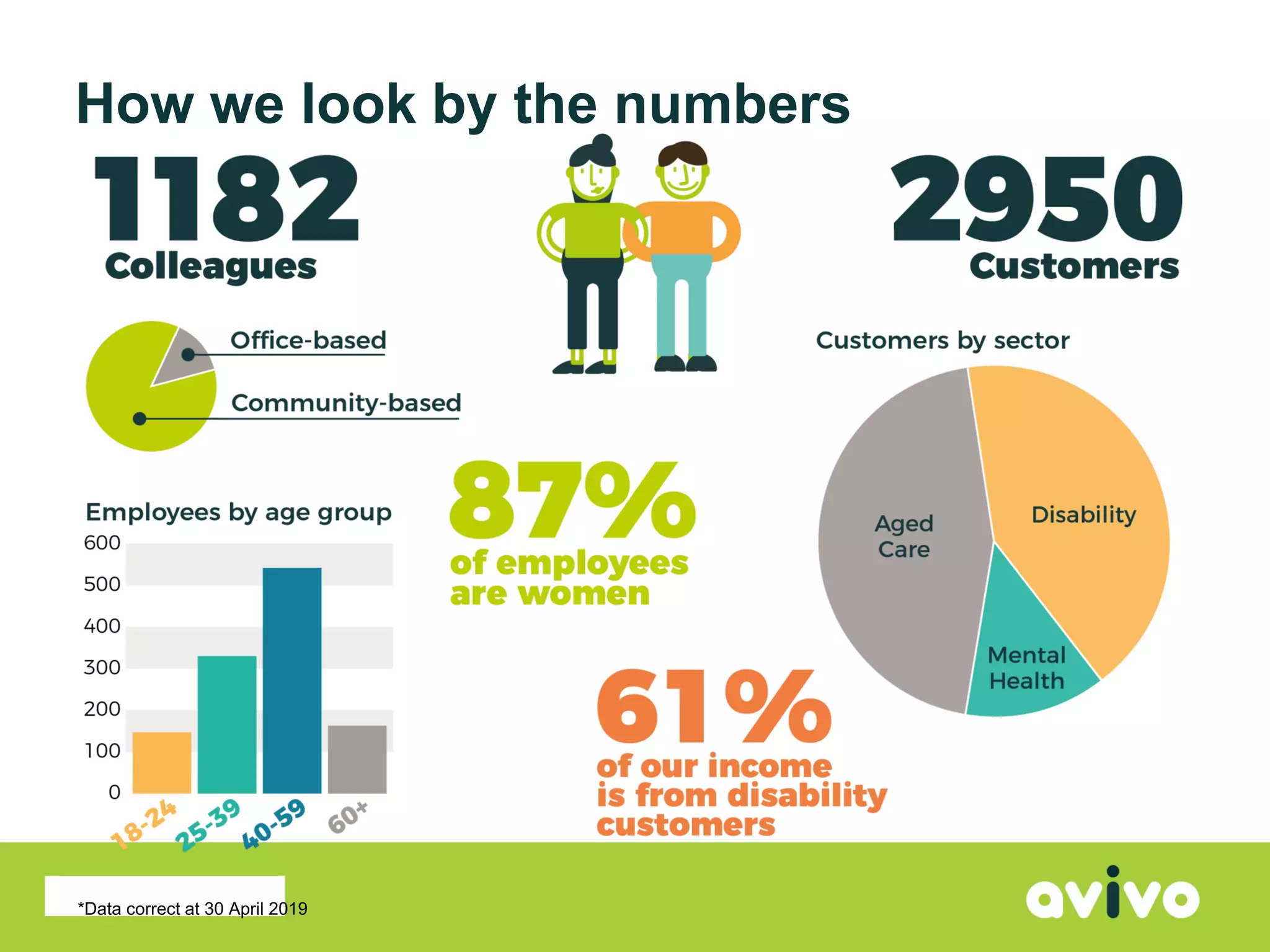
How we look by the numbers
*Data correct at 30 April 2019
Context for Support Providers
• Calls of impending crisis in workforce availability and quality
• 40% of the workforce now casualised
• 35% turnover nationally
• Tension to be simple suppliers at odds with values of partnership
• Encouraged market competition killing collaboration
• Movement of Providers rejecting ‘supply’ and claim community
organisations investing in our communities
• Organisations looking inward – how we operate to attract the best
people
Evidence that workforce culture significantly
impacts on the quality of service and support
people and families receive.
Organisational Culture and Practices
What helps you be your best at work?
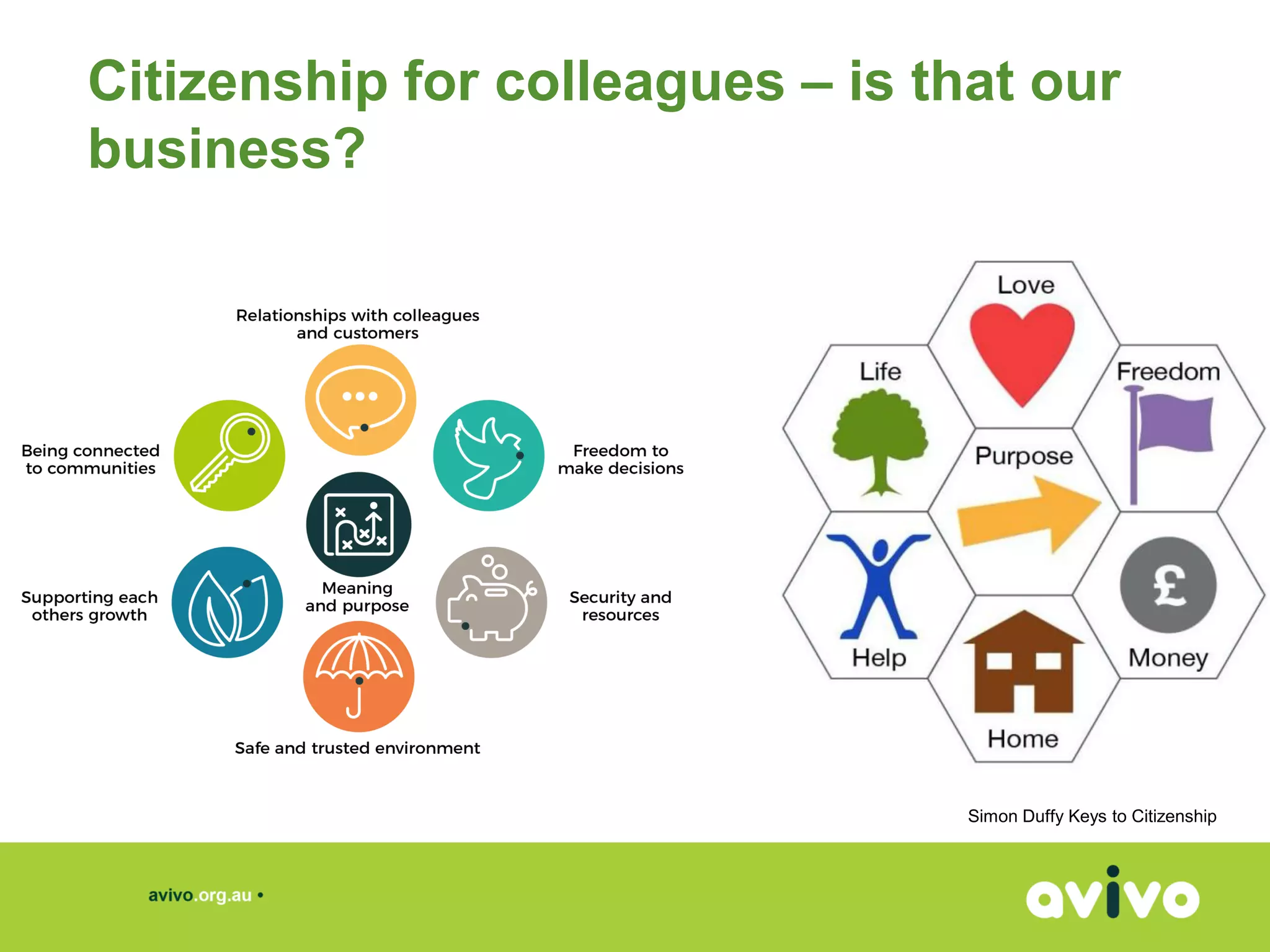
Citizenship for colleagues – is that our
business?
Simon Duffy Keys to Citizenship
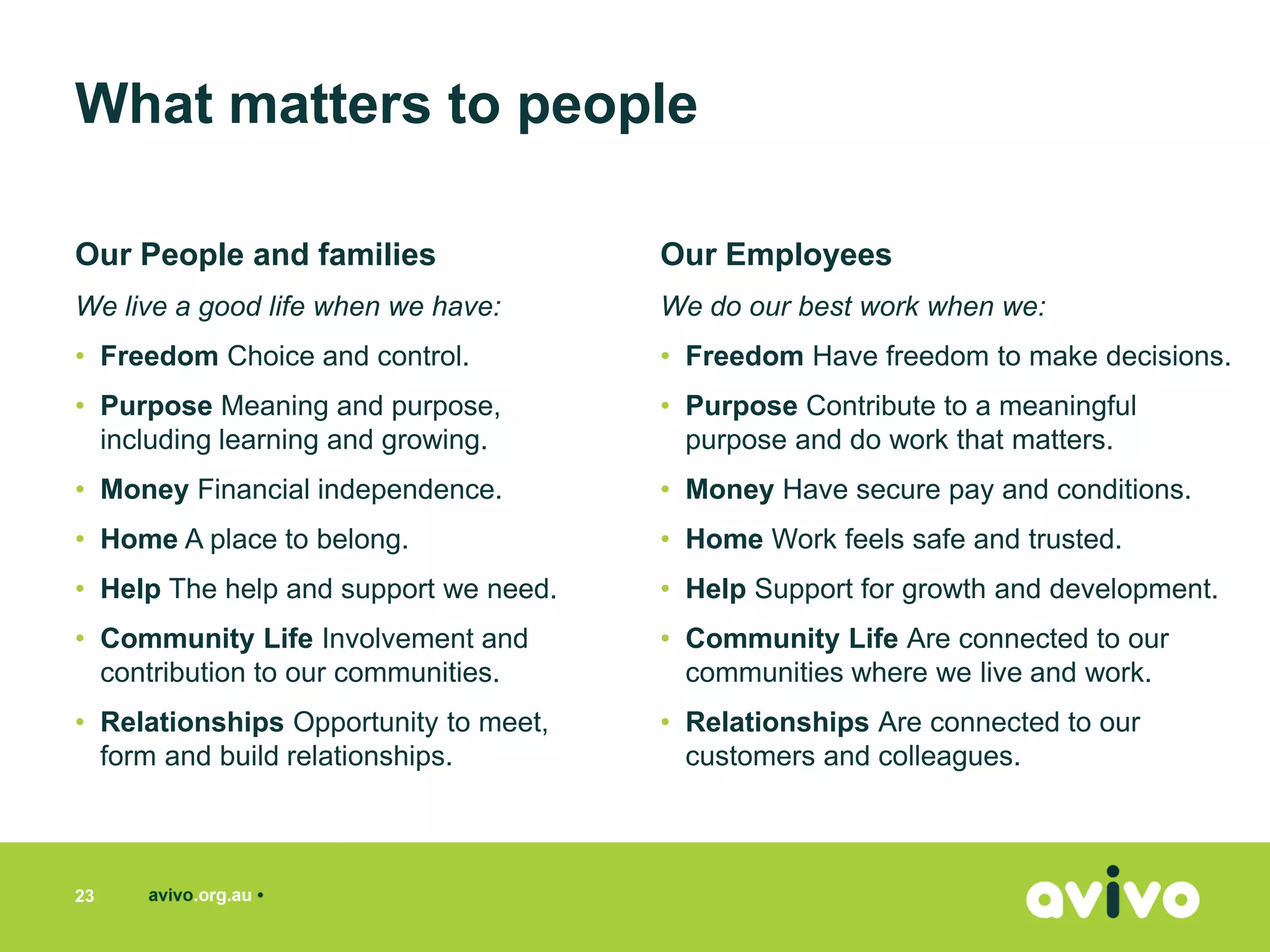
Our People and families
We live a good life when we have:
• Freedom Choice and control.
• Purpose Meaning and purpose,
including learning and growing.
• Money Financial independence.
• Home A place to belong.
• Help The help and support we need.
• Community Life Involvement and
contribution to our communities.
• Relationships Opportunity to meet,
form and build relationships.
Our Employees
We do our best work when we:
• Freedom Have freedom to make decisions.
• Purpose Contribute to a meaningful
purpose and do work that matters.
• Money Have secure pay and conditions.
• Home Work feels safe and trusted.
• Help Support for growth and development.
• Community Life Are connected to our
communities where we live and work.
• Relationships Are connected to our
customers and colleagues.
23
What matters to people
24
To increase autonomy - We’re organizing
ourselves into teams
We’re building a network of self
managing neighbourhood teams
25
• Autonomous teams with robust
support
• Challenging how we use the
resources – management etc
• Self directed development
budgets
• Investment in our local
communities
• Teams and partnerships
[Presentation headline]26
Our Employees
We do our best work when we:
• Freedom Have freedom to make
decisions.
• Purpose Contribute to a meaningful
purpose and do work that matters.
• Money Have secure pay and conditions.
• Home Work feels safe and trusted.
• Help Support for growth and
development.
• Community Life Are connected to our
communities where we live and work.
• Relationships Are connected to our
customers and colleagues.
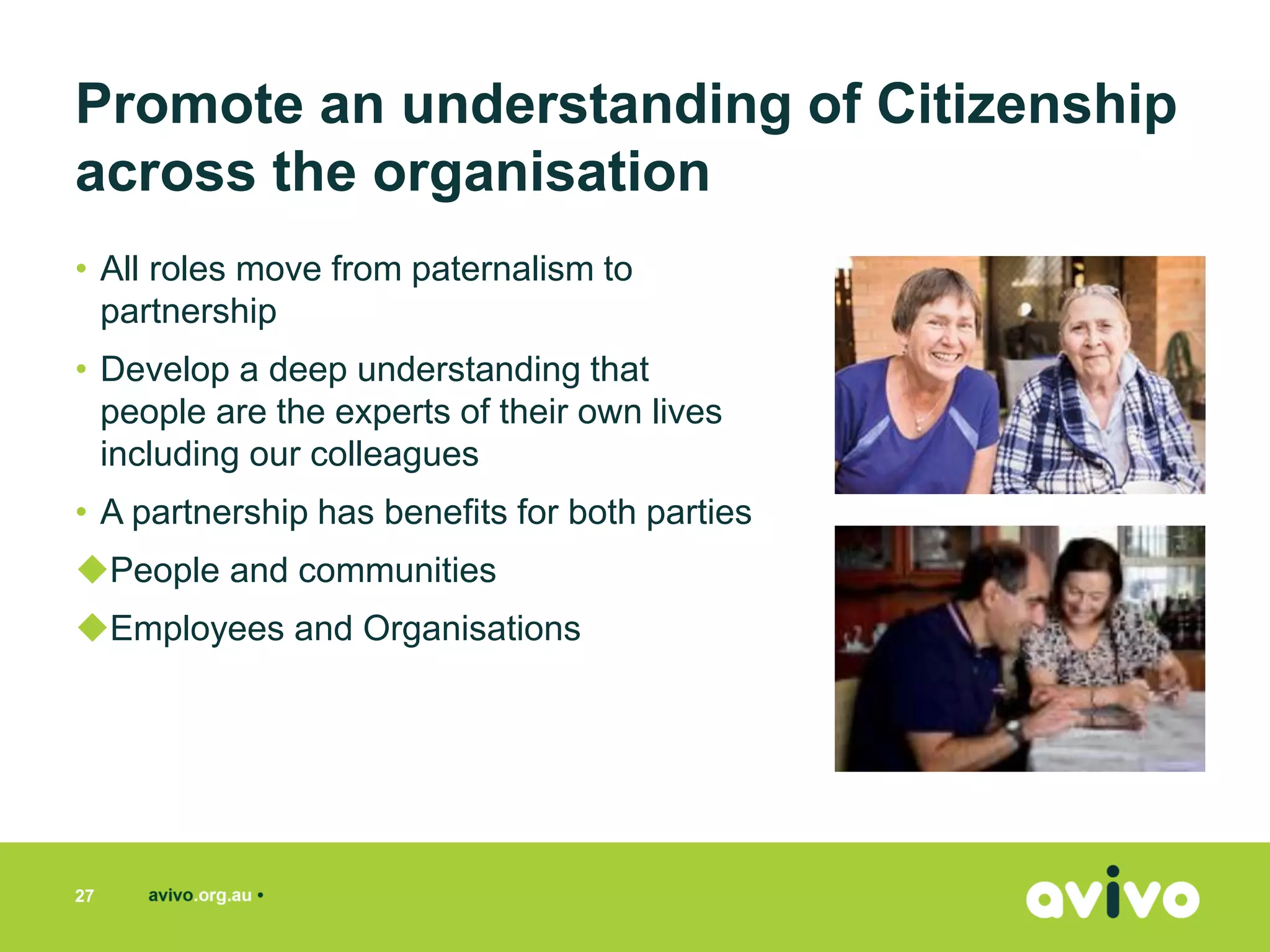
• All roles move from paternalism to
partnership
• Develop a deep understanding that
people are the experts of their own lives
including our colleagues
• A partnership has benefits for both parties
◆People and communities
◆Employees and Organisations
27
Promote an understanding of Citizenship
across the organisation
• Small Sparks grants – people, families and colleagues
• Average grant $600
• Wellness, exercise and (employee) morale
• Diversity and inclusion
• The Arts
• Education
Investing in active citizenship
[Presentation headline]28
• People and families are the best Advisors
• Trusting people to make decisions in
partnership with people and families
• The organisation needs to not get in the
way, but facilitate and support
• Support Staff who work in their local
community are working on an asset for
themselves and their families
29
Co-design, Co-production or simply
working together?
• Investing in and supporting peer to peer
connection
• Routinely asking, ‘would you be willing to
share your experience with one other
person, if we thought it might benefit
them?’
• NDIS experiences
30
Facilitating and supporting peer support
• Our context can push us in a direction that may not be where we had
hoped to travel
• More of the same will have minimal results and impact
• Courage and integrity in how we work with people and how we work
with Governments is needed
31
Creativity
• Self directed support can increase
accountability
• Partnerships offer a platform for
accountability in action
• Accountability offers strength to people
and families
• Opportunity to find a new partner, new
organisation based on what we hold each
other accountable for
32
Accountability
[Presentation headline]33

Self Directed Support and Community Organisations

  • 1.
    Self Directed Support andCommunity Organisations Kate Fulton
  • 2.
    A national campaignfor change – mainstream support 2
  • 3.
    • The NDISprovides all Australians under the age of 65 who have a permanent and significant disability with reasonable and necessary supports they need to enjoy an ordinary life. • The NDIS helps people with a disability and or mental health condition to achieve their goals. • As an insurance scheme the NDIS takes a lifetime approach, investing in people with a disability early to improve their outcomes later on in life. 3 What is the NDIS?
  • 4.
    • The NDISprovides reasonable and necessary funding to people with a permanent and significant disability to access the supports and services they need to live and enjoy their life. • Every NDIS participant has an individual plan that lists their goals and the funding they have received. • NDIS participants use their funding to purchase supports and services that will help them achieve their goals. What does the NDIS do? 4
  • 5.
    NDIS Overview, Access,Ineligibility & Internal Reviews5 Accessing the NDIS ✓Have a permanent disability that significantly affects their ability to take part in everyday activities ✓Be aged less than 65 when they apply and are accepted into the NDIS ✓Be an Australian Citizen or hold a permanent visa or a protected special category ✓Live in Australia where the NDIS is available
  • 6.
    NDIS Australia Line Items$$ Agreed Plan • Outcomes • Strategies = Budget Assessment / Planning Shopping
  • 7.
    NDIS Overview7 Reasonable andnecessary Reasonable and necessary Expectations of informal networks Most appropriately funded Value for money Pursue goals and aspirations Social and economical participation Effective and beneficial NDIS Session 2 – Part 1
  • 8.
    What is theNDIS and other government departments responsible for? Other Government Department • Education - Teachers, learning assistants and other supports such as Auslan interpreters. • Health - Diagnosis and assessment of health conditions, including mental health conditions and disabilities. • Employer - Transport for work activities such as meetings. NDIS • Self-care at school related to the student’s disability, such as assistance with eating. • Prosthetics and artificial limbs (surgery remains the responsibility of the health system). • Personal care for people who need support at work because of their disability (for example, assistance with personal care or eating meals). NDIS Session 2 – Part 1
  • 9.
    NDIS plans havethree main budget categories for Support types: • Core Supports For: everyday activities, current disability-related needs and work towards goals. • Capital Supports For: higher-cost pieces of assistive technology, equipment and home or vehicle modifications, and funding for one-off purchases. • Capacity Building Supports For: building independence and skills to help reach long-term goals. 9 Types of Support
  • 10.
    10 Core Supports budget •Core Supports help with everyday activities, current disability-related needs and work towards goals. • The Core Supports budget is the most flexible. • In most cases, you can use the funding across any of the following four support categories.
  • 11.
    • Capital Supportsinclude: ✓higher-cost pieces of assistive technology and equipment, ✓home or vehicle modifications, and ✓funding for one-off purchases including Specialist Disability Accommodation • Capital Supports budget can only be used for their specific purpose and cannot be used to pay for anything else. 11 Capital Supports budget
  • 12.
    • Capacity BuildingSupports help build independence and skills to help reach long-term goals. • Capacity Building Supports budget cannot be moved from one support category to another. • Funding can only be used to purchase approved individual supports that fall within that Capacity Building category. 12 Capacity Building (CB) Supports budget
  • 13.
    Plan-managed • A planmanager makes payments from customer’s funding to their chosen providers • The cost of a plan manager is funded in the plan • Customers can choose any provider in the community Self-managed • Customers have total control & responsibility for managing the money in their plan. • Customers make their own claims from the portal and pay their providers directly. • Can choose any provider in the community NDIS Session 2 – Part 113 NDIS Management Options Agency-managed • NDIS pays the provider directly • The provider makes their own claims from the portal • Customer is limited to choosing NDIS registered providers only.
  • 14.
    My reality Consumerism SocialJustice NDIS Citizenship
  • 15.
    • Eligibility isclear, fair and transparent • Individual allocation of funds • Clear distribution of resources • Individual plans both for design and funding • Ability to purchase support that makes sense to the person most of the time • Insurance actuary predicting longer term costs for all conditions (and investments that deliver good outcomes & economical benefits) NDIS Strengths 15
  • 16.
    • Over engineered- inflexible funding leads to poorer outcomes • Assessment and planning merged together and led by the NDIA, no incentive to design uniquely and get good value for money • Complicated, burdensome and bureaucratic • Misunderstanding of self management and its potential for all • Safeguarding unclear • Regional and remote areas have no providers - community support • Confused and unfocused investment in community infrastructure • Challenging pricing for Providers • Predicted to require double the current workforce NDIS Issues 16
  • 17.
    • Supports 3000people across Western Australia in their own homes - People with a disability - People who experience mental ill health - People who are older and or frail - Largest Shared Management partner in WA - Motto ‘what makes sense to you’ [Presentation headline]17 Avivo
  • 18.
    18 How we lookby the numbers *Data correct at 30 April 2019
  • 19.
    Context for SupportProviders • Calls of impending crisis in workforce availability and quality • 40% of the workforce now casualised • 35% turnover nationally • Tension to be simple suppliers at odds with values of partnership • Encouraged market competition killing collaboration • Movement of Providers rejecting ‘supply’ and claim community organisations investing in our communities • Organisations looking inward – how we operate to attract the best people
  • 20.
    Evidence that workforceculture significantly impacts on the quality of service and support people and families receive. Organisational Culture and Practices
  • 21.
    What helps yoube your best at work?
  • 22.
    Citizenship for colleagues– is that our business? Simon Duffy Keys to Citizenship
  • 23.
    Our People andfamilies We live a good life when we have: • Freedom Choice and control. • Purpose Meaning and purpose, including learning and growing. • Money Financial independence. • Home A place to belong. • Help The help and support we need. • Community Life Involvement and contribution to our communities. • Relationships Opportunity to meet, form and build relationships. Our Employees We do our best work when we: • Freedom Have freedom to make decisions. • Purpose Contribute to a meaningful purpose and do work that matters. • Money Have secure pay and conditions. • Home Work feels safe and trusted. • Help Support for growth and development. • Community Life Are connected to our communities where we live and work. • Relationships Are connected to our customers and colleagues. 23 What matters to people
  • 24.
    24 To increase autonomy- We’re organizing ourselves into teams
  • 25.
    We’re building anetwork of self managing neighbourhood teams 25
  • 26.
    • Autonomous teamswith robust support • Challenging how we use the resources – management etc • Self directed development budgets • Investment in our local communities • Teams and partnerships [Presentation headline]26 Our Employees We do our best work when we: • Freedom Have freedom to make decisions. • Purpose Contribute to a meaningful purpose and do work that matters. • Money Have secure pay and conditions. • Home Work feels safe and trusted. • Help Support for growth and development. • Community Life Are connected to our communities where we live and work. • Relationships Are connected to our customers and colleagues.
  • 27.
    • All rolesmove from paternalism to partnership • Develop a deep understanding that people are the experts of their own lives including our colleagues • A partnership has benefits for both parties ◆People and communities ◆Employees and Organisations 27 Promote an understanding of Citizenship across the organisation
  • 28.
    • Small Sparksgrants – people, families and colleagues • Average grant $600 • Wellness, exercise and (employee) morale • Diversity and inclusion • The Arts • Education Investing in active citizenship [Presentation headline]28
  • 29.
    • People andfamilies are the best Advisors • Trusting people to make decisions in partnership with people and families • The organisation needs to not get in the way, but facilitate and support • Support Staff who work in their local community are working on an asset for themselves and their families 29 Co-design, Co-production or simply working together?
  • 30.
    • Investing inand supporting peer to peer connection • Routinely asking, ‘would you be willing to share your experience with one other person, if we thought it might benefit them?’ • NDIS experiences 30 Facilitating and supporting peer support
  • 31.
    • Our contextcan push us in a direction that may not be where we had hoped to travel • More of the same will have minimal results and impact • Courage and integrity in how we work with people and how we work with Governments is needed 31 Creativity
  • 32.
    • Self directedsupport can increase accountability • Partnerships offer a platform for accountability in action • Accountability offers strength to people and families • Opportunity to find a new partner, new organisation based on what we hold each other accountable for 32 Accountability
  • 33.