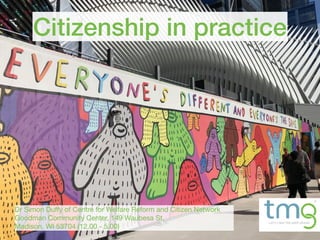
Citizenship in practice
Dr Simon Duffy of Centre for Welfare Reform and Citizen Network

Goodman Community Center, 149 Waubesa St, 

Madison, WI 53704 (12.00 - 5.00)
• In 1992 I first visited Madison as part of a study tour from
England, it was one of the most important moments of my life -
and not just because I decided to ask Nicola to marry me…

• It helped me understand that, when care becomes a service, and
people become service users, we lose the plot - we lose sight of
the person, their gifts and their true needs.

• I am going to explore why I think the idea of citizenship is an
essential idea for our times.

• Why citizenship should change our social systems.

• I am going to suggest that in practice a commitment to citizenship
changes the everyday details of how we work. 

• I will propose that these values are the same at work and at home.
If we say “everyone’s equal”
when we’re all so different…
then what does that
really mean?
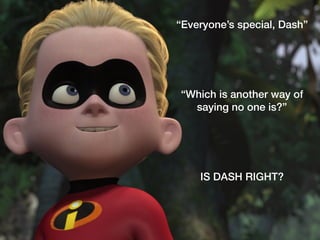
“Everyone’s special, Dash”
“Which is another way of 

saying no one is?”
IS DASH RIGHT?
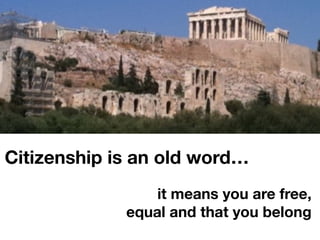
Citizenship is an old word…
it means you are free,
equal and that you belong
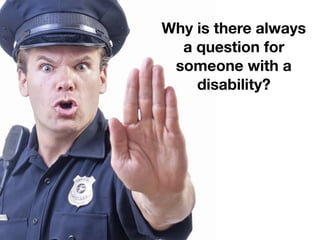
Why is there always

a question for
someone with a

disability?
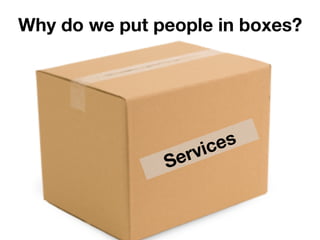
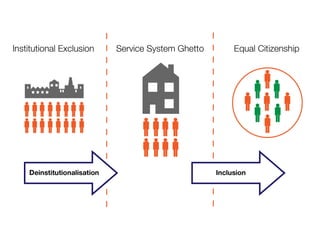
Why do we put people in boxes?
Services
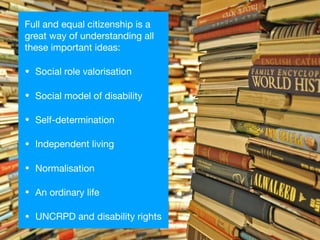
Full and equal citizenship is a
great way of understanding all
these important ideas:

• Social role valorisation

• Social model of disability

• Self-determination

• Independent living

• Normalisation

• An ordinary life

• UNCRPD and disability rights
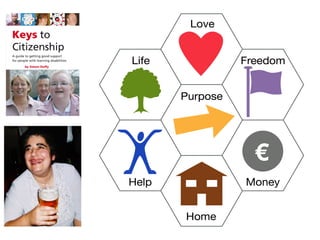
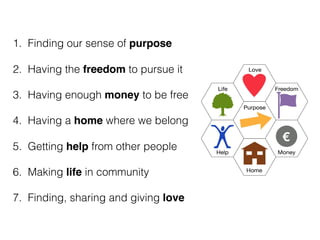
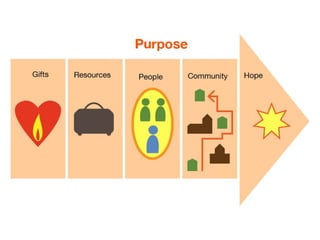
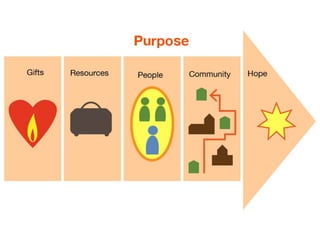
1. Finding our sense of purpose
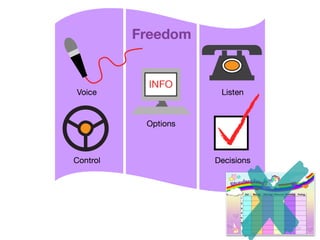
2. Having the freedom to pursue it
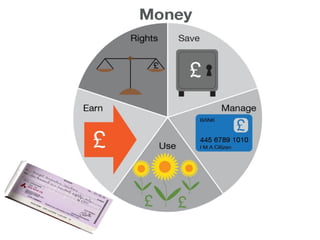
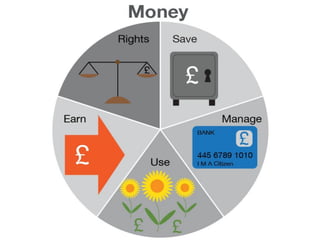
3. Having enough money to be free
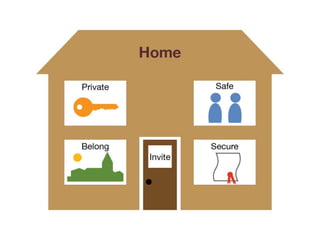
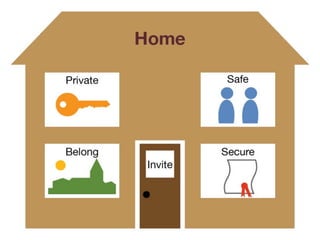
4. Having a home where we belong
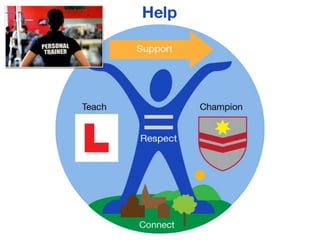
5. Getting help from other people
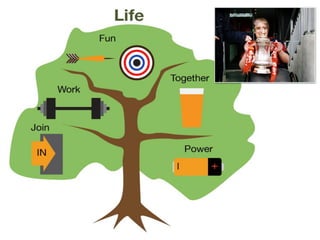
6. Making life in community
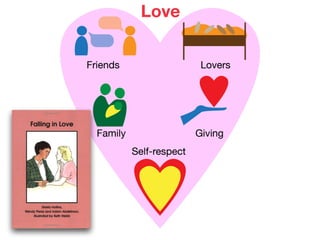
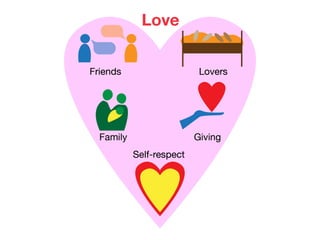
7. Finding, sharing and giving love
There are lots of ways you
can use the keys to
citizenship
If everyone is a citizen…
then what does that mean
for how we organise
support?
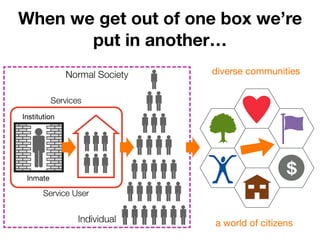
When we get out of one box we’re
put in another…
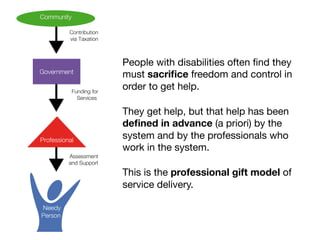
People with disabilities often find they
must sacrifice freedom and control in
order to get help.

They get help, but that help has been
defined in advance (a priori) by the
system and by the professionals who
work in the system.

This is the professional gift model of
service delivery.
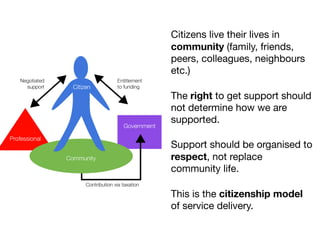
Citizens live their lives in
community (family, friends,
peers, colleagues, neighbours
etc.)

The right to get support should
not determine how we are
supported.

Support should be organised to
respect, not replace
community life.

This is the citizenship model
of service delivery.
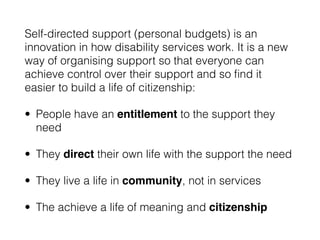
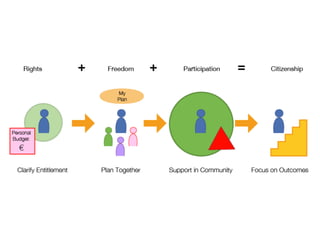
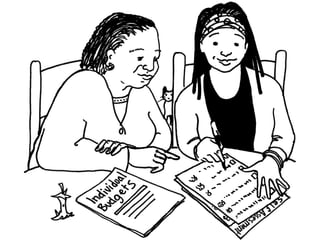
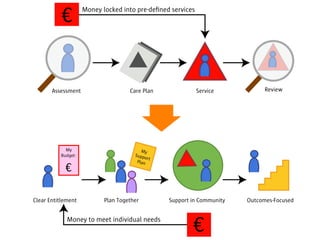
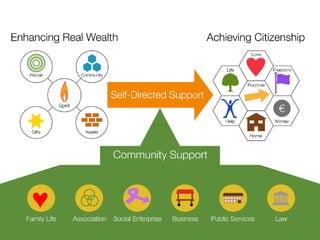
Self-directed support (personal budgets) is an
innovation in how disability services work. It is a new
way of organising support so that everyone can
achieve control over their support and so find it
easier to build a life of citizenship:
• People have an entitlement to the support they
need
• They direct their own life with the support the need
• They live a life in community, not in services
• The achieve a life of meaning and citizenship
If our job is to advance
citizenship for all…
then what does that mean
for my work?
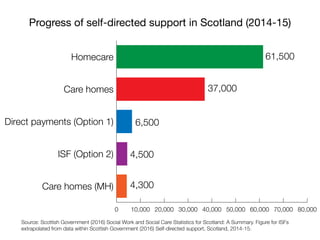
1. Fan the flames
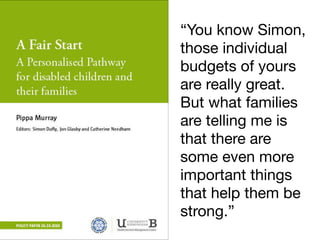
“You know Simon,
those individual
budgets of yours
are really great.
But what families
are telling me is
that there are
some even more
important things
that help them be
strong.”
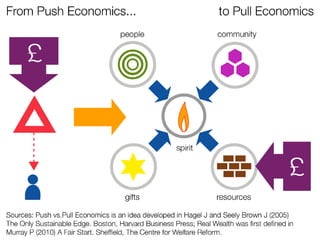
The reason it’s efficient
is that it pulls in other
‘resources’ - it is not
just a service
transaction.
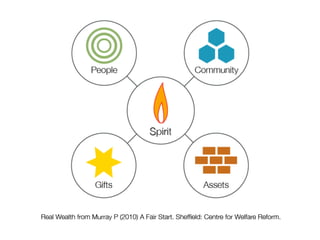
Is this not what person-
centred planning does?


It helps fan the flames of
the human spirit and helps
people come together to
build their real wealth.
You can’t help
others if you are
full of chaos,
confused
intentions and
fear. Change
begins with
ourselves.
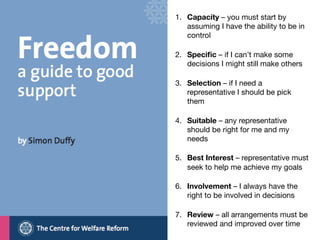
2. Clarify freedom
1. Capacity – you must start by
assuming I have the ability to be in
control

2. Specific – if I can’t make some
decisions I might still make others

3. Selection – if I need a
representative I should be pick
them

4. Suitable – any representative
should be right for me and my
needs 

5. Best Interest – representative must
seek to help me achieve my goals

6. Involvement – I always have the
right to be involved in decisions

7. Review – all arrangements must be
reviewed and improved over time
3. Enable independence
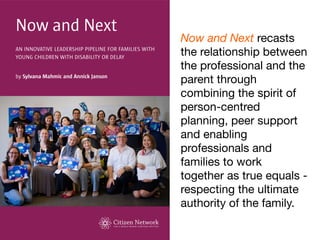
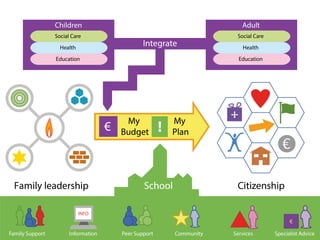
Now and Next recasts
the relationship between
the professional and the
parent through
combining the spirit of
person-centred
planning, peer support
and enabling
professionals and
families to work
together as true equals -
respecting the ultimate
authority of the family.
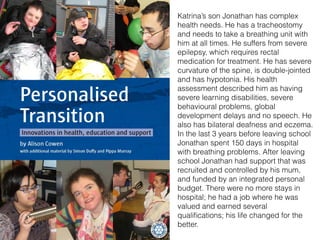
Katrina’s son Jonathan has complex
health needs. He has a tracheostomy
and needs to take a breathing unit with
him at all times. He suffers from severe
epilepsy, which requires rectal
medication for treatment. He has severe
curvature of the spine, is double-jointed
and has hypotonia. His health
assessment described him as having
severe learning disabilities, severe
behavioural problems, global
development delays and no speech. He
also has bilateral deafness and eczema.
In the last 3 years before leaving school
Jonathan spent 150 days in hospital
with breathing problems. After leaving
school Jonathan had support that was
recruited and controlled by his mum,
and funded by an integrated personal
budget. There were no more stays in
hospital; he had a job where he was
valued and earned several
qualifications; his life changed for the
better.
4. Build strong foundations
5. Get good help
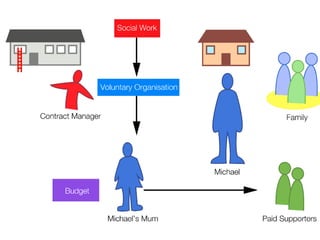
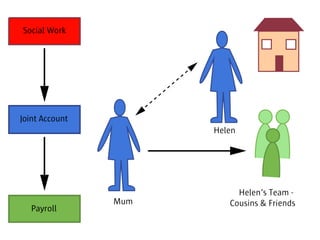
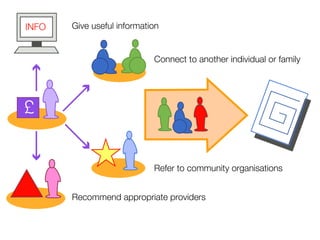
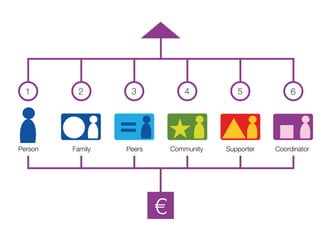
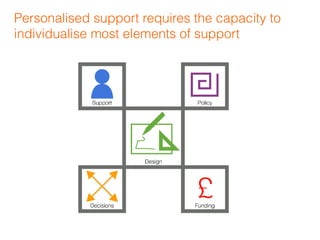
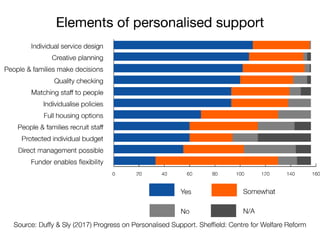
Personalised support requires the capacity to
individualise most elements of support
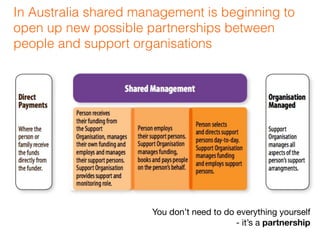
In Australia shared management is beginning to
open up new possible partnerships between
people and support organisations
You don’t need to do everything yourself
- it’s a partnership
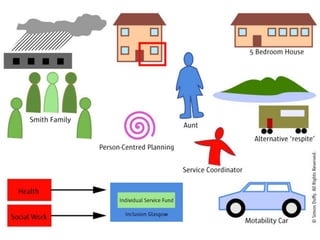
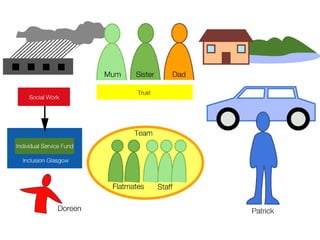
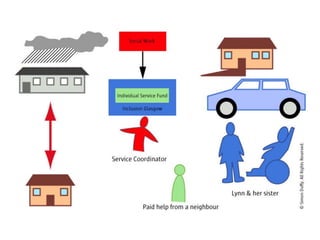
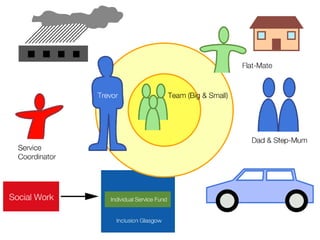
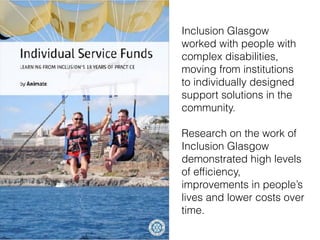
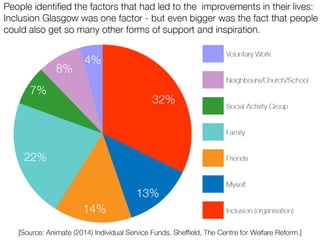
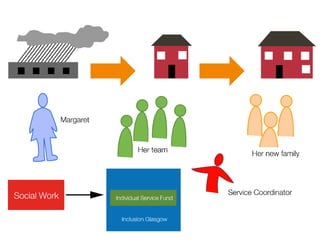
Inclusion Glasgow
worked with people with
complex disabilities,
moving from institutions
to individually designed
support solutions in the
community.
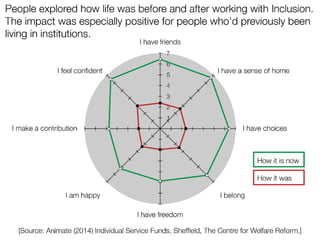
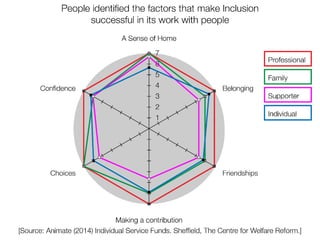
Research on the work of
Inclusion Glasgow
demonstrated high levels
of efficiency,
improvements in people’s
lives and lower costs over
time.
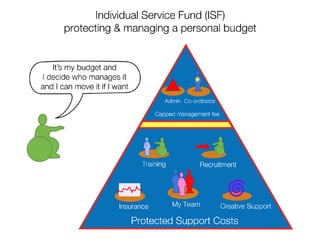
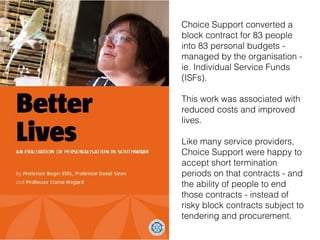
Choice Support converted a
block contract for 83 people
into 83 personal budgets -
managed by the organisation -
ie. Individual Service Funds
(ISFs).
This work was associated with
reduced costs and improved
lives.
Like many service providers,
Choice Support were happy to
accept short termination
periods on that contracts - and
the ability of people to end
those contracts - instead of
risky block contracts subject to
tendering and procurement.
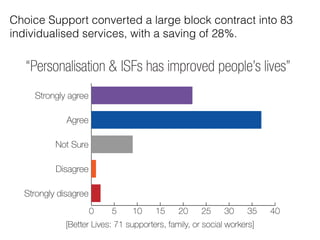
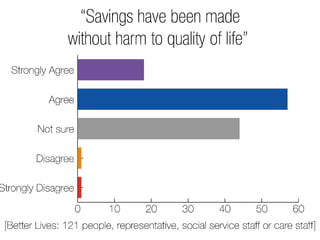
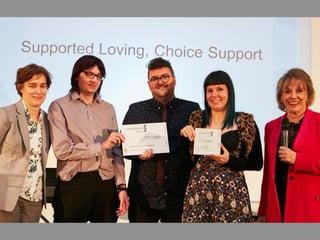
Choice Support converted a large block contract into 83
individualised services, with a saving of 28%.
Social workers and support staff came to see the process as
personally rewarding.
There are many
countries around
the world where
there are forms of
highly personalised
support - some of
which have existed
for over 25 years -
but they are still
unusual and
unappreciated.
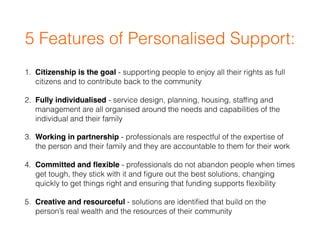
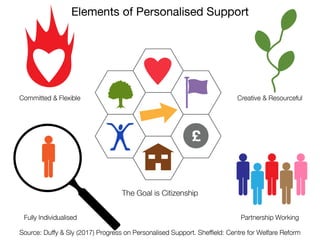
5 Features of Personalised Support:
1. Citizenship is the goal - supporting people to enjoy all their rights as full
citizens and to contribute back to the community
2. Fully individualised - service design, planning, housing, staffing and
management are all organised around the needs and capabilities of the
individual and their family
3. Working in partnership - professionals are respectful of the expertise of
the person and their family and they are accountable to them for their work
4. Committed and flexible - professionals do not abandon people when times
get tough, they stick with it and figure out the best solutions, changing
quickly to get things right and ensuring that funding supports flexibility
5. Creative and resourceful - solutions are identified that build on the
person’s real wealth and the resources of their community
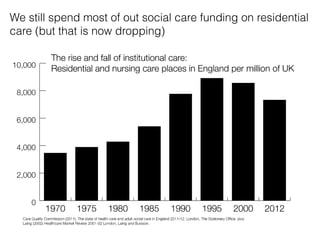
We still spend most of out social care funding on residential
care (but that is now dropping)
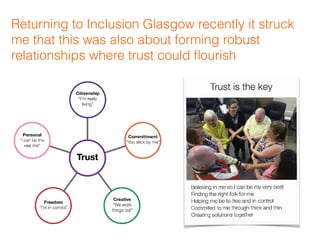
Returning to Inclusion Glasgow recently it struck
me that this was also about forming robust
relationships where trust could flourish
http://www.centreforwelfarereform.org/library/by-az/recovery-stories.html
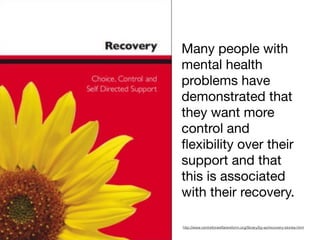
Many people with
mental health
problems have
demonstrated that
they want more
control and
flexibility over their
support and that
this is associated
with their recovery.
“.…to pay for swimming lessons.” [S.S.S.]
“Our hope for the future is that my husband will
continue to live at home. Direct Payments plus
committed and smart professionals are the key
enablers for this.” [Fred]
“This allowed me to have a holiday with my daughter…
I also go to the theatre, meals out… hobbies such as
card making…” [Carol]
“Personal budgets have enabled us to work in
partnership with our service users to identify and
access services and resources that are meaningful to
their Recovery.” [Mandy]
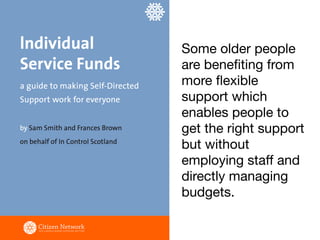
Some older people
are benefiting from
more flexible
support which
enables people to
get the right support
but without
employing staff and
directly managing
budgets.
“One lady banks her hours in order that she can have respite at home
rather than going to residential which she is frightened of so her
husband can have a week away with his son. Her support changes
from 4 calls a day to a temporary live-in service.”
“When a gentleman suddenly became 'end of life' care he requested
sleep-ins as he was frightened; the provider reorganised his hours to
accommodate this that same night.”
“A lady went to Wales on holiday and the provider purchased support
on her behalf from a local agency in Wales.”
“One gentleman has a fluctuating condition and changes the times
and staff he wants on a weekly basis to suit his changing needs.”
“This organisation also work with a number of individuals who use their
staff and sub-contracted self-employed PAs mixed. Provider staff for
personal care and PAs for companionship and social outings.”
6. Open the doors
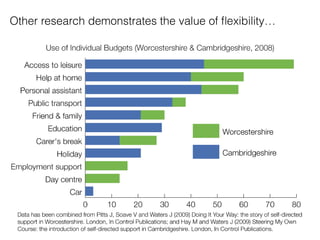
Other research demonstrates the value of flexibility…
7. Let love shine in
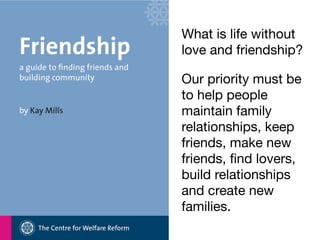
What is life without
love and friendship?

Our priority must be
to help people
maintain family
relationships, keep
friends, make new
friends, find lovers,
build relationships
and create new
families.
If citizenship is the key
to a good life…
then what does that mean
for me, my family and 

my community?
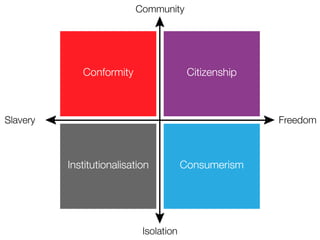
Citizenship: good and bad
The wrong kind of citizenship - We’re special
because they are members of a special
community (like a country) - we want to keep it
special and keep the outsiders out

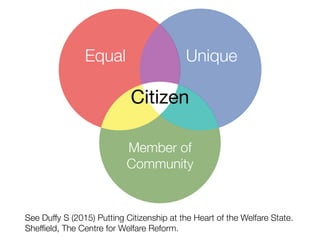
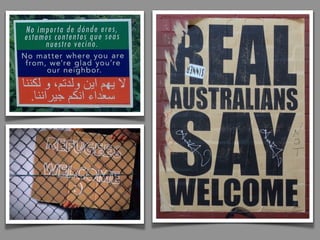
The right kind of citizenship - Everybody’s
equal and we all need to belong to many
different communities - we want to welcome
and include everybody
or

a life of citizenship
freedom, meaning,
contribution

Money? Power? Fame?
What do we want
for our children?
What do we want 

for ourselves?
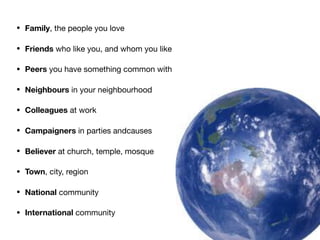
• Family, the people you love

• Friends who like you, and whom you like

• Peers you have something common with

• Neighbours in your neighbourhood

• Colleagues at work

• Campaigners in parties andcauses

• Believer at church, temple, mosque

• Town, city, region

• National community

• International community
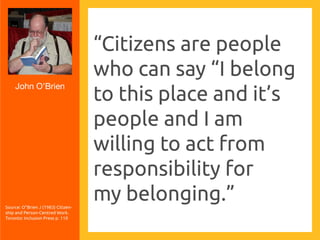
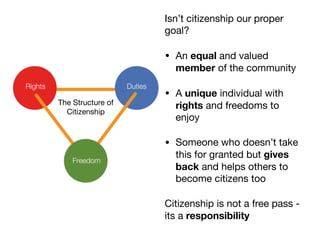
Isn’t citizenship our proper
goal?

• An equal and valued
member of the community

• A unique individual with
rights and freedoms to
enjoy

• Someone who doesn’t take
this for granted but gives
back and helps others to
become citizens too

Citizenship is not a free pass -
its a responsibility
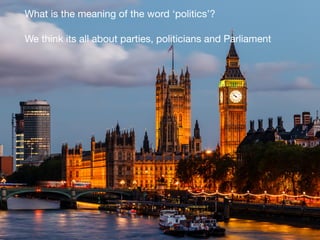
What is the meaning of the word ‘politics’?

We think its all about parties, politicians and Parliament
What is the meaning of the word ‘politics’?

It comes from a Greek word ‘polis’ which
sometimes is translated as ‘state’

But is better translated as city or even better as
community

Politics should mean ‘local community knowledge’

Somehow we’ve turned it upside down.
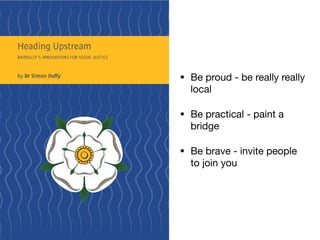
• Be proud - be really really
local

• Be practical - paint a
bridge

• Be brave - invite people
to join you
More information at www.cforwr.org
Follow @CforWR @simonjduffy @citizen_network
Like fb.me/centreforwelfarereform
e Contact simon@centreforwelfarereform.org
Join www.citizen-network.org

Citizenship in Practice

  • 1.
    Citizenship in practice DrSimon Duffy of Centre for Welfare Reform and Citizen Network
 Goodman Community Center, 149 Waubesa St, 
 Madison, WI 53704 (12.00 - 5.00)
  • 2.
    • In 1992I first visited Madison as part of a study tour from England, it was one of the most important moments of my life - and not just because I decided to ask Nicola to marry me… • It helped me understand that, when care becomes a service, and people become service users, we lose the plot - we lose sight of the person, their gifts and their true needs. • I am going to explore why I think the idea of citizenship is an essential idea for our times. • Why citizenship should change our social systems. • I am going to suggest that in practice a commitment to citizenship changes the everyday details of how we work. • I will propose that these values are the same at work and at home.
  • 3.
    If we say“everyone’s equal” when we’re all so different… then what does that really mean?
  • 4.
    “Everyone’s special, Dash” “Whichis another way of 
 saying no one is?” IS DASH RIGHT?
  • 5.
    Citizenship is anold word… it means you are free, equal and that you belong
  • 10.
    Why is therealways
 a question for someone with a
 disability?
  • 11.
    Why do weput people in boxes? Services
  • 14.
    Full and equalcitizenship is a great way of understanding all these important ideas: • Social role valorisation • Social model of disability • Self-determination • Independent living • Normalisation • An ordinary life • UNCRPD and disability rights
  • 16.
    1. Finding oursense of purpose 2. Having the freedom to pursue it 3. Having enough money to be free 4. Having a home where we belong 5. Getting help from other people 6. Making life in community 7. Finding, sharing and giving love
  • 24.
    There are lotsof ways you can use the keys to citizenship
  • 26.
    If everyone isa citizen… then what does that mean for how we organise support?
  • 28.
    When we getout of one box we’re put in another…
  • 30.
    People with disabilitiesoften find they must sacrifice freedom and control in order to get help. They get help, but that help has been defined in advance (a priori) by the system and by the professionals who work in the system. This is the professional gift model of service delivery.
  • 31.
    Citizens live theirlives in community (family, friends, peers, colleagues, neighbours etc.) The right to get support should not determine how we are supported. Support should be organised to respect, not replace community life. This is the citizenship model of service delivery.
  • 32.
    Self-directed support (personalbudgets) is an innovation in how disability services work. It is a new way of organising support so that everyone can achieve control over their support and so find it easier to build a life of citizenship: • People have an entitlement to the support they need • They direct their own life with the support the need • They live a life in community, not in services • The achieve a life of meaning and citizenship
  • 42.
    If our jobis to advance citizenship for all… then what does that mean for my work?
  • 43.
    1. Fan theflames
  • 45.
    “You know Simon, thoseindividual budgets of yours are really great. But what families are telling me is that there are some even more important things that help them be strong.”
  • 50.
    The reason it’sefficient is that it pulls in other ‘resources’ - it is not just a service transaction.
  • 52.
    Is this notwhat person- centred planning does? 
 It helps fan the flames of the human spirit and helps people come together to build their real wealth.
  • 53.
    You can’t help othersif you are full of chaos, confused intentions and fear. Change begins with ourselves.
  • 54.
  • 55.
    1. Capacity –you must start by assuming I have the ability to be in control 2. Specific – if I can’t make some decisions I might still make others 3. Selection – if I need a representative I should be pick them 4. Suitable – any representative should be right for me and my needs 5. Best Interest – representative must seek to help me achieve my goals 6. Involvement – I always have the right to be involved in decisions 7. Review – all arrangements must be reviewed and improved over time
  • 59.
  • 64.
    Now and Nextrecasts the relationship between the professional and the parent through combining the spirit of person-centred planning, peer support and enabling professionals and families to work together as true equals - respecting the ultimate authority of the family.
  • 67.
    Katrina’s son Jonathanhas complex health needs. He has a tracheostomy and needs to take a breathing unit with him at all times. He suffers from severe epilepsy, which requires rectal medication for treatment. He has severe curvature of the spine, is double-jointed and has hypotonia. His health assessment described him as having severe learning disabilities, severe behavioural problems, global development delays and no speech. He also has bilateral deafness and eczema. In the last 3 years before leaving school Jonathan spent 150 days in hospital with breathing problems. After leaving school Jonathan had support that was recruited and controlled by his mum, and funded by an integrated personal budget. There were no more stays in hospital; he had a job where he was valued and earned several qualifications; his life changed for the better.
  • 68.
    4. Build strongfoundations
  • 72.
  • 79.
    Personalised support requiresthe capacity to individualise most elements of support
  • 81.
    In Australia sharedmanagement is beginning to open up new possible partnerships between people and support organisations You don’t need to do everything yourself - it’s a partnership
  • 82.
    Inclusion Glasgow worked withpeople with complex disabilities, moving from institutions to individually designed support solutions in the community. Research on the work of Inclusion Glasgow demonstrated high levels of efficiency, improvements in people’s lives and lower costs over time.
  • 86.
    Choice Support converteda block contract for 83 people into 83 personal budgets - managed by the organisation - ie. Individual Service Funds (ISFs). This work was associated with reduced costs and improved lives. Like many service providers, Choice Support were happy to accept short termination periods on that contracts - and the ability of people to end those contracts - instead of risky block contracts subject to tendering and procurement.
  • 87.
    Choice Support converteda large block contract into 83 individualised services, with a saving of 28%.
  • 89.
    Social workers andsupport staff came to see the process as personally rewarding.
  • 90.
    There are many countriesaround the world where there are forms of highly personalised support - some of which have existed for over 25 years - but they are still unusual and unappreciated.
  • 92.
    5 Features ofPersonalised Support: 1. Citizenship is the goal - supporting people to enjoy all their rights as full citizens and to contribute back to the community 2. Fully individualised - service design, planning, housing, staffing and management are all organised around the needs and capabilities of the individual and their family 3. Working in partnership - professionals are respectful of the expertise of the person and their family and they are accountable to them for their work 4. Committed and flexible - professionals do not abandon people when times get tough, they stick with it and figure out the best solutions, changing quickly to get things right and ensuring that funding supports flexibility 5. Creative and resourceful - solutions are identified that build on the person’s real wealth and the resources of their community
  • 94.
    We still spendmost of out social care funding on residential care (but that is now dropping)
  • 95.
    Returning to InclusionGlasgow recently it struck me that this was also about forming robust relationships where trust could flourish
  • 96.
    http://www.centreforwelfarereform.org/library/by-az/recovery-stories.html Many people with mentalhealth problems have demonstrated that they want more control and flexibility over their support and that this is associated with their recovery.
  • 97.
    “.…to pay forswimming lessons.” [S.S.S.] “Our hope for the future is that my husband will continue to live at home. Direct Payments plus committed and smart professionals are the key enablers for this.” [Fred] “This allowed me to have a holiday with my daughter… I also go to the theatre, meals out… hobbies such as card making…” [Carol] “Personal budgets have enabled us to work in partnership with our service users to identify and access services and resources that are meaningful to their Recovery.” [Mandy]
  • 98.
    Some older people arebenefiting from more flexible support which enables people to get the right support but without employing staff and directly managing budgets.
  • 99.
    “One lady banksher hours in order that she can have respite at home rather than going to residential which she is frightened of so her husband can have a week away with his son. Her support changes from 4 calls a day to a temporary live-in service.” “When a gentleman suddenly became 'end of life' care he requested sleep-ins as he was frightened; the provider reorganised his hours to accommodate this that same night.” “A lady went to Wales on holiday and the provider purchased support on her behalf from a local agency in Wales.” “One gentleman has a fluctuating condition and changes the times and staff he wants on a weekly basis to suit his changing needs.” “This organisation also work with a number of individuals who use their staff and sub-contracted self-employed PAs mixed. Provider staff for personal care and PAs for companionship and social outings.”
  • 101.
  • 104.
    Other research demonstratesthe value of flexibility…
  • 108.
    7. Let loveshine in
  • 110.
    What is lifewithout love and friendship? Our priority must be to help people maintain family relationships, keep friends, make new friends, find lovers, build relationships and create new families.
  • 113.
    If citizenship isthe key to a good life… then what does that mean for me, my family and 
 my community?
  • 114.
    Citizenship: good andbad The wrong kind of citizenship - We’re special because they are members of a special community (like a country) - we want to keep it special and keep the outsiders out The right kind of citizenship - Everybody’s equal and we all need to belong to many different communities - we want to welcome and include everybody
  • 120.
    or
 a life ofcitizenship freedom, meaning, contribution Money? Power? Fame?
  • 121.
    What do wewant for our children?
  • 122.
    What do wewant 
 for ourselves?
  • 124.
    • Family, thepeople you love • Friends who like you, and whom you like • Peers you have something common with • Neighbours in your neighbourhood • Colleagues at work • Campaigners in parties andcauses • Believer at church, temple, mosque • Town, city, region • National community • International community
  • 125.
    Isn’t citizenship ourproper goal? • An equal and valued member of the community • A unique individual with rights and freedoms to enjoy • Someone who doesn’t take this for granted but gives back and helps others to become citizens too Citizenship is not a free pass - its a responsibility
  • 127.
    What is themeaning of the word ‘politics’? We think its all about parties, politicians and Parliament
  • 128.
    What is themeaning of the word ‘politics’? It comes from a Greek word ‘polis’ which sometimes is translated as ‘state’ But is better translated as city or even better as community Politics should mean ‘local community knowledge’ Somehow we’ve turned it upside down.
  • 129.
    • Be proud- be really really local • Be practical - paint a bridge • Be brave - invite people to join you
  • 130.
    More information atwww.cforwr.org Follow @CforWR @simonjduffy @citizen_network Like fb.me/centreforwelfarereform e Contact simon@centreforwelfarereform.org Join www.citizen-network.org