National Disability
Insurance Scheme
(NDIS)
Anne Skordis
14 September 2016
GM, Scheme Transition
Agenda
• Moving to full scheme – transition
• Pathways for participants – first plan
• The growing market
• What is coming – future plans and goals
ContextContext
Overall Context
Projected Growth in NDIS participation - Source: NDIA/ NOUS report
Projected Growth in NSW NDIS participation -Source: NDIA Actuary NSW MPS
The NDIS has taken off
9%
12,100 55,300
81%
115,600
100%
142,100
NSW
Projected
Participants
39%
We are here
We are here
When will the NDIS be in my
area?
• The NDIS is currently working in some places
around Australia, new places will be added
slowly.
• We are starting the NDIS in this way to make
sure we get things right, slowly and over time.
• The NDIS will start all around Australia from
July 2016.
From 1 July 2016
• Central Coast
• Northern Sydney
• South Western Sydney
• Southern NSW
• Western Sydney
• Remaining populations of Hunter
New England and Nepean Blue
Mountains
From 1 July 2017
• Illawarra Shoalhaven
• Mid North Coast
• Murrumbidgee
• Northern NSW
• South Eastern Sydney
• Sydney
• Western NSW
• Far West
NDIS rollout in NSW
1 July 2018
The NDIS is operating state-wide
Challenges
• The NDIS is being introduced in stages to ensure it is successful and sustainable.
• The transition phase is a unique period for the NDIS. We have a large number of people
joining the Scheme during a short period of time.
• Things won’t be perfect immediately, but we will continue to listen, learn and improve as
the Scheme grows.
• As the NDIS is changing the way we support people with disability in Australia, it will take
time for the market place to develop, which will allow people with disability to have choice
and control.
• Our focus is on as smooth as possible transition, where we move from old systems to new,
and avoid disruption to services.
• In some areas of Australia the market will not be fully developed during the early stages of
the Scheme’s roll out. The Agency will be working in these areas to support market
development as quickly as possible, but this will take time
These supports can help you…
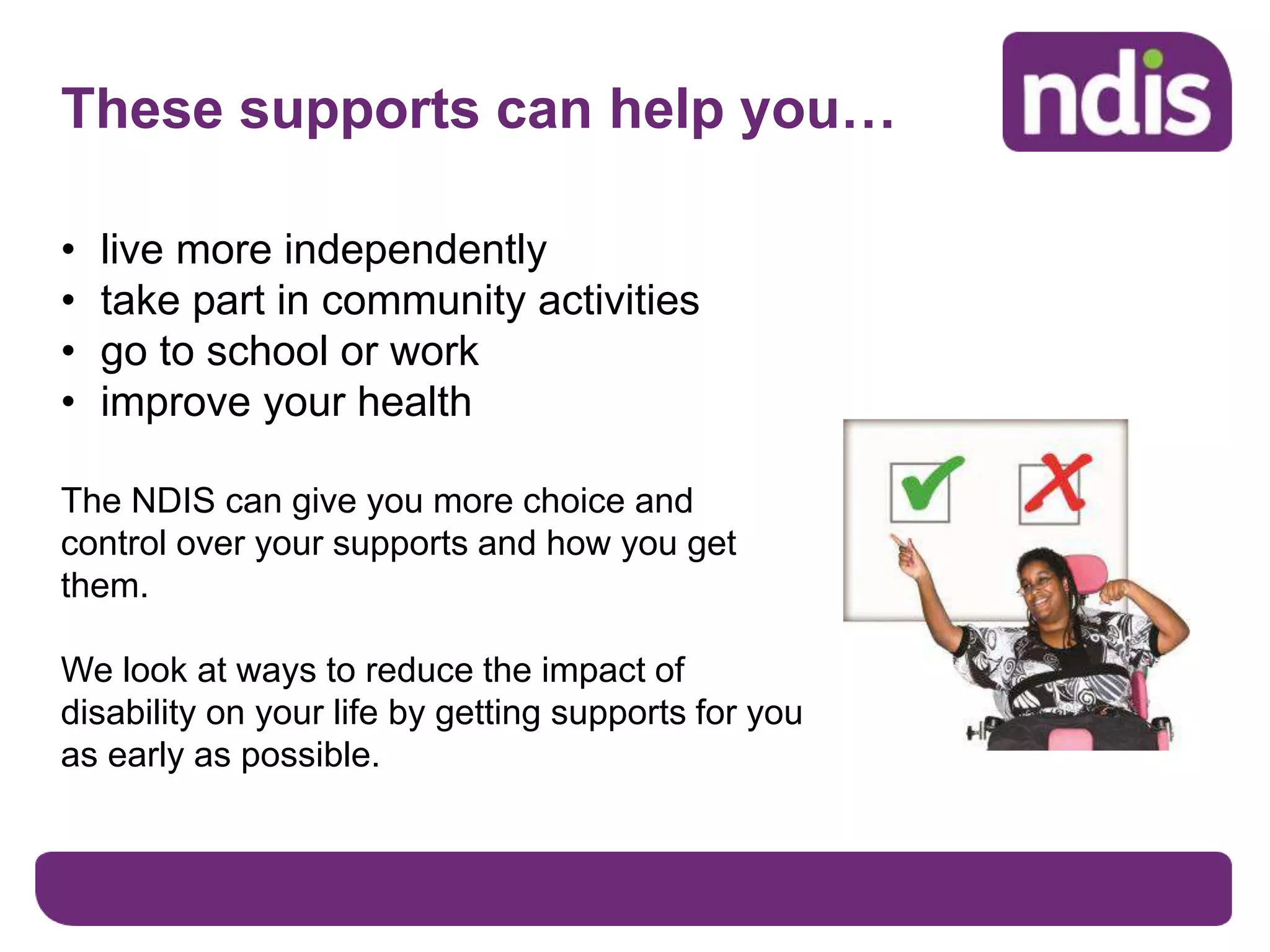
The NDIS can give you more choice and
control over your supports and how you get
them.
We look at ways to reduce the impact of
disability on your life by getting supports for you
as early as possible.
• live more independently
• take part in community activities
• go to school or work
• improve your health
What other supports might I
have?
Other examples of support include the support you receive
from:
• family and friends
• community and disability services
• health services
• education services
Case Study: Tina
‘I want to get across to people is this isn’t about flying to the
moon, it’s about getting out of bed, having a shower, eating. It’s
nothing exciting, it’s about everyday stuff.‘
‘Before the NDIS I didn’t have funding for support with toilet
shifts. I now get morning support – all personal care related, an
afternoon shift, which helps with things like helping me prepare
tea and a night shift to put me to bed.’
‘Recently, a friend of mine said she couldn’t keep up with me
now, because I’m getting my life back.’
‘I can actually think about doing things, not just trying to cope
with getting out of bed and preparing meals. I now have the
energy to enjoy people’s company and I didn’t have that before.’
‘Thanks to NDIS I have my life back – I am living and not just
existing.’
Local Area Coordination will be
delivered with Partners
• Local Area Coordinators (LACs) will
support some participants and their
families to join in and contribute to the
life of their community and assist with
the planning process, plan
implementation and community
participation.
• LACs will support participants through
all steps on their NDIS pathway.
• LACs will also deliver some activities to
people who are not eligible for the
Scheme and in building community
capacity.
Specialist Disability
Accommodation (SDA)
• SDA refers to accommodation for participants who required
specialist housing solutions to assist with the delivery of
supports that cater for their complete functional impairment
and/or very high support needs.
• New Approach – the NDIS is adopting a new approach to
funding of SDA for people with a reasonable and necessary
need for SDA supports under the Scheme.
Markets
• The NDIA has released the NSW Market Position Statement (MPS).
• Highlights include:
– More people: The NSW market for disability supports is estimated to grow
from 78,000 people in 2016 to 142,000 in 2019
– More funding: The level of annual expenditure is estimated to grow from
$3.4 billion to $6.8 billion in 2019
– More jobs: The workforce required to service this demand is estimated to
grow from 24,750 - 30,250 to 48,400 - 59,200 FTE in 2019
• Increased opportunities for people with disability to be included in the workforce:
– The School Leaver Employment Supports (SLES) is a new NDIS initiative
that will be progressively rolled out across States and Territories from July
2016.
– The aim of SLES is to assist young people to aspire to employment and to
access reasonable and necessary supports through their plan to set them
on the pathway towards economic independence.
Clients who have complex needs
• The NDIS recognises the importance of a participant’s informal and formal
support system. This is especially true where a person has a level of
complexity in their support needs.
• The transfer of knowledge and skills is essential in ensuring the transition is
as seamless as possible. This includes the sharing of information with the
client’s consent.
• NDIS planners and local area coordinators are working closely with NSW
Government and providers to support the transition of participants that have
complex requirements.
Duncan: knows when to fold ‘em
Since becoming an NDIS participant in Tasmania, Duncan
who turned 20 in June, has found a new level of
independence.
According to his mother Meredith, Duncan is a happy go-
lucky guy who is ‘interested in music, partying and a range of
sports’, which makes him very much like any other young
adult.
And like most young adults, Duncan, who has Down
syndrome, now has a part-time job, working 10 hours a
week at the local laundrette where he is responsible for
folding and sorting. ‘He’s very excited when his pay slip
arrives,’ Meredith says. ‘He seems to be thoroughly enjoying
it.'
His independence has been extended by his self-managed
NDIS plan which includes an iPad set up with a speech
programme to help him communicate and flexible supports
for weekend social and sporting activities.
Visit: www.ndis.gov.au
Phone: 1800 800 110
Email: enquiries@ndis.gov.au
Questions?

Ndis easy-english-presentation-

  • 1.
    National Disability Insurance Scheme (NDIS) AnneSkordis 14 September 2016 GM, Scheme Transition
  • 2.
    Agenda • Moving tofull scheme – transition • Pathways for participants – first plan • The growing market • What is coming – future plans and goals
  • 3.
    ContextContext Overall Context Projected Growthin NDIS participation - Source: NDIA/ NOUS report Projected Growth in NSW NDIS participation -Source: NDIA Actuary NSW MPS The NDIS has taken off 9% 12,100 55,300 81% 115,600 100% 142,100 NSW Projected Participants 39% We are here We are here
  • 4.
    When will theNDIS be in my area? • The NDIS is currently working in some places around Australia, new places will be added slowly. • We are starting the NDIS in this way to make sure we get things right, slowly and over time. • The NDIS will start all around Australia from July 2016.
  • 5.
    From 1 July2016 • Central Coast • Northern Sydney • South Western Sydney • Southern NSW • Western Sydney • Remaining populations of Hunter New England and Nepean Blue Mountains From 1 July 2017 • Illawarra Shoalhaven • Mid North Coast • Murrumbidgee • Northern NSW • South Eastern Sydney • Sydney • Western NSW • Far West NDIS rollout in NSW 1 July 2018 The NDIS is operating state-wide
  • 6.
    Challenges • The NDISis being introduced in stages to ensure it is successful and sustainable. • The transition phase is a unique period for the NDIS. We have a large number of people joining the Scheme during a short period of time. • Things won’t be perfect immediately, but we will continue to listen, learn and improve as the Scheme grows. • As the NDIS is changing the way we support people with disability in Australia, it will take time for the market place to develop, which will allow people with disability to have choice and control. • Our focus is on as smooth as possible transition, where we move from old systems to new, and avoid disruption to services. • In some areas of Australia the market will not be fully developed during the early stages of the Scheme’s roll out. The Agency will be working in these areas to support market development as quickly as possible, but this will take time
  • 10.
    These supports canhelp you… The NDIS can give you more choice and control over your supports and how you get them. We look at ways to reduce the impact of disability on your life by getting supports for you as early as possible. • live more independently • take part in community activities • go to school or work • improve your health
  • 11.
    What other supportsmight I have? Other examples of support include the support you receive from: • family and friends • community and disability services • health services • education services
  • 12.
    Case Study: Tina ‘Iwant to get across to people is this isn’t about flying to the moon, it’s about getting out of bed, having a shower, eating. It’s nothing exciting, it’s about everyday stuff.‘ ‘Before the NDIS I didn’t have funding for support with toilet shifts. I now get morning support – all personal care related, an afternoon shift, which helps with things like helping me prepare tea and a night shift to put me to bed.’ ‘Recently, a friend of mine said she couldn’t keep up with me now, because I’m getting my life back.’ ‘I can actually think about doing things, not just trying to cope with getting out of bed and preparing meals. I now have the energy to enjoy people’s company and I didn’t have that before.’ ‘Thanks to NDIS I have my life back – I am living and not just existing.’
  • 13.
    Local Area Coordinationwill be delivered with Partners • Local Area Coordinators (LACs) will support some participants and their families to join in and contribute to the life of their community and assist with the planning process, plan implementation and community participation. • LACs will support participants through all steps on their NDIS pathway. • LACs will also deliver some activities to people who are not eligible for the Scheme and in building community capacity.
  • 14.
    Specialist Disability Accommodation (SDA) •SDA refers to accommodation for participants who required specialist housing solutions to assist with the delivery of supports that cater for their complete functional impairment and/or very high support needs. • New Approach – the NDIS is adopting a new approach to funding of SDA for people with a reasonable and necessary need for SDA supports under the Scheme.
  • 15.
    Markets • The NDIAhas released the NSW Market Position Statement (MPS). • Highlights include: – More people: The NSW market for disability supports is estimated to grow from 78,000 people in 2016 to 142,000 in 2019 – More funding: The level of annual expenditure is estimated to grow from $3.4 billion to $6.8 billion in 2019 – More jobs: The workforce required to service this demand is estimated to grow from 24,750 - 30,250 to 48,400 - 59,200 FTE in 2019 • Increased opportunities for people with disability to be included in the workforce: – The School Leaver Employment Supports (SLES) is a new NDIS initiative that will be progressively rolled out across States and Territories from July 2016. – The aim of SLES is to assist young people to aspire to employment and to access reasonable and necessary supports through their plan to set them on the pathway towards economic independence.
  • 16.
    Clients who havecomplex needs • The NDIS recognises the importance of a participant’s informal and formal support system. This is especially true where a person has a level of complexity in their support needs. • The transfer of knowledge and skills is essential in ensuring the transition is as seamless as possible. This includes the sharing of information with the client’s consent. • NDIS planners and local area coordinators are working closely with NSW Government and providers to support the transition of participants that have complex requirements.
  • 17.
    Duncan: knows whento fold ‘em Since becoming an NDIS participant in Tasmania, Duncan who turned 20 in June, has found a new level of independence. According to his mother Meredith, Duncan is a happy go- lucky guy who is ‘interested in music, partying and a range of sports’, which makes him very much like any other young adult. And like most young adults, Duncan, who has Down syndrome, now has a part-time job, working 10 hours a week at the local laundrette where he is responsible for folding and sorting. ‘He’s very excited when his pay slip arrives,’ Meredith says. ‘He seems to be thoroughly enjoying it.' His independence has been extended by his self-managed NDIS plan which includes an iPad set up with a speech programme to help him communicate and flexible supports for weekend social and sporting activities.
  • 18.
    Visit: www.ndis.gov.au Phone: 1800800 110 Email: enquiries@ndis.gov.au Questions?

Editor's Notes

  • #5 We don’t know when where how this might happen
  • #6 In NSW, the NDIS will be rolled out progressively across different locations. From 1 July 2016 seven districts will begin to transition to the NDIS. These districts are: • Central Coast • Northern Sydney • South Western Sydney • Southern NSW • Western Sydney • Remaining populations of Hunter New England and Nepean Blue Mountains From 1 July 2017 a further eight districts will begin to transition to the NDIS. These districts will be: • Illawarra Shoalhaven • Mid North Coast • Murrumbidgee • Northern NSW • South Eastern Sydney • Sydney • Western NSW • Far West The details on how people will phase into the NDIS have been negotiated between the Commonwealth and NSW Governments. People currently receiving supports through the NSW Government specialist disability services system will be prioritised. July 2016 NSW focus will be: Large Residential Centres Group Homes Community High Existing Commonwealth and state-based services and supports will continue until eligible people start their plan with the NDIS. More information on how people will phase into the NDIS in NSW is available from www.ndis.gov.au/nsw
  • #8 The start of a lifelong relationship Your first plan with the NDIS will continue to give you the support you need now. In place for 12 months This will give you time to think about how those supports are working for you. Learn the options available It will make sure you have time to learn more about all of your options with the NDIS. It will also give you an opportunity to explore options to get involved in your local community. Consider your goals Your first plan will give you time to think about what you might need to help you achieve your goals before you do your next plan.
  • #9 Self-direction You have control over your supports and how they are provided. You can choose your providers You will normally need to make a written agreement with your providers to do this. Participant Portal An online tool available through the myGov website that keeps all of your documents together. Think about your future goals It is important to think about how your first plan is working for you – what is good and what is not.
  • #10 Think about your life now, including which supports are helping you and which are not. Identify your strengths, interests, opportunities and challenges. Consider your current informal, mainstream, funded and community supports. Think about your goals and what you want to achieve. Write this down so that you are prepared for your plan review.
  • #13 More stories… Michael Intellectual disability Physical disability in a wheelchair Was at day program 5 days week His goal was to find volunteer work and not be at day programs 5 days With his NDIS plan Michael now has an individual support worker two days a week and helps him volunteer at a local Target store. Another day Michael stays home with his support worker he has had support to build a glass house and start a vegie garden. Michael makes mosaic pictures, pots and bird baths which he is thinking of selling at a local craft market. Michael would like to have a third day to not be at day program and has his support worker helping speak to local nurseries so he can volunteer doing some potting plants if they have work available. Michael has had assessments to look at his wheelchair, his bed, his shower chair some equipment has been upgrade or he has new equipment. Michael has respite out of home, but if Michael wants he can stay at home overnight while his parents are away and he has staff stay at his house overnight. Michael's mum has a modified car so he can travel in his wheelchair. Michael's mum is thinking about purchasing a new car, Michael's NDIS planner can put this in his plan and recommend a car modification that the NDIS will consider paying for.   Hannah Intellectual and physical disability Before NDIS Hannah had 1 hour personal care a day and 5 days day program Her goals included to be able to go to the fish and chip shop to get dinner for her and her mum on a Friday night and go out with her friends on the weekend. Her goals also included not having the wheel on her manual wheelchair fall off and always need repair and to be able to get her wheelchair into the bathroom. In her NDIS plan she has an OT assessment to look at a new manual wheelchair and electric wheelchair so she could be more independent and go to the shops. Hannah now has a new manual wheelchair and the wheel does not fall off. She also has a new electric wheelchair and can go by herself to get fish and chips. She has personal care 2 hours per day which was what she wanted morning and night. An OT assessment looked at Hannah's bathroom and it was modified so her wheelchair can go in the bathroom. Hannah also goes out with her friend from day programs on a Saturday to the movies.
  • #15 Specialist Disability Accommodation (SDA) refers to specialist building solutions. It may include specialist designs for people with very high needs or may have a location or features that make it feasible to provide supports for independent living. Supported Independent Living (SIL) are the reasonable and necessary supports to assist participants with assistance and/or supervising tasks of daily life in a shared living environment with a focus on developing the skills of each individual to live as autonomously as possible. It is estimated from the Productivity Commission and the Scheme Actuary that only about 28,000 NDIS participants (from a total of approximately 460,000 NDIS participants) will have a reasonable and necessary need for SDA. New Approach – the NDIS is adopting a new approach to funding of SDA for people with a reasonable and necessary need for SDA supports under the Scheme. Opportunity – the funding approach affords greater opportunity for a range of ownership models including shared ownership arrangements. The SDA pricing matric includes smaller form and independent living building types – that is anticipated to change the landscape of SDA across Australia and to encourage innovation and investment in new SDA. SDA must comply with the minimum design standards for at least one design category as set out in the Liveable Housing Design Guidelines. Taken together with the reasonable rent contributions, the SDA price will allow developers and agencies to take on debt or redeploy equity, in order to build new SDA. The Reasonable Rent Contribution =25% basic rate DSP + 100% any rent assistance. Board is set at 50% basic rate DSP + 100% any energy supplement. Under continuity of support arrangements, existing residents of shared supported accommodation with have SDA in their first plan.
  • #16 The National Disability Insurance Agency (NDIA) has released the New South Wales Market Position Statement (MPS), the first in a series to be developed by the NDIA. This MPS will help inform current and prospective providers, and market stakeholders more broadly, of the opportunities the National Disability Insurance Scheme (NDIS) will create in coming years. It provides a high-level look at New South Wales (NSW) with an initial module focusing on Western Sydney. The NDIS market will expand significantly in coming years, creating opportunities for the existing sector and new entrants, as well as for mainstream businesses to make their services more accessible and inclusive to people with disability. It will also drive employment opportunities and economic development activities in communities around the State. Market highlights include: •More people: The NSW market for disability supports is estimated to grow from 78,000 people in 2016 to 142,000 in 2019 •More funding: The level of annual expenditure is estimated to grow from $3.4 billion to $6.8 billion in 2019 •More jobs: The workforce required to service this demand is estimated to grow from 24,750 - 30,250 to 48,400 - 59,200 FTE in 2019 •The biggest markets will be South Western Sydney and Hunter New England, with Western Sydney a high growth market •Scheme experience in the Hunter trial site shows the largest support category by committed funding is Assistance with daily life and represents almost 80 per cent of funded supports to date •Western Sydney: The Western Sydney market will see another 8,100 participants enter the NDIS, a growth of $390 million in funded supports, and an additional 2,700 - 3,300 FTE in jobs to deliver these services The Agency is committed to increasing employment opportunities for people with disability, including setting targets for the agency as an employer of people with disability. Recently the Agency has partnered with the Committee for Geelong who have been contracted to source and measure the success of a pilot program to bring 2 staff at the APS1 level who have an identified intellectual disability. Two candidates have been appointed and will be starting with the Agency in Geelong in a couple of weeks time.
  • #17 Carers and providers of support and services to a person who has complex needs have a wealth of knowledge and experience on the best way to support that person. This can include understanding how to communicate with the person to get the best outcome and really understand the person’s wishes and goals. It is also important that information is shared that keeps everyone including the client safe. The Agency values that transfer of knowledge and capability – both through attracting that experience into the agency, and through working with the NSW Government on identifying all the touch points where collaborative work can expedite the transition for NSW clients. FACS and providers are putting together a ‘dossier’ of information, that is given to the client who can then share what they choose to share. There are a very small number of clients where there may be significant issues in their engagement. Where there is a current key worker or person who has a good working relationship, it has been agreed that they will assist the Agency in meeting with the participant and developing the plan.