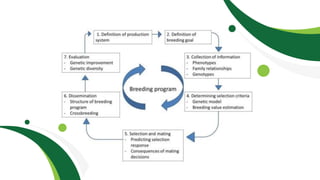
Breeding PROGRAM
This answers the question :
Which traits should be improved in the next generations?
Examples of breeding goals are defined improvements in
traits of production, product quality, health and welfare traits,
conformation traits, sport performance, fertility etc.
Breeding goal
• The mean genetic value of an individual as a parent for a trait.
• It is estimated as twice the average superiority of the individual’s progeny relative
to all other progeny under conditions of random mating
• The estimated breeding value indicates the value of the animal with respect to
the breeding goal:
the lowest ones will have a negative effect on the breeding goal traits and
the highest ones will improve breeding goal traits.
Breeding value
• The mean genetic value of an individual as a parent for a trait.
• It is estimated as twice the average superiority of the individual’s progeny relative
to all other progeny under conditions of random mating
• The estimated breeding value indicates the value of the animal with respect to
the breeding goal:
the lowest ones will have a negative effect on the breeding goal traits and
the highest ones will improve breeding goal traits.
Breeding value
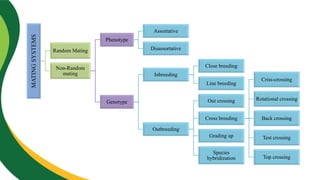
System of Mating in
Animal Breeding System
MATING
SYSTEMS
Random Mating
Non-Random
mating
Phenotype
Assortative
Disassortative
Genotype
Inbreeding
Close breeding
Line breeding
Outbreeding
Out crossing
Cross breeding
Criss-crossing
Rotational crossing
Back crossing
Test crossing
Top crossing
Grading up
Species
hybridization
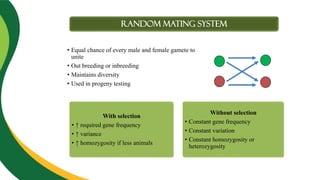
Random mating system
• Equal chance of every male and female gamete to
unite
• Out breeding or inbreeding
• Maintains diversity
• Used in progeny testing
With selection
• ↑ required gene frequency
• ↑ variance
• ↑ homozygosity if less animals
Without selection
• Constant gene frequency
• Constant variation
• Constant homozygosity or
heterozygosity
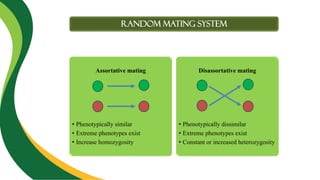
Random mating system
Assortative mating
• Phenotypically similar
• Extreme phenotypes exist
• Increase homozygosity
Disassortative mating
• Phenotypically dissimilar
• Extreme phenotypes exist
• Constant or increased heterozygosity
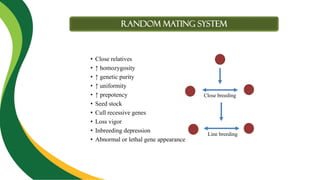
Random mating system
• Close relatives
• ↑ homozygosity
• ↑ genetic purity
• ↑ uniformity
• ↑ prepotency
• Seed stock
• Cull recessive genes
• Loss vigor
• Inbreeding depression
• Abnormal or lethal gene appearance
Close breeding
Line breeding
inbreeding
Mating of closely related animals.
For example, sire to daughter,
son to dam, and bother to sister
.
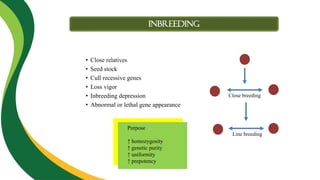
inbreeding
• Close relatives
• Seed stock
• Cull recessive genes
• Loss vigor
• Inbreeding depression
• Abnormal or lethal gene appearance
Close breeding
Line breeding
Purpose
↑ homozygosity
↑ genetic purity
↑ uniformity
↑ prepotency
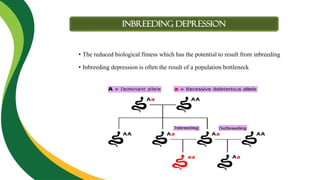
Inbreeding DEPRESSION
• The reduced biological fitness which has the potential to result from inbreeding
• Inbreeding depression is often the result of a population bottleneck
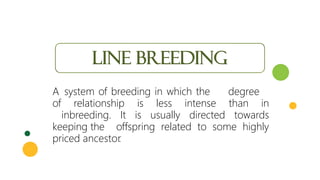
LINE breeding
A system of breeding in which the degree
of relationship is less intense than in
inbreeding. It is usually directed towards
keeping the offspring related to some highly
priced ancestor
.
LINE breeding
A system of breeding in which the degree
of relationship is less intense than in
inbreeding. It is usually directed towards
keeping the offspring related to some highly
priced ancestor
.
out breeding
methods
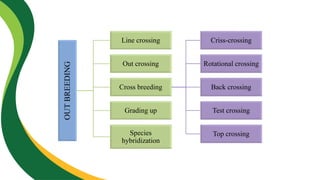
OUT
BREEDING
Line crossing
Out crossing
Cross breeding
Criss-crossing
Rotational crossing
Back crossing
Test crossing
Top crossing
Grading up
Species
hybridization
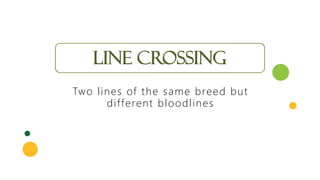
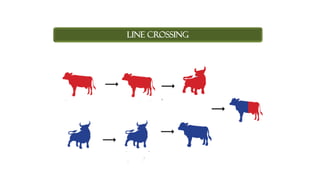
LINE CROSSING
Two lines of the same breed but
different bloodlines
Line crossing
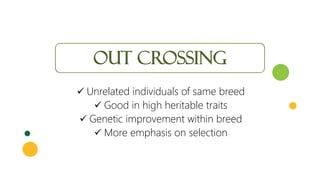
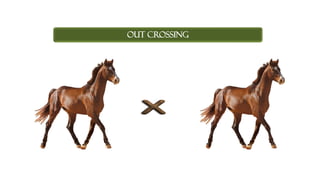
out CROSSING
✓ Unrelated individuals of same breed
✓ Good in high heritable traits
✓ Genetic improvement within breed
✓ More emphasis on selection
out crossing
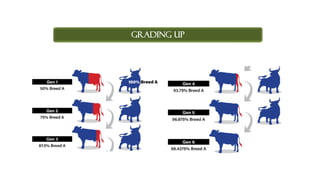
Grading up
Higher quality breed repeated
Grading up
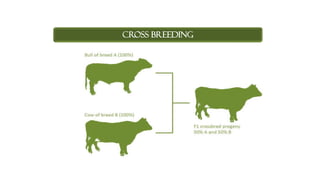
Cross breeding
Is the mating of males and females livestock
animals of different breed compositions or types.
CROSS BREEDING
Heterosis
– is the superiority of the crossbreed offspring.
Mathematically, heterosis is the difference in
performance between the crossbred and
the average performance of its purebred
parents.
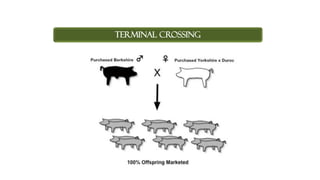
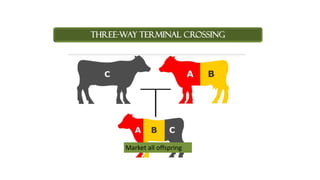
Terminal crossing
All the crossbred offspring are sold and
replacement of females must be purchased
or produced in the group by mating the
proportion of the group to the males of the
same breed.
Terminal crossing
All the crossbred offspring are sold and
replacement of females must be purchased
or produced in the group by mating the
proportion of the group to the males of the
same breed.
TERMINAL CROSSING
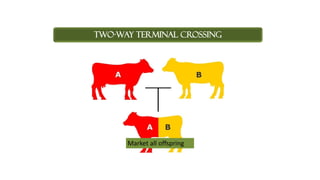
Two-way TERMINAL CROSSING
Market all offspring
Three-way TERMINAL CROSSING
Market all offspring
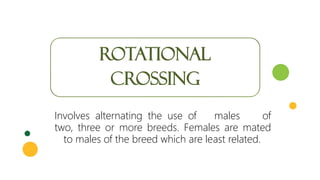
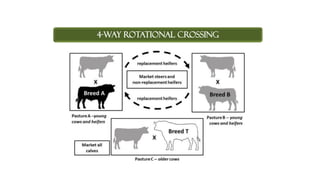
ROTATIONAL
CROSSING
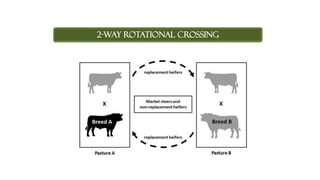
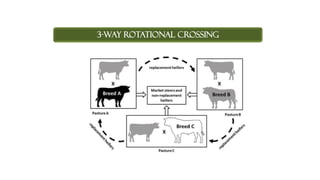
Involves alternating the use of males of
two, three or more breeds. Females are mated
to males of the breed which are least related.
2-WAY ROTATIONAL CROSSING
3-WAY ROTATIONAL CROSSING
4-WAY ROTATIONAL CROSSING
ROTOTERMINAL
CROSSING
Involves both terminal crossing and
rotational crossing
ANIMAL BREEDING PROGRAM AND BREEDING  METHODS.pdf

ANIMAL BREEDING PROGRAM AND BREEDING METHODS.pdf

  • 2.
  • 4.
    This answers thequestion : Which traits should be improved in the next generations? Examples of breeding goals are defined improvements in traits of production, product quality, health and welfare traits, conformation traits, sport performance, fertility etc. Breeding goal
  • 5.
    • The meangenetic value of an individual as a parent for a trait. • It is estimated as twice the average superiority of the individual’s progeny relative to all other progeny under conditions of random mating • The estimated breeding value indicates the value of the animal with respect to the breeding goal: the lowest ones will have a negative effect on the breeding goal traits and the highest ones will improve breeding goal traits. Breeding value
  • 6.
    • The meangenetic value of an individual as a parent for a trait. • It is estimated as twice the average superiority of the individual’s progeny relative to all other progeny under conditions of random mating • The estimated breeding value indicates the value of the animal with respect to the breeding goal: the lowest ones will have a negative effect on the breeding goal traits and the highest ones will improve breeding goal traits. Breeding value
  • 7.
    System of Matingin Animal Breeding System
  • 8.
    MATING SYSTEMS Random Mating Non-Random mating Phenotype Assortative Disassortative Genotype Inbreeding Close breeding Linebreeding Outbreeding Out crossing Cross breeding Criss-crossing Rotational crossing Back crossing Test crossing Top crossing Grading up Species hybridization
  • 9.
    Random mating system •Equal chance of every male and female gamete to unite • Out breeding or inbreeding • Maintains diversity • Used in progeny testing With selection • ↑ required gene frequency • ↑ variance • ↑ homozygosity if less animals Without selection • Constant gene frequency • Constant variation • Constant homozygosity or heterozygosity
  • 10.
    Random mating system Assortativemating • Phenotypically similar • Extreme phenotypes exist • Increase homozygosity Disassortative mating • Phenotypically dissimilar • Extreme phenotypes exist • Constant or increased heterozygosity
  • 11.
    Random mating system •Close relatives • ↑ homozygosity • ↑ genetic purity • ↑ uniformity • ↑ prepotency • Seed stock • Cull recessive genes • Loss vigor • Inbreeding depression • Abnormal or lethal gene appearance Close breeding Line breeding
  • 12.
    inbreeding Mating of closelyrelated animals. For example, sire to daughter, son to dam, and bother to sister .
  • 13.
    inbreeding • Close relatives •Seed stock • Cull recessive genes • Loss vigor • Inbreeding depression • Abnormal or lethal gene appearance Close breeding Line breeding Purpose ↑ homozygosity ↑ genetic purity ↑ uniformity ↑ prepotency
  • 14.
    Inbreeding DEPRESSION • Thereduced biological fitness which has the potential to result from inbreeding • Inbreeding depression is often the result of a population bottleneck
  • 15.
    LINE breeding A systemof breeding in which the degree of relationship is less intense than in inbreeding. It is usually directed towards keeping the offspring related to some highly priced ancestor .
  • 16.
    LINE breeding A systemof breeding in which the degree of relationship is less intense than in inbreeding. It is usually directed towards keeping the offspring related to some highly priced ancestor .
  • 17.
  • 18.
    OUT BREEDING Line crossing Out crossing Crossbreeding Criss-crossing Rotational crossing Back crossing Test crossing Top crossing Grading up Species hybridization
  • 19.
    LINE CROSSING Two linesof the same breed but different bloodlines
  • 20.
  • 21.
    out CROSSING ✓ Unrelatedindividuals of same breed ✓ Good in high heritable traits ✓ Genetic improvement within breed ✓ More emphasis on selection
  • 22.
  • 23.
  • 24.
  • 25.
    Cross breeding Is themating of males and females livestock animals of different breed compositions or types.
  • 26.
  • 27.
    Heterosis – is thesuperiority of the crossbreed offspring. Mathematically, heterosis is the difference in performance between the crossbred and the average performance of its purebred parents.
  • 28.
    Terminal crossing All thecrossbred offspring are sold and replacement of females must be purchased or produced in the group by mating the proportion of the group to the males of the same breed.
  • 29.
    Terminal crossing All thecrossbred offspring are sold and replacement of females must be purchased or produced in the group by mating the proportion of the group to the males of the same breed.
  • 30.
  • 31.
  • 32.
  • 33.
    ROTATIONAL CROSSING Involves alternating theuse of males of two, three or more breeds. Females are mated to males of the breed which are least related.
  • 34.
  • 35.
  • 36.
  • 37.
    ROTOTERMINAL CROSSING Involves both terminalcrossing and rotational crossing