But we’re Librarians not
researchers:
Building a research culture in the Library and
Information Science Sector
May, 2016
Tricia Bingham & Stephanie Reid
Libraries and Learning Services
University of Auckland, with the
assistance of RLL1 workshop participants,
2016.
“I generally find that librarians are
not that interested in research
into LIS practice beyond liaising
with other local libraries to 'ask
what they did' on some issue
which comes up in day-to-day
practice.”
(Healthcare Researcher, as cited in Cruickshank, Hall, & Taylor-Smith, 2011, p. 10)
I am a researcher.
Agree or Disagree?
Why do you consider
yourself a researcher?
Why don’t you?
What is research?
What constitutes
research?
Research can be
any of the following:
User experience
research
Evidence based
Evidence informed
Horizon scanning
Front end analysis
Formal research
projects
(resulting in
publication)
Literature based
“As librarians, we must ask
ourselves the embarrassing
question: when was the last
time we consulted the literature
to find evidence about a library
or profession-based problem?”
(Crumley & Koufgiannakis, 2002)
What did “they” do
and how well did it work?
Systematic review
Evidence based
Evidence informed
“Some of the richest data we get, and
some of the most surprising things that we
learn, come from the questions we didn't
even know to ask until somebody
mentions something and we start to
investigate that and just say ‘Tell us more
about that.’”
(P-11, as cited in MacDonald, 2015, p. 4)
User feedback
A/B Testing
User experience
research
Hear third hand the contents of the
latest EDUCAUSE report.
Actively and systematically seek out
sources of information to assist with
strategic planning and future proofing.
Horizon
scanning
It’s broken and you fix it.
Understanding situation, context and
stakeholders / SWOT analyses.
Front end analysis
Survey
Research for publication
“Though familiar with the
research process and
responsible for supporting
others in their academic
agendas, it is said, ‘librarians
generally do not publish their
research.’”
(Crumley & Koufgiannakis, as cited in
Kennedy & Brancolini, 2012, p. 431)
Formal research
projects
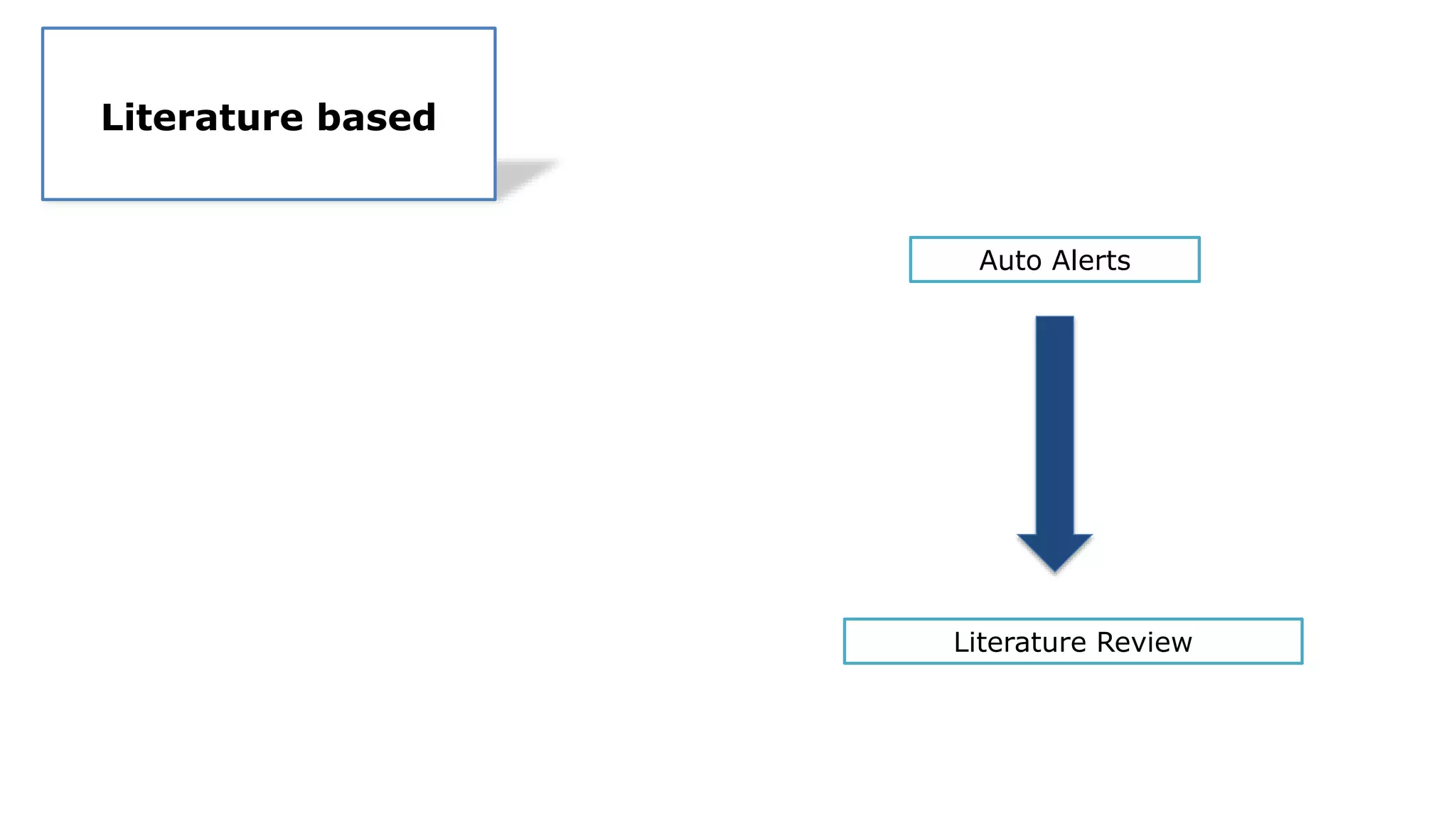
Auto Alerts
Literature Review
Literature based
I am a researcher.
Agree or Disagree?
Summarized Responses from RLL1 participants
• I am doing research – action
research, basic research, surveys…
• I like to learn, expand, grow & upskill
• I am curious
• Part of the job description /
Attached to project work
• I ask questions and find solutions
/answers
I am a researcher I am not a researcher
“ We learn, investigate, change for better. “
• Not sure the work is research
• Based on the teams worked with –
internal only
• Work is done on behalf of others
• Accustomed to thinking of my clients as
the researchers + myself as facilitator
• Research is not in our: time allocation,
pay, job description, no PBRF
• Often no support/encouragement form
institution
Summarized Responses from RLL1 participants
• I use research to inform practice
• I am an informed decision maker
• I share my findings
• I help others research
• I am user focussed
• I consume research
• I need to improve services and
programmes
I am a researcher I am not a researcher
• Definitions matter – research does
not equal output
• If an academic hasn’t done it, it‘s
not really research
• Feel like I don’t have time
• What should I research? So many
options – too overwhelming
• Don’t have much experience. How
to do?
• Not published? = Not research?
Where do you want to be
in research?
What’s stopping you?
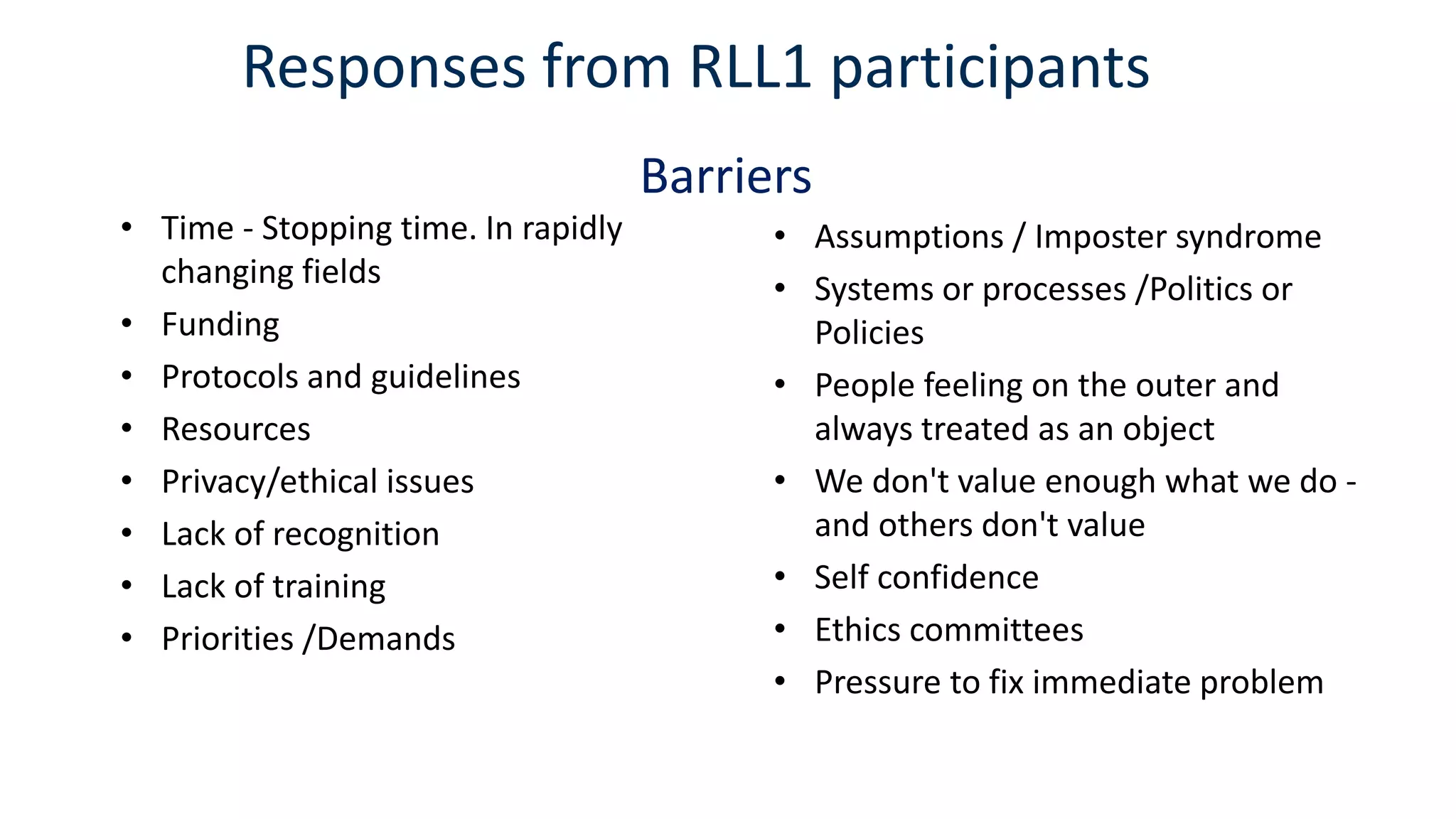
Responses from RLL1 participants
• Time - Stopping time. In rapidly
changing fields
• Funding
• Protocols and guidelines
• Resources
• Privacy/ethical issues
• Lack of recognition
• Lack of training
• Priorities /Demands
• Assumptions / Imposter syndrome
• Systems or processes /Politics or
Policies
• People feeling on the outer and
always treated as an object
• We don't value enough what we do -
and others don't value
• Self confidence
• Ethics committees
• Pressure to fix immediate problem
Barriers
Responses from RLL1 participants
• New technologies/ new things we
have to learn
• Community willingness / Trust
• High end can be overwhelming
• Deciding on the problem and scope
• Lack of access to data / Data sharing
• Isolation /No experienced person to
support
Barriers
• Lack of time/support/funding barriers
• Lack of motivation / Perception of
low relevance to practice
• No duty of care for research
Barriers may include:
(Cruickshank, Hall, & Taylor-Smith, 2011; Mcenemy, 2010; Wilson, 2013)
• Ineffective dissemination
• Target audience not receptive
• Real or perceived lack of skills
• Lack of literature
Barriers may include:
(Cruickshank, Hall, & Taylor-Smith, 2011; Mcenemy, 2010; Wilson, 2013)
What can we do to
strengthen a research
culture in the LIS sector?
• At an individual level?
• At an institutional level?
• At a professional body level?
• At an educational level?
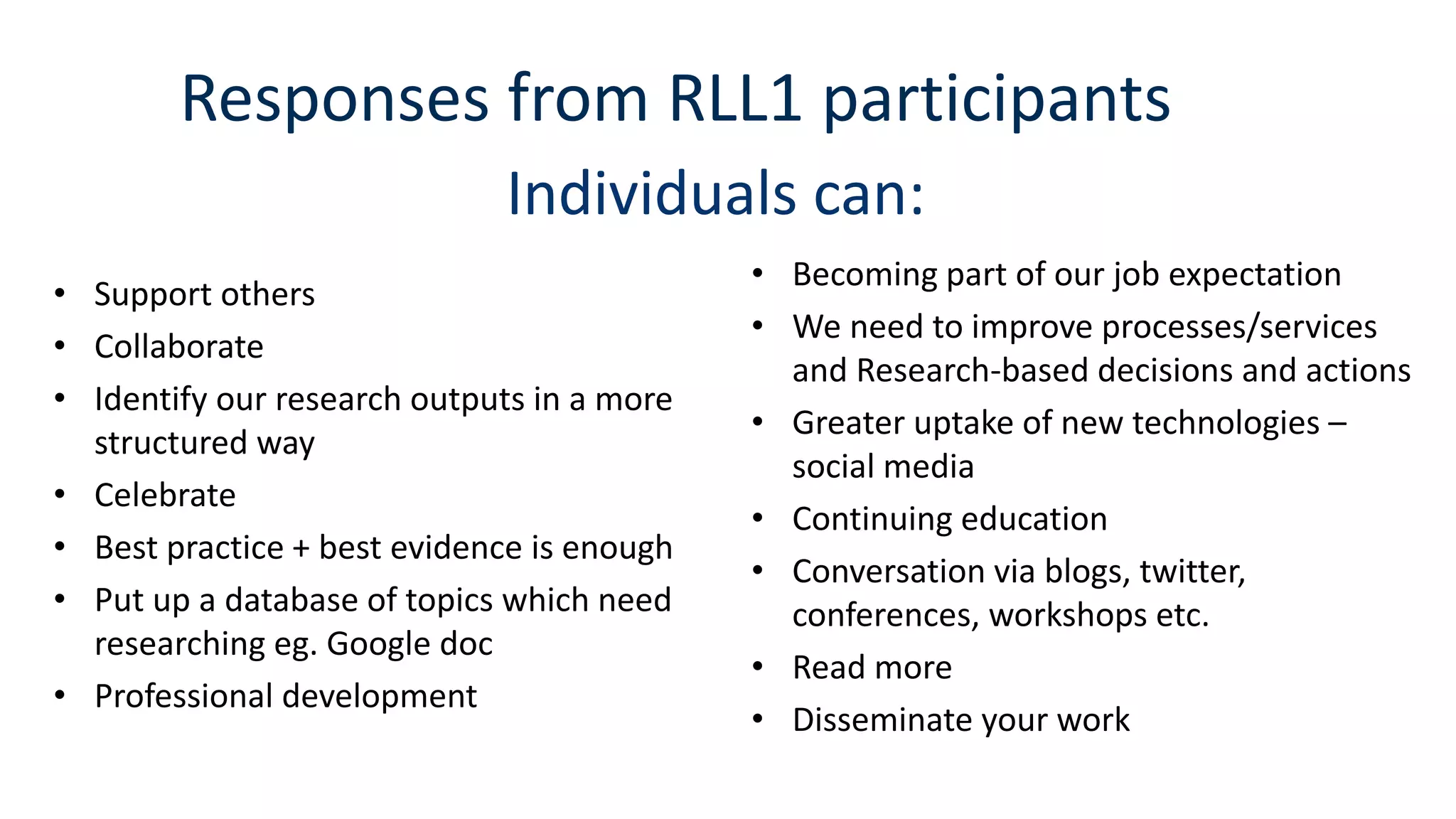
Individuals can:
• Support others
• Collaborate
• Identify our research outputs in a more
structured way
• Celebrate
• Best practice + best evidence is enough
• Put up a database of topics which need
researching eg. Google doc
• Professional development
• Becoming part of our job expectation
• We need to improve processes/services
and Research-based decisions and actions
• Greater uptake of new technologies –
social media
• Continuing education
• Conversation via blogs, twitter,
conferences, workshops etc.
• Read more
• Disseminate your work
Responses from RLL1 participants
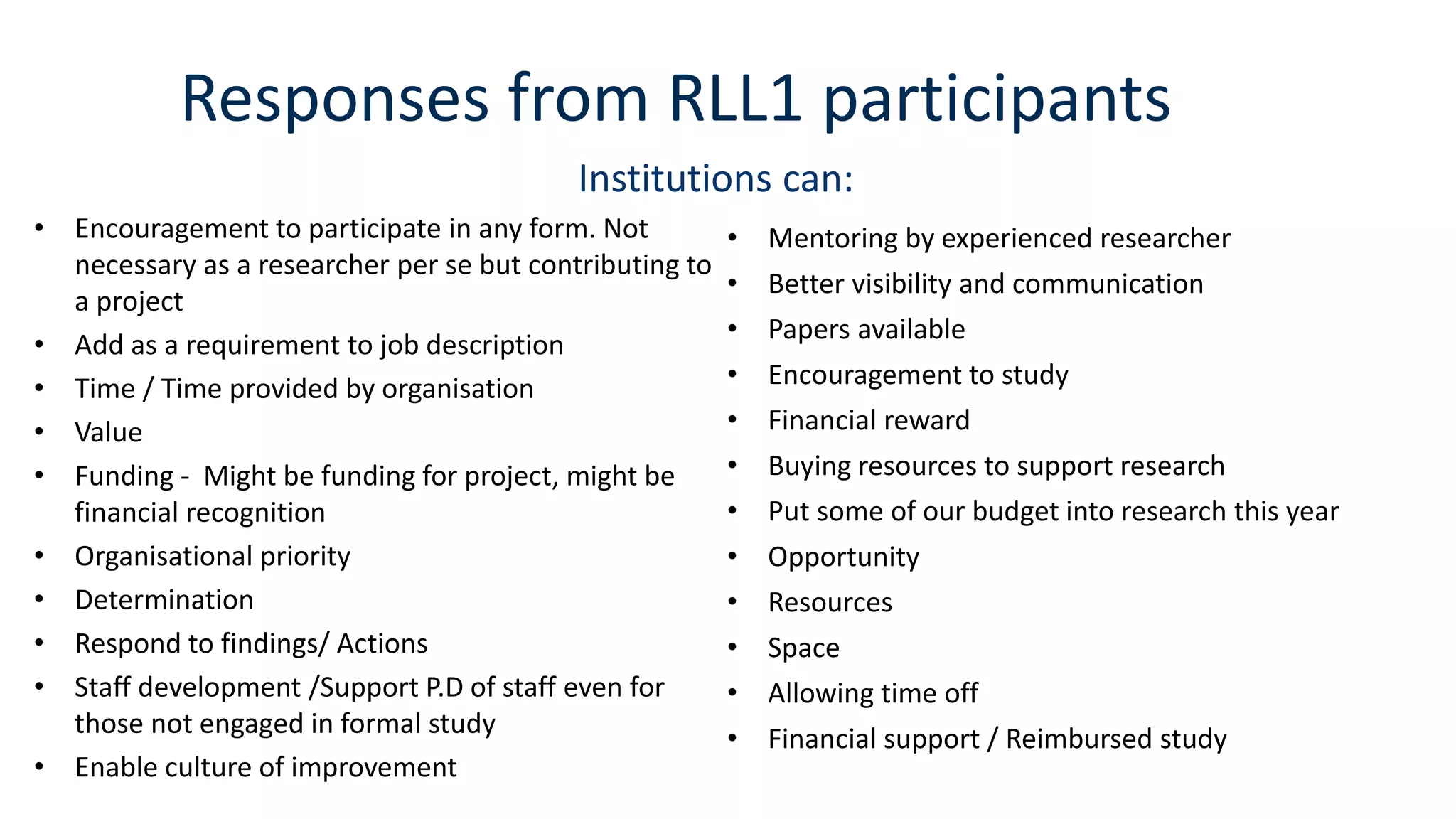
Institutions can:
• Encouragement to participate in any form. Not
necessary as a researcher per se but contributing to
a project
• Add as a requirement to job description
• Time / Time provided by organisation
• Value
• Funding - Might be funding for project, might be
financial recognition
• Organisational priority
• Determination
• Respond to findings/ Actions
• Staff development /Support P.D of staff even for
those not engaged in formal study
• Enable culture of improvement
Responses from RLL1 participants
• Mentoring by experienced researcher
• Better visibility and communication
• Papers available
• Encouragement to study
• Financial reward
• Buying resources to support research
• Put some of our budget into research this year
• Opportunity
• Resources
• Space
• Allowing time off
• Financial support / Reimbursed study
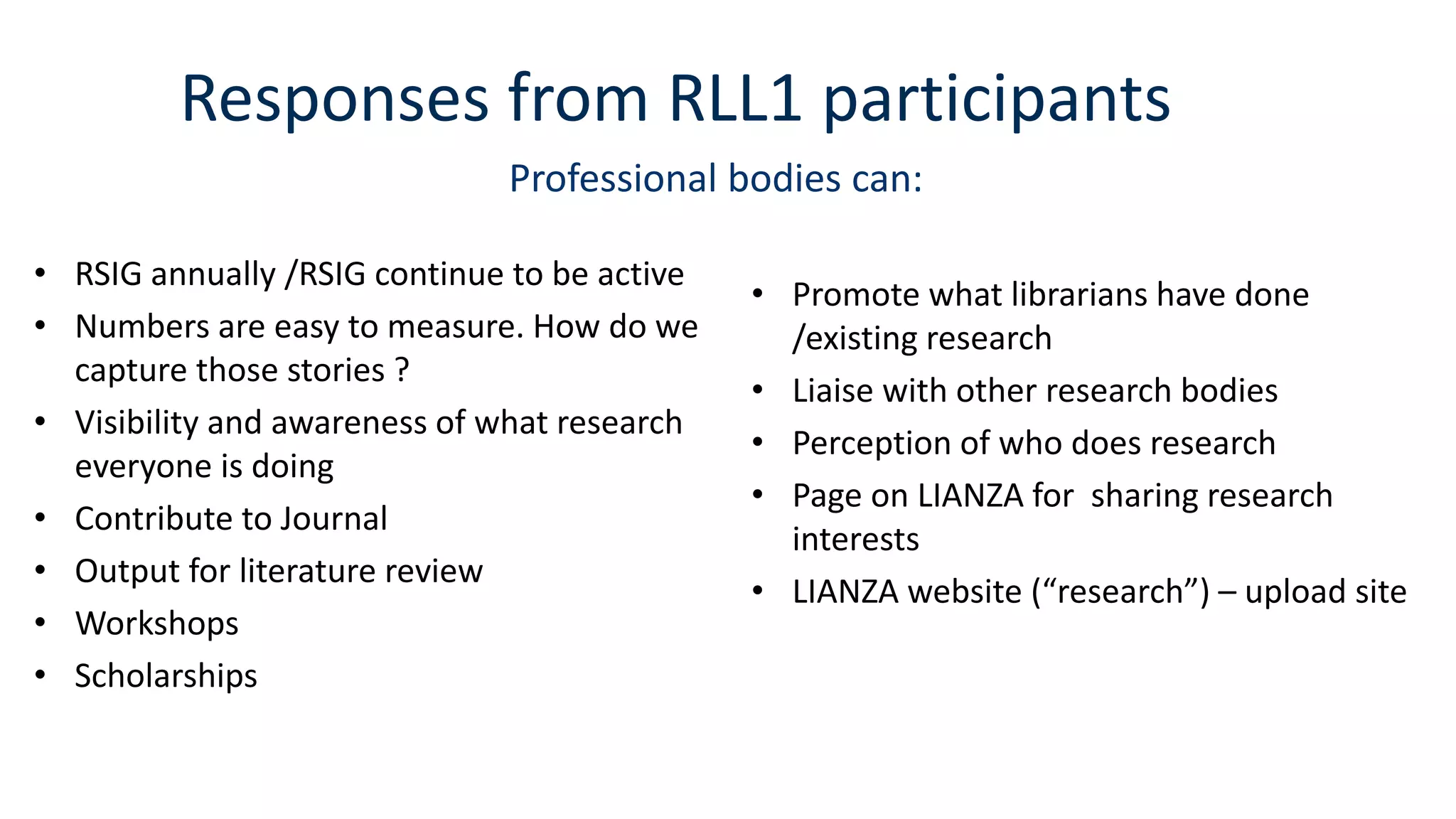
Professional bodies can:
• RSIG annually /RSIG continue to be active
• Numbers are easy to measure. How do we
capture those stories ?
• Visibility and awareness of what research
everyone is doing
• Contribute to Journal
• Output for literature review
• Workshops
• Scholarships
• Promote what librarians have done
/existing research
• Liaise with other research bodies
• Perception of who does research
• Page on LIANZA for sharing research
interests
• LIANZA website (“research”) – upload site
Responses from RLL1 participants
Individuals can:
• Seek out colleagues for collaboration
and mentorship
• Organise events, e.g. lunchtime reading
groups
• Be a practitioner-researcher.
Use research for purpose and impact
(Mcenemy, 2010; Pickton, 2016; Wilson, 2013)
Individuals can:
• Be a disseminator. Seek out opportunities.
• Use research in multiple ways.
Don’t just do one paper about your
research
• Be enthusiastic
• Implement formalised curiosity
(Mcenemy, 2010; Pickton, 2016; Wilson, 2013)
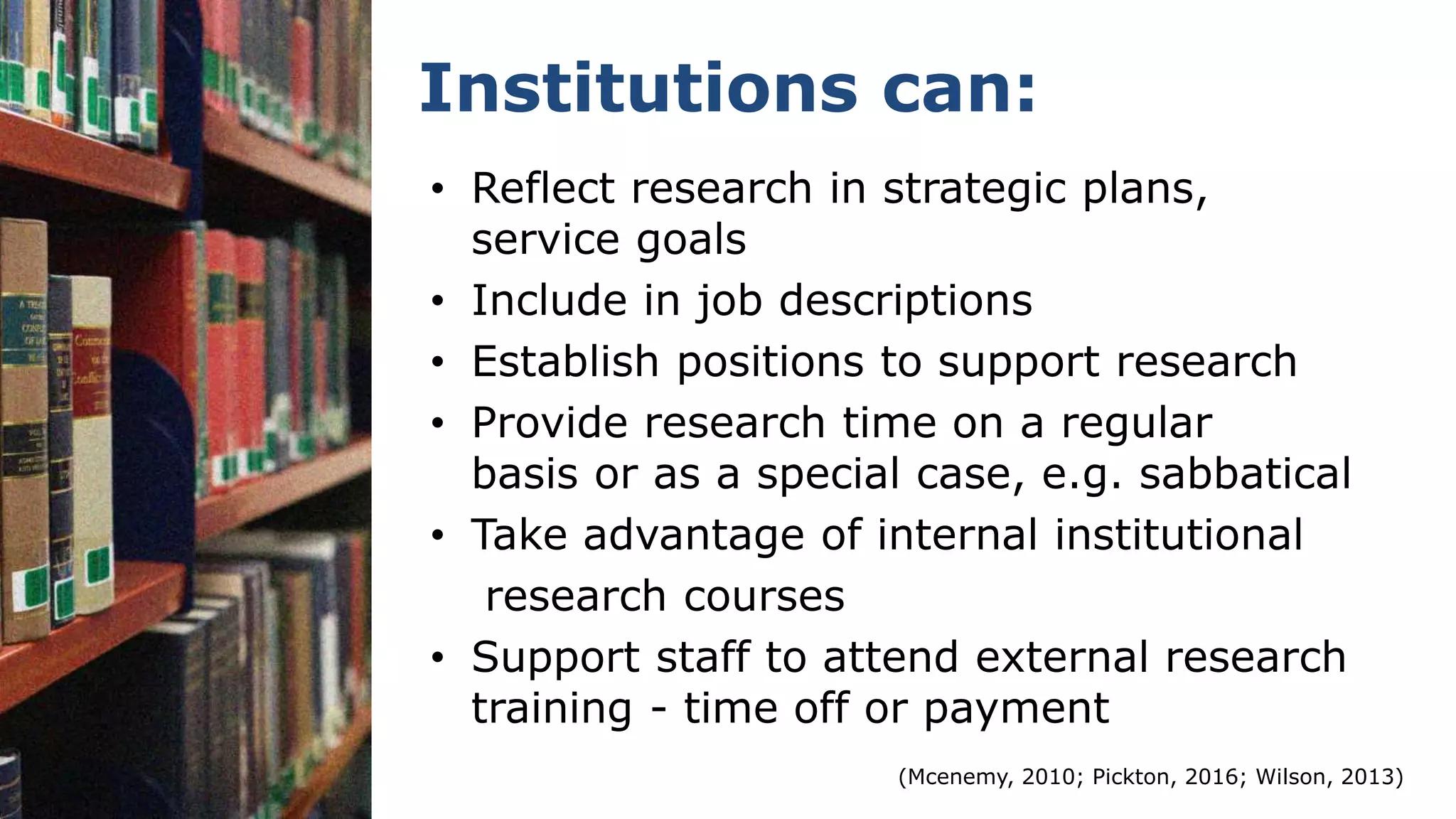
Institutions can:
• Reflect research in strategic plans,
service goals
• Include in job descriptions
• Establish positions to support research
• Provide research time on a regular
basis or as a special case, e.g. sabbatical
• Take advantage of internal institutional
research courses
• Support staff to attend external research
training - time off or payment
(Mcenemy, 2010; Pickton, 2016; Wilson, 2013)
Institutions can:
• Set up research funds
• Create a Research Working Group
or committee
• Recognition and award
• Peer support
• Discussion groups/lunchtime sessions etc.
• Encouragement
(Mcenemy, 2010; Pickton, 2016; Wilson, 2013)
Professional bodies can:
• Encourage an evidence based approach
• Encourage practitioner PhDs
• Provide research training:
Continuing education
• Online repositories of resources
• Awards / Project sponsorship
• Promote article writing
(Mcenemy, 2010; Pickton, 2016; Wilson, 2013)
Professional bodies can:
• Make conferences more research oriented.
Introduce a peer review process for
accepting papers
• Research forums
• Encourage research output
and dissemination
• Encourage discourse – including dissent
(Mcenemy, 2010; Pickton, 2016; Wilson, 2013)
Educators can:
• Research curriculum including tools
such as SPSS, nVivo
• Promote research and its importance
• Provide opportunities for students
who otherwise would have no opportunity
to research
(Mcenemy, 2010; Pickton, 2016; Wilson, 2013)
“It can be strongly argued that research is
critical for the creation of professional
knowledge and therefore critical to the
survival and growth of the library and
information profession. Without a
commitment to research, we will not be a
profession as such, but merely an occupation
that focuses on routine processes ”
(Hallam, as cited in Bhatti and Chohan, 2012, p. 2)
What is your takeaway?
What one thing can you do?
References
Bhatti, R., & Chohan, T. M. (2012). Assessing the role of library associations in promoting research culture in LIS. Library
Philosophy and Practice, (839) Retrieved from http://digitalcommons.unl.edu/libphilprac/839
Cruickshank, P., Hall, H. & Taylor-Smith, E. (2011). Enhancing the impact of LIS Research Projects. Retrieved from URL:
http://www.researchinfonet.org/wpcontent/uploads/2012/01/RiLIES_report_FINAL.pdf [accessed 26.09.13]
Crumley, E., & Koufogiannakis, D. (2002). Developing evidence-based librarianship: Practical steps for implementation. Health
Information and Libraries Journal, 19, 61–70
Kennedy, M. R., & Brancolini, K. R. (2011). Academic librarian research: A survey of attitudes, involvement, and perceived
capabilities. College & Research Libraries, crl-276 431-448. Retrieved from http://crl.acrl.org/
McMenemy, D. (2010). Fostering a research culture in UK library practice: barriers and solutions. Library Review, 59(5),
321-324. doi:http://dx.doi.org.ezproxy.auckland.ac.nz/10.1108/00242531011047019
MacDonald, C. (2015). User experience librarians: User advocates, user researchers, usability evaluators, or all of the above?
Proceedings of the association for Information Science and Technology, 52(1). Retrieved from
http://onlinelibrary.wiley.com/journal/10.1002/(ISSN)2373-9231
Pickton, M. (2016). Facilitating a research culture in an academic library: top down and bottom up approaches. New Library World,
117(1/2), 105-127. http://dx.doi.org.ezproxy.auckland.ac.nz/10.1108/NLW-10-2015-0075
Wilson, V. (2013). Formalized curiosity: Reflecting on the librarian practitioner-researcher. Evidence Based Library and Information
Practice, 8(1), 111-117.

RLL1, Tricia Bingham and Stephanie Reid ."But we're Librarians not Researchers"

  • 1.
    But we’re Librariansnot researchers: Building a research culture in the Library and Information Science Sector May, 2016 Tricia Bingham & Stephanie Reid Libraries and Learning Services University of Auckland, with the assistance of RLL1 workshop participants, 2016.
  • 2.
    “I generally findthat librarians are not that interested in research into LIS practice beyond liaising with other local libraries to 'ask what they did' on some issue which comes up in day-to-day practice.” (Healthcare Researcher, as cited in Cruickshank, Hall, & Taylor-Smith, 2011, p. 10)
  • 3.
    I am aresearcher. Agree or Disagree?
  • 4.
    Why do youconsider yourself a researcher? Why don’t you?
  • 5.
    What is research? Whatconstitutes research?
  • 6.
    Research can be anyof the following: User experience research Evidence based Evidence informed Horizon scanning Front end analysis Formal research projects (resulting in publication) Literature based
  • 7.
    “As librarians, wemust ask ourselves the embarrassing question: when was the last time we consulted the literature to find evidence about a library or profession-based problem?” (Crumley & Koufgiannakis, 2002) What did “they” do and how well did it work? Systematic review Evidence based Evidence informed
  • 8.
    “Some of therichest data we get, and some of the most surprising things that we learn, come from the questions we didn't even know to ask until somebody mentions something and we start to investigate that and just say ‘Tell us more about that.’” (P-11, as cited in MacDonald, 2015, p. 4) User feedback A/B Testing User experience research
  • 9.
    Hear third handthe contents of the latest EDUCAUSE report. Actively and systematically seek out sources of information to assist with strategic planning and future proofing. Horizon scanning
  • 10.
    It’s broken andyou fix it. Understanding situation, context and stakeholders / SWOT analyses. Front end analysis
  • 11.
    Survey Research for publication “Thoughfamiliar with the research process and responsible for supporting others in their academic agendas, it is said, ‘librarians generally do not publish their research.’” (Crumley & Koufgiannakis, as cited in Kennedy & Brancolini, 2012, p. 431) Formal research projects
  • 12.
  • 13.
    I am aresearcher. Agree or Disagree?
  • 14.
    Summarized Responses fromRLL1 participants • I am doing research – action research, basic research, surveys… • I like to learn, expand, grow & upskill • I am curious • Part of the job description / Attached to project work • I ask questions and find solutions /answers I am a researcher I am not a researcher “ We learn, investigate, change for better. “ • Not sure the work is research • Based on the teams worked with – internal only • Work is done on behalf of others • Accustomed to thinking of my clients as the researchers + myself as facilitator • Research is not in our: time allocation, pay, job description, no PBRF • Often no support/encouragement form institution
  • 15.
    Summarized Responses fromRLL1 participants • I use research to inform practice • I am an informed decision maker • I share my findings • I help others research • I am user focussed • I consume research • I need to improve services and programmes I am a researcher I am not a researcher • Definitions matter – research does not equal output • If an academic hasn’t done it, it‘s not really research • Feel like I don’t have time • What should I research? So many options – too overwhelming • Don’t have much experience. How to do? • Not published? = Not research?
  • 16.
    Where do youwant to be in research?
  • 17.
  • 18.
    Responses from RLL1participants • Time - Stopping time. In rapidly changing fields • Funding • Protocols and guidelines • Resources • Privacy/ethical issues • Lack of recognition • Lack of training • Priorities /Demands • Assumptions / Imposter syndrome • Systems or processes /Politics or Policies • People feeling on the outer and always treated as an object • We don't value enough what we do - and others don't value • Self confidence • Ethics committees • Pressure to fix immediate problem Barriers
  • 19.
    Responses from RLL1participants • New technologies/ new things we have to learn • Community willingness / Trust • High end can be overwhelming • Deciding on the problem and scope • Lack of access to data / Data sharing • Isolation /No experienced person to support Barriers
  • 20.
    • Lack oftime/support/funding barriers • Lack of motivation / Perception of low relevance to practice • No duty of care for research Barriers may include: (Cruickshank, Hall, & Taylor-Smith, 2011; Mcenemy, 2010; Wilson, 2013)
  • 21.
    • Ineffective dissemination •Target audience not receptive • Real or perceived lack of skills • Lack of literature Barriers may include: (Cruickshank, Hall, & Taylor-Smith, 2011; Mcenemy, 2010; Wilson, 2013)
  • 22.
    What can wedo to strengthen a research culture in the LIS sector? • At an individual level? • At an institutional level? • At a professional body level? • At an educational level?
  • 23.
    Individuals can: • Supportothers • Collaborate • Identify our research outputs in a more structured way • Celebrate • Best practice + best evidence is enough • Put up a database of topics which need researching eg. Google doc • Professional development • Becoming part of our job expectation • We need to improve processes/services and Research-based decisions and actions • Greater uptake of new technologies – social media • Continuing education • Conversation via blogs, twitter, conferences, workshops etc. • Read more • Disseminate your work Responses from RLL1 participants
  • 24.
    Institutions can: • Encouragementto participate in any form. Not necessary as a researcher per se but contributing to a project • Add as a requirement to job description • Time / Time provided by organisation • Value • Funding - Might be funding for project, might be financial recognition • Organisational priority • Determination • Respond to findings/ Actions • Staff development /Support P.D of staff even for those not engaged in formal study • Enable culture of improvement Responses from RLL1 participants • Mentoring by experienced researcher • Better visibility and communication • Papers available • Encouragement to study • Financial reward • Buying resources to support research • Put some of our budget into research this year • Opportunity • Resources • Space • Allowing time off • Financial support / Reimbursed study
  • 25.
    Professional bodies can: •RSIG annually /RSIG continue to be active • Numbers are easy to measure. How do we capture those stories ? • Visibility and awareness of what research everyone is doing • Contribute to Journal • Output for literature review • Workshops • Scholarships • Promote what librarians have done /existing research • Liaise with other research bodies • Perception of who does research • Page on LIANZA for sharing research interests • LIANZA website (“research”) – upload site Responses from RLL1 participants
  • 26.
    Individuals can: • Seekout colleagues for collaboration and mentorship • Organise events, e.g. lunchtime reading groups • Be a practitioner-researcher. Use research for purpose and impact (Mcenemy, 2010; Pickton, 2016; Wilson, 2013)
  • 27.
    Individuals can: • Bea disseminator. Seek out opportunities. • Use research in multiple ways. Don’t just do one paper about your research • Be enthusiastic • Implement formalised curiosity (Mcenemy, 2010; Pickton, 2016; Wilson, 2013)
  • 28.
    Institutions can: • Reflectresearch in strategic plans, service goals • Include in job descriptions • Establish positions to support research • Provide research time on a regular basis or as a special case, e.g. sabbatical • Take advantage of internal institutional research courses • Support staff to attend external research training - time off or payment (Mcenemy, 2010; Pickton, 2016; Wilson, 2013)
  • 29.
    Institutions can: • Setup research funds • Create a Research Working Group or committee • Recognition and award • Peer support • Discussion groups/lunchtime sessions etc. • Encouragement (Mcenemy, 2010; Pickton, 2016; Wilson, 2013)
  • 30.
    Professional bodies can: •Encourage an evidence based approach • Encourage practitioner PhDs • Provide research training: Continuing education • Online repositories of resources • Awards / Project sponsorship • Promote article writing (Mcenemy, 2010; Pickton, 2016; Wilson, 2013)
  • 31.
    Professional bodies can: •Make conferences more research oriented. Introduce a peer review process for accepting papers • Research forums • Encourage research output and dissemination • Encourage discourse – including dissent (Mcenemy, 2010; Pickton, 2016; Wilson, 2013)
  • 32.
    Educators can: • Researchcurriculum including tools such as SPSS, nVivo • Promote research and its importance • Provide opportunities for students who otherwise would have no opportunity to research (Mcenemy, 2010; Pickton, 2016; Wilson, 2013)
  • 33.
    “It can bestrongly argued that research is critical for the creation of professional knowledge and therefore critical to the survival and growth of the library and information profession. Without a commitment to research, we will not be a profession as such, but merely an occupation that focuses on routine processes ” (Hallam, as cited in Bhatti and Chohan, 2012, p. 2)
  • 34.
    What is yourtakeaway? What one thing can you do?
  • 35.
    References Bhatti, R., &Chohan, T. M. (2012). Assessing the role of library associations in promoting research culture in LIS. Library Philosophy and Practice, (839) Retrieved from http://digitalcommons.unl.edu/libphilprac/839 Cruickshank, P., Hall, H. & Taylor-Smith, E. (2011). Enhancing the impact of LIS Research Projects. Retrieved from URL: http://www.researchinfonet.org/wpcontent/uploads/2012/01/RiLIES_report_FINAL.pdf [accessed 26.09.13] Crumley, E., & Koufogiannakis, D. (2002). Developing evidence-based librarianship: Practical steps for implementation. Health Information and Libraries Journal, 19, 61–70 Kennedy, M. R., & Brancolini, K. R. (2011). Academic librarian research: A survey of attitudes, involvement, and perceived capabilities. College & Research Libraries, crl-276 431-448. Retrieved from http://crl.acrl.org/ McMenemy, D. (2010). Fostering a research culture in UK library practice: barriers and solutions. Library Review, 59(5), 321-324. doi:http://dx.doi.org.ezproxy.auckland.ac.nz/10.1108/00242531011047019 MacDonald, C. (2015). User experience librarians: User advocates, user researchers, usability evaluators, or all of the above? Proceedings of the association for Information Science and Technology, 52(1). Retrieved from http://onlinelibrary.wiley.com/journal/10.1002/(ISSN)2373-9231 Pickton, M. (2016). Facilitating a research culture in an academic library: top down and bottom up approaches. New Library World, 117(1/2), 105-127. http://dx.doi.org.ezproxy.auckland.ac.nz/10.1108/NLW-10-2015-0075 Wilson, V. (2013). Formalized curiosity: Reflecting on the librarian practitioner-researcher. Evidence Based Library and Information Practice, 8(1), 111-117.