Seed rate calculation
• Seed rate calculation helps determine the amount of seeds needed to
plant a specific area, ensuring an optimal plant population for good
yield.
How to calculate
•Target plant population: This is the desired number of plants per
unit area (e.g., plants per square meter) after establishment.
•Thousand Seed Weight (TSW): This is the weight of 1000 seeds of
your specific crop variety. Seed companies typically provide this
information on seed packaging or through variety descriptions.
•Germination rate: This is the percentage of seeds expected to
germinate under ideal conditions. Seed testing labs can provide
this data, but general estimates are available for various crops.
•Emergence rate: This is the percentage of germinated seeds that
successfully establish into mature plants. Factors like weather, soil
conditions, and pests can affect emergence.
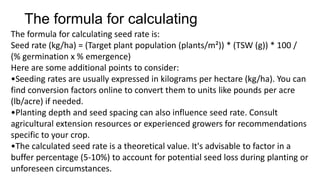
The formula for calculating
The formula for calculating seed rate is:
Seed rate (kg/ha) = (Target plant population (plants/m²)) * (TSW (g)) * 100 /
(% germination x % emergence)
Here are some additional points to consider:
•Seeding rates are usually expressed in kilograms per hectare (kg/ha). You can
find conversion factors online to convert them to units like pounds per acre
(lb/acre) if needed.
•Planting depth and seed spacing can also influence seed rate. Consult
agricultural extension resources or experienced growers for recommendations
specific to your crop.
•The calculated seed rate is a theoretical value. It's advisable to factor in a
buffer percentage (5-10%) to account for potential seed loss during planting or
unforeseen circumstances.
Additional considerations:
• Seeding rates are typically expressed in kilograms per hectare (kg/ha).
Conversion factors are available online to convert them to your
preferred units.
• Planting depth and seed distribution can influence seed rate. Consult
agricultural resources for specific recommendations.
• The calculated seed rate is a theoretical value. Add a buffer
percentage (5-10%) to account for potential seed loss during planting
or unforeseen circumstances.
• Row length and seed spacing method:
• This is a simpler method but less precise. It's suitable for small-scale
planting or when the exact TSW or emergence rate is unknown.
Here's what you'll need:
• Desired plant spacing: The distance between individual plants within
a row.
• Row length: The length of each planting row.
• Number of seeds per planting hole (if applicable): Some crops involve
planting multiple seeds per hole.
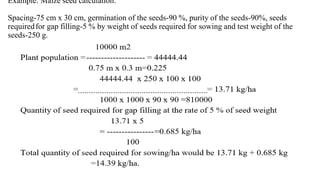
Example: Maize seed calculation:
Spacing-75 cm x 30 cm, germination of the seeds-90 %, purity of the seeds-90%, seeds
requiredfor gap filling-5 % by weight of seeds required for sowing and test weight of the
seeds-250 g.

seed rate calculation with example of maize.pptx

  • 1.
  • 2.
    • Seed ratecalculation helps determine the amount of seeds needed to plant a specific area, ensuring an optimal plant population for good yield.
  • 4.
    How to calculate •Targetplant population: This is the desired number of plants per unit area (e.g., plants per square meter) after establishment. •Thousand Seed Weight (TSW): This is the weight of 1000 seeds of your specific crop variety. Seed companies typically provide this information on seed packaging or through variety descriptions. •Germination rate: This is the percentage of seeds expected to germinate under ideal conditions. Seed testing labs can provide this data, but general estimates are available for various crops. •Emergence rate: This is the percentage of germinated seeds that successfully establish into mature plants. Factors like weather, soil conditions, and pests can affect emergence.
  • 5.
    The formula forcalculating The formula for calculating seed rate is: Seed rate (kg/ha) = (Target plant population (plants/m²)) * (TSW (g)) * 100 / (% germination x % emergence) Here are some additional points to consider: •Seeding rates are usually expressed in kilograms per hectare (kg/ha). You can find conversion factors online to convert them to units like pounds per acre (lb/acre) if needed. •Planting depth and seed spacing can also influence seed rate. Consult agricultural extension resources or experienced growers for recommendations specific to your crop. •The calculated seed rate is a theoretical value. It's advisable to factor in a buffer percentage (5-10%) to account for potential seed loss during planting or unforeseen circumstances.
  • 6.
    Additional considerations: • Seedingrates are typically expressed in kilograms per hectare (kg/ha). Conversion factors are available online to convert them to your preferred units. • Planting depth and seed distribution can influence seed rate. Consult agricultural resources for specific recommendations. • The calculated seed rate is a theoretical value. Add a buffer percentage (5-10%) to account for potential seed loss during planting or unforeseen circumstances.
  • 7.
    • Row lengthand seed spacing method: • This is a simpler method but less precise. It's suitable for small-scale planting or when the exact TSW or emergence rate is unknown. Here's what you'll need: • Desired plant spacing: The distance between individual plants within a row. • Row length: The length of each planting row. • Number of seeds per planting hole (if applicable): Some crops involve planting multiple seeds per hole.
  • 8.
    Example: Maize seedcalculation: Spacing-75 cm x 30 cm, germination of the seeds-90 %, purity of the seeds-90%, seeds requiredfor gap filling-5 % by weight of seeds required for sowing and test weight of the seeds-250 g.