HYBRID SEED
PRODUCTION
TECHNOLOGY OF ONION
INTRODUCTION
• Onion (Allium cepa L.) is a major bulbous crop among the cultivated
vegetable crops and it is of global importance.
• Top 3rd vegetable with production of 1.064 mT 15.118mha.
• India needs around 7000 tonnes of seeds annually.
• India is the second largest producer of onion.
• Highest foreign exchange earner among the fruits and vegetables.
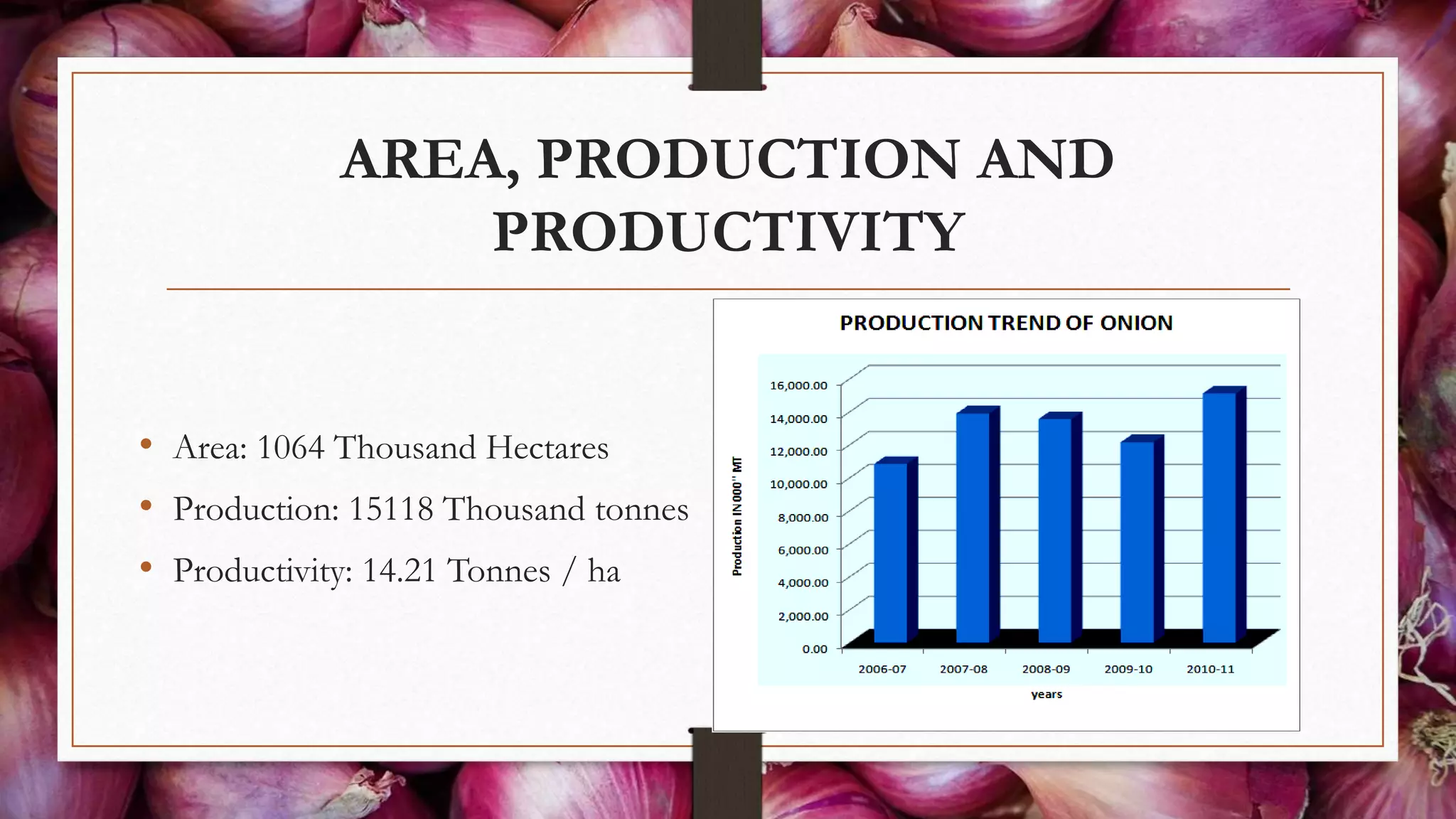
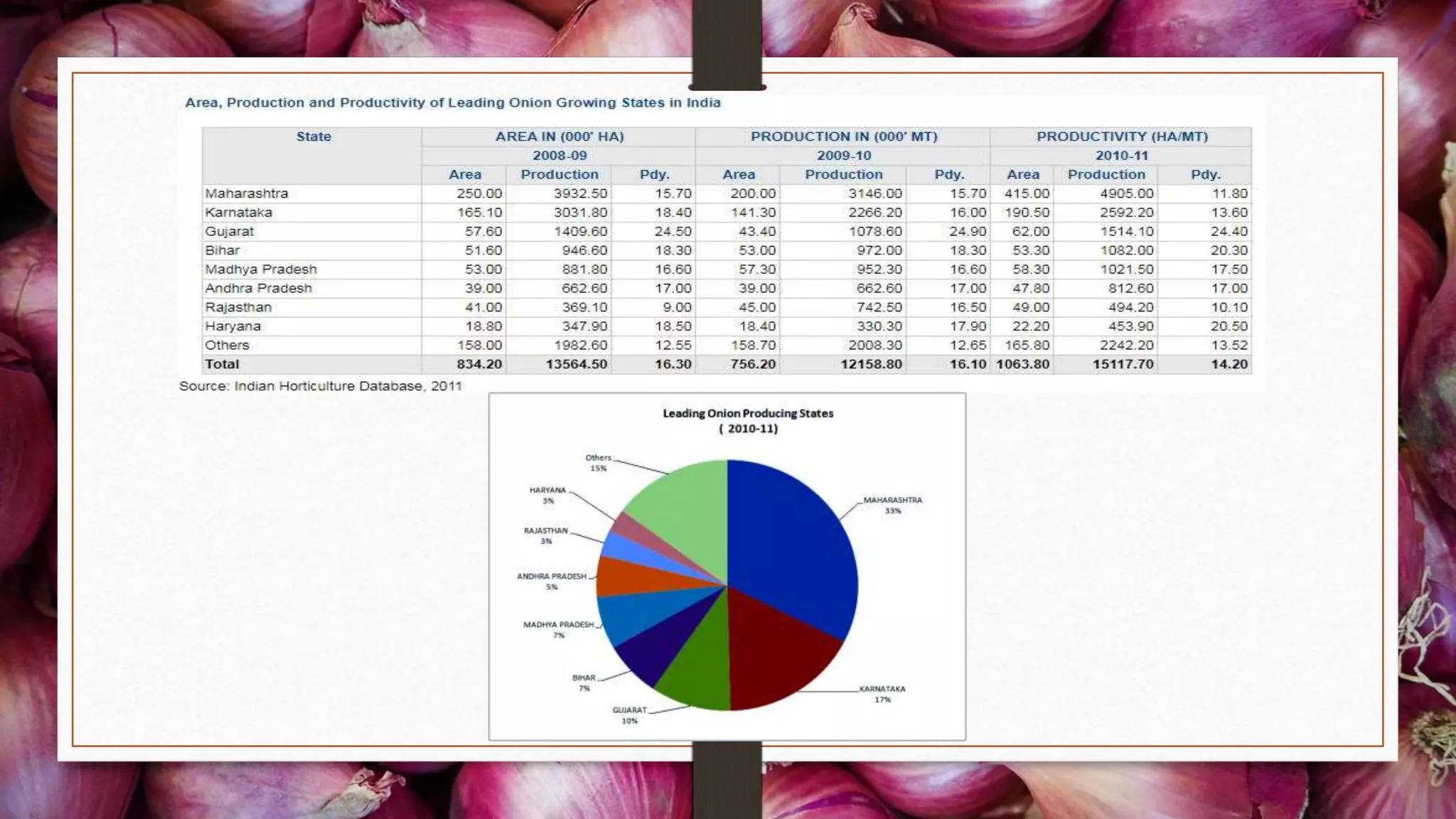
AREA, PRODUCTION AND
PRODUCTIVITY
• Area: 1064 Thousand Hectares
• Production: 15118 Thousand tonnes
• Productivity: 14.21 Tonnes / ha
SCIENTIFIC CLASSIFICATION
• Kingdom: Plantae
• Sub-Kingdom: Tracheophytes
• Super Division: Angiosperms
• Clade: Monocots
• Order: Asparagales
• Family: Amaryllidaceae
• Subfamily: Allioideae
• Genus: Allium
• Species: A. cepa
• Binomial name: Allium cepa L.
ORIGIN OF ONION
• Onions have been variously described as having originated in Iran, western
Indian subcontinent and Central Asia.
• Primary center of origin: The region of Iran and Pakistan
• Secondary center of origin: The near east Asiatic and Mediterranean regions
LAND PREPARATION
• Land to be used for seed production of onion should be free from
volunteer plants.
• Although onion can be grown nearly in all types of soil from sandy loam to
loam.
• Heavy clay soil should be avoided, but unless they are satisfactory well
supplied with humus to lighten them.
• The soils pH should preferably be 6.0-6.8.
SOURCES OF SEED
• Seeds
• Onion Sets
• Onion Transplants
• Bulbs
• Onion is a cross pollinated crop
• Isolation distance should be 1000-1600m and 500m is recommended for
certified and foundation seed production
METHODS OF SEED PRODUCTION
• Seed to seed method: The bulbs of first season crop is left to over winter
in the field so as to produce seed in the following season.
• Bulb to seed method: The bulbs produced in the previous season are
lifted selected stored and replanted to produce seeds in the second year
▪ Advantages:
· It permits selection of true to type and healthy bulbs.
· Seed yields are comparatively very high.
FERTILIZERS
• 20-25t of FYM at time of ploughing
• 125kg N,75 kg P2O5,125 Kg K2O
• Entire dose of p & k are applied at time of final land preparation
• Nitrogen to be top-dressed in 2 splits first half at 3-4 weeks after transplanting,
second half at 2 months after transplanting
SEED TREATMENT
• The seed treatment fungicide, tebuconazole, reduced the incidence of onion
smut by 90 to 98%.
• This level of control was comparable to the industry standard, which is a
combination of two seed treatment fungicides [thiram + carboxin] + an in-
furrow application of maneb.
SEED RATE
• Onion seeds are sown in nursery beds to raise seedlings For common big
onions, 8-10 kg seed is sufficient for raising seedlings for one hectare,
accommodating 100-110 beds of 3m X 0.6m size each.
• For broadcasting directly in the field or sowing in the rows, 20-25 kg seeds is
enough for a hectare.
• For multiplier onions 10-12 quintal bulblets are required for planting one
hectare.
SOWING AND SPACING
• Transplanting: When the seedlings are 6-8 weeks old and 15 cm high, they
should be removed from the nursery beds and transplanted in the main field
at a distance
15-20 cm between lines
7-10 cm between plants or seedlings
• Irrigate the field soon after transplanting. The transplanting should be done
either in early hours or late in the evening to avoid the drying of seedlings.
Care must be taken to discriminate the seedling with damaged roots or
diseases.
• Direct seed sowing: Seed (16-20 kg) is sown by hand kera method or drill method to
ensure seed depth 2-3 cm in lines at 30 cm apart. After 6-8 weeks, spacing between
plants is adjusted to 10 cm by thinning and gap filling operations. This method requires
more field labour for weeding at 10 days interval.
Planting bulbs: Small and medium sized bulbs about 10-12 quintal are dibbled keeping
30 cm distance between lines and 15 cm between bulbs. Irrigation can be applied within
one to two days after dibbling.
ROGUEING
• Plot should be visited regularly.
• Yellow and lanky plants should be removed before flowering.
• Plants with differential umbel height should be removed before opening of
flowers.
• Plants affected by aster yellow and stemphyllium blight should be removed
before seed harvest.
IRRIGATION
• Irrigation is given at 7-10 days interval depending on types of soil and
season.
• Earthing is done 2 months after transplanting to avoid lodging.
• Weeding and hoeing are done as per requirement.
ANTHESIS AND FLOWERING
• Flowering: It takes 64-67 days to flower from the date of bulb sowing,
remain flowering for next 40-45 days and 88-91 days to produce maximum
number of open flowers.
• Anthesis occurs at 06-07 am and anther dehiscence continues from 07 am to
05 pm.
• Each anther produces an average of 1609 pollen grains. Floral nectaries
located at lower part of ovary, produces an average of 1.80 µl nectar per
floret. As a reward, onion flowers produce surplus quantity ofpollen and
nectar
FLORAL MORPHOLOGY
• The anthesis begins from outer flowers and goes centrally in succession The
flower is protandrous in nature and stigma becomes receptive when shedding
of pollen is over.
• When the onion plant is induced to flower, the shoot apex ceases to produce
leaf primordia and initiates the inflorescence onion flower range from 50 to
more than 2000 per umbel.
• Umbel is the flowering structure. Umbel is an aggregate of 5- 10 flowers
each of which opens in definite order.
• Biennial herb
• Leaves are tubular
• Bulbs are formed by attachment of swollen leaf base to underground part of
stem
• Flowers are produced during second phase after bulb formation
• Flowering structure : Umbel
FIELD INSPECTION
Mother bulb production stage
• First inspection shall be made after transplanting of seedlings in order to
determine isolation, volunteer plants, off-types including bolters and other
relevant factors.
• The second inspection shall be made after the bulbs have been lifted to
verify the true characteristics of bulbs.
Seed production stage
• The first inspection should be made before flowering in order to
determine isolation, off types including bolters and relevant factors.
• The second and third inspection shall be made during flowering to check
isolation, off types and other relevant factors.
• The forth inspection shall be made at maturity to verify the true nature
of the plant and other relevant factors.
PEST AND DISEASES
• There are several important pests that attack onions and garlic, like
nematodes, stem and bulb eelworm, thirps and onion fly or maggot.
• Onions are also very prone to foliar diseases and bulb rots, such as slimy or
‘sour’ outer scales, a bacterial disease that significantly reduces onion bulb
quality.
• Fungal diseases such as neck rot, mildew, rust and leaf rot, are frequent too.
Sour Scales Neck Rot
Onion
maggot
s
Onion fly
Thrips
HARVESTING
• All seed heads do not mature simultaneously, therefore, harvesting is done in
installments.
• When seed inside capsules become black and 20-25% black seeds are
exposed the umbels should be cut with 10-15 cm stem attached.
• The umbels are spread on ground or canvas to avoid attack of mould for
drying.
• The optimum moisture content is 10 to 15 per cent at the time of harvesting.
SEED YIELD
• 500 - 800 kg seed/ha, in best management and climatic conditions 1000 to
1200 kg seed can be obtained.
• Grading Seeds are size graded using BSS 10X10 wire mesh sieve and the
seeds retained by this sieve alone is recommended for sowing/storage.
SEED STANDARDS
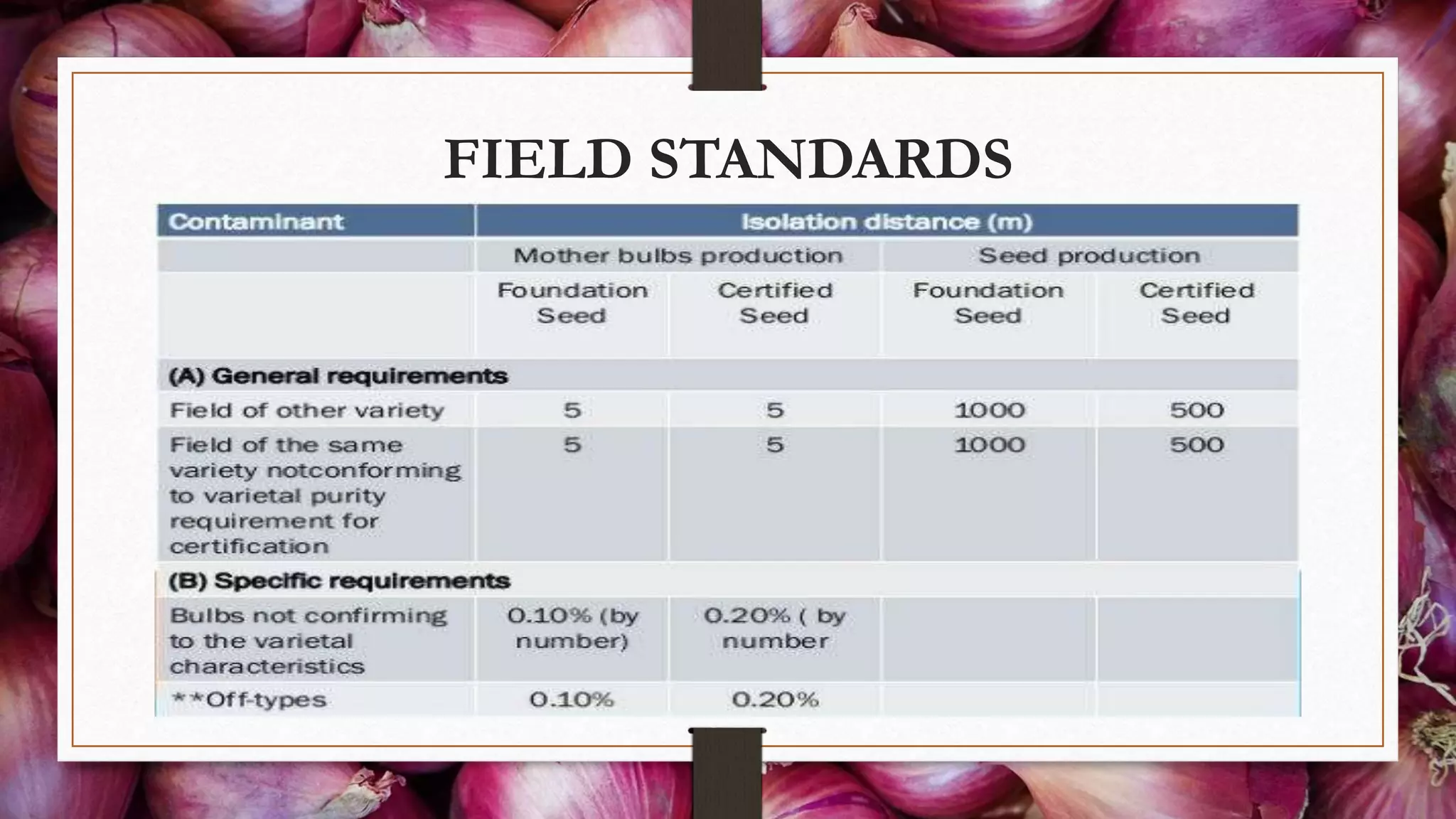
FIELD STANDARDS
HYBRID SEED PRODUCTION
• Hand emasculation and pollination : Flowers are very small, androgynous,
very few seeds/ cross. It is time and labour combursum, so, it is not
economical. Not followed also.
• Use of Male sterile lines-4F:1M
a) CMS :commonly used
b) CGMS : also used but high cost of production.
USE OF MALE STERILE LINES
• In onion the use of male-sterile lines is common to produce seeds of F1
hybrids.
• The male sterility in onion is due to the interaction of cytoplasm and nuclear
gene.
• The nuclear gene is single recessive msms while its dominant allele MsMs is
for male fertility.
PARENTAL LINES
• Three parental lines, namely A, B and C, are used for hybrid seed production.
The line A, known as the female parent, is male sterile having the genetic
constitution Smsms, which produces hybrid seeds, The line B with the geno-
type Nmsms is the male-fertile counterpart for the maintenance of male
sterility of line A The line C is the fertile pollen parent or inbred which is
genetically diverse from the lines A and B.
PROCEDURE
• The hybrid seed is produced in the open in an isolated field. The bulbs of A (male
sterile) and C (pollen parent) lines are planted alternately in a ratio of 4 rows of the A
line to 1 row of the C line.
• Sometimes 8 rows of the A line are alternated with 2 rows of the C line. The
flowering in the lines A and C must synchronize.
• If it does not, it can be accomplished by adjusting planting dates of the lines A and C.
• Daily rogueing of pollen-bearing plants and other off-types in the line A in the
morning before the anthers dehisce is essential.
• When the seed of the line C is not to be saved its flower stalks may be cut and
destroyed as soon as the pollination is completed.
ISOLATION
• For mother bulb production 5 m isolation should be maintained. Since onion
is cross pollinated through insect (entomophilous) two varieties have to be
well isolated from each other.
• An isolation distance of 1000 m for foundation seed and 500 m for certified
seed shall be provided all round a seed field to separate it from fields of
other varieties, fields of the same variety not confirming to varietal purity
requirement for certification.
HYBRIDS AND VARIETIES
Hybrids Varieties
INDAM MARSHAL Ailsa Craig
INDAM GULAB Italian Torpedo
F1 HYBRID – INDAM 4 Red Burgundy
AS-345 Utah Yellow Sweet Spanish
AS-N-53 Walla Walla
RECENT WORKS
• Onion variety Arka Kalyan cultivation is economically viable for the farmers as compared to local
variety which is mainly cultivated in Chitradurga district. Onion variety Arka Kalyan gives returns
even during agricultural drought years and resistant to purple blotch. This is in contrast to the
local varieties cultivated by the farmers. The comparison of economics between commercial seed
and bulb production of Arka Kalyan variety revealed that commercial seed production activity
gave high net returns of Rs 7,10,000 as compared to commercial bulb production with Rs
2,05,000.
• The production of onion gave higher net returns compared to commercial bulb production and
also provides additional employment to the family members of farmers. It is helping farmers of
Chitradurga district to achieve self-reliance on quality seeds and timely availability in their local
region. This has greatly reduced the risks and uncertainties involved in purchase of seeds from
neighbouring state.
Thank You

Onion seed production

  • 1.
  • 2.
    INTRODUCTION • Onion (Alliumcepa L.) is a major bulbous crop among the cultivated vegetable crops and it is of global importance. • Top 3rd vegetable with production of 1.064 mT 15.118mha. • India needs around 7000 tonnes of seeds annually. • India is the second largest producer of onion. • Highest foreign exchange earner among the fruits and vegetables.
  • 3.
    AREA, PRODUCTION AND PRODUCTIVITY •Area: 1064 Thousand Hectares • Production: 15118 Thousand tonnes • Productivity: 14.21 Tonnes / ha
  • 5.
    SCIENTIFIC CLASSIFICATION • Kingdom:Plantae • Sub-Kingdom: Tracheophytes • Super Division: Angiosperms • Clade: Monocots • Order: Asparagales • Family: Amaryllidaceae • Subfamily: Allioideae • Genus: Allium • Species: A. cepa • Binomial name: Allium cepa L.
  • 6.
    ORIGIN OF ONION •Onions have been variously described as having originated in Iran, western Indian subcontinent and Central Asia. • Primary center of origin: The region of Iran and Pakistan • Secondary center of origin: The near east Asiatic and Mediterranean regions
  • 7.
    LAND PREPARATION • Landto be used for seed production of onion should be free from volunteer plants. • Although onion can be grown nearly in all types of soil from sandy loam to loam. • Heavy clay soil should be avoided, but unless they are satisfactory well supplied with humus to lighten them. • The soils pH should preferably be 6.0-6.8.
  • 8.
    SOURCES OF SEED •Seeds • Onion Sets • Onion Transplants • Bulbs • Onion is a cross pollinated crop • Isolation distance should be 1000-1600m and 500m is recommended for certified and foundation seed production
  • 9.
    METHODS OF SEEDPRODUCTION • Seed to seed method: The bulbs of first season crop is left to over winter in the field so as to produce seed in the following season. • Bulb to seed method: The bulbs produced in the previous season are lifted selected stored and replanted to produce seeds in the second year ▪ Advantages: · It permits selection of true to type and healthy bulbs. · Seed yields are comparatively very high.
  • 10.
    FERTILIZERS • 20-25t ofFYM at time of ploughing • 125kg N,75 kg P2O5,125 Kg K2O • Entire dose of p & k are applied at time of final land preparation • Nitrogen to be top-dressed in 2 splits first half at 3-4 weeks after transplanting, second half at 2 months after transplanting
  • 11.
    SEED TREATMENT • Theseed treatment fungicide, tebuconazole, reduced the incidence of onion smut by 90 to 98%. • This level of control was comparable to the industry standard, which is a combination of two seed treatment fungicides [thiram + carboxin] + an in- furrow application of maneb.
  • 12.
    SEED RATE • Onionseeds are sown in nursery beds to raise seedlings For common big onions, 8-10 kg seed is sufficient for raising seedlings for one hectare, accommodating 100-110 beds of 3m X 0.6m size each. • For broadcasting directly in the field or sowing in the rows, 20-25 kg seeds is enough for a hectare. • For multiplier onions 10-12 quintal bulblets are required for planting one hectare.
  • 13.
    SOWING AND SPACING •Transplanting: When the seedlings are 6-8 weeks old and 15 cm high, they should be removed from the nursery beds and transplanted in the main field at a distance 15-20 cm between lines 7-10 cm between plants or seedlings • Irrigate the field soon after transplanting. The transplanting should be done either in early hours or late in the evening to avoid the drying of seedlings. Care must be taken to discriminate the seedling with damaged roots or diseases.
  • 14.
    • Direct seedsowing: Seed (16-20 kg) is sown by hand kera method or drill method to ensure seed depth 2-3 cm in lines at 30 cm apart. After 6-8 weeks, spacing between plants is adjusted to 10 cm by thinning and gap filling operations. This method requires more field labour for weeding at 10 days interval. Planting bulbs: Small and medium sized bulbs about 10-12 quintal are dibbled keeping 30 cm distance between lines and 15 cm between bulbs. Irrigation can be applied within one to two days after dibbling.
  • 15.
    ROGUEING • Plot shouldbe visited regularly. • Yellow and lanky plants should be removed before flowering. • Plants with differential umbel height should be removed before opening of flowers. • Plants affected by aster yellow and stemphyllium blight should be removed before seed harvest.
  • 16.
    IRRIGATION • Irrigation isgiven at 7-10 days interval depending on types of soil and season. • Earthing is done 2 months after transplanting to avoid lodging. • Weeding and hoeing are done as per requirement.
  • 17.
    ANTHESIS AND FLOWERING •Flowering: It takes 64-67 days to flower from the date of bulb sowing, remain flowering for next 40-45 days and 88-91 days to produce maximum number of open flowers. • Anthesis occurs at 06-07 am and anther dehiscence continues from 07 am to 05 pm. • Each anther produces an average of 1609 pollen grains. Floral nectaries located at lower part of ovary, produces an average of 1.80 µl nectar per floret. As a reward, onion flowers produce surplus quantity ofpollen and nectar
  • 18.
    FLORAL MORPHOLOGY • Theanthesis begins from outer flowers and goes centrally in succession The flower is protandrous in nature and stigma becomes receptive when shedding of pollen is over. • When the onion plant is induced to flower, the shoot apex ceases to produce leaf primordia and initiates the inflorescence onion flower range from 50 to more than 2000 per umbel. • Umbel is the flowering structure. Umbel is an aggregate of 5- 10 flowers each of which opens in definite order.
  • 19.
    • Biennial herb •Leaves are tubular • Bulbs are formed by attachment of swollen leaf base to underground part of stem • Flowers are produced during second phase after bulb formation • Flowering structure : Umbel
  • 21.
    FIELD INSPECTION Mother bulbproduction stage • First inspection shall be made after transplanting of seedlings in order to determine isolation, volunteer plants, off-types including bolters and other relevant factors. • The second inspection shall be made after the bulbs have been lifted to verify the true characteristics of bulbs.
  • 22.
    Seed production stage •The first inspection should be made before flowering in order to determine isolation, off types including bolters and relevant factors. • The second and third inspection shall be made during flowering to check isolation, off types and other relevant factors. • The forth inspection shall be made at maturity to verify the true nature of the plant and other relevant factors.
  • 23.
    PEST AND DISEASES •There are several important pests that attack onions and garlic, like nematodes, stem and bulb eelworm, thirps and onion fly or maggot. • Onions are also very prone to foliar diseases and bulb rots, such as slimy or ‘sour’ outer scales, a bacterial disease that significantly reduces onion bulb quality. • Fungal diseases such as neck rot, mildew, rust and leaf rot, are frequent too.
  • 24.
  • 25.
  • 26.
    HARVESTING • All seedheads do not mature simultaneously, therefore, harvesting is done in installments. • When seed inside capsules become black and 20-25% black seeds are exposed the umbels should be cut with 10-15 cm stem attached. • The umbels are spread on ground or canvas to avoid attack of mould for drying. • The optimum moisture content is 10 to 15 per cent at the time of harvesting.
  • 27.
    SEED YIELD • 500- 800 kg seed/ha, in best management and climatic conditions 1000 to 1200 kg seed can be obtained. • Grading Seeds are size graded using BSS 10X10 wire mesh sieve and the seeds retained by this sieve alone is recommended for sowing/storage.
  • 28.
  • 29.
  • 30.
    HYBRID SEED PRODUCTION •Hand emasculation and pollination : Flowers are very small, androgynous, very few seeds/ cross. It is time and labour combursum, so, it is not economical. Not followed also. • Use of Male sterile lines-4F:1M a) CMS :commonly used b) CGMS : also used but high cost of production.
  • 31.
    USE OF MALESTERILE LINES • In onion the use of male-sterile lines is common to produce seeds of F1 hybrids. • The male sterility in onion is due to the interaction of cytoplasm and nuclear gene. • The nuclear gene is single recessive msms while its dominant allele MsMs is for male fertility.
  • 32.
    PARENTAL LINES • Threeparental lines, namely A, B and C, are used for hybrid seed production. The line A, known as the female parent, is male sterile having the genetic constitution Smsms, which produces hybrid seeds, The line B with the geno- type Nmsms is the male-fertile counterpart for the maintenance of male sterility of line A The line C is the fertile pollen parent or inbred which is genetically diverse from the lines A and B.
  • 33.
    PROCEDURE • The hybridseed is produced in the open in an isolated field. The bulbs of A (male sterile) and C (pollen parent) lines are planted alternately in a ratio of 4 rows of the A line to 1 row of the C line. • Sometimes 8 rows of the A line are alternated with 2 rows of the C line. The flowering in the lines A and C must synchronize. • If it does not, it can be accomplished by adjusting planting dates of the lines A and C. • Daily rogueing of pollen-bearing plants and other off-types in the line A in the morning before the anthers dehisce is essential. • When the seed of the line C is not to be saved its flower stalks may be cut and destroyed as soon as the pollination is completed.
  • 34.
    ISOLATION • For motherbulb production 5 m isolation should be maintained. Since onion is cross pollinated through insect (entomophilous) two varieties have to be well isolated from each other. • An isolation distance of 1000 m for foundation seed and 500 m for certified seed shall be provided all round a seed field to separate it from fields of other varieties, fields of the same variety not confirming to varietal purity requirement for certification.
  • 35.
    HYBRIDS AND VARIETIES HybridsVarieties INDAM MARSHAL Ailsa Craig INDAM GULAB Italian Torpedo F1 HYBRID – INDAM 4 Red Burgundy AS-345 Utah Yellow Sweet Spanish AS-N-53 Walla Walla
  • 36.
    RECENT WORKS • Onionvariety Arka Kalyan cultivation is economically viable for the farmers as compared to local variety which is mainly cultivated in Chitradurga district. Onion variety Arka Kalyan gives returns even during agricultural drought years and resistant to purple blotch. This is in contrast to the local varieties cultivated by the farmers. The comparison of economics between commercial seed and bulb production of Arka Kalyan variety revealed that commercial seed production activity gave high net returns of Rs 7,10,000 as compared to commercial bulb production with Rs 2,05,000. • The production of onion gave higher net returns compared to commercial bulb production and also provides additional employment to the family members of farmers. It is helping farmers of Chitradurga district to achieve self-reliance on quality seeds and timely availability in their local region. This has greatly reduced the risks and uncertainties involved in purchase of seeds from neighbouring state.
  • 37.