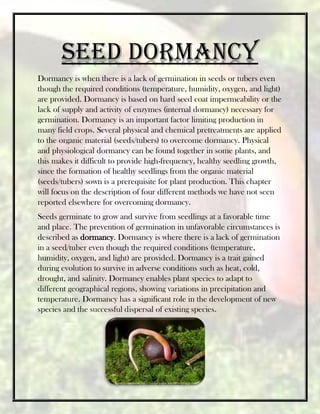
Seed dormancy
Dormancy is when there is a lack of germination in seeds or tubers even
though the required conditions (temperature, humidity, oxygen, and light)
are provided. Dormancy is based on hard seed coat impermeability or the
lack of supply and activity of enzymes (internal dormancy) necessary for
germination. Dormancy is an important factor limiting production in
many field crops. Several physical and chemical pretreatments are applied
to the organic material (seeds/tubers) to overcome dormancy. Physical
and physiological dormancy can be found together in some plants, and
this makes it difficult to provide high-frequency, healthy seedling growth,
since the formation of healthy seedlings from the organic material
(seeds/tubers) sown is a prerequisite for plant production. This chapter
will focus on the description of four different methods we have not seen
reported elsewhere for overcoming dormancy.
Seeds germinate to grow and survive from seedlings at a favorable time
and place. The prevention of germination in unfavorable circumstances is
described as dormancy. Dormancy is where there is a lack of germination
in a seed/tuber even though the required conditions (temperature,
humidity, oxygen, and light) are provided. Dormancy is a trait gained
during evolution to survive in adverse conditions such as heat, cold,
drought, and salinity. Dormancy enables plant species to adapt to
different geographical regions, showing variations in precipitation and
temperature. Dormancy has a significant role in the development of new
species and the successful dispersal of existing species.
Types of Seed Dormancy
There are two types of seed dormancy in general: seed coat (physical)
dormancy and internal dormancy. In seed coat dormancy, the seed coat
prevents oxygen and/or water permeating into the seed. Sometimes,
dormancy is caused by inhibiting chemicals inside the seed. Seeds with
seed coat dormancy can remain on/in the ground without germinating
until the seed coat allows water and oxygen to enter the seed or eliminate
the inhibiting chemicals. Seed coat dormancy is common in California
lilac (Ceanothus), manzanita (Arctostaphylos), sumac (Rhus), and
members of the legume family. Scarification, hot water, dry heat, fire, acid
and other chemicals, mulch, and light are the methods used for breaking
seed coat dormancy.
Physiological conditions causing internal dormancy arise from the
presence of germination inhibitors inside the seed. The adverse effects of
these inhibitors should be eliminated in order to start germination by
using germination-promoting substances such as gibberellic acid (GA3)
and potassium nitrate (KNO3). The most common inhibitor is abscisic
acid (ABA). Sugar maple, Norway maple (Acer platanoides L.), planetree
maple (Acer pseudoplatanus), European hazel (Corylus avellana L.),
white ash (Fraxinus americana L.), apple (Malus pumila Mill.), northern
red (Quercus rubra L.), and English oaks are the species that have ABA
as an internal inhibitor. Another type of internal dormancy is caused by
lack of enzymes, which is required for complete physiological maturation.
Seed coat and internal dormancy can be found together in a species.
Seeds with this combined dormancy should be treated by overcoming the
problems raised by the impermeable seed coat first, and then overcoming
the internal dormancy.
The effects of magnetic field strength squirting cucumber (Ecballium
elaterium (L.) A. Rich.) fruit juice, sodium hypochlorite solutions, and
gamma radiation on overcoming dormancy are discussed.
New methods for overcoming dormancy
1. Magnetic field strength
All living creatures are exposed to magnetic field throughout their lives.
Exposing seeds to magnetic field is one of the physical treatments to
increase seed germination and plant development. It was reported that
seed germination was improved by physiological changes in seeds, such as
faster water assimilation and higher photosynthesis, under the effect of
magnetic field. Many researchers have reported that exposing seeds to a
magnetic field increased seed vigor and germination. Although there are
many reports on the effects of magnetic field on seed germination, plant
growth, protein biosynthesis, and root development, to our knowledge the
effect of magnetic field on overcoming dormancy has not been reported
before.
2. Squirting cucumber (Ecballium elaterium (L.) A. Rich.) fruit
juice
Squirting cucumber (Ecballium elaterium (L.) A. Rich.), which is
commonly found in Turkey, is an important medicinal plant. It contains
different compounds such as α-elaterin (cucurbitacin E), β-elaterin
(cucurbitacin B), elatericine A, and elatericine B (cucurbitacin I) in
different plant organs. It also contains sterols, phenolic compounds,
vitamins, flavonoids, alkaloids, resin, starch, amino acids, and fatty acids.
In vitro regeneration was affected significantly by squirting cucumber fruit
juice. It was also reported that squirting cucumber fruit juice stimulated
rapid germination and seedling growth in rapeseed.
Mature squirting cucumber fruits were collected from their natural
growing areas around Ankara. Fruit juice was extracted and then filtered
in order to remove the bigger parts. The fruit juice was subject to sterile
filtration and kept in the refrigerator at −20°C.
3. Sodium hypochlorite solutions
Sodium hypochlorite (NaOCl) has been most widely used for surface
sterilization. NaOCl is highly effective against all kinds of bacteria, fungi,
and viruses. Moreover, NaOCl has strong oxidizing properties that make
it highly reactive with amino acids, nucleic acids, amines, and amides.
The most important treatment prior to culture initiation is perhaps
surface-sterilization of the explant. Since in vitro conditions provide
bacteria and fungi with an optimal growth environment, unsuccessful
sterilization hinders the progress of tissue culture studies. On the one
hand, sterilization of the tissue aims to eliminate all microorganisms that
can easily grow in vitro conditions; on the other hand, it should guarantee
the explant’s viability and regeneration capacity, which are known to be
affected by the concentration, treatment period, and temperature of the
disinfectant.
4. Gamma radiation
Gamma rays have an ionizing radiation effect on plant growth and
development by inducing cytological, biochemical, physiological, and
morphological changes in cells and tissues by producing free radicals in
cells. Higher doses of gamma radiation have been reported to be
inhibitory, whereas lower doses are stimulatory. Low doses of gamma rays
have been reported to increase seed germination and plant growth, cell
proliferation, germination, cell growth, enzyme activity, stress resistance,
and crop yields. Stimulation of plant growth at low gamma radiation doses
is known as hormesis. The hormesis phenomenon is described as a
stimulating effect on any factor in the growth of an organism.
Conclusion
Dormancy is a state of lack of germination in seeds/tubers even though
the required conditions (temperature, humidity, oxygen, and light) have
been provided and is based on hard seed coat impermeability or a lack of
supply and activity of the enzymes necessary for germination. Dormancy
is an important factor limiting production in many field crops. Several
physical and chemical pretreatments are applied to organic material
(seeds/tubers) for overcoming dormancy. Physical and internal dormancy
can be found together in some plant species and this makes it difficult to
provide high-frequency healthy seedling growth, whereas the sprouting of
seeds/tubers sown and the formation of healthy seedlings is a prerequisite
for plant production. This chapter focuses on four different methods that
have not been reported elsewhere for overcoming dormancy. We think
that these newly described methods will help growers and researchers to
overcome dormancy problem in plant production.
Growing of fruit
trees
Many people mistakenly believe that fruit trees come true to name from
seeds, but the seeds from a fruit actually produce a new variety that is a
hybrid of two plants.
The new plant will be the same kind of plant, but its fruit and vegetative
portions may not look the same as the parent, because the plant is
"heterozygous."
Therefore, all fruit trees must be vegetatively propagated by either grafting
or budding methods.
Grafting and budding require that you have a compatible rootstock or
mother plant onto which you can attach your desired variety. An
inexpensive way to obtain a seedling rootstock is to collect seeds from the
type of plant you are propagating.
The seeds of all common tree fruits (apple, pear, peach, and cherry)
require a chilling period before they will germinate and form new plants.
The chilling period occurs after the fruit portion is ripe. This period is
known as either dormancy or afterripening. During this period the
embryo develops until it is mature. This is accomplished by subjecting the
seeds to a cold treatment.
Experimenting with Growing Fruit Trees from Seed
Homeowners and amateur fruit growers often like to experiment and
grow tree fruit from seed. Frequently many of these people have the
mistaken impression that a tree grown from seed will produce fruit exactly
like the fruit they saw or consumed. This is an erroneous assumption
because the seed is a product of the pollen (male) source and the flower
ovule (female) source. The seed will produce the same kind of plant--that
is an apple peach or pear. The fruit, however, will have a mixture of the
two parent's characteristics. Although this may be disheartening for the
person trying to preserve that favorite fruit it should be pointed out that
many of our current apple cultivars were discovered as chance seedlings.
Several good examples of this are Delicious, Golden Delicious, Granny
Smith and McIntosh.
Another reason for growing plants from seed is to produce seedlings onto
which you can vegetatively propagate a desired cultivar. Again the resulting
seed will be a mixture of the parent's characteristics, and a plant selected
because of its growth habit will not come true from seed. It may be more
or less vigorous or more or less susceptible to pests.
In either case tree fruit can be grown from seed if handled properly.
There are three basic methods that can be used. Both methods require a
period of after ripening of the seed. Tree fruit seeds require a period,
after the fruit is ripe, before they will germinate and form new plants.
During that period the embryo of the seed develops until it is mature.
The after ripening is usually accomplished by exposing the seeds to a
period of cold.
Method 1
Prepare a garden soil plot in the fall as you would for planting any other
type of seeds. Make a furrow that is no more than 1 to 2 times deeper
than the longest dimension of the seed. Cover the seeds with a light cover
soil and add 1 to 2 inches of sand over the row. This will prevent crusting
of the soil which inhibits germination.
Next, place a wire screen over the row. Push the edges of the screen
several inches into the soil on all four sides. This prevents chipmunks and
squirrels from digging up the seeds. The following spring carefully watch
the seeded area closely for newly germinated seedlings. As they grow,
remove the wire screen to prevent bending of the new plants.
Method 2
Remove the seeds and/or pits from the fruit of which you wish to
reproduce. Remove all adhering fruit portions and allow the seeds to air
dry. Then place them in a glass jar to which a loosely fitted lid or cover
may be added. Set the seeds aside until mid-January. Mix the seeds (in
mid-January) with either moist (but not wet) sphagnum peat moss, sand or
shredded paper towels. Return the mixture to the jar and replace the lid.
Place the jar with the seeds in a refrigerator until after the last severe
spring frosts have occurred in your area. The seeds should remain in the
refrigerator for at least 60 days. In the early spring prepare a seedbed, with
furrows as described above, and plant the seeds. Germination may be
enhanced by soaking the seeds in water for 12 to 24 hours before
planting. Keep the soil moist. Do not add fertilizer at planting.
Method 3
Collect the seeds from apples that had been in cold storage for a month
or so; rinse them in a 10% Clorox solution; then dust them with captan or
a similar fungicide. Line the seeds out in trays of moist peat moss or
vermiculite. After they germinate, plant them about 1-inch-deep in parallel
seed lines about 2 inches apart. After several months in a 40-degree F
refrigerator the healthy seeds should germinate and sprout. Transplant
them into 4 inch pots with soft tweezers, when they had 2 to 4 true leaves
(not counting the cotyledons). You could also group the resultant
seedlings by their probable chill unit requirements, assuming that those
germinating first had lower chill requirements.
With all methods, after the seedlings are 6 to 8 inches tall carefully band 1
to 2 tablespoons of urea along each 12 inches of row. Keep the fertilizer
about 2 inches away from the plants. Water thoroughly every 10 to 12
days.
SPECIAL NOTE
Stone fruits have a hard covering over the embryo. To facilitate
germination it is helpful to crack the hard covering slightly using a
nutcracker just before planting. Be careful not to crush the embryo inside
the covering. The new seedlings will develop a tap root. To facilitate
transplanting, it is necessary to cut the taproot by pushing a spade under
each plant. The spade should be pushed into the soil to cut the taproot
about 5 to 6 inches below the surface.
Peach, nectarine and apricot seedlings may be budded the first summer,
usually in late July or early August, and transplanted the following spring.
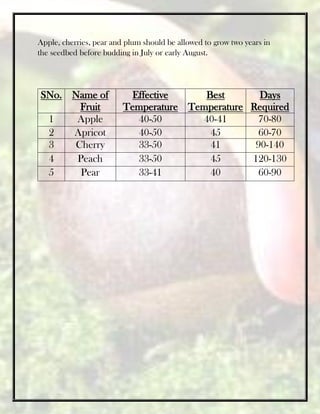
Apple, cherries, pear and plum should be allowed to grow two years in
the seedbed before budding in July or early August.
SNo. Name of
Fruit
Effective
Temperature
Best
Temperature
Days
Required
1 Apple 40-50 40-41 70-80
2 Apricot 40-50 45 60-70
3 Cherry 33-50 41 90-140
4 Peach 33-50 45 120-130
5 Pear 33-41 40 60-90

Seed dormancy

  • 1.
    Seed dormancy Dormancy iswhen there is a lack of germination in seeds or tubers even though the required conditions (temperature, humidity, oxygen, and light) are provided. Dormancy is based on hard seed coat impermeability or the lack of supply and activity of enzymes (internal dormancy) necessary for germination. Dormancy is an important factor limiting production in many field crops. Several physical and chemical pretreatments are applied to the organic material (seeds/tubers) to overcome dormancy. Physical and physiological dormancy can be found together in some plants, and this makes it difficult to provide high-frequency, healthy seedling growth, since the formation of healthy seedlings from the organic material (seeds/tubers) sown is a prerequisite for plant production. This chapter will focus on the description of four different methods we have not seen reported elsewhere for overcoming dormancy. Seeds germinate to grow and survive from seedlings at a favorable time and place. The prevention of germination in unfavorable circumstances is described as dormancy. Dormancy is where there is a lack of germination in a seed/tuber even though the required conditions (temperature, humidity, oxygen, and light) are provided. Dormancy is a trait gained during evolution to survive in adverse conditions such as heat, cold, drought, and salinity. Dormancy enables plant species to adapt to different geographical regions, showing variations in precipitation and temperature. Dormancy has a significant role in the development of new species and the successful dispersal of existing species.
  • 2.
    Types of SeedDormancy There are two types of seed dormancy in general: seed coat (physical) dormancy and internal dormancy. In seed coat dormancy, the seed coat prevents oxygen and/or water permeating into the seed. Sometimes, dormancy is caused by inhibiting chemicals inside the seed. Seeds with seed coat dormancy can remain on/in the ground without germinating until the seed coat allows water and oxygen to enter the seed or eliminate the inhibiting chemicals. Seed coat dormancy is common in California lilac (Ceanothus), manzanita (Arctostaphylos), sumac (Rhus), and members of the legume family. Scarification, hot water, dry heat, fire, acid and other chemicals, mulch, and light are the methods used for breaking seed coat dormancy. Physiological conditions causing internal dormancy arise from the presence of germination inhibitors inside the seed. The adverse effects of these inhibitors should be eliminated in order to start germination by using germination-promoting substances such as gibberellic acid (GA3) and potassium nitrate (KNO3). The most common inhibitor is abscisic acid (ABA). Sugar maple, Norway maple (Acer platanoides L.), planetree maple (Acer pseudoplatanus), European hazel (Corylus avellana L.), white ash (Fraxinus americana L.), apple (Malus pumila Mill.), northern red (Quercus rubra L.), and English oaks are the species that have ABA as an internal inhibitor. Another type of internal dormancy is caused by lack of enzymes, which is required for complete physiological maturation. Seed coat and internal dormancy can be found together in a species. Seeds with this combined dormancy should be treated by overcoming the problems raised by the impermeable seed coat first, and then overcoming the internal dormancy. The effects of magnetic field strength squirting cucumber (Ecballium elaterium (L.) A. Rich.) fruit juice, sodium hypochlorite solutions, and gamma radiation on overcoming dormancy are discussed.
  • 3.
    New methods forovercoming dormancy 1. Magnetic field strength All living creatures are exposed to magnetic field throughout their lives. Exposing seeds to magnetic field is one of the physical treatments to increase seed germination and plant development. It was reported that seed germination was improved by physiological changes in seeds, such as faster water assimilation and higher photosynthesis, under the effect of magnetic field. Many researchers have reported that exposing seeds to a magnetic field increased seed vigor and germination. Although there are many reports on the effects of magnetic field on seed germination, plant growth, protein biosynthesis, and root development, to our knowledge the effect of magnetic field on overcoming dormancy has not been reported before. 2. Squirting cucumber (Ecballium elaterium (L.) A. Rich.) fruit juice Squirting cucumber (Ecballium elaterium (L.) A. Rich.), which is commonly found in Turkey, is an important medicinal plant. It contains different compounds such as α-elaterin (cucurbitacin E), β-elaterin (cucurbitacin B), elatericine A, and elatericine B (cucurbitacin I) in different plant organs. It also contains sterols, phenolic compounds, vitamins, flavonoids, alkaloids, resin, starch, amino acids, and fatty acids. In vitro regeneration was affected significantly by squirting cucumber fruit juice. It was also reported that squirting cucumber fruit juice stimulated rapid germination and seedling growth in rapeseed. Mature squirting cucumber fruits were collected from their natural growing areas around Ankara. Fruit juice was extracted and then filtered in order to remove the bigger parts. The fruit juice was subject to sterile filtration and kept in the refrigerator at −20°C.
  • 4.
    3. Sodium hypochloritesolutions Sodium hypochlorite (NaOCl) has been most widely used for surface sterilization. NaOCl is highly effective against all kinds of bacteria, fungi, and viruses. Moreover, NaOCl has strong oxidizing properties that make it highly reactive with amino acids, nucleic acids, amines, and amides. The most important treatment prior to culture initiation is perhaps surface-sterilization of the explant. Since in vitro conditions provide bacteria and fungi with an optimal growth environment, unsuccessful sterilization hinders the progress of tissue culture studies. On the one hand, sterilization of the tissue aims to eliminate all microorganisms that can easily grow in vitro conditions; on the other hand, it should guarantee the explant’s viability and regeneration capacity, which are known to be affected by the concentration, treatment period, and temperature of the disinfectant. 4. Gamma radiation Gamma rays have an ionizing radiation effect on plant growth and development by inducing cytological, biochemical, physiological, and morphological changes in cells and tissues by producing free radicals in cells. Higher doses of gamma radiation have been reported to be inhibitory, whereas lower doses are stimulatory. Low doses of gamma rays have been reported to increase seed germination and plant growth, cell proliferation, germination, cell growth, enzyme activity, stress resistance, and crop yields. Stimulation of plant growth at low gamma radiation doses is known as hormesis. The hormesis phenomenon is described as a stimulating effect on any factor in the growth of an organism.
  • 5.
    Conclusion Dormancy is astate of lack of germination in seeds/tubers even though the required conditions (temperature, humidity, oxygen, and light) have been provided and is based on hard seed coat impermeability or a lack of supply and activity of the enzymes necessary for germination. Dormancy is an important factor limiting production in many field crops. Several physical and chemical pretreatments are applied to organic material (seeds/tubers) for overcoming dormancy. Physical and internal dormancy can be found together in some plant species and this makes it difficult to provide high-frequency healthy seedling growth, whereas the sprouting of seeds/tubers sown and the formation of healthy seedlings is a prerequisite for plant production. This chapter focuses on four different methods that have not been reported elsewhere for overcoming dormancy. We think that these newly described methods will help growers and researchers to overcome dormancy problem in plant production.
  • 6.
    Growing of fruit trees Manypeople mistakenly believe that fruit trees come true to name from seeds, but the seeds from a fruit actually produce a new variety that is a hybrid of two plants. The new plant will be the same kind of plant, but its fruit and vegetative portions may not look the same as the parent, because the plant is "heterozygous." Therefore, all fruit trees must be vegetatively propagated by either grafting or budding methods. Grafting and budding require that you have a compatible rootstock or mother plant onto which you can attach your desired variety. An inexpensive way to obtain a seedling rootstock is to collect seeds from the type of plant you are propagating. The seeds of all common tree fruits (apple, pear, peach, and cherry) require a chilling period before they will germinate and form new plants. The chilling period occurs after the fruit portion is ripe. This period is known as either dormancy or afterripening. During this period the embryo develops until it is mature. This is accomplished by subjecting the seeds to a cold treatment. Experimenting with Growing Fruit Trees from Seed
  • 7.
    Homeowners and amateurfruit growers often like to experiment and grow tree fruit from seed. Frequently many of these people have the mistaken impression that a tree grown from seed will produce fruit exactly like the fruit they saw or consumed. This is an erroneous assumption because the seed is a product of the pollen (male) source and the flower ovule (female) source. The seed will produce the same kind of plant--that is an apple peach or pear. The fruit, however, will have a mixture of the two parent's characteristics. Although this may be disheartening for the person trying to preserve that favorite fruit it should be pointed out that many of our current apple cultivars were discovered as chance seedlings. Several good examples of this are Delicious, Golden Delicious, Granny Smith and McIntosh. Another reason for growing plants from seed is to produce seedlings onto which you can vegetatively propagate a desired cultivar. Again the resulting seed will be a mixture of the parent's characteristics, and a plant selected because of its growth habit will not come true from seed. It may be more or less vigorous or more or less susceptible to pests. In either case tree fruit can be grown from seed if handled properly. There are three basic methods that can be used. Both methods require a period of after ripening of the seed. Tree fruit seeds require a period, after the fruit is ripe, before they will germinate and form new plants. During that period the embryo of the seed develops until it is mature. The after ripening is usually accomplished by exposing the seeds to a period of cold. Method 1
  • 8.
    Prepare a gardensoil plot in the fall as you would for planting any other type of seeds. Make a furrow that is no more than 1 to 2 times deeper than the longest dimension of the seed. Cover the seeds with a light cover soil and add 1 to 2 inches of sand over the row. This will prevent crusting of the soil which inhibits germination. Next, place a wire screen over the row. Push the edges of the screen several inches into the soil on all four sides. This prevents chipmunks and squirrels from digging up the seeds. The following spring carefully watch the seeded area closely for newly germinated seedlings. As they grow, remove the wire screen to prevent bending of the new plants. Method 2 Remove the seeds and/or pits from the fruit of which you wish to reproduce. Remove all adhering fruit portions and allow the seeds to air dry. Then place them in a glass jar to which a loosely fitted lid or cover may be added. Set the seeds aside until mid-January. Mix the seeds (in mid-January) with either moist (but not wet) sphagnum peat moss, sand or shredded paper towels. Return the mixture to the jar and replace the lid. Place the jar with the seeds in a refrigerator until after the last severe spring frosts have occurred in your area. The seeds should remain in the refrigerator for at least 60 days. In the early spring prepare a seedbed, with furrows as described above, and plant the seeds. Germination may be enhanced by soaking the seeds in water for 12 to 24 hours before planting. Keep the soil moist. Do not add fertilizer at planting. Method 3 Collect the seeds from apples that had been in cold storage for a month or so; rinse them in a 10% Clorox solution; then dust them with captan or a similar fungicide. Line the seeds out in trays of moist peat moss or vermiculite. After they germinate, plant them about 1-inch-deep in parallel seed lines about 2 inches apart. After several months in a 40-degree F refrigerator the healthy seeds should germinate and sprout. Transplant
  • 9.
    them into 4inch pots with soft tweezers, when they had 2 to 4 true leaves (not counting the cotyledons). You could also group the resultant seedlings by their probable chill unit requirements, assuming that those germinating first had lower chill requirements. With all methods, after the seedlings are 6 to 8 inches tall carefully band 1 to 2 tablespoons of urea along each 12 inches of row. Keep the fertilizer about 2 inches away from the plants. Water thoroughly every 10 to 12 days. SPECIAL NOTE Stone fruits have a hard covering over the embryo. To facilitate germination it is helpful to crack the hard covering slightly using a nutcracker just before planting. Be careful not to crush the embryo inside the covering. The new seedlings will develop a tap root. To facilitate transplanting, it is necessary to cut the taproot by pushing a spade under each plant. The spade should be pushed into the soil to cut the taproot about 5 to 6 inches below the surface. Peach, nectarine and apricot seedlings may be budded the first summer, usually in late July or early August, and transplanted the following spring.
  • 10.
    Apple, cherries, pearand plum should be allowed to grow two years in the seedbed before budding in July or early August. SNo. Name of Fruit Effective Temperature Best Temperature Days Required 1 Apple 40-50 40-41 70-80 2 Apricot 40-50 45 60-70 3 Cherry 33-50 41 90-140 4 Peach 33-50 45 120-130 5 Pear 33-41 40 60-90