Video Displays in
Computer Organisation
SUBMITTED BY :-
MANAV GOEL (16CSU192)
KASHIESH PATHAK (16CSU168).
SUBMITTEDTO :-
DR. A. CHARAN KUMARI
CSL212
Keep
‘em
Open
INDEX :-
•CRT Monitor
•DVST
•Plasma Panel Displays
•LCD Displays
•LED Displays
CRT Monitors :
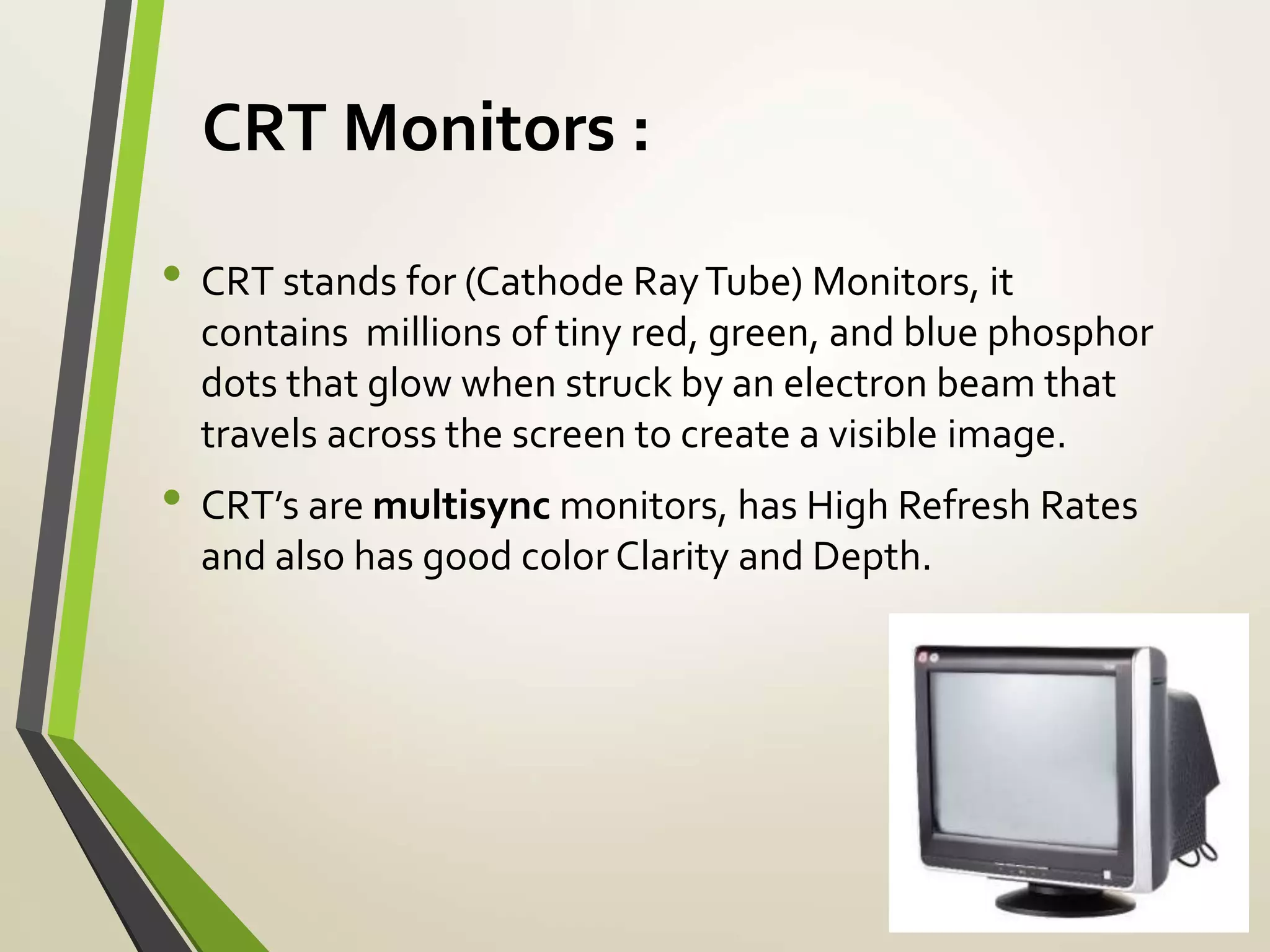
• CRT stands for (Cathode RayTube) Monitors, it
contains millions of tiny red, green, and blue phosphor
dots that glow when struck by an electron beam that
travels across the screen to create a visible image.
• CRT’s are multisync monitors, has High Refresh Rates
and also has good color Clarity and Depth.
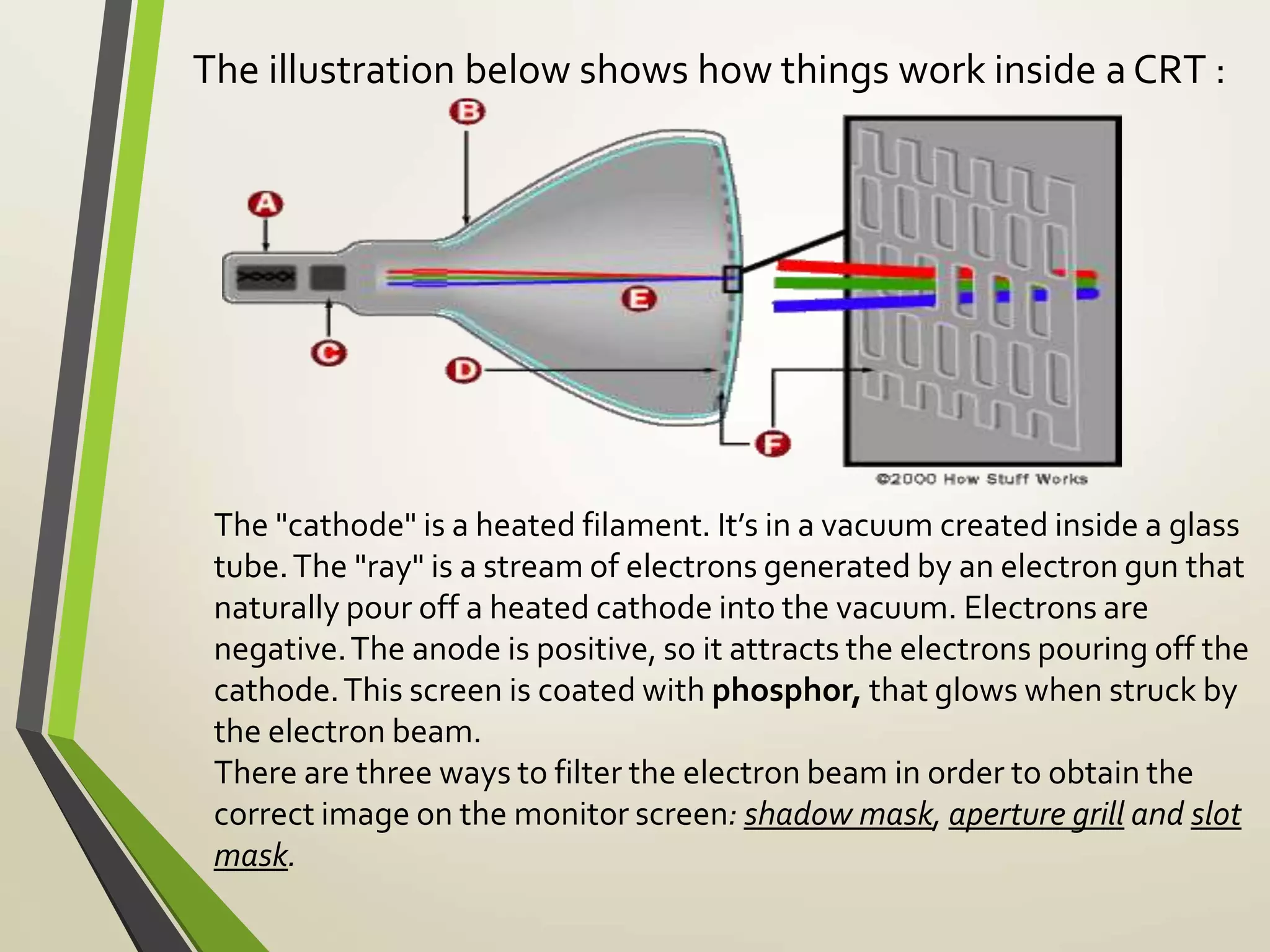
The illustration below shows how things work inside a CRT :
The "cathode" is a heated filament. It’s in a vacuum created inside a glass
tube.The "ray" is a stream of electrons generated by an electron gun that
naturally pour off a heated cathode into the vacuum. Electrons are
negative.The anode is positive, so it attracts the electrons pouring off the
cathode.This screen is coated with phosphor, that glows when struck by
the electron beam.
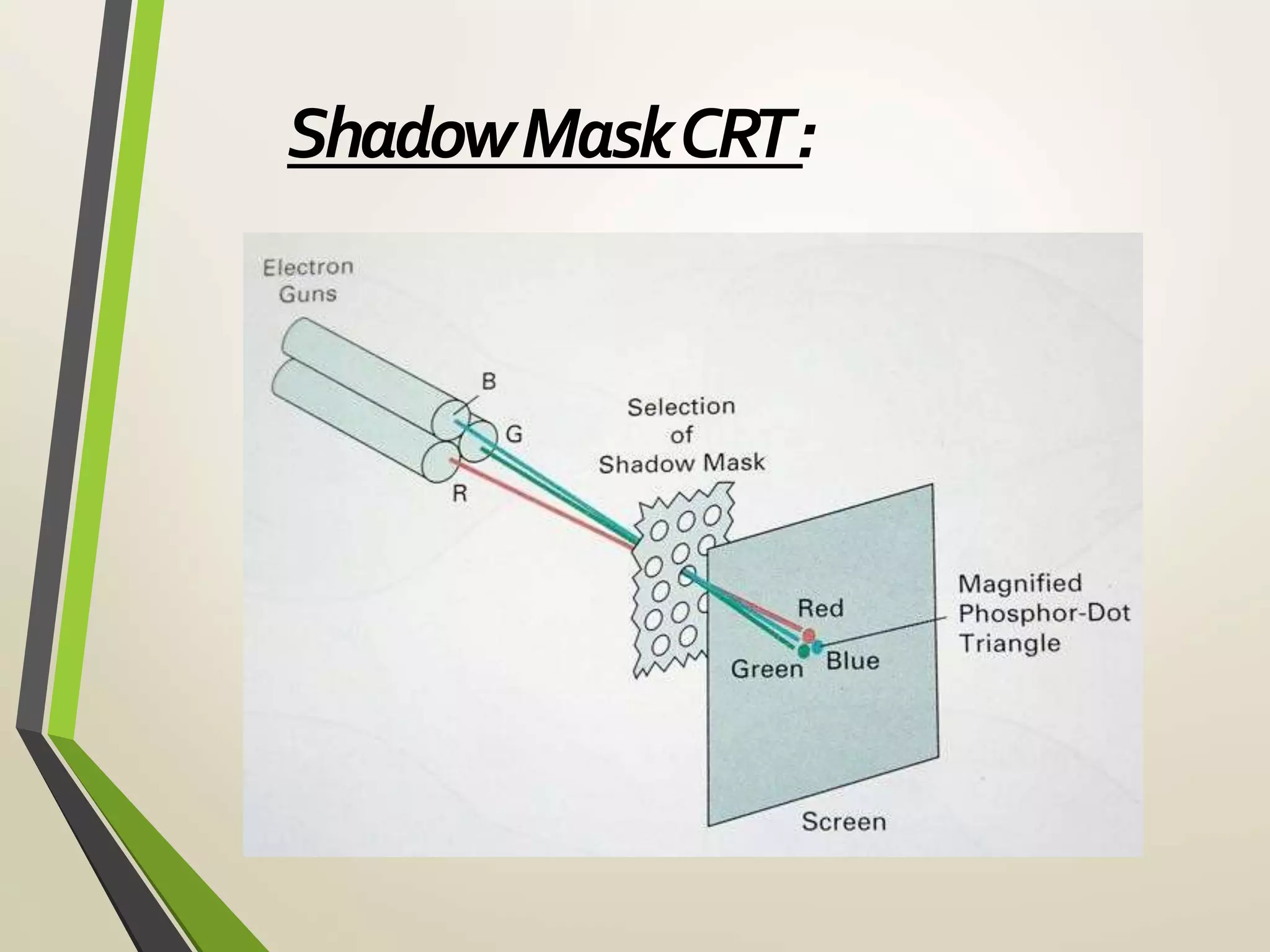
There are three ways to filter the electron beam in order to obtain the
correct image on the monitor screen: shadow mask, aperture grill and slot
mask.
ShadowMaskCRT:
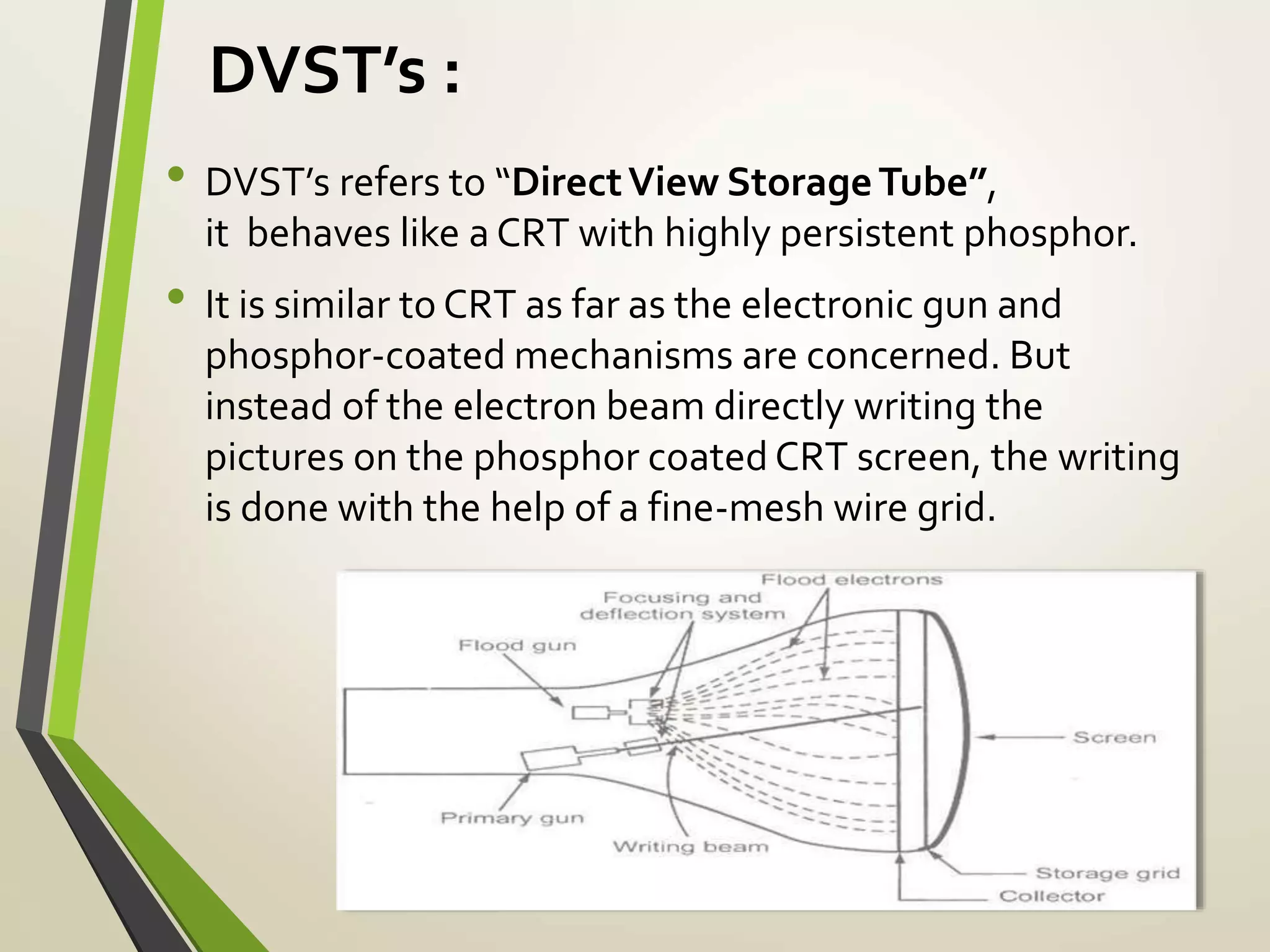
DVST’s :
• DVST’s refers to “DirectView StorageTube”,
it behaves like a CRT with highly persistent phosphor.
• It is similar to CRT as far as the electronic gun and
phosphor-coated mechanisms are concerned. But
instead of the electron beam directly writing the
pictures on the phosphor coated CRT screen, the writing
is done with the help of a fine-mesh wire grid.
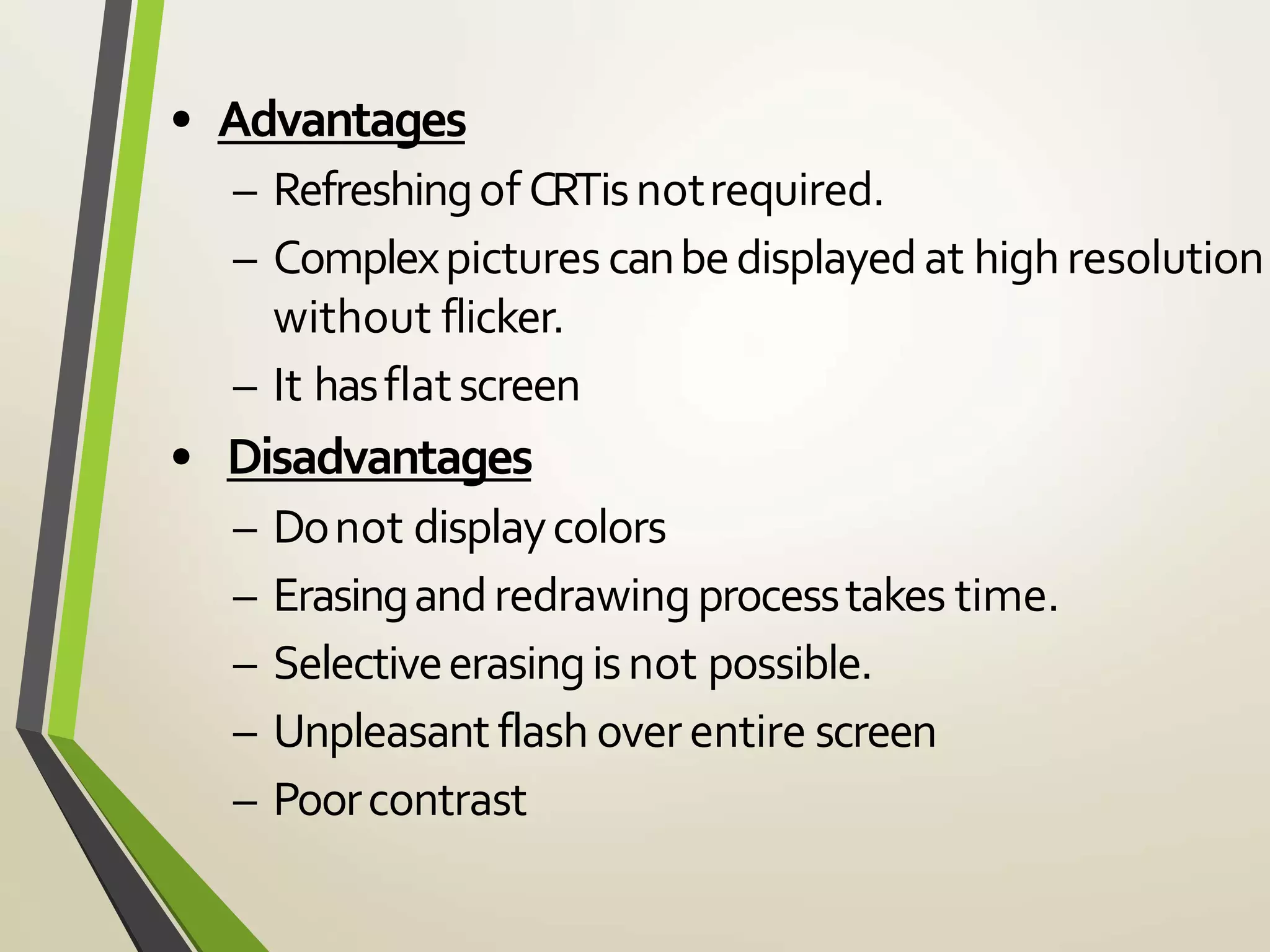
• Advantages
– Refreshingof CRTisnotrequired.
– Complexpicturescanbedisplayedat highresolution
without flicker.
– It hasflatscreen
• Disadvantages
– Donot displaycolors
– Erasingandredrawingprocesstakes time.
– Selectiveerasingisnot possible.
– Unpleasantflash overentire screen
– Poorcontrast
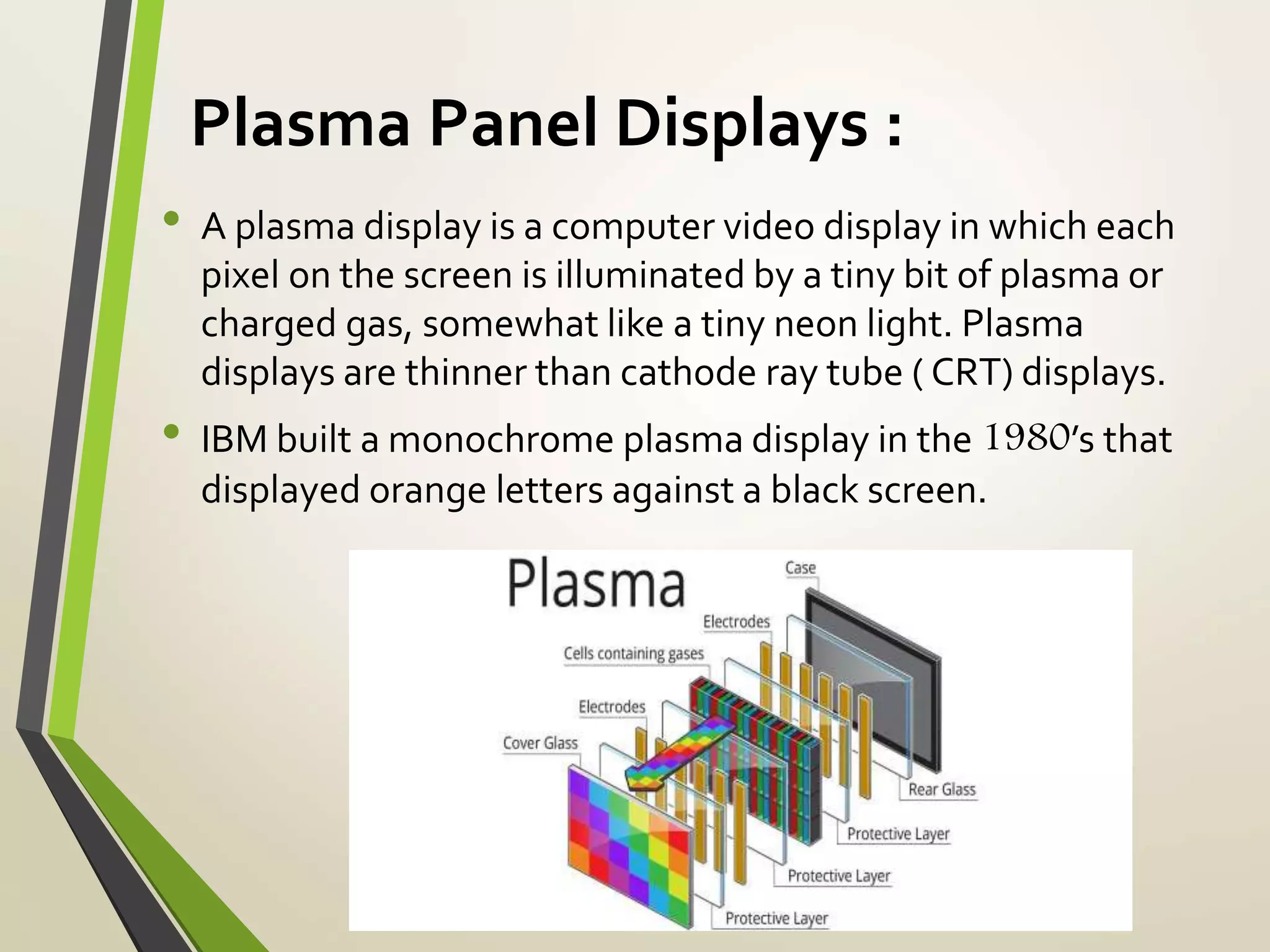
Plasma Panel Displays :
• A plasma display is a computer video display in which each
pixel on the screen is illuminated by a tiny bit of plasma or
charged gas, somewhat like a tiny neon light. Plasma
displays are thinner than cathode ray tube ( CRT) displays.
• IBM built a monochrome plasma display in the 1980’s that
displayed orange letters against a black screen.
• Advantages
– Refreshingisnotrequired
– Steadyimagefree offlicker
– Lessbulky thanCRT
– Allowsselectivewriting anderasing
– Flatscreenandtransparent
• Disadvantages
– Poorresolution (60dots perinch)
– Complexaddressingandwriting
– CostlierthanCRT
LCD :
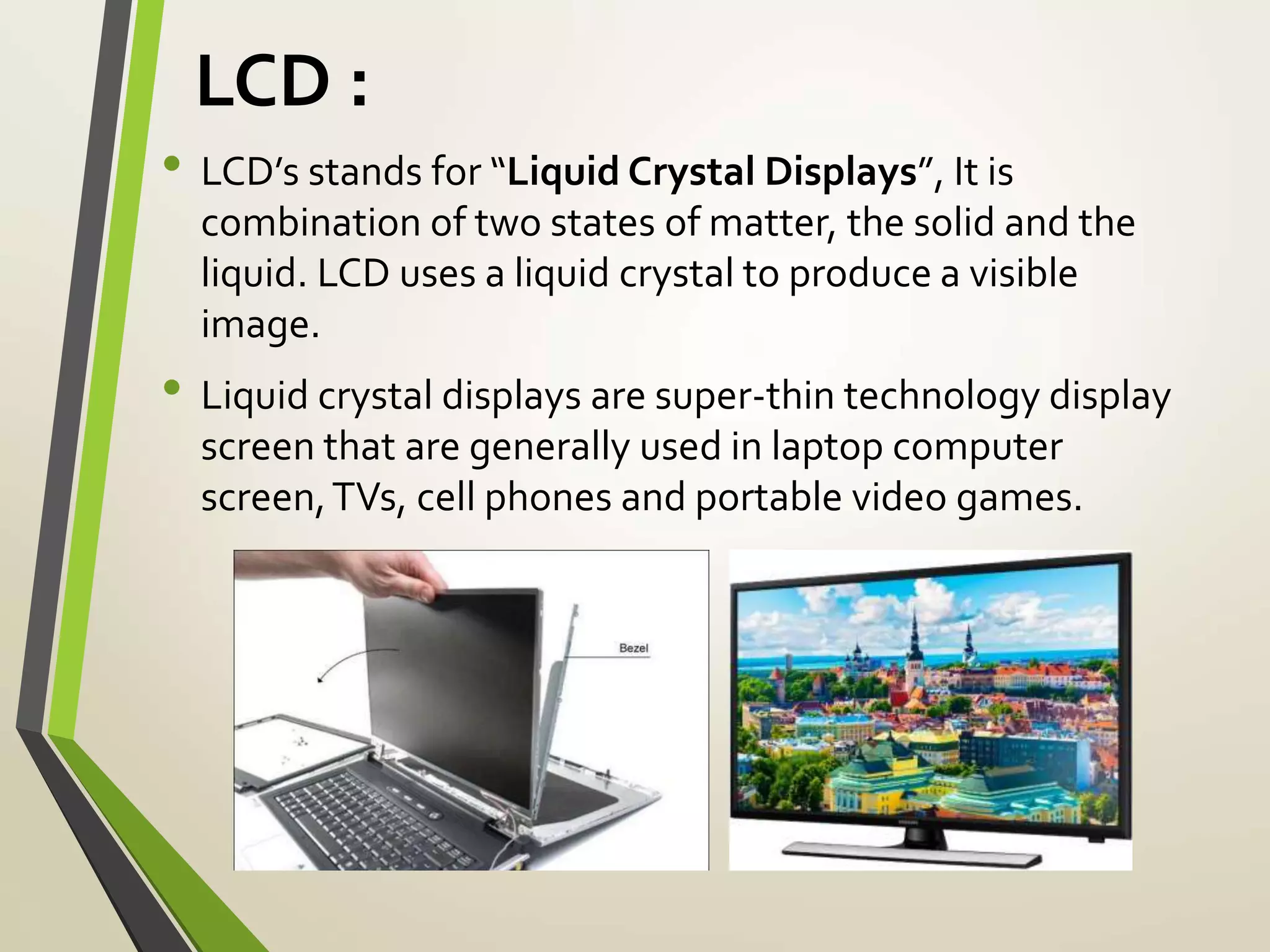
• LCD’s stands for “Liquid Crystal Displays”, It is
combination of two states of matter, the solid and the
liquid. LCD uses a liquid crystal to produce a visible
image.
• Liquid crystal displays are super-thin technology display
screen that are generally used in laptop computer
screen,TVs, cell phones and portable video games.
ADVANTAGES :- DISADVANTAGES :-
i. It is very compact, thin,
and light than CRT
displays.
ii. The LCD can be made in
large sizes of over 60 inch
or 150 cm diagonal.
iii. It does not affect by the
magnetic fields.
iv. Due to low power
consumption, small heat
emitted during operation.
v. It does not affect by the
magnetic fields.
i. In high temperature
environments there is loss of
contrast.
ii. It is relatively bright but not
suitable for very brightly
environments.
iii. It consumed a lot of electricity
which produce a lot of heat.
iv. It has individual liquid crystals
which cannot complete all block
of the backlight.
v. From the viewing angle, the
colour and contrast not
consistent.
LED :
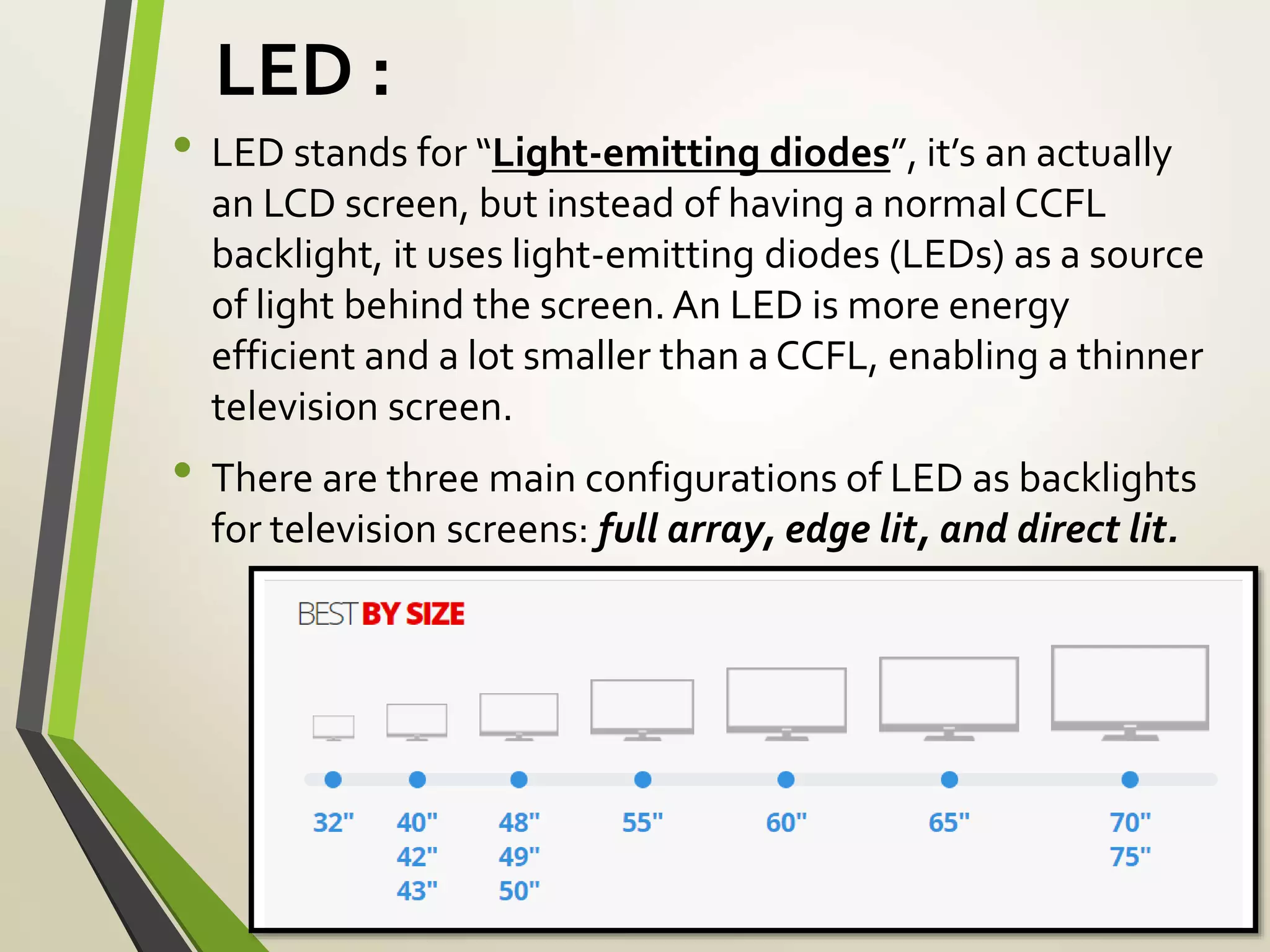
• LED stands for “Light-emitting diodes”, it’s an actually
an LCD screen, but instead of having a normal CCFL
backlight, it uses light-emitting diodes (LEDs) as a source
of light behind the screen. An LED is more energy
efficient and a lot smaller than a CCFL, enabling a thinner
television screen.
• There are three main configurations of LED as backlights
for television screens: full array, edge lit, and direct lit.
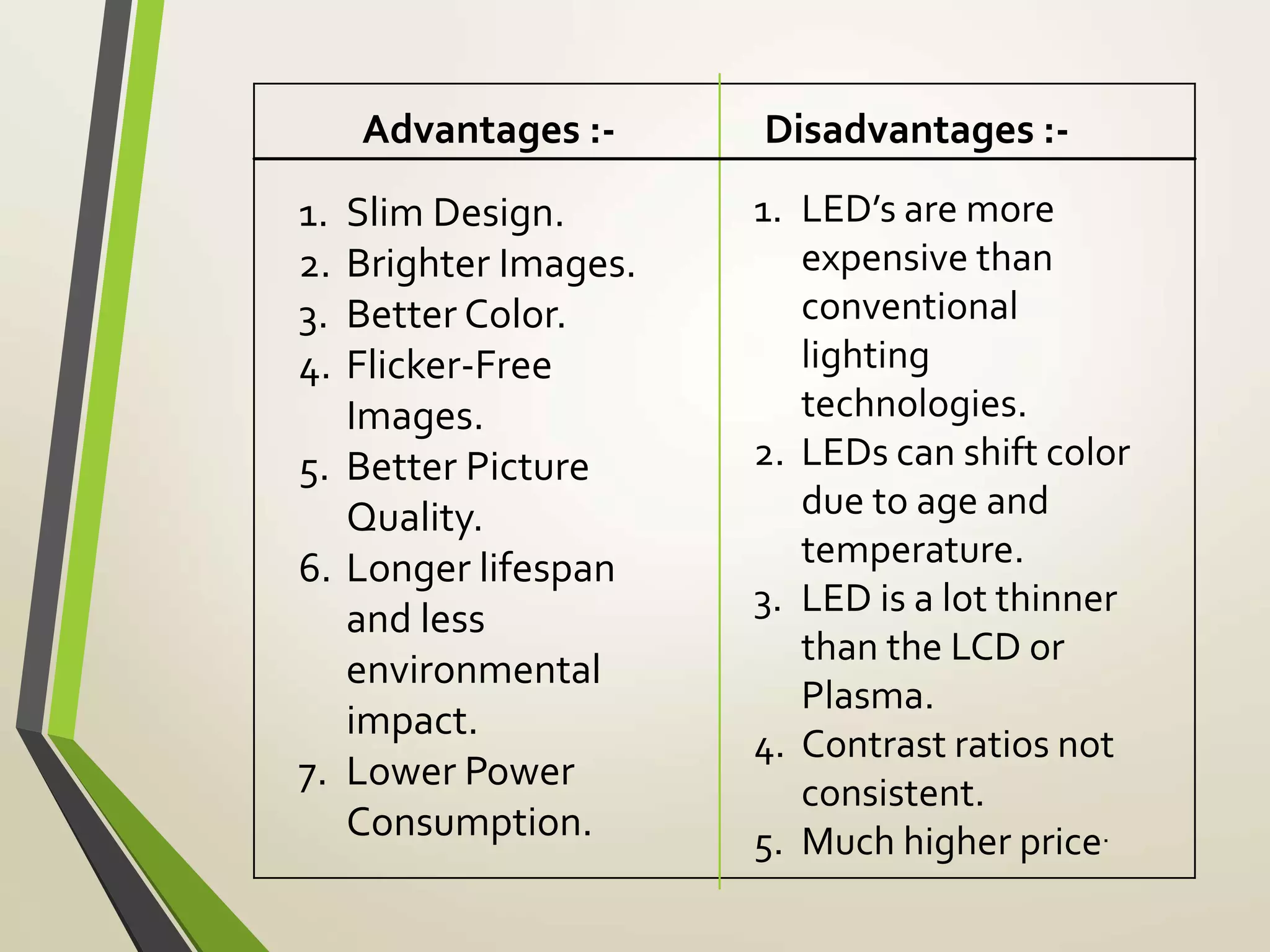
Advantages :- Disadvantages :-
1. Slim Design.
2. Brighter Images.
3. Better Color.
4. Flicker-Free
Images.
5. Better Picture
Quality.
6. Longer lifespan
and less
environmental
impact.
7. Lower Power
Consumption.
1. LED’s are more
expensive than
conventional
lighting
technologies.
2. LEDs can shift color
due to age and
temperature.
3. LED is a lot thinner
than the LCD or
Plasma.
4. Contrast ratios not
consistent.
5. Much higher price.
References :
• Websites:
•http://en.wikipedia.org
• ComputerArchitecture and Organization
–ByA. P.Godse (from books.google.com)
• Computer Organization
–By Hamacher andZaky
–https://www.quora.com/
ThankYou forYour
Time & Attention
Have a nice day

Video displays in computer organisation

  • 1.
    Video Displays in ComputerOrganisation SUBMITTED BY :- MANAV GOEL (16CSU192) KASHIESH PATHAK (16CSU168). SUBMITTEDTO :- DR. A. CHARAN KUMARI CSL212
  • 2.
  • 3.
    INDEX :- •CRT Monitor •DVST •PlasmaPanel Displays •LCD Displays •LED Displays
  • 4.
    CRT Monitors : •CRT stands for (Cathode RayTube) Monitors, it contains millions of tiny red, green, and blue phosphor dots that glow when struck by an electron beam that travels across the screen to create a visible image. • CRT’s are multisync monitors, has High Refresh Rates and also has good color Clarity and Depth.
  • 5.
    The illustration belowshows how things work inside a CRT : The "cathode" is a heated filament. It’s in a vacuum created inside a glass tube.The "ray" is a stream of electrons generated by an electron gun that naturally pour off a heated cathode into the vacuum. Electrons are negative.The anode is positive, so it attracts the electrons pouring off the cathode.This screen is coated with phosphor, that glows when struck by the electron beam. There are three ways to filter the electron beam in order to obtain the correct image on the monitor screen: shadow mask, aperture grill and slot mask.
  • 6.
  • 7.
    DVST’s : • DVST’srefers to “DirectView StorageTube”, it behaves like a CRT with highly persistent phosphor. • It is similar to CRT as far as the electronic gun and phosphor-coated mechanisms are concerned. But instead of the electron beam directly writing the pictures on the phosphor coated CRT screen, the writing is done with the help of a fine-mesh wire grid.
  • 8.
    • Advantages – RefreshingofCRTisnotrequired. – Complexpicturescanbedisplayedat highresolution without flicker. – It hasflatscreen • Disadvantages – Donot displaycolors – Erasingandredrawingprocesstakes time. – Selectiveerasingisnot possible. – Unpleasantflash overentire screen – Poorcontrast
  • 9.
    Plasma Panel Displays: • A plasma display is a computer video display in which each pixel on the screen is illuminated by a tiny bit of plasma or charged gas, somewhat like a tiny neon light. Plasma displays are thinner than cathode ray tube ( CRT) displays. • IBM built a monochrome plasma display in the 1980’s that displayed orange letters against a black screen.
  • 10.
    • Advantages – Refreshingisnotrequired –Steadyimagefree offlicker – Lessbulky thanCRT – Allowsselectivewriting anderasing – Flatscreenandtransparent • Disadvantages – Poorresolution (60dots perinch) – Complexaddressingandwriting – CostlierthanCRT
  • 11.
    LCD : • LCD’sstands for “Liquid Crystal Displays”, It is combination of two states of matter, the solid and the liquid. LCD uses a liquid crystal to produce a visible image. • Liquid crystal displays are super-thin technology display screen that are generally used in laptop computer screen,TVs, cell phones and portable video games.
  • 12.
    ADVANTAGES :- DISADVANTAGES:- i. It is very compact, thin, and light than CRT displays. ii. The LCD can be made in large sizes of over 60 inch or 150 cm diagonal. iii. It does not affect by the magnetic fields. iv. Due to low power consumption, small heat emitted during operation. v. It does not affect by the magnetic fields. i. In high temperature environments there is loss of contrast. ii. It is relatively bright but not suitable for very brightly environments. iii. It consumed a lot of electricity which produce a lot of heat. iv. It has individual liquid crystals which cannot complete all block of the backlight. v. From the viewing angle, the colour and contrast not consistent.
  • 13.
    LED : • LEDstands for “Light-emitting diodes”, it’s an actually an LCD screen, but instead of having a normal CCFL backlight, it uses light-emitting diodes (LEDs) as a source of light behind the screen. An LED is more energy efficient and a lot smaller than a CCFL, enabling a thinner television screen. • There are three main configurations of LED as backlights for television screens: full array, edge lit, and direct lit.
  • 14.
    Advantages :- Disadvantages:- 1. Slim Design. 2. Brighter Images. 3. Better Color. 4. Flicker-Free Images. 5. Better Picture Quality. 6. Longer lifespan and less environmental impact. 7. Lower Power Consumption. 1. LED’s are more expensive than conventional lighting technologies. 2. LEDs can shift color due to age and temperature. 3. LED is a lot thinner than the LCD or Plasma. 4. Contrast ratios not consistent. 5. Much higher price.
  • 15.
    References : • Websites: •http://en.wikipedia.org •ComputerArchitecture and Organization –ByA. P.Godse (from books.google.com) • Computer Organization –By Hamacher andZaky –https://www.quora.com/
  • 16.
    ThankYou forYour Time &Attention Have a nice day