








Security systemswww.blazeautomation .com
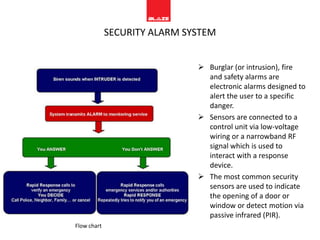
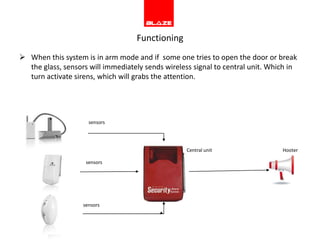
SECURITY ALARM SYSTEMBurglar (or intrusion), fire and safety alarms are electronic alarms designed to alert the user to a specific danger.
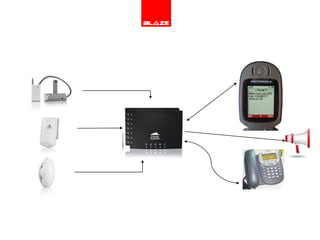
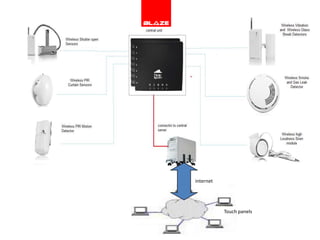
Sensors are connected to a control unit via low-voltage wiring or a narrowband RF signal which is used to interact with a response device.
The most common security sensors are used to indicate the opening of a door or window or detect motion via passive infrared (PIR).Flow chart
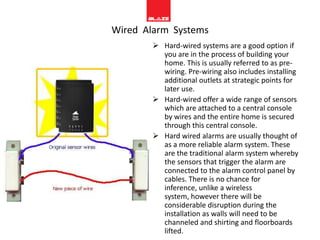
Wired  Alarm  SystemsHard-wired systems are a good option if you are in the process of building your home. This is usually referred to as pre-wiring. Pre-wiring also includes installing additional outlets at strategic points for later use.
Hard-wired offer a wide range of sensors which are attached to a central console by wires and the entire home is secured through this central console.
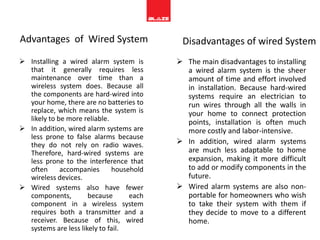
Hard wired alarms are usually thought of as a more reliable alarm system. These are the traditional alarm system whereby the sensors that trigger the alarm are connected to the alarm control panel by cables. There is no chance for inference, unlike a wireless system, however there will be considerable disruption during the installation as walls will need to be channeled and shirting and floorboards lifted.Advantages  of  Wired SystemDisadvantages of wired SystemInstalling a wired alarm system is that it generally requires less maintenance over time than a wireless system does. Because all the components are hard-wired into your home, there are no batteries to replace, which means the system is likely to be more reliable.
In addition, wired alarm systems are less prone to false alarms because they do not rely on radio waves. Therefore, hard-wired systems are less prone to the interference that often accompanies household wireless devices.
Wired systems also have fewer components, because each component in a wireless system requires both a transmitter and a receiver. Because of this, wired systems are less likely to fail.
The main disadvantages to installing a wired alarm system is the sheer amount of time and effort involved in installation. Because hard-wired systems require an electrician to run wires through all the walls in your home to connect protection points, installation is often much more costly and labor-intensive.
In addition, wired alarm systems are much less adaptable to home expansion, making it more difficult to add or modify components in the future.
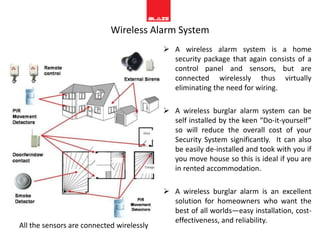
Wired alarm systems are also non-portable for homeowners who wish to take their system with them if they decide to move to a different home.Wireless Alarm SystemA wireless alarm system is a home security package that again consists of a control panel and sensors, but are connected wirelessly thus virtually eliminating the need for wiring.
A wireless burglar alarm system can be self installed by the keen “Do-it-yourself” so will reduce the overall cost of your Security System significantly.  It can also be easily de-installed and took with you if you move house so this is ideal if you are in rented accommodation.
A wireless burglar alarm is an excellent solution for homeowners who want the best of all worlds—easy installation, cost-effectiveness, and reliability.All the sensors are connected wirelessly
Advantages of WirelessDisadvantages of WirelessBattery Dependence :: Sophisticated burglars can disable a wired system by cutting the right wires. With wireless systems, there are no wires, so a burglar needs to disable each individual component.
Alerts :: Wired alarm systems have the capacity to alert the police or a security served. While some wireless alarms can dial 911 and play a recorded message, they mostly just make a loud noise.
Range::Wireless systems operate via radio signals, which means each component must be within range of the central station. For large houses, that may leave certain areas unsecured
Portability:: Wireless alarm systems don't need an elaborate set up. When you move, you can disconnect all the components very easily and take them with you.
Independence:: Wireless alarms are not connected to the power grid in your house. Batteries allow them to function even in the event of a blackout.
Anti- sabotage:: Sophisticated burglars can disable a wired system by cutting the right wires. With wireless systems, there are no wires, so a burglar needs to disable each individual component.COMPONENTS OF SECURITY SYSTEMSCentral Unit
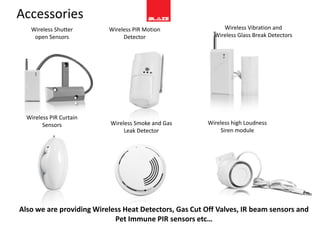
Door/Window Magnetic sensors.
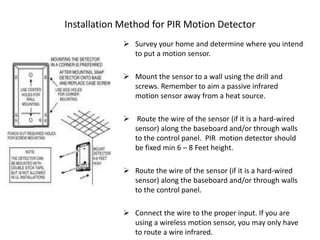
PIR Motion Detectors.
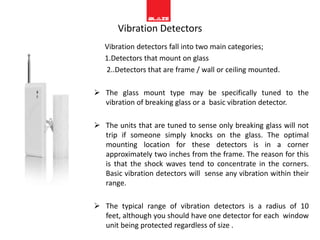
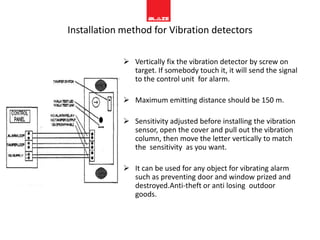
Vibration Detectors.
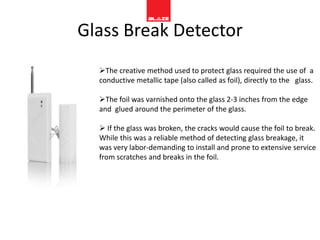
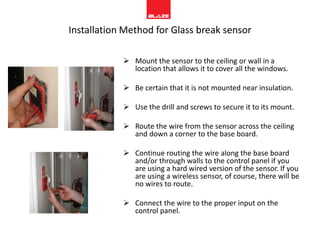
Glass break Detectors.
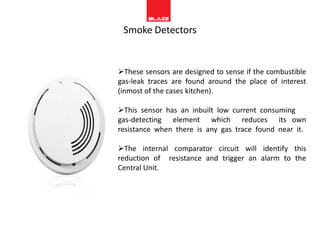
Gas Leak Detectors.
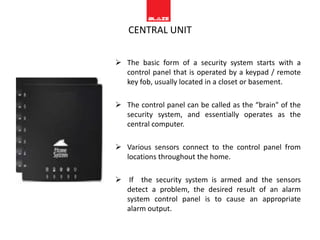
Smoke Detector.CENTRAL UNITThe basic form of a security system starts with a control panel that is operated by a keypad / remote key fob, usually located in a closet or basement.
The control panel can be called as the “brain" of the security system, and essentially operates as the central computer.
Various sensors connect to the control panel from locations throughout the home.
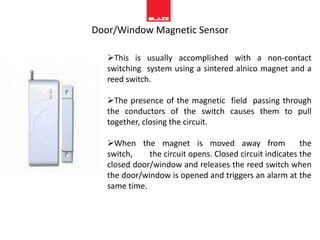
 If  the security system is armed and the sensors detect a problem, the desired result of an alarm system control panel is to cause an appropriate alarm output.Door/Window Magnetic Sensor This is usually accomplished with a non-contact     switching  system using a sintered alnico magnet and a reed switch.
The presence of the magnetic  field  passing through the conductors of the switch causes them to pull together, closing the circuit.
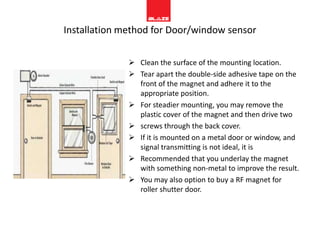
When the magnet is moved away from  the switch,        the circuit opens. Closed circuit indicates the closed door/window and releases the reed switch when the door/window is opened and triggers an alarm at the same time.     Installation method for Door/window sensorClean the surface of the mounting location.
Tear apart the double-side adhesive tape on the front of the magnet and adhere it to the appropriate position.
For steadier mounting, you may remove the plastic cover of the magnet and then drive two

Security Alarm Systems blaze automation

  • 1.
  • 2.
    SECURITY ALARM SYSTEMBurglar(or intrusion), fire and safety alarms are electronic alarms designed to alert the user to a specific danger.
  • 3.
    Sensors are connectedto a control unit via low-voltage wiring or a narrowband RF signal which is used to interact with a response device.
  • 4.
    The most commonsecurity sensors are used to indicate the opening of a door or window or detect motion via passive infrared (PIR).Flow chart
  • 5.
    Wired Alarm SystemsHard-wired systems are a good option if you are in the process of building your home. This is usually referred to as pre-wiring. Pre-wiring also includes installing additional outlets at strategic points for later use.
  • 6.
    Hard-wired offer awide range of sensors which are attached to a central console by wires and the entire home is secured through this central console.
  • 7.
    Hard wired alarmsare usually thought of as a more reliable alarm system. These are the traditional alarm system whereby the sensors that trigger the alarm are connected to the alarm control panel by cables. There is no chance for inference, unlike a wireless system, however there will be considerable disruption during the installation as walls will need to be channeled and shirting and floorboards lifted.Advantages of Wired SystemDisadvantages of wired SystemInstalling a wired alarm system is that it generally requires less maintenance over time than a wireless system does. Because all the components are hard-wired into your home, there are no batteries to replace, which means the system is likely to be more reliable.
  • 8.
    In addition, wiredalarm systems are less prone to false alarms because they do not rely on radio waves. Therefore, hard-wired systems are less prone to the interference that often accompanies household wireless devices.
  • 9.
    Wired systems alsohave fewer components, because each component in a wireless system requires both a transmitter and a receiver. Because of this, wired systems are less likely to fail.
  • 10.
    The main disadvantagesto installing a wired alarm system is the sheer amount of time and effort involved in installation. Because hard-wired systems require an electrician to run wires through all the walls in your home to connect protection points, installation is often much more costly and labor-intensive.
  • 11.
    In addition, wiredalarm systems are much less adaptable to home expansion, making it more difficult to add or modify components in the future.
  • 12.
    Wired alarm systemsare also non-portable for homeowners who wish to take their system with them if they decide to move to a different home.Wireless Alarm SystemA wireless alarm system is a home security package that again consists of a control panel and sensors, but are connected wirelessly thus virtually eliminating the need for wiring.
  • 13.
    A wireless burglaralarm system can be self installed by the keen “Do-it-yourself” so will reduce the overall cost of your Security System significantly. It can also be easily de-installed and took with you if you move house so this is ideal if you are in rented accommodation.
  • 14.
    A wireless burglaralarm is an excellent solution for homeowners who want the best of all worlds—easy installation, cost-effectiveness, and reliability.All the sensors are connected wirelessly
  • 15.
    Advantages of WirelessDisadvantagesof WirelessBattery Dependence :: Sophisticated burglars can disable a wired system by cutting the right wires. With wireless systems, there are no wires, so a burglar needs to disable each individual component.
  • 16.
    Alerts :: Wiredalarm systems have the capacity to alert the police or a security served. While some wireless alarms can dial 911 and play a recorded message, they mostly just make a loud noise.
  • 17.
    Range::Wireless systems operatevia radio signals, which means each component must be within range of the central station. For large houses, that may leave certain areas unsecured
  • 18.
    Portability:: Wireless alarmsystems don't need an elaborate set up. When you move, you can disconnect all the components very easily and take them with you.
  • 19.
    Independence:: Wireless alarmsare not connected to the power grid in your house. Batteries allow them to function even in the event of a blackout.
  • 20.
    Anti- sabotage:: Sophisticatedburglars can disable a wired system by cutting the right wires. With wireless systems, there are no wires, so a burglar needs to disable each individual component.COMPONENTS OF SECURITY SYSTEMSCentral Unit
  • 21.
  • 22.
  • 23.
  • 24.
  • 25.
  • 26.
    Smoke Detector.CENTRAL UNITThebasic form of a security system starts with a control panel that is operated by a keypad / remote key fob, usually located in a closet or basement.
  • 27.
    The control panelcan be called as the “brain" of the security system, and essentially operates as the central computer.
  • 28.
    Various sensors connectto the control panel from locations throughout the home.
  • 29.
    If the security system is armed and the sensors detect a problem, the desired result of an alarm system control panel is to cause an appropriate alarm output.Door/Window Magnetic Sensor This is usually accomplished with a non-contact switching system using a sintered alnico magnet and a reed switch.
  • 30.
    The presence ofthe magnetic field passing through the conductors of the switch causes them to pull together, closing the circuit.
  • 31.
    When the magnetis moved away from the switch, the circuit opens. Closed circuit indicates the closed door/window and releases the reed switch when the door/window is opened and triggers an alarm at the same time. Installation method for Door/window sensorClean the surface of the mounting location.
  • 32.
    Tear apart thedouble-side adhesive tape on the front of the magnet and adhere it to the appropriate position.
  • 33.
    For steadier mounting,you may remove the plastic cover of the magnet and then drive two