

1Human Impact on the environment
2When you look at the history of humanity it's basically a relationship between the two most complicated systems on Earth :Human society and nature.Now , We are causing the devastation to our very foundation of our life system that has given us birth.We should come out of the illusion that people are separate from nature.
PollutionSince the industrial revolution, society has had a tendency to assume that the environment can absorb any amount of pollution.Many of the most disastrous incidents of pollution involve industrial chemicals that are toxic or carcinogenic3Pollution from thermal power plant
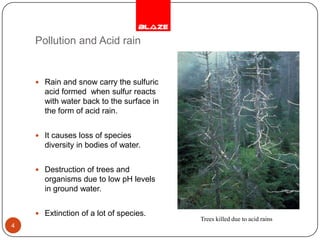
Pollution and Acid rainRain and snow carry the sulfuric acid formed  when sulfur reacts with water back to the surface in the form of acid rain.It causes loss of species diversity in bodies of water.Destruction of trees and organisms due to low pH levels in ground water.Extinction of a lot of species.4Trees killed due to acid rains
Depletion of Ozone LayerChlorofluorocarbons (CFCs) are a class of chemicals involved in ozone destruction.Coolant in refrigerators and air conditioners propellant in aerosol dispensers release CFCs.Ozone depletion will cause and increase in the number of people who develop skin cancer and cataract.5Ozone layer
Global WarmingCarbon dioxide in the atmosphere influences global temperatures.Global warming during Earth's current interglacial warmperiod has greatly altered our environment and the distribution and diversity of all life. Global surface temperature increased 0.74 ± 0.18 °C (1.33 ± 0.32 °F) between the    start and the end of the 20th centuryBroader effects are expected to include glacial retreat, arctic shrinkage,  including long-term shrinkage of  Greenland ice sheet, and worldwide sera level rise  due to global warming.6
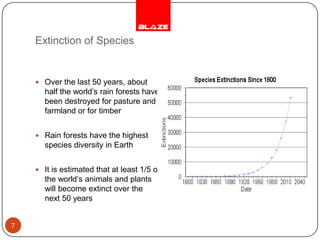
Extinction of SpeciesOver the last 50 years, about half the world’s rain forests have been destroyed for pasture and farmland or for timberRain forests have the highest species diversity in EarthIt is estimated that at least 1/5 of the world’s animals and plants will become extinct over the next 50 years7
Non-replaceable ResourcesFossil fuels: Fossil fuels like coal, natural gas and petroleum products once  used are not replaceable  and will add global warming gasses in to the environment.Loss of top soil: by repeatedly turning over soil to eliminate weeds, by allowing animals to overgraze ranges and pastures, and by practicing poor land management we permit the wind and rain to remove more and morePollution and depletion of ground water: Water seeps into aquifers at too slow a rate to replace the large amount of water being withdrawn for unnecessary use (watering lawns, washing cars, and running fountains)8
Examples of Disastrous EventsIn the early 1970s, Lake Erie was so polluted from large amounts of industrial chemicals that few fish could survive thereThe Exxon Valdez ran aground on the Alaska coast in 1989, spilling 11 million gallons of oil and killing thousands of marine animals.  Even today the evidence of damage to local wildlife continues to mountUN estimates by the middle of the century there may be 150 million environmental refugees at any given time from climate change.9Katrina
Natural calamities 10
The 5 components of solving any environmental problem11AssessmentRisk analysisPublic educationPolitical actionFollow-through
Assessment12The gathering of informationData collectionPerforming experimentsMake predictions
Risk Analysis13Use the information from assessment to predict the consequences of environmental interventionEvaluate the potential to solve the problem as well as any adverse effects the plan might create
Public Education14Inform the publicExplain the problem in understandable termsPresent alternative actionsExplain probable costs and results
Political Action15The public, through its elected officials, selects and implements a course of action.Exercise your right to vote.Write to elected officials.Support special interest groups.
Global Warming SolutionsReducing the amount of gas released in the atmosphere :energy efficiency renewable energy vehicle technology solutions Increase the efficiency of photosynthesis 16
Why aren't we responding to climate change?First and foremost : economy    >>The greatest weapon of mass destruction is corporate economic globalization.     >>People think that, to implement eco-friendly measures    is  expensive.Lack of awareness     >>Many people still don’t know what is green house effect.    >>what extent it is damging our eco-system17
Fundamental opportunity cost of economic growthAs the economy grows, it displaces, it encroaches upon the biosphere, and this is a fundamental costWhat would it cost us to take carbon dioxide out of the air and put oxygen back in it, which all the green things do for us for nothing.What would it cost to pollinating all of the flowering plants.In our modern globalized world  growth continues to be the focus of many corporations and governments  who deplete our environment for economic gain.  18
What blaze can offer?Blaze considered both environment and economy  to design products which keep balance between both of them.
One of its kind is BLAZE occupancy  based lighting system.
On an average 30% of the energy  on lighting  can saved by implementing occupancy based lighting.
There are other indirect benefits from occupancy based lighting. Refer to annexure 1 19
How occupancy based lighting works (example)Provide light when and where it is required – an egress path for late night workers eliminates unnecessary energy usage after hours.20
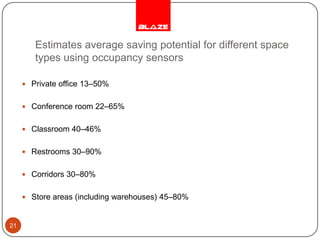
Estimates average saving potential for different space types using occupancy sensors Private office 13–50%Conference room 22–65%Classroom 40–46%Restrooms 30–90%Corridors 30–80%Store areas (including warehouses) 45–80%21
Detection pattern of Occupancy sensors22
Features Blaze Occupancy sensorsAll occupancy detection sensors feature advanced robust wireless RF platform Easy installation with out retrofit or reconstructionOn-board management selectable setting for maximum control without requiring advanced technical knowledgeMultiple rooms, HVAC and balcony doors easily accommodated with no additional wiring required Occupancy detection only requires single occupant movement.         Wide range of cost effective and reliable occupancy sensor are  available with BLAZE23

Blazeautomation Occupancy Based Lighting

  • 1.
    1Human Impact onthe environment
  • 2.
    2When you lookat the history of humanity it's basically a relationship between the two most complicated systems on Earth :Human society and nature.Now , We are causing the devastation to our very foundation of our life system that has given us birth.We should come out of the illusion that people are separate from nature.
  • 3.
    PollutionSince the industrialrevolution, society has had a tendency to assume that the environment can absorb any amount of pollution.Many of the most disastrous incidents of pollution involve industrial chemicals that are toxic or carcinogenic3Pollution from thermal power plant
  • 4.
    Pollution and AcidrainRain and snow carry the sulfuric acid formed when sulfur reacts with water back to the surface in the form of acid rain.It causes loss of species diversity in bodies of water.Destruction of trees and organisms due to low pH levels in ground water.Extinction of a lot of species.4Trees killed due to acid rains
  • 5.
    Depletion of OzoneLayerChlorofluorocarbons (CFCs) are a class of chemicals involved in ozone destruction.Coolant in refrigerators and air conditioners propellant in aerosol dispensers release CFCs.Ozone depletion will cause and increase in the number of people who develop skin cancer and cataract.5Ozone layer
  • 6.
    Global WarmingCarbon dioxidein the atmosphere influences global temperatures.Global warming during Earth's current interglacial warmperiod has greatly altered our environment and the distribution and diversity of all life. Global surface temperature increased 0.74 ± 0.18 °C (1.33 ± 0.32 °F) between the start and the end of the 20th centuryBroader effects are expected to include glacial retreat, arctic shrinkage,  including long-term shrinkage of  Greenland ice sheet, and worldwide sera level rise due to global warming.6
  • 7.
    Extinction of SpeciesOverthe last 50 years, about half the world’s rain forests have been destroyed for pasture and farmland or for timberRain forests have the highest species diversity in EarthIt is estimated that at least 1/5 of the world’s animals and plants will become extinct over the next 50 years7
  • 8.
    Non-replaceable ResourcesFossil fuels:Fossil fuels like coal, natural gas and petroleum products once used are not replaceable and will add global warming gasses in to the environment.Loss of top soil: by repeatedly turning over soil to eliminate weeds, by allowing animals to overgraze ranges and pastures, and by practicing poor land management we permit the wind and rain to remove more and morePollution and depletion of ground water: Water seeps into aquifers at too slow a rate to replace the large amount of water being withdrawn for unnecessary use (watering lawns, washing cars, and running fountains)8
  • 9.
    Examples of DisastrousEventsIn the early 1970s, Lake Erie was so polluted from large amounts of industrial chemicals that few fish could survive thereThe Exxon Valdez ran aground on the Alaska coast in 1989, spilling 11 million gallons of oil and killing thousands of marine animals. Even today the evidence of damage to local wildlife continues to mountUN estimates by the middle of the century there may be 150 million environmental refugees at any given time from climate change.9Katrina
  • 10.
  • 11.
    The 5 componentsof solving any environmental problem11AssessmentRisk analysisPublic educationPolitical actionFollow-through
  • 12.
    Assessment12The gathering ofinformationData collectionPerforming experimentsMake predictions
  • 13.
    Risk Analysis13Use theinformation from assessment to predict the consequences of environmental interventionEvaluate the potential to solve the problem as well as any adverse effects the plan might create
  • 14.
    Public Education14Inform thepublicExplain the problem in understandable termsPresent alternative actionsExplain probable costs and results
  • 15.
    Political Action15The public,through its elected officials, selects and implements a course of action.Exercise your right to vote.Write to elected officials.Support special interest groups.
  • 16.
    Global Warming SolutionsReducingthe amount of gas released in the atmosphere :energy efficiency renewable energy vehicle technology solutions Increase the efficiency of photosynthesis 16
  • 17.
    Why aren't weresponding to climate change?First and foremost : economy >>The greatest weapon of mass destruction is corporate economic globalization. >>People think that, to implement eco-friendly measures is expensive.Lack of awareness >>Many people still don’t know what is green house effect. >>what extent it is damging our eco-system17
  • 18.
    Fundamental opportunity costof economic growthAs the economy grows, it displaces, it encroaches upon the biosphere, and this is a fundamental costWhat would it cost us to take carbon dioxide out of the air and put oxygen back in it, which all the green things do for us for nothing.What would it cost to pollinating all of the flowering plants.In our modern globalized world growth continues to be the focus of many corporations and governments who deplete our environment for economic gain. 18
  • 19.
    What blaze canoffer?Blaze considered both environment and economy to design products which keep balance between both of them.
  • 20.
    One of itskind is BLAZE occupancy based lighting system.
  • 21.
    On an average30% of the energy on lighting can saved by implementing occupancy based lighting.
  • 22.
    There are otherindirect benefits from occupancy based lighting. Refer to annexure 1 19
  • 23.
    How occupancy basedlighting works (example)Provide light when and where it is required – an egress path for late night workers eliminates unnecessary energy usage after hours.20
  • 24.
    Estimates average savingpotential for different space types using occupancy sensors Private office 13–50%Conference room 22–65%Classroom 40–46%Restrooms 30–90%Corridors 30–80%Store areas (including warehouses) 45–80%21
  • 25.
    Detection pattern ofOccupancy sensors22
  • 26.
    Features Blaze OccupancysensorsAll occupancy detection sensors feature advanced robust wireless RF platform Easy installation with out retrofit or reconstructionOn-board management selectable setting for maximum control without requiring advanced technical knowledgeMultiple rooms, HVAC and balcony doors easily accommodated with no additional wiring required Occupancy detection only requires single occupant movement. Wide range of cost effective and reliable occupancy sensor are available with BLAZE23