Cisco@Work Case Study:Closed-Circuit TV Over IPCisco Information TechnologyMay 20, 2004
OverviewChallengeSecurity transitioned from “analog” closed-circuit TV (CCTV) for surveillance to “digital” CCTV for surveillance.  After the transition, Security realized that a different skill set (IT server support) was needed in using servers with hard drives compared to using video cassette recorders (VCRs). SolutionChange from a “silo” support model where Security purchased and self-managed equipment to working closely with IT to deploy standard server equipment for CCTV.ResultsAn “IT-managed” solution for CCTV over IP.Next StepsThe Cisco® Security, Technology, and Systems (STS) department is monitoring the evolution of IP cameras to replace the existing analog cameras.
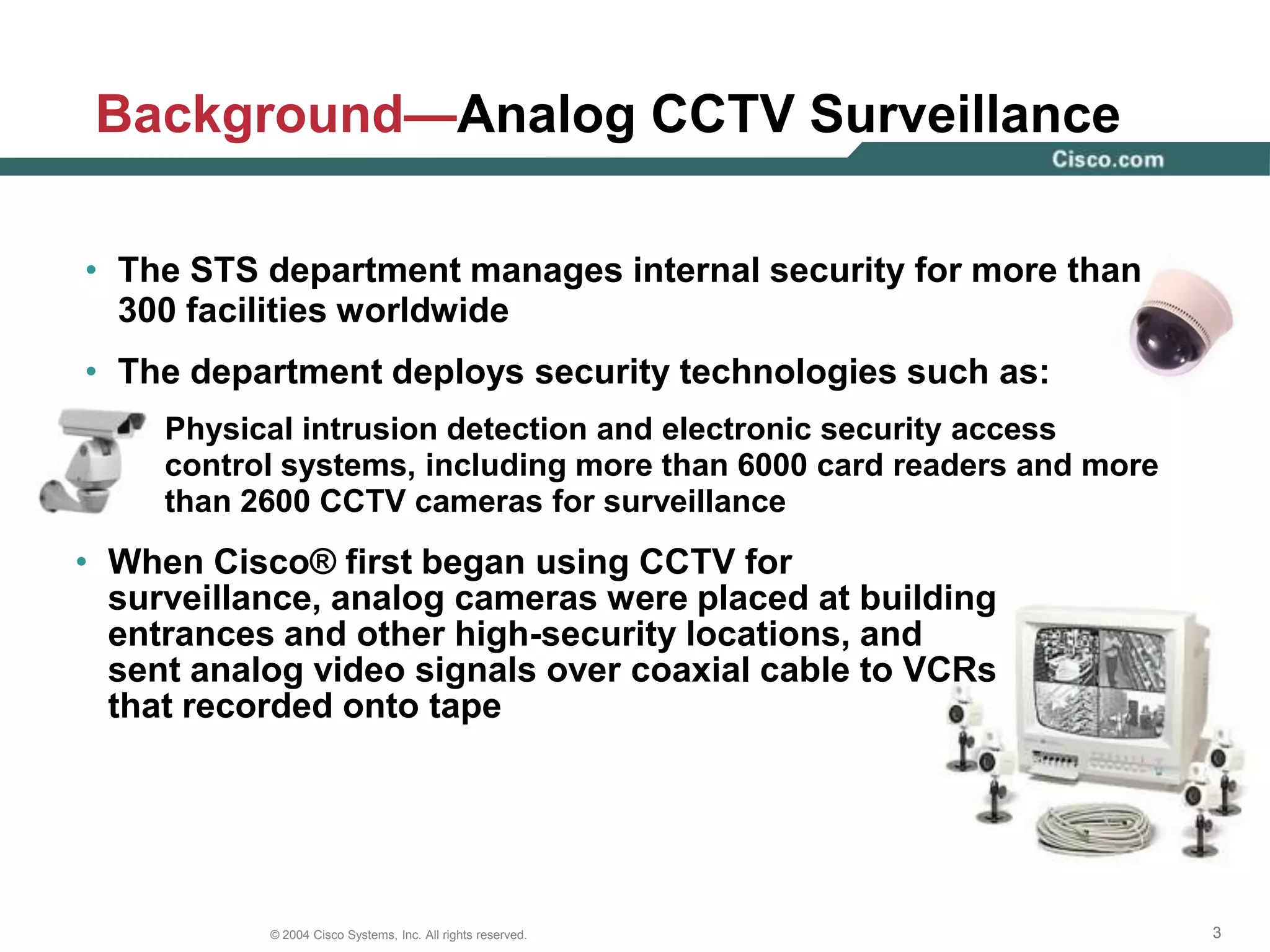
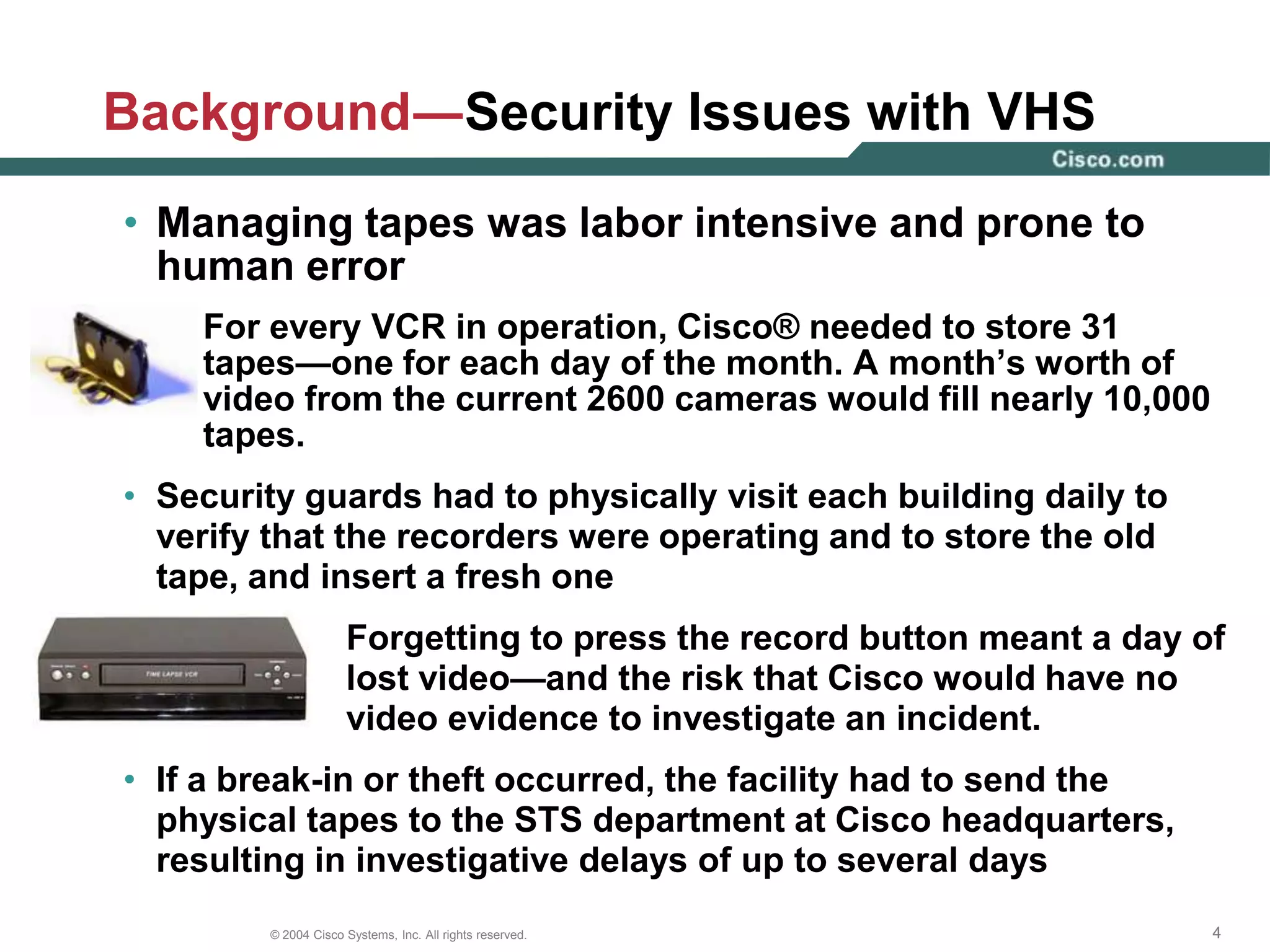
Background—Analog CCTV SurveillanceThe STS department manages internal security for more than 300 facilities worldwide The department deploys security technologies such as:Physical intrusion detection and electronic security access control systems, including more than 6000 card readers and more than 2600 CCTV cameras for surveillance When Cisco® first began using CCTV for surveillance, analog cameras were placed at building entrances and other high-security locations, and sent analog video signals over coaxial cable to VCRs that recorded onto tape Background―Security Issues with VHSManaging tapes was labor intensive and prone to human error For every VCR in operation, Cisco® needed to store 31 tapes—one for each day of the month. A month’s worth of video from the current 2600 cameras would fill nearly 10,000 tapes. Security guards had to physically visit each building daily to verify that the recorders were operating and to store the old tape, and insert a fresh one Forgetting to press the record button meant a day of lost video—and the risk that Cisco would have no video evidence to investigate an incident. If a break-in or theft occurred, the facility had to send the physical tapes to the STS department at Cisco headquarters, resulting in investigative delays of up to several days
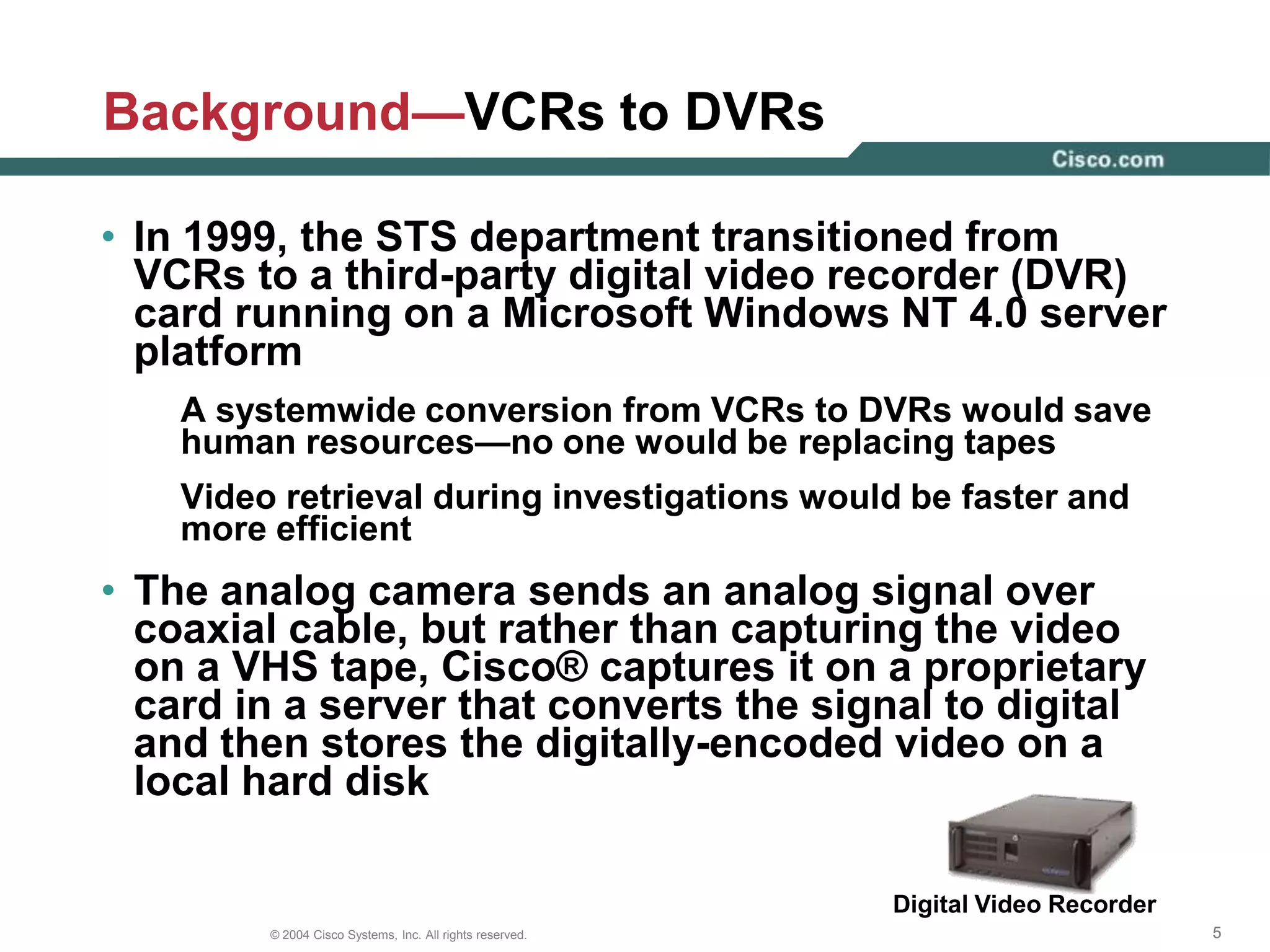
In 1999, the STS department transitioned from VCRs to a third-party digital video recorder (DVR) card running on a Microsoft Windows NT 4.0 server platformA systemwide conversion from VCRs to DVRs would save human resources—no one would be replacing tapesVideo retrieval during investigations would be faster and more efficientThe analog camera sends an analog signal over coaxial cable, but rather than capturing the video on a VHS tape, Cisco® captures it on a proprietary card in a server that converts the signal to digital and then stores the digitally-encoded video on a local hard diskBackground—VCRs to DVRsDigital Video Recorder
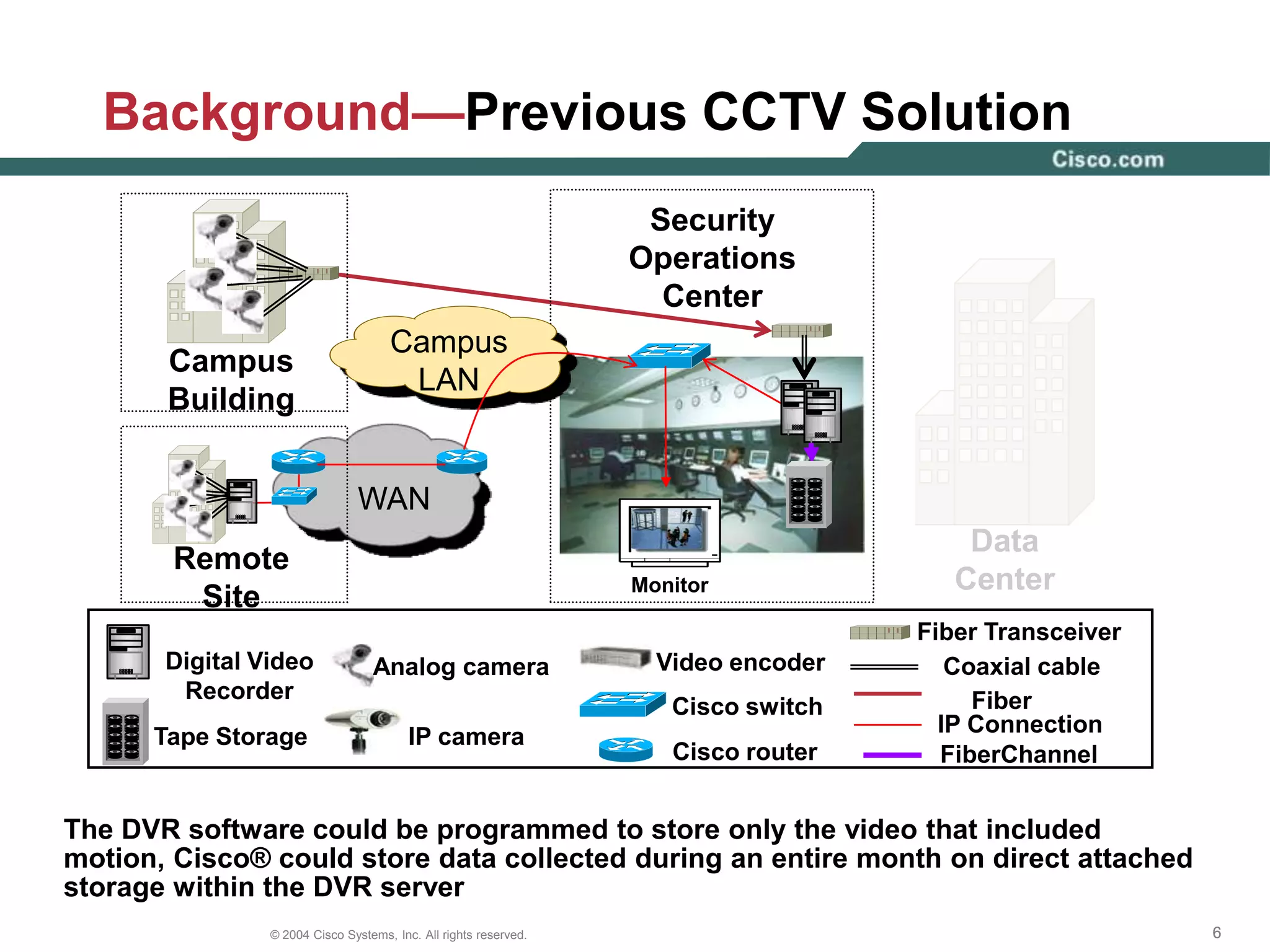
Background—Previous CCTV SolutionSecurity Operations CenterCampus BuildingCampus LANWANData CenterRemote SiteMonitorFiber TransceiverDigital Video RecorderVideo encoder Coaxial cableAnalog cameraFiberCisco switchIP ConnectionTape StorageIP cameraCisco routerFiberChannelThe DVR software could be programmed to store only the video that included motion, Cisco® could store data collected during an entire month on direct attached storage within the DVR server
Challenge—Higher Management Skills NeededAfter storing digital surveillance video on DVRs, the system grew until the STS department found itself managing more than 330 servers at Cisco® facilities worldwideThe department was overburdened with keeping these 330 servers online and up to date with the latest software patchesThe major problem resulting from our transition to digital surveillance video was that servers with hard drives require a higher management skill set compared with VCRsTraditional security investigators do not understand server software patches, secure access, and data backups, and these are among the IT Infrastructure group’s core competencies
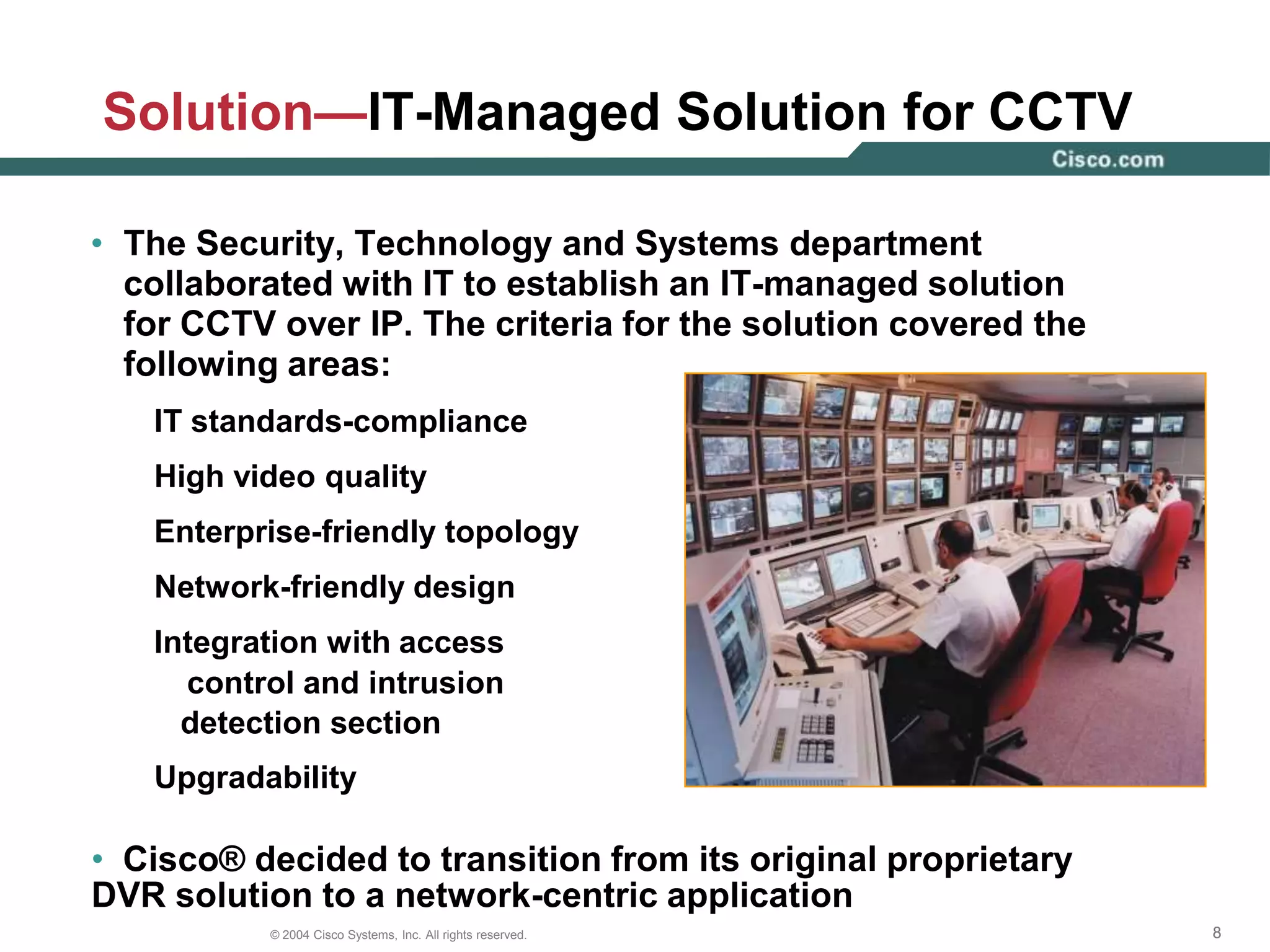
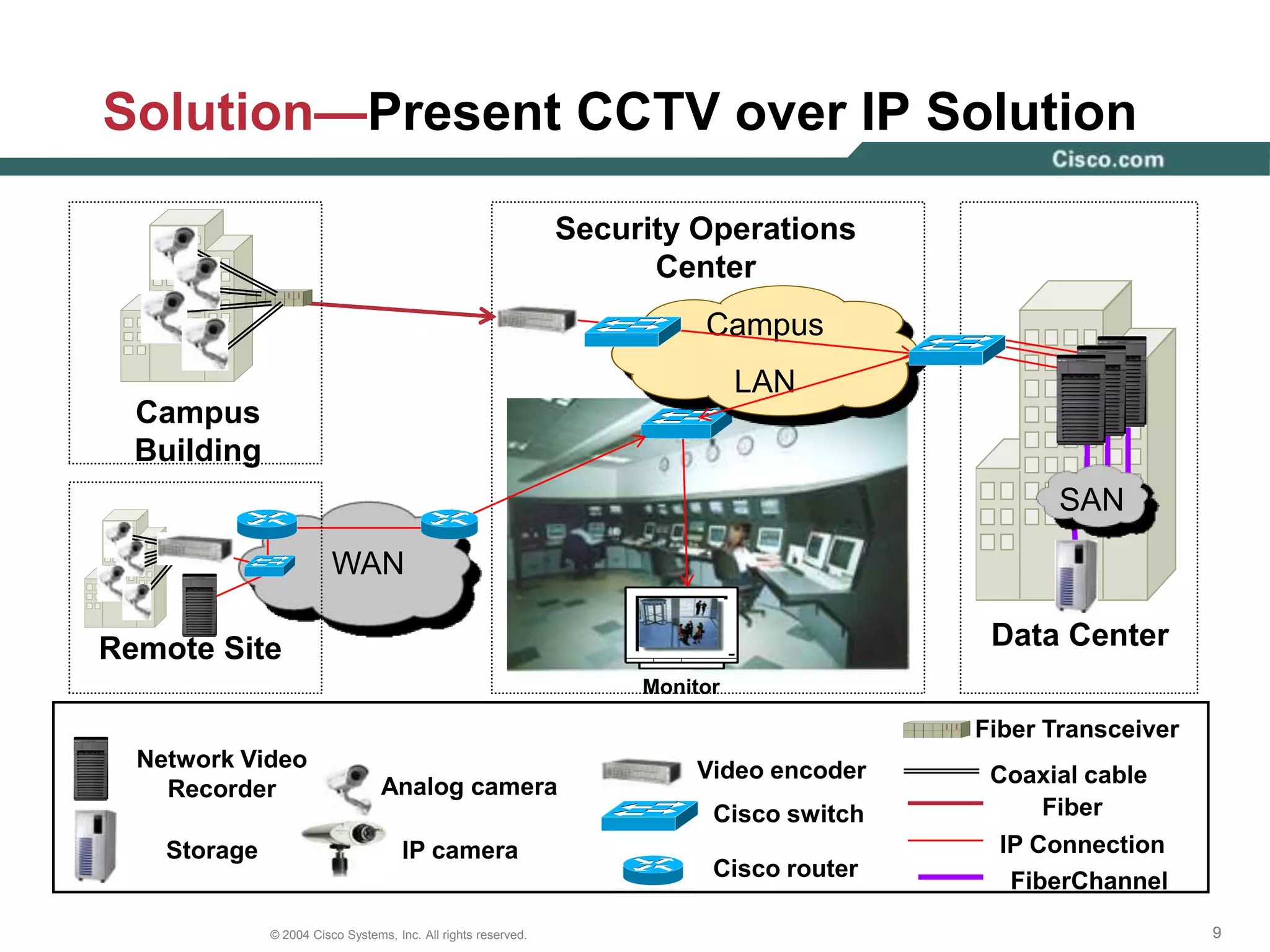
Solution—IT-Managed Solution for CCTVThe Security, Technology and Systems department collaborated with IT to establish an IT-managed solution for CCTV over IP. The criteria for the solution covered the following areas:IT standards-complianceHigh video qualityEnterprise-friendly topologyNetwork-friendly designIntegration with access	control and intrusion    detection sectionUpgradability  Cisco® decided to transition from its original proprietary DVR solution to a network-centric application Solution—PresentCCTV over IP SolutionSecurity Operations CenterCampus BuildingCampus LANSANWANMonitorData CenterRemote SiteFiber TransceiverNetwork Video RecorderVideo encoder Coaxial cableAnalog cameraFiberCisco switchIP ConnectionStorageIP cameraCisco routerFiberChannel
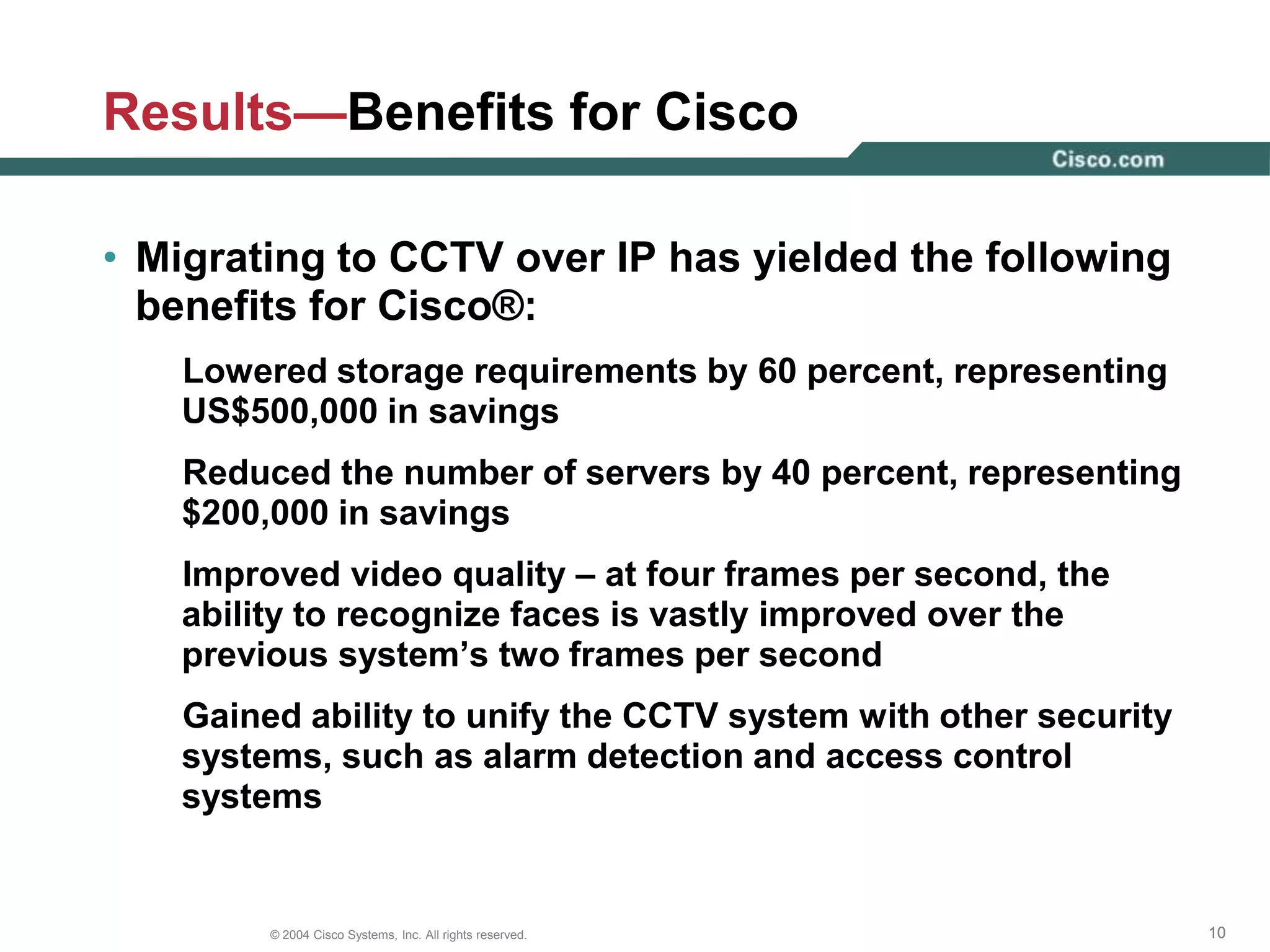
Results—Benefits for CiscoMigrating to CCTV over IP has yielded the following benefits for Cisco®:Lowered storage requirements by 60 percent, representing US$500,000 in savings Reduced the number of servers by 40 percent, representing $200,000 in savings Improved video quality – at four frames per second, the ability to recognize faces is vastly improved over the previous system’s two frames per secondGained ability to unify the CCTV system with other security systems, such as alarm detection and access control systems
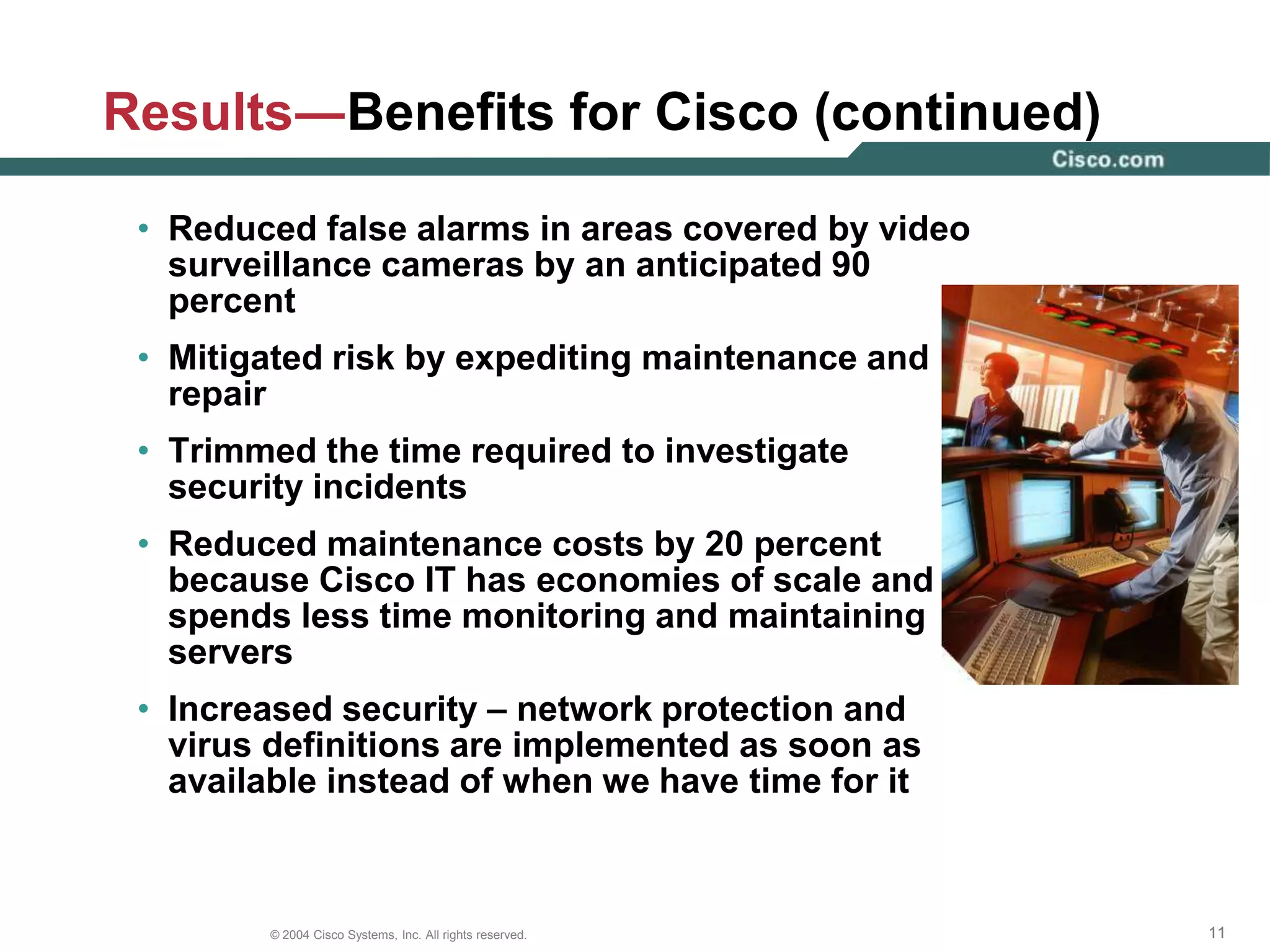
Reduced false alarms in areas covered by video surveillance cameras by an anticipated 90 percent
Mitigated risk by expediting maintenance and repair
Trimmed the time required to investigate security incidents
Reduced maintenance costs by 20 percent because Cisco IT has economies of scale and spends less time monitoring and maintaining servers
Increased security – network protection and virus definitions are implemented as soon as available instead of when we have time for itResults―Benefits for Cisco (continued)
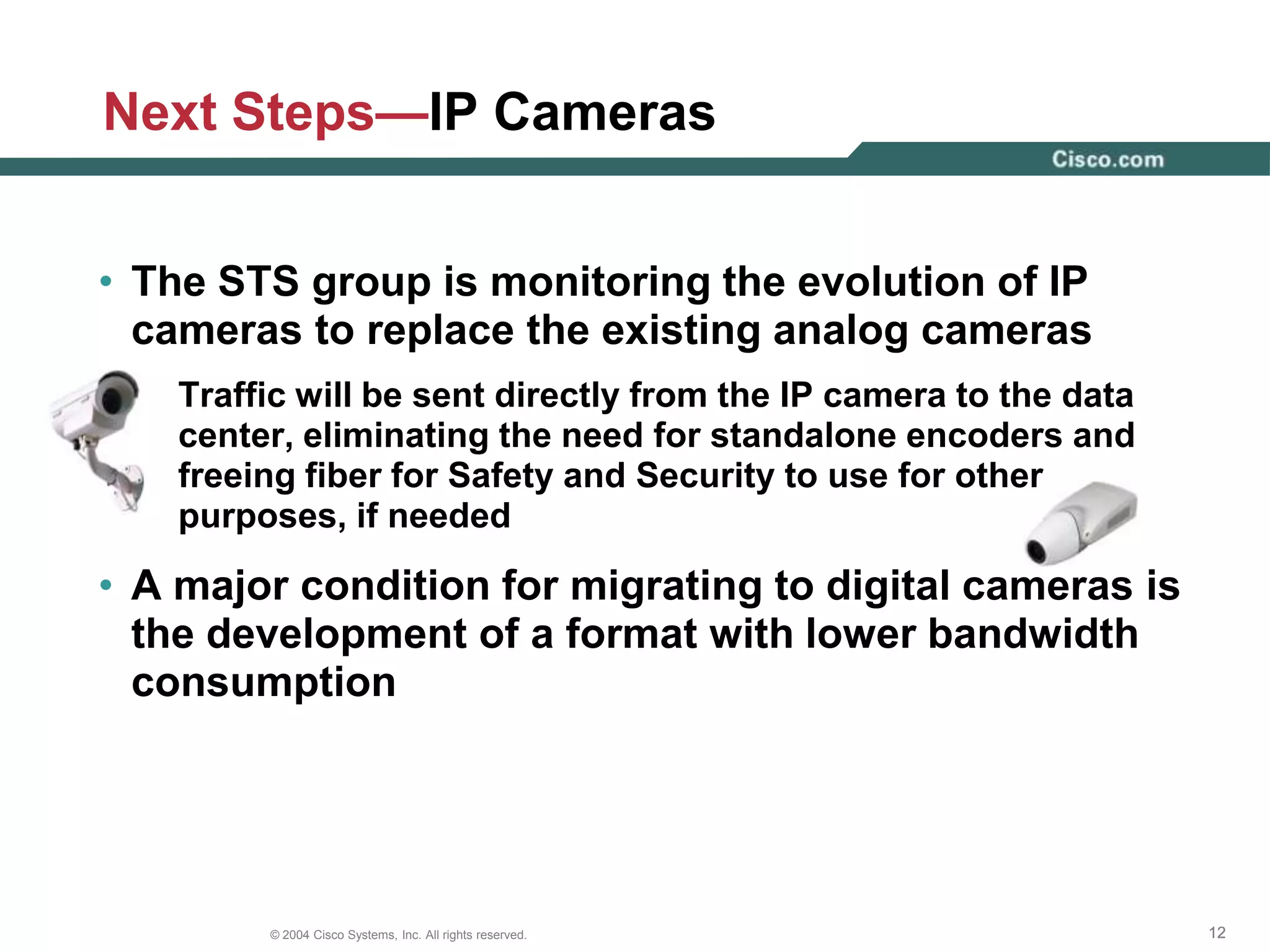
Next Steps—IP CamerasThe STS group is monitoring the evolution of IP cameras to replace the existing analog camerasTraffic will be sent directly from the IP camera to the data center, eliminating the need for standalone encoders and freeing fiber for Safety and Security to use for other purposes, if neededA major condition for migrating to digital cameras is the development of a format with lower bandwidth consumption
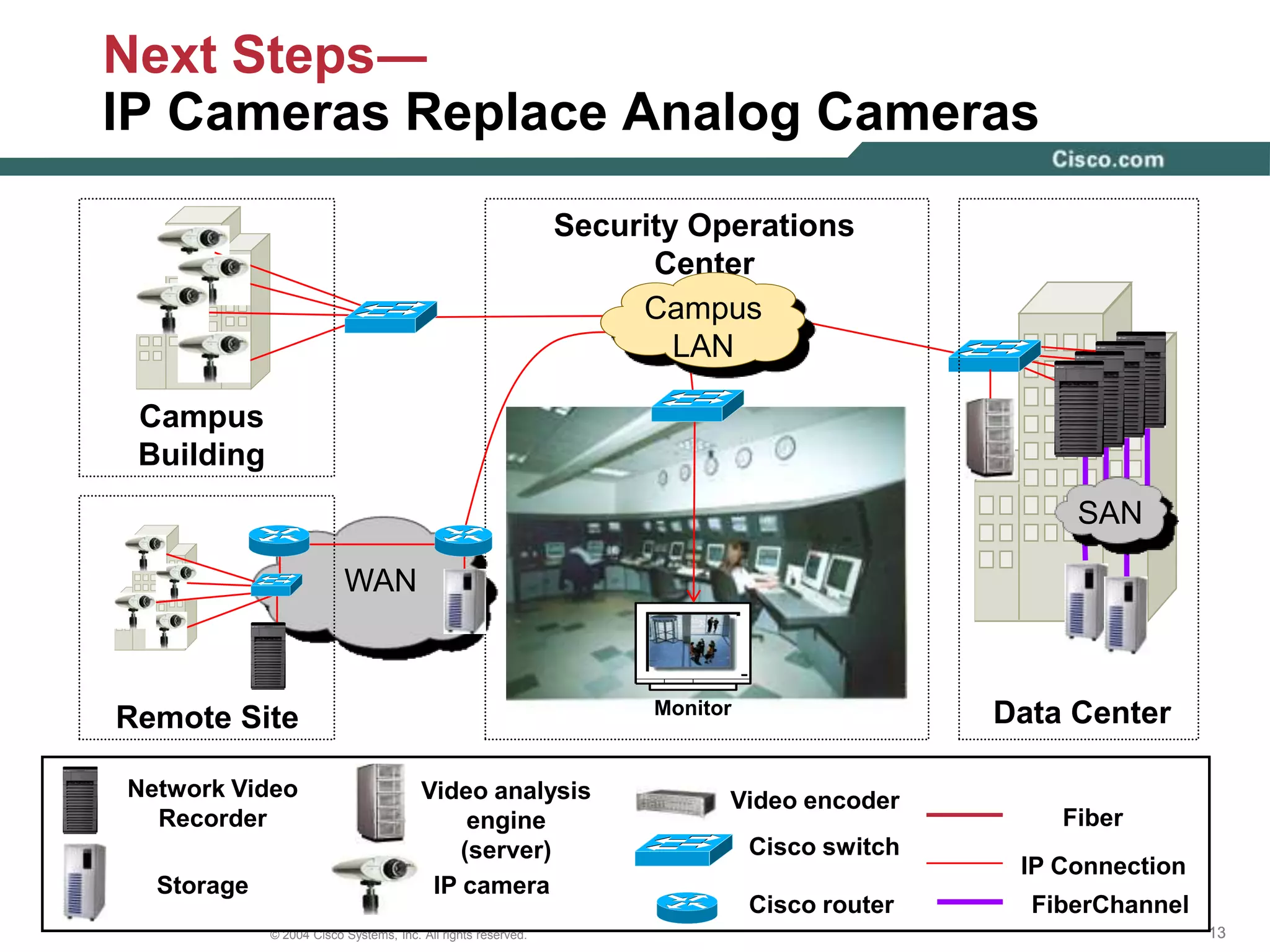
Next Steps―IP Cameras Replace Analog CamerasSecurity Operations CenterCampus BuildingCampus LANSANWANMonitorData CenterRemote SiteNetwork Video RecorderVideo analysis engine (server)Video encoder FiberCisco switchIP ConnectionStorageIP cameraCisco routerFiberChannel
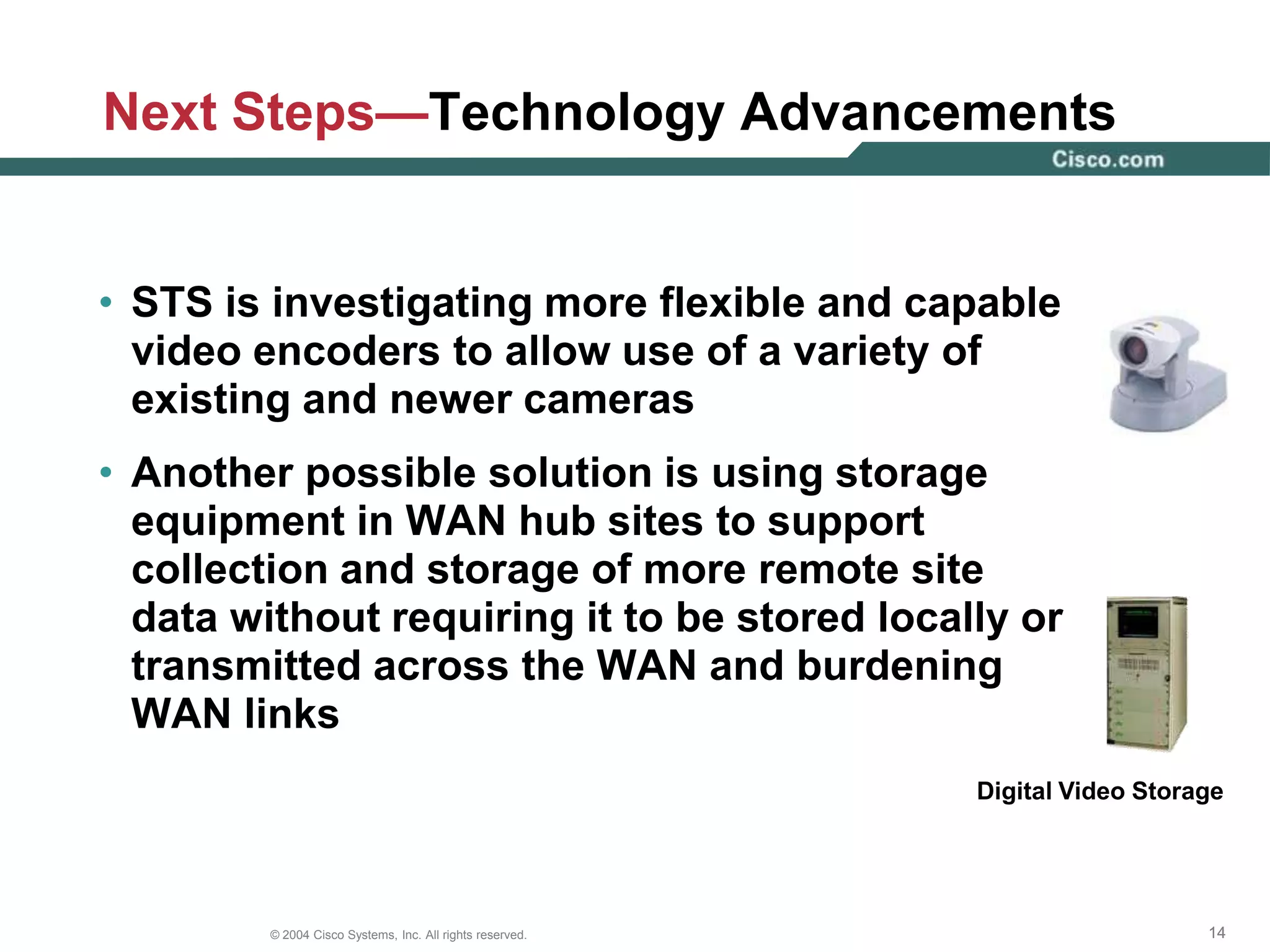
STS is investigating more flexible and capable video encoders to allow use of a variety of existing and newer camerasAnother possible solution is using storage equipment in WAN hub sites to support collection and storage of more remote site data without requiring it to be stored locally or transmitted across the WAN and burdening WAN linksNext Steps—Technology AdvancementsDigital Video Storage
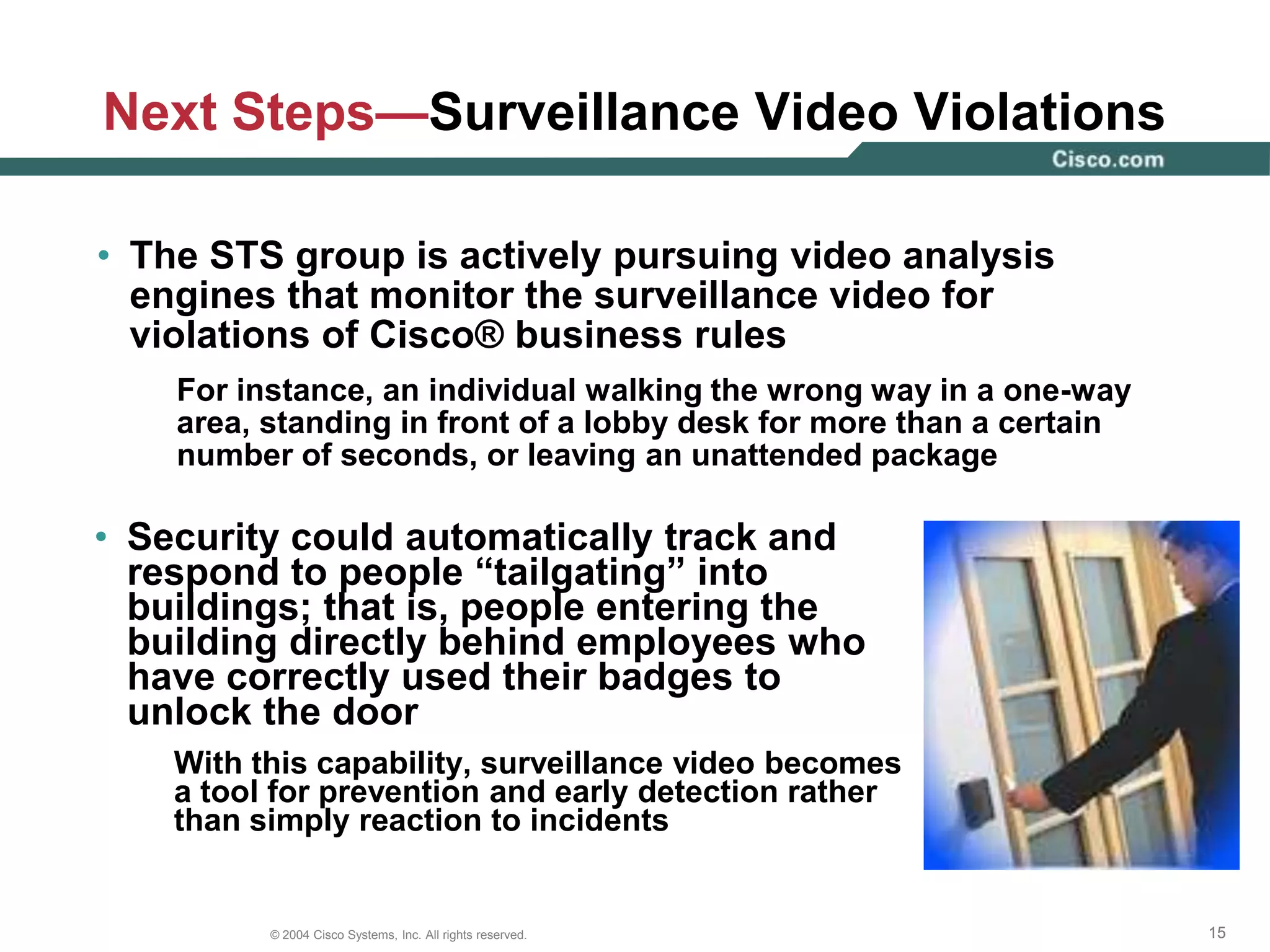
Security could automatically track and respond to people “tailgating” into buildings; that is, people entering the building directly behind employees who have correctly used their badges to unlock the doorWith this capability, surveillance video becomes a tool for prevention and early detection rather than simply reaction to incidentsNext Steps—Surveillance Video ViolationsThe STS group is actively pursuing video analysis engines that monitor the surveillance video for violations of Cisco® business rulesFor instance, an individual walking the wrong way in a one-way area, standing in front of a lobby desk for more than a certain number of seconds, or leaving an unattended package

Blaze Automation Cisco Security And Cctv Camera Solutions

  • 1.
    Cisco@Work Case Study:Closed-CircuitTV Over IPCisco Information TechnologyMay 20, 2004
  • 2.
    OverviewChallengeSecurity transitioned from“analog” closed-circuit TV (CCTV) for surveillance to “digital” CCTV for surveillance. After the transition, Security realized that a different skill set (IT server support) was needed in using servers with hard drives compared to using video cassette recorders (VCRs). SolutionChange from a “silo” support model where Security purchased and self-managed equipment to working closely with IT to deploy standard server equipment for CCTV.ResultsAn “IT-managed” solution for CCTV over IP.Next StepsThe Cisco® Security, Technology, and Systems (STS) department is monitoring the evolution of IP cameras to replace the existing analog cameras.
  • 3.
    Background—Analog CCTV SurveillanceTheSTS department manages internal security for more than 300 facilities worldwide The department deploys security technologies such as:Physical intrusion detection and electronic security access control systems, including more than 6000 card readers and more than 2600 CCTV cameras for surveillance When Cisco® first began using CCTV for surveillance, analog cameras were placed at building entrances and other high-security locations, and sent analog video signals over coaxial cable to VCRs that recorded onto tape Background―Security Issues with VHSManaging tapes was labor intensive and prone to human error For every VCR in operation, Cisco® needed to store 31 tapes—one for each day of the month. A month’s worth of video from the current 2600 cameras would fill nearly 10,000 tapes. Security guards had to physically visit each building daily to verify that the recorders were operating and to store the old tape, and insert a fresh one Forgetting to press the record button meant a day of lost video—and the risk that Cisco would have no video evidence to investigate an incident. If a break-in or theft occurred, the facility had to send the physical tapes to the STS department at Cisco headquarters, resulting in investigative delays of up to several days
  • 4.
    In 1999, theSTS department transitioned from VCRs to a third-party digital video recorder (DVR) card running on a Microsoft Windows NT 4.0 server platformA systemwide conversion from VCRs to DVRs would save human resources—no one would be replacing tapesVideo retrieval during investigations would be faster and more efficientThe analog camera sends an analog signal over coaxial cable, but rather than capturing the video on a VHS tape, Cisco® captures it on a proprietary card in a server that converts the signal to digital and then stores the digitally-encoded video on a local hard diskBackground—VCRs to DVRsDigital Video Recorder
  • 5.
    Background—Previous CCTV SolutionSecurityOperations CenterCampus BuildingCampus LANWANData CenterRemote SiteMonitorFiber TransceiverDigital Video RecorderVideo encoder Coaxial cableAnalog cameraFiberCisco switchIP ConnectionTape StorageIP cameraCisco routerFiberChannelThe DVR software could be programmed to store only the video that included motion, Cisco® could store data collected during an entire month on direct attached storage within the DVR server
  • 6.
    Challenge—Higher Management SkillsNeededAfter storing digital surveillance video on DVRs, the system grew until the STS department found itself managing more than 330 servers at Cisco® facilities worldwideThe department was overburdened with keeping these 330 servers online and up to date with the latest software patchesThe major problem resulting from our transition to digital surveillance video was that servers with hard drives require a higher management skill set compared with VCRsTraditional security investigators do not understand server software patches, secure access, and data backups, and these are among the IT Infrastructure group’s core competencies
  • 7.
    Solution—IT-Managed Solution forCCTVThe Security, Technology and Systems department collaborated with IT to establish an IT-managed solution for CCTV over IP. The criteria for the solution covered the following areas:IT standards-complianceHigh video qualityEnterprise-friendly topologyNetwork-friendly designIntegration with access control and intrusion detection sectionUpgradability Cisco® decided to transition from its original proprietary DVR solution to a network-centric application Solution—PresentCCTV over IP SolutionSecurity Operations CenterCampus BuildingCampus LANSANWANMonitorData CenterRemote SiteFiber TransceiverNetwork Video RecorderVideo encoder Coaxial cableAnalog cameraFiberCisco switchIP ConnectionStorageIP cameraCisco routerFiberChannel
  • 8.
    Results—Benefits for CiscoMigratingto CCTV over IP has yielded the following benefits for Cisco®:Lowered storage requirements by 60 percent, representing US$500,000 in savings Reduced the number of servers by 40 percent, representing $200,000 in savings Improved video quality – at four frames per second, the ability to recognize faces is vastly improved over the previous system’s two frames per secondGained ability to unify the CCTV system with other security systems, such as alarm detection and access control systems
  • 9.
    Reduced false alarmsin areas covered by video surveillance cameras by an anticipated 90 percent
  • 10.
    Mitigated risk byexpediting maintenance and repair
  • 11.
    Trimmed the timerequired to investigate security incidents
  • 12.
    Reduced maintenance costsby 20 percent because Cisco IT has economies of scale and spends less time monitoring and maintaining servers
  • 13.
    Increased security –network protection and virus definitions are implemented as soon as available instead of when we have time for itResults―Benefits for Cisco (continued)
  • 14.
    Next Steps—IP CamerasTheSTS group is monitoring the evolution of IP cameras to replace the existing analog camerasTraffic will be sent directly from the IP camera to the data center, eliminating the need for standalone encoders and freeing fiber for Safety and Security to use for other purposes, if neededA major condition for migrating to digital cameras is the development of a format with lower bandwidth consumption
  • 15.
    Next Steps―IP CamerasReplace Analog CamerasSecurity Operations CenterCampus BuildingCampus LANSANWANMonitorData CenterRemote SiteNetwork Video RecorderVideo analysis engine (server)Video encoder FiberCisco switchIP ConnectionStorageIP cameraCisco routerFiberChannel
  • 16.
    STS is investigatingmore flexible and capable video encoders to allow use of a variety of existing and newer camerasAnother possible solution is using storage equipment in WAN hub sites to support collection and storage of more remote site data without requiring it to be stored locally or transmitted across the WAN and burdening WAN linksNext Steps—Technology AdvancementsDigital Video Storage
  • 17.
    Security could automaticallytrack and respond to people “tailgating” into buildings; that is, people entering the building directly behind employees who have correctly used their badges to unlock the doorWith this capability, surveillance video becomes a tool for prevention and early detection rather than simply reaction to incidentsNext Steps—Surveillance Video ViolationsThe STS group is actively pursuing video analysis engines that monitor the surveillance video for violations of Cisco® business rulesFor instance, an individual walking the wrong way in a one-way area, standing in front of a lobby desk for more than a certain number of seconds, or leaving an unattended package
  • 18.
    Lessons LearnedThe chieflessons learned from the transition to digital CCTV pertain to making the best use of Cisco® IT resourcesPhysical security and IT security are converging – both groups need to work more closely than beforeAs the use of technology for physical security increases, computer literacy will become increasingly importantWe had to shift our culture to let IT do the work and run through its own processesAll parties agree that the culture change required to partner with IT yielded dividends
  • 19.
    For additional CiscoIT case studies on a variety of business solutions, go to Cisco IT @ Workwww.cisco.com/go/ciscoitatworkThis publication describes how Cisco has benefited from the deployment of its own products. Many factors may have contributed to the results and benefits described; Cisco does not guarantee comparable results elsewhere.CISCO PROVIDES THIS PUBLICATION AS IS WITHOUT WARRANTY OF ANY KIND, EITHER EXPRESS OR IMPLIED, INCLUDING THE IMPLIED WARRANTIES OF MERCHANTABILITY OR FITNESS FOR A PARTICULAR PURPOSE. Some jurisdictions do not allow disclaimer of express or implied warranties, therefore this disclaimer may not apply to you.Rich Gore171717© 2004 Cisco Systems, Inc. All rights reserved.