SECTION 5.3

HOMOGENEOUS EQUATIONS WITH CONSTANT COEFFICIENTS
This is a purely computational section devoted to the single most widely applicable type of
higher order differential equations — linear ones with constant coefficients. In Problems 1-20,
we write first the characteristic equation and its list of roots, then the corresponding general
solution of the given differential equation. Explanatory comments are included only when the
solution of the characteristic equation is not routine.

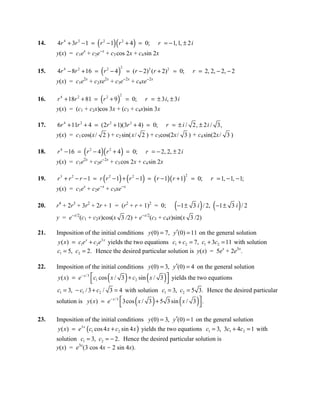
1.     r 2 − 4 = ( r − 2 )( r + 2 ) = 0;                r = − 2, 2;          y ( x ) = c1e2x + c2e-2x

2.     2r 2 − 3r = r ( 2r − 3) = 0;                   r = 0, 3 / 2;         y ( x) = c1 + c2e3x/2

3.     r 2 + 3r − 10 = ( r + 5 )( r − 2 ) = 0;                  r = − 5, 2;           y ( x) = c1e2x + c2e-5x

4.     2r 2 − 7r + 3 = ( 2r − 1)( r − 3) = 0;                       r = 1/ 2, 3;       y ( x) = c1ex/2 + c2e3x

       r 2 + 6r + 9 = ( r + 3) = 0;
                                 2
5.                                                    r = − 3, − 3;          y ( x ) = c1e-3x + c2xe-3x

6.     r 2 + 5r + 5 = 0;             (
                                r = −5 ± 5 / 2          )
       y(x) = e-5x/2[c1exp(x 5 /2) + c2exp(-x 5 /2)]

       4r 2 − 12r + 9 = ( 2r − 3) = 0;
                                     2
7.                                                          r = − 3 / 2, − 3 / 2;         y ( x) = c1e3x/2 + c2xe3x/2

8.     r 2 − 6r + 13 = 0;                (
                                r = 6 ± −16 / 2 = 3 ± 2 i;  )                          y ( x) = e3x(c1 cos 2x + c2 sin 2x)


9.     r 2 + 8r + 25 = 0;                (
                                 r = −8 ± −36 / 2 = − 4 ± 3 i;  )                         y ( x ) = e-4x(c1 cos 3x + c2 sin 3x)

10.    5r 4 + 3r 3 = r 3 (5r + 3) = 0;                  r = 0, 0, 0, − 3 / 5;          y ( x) = c1 + c2x + c3x2 + c4e-3x/5

       r 4 − 8r 3 + 16r 2 = r 2 ( r − 4 ) = 0;
                                               2
11.                                                             r = 0, 0, 4, 4;          y ( x) = c1 + c2x + c3e4x + c4xe4x

       r 4 − 3r 3 + 3r 2 − r = r ( r − 1) = 0;
                                                  3
12.                                                                 r = 0, 1, 1, 1;      y ( x) = c1 + c2ex + c3xex + c4x2ex

       9r 3 + 12r 2 + 4r = r (3r + 2 ) = 0;
                                              2
13.                                                             r = 0, − 2 / 3, − 2 / 3
                        -2x/3                -2x/3
       y(x) = c1 + c2e          + c3xe
14.                     (               )(
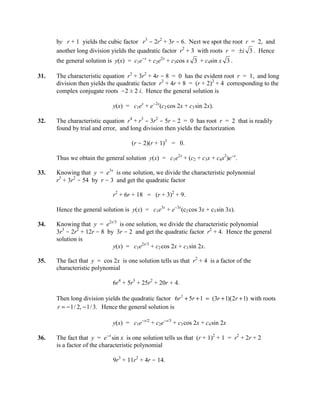
      4r 4 + 3r 2 − 1 = r 2 − 1 r 2 + 4 = 0;         )               r = − 1, 1, ± 2 i
      y(x) = c1ex + c2e-x + c3 cos 2x + c4 sin 2x

                            (            )
                                             2
15.   4r 4 − 8r 2 + 16 = r 2 − 4                  = (r − 2)2 (r + 2)2 = 0;             r = 2, 2, − 2, − 2
      y(x) = c1e2x + c2xe2x + c3e-2x + c4xe-2x

                            (            )
                                             2
16.   r 4 + 18r 2 + 81 = r 2 + 9                 = 0;        r = ± 3 i, ± 3 i
      y(x) = (c1 + c2x)cos 3x + (c3 + c4x)sin 3x

17.   6r 4 + 11r 2 + 4 = (2r 2 + 1)(3r 2 + 4) = 0;                      r = ± i / 2, ± 2 i / 3,
      y(x) = c1 cos(x/ 2 ) + c2 sin(x/ 2 ) + c3cos(2x/ 3 ) + c4 sin(2x/ 3 )

18.               (         )(
      r 4 − 16 = r 2 − 4 r 2 + 4 = 0;        )               r = − 2, 2, ± 2 i
                  2x
      y(x) = c1e + c2e-2x + c3 cos 2x + c4 sin 2x

19.                             (            ) (         )
      r 3 + r 2 − r − 1 = r r 2 − 1 + r 2 − 1 = ( r − 1)( r + 1) = 0;
                                                                                   2
                                                                                               r = 1, − 1, − 1;
                  x      -x                  -x
      y(x) = c1e + c2e + c3xe

20.   r4 + 2r3 + 3r2 + 2r + 1 = (r2 + r + 1)2 = 0;                           ( −1 ±          ) (
                                                                                       3 i / 2, −1 ± 3 i / 2)
      y = e-x/2(c1 + c2x)cos(x 3 /2) + e-x/2(c3 + c4x)sin(x 3 /2)

21.   Imposition of the initial conditions y (0) = 7, y′(0) = 11 on the general solution
       y ( x ) = c1e x + c2e3 x yields the two equations c1 + c2 = 7, c1 + 3c2 = 11 with solution
      c1 = 5, c2 = 2. Hence the desired particular solution is y(x) = 5ex + 2e3x.

22.   Imposition of the initial conditions y (0) = 3, y′(0) = 4 on the general solution

                                   (            )          (         )
      y ( x) = e − x / 3 c1 cos x / 3 + c2 sin x / 3  yields the two equations

      c1 = 3, − c1 / 3 + c2 / 3 = 4 with solution c1 = 3, c2 = 5 3. Hence the desired particular
                                                     (           )
      solution is y ( x ) = e − x / 3 3cos x / 3 + 5 3 sin x / 3  .
                                                                             (         )
23.   Imposition of the initial conditions y (0) = 3, y′(0) = 1 on the general solution
       y ( x ) = e3 x (c1 cos 4 x + c2 sin 4 x ) yields the two equations c1 = 3, 3c1 + 4c2 = 1 with
      solution c1 = 3, c2 = − 2. Hence the desired particular solution is
      y(x) = e3x(3 cos 4x - 2 sin 4x).
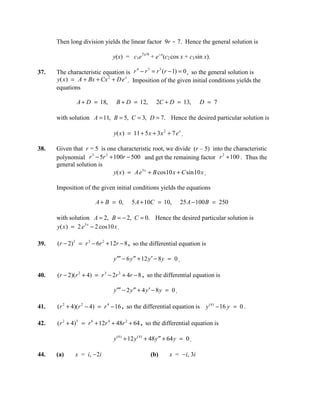
24.   Imposition of the initial conditions y (0) = 1, y ′(0) = − 1, y ′′(0) = 3 on the general
      solution y ( x ) = c1 + c2e 2 x + c3e − x / 2 yields the three equations

                      c1 + c2 + c3 = 1,      − c2 / 2 + 2c3 = − 1,    c2 / 4 + 4c3 = 3

      with solution c1 = − 7 / 2, c2 = 1/ 2, c3 = 4. Hence the desired particular solution is
      y(x) = (-7 + e2x + 8e-x/2)/2.

25.   Imposition of the initial conditions y (0) = − 1, y′(0) = 0, y′′(0) = 1 on the general
      solution y ( x) = c1 + c2 x + c3e −2 x / 3 yields the three equations

                      c1 + c3 = − 1,      c2 − 2c3 / 3 = 0,     4c3 / 9 = 1

      with solution c1 = − 13 / 4, c2 = 3 / 2, c3 = 9 / 4. Hence the desired particular solution is
      y(x) = (-13 + 6x + 9e-2x/3)/4.

26.   Imposition of the initial conditions y (0) = 1, y ′(0) = − 1, y ′′(0) = 3 on the general
      solution y ( x ) = c1 + c2e −5 x + c3 x e −5 x yields the three equations

                      c1 + c2 = 3,     − 5c2 + c3 = 4,        25c2 − 10c3 = 5

      with solution c1 = 24 / 5, c2 = − 9 / 5, c3 = − 5. Hence the desired particular solution is
      y(x) = (24 - 9e-5x - 25xe-5x)/5.

27.   First we spot the root r = 1. Then long division of the polynomial r 3 + 3r 2 − 4
      by r - 1 yields the quadratic factor r 2 + 4r + 4 = (r + 2) 2 with roots
      r = -2, -2. Hence the general solution is y(x) = c1ex + c2e-2x + c3xe-2x.

28.   First we spot the root r = 2. Then long division of the polynomial 2r3 - r2 - 5r - 2
      by the factor r - 2 yields the quadratic factor 2r2 + 3r + 1 = (2r + 1)(r + 1) with roots
      r = -1, -1/2. Hence the general solution is y(x) = c1e2x + c2e-x + c3e-x/2.

29.   First we spot the root r = –3. Then long division of the polynomial r 3 + 27 by
                                                                                (        )
      r + 3 yields the quadratic factor r 2 − 3r + 9 with roots r = 3 1 ± i 3 / 2. Hence the
                                          -3x    3x/2
      general solution is y(x) = c1e            +e      [c2cos(3x 3 /2) + c3 sin(3x 3 /2)].

30.   First we spot the root r = -1. Then long division of the polynomial

                                          r4 - r3 + r2 - 3r - 6
by r + 1 yields the cubic factor r3 - 2r2 + 3r - 6. Next we spot the root r = 2, and
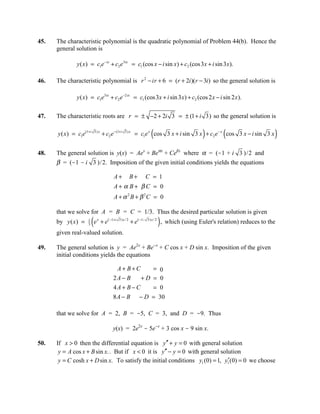
      another long division yields the quadratic factor r2 + 3 with roots r = ±i 3 . Hence
      the general solution is y(x) = c1e-x + c2e2x + c3cos x 3 + c4sin x 3 .

31.   The characteristic equation r3 + 3r2 + 4r - 8 = 0 has the evident root r = 1, and long
      division then yields the quadratic factor r2 + 4r + 8 = (r + 2)2 + 4 corresponding to the
      complex conjugate roots -2 ± 2 i. Hence the general solution is

                             y(x) = c1ex + e-2x(c2 cos 2x + c3 sin 2x).

32.   The characteristic equation r4 + r3 - 3r2 - 5r - 2 = 0 has root r = 2 that is readily
      found by trial and error, and long division then yields the factorization

                                    (r - 2)(r + 1)3 = 0.

      Thus we obtain the general solution y(x) = c1e2x + (c2 + c3x + c4x2)e-x.

33.   Knowing that y = e3x is one solution, we divide the characteristic polynomial
      r3 + 3r2 - 54 by r - 3 and get the quadratic factor

                             r2 + 6r + 18 = (r + 3)2 + 9.

      Hence the general solution is y(x) = c1e3x + e-3x(c2 cos 3x + c3 sin 3x).

34.   Knowing that y = e2x/3 is one solution, we divide the characteristic polynomial
      3r3 - 2r2 + 12r - 8 by 3r - 2 and get the quadratic factor r2 + 4. Hence the general
      solution is
                            y(x) = c1e2x/3 + c2 cos 2x + c3 sin 2x.

35.   The fact that y = cos 2x is one solution tells us that r2 + 4 is a factor of the
      characteristic polynomial

                             6r4 + 5r3 + 25r2 + 20r + 4.

      Then long division yields the quadratic factor 6r 2 + 5r + 1 = (3r + 1)(2r + 1) with roots
      r = − 1/ 2, − 1/ 3. Hence the general solution is

                             y(x) = c1e-x/2 + c2e-x/3 + c3 cos 2x + c4 sin 2x

36.   The fact that y = e-x sin x is one solution tells us that (r + 1)2 + 1 = r2 + 2r + 2
      is a factor of the characteristic polynomial

                             9r3 + 11r2 + 4r - 14.
Then long division yields the linear factor 9r - 7. Hence the general solution is

                              y(x) = c1e7x/9 + e-x(c2 cos x + c3 sin x).

      The characteristic equation is r − r = r (r − 1) = 0 , so the general solution is
                                        4   3    3
37.
      y( x ) = A + Bx + Cx 2 + D e x . Imposition of the given initial conditions yields the
      equations

              A + D = 18,       B + D = 12,          2C + D = 13,           D = 7

      with solution A = 11, B = 5, C = 3, D = 7. Hence the desired particular solution is

                              y( x ) = 11 + 5 x + 3 x 2 + 7 e x .

38.   Given that r = 5 is one characteristic root, we divide (r – 5) into the characteristic
      polynomial r − 5r + 100r − 500 and get the remaining factor r + 100 . Thus the
                     3    2                                              2

      general solution is
                            y( x ) = A e 5 x + B cos 10 x + C sin 10 x .

      Imposition of the given initial conditions yields the equations

                      A + B = 0,       5 A + 10C = 10,              25 A − 100 B = 250

      with solution A = 2, B = − 2, C = 0. Hence the desired particular solution is
      y( x ) = 2 e 5 x − 2 cos 10 x .

39.   (r − 2)3 = r 3 − 6r 2 + 12r − 8 , so the differential equation is

                              y ′′′ − 6 y ′′ + 12 y ′ − 8 y = 0 .

40.   (r − 2)(r 2 + 4) = r 3 − 2r 2 + 4r − 8 , so the differential equation is

                              y ′′′ − 2 y ′′ + 4 y ′ − 8 y = 0 .

41.   (r 2 + 4)(r 2 − 4) = r 4 − 16 , so the differential equation is y (4) − 16 y = 0 .

42.   (r 2 + 4)3 = r 6 + 12r 4 + 48r 2 + 64 , so the differential equation is

                              y ( 6 ) + 12 y ( 4 ) + 48 y ′′ + 64 y = 0 .

44.   (a)    x = i, -2i                           (b)       x = -i, 3i
45.   The characteristic polynomial is the quadratic polynomial of Problem 44(b). Hence the
      general solution is

                y ( x ) = c1e − ix + c2 e3ix = c1 (cos x − i sin x ) + c2 (cos 3x + i sin 3x ).

46.   The characteristic polynomial is r 2 − ir + 6 = (r + 2i )(r − 3i ) so the general solution is

                y ( x) = c1e3 ix + c2 e −2 ix = c1 (cos 3x + i sin 3x) + c2 (cos 2 x − i sin 2 x ).

47.   The characteristic roots are r = ± −2 + 2i 3 = ± (1 + i 3) so the general solution is

      y ( x ) = c1e(1+ i   3) x
                                   + c2 e − (1+ i   3)x
                                                                       (                        )        (
                                                            = c1e x cos 3 x + i sin 3 x + c2 e − x cos 3 x − i sin 3 x        )
48.   The general solution is y(x) = Aex + Beαx + Ceßx where α = (-1 + i 3 )/2 and
      β = (-1 - i 3 )/2. Imposition of the given initial conditions yields the equations

                                           A+             B+         C = 1
                                           A+ α B+ βC = 0
                                           A + α 2 B + β 2C = 0

      that we solve for A = B = C = 1/3. Thus the desired particular solution is given
      by y ( x ) =    1
                      3   (e   x
                                   + e( −1+ i   3)x / 2
                                                          + e( −1−   3)x/ 2
                                                                              ) , which (using Euler's relation) reduces to the
      given real-valued solution.

49.   The general solution is y = Ae2x + Be-x + C cos x + D sin x. Imposition of the given
      initial conditions yields the equations

                                             A+ B+C      = 0
                                           2A − B     +D = 0
                                           4A + B − C    = 0
                                           8 A − B − D = 30

      that we solve for A = 2, B = -5, C = 3, and D = -9. Thus

                                          y(x) = 2e2x - 5e-x + 3 cos x - 9 sin x.

50.   If x > 0 then the differential equation is y′′ + y = 0 with general solution
       y = A cos x + B sin x. . But if x < 0 it is y′′ − y = 0 with general solution
       y = C cosh x + D sin x. To satisfy the initial conditions y1 (0) = 1, y1′(0) = 0 we choose
′
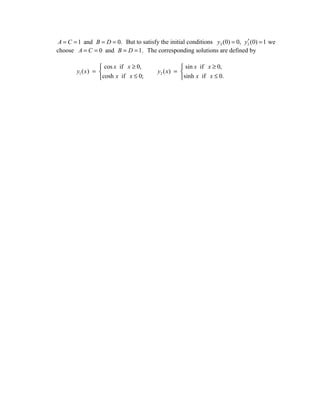
 A = C = 1 and B = D = 0. But to satisfy the initial conditions y2 (0) = 0, y2 (0) = 1 we
choose A = C = 0 and B = D = 1. The corresponding solutions are defined by

                    cos x if x ≥ 0,                 sin x if x ≥ 0,
        y1 ( x ) =                      y2 ( x ) = 
                   cosh x if x ≤ 0;                sinh x if x ≤ 0.

Sect5 3

  • 1.
    SECTION 5.3 HOMOGENEOUS EQUATIONSWITH CONSTANT COEFFICIENTS This is a purely computational section devoted to the single most widely applicable type of higher order differential equations — linear ones with constant coefficients. In Problems 1-20, we write first the characteristic equation and its list of roots, then the corresponding general solution of the given differential equation. Explanatory comments are included only when the solution of the characteristic equation is not routine. 1. r 2 − 4 = ( r − 2 )( r + 2 ) = 0; r = − 2, 2; y ( x ) = c1e2x + c2e-2x 2. 2r 2 − 3r = r ( 2r − 3) = 0; r = 0, 3 / 2; y ( x) = c1 + c2e3x/2 3. r 2 + 3r − 10 = ( r + 5 )( r − 2 ) = 0; r = − 5, 2; y ( x) = c1e2x + c2e-5x 4. 2r 2 − 7r + 3 = ( 2r − 1)( r − 3) = 0; r = 1/ 2, 3; y ( x) = c1ex/2 + c2e3x r 2 + 6r + 9 = ( r + 3) = 0; 2 5. r = − 3, − 3; y ( x ) = c1e-3x + c2xe-3x 6. r 2 + 5r + 5 = 0; ( r = −5 ± 5 / 2 ) y(x) = e-5x/2[c1exp(x 5 /2) + c2exp(-x 5 /2)] 4r 2 − 12r + 9 = ( 2r − 3) = 0; 2 7. r = − 3 / 2, − 3 / 2; y ( x) = c1e3x/2 + c2xe3x/2 8. r 2 − 6r + 13 = 0; ( r = 6 ± −16 / 2 = 3 ± 2 i; ) y ( x) = e3x(c1 cos 2x + c2 sin 2x) 9. r 2 + 8r + 25 = 0; ( r = −8 ± −36 / 2 = − 4 ± 3 i; ) y ( x ) = e-4x(c1 cos 3x + c2 sin 3x) 10. 5r 4 + 3r 3 = r 3 (5r + 3) = 0; r = 0, 0, 0, − 3 / 5; y ( x) = c1 + c2x + c3x2 + c4e-3x/5 r 4 − 8r 3 + 16r 2 = r 2 ( r − 4 ) = 0; 2 11. r = 0, 0, 4, 4; y ( x) = c1 + c2x + c3e4x + c4xe4x r 4 − 3r 3 + 3r 2 − r = r ( r − 1) = 0; 3 12. r = 0, 1, 1, 1; y ( x) = c1 + c2ex + c3xex + c4x2ex 9r 3 + 12r 2 + 4r = r (3r + 2 ) = 0; 2 13. r = 0, − 2 / 3, − 2 / 3 -2x/3 -2x/3 y(x) = c1 + c2e + c3xe
  • 2.
    14. ( )( 4r 4 + 3r 2 − 1 = r 2 − 1 r 2 + 4 = 0; ) r = − 1, 1, ± 2 i y(x) = c1ex + c2e-x + c3 cos 2x + c4 sin 2x ( ) 2 15. 4r 4 − 8r 2 + 16 = r 2 − 4 = (r − 2)2 (r + 2)2 = 0; r = 2, 2, − 2, − 2 y(x) = c1e2x + c2xe2x + c3e-2x + c4xe-2x ( ) 2 16. r 4 + 18r 2 + 81 = r 2 + 9 = 0; r = ± 3 i, ± 3 i y(x) = (c1 + c2x)cos 3x + (c3 + c4x)sin 3x 17. 6r 4 + 11r 2 + 4 = (2r 2 + 1)(3r 2 + 4) = 0; r = ± i / 2, ± 2 i / 3, y(x) = c1 cos(x/ 2 ) + c2 sin(x/ 2 ) + c3cos(2x/ 3 ) + c4 sin(2x/ 3 ) 18. ( )( r 4 − 16 = r 2 − 4 r 2 + 4 = 0; ) r = − 2, 2, ± 2 i 2x y(x) = c1e + c2e-2x + c3 cos 2x + c4 sin 2x 19. ( ) ( ) r 3 + r 2 − r − 1 = r r 2 − 1 + r 2 − 1 = ( r − 1)( r + 1) = 0; 2 r = 1, − 1, − 1; x -x -x y(x) = c1e + c2e + c3xe 20. r4 + 2r3 + 3r2 + 2r + 1 = (r2 + r + 1)2 = 0; ( −1 ± ) ( 3 i / 2, −1 ± 3 i / 2) y = e-x/2(c1 + c2x)cos(x 3 /2) + e-x/2(c3 + c4x)sin(x 3 /2) 21. Imposition of the initial conditions y (0) = 7, y′(0) = 11 on the general solution y ( x ) = c1e x + c2e3 x yields the two equations c1 + c2 = 7, c1 + 3c2 = 11 with solution c1 = 5, c2 = 2. Hence the desired particular solution is y(x) = 5ex + 2e3x. 22. Imposition of the initial conditions y (0) = 3, y′(0) = 4 on the general solution  ( )  ( ) y ( x) = e − x / 3 c1 cos x / 3 + c2 sin x / 3  yields the two equations c1 = 3, − c1 / 3 + c2 / 3 = 4 with solution c1 = 3, c2 = 5 3. Hence the desired particular ( ) solution is y ( x ) = e − x / 3 3cos x / 3 + 5 3 sin x / 3  .   ( ) 23. Imposition of the initial conditions y (0) = 3, y′(0) = 1 on the general solution y ( x ) = e3 x (c1 cos 4 x + c2 sin 4 x ) yields the two equations c1 = 3, 3c1 + 4c2 = 1 with solution c1 = 3, c2 = − 2. Hence the desired particular solution is y(x) = e3x(3 cos 4x - 2 sin 4x).
  • 3.
    24. Imposition of the initial conditions y (0) = 1, y ′(0) = − 1, y ′′(0) = 3 on the general solution y ( x ) = c1 + c2e 2 x + c3e − x / 2 yields the three equations c1 + c2 + c3 = 1, − c2 / 2 + 2c3 = − 1, c2 / 4 + 4c3 = 3 with solution c1 = − 7 / 2, c2 = 1/ 2, c3 = 4. Hence the desired particular solution is y(x) = (-7 + e2x + 8e-x/2)/2. 25. Imposition of the initial conditions y (0) = − 1, y′(0) = 0, y′′(0) = 1 on the general solution y ( x) = c1 + c2 x + c3e −2 x / 3 yields the three equations c1 + c3 = − 1, c2 − 2c3 / 3 = 0, 4c3 / 9 = 1 with solution c1 = − 13 / 4, c2 = 3 / 2, c3 = 9 / 4. Hence the desired particular solution is y(x) = (-13 + 6x + 9e-2x/3)/4. 26. Imposition of the initial conditions y (0) = 1, y ′(0) = − 1, y ′′(0) = 3 on the general solution y ( x ) = c1 + c2e −5 x + c3 x e −5 x yields the three equations c1 + c2 = 3, − 5c2 + c3 = 4, 25c2 − 10c3 = 5 with solution c1 = 24 / 5, c2 = − 9 / 5, c3 = − 5. Hence the desired particular solution is y(x) = (24 - 9e-5x - 25xe-5x)/5. 27. First we spot the root r = 1. Then long division of the polynomial r 3 + 3r 2 − 4 by r - 1 yields the quadratic factor r 2 + 4r + 4 = (r + 2) 2 with roots r = -2, -2. Hence the general solution is y(x) = c1ex + c2e-2x + c3xe-2x. 28. First we spot the root r = 2. Then long division of the polynomial 2r3 - r2 - 5r - 2 by the factor r - 2 yields the quadratic factor 2r2 + 3r + 1 = (2r + 1)(r + 1) with roots r = -1, -1/2. Hence the general solution is y(x) = c1e2x + c2e-x + c3e-x/2. 29. First we spot the root r = –3. Then long division of the polynomial r 3 + 27 by ( ) r + 3 yields the quadratic factor r 2 − 3r + 9 with roots r = 3 1 ± i 3 / 2. Hence the -3x 3x/2 general solution is y(x) = c1e +e [c2cos(3x 3 /2) + c3 sin(3x 3 /2)]. 30. First we spot the root r = -1. Then long division of the polynomial r4 - r3 + r2 - 3r - 6
  • 4.
    by r +1 yields the cubic factor r3 - 2r2 + 3r - 6. Next we spot the root r = 2, and another long division yields the quadratic factor r2 + 3 with roots r = ±i 3 . Hence the general solution is y(x) = c1e-x + c2e2x + c3cos x 3 + c4sin x 3 . 31. The characteristic equation r3 + 3r2 + 4r - 8 = 0 has the evident root r = 1, and long division then yields the quadratic factor r2 + 4r + 8 = (r + 2)2 + 4 corresponding to the complex conjugate roots -2 ± 2 i. Hence the general solution is y(x) = c1ex + e-2x(c2 cos 2x + c3 sin 2x). 32. The characteristic equation r4 + r3 - 3r2 - 5r - 2 = 0 has root r = 2 that is readily found by trial and error, and long division then yields the factorization (r - 2)(r + 1)3 = 0. Thus we obtain the general solution y(x) = c1e2x + (c2 + c3x + c4x2)e-x. 33. Knowing that y = e3x is one solution, we divide the characteristic polynomial r3 + 3r2 - 54 by r - 3 and get the quadratic factor r2 + 6r + 18 = (r + 3)2 + 9. Hence the general solution is y(x) = c1e3x + e-3x(c2 cos 3x + c3 sin 3x). 34. Knowing that y = e2x/3 is one solution, we divide the characteristic polynomial 3r3 - 2r2 + 12r - 8 by 3r - 2 and get the quadratic factor r2 + 4. Hence the general solution is y(x) = c1e2x/3 + c2 cos 2x + c3 sin 2x. 35. The fact that y = cos 2x is one solution tells us that r2 + 4 is a factor of the characteristic polynomial 6r4 + 5r3 + 25r2 + 20r + 4. Then long division yields the quadratic factor 6r 2 + 5r + 1 = (3r + 1)(2r + 1) with roots r = − 1/ 2, − 1/ 3. Hence the general solution is y(x) = c1e-x/2 + c2e-x/3 + c3 cos 2x + c4 sin 2x 36. The fact that y = e-x sin x is one solution tells us that (r + 1)2 + 1 = r2 + 2r + 2 is a factor of the characteristic polynomial 9r3 + 11r2 + 4r - 14.
  • 5.
    Then long divisionyields the linear factor 9r - 7. Hence the general solution is y(x) = c1e7x/9 + e-x(c2 cos x + c3 sin x). The characteristic equation is r − r = r (r − 1) = 0 , so the general solution is 4 3 3 37. y( x ) = A + Bx + Cx 2 + D e x . Imposition of the given initial conditions yields the equations A + D = 18, B + D = 12, 2C + D = 13, D = 7 with solution A = 11, B = 5, C = 3, D = 7. Hence the desired particular solution is y( x ) = 11 + 5 x + 3 x 2 + 7 e x . 38. Given that r = 5 is one characteristic root, we divide (r – 5) into the characteristic polynomial r − 5r + 100r − 500 and get the remaining factor r + 100 . Thus the 3 2 2 general solution is y( x ) = A e 5 x + B cos 10 x + C sin 10 x . Imposition of the given initial conditions yields the equations A + B = 0, 5 A + 10C = 10, 25 A − 100 B = 250 with solution A = 2, B = − 2, C = 0. Hence the desired particular solution is y( x ) = 2 e 5 x − 2 cos 10 x . 39. (r − 2)3 = r 3 − 6r 2 + 12r − 8 , so the differential equation is y ′′′ − 6 y ′′ + 12 y ′ − 8 y = 0 . 40. (r − 2)(r 2 + 4) = r 3 − 2r 2 + 4r − 8 , so the differential equation is y ′′′ − 2 y ′′ + 4 y ′ − 8 y = 0 . 41. (r 2 + 4)(r 2 − 4) = r 4 − 16 , so the differential equation is y (4) − 16 y = 0 . 42. (r 2 + 4)3 = r 6 + 12r 4 + 48r 2 + 64 , so the differential equation is y ( 6 ) + 12 y ( 4 ) + 48 y ′′ + 64 y = 0 . 44. (a) x = i, -2i (b) x = -i, 3i
  • 6.
    45. The characteristic polynomial is the quadratic polynomial of Problem 44(b). Hence the general solution is y ( x ) = c1e − ix + c2 e3ix = c1 (cos x − i sin x ) + c2 (cos 3x + i sin 3x ). 46. The characteristic polynomial is r 2 − ir + 6 = (r + 2i )(r − 3i ) so the general solution is y ( x) = c1e3 ix + c2 e −2 ix = c1 (cos 3x + i sin 3x) + c2 (cos 2 x − i sin 2 x ). 47. The characteristic roots are r = ± −2 + 2i 3 = ± (1 + i 3) so the general solution is y ( x ) = c1e(1+ i 3) x + c2 e − (1+ i 3)x ( ) ( = c1e x cos 3 x + i sin 3 x + c2 e − x cos 3 x − i sin 3 x ) 48. The general solution is y(x) = Aex + Beαx + Ceßx where α = (-1 + i 3 )/2 and β = (-1 - i 3 )/2. Imposition of the given initial conditions yields the equations A+ B+ C = 1 A+ α B+ βC = 0 A + α 2 B + β 2C = 0 that we solve for A = B = C = 1/3. Thus the desired particular solution is given by y ( x ) = 1 3 (e x + e( −1+ i 3)x / 2 + e( −1− 3)x/ 2 ) , which (using Euler's relation) reduces to the given real-valued solution. 49. The general solution is y = Ae2x + Be-x + C cos x + D sin x. Imposition of the given initial conditions yields the equations A+ B+C = 0 2A − B +D = 0 4A + B − C = 0 8 A − B − D = 30 that we solve for A = 2, B = -5, C = 3, and D = -9. Thus y(x) = 2e2x - 5e-x + 3 cos x - 9 sin x. 50. If x > 0 then the differential equation is y′′ + y = 0 with general solution y = A cos x + B sin x. . But if x < 0 it is y′′ − y = 0 with general solution y = C cosh x + D sin x. To satisfy the initial conditions y1 (0) = 1, y1′(0) = 0 we choose
  • 7.
    ′ A =C = 1 and B = D = 0. But to satisfy the initial conditions y2 (0) = 0, y2 (0) = 1 we choose A = C = 0 and B = D = 1. The corresponding solutions are defined by  cos x if x ≥ 0,  sin x if x ≥ 0, y1 ( x ) =  y2 ( x ) =  cosh x if x ≤ 0; sinh x if x ≤ 0.